Smart Camera Market for Security & Surveillance by Application (Public Spaces, Commercial Facilities, Residential Infrastructure), Sensor Technology, Scanning Technology, and Region (Americas, Europe, APAC) - Global Growth Driver and Industry Forecast to 2035


Smart Camera Market for Security & Surveillance Market Summary
The global Smart Camera Market for Security & Surveillance is expanding rapidly as organizations move from conventional video recording toward intelligent, connected, and automated security systems. Based on current industry estimates and rounded market assumptions, the market is valued at approximately USD 45-50 billion in 2025 and is projected to reach approximately USD 120-130 billion by 2035, representing a CAGR of around 10%-11% during the forecast period. The broader surveillance-camera market was estimated at about USD 48 billion in 2025, while smart surveillance estimates indicate continued double-digit expansion driven by AI analytics, cloud-based surveillance, and connected camera deployments.
The transition toward AI-enabled security is the primary structural change influencing the Smart Camera Market for Security & Surveillance. Modern smart cameras increasingly combine high-resolution imaging with computer vision, machine learning, edge processing, object detection, facial and vehicle recognition, anomaly detection, and automated alerts. IoT connectivity allows cameras to communicate with access-control systems, alarms, sensors, command centers, and cloud platforms, transforming cameras from passive recording devices into active security and intelligence endpoints. The growing use of AI for proactive threat detection is a particularly important market driver.
Demand is also being supported by urbanization, smart-city investments, rising security requirements, retail loss prevention, critical-infrastructure protection, transportation modernization, industrial automation, and the expansion of connected buildings. Businesses increasingly seek systems capable of monitoring large environments without requiring proportional increases in human security personnel. Consequently, automation and AI-assisted monitoring are improving operational efficiency while creating new recurring opportunities in video analytics, cloud storage, software subscriptions, and Video Surveillance as a Service (VSaaS).
Key Market Trends & Insights
North America remains a leading regional market. Strong adoption of AI-enabled security, advanced enterprise infrastructure, high spending on physical security, and demand from transportation, retail, education, healthcare, and critical infrastructure support the region. North America accounted for approximately 37% of the AI-in-video-surveillance market in 2025 in one recent industry assessment.
Asia Pacific represents the fastest-growing major opportunity. Large-scale urbanization, smart-city programs, infrastructure development, manufacturing expansion, and increasing security investment are driving camera deployments throughout China, Japan, India, South Korea, and Southeast Asia. The broader surveillance-camera market remains heavily concentrated in Asia Pacific, which held the largest regional share in several recent market assessments.
IP-based smart cameras dominate new installations. Network-connected cameras provide remote access, centralized management, higher scalability, integration with analytics software, and easier connection to cloud and IoT platforms. This makes them increasingly preferable to legacy analog surveillance systems.
AI-powered analytics are becoming a core differentiator. Computer vision enables cameras to identify people, vehicles, objects, unusual behavior, perimeter breaches, crowd patterns, and other events without requiring operators to watch every video feed continuously. AI in video surveillance is projected to expand significantly faster than the overall camera market, reflecting strong investment in intelligent analytics.
Edge AI is gaining strategic importance. Processing video locally at or near the camera can reduce latency, bandwidth requirements, and cloud-processing costs. This is particularly valuable for real-time intrusion detection, industrial safety, traffic monitoring, and environments where continuous cloud connectivity is impractical.
Cloud and VSaaS are changing purchasing models. Cloud-managed cameras allow organizations to scale deployments, manage multiple locations centrally, and access analytics remotely. Subscription models can also reduce upfront infrastructure requirements and shift spending toward recurring software and services.
Market Size & Forecast
- Base year market size: Approximately USD 45-50 billion in 2025.
- Forecast value by 2035: Approximately USD 120-130 billion.
- CAGR: Approximately 10%-11% during the forecast period.
- Growth factors: AI-based video analytics, IoT connectivity, cloud surveillance, smart-city development, rising security requirements, automation, critical-infrastructure modernization, and demand for real-time threat detection are expected to drive expansion.
Smart Camera Market for Security & Surveillance Market Top 10 key takeaway
- The global Smart Camera Market for Security & Surveillance is estimated at approximately USD 45-50 billion in 2025.
- Market value is expected to reach approximately USD 120-130 billion by 2035.
- The market is projected to expand at approximately 10%-11% CAGR through the forecast period.
- North America remains a leading market due to advanced security infrastructure and AI adoption.
- Asia Pacific is expected to record the fastest growth as smart-city and infrastructure investments accelerate.
- IP-based cameras are increasingly replacing or supplementing legacy analog systems.
- AI-based computer vision is shifting surveillance from passive recording to automated threat detection.
- Edge AI is reducing latency and bandwidth requirements for real-time security applications.
- Cloud-based VSaaS is creating scalable subscription and remote-management opportunities.
- Privacy, cybersecurity, interoperability, and responsible AI will increasingly influence purchasing decisions.
Product Insights
The Smart Camera Market for Security & Surveillance encompasses IP cameras, network cameras, dome cameras, bullet cameras, PTZ cameras, thermal cameras, multisensor cameras, panoramic cameras, cellular cameras, and specialized AI-enabled imaging systems. Among these categories, IP-based smart cameras represent the leading product segment because they provide the connectivity required for centralized management, remote monitoring, analytics integration, and IoT-enabled security architectures.
IP cameras have become particularly attractive to commercial and institutional customers because they can transmit high-resolution video over existing network infrastructure while supporting software-based analytics. Their ability to integrate with network video recorders, video-management systems, access-control platforms, cloud applications, and security operations centers makes them more flexible than traditional analog cameras. As organizations expand from single-site deployments to multi-location security networks, centralized IP architecture becomes increasingly valuable.
Dome and bullet cameras remain widely deployed because they serve different physical and environmental requirements. Dome cameras are commonly used indoors and in locations where discreet installation is desirable, while bullet cameras are suitable for visible perimeter monitoring and outdoor applications. PTZ cameras remain important for large sites because automated pan, tilt, and zoom functions allow operators or software systems to monitor wide areas using fewer devices.
Thermal and multispectral cameras represent higher-value emerging categories. Thermal cameras can provide visibility in low-light and challenging environmental conditions, making them useful for critical infrastructure, industrial sites, perimeter security, and transportation. Multisensor cameras can combine several viewing angles or sensing capabilities into a single system, improving situational awareness while reducing installation complexity.
The product landscape is increasingly being shaped by embedded AI. Cameras are no longer required to transmit every frame to a centralized server for analysis. Intelligent cameras can perform object classification, people counting, intrusion detection, vehicle identification, and anomaly analysis locally. Research on smart-camera architectures highlights the significant influence of deep learning on camera design, image processing, and power efficiency.
Technology / Component Insights (Rename based on keyword if needed)
Technology is the central competitive factor in the Smart Camera Market for Security & Surveillance. Modern systems combine CMOS image sensors, processors, AI accelerators, networking hardware, storage, microphones, illumination systems, firmware, video-management software, and analytics platforms. Improvements in image resolution and low-light performance are occurring alongside major advances in software intelligence.
Artificial intelligence and computer vision are particularly important. AI algorithms can identify objects, detect movement patterns, recognize specific events, and generate alerts automatically. Instead of relying solely on motion detection, intelligent systems can distinguish between people, vehicles, animals, and environmental movement. This reduces false alarms and allows security teams to prioritize events with greater operational relevance. AI video surveillance is projected to grow considerably faster than conventional surveillance markets, demonstrating the increasing commercial value of intelligent analytics.
IoT connectivity is expanding the role of cameras within broader security ecosystems. A smart camera can exchange information with door controllers, intrusion sensors, lighting systems, intercoms, environmental sensors, and building-management platforms. In a retail environment, for example, video analytics can be integrated with point-of-sale information and inventory systems to identify suspicious activity or operational anomalies.
Cloud computing is another major technology driver. Cloud platforms allow centralized camera administration, remote firmware management, scalable storage, cross-site analytics, and mobile access. This is especially useful for retailers, logistics companies, banks, educational networks, and enterprises managing hundreds or thousands of locations.
Automation is reducing the dependence on constant human observation. Automated alerts, scheduled monitoring, intelligent tracking, and event classification can allow security personnel to concentrate on high-priority incidents. Future systems are expected to incorporate increasingly sophisticated AI models, multimodal analytics, edge processing, privacy-preserving computation, cybersecurity monitoring, and automated incident workflows.
Application Insights
The commercial and enterprise security segment represents one of the largest application areas for smart cameras. Offices, retail stores, warehouses, financial institutions, hotels, healthcare facilities, and educational campuses are adopting intelligent cameras to improve physical security, manage access, prevent theft, and monitor operational activity. The ability to combine security monitoring with business intelligence is making smart cameras more valuable to enterprise customers.
Retail represents a particularly promising application. AI-enabled cameras can support loss prevention, queue monitoring, customer-flow analysis, shelf monitoring, and occupancy measurement. This moves camera technology beyond conventional security and creates opportunities for retailers to derive operational insights from the same infrastructure.
Government and public-sector applications are another major demand center. Smart cameras are deployed for public safety, transportation monitoring, city surveillance, critical infrastructure, and emergency response. Smart-city programs are accelerating the integration of cameras with traffic systems, public transportation networks, environmental sensors, and command centers.
Industrial applications are expanding as manufacturers adopt automation and Industry 4.0 technologies. Cameras can inspect products, monitor restricted areas, detect unsafe behavior, and provide machine-vision data for automated production. Combining cameras with robotics and AI allows manufacturers to perform quality control and safety monitoring with greater consistency.
Residential security is also becoming increasingly intelligent. Connected cameras with mobile applications, cloud storage, person detection, and automated notifications are increasingly accessible to consumers. Future growth opportunities are expected in smart buildings, logistics, autonomous transportation, airports, energy infrastructure, healthcare, and industrial safety.
Regional Insights
North America remains a leading regional market for the Smart Camera Market for Security & Surveillance, supported by strong enterprise spending, established security integrators, advanced cloud infrastructure, and early adoption of AI analytics. The United States accounts for a substantial portion of regional demand, particularly across retail, public infrastructure, healthcare, transportation, education, and commercial properties. The region's mature technology ecosystem also encourages adoption of edge AI, VSaaS, and integrated security platforms.
Europe remains a significant market, supported by demand for intelligent transportation, industrial security, retail surveillance, smart buildings, and critical-infrastructure monitoring. However, privacy and data-protection requirements play a particularly important role in product selection. Vendors increasingly need to demonstrate secure data handling, configurable retention, privacy controls, and responsible AI practices.
Asia Pacific is expected to record the fastest growth. Rapid urbanization, large infrastructure projects, smart-city initiatives, manufacturing expansion, and increasing public-safety investment are creating substantial opportunities. China remains a major production and deployment center, while Japan and South Korea emphasize high-quality imaging, automation, robotics, and advanced industrial applications. The region's leadership in the broader surveillance-camera market reinforces its long-term strategic importance.
- North America: Strong enterprise spending, AI adoption, and sophisticated security infrastructure support leadership.
- Europe: Privacy-conscious intelligent surveillance and industrial applications remain key growth areas.
- Asia Pacific: Fast urbanization, infrastructure investment, and manufacturing are accelerating deployments.
- China: Large-scale smart-city and security infrastructure programs support substantial camera demand.
- Emerging markets: Affordable IP cameras and cloud-based systems are increasing accessibility.
[Country]-Specific Market Trends
In APAC, China is expected to remain one of the largest national markets, supported by extensive urban infrastructure, transportation networks, industrial facilities, and smart-city development. The country also has a large domestic ecosystem of camera manufacturers, analytics providers, and system integrators. Japan is expected to grow at approximately 9%-11% CAGR, with demand supported by advanced manufacturing, aging-related security requirements, transportation infrastructure, robotics, and technology-intensive facilities. South Korea and India are also becoming increasingly important as smart infrastructure and digital transformation programs expand.
In North America, the United States remains the principal market and is expected to grow at approximately 9%-11% CAGR. Demand is supported by enterprise security modernization, public safety, AI video analytics, retail loss prevention, critical infrastructure, and cloud-based surveillance. Canada is expected to grow at approximately 8%-10% CAGR, with applications spanning transportation, commercial buildings, public infrastructure, and industrial facilities. Mexico is positioned for approximately 9%-11% CAGR, supported by manufacturing investment, logistics infrastructure, retail development, and security modernization.
In Europe, Germany is projected to grow at approximately 8%-10% CAGR, benefiting from industrial automation, automotive manufacturing, logistics, and smart-building deployment. France is expected to expand at approximately 8%-10% CAGR, supported by transportation, public infrastructure, retail, and security investments. Across Europe, privacy-by-design capabilities and compliance with data-protection requirements will remain important competitive factors.
Government initiatives are influential across all regions. Smart-city programs, public transportation investments, critical-infrastructure protection, industrial modernization, and urban safety initiatives can accelerate deployments. At the same time, regulatory requirements around biometric identification, personal data, cybersecurity, and AI governance are influencing how vendors design and market intelligent surveillance systems.
- China: Large infrastructure programs and domestic technology ecosystems support high-volume adoption.
- Japan: Advanced automation, robotics, transportation, and public infrastructure drive sophisticated deployments.
- United States: AI analytics, enterprise security, retail, and critical infrastructure represent major opportunities.
- Germany: Industrial automation and smart manufacturing support intelligent camera demand.
- France: Public infrastructure, transportation, retail, and smart-city programs sustain market expansion.
Key Smart Camera Market for Security & Surveillance Company Insights
The competitive landscape includes Hikvision, Dahua Technology, Axis Communications, Hanwha Vision, Bosch Security and Safety Systems, Motorola Solutions/Avigilon, Honeywell, Sony, Panasonic, and Teledyne FLIR. Competition is increasingly shifting from camera hardware specifications toward complete intelligent-security platforms incorporating AI analytics, cybersecurity, cloud management, interoperability, and specialized applications. Recent industry assessments consistently identify companies such as Hikvision, Dahua, Axis, Motorola Solutions, and Bosch among significant participants in AI-enabled video surveillance.
Hikvision and Dahua maintain broad portfolios spanning IP cameras, thermal systems, AI analytics, recorders, and software platforms. Axis Communications focuses heavily on network cameras, edge analytics, cybersecurity, and enterprise-grade integrations. Hanwha Vision is strengthening its position through AI-enabled cameras and integrated video-management solutions.
Bosch emphasizes intelligent video analytics, critical infrastructure, transportation, and enterprise security. Motorola Solutions has expanded its video-security capabilities through the Avigilon portfolio, combining cameras, analytics, access control, and command-center technologies. Sony remains important in imaging components and high-performance camera technologies, while Teledyne FLIR has a strong position in thermal and specialized sensing applications.
The competitive environment is increasingly defined by AI performance, analytics accuracy, cybersecurity, privacy controls, interoperability, and lifecycle support. Vendors that can offer open integrations and scalable software ecosystems are positioned to compete effectively for enterprise customers.
- Hikvision: Broad camera portfolios combined with AI analytics and integrated security platforms.
- Dahua Technology: Focuses on AI-enabled imaging, analytics, thermal products, and network surveillance.
- Axis Communications: Emphasizes network cameras, edge intelligence, cybersecurity, and open integration.
- Hanwha Vision: Develops AI-enabled cameras and enterprise video-management solutions.
- Motorola Solutions/Avigilon: Combines intelligent video, access control, analytics, and command-center capabilities.
Recent Developments
A major recent trend is the rapid commercialization of AI-enabled video surveillance. Computer vision, deep learning, edge AI, and cloud analytics are increasingly embedded in security platforms to support real-time object detection, anomaly recognition, vehicle identification, crowd analytics, and proactive threat detection. The AI-in-video-surveillance market is forecast to expand at a substantially faster pace than conventional surveillance, highlighting the importance of intelligent software in future camera deployments.
Another development is the growing adoption of cloud-connected and hybrid surveillance architectures. Organizations are increasingly combining local recording and edge analytics with cloud-based management and remote access. This model provides greater flexibility while allowing customers to retain local processing for latency-sensitive or privacy-sensitive applications.
Camera manufacturers are also expanding into specialized sensing. Recent market activity includes advances in 4K security-camera sensors, intelligent imaging, robotics-oriented vision, and next-generation image sensors. Such developments demonstrate how security cameras are increasingly becoming multipurpose AI-enabled sensing platforms rather than standalone recording devices.
Market Segmentation
The Smart Camera Market for Security & Surveillance can be segmented By Product into IP cameras, dome cameras, bullet cameras, PTZ cameras, thermal cameras, multisensor cameras, panoramic cameras, cellular cameras, and other specialized smart cameras. IP and network cameras represent the core of new enterprise deployments because they support connectivity, centralized management, and AI analytics.
By Technology / Component, the market includes CMOS image sensors, processors and AI accelerators, networking components, storage, illumination systems, microphones, firmware, video-management software, cloud analytics, and edge-computing technologies. AI processors and edge analytics are becoming increasingly important because they allow cameras to analyze video locally and generate immediate alerts.
By Application, the market covers commercial buildings, retail, residential security, government and public safety, transportation, industrial facilities, healthcare, education, banking and financial services, logistics, and critical infrastructure. Commercial and government applications remain major demand centers, while retail, industrial automation, and smart-city programs offer strong future growth opportunities.
By Region, the market covers North America, Europe, Asia Pacific, Latin America, and the Middle East & Africa. North America remains a leading market within the intelligent security segment, while Asia Pacific represents the fastest-growing major opportunity due to infrastructure investment, urbanization, and large-scale surveillance deployments.
- By Product: IP, dome, bullet, PTZ, thermal, multisensor, and panoramic cameras constitute the principal categories.
- By Technology: AI processors, computer vision, edge computing, IoT connectivity, and cloud analytics drive innovation.
- By Application: Commercial, government, transportation, retail, industrial, and residential security represent major demand centers.
- By Deployment: On-premises, cloud, and hybrid architectures address different security, cost, and privacy requirements.
- By Region: North America leads the intelligent segment while Asia Pacific offers the strongest growth trajectory.
Conclusion
The global Smart Camera Market for Security & Surveillance is transitioning from conventional video recording toward intelligent, connected, and increasingly autonomous security infrastructure. With an estimated market size of approximately USD 45-50 billion in 2025, the market is positioned to reach approximately USD 120-130 billion by 2035, supported by an estimated 10%-11% CAGR.
AI will remain the most important technology shaping this transition. Computer vision and deep-learning algorithms are enabling cameras to understand visual events rather than simply capture them. As AI models become more efficient, edge processing will allow greater intelligence to be embedded directly into cameras, reducing latency and improving scalability.
IoT will further increase the strategic importance of smart cameras by connecting video systems with access control, alarms, sensors, building-management platforms, transportation networks, and enterprise software. Automation will allow organizations to monitor larger environments while reducing the burden of continuous manual observation. Cloud and VSaaS models will also create recurring revenue opportunities for vendors while lowering deployment barriers for customers.
However, market expansion will depend not only on technological performance but also on trust. Cybersecurity vulnerabilities, unauthorized access, biometric privacy, data retention, AI bias, and regulatory compliance can materially affect adoption. Vendors that combine strong security architecture with transparent privacy controls and responsible AI will have an important competitive advantage.
By 2035, smart cameras are expected to function increasingly as AI-enabled IoT sensors capable of detecting events, interpreting environments, triggering automated workflows, and generating operational intelligence. For businesses, governments, infrastructure operators, and security integrators, the Smart Camera Market for Security & Surveillance therefore represents more than a hardware opportunity. It is becoming a strategic component of digital transformation, intelligent infrastructure, automation, and proactive security management.
FAQs
1. What is the market size of the Smart Camera Market for Security & Surveillance?
The global Smart Camera Market for Security & Surveillance is estimated at approximately USD 45-50 billion in 2025, based on rounded market estimates for the intelligent security-camera segment. Broader surveillance-camera research places the overall surveillance-camera market at approximately USD 48 billion in 2025.
2. What is the growth rate of the Smart Camera Market for Security & Surveillance?
The market is expected to expand at approximately 10%-11% CAGR through 2035. Growth is supported by AI analytics, cloud surveillance, IoT connectivity, smart-city investment, and increasing requirements for proactive security. Recent smart-surveillance estimates similarly indicate double-digit growth.
3. What are the key drivers of the Smart Camera Market for Security & Surveillance?
Key drivers include rising security requirements, AI-powered video analytics, IoT adoption, smart-city development, cloud-based surveillance, edge computing, industrial automation, retail loss prevention, critical-infrastructure protection, and the increasing need for real-time threat detection.
4. Which region leads the Smart Camera Market for Security & Surveillance?
North America is a leading region for AI-enabled smart surveillance because of its mature enterprise-security ecosystem, advanced cloud infrastructure, and strong adoption of AI analytics. Asia Pacific is expected to experience the fastest growth, supported by urbanization, infrastructure development, manufacturing, and smart-city investment.
5. Who are the key companies in the Smart Camera Market for Security & Surveillance?
Major companies include Hikvision, Dahua Technology, Axis Communications, Hanwha Vision, Bosch Security and Safety Systems, Motorola Solutions/Avigilon, Honeywell, Sony, Panasonic, and Teledyne FLIR. Their strategies increasingly emphasize AI analytics, edge processing, cybersecurity, cloud connectivity, interoperability, and application-specific intelligent surveillance solutions.
To speak to our analyst for a discussion on the above findings, click Speak to Analyst
 Exclusive indicates content/data unique to MarketsandMarkets and not available with any competitors.
Table of Contents
1 Introduction (Page No. - 10)
1.1 Objectives of the Study
1.2 Market Segmentation and Coverage
1.3 Stakeholders
2 Research Methodology (Page No. - 12)
2.1 Integrated Ecosystem of the Global Smart Camera for Security & Surveillance Market
2.2 Arriving at the Global Smart Camera market for Security & Surveillance Size
2.2.1 Top-Down Approach
2.2.2 Bottom-Up Approach
2.2.3 Demand Side Approach
2.2.4 Macro Indicator-Based Approach
2.3 Assumptions
3 Executive Summary (Page No. - 19)
4 Market Overview (Page No. - 21)
4.1 Introduction
4.2 Smart Camera for Security & Surveillance Market: Comparison With Smart Camera Market (Parent Market)
4.3 Market Drivers and Restraints
4.4 Key Market Dynamics
4.5 Demand Side Analysis
5 Smart Camera for Security & Surveillance Market, By Sensor Technology (Page No. - 28)
5.1 Introduction
5.2 Cmos
5.3 Ccd
5.4 Comparison With Parent Market
6 Smart Camera for Security & Surveillance Market, By Scanning Technology (Page No. - 32)
6.1 Introduction
6.2 Line Scan
6.3 Area Scan
6.4 Comparison With Parent Market
7 Smart Camera for Security & Surveillance Market, By Application (Page No. - 36)
7.1 Introduction
7.2 Public Spaces
7.3 Military & Defense
7.4 Transit Facilities
7.5 Commercial Facilities
7.6 Enterprise & Government Infrastructure
7.7 Residential Infrastructure
8 Smart Camera for Security & Surveillance Market, By Region (Page No. - 45)
8.1 Introduction
8.1.1 Americas
8.1.2 Europe
8.1.3 Asia-Pacific
8.1.4 Rest of the World
9 Competitive Landscape (Page No. - 55)
9.1 Introduction
9.1.1 Market Assessment for the Top Players
9.2 New Product Developments
9.3 Acquisitions and Other Expansions
10 Company Profiles (Page No. - 60)
(Overview, Products & Services, Strategies & Insights, Developments and MnM View)*
10.1 Bosch Security Systems, Inc.
10.2 Canon Inc.
10.3 Flir Systems, Inc.
10.4 Panasonic Corporation
10.5 Raptor Photonics Ltd.
10.6 Samsung Techwin Co., Ltd.
10.7 Sony Corporation
10.8 Watec Co., Ltd.
*Details on Overview, Products & Services, Strategies & Insights, Developments and MnM View Might Not Be Captured in Case of Unlisted Companies.
11 Appendix (Page No. - 79)
11.1 Customization Options
11.1.1 Product Portfolio Analysis
11.1.2 Country-Level Data Analysis
11.1.3 Product Comparison of Various Competitors
11.1.4 Trade Analysis
11.2 Introducing RT: Real Time Market Intelligence
11.2.1 RT Snapshots
11.3 Related Reports
List of Tables (43 Tables)
Table 1 R&D Expenditure, 2012-2013 (USD Billion)
Table 2 Smart Camera for Security & Surveillance Market: Comparison With Parent Market, 2013-2020 (USD Billion)
Table 3 Smart Camera Market for Security & Surveillance: Drivers and Restraints
Table 4 Smart Camera for Security & Surveillance Market , By Region, 2013-2020 (USD Million)
Table 5 Smart Camera Market for Security & Surveillance, By Application, 2013-2020 (USD Million)
Table 6 Smart Camera for Security & Surveillance Market , By Scanning Technology, 2014-2020 (USD Million)
Table 7 Smart Camera Market for Security & Surveillance, By Sensing Technology, 2013-2020 (USD Million)
Table 8 Smart Camera for Security & Surveillance Market : Comparison With Application Market, 2013-2020 (USD Billion)
Table 9 Smart Camera Market for Security & Surveillance, By Sensor Technology, 2013-2020 (USD Million)
Table 10 Smart Camera for Security & Surveillance Market , By Sensor Technology: Comparison With Parent Market, 2013-2020 (USD Million)
Table 11 Smart Camera for Security & Surveillance Market, By Scanning Technology, 2013-2020 (USD Million)
Table 12 Smart Camera for Security & Surveillance Market By Scanning Technology: Comparison With Parent Market, 2013-2020 (USD Million)
Table 13 Smart Camera for Security & Surveillance Market, By Application, 2013–2020 (USD Million)
Table 14 Smart Camera for Security & Surveillance Market in Public Spaces, By Region, 2013–2020 (USD Million)
Table 15 Smart Cameras for Security & Surveillance Market in Military & Defense, By Region, 2013–2020 (USD Million)
Table 16 Smart Camera for Security & Surveillance Market in Transit Facilities, By Region, 2013–2020 (USD Million)
Table 17 Smart Camera Market for Security & Surveillance in Commercial Facilities, By Region, 2013–2020 (USD Million)
Table 18 Smart Camera for Security & Surveillance Market in Enterprise & Government Infrastructure, By Region, 2013–2020 (USD Million)
Table 19 Smart Camera for Security & Surveillance Market in Residential Infrastructure, By Region, 2013–2020 (USD Million)
Table 20 Smart Camera for Security & Surveillance Market, By Region, 2013-2020 (USD Million)
Table 21 Americas Smart Camera Market for Security & Surveillance, By Country, 2014-2020 (USD Million)
Table 22 Americas Smart Camera for Security & Surveillance Market, By Application, 2013-2020 (USD Million)
Table 23 Europe Smart Camera for Security & Surveillance Market , By Country, 2013-2020 (USD Million)
Table 24 Europe Smart Camera for Security & Surveillance Market, By Application, 2013-2020 (USD Million)
Table 25 Asia-Pacific Smart Camera for Security & Surveillance Market, By Country, 2013-2020 (USD Million)
Table 26 Asia-Pacific Smart Camera Market for Security & Surveillance, By Application, 2013-2020 (USD Million)
Table 27 RoW Smart Camera for Security & Surveillance Market, By Region, 2013-2020 (USD Million)
Table 28 RoW Smart Camera for Security & Surveillance Market, By Application, 2013-2020 (USD Million)
Table 29 Smart Camera Market for Security & Surveillance: New Product Developments
Table 30 Smart Camera for Security & Surveillance Market: Acquisitions and Other Expansions
Table 31 Canon Inc.: Revenue, By Business Segment, 2011–2014 (USD Billion)
Table 32 Canon Inc.: Revenue, By Geographic Segment, 2011–2014 (USD Billion)
Table 33 Flir Systems, Inc: Revenue, By Business Segment, 2011–2014 (USD Million)
Table 34 Flir Systems, Inc: Revenue, By Geographic Segment, 2011–2014 (USD Million)
Table 35 Panasonic Corporation: Revenue, By Business Segment, 2011–2015 (USD Billion)
Table 36 Panasonic Corporation: Revenue, By Geographic Segment, 2011–2015 (USD Billion)
Table 37 Samsung Techwin Co., Ltd. : Revenue, By Business Segment, 2011–2014 (USD Million)
Table 38 Samsung Techwin Co., Ltd: Revenue, By Geographic Segment, 2011–2014 (USD Million)
Table 39 Samsung Techwin Co., Ltd.: Revenue, By Business Segment, 2011–2014 (USD Million)
Table 40 Samsung Techwin Co., Ltd.: Revenue, By Geographic Segment, 2011–2014 (USD Million)
Table 41 Sony Corporation: Sales and Operating Revenue, By Business Segments, 2011–2015 (USD Billion)
Table 42 Sony Corporation: Sales and Operating Revenue, By Business Subsegment, 2011–2015 (USD Billion)
Table 43 Sony Corporation: Sales & Operating Revenue, By Geographic Segment, 2011–2015 (USD Billion)
List of Figures (35 Figures)
Figure 1 Global Intelligence Camera for Security & Surveillance Market: Segmentation & Coverage
Figure 2 Integrated Ecosystem of the Smart Camera for Security & Surveillance Market
Figure 3 Arriving at Global Smart Camera for Security & Surveillance Market Size: Top-Down Approach
Figure 4 Arriving at Global Smart Camera Market for Security & Surveillance Size: Bottom-Up Approach
Figure 5 Global Application Market, 2014 (USD Billion)
Figure 6 R&D Expenditure, 2012 & 2013 (USD Billion)
Figure 7 Smart Camera Market for Security & Surveillance: Snapshot
Figure 8 Smart Camera for Security & Surveillance Market: Growth Aspects
Figure 9 Smart Camera Market for Security & Surveillance: Comparison With Parent Market, 2013-2020 (USD Billion)
Figure 10 Smart Camera for Security & Surveillance Market, By Geography, 2015 & 2020 (USD Million)
Figure 11 Smart Camera for Security & Surveillance Market, By Application, 2015 & 2020 (USD Million)
Figure 12 Smart Camera for Security & Surveillance Market, By Scanning Technology, 2015 & 2020 (USD Million)
Figure 13 Smart Camera Market for Security & Surveillance, By Sensor Technology, 2015 & 2020 (USD Million)
Figure 14 Demand Side Analysis, 2013-2020 (USD Billion)
Figure 15 Smart Camera for Security & Surveillance Market, By Sensor Technology, 2015 & 2020 (USD Million)
Figure 16 Smart Camera Market for Security & Surveillance, By Sensor Technology: Comparison With Parent Market, 2013-2020 (USD Million)
Figure 17 Smart Camera for Security & Surveillance Market, By Scanning Technology, 2015 & 2020 (USD Million)
Figure 18 Smart Camera Market for Security & Surveillance, By Scanning Technology: Comparison With Parent Market, 2013-2020 (USD Million)
Figure 19 Smart Camera for Security & Surveillance Market, By Application, 2015 & 2020 (USD Million)
Figure 20 Smart Camera for Security & Surveillance Market in Public Spaces, By Region, 2013-2020 (USD Million)
Figure 21 Smart Camera Market for Security & Surveillance in Military & Defense, By Region, 2013-2020 (USD Million)
Figure 22 Smart Camera for Security & Surveillance Market in Transit Facilities, By Region, 2013-2020 (USD Million)
Figure 23 Smart Camera Market for Security & Surveillance in Commercial Facilities, By Region, 2013-2020 (USD Million)
Figure 24 Smart Camera for Security & Surveillance Market in Enterprise & Government Infrastructure, By Region, 2013-2020 (USD Million)
Figure 25 Smart Camera Market for Security & Surveillance in Residential Infrastructure, By Region, 2013-2020 (USD Million)
Figure 26 Smart Camera for Security & Surveillance Market, By Region, 2014-2020 (USD Million)
Figure 27 Americas Smart Camera for Security & Surveillance Market, By Country, 2015 & 2020 (USD Million)
Figure 28 Americas Smart Camera Market for Security & Surveillance, By Application, 2015 & 2020 (USD Million)
Figure 29 Europe Smart Camera for Security & Surveillance Market, By Country, 2015 & 2020 (USD Million)
Figure 30 Europe Smart Camera Market for Security & Surveillance, By Application, 2015 & 2020 (USD Million)
Figure 31 Asia-Pacific Smart Camera for Security & Surveillance Market, By Country, 2015 & 2020 (USD Million)
Figure 32 Asia-Pacific Smart Camera Market for Security & Surveillance, By Application, 2015 & 2020 (USD Million)
Figure 33 RoW Smart Camera for Security & Surveillance Market, By Country, 2015 & 2020 (USD Million)
Figure 34 RoW Smart Camera for Security & Surveillance Market, By Application, 2015 & 2020 (USD Million)
Figure 35 Smart for Security & Surveillance Camera Market: Market Assessment for the Top Players, 2014
The global smart camera market for security & surveillance has been segmented into sensor technology and scanning technology. Both these segments individually cater to the global market. The sensor technology segment of the global smart camera for security & surveillance market has been further classified into CMOS and CCD. The scanning technology segment of the global smart camera for security & surveillance market has been segmented into line scan and area scan. Geographically, the global smart camera market for security & surveillance has been segmented into the Americas, Europe, Asia-Pacific, and rest of the world (RoW).
The key players operating in the global smart camera market for security & surveillance were identified across different regions, along with their offerings, distribution channels, and geographical presence. Moreover, the average revenue generated by these companies, which have been segmented on the basis of region, was used to arrive at the overall market size. This overall size of the global smart camera for security & surveillance market was used in the top-down approach to estimate the sizes of various subsegments via percentage splits from secondary and primary research. The entire procedure included study of annual and financial reports of the top market players and interviews of the industry experts, such as CEOs, vice presidents, directors, and marketing executives to obtain key insights regarding the global smart camera market for security & surveillance.
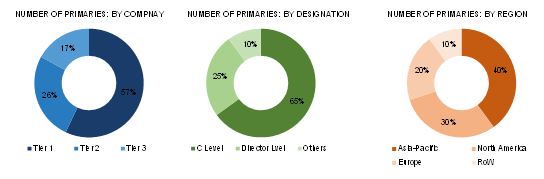
To know about the assumptions considered for the study, download the pdf brochure
This report provides valuable insights regarding ecosystem of the global smart camera market for security & surveillance comprising product manufacturers and suppliers, original equipment manufacturers (OEMs), system integrators, middleware and firmware providers, suppliers and distributors, technology providers, service providers, and manufacturers of electronic devices. This study answers several questions of the stakeholders, primarily, by providing insights on the market segments that need to be focused during the next two to five years for prioritizing efforts and investments.
Target Audience
- Original Equipment Manufacturers (OEMs)
- ODM and OEM Technology Solution Providers
- Suppliers and Distributors
- Research Organizations and Institutes
- Market Research and Consulting Firms
- Technology Standards Organizations, Forums, Alliances, and Associations
- Technology Investors
- Analysts and Strategic Business Planners
- End Users
- Government and Other Regulatory Bodies
Scope of the global smart camera for security & surveillance market:
Global Smart Camera for Security & Surveillance Market, By Application:
- Public Spaces
- Military & Defense
- Transit Facilities
- Commercial Facilities
- Enterprise & Government Infrastructure
- Residential Infrastructure
Global Smart Camera for Security & Surveillance Market, By Sensor Technology
- CMOS
- CCD
Global Smart Camera for Security & Surveillance Market, By Scanning Technology
- Area Scan
- Line Scan
Global Smart Camera for Security & Surveillance Market, By Region
- Americas
- Europe
- Asia-Pacific
- RoW
Available Customizations:
Along with the market data, MarketsandMarkets also offers customizations to meet specific needs of the clients. The following customization options are available for this report:
Regional Analysis
- Further breakdown of region/country-specific analysis
Company Information
- Detailed analysis and profiling of additional market players (Up to five)













Growth opportunities and latent adjacency in Smart Camera Market