Smart Pneumatics Market by Component (Hardware, Software, and Services), Type (Valves, Actuators, and Modules), Industries (Automotive, Semiconductor, Food & Beverage, Water & Wastewater, Oil & Gas), and Geography - Global Growth Driver and Industry Forecast to 2035


Smart Pneumatics Market Summary
The global Smart Pneumatics Market is entering a strong growth phase as manufacturers increasingly shift from conventional pneumatic systems toward connected, sensor-enabled, and data-driven automation solutions. The market is estimated at approximately USD 3.5–4.0 billion in 2025 and is projected to reach around USD 6.5–7.5 billion by 2035, registering a CAGR of approximately 6–8% during the forecast period. Rising adoption of Industry 4.0, industrial IoT (IIoT), predictive maintenance, and automated production processes is creating sustained demand for smart pneumatic components that can monitor pressure, flow, temperature, position, and operating conditions in real time. Integration with PLCs, industrial networks, cloud platforms, edge computing, and AI-based analytics is further expanding the role of pneumatics from basic actuation to intelligent process optimization. Automotive, food & beverage, packaging, electronics, pharmaceuticals, and logistics industries are increasingly adopting Smart Pneumatics Market solutions to improve machine availability, reduce compressed-air consumption, enhance productivity, and support digital transformation initiatives.
Key Market Trends & Insights
The Smart Pneumatics Market is being shaped by several important technological and industrial trends. North America remains a leading regional market because of its mature industrial automation ecosystem, strong investment in connected manufacturing, and high adoption of advanced control systems. Asia Pacific is expected to register the fastest growth through 2035, supported by expanding manufacturing capacity, industrial modernization, and increasing investments in factory automation in China, Japan, South Korea, and other emerging economies.
Connected pneumatic systems equipped with sensors and communication interfaces are becoming increasingly important as manufacturers seek greater visibility into machine performance. Energy-efficient pneumatic products are another major trend because compressed-air systems can account for a significant portion of industrial energy consumption. Manufacturers are therefore combining pressure monitoring, leak detection, variable control, and intelligent diagnostics to reduce energy waste.
AI and machine learning are also beginning to influence pneumatic automation. By analyzing historical pressure, flow, cycle-time, and vibration data, intelligent systems can identify abnormal operating conditions and support predictive maintenance. Edge computing is expected to gain traction because it allows machine-level analysis with lower latency, while cloud connectivity enables centralized monitoring across multiple production facilities.
The shift toward modular automation is another important trend. Smart valves, intelligent actuators, sensors, and controllers can increasingly communicate through industrial Ethernet and other digital protocols, allowing pneumatic subsystems to integrate more effectively with broader factory automation architectures.
Market Size & Forecast
- Base year market size: Approximately USD 3.5–4.0 billion in 2025
- Forecast value by 2035: Approximately USD 6.5–7.5 billion
- CAGR: Approximately 6–8% during 2025–2035
- Primary growth factors: Industry 4.0 adoption, IIoT connectivity, factory automation, energy-efficiency requirements, predictive maintenance, and demand for real-time equipment monitoring
Smart Pneumatics Market Top 10 key takeaway
- The Smart Pneumatics Market is projected to expand steadily through 2035 as industrial automation accelerates.
- Connected pneumatic components are replacing conventional components in digitally enabled production environments.
- North America represents a major market because of its mature automation and IIoT infrastructure.
- Asia Pacific is expected to record the fastest growth during the forecast period.
- Smart valves and sensor-integrated pneumatic systems are gaining significant commercial traction.
- Predictive maintenance is emerging as a major value proposition for smart pneumatic solutions.
- Automotive and manufacturing applications remain important contributors to market demand.
- Energy-efficient pneumatic technologies are gaining importance as manufacturers seek to reduce operating costs.
- AI, edge computing, and cloud connectivity are expanding the functionality of pneumatic systems.
- Integration with industrial communication networks will remain central to the future of smart pneumatic automation.
Product Insights
The Smart Pneumatics Market can be broadly characterized by smart valves, smart actuators, intelligent air preparation equipment, sensors, controllers, and associated connectivity solutions. Among these categories, smart valves and sensor-integrated pneumatic components are expected to maintain a leading position because valves represent a critical control point within pneumatic automation systems. Adding embedded sensors and communication capabilities enables manufacturers to monitor pressure, flow, switching cycles, temperature, and operating status without requiring extensive external instrumentation.
Smart pneumatic valves are increasingly being designed with diagnostic capabilities that can communicate information to programmable logic controllers and industrial automation platforms. This allows operators to identify deviations in operating conditions before they result in equipment failure. The ability to capture real-time data also supports production optimization and condition-based maintenance.
Smart actuators are another important product category. Traditional pneumatic cylinders provide reliable linear motion, but intelligent actuators can combine position sensing and performance monitoring with digital connectivity. This capability is particularly useful in applications requiring repeatable motion, high-speed operation, and continuous process monitoring.
Intelligent air preparation systems are also gaining attention. These systems monitor pressure and air quality while helping manufacturers identify excessive consumption, pressure drops, and leakage. As energy efficiency becomes a greater priority, demand for digitally monitored air preparation equipment is expected to increase.
Future product development is likely to focus on compact sensor integration, wireless connectivity, edge intelligence, and lower power consumption. Manufacturers are also expected to develop modular smart pneumatic platforms that can be easily retrofitted into existing machinery, reducing the cost and complexity of digital transformation.
Technology / Component Insights (Rename based on keyword if needed)
Technology development is central to the evolution of the Smart Pneumatics Market. Conventional pneumatic systems are increasingly being equipped with pressure sensors, flow sensors, position sensors, temperature sensors, and electronic control units. These components transform pneumatic equipment into data-generating assets capable of providing continuous information about machine performance.
Industrial IoT is one of the strongest technology drivers. IIoT connectivity allows pneumatic components to exchange information with PLCs, supervisory control systems, manufacturing execution systems, and cloud platforms. Industrial Ethernet technologies and protocols such as PROFINET, EtherNet/IP, IO-Link, and OPC UA enable more efficient data exchange between field devices and higher-level automation systems.
IO-Link is particularly relevant because it enables intelligent communication between sensors and control systems while simplifying device configuration and diagnostics. Smart pneumatic systems can use this connectivity to transmit operational data and identify component degradation.
AI and machine learning are expected to create another layer of intelligence. AI algorithms can analyze pressure patterns, actuator cycle times, valve behavior, and energy consumption to identify unusual conditions. Instead of relying only on fixed maintenance schedules, manufacturers can use these insights to determine when components are likely to require servicing.
Cloud platforms can aggregate pneumatic performance data from multiple machines and production sites. However, edge computing is increasingly important for applications where real-time decision-making is required. Edge devices can process data close to the equipment, reducing latency and limiting the amount of information that needs to be transferred to cloud infrastructure.
Future technology development will also focus on cybersecurity, wireless connectivity, digital twins, and interoperability. As pneumatic systems become increasingly connected, manufacturers will require secure architectures that protect production data while maintaining reliable communication between components.
Application Insights
Manufacturing remains one of the most important application areas for the Smart Pneumatics Market because pneumatic systems are extensively used for gripping, clamping, lifting, sorting, positioning, packaging, and material handling. Automotive manufacturing is a particularly important application because production lines rely heavily on automated pneumatic equipment for repetitive and high-speed operations.
The automotive sector is increasingly adopting connected pneumatic solutions as factories become more automated and data-driven. Smart components can provide information about actuator cycles, pressure conditions, and equipment health, helping manufacturers minimize unexpected downtime.
Food and beverage processing is another significant application. Pneumatic systems are widely used because they can provide reliable motion in environments where cleanliness and controlled operation are important. Smart monitoring enables operators to maintain equipment performance while supporting preventive maintenance.
Packaging is expected to remain a strong growth application because high-speed packaging lines require accurate and reliable pneumatic motion. Intelligent pneumatic systems can monitor cycle times and operating conditions, helping manufacturers optimize production and identify early signs of component deterioration.
Pharmaceutical and electronics manufacturing also present opportunities. These industries increasingly require precision, repeatability, and controlled operating conditions. Smart pneumatic systems can provide the monitoring and diagnostic capabilities needed for increasingly automated production environments.
Warehousing and logistics automation represents another emerging opportunity. Automated sorting, picking, conveying, and handling systems increasingly rely on connected pneumatic components. As smart factories and automated warehouses expand, demand for intelligent pneumatic solutions is expected to rise accordingly.
Regional Insights
North America is expected to maintain a leading position in the Smart Pneumatics Market because of its established manufacturing base, advanced industrial automation infrastructure, and widespread adoption of IIoT technologies. The US market benefits from continued investments in factory modernization, robotics, digital manufacturing, and predictive maintenance. Manufacturers are increasingly integrating smart pneumatic systems with existing automation platforms to improve equipment visibility and operational efficiency.
Europe represents another important market, supported by its strong industrial automation ecosystem and emphasis on energy efficiency. Germany, in particular, remains a major contributor because of its automotive, machinery, electronics, and industrial manufacturing industries. European manufacturers are increasingly focused on reducing energy consumption and improving machine efficiency, creating favorable conditions for smart pneumatic technologies.
Asia Pacific is projected to be the fastest-growing regional market through 2035. China, Japan, and other Asian economies are investing heavily in automated manufacturing, robotics, electronics production, and smart factories. Increasing labor costs, growing demand for production efficiency, and government-backed industrial modernization initiatives are encouraging manufacturers to adopt connected automation solutions.
- North America benefits from advanced industrial automation and IIoT adoption.
- Europe is driven by energy efficiency, Industry 4.0, and industrial modernization.
- Asia Pacific is expected to register the fastest market growth.
- China and Japan remain major centers for smart manufacturing investment.
- Smart factory development is increasing demand for connected pneumatic components.
Country-Specific Market Trends
China is expected to record a CAGR of approximately 8–10% in the Smart Pneumatics Market through 2035, supported by large-scale investments in manufacturing automation, robotics, electronics, automotive production, and smart factories. Government initiatives supporting industrial digitalization are encouraging manufacturers to modernize production infrastructure and adopt connected components.
Japan is expected to grow at approximately 6–8%, supported by its sophisticated robotics and factory automation ecosystem. Demand is particularly strong for precision pneumatic equipment used in electronics, automotive, semiconductor, and machinery manufacturing. Japanese manufacturers are also emphasizing energy efficiency and predictive maintenance.
In North America, the United States is expected to grow at approximately 6–8%, supported by investments in reshoring, advanced manufacturing, robotics, and digital factory infrastructure. Canada is projected to grow at around 5–7%, with adoption concentrated in automotive, food processing, machinery, and logistics. Mexico could record growth of approximately 7–9% as manufacturing investments and nearshoring activities increase demand for automated production equipment.
Germany is expected to register approximately 6–8% growth, supported by Industry 4.0 adoption and its large automotive and machinery manufacturing base. France is expected to grow at approximately 5–7%, driven by factory modernization, automation investments, and energy-efficiency initiatives.
- China is emerging as a major growth engine for smart pneumatic automation.
- Japan emphasizes precision, robotics, and intelligent manufacturing.
- US demand is supported by advanced manufacturing and factory modernization.
- Mexico benefits from manufacturing expansion and nearshoring.
- Germany and France are strengthening adoption through digitalization and energy efficiency.
Key Smart Pneumatics Market Company Insights
The Smart Pneumatics Market is characterized by the presence of established industrial automation and pneumatic technology companies. Key participants include SMC Corporation, Festo, Emerson, Parker Hannifin, IMI, Bosch Rexroth, CKD Corporation, Aventics, Norgren, and Airtac International. These companies are focusing on combining pneumatic expertise with sensors, digital communication, diagnostics, and intelligent control capabilities.
SMC and Festo are investing in smart pneumatic components and digital automation platforms that enable real-time monitoring and system integration. Emerson and Parker Hannifin are leveraging broader automation and industrial technology portfolios to support connected pneumatic applications. Bosch Rexroth is emphasizing integrated automation architectures in which pneumatic technologies can operate alongside electric drives, robotics, and digital control platforms.
Companies are increasingly developing products that support IO-Link and industrial communication protocols. AI-enabled diagnostics, cloud-based monitoring, energy analytics, and predictive maintenance are becoming important areas of product differentiation. Vendors are also focusing on retrofit solutions because many industrial facilities continue to operate legacy pneumatic infrastructure.
- Leading companies are integrating sensors and digital connectivity into pneumatic products.
- Energy monitoring is becoming an important product differentiator.
- AI-enabled diagnostics are supporting predictive maintenance strategies.
- Industrial communication compatibility is expanding product interoperability.
- Retrofit solutions are creating opportunities in legacy manufacturing facilities.
Recent Developments
The Smart Pneumatics Market is experiencing continued product development focused on connectivity, diagnostics, and energy efficiency. Leading pneumatic manufacturers have expanded smart valve and actuator portfolios with integrated sensors and IO-Link communication capabilities, enabling real-time monitoring of equipment conditions.
Industrial automation companies are also introducing digital platforms capable of collecting pneumatic system data and presenting actionable information through dashboards. These platforms support predictive maintenance by tracking pressure, flow, cycle counts, and component health.
Strategic collaborations between pneumatic technology providers and industrial automation or software companies are also increasing. Such partnerships are designed to combine pneumatic hardware with cloud analytics, edge computing, AI-based monitoring, and broader factory automation platforms.
Market Segmentation
The Smart Pneumatics Market is segmented by product, technology/component, application, and region. By product, the market includes smart valves, smart actuators, intelligent air preparation systems, sensors, controllers, and other connected pneumatic components. Smart valves and sensor-enabled products are expected to maintain strong demand because they provide the control and monitoring capabilities required for connected pneumatic systems.
By technology/component, the market encompasses sensors, embedded electronics, communication interfaces, controllers, connectivity platforms, and software. IIoT connectivity, IO-Link, industrial Ethernet, edge computing, and cloud analytics are increasingly important in enabling intelligent operation. By application, the market spans automotive, food & beverage, packaging, pharmaceuticals, electronics, chemicals, logistics, and general manufacturing. Automotive and industrial manufacturing remain major demand centers, while logistics automation and electronics manufacturing offer significant future opportunities.
Regionally, the market is divided into North America, Europe, Asia Pacific, and the Rest of the World. Asia Pacific is expected to demonstrate the strongest growth, while North America and Europe remain important markets because of their advanced automation infrastructure.
- Smart valves and intelligent actuators are key product categories.
- Sensors and communication interfaces form the foundation of smart pneumatic systems.
- Automotive and manufacturing remain leading applications.
- Logistics, electronics, and packaging offer strong future opportunities.
- Asia Pacific is expected to demonstrate the highest growth rate through 2035.
Conclusion
The Smart Pneumatics Market is expected to expand steadily through 2035 as industrial organizations transition from conventional pneumatic equipment toward connected, intelligent, and energy-efficient automation systems. The combination of IIoT, AI, edge computing, cloud analytics, and industrial communication technologies is transforming pneumatic components into data-generating assets that can contribute directly to production optimization and predictive maintenance.
AI will increasingly enable manufacturers to analyze pneumatic operating data and detect abnormal patterns before failures occur. IoT connectivity will provide real-time visibility into equipment performance, while automation platforms will enable seamless coordination between pneumatic systems, robots, sensors, and other production assets. Energy optimization will remain another important priority as manufacturers seek to reduce compressed-air waste and lower overall operating costs.
Through 2035, businesses that adopt Smart Pneumatics Market solutions will increasingly view pneumatic equipment as part of a broader digital manufacturing architecture rather than as isolated mechanical components. Suppliers capable of combining reliable pneumatic performance with connectivity, cybersecurity, analytics, and intelligent diagnostics will be well positioned to capture emerging opportunities. As smart factories continue to expand, smart pneumatics will become an increasingly strategic technology for improving productivity, machine availability, energy efficiency, and long-term manufacturing competitiveness.
FAQs
1. What is the estimated size of the Smart Pneumatics Market?
The Smart Pneumatics Market is estimated at approximately USD 3.5–4.0 billion in 2025 and is projected to reach around USD 6.5–7.5 billion by 2035.
2. What is the expected growth rate of the Smart Pneumatics Market?
The market is projected to grow at a CAGR of approximately 6–8% during 2025–2035, supported by industrial automation, IIoT, predictive maintenance, and energy-efficiency initiatives.
3. What are the key drivers of the Smart Pneumatics Market?
Major drivers include Industry 4.0 adoption, connected manufacturing, demand for predictive maintenance, increasing factory automation, compressed-air energy optimization, and integration of AI and IoT technologies.
4. Which region is expected to lead the Smart Pneumatics Market?
North America is expected to remain a leading regional market, while Asia Pacific is projected to register the fastest growth through 2035 because of expanding manufacturing automation and smart factory investments.
5. Who are the key companies in the Smart Pneumatics Market?
Major companies include SMC Corporation, Festo, Emerson, Parker Hannifin, IMI, Bosch Rexroth, CKD Corporation, Norgren, Aventics, and Airtac International.
To speak to our analyst for a discussion on the above findings, click Speak to Analyst
 Exclusive indicates content/data unique to MarketsandMarkets and not available with any competitors.
Table of Contents
1 Introduction (Page No. - 14)
1.1 Study Objectives
1.2 Definition
1.3 Study Scope
1.3.1 Geographic Scope
1.3.2 Years Considered
1.4 Currency
1.5 Limitations
1.6 Stakeholders
2 Research Methodology (Page No. - 18)
2.1 Research Data
2.2 Secondary and Primary Research
2.2.1 Secondary Data
2.2.1.1 Secondary Sources
2.2.2 Primary Data
2.2.2.1 Primary Sources
2.2.2.2 Key Industry Insights
2.2.2.3 Breakdown of Primaries
2.3 Market Size Estimation
2.3.1 Bottom-Up Approach
2.3.2 Top-Down Approach
2.4 Data Triangulation
2.5 Research Assumptions
3 Executive Summary (Page No. - 27)
4 Premium Insights (Page No. - 33)
4.1 Attractive Growth Opportunities in Smart Pneumatics Market
4.2 Market, By Type
4.3 Market in North America, By Country and Industry
4.4 Market, By Industry
4.5 Market, By Country, 2018
5 Market Overview (Page No. - 36)
5.1 Introduction
5.2 Market Dynamics
5.2.1 Drivers
5.2.1.1 Growing Awareness Toward Predictive Maintenance
5.2.1.2 Penetration of Digitization and IIoT
5.2.1.3 Demand for Smart Pneumatics Due to Remote Monitoring Capabilities
5.2.1.4 Need for Wireless Infrastructure to Maintain/Monitor Equipment in Plants
5.2.1.5 Stringent Environmental and Safety Regulations in Energy Industry
5.2.2 Restraints
5.2.2.1 High Initial Investments in Valve Projects
5.2.2.2 Lack of Common Platform for Zigbee, Profibus, and Ethernet
5.2.2.3 Lack of Standardized Certifications and Government Policies
5.2.3 Opportunities
5.2.3.1 Technological Innovations With Improved Capabilities
5.2.3.2 Advent of Artificial Intelligence and Machine Learning
5.2.4 Challenges
5.2.4.1 High Cost of Fabrication
5.2.4.2 Duplication of Technology
5.2.4.3 Increasing Security Risks Associated With Cloud Platform
5.3 Value Chain Analysis
6 Smart Pneumatics Market, By Component (Page No. - 42)
6.1 Introduction
6.2 Hardware
6.2.1 Sensor
6.2.2 Communications Technology
6.3 Software and Services
6.3.1 Software
6.3.1.1 Data Integration
6.3.1.2 Diagnostic Reporting
6.3.1.3 Parameter Calculation
6.3.2 Services
7 Smart Pneumatics Market, By Type (Page No. - 47)
7.1 Introduction
7.2 Smart Pneumatic Valves
7.2.1 With IIoT Trending, Pneumatic Valves Have Emerged as the Center of the Smart Movement
7.3 Smart Pneumatic Actuators
7.3.1 Smart Pneumatic Actuators are Expected to Grow at A Significant Rate During the Forcast Period
7.4 Smart Pneumatic Modules
7.4.1 Smart Pneumatic Modules Facilitate Predictive Maintenance
8 Smart Pneumatics Market, By Industry (Page No. - 53)
8.1 Introduction
8.2 Oil & Gas
8.2.1 Smart Pneumatic Solutions are Mostly Employed in Downstream Operations
8.3 Energy & Power
8.3.1 APAC Held the Largest Share of the Market for the Energy & Power Industry in 2017
8.4 Water & Wastewater
8.4.1 Proper Operation and Maintenance of Pneumatic Systems Contribute to the Smooth Operation of Water/Wastewater Facilities.
8.5 Automotive
8.5.1 Smart Pneumatic Systems Play A Crucial Role in Ensuring Efficient, Continuous Manufacturing Processes.
8.6 Semiconductor
8.6.1 New Technologies, Such as IoT, and Advanced Analytics, Have Boosted the Sales of Semiconductor and Electronic Devices
8.7 Food & Beverages
8.7.1 Food and Beverages Industry to Hold A Significant Market for Smart Pneumatic Systems
8.8 Others
8.8.1 Metal and Mining
8.8.1.1 Increasing Complexity of Machinery and the Growing Demand for Greater Productivity, has Led to the Adoption of Smart Pneumatic Systems
8.8.2 Chemicals
8.8.2.1 Smart Pneumatics is Used to Monitor the Chemical Processes in A Plant
8.8.3 Pharmaceuticals
8.8.3.1 The Use of Smart Pneumatics has Helped Pharmaceutical Companies in Eliminating Process Constraints
9 Geographic Analysis (Page No. - 69)
9.1 Introduction
9.2 North America
9.2.1 US
9.2.1.1 Accounted for the Largest Share for Smart Pneumatic Market in North America
9.2.2 Canada
9.2.2.1 Canada is Promoting the Adoption of New Manufacturing Technologies and Processes Related to Automation
9.2.3 Mexico
9.2.3.1 Low Cost Labor and Necessary Infrastructure Boost the Growth of Smart Pneumatic Market
9.3 Europe
9.3.1 Germany
9.3.1.1 Germany Held the Largest Share of the Market in Europe
9.3.2 UK
9.3.2.1 Growth in the Industrial Automation Market in the UK, to Provide Potential Growth Opportunities for the Market
9.3.3 France
9.3.3.1 Manufacturers in France are Adopting Smart Factory Initiatives to Automate Their Manufacturing Processes and Enhance Competitiveness
9.3.4 Rest of Europe
9.3.4.1 Manufacturers in France are Adopting Smart Factory Initiatives to Automate Their Manufacturing Processes and Enhance Competitiveness
9.4 APAC
9.4.1 China
9.4.1.1 China Holds Immense Potential for the Growth of the Smart Pneumatics Market
9.4.2 Japan
9.4.2.1 Japan’s Significant Advancements in Technology has Increased FDI Inflow in Its Industrial Sector
9.4.3 India
9.4.3.1 India Presents Huge Growth Opportunities for the IIoT Market Given Its Large-Scale Industrial Development
9.4.4 Rest of APAC
9.4.4.1 Availability of Labor at Considerably Lower Rates Than in Other Regions and the Growing Number of Production-Based Companies are the Key Factors Driving the Growth of the Market
9.5 RoW
9.5.1 Middle East
9.5.1.1 Increasing Demand From the Oil & Gas Vertical and Numerous Smart Cities Initiatives Have Boosted the Adoption of IoT in the Middle East
9.5.2 South America
9.5.2.1 Industries in South America are Also Focusing on Smart Manufacturing to Produce High-Quality End Products
9.5.3 Africa
9.5.3.1 Increasing Investments in Infrastructure Development and Wider Adoption of Advanced Technologies Would Create Growth Avenues for the Market in the Near Future
10 Competitive Landscape (Page No. - 87)
10.1 Overview
10.2 Ranking Analysis, 2017
10.3 Competitive Situations and Trends
10.3.1 Product Launches and Developments
10.3.2 Acquisition, Collaborations, and Partnerships
10.3.3 Contracts, and Expansions
11 Company Profiles (Page No. - 91)
11.1 Key Players
(Overview, Products Offered, Recent Developments, SWOT Analysis, and MnM View)*
11.1.1 Emerson Electric
11.1.2 Festo
11.1.3 Parker Hannifin
11.1.4 Bimba Manufcatruing
11.1.5 Rotork
11.1.6 Mesto
11.1.7 Thomson Industries
*Overview, Products Offered, Recent Developments, SWOT Analysis, and MnM View Might Not Be Captured in Case of Unlisted Companies.
12 Appendix (Page No. - 108)
12.1 Insights of Industry Experts
12.2 Discussion Guide
12.3 Knowledge Store: Marketsandmarkets’ Subscription Portal
12.4 Available Customizations
12.5 Related Reports
12.6 Author Details
List of Tables (30 Tables)
Table 1 Smart Pneumatics Market, By Type, 2016–2023 (USD Million)
Table 2 Market, By Type, 2016–2023 (USD Million)
Table 3 Smart Pneumatic Valve Market, By Industry, 2016–2023 (USD Million)
Table 4 Smart Pneumatic Actuators Market, By Industry, 2016–2023 (USD Million)
Table 5 Smart Pneumatic Modules Market, By Industry, 2016–2023 (USD Million)
Table 6 Market, By Industry, 2016–2023 (USD Million)
Table 7 Market for Oil & Gas, By Type, 2016–2023 (USD Million)
Table 8 Market for Oil & Gas, By Region, 2016–2023 (USD Million)
Table 9 Market for Energy & Power, By Type, 2016–2023 (USD Million)
Table 10 Market for Energy & Power, By Region, 2016–2023 (USD Million)
Table 11 Market for Water & Wastewater, By Type, 2016–2023 (USD Million)
Table 12 Market for Water & Wastewater, By Region, 2016–2023 (USD Million)
Table 13 Market for Automotive, By Type, 2016–2023 (USD Million)
Table 14 Market for Automotive, By Region, 2016–2023 (USD Million)
Table 15 Market for Semiconductor, By Type, 2016–2023 (USD Million)
Table 16 Market for Semiconductor, By Region, 2016–2023 (USD Million)
Table 17 Market for Food & Beverages, By Type, 2016–2023 (USD Million)
Table 18 Market for Food & Beverages, By Region, 2016–2023 (USD Million)
Table 19 Market for Others, By Type, 2016–2023 (USD Million)
Table 20 Market for Others, By Region, 2016–2023 (USD Million)
Table 21 Market, By Region, 2016–2023 (USD Million)
Table 22 Market in North America, By Country, 2016–2023 (USD Million)
Table 23 Market in North America, By Industry, 2016–2023 (USD Million)
Table 24 Market in Europe, By Country, 2016–2023 (USD Million)
Table 25 Market in Europe, By Industry, 2016–2023 (USD Million)
Table 26 Market in APAC, By Country, 2016–2023 (USD Million)
Table 27 Market in APAC, By Industry, 2016–2023 (USD Million)
Table 28 Market in RoW, By Region, 2016–2023 (USD Million)
Table 29 Market in South America, By Country, 2016–2023 (USD Million)
Table 30 Smart Pneumatics Market in RoW, By Industry, 2016–2023 (USD Million)
List of Figures (38 Figures)
Figure 1 Research Design
Figure 2 Bottom-Up Approach
Figure 3 Top-Down Approach
Figure 4 Data Triangulation
Figure 5 Smart Pneumatics Market, in Terms of Value, 2016–2023
Figure 6 Snapshot of Market: Smart Pneumatic Valves to Hold Larger Market Size in 2018
Figure 7 Hardware Component to Dominate the Market During Forecast Period, in Terms of Size
Figure 8 Market for Automotive Applications to Grow at Highest CAGR During Forecast Period
Figure 9 APAC to Hold Largest Share of Market in 2018
Figure 10 Rise in Adoption of IIoT to Creat Attractive Growth Opportunities for Market Players
Figure 11 Smart Pneumatic Actuators Market to Grow at Highest CAGR During Forecast Period
Figure 12 US to Hold Largest Share of Market in North America By 2023
Figure 13 Automotive Industry to Dominate Market During 2018–2023
Figure 14 APAC Expected to Witness the Highest Growth Rate During the Forecast Period
Figure 15 Inherent Advantages Drive Market
Figure 16 Market: Major Value Added By Manufacturers and Component Providers
Figure 17 Smart Pneumatic Market, By Type
Figure 18 Market for Software and Services to Grow at Highest CAGR From 2018 to 2023
Figure 19 Smart Pneumatic Market, By Type, 2017
Figure 20 Market for Smart Pneumatic Actuators to Grow at Highest CAGR From 2018 to 2023
Figure 21 Automotive to Dominate Smart Pneumatic Actuators Market By 2023
Figure 22 Smart Pneumatic Market, By Industry
Figure 23 Market for Automotive Expected to Grow at Highest CAGR From 2018 to 2023
Figure 24 APAC to Hold Largest Share of Market for Energy & Power During Forecast Period
Figure 25 Smart Pneumatic Modules Market for Automotive Industry to Grow at Highest CAGR During Forecast Period
Figure 26 APAC Expected to Hold Largest Share of Market for Food & Beverages Industry By 2023
Figure 27 Smart Pneumatic Valves Market for Others to Grow at Highest Rate During Forecast Period
Figure 28 Geographic Snapshot: India Expected to Witness Significant Growth During Forecast Period
Figure 29 APAC Held Largest Share of Market in 2017
Figure 30 North America: Snapshot of Market
Figure 31 Europe: Snapshot of Market
Figure 32 APAC: Snapshot of Market
Figure 33 Product Launches and Developments Adopted as Key Growth Strategies From January 2016 to November 2018
Figure 34 Smart Pneumatic Market: Ranking Analysis (2017)
Figure 35 Emerson Electric: Company Snapshot
Figure 36 Parker Hannifin: Company Snapshot
Figure 37 Rotork: Company Snapshot
Figure 38 Metso: Company Snapshot
The study involved four major activities in estimating the current size of the smart pneumatic market. Exhaustive secondary research was done to collect information on the market, peer market, and parent market. The next step was to validate these findings, assumptions, and sizing with industry experts across the value chain through primary research. Both top-down and bottom-up approaches were employed to estimate the complete market size. After that, market breakdown and data triangulation methods were used to estimate the market size of segments and subsegments.
Secondary Research
The research methodology used to estimate and forecast the smart pneumatic market begins with capturing data on revenue of key vendors in the market through secondary research. This study incorporates the use of extensive secondary sources, directories, and databases, such as Hoovers, Bloomberg Businessweek, Factiva, and OneSource to identify and collect information useful for the technical, market-oriented, and commercial study of the smart pneumatic market. Vendor offerings have also been considered to determine the market segmentation. This entire research methodology includes the study of annual and financial reports of top players, presentations, press releases, journals, paid databases, trade directories, regulatory bodies, and safety standard organizations
Primary Research
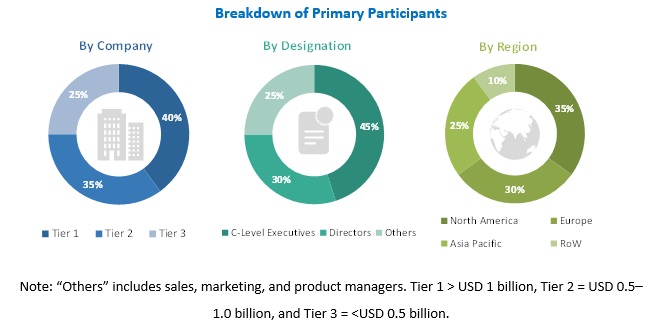
Smart pneumatic market comprises several stakeholders, such as suppliers of raw material and manufacturing equipment; standard components, original equipment manufacturers (OEMs); original device manufacturers (ODMs) of smart pneumatic; solutions providers; vendors of assembly, testing, and packaging solutions; and system integrators in the supply chain. Various primary sources from both the supply and demand sides of the market were interviewed to obtain qualitative and quantitative information. Following is the breakdown of primary respondents.
To know about the assumptions considered for the study, download the pdf brochure
Market Size Estimation
Both top-down and bottom-up approaches have been used to estimate and validate the total size of the smart pneumatics market. These methods have been also used extensively to estimate the size of various subsegments in the market. The following method has been used to estimate the market size:
- Major players in the industry and markets have been identified through extensive secondary research.
- The industry’s supply chain and market size, in terms of value, have been determined through primary and secondary research.
- All percentage shares, splits, and breakdowns have been determined using secondary sources and verified through primary sources.
Data Triangulation
After arriving at the overall market size-using the estimation processes as explained above—the market was split into several segments and subsegments. To complete the overall market engineering process and arrive at the exact statistics of each market segment and subsegment, data triangulation, and market breakdown procedures were employed, wherever applicable. The data have been triangulated by studying various factors and trends from both the demand and supply sides. The market has also been validated using both top-down and bottom-up approaches
Report Objectives
- To describe and forecast the smart pneumatics market, in terms of value, by component, type, and industry
- To describe and forecast the smart pneumatics market, in terms of value, by region—North America, Europe, Asia Pacific (APAC), and Rest of the World (RoW)—along with respective countries
- To provide detailed information regarding the major factors (drivers, restraints, opportunities, and challenges) influencing the growth of the smart pneumatic market
- To strategically analyze micromarkets with respect to individual growth trends, prospects, and contributions to the overall market
- To study the complete value chain of the smart pneumatics market
- To analyze market opportunities for stakeholders by identifying high-growth segments of the smart pneumatics ecosystem
- To strategically profile key players and comprehensively analyze their market positions, in terms of ranking and core competencies, along with detailing the competitive landscape for market leaders
- To analyze strategic approaches, such as product launches, acquisitions, collaborations, contracts, agreements, expansions, and partnerships, in the smart pneumatics market
Available Customizations:
With the given market data, MarketsandMarkets offers customizations according to the specific requirements of a company. The following customization options are available for the report:
Company Information
- Detailed analysis and profiling of additional market players (up to 5)













Growth opportunities and latent adjacency in Smart Pneumatics Market