



Wireless Gigabit Market Size Share and Trends
Report Code
SE 4333
Published in
Sep, 2024, By MarketsandMarkets™
Wireless Gigabit Market SoC, Module, IEEE 802.11AD, IEEE 802.11AY, 57-71 GHz, Router, Access Point, Docking Station, Backhaul Station, Adapter, AR/VR, Multimedia Streaming, Video Wall, Biometric, Smart City, Gesture Control - Global Forecast to 2029

USD 138.8 MN
MARKET SIZE, 2029

CAGR 15.7%
(2024-2029)

220
REPORT PAGES

156
MARKET TABLES
WIRELESS GIGABIT MARKET OVERVIEW
The wireless gigabit industry is projected to reach USD 138.8 million by 2029 from USD 66.9 million in 2024, at a CAGR of 15.7% from 2024 to 2029. WiGig operates in the unlicensed 60 GHz frequency band, providing multi-gigabit speeds and low interference. It is suited for enabling high-bandwidth applications such as HD video streaming, online gaming, and smart devices such as smartphones and AR/VR devices. Additionally, deploying 5G networks presents further opportunities for WiGig technology to support wireless backhaul and improve network performance and capacity in urban areas.
WIRELESS GIGABIT MARKET KEY TAKEAWAYS
-
BY REGIONBy region, North America is expected to grow at the fastest CAGR of 17.6% during the forecast period.
-
BY OFFERINGBy offering, the module segment is expected to grow at the highest CAGR of 17.1% during the forecast period.
-
BY PRODUCTBy product, the network infrastructure device is expected to dominate the market in terms of growth rate.
-
BY END USERBy end user, the telecom segment is expected to register the highest share of 38.8% in 2025.
-
COMPETITIVE LANDSCAPE - KEY PLAYERSPeraso Technologies Inc., Sivers Semiconductors AB, Qualcomm Technologies, Inc., and STMicroelectronics, were identified as some of the star players in the wireless gigabit companies, given their strong market share and product footprint.
-
COMPETITIVE LANDSCAPE - STARTUPS/SMESJiangsu Creatcomm Technologies Co., Ltd., Common Networks, Inc., among others, have distinguished themselves among SMEs by securing strong footholds in specialized niche areas, underscoring their potential as emerging market leaders.
The growing adoption of AR/VR devices, IoT, and connected devices, and rising demand for definition video streaming and online gaming create new avenues for wireless gigabit applications. Continuous advancements in wireless communication technologies drive market growth by offering enhanced speed and capacity.
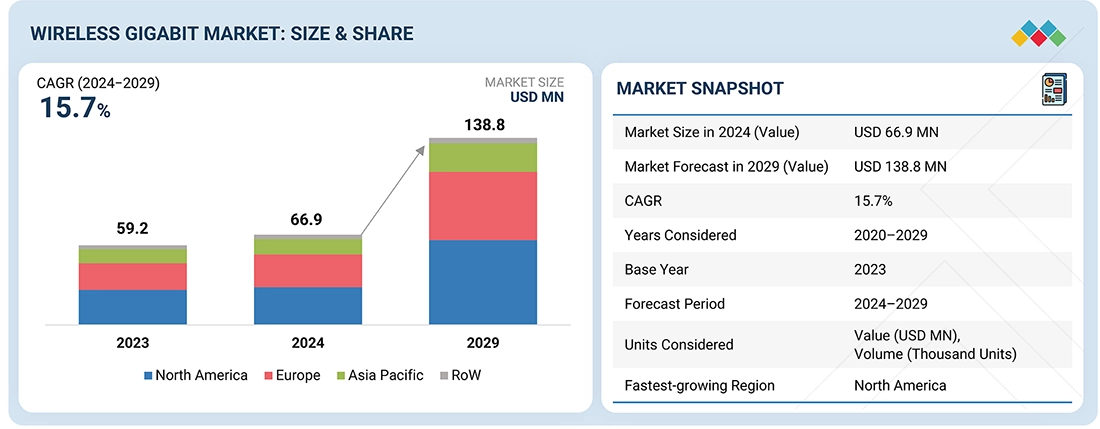
Source: Secondary Research, Interviews with Experts, MarketsandMarkets Analysis
TRENDS & DISRUPTIONS IMPACTING CUSTOMERS' CUSTOMERS
In the wireless gigabit market, key trends and disruptions impacting customer businesses include the increasing demand for high-speed, low-latency wireless connectivity driven by the proliferation of data-intensive applications such as 4K/8K video streaming, AR/VR, and cloud computing. The adoption of WiGig technology enables businesses to achieve faster data transmission rates, which is critical for real-time data processing and enhanced user experiences.
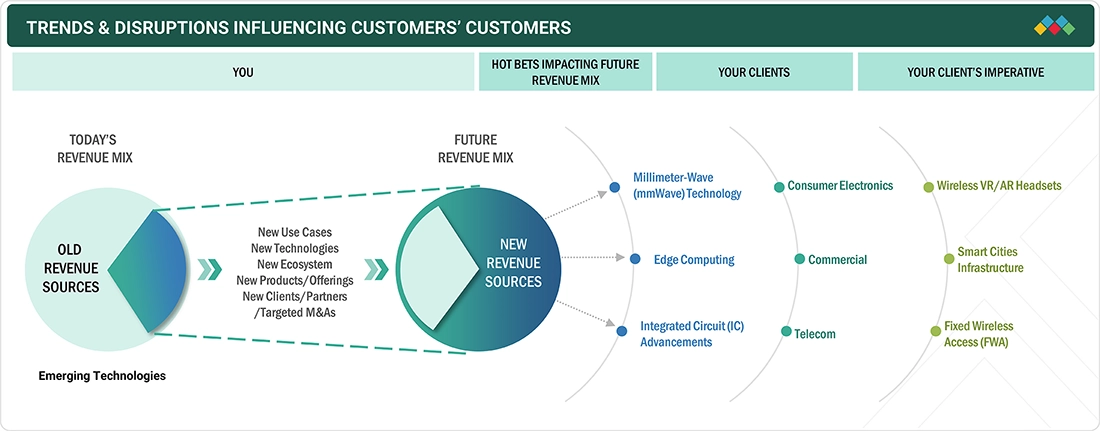
Source: Secondary Research, Interviews with Experts, MarketsandMarkets Analysis
WIRELESS GIGABIT MARKET DYNAMICS

Drivers
Impact
Level
Level
-
Rising demand for high-definition content

-
Surging adoption of AR/VR devices


RESTRAINTS
Impact
Level
Level
-
High deployment costs

-
Data privacy and security concerns


OPPORTUNITIES
Impact
Level
Level
-
Rising deployment of 5G networks

-
Increasing investments in smart city projects


CHALLENGES
Impact
Level
Level
-
Obsolescence of older technologies due to constant technological advancements

-
Complexities associated with integration of WiGig technology with

Source: Secondary Research, Interviews with Experts, MarketsandMarkets Analysis
Driver: Rising demand for high-definition content
The increasing consumption of high-definition and 4K content across various devices drives the demand for wireless HD video streaming. According to Forbes, an overwhelming 99% of US households now subscribe to at least one or more streaming services, with Netflix, Amazon Prime Video, and Apple TV+ topping the charts. As consumers shift toward higher-quality video experiences, traditional Wi-Fi networks often struggle to handle these streams' large bandwidth requirements and low latency needs.
Restraint: High deployment costs
High deployment costs significantly restrain the wireless gigabit market, primarily because the technology requires substantial investment in new infrastructure and compatible devices. WiGig operates in the 60 GHz frequency band, necessitating specialized equipment such as advanced antennas, transceivers, and network infrastructure capable of handling high-frequency signals. The development, manufacturing, and installation of these components are expensive, and these costs are typically passed on to end users.
Opportunity: Rising deployment of 5G networks
The expansion of 5G networks accelerates the adoption of advanced technologies that benefit from high-speed wireless connectivity, including IoT devices, smart cities, and autonomous vehicles. WiGig can play a crucial role in these ecosystems by providing the high-speed data transfer needed for seamless operation and integration.
Challenge: Obsolescence of older technologies due to constant technological advancements
Rapid technological change poses a significant challenge for the WiGig market by necessitating continuous updates and advancements to keep pace with emerging innovations. The wireless technology landscape evolves swiftly, with frequent advancements in competing standards such as Wi-Fi 6, Wi-Fi 7, and upcoming 6G technologies, which often introduce new features and improved performance metrics. This constant evolution can make existing WiGig solutions quickly obsolete,
WIRELESS GIGABIT MARKET SIZE SHARE AND TRENDS: COMMERCIAL USE CASES ACROSS INDUSTRIES
| COMPANY | USE CASE DESCRIPTION | BENEFITS |
|---|---|---|
 |
Dell utilized Qualcomm's WiGig chipsets to create wireless docking solutions. These allowed users to wirelessly connect peripherals such as monitors, keyboards, mice, and external storage devices. | Dell's wireless docking solutions allowed employees to move around their workspaces more freely without losing connectivity to their peripherals. This increased workplace flexibility and enabled hot-desking and collaborative work environments. |
 |
Harman incorporated Peraso's WiGig chipsets into its infotainment systems, allowing the system to connect wirelessly with multiple devices inside the car at gigabit speeds. This enabled passengers to stream 4K videos, play online games, and transfer large media files quickly and seamlessly. | The implementation of WiGig enabled data transfer speeds up to several gigabits per second, far surpassing traditional wireless technologies. By integrating cutting-edge WiGig technology, Harman positioned itself as a leader in the connected car market, offering a unique value proposition that differentiates its products from those of competitors. |
 |
Cisco partnered with Peraso Technologies, a company specializing in 60 GHz WiGig chipsets. Peraso's chipsets, based on IEEE 802.11ad, provided the high bandwidth needed for enterprise applications while operating in the millimeter-wave spectrum, which reduced interference compared to traditional 2.4 GHz and 5 GHz Wi-Fi frequencies. | The integration of Peraso's WiGig technology into Cisco's networking solutions led to enhanced wireless performance in enterprise settings, enabling seamless connectivity for a large number of devices with minimal interference. |
 |
The wireless docking solution enabled EliteBook users to connect to multiple peripherals such as monitors, external storage devices, printers, and network connections, without needing physical cables. | The wireless docking solution helped create cleaner, more organized workspaces by eliminating the need for multiple cables. This not only improved the aesthetic appeal of the workspace but also reduced the risk of cable-related issues. |
Logos and trademarks shown above are the property of their respective owners. Their use here is for informational and illustrative purposes only.
WIRELESS GIGABIT MARKET ECOSYSTEM
As advancements in consumer electronics, IoT devices, and enterprise solutions continue to rise, the WiGig ecosystem is expanding, encompassing a diverse array of stakeholders, including chip manufacturers, device developers, network providers, and regulatory bodies. Understanding the dynamics of this ecosystem is crucial for identifying growth opportunities, market challenges, and competitive positioning in the evolving landscape.
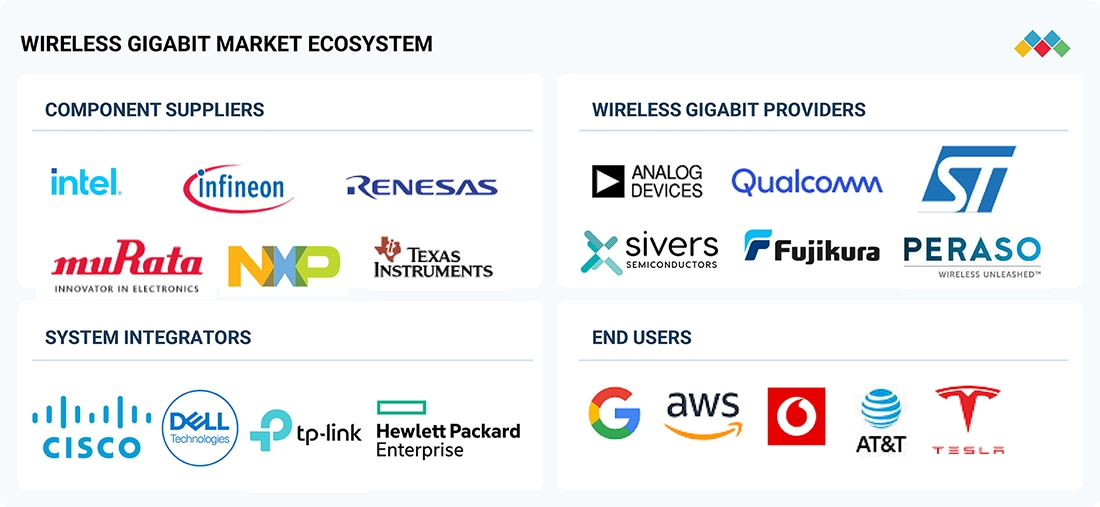
Logos and trademarks shown above are the property of their respective owners. Their use here is for informational and illustrative purposes only.
WIRELESS GIGABIT MARKET SEGMENTS
Source: Secondary Research, Interviews with Experts, MarketsandMarkets Analysis
Wireless Gigabit Market, By Offering
The WiGig market is gaining momentum in module offerings with the rising need for high-speed and low-latency wireless connections among various devices, citing applications. Modules enable fast switching of consumer electronics, enterprise solutions, and industrial systems over to WiGig technology and represent a flexible solution with the right cost strategy for manufacturers implementing high-speed wireless functionality.
Wireless Gigabit Market, By Channel
WiGig for the 63-65 GHz channel is gaining ground, as it can deliver ultra-high-speed transmission and maximum resistance to interference between short ranges. It is an excellent opportunity, specifically in dense urban environments with high-capacity requirements. That slice of spectrum is crucial for 4K/8K video streaming, AR/VR experiences in real-time, and wireless backhaul when it comes to the heaviest bandwidth activities on future 5G networks.
Wireless Gigabit Market, By End User
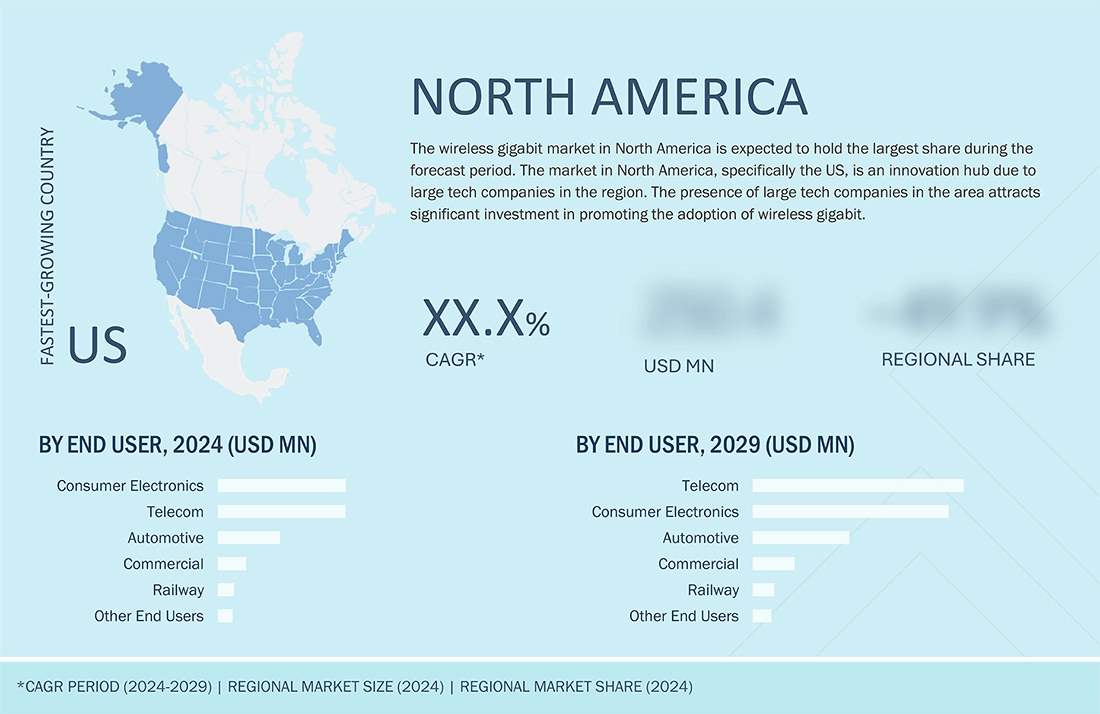
The wireless gigabit market for telecom end users is projected to account for the largest share of the market during the forecast period. Mobile and internet penetration has increased network traffic, driving operators to invest in advanced technologies to mitigate network congestion.
WIRELESS GIGABIT MARKET REGION
North America is expected to be the fastest-growing region across the wireless gigabit market during the forecast period
The wireless gigabit market in North America is expected to hold the largest share during the forecast period. The market in North America, specifically the US, is an innovation hub due to large tech companies in the region. The presence of large tech companies in the area attracts significant investment in promoting the adoption of wireless gigabit.
WIRELESS GIGABIT MARKET SIZE SHARE AND TRENDS: COMPANY EVALUATION MATRIX
In the Wireless Gigabit market matrix, Peraso Technologies (Star) and Blu Wireless (Emerging Leader) lead with a strong market presence and a wide product portfolio, driving large-scale adoption across various industries, including telecom and consumer electronics.
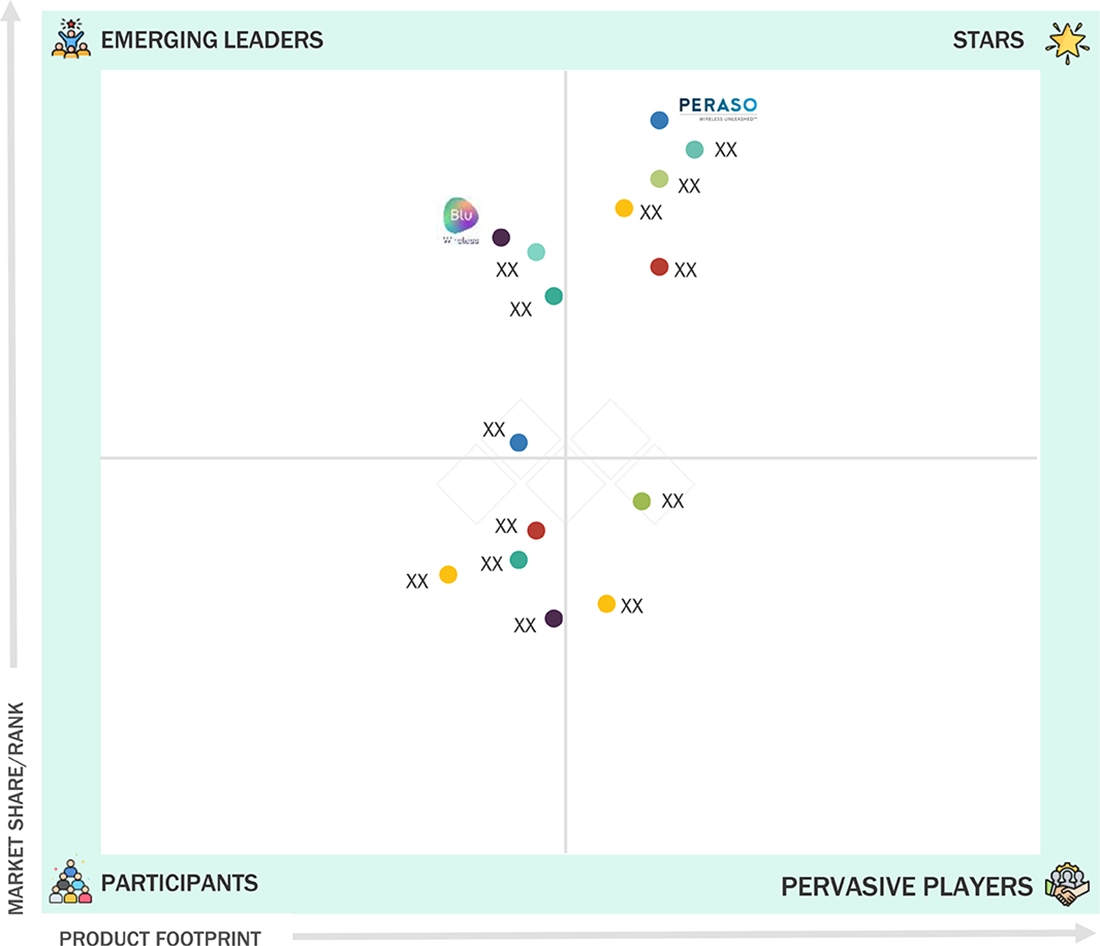
Source: Secondary Research, Interviews with Experts, MarketsandMarkets Analysis
WIRELESS GIGABIT MARKET KEY PLAYERS
WIRELESS GIGABIT MARKET SCOPE
| REPORT METRIC | DETAILS |
|---|---|
| Market Size in 2024 (Value) | USD 66.9 Million |
| Market Forecast in 2029 (Value) | USD 138.8 Million |
| Growth Rate | CAGR of 15.7% from 2024–2029 |
| Years Considered | 2020–2029 |
| Base Year | 2023 |
| Forecast Period | 2024–2029 |
| Units Considered | Value (USD Million) and Volume (Thousand Units) |
| Report Coverage | Revenue forecast, company ranking, competitive landscape, growth factors, and trends |
| Segments Covered |
|
| Regional Scope | North America, Europe, Asia Pacific, RoW |
WHAT IS IN IT FOR YOU: WIRELESS GIGABIT MARKET SIZE SHARE AND TRENDS REPORT CONTENT GUIDE
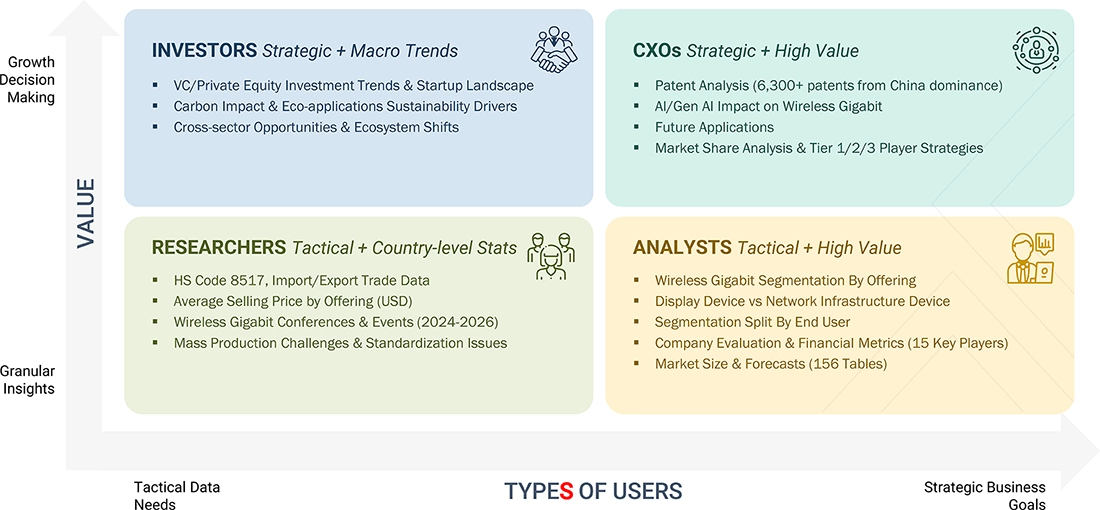
DELIVERED CUSTOMIZATIONS
We have successfully delivered the following deep-dive customizations:
| CLIENT REQUEST | CUSTOMIZATION DELIVERED | VALUE ADDS |
|---|---|---|
| Telecom Equipment Manufacturer (US-based) |
|
|
| Consumer Electronics Brand (Asia-based) |
|
|
| Semiconductor & RF Chipset Vendor |
|
|
| Fixed Wireless Access (FWA) Service Provider |
|
|
RECENT DEVELOPMENTS
- September 2023 : Peraso Technologies Inc. announced the release of the PRM2144X, its latest mmWave module in the Perspectus series, which features long-range, outdoor applications.
- February 2022 : Pharrowtech launched the PTR1060, the world’s first IEEE 802.11ay-compliant CMOS RF chip for indoor and outdoor wireless use cases, supporting 57 to 71 GHz bandwidth.
Table of Contents
 Exclusive indicates content/data unique to MarketsandMarkets and not available with any competitors.
TITLE
PAGE NO
1
INTRODUCTION
21
2
RESEARCH METHODOLOGY
26
3
EXECUTIVE SUMMARY
38
4
PREMIUM INSIGHTS
42
5
MARKET OVERVIEW
High-definition demand and 5G drive market growth amid privacy and interoperability challenges.
45
5.1
INTRODUCTION
5.2
MARKET DYNAMICS
5.2.1
DRIVERS
5.2.1.1
RISING DEMAND FOR HIGH-DEFINITION CONTENT
5.2.1.2
SURGING ADOPTION OF AR/VR DEVICES
5.2.1.3
INCREASING DEMAND FOR SMART DEVICES
5.2.1.4
GROWING INVESTMENTS IN HIGH-SPEED INTERNET
5.2.2
RESTRAINTS
5.2.2.1
HIGH DEPLOYMENT COSTS
5.2.2.2
DATA PRIVACY AND SECURITY CONCERNS
5.2.2.3
INTEROPERABILITY ISSUES DUE TO LACK OF STANDARD PROTOCOLS
5.2.3
OPPORTUNITIES
5.2.3.1
RISING DEPLOYMENT OF 5G NETWORKS
5.2.3.2
INCREASING INVESTMENTS IN SMART CITY PROJECTS
5.2.3.3
EMERGENCE OF SMART AND CONNECTED VEHICLES
5.2.4
CHALLENGES
5.2.4.1
OBSOLESCENCE OF OLDER TECHNOLOGIES DUE TO CONSTANT TECHNOLOGICAL ADVANCEMENTS
5.2.4.2
COMPLEXITIES ASSOCIATED WITH INTEGRATION OF WIGIG TECHNOLOGY WITH EXISTING AND LEGACY SYSTEMS
5.3
TRENDS/DISRUPTIONS IMPACTING CUSTOMER BUSINESS
5.4
PRICING ANALYSIS
5.4.1
AVERAGE SELLING PRICE TREND OF KEY PLAYERS, BY OFFERING
5.4.2
INDICATIVE PRICING TREND OF WIRELESS GIGABIT OFFERINGS, BY REGION
5.5
VALUE CHAIN ANALYSIS
5.6
ECOSYSTEM ANALYSIS
5.7
INVESTMENT AND FUNDING SCENARIO
5.8
TECHNOLOGY ANALYSIS
5.8.1
KEY TECHNOLOGIES
5.8.1.1
MILLIMETER-WAVE TECHNOLOGY
5.8.1.2
BEAMFORMING
5.8.1.3
ADVANCED ANTENNA ARRAYS
5.8.1.4
HIGH-EFFICIENCY POWER AMPLIFIERS
5.8.2
COMPLEMENTARY TECHNOLOGIES
5.8.2.1
EDGE COMPUTING
5.8.2.2
INTERNET OF THINGS
5.8.2.3
ARTIFICIAL INTELLIGENCE AND MACHINE LEARNING
5.8.2.4
AUGMENTED REALITY AND VIRTUAL REALITY
5.8.3
ADJACENT TECHNOLOGIES
5.8.3.1
CLOUD COMPUTING
5.8.3.2
5G NETWORKS
5.8.3.3
WI-FI 6E
5.9
PATENT ANALYSIS
5.10
TRADE ANALYSIS
5.10.1
IMPORT SCENARIO (HS CODE 8517)
5.10.2
EXPORT SCENARIO (HS CODE 8517)
5.11
KEY CONFERENCES AND EVENTS, 2024–2025
5.12
CASE STUDY ANALYSIS
5.12.1
DELL PARTNERED WITH QUALCOMM TO INTEGRATE WIGIG TECHNOLOGY INTO ITS LAPTOPS AND DOCKING STATIONS
5.12.2
HARMAN PARTNERED WITH PERASO TECHNOLOGIES TO INTEGRATE WIGIG TECHNOLOGY INTO IN-CAR INFOTAINMENT SYSTEMS
5.12.3
CISCO PARTNERED WITH PERASO TECHNOLOGIES TO INTEGRATE WIGIG TECHNOLOGY INTO THEIR WIRELESS INFRASTRUCTURE SOLUTIONS
5.12.4
HP COLLABORATED WITH WILOCITY TO INCORPORATE WIGIG TECHNOLOGY INTO ITS ELITEBOOK SERIES OF LAPTOPS
5.12.5
NETGEAR COLLABORATED WITH QUALCOMM TO DEVELOP NIGHTHAWK X10 AD7200 SMART WI-FI ROUTER
5.13
TARIFF AND REGULATORY LANDSCAPE
5.13.1
TARIFF ANALYSIS
5.13.2
REGULATORY BODIES, GOVERNMENT AGENCIES, AND OTHER ORGANIZATIONS
5.13.3
STANDARDS
5.14
PORTER'S FIVE FORCES ANALYSIS
5.14.1
THREAT OF NEW ENTRANTS
5.14.2
THREAT OF SUBSTITUTES
5.14.3
BARGAINING POWER OF SUPPLIERS
5.14.4
BARGAINING POWER OF BUYERS
5.14.5
INTENSITY OF COMPETITION RIVALRY
5.15
KEY STAKEHOLDERS AND BUYING CRITERIA
5.15.1
KEY STAKEHOLDERS IN BUYING PROCESS
5.15.2
BUYING CRITERIA
5.16
IMPACT OF AI/GEN AI ON WIRELESS GIGABIT MARKET
6
USE CASES OF WIRELESS GIGABIT TECHNOLOGY
Revolutionize connectivity with Wireless Gigabit: from smart cities to immersive AR/VR experiences.
82
6.1
INTRODUCTION
6.2
MULTIMEDIA STREAMING
6.2.1
VIDEO WALL
6.3
ONLINE GAMING
6.4
WIRELESS DOCKING
6.5
BIOMETRIC AUTHENTICATION
6.6
GESTURE CONTROL & PROXIMITY SENSING
6.7
AR/VR DEVICES
6.8
SMART CITIES
7
WIRELESS GIGABIT MARKET, BY CHANNEL
Market Size & Growth Rate Forecast Analysis to 2029 in USD Million | 12 Data Tables
85
7.1
INTRODUCTION
7.2
57–59 GHZ
7.2.1
HIGH-SPEED DATA DEMANDS IN VR/AR AND WIRELESS CONNECTIVITY TO FUEL MARKET GROWTH
7.3
59–61 GHZ
7.3.1
INCREASING DEMAND FOR HIGH-CAPACITY WIRELESS BACKHAUL AND SECURE NETWORKS TO FOSTER MARKET GROWTH
7.4
61–63 GHZ
7.4.1
HIGH FLEXIBILITY AND EFFICIENCY DUE TO MINIMIZED CABLING TO BOOST DEMAND
7.5
63–65 GHZ
7.5.1
SURGING DEMAND FOR ADVANCED DRIVER-ASSISTANCE SYSTEMS TO ACCELERATE MARKET GROWTH
7.6
OTHER CHANNELS
8
WIRELESS GIGABIT MARKET, BY PROTOCOL
Market Size & Growth Rate Forecast Analysis to 2029 in USD Million | 6 Data Tables
93
8.1
INTRODUCTION
8.2
IEEE 802.11 AD
8.2.1
HIGH-SPEED DATA TRANSFER FOR ULTRA-HD STREAMING AND VR TO DRIVE MARKET
8.3
IEEE 802.11 AY
8.3.1
EXTENDED RANGE AND ENHANCED CONNECTIVITY TO PROPEL MARKET GROWTH
9
WIRELESS GIGABIT MARKET, BY PRODUCT
Market Size & Growth Rate Forecast Analysis to 2029 in USD Million | 8 Data Tables
97
9.1
INTRODUCTION
9.2
DISPLAY DEVICES
9.2.1
GROWING DEMAND FOR HIGH-SPEED VIDEO STREAMING AND REMOTE WORK TO DRIVE ADOPTION
9.3
NETWORK INFRASTRUCTURE DEVICES
9.3.1
NETWORK ROUTERS & ACCESS POINTS
9.3.1.1
RISING DEMAND FOR HIGH-SPEED INTERNET AND DATA SERVICES TO DRIVE MARKET
9.3.2
NETWORK ADAPTERS
9.3.2.1
ESCALATING ADOPTION OF IOT AND SMART HOME TECHNOLOGIES TO ACCELERATE MARKET GROWTH
9.3.3
BACKHAUL STATIONS
9.3.3.1
SURGING DEMAND FOR HIGH-SPEED AND LOW-LATENCY CONNECTIVITY TO FUEL MARKET GROWTH
9.3.4
DOCKING STATIONS
9.3.4.1
ELEVATING NEED FOR LAPTOPS AND MOBILE DEVICES TO BOOST DEMAND
10
WIRELESS GIGABIT MARKET, BY OFFERING
Market Size & Growth Rate Forecast Analysis to 2029 in USD Million and Units | 16 Data Tables
104
10.1
INTRODUCTION
10.2
SOC
10.2.1
RISING DEMAND FOR EFFICIENT AND HIGH-PERFORMANCE WIRELESS COMMUNICATION TO FUEL MARKET GROWTH
10.3
MODULE
10.3.1
PRESSING NEED FOR RAPID, HIGH-BANDWIDTH WIRELESS CONNECTIONS TO FOSTER MARKET GROWTH
11
WIRELESS GIGABIT MARKET, BY END USER
Market Size & Growth Rate Forecast Analysis to 2029 in USD Million | 14 Data Tables
111
11.1
INTRODUCTION
11.2
TELECOM
11.2.1
GROWING DATA TRAFFIC AND DEMAND FOR HIGH-SPEED CONNECTIVITY TO PROPEL MARKET
11.3
CONSUMER ELECTRONICS
11.3.1
RAPID ADOPTION OF SMART DEVICES TO ACCELERATE MARKET GROWTH
11.4
AUTOMOTIVE
11.4.1
RISING DEMAND FOR V2X COMMUNICATION TO AUGMENT MARKET GROWTH
11.5
COMMERCIAL
11.5.1
SHIFT TOWARD DIGITAL BANKING AND ADVANCED FINANCIAL SERVICES TO BOOST DEMAND
11.5.2
BFSI
11.5.3
MEDICAL
11.6
RAILWAY
11.6.1
ADOPTION OF SMART TECHNOLOGIES TO ENHANCE EFFICIENCY, SAFETY, AND PASSENGER EXPERIENCE TO FUEL MARKET GROWTH
11.6.2
HIGH-SPEED RAIL
11.7
OTHER END USERS
12
WIRELESS GIGABIT MARKET, BY REGION
Comprehensive coverage of 9 Regions with country-level deep-dive of 10 Countries | 36 Data Tables.
121
12.1
INTRODUCTION
12.2
NORTH AMERICA
12.2.1
MACROECONOMIC OUTLOOK FOR NORTH AMERICA
12.2.2
US
12.2.2.1
SURGING DEMAND FOR HIGH-SPEED, LOW-LATENCY WIRELESS CONNECTIVITY TO FUEL MARKET GROWTH
12.2.3
CANADA
12.2.3.1
GOVERNMENT-LED REMOTE AND RURAL CONNECTIVITY PROJECTS TO FOSTER MARKET GROWTH
12.2.4
MEXICO
12.2.4.1
RAPID EXPANSION OF DATA CENTERS TO BOOST DEMAND
12.3
EUROPE
12.3.1
MACROECONOMIC OUTLOOK FOR EUROPE
12.3.2
UK
12.3.2.1
SIGNIFICANT FUNDING TO SUPPORT ENHANCEMENT OF DIGITAL INFRASTRUCTURE TO SPIKE DEMAND
12.3.3
GERMANY
12.3.3.1
INCREASING ADOPTION OF CLOUD COMPUTING TO DRIVE MARKET GROWTH
12.3.4
FRANCE
12.3.4.1
GOVERNMENT AND PRIVATE SECTOR INVESTMENTS TO BOOST DEMAND
12.3.5
ITALY
12.3.5.1
HIGH-SPEED BROADBAND NETWORKS AND 5G DEPLOYMENT TO FOSTER MARKET GROWTH
12.3.6
REST OF EUROPE
12.4
ASIA PACIFIC
12.4.1
MACROECONOMIC OUTLOOK FOR ASIA PACIFIC
12.4.2
CHINA
12.4.2.1
INDUSTRIAL AND CONSUMER IOT EXPANSION TO DRIVE MARKET
12.4.3
JAPAN
12.4.3.1
ROBUST DIGITAL INFRASTRUCTURE AND GOVERNMENT SUPPORT TO FUEL MARKET GROWTH
12.4.4
SOUTH KOREA
12.4.4.1
NEED FOR ROBUST NETWORK SECURITY SOLUTIONS TO OFFER LUCRATIVE GROWTH OPPORTUNITIES
12.4.5
REST OF ASIA PACIFIC
12.5
ROW
12.5.1
MACROECONOMIC OUTLOOK FOR ROW
12.5.2
MIDDLE EAST
12.5.2.1
INCREASING NUMBER OF SMART CITY PROJECTS TO DRIVE MARKET
12.5.2.1.1
GCC COUNTRIES
12.5.2.2
REST OF MIDDLE EAST
12.5.3
SOUTH AMERICA
12.5.3.1
GROWING ADOPTION OF ADVANCED WIRELESS CONNECTIVITY SOLUTIONS TO SUPPORT MARKET GROWTH
12.5.4
AFRICA
12.5.4.1
GOVERNMENT EFFORTS TO EXPAND INTERNET ACCESS AND ENCOURAGE USAGE TO SPUR DEMAND
13
COMPETITIVE LANDSCAPE
Discover how key players' strategic moves shape market dominance and influence financial metrics.
149
13.1
INTRODUCTION
13.2
KEY PLAYER STRATEGIES/RIGHT TO WIN, 2021–2024
13.3
REVENUE ANALYSIS, 2019–2023
13.4
MARKET SHARE ANALYSIS, 2023
13.5
COMPANY VALUATION AND FINANCIAL METRICS
13.6
BRAND/PRODUCT COMPARISON
13.7
COMPANY EVALUATION MATRIX: KEY PLAYERS, 2023
13.7.1
STARS
13.7.2
EMERGING LEADERS
13.7.3
PERVASIVE PLAYERS
13.7.4
PARTICIPANTS
13.7.5
COMPANY FOOTPRINT: KEY PLAYERS, 2023
13.7.5.1
COMPANY FOOTPRINT
13.7.5.2
OFFERING FOOTPRINT
13.7.5.3
PROTOCOL FOOTPRINT
13.7.5.4
CHANNEL FOOTPRINT
13.7.5.5
PRODUCT FOOTPRINT
13.7.5.6
END USER FOOTPRINT
13.7.5.7
REGION FOOTPRINT
13.8
COMPANY EVALUATION MATRIX: STARTUPS/SMES, 2023
13.8.1
PROGRESSIVE COMPANIES
13.8.2
RESPONSIVE COMPANIES
13.8.3
DYNAMIC COMPANIES
13.8.4
STARTING BLOCKS
13.8.5
COMPETITIVE BENCHMARKING: STARTUPS/SMES, 2023
13.8.5.1
DETAILED LIST OF KEY STARTUPS/SMES
13.8.5.2
COMPETITIVE BENCHMARKING OF KEY STARTUPS/SMES
13.9
COMPETITIVE SCENARIO
13.9.1
PRODUCT/SERVICE LAUNCHES
13.9.2
DEALS
14
COMPANY PROFILES
In-depth Company Profiles of Leading Market Players with detailed Business Overview, Product and Service Portfolio, Recent Developments, and Unique Analyst Perspective (MnM View)
172
14.1
KEY PLAYERS
14.1.1
PERASO TECHNOLOGIES INC.
14.1.1.1
BUSINESS OVERVIEW
14.1.1.2
PRODUCTS/SOLUTIONS/SERVICES OFFERED
14.1.1.3
RECENT DEVELOPMENTS
14.1.1.3.1
PRODUCT/SERVICE LAUNCHES
14.1.1.4
MNM VIEW
14.1.1.4.1
KEY STRENGTHS
14.1.1.4.2
STRATEGIC CHOICES
14.1.1.4.3
WEAKNESSES AND COMPETITIVE THREATS
14.1.2
SIVERS SEMICONDUCTORS AB
14.1.3
TENSORCOM, INC.
14.1.4
STMICROELECTRONICS
14.1.5
QUALCOMM TECHNOLOGIES, INC.
14.1.6
FUJIKURA LTD.
14.1.7
BLU WIRELESS
14.1.8
PHARROWTECH
14.1.9
INDIE SEMICONDUCTOR
14.1.10
ANALOG DEVICES, INC.
14.1.11
CAMBIUM NETWORKS, LTD.
14.1.12
RENESAS ELECTRONICS CORPORATION
14.1.13
MURATA MANUFACTURING CO., LTD.
14.2
OTHER KEY PLAYERS
14.2.1
MISTRAL SOLUTIONS PVT. LTD.
14.2.2
MOVANDI CORPORATION
14.2.3
PASTERNACK
14.2.4
JIANGSU CREATCOMM TECHNOLOGIES CO., LTD.
14.2.5
MIKROTIK
14.2.6
COMMON NETWORKS, INC.
14.2.7
EDGECORE NETWORKS
14.2.8
AIRVINE SCIENTIFIC, INC.
14.2.9
WIRELESS EXCELLENCE LIMITED
14.2.10
LASER 2000
14.2.11
AXXCSS WIRELESS SOLUTIONS, INC.
14.2.12
TACHYON NETWORKS
15
APPENDIX
214
15.1
DISCUSSION GUIDE
15.2
KNOWLEDGESTORE: MARKETSANDMARKETS’ SUBSCRIPTION PORTAL
15.3
CUSTOMIZATION OPTIONS
15.4
RELATED REPORTS
15.5
AUTHOR DETAILS
LIST OF TABLES
TABLE 1
WIRELESS GIGABIT MARKET: RISK ANALYSIS
TABLE 2
INDICATIVE PRICING TREND OF WIRELESS GIGABIT OFFERINGS, BY KEY PLAYER, 2023 (USD)
TABLE 3
INDICATIVE PRICING TREND OF SOC & MODULE, BY REGION, 2023 (USD)
TABLE 4
ROLE OF COMPANIES IN ECOSYSTEM
TABLE 5
LIST OF PATENTS IN WIRELESS GIGABIT MARKET, 2020–2023
TABLE 6
IMPORT DATA FOR HS CODE 8517-COMPLIANT PRODUCTS, BY COUNTRY, 2019–2023
TABLE 7
EXPORT DATA FOR HS CODE 8517-COMPLIANT PRODUCTS, BY COUNTRY, 2019–2023
TABLE 8
WIRELESS GIGABIT MARKET: LIST OF CONFERENCES AND EVENTS
TABLE 9
MFN TARIFFS FOR HS CODE 8517-COMPLIANT PRODUCTS EXPORTED BY US
TABLE 10
MFN TARIFFS FOR HS CODE 8517-COMPLIANT PRODUCTS EXPORTED BY CHINA
TABLE 11
MFN TARIFFS FOR HS CODE 8517-COMPLIANT PRODUCTS EXPORTED BY GERMANY
TABLE 12
NORTH AMERICA: REGULATORY BODIES, GOVERNMENT AGENCIES, AND OTHER ORGANIZATIONS
TABLE 13
EUROPE: REGULATORY BODIES, GOVERNMENT AGENCIES, AND OTHER ORGANIZATIONS
TABLE 14
ASIA PACIFIC: REGULATORY BODIES, GOVERNMENT AGENCIES, AND OTHER ORGANIZATIONS
TABLE 15
ROW: REGULATORY BODIES, GOVERNMENT AGENCIES, AND OTHER ORGANIZATIONS
TABLE 16
STANDARDS AND REGULATIONS RELATED TO WIRELESS GIGABIT MARKET
TABLE 17
IMPACT OF PORTER'S FIVE FORCES ON WIRELESS GIGABIT MARKET
TABLE 18
INFLUENCE OF STAKEHOLDERS ON BUYING PROCESS FOR TOP THREE END USERS (%)
TABLE 19
KEY BUYING CRITERIA FOR TOP THREE END USERS
TABLE 20
WIRELESS GIGABIT MARKET, BY CHANNEL, 2020–2023 (USD MILLION)
TABLE 21
WIRELESS GIGABIT MARKET, BY CHANNEL, 2024–2029 (USD MILLION)
TABLE 22
57–59 GHZ: WIRELESS GIGABIT MARKET, BY REGION, 2020–2023 (USD MILLION)
TABLE 23
57–59 GHZ: WIRELESS GIGABIT MARKET, BY REGION, 2024–2029 (USD MILLION)
TABLE 24
59–61 GHZ: WIRELESS GIGABIT MARKET, BY REGION, 2020–2023 (USD MILLION)
TABLE 25
59–61 GHZ: WIRELESS GIGABIT MARKET, BY REGION, 2024–2029 (USD MILLION)
TABLE 26
61–63 GHZ: WIRELESS GIGABIT MARKET, BY REGION, 2020–2023 (USD MILLION)
TABLE 27
61–63 GHZ: WIRELESS GIGABIT MARKET, BY REGION, 2024–2029 (USD MILLION)
TABLE 28
63–65 GHZ: WIRELESS GIGABIT MARKET, BY REGION, 2020–2023 (USD MILLION)
TABLE 29
63–65 GHZ: WIRELESS GIGABIT MARKET, BY REGION, 2024–2029 (USD MILLION)
TABLE 30
OTHER CHANNELS: WIRELESS GIGABIT MARKET, BY REGION, 2020–2023 (USD MILLION)
TABLE 31
OTHER CHANNELS: WIRELESS GIGABIT MARKET, BY REGION, 2024–2029 (USD MILLION)
TABLE 32
WIRELESS GIGABIT MARKET, BY PROTOCOL, 2020–2023 (USD MILLION)
TABLE 33
WIRELESS GIGABIT MARKET, BY PROTOCOL, 2024–2029 (USD MILLION)
TABLE 34
IEEE 802.11 AD: WIRELESS GIGABIT MARKET, BY OFFERING, 2020–2023 (USD MILLION)
TABLE 35
IEEE 802.11 AD: WIRELESS GIGABIT MARKET, BY OFFERING, 2024–2029 (USD MILLION)
TABLE 36
IEEE 802.11AY: WIRELESS GIGABIT MARKET, BY OFFERING, 2020–2023 (USD MILLION)
TABLE 37
IEEE 802.11AY: WIRELESS GIGABIT MARKET, BY OFFERING, 2024–2029 (USD MILLION)
TABLE 38
WIRELESS GIGABIT MARKET, BY PRODUCT, 2020–2023 (USD MILLION)
TABLE 39
WIRELESS GIGABIT MARKET, BY PRODUCT, 2024–2029 (USD MILLION)
TABLE 40
DISPLAY DEVICES: WIRELESS GIGABIT MARKET, BY OFFERING, 2020–2023 (USD MILLION)
TABLE 41
DISPLAY DEVICES: WIRELESS GIGABIT MARKET, BY OFFERING, 2024–2029 (USD MILLION)
TABLE 42
NETWORK INFRASTRUCTURE DEVICES: WIRELESS GIGABIT MARKET, BY OFFERING, 2020–2023 (USD MILLION)
TABLE 43
NETWORK INFRASTRUCTURE DEVICES: WIRELESS GIGABIT MARKET, BY OFFERING, 2024–2029 (USD MILLION)
TABLE 44
NETWORK INFRASTRUCTURE DEVICES: WIRELESS GIGABIT MARKET, BY DEVICE TYPE, 2020–2023 (USD MILLION)
TABLE 45
NETWORK INFRASTRUCTURE DEVICES: WIRELESS GIGABIT MARKET, BY DEVICE TYPE, 2024–2029 (USD MILLION)
TABLE 46
WIRELESS GIGABIT MARKET, BY OFFERING, 2020–2023 (USD MILLION)
TABLE 47
WIRELESS GIGABIT MARKET, BY OFFERING, 2024–2029 (USD MILLION)
TABLE 48
WIRELESS GIGABIT MARKET, BY OFFERING, 2020–2023 (THOUSAND UNITS)
TABLE 49
WIRELESS GIGABIT MARKET, BY OFFERING, 2024–2029 (THOUSAND UNITS)
TABLE 50
SOC: WIRELESS GIGABIT MARKET, BY PRODUCT, 2020–2023 (USD MILLION)
TABLE 51
SOC: WIRELESS GIGABIT MARKET, BY PRODUCT, 2024–2029 (USD MILLION)
TABLE 52
SOC: WIRELESS GIGABIT MARKET, BY PROTOCOL, 2020–2023 (USD MILLION)
TABLE 53
SOC: WIRELESS GIGABIT MARKET, BY PROTOCOL, 2024–2029 (USD MILLION)
TABLE 54
SOC: WIRELESS GIGABIT MARKET, BY REGION, 2020–2023 (USD MILLION)
TABLE 55
SOC: WIRELESS GIGABIT MARKET, BY REGION, 2024–2029 (USD MILLION)
TABLE 56
MODULE: WIRELESS GIGABIT MARKET, BY PRODUCT, 2020–2023 (USD MILLION)
TABLE 57
MODULE: WIRELESS GIGABIT MARKET, BY PRODUCT, 2024–2029 (USD MILLION)
TABLE 58
MODULE: WIRELESS GIGABIT MARKET, BY PROTOCOL, 2020–2023 (USD MILLION)
TABLE 59
MODULE: WIRELESS GIGABIT MARKET, BY PROTOCOL, 2024–2029 (USD MILLION)
TABLE 60
MODULE: WIRELESS GIGABIT MARKET, BY REGION, 2020–2023 (USD MILLION)
TABLE 61
MODULE: WIRELESS GIGABIT MARKET, BY REGION, 2024–2029 (USD MILLION)
TABLE 62
WIRELESS GIGABIT MARKET, BY END USER, 2020–2023 (USD MILLION)
TABLE 63
WIRELESS GIGABIT MARKET, BY END USER, 2024–2029 (USD MILLION)
TABLE 64
TELECOM: WIRELESS GIGABIT MARKET, BY REGION, 2020–2023 (USD MILLION)
TABLE 65
TELECOM: WIRELESS GIGABIT MARKET, BY REGION, 2024–2029 (USD MILLION)
TABLE 66
CONSUMER ELECTRONICS: WIRELESS GIGABIT MARKET, BY REGION, 2020–2023 (USD MILLION)
TABLE 67
CONSUMER ELECTRONICS: WIRELESS GIGABIT MARKET, BY REGION, 2024–2029 (USD MILLION)
TABLE 68
AUTOMOTIVE: WIRELESS GIGABIT MARKET, BY REGION, 2020–2023 (USD MILLION)
TABLE 69
AUTOMOTIVE: WIRELESS GIGABIT MARKET, BY REGION, 2024–2029 (USD MILLION)
TABLE 70
COMMERCIAL: WIRELESS GIGABIT MARKET, BY REGION, 2020–2023 (USD MILLION)
TABLE 71
COMMERCIAL: WIRELESS GIGABIT MARKET, BY REGION, 2024–2029 (USD MILLION)
TABLE 72
RAILWAY: WIRELESS GIGABIT MARKET, BY REGION, 2020–2023 (USD MILLION)
TABLE 73
RAILWAY: WIRELESS GIGABIT MARKET, BY REGION, 2024–2029 (USD MILLION)
TABLE 74
OTHER END USERS: WIRELESS GIGABIT MARKET, BY REGION, 2020–2023 (USD MILLION)
TABLE 75
OTHER END USERS: WIRELESS GIGABIT MARKET, BY REGION, 2024–2029 (USD MILLION)
TABLE 76
WIRELESS GIGABIT MARKET, BY REGION, 2020–2023 (USD MILLION)
TABLE 77
WIRELESS GIGABIT MARKET, BY REGION, 2024–2029 (USD MILLION)
TABLE 78
NORTH AMERICA: WIRELESS GIGABIT MARKET, BY COUNTRY, 2020–2023 (USD MILLION)
TABLE 79
NORTH AMERICA: WIRELESS GIGABIT MARKET, BY COUNTRY, 2024–2029 (USD MILLION)
TABLE 80
NORTH AMERICA: WIRELESS GIGABIT MARKET, BY OFFERING, 2020–2023 (USD MILLION)
TABLE 81
NORTH AMERICA: WIRELESS GIGABIT MARKET, BY OFFERING, 2024–2029 (USD MILLION)
TABLE 82
NORTH AMERICA: WIRELESS GIGABIT MARKET, BY CHANNEL, 2020–2023 (USD MILLION)
TABLE 83
NORTH AMERICA: WIRELESS GIGABIT MARKET, BY CHANNEL, 2024–2029 (USD MILLION)
TABLE 84
NORTH AMERICA: WIRELESS GIGABIT MARKET, BY END USER, 2020–2023 (USD MILLION)
TABLE 85
NORTH AMERICA: WIRELESS GIGABIT MARKET, BY END USER, 2024–2029 (USD MILLION)
TABLE 86
EUROPE: WIRELESS GIGABIT MARKET, BY COUNTRY, 2020–2023 (USD MILLION)
TABLE 87
EUROPE: WIRELESS GIGABIT MARKET, BY COUNTRY, 2024–2029 (USD MILLION)
TABLE 88
EUROPE: WIRELESS GIGABIT MARKET, BY OFFERING, 2020–2023 (USD MILLION)
TABLE 89
EUROPE: WIRELESS GIGABIT MARKET, BY OFFERING, 2024–2029 (USD MILLION)
TABLE 90
EUROPE: WIRELESS GIGABIT MARKET, BY CHANNEL, 2020–2023 (USD MILLION)
TABLE 91
EUROPE: WIRELESS GIGABIT MARKET, BY CHANNEL, 2024–2029 (USD MILLION)
TABLE 92
EUROPE: WIRELESS GIGABIT MARKET, BY END USER, 2020–2023 (USD MILLION)
TABLE 93
EUROPE: WIRELESS GIGABIT MARKET, BY END USER, 2024–2029 (USD MILLION)
TABLE 94
ASIA PACIFIC: WIRELESS GIGABIT MARKET, BY COUNTRY, 2020–2023 (USD MILLION)
TABLE 95
ASIA PACIFIC: WIRELESS GIGABIT MARKET, BY COUNTRY, 2024–2029 (USD MILLION)
TABLE 96
ASIA PACIFIC: WIRELESS GIGABIT MARKET, BY OFFERING, 2020–2023 (USD MILLION)
TABLE 97
ASIA PACIFIC: WIRELESS GIGABIT MARKET, BY OFFERING, 2024–2029 (USD MILLION)
TABLE 98
ASIA PACIFIC: WIRELESS GIGABIT MARKET, BY CHANNEL, 2020–2023 (USD MILLION)
TABLE 99
ASIA PACIFIC: WIRELESS GIGABIT MARKET, BY CHANNEL, 2024–2029 (USD MILLION)
TABLE 100
ASIA PACIFIC: WIRELESS GIGABIT MARKET, BY END USER, 2020–2023 (USD MILLION)
TABLE 101
ASIA PACIFIC: WIRELESS GIGABIT MARKET, BY END USER, 2024–2029 (USD MILLION)
TABLE 102
ROW: WIRELESS GIGABIT MARKET, BY REGION, 2020–2023 (USD MILLION)
TABLE 103
ROW: WIRELESS GIGABIT MARKET, BY REGION, 2024–2029 (USD MILLION)
TABLE 104
ROW: WIRELESS GIGABIT MARKET, BY OFFERING, 2020–2023 (USD MILLION)
TABLE 105
ROW: WIRELESS GIGABIT MARKET, BY OFFERING, 2024–2029 (USD MILLION)
TABLE 106
ROW: WIRELESS GIGABIT MARKET, BY CHANNEL, 2020–2023 (USD MILLION)
TABLE 107
ROW: WIRELESS GIGABIT MARKET, BY CHANNEL, 2024–2029 (USD MILLION)
TABLE 108
ROW: WIRELESS GIGABIT MARKET, BY END USER, 2020–2023 (USD MILLION)
TABLE 109
ROW: WIRELESS GIGABIT MARKET, BY END USER, 2024–2029 (USD MILLION)
TABLE 110
MIDDLE EAST: WIRELESS GIGABIT MARKET, BY COUNTRY, 2020–2023 (USD MILLION)
TABLE 111
MIDDLE EAST: WIRELESS GIGABIT MARKET, BY COUNTRY, 2024–2029 (USD MILLION)
TABLE 112
WIRELESS GIGABIT MARKET: OVERVIEW OF STRATEGIES ADOPTED BY KEY PLAYERS, 2021–2024
TABLE 113
WIRELESS GIGABIT: DEGREE OF COMPETITION
TABLE 114
WIRELESS GIGABIT MARKET: OFFERING FOOTPRINT
TABLE 115
WIRELESS GIGABIT MARKET: PROTOCOL FOOTPRINT
TABLE 116
WIRELESS GIGABIT MARKET: CHANNEL FOOTPRINT
TABLE 117
WIRELESS GIGABIT MARKET: PRODUCT FOOTPRINT
TABLE 118
WIRELESS GIGABIT MARKET: END USER FOOTPRINT
TABLE 119
WIRELESS GIGABIT MARKET: REGION FOOTPRINT
TABLE 120
WIRELESS GIGABIT MARKET: DETAILED LIST OF KEY STARTUPS
TABLE 121
WIRELESS GIGABIT MARKET: COMPETITIVE BENCHMARKING OF KEY STARTUPS/SMES
TABLE 122
WIRELESS GIGABIT MARKET: PRODUCT/SERVICE LAUNCHES, JANUARY 2021– AUGUST 2024
TABLE 123
WIRELESS GIGABIT MARKET: DEALS, JANUARY 2021–AUGUST 2024
TABLE 124
PERASO TECHNOLOGIES INC.: COMPANY OVERVIEW
TABLE 125
PERASO TECHNOLOGIES INC.: PRODUCTS/SOLUTIONS/SERVICES OFFERINGS
TABLE 126
PERASO TECHNOLOGIES INC.: PRODUCT/SERVICE LAUNCHES
TABLE 127
SIVERS SEMICONDUCTORS AB: COMPANY OVERVIEW
TABLE 128
SIVERS SEMICONDUCTORS AB: PRODUCTS/SOLUTIONS/SERVICES OFFERINGS
TABLE 129
SIVERS SEMICONDUCTORS AB: PRODUCT/SERVICE LAUNCHES
TABLE 130
TENSORCOM, INC.: COMPANY OVERVIEW
TABLE 131
TENSORCOM, INC.: PRODUCT/SOLUTION/SERVICE OFFERINGS
TABLE 132
STMICROELECTRONICS: COMPANY OVERVIEW
TABLE 133
STMICROELECTRONICS: PRODUCT/SERVICE/SOLUTION OFFERINGS
TABLE 134
STMICROELECTRONICS: PRODUCT/SERVICE LAUNCHES
TABLE 135
STMICROELECTRONICS: DEALS
TABLE 136
QUALCOMM TECHNOLOGIES, INC.: COMPANY OVERVIEW
TABLE 137
QUALCOMM TECHNOLOGIES, INC.: PRODUCT/SOLUTION/SERVICE OFFERINGS
TABLE 138
FUJIKURA LTD.: COMPANY OVERVIEW
TABLE 139
FUJIKURA LTD.: PRODUCT/SOLUTION/SERVICE OFFERINGS
TABLE 140
FUJIKURA LTD.: PRODUCT/SERVICE LAUNCHES
TABLE 141
BLU WIRELESS: COMPANY OVERVIEW
TABLE 142
BLU WIRELESS: PRODUCT/SOLUTION/SERVICE OFFERINGS
TABLE 143
PHARROWTECH: COMPANY OVERVIEW
TABLE 144
PHARROWTECH: PRODUCT/SOLUTION/SERVICE OFFERINGS
TABLE 145
PHARROWTECH: PRODUCT/SERVICE LAUNCHES
TABLE 146
PHARROWTECH: DEALS
TABLE 147
INDIE SEMICONDUCTOR: COMPANY OVERVIEW
TABLE 148
INDIE SEMICONDUCTOR: PRODUCT/SOLUTION/SERVICE OFFERINGS
TABLE 149
ANALOG DEVICES, INC.: COMPANY OVERVIEW
TABLE 150
ANALOG DEVICES, INC.: PRODUCT/SOLUTION/SERVICE OFFERINGS
TABLE 151
CAMBIUM NETWORKS, LTD.: COMPANY OVERVIEW
TABLE 152
CAMBIUM NETWORKS, LTD.: PRODUCT/SOLUTION/SERVICE OFFERINGS
TABLE 153
RENESAS ELECTRONICS CORPORATION: COMPANY OVERVIEW
TABLE 154
RENESAS ELECTRONICS CORPORATION: PRODUCT/SOLUTION/ SERVICE OFFERINGS
TABLE 155
MURATA MANUFACTURING CO., LTD.: COMPANY OVERVIEW
TABLE 156
MURATA MANUFACTURING CO., LTD.: PRODUCT/SOLUTION/SERVICE OFFERINGS
LIST OF FIGURES
FIGURE 1
WIRELESS GIGABIT MARKET SEGMENTATION
FIGURE 2
WIRELESS GIGABIT MARKET: RESEARCH DESIGN
FIGURE 3
WIRELESS GIGABIT MARKET SIZE ESTIMATION METHODOLOGY
FIGURE 4
WIRELESS GIGABIT MARKET: REVENUE FROM SALES OF WIRELESS GIGABIT PRODUCTS AND SOLUTIONS
FIGURE 5
WIRELESS GIGABIT MARKET: BOTTOM-UP APPROACH
FIGURE 6
WIRELESS GIGABIT MARKET: TOP-DOWN APPROACH
FIGURE 7
WIRELESS GIGABIT MARKET: DATA TRIANGULATION
FIGURE 8
WIRELESS GIGABIT MARKET: RESEARCH ASSUMPTIONS
FIGURE 9
MODULE SEGMENT TO HOLD LARGER MARKET SHARE IN 2029
FIGURE 10
57–59 GHZ SEGMENT TO DOMINATE MARKET, BY CHANNEL, DURING FORECAST PERIOD
FIGURE 11
NETWORK INFRASTRUCTURE DEVICES SEGMENT TO SECURE LARGER MARKET SHARE THROUGHOUT FORECAST PERIOD
FIGURE 12
TELECOM SEGMENT TO CAPTURE LARGEST SHARE OF WIRELESS GIGABIT MARKET, BY END USER, THROUGHOUT FORECAST PERIOD
FIGURE 13
NORTH AMERICA ACCOUNTED FOR LARGEST SHARE OF WIRELESS GIGABIT MARKET IN 2023
FIGURE 14
INCREASING ADOPTION OF SMART DEVICES AND EXPANSION OF SMART CITIES TO CONTRIBUTE TO MARKET GROWTH
FIGURE 15
CHINA AND TELECOM SEGMENT TO HOLD LARGEST SHARES OF WIRELESS GIGABIT MARKET IN ASIA PACIFIC IN 2024
FIGURE 16
US TO HOLD LARGEST SHARE OF NORTH AMERICAN WIRELESS GIGABIT MARKET IN 2029
FIGURE 17
US TO EXHIBIT HIGHEST CAGR IN GLOBAL WIRELESS GIGABIT MARKET DURING FORECAST PERIOD
FIGURE 18
WIRELESS GIGABIT MARKET: DRIVERS, RESTRAINTS, OPPORTUNITIES, AND CHALLENGES
FIGURE 19
WIRELESS GIGABIT MARKET: IMPACT ANALYSIS OF DRIVERS
FIGURE 20
WIRELESS GIGABIT MARKET: IMPACT ANALYSIS OF RESTRAINTS
FIGURE 21
WIRELESS GIGABIT MARKET: IMPACT ANALYSIS OF OPPORTUNITIES
FIGURE 22
WIRELESS GIGABIT MARKET: IMPACT ANALYSIS OF CHALLENGES
FIGURE 23
TRENDS/DISRUPTIONS INFLUENCING CUSTOMER BUSINESS
FIGURE 24
AVERAGE SELLING PRICE TREND OF WIRELESS GIGABIT OFFERINGS PROVIDED BY KEY PLAYERS
FIGURE 25
AVERAGE SELLING PRICE TREND OF WIRELESS GIGABIT OFFERINGS, 2020–2024
FIGURE 26
AVERAGE SELLING PRICE OF WIRELESS GIGABIT SOC OFFERING, BY REGION, 2020–2024
FIGURE 27
AVERAGE SELLING PRICE TREND OF WIRELESS GIGABIT MODULE OFFERING, BY REGION, 2020–2024
FIGURE 28
WIRELESS GIGABIT MARKET: VALUE CHAIN ANALYSIS
FIGURE 29
ECOSYSTEM ANALYSIS
FIGURE 30
WIRELESS GIGABIT-RELATED DEALS AND FUNDING FROM 2018 TO 2023
FIGURE 31
PATENTS APPLIED AND GRANTED, 2013–2023
FIGURE 32
IMPORT SCENARIO FOR HS CODE 8517-COMPLIANT PRODUCTS, BY COUNTRY, 2019–2023
FIGURE 33
EXPORT SCENARIO FOR HS CODE 8517-COMPLIANT PRODUCTS, BY COUNTRY, 2019–2023
FIGURE 34
WIRELESS GIGABIT MARKET: PORTER'S FIVE FORCES ANALYSIS
FIGURE 35
INFLUENCE OF STAKEHOLDERS ON BUYING PROCESS FOR TOP THREE END USERS
FIGURE 36
KEY BUYING CRITERIA FOR TOP THREE END USERS
FIGURE 37
IMPACT OF AI/GEN AI ON WIRELESS GIGABIT MARKET
FIGURE 38
57–59 GHZ SEGMENT TO CAPTURE LARGEST SHARE OF WIRELESS GIGABIT MARKET, BY CHANNEL, THROUGHOUT FORECAST PERIOD
FIGURE 39
IEEE 802.11 AD SEGMENT TO ACCOUNT FOR LARGER SHARE OF WIRELESS GIGABIT MARKET, BY PROTOCOL, THROUGHOUT FORECAST PERIOD
FIGURE 40
NETWORK INFRASTRUCTURE DEVICES TO HOLD LARGER MARKET SHARE DURING FORECAST PERIOD
FIGURE 41
MODULE SEGMENT TO SECURE LARGER MARKET SHARE DURING FORECAST PERIOD
FIGURE 42
TELECOM SEGMENT TO SECURE LARGEST MARKET SHARE DURING FORECAST PERIOD
FIGURE 43
WIRELESS GIGABIT MARKET IN NORTH AMERICA TO GROW AT HIGHEST CAGR DURING FORECAST PERIOD
FIGURE 44
NORTH AMERICA: WIRELESS GIGABIT MARKET
FIGURE 45
EUROPE: WIRELESS GIGABIT MARKET
FIGURE 46
ASIA PACIFIC: WIRELESS GIGABIT MARKET
FIGURE 47
WIRELESS GIGABIT MARKET: REVENUE ANALYSIS OF KEY PLAYERS, 2019–2023
FIGURE 48
MARKET SHARE ANALYSIS OF KEY PLAYERS, 2023
FIGURE 49
WIRELESS GIGABIT MARKET: COMPANY EV/EBITDA, 2023
FIGURE 50
WIRELESS GIGABIT MARKET: COMPANY VALUATION, 2023
FIGURE 51
WIRELESS GIGABIT MARKET: BRAND/PRODUCT COMPARISON
FIGURE 52
WIRELESS GIGABIT MARKET: COMPANY EVALUATION MATRIX (KEY PLAYERS), 2023
FIGURE 53
WIRELESS GIGABIT MARKET: COMPANY FOOTPRINT
FIGURE 54
WIRELESS GIGABIT MARKET: COMPANY EVALUATION MATRIX (STARTUPS/SMES), 2023
FIGURE 55
PERASO TECHNOLOGIES INC.: COMPANY SNAPSHOT
FIGURE 56
SIVERS SEMICONDUCTORS AB: COMPANY SNAPSHOT
FIGURE 57
STMICROELECTRONICS: COMPANY SNAPSHOT
FIGURE 58
QUALCOMM TECHNOLOGIES, INC.: COMPANY SNAPSHOT
FIGURE 59
FUJIKURA LTD.: COMPANY SNAPSHOT
FIGURE 60
INDIE SEMICONDUCTOR: COMPANY SNAPSHOT
FIGURE 61
ANALOG DEVICES, INC.: COMPANY SNAPSHOT
FIGURE 62
CAMBIUM NETWORKS, LTD.: COMPANY SNAPSHOT
FIGURE 63
RENESAS ELECTRONICS CORPORATION: COMPANY SNAPSHOT
FIGURE 64
MURATA MANUFACTURING CO., LTD.: COMPANY SNAPSHOT
Methodology
The study involved four major activities in estimating the current size of the Wireless gigabit market. Exhaustive secondary research collected information on the market, peer, and parent markets. The next step was to validate these findings, assumptions, and sizing with industry experts across the value chain through primary research. Both top-down and bottom-up approaches were employed to estimate the complete market size. After that, market breakdown and data triangulation were used to estimate the market size of segments and subsegments.
Secondary Research
Secondary sources for this research study included corporate filings (such as annual reports, investor presentations, and financial statements), trade, business, professional associations, white papers, certified publications, articles by recognized authors, directories, and databases. The secondary data was collected and analyzed to determine the overall market size, further validated through primary research.
List of major secondary sources
|
SOURCE |
WEB LINK |
|
Federal Communications Commission (FCC) |
|
|
Canadian Radio-television and Telecommunications Commission (CRTC) |
|
|
European Telecommunications Standards Institute (ETSI) |
|
|
Office of Communications (Ofcom) |
|
|
Ministry of Industry and Information Technology (MIIT) |
|
|
Ministry of Internal Affairs and Communications (MIC) |
|
|
Ministry of Electronics and Information Technology (MeitY) |
|
|
Ericsson |
https://www.ericsson.com/en/reports-and-papers/mobility-report/reports/june-2024 |
|
Nokia |
https://www.nokia.com/about-us/company/worldwide-presence/india/mbit-index-2024/ |
Primary Research
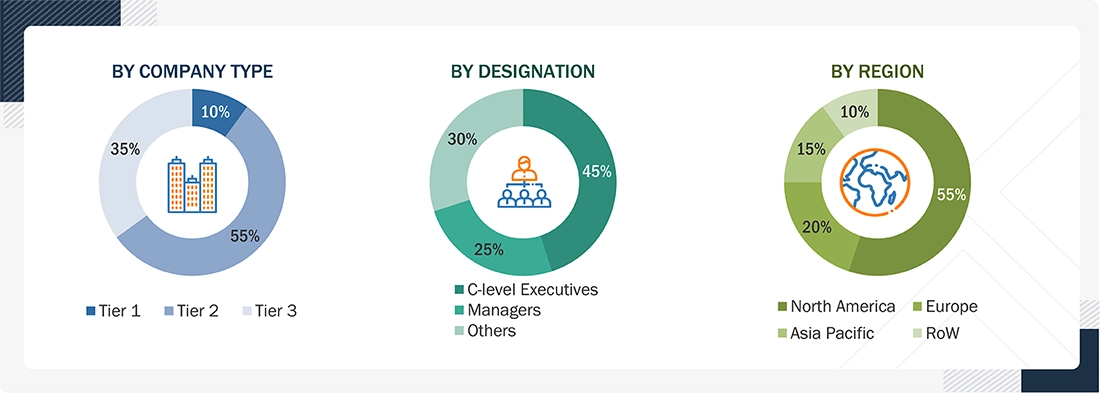
Extensive primary research was conducted after gaining knowledge about the current scenario of the Wireless gigabit market through secondary research. Several primary interviews were conducted with experts from the demand and supply sides across four major regions: North America, Europe, Asia Pacific, and RoW. This primary data was collected through questionnaires, emails, and telephone interviews.
To know about the assumptions considered for the study, download the pdf brochure
Market Size Estimation
Both top-down and bottom-up approaches were used to estimate and validate the Wireless gigabit market size and its various dependent submarkets. The key players in the market were identified through secondary research, and their market share in the respective regions was determined through primary and secondary research. This entire procedure involved the study of annual and financial reports of top players and extensive interviews with industry leaders such as chief executive officers (CEOs), vice presidents (VPs), directors, and marketing executives. All percentage shares and breakdowns were determined using secondary sources and verified through primary sources. All the possible parameters that affect the markets covered in this research study were accounted for, viewed in extensive detail, verified through primary research, and analyzed to obtain the final quantitative and qualitative data. This data was consolidated and supplemented with detailed inputs and analysis from MarketsandMarkets and presented in this report.
Bottom-Up Approach and Top-Down Approach
The bottom-up approach was used to determine the overall size of the wireless gigabit market based on the revenues of the key players and their shares in the market. The overall market size was calculated based on the revenues of the key players identified in the market.
- Identifying various end-use industries using or expected to implement Wireless Gigabit
- Identifying various end users using or expected to implement Wireless Gigabit
- Analyzing each end user, along with the significant related companies and Wireless gigabit providers
- Estimating the Wireless gigabit market for end user
- Understanding the demand generated by companies operating across different end-user
- Tracking the ongoing and upcoming implementation of projects based on Wireless gigabit technology by end users and forecasting the market based on these developments and other critical parameters
- Carrying out multiple discussions with key opinion leaders to understand the type of Wireless gigabit products designed and developed vertically, helping analyze the breakdown of the scope of work carried out by each significant company in the Wireless gigabit market
- Arriving at the market estimates by analyzing Wireless gigabit companies as per their countries and subsequently combining this information to arrive at the market estimates by region
- Verifying and cross-checking the forecasts at every level through discussions with the key opinion leaders, including CXOs, directors, and operations managers, and finally with domain experts at MarketsandMarkets
- Studying various paid and unpaid sources of information, such as annual reports, press releases, white papers, and databases
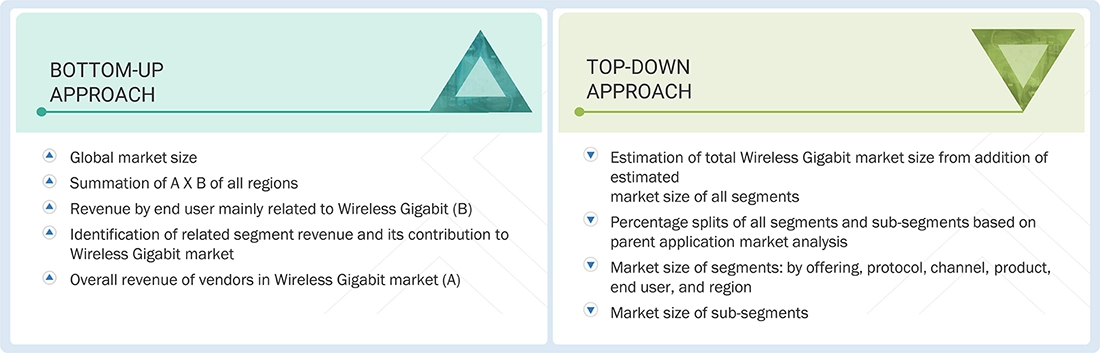
In the top-down approach, the overall market size has been used to estimate the size of the individual markets (mentioned in the market segmentation) through percentage splits from secondary and primary research.
The most appropriate immediate parent market size has been used to implement the top-down approach to calculate the market size of specific segments. The top-down approach was implemented for the data extracted from the secondary research to validate the market size obtained.
Each company's market share was estimated to verify the revenue shares used earlier in the top-down approach. This study determined and confirmed the overall parent and individual market sizes using the data triangulation method and validating data through primaries. The data triangulation method is explained in the next section.
- Focusing on top-line investments and expenditures being made in the ecosystems of various end-user
- Building and developing the information related to the market revenue generated by critical Wireless gigabit solution providers
- Conducting multiple on-field discussions with the key opinion leaders involved in the development of Wireless gigabit products in various end-user
- Estimating geographic splits using secondary sources based on numerous factors, such as the number of players in a specific country and region, the offering of Wireless gigabit, and the level of solutions offered by end-user
Data Triangulation
After arriving at the overall market size from the above estimation process, the market has been split into several segments and subsegments. The data triangulation procedure has been employed wherever applicable to complete the overall market engineering process and arrive at the exact statistics for all segments and subsegments. The data has been triangulated by studying various factors and trends from both the demand and supply sides. Additionally, the market size has been validated using top-down and bottom-up approaches.
Market Definition
Wireless Gigabit (WiGig) is a high-speed wireless communication technology operating in the 60 GHz frequency band. It is designed to provide very fast data rates over short distances, making it ideal for high-bandwidth and low-latency applications such as AR/VR devices, HD video streaming, online gaming, and more. WiGig technology follows the IEEE 802.11ad and IEEE 802.11ay standard protocols, enabling multi-gigabit speeds up to 7 Gbps.
Key Stakeholders
- Technology Developers and Standardization Bodies
- Semiconductor Manufacturers
- Device Manufacturers
- Network Equipment Manufacturers
- Telecommunications Providers
- Software and Application Developers
- Enterprise Users and End Consumers
- Regulatory Bodies and Governments
- Research and Academic Institutions
- Investors and Venture Capitalists
Report Objectives
- To define, describe, and forecast the Wireless gigabit (WiGig) market by offering, protocol, channel, product, use case, end user, and region
- To forecast the size of the market segments for four major regions—North America, Europe, Asia Pacific, and the Rest of the World (RoW)
- To provide detailed information regarding the major factors influencing the growth of the market (drivers, restraints, opportunities, and challenges)
- To strategically analyze micromarkets concerning individual growth trends, prospects, and contributions to the total market
- To provide a detailed overview of the Wireless gigabit (WiGig) market’s value chain, the ecosystem, technology trends, use cases, regulatory environment, and Porter’s five forces analysis.
- To strategically profile the key players and comprehensively analyze their market shares and core competencies
- To analyze the opportunities in the market for stakeholders and describe the competitive landscape of the market
- To analyze competitive developments, such as partnerships, product developments, and research & development (R&D), in the market
Available Customizations
With the given market data, MarketsandMarkets offers customizations according to the specific requirements of companies. The following customization options are available for the report:
- Detailed analysis and profiling of additional market players (up to 5)
- Additional country-level analysis of the Wireless gigabit market
Product Analysis
- The product matrix provides a detailed comparison of each company's product portfolio in the wireless gigabit market.
Frequently Asked Questions:
What are the major driving factors and opportunities for the wireless gigabit market?
Some of the major driving factors for the growth of this market include the growing demand for HD video streaming, increased adoption of AR/VR devices, proliferation of smart devices, and a rise in investment in high-speed internet. Moreover, the rising deployment of 5G networks, the increasing prevalence of smart city initiatives, and increasing investments in vehicle-to-everything (V2X) communication are critical opportunities for the wireless gigabit market.
Which region is expected to hold the largest market share?
The North American WiGig market is emerging, providing a cutting-edge digital network in the region supported by early adoption of new technology and heavy investment in deploying 5G networks. WiGig is emerging as an essential technology for delivering ultra-fast wireless connections, a must-have due to the popularity of HD video streaming and other bandwidth-heavy applications such as remote work solutions or AR/VR. North America also holds a significant market position, focusing on smart cities, IT, IoT development, etc. These factors contribute to the growth of the wireless gigabit market in North America.
Who are the leading players in the global wireless gigabit market?
Companies such as Peraso Technologies Inc. (US), Tensorcom, Inc. (US), Sivers Semiconductors AB (Sweden), STMicroelectronics (Switzerland), and Qualcomm (US) are the leading players in the market.
What are some of the technological advancements in the market?
Increased innovation in the chipsets and modules has significantly improved the power consumption and range limitations. WiGig integration with 5G networks is transforming wireless backhaul, meeting modern networks' high-speed and low-latency needs. In addition, more effective beamforming technology and spectrum management allow for stronger signals with less interference, even in crowded areas. These technological advancements are fuelling the development of advanced WiGig-powered products, such as high-resolution wireless displays and AR/VR headsets to home automation devices, expanding this market's adoption and growth.
What are some macroeconomic factors impacting the wireless gigabit market?
Macroeconomic factors such as interest rates, inflation, GDP growth, unemployment, and debt will significantly impact the wireless gigabit market in the coming years. These factors highly depend on government initiatives, enterprise investments, borrowing costs, and research and development spending. High inflation leads to an increase in interest rates, restricting businesses from minimizing spending on advanced wireless communication technology research and development. Reduced wireless communication technology investments may delay the development of advanced wireless solutions, impacting the wireless gigabit market growth.
To speak to our an
Fact checked
Personalize This Research
- Triangulate with your Own Data
- Get Data as per your Format and Definition
- Gain a Deeper Dive on a Specific Application, Geography, Customer or Competitor
- Any level of Personalization
Let Us Help You
- What are the Known and Unknown Adjacencies Impacting the Wireless Gigabit Market
- What will your New Revenue Sources be?
- Who will be your Top Customer; what will make them switch?
- Defend your Market Share or Win Competitors
- Get a Scorecard for Target Partners

Custom Market Research Services
We Will Customise The Research For You, In Case The Report Listed Above Does Not Meet With Your Requirements
Get 10% Free CustomisationTESTIMONIALS

Tetsuya Ohhira
Business Development Manager-Technology Business
Nikon Corporation,
Leading Japanese MNC specializing in optics and imaging productswww.nikon.com
MarketsandMarkets™ response
is quick. Their attitude is flexible and positive. Analyst Insights are globally considered and
significant. Client Services quickly respond to our inquiry and demand. Their wide range of global
surveys help us make our strategic plan.
We hope Knowledge Store will be easier to search
for a report.
VP - Marketing & Business Development
Leading Provider of Process Control Solutions
We engaged with MarketsandMarkets on a study to perform an analysis and recommend a Go-To-Market strategy for metrology and process control in the semiconductor market. The study was tailored to our targets and needs with well-defined milestones. Our overall experience with the MarketsandMarkets team was very good throughout the project in all aspects including the analysis methodologies used, the quality and depth of primary and secondary data sets, the professionalism and flexibility of the team and the ability to meet the target schedule and milestones. We want to thank MarketsandMarkets team for a job well done.
- US Wireless Gigabit Market
- Canada Wireless Gigabit Market
- Mexico Wireless Gigabit Market
- Germany Wireless Gigabit Market
- UK Wireless Gigabit Market
- France Wireless Gigabit Market
- Italy Wireless Gigabit Market
- Rest Of Europe Wireless Gigabit Market
- China Wireless Gigabit Market
- Japan Wireless Gigabit Market
- South Korea Wireless Gigabit Market
- Rest Of Asia Pacific Wireless Gigabit Market
- GCC Countries Wireless Gigabit Market
- Rest Of Middle East Wireless Gigabit Market
Growth opportunities and latent adjacency in Wireless Gigabit Market






Jesse
Apr, 2026
Why are network infrastructure devices dominating growth in the wireless gigabit ecosystem.
Gerald
Apr, 2026
Can niche players like Jiangsu Creatcomm Technologies Co., Ltd. and Common Networks, Inc. disrupt established telecom giants?.