Adhesion Promoter Market

Adhesion Promoter Market by Type (Silane, Maleic Anhydride, Chlorinated Polyolefins, Titanate & Zirconate), Application (Plastics & Composites, Paints & Coatings, Rubber, Adhesives, Metals), Region - Global Forecast to 2031




ADHESION PROMOTER MARKET
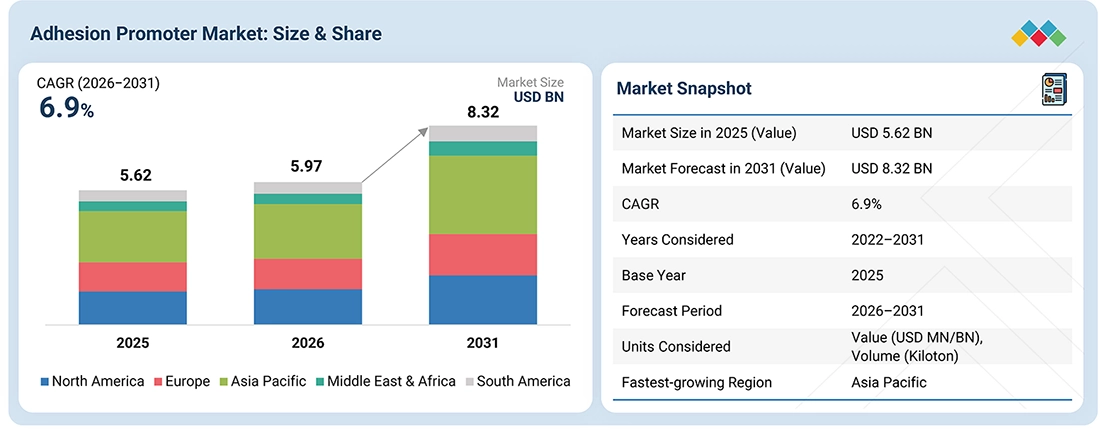
Source: Secondary Research, Interviews with Experts, MarketsandMarkets Analysis | Updated on : September 16, 2026
The adhesion promoter market is projected to grow from USD 5.97 billion in 2026 to USD 8.32 billion by 2031, at a CAGR of 6.9% during the forecast period. The market is growing at a steady pace, fueled by rising demand in high-performance plastics & composites, paints & coatings, rubber, adhesives, and other material-related applications. This growth is supported by the increasing use of lightweight and multi-material assemblies in vehicles, construction, packaging, and other sectors, where adhesion promoters help improve adhesion between different materials. Moreover, the rise in electrification of vehicles, the use of more recycled and engineered materials, and the growth of construction and infrastructural activities are contributing to an increase in the demand for adhesion promoters.
KEY TAKEAWAYS
-
By RegionAsia Pacific is projected to grow at the highest CAGR of 7.5%, in terms of value, during the forecast period.
-
By TypeBy type, the silane segment accounted for a share of 39.0%, in terms of value, of the overall market in 2025.
-
By ApplicationBy application, the plastics & composites segment accounted for the largest share of 31.0%, in terms of value, in 2025.
-
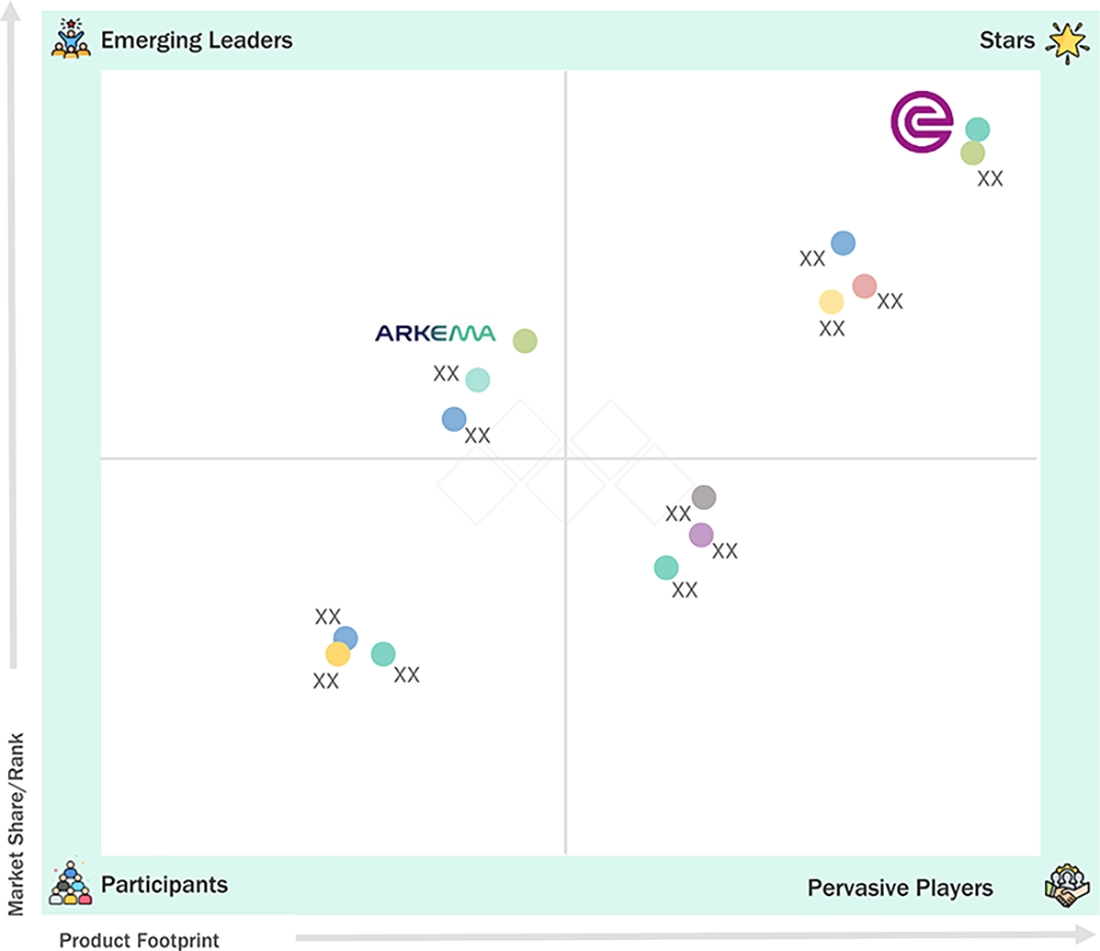
Competitive Landscape - Key PlayersEvonik Industries AG, BYK, Momentive Performance Materials Inc., Dow, and Wacker Chemie AG were identified as star players in the adhesion promoter market, given their strong market share and product footprint.
-
Competitive Landscape - StartupsKleberco, Guangzhou Deco Chemical Technology Co., Ltd., and Opal Paints Products Private Limited, among others, have distinguished themselves as startups and SMEs by establishing strong footholds in specialized niches, underscoring their potential as emerging market leaders.
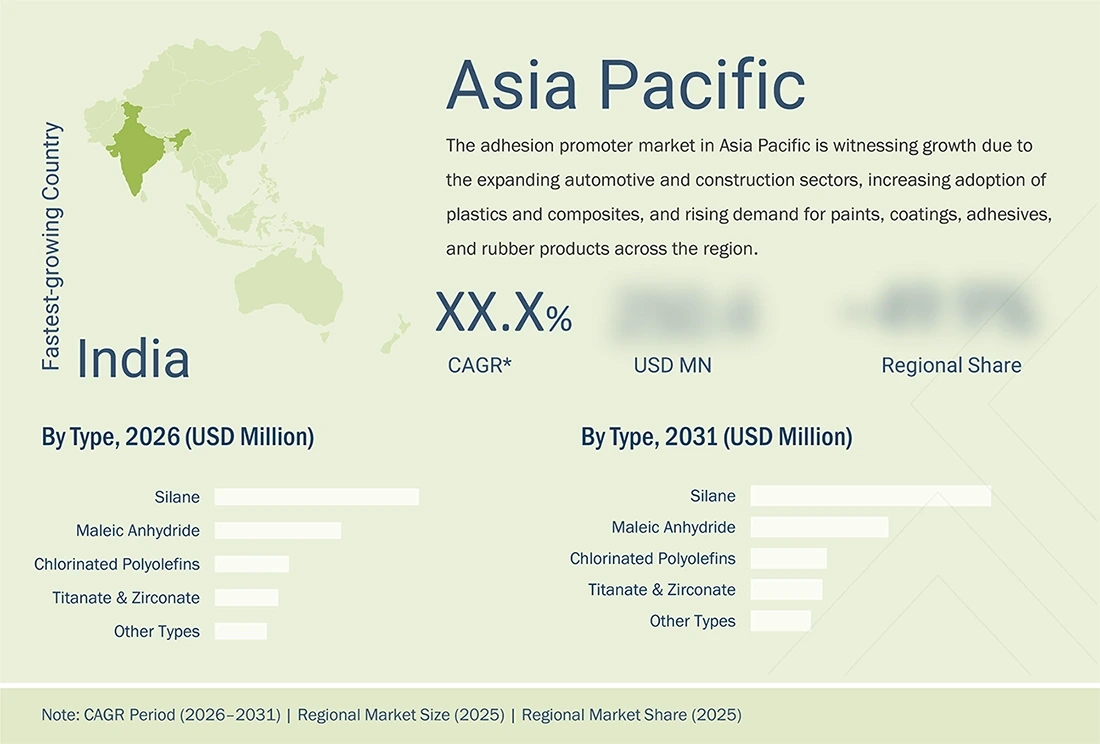
Industrialization, automobile production, and construction activities are driving demand for lightweight, high-strength materials. Furthermore, the increasing application of plastics & composites, paints & coatings, rubber, and adhesives, along with increased manufacturing capacity and cost-effective manufacturing process have been aiding the adoption of adhesion promoters in Asia Pacific countries. Multi-material parts, recycled material usage, and advanced formulations are also some of the factors that are contributing to the growth of the adhesion promoter market in the region.
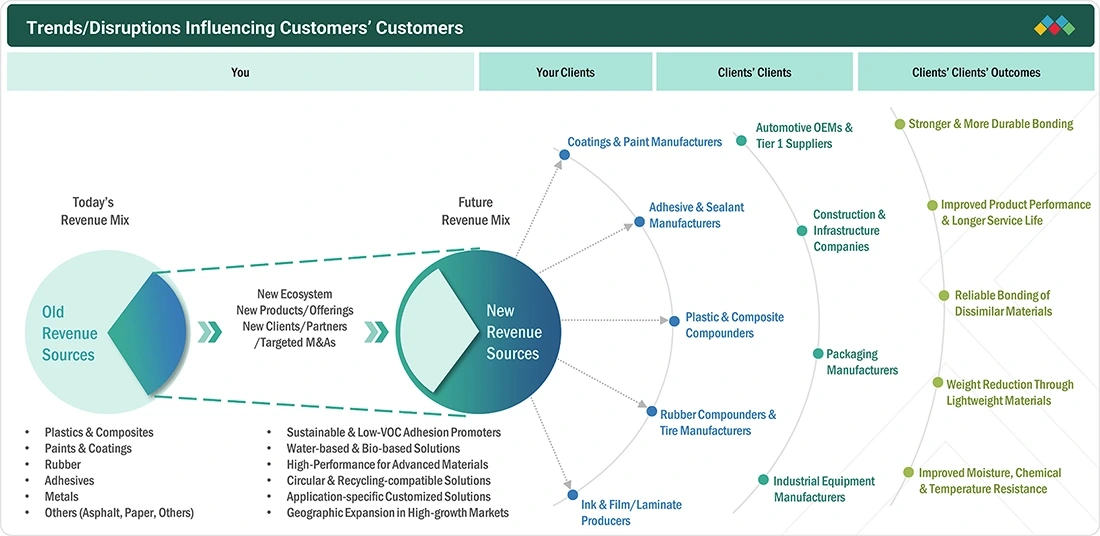
TRENDS & DISRUPTIONS IMPACTING CUSTOMERS' CUSTOMERS
Revenue in the adhesion promoter market is shifting from a volume-driven model to a more value-added revenue model due to changing end-user requirements, material innovations and increased regulatory pressure. Currently, major revenue streams in the adhesion promoters market include plastics & composites, paints & coatings, rubber, adhesives, metals, and other industrial uses. The use of adhesion promoters in these applications offers advantages in terms of increasing interfacial bonding, increasing durability, and ensuring compatibility of different materials. In the future, it is expected that revenues will shift more towards lightweight, multi-material automotive parts, electric vehicles & battery applications, recycled & advanced plastics, sustainable & low-VOC paints & coatings, high-performance adhesives, tire applications, and asphalt & infrastructure materials.
Source: Secondary Research, Interviews with Experts, MarketsandMarkets Analysis
MARKET DYNAMICS

Level
-
Growing adoption of lightweight plastics, composites, and multi-material structures

-
Accelerating vehicle electrification and adoption of multi-material automotive architectures


Level
-
Increasing environmental and regulatory compliance requirements

-
Raw material price volatility and supply chain Instability


Level
-
Development of sustainable, low-VOC, water-based, and bio-based adhesion promoters

-
Growing demand for adhesion promoters in asphalt


Level
-
Performance gaps on low-surface-energy, recycled, and next-generation substrates

-
Balancing adhesion performance with recyclability and circularity requirements

Source: Secondary Research, Interviews with Experts, MarketsandMarkets Analysis
Driver: Growing adoption of lightweight plastics, composites, and multi-material structures
The increasing use of lightweight plastics, composites, and multi-material structures across automotive, electronics, aerospace, construction, and industrial applications is driving demand for adhesion promoters. Manufacturers are increasingly replacing conventional metals and single-material constructions with thermoplastics, glass fiber-reinforced polymers, carbon fiber composites, and aluminum to reduce weight, improve energy efficiency, and enable greater design flexibility. However, differences in surface characteristics, chemical composition, and surface energy can make bonding between dissimilar materials challenging. Adhesion promoters improve interfacial compatibility and bonding, enabling the broader use of adhesives, coatings, and composite formulations. In automotive applications, the rising usage of polymer-metal, polymer-composites, and composite-composite interfaces has led to an increased demand for application-specific adhesion promoters. As multi-material assemblies become common, there will be an increased demand for adhesion promoters in plastics & composites, adhesives, coatings, and surface treatment applications.
Restraint: Raw material price volatility and supply chain instability
Volatility in the price of raw materials acts as a significant restrain in the adhesion promoters market. The price of specialty and commodity chemicals are affected by the price of energy, demand for chemicals, capacity, and geopolitical factors. Silane-based adhesion promoters are based on silicon based intermediates, whereas maleic anhydride grafted adhesion promoters are based on petrochemical raw materials. Variability in the prices of these raw materials will affect the cost of production, making it difficult for manufacturers to maintain stable prices. Another supply side risk is due to the concentration of production of the key raw materials in some geographical areas. According to USGS estimates in 2024, China produced 87% of the world’s total silicon-metal.
Opportunity: Growing demand for adhesion promoters in asphalt
With an increased interest in pavement longevity and moisture damage prevention, adhesion promoters could find increasing applications in the asphalt industry. Silane adhesion promoters could help improve the interactions between the asphalt binder and the mineral aggregate, thus improving the binder-aggregate interface and enhancing resistance to moisture damage. Scientific literature proves the improved adhesion between asphalt and aggregates due to the silane coupling agent, whereas further developments of silane technology for asphalt interfaces would enable its application in pavement construction. With a growing emphasis on pavement longevity and moisture damage prevention, the implementation of adhesion promoters in asphalt/bitumen technologies could increase.
Challenge: Balancing adhesion performance with recyclability and circularity requirements
With the focus shifting toward recycling and circular materials, there exists a technical issue for adhesion promoter manufacturers, wherein the strong bond between dissimilar materials makes it hard to separate, recycle and reprocess them when they reach their end-of-life stage. The relevance of this issue is especially true for multiple materials applications in fields such as automotive, packaging, electronics and composite, where bonded parts may make their separation complicated. On the other hand, with the rise in the use of recycled polymers, the adhesion promoter needs to ensure the bonding strength and durability without compromising on the quality of the recycled materials.
ADHESION PROMOTER MARKET: COMMERCIAL USE CASES ACROSS INDUSTRIES
| COMPANY | USE CASE DESCRIPTION | BENEFITS |
|---|---|---|
 |
DYNASYLAN silanes are used as adhesion promoters, coupling agents, and surface modifiers in coatings, paints, metal treatment, adhesives, sealants, plastics, fillers, and glass fibers. They are also used in automotive, construction, and electronics applications. | Creates molecular bridges between organic and inorganic materials, improving adhesion, compatibility, and durability. In coatings, DYNASYLAN products can improve bonding to glass, metal, and plastics while enhancing chemical resistance and durability. |
 |
SilQuest, CoatOSil, and other silane technologies are used as adhesion promoters and coupling agents in paints, coatings, adhesives, sealants, plastics, composites, and tire/rubber applications. | Improve interfacial bonding, adhesion, durability, and resistance to water, chemicals, heat, and abrasion. In tire and rubber applications, silane coupling agents can improve rolling resistance, wet traction, abrasion resistance, and composite toughness. |
 |
DOWSIL adhesion promoters and primers are used for plastic, rubber, glass, metal, masonry, wood, granite, and coating substrates, including automotive sealants and other adhesive applications. | Improve adhesion between sealants, adhesives, coatings, rubber, and difficult substrates. DOWSIL™ APZ-6601, for example, improves adhesion between adhesives and plastic, glass, metal, and rubber surfaces. |
 |
BASF's Lupasol products are used as adhesion promoters in adhesives, printing inks, car tires, plastics modification, and multilayer packaging films. Loxanol products are also used to promote adhesion in coatings, inks, and packaging applications. | Improve bonding between different materials, including plastics and polar substrates. In multilayer packaging, Lupasol® and Loxanol® products improve adhesion between films, coatings, inks, and substrates and can enable lower-temperature sealing. |
 |
Wetfix, Redicote, and Kling Beta adhesion promoters/antistrips are used in asphalt and bitumen applications, including hot/warm mix, chip seal, cutback applications, and patch mix. | It creates a strong chemical bond between bitumen and aggregate that is resistant to water, helping improve pavement durability and life expectancy. |
Logos and trademarks shown above are the property of their respective owners. Their use here is for informational and illustrative purposes only.
MARKET ECOSYSTEM
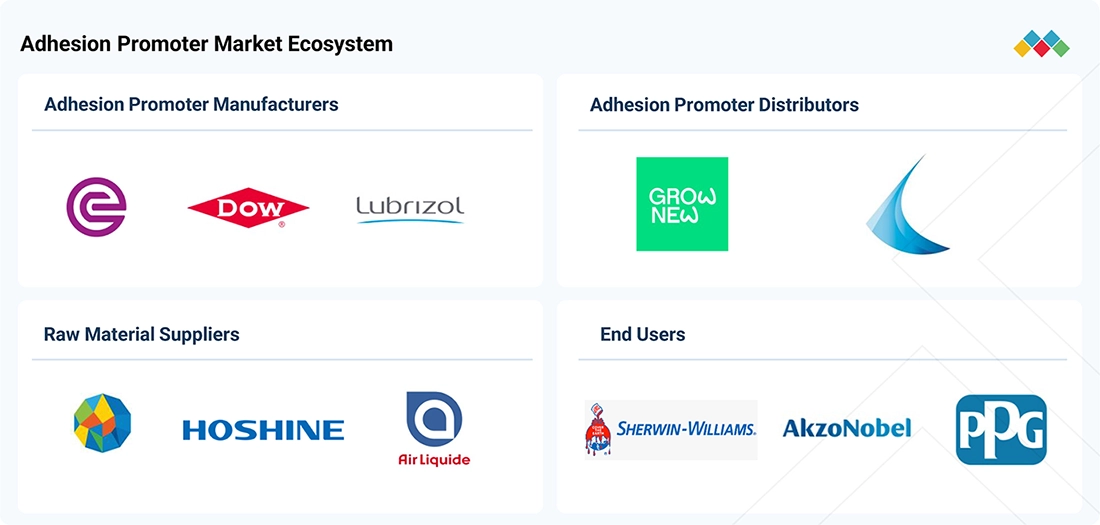
The adhesion promoter market ecosystem is highly integrated and consists of a robust network of manufacturers, raw material suppliers, distributors, and end-use industries. The ecosystem consists of raw material suppliers (e.g., Ferroglobe, Hoshine Silicon Industry Co., Ltd.), producers (e.g., Evonik Industries AG, Dow), distributors (e.g., Grolman Group, Safic-Alcan), and end users (e.g., The Sherwin-Williams Company, PPG Industries, Inc.). Adhesion promoters are used in applications such as paints & coatings and plastics & composites. Together, this interconnected ecosystem fosters product innovation, ensures stable supply chains, and supports strong market growth.
Logos and trademarks shown above are the property of their respective owners. Their use here is for informational and illustrative purposes only.
MARKET SEGMENTS
Source: Secondary Research, Interviews with Experts, MarketsandMarkets Analysis
Adhesion Promoter Market, By Type
Silane accounts for the major share of the overall adhesion promoter market. It is widely used in plastics & composites, paints & coatings, rubber, and adhesives. Maleic anhydride adhesion promoter is also useful in ensuring compatibility and bonding of different kinds of polymers and materials. Chlorinated polyolefins are extensively used wherever increased adhesion is needed on low-surface-energy substrates like polyolefins, especially in coatings and the automotive industry. Titanate & zirconate adhesion promoters enhance the interaction between organic polymers and inorganic fillers, pigments, and substrates in applications such as plastics, coatings, and composites. Increasing use of lightweight plastic & composite, multi-material constructions, coatings, and adhesives is driving the demand for these adhesion promoters.
Adhesion Promoter Market, By Application
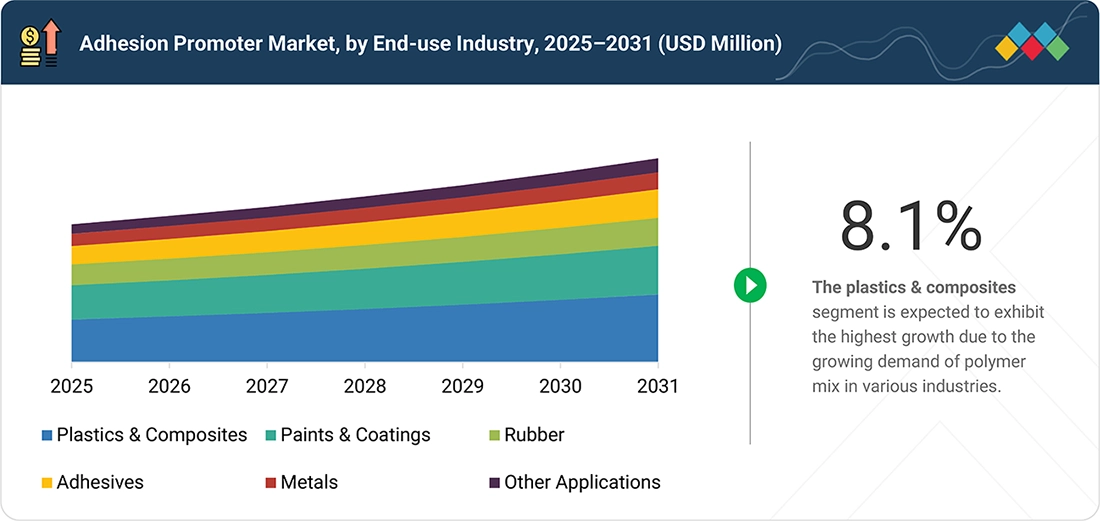
The plastics & composites segment is estimated to be the largest application of adhesion promoters. This is attributed to the increased use of lightweight plastic materials and glass fiber-reinforced composites in automotive, construction, electronic and industrial sectors. Paints & coatings form another major application segment, where adhesion promoters help improve coating adhesion to difficult substrates. The adhesion promoter market in the rubber application segment is driven by the rising use to increase the bonding strength between rubber compounds and reinforcement materials such as tire and industrial rubber products. Adhesives use adhesion promoters to improve bonding between dissimilar substrates and ensure bond durability. For metals, adhesion promoters help improve the bonding of coatings, adhesives and polymeric materials to the metal surface.
REGION
Asia Pacific is estimated to account for the largest market share during the forecast period.
Asia Pacific is expected to remain the dominant market for adhesion promoters during the forecast period. The well-developed manufacturing industry in China, India, Japan, and South Korea is driving regional market growth. Growth in the automotive industry and its need for lightweight plastics, composites, and multi-material components fuel market growth. At the same time, more and more construction and infrastructure projects require coatings and adhesives with enhanced adhesion capabilities. In addition, the availability of major chemical companies, raw materials, and cost-effective production are other advantages of this region for adhesion promoter production and distribution.
ADHESION PROMOTER MARKET: COMPANY EVALUATION MATRIX
Evonik Industries AG (Star) maintains a strong position in the adhesion promoters market through its broad portfolio of DYNASylan silane products, extensive application expertise, and established presence across coatings, adhesives, sealants, plastics, and composites. BASF (Emerging Player) is strengthening its position through its portfolio of adhesion-promoting solutions, including Lupasol and other specialty additives used across adhesives, coatings, plastics, packaging, and rubber applications. Evonik sustains its strong market position through its established product portfolio, global presence, and technical capabilities across diverse substrate and formulation requirements, while BASF is expanding its presence by leveraging its broad specialty chemicals portfolio, application expertise, and growing demand for high-performance adhesion solutions across multiple end-use industries.
Source: Secondary Research, Interviews with Experts, MarketsandMarkets Analysis
KEY MARKET PLAYERS
- Evonik Industries AG (Germany)
- BYK (Germany)
- Momentive Performance Materials Inc. (US)
- Dow (US)
- Wacker Chemie AG (Germany)
- 3M (US)
- Eastman Chemical Company (US)
- Rust-Oleum Corporation (US)
- Nouryon (Netherlands)
- Arkema (France)
- BASF (Germany)
- AkzoNobel N.V. (Netherlands)
- PPG Industries, Inc. (US)
- Lubrizol (US)
- EMS-CHEMIE HOLDING AG (Switzerland)
- The Sherwin-Williams Company (US)
- MEC Company (Japan)
- Huntsman (US)
- Lanxess (Germany)
MARKET SCOPE
| REPORT METRIC | DETAILS |
|---|---|
| Market Size in 2025 (Value) | USD 5.62 Billion |
| Market Forecast in 2026 | USD 5.97 Billion |
| Market Forecast in 2031 | USD 8.32 Billion |
| Growth Rate | CAGR of 6.9% from 2026-2031 |
| Years Considered | 2022–2031 |
| Base Year | 2025 |
| Forecast Period | 2026–2031 |
| Units Considered | Value (USD Million/Billion) and Volume (Kiloton) |
| Report Coverage | Revenue forecast, company ranking, competitive landscape, growth factors, and trends |
| Segments Covered |
|
| Regional Scope | North America, Europe, Asia Pacific, Middle East & Africa, South America |
WHAT IS IN IT FOR YOU: ADHESION PROMOTER MARKET REPORT CONTENT GUIDE
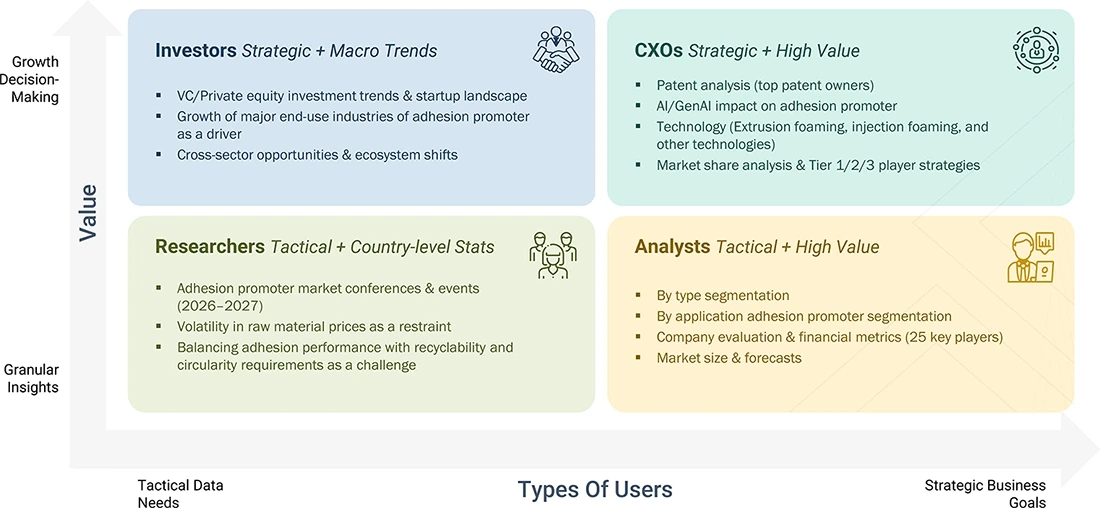
DELIVERED CUSTOMIZATIONS
We have successfully delivered the following deep-dive customizations:
| CLIENT REQUEST | CUSTOMIZATION DELIVERED | VALUE ADDS |
|---|---|---|
| Application-specific adhesion promoter insights | Evaluated the use of adhesion promoters across plastics & composites, paints & coatings, rubber, adhesives, metals, and other applications, with analysis of the bonding requirements and role of adhesion promoters across different material systems | Helps clients identify high-potential application areas and align product development and sales strategies with specific bonding requirements |
| Demand insights for different adhesion promoter types | Assessed silane, maleic anhydride, chlorinated polyolefins, and titanate & zirconate based on their application areas, substrate compatibility, performance requirements, and adoption across end-use applications | Supports product portfolio prioritization and helps manufacturers identify the most relevant chemistries for different customer and application requirements |
| Building & Construction Companies (Insulation, Panels, Roofing) |
|
|
| Insights on lightweight and multi-material applications | Analyzed the increasing use of plastics, composites, and multi-material structures in automotive, electronics, construction, and industrial applications and evaluated the resulting need for improved adhesion between dissimilar substrates | Helps companies identify opportunities for developing formulations aligned with evolving environmental requirements and customer sustainability objectives |
| Emerging application opportunities | Evaluated developing applications such as asphalt and advanced multi-material systems where improved adhesion, moisture resistance, durability, and material compatibility can provide performance benefits | Enables clients to identify emerging application areas and evaluate opportunities for portfolio expansion beyond established adhesion promoter uses |
RECENT DEVELOPMENTS
- February 2025 : Momentive Performance Materials and Jiangxi Hungpai New Material Co., Ltd. signed an agreement to establish a joint venture company that will be engaged in the manufacturing, promotion, and selling of silanes in Asia Pacific. This cooperation joins experience of Momentive worldwide with the manufacturing capacity of Hungpai and should help Momentive to implement the "in region for region" approach. This joint venture will improve supply responsiveness and help Momentive operate effectively in the rapidly developing Asia Pacific silanes market.
- July 2023 : Eastman's new range of Advantis adhesion promoters is aimed at paint and coating manufacturers. They are formulated to minimize or eliminate substances of concern, helping formulators comply with regulations and create sustainable, effective adhesion promoters. According to Eastman, the products are intended as replacements for conventional adhesion promoter formulations and can be supplied in solution, water dispersion, or resin form.
Table of Contents
 Exclusive indicates content/data unique to MarketsandMarkets and not available with any competitors.
Methodology
The research methodology used to estimate the current size of the adhesion promoters market consisted of four major activities: a) Extensive secondary research was performed to acquire detailed information about the market, peer markets, and parent markets; b) These findings, assumptions, and metrics were verified through primary research with experts from the demand and supply sides of the adhesion promoters value chain; c) Both top-down and bottom-up approaches were used to estimate the total market size; and d) The estimation of market sizes for various segments and subsegments in the market was finalized using complete market segmentation and data triangulation techniques.
Secondary Research
The research methodology for estimating and forecasting the adhesion promoters market begins with gathering data on key vendors' revenue by doing secondary research. The secondary research process involves consulting a range of secondary sources, including Hoover's, Bloomberg Businessweek, Factiva, the World Bank, and industry-specific journals. These secondary sources encompass annual reports, press releases, investor presentations, white papers, certified publications, articles from recognized authors, regulatory notifications, trade directories, and databases. Also, vendor offerings are taken into consideration to inform market segmentation.
Primary Research
The adhesion promoters market comprises several stakeholders, including raw material suppliers, processors, end-product manufacturers, and regulatory organizations, throughout the supply chain. The demand side of this market is characterized by the development of various industries, including plastics & composites, paints & coatings, rubber, adhesives, metals, and others. The supply side is characterized by advancements in technology and a wide range of diverse applications. Various primary sources from the supply and demand sides of the market were interviewed to obtain qualitative and quantitative information.
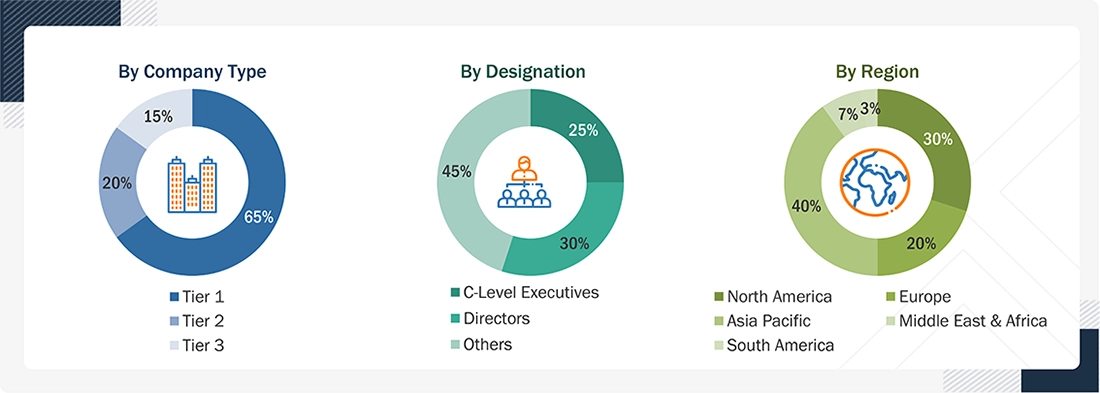
The following is the breakdown of the primary respondents:
To know about the assumptions considered for the study, download the pdf brochure
Market Size Estimation
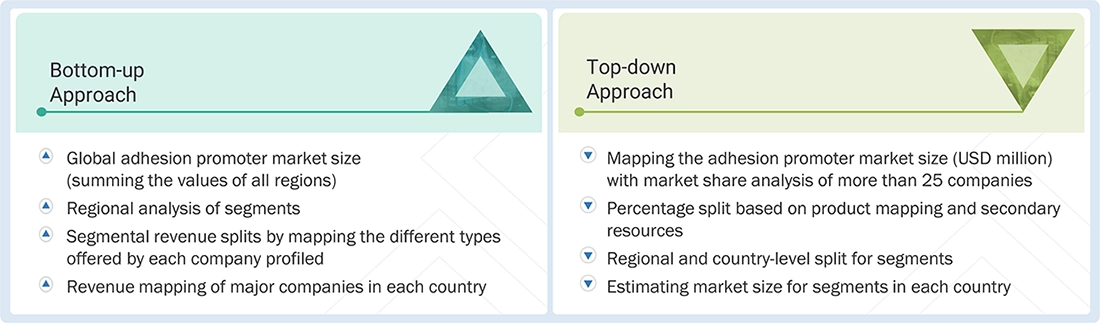
The top-down and bottom-up approaches were employed to estimate and validate the total size of the adhesion promoter market. These approaches were also used extensively to estimate the size of various dependent market subsegments.
The following considerations were made in these approaches:
- Extensive primary research and secondary research were done to identify the key players.
- The value chain and market size of the adhesion promoters market, in terms of value, were determined through primary and secondary research.
- All percentage shares, splits, and breakdowns were collected through secondary sources and verified through primary sources.
- All possible parameters that affect the market were covered in this research study and are viewed in extensive detail, verified through primary research, and analyzed to obtain the final quantitative and qualitative data.
- The study of reports, reviews, and newsletters of top market players, along with extensive interviews for opinions from key leaders, such as CEOs, directors, and marketing executives, is included in this research.
Adhesion Promoter Market : Top-Down and Bottom-Up Approach
Data Triangulation
After estimating the overall market size, the market was split into various segments and subsegments. Data triangulation and market segmentation techniques, along with the market engineering process, were employed to obtain precise market analysis data for each segment and its subsegments. The research methodology used to estimate and forecast the global market size began by aggregating data and information from various levels, including country-level data.
Market Definition
Adhesion promoters, also known as coupling agents or compatibilizers, are chemical additives that improve the bonding and interfacial compatibility between two dissimilar materials, particularly organic and inorganic surfaces. They function at the interface by promoting chemical or physical interactions between the materials, thereby overcoming differences in surface chemistry, polarity, reactivity, and thermal expansion. Adhesion promoters enhance adhesion strength, durability, and overall performance of the bonded system while improving resistance to moisture, heat, and other environmental conditions that can cause adhesion failure.
Key Stakeholders
- Adhesion promoter manufacturers, processors, and technology providers
- End-use industries, including plastics & composites, paints & coatings, rubber, adhesives, metals, and others
- Research institutions, standards organizations, and regulatory agencies such as ASTM, ISO, IAEA, and national materials authorities
- NGOs, governments, investment banks, venture capitalists, and private equity firms
Report Objectives
- To define, describe, and forecast the market size of adhesion promoters, in terms of value and volume
- To provide detailed information regarding the key factors, such as drivers, restraints, opportunities, and industry-specific challenges, influencing the growth of the market
- To analyze and forecast the size of various segments (type and application) of the market based on five major regions: North America, Europe, Asia Pacific, South America, and the Middle East & Africa, along with key countries in each of these regions
- To analyze recent developments and competitive strategies, including acquisition, product launch, and others, to understand the market's competitive landscape
- To strategically profile the key players in the market and comprehensively analyze their core competencies
Available customizations:
With the given market data, MarketsandMarkets offers customizations according to the client-specific needs.
The following customization options are available for the report:
- Additional country-level analysis of the adhesion promoter market
- Profiling of additional market players (up to 5)
Product Analysis
-
Product matrix, which provides a detailed comparison of each company's product portfolio


Personalize This Research
- Triangulate with your Own Data
- Get Data as per your Format and Definition
- Gain a Deeper Dive on a Specific Application, Geography, Customer or Competitor
- Any level of Personalization
Let Us Help You
- What are the Known and Unknown Adjacencies Impacting the Adhesion Promoter Market
- What will your New Revenue Sources be?
- Who will be your Top Customer; what will make them switch?
- Defend your Market Share or Win Competitors
- Get a Scorecard for Target Partners

Custom Market Research Services
We Will Customise The Research For You, In Case The Report Listed Above Does Not Meet With Your Requirements
Get 10% Free CustomisationTESTIMONIALS
We at Nissan Chemicals Corporation have been clients of MarketsandMarkets for more than a year now. We recently consulted MarketsandMarkets for a study, the team at MarketsandMarkets was extremely professional and organized. The business insights were very detailed and aligned well with our expectations that really helped us formulate the Business Plans and device new strategies for development themes. MarketsandMarkets offers a unique combination of expertise and dedicated engagement model. Their research findings have helped us in designing our Pricing Strategy which will make it easier for us to predict the future sales and profits for the next ten years. We look forward to working with MarketsandMarkets in the future.
VP of Strategy & New Business Development
Leading Specialty Chemical Company
The MarketsandMarkets Engagement Model, composed of both the Knowledge Store and advisory custom research, has greatly helped us in understanding our markets and making strategic decisions. The Knowledge Store is a fast way to allow everyone in our organization to understand more about most any market they are interested in. The ability to then get custom research done and get answers to specific strategic questions and market insight has been spectacular. The Markets and Markets team feel more like colleagues than vendors and their services have helped us change our culture where statements of things like growth opportunities and competitive position are always backed by industry research.

Rich Gibson,
Director, Corporate Strategy
Milliken & Company,
Leading Industrial Manufacturer of specialty chemical, floor covering, performance and protective textile materials, and healthcaremilliken.com
MarketsandMarkets is a trusted resource that helps us to better understand markets that are near-adjacencies-whether its technology, value chain or geography. Their Knowledge Store platform provides a dashboard of markets and their characteristics which is easy to use and saves us time.
Adam Shaw,
Market Development and Strategy Manager
AdvanSix Inc. USA,
An American Leader in Chemicalswww.advansix.com
The Knowledge Store from MarketsandMarkets is a valuable tool which has helped my team acquire greater insight in to the end markets that our business serves. This has enabled us to help our company build stronger strategies throughout our planning process.
TOSHIO KINOSHITA
Senior Chif Consultion Research & Consulting Division
Mitsubishi Chemical Research Corporation,
Leading Manufacturer of Chemical Productswww.mitsubishichem-res.co.jp/en/

We recently engaged with MarketsandMarkets for a study, the team not only clearly understood our business objectives but was also extremely professional in the way they handled the entire project. The study was efficiently conducted in a phase-wise manner, and the engagement model furnished us with high-quality business insights that far exceeded our expectations at each phase. We were especially happy that MarketsandMarkets could provide us with both, an English as well as a Japanese version of the study. A special thanks to the Analyst Team and Client Services Team, whose fluency in Japanese enhanced our comfort level, as we could converse with them in our preferred language.
Independent entrepreneurs
Arrow Precision
We approached MarketsandMarkets for study on Proppants Market, and their work exceeded our expectations. The study conducted was comprehensive and enabled us to view the market through the various dimensions. In addition, the team was extraordinarily responsive throughout the process and resolved our queries on time. I strongly recommend MarketsandMarkets and will certainly consider them for additional market assessments we will need in the future.
Global engineering company, Japan
Deputy Manager,
Strategic Planning OfficeThe high-quality insights shared by the MarketsandMarkets team helped us understand the pharmaceutical plant designers in a specific geography. It also captured the risks that we may likely face in communicating with our potential partners. The study would enable us identify partners, which would impact our future growth.






Growth opportunities and latent adjacency in Adhesion Promoter Market