



Agriculture Adjuvants Market Trends, Growth, and Forecast [Latest]
Report Code
AGI 3064
Published in
Oct, 2026, By MarketsandMarkets™
Agricultural Adjuvants Market by Formulation (Suspension Concentrates, Emulsified Concentrates), Adoption Stage (In-Formulation, Tank Mix), Function (Activator Adjuvants, Utility Adjuvants), Application, Crop Type & Region - Global Forecast to 2031

USD 5.64 BN
MARKET SIZE, 2031

CAGR 4.5%
(2026-2031)

300
REPORT PAGES

280
MARKET TABLES
OVERVIEW
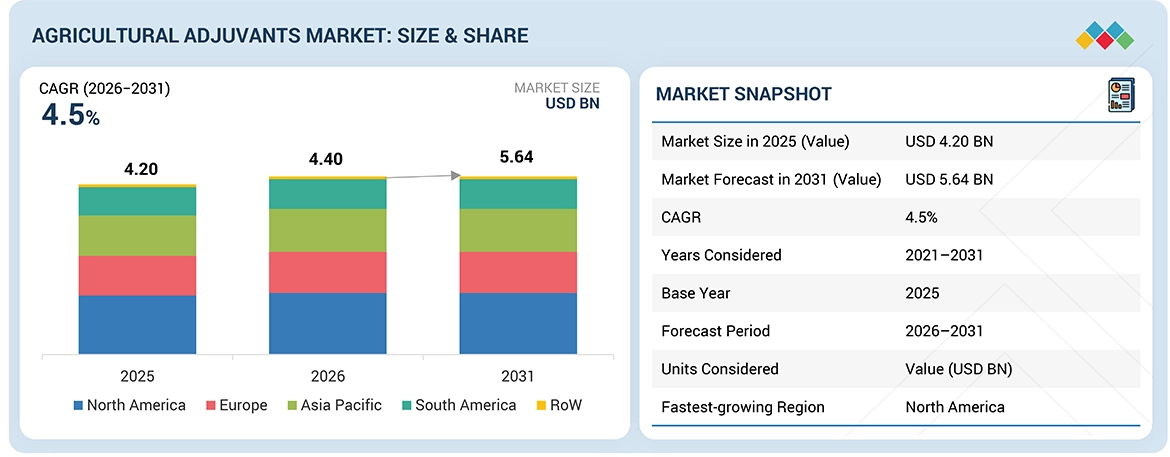
Source: Secondary Research, Interviews with Experts, MarketsandMarkets Analysis
The agricultural adjuvants market is projected to reach USD 5.64 billion by 2031 from USD 4.40 billion in 2026, at a CAGR of 4.5% from 2026 to 2031. The market is growing steadily as farmers are looking for ways to enhance the effectiveness of pesticides. The market is also driven by the changing regulations that focus on spray drift reduction and input management. Agricultural adjuvants have become an essential part of modern crop protection as the use of adjuvants has increased in cereals and grains, fruits and vegetables, and row crops. The agricultural adjuvants market is also driven by the increasing demand for adjuvants in developing countries.
Market Size and Forecast:
- Market Size Value in 2025: USD 4.20 Billion
- Market Size Value in 2026: USD 4.40 Billion
- Revenue Forecast in 2031: USD 5.64 Billion
- Growth Rate: CAGR of 4.5% from 2026 to 2031
- Data available from 2021 to 2031
- Base year: 2025
- Forecast period: 2026–2031
- North America is estimated to account for the largest market share of 34.6% in 2026.
- The tank-mix segment is expected to register a higher CAGR of 4.7% from 2026 to 2031.
Key Market Trends and Insights
- By Crop Type: Rising cultivation of cereals & grains, oilseeds & pulses, fruits & vegetables, and other high-value crops is boosting the adoption of agriculture adjuvants to enhance crop protection efficiency and productivity.
-
Key Advantages: Agriculture adjuvants improve pesticide performance, enhance spray coverage and absorption, reduce drift, and support higher crop yields.
-
Growing Trends: Adoption of precision agriculture, advanced spraying technologies, and sustainable farming practices is increasing the use of agriculture adjuvants.
- Growth Opportunities: Growing food demand, expansion of high-value crop cultivation, increased focus on efficient pesticide use, and supportive government initiatives are creating significant opportunities in the agriculture adjuvants market.
KEY TAKEAWAYS
-
BY REGIONNorth America is estimated to account for the largest market share of 34.6% in 2026.
-
BY ADOPTION STAGEBy adoption stage, the tank-mix segment is expected to register a higher CAGR of 4.7% from 2026 to 2031.
-
BY APPLICATIONBy application, the herbicides segment is expected to register the highest CAGR of 4.8% during the forecast period.
-
BY CROP TYPEBy crop type, the cereals and grains segment is projected to grow at the highest rate from 2026 to 2031.
-
BY FUNCTIONBy function, the activator adjuvants segment is estimated to dominate the market.
-
BY FORMULATIONBy formulation, the emulsifiable concentrates segment is estimated to account for a significant market share.
-
COMPETITIVE LANDSCAPECorteva Agriscience, Wilbur-Ellis Company LLC, WinField United, and Precision Laboratories LLC were identified as some of the star players in the agricultural adjuvants market, given their strong market share and product footprint.
The agricultural adjuvants market is expected to experience steady growth owing to the demand from farmers for environmentally friendly methods of crop protection. The market growth is also attributed to new microbial and biochemical products entering the market and existing integrated pest management (IPM) systems gaining wider acceptance from farmers. The agricultural industry identifies biopesticides as a highly promising growth sector because farmers now use biological products in their crop protection programs across all major crop categories, including fruits, vegetables, and row crops.
TRENDS & DISRUPTIONS IMPACTING CUSTOMERS' CUSTOMERS
The global market for agricultural adjuvants is moving in the direction of sustainable and efficiency-driven crop protection strategies. Increasing regulatory pressure related to the use and application of pesticides and the increasing awareness level related to the quality of the spray water are the major factors driving the demand for water conditioners, buffering agents, and anti-foaming agents. Increasing awareness levels related to the quality of pesticides and the impact of hard water and pH imbalance on the efficacy and efficiency of the pesticides are driving the market for spray solution management technologies. Increasing innovation in formulation and spray solution diagnostic tools is helping the development of multi-functional and eco-friendly utility adjuvants.

Source: Secondary Research, Interviews with Experts, MarketsandMarkets Analysis
MARKET DYNAMICS

Drivers
Impact
Level
Level
-
Growing adoption of precision agriculture

-
Stringent environmental regulations


RESTRAINTS
Impact
Level
Level
-
Strict regulatory approval processes for formulation components

-
Performance variability under diverse climatic and crop conditions


OPPORTUNITIES
Impact
Level
Level
-
Rising demand for sustainable agricultural inputs

-
Herbicide resistance concerns driving demand for advanced surfactant technologies


CHALLENGES
Impact
Level
Level
-
Raw material price volatility

-
Ongoing compatibility requirements with new pesticide formulations

Source: Secondary Research, Interviews with Experts, MarketsandMarkets Analysis
Driver: Growing adoption of precision agriculture
The growing use of precision agriculture methods and advanced spraying technology is a major driving force behind the demand for high-performance adjuvants, as farmers are increasingly turning to the use of GPS-guided systems, drone spraying, sensor-based field mapping, and variable rate application equipment that require optimized droplet spectrum control, superior canopy penetration, enhanced surface wetting, and reduced off-target drift to maximize pesticide performance, reduce total chemical use, improve efficiency, and optimize return on investment in large-scale and high-value crop production systems.
Restraint: Strict regulatory approval processes for formulation components
The stringent regulatory approval procedures for surfactants, oils, polymers, and specialty formulation ingredients may result in longer development times for products, increased expenses for regulatory compliance, and decreased flexibility of formulations in key agricultural areas.
Opportunity: Rising demand for sustainable agricultural inputs
The increasing global focus on sustainable agriculture and responsible management of agricultural inputs creates a substantial opportunity for growth for bio-based, low-toxicity, and biodegradable adjuvants, especially those produced from renewable resources, as farmers look for solutions that meet the requirements of residue compliance, sustainability, carbon reduction, and integrated crop management.
Challenge: Raw material price volatility
Raw material price volatility, particularly petroleum-based surfactants, specialty emulsifiers, and performance additives, poses a significant cost challenge to the manufacturing sector, and supply chain disruptions, energy price volatility, transportation challenges, and geopolitical tensions also affect the agricultural adjuvants market in terms of procurement stability and pricing strategies.
AGRICULTURE ADJUVANTS MARKET TRENDS, GROWTH, AND FORECAST [LATEST]: COMMERCIAL USE CASES ACROSS INDUSTRIES
| COMPANY | USE CASE DESCRIPTION | BENEFITS |
|---|---|---|
 |
Application of microbial bioinsecticides in corn and soybean farming | Enhances targeted pest control, minimizes residues, and supports sustainable row-crop systems |
 |
Use of Bacillus-based biofungicides in fruits and vegetables | Strengthens disease management, improves crop quality, and meets residue-free requirements |
 |
Integration of botanical and microbial biopesticides in specialty crops | Provides broad-spectrum protection and supports IPM while reducing synthetic pesticide use |
 |
Use of biofungicides and seed-applied biologicals in cereals and grains | Improves early-stage protection, enhances plant vigor, and promotes sustainable crop production |
Logos and trademarks shown above are the property of their respective owners. Their use here is for informational and illustrative purposes only.
MARKET ECOSYSTEM
Some of the prominent companies in this market include well-established and financially sound manufacturers of biopesticide products. These companies have been operational in the market for over a decade and have diversified portfolios, latest technologies, and excellent global sales and marketing networks. The market ecosystem comprises manufacturers, regulatory bodies, and end users. Key manufacturers like Corteva Agriscience, Valent BioSciences, Certis Biologicals, and BASF develop microbial, botanical, and biochemical solutions.

Logos and trademarks shown above are the property of their respective owners. Their use here is for informational and illustrative purposes only.
MARKET SEGMENTS

Source: Secondary Research, Interviews with Experts, MarketsandMarkets Analysis
Agricultural Adjuvants Market, By Function
The activator adjuvants segment is estimated to lead the agricultural adjuvants market. The capacity to reduce surface tension, improve spray coverage, and increase plant tissue penetration makes surfactants an integral part of tank-mix adjuvants. Non-ionic surfactants, organosilicone surfactants, and oil-based surfactants are commonly used to improve the efficacy of pesticides in different environmental conditions. The increased need for spray efficiency, canopy coverage, and rainfastness has further consolidated the market leadership of surfactants in the tank-mix adjuvants market.
Agricultural Adjuvants Market, By Application
By application, the herbicides segment is estimated to account for the largest share of the agricultural adjuvants market. The widespread challenge of weed resistance and the need for improved herbicide performance have increased reliance on adjuvants that enhance spreading, absorption, and droplet retention. Tank-mix adjuvants play a critical role in improving herbicide efficacy, reducing drift, and minimizing reapplication frequency. Given the high volume of herbicide usage globally, particularly in row crops and cereals, this segment continues to dominate the market.
Agricultural Adjuvants Market, By Crop Type
By crop type, the cereals and grains segment is estimated to hold the largest share of the agricultural adjuvants market. The cultivation of crops like wheat, rice, corn, and barley in prominent agricultural countries of the world has fueled the demand for herbicides and pesticides, hence boosting the demand for tank mix adjuvants. The large-scale cultivation of these crops, along with the focus on maximizing crop production efficiency, has fueled the demand for tank mix adjuvants. The continuous need for the application of these chemicals for efficient crop growth has ensured the demand for performance-enhancing adjuvants.
Agricultural Adjuvants Market, By Adoption Stage
In-formulation adjuvants currently account for the largest market share, by adoption stage. In-formulation adjuvants are directly introduced into crop protection formulations by manufacturers, which ensures that compatibility is optimized. In-formulation adjuvants are preferred because of the increasing demand for ready-to-use formulations that ensure improved efficiency during application. There is also pressure from authorities regarding spray drift control and environmental safety, which makes agrochemical companies introduce adjuvants directly into formulations, hence their dominance.
Agricultural Adjuvants Market, By Formulation
The largest market share is occupied by suspension-type formulations. This is primarily because of their high level of stability, dispersion, and compatibility. These formulations are highly effective in maintaining the consistency of the droplet size and also in minimizing the problems of sedimentation. These are highly useful in the context of large-scale agricultural spray activities. In addition, the need for reliability in terms of conditions has increased the use of suspension-type tank mix adjuvants in key agricultural regions.
REGION
North America to be fastest-growing region in global agricultural adjuvants market during forecast period
The agricultural adjuvants market in North America is expected to witness rapid growth, owing to stringent regulations regarding spraying, increasing incidents of herbicide resistance, and the need to improve pesticide efficiency. Adjuvants are being increasingly adopted by farmers as they help in reducing drift, improving spraying, and managing costs. Increased investments in new and precision-compatible adjuvants are contributing to the growth of the North American market.

AGRICULTURE ADJUVANTS MARKET TRENDS, GROWTH, AND FORECAST [LATEST]: COMPANY EVALUATION MATRIX
Star companies such as Corteva Agriscience, along with other major agrochemical players worldwide, have broad and diversified tank mix adjuvant portfolios, strong brand names, and significant influence in the market. Emerging leaders like Certis continue to increase their footprint by developing innovative performance-enhancing adjuvant products and strategic partnerships, especially in sustainable and specialty crop segments. Players continue to operate steadily with regional offers, while pervasive players have a moderate and expanding footprint in the market.

Source: Secondary Research, Interviews with Experts, MarketsandMarkets Analysis
KEY MARKET PLAYERS
- BASF SE (Germany)
- Corteva Agriscience (US)
- Croda International plc (UK)
- Evonik Industries AG (Germany)
- Solvay SA (Belgium)
- Nufarm Ltd. (Australia)
- Clariant AG (Switzerland)
- Huntsman Corporation (US)
- Helena Agri-Enterprises LLC (US)
- Wilbur-Ellis Company LLC (US)
- Brandt Consolidated Inc. (US)
- Akzo Nobel N.V. (Netherlands)
- Loveland Products Inc. (US)
- Precision Laboratories LLC (US)
- Miller Chemical & Fertilizer LLC (US)
MARKET SCOPE
| REPORT METRIC | DETAILS |
|---|---|
| Market Size in 2025 (Value) | USD 4.20 Billion |
| Market Forecast in 2030 (value) | USD 5.64 Billion |
| Growth Rate | CAGR of 4.5% from 2026 to 2031 |
| Years Considered | 2021-2031 |
| Base Year | 2025 |
| Forecast Period | 2026-2031 |
| Units Considered | Value (USD Million/Billion) |
| Report Coverage | Revenue forecast, company ranking, competitive landscape, growth factors, and trends. |
| Segments Covered |
|
| Countries Covered | North America, South America, Europe, Asia Pacific, Rest of the World |
WHAT IS IN IT FOR YOU: AGRICULTURE ADJUVANTS MARKET TRENDS, GROWTH, AND FORECAST [LATEST] REPORT CONTENT GUIDE

DELIVERED CUSTOMIZATIONS
We have successfully delivered the following deep-dive customizations:
| CLIENT REQUEST | CUSTOMIZATION DELIVERED | VALUE ADDS |
|---|---|---|
| Crop Protection Chemical Manufacturer |
|
|
| Agricultural Input Distributor |
|
|
| Adjuvant Formulation Company |
|
|
| Investor / Private Equity Firm |
|
|
RECENT DEVELOPMENTS
- January 2025 : Syngenta Group advanced its biologicals platform with the rollout of new nature-inspired microbial and biochemical solutions supported by expanded manufacturing capacity.
- February 2025 : UPL launched Thiopron, a sulfur-based biofungicide aimed at sustainable powdery mildew control in specialty crops
- January 2025 : Valent BioSciences entered into a strategic partnership to commercialize Sweetsei and other Seipasa biostimulants in the US market.
- December 2024 : AgBiome transferred its biological fungicides Howler and Theia to Certis Biologicals, enabling expanded commercialization of these microbial solutions globally.
Table of Contents
 Exclusive indicates content/data unique to MarketsandMarkets and not available with any competitors.
TITLE
PAGE NO
1
INTRODUCTION
15
2
EXECUTIVE SUMMARY
3
PREMIUM INSIGHTS
4
MARKET OVERVIEW
Captures industry movement, adoption patterns, and strategic signals across key end-use segments and regions.
4.1
INTRODUCTION
4.2
MACROECONOMIC INDICATORS
4.3
MARKET DYNAMICS
4.3.1
DRIVERS
4.3.1.1
GROWING ADOPTION OF PRECISION AGRICULTURE
4.3.1.2
STRINGENT ENVIRONMENTAL REGULATIONS
4.3.2
RESTRAINTS
4.3.2.1
STRICT REGULATORY APPROVAL PROCESSES FOR FORMULATION COMPONENTS
4.3.2.2
PERFORMANCE VARIABILITY UNDER DIVERSE CLIMATIC AND CROP CONDITIONS
4.3.3
OPPORTUNITIES
4.3.3.1
RISING DEMAND FOR SUSTAINABLE AGRICULTURAL INPUTS
4.3.3.2
HERBICIDE RESISTANCE CONCERNS DRIVING DEMAND FOR ADVANCED SURFACTANT TECHNOLOGIES
4.3.4
CHALLENGES
4.3.4.1
RAW MATERIAL PRICE VOLATILITY
4.3.4.2
ONGOING COMPATIBILITY REQUIREMENTS WITH NEW PESTICIDE FORMULATIONS
4.3
UNMET NEEDS AND WHITE SPACES
4.4
INTERCONNECTED MARKETS AND CROSS-SECTOR OPPORTUNITIES
4.5
STRATEGIC MOVES BY TIER-1/2/3 PLAYERS
5
INDUSTRY TRENDS
Covers the key developments, trend analysis, and actionable insights to support strategic planning and positioning.
5.1
PORTER’S FIVE FORCES ANALYSIS
5.2
VALUE CHAIN ANALYSIS
5.3
ECOSYSTEM ANALYSIS
5.4
PRICING ANALYSIS
5.4.1
AVERAGE SELLING PRICE TREND OF KEY PLAYERS, BY TYPE, 2026–2031
5.4.2
AVERAGE SELLING PRICE TREND, BY REGION, 2026–2031
5.4.3
AVERAGE SELLING PRICE TREND, BY APPLICATION, 2026–2031
5.5
TRADE ANALYSIS
5.5.1
IMPORT SCENARIO (HS CODE 3402)
5.5.2
EXPORT SCENARIO (HS CODE 3402)
5.6
KEY CONFERENCES AND EVENTS, 2025–2026
5.7
TRENDS/DISRUPTIONS IMPACTING CUSTOMER BUSINESS
5.8
INVESTMENT AND FUNDING SCENARIO
5.9
CASE STUDY ANALYSIS
5.10
IMPACT OF 2025 US TARIFF - AGRICULTURAL ADJUVANTS MARKET
5.10.1
INTRODUCTION
5.10.2
KEY TARIFF RATES
5.10.3
PRICE IMPACT ANALYSIS
5.10.4
IMPACT ON COUNTRIES/REGIONS
5.10.5
IMPACT ON END-USE INDUSTRIES
6
STRATEGIC DISRUPTIONS THROUGH TECHNOLOGY, PATENTS, DIGITAL, AND AI ADOPTIONS
6.1
KEY EMERGING TECHNOLOGIES
6.1.1
BIO-BASED AND ECO-FRIENDLY ADJUVANTS
6.1.2
MULTI-FUNCTIONAL FORMULATIONS
6.2
COMPLEMENTARY TECHNOLOGIES
6.3
TECHNOLOGY/PRODUCT ROADMAP
6.4
PATENT ANALYSIS
6.5
FUTURE APPLICATIONS
6.6
IMPACT OF AI/GEN AI ON AGRICULTURAL ADJUVANTS MARKET
6.6.1
TOP USE CASES AND MARKET POTENTIAL
6.6.2
BEST PRACTICES IN AGRICULTURAL ADJUVANTS MARKET
6.6.3
CASE STUDIES OF AI IMPLEMENTATION IN AGRICULTURAL ADJUVANTS MARKET
6.6.4
INTERCONNECTED ADJACENT ECOSYSTEM AND IMPACT ON MARKET PLAYERS
6.6.5
CLIENTS’ READINESS TO ADOPT GENERATIVE AI IN AGRICULTURAL ADJUVANTS MARKET
6.7
SUCCESS STORIES AND REAL-WORLD APPLICATIONS
7
REGULATORY LANDSCAPES
7.1
REGIONAL REGULATIONS AND COMPLIANCE
7.1.1
REGULATORY BODIES, GOVERNMENT AGENCIES, AND OTHER ORGANIZATIONS
7.1.2
INDUSTRY STANDARDS
8
CUSTOMER LANDSCAPE AND BUYER BEHAVIOR
8.1
DECISION-MAKING PROCESS
8.2
KEY STAKEHOLDERS INVOLVED IN BUYING PROCESS AND THEIR EVALUATION CRITERIA
8.2.1
KEY STAKEHOLDERS IN BUYING PROCESS
8.2.2
BUYING CRITERIA
8.3
ADOPTION BARRIERS AND INTERNAL CHALLENGES
8.4
UNMET NEEDS FROM VARIOUS END-USE INDUSTRIES
8.5
MARKET PROFITABILITY
9
AGRICULTURAL ADJUVANTS MARKET, BY ADOPTION STAGE
Market Size, Volume & Forecast – USD Million
INCREASING ON-FARM CUSTOMIZATION DRIVING TANK-MIX ADJUVANT ADOPTION
9.1
INTRODUCTION
9.2
IN-FORMULATION
9.3
TANK MIX
10
AGRICULTURAL ADJUVANTS MARKET, BY FUNCTION
Market Size, Volume & Forecast – USD Million
10.1
INCREASING HERBICIDE EFFICIENCY DRIVING ACTIVATOR ADJUVANT ADOPTION
10.2
INTRODUCTION
10.3
ACTIVATOR ADJUVANTS
10.4
UTILITY ADJUVANTS
10
AGRICULTURAL ADJUVANTS MARKET, BY APPLICATION
Market Size, Volume & Forecast – USD Million
10.1
GROWING PEST PRESSURE ACCELERATING ADJUVANT USE IN INSECTICIDE SPRAYS
10.2
HERBICIDES
10.3
INSECTICIDES
10.4
FUNGICIDES
10.5
OTHER APPLICATIONS
11
AGRICULTURAL ADJUVANTS MARKET, BY FORMULATION
Market Size, Volume & Forecast – USD Million
11.1
GROWING ADOPTION OF CROP-SPECIFIC ADJUVANT FORMULATIONS
11.2
SUSPENSION CONCENTRATES
11.3
EMULSIFIABLE CONCENTRATES
12
AGRICULTURAL ADJUVANTS MARKET, BY CROP TYPE
Market Size, Volume & Forecast – USD Million
12.1
EXPANDING CEREAL CULTIVATION DRIVING HIGHER ADJUVANT CONSUMPTION
12.2
INTRODUCTION
12.3
CEREALS & GRAINS
12.2.1
CORN
12.2.2
WHEAT
12.2.3
RICE
12.2.4
OTHER CEREALS & GRAINS
12.4
OILSEEDS & PULSES
12.3.1
SOYA BEANS
12.3.1
SUNFLOWERS
12.3.2
OTHER OILSEEDS & PULSES
12.5
FRUITS & VEGETABLES
12.4.1
BANANA
12.4.2
CITRUS FRUITS (ORANGE, LIME, AND GRAPEFRUIT, AMONG OTHERS)
12.4.3
ROOT & TUBER VEGETABLES
12.4.4
LEAVY VEGETABLES
12.4.5
POME FRUITS
12.4.6
BERRIES
12.4.7
OTHER FRUITS & VEGETABLES
12.6
OTHER CROP TYPES
13
AGRICULTURAL ADJUVANTS MARKET, BY REGION
Market Size, Volume & Forecast – USD Million
13.1
ADVANCED FARMING PRACTICES ACCELERATING ADJUVANT ADOPTION RATES
13.2
INTRODUCTION
13.3
NORTH AMERICA
13.2.2
US
13.2.3
CANADA
13.2.4
MEXICO
13.4
EUROPE
13.3.2
GERMANY
13.3.3
FRANCE
13.3.4
UK
13.3.5
ITALY
13.3.6
SPAIN
13.3.7
REST OF EUROPE
13.5
ASIA PACIFIC
13.4.2
CHINA
13.4.3
INDIA
13.4.4
JAPAN
13.4.5
AUSTRALIA & NEW ZEALAND
13.4.7
REST OF ASIA PACIFIC
13.6
SOUTH AMERICA
13.5.2
BRAZIL
13.5.3
ARGENTINA
13.5.4
REST OF SOUTH AMERICA
13.7
REST OF THE WORLD
13.6.2
MIDDLE EAST
13.6.3
AFRICA
13.6.4
OTHERS
14
COMPETITIVE LANDSCAPE
14.1
OVERVIEW
14.2
KEY PLAYER COMPETITIVE STRATEGIES/RIGHT TO WIN
14.2.1
STRATEGIC INITIATIVES
14.3
REVENUE ANALYSIS
14.4
MARKET SHARE ANALYSIS
14.5
BRAND COMPARISON
14.5.1
CORTEVA AGRISCIENCE (CORTEVA AGRISCIENCE)
14.5.2
VALENT BIOSCIENCES (VALENT BIOSCIENCES)
14.5.3
BASF (BASF)
14.5.4
CRODA INTERNATIONAL PLC (CRODA INTERNATIONAL PLC)
14.6
COMPANY EVALUATION MATRIX: KEY PLAYERS,
14.6.1
STARS
14.6.2
EMERGING LEADERS
14.6.3
PERVASIVE PLAYERS
14.6.4
PARTICIPANTS
14.6.5
COMPANY FOOTPRINT: KEY PLAYERS,
14.6.5.1
COMPANY FOOTPRINT
14.6.5.2
REGION FOOTPRINT
14.6.5.3
APPLICATION FOOTPRINT
14.6.5.5
CROP TYPE FOOTPRINT
14.7
COMPANY EVALUATION MATRIX: STARTUPS/SMES,
14.7.1
PROGRESSIVE COMPANIES
14.7.2
RESPONSIVE COMPANIES
14.7.3
DYNAMIC COMPANIES
14.7.4
STARTING BLOCKS
14.7.5
COMPETITIVE BENCHMARKING: STARTUPS/SMES,
14.7.5.1
DETAILED LIST OF KEY STARTUPS/SMES
14.7.5.2
COMPETITIVE BENCHMARKING OF KEY STARTUPS/SMES
14.9
COMPANY VALUATION AND FINANCIAL METRICS
14.9
COMPETITIVE SCENARIO
14.9.1
PRODUCT LAUNCHES
14.9.2
DEALS
14.9.3
EXPANSIONS
15
COMPANY PROFILES
1.1
KEY PLAYERS
15.1.1
BASF SE
15.1.1.1
BUSINESS OVERVIEW
15.1.1.2
PRODUCTS/SOLUTIONS/SERVICES OFFERED
15.1.1.3
MNM VIEW
15.1.1.3.1
KEY STRENGTHS
15.1.1.3.2
STRATEGIC CHOICES
15.1.1.3.3
WEAKNESSES/COMPETITIVE THREATS
15.1.2
CORTEVA AGRISCIENCE
15.1.2.1
BUSINESS OVERVIEW
15.1.2.2
PRODUCTS/SOLUTIONS/SERVICES OFFERED
15.1.2.3
MNM VIEW
15.1.2.3.1
KEY STRENGTHS
15.1.2.3.2
STRATEGIC CHOICES
15.1.2.3.3
WEAKNESSES/COMPETITIVE THREATS
15.1.3
CRODA INTERNATIONAL
15.1.3.1
BUSINESS OVERVIEW
15.1.3.2
PRODUCTS/SOLUTIONS/SERVICES OFFERED
15.1.4.3
MNM VIEW
15.1.3.3.1
KEY STRENGTHS
15.1.3.3.2
STRATEGIC CHOICES
15.1.3.3.3
WEAKNESSES/COMPETITIVE THREATS
15.1.4
EVONIK INDUSTRIES AG
15.1.4.1
BUSINESS OVERVIEW
15.1.4.2
PRODUCTS/SOLUTIONS/SERVICES OFFERED
15.1.4.3
MNM VIEW
15.1.4.3.1
KEY STRENGTHS
15.1.4.3.2
STRATEGIC CHOICES
15.1.4.3.3
WEAKNESSES/COMPETITIVE THREATS
15.1.5
SOLVAY SA
15.1.5.1
BUSINESS OVERVIEW
15.1.5.2
PRODUCTS/SOLUTIONS/SERVICES OFFERED
15.1.5.3
MNM VIEW
15.1.5.3.1
KEY STRENGTHS
15.1.5.3.2
STRATEGIC CHOICES
15.1.5.3.3
WEAKNESSES/COMPETITIVE THREATS
15.1.6
NUFARM LTD
15.1.6.1
BUSINESS OVERVIEW
15.1.6.2
PRODUCTS/SOLUTIONS/SERVICES OFFERED
15.1.6.3
MNM VIEW
15.1.6.3.1
KEY STRENGTHS
15.1.6.3.2
STRATEGIC CHOICES
15.1.6.3.3
WEAKNESSES/COMPETITIVE THREATS
15.1.7
DOWDUPONT (DOW INC./CORTEVA HERITAGE)
15.1.7.1
BUSINESS OVERVIEW
15.1.7.2
PRODUCTS/SOLUTIONS/SERVICES OFFERED
15.1.7.3
MNM VIEW
15.1.7.3.1
KEY STRENGTHS
15.1.7.3.2
STRATEGIC CHOICES
15.1.7.3.3
WEAKNESSES/COMPETITIVE THREATS
15.1.8
CLARIANT AG
15.1.8.1
BUSINESS OVERVIEW
15.1.8.2
PRODUCTS/SOLUTIONS/SERVICES OFFERED
15.1.8.3
MNM VIEW
15.1.8.3.1
KEY STRENGTHS
15.1.8.3.2
STRATEGIC CHOICES
15.1.8.3.3
WEAKNESSES/COMPETITIVE THREATS
15.1.9
HELENA AGRI-ENTERPRISES LLC
15.1.9.1
BUSINESS OVERVIEW
15.1.9.2
PRODUCTS/SOLUTIONS/SERVICES OFFERED
15.1.9.3
MNM VIEW
15.1.9.3.1
KEY STRENGTHS
15.1.9.3.2
STRATEGIC CHOICES
15.1.9.3.3
WEAKNESSES/COMPETITIVE THREATS
15.1.10
WILBUR-ELLIS COMPANY LLC
15.1.10.1
BUSINESS OVERVIEW
15.1.10.2
PRODUCTS/SOLUTIONS/SERVICES OFFERED
15.1.10.3
MNM VIEW
15.1.10.3.1
KEY STRENGTHS
15.1.10.3.2
STRATEGIC CHOICES
15.1.10.3.3
WEAKNESSES/COMPETITIVE THREATS
15.1.11
HUNTSMAN CORPORATION
15.1.12.1
BUSINESS OVERVIEW
15.1.12.2
PRODUCTS/SOLUTIONS/SERVICES OFFERED
15.1.12.3
MNM VIEW
15.1.12.3.1
KEY STRENGTHS
15.1.12.3.2
STRATEGIC CHOICES
15.1.12.3.3
WEAKNESSES/COMPETITIVE THREATS
15.1.12
BRANDT CONSOLIDATED INC.
15.1.12.1
BUSINESS OVERVIEW
15.1.12.2
PRODUCTS/SOLUTIONS/SERVICES OFFERED
15.1.12.3
MNM VIEW
15.1.12.3.1
KEY STRENGTHS
15.1.12.3.2
STRATEGIC CHOICES
15.1.12.3.3
WEAKNESSES/COMPETITIVE THREATS
15.1.13
AKZO NOBEL N.V.
15.1.13.1
BUSINESS OVERVIEW
15.1.13.2
PRODUCTS/SOLUTIONS/SERVICES OFFERED
15.1.13.3
MNM VIEW
15.1.13.3.1
KEY STRENGTHS
15.1.13.3.2
STRATEGIC CHOICES
15.1.13.3.3
WEAKNESSES/COMPETITIVE THREATS
15.1.14
LOVELAND PRODUCTS INC.
15.1.15.1
BUSINESS OVERVIEW
15.1.15.2
PRODUCTS/SOLUTIONS/SERVICES OFFERED
15.1.15.3
MNM VIEW
15.1.15.3.1
KEY STRENGTHS
15.1.15.3.2
STRATEGIC CHOICES
15.1.15.3.3
WEAKNESSES/COMPETITIVE THREATS
15.1.14
PRECISION LABORATORIES LLC
15.1.13.1
BUSINESS OVERVIEW
15.1.13.2
PRODUCTS/SOLUTIONS/SERVICES OFFERED
15.1.13.3
MNM VIEW
15.1.13.3.1
KEY STRENGTHS
15.1.13.3.2
STRATEGIC CHOICES
15.1.13.3.3
WEAKNESSES/COMPETITIVE THREATS
NOTE: THE KEY COMPANY PROFILES INCLUDE BUSINESS OVERVIEW, RECENT FINANCIALS, PRODUCT OFFERINGS, AND KEY STRATEGIES. RECENT FINANCIALS CAN BE PROVIDED BASED ON DATA/INFORMATION AVAILABILITY IN THE PUBLIC DOMAIN. THE LIST OF COMPANIES MENTIONED ABOVE CAN BE
16
RESEARCH METHODOLOGY
16.1
RESEARCH DATA
16.1.1
SECONDARY DATA
16.1.1.1
KEY DATA FROM SECONDARY SOURCES
16.1.2
PRIMARY DATA
16.1.2.1
KEY DATA FROM PRIMARY SOURCES
16.1.2.2
KEY PRIMARY PARTICIPANTS
16.1.2.3
BREAKDOWN OF PRIMARY INTERVIEWS
16.1.2.4
KEY INDUSTRY INSIGHTS
16.2
MARKET SIZE ESTIMATION
16.2.1
BOTTOM-UP APPROACH
16.2.2
TOP-DOWN APPROACH
16.2.3
BASE NUMBER CALCULATION
16.3
MARKET FORECAST APPROACH
16.3.1
SUPPLY SIDE
16.3.2
DEMAND SIDE
16.4
DATA TRIANGULATION
16.5
FACTOR ANALYSIS
16.6
RESEARCH ASSUMPTIONS
15.7
RESEARCH LIMITATIONS AND RISK ASSESSMENT
17
APPENDIX
17.1
DISCUSSION GUIDE
17.2
KNOWLEDGESTORE: MARKETSANDMARKETS’ SUBSCRIPTION PORTAL
17.3
CUSTOMIZATION OPTIONS
17.4
RELATED REPORTS
17.5
AUTHOR DETAILS
NOTE: THE TOC PREPARED ABOVE IS TENTATIVE AND MAY BE SUBJECT TO CHANGE BASED ON RESEARCH PROGRESS.
Methodology
This study contains four major activities to arrive at the current size of the agricultural adjuvants market. The first activity was comprehensive secondary research to collect information about the market, the peer market, and the parent market. The subsequent activity was to validate these findings, assumptions, and estimates with the industry experts across the value chain through primary research. Both top-down and bottom-up approaches were used to arrive at the total market size. Finally, market breakdown and data triangulation were used to arrive at the market size of the segments and subsegments.
Secondary Research
This research relied heavily on secondary sources, directories, and databases, such as Bloomberg Businessweek and Factiva, to identify and collect information useful for a technical, market-oriented, and commercial study of the agricultural adjuvants market.
In the secondary research process, different sources such as annual reports, press releases & investor presentations of companies, white papers, certified publications, articles by renowned authors, gold & silver standard websites, directories, and databases were referred to to identify and collect information.
Secondary research has been mainly used to extract key information regarding the supply chain of the industry, the total number of key players, and market classification and segmentation based on industry trends down to the bottom-most level, regional markets, and key developments from both market and technology perspectives.
Primary Research
Extensive primary research was conducted after obtaining information about the agricultural adjuvants market scenario through secondary research. Several primary interviews were conducted with market experts from both the demand and supply sides of the market in the key countries of North America, Europe, Asia Pacific, South America, and the Rest of the World (RoW). Primary data was collected through questionnaires, emails, and telephonic interviews. The primary sources from the supply side included various industry experts, such as Chief X Officers (CXOs), Vice Presidents (VPs), Directors from business development, marketing, research, and development teams, and key opinion leaders. Primary interviews were conducted to gather insights such as market statistics, data on revenue collected from the products and services, market breakdowns, market size estimations, market forecasting, and data triangulation. Primary research also helped in understanding the various trends associated with agricultural adjuvants' core material, shell material, method, technology, and application. Stakeholders from the demand side, such as research institutions and universities, and third-party vendors, were interviewed to understand the buyer's perspective on the service, and their current usage of encapsulation and the outlook of their business, which will impact the overall market.
Breakdown of Primary INTERVIEWS

Note: The three tiers of the companies are defined based on their total revenues in 2023 or 2024, as per the availability of financial data: Tier 1: Revenue >USD 1 billion; Tier 2: USD 100 million ≤ Revenue ≤ USD 1 billion; Tier 3: Revenue <USD 100 million.
To know about the assumptions considered for the study, download the pdf brochure
|
COMPANY NAME |
DESIGNATION |
|
Corteva Agriscience (US) |
R&D Expert |
|
BASF SE (Germany) |
Sales Manager |
|
Nufarm (Australia) |
Sales Manager |
|
Croda International plc (UK) |
Manager |
|
Evonik Industries AG (Germany) |
Sales Manager |
|
UPL Limited (India) |
Marketing Manager |
Market Size Estimation
Both the top-down and bottom-up approaches were used to estimate and validate the total size of the agricultural adjuvants market. These approaches were also used extensively to determine the size of various subsegments in the market. The research methodology used to estimate the market size includes the following details:
- The key players in the industry and the overall markets were identified through extensive secondary research.
- All shares, splits, and breakdowns were determined using secondary sources and verified through primary sources.
- All possible parameters that affect the market covered in this research study were accounted for, viewed in extensive detail, verified through primary research, and analyzed to obtain final quantitative and qualitative data.
- The research included the study of reports, reviews, and newsletters of top market players, along with extensive interviews for opinions from leaders, such as CEOs, directors, and marketing executives.
Agriculture Adjuvants Market : Top-Down and Bottom-Up Approach

Data Triangulation
After arriving at the overall market size from the estimation process explained above, the total market was split into several segments and subsegments. Data triangulation and market breakdown procedures were employed, wherever applicable, to estimate the overall market and arrive at the exact statistics for all segments and subsegments. The data was triangulated by studying various factors and trends from the demand and supply sides. Along with this, the market size was validated using both the top-down and bottom-up approaches.
Market Definition
According to the United States Environmental Protection Agency (EPA), agricultural activator adjuvants are a type of adjuvant that enhances the activity of an herbicide. They increase the herbicide's absorption into the plant, spreading the herbicide over the leaf surface, and making the herbicide more resistant to degradation by sunlight. Activator adjuvants can be included in the herbicide formulation by the manufacturer or added to the spray tank by the applicator.
Key Stakeholders
- Manufacturers of pesticides, fertilizers, and other crop inputs
- Key manufacturers of adjuvants, surfactants, and bio-surfactants
- Pesticide traders, distributors, and suppliers
- Raw material and intermediate traders and suppliers in the agricultural activator adjuvants market
- Manufacturers and suppliers related to seed treatment and the seed industry
- Concerned government authorities, commercial R&D institutions, and other regulatory bodies
- Regulatory bodies such as
- US Food and Drug Administration (FDA)
- European Commission (EC)
- European Food Safety Authority (EFSA)
- United States Department of Agriculture (USDA)
- Food Standards Australia New Zealand (FSANZ)
- United States Environmental Protection Agency (USEPA)
- Pest Management Regulatory Agency (PMRA)
- Council of Producers and Distributors of Agrotechnology (CPDA)
- Government agencies and NGOs
- Commercial research & development (R&D) institutions and financial institutions
- Food and Agriculture Organization (FAO)
- World Health Organization (WHO)
- Intermediary suppliers such as wholesalers and dealers
Report Objectives
- To determine and project the size of the agricultural adjuvants market with respect to adoption stage, function, application, crop type, and region in terms of value and volume over five years, ranging from 2026 to 2031
- To identify the attractive opportunities in the market by determining the largest and fastest-growing segments across regions
- To provide detailed information about the key factors influencing market growth (drivers, restraints, opportunities, and challenges)
- To analyze the opportunities in the market for stakeholders and provide details of the competitive landscape for market leaders
- To analyze the micro-markets with respect to individual growth trends, prospects, and their contribution to the total market
- To identify and profile the key players in the market
- To understand the competitive landscape and identify the major growth strategies adopted by players across the key regions
- To provide insights into key product innovations and investments in the market
Available customizations:
With the given market data, MarketsandMarkets offers customizations according to company-specific scientific needs.
The following customization options are available for the report:
Product Analysis
- Products Matrix, which gives a detailed comparison of the service portfolio of each company.
Geographic Analysis
With the given market data, MarketsandMarkets offers customizations according to company-specific scientific needs.
- Further breakdown of the Rest of Europe market for agricultural adjuvants into Poland and Portugal
- Further breakdown of the Rest of Asia Pacific market for agricultural adjuvants into Thailand, Vietnam, and South Korea.
- Further breakdown of the Rest of South America market for agricultural adjuvants into Chile, Colombia, Peru, and Uruguay.
Company Information
- Detailed analyses and profiling of additional market players (up to five)
Key Questions Addressed by the Report
What is the current size of the agricultural adjuvants market?
The agricultural adjuvants market is valued at USD 4.40 billion in 2026 and is projected to reach USD 5.64 billion by 2031, reflecting steady adoption of adjuvant technologies in modern agriculture.
What is the expected CAGR of the agricultural adjuvants market?
The agricultural adjuvants market is expected to register a CAGR of 4.5% between 2026 and 2031, driven by increasing demand for efficient crop protection solutions and improved pesticide performance.
What is driving the growth of the agricultural adjuvants market?
The agricultural adjuvants market growth is supported by rising demand for higher crop productivity, increasing use of crop protection chemicals, expanding precision agriculture, regulatory emphasis on reducing spray drift, and the need to improve pesticide efficiency while lowering input costs.
What are the latest trends in the agricultural adjuvants market?
Key trends include growing adoption of tank-mix adjuvants, development of environmentally friendly formulations, increasing use of surfactant-based products, greater integration with precision farming technologies, and rising demand for sustainable agricultural inputs.
What opportunities exist in the agricultural adjuvants market?
The agricultural adjuvants market offers significant opportunities through expanding agriculture in emerging economies, increasing adoption of high-value crops, innovation in multifunctional adjuvants, and rising investments in advanced crop protection technologies.
Fact checked
Personalize This Research
- Triangulate with your Own Data
- Get Data as per your Format and Definition
- Gain a Deeper Dive on a Specific Application, Geography, Customer or Competitor
- Any level of Personalization
Let Us Help You
- What are the Known and Unknown Adjacencies Impacting the Agricultural Adjuvants Market
- What will your New Revenue Sources be?
- Who will be your Top Customer; what will make them switch?
- Defend your Market Share or Win Competitors
- Get a Scorecard for Target Partners

Custom Market Research Services
We Will Customise The Research For You, In Case The Report Listed Above Does Not Meet With Your Requirements
Get 10% Free CustomisationTESTIMONIALS

Business Innovation Director
US Based Leading Agribusiness,
Food and Ingredients ManufacturerI highly appreciate the team's efficiency for a well conducted study that helped us clarify some blind spots in food and agricultural niche markets. Although compiling information for B2B markets is very difficult, the MnM team pulled out the task successfully. The quality of research, level of insights, and responsiveness of team were commendable.
- US Agricultural Adjuvants Market
- Canada Agricultural Adjuvants Market
- Mexico Agricultural Adjuvants Market
- Germany Agricultural Adjuvants Market
- UK Agricultural Adjuvants Market
- France Agricultural Adjuvants Market
- Spain Agricultural Adjuvants Market
- Italy Agricultural Adjuvants Market
- China Agricultural Adjuvants Market
- India Agricultural Adjuvants Market
- Japan Agricultural Adjuvants Market
- Brazil Agricultural Adjuvants Market
- Argentina Agricultural Adjuvants Market
- Rest Of Europe Agricultural Adjuvants Market
- United Kingdom Agricultural Adjuvants Market
Growth opportunities and latent adjacency in Agricultural Adjuvants Market






Robert
Apr, 2026
Why are foliar-applied agrochemicals increasingly dependent on adjuvants?.
Megan
Apr, 2026
What role do agricultural adjuvants play in plant nutrition and crop input efficiency?.
David
Apr, 2026
What is a key trend in the agricultural adjuvants market? .
John
Apr, 2026
What key factors are driving the agricultural adjuvants market growth?.
John
Apr, 2026
What key factors are driving the agricultural adjuvants market growth?.