Airborne Surveillance Market by Type (LiDAR, Radar, Imaging System), Product Type (Manned, Unmanned), Application (Military, Defense & Security, Commercial (Surveying & Mapping, Inspection, & Monitoring)), and Geography - Global Forecast to 2036


Airborne Surveillance Market Summary
The Airborne Surveillance Market is gaining strong momentum as governments, defense agencies, and commercial organizations increasingly invest in advanced aerial monitoring systems to enhance situational awareness, border security, disaster management, and intelligence gathering. In 2025, the market size is estimated to be in the range of USD 6.0–7.0 billion and is projected to reach approximately USD 15.0–18.0 billion by 2036, growing at a CAGR of around 8%–10% during the forecast period. This growth is fueled by rising geopolitical tensions, increasing demand for real-time intelligence, and advancements in sensor and communication technologies.
The integration of artificial intelligence (AI), Internet of Things (IoT), and automation is transforming airborne surveillance systems into intelligent platforms capable of real-time data processing, predictive analytics, and autonomous operations. AI-powered image recognition, object tracking, and anomaly detection are significantly improving mission efficiency and accuracy. IoT connectivity enables seamless data transmission between airborne platforms and ground control systems, while automation is enabling unmanned and semi-autonomous surveillance missions. As digital transformation accelerates in defense and security sectors, airborne surveillance systems are becoming critical assets for modern operations.
Key Market Trends & Insights
North America leads the Airborne Surveillance Market, driven by high defense spending, advanced technological capabilities, and early adoption of next-generation surveillance systems. Asia Pacific is the fastest-growing region, supported by increasing defense budgets, border security concerns, and investments in modern surveillance infrastructure. Europe maintains steady growth due to ongoing modernization of defense systems and increasing focus on security and intelligence capabilities.
Unmanned aerial vehicles (UAVs) dominate the market due to their flexibility, cost-effectiveness, and ability to operate in high-risk environments without human intervention. Emerging trends include the integration of multi-sensor systems, including radar, electro-optical/infrared (EO/IR) sensors, and communication intelligence systems.
AI and automation are playing a pivotal role in enhancing surveillance capabilities by enabling real-time data analysis, autonomous navigation, and threat detection. The adoption of cloud-based data management and edge computing is further improving system performance and decision-making speed. Additionally, the growing use of satellite communication and 5G networks is enhancing connectivity and data transmission capabilities.
Market Size & Forecast
- Base year market size (2025): USD 6.0–7.0 billion
- Forecast value by 2036: USD 15.0–18.0 billion
- CAGR: 8%–10%
- Growth is driven by increasing defense investments, demand for real-time intelligence, and integration of AI, IoT, and automation technologies
Airborne Surveillance Market Top 10 key takeaway
- Rising demand for real-time intelligence and situational awareness
- Market expected to grow at up to 10% CAGR through 2036
- North America leads due to high defense spending
- Asia Pacific is the fastest-growing region with increasing security concerns
- UAVs dominate due to flexibility and cost efficiency
- AI enables advanced image recognition and threat detection
- IoT integration supports real-time data transmission
- Multi-sensor systems enhance surveillance capabilities
- Cloud and edge computing improve data processing efficiency
- Automation enables autonomous and unmanned operations
Product Insights
Unmanned aerial vehicles (UAVs) represent the leading product segment in the Airborne Surveillance Market, driven by their ability to perform long-duration missions, access remote or hazardous areas, and operate with minimal human intervention. UAVs are widely used for border surveillance, intelligence gathering, and disaster response, making them indispensable in modern surveillance operations.
Manned aircraft, including fixed-wing and rotary-wing platforms, continue to hold a significant share due to their ability to carry advanced sensor payloads and operate over extended ranges. These platforms are often used in large-scale surveillance missions requiring high endurance and complex data collection.
Emerging product categories include high-altitude long-endurance (HALE) drones and hybrid UAV systems, which offer enhanced capabilities such as extended flight duration and improved payload capacity. AI integration is enabling these platforms to perform autonomous missions, analyze data in real time, and adapt to dynamic environments, significantly improving operational efficiency.
Technology / Component Insights (Rename based on keyword if needed)
The Airborne Surveillance Market is driven by advanced technologies such as radar systems, electro-optical/infrared (EO/IR) sensors, communication intelligence (COMINT) systems, and signal intelligence (SIGINT) solutions. These technologies enable comprehensive data collection and analysis, providing actionable insights for decision-makers.
Artificial intelligence is revolutionizing surveillance operations by enabling automated image processing, object detection, and predictive analytics. AI algorithms can analyze vast amounts of data in real time, identifying patterns and anomalies that may indicate potential threats.
IoT integration allows seamless communication between airborne platforms and ground control systems, enabling real-time data sharing and remote monitoring. Cloud computing and edge computing are enhancing data processing capabilities, reducing latency, and improving decision-making speed.
Automation is enabling autonomous flight operations and mission planning, reducing the need for human intervention and increasing operational efficiency. Future innovation trends include the integration of quantum sensors, advanced communication technologies, and next-generation AI algorithms, which are expected to further enhance surveillance capabilities.
Application Insights
Defense and military applications represent the leading segment in the Airborne Surveillance Market, driven by the need for intelligence, reconnaissance, and surveillance (ISR) capabilities. Airborne surveillance systems are critical for border security, counter-terrorism operations, and battlefield awareness.
Homeland security and law enforcement agencies are also major users of airborne surveillance systems, utilizing them for monitoring public safety, managing large events, and responding to emergencies. The increasing focus on disaster management is driving the adoption of surveillance systems for search and rescue operations and environmental monitoring.
Commercial applications are emerging as a significant growth area, with industries such as agriculture, oil and gas, and infrastructure leveraging airborne surveillance for monitoring and inspection purposes. Future opportunities lie in smart city projects, where airborne surveillance systems can be integrated with other technologies to enhance urban security and management.
Regional Insights
North America leads the Airborne Surveillance Market, supported by high defense budgets, advanced technological infrastructure, and strong presence of leading defense contractors. The region continues to invest heavily in next-generation surveillance systems and AI integration.
Europe follows with steady growth, driven by modernization of defense systems and increasing focus on security and intelligence capabilities. The region’s emphasis on collaboration and joint defense initiatives is also contributing to market expansion.
Asia Pacific is the fastest-growing region, fueled by rising defense expenditures, geopolitical tensions, and increasing investments in surveillance infrastructure. Countries such as China, India, and Japan are driving demand for advanced airborne surveillance systems.
- North America dominates due to high defense spending and innovation
- Europe shows steady growth with modernization of defense systems
- Asia Pacific is the fastest-growing region with rising security concerns
- Government investments support surveillance infrastructure development
- Increasing demand for ISR capabilities drives regional growth
Country-Specific Market Trends
In Asia Pacific, China leads the Airborne Surveillance Market with a CAGR of approximately 10%–12%, driven by significant defense investments and technological advancements. Japan follows with a CAGR of around 8%–10%, focusing on advanced surveillance technologies and maritime security.
In North America, the United States dominates with a CAGR of 9%–11%, supported by strong R&D capabilities and continuous investment in defense technologies. Canada and Mexico are experiencing steady growth due to increasing focus on border security and surveillance.
In Europe, Germany and France are key markets, with CAGR ranging between 7%–9%. These countries are investing in modernizing their defense capabilities and enhancing intelligence systems.
- China leads in defense investment and technological development
- Japan focuses on maritime and advanced surveillance systems
- United States drives innovation and AI adoption in surveillance
- Germany and France lead defense modernization in Europe
- Government initiatives play a crucial role in market growth
Key Airborne Surveillance Market Company Insights
The Airborne Surveillance Market is highly competitive, with major players focusing on innovation, integration, and advanced technology development. Key companies include Lockheed Martin Corporation, Northrop Grumman Corporation, Boeing Company, Raytheon Technologies, Thales Group, L3Harris Technologies, and Elbit Systems.
These companies are investing heavily in research and development to enhance system capabilities and integrate AI and IoT technologies. Advanced sensor systems, autonomous platforms, and data analytics solutions are key areas of focus.
Strategic partnerships and collaborations with government agencies and technology providers are driving market expansion. Companies are also focusing on developing cost-effective and scalable solutions to meet the evolving needs of defense and commercial sectors.
- Strong focus on R&D and technological innovation
- AI integration enhances surveillance capabilities
- Strategic partnerships drive market expansion
- Companies targeting defense and commercial applications
- Development of autonomous and scalable solutions
Recent Developments
The Airborne Surveillance Market has witnessed several notable developments in recent years. Companies have launched advanced UAV systems equipped with AI-powered analytics and multi-sensor capabilities, enabling enhanced surveillance performance.
Additionally, partnerships between defense contractors and technology providers are enabling the development of integrated surveillance solutions. Governments are also increasing investments in next-generation surveillance systems, supporting market growth.
Market Segmentation
The Airborne Surveillance Market is segmented based on product, technology, application, and region. By product, the market includes UAVs, manned aircraft, and hybrid systems, with UAVs dominating due to their flexibility and cost efficiency.
By technology, the market includes radar, EO/IR sensors, and communication intelligence systems, which enable comprehensive data collection and analysis. In terms of application, defense and military lead the market, followed by homeland security and commercial sectors. Regionally, the market is divided into North America, Europe, Asia Pacific, and the Rest of the World, with Asia Pacific expected to witness the highest growth during the forecast period.
- UAVs dominate the product segment
- Advanced sensor technologies drive innovation
- Defense remains the largest application segment
- Commercial applications show emerging growth potential
- Asia Pacific expected to lead future market expansion
Conclusion
The Airborne Surveillance Market is poised for strong growth through 2036, driven by increasing demand for real-time intelligence, advancements in AI and automation, and rising defense investments. The integration of AI, IoT, and cloud technologies is transforming surveillance systems into intelligent platforms capable of delivering actionable insights.
As global security challenges continue to evolve, airborne surveillance systems will play a critical role in ensuring safety, security, and operational efficiency. Organizations that invest in advanced technologies and strategic partnerships will be well-positioned to capitalize on the opportunities in this dynamic market.
FAQs
1. What is the current size of the Airborne Surveillance Market?
The market size is estimated to be between USD 6.0–7.0 billion in 2025.
2. What is the expected growth rate of the market?
The market is projected to grow at a CAGR of 8%–10% from 2025 to 2036.
3. What are the key drivers of market growth?
Key drivers include rising defense investments, demand for real-time intelligence, and integration of AI and IoT technologies.
4. Which region leads the Airborne Surveillance Market?
North America currently leads the market due to high defense spending and advanced technology adoption.
5. Who are the key players in the market?
Major companies include Lockheed Martin Corporation, Northrop Grumman Corporation, Boeing Company, Raytheon Technologies, Thales Group, L3Harris Technologies, and Elbit Systems
 Exclusive indicates content/data unique to MarketsandMarkets and not available with any competitors.
Table of Contents
1 Introduction (Page No. - 16)
1.1 Objectives of the Study
1.2 Market Definition
1.3 Study Scope
1.3.1 Markets Covered
1.4 Years Considered for the Study
1.5 Currency
1.6 Stakeholders
2 Research Methodology (Page No. - 19)
2.1 Research Data
2.1.1 Secondary Data
2.1.1.1 Major Secondary Sources
2.1.1.2 Key Data From Secondary Sources
2.1.2 Primary Data
2.1.2.1 Primary Interviews With Experts
2.1.2.2 Breakdown of Primaries
2.1.2.3 Key Data From Primary Sources
2.1.2.4 Key Industry Insights
2.2 Market Size Estimation
2.2.1 Bottom-Up Approach
2.2.1.1 Approach for Capturing Market Share By Bottom-Up Analysis (Demand Side)
2.2.2 Top-Down Approach
2.2.2.1 Approach for Capturing Market Share By Top-Down Analysis (Supply Side)
2.3 Market Breakdown and Data Triangulation
2.4 Research Assumptions
3 Executive Summary (Page No. - 29)
4 Premium Insights (Page No. - 33)
4.1 Attractive Opportunities in the Airborne Surveillance Market
4.2 Airborne Surveillance Market, By Application
4.3 Airborne Surveillance Market in North America, By Type and Country
4.4 Airborne Surveillance Market: Geographic Snapshot
5 Market Overview (Page No. - 36)
5.1 Introduction
5.2 Market Dynamics
5.2.1 Drivers
5.2.1.1 Availability of Low-Cost UAVS in Abundance
5.2.1.2 Growing Demand for UAVS in Commercial Applications
5.2.1.3 Amendments in Laws Leading to Increase in the Use of UAVS and Drones
5.2.1.4 Internet of Things (IoT) Leading to Increase in the Applications of Drones
5.2.1.5 Rapid Technological Advancements
5.2.2 Restraints
5.2.2.1 High Cost of LiDAR
5.2.3 Opportunities
5.2.3.1 Use of Enhanced Batteries to Increase the Flying Time of UAVS
5.2.3.2 Rising Interest and Funding Toward UAVS
5.2.4 Challenges
5.2.4.1 Air Traffic Management
5.2.4.2 Possible Violation of Human Privacy
5.2.4.3 Lack of Skilled Pilots
6 Airborne Surveillance Market, By Type (Page No. - 40)
6.1 Introduction
6.2 LiDAR
6.3 Radar
6.4 Imaging System
7 Airborne Surveillance Market, By Product Type (Page No. - 55)
7.1 Introduction
7.2 Manned Systems
7.2.1 Helicopter
7.2.2 Aircraft
7.3 Unmanned System
7.3.1 UAV/UAS
7.3.1.1 Fixed Wing
7.3.1.2 Rotary Wing
7.3.1.3 Drones
7.3.1.4 Vtols
7.3.2 Balloons/Aerostats
8 Airborne Surveillance Market, By Application (Page No. - 65)
8.1 Introduction
8.2 Military, Defense, and Security
8.2.1 Isr and Targeting
8.2.2 Search and Rescue (SAR)
8.2.3 Law Enforcement
8.2.4 Border Surveillance
8.3 Commercial
8.3.1 Engineering, Surveying, and Mapping
8.3.2 Inspection and Monitoring
8.3.3 Agriculture and Forestry
8.3.4 Exploration
8.3.5 Insurance
8.3.6 Others
8.3.6.1 Education
8.3.6.2 Healthcare
8.3.6.3 Delivery and Logistics
9 Geographic Analysis (Page No. - 81)
9.1 Introduction
9.2 North America
9.2.1 US
9.2.2 Canada
9.2.3 Mexico
9.3 Europe
9.3.1 Russia
9.3.2 Germany
9.3.3 UK
9.3.4 France
9.3.5 Rest of Europe
9.4 Asia Pacific
9.4.1 China
9.4.2 Japan
9.4.3 India
9.4.4 Rest of APAC
9.5 RoW
9.5.1 South America
9.5.2 Middle East & Africa
10 Competitive Landscape (Page No. - 105)
10.1 Overview
10.2 Market Ranking Analysis
10.2.1 Product Launches
10.2.2 Agreements, Collaborations, Partnerships, and Contracts
10.2.3 Mergers & Acquisitions
10.2.4 Expansions
11 Company Profiles (Page No. - 109)
11.1 Introduction
11.2 Airbus
(Business Overview, Products Offered, Recent Developments, SWOT Analysis, and MnM View)*
11.3 BAE Systems
11.4 Boeing
11.5 Lockheed Martin
11.6 Raytheon
11.7 Flir Systems
11.8 Israel Aerospace Industries (IAI)
11.9 L-3 Wescam
11.10 Leica Geosystems AG
11.11 Leonardo
11.12 Northrop Grumman
11.13 Saab
11.14 Safran
11.15 Teledyne Technologies
11.16 Thales
11.17 Start-Up Ecosystem
*Details on Business Overview, Products Offered, Recent Developments, SWOT Analysis, and MnM View Might Not Be Captured in Case of Unlisted Companies.
12 Appendix (Page No. - 154)
12.1 Insights From Industry Experts
12.2 Discussion Guide
12.3 Knowledge Store: Marketsandmarkets’ Subscription Portal
12.4 Introducing RT: Real-Time Market Intelligence
12.5 Available Customization
12.6 Related Reports
12.7 Author Details
List of Tables (70 Tables)
Table 1 List of UAVS and Their Prices
Table 2 Airborne Surveillance Market, By Type, 2015–2023 (USD Million)
Table 3 Airborne LiDAR Market, By Type, 2015–2023 (USD Million)
Table 4 Airborne LiDAR Market, By Application, 2015–2023 (USD Million)
Table 5 Airborne LiDAR Market for Commercial Application By Type, 2015–2023 (USD Million)
Table 6 Airborne LiDAR Market, By Region, 2015–2023 (USD Million)
Table 7 Airborne LiDAR Market in North America, By Country, 2015–2023 (USD Million)
Table 8 Airborne LiDAR Market in Europe, By Country, 2015–2023 (USD Million)
Table 9 Airborne LiDAR Market in APAC, By Country, 2015–2023 (USD Million)
Table 10 Airborne LiDAR Market in RoW, By Region, 2015–2023 (USD Million)
Table 11 Airborne Radar Market, By Application, 2015–2023 (USD Billion)
Table 12 Airborne Radar Market, By Region, 2015–2023 (USD Million)
Table 13 Airborne Radar Market in North America, By Country, 2015–2023 (USD Million)
Table 14 Airborne Radar Market in Europe, By Country, 2015–2023 (USD Million)
Table 15 Airborne Radar Market in APAC, By Country, 2015–2023 (USD Million)
Table 16 Airborne Radar Market in RoW, By Region, 2015–2023 (USD Million)
Table 17 Airborne Imaging System Market, By Application, 2015–2023 (USD Million)
Table 18 Airborne Imaging System Market, for Commercial Application, By Type, 2015–2023 (USD Million)
Table 19 Airborne Imaging System Market, By Region, 2015–2023 (USD Million)
Table 20 Airborne Imaging System Market in North America, By Country, 2015–2023 (USD Million)
Table 21 Airborne Imaging System Market in Europe, By Country, 2015–2023 (USD Million)
Table 22 Airborne Imaging System Market in APAC, By Country, 2015–2023 (USD Million)
Table 23 Airborne Imaging System Market in RoW, By Region, 2015–2023 (USD Million)
Table 24 Airborne Surveillance Market, By Product Type, 2015–2023 (USD Million)
Table 25 Airborne Radar Market, By Product Type, 2015–2023 (USD Billion)
Table 26 Airborne Imaging System Market, By Product Type, 2015–2023 (USD Million)
Table 27 Airborne Imaging System Market for Manned System, By Application, 2015–2023 (USD Million)
Table 28 Unmanned Airborne Imaging System Market, By Application, 2015–2023 (USD Million)
Table 29 Capabilities of UAVS Based on Type
Table 30 Airborne Surveillance Market, By Application, 2015–2023 (USD Million)
Table 31 Drones/UAS Used in Military Applications:
Table 32 Airborne LiDAR Market for Military, Defense, and Security Application, By Region, 2015–2023 (USD Million)
Table 33 Airborne Imaging System Market for Military, Defense, and Security Application, By Region, 2015–2023 (USD Million)
Table 34 Airborne LiDAR Market for Commercial Application, By Region, 2015–2023 (USD Million)
Table 35 Airborne Imaging System Market for Commercial Application, By Region, 2015–2023 (USD Million)
Table 36 Airborne LiDAR Market for Engineering, Surveying, and Mapping Application, By Region, 2015–2023 (USD Million)
Table 37 Airborne Imaging System Market for Engineering, Surveying, and Mapping Application, By Region, 2015–2023 (USD Million)
Table 38 Airborne LiDAR Market for Inspection and Monitoring Application, By Region, 2015–2023 (USD Million)
Table 39 Airborne Imaging System Market for Inspection and Monitoring Application, By Region, 2015-2023 (USD Million)
Table 40 Airborne LiDAR Market for Agriculture and Forestry Application, By Region, 2015–2023 (USD Million)
Table 41 Airborne Imaging System Market for Agriculture and Forestry Application, By Region, 2015–2023 (USD Million)
Table 42 Airborne LiDAR Market for Exploration Application, By Region, 2015–2023 (USD Million)
Table 43 Airborne Imaging System Market for Insurance Application, By Region, 2015–2023 (USD Million)
Table 44 Airborne Imaging System Market for Other Commercial Application, By Region, 2015–2023 (USD Million)
Table 45 Airborne Surveillance Market, By Region,2015–2023 (USD Million)
Table 46 Airborne Surveillance Market in North America, By Country, 2015–2023 (USD Million)
Table 47 Airborne LiDAR Market in North America By Application 2015–2023 (USD Million)
Table 48 Airborne LiDAR Market in North America, for Commercial Application By Type, 2015–2023 (USD Million)
Table 49 Airborne Imaging System Market in North America, By Application, 2015–2023 (USD Million)
Table 50 Airborne Imaging System Market in North America, for Commercial Application By Type, 2015–2023 (USD Million)
Table 51 Airborne Surveillance Market in Europe, By Country, 2015–2023 (USD Million)
Table 52 Airborne LiDAR Market in Europe By Application, 2015–2023 (USD Million)
Table 53 Airborne LiDAR Market in Europe for Commercial Application By Type, 2015–2023 (USD Million)
Table 54 Airborne Imaging System Market in Europe By Application, 2015–2023 (USD Million)
Table 55 Airborne Imaging System Market in Europe for Commercial Application By Type, 2015–2023 (USD Million)
Table 56 Airborne Surveillance Market in APAC, By Country, 2015–2023 (USD Million)
Table 57 Airborne LiDAR Market in APAC By Application, 2015–2023 (USD Million)
Table 58 Airborne LiDAR Market in APAC for Commercial Application By Type, 2015–2023 (USD Million)
Table 59 Airborne Imaging System Market in APAC By Application, 2015–2023 (USD Million)
Table 60 Airborne Imaging System Market in APAC for Commercial Application By Type, 2015–2023 (USD Million)
Table 61 Airborne Surveillance Market in RoW By Region, 2015–2023 (USD Million)
Table 62 Airborne LiDAR Market in RoW By Application, 2015–2023 (USD Million)
Table 63 Airborne LiDAR Market for Commercial Application By Type, 2015–2023 (USD Million)
Table 64 Airborne Imaging System Market in RoW By Application, 2015–2023 (USD Million)
Table 65 Airborne Imaging System Market in RoW for Commercial Application, 2015–2023 (USD Million)
Table 66 Ranking of Players, 2016
Table 67 Product Launches, 2014–2017
Table 68 Agreements, Collaborations, Partnerships, and Contracts, 2014–2017
Table 69 Mergers & Acquisitions, 2014–2017
Table 70 Expansions, 2015–2017
List of Figures (71 Figures)
Figure 1 Airborne Surveillance Market Segmentation
Figure 2 Airborne Surveillance Market: Process Flow of Market Size Estimation
Figure 3 Airborne Surveillance Market: Research Design
Figure 4 Bottom-Up Approach to Arrive at Market Size
Figure 5 Top-Down Approach to Arrive at Market Size
Figure 6 Data Triangulation
Figure 7 Assumptions for Research Study
Figure 8 LiDAR Expected to Grow at the Highest Rate in the Airborne Surveillance Market During the Forecast Period
Figure 9 Airborne Surveillance Market for Unmanned Systems Expected to Grow at the Highest CAGR During the Forecast Period
Figure 10 Engineering, Surveying and Mapping Expected to Dominate the Airborne Imaging System Market for Commercial Application During the Forecast Period
Figure 11 North America Dominated the Airborne Surveillance Market in 2016
Figure 12 Increasing Adoption of Unmanned Aerial Vehicles is Expected to Drive Airborne Surveillance Market Between 2017 and 2023
Figure 13 Airborne Surveillance Market for Commercial Application Expected to Grow at the Highest CAGR During the Forecast Period
Figure 14 Radar and US Held A Major Share of the North American Airborne Surveillance Market in 2016
Figure 15 US Accounted for the Largest Share of the Airborne Surveillance Market in 2016
Figure 16 The Availability of Drones at Lower Cost and Improved Laws Have Been A Major Driving Force for Airborne Surveillance Market.
Figure 17 Airborne LiDAR Market Expected to Grow at the Highest CAGR During the Forecast Period
Figure 18 Conceptual Working of LiDAR System
Figure 19 Airborne LiDAR Market for Topography Type Expected to Grow at A Higher CAGR During the Forecast Period
Figure 20 Airborne LiDAR Market for Engineering, Surveying, and Mapping Application Expected to Grow at the Highest CAGR During the Forecast Period
Figure 21 Airborne LiDAR Market in APAC Expected to Grow at the Highest CAGR During the Forecast Period
Figure 22 Airborne Radar Market for Commercial Application Expected to Grow at A Higher CAGR During the Forecast Period
Figure 23 North America Expected to Dominate the Airborne Radar Market During the Forecast Period
Figure 24 Key Elements of Imaging Systems
Figure 25 Airborne Imaging System Market for Imaging, Surveying, and Mapping Application Expected to Grow at the Highest CAGR During the Forecast Period
Figure 26 Airborne Imaging System Market in APAC Expected to Grow at the Highest CAGR During the Forecast Period
Figure 27 Airborne Surveillance Market for Unmanned System Expected to Grow at A Higher CAGR During the Forecast Period
Figure 28 Airborne Radar Market for Manned System Expected to Lead During the Forecast Period
Figure 29 Airborne Imaging System Market for Unmanned System Expected to Grow at A Higher CAGR During the Forecast Period
Figure 30 Manned Airborne Imaging System Market Expected to Grow at A Higher CAGR for the Commercial Application During the Forecast Period
Figure 31 Unmanned Airborne Imaging System Market Expected to Grow at A Higher CAGR for the Commercial Application During the Forecast Period
Figure 32 Data Communication in UAV
Figure 33 Key Components of Drones
Figure 34 Elements of Aerostat
Figure 35 Airborne Surveillance Market for the Commercial Application to Grow at A Higher CAGR During the Forecast Period
Figure 36 North America Expected to Lead the Airborne LiDAR Market for Commercial Application During the Forecast Period
Figure 37 Airborne Imaging System Market for Engineering, Surveying, and Mapping Application is Expected to Grow at the Highest CAGR in APAC During the Forecast Period
Figure 38 Airborne LiDAR Market for Inspection and Monitoring Application to Grow at the Highest CAGR in APAC
Figure 39 North America Expected to Dominate the Airborne Imaging System Market for Inspection and Monitoring Application During the Forecast Period
Figure 40 Market for Airborne Imaging System for Agriculture and Forestry Application in APAC is Expected to Grow at the Highest CAGR
Figure 41 Airborne Surveillance Market in China Expected to Grow at the Highest CAGR Between 2017 and 2023
Figure 42 Airborne Surveillance Market in APAC is Expected to Grow at the Highest CAGR Between 2017 and 2023
Figure 43 Airborne Surveillance Market Snapshopt in North America
Figure 44 Airborne Surveillance Market in the US to Grow at the Highest CAGR Between 2017 and 2023
Figure 45 Engineering, Surveying, and Mapping Application Expected to Dominate the Commercial Airborne LiDAR Market in North America
Figure 46 Airborne Surveillance Market Snapshot in Europe
Figure 47 Russia Expected to Dominate the Airborne Surveillance Market in Europe During 2017–2023
Figure 48 Engineering, Surveying, and Mapping Application in Europe is Expected to Grow at the Highest CAGR for Airborne LiDAR Market During the Forecast Period
Figure 49 Airborne Surveillance Market Snapshot in APAC
Figure 50 China is Expected to Dominate the Airborne Surveillance Market in APAC
Figure 51 Engineering, Surveying, and Mapping Application Expected to Lead the Commercial Airborne LiDAR Market in APAC During the Forecast Period
Figure 52 Airborne Surveillance Market in South America in RoW to Grow at A Higher CAGR During the Forecast Period
Figure 53 Organic and Inorganic Strategies Adopted By Companies Operating in the Airborne Surveillance Market
Figure 54 AirbUS: Company Snapshot
Figure 55 AirbUS: SWOT Analysis
Figure 56 BAE Systems: Company Snapshot
Figure 57 BAE Systems: SWOT Analysis
Figure 58 Boeing: Company Snapshot
Figure 59 Boeing: SWOT Analysis
Figure 60 Lockheed Martin: Company Snapshot
Figure 61 Lockheed Martin: SWOT Analysis
Figure 62 Raytheon: Company Snapshot
Figure 63 Raytheon: SWOT Analysis
Figure 64 Flir Systems: Company Snapshot
Figure 65 Israel Aerospace Industries: Company Snapshot
Figure 66 Leonardo: Company Snapshot
Figure 67 Northrop Grumman: Company Snapshot
Figure 68 Saab: Company Snapshot
Figure 69 Safran: Company Snapshot
Figure 70 Teledyne Technologies: Company Snapshot
Figure 71 Thales: Company Snapshot
The base year considered for the study is 2016, and the forecast period considered is 2017–2023. This report provides a detailed analysis of the airborne surveillance market based on type, product type, application, and region. The report forecasts the market size, in terms of value, for various segments with regard to four main regions—North America, Europe, APAC, and RoW. It strategically profiles key players and comprehensively analyzes their market rankings and core competencies, along with detailing the competitive landscape for the market leaders.
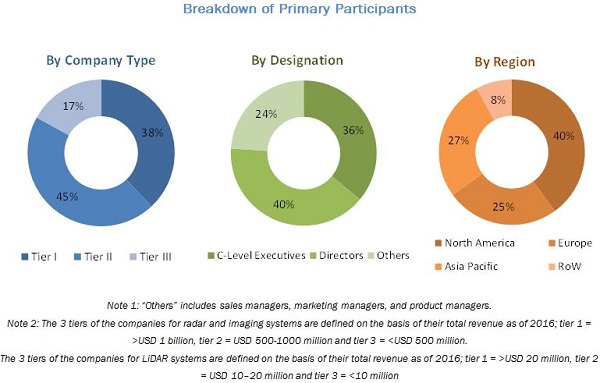
The research methodology used to estimate and forecast the airborne surveillance market begins with capturing data on key vendor revenues through secondary research. Secondary sources used for this research study include government sources, corporate filings (such as annual reports, investor presentations, and financial statements), and trade, industry news, and associations. The bottom-up procedure has been employed to arrive at the overall size of the airborne surveillance market from the revenues of key players for different types of airborne surveillance systems in the market. After arriving at the overall market size, the total market has been split into several segments and subsegments, which have been verified through primary research by conducting extensive interviews with people holding key positions in the industry such as CEOs, VPs, directors, and executives. The data triangulation and market breakdown procedures have been employed to complete the overall market engineering process and arrive at the exact statistics for all segments and subsegments. The breakdown of the profiles of primary respondents has been depicted in the below figure.
To know about the assumptions considered for the study, download the pdf brochure
The airborne surveillance market comprises a network of players involved in the research and product development, raw material suppliers, manufacturers, OEMs, investors, and distributors. Players operating in the airborne surveillance market include Airbus (France), Boeing (US), Saab (Sweden), BAE Systems (UK), Raytheon (US), Lockheed Martin (US), Leonardo (Italy), FLIR Systems (US), Northrop Grumman (US), L-3 Wescam (Canada), Leica Geosystems (Switzerland), Teledyne Technologies (US), Safran (France), Thales (France), and Israel Aerospace Industries (Israel).
Key Target Audience
- Drones and UAV manufacturers
- Airborne surveillance system manufacturers and suppliers
- Research organizations and consulting companies
- Associations, alliances, and organizations related to airborne surveillance
- Analysts and strategic business planners
- End users of airborne surveillance systems across various industries such as military and commercial applications. The military segment applications are ISR and targeting, search and rescue, law enforcement, border surveillance. The commercial applications are engineering, surveying, and mapping, inspection and monitoring, agriculture and forestry, exploration, insurance, education sector, healthcare and delivery and logistics.
“This study answers several questions for the stakeholders, primarily which market segments to focus on in the next 2–5 years for prioritizing efforts and investments.”
Scope of the Report:
This research report categorizes the airborne surveillance market on the basis of type, product type, application, and region.
Airborne surveillance market by type:
- LiDAR
- Radar
- Imaging System
Airborne surveillance market by product type:
- Manned system
- Unmanned system
Airborne surveillance market by application:
-
Military, defense, and security
- ISR and targeting
- Search and rescue
- Law enforcement
- Border surveillance
-
Commercial
- Engineering, surveying, and mapping
- Inspection and monitoring
- Agriculture and forestry
- Exploration
- Insurance
- Others
Airborne surveillance market by region:
- North America
- Europe
- APAC
- RoW
Available Customizations:
With the given market data, MarketsandMarkets offers customizations according to the company’s specific needs. The following customization options are available for the report:
Company Information:
Detailed analysis and profiling of additional market players (up to 5)













Growth opportunities and latent adjacency in Airborne Surveillance Market
We produce hyperspectral & multispectral imaging sensors for a range of applications, including remote sensing. I would like to speak to an analyst who is working on reports focusing on this area.