Artificial Intelligence in Marketing Market by Offering (Hardware, Software, Services), Technology (Machine Learning, Context-Aware Computing, NLP, Computer Vision), Deployment Type, Application, End-User Industry, and Geography - Global Forecast to 2035


Artificial Intelligence in Marketing Market Overview
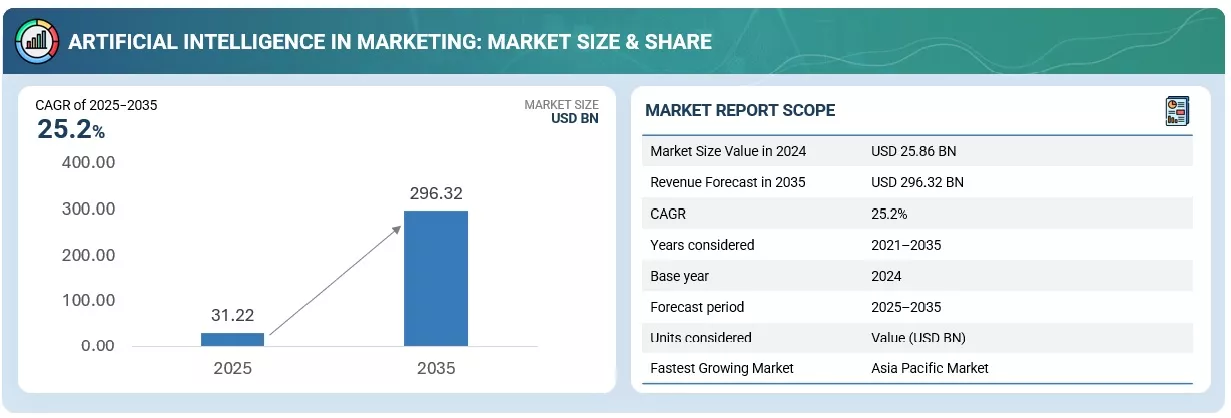
The global Artificial Intelligence in Marketing Market was valued at USD 25.86 billion in 2024 and is estimated to reach USD 296.32 billion by 2035, at a CAGR of 25.2% between 2025 and 2035.
The Artificial Intelligence in Marketing Market is expected to experience exponential growth between 2024 and 2035 as businesses increasingly embrace intelligent technologies to enhance customer engagement, optimize campaigns, and improve decision making. Artificial intelligence has become a cornerstone of modern marketing, enabling companies to extract actionable insights from large volumes of data and personalize interactions at scale. With the integration of machine learning, natural language processing, computer vision, and context aware computing, AI driven marketing platforms are transforming how organizations connect with their audiences, measure performance, and drive growth across digital and physical channels.
The adoption of AI in marketing is expanding rapidly across industries such as retail, e commerce, banking, healthcare, media, and telecommunications. Organizations are using AI powered tools to predict consumer behavior, automate content generation, and optimize pricing strategies. As data becomes central to competitive advantage, AI technologies are helping marketers turn raw data into predictive intelligence that informs strategic decisions. The market is further fueled by the proliferation of digital platforms, increased demand for personalization, and the growing use of cloud based analytics and automation tools.
Market Dynamics
Artificial intelligence has shifted the focus of marketing from intuition based decision making to data driven precision. The growing volume of consumer data generated from online browsing, mobile applications, and social media has created an urgent need for advanced tools that can process and interpret information in real time. AI provides marketers with predictive analytics capabilities that improve lead generation, audience targeting, and campaign effectiveness. Moreover, advancements in cloud computing and 5G connectivity have accelerated the deployment of AI solutions, making them more accessible to businesses of all sizes.
One of the most significant drivers of market growth is the demand for hyper personalization. Consumers today expect tailored recommendations and content that align with their individual preferences and behaviors. AI algorithms enable this by continuously learning from user interactions and adapting marketing strategies dynamically. Additionally, AI enhances customer service through chatbots, voice assistants, and virtual agents that provide instant, human like support across multiple communication channels. These applications improve customer satisfaction while reducing operational costs for enterprises.
Market Segmentation by Offering
The market is segmented by offering into hardware, software, and services. The software segment currently holds the largest market share as it includes key components such as AI marketing platforms, analytics tools, and automation solutions. These systems integrate machine learning algorithms with marketing data to optimize campaign performance, content creation, and audience segmentation. Cloud based AI software is gaining popularity because it offers scalability, real time insights, and cost efficiency.
The hardware segment consists of processing units, GPUs, and storage systems designed to support intensive AI workloads. The need for powerful computing hardware continues to rise as AI algorithms become more complex and data volumes expand. The services segment, which includes consulting, integration, and support services, is also witnessing strong growth as businesses seek expertise to deploy AI effectively within their marketing ecosystems. Service providers help organizations customize AI models, integrate them with existing tools, and ensure compliance with data protection regulations.
Market Segmentation by Technology
The Artificial Intelligence in Marketing Market incorporates several advanced technologies, including machine learning, natural language processing, computer vision, and context aware computing. Machine learning forms the backbone of AI marketing by enabling predictive analytics, recommendation engines, and automated decision making. Through continuous learning from data, machine learning models improve targeting accuracy and campaign optimization over time.
Natural language processing (NLP) plays a critical role in understanding and generating human language, powering applications such as chatbots, sentiment analysis, and automated content creation. NLP allows brands to analyze customer feedback, social media conversations, and online reviews to assess public perception and tailor communication strategies accordingly. Computer vision technology enables visual content recognition, allowing marketers to analyze images and videos for brand visibility, user engagement, and emotional impact. It is increasingly used in visual search, product tagging, and advertising analytics.
Context aware computing combines environmental data, user behavior, and device information to deliver highly relevant marketing messages. By understanding contextual factors such as location, time, and intent, AI can serve personalized offers that increase conversion rates. Together, these technologies create an ecosystem where data, automation, and creativity converge to deliver superior marketing outcomes.
Deployment Type
AI marketing solutions can be deployed on premise or via cloud platforms. Cloud deployment is dominating the market due to its flexibility, scalability, and cost effectiveness. Cloud based solutions allow businesses to access powerful AI tools without heavy investments in infrastructure, making them ideal for small and medium sized enterprises. Cloud services also support remote accessibility and easy integration with other marketing and analytics platforms.
On premise deployment remains relevant among large enterprises that handle sensitive data or operate in regulated industries such as banking and healthcare. These organizations prefer on premise systems to maintain control over data privacy and security. However, advancements in hybrid cloud architectures are enabling organizations to balance security with scalability by combining the strengths of both models.
Application Analysis
AI is reshaping every aspect of marketing, from customer acquisition to retention. Major applications include predictive analytics, content creation, campaign management, customer relationship management, and social media monitoring. Predictive analytics uses AI to forecast customer behavior and optimize marketing budgets by identifying high potential leads and profitable customer segments. AI driven content generation tools are being used to create personalized advertisements, social media posts, and email campaigns at scale.
In campaign management, AI automates ad placements and bidding strategies across digital platforms to maximize return on investment. Customer relationship management systems are increasingly integrating AI capabilities to enhance customer engagement, automate follow ups, and deliver data driven insights. Social media monitoring powered by AI enables real time tracking of brand sentiment, competitor activity, and trending topics, allowing marketers to respond swiftly to market dynamics. Additionally, AI is improving search engine optimization by analyzing user intent and optimizing content accordingly.
End User Industry Analysis
The adoption of AI in marketing spans multiple industries, each leveraging technology to meet specific business objectives. In the retail and e commerce sector, AI is used to personalize shopping experiences, recommend products, and optimize pricing strategies based on demand fluctuations. In the banking and financial services industry, AI helps analyze customer data for targeted marketing of loans, credit cards, and investment products while ensuring compliance with regulations.
The healthcare sector uses AI to enhance patient engagement through personalized communication, health awareness campaigns, and predictive analytics for service demand. The media and entertainment industry relies on AI for audience analytics, automated video editing, and content recommendation engines. In the telecommunications sector, AI driven marketing tools support churn prediction, customer segmentation, and dynamic pricing. The automotive industry applies AI marketing to understand customer preferences, manage digital showrooms, and promote connected vehicle technologies.
Regional Insights
Regionally, the Artificial Intelligence in Marketing Market is segmented into North America, Europe, Asia Pacific, and the Middle East and Africa. North America currently leads the global market due to the strong presence of technology giants, advanced digital infrastructure, and early adoption of AI tools. The United States in particular remains a major hub for innovation, with companies integrating AI across digital advertising, customer analytics, and e commerce platforms.
Europe is witnessing robust growth supported by data privacy regulations such as the General Data Protection Regulation, which encourages transparent and responsible AI adoption. Countries like Germany, the United Kingdom, and France are investing heavily in AI research and innovation to enhance marketing efficiency across sectors. Asia Pacific is expected to register the fastest growth during the forecast period, driven by the rapid digital transformation of economies such as China, India, Japan, and South Korea. Expanding internet penetration, rising smartphone usage, and increasing e commerce activity are fueling AI adoption in marketing throughout the region.
The Middle East and Africa are emerging markets with growing investments in AI technology as part of national digitalization strategies. Governments and enterprises in these regions are leveraging AI to enhance tourism promotion, retail experiences, and financial services marketing.
Market Trends
Several key trends are shaping the Artificial Intelligence in Marketing Market. One major trend is the shift toward generative AI for creative content development. Businesses are using generative models to design advertisements, write promotional copy, and create visual assets, reducing time and cost while maintaining quality. Another important trend is the integration of voice search and conversational marketing, where AI powered voice assistants are enabling brands to interact with customers naturally and efficiently.
AI powered data analytics is also driving predictive and prescriptive marketing, helping companies not only understand consumer behavior but also anticipate future actions. Furthermore, privacy enhancing technologies are emerging to balance personalization with data security, addressing growing consumer concerns about data misuse. The use of AI in influencer marketing is expanding as algorithms identify and evaluate influencers based on engagement metrics and audience relevance rather than simple follower counts.
Challenges
Despite its advantages, the AI marketing industry faces challenges related to data quality, algorithm bias, and ethical considerations. The accuracy of AI predictions depends heavily on the quality and completeness of input data. Biased datasets can lead to discriminatory outcomes, potentially damaging brand reputation. Another challenge lies in data privacy regulations that restrict how customer data can be collected and used. Companies must ensure transparency and compliance to maintain consumer trust.
Moreover, the high cost of AI implementation and the shortage of skilled professionals capable of managing complex AI systems can hinder adoption among smaller businesses. Continuous technological updates and integration complexities also present obstacles to seamless AI deployment across diverse marketing ecosystems.
Future Outlook
The future of the Artificial Intelligence in Marketing Market promises remarkable transformation as AI becomes more embedded in every marketing function. By 2035, AI is expected to be an indispensable component of marketing strategies, driving personalization, automation, and intelligent decision making. The convergence of AI with emerging technologies such as blockchain, augmented reality, and edge computing will further expand possibilities for immersive and secure marketing experiences.
Advancements in natural language understanding and emotional AI will enable deeper consumer engagement, while predictive analytics will guide strategic planning and resource allocation. The rise of ethical AI frameworks will ensure transparency, fairness, and accountability in automated marketing decisions. As enterprises strive to differentiate themselves in a data driven world, AI will empower marketers to deliver meaningful, contextually relevant, and personalized experiences that strengthen brand loyalty and business growth.
Scope of the Report:
The report segments the AI in marketing market into the following segments:
Based on Offering, the Artificial Intelligence in Marketing Market been Segmented as follows:
- Hardware
- Software
- Services
Based on Deployment Type, the Artificial Intelligence in Marketing Market been Segmented as follows:
- Cloud
- On Premises
Based on Application, the Artificial Intelligence in Marketing Market been Segmented as follows:
- Social Media Advertising
- Search Advertising
- Dynamic Pricing
- Virtual Assistant
- Content Curation
- Sales & Marketing Automation
- Analytics Platform
- Others (Website Design and Emotion Measurement)
Based on Technology, the Artificial Intelligence in Marketing Market been Segmented as follows:
- Machine Learning
- Context-Aware Computing
- Natural Language Processing
- Computer Vision
Based on End-User Industry, the Artificial Intelligence in Marketing Market been Segmented as follows:
- BFSI
- Retail
- Consumer Goods
- Media & Entertainment
- Enterprise
- Others (Education, Healthcare, Manufacturing, and Automotive)
Based on Region, the Artificial Intelligence in Marketing Market been Segmented as follows:
- North America
- Europe
- APAC
- RoW
Available Customizations
- Analysis of industries in the AI in marketing market in different geographic regions. Customization can be provided on the country-wise analysis of the market with respect to industries.
- Detailed analysis and profiling of additional market players (up to 5)
To speak to our analyst for a discussion on the above findings, click Speak to Analyst
 Exclusive indicates content/data unique to MarketsandMarkets and not available with any competitors.
Table of Contents
1 Introduction (Page No. - 15)
1.1 Study Objectives
1.2 Definition
1.3 Study Scope
1.3.1 Markets Covered
1.3.2 Years Considered for This Study
1.4 Currency
1.5 Limitations
1.6 Stakeholders
2 Research Methodology (Page No. - 19)
2.1 Research Data
2.1.1 Secondary Data
2.1.1.1 Key Data From Secondary Sources
2.1.2 Primary Data
2.1.2.1 Key Data From Primary Sources
2.1.2.2 Key Industry Insights
2.1.2.3 Breakdown of Primaries
2.2 Market Size Estimation
2.2.1 Bottom-Up Approach
2.2.2 Top-Down Approach
2.3 Market Breakdown & Data Triangulation
2.4 Research Assumptions
3 Executive Summary (Page No. - 28)
4 Premium Insights (Page No. - 33)
4.1 Attractive Opportunities in ARTIFICIAL INTELLIGENCE IN MARKETING MARKET
4.2 ARTIFICIAL INTELLIGENCE IN MARKETING MARKET, By Offering
4.3 AI IN MARKETING MARKET, By Deployment Type
4.4 ARTIFICIAL INTELLIGENCE IN MARKETING MARKET, By Technology
4.5 ARTIFICIAL INTELLIGENCE IN MARKETING MARKET, By Application and Region
4.6 ARTIFICIAL INTELLIGENCE IN MARKETING MARKET, By End-User Industry
4.7 AI IN MARKETING MARKET, By Country
5 Market Overview (Page No. - 37)
5.1 Introduction
5.2 Market Dynamics
5.2.1 Drivers
5.2.1.1 Growing Adoption of Customer-Centric Marketing Strategies
5.2.1.2 Increased Use of Social Media for Advertising
5.2.1.3 Increase in Demand for Virtual Assistants
5.2.2 Restraints
5.2.2.1 Limited Number of AI Experts
5.2.3 Opportunities
5.2.3.1 Growth in Adoption of Cloud-Based Applications and Services
5.2.3.2 Evolution of Marketing Analytics
5.2.4 Challenges
5.2.4.1 Concerns Regarding Data Privacy
5.2.4.2 Unreliability of AI Algorithms
5.3 Use Cases
5.3.1 Redballoon Used Albert Technologies Platform to Reduce Customer Acquisition Cost
5.3.2 Lincoln Motor Company Used Oculus360 Ai-Driven Consumer Insights Platform
5.3.3 Abuv Media Used Sentient Ascend for Widget Creation
5.3.4 Garmin Used Gumgum AI Technology to Increase Customer Awareness of Vívosmart 3 Smart Activity Tracker
5.3.5 Carrefour Used Appier AI to Grow Online Store Purchases
6 Artificial Intelligence in Marketing Market, By Offering (Page No. - 43)
6.1 Introduction
6.2 Software
6.2.1 AI Solutions
6.2.2 AI Platforms
6.3 Hardware
6.3.1 Processor
6.3.2 Storage
6.3.3 Network
6.4 Services
6.4.1 Deployment & Integration
6.4.2 Support & Maintenance
7 Artificial Intelligence in Marketing Market, By Deployment Type (Page No. - 53)
7.1 Introduction
7.2 Cloud
7.3 on Premises
8 Artificial Intelligence in Marketing Market, By Technology (Page No. - 57)
8.1 Introduction
8.2 Machine Learning
8.2.1 Deep Learning
8.2.2 Supervised Learning
8.2.3 Unsupervised Learning
8.2.4 Reinforcement Learning
8.2.5 Semi-Supervised Learning
8.3 Natural Language Processing (NLP)
8.4 Context-Aware Computing
8.5 Computer Vision
9 Artificial Intelligence in Marketing Market, By Application (Page No. - 66)
9.1 Introduction
9.2 Search Advertising
9.3 Social Media Advertising
9.4 Dynamic Pricing
9.5 Virtual Assistant
9.6 Content Curation
9.7 Sales & Marketing Automation
9.8 Analytics Platform
9.9 Others
10 Artificial Intelligence in Marketing Market, By End-User Industry (Page No. - 77)
10.1 Introduction
10.2 Enterprise
10.3 BFSI
10.4 Retail
10.5 Consumer Goods
10.6 Media & Advertising
10.7 Others
11 Geographic Analysis (Page No. - 86)
11.1 Introduction
11.2 North America
11.2.1 US
11.2.2 Canada
11.2.3 Mexico
11.3 Europe
11.3.1 UK
11.3.2 Germany
11.3.3 France
11.3.4 Italy
11.3.5 Spain
11.3.6 Rest of Europe (RoE)
11.4 Asia Pacific
11.4.1 China
11.4.2 Japan
11.4.3 South Korea
11.4.4 India
11.4.5 Rest of APAC (RoAPAC)
11.5 Rest of the World (RoW)
11.5.1 Middle East and Africa (MEA)
11.5.2 South America
12 Competitive Landscape (Page No. - 111)
12.1 Overview
12.2 Market Ranking Analysis
12.3 Competitive Scenario
12.3.1 Product Launches
12.3.2 Partnerships and Collaborations
12.3.3 Acquisitions
12.3.4 Expansions
13 Company Profiles (Page No. - 118)
13.1 Key Players
(Business Overview, Products & Services, Key Insights, Recent Developments, SWOT Analysis, MnM View)*
13.1.1 Nvidia
13.1.2 Intel
13.1.3 Xilinx
13.1.4 Samsung Electronics
13.1.5 Micron
13.1.6 IBM
13.1.7 Alphabet
13.1.8 Microsoft
13.1.9 Facebook
13.1.10 Amazon
13.1.11 Salesforce
13.1.12 Baidu
13.1.13 Sentient Technologies
13.1.14 Albert Technologies
13.1.15 Oculus360
13.2 Other Key Companies
13.2.1 Twitter
13.2.2 Oracle
13.2.3 Insidesales
13.2.4 Persado
13.2.5 Mariana
13.2.6 Drawbridge
13.2.7 Narrative Science
13.2.8 Appier
13.2.9 Gumgum
13.2.10 Zensed
*Details on Business Overview, Products & Services, Key Insights, Recent Developments, SWOT Analysis, MnM View Might Not Be Captured in Case of Unlisted Companies.
14 Appendix (Page No. - 162)
14.1 Insights From Industry Experts
14.2 Discussion Guide
14.3 Knowledge Store: Marketsandmarkets’ Subscription Portal
14.4 Introducing RT: Real-Time Market Intelligence
14.5 Available Customizations
14.6 Related Reports
14.7 Author Details
List of Tables (67 Tables)
Table 1 Artificial Intelligence in Marketing Market, By Offering, 2015–2025 (USD Million)
Table 2 Artificial Intelligence in Marketing Market, By Software, 2015–2025 (USD Million)
Table 3 Market for Software, By AI Platform, 2015–2025 (USD Million)
Table 4 Market for Software, By Region, 2015–2025 (USD Million)
Table 5 AI in Marketing Market, By Hardware, 2015–2025 (USD Million)
Table 6 Market for Hardware, By Processor, 2015–2025 (USD Million)
Table 7 Market for Hardware, By Region, 2015–2025 (USD Million)
Table 8 Artificial Intelligence in Marketing Market, By Service, 2015–2025 (USD Million)
Table 9 AI in Marketing Market for Services, By Region, 2015–2025 (USD Million)
Table 10 AI in Marketing Market, By Deployment Type, 2015–2025 (USD Million)
Table 11 Artificial Intelligence in Marketing Market for Cloud Deployment, By Region, 2015–2025 (USD Million)
Table 12 Market for On-Premise Deployment, By Region, 2015–2025 (USD Million)
Table 13 Market, By Technology, 2015–2025 (USD Million)
Table 14 Artificial Intelligence in Marketing Market for Machine Learning, By Type, 2015–2025 (USD Million)
Table 15 Market for Machine Learning, By Region, 2015–2025 (USD Million)
Table 16 Market for NLP, By Type, 2015–2025 (USD Million)
Table 17 Market for NLP, By Region, 2015–2025 (USD Million)
Table 18 AI in Marketing Market for Context-Aware Computing, By Type, 2015–2025 (USD Million)
Table 19 Market for Context-Aware Computing, By Region, 2015–2025 (USD Million)
Table 20 Market for Computer Vision, By Region, 2015–2025 (USD Million)
Table 21 AI in Marketing Market, By Application, 2015–2025 (USD Million)
Table 22 Market for Search Advertising, By Region, 2015–2025 (USD Million)
Table 23 Market for Social Media Advertising, By Region, 2015–2025 (USD Million)
Table 24 Market for Dynamic Pricing, By Region, 2015–2025 (USD Million)
Table 25 Market for Virtual Assistant, By Region, 2015–2025 (USD Million)
Table 26 Market for Content Curation, By Region, 2015–2025 (USD Million)
Table 27 AI in Marketing Market for Sales & Marketing Automation, By Region, 2015–2025 (USD Million)
Table 28 Market for Analytics Platform, By Region, 2015–2025 (USD Million)
Table 29 Artificial Intelligence in Marketing Market for Others, By Region, 2015–2025 (USD Million)
Table 30 Artificial Intelligence in Marketing Market, By End-User Industry, 2015–2025 (USD Million)
Table 31 Market for Enterprise, By Region, 2015–2025 (USD Million)
Table 32 Market for BFSI, By Region, 2015–2025 (USD Million)
Table 33 Market for Retail, By Region, 2015–2025 (USD Million)
Table 34 Market for Consumer Goods, By Region, 2015–2025 (USD Million)
Table 35 Market for Media & Advertising, By Region, 2015–2025 (USD Million)
Table 36 Market for Others, By Region, 2015–2025 (USD Million)
Table 37 Artificial Intelligence in Marketing Market, By Region, 2015–2025 (USD Million)
Table 38 Market in North America, By Country, 2015–2025 (USD Million)
Table 39 Market in North America, By Application, 2015–2025 (USD Million)
Table 40 Market in North America, By Deployment Type, 2015–2025 (USD Million)
Table 41 Market in North America, By End-User Industry, 2015–2025 (USD Million)
Table 42 Artificial Intelligence in Marketing Market in North America, By Technology, 2015–2025 (USD Million)
Table 43 Artificial Intelligence in Marketing Market in North America, By Offering, 2015–2025 (USD Million)
Table 44 Artificial Intelligence in Marketing Market in Europe, By Country, 2015–2025 (USD Million)
Table 45 Market in Europe, By Application, 2015–2025 (USD Million)
Table 46 AI in Marketing Market in Europe, By Deployment Type, 2015–2025 (USD Million)
Table 47 Market in Europe, By End-User Industry, 2015–2025 (USD Million)
Table 48 Market in Europe, By Technology, 2015–2025 (USD Million)
Table 49 Market in Europe, By Offering, 2015–2025 (USD Million)
Table 50 Market in APAC, By Country, 2015–2025 (USD Million)
Table 51 AI in Marketing Market in APAC, By Application, 2015–2025 (USD Million)
Table 52 Artificial Intelligence in Marketing Market in APAC, By Deployment Type, 2015–2025 (USD Million)
Table 53 Artificial Intelligence in Marketing Market in APAC, By End-User Industry, 2015–2025 (USD Million)
Table 54 Market in APAC, By Technology, 2015–2025 (USD Million)
Table 55 Artificial Intelligence in Marketing Market in APAC, By Offering, 2015–2025 (USD Million)
Table 56 Artificial Intelligence in Marketing Market in RoW, By Region, 2015–2025 (USD Million)
Table 57 Artificial Intelligence in Marketing Market in RoW, By Application, 2015–2025 (USD Million)
Table 58 Market in RoW, By Deployment Type, 2015–2025 (USD Million)
Table 59 AI in Marketing Market in RoW, By End-User Industry, 2015–2025 (USD Million)
Table 60 Market in RoW, By Technology, 2015–2025 (USD Million)
Table 61 Market in RoW, By Offering, 2015–2025 (USD Million)
Table 62 Top 5 Players in AI in Marketing Market for Hardware (2017)
Table 63 Top 5 Players in AI in Marketing Market for Solutions (2017)
Table 64 Product Launches, 2017
Table 65 Partnerships & Collaborations, 2017
Table 66 Acquisitions, 2016–2017
Table 67 Expansions, 2017
List of Figures (59 Figures)
Figure 1 AI in Marketing Market: Research Methodology
Figure 2 Market Size Estimation Process Flow
Figure 3 Artificial Intelligence in Marketing Market Size Estimation Methodology: Bottom-Up Approach
Figure 4 Market Size Estimation Methodology: Top-Down Approach
Figure 5 Market Breakdown & Data Triangulation
Figure 6 AI in Marketing Market, By Offering, 2018–2025
Figure 7 AI in Marketing Market, By Deployment Type, 2018–2025
Figure 8 AI in Marketing Market, By Technology, 2018 vs 2025
Figure 9 Artificial Intelligence in Marketing Market, By Application, 2016–2025
Figure 10 Market, By End-User Industry, 2016–2025
Figure 11 AI in Marketing Market, By Region, 2018–2025
Figure 12 Increasing Demand for Virtual Assistants Driving Growth of Market
Figure 13 Software to Hold Largest Size of Market Between 2018 and 2025
Figure 14 Cloud Deployment to Hold Largest Size of Market Between 2018 and 2025
Figure 15 Market for Machine Learning to Grow at Highest CAGR During Forecast Period
Figure 16 Search Advertising to Hold Largest Share of Market in 2018
Figure 17 Enterprise to Hold Largest Size of Market By 2025
Figure 18 Artificial Intelligence in Marketing Market in China to Grow at Highest CAGR During Forecast Period
Figure 19 Artificial Intelligence in Marketing Market: Drivers, Restraints, Opportunities, and Challenges
Figure 20 Number of Social Media Users, 2010–2021
Figure 21 Time Spent on Social Networking By Internet Users Worldwide, 2012–2017 (Minutes)
Figure 22 Social Media Marketing Respondent Drivers
Figure 23 Software to Hold Largest Size of Market in 2018
Figure 24 Machine Learning Framework to Hold Larger Size of AI Software in Marketing Market for AI Platforms in 2018
Figure 25 Processor to Hold Largest Size of Market for Hardware in 2018
Figure 26 North America to Hold Largest Size of AI in Marketing Market for Services in 2018
Figure 27 Market for Cloud-Based Deployment to Grow at Higher CAGR During Forecast Period
Figure 28 Machine Learning to Hold Largest Share of Market in 2018
Figure 29 Supervised Learning to Hold Largest Size of Market for Machine Learning in 2018
Figure 30 Text Analytics to Hold Largest Size of Market for NLP in 2018
Figure 31 User Context to Hold Largest Size of Market for Context-Aware Computing in 2018
Figure 32 Search Advertising to Hold Largest Size of Market in 2018
Figure 33 Market for Dynamic Pricing in APAC to Grow at Highest CAGR During Forecast Period
Figure 34 North America to Hold Largest Size of Market for Sales & Marketing Automation in 2018
Figure 35 Enterprise to Hold Largest Size of Market By 2025
Figure 36 Artificial Intelligence in Marketing Market for Retail in APAC to Grow at Highest CAGR During Forecast Period
Figure 37 North America to Hold Largest Size of Market for Media & Advertising in 2018
Figure 38 North America to Hold Largest Size of Market Between 2018 and 2025
Figure 39 North America: Artificial Intelligence in Marketing Market Snapshot
Figure 40 US to Hold Largest Size of Market in North America in 2018
Figure 41 Europe: Market Snapshot
Figure 42 UK to Hold Largest Size of Market in Europe in 2018
Figure 43 APAC: AI in Marketing Market Snapshot
Figure 44 China to Hold Largest Size of Market in APAC in 2018
Figure 45 South America to Hold Largest Size of Market in RoW in 2018
Figure 46 Companies Adopted Product Launches as Key Growth Strategy Between 2015 and 2017
Figure 47 Nvidia: Company Snapshot
Figure 48 Intel: Company Snapshot
Figure 49 Xilinx: Company Snapshot
Figure 50 Samsung Electronics: Company Snapshot
Figure 51 Micron: Company Snapshot
Figure 52 IBM: Company Snapshot
Figure 53 Alphabet: Company Snapshot
Figure 54 Microsoft: Company Snapshot
Figure 55 Facebook: Company Snapshot
Figure 56 Amazon: Company Snapshot
Figure 57 Salesforce: Company Snapshot
Figure 58 Baidu: Company Snapshot
Figure 59 Albert Technologies: Company Snapshot













Growth opportunities and latent adjacency in Artificial Intelligence in Marketing Market