Thermal Systems Market Size, Share & Analysis

Thermal Systems Market by Application (Front & Rear A/C, Powertrain, Seat, Steering, Battery, Motor, Power Electronics, Waste Heat Recovery, Sensor), Technology, Component, Vehicle (ICE & Electric), and Region – Global Forecast to 2033




OVERVIEW
Source: Secondary Research, Interviews with Experts, MarketsandMarkets Analysis
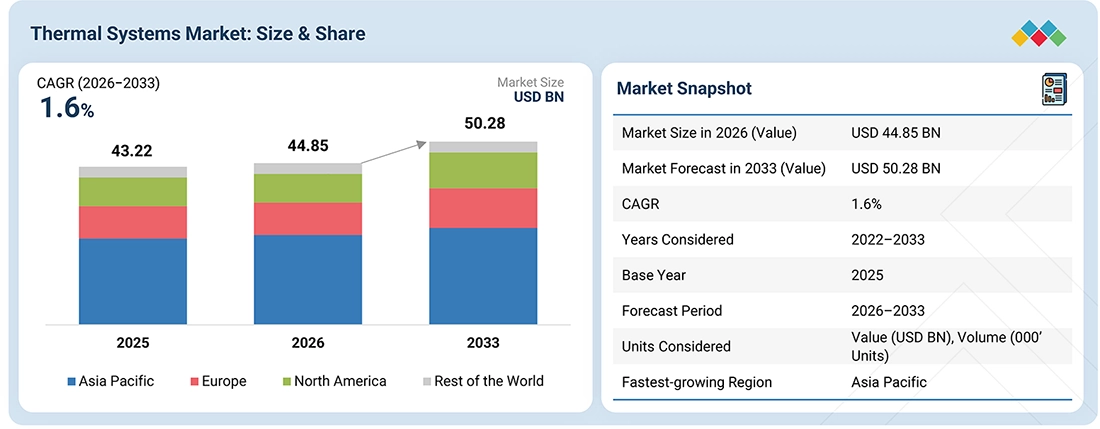
The thermal systems market is projected to grow from USD 44.85 billion in 2026 to USD 50.28 billion by 2033, at a CAGR of 1.6%. Market growth is increasingly being shaped by the transition from component-level temperature control to integrated vehicle thermal-energy management, as OEMs seek to optimize thermal loads across ICE powertrains, batteries, e-motors, power electronics, charging systems, and the cabin. In ICE and hybrid vehicles, electronically controlled cooling, variable coolant flow, charge-air and transmission thermal management, and waste-heat recovery are enabling more precise temperature control and improved powertrain efficiency. Meanwhile, BEV architectures are creating significantly higher thermal-management content through battery preconditioning, fast-charging thermal control, heat pumps, e-compressors, liquid cooling, and integrated multi-loop architectures. The technology landscape is also shifting toward pre-integrated thermal modules, intelligent valves and pumps, heat recovery, and predictive software, allowing thermal energy to be dynamically transferred between the battery, e-powertrain, and cabin according to vehicle operating conditions. Consequently, value is migrating from individual thermal components toward integrated hardware–software thermal architectures that improve charging performance, EV range, component durability, cabin efficiency and overall vehicle energy utilization. NREL estimates that EV climate control can reduce driving range by more than 50% under high heating and cooling loads, highlighting the need for more energy-efficient thermal management systems. In response, global OEMs are shifting from conventional HVAC components toward integrated and intelligent thermal management architectures that optimize cabin energy consumption while maintaining passenger comfort. This shift is expected to increase demand for advanced thermal management solutions for batteries, e-motors, and power electronics architecture. The mandatory cabin AC requirement for N2 and N3 vehicles from October 2025 is expected to accelerate HVAC adoption across India’s medium- and heavy-duty truck fleet, creating a regulatory-driven demand opportunity for HVAC system and component suppliers.
KEY TAKEAWAYS
-
MARKET SNAPSHOT:
Market Size (2025): USD 43.22 Billion
Current Market Size (2026): USD 44.85 Billion
Projected Market Size (2033): USD 50.28 Billion
CAGR (2026–2033): 1.6% -
By RegionAsia Pacific is estimated to be the largest market for automotive thermal systems in 2026, driven by its dominant vehicle production base, particularly in China, Japan, and India.
-
By Vehicle Type (ICE)Passenger cars are expected to account for the largest share of the ICE thermal systems market in 2026, owing to their larger vehicle population and higher installation of engine cooling and HVAC systems.
-
By Vehicle Type (Eletric and Hybrid)BEVs are expected to account for the largest share of the electric & hybrid thermal systems market in 2026, driven by the increasing thermal-management requirements of batteries, e-motors, and power electronics.
-
By Application (ICE)Waste heat recovery is expected to be the fastest-growing ICE application through 2033, registering a CAGR of 3.2%, driven by increasing use of waste exhaust heat to improve fuel efficiency and reduce thermal losses.
-
By Application (Eletric and Hybrid)Front air conditioning is estimated to account for the largest share of the electric & hybrid thermal systems market in 2026, as cabin HVAC remains an essential thermal function across passenger vehicles.
-
By Componet (ICE)Heat exchangers are estimated to account for the largest share of the ICE thermal systems market in 2026, owing to their widespread use across engine, HVAC, oil, and charge-air cooling circuits.
-
By Component (Eletirc and Hybird)Heat exchangers are estimated to account for the largest share of the electric & hybrid thermal systems market in 2026, driven by their use across battery, power electronics, motor, and cabin thermal circuits.
-
By TechnologyActive transmission warm-up is expected to be the fastest-growing technology segment through 2033, registering a CAGR of 2.0%, driven by its ability to reduce transmission warm-up time and improve drivetrain efficiency during cold operation.
The thermal systems market is expanding as thermal management becomes increasingly important across both ICE and electrified vehicles. In ICE vehicles, demand continues to be supported by the need for efficient engine cooling, HVAC performance, charge-air cooling, and exhaust thermal management, while tighter fuel-efficiency and emission requirements are encouraging OEMs to adopt more efficient thermal solutions. The increasing penetration of hybrid and electric vehicles is adding new thermal requirements for batteries, electric motors, power electronics, and passenger cabins, creating additional content per vehicle. As vehicle electrification progresses, heat pumps, electric compressors, coolant pumps, thermal valves, and integrated battery thermal management systems are gaining importance. At the same time, advances in integrated thermal management and intelligent temperature control are enabling better coordination of powertrain, battery, and cabin thermal loads. With ICE vehicles continuing to account for a substantial share of global vehicle production while hybrid and EV adoption steadily increases, automotive thermal systems are evolving toward more efficient, integrated, and electronically controlled architectures, supporting sustained market growth through the forecast period.
TRENDS & DISRUPTIONS IMPACTING CUSTOMERS' CUSTOMERS
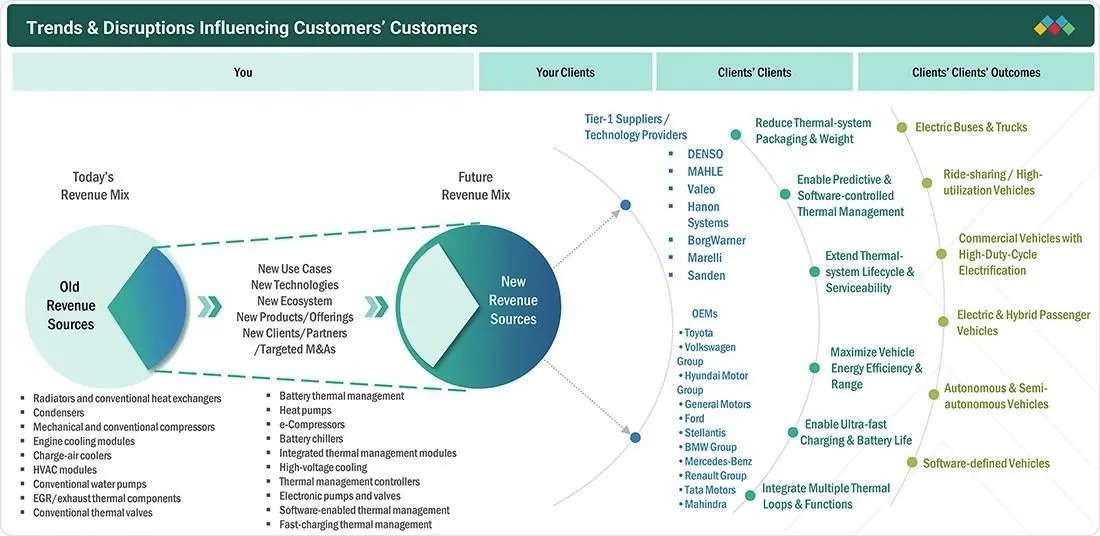
The thermal systems market is witnessing a shift in revenue toward advanced and intelligent thermal solutions, as OEMs increasingly seek technologies that improve vehicle energy efficiency, extend EV range, enable ultra-fast charging, reduce thermal-system packaging and weight, and enhance personalized cabin comfort. These requirements are being driven by the transition toward BEV/HEV/PHEV platforms, 800V/1,000V architectures, larger and premium SUVs/MPVs, software-defined vehicles, autonomous vehicles, and electrified commercial vehicles, creating demand for integrated multi-loop thermal architectures, battery preconditioning, predictive thermal control, heat recovery, intelligent pumps and valves, and advanced cabin thermal technologies. Consequently, thermal system suppliers are expanding beyond conventional engine cooling, transmission, and air-conditioning components toward integrated thermal modules, battery thermal management, waste-heat recovery, control systems, and software-enabled thermal-energy management, creating new revenue pools across next-generation vehicle platforms.
Source: Secondary Research, Interviews with Experts, MarketsandMarkets Analysis
MARKET DYNAMICS

Level
-
Thermal management becoming vehicle efficiency and range-critical system

-
Fast charging, higher power density, and software-defined vehicles raising thermal control requirements


Level
-
Limited adoption of advanced thermal management systems in cost-sensitive vehicles


Level
-
Electrification of thermal components across ICE, hybrid, and commercial vehicles

-
Shift from individual thermal components to integrated thermal modules


Level
-
Complex multi-loop thermal coordination across powertrain and vehicle systems

-
Durability and reliability under high thermal loads and transient operating conditions

Source: Secondary Research, Interviews with Experts, MarketsandMarkets Analysis
Driver: Thermal management becoming vehicle efficiency and range-critical system
The growing transition toward hybrid and battery-electric vehicles is making thermal management increasingly critical to vehicle efficiency, performance, and driving range. Unlike conventional vehicles, electrified vehicles require precise temperature control across the battery pack, electric motor, power electronics, charging system, and passenger cabin. Inefficient thermal management can increase energy consumption, reduce battery performance, and limit driving range, making thermal systems an increasingly important part of vehicle architecture. The focus on energy efficiency is accelerating the adoption of advanced thermal management technologies, including heat pumps, battery cooling systems, integrated coolant loops, electronic water pumps, intelligent valves, and centralized thermal architectures. Heating and cooling loads can directly affect energy available for propulsion, particularly under extreme conditions. Automakers are therefore shifting from component-level cooling and heating toward integrated thermal architectures that manage multiple heat sources and loads more efficiently. This transition is increasing the role of software, sensors, and electronic controls in automotive thermal systems. Advanced controls can regulate coolant flow, refrigerant circuits, and component temperatures based on operating conditions, optimizing energy consumption while maintaining battery performance, cabin comfort, and component durability. As hybrid and electric vehicle production expands, thermal management is evolving from a supporting function into a vehicle-level, efficiency- and range-critical system, increasing the importance of automotive thermal system suppliers.
Restraint: Limited adoption of advanced thermal management systems in cost-sensitive vehicles
The increasing complexity of advanced automotive thermal management systems can limit adoption in cost-sensitive vehicle segments. Technologies such as heat pumps, integrated thermal modules, multi-loop cooling architectures, electronically controlled valves, high-performance heat exchangers, and advanced battery cooling systems involve higher component costs, additional sensors and electronics, and greater integration requirements. For entry-level passenger cars and price-sensitive markets, OEMs may prioritize affordability and proven thermal architectures over higher-cost systems offering incremental efficiency benefits. The cost challenge is particularly significant where vehicle price is a key buying criterion and manufacturers operate under tight cost targets. Advanced thermal systems may require vehicle architecture redesign, additional control hardware, and more sophisticated calibration and validation, increasing development and production costs. The benefits of technologies such as heat pumps and integrated thermal systems also vary with vehicle size, battery capacity, climate, and usage, making their business case less compelling across all segments. As a result, adoption is likely to vary across vehicle categories and regions. Premium EVs, high-performance models, and vehicles with larger battery packs are more likely to adopt advanced thermal technologies, while entry-level EVs, ICE vehicles, and cost-sensitive models may continue using simpler cooling and HVAC architectures. Overall, cost sensitivity can slow the penetration of advanced thermal technologies, particularly in high-volume, price-competitive segments.
Opportunity: Electrification of thermal components across ICE, hybrid, and commercial vehicles
The increasing electrification of vehicle subsystems is creating significant opportunities for automotive thermal system suppliers across internal combustion engine, hybrid, electric, and commercial vehicle platforms. Conventional mechanically driven thermal components, such as water pumps, cooling fans, compressors, and certain control mechanisms, are increasingly being replaced or supplemented by electrically driven alternatives. Electrification enables these components to operate independently of engine speed, allowing more precise control of cooling and heating capacity based on actual vehicle and component requirements. This creates opportunities to improve energy efficiency, reduce parasitic engine losses, and support increasingly complex vehicle architectures. The opportunity extends beyond battery-electric vehicles. Hybrid vehicles require thermal systems capable of managing both conventional powertrain components and electrified systems, including batteries, electric motors, inverters, and power electronics. Similarly, ICE vehicles are increasingly adopting electrically controlled pumps, fans, valves, and compressors to improve fuel efficiency and support tighter emissions requirements. In commercial vehicles, the growing demand for improved powertrain efficiency, auxiliary cooling, cabin comfort, and thermal control of increasingly electrified subsystems is expanding the addressable market for electrically driven thermal components. As a result, suppliers can generate new content opportunities even in vehicle platforms that are not fully electric.
Challenge: Complex multi-loop thermal coordination across powertrain and vehicle systems
The growing integration of batteries, e-motors, inverters, cabin HVAC, and, in hybrid vehicles, internal combustion engines is creating increasingly interconnected thermal systems. The challenge lies in the fact that these systems do not operate at the same temperature levels or require cooling and heating at the same time. The difficulty arises when multiple thermal demands occur simultaneously. During fast charging in high ambient temperatures, for example, the battery may require intensive cooling while the cabin air-conditioning system also requires compressor capacity. Similarly, using available waste heat for cabin heating may improve energy efficiency but can conflict with the temperature requirements of the battery or power electronics. This means thermal management cannot be optimized for one subsystem in isolation. OEMs must continuously balance battery performance, charging speed, driving range, powertrain protection, and passenger comfort. As individual loops become interconnected, changes in coolant flow, valve operation, pump speed, or compressor capacity in one part of the system can influence another. This makes control strategy development, software calibration, and vehicle-level validation significantly more difficult than conventional component-level thermal management.
THERMAL SYSTEMS MARKET SIZE, SHARE & ANALYSIS: COMMERCIAL USE CASES ACROSS INDUSTRIES
| COMPANY | USE CASE DESCRIPTION | BENEFITS |
|---|---|---|
 |
Heat pumps, electric compressors, chillers, electric water pumps, and multi-flow valves for BEV and hybrid thermal management. | Improved energy efficiency, extended driving range, faster charging, and longer battery life. |
 |
Battery cooling, heat pumps, electric compressors, cooling modules, and integrated thermal-management systems for electric and hybrid vehicles. | Improved battery performance, faster charging, extended EV range, and optimized vehicle thermal efficiency. |
 |
Battery chillers, heat pumps, electric compressors, and smart coolant modules for EV and hybrid thermal-management systems. | Lower energy consumption, improved battery cooling, faster charging, better range, and reduced packaging complexity. |
 |
Heat pumps, battery thermal-management systems, thermal-management controllers, and software-defined thermal systems for electrified vehicles. | Improved driving range, reduced thermal-system size, optimized battery temperature, and higher system efficiency. |
 |
High-voltage coolant heaters, eFans, battery eCoolers, power-electronics cooling, and integrated thermal modules for hybrid and electric vehicles. | Improved battery and cabin temperature control, faster charging, longer range, high-voltage cooling efficiency, and compact packaging. |
Logos and trademarks shown above are the property of their respective owners. Their use here is for informational and illustrative purposes only.
MARKET ECOSYSTEM
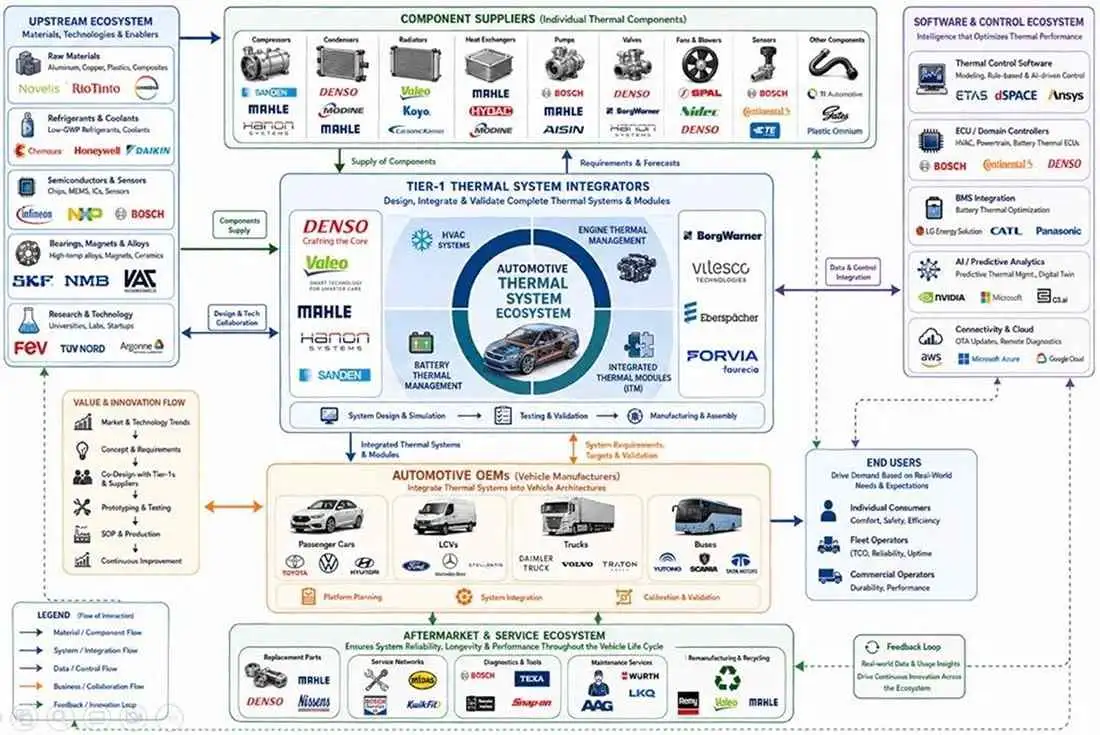
This section highlights the automotive thermal systems ecosystem, comprising raw material and refrigerant suppliers, individual thermal-component manufacturers, Tier-1 thermal system integrators, software and control technology providers, automotive OEMs, end users, and aftermarket and service providers. These stakeholders collectively support the design, integration, production, and lifecycle management of thermal systems across passenger cars, LCVs, trucks, and buses. The ecosystem is evolving from conventional engine cooling and HVAC components toward integrated battery thermal management, heat pumps, electric compressors, smart valves, thermal-control software, and connected thermal-management solutions, driven by vehicle electrification, energy-efficiency requirements, fast-charging needs, improved cabin comfort, and the increasing integration of thermal functions across the vehicle.
Logos and trademarks shown above are the property of their respective owners. Their use here is for informational and illustrative purposes only.
MARKET SEGMENTS
Source: Secondary Research, Interviews with Experts, MarketsandMarkets Analysis
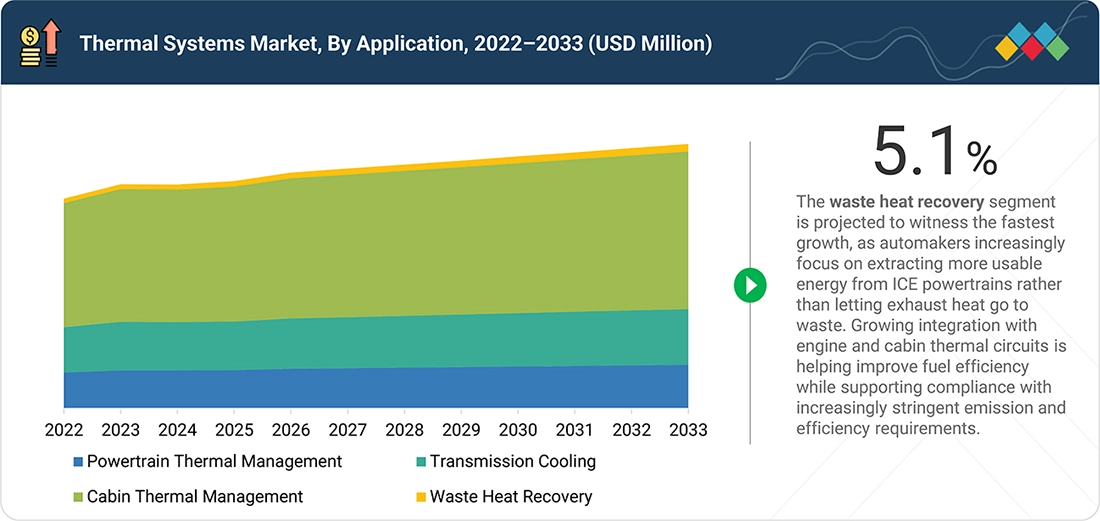
Thermal Systems Market, By Application (ICE)
By application, waste heat recovery is expected to register the highest CAGR in the thermal systems market for ICE vehicles, as OEMs look to capture more of the heat already generated by the engine and exhaust system. Reusing this heat for engine warm-up and cabin heating can improve fuel efficiency while reducing thermal losses, making waste heat recovery increasingly relevant as ICE efficiency requirements tighten.
Thermal Systems Market, By Components (Eletric and Hybrid)
By component, heat exchangers are estimated to account for the largest share og the thermal systems market for electric and hybrid vehicles, driven by the need to manage heat across batteries, electric motors, power electronics, and cabin systems. Heat exchangers enable efficient transfer of thermal energy between multiple cooling and heating circuits, which becomes increasingly important as electrified vehicles incorporate more interconnected thermal loops. Demand is expected to remain strong across battery-electric and hybrid vehicles, as higher battery capacities, faster charging, and increasing power density require more effective heat dissipation and temperature control.
Thermal Systems Market, By Techonology
By technology, active transmission warm-up is expected to register the highest CAGR in the thermal systems market, driven by the growing focus on reducing transmission losses during cold-start and low-temperature operating conditions. Active transmission warmup accelerates the heating of transmission fluid and components by directing available thermal energy toward the transmission, allowing it to reach its efficient operating range faster. Adoption is expected to increase in hybrid and fuel-efficient passenger vehicles, as OEMs seek additional drivetrain efficiency gains through improved thermal control without requiring fundamental changes to the transmission architecture.
REGION
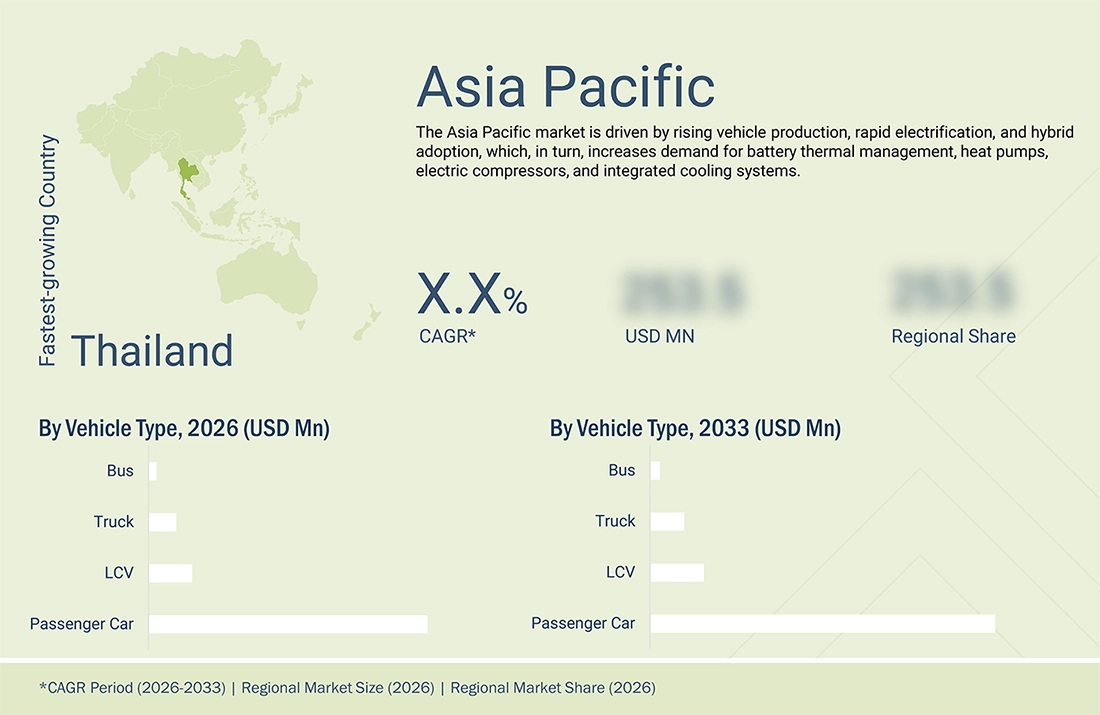
Asia Pacific to lead global thermal systems market during forecast period
Asia Pacific (APAC) is estimated to be the largest market for automotive thermal systems because it combines the world's highest vehicle production base with rapid electrification, strong growth in SUVs/MPVs, and increasingly sophisticated vehicle architectures. China is the primary growth engine, with the largest NEV production globally in 2025, while Southeast Asia is entering a faster electrification phase. India adds another large volume pool, with growing SUV and MPV demand increasing the requirement for higher-capacity HVAC and cabin thermal systems. At the same time, APAC is becoming a major hub for localized EV and battery manufacturing, with Southeast Asia accounting for more than half of Chinese automakers' overseas ICE/EV manufacturing footprint, strengthening the regional supply base for compressors, heat exchangers, pumps, valves, battery-cooling components, and integrated thermal modules. The technology transition is also increasing thermal content per vehicle: BEVs and PHEVs require dedicated battery thermal management, e-motor/inverter cooling, and efficient cabin heating; fast charging and higher-voltage architectures are driving demand for liquid cooling and tighter temperature control, while heat pumps, integrated thermal-management modules, refrigerant-based battery cooling, electronic coolant pumps, and intelligent thermal controls are becoming more prominent. Regulatory and efficiency pressures, including China's increasingly stringent vehicle-efficiency/emission requirements, India's BS-VI/CAFE framework, and accelerating electrification policies across ASEAN, are encouraging OEMs to reduce energy consumption and improve range without compromising cabin comfort. Consequently, the APAC thermal systems market is evolving from conventional engine cooling + HVAC toward integrated vehicle thermal management, where battery, power electronics, e-motor, cabin HVAC, and increasingly thermal-energy recovery are controlled as one system; the next phase is likely to be driven by centralized thermal architectures, intelligent predictive controls, heat-pump adoption, higher-efficiency components, and software-defined thermal management, further reinforcing APAC's position as both the largest production market and a key innovation center for automotive thermal systems.
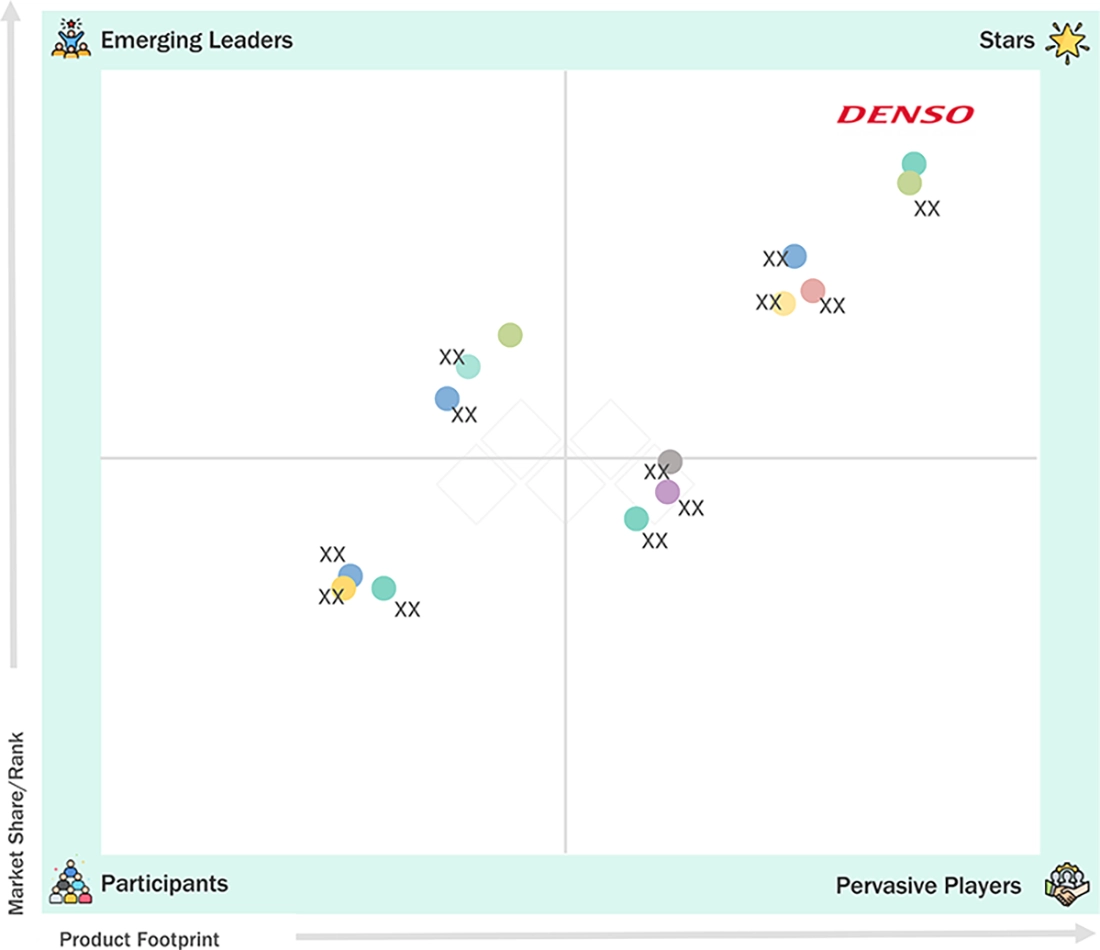
THERMAL SYSTEMS MARKET SIZE, SHARE & ANALYSIS: COMPANY EVALUATION MATRIX
In the thermal systems market matrix, DENSO Corporation (Star) leads with a strong global presence, extensive thermal-management portfolio, and established relationships with major automotive OEMs. The company maintains a strong position across conventional and advanced thermal technologies, including HVAC, heat pumps, electric compressors, battery chillers, electric water pumps, and integrated thermal-management solutions, enabling it to address evolving requirements for vehicle efficiency, electrification, battery performance, fast charging, and cabin comfort.
Source: Secondary Research, Interviews with Experts, MarketsandMarkets Analysis
KEY MARKET PLAYERS
- DENSO Corporation (Japan)
- MAHLE GmbH (Germany)
- Valeo SA (France)
- Hanon Systems (South Korea)
- BorgWarner Inc. (US)
- Gentherm Inc. (US)
- Schaeffler AG (Germany)
- Johnson Electric Holdings Limited (Hong Kong)
- Dana Incorporated (US)
- Robert Bosch GmbH (Germany)
MARKET SCOPE
| REPORT METRIC | DETAILS |
|---|---|
| Market Size in 2026 (Value) | USD 44.85 Billion |
| Market Forecast in 2033 (Value) | USD 50.28 Billion |
| Growth Rate | 1.6% |
| Years Considered | 2022–2033 |
| Base Year | 2025 |
| Forecast Period | 2026–2033 |
| Units Considered | Value (USD Million/Billion), Volume (Units) |
| Report Coverage | Revenue forecast, Regional Market Shares, Competitive Landscape, Driving factors, Trends & Disruption, Macroeconomic Trends, and others |
| Segments Covered |
|
| Regional Scope | Asia Pacific, Europe, North America, Rest of the World |
WHAT IS IN IT FOR YOU: THERMAL SYSTEMS MARKET SIZE, SHARE & ANALYSIS REPORT CONTENT GUIDE
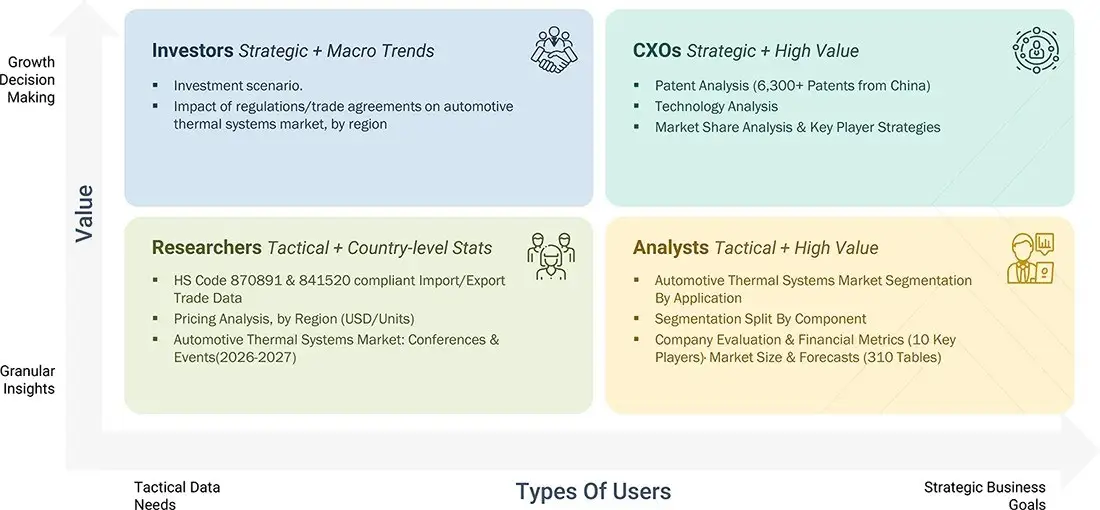
DELIVERED CUSTOMIZATIONS
We have successfully delivered the following deep-dive customizations:
| CLIENT REQUEST | CUSTOMIZATION DELIVERED | VALUE ADDS |
|---|---|---|
| ELECTRIC & HYBRID THERMAL SYSTEMS MARKET, BY APPLICATION COUNTRY-WISE DATA | Battery Thermal System Transmission system Engine Cooling Front Air Conditioning Motor Thermal System Power Electronics Rear Air Conditioning Heated/Ventilated Seats Heated Steering Waste Heat Recovery | Market opportunity and investment in manufacturing thermal systems for countries-wise data |
RECENT DEVELOPMENTS
- May 2026 : DENSO expanded its A/C and engine-cooling portfolio with 8 new condensers and 1 engine-cooling thermostat, covering 136 additional vehicle applications and 13 OE references across Europe. The additions include applications for Audi, BMW, Hyundai, Kia, Mercedes-Benz, Renault, Volkswagen, SEAT and Škoda.
- February 2026 : MAHLE developed a heat-recovery system for EV cabin heating that recovers heat from cabin exhaust air and preheats incoming fresh air. The system is designed to reduce HVAC energy demand by approximately 20%, improving winter driving range while maintaining cabin air quality.
- March 2026 : Hanon Systems announced the supply of its highly integrated cooling entity for EVs. The compact module integrates an eCompressor, electronic expansion valve block, water-cooled condenser, internal heat exchanger, chiller, A/C lines, and pressure/temperature sensors into one high-power-density solution to reduce system complexity and improve thermal performance and energy utilization.
- June 2026 : New battery-thermal technologies presented within Schaeffler's Energy Management portfolio, including an oil-cooled battery-cell concept and battery cooling module for next-generation EVs.
Table of Contents
 Exclusive indicates content/data unique to MarketsandMarkets and not available with any competitors.
Methodology
This study involved four main activities to estimate the current size of the thermal systems market. Exhaustive secondary research was carried out to collect information on the market, such as product types and application types. The next step involved validating these findings, assumptions, and market analysis with industry experts across value chains through primary research. Bottom-up and top-down approaches were employed to estimate the complete market size for different segments considered under this study. Thereafter, market breakdown and data triangulation processes were used to estimate the market size of segments and subsegments.
Secondary Research
Secondary sources referred to in this research study included international automotive thermal system organizations and published articles; corporate filings (such as annual reports, investor presentations, and financial statements); and trade, business, and automotive associations. The secondary data was collected and analyzed to arrive at the overall market size, which was further validated by primary research.
Primary Research
Extensive primary research was conducted after acquiring an understanding of the thermal systems market scenario through secondary research. Several primary interviews were conducted with market experts from both the demand (OEMs) and supply (thermal system integrators and component manufacturers) sides across major regions, namely, North America, Europe, Asia Pacific, and the Rest of the World. Approximately 30% and 70% of primary interviews were conducted from the demand and supply sides, respectively. Primary data was collected through questionnaires, emails, and telephonic interviews. In the canvassing of primary data, various departments within organizations were covered, such as sales, operations, and marketing, to provide a holistic viewpoint in the report.
After interacting with industry participants, brief sessions were conducted with highly experienced independent consultants to reinforce the findings from primary data. This, along with the opinions of the in-house subject-matter experts, led to the findings as described in this report.
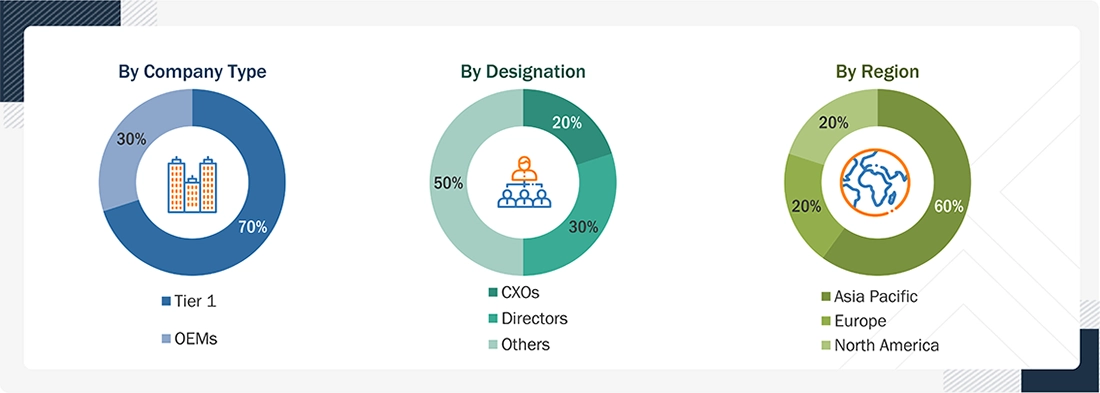
Note: Company tiers are based on the supply chain; the revenue of the company is not considered. Other designations include sales managers, marketing managers, and product managers.
To know about the assumptions considered for the study, download the pdf brochure
Market Size Estimation
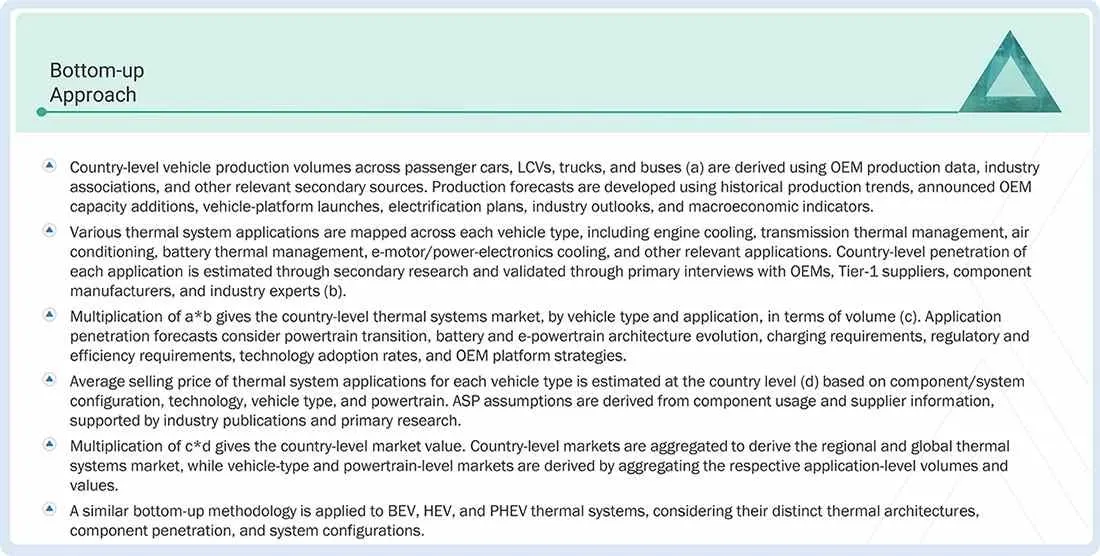
The thermal systems market, in terms of volume, was estimated using a bottom-up approach based on country-level vehicle production across passenger cars, LCVs, trucks, and buses. Firstly, vehicle production volumes were established at the country level using OEM production data, industry associations, and other relevant secondary sources. Vehicle production forecasts were developed using historical production trends, announced OEM capacity additions, vehicle-platform launches, electrification plans, industry outlooks, and macroeconomic indicators.
Then the various thermal system applications used across each vehicle type - such as engine cooling, transmission thermal management, air conditioning, battery thermal management, e-motor/power-electronics cooling, and other relevant applications - were mapped based on powertrain and vehicle architecture. The penetration rate of each application was estimated at the country level through secondary research and validated through primary interviews with OEMs, Tier-1 suppliers, component manufacturers, and industry experts. Country-level application volumes were subsequently calculated by multiplying vehicle production by the corresponding application penetration. Application penetration was forecast based on powertrain transition, battery and e-powertrain architecture evolution, charging requirements, regulatory/efficiency requirements, technology adoption rates, and OEM platform strategies.
For market value estimation, the average selling price (ASP) of each thermal system application was determined at the country level based on component/system configuration, technology, vehicle type, and powertrain. The application-level volume was multiplied by the corresponding ASP to derive the country-level market value, which was then aggregated to obtain regional and global market sizes. Vehicle-type and powertrain-level markets were derived by aggregating the respective application-level volumes and values. A similar bottom-up methodology was applied to BEV, HEV, and PHEV thermal systems, considering their distinct thermal architectures, component penetration, and system configurations.
thermal systems market size: bottom-up approach.
Vehicle-type and powertrain-level markets were derived by aggregating the respective application-level volumes and values. A similar bottom-up methodology was applied to BEV, HEV, and PHEV thermal systems, considering their distinct thermal architectures, component penetration, and system configurations.
Data Triangulation
All percentage shares, splits, and breakdowns have been determined using secondary sources and verified by primary sources. All parameters that are said to affect the markets covered in this research study have been accounted for, viewed in extensive detail, and analyzed to obtain the final quantitative and qualitative data. This data has been consolidated, enhanced with detailed inputs and analysis from MarketsandMarkets, and presented in the report. The following figure is an illustrative representation of the overall market size estimation process employed for this study.
Market Definition
Automotive thermal systems use heating, cooling, heat exchange, and temperature-control technologies to maintain the operating temperature of the vehicle’s powertrain, battery, electric drive, electronics, and passenger cabin. The systems include individual components as well as integrated thermal-management modules used across ICE, hybrid, and electric vehicles. Modern thermal systems increasingly combine coolant and refrigerant circuits to improve energy efficiency, vehicle range, component durability, and cabin comfort.
- Engine Thermal Management: Engine thermal management systems regulate engine and under-hood temperatures through components such as radiators, coolant pumps, thermostats, cooling fans, heat exchangers, air coolers, and oil coolers. These systems maintain the engine within its desired operating temperature, supporting fuel efficiency, emissions performance, and component durability.
- HVAC Thermal Management: HVAC systems provide cabin heating, cooling, ventilation, and dehumidification. They typically comprise compressors, condensers, evaporators, blowers, heaters, expansion valves, and associated controls. In electrified vehicles, electric compressors and heat-pump-based HVAC systems are increasingly used to provide cabin conditioning while limiting the impact on vehicle energy consumption.
- Battery Thermal Management System (BTMS): BTMS maintains battery cells within an appropriate temperature range during driving, charging, and extreme ambient conditions. Technologies include air cooling, liquid cooling, refrigerant-based cooling, coolant pumps, valves, chillers, and electric heaters. Effective battery thermal management supports battery performance, safety, charging capability, and service life.
- Electric Powertrain Thermal Management: Electric powertrain thermal management controls the temperature of electric motors, inverters, power electronics, onboard chargers, and DC-DC converters. Liquid cooling circuits using coolant pumps, valves, heat exchangers, and cooling plates are used to dissipate heat and maintain component efficiency and durability, particularly under high-load and fast-charging conditions.
- Heat Pump and Waste Heat Recovery: Heat-pump systems transfer heat from ambient air or vehicle components to provide efficient cabin or battery heating. Waste-heat recovery captures heat generated by the battery, electric motor, power electronics, or charging system and redirects it to other thermal circuits. This reduces dependence on electrical resistance heating and can improve energy efficiency and EV driving range.
- Integrated Thermal Management: Integrated thermal management combines multiple thermal circuits and components, including coolant pumps, valves, heat exchangers, compressors, HVAC, battery cooling, and powertrain cooling under centralized control. The integration of these functions reduces component count and packaging complexity while enabling more efficient distribution and reuse of thermal energy across the vehicle.
- Thermal Management Control System: Thermal control systems use temperature, pressure, flow, and other vehicle data to regulate pumps, valves, compressors, fans, heaters, and other thermal actuators. Centralized electronic control enables real-time optimization of thermal energy distribution across the cabin, battery, powertrain, and electronics
Key Stakeholders
- Automobile OEMs
- Automotive Thermal Management System Suppliers
- Automotive HVAC System & Component Suppliers
- Automotive Heat Exchanger Manufacturers & Suppliers
- Electric Coolant Pump Manufacturers
- Coolant Valve & Flow-Control Manufacturers
- Automotive Compressor Manufacturers
- Cooling Fan & Blower Manufacturers
- Battery Chiller & Cold-Plate Manufacturers
- Heat Pump & Electric Heater Manufacturers
- Automotive Thermal Sensor & Control-System Suppliers
- Automotive Semiconductor & Electronics Component Suppliers
- Automotive Hose, Pipe & Fluid-Transport Suppliers
- Thermal Management Software, Engineering & Testing Providers
- Automotive Aftermarket & Replacement-Part Suppliers
Report Objectives
- To define, describe, and forecast the thermal systems market in terms of value (USD million) and volume (thousand units), based on the following segments:
- By Application (ICE): Powertrain Thermal Management (Engine Cooling), Transmission Cooling, Cabin Thermal Management (Front Air Conditioning, Rear Air Conditioning, Heated/Ventilated Seats, and Heated Steering), and Waste Heat Recovery
- By ICE Vehicle Type: Passenger Car, LCV, Truck, and Bus
- By Application (Electric and Hybrid Vehicle): Battery Thermal Management, Powertrain Thermal Management (Transmission Cooling & Engine Cooling), Cabin Thermal Management (Front Air Conditioning, Rear Air Conditioning, Heated/Ventilated Seats, and Heated Steering), E-motor, Power Electronics, and Waste Heat Recovery
- By Electric and Hybrid Vehicle Type: BEV, PHEV, FCEV, 48V Mild-hybrid, and Electric Commercial Vehicle
- By Technology (ICE): Active Transmission Warm-up, Exhaust Gas Recirculation, Engine Thermal Mass Reduction, Reduced HVAC System Loading, and Other Technologies
- By Component (ICE): Air Filter, Condenser, Compressor, Water Pump, Motor, Heat Exchanger, Heater Control Unit, Thermoelectric Generator, Electric Compressor, Electric Water Pump, EGR Valve, A/C Valve, Oxygen Sensor, Temperature Sensor, and Charge Air Cooler
- By Component (Electric and Hybrid Vehicle): Air Filter, Condenser, Electric Compressor, Electric Water Pump, Electric Motor, Heat Exchanger, Heater Control Unit, and Thermoelectric Generator
- By Region: Asia Pacific, Europe, North America, and Rest of the World
- To understand the market dynamics (drivers, restraints, opportunities, and challenges) of the thermal systems market
- To analyze the market ranking and market share of key players operating in the market
- To understand the dynamics of the market competitors and distinguish them into stars, emerging leaders, pervasive companies, and participants according to their product portfolio strength and business strategies
- To analyze recent developments, alliances, joint ventures, mergers & acquisitions, new product launches, and other activities carried out by key industry players in the market
Available customizations:
Along with the given market data, MarketsandMarkets offers customizations in accordance with the company’s specific needs.
ELECTRIC & HYBRID THERMAL SYSTEM MARKET, BY APPLICATION COUNTRY-WISE DATA
- Battery Thermal System
- Transmission system
- Engine Cooling
- Front Air Conditioning
- Motor Thermal System
- Power Electronics
- Rear Air Conditioning
- Heated/Ventilated Seats
- Heated Steering
- Waste Heat Recovery
Note: Asia Pacific (China, India, Japan, South Korea), North America (US, Canada), Europe (Germany, France, Norway, Spain, Sweden, UK)
ELECTRIC & HYBRID THERMAL SYSTEM MARKET, BY VEHICLE TYPE, COUNTRY-WISE DATA
- BEV
- PHEV
- FCEV
Note: Asia Pacific (China, India, Japan, South Korea), North America (US, Canada), Europe (Germany, France, Norway, Spain, Sweden, UK)


Personalize This Research
- Triangulate with your Own Data
- Get Data as per your Format and Definition
- Gain a Deeper Dive on a Specific Application, Geography, Customer or Competitor
- Any level of Personalization
Let Us Help You
- What are the Known and Unknown Adjacencies Impacting the Thermal Systems Market
- What will your New Revenue Sources be?
- Who will be your Top Customer; what will make them switch?
- Defend your Market Share or Win Competitors
- Get a Scorecard for Target Partners

Custom Market Research Services
We Will Customise The Research For You, In Case The Report Listed Above Does Not Meet With Your Requirements
Get 10% Free CustomisationTESTIMONIALS

JIM NAAS
PRODUCT DIRECTOR, WEASLER
Weasler Engineering, a CentroMotion organization
Global Provider of Industrial Actuation & Control Solutionswww.weasler.com
Our organization was interested in learning more about the attractiveness of a particular market space. We contacted MarketsandMarkets to help us based on previous positive experiences we had with them. The results did not disappoint! We discussed our objectives with them, and the team at MarketsandMarkets developed and executed a proposal that met our needs precisely. We were very impressed by their level of expertise, the quality of the analysis and their insightful recommendations. We would not hesitate in working with them again in the future.

Matt Kardel,
Vice President
Aptiv,
A global technology company that develops safer, greener and more connected solutions.www.aptiv.com
We contracted with
MarketsandMarkets to evaluate the value chain and potential go-to-market partners related to our
interest in the Fleet Management space. The team successfully completed the work on time and at the
pricing agreed. MarketsandMarkets listened and understood our objectives and collaborated well with
us to help us get the visibility we needed to make an investment.
We have subsequently used
MarketsandMarkets again related to Smart Cities to good results.






Growth opportunities and latent adjacency in Thermal Systems Market