Automotive Wiring Harness Market Size, Share & Analysis

Automotive Wiring Harness Market by Application (Engine, Chassis, Cabin, Body & Lighting, HVAC, Battery, Dashboard/Cabin, Seat, Sunroof, Door, infotainment, ADAS), ICE & EV Transmission Type, Data Rate, Material & Region - Global Forecast To 2033



OVERVIEW
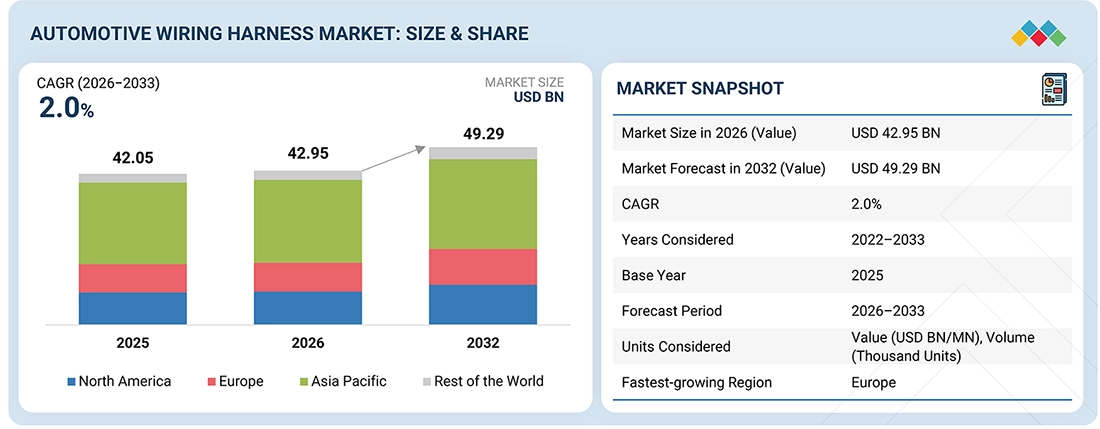
Source: Secondary Research, Interviews with Experts, MarketsandMarkets Analysis
The automotive wiring harness market is expected to grow from USD 42.95 billion in 2026 to USD 49.29 billion by 2033, registering a CAGR of 2.0%. The market is being propelled by two shifts: the rapid increase in vehicle electrification and the transition toward software-defined vehicle architectures. BEVs require significantly more wiring content due to high-voltage power distribution, battery management systems, thermal management, and advanced sensor integration. ADAS and connected-car functions are driving demand for high-speed data harnesses using Ethernet and zonal architectures. At the same time, OEMs are under pressure to reduce harness complexity, weight, and assembly costs, making scalability and modular integration a key competitive differentiator.
KEY TAKEAWAYS
-
MARKET SNAPSHOT:
Market Size (2025): USD 42.05 Billion
Current Market Size (2026): USD 42.95 Billion
Projected Market Size (2033): USD 49.29 Billion
CAGR (2026–2033): 2.0% -
BY REGIONAsia Pacific holds the largest share of the automotive wiring harness market.
-
ICE BY APPLICATIONADAS is the fastest-growing segment during the forecast period
-
ICE BY COMPONENTWires hold the highest market share of >65% in terms of value.
-
ICE BY MATERIALOptical fiber is the fastest-growing segment during the forecast period.
-
ICE BY TRANSMISSION TYPEThe electrical wiring segment holds >90% of the market in terms of value.
-
ICE BY VEHICLE TYPELight commercial vehicles are expected to exhibit the fastest growth during the forecast period.
-
EV BY VEHICEL TYPEBEVs hold the largest market share of >65% in terms of value.
-
EV BY MATERIALOptical fiber is the fastest-growing segment in terms of value.
-
EV BY TRANSMISSION TYPEElectric wiring holds the leading position in terms of value.
-
HIGH VOLTAGE BY APPLICATIONMotor management is expected to grow at a CAGR of 8.0% during the forecast period.
-
DATA TRANSMISSION BY DATA TRANSFER RATEThe <150 Mbps segment holds the largest market share of >80% in terms of value.
-
DATA TRANSMISSION BY APPLICATIONADAS is the fastest-growing segment in terms of value.
-
ICE BY VOLTAGE TYPE>400V is the fastest-growing segment with a CAGR of 11.0%.
-
COMPETITIVE LANDSCAPEYazaki Corporation (Japan), Sumitomo Electric Industries (Japan), Aptiv (Ireland), Furukawa Electric (Japan), and Leoni AG (Germany) were identified as star players in the automotive wiring harness market, as they are focused on innovation, investment in R&D, and higher partnership deals with OEMs.
In the automotive wiring harness market, OEMs are aggressively integrating advanced emission control systems, turbocharged engine monitoring, ADAS-ready sensor wiring, and connected infotainment architectures, significantly increasing wiring content per vehicle. This has driven demand for wire harnesses with higher circuit counts, improved data transmission capabilities, and lightweight materials, rather than simple volume growth.
TRENDS & DISRUPTIONS IMPACTING CUSTOMERS' CUSTOMERS
Future revenue growth for automotive wiring harness manufacturers is expected to be driven by next-generation materials and architectures, including aluminum wiring, plastic and glass optical fibers, and high-voltage wiring harnesses, as OEMs move toward software-defined vehicles and electrified platforms. Automakers are increasingly adopting zonal and centralized compute architectures, along with automotive Ethernet, to reduce vehicle complexity, lower copper usage, and achieve significant weight reduction while supporting higher data and power demands. At the same time, the growing integration of ADAS, OTA-enabled electrical architectures, and advanced connectivity systems is increasing demand for high-speed, lightweight, and modular wiring solutions. These advancements enable end users to benefit from higher connectivity, autonomous driving capabilities, faster diagnostics, and continuously updated vehicle functionality, ultimately improving overall vehicle efficiency, safety, and performance.

Source: Secondary Research, Interviews with Experts, MarketsandMarkets Analysis
MARKET DYNAMICS

Level
-
Transition from domain to zonal architecture

-
Electric energy density explosion


Level
-
Lack of skilled workforce for developing E/E architecture


Level
-
Increase in use of high-voltage harnesses and optical fiber cables

-
Extensive use of aluminum wiring harnesses


Level
-
Higher development cost in premium cars

-
Issues related to wire preparation, staging, and crimping

Source: Secondary Research, Interviews with Experts, MarketsandMarkets Analysis
Driver: Transition from domain to zonal architecture
Automakers are shifting toward zonal E/E architecture because it reduces wiring complexity by ~20–30%, shortens cable lengths, and replaces multiple ECUs with fewer, more powerful computing units, enabling faster data exchange for ADAS, over-the-air updates, and software-defined vehicle functions.
Restraint: Lack of skilled workforce for developing E/E architexture
OEMs are transitioning toward zonal and software-defined architectures. Designing these systems now requires deep expertise in high-speed data networks (Automotive Ethernet), functional safety (ISO 26262), cybersecurity, embedded software, and system integration across multiple domains. However, the workforce of such cross-disciplinary talent is limited, especially in emerging automotive hubs.
Opportunity: Extensive use of aluminum wire harnesses
OEMs push for vehicle lightweighting to improve fuel efficiency and meet CO2 norms in ICE and hybrid platforms. Aluminum, which is up to ~40–50% lighter than copper, has emerged as a strong substitute in low-voltage power distribution and select body harness applications. Aluminum adoption is reshaping the market from a pure copper-based commodity model, where cost optimization and lightweighting are becoming key value drivers.
Challenge: Issues related to wire preparation, staging, and crimping
Wire preparation (cutting, stripping, and labeling) must meet tight tolerances across thousands of variants per platform, and even minor deviations can cause signal loss, short circuits, or connector failure in modern high-speed and ADAS-enabled systems. Staging adds further complexity because harnesses require manual sequencing of hundreds of wires across multiple variants, increasing the risk of routing errors and rework. Crimping is particularly critical, as inconsistent crimp force or misalignment can compromise electrical conductivity, mechanical strength, and long-term vibration resistance, especially in high-temperature engine bays and EV power distribution systems.
AUTOMOTIVE WIRING HARNESS MARKET SIZE, SHARE & ANALYSIS: COMMERCIAL USE CASES ACROSS INDUSTRIES
| COMPANY | USE CASE DESCRIPTION | BENEFITS |
|---|---|---|
 |
Developing next-generation optical wiring harnesses and lightweight aluminum harnesses to support autonomous driving, ADAS, and high-speed in-vehicle data communication. The company is also integrating wheel speed sensor and EPB harness functions to reduce system complexity. | Enables >10 Gbps high-speed data transmission for sensor-rich vehicles, while reducing harness weight, packaging complexity, and overall vehicle cost. Supports SDV and autonomous vehicle architectures. |
 |
Expanding high-voltage wiring harness and power distribution systems for EVs, HEVs, and FCVs, supported by vertically integrated manufacturing from raw material development to final harness assembly. | Improves power distribution efficiency and reliability in electrified vehicles while enabling faster product customization, quality control, and scalability for global OEM programs. |
 |
Advancing smart vehicle electrical architectures and zonal wiring systems for software-defined vehicles, integrating centralized compute, high-speed data networks, and advanced safety systems. | Reduces wiring complexity, ECU count, and vehicle weight while improving software scalability, OTA capability, and electrical architecture efficiency for next-generation connected vehicles. |
 |
Deploying lightweight aluminum wiring harnesses with proprietary Alpha Terminal corrosion-proof technology for EVs and next-generation vehicles, including adoption in Toyota Land Cruiser seat harnesses. | Achieved 20–44% harness weight reduction versus copper systems, lowering CO2 emissions and improving vehicle efficiency while maintaining corrosion resistance and durability. |
Logos and trademarks shown above are the property of their respective owners. Their use here is for informational and illustrative purposes only.
MARKET ECOSYSTEM
The ecosystem encompasses various automotive wiring harness market players, including design and development firms, component manufacturers, automotive wiring harness manufacturers, and end users. The leading players in the market include Yazaki Corporation (Japan), Sumitomo Electric Industries (Japan), Aptiv (Ireland), Furukawa Electric (Japan), and Leoni AG (Germany). These companies offer advanced materials and electrical wires used in automotive wiring harnesses and have a strong distribution network worldwide.

Logos and trademarks shown above are the property of their respective owners. Their use here is for informational and illustrative purposes only.
MARKET SEGMENTS

Source: Secondary Research, Interviews with Experts, MarketsandMarkets Analysis
ICE By Application
The ADAS wiring harness segment is the fastest-growing within automotive wiring systems as safety regulations (Euro NCAP, NHTSA, C-NCAP, Bharat NCAP) push OEMs to include features such as AEB, lane assist, and 360° cameras even in mid-range vehicles. These systems rely on CAN and LIN for control signals, while Automotive Ethernet and high-speed data buses handle radar and camera data, significantly increasing in-vehicle data traffic. This has led to higher sensor density, more shielded high-speed cables, and increased circuit complexity, making ADAS a key driver of rising wiring harness content per vehicle.
ICE By Component
Wires as a component continue to dominate the automotive wiring harness market and are expected to remain dominant throughout the forecast period, as they are the backbone of vehicle electrical systems. OEMs and Tier-1 companies are actively redesigning vehicle electrical systems toward centralized computing and zonal architectures, which, while reducing overall harness length, increase demand for high-performance, high-speed, and multi-functional wires (Ethernet, shielded twisted pairs, and lightweight aluminum-based conductors).
ICE By Material
The optical fiber segment is the fastest-growing material in automotive wiring harnesses because modern vehicles are rapidly adopting high-bandwidth, low-latency digital architectures driven by ADAS, autonomous driving, and connected infotainment systems. In luxury vehicles, OEMs and Tier-1 suppliers are deploying advanced plastic optical fiber (POF), graded-index multimode fibers, and hybrid copper-fiber assemblies, which offer improved flexibility, lower cost than glass fiber, and better integration into tight vehicle spaces. As a result, data transmission speeds have jumped from 100 Mbps in traditional copper-based systems to >10 Gbps, enabling real-time sensor fusion and autonomous driving functions.
ICE By Data Rate
The <150 Mbps data transmission segment holds the highest market share because it is cost-optimal and functions sufficiently in entry- to mid-level vehicles. OEMs are offering >150 Mbps data transfer rates in luxury cars, which primarily use materials like shielded copper-based communication cables, especially Shielded Twisted Pair (STP) and Unshielded Twisted Pair (UTP) Ethernet-grade wiring for communication. Hence, the increase in demand for premium and luxury cars will drive the market for >150 Mbps data rates.
ICE By Voltage
The >400V segment is the fastest-growing in automotive wiring harnesses because the industry is rapidly shifting toward high-voltage electric architectures to support BEVs, high-performance hybrids, and fast-charging systems. This growth is further accelerated by the need for faster charging (ultra-fast DC charging), improved energy efficiency, and reduced power loss.
REGION
Europe to be fastest-growing market during forecast period
Europe is growing significantly in the automotive wiring harness market, driven by a strong concentration of premium and luxury vehicle manufacturing, rapid electrification, and high adoption of connected vehicle technologies. Germany leads the region, with strong deployment of 800V EV platforms, ADAS integration, and centralized E/E architectures, driving demand for high-voltage and high-speed data harness systems. France, the UK, and Sweden are advancing automotive Ethernet, centralized vehicle computing, and next-generation EV platforms, while Eastern Europe (Poland, Hungary, Romania, Czech Republic) is emerging as a key cost-efficient manufacturing hub for EV and premium vehicle components. Across the region, OEMs are increasingly adopting lightweight aluminum wiring, modular harness designs, shielded communication cables, and early zonal architecture concepts to reduce copper usage, vehicle weight, and electrical complexity while supporting advanced EV and ADAS-enabled platforms.

AUTOMOTIVE WIRING HARNESS MARKET SIZE, SHARE & ANALYSIS: COMPANY EVALUATION MATRIX
Sumitomo Electric (Star) maintains a strong market presence and offers a wide range of products in the automotive wiring harness market, enabling widespread adoption in dashboard/cabin harnesses and body & lighting. Nexans (Emerging Leader) is gaining traction with innovative automotive wiring harnesses featuring high data transfer speeds and new materials in wire harnesses.

Source: Secondary Research, Interviews with Experts, MarketsandMarkets Analysis
KEY MARKET PLAYERS
- Yazaki Corporation
- Sumitomo Electric Industries
- Aptiv
- Furukawa Electric
- Leoni AG
- Samwardhana Motherson Internation Limited
- Lear Corporation
- Prysmian Group
- Nexans
- Gebauer & Griller Group
- Fujikura Ltd.
MARKET SNAPSHOT TABLE SCOPE
| REPORT METRIC | DETAILS |
|---|---|
| Base Year Market Size in 2025 (Value) | USD 42.05 Billion |
| Base Year Market Size in 2026 (Value) | USD 42.96 Billion |
| Market Forecast in 2033 (Value) | USD 49.29 Billion |
| Growth Rate | CAGR of 2.0% from 2026 to 2033 |
| Years Considered | 2022–2033 |
| Base Year | 2025 |
| Forecast Period | 2026–2033 |
| Units Considered | Value (USD BN/MN), Volume (Thousand Units) |
| Report Coverage | Revenue forecast, company ranking, competitive landscape, growth factors, and trends |
| Segments Covered | By Category (general wires, heat resistant wires, shielded wires, tubed wires) ICE By Application (engine, chassis, body & lighting, HVAC, dashboard/cabin, battery, door, infotainment, active & passive safety, ADAS, roof, seat, other applications) ICE By Component (connectors, wires, terminals, other components) ICE By Material (metallic, optical fiber) ICE By Transmission Type (data transmission, electric wiring) By ICE Vehicle Type & Application (passenger cars, light commercial vehicles, buses, trucks) 48V Architecture By Type (pipe shielded wiring harnesses, power cables, direct connectors) By EV Type & Application (BEVs, PHEVs, FCEVs) EV By Material (metallic, optical fiber) EV By Transmission Type (data transmission, electric wiring) High Voltage By application (Battery & battery management systems, motor management) By Data Rate (<150 mbps, 150 mbps to 1 gbps) Data Transmission By application (ADAS, infotainment, security, others) By Voltage (<400 V and >400 V) By Region (Asia Pacific, Europe, North America, Rest of the World) |
| Regional Scope | Asia Pacific, Europe, North America, Rest of the World |
WHAT IS IN IT FOR YOU: AUTOMOTIVE WIRING HARNESS MARKET SIZE, SHARE & ANALYSIS REPORT CONTENT GUIDE

DELIVERED CUSTOMIZATIONS
We have successfully delivered the following deep-dive customizations:
| CLIENT REQUEST | CUSTOMIZATION DELIVERED | VALUE ADDS |
|---|---|---|
| OEM demand for reduced vehicle weight and improved fuel efficiency in ICE platforms | Development of aluminum-based wiring harnesses and optimized copper-aluminum hybrid conductors with lightweight insulation materials | Achieves 10–25% weight reduction, improves fuel efficiency/EV range, and supports OEM CO2 compliance targets |
| Increasing need for ADAS integration in mid-to-premium vehicles | Design of high-density harness systems with additional shielded data lines for cameras, radar, and sensors using CAN + Automotive Ethernet architecture | Enables real-time sensor communication, improved safety compliance (NCAP), and higher ADAS feature penetration |
| OEM push for zonal E/E architecture and reduced wiring complexity | Delivery of modular zonal harness systems with centralized power/data distribution and reduced wire length architecture | Reduces harness length by ~20–30%, lowers assembly complexity, and improves vehicle scalability across platforms |
| Requirement for high-voltage EV platforms (400V–800V systems) | Development of high-voltage shielded wiring harnesses with XLPE/silicone insulation and enhanced EMI protection for battery, inverter, and motor systems | Ensures safe high-power transmission, fast charging compatibility, and improved thermal/electrical durability |
| OEM demand for cost optimization in high-volume ICE production programs | Implementation of localized manufacturing, automated crimping/terminal assembly, and platform-based standardized harness designs | Delivers lower production cost, improved quality consistency, and faster time-to-market for global OEM vehicle platforms |
RECENT DEVELOPMENTS
- February 2026 : Matherson, Yazaki, and Sumitomo expanded manufacturing footprints in India and ASEAN, supporting dual ICE + EV demand.
- January 2026 : Sumitomo Electric has strategically expanded its supply agreements with major Chinese OEMs, capitalizing on the shift toward zonal electronic architectures in next-generation electric and autonomous vehicles.
- September 2025 : Leoni continued rollout of zonal wiring architecture programs, reducing wiring length and complexity in next-generation OEM platforms.
- June 2025 : Sumitomo Electric increased supply for EV wiring harness systems (400V–800V platforms) supporting Chinese OEM electrification programs.
- March 2025 : Aptiv expanded its ADAS-enabled overhead and zonal wiring harness platforms, driven by rising camera, radar, and cabin sensor integration in premium vehicles.
Table of Contents
 Exclusive indicates content/data unique to MarketsandMarkets and not available with any competitors.
Methodology
Various secondary sources, directories, and databases have been used to identify and collect information for an extensive automotive wiring harness market study. The study involved four main activities in estimating the current size of the automotive wiring harness market: secondary research, validation through primary research, assumptions, and market analysis. The research study involved various secondary sources, such as company annual reports/presentations, industry association publications, automotive wiring harness magazine articles, directories, technical handbooks, World Economic Outlook, trade websites, technical articles, and databases, which were used to identify and collect information for an extensive study of the automotive wiring harness market. Primary sources experts from related industries, automobile OEMs, and suppliers were interviewed to obtain and verify critical information and assess prospects and market estimations.
Secondary Research
Secondary sources referred to in this research study include automotive sector organizations such as the Organization Internationale des Constructeurs d'Automobiles (OICA); corporate filings (such as annual reports, investor presentations, and financial statements); and trade, business, automotive e/e architecture, and automotive wiring harness associations. The secondary data has been collected and analyzed to arrive at the overall market size, which has been further validated by primary research.
Primary Research
Extensive primary research has been conducted after obtaining an understanding of the automotive wiring harness market scenario through secondary research. Approximately 80% of the primary interviews have been conducted with automotive wiring harness providers, and 20% from automotive OEMs across North America, Europe, and Asia Pacific. Primary data was collected through questionnaires, e-mails, and telephonic interviews. In the canvassing of primaries, various departments within organizations, such as sales, operations, and administration, were covered to provide a holistic viewpoint in the report. After interacting with industry experts, brief sessions were conducted with highly experienced independent consultants to validate the findings from the primaries.
The following is the breakdown of primary respondents:
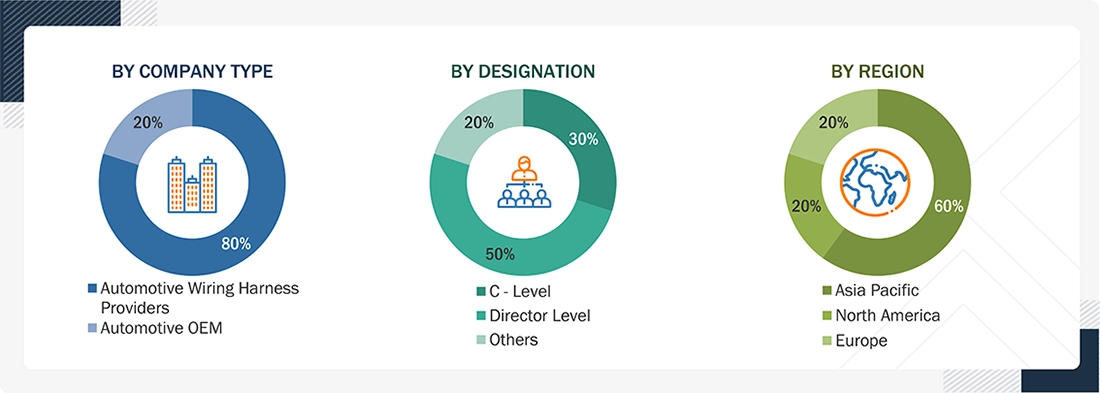
Note: Company tiers are based on the supply chain (Tier 1: component manufacturers and OEMs are automotive wiring harness manufacturers). Other designations include sales, marketing, and product managers.
To know about the assumptions considered for the study, download the pdf brochure
Market Size Estimation
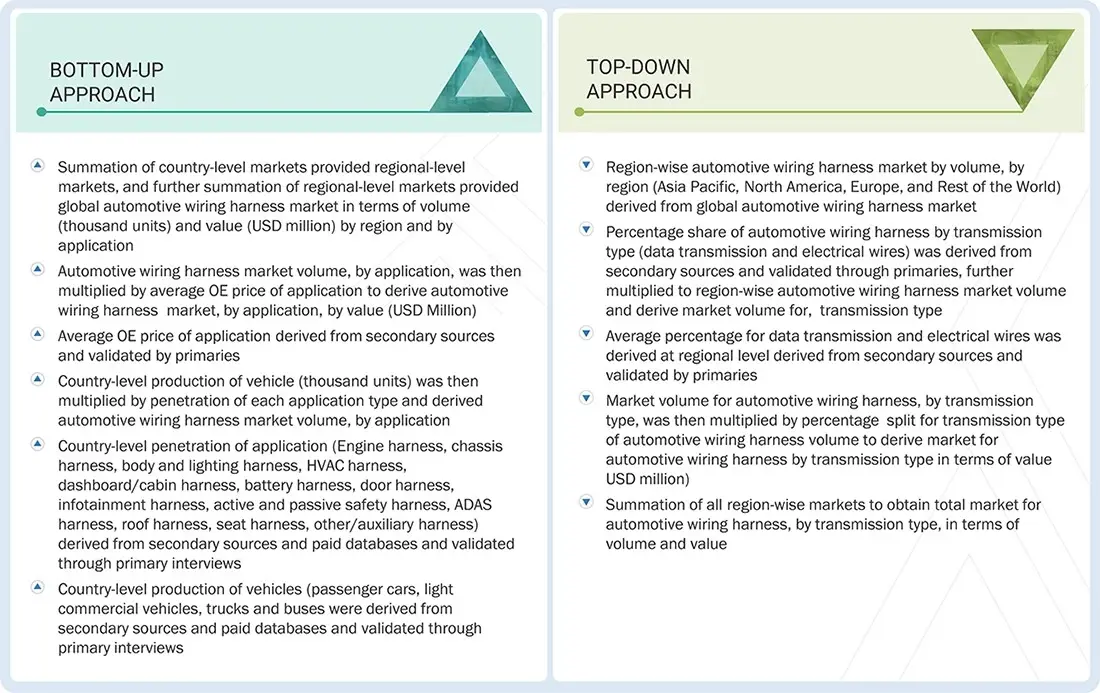
The bottom-up approach derived the market size based on volume and value. This was followed by primary interviews and feature mapping on a regional basis from the MarketsandMarkets repository. The market size was validated through in-depth interviews with industry experts, excerpts available in the discussion guide in the appendix, and secondary research. The report-writing phase begins after arriving at the final numbers for the market size.
Data Triangulation
After arriving at the overall market size, the market was split into several segments and subsegments. To complete the overall market engineering process and arrive at the exact statistics of each market segment and subsegment, data triangulation and market breakdown procedures were employed, wherever applicable. The data was triangulated by studying various factors and trends from both the demand and supply sides.
Market Definition
A wiring harness is defined as an organized set of wires, terminals, and connectors that run throughout the vehicle and relay information and electric power, thereby playing a critical role in connecting various components. Power and information travel through this network, like the circulatory and central nervous systems of the human body. According to Siemens Software, a wire harness is a system of insulated conducting wires bound together with insulation materials, used in the electrical system of a motor vehicle, complex machine, or aircraft, and its purpose is to organize individual wires into a single unit to efficiently transmit electrical power and signals.
Key Stakeholders
- Tier-1 Wiring Harness Suppliers
- OEMs
- Tier-2/Component Suppliers
- Raw Material Supplier
- Electronics & Semiconductor Companies
- Manufacturing & Automation Solution Providers
- Regulatory & Standards Bodies
- Aftermarket & Service Providers
- End Users
Report Objectives
- To define, describe, and forecast the size of the automotive wiring harness market in terms of value (USD million) and volume (thousand units)
- By category (general wires, heat-resistant wires, shielded wires, tubed wires)
- By application (engine, chassis, body & lighting, HVAC, dashboard/cabin, battery, door, infotainment, active & passive safety, ADAS, roof, seat, other applications)
- By component (connectors, wires, terminals, other components)
- By material [metallic (copper, aluminum, other metallic materials), optical fiber (glass optical fiber, plastic optical fiber)]
- ICE vehicle by transmission type (data transmission, electrical wiring)
- By ICE vehicle type (passenger cars, light commercial vehicles, buses, trucks)
- 48V architecture wiring harness by type (pipe shielded wiring harnesses, power cables, direct connectors)
- By EV type (BEVs, PHEVs, FCEVs)
- EV by material (metallic, optical fiber)
- EV by transmission type (data transmission, electrical wiring)
- High voltage by application (battery & battery management systems, motor management)
- Data transmission by data transfer rate (<150 Mbps, 150 Mbps to 1 Gbps) (in terms of value only)
- Data transmission by application (ADAS, infotainment, security, others)
- By Voltage (<400V, >400V)
- By region (Asia Pacific, North America, Europe, Rest of the World)
- To understand the dynamics (drivers, restraints, opportunities, and challenges) of the market
- To strategically analyze the market with trade analysis, pricing analysis, case study analysis, patent analysis, technology analysis, regulatory analysis, key conferences and events, trends/disruptions impacting buyers, and the investment and funding case scenario.
- To analyze the competitive landscape of the global players in the market, along with their market share.
- To analyze the market share of automotive wire harness manufacturers at the global level.
- To understand the dynamics of competitors and distinguish them into stars, emerging leaders, pervasive players, and participants according to the strength of their product portfolio and business strategies
- To analyze a detailed listing of OEMs and their brands, mergers & acquisitions, partnerships, collaborations, expansions, and product launches/developments, a company evaluation matrix, competitive scenario, company valuation and financial metrics, and brand and product comparison undertaken by key participants in the market.
Available customizations:
Along with the market data, MarketsandMarkets offers customizations per company-specific needs.
The following customization options are available for the report:
Asia Pacific
- China
- India
- Japan
- South Korea
- Thailand
- Rest of Asia Pacific
Europe
- Germany
- France
- UK
- Spain
- Russia
- Italy
- Rest of Europe
North America
- US
- Canada
- Mexico
Rest of the World
- Brazil
- South Africa
- Other
Asia Pacific
- China
- India
- Japan
- South Korea
- Thailand
- Rest of Asia Pacific
Europe
- Germany
- France
- UK
- Spain
- Russia
- Italy
- Rest of Europe
North America
- US
- Canada
- Mexico
Rest of the World
- Brazil
- South Africa
- Other
DETAILED ANALYSIS AND PROFILING OF up to three ADDITIONAL MARKET PLAYERS
Key Questions Addressed by the Report
What is the current market size of the Automotive Wiring Harness Market?
The global Automotive Wiring Harness Market is projected to grow from USD 42.95 billion in 2026 to USD 49.29 billion by 2033, with a CAGR of 2.0%.
What are the key factors driving the growth of the Automotive Wiring Harness Market?
The market is driven by increasing vehicle electrification, the transition to software-defined vehicles, growing adoption of ADAS and connected car technologies, rising demand for high-voltage wiring in electric vehicles, and the need for lightweight, high-speed data transmission systems.
Which vehicle segment is expected to dominate the Automotive Wiring Harness Market?
Battery Electric Vehicles (BEVs) are expected to account for the largest share of the EV wiring harness market due to their extensive use of high-voltage electrical systems, battery management systems, thermal management, and advanced electronic architectures.
Which application segment is expected to witness the fastest growth in the Automotive Wiring Harness Market?
The ADAS (Advanced Driver Assistance Systems) segment is expected to register the fastest growth, fueled by increasing integration of radar, cameras, LiDAR, driver monitoring systems, and high-speed automotive Ethernet networks in modern vehicles.
Which region is expected to experience significant growth in the Automotive Wiring Harness Market?
North America is expected to be the second-fastest-growing regional market during the forecast period, supported by rising EV production, increasing adoption of premium vehicles, and growing integration of advanced safety and connectivity features.


Personalize This Research
- Triangulate with your Own Data
- Get Data as per your Format and Definition
- Gain a Deeper Dive on a Specific Application, Geography, Customer or Competitor
- Any level of Personalization
Let Us Help You
- What are the Known and Unknown Adjacencies Impacting the Automotive Wiring Harness Market
- What will your New Revenue Sources be?
- Who will be your Top Customer; what will make them switch?
- Defend your Market Share or Win Competitors
- Get a Scorecard for Target Partners

Custom Market Research Services
We Will Customise The Research For You, In Case The Report Listed Above Does Not Meet With Your Requirements
Get 10% Free CustomisationTESTIMONIALS

JIM NAAS
PRODUCT DIRECTOR, WEASLER
Weasler Engineering, a CentroMotion organization
Global Provider of Industrial Actuation & Control Solutionswww.weasler.com
Our organization was interested in learning more about the attractiveness of a particular market space. We contacted MarketsandMarkets to help us based on previous positive experiences we had with them. The results did not disappoint! We discussed our objectives with them, and the team at MarketsandMarkets developed and executed a proposal that met our needs precisely. We were very impressed by their level of expertise, the quality of the analysis and their insightful recommendations. We would not hesitate in working with them again in the future.

Matt Kardel,
Vice President
Aptiv,
A global technology company that develops safer, greener and more connected solutions.www.aptiv.com
We contracted with
MarketsandMarkets to evaluate the value chain and potential go-to-market partners related to our
interest in the Fleet Management space. The team successfully completed the work on time and at the
pricing agreed. MarketsandMarkets listened and understood our objectives and collaborated well with
us to help us get the visibility we needed to make an investment.
We have subsequently used
MarketsandMarkets again related to Smart Cities to good results.
- Japan Automotive Wiring Harness Market
- South Korea Automotive Wiring Harness Market
- India Automotive Wiring Harness Market
- Thailand Automotive Wiring Harness Market
- Germany Automotive Wiring Harness Market
- France Automotive Wiring Harness Market
- UK Automotive Wiring Harness Market
- Spain Automotive Wiring Harness Market
- Russia Automotive Wiring Harness Market
- Italy Automotive Wiring Harness Market
- Canada Automotive Wiring Harness Market
- Mexico Automotive Wiring Harness Market
- Brazil Automotive Wiring Harness Market
- South Africa Automotive Wiring Harness Market
- US Automotive Wiring Harness Market
- China Automotive Wiring Harness Market
Growth opportunities and latent adjacency in Automotive Wiring Harness Market






Devang
Jul, 2022
Automotive Wiring Harness Market comparison (ratings) illustrating the strength of Product portfolio of different companies including Leoni in four parameters: a. Product offerings b. R&D Expenditure c. Inorganic d. Organic 2. Provided ratings chart in terms of Business strategy Excellence on two parameters: a. Product Offerings – Breadth and Depth b. R&D Expenditure Moreover, along with major players in the market, we have provided MNM view and SWOT analysis for Leoni. The same is provided to other major 4 players as well. This includes: 1. Furukuwa Electric 2. Aptiv PLC 3. Yazaki Corporation 4. Sumitomo Electric Industries.