Busbar Monitoring Market by Monitoring Technology (Thermal/Infrared Imaging, Partial Discharge Detection, Fiber Optic Temperature Sensing, Current/Load Sensors, IoT Predictive Maintenance), Application, End User - Global Forecast to 2032


Busbar Monitoring Market to 2032: Size, Share & Growth Report
The global Busbar Monitoring market is projected to grow from USD 1,450 million in 2026 to USD 3,200 million by 2032, at a CAGR of approximately 14% during 2026–2032. Growth is driven by AI data center power density growth driving busway deployment and monitoring adoption, Legrand's aggressive busway acquisition strategy consolidating fragmented monitoring specialists, and vendors embedding monitoring directly into busway hardware rather than treating it as an aftermarket retrofit.
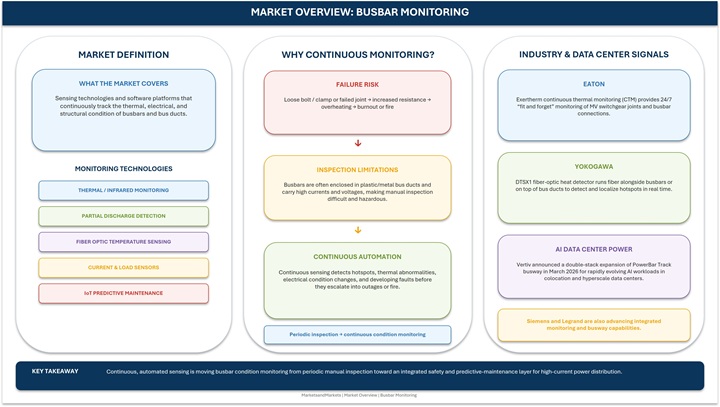
Busbar Monitoring Market
Busbar monitoring covers the sensing technologies and software platforms that continuously track the thermal, electrical, and structural condition of busbars and bus ducts, the conductor systems that carry power through switchgear, panel boards, and increasingly, data center power distribution. The market spans thermal imaging and infrared monitoring, partial discharge detection, fiber optic temperature sensing, current and load monitoring sensors, and IoT-enabled predictive maintenance platforms, deployed to catch developing faults before a loose bolt, degraded clamp, or failed joint escalates into an unplanned outage or fire.
The risk busbar monitoring addresses is well understood by the vendors building it: a loose bolt or clamp, or a failed welded joint, can increase electrical resistance and cause overheating at that spot, which can further elevate resistance and potentially lead to burnout or fire. Because busbars are often housed inside plastic or metal bus ducts in hard-to-reach areas, and carry high currents and voltages, manual visual inspection is both difficult and hazardous — which is precisely why vendors are moving monitoring from a periodic manual task into continuous, automated sensing. Eaton's Exertherm continuous thermal monitoring (CTM) solution provides “fit and forget” 24/7 monitoring of MV switchgear joints and busbar connections, while Yokogawa's DTSX1 fiber optic heat detector runs fiber-optic cable alongside busbars or on top of bus ducts to detect hotspots and localize abnormalities in real time.
Data center power distribution has become the market's most active battleground for monitoring-integrated busway innovation. Vertiv announced a compact, high-capacity double-stack expansion of its PowerBar Track busway family in March 2026, designed specifically to address rapidly evolving AI workloads in colocation and hyperscale data centers. Siemens has developed its LData busbar trunking system with integrated monitoring built directly into the product rather than added afterward, and Legrand has pursued an aggressive, multi-acquisition strategy to consolidate busway and monitoring specialists as data centers become a larger share of its business. The Busbar Monitoring market is where continuous, automated sensing is replacing periodic manual inspection as the default safety standard for high-current power distribution — and the vendors that can embed reliable monitoring directly into busway hardware will capture the category's growth.
Top 10 Key Takeaways
- North America holds the largest market share, driven by the concentration of hyperscale AI data center campuses and leading busway/monitoring vendors, including Vertiv and Eaton, headquartered in the region.
- Asia Pacific is the fastest-growing region, propelled by Legrand's active acquisition strategy in the region, including its 2025 purchase of Malaysia-based Linkk Busway Systems, and rapidly expanding regional data center buildout.
- Thermal imaging and infrared monitoring leads by technology revenue, reflecting its position as the most widely deployed and longest-established busbar condition monitoring method; IoT-enabled predictive maintenance platforms are the fastest-growing technology as monitoring shifts from standalone sensors to software-layered asset management.
- Industrial switchgear and process facilities dominate by application; data center power distribution is the fastest-growing application as AI rack power density makes continuous thermal monitoring a design requirement rather than an optional add-on.
- Data center operators and hyperscalers are the fastest-growing end-user category as monitoring-integrated busway systems increasingly get specified from the initial design stage rather than retrofitted after commissioning.
- Vertiv's March 2026 launch of its PowerBar Track double-stack busway system, supporting up to 2,000A under UL 857 and 2,500A under IEC 61439-6, illustrates how quickly busway vendors are re-engineering for AI-driven power density.
- Legrand's data center segment already accounted for 20% of the company's proforma sales in 2024, and the company pursued eight or more acquisitions in the busway and data center infrastructure space during 2025 alone.
- Eaton's Exertherm continuous thermal monitoring solution and Yokogawa's DTSX1 fiber optic heat detector illustrate how established industrial vendors are converting a traditionally manual, periodic inspection task into always-on automated sensing.
- The near-term opportunity lies in greenfield AI data center buildout, which lets operators specify monitoring-integrated busway systems from the initial design stage rather than retrofitting sensors onto live, high-current infrastructure later.
- The near-term risk is slow retrofit monitoring adoption across the vast existing installed base of unmonitored busbars and bus ducts, where the cost and operational disruption of adding sensors to live infrastructure remains a real adoption barrier.
Why the Busbar Monitoring Market Matters Now
Busbars sit at the center of a genuine, well-documented safety risk that facility operators can no longer manage through manual inspection alone. As one industry technical guide puts it plainly, a loose bolt or clamp, or a failed welded joint, can increase electrical resistance, causing overheating at that spot, which can further elevate resistance and potentially lead to burnout or even fire. Because busbars are frequently housed inside covers and ducts in hard-to-reach areas, and carry dangerously high currents and voltages, the visual inspections operators have long relied on are both difficult to perform thoroughly and hazardous to the technicians performing them.
This matters commercially because the industry's leading vendors are no longer treating monitoring as an optional accessory — they are building it directly into new busway products. Siemens' LData busbar trunking system was designed specifically to enable “enhanced reliability and efficiency through easier energy monitoring without data cables,” while Eaton markets its bus duct monitoring explicitly around continuous visibility into busway, tap-off, and end-feed box connections to “help identify developing thermal issues early” and “reduce the risk of unplanned outages by detecting abnormal heating before it impacts critical operations.” That shift from periodic inspection to continuous sensing is the single clearest signal of where the market is headed.
The market covers thermal imaging and infrared monitoring, partial discharge detection, fiber optic temperature sensing, current and load monitoring sensors, and IoT-enabled predictive maintenance platforms. Out of scope are the busbars and bus duct hardware themselves sold without a monitoring component, general electrical panel boards and switchgear evaluated independently of busbar-specific sensing, and broader building management systems not specific to busbar condition monitoring.
The market connects to the
Generator Sales Market — https://www.marketsandmarkets.com/Market-Reports/generator-sales-market-47544335.html
Power Monitoring Market — https://www.marketsandmarkets.com/Market-Reports/power-monitoring-market-197503460.html
DERMS Architecture and Edge Control Market — https://www.marketsandmarkets.com/Market-Reports/derms-architecture-and-edge-control-market-206649623.html
Circuit Breaker Monitoring Systems Market — https://www.marketsandmarkets.com/Market-Reports/circuit-breaker-monitoring-systems-market-133358428.html
Power Device Analyzer Market — https://www.marketsandmarkets.com/Market-Reports/power-device-analyzer-market-259267665.html
Report Scope
| Report Metric | Details |
|---|---|
| Market Size in 2026 (Value) | USD 1,450 Million |
| Market Forecast in 2032 (Value) | USD 3,200 Million |
| Growth Rate | CAGR of 14% from 2026–2032 |
| Years Considered | 2022–2032 |
| Base Year | 2025 |
| Forecast Period | 2026–2032 |
| Units Considered | Value (USD Million) |
| Report Coverage | Revenue forecast, company ranking, competitive landscape, growth factors, and trends |
| Top Companies |
|
| Growth Drivers |
|
| Segments Covered |
|
| Regional Scope | North America, Europe, Asia Pacific, Rest of World |
Market Trends Shaping Busbar Monitoring
The defining trend is the shift from aftermarket retrofit sensing to factory-integrated monitoring. Siemens' LData busbar trunking system and Vertiv's PowerBar Track double-stack busway both build monitoring and energy visibility directly into the product rather than treating sensing as a separate accessory added after installation, reflecting a broader industry move to specify monitoring capability at the point of original design.
A second trend is busway consolidation through acquisition accelerating monitoring capability rollout. Legrand pursued an aggressive acquisition strategy through 2024 and 2025, including Power Bus Way in Toronto and Linkk Busway Systems in Malaysia, with CEO Benoit Coquart noting the data center segment already accounted for 20% of the group's proforma sales in 2024 — consolidation that is concentrating monitoring expertise inside a smaller number of larger, better-resourced vendors.
A third trend is fiber optic and wireless sensing reducing manual inspection of hard-to-reach busbars. Yokogawa's DTSX1 fiber optic heat detector installs alongside busbars or on top of bus ducts to detect hotspots and localize abnormalities without requiring a technician to physically access enclosed, high-current infrastructure — directly addressing the safety hazard that manual busbar inspection has always posed.
A fourth trend is high-density AI racks making continuous thermal monitoring a design requirement. Vertiv's double-stack PowerBar Track busway, designed to address rapidly evolving AI workloads within colocation and hyperscale data centers, illustrates how rising rack power density is pushing monitoring from a nice-to-have feature into a baseline specification for new AI data center power distribution.
A fifth trend is predictive maintenance software layering onto physical sensor hardware. Eaton's partial discharge remote monitoring analytics platform provides insight into defects and deterioration in transformers, motors, and switchgear specifically to help operators predict potential failure and better manage repair and replacement before an unexpected outage — turning raw sensor data into an actionable maintenance decision rather than a simple alarm.
Market Drivers Accelerating Growth
The first driver is AI data center power density growth: as rack power requirements rise, busway systems such as Vertiv's double-stack PowerBar Track are being engineered specifically for AI workloads, and the higher currents involved make continuous thermal monitoring a practical necessity rather than an optional safety enhancement.
The second driver is Legrand's aggressive busway acquisition strategy, which pursued eight or more acquisitions in the data center and busway space during 2025 alone, consolidating previously fragmented busbar and monitoring specialists — including Linkk Busway Systems in Malaysia and Power Bus Way in Toronto — into a larger, more resourced platform capable of scaling monitoring capability globally.
The third driver is vendors embedding monitoring directly into busway hardware: Siemens' LData system and Eaton's Exertherm CTM solution both reflect a shift toward factory-integrated sensing built into the product from the outset, rather than monitoring capability that facility operators must separately specify and retrofit after installation.
Market Challenges and Restraints
The most significant restraint is slow retrofit monitoring adoption across the existing unmonitored installed base. The vast majority of busbars and bus ducts already in service were installed without integrated monitoring, and adding sensors to live, high-current infrastructure carries real cost and operational disruption — meaning much of the market's growth depends on new construction and major renovation cycles rather than rapid retrofit of the existing base.
A second restraint is a fragmented technology landscape without a single dominant monitoring standard. Thermal imaging, partial discharge detection, fiber optic sensing, and current monitoring sensors each address different failure modes and come from different vendor ecosystems, complicating procurement decisions for facility operators who must choose among competing approaches rather than a single, universally accepted standard.
A third challenge is balancing monitoring system cost against total busway system budget, particularly for cost-sensitive commercial and lower-tier industrial applications where the incremental cost of integrated monitoring can be a harder sell than in mission-critical data center or industrial process environments. A related challenge is sustaining low false-alarm rates: automated monitoring systems must reliably distinguish genuine developing faults from normal operating variation to maintain facility operator trust in automated thermal and partial discharge alerts over time.
Segment Insights
By Monitoring Technology
Thermal imaging and infrared monitoring leads by technology revenue, reflecting its position as the most widely deployed and longest-established method for detecting the hotspots that a loose bolt, degraded clamp, or failed joint produces before it escalates into a serious fault.
IoT-enabled predictive maintenance platforms are the fastest-growing technology, propelled directly by vendors such as Eaton layering analytics on top of raw sensor data to help operators predict potential equipment failure and plan repair and replacement proactively rather than reactively.
By Application
Industrial switchgear and process facilities dominate by application, anchored by the large, established base of manufacturing and processing facilities that have relied on partial discharge and thermal monitoring for switchgear and motor condition assessment for decades.
Data center power distribution is the fastest-growing application, driven directly by AI rack power density making continuous busbar and bus duct thermal monitoring a design requirement, reflected in Vertiv's, Siemens', and Legrand's concentrated 2025–2026 product and acquisition activity specifically targeting this segment.
Key segmentation insights:
- Thermal/infrared monitoring leads technology revenue; IoT-enabled predictive maintenance platforms grow fastest as monitoring shifts to software-layered asset management.
- Industrial switchgear/process facilities dominate by application; data center power distribution grows fastest on AI rack power density.
- Data center operators/hyperscalers grow fastest among end users as monitoring-integrated busway systems get specified at the design stage.
- The factory-integrated monitoring model and the standalone retrofit sensor model represent two competing routes to market.
- AI data center buildout and busway vendor consolidation are the structural drivers converting busbar monitoring into a mainstream specification rather than a niche safety add-on.
Regional Analysis: Busbar Monitoring Market by Region
North America
North America holds the largest share, valued at roughly USD 580 million in 2026 and projected to reach about USD 940 million by 2032, growing at a CAGR of approximately 8.4%. The United States dominates through the concentration of hyperscale AI data center campuses and leading busway/monitoring vendors — Vertiv and Eaton — headquartered in the region, alongside Legrand's 2024 acquisition of Toronto-based Power Bus Way extending its North American busbar footprint. Canada contributes through growing data center and industrial monitoring adoption.
Europe
Europe is valued at approximately USD 350 million in 2026 and forecast to reach around USD 590 million by 2032, expanding at a CAGR of approximately 9.1%. Germany anchors the region through Siemens' LData busbar trunking system, developed specifically for data centers seeking improved efficiency, availability, and adaptability; the United Kingdom and France contribute through growing enterprise and colocation data center investment.
Asia Pacific
Asia Pacific is the fastest-growing region, valued at roughly USD 435 million in 2026 and projected to reach about USD 1,190 million by 2032, growing at a CAGR of approximately 18.3%. Malaysia contributes directly through Legrand's 2025 acquisition of Linkk Busway Systems, a reference specialist in power busbars for data centers' grey space; China continues to expand industrial and data center busbar monitoring demand; and Japan adds growing adoption through Yokogawa's fiber optic monitoring technology.
Rest of World
The Rest of World market is valued at USD 85 million in 2026 and is projected to reach about USD 165 million by 2032, growing at a CAGR of approximately 11.7%. The Middle East contributes through growing sovereign AI data center and industrial electrification investment, while Latin America adds expanding regional industrial and data center monitoring adoption.
Key Company Insights
The competitive landscape spans three tiers: established electrical equipment conglomerates embedding monitoring into busway product lines, specialized condition-monitoring and sensing technology providers, and busway-focused vendors expanding through acquisition. Leading players include Eaton, Vertiv, Legrand (Starline), Siemens AG, Schneider Electric, ABB Ltd., Yokogawa Electric, Rittal, Delta Electronics, Chint Group, Methode Electronics, C&S Electric, Anord Mardix, Qualitrol, and Doble Engineering.
- Eaton (Exertherm CTM thermal monitoring, PowerWave busway)
- Vertiv (PowerBar Track double-stack busway)
- Legrand / Starline (Universal Electric, busway acquisitions)
- Siemens AG (LData busbar trunking with integrated monitoring)
- Schneider Electric (Canalis busbar system)
- ABB Ltd. (busbar and switchgear monitoring)
- Yokogawa Electric (DTSX1 fiber optic heat detector)
- Rittal (busbar systems)
- Delta Electronics (busway and monitoring)
- Chint Group (busbar systems)
- Methode Electronics (busbar sensing technology)
- C&S Electric (busbar systems)
- Anord Mardix (busway systems for data centers)
- Qualitrol (partial discharge and condition monitoring sensors)
- Doble Engineering (asset condition monitoring, partial discharge testing)
Eaton anchors the market's continuous thermal monitoring tier through its Exertherm CTM solution, marketed as a “fit and forget” 24/7 monitoring technology for MV switchgear joints and busbar connections, alongside a separate partial discharge remote monitoring analytics platform covering transformers, motors, and switchgear. Vertiv competes directly in AI data center busway innovation, having launched its double-stack PowerBar Track system in March 2026 to address rapidly evolving AI workloads in colocation and hyperscale facilities. Legrand, through its Starline (Universal Electric) brand, has pursued the most aggressive acquisition-led growth strategy in the category, consolidating regional busway and monitoring specialists including Linkk Busway Systems in Malaysia and Power Bus Way in Toronto.
Siemens differentiates through factory-integrated design, having developed its LData busbar trunking system specifically to enable easier energy monitoring without data cables for data centers seeking improved efficiency and adaptability. Schneider Electric, ABB, Rittal, Delta Electronics, Chint Group, C&S Electric, and Anord Mardix compete across established industrial busbar and data center busway product lines, while Yokogawa anchors the fiber optic sensing tier with its DTSX1 heat detector purpose-built for busbar and bus duct applications. Methode Electronics, Qualitrol, and Doble Engineering round out the competitive field as specialized sensing and condition-monitoring technology providers serving both busbar-specific and broader switchgear and transformer monitoring applications.
Key company strategy insights:
- Eaton holds the clearest position in continuous thermal and partial discharge monitoring through its Exertherm CTM and remote monitoring analytics platforms.
- Vertiv's March 2026 double-stack busway launch positions it directly at the center of AI data center power density growth.
- Legrand's acquisition-led strategy, consolidating regional busway and monitoring specialists, gives it the broadest global footprint assembled through M&A rather than organic development alone.
- Siemens' factory-integrated LData system illustrates how monitoring is increasingly built into busway products from the outset rather than retrofitted.
- Yokogawa, Methode Electronics, Qualitrol, and Doble Engineering compete on specialized sensing technology depth outside the largest diversified electrical equipment conglomerates.
Recent Developments
- March 2026: Vertiv announced the expansion of its PowerBar Track busway family with a compact, high-capacity double-stack design supporting up to 2,000A under UL 857 and 2,500A under IEC 61439-6, built to address rapidly evolving AI workloads in colocation and hyperscale data centers.¹
- February 2026: Legrand reported record 2025 revenue growth of 13%, driven substantially by continued strong data center demand and its ongoing busway and data center infrastructure acquisition strategy.²
- June 2025: Legrand acquired Linkk Busway Systems, an Asian reference specialist in power busbars for data centers, based in Malaysia — its third acquisition of the year and second in the data center segment.³
- December 2024: Legrand acquired Power Bus Way, a leading North American specialist in cable bus power busbars for data centers based in Toronto, Canada — its fifth data center-related acquisition of the year.4
Sources:
- ¹ Vertiv / PRNewswire, March 3, 2026 — Vertiv Announces Scalable, High-Capacity Double Stack Busway System That Preserves White Space for Growing AI Data Center Demands
- ² Legrand, February 2026 — Full-Year 2025 Results
- ³ Legrand, June 2025 — Legrand Strengthens Its Positions as World Champion in Datacenters With the Acquisition of Linkk Busway Systems in Asia
- 4 Legrand, December 2024 — Legrand Announces the Acquisition of Power Bus Way in Datacenters in North America
Real-World Use Cases
- Eaton's Exertherm continuous thermal monitoring (CTM) solution for MV switchgear provides “fit and forget” 24/7 electrical infrastructure monitoring, giving facility operators an early warning of potentially compromised assets before they fail and cause unplanned facility outages — directly addressing thermal risks in areas “where the eye can't see and the hands can't reach.” The solution illustrates how continuous automated monitoring is replacing the periodic manual thermal imaging inspections that have historically been the industry's default safety practice.5
- Yokogawa's DTSX1 Fiber Optic Heat Detector installs fiber-optic cable alongside busbars or on top of bus ducts in data centers to detect hotspots, fires, and temperature anomalies, with individually configurable alarms enabling rapid detection and localization of abnormalities. Because busbars are often housed inside hard-to-reach ducts and covers and carry high currents and voltages, the solution gives data center operators a safer, more affordable alternative to manual visual inspection.6
Sources:
- 5 Eaton — MV Switchgear Temperature Monitoring / Continuous Thermal Monitoring, Bus Duct
- 6 Yokogawa America — Improve Data Center Safety With Busbar/Bus Duct Monitoring
Market Segmentation
The Busbar Monitoring market segments across three interlocking axes. By monitoring technology, it spans thermal/infrared imaging, partial discharge detection, fiber optic temperature sensing, current/load monitoring sensors, and IoT-enabled predictive maintenance platforms — five categories reflecting different physical failure modes and levels of software-layered analysis. By application, it covers data center power distribution, industrial switchgear/process facilities, utility substations/transmission, commercial/institutional buildings, and transportation/traction. By end user, it serves data center operators/hyperscalers, industrial manufacturers, utilities, commercial building owners, and transportation authorities.
These axes interlock: a hyperscale data center operator (end user) specifies Vertiv's double-stack PowerBar Track busway with integrated monitoring (monitoring technology: thermal/infrared imaging) to power a high-density AI rack row (application: data center power distribution) — three axes converging in a single, monitoring-integrated power distribution deployment.
Key segmentation insights:
- Thermal/infrared monitoring leads technology revenue; IoT-enabled predictive maintenance platforms grow fastest as monitoring shifts to software-layered asset management.
- Industrial switchgear/process facilities dominate by application; data center power distribution grows fastest on AI rack power density.
- Data center operators/hyperscalers grow fastest among end users as monitoring-integrated busway systems get specified at the design stage.
- The factory-integrated monitoring model and the standalone retrofit sensor model represent two competing routes to market.
- AI data center buildout and busway vendor consolidation are the structural drivers of market growth through 2032.
Opportunities and Future Outlook
Through 2032, busbar monitoring will mature from a periodic manual inspection task into a continuous, factory-integrated safety standard specified at the point of original busway design. The forces driving the market — AI data center power density making continuous monitoring a practical necessity, Legrand's acquisition-led consolidation of fragmented busway and monitoring specialists, and vendors such as Siemens and Eaton building sensing directly into new products — are structural and mutually reinforcing, even as the vast existing unmonitored installed base and a fragmented technology landscape introduce near-term adoption friction. Continued IoT and predictive maintenance software layering on top of physical sensor hardware will be the next catalyst, converting raw thermal and partial discharge data into the kind of proactive maintenance decisions that prevent outages before they happen.
For data center facilities directors, electrical engineers, and investors, the Busbar Monitoring market is where continuous, automated sensing is replacing periodic manual inspection as the default safety standard for high-current power distribution, and the vendors that can embed reliable monitoring directly into busway hardware will determine how safely the next generation of AI data center and industrial power infrastructure operates.
Frequently Asked Questions (FAQ)
1. How big is the Busbar Monitoring market?
The Busbar Monitoring market is projected to grow from USD 1,450 million in 2026 to about USD 3,200 million by 2032. North America accounts for the largest share, driven by the concentration of hyperscale AI data center campuses and leading busway/monitoring vendors.
2. What is the Busbar Monitoring market growth rate?
The market is forecast to grow at a CAGR of approximately 14% from 2026 to 2032. Asia Pacific is the fastest-growing region at around 18.3%, driven by Legrand's regional acquisition strategy and expanding data center buildout.
3. Which segment leads the Busbar Monitoring market?
By monitoring technology, thermal/infrared imaging leads; IoT-enabled predictive maintenance platforms grow fastest. By application, industrial switchgear/process facilities lead; data center power distribution grows fastest.
4. Who are the key players in the Busbar Monitoring market?
Leading players include Eaton, Vertiv, Legrand (Starline), Siemens AG, Schneider Electric, ABB Ltd., Yokogawa Electric, Rittal, Delta Electronics, Chint Group, Methode Electronics, C&S Electric, Anord Mardix, Qualitrol, and Doble Engineering.
5. What are the factors driving the Busbar Monitoring market?
The primary drivers are AI data center power density growth driving busway deployment and monitoring adoption, Legrand's aggressive busway acquisition strategy consolidating fragmented monitoring specialists, and vendors embedding monitoring directly into busway hardware rather than aftermarket retrofit.
Speak With Our Analyst
The Busbar Monitoring market is where continuous, automated sensing is replacing periodic manual inspection as the default safety standard for high-current power distribution, and vendor-level detail on monitoring technology capability, product integration strategy, and application-specific requirements is where strategic decisions are won or lost. MarketsandMarkets can help you go deeper: request a sample of the full study, speak with our analyst about your specific questions, or customize the scope to your target technologies, applications, and geographies. Reach out to explore how this intelligence can inform your electrical infrastructure strategy, vendor selection, or investment thesis.
 Exclusive indicates content/data unique to MarketsandMarkets and not available with any competitors.
TABLE OF CONTENTS
1 Introduction
1.1 Study Objectives
1.2 Market Definition and Scope
1.2.1 Inclusions and Exclusions
1.3 Study Scope
1.3.1 Markets Covered
1.3.2 Geographic Segmentation
1.3.3 Years Considered
1.4 Currency Considered
1.5 Stakeholders
2 Research Methodology
2.1 Research Approach
2.1.1 Secondary Research
2.1.2 Primary Research
2.1.2.1 Breakdown of Primaries
2.2 Market Size Estimation
2.2.1 Bottom-Up Approach
2.2.2 Top-Down Approach
2.3 Data Triangulation
2.4 Research Assumptions
2.5 Limitations and Risk Assessment
3 Executive Summary
4 Premium Insights
4.1 Attractive Opportunities in the Busbar Monitoring Market
4.2 Market, By Monitoring Technology
4.3 Market, By Region
4.4 Market, By Application
5 Market Overview
5.1 Introduction
5.2 Market Dynamics
5.2.1 Drivers
5.2.1.1 AI Data Center Power Density Growth Driving Busway Deployment and Monitoring Adoption
5.2.1.2 Legrand's Aggressive Busway Acquisition Strategy Consolidating Fragmented Monitoring Specialists
5.2.1.3 Vendors Embedding Monitoring Directly Into Busway Hardware Rather Than Aftermarket Retrofit
5.2.2 Restraints
5.2.2.1 Slow Retrofit Monitoring Adoption Across the Existing Unmonitored Installed Base
5.2.2.2 Fragmented Technology Landscape Without a Single Dominant Monitoring Standard
5.2.3 Opportunities
5.2.3.1 Greenfield AI Data Center Buildout Enabling Monitoring-Integrated Specification From Design Stage
5.2.3.2 Industrial Predictive Maintenance and Digital Twin Adoption Expanding the Software/Analytics Layer
5.2.4 Challenges
5.2.4.1 Balancing Monitoring System Cost Against Total Busway System Budget
5.2.4.2 Sustaining Low False-Alarm Rates to Maintain Facility Operator Trust
5.3 Value Chain Analysis
5.4 Ecosystem Analysis
5.5 Investment and Funding Scenario
5.6 Pricing Analysis
5.7 Trends and Disruptions Impacting Customer Business
5.8 Technology Analysis
5.8.1 Key Technologies (Thermal/Infrared Imaging, Partial Discharge Detection, Fiber Optic Temperature Sensing)
5.8.2 Complementary Technologies (Current and Load Monitoring Sensors, Wireless Sensor Networks)
5.8.3 Adjacent Technologies (IoT-Enabled Predictive Maintenance Platforms, Digital Twins, DCIM Integration)
5.9 Porter's Five Forces Analysis
5.10 Key Stakeholders and Buying Criteria
5.11 Case Study Analysis
5.12 Key Conferences and Events
5.13 Regulatory Landscape
5.13.1 NFPA 70B Maintenance Guidelines for Electrical Equipment
5.13.2 IEC/BS 7671 Voltage Drop and Electrical Installation Standards
5.13.3 UL 857 and IEC 61439-6 Busway System Safety Standards
5.13.4 Uptime Institute Tier Certification Electrical Infrastructure Requirements
5.14 Impact of AI on the Market
5.15 Impact of 2025 US Tariffs on Supply Chains
6 Industry Trends
6.1 From Aftermarket Retrofit Sensing to Factory-Integrated Monitoring
6.2 Busway Consolidation Through Acquisition Accelerating Monitoring Capability Rollout
6.3 Fiber Optic and Wireless Sensing Reducing Manual Inspection of Hard-to-Reach Busbars
6.4 High-Density AI Racks Making Continuous Thermal Monitoring a Design Requirement
6.5 Partial Discharge Analytics Extending From Switchgear Into Broader Busbar Networks
6.6 Predictive Maintenance Software Layering Onto Physical Sensor Hardware
7 Technology Adoption and Strategic Disruption Landscape
7.1 Periodic Manual Thermal Imaging Inspection vs. Continuous Automated Monitoring
7.2 Standalone Retrofit Sensors vs. Factory-Integrated Monitoring-Enabled Busway Systems
7.3 Point Temperature Sensors vs. Distributed Fiber Optic Temperature Sensing
7.4 Hardware-Only Monitoring vs. IoT-Enabled Predictive Maintenance Software Platforms
8 Customer Landscape and Buyer Behavior
8.1 Decision-Making Process — Data Center Facilities Director, Electrical Engineer, Plant Reliability Manager
8.2 Monitoring Specification Increasingly Bundled Into Initial Busway System Procurement
8.3 ROI Framework: Unplanned Outage Avoidance, Inspection Labor Savings, Asset Life Extension
8.4 Build vs. Buy: Integrated Monitoring-Enabled Busway Systems vs. Standalone Retrofit Sensor Kits
9 Busbar Monitoring Market, By Monitoring Technology
9.1 Introduction
9.2 Thermal Imaging and Infrared Monitoring
9.3 Partial Discharge Detection
9.4 Fiber Optic Temperature Sensing
9.5 Current and Load Monitoring Sensors
9.6 IoT-Enabled Predictive Maintenance Platforms
10 Busbar Monitoring Market, By Application
10.1 Introduction
10.2 Data Center Power Distribution
10.3 Industrial Switchgear and Process Facilities
10.4 Utility Substations and Transmission
10.5 Commercial and Institutional Buildings
10.6 Transportation and Traction
11 Busbar Monitoring Market, By End User
11.1 Introduction
11.2 Data Center Operators and Hyperscalers
11.3 Industrial Manufacturers
11.4 Utilities
11.5 Commercial Building Owners
11.6 Transportation Authorities
12 Busbar Monitoring Market, By Region
12.1 Introduction
12.2 North America
12.2.1 United States
12.2.2 Canada
12.3 Europe
12.3.1 Germany
12.3.2 United Kingdom
12.3.3 France
12.3.4 Rest of Europe
12.4 Asia Pacific
12.4.1 China
12.4.2 Japan
12.4.3 Malaysia
12.4.4 Rest of Asia Pacific
12.5 Rest of World
12.5.1 Middle East
12.5.2 Latin America
13 Competitive Landscape
13.1 Overview
13.2 Key Player Strategies / Right to Win
13.3 Revenue Analysis
13.4 Market Share Analysis
13.5 Company Evaluation Matrix
13.6 Competitive Benchmarking
13.7 Competitive Scenario
14 Company Profiles
14.1 Eaton (Exertherm CTM Thermal Monitoring, PowerWave Busway)
14.2 Vertiv (PowerBar Track Double-Stack Busway)
14.3 Legrand / Starline (Universal Electric, Busway Acquisitions)
14.4 Siemens AG (LData Busbar Trunking With Integrated Monitoring)
14.5 Schneider Electric (Canalis Busbar System)
14.6 ABB Ltd. (Busbar and Switchgear Monitoring)
14.7 Yokogawa Electric (DTSX1 Fiber Optic Heat Detector)
14.8 Rittal (Busbar Systems)
14.9 Delta Electronics (Busway and Monitoring)
14.10 Chint Group (Busbar Systems)
14.11 Methode Electronics (Busbar Sensing Technology)
14.12 C&S Electric (Busbar Systems)
14.13 Anord Mardix (Busway Systems for Data Centers)
14.14 Qualitrol (Partial Discharge and Condition Monitoring Sensors)
14.15 Doble Engineering (Asset Condition Monitoring, Partial Discharge Testing)
15 Appendix
15.1 Discussion Guide
15.2 KnowledgeStore: Subscription Portal
15.3 Customization Options
15.4 Related Reports
15.5 Author Details

















Growth opportunities and latent adjacency in Busbar Monitoring Market