



Generator Market
Report Code
EP 3131
Published in
Jul, 2026, By MarketsandMarkets™
Generator Market by Design (Stationary, Portable), Fuel Type (Diesel, Gas, LPG, Biofuels, Coal Gas, Gasoline, Producer Gas, Fuel Cells), Application, Sales Channel, Power Rating, End User, and Region - Global Forecast to 2031

USD 35.38 BN
MARKET SIZE, 2031

CAGR 5.7%
(2026-2031)

300
REPORT PAGES

140
MARKET TABLES
OVERVIEW
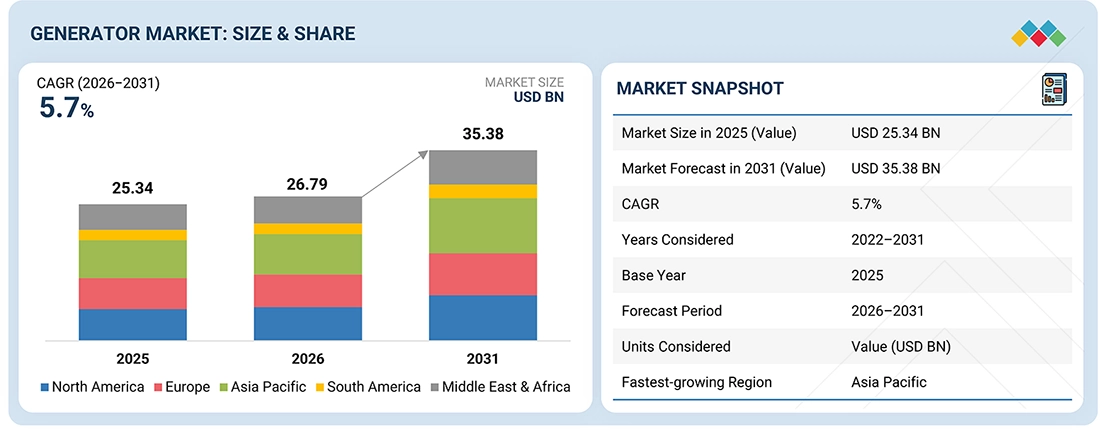
Source: Secondary Research, Interviews with Experts, MarketsandMarkets Analysis
The generator market is projected to grow from USD 26.79 billion in 2026 to USD 35.38 billion by 2031, at a CAGR of 5.7% during the forecast period. Market growth is driven by rising demand for reliable backup power, frequent grid outages, aging infrastructure, and rapid industrialization across key economies worldwide. Generators are increasingly deployed to meet energy security needs, support business continuity in critical sectors, and complement renewable energy integration in hybrid systems across North America, Europe, Asia Pacific, and other regions. Continuous advancements in generator technology, including the development of higher-efficiency engines, hybrid and bi-fuel systems, inverter technologies, remote monitoring capabilities, and lower-emission models, are improving performance, reducing operating costs, and expanding deployment across diverse applications and environments.
KEY TAKEAWAYS
-
Market SnapshotCurrent Market Size (2026): USD 67.95 BillionProjected Market Size (2031): USD 112.10 BillionCAGR (2026–2031): 10.5%
-
BY REGION:Asia Pacific accounts for the largest market share of 27.7% in 2025.
-
BY FUEL TYPE:By fuel type, the fuel cell segment is projected to grow at the highest rate from 2026 to 2031.
-
BY POWER RATING:By power rating, the up to 62.5 kVA segment is projected to grow at the highest rate from 2026 to 2031.
-
BY SALES CHANNEL:By sales channel, the direct segment is projected to grow at the highest rate from 2026 to 2031.
-
BY DESIGN:By design, the above 15 MW segment is projected to grow at the highest rate from 2026 to 2031.
-
BY APPLICATION:By application, the standby segment is projected to grow at the highest rate from 2026 to 2031.
-
BY END USER:By end user, the industrial segment is projected to grow at the highest rate from 2026 to 2031.
-
COMPETITIVE LANDSCAPE - KEY PLAYERS:Companies such as Caterpillar (US), Cummins Inc. (US), and Rolls-Royce plc (UK) were identified as some of the star players in the generator market.
-
COMPETITIVE LANDSCAPE - STARTUPS/SMEs:GFE Sustainable (US), WATT Fuel Cell (US), and PowerUp Fuel Cells (Estonia) have distinguished themselves among startups and SMEs in the generator market.
Generators produce electricity by converting mechanical energy from various fuel sources, primarily diesel, natural gas, gasoline, or other alternatives, into electrical power through an internal combustion engine coupled with an alternator. They are widely used for standby backup power, peak shaving, prime, and continuous applications, supplying electricity to residential, commercial, and industrial consumers during grid outages or in off-grid locations. Generator systems consist of several key components, including the engine, alternator, control panels, fuel systems, cooling systems, and enclosures. These units are designed to deliver reliable power across a range of capacities, from small portable models for homes and events to large stationary installations for data centers, hospitals, manufacturing facilities, and utilities.
TRENDS & DISRUPTIONS IMPACTING CUSTOMERS' CUSTOMERS
Increasing frequency of power outages, aging grid infrastructure, and rapid industrialization are expected to drive the growth of the generator market. Furthermore, expanding data centers, rising demand for reliable backup and continuous power across commercial and industrial sectors, supportive government initiatives for energy security, growth in construction and infrastructure projects, and technological advancements in hybrid, inverter, and cleaner-fuel generators are attracting substantial investments into the generator industry globally.
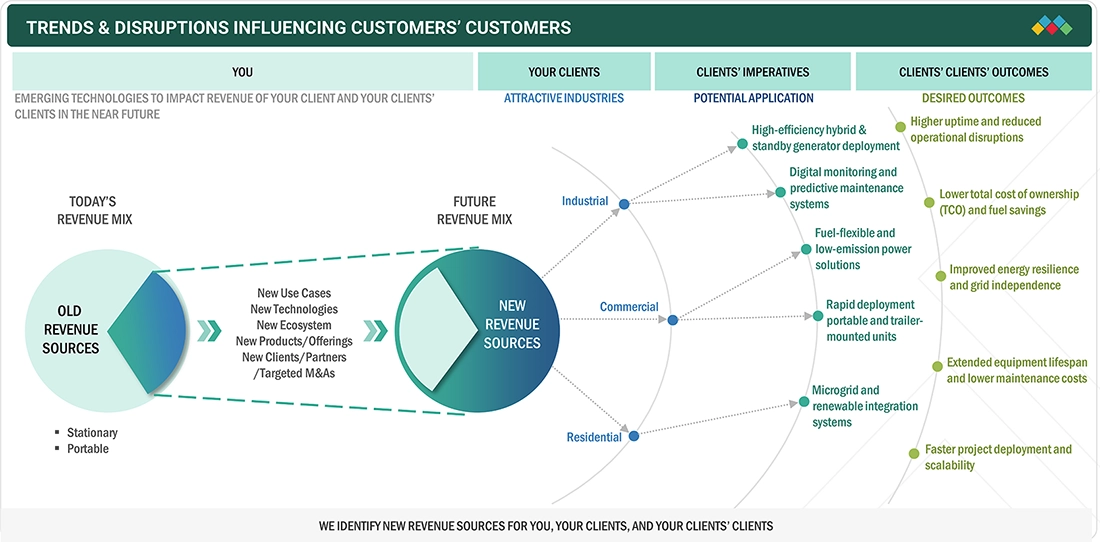
Source: Secondary Research, Interviews with Experts, MarketsandMarkets Analysis
MARKET DYNAMICS

Drivers
Impact
Level
Level
-
Increasing demand for uninterrupted and reliable power supply

-
Rising power outages signal global surge in generator demand


RESTRAINTS
Impact
Level
Level
-
High operational costs associated with diesel generators

-
High capital expenditure related to hydrogen energy storage


OPPORTUNITIES
Impact
Level
Level
-
Rising adoption of fuel cell generators

-
Growing demand for hybrid generators, bi-fuel generators, and inverter generators


CHALLENGES
Impact
Level
Level
-
Imposition of strict emission standards

Source: Secondary Research, Interviews with Experts, MarketsandMarkets Analysis
Driver: Rising power outages signal global surge in generator demand
Aging infrastructure, rising demand for electricity, and natural events create power outages to such an extent that they have significantly driven demand for backup generators. As urban populations increase and industries expand, the electrical grid comes under more pressure, which leads to outages and disrupts some critical operations. Such disruptions create a need for dependable sources of power, thus encouraging businesses and even households to invest in generators for continuity. Planned and unplanned outages, and, in particular, blackouts related to weather events or equipment failure, have created a need for generators as the necessary answer for continued operations during a power outage.
Restraints: High operational costs associated with diesel generators
The generator market has been under pressure due to the high operational expenses, which have been associated with diesel generators and which arise from the accelerating price of fuel. Diesel-based generators normally serve as a reliable means of backup power for various businesses and industries which could depend on them, but the increasing price of fuel presents the industry with a dilemma. The sharply increased fuel prices have created an atmosphere of concern over the viability of using diesel generators - a factor that impacts the demand dynamics in the market. Volatility in international crude oil prices, geopolitical factors, and an imbalance in supply and demand have led to the surge in fuel prices. The price range of diesel fuel varies significantly between regions and countries, thus posing a large cost of doing business in operations running continuously on generators. On average, cost of operation in the case of the diesel generator is significantly influenced by the price of diesel fuel. In general, it is higher compared to other sources of power. The higher cost of diesel fuel therefore increases the cost of diesel generator operation directly and they are less economical compared to other alternatives such as natural gas or renewable power sources. Though these are reliable and efficient, one of the factors that mainly comprise business concerns in regard to operating on diesel generators for a source of power is economic cost of fuel.
Opportunities: Growing demand for hybrid generators, bi-fuel generators, and inverter generators
There are various alternative fuels presently being developed to replace fossil fuels. So, this is attracting innovations in the generator market. Hybrid gensets, which comprise a combination of an internal combustion engine and batteries, are being manufactured by some OEMs. The hybrid genset provides power optimally by using the engine at times of high loads and the battery at lower loads. Hybrid generators benefit much more compared to the conventional gensets. It reduced running times, fuel consumption, and noise. As expected, it finds applications in mobile gensets for rural or remote places, urban construction sites, residential, and the mining sector. For example, the US-based company, Ecoflow, designed Delta Pro Ultra - the whole-house battery generator with up to one month's power backup. This system can work for plenty of scenarios with multiple energy sources because it has a single-unit capacity of 6 kWh, 7.2 kW output, and 5.6 kW solar input. Bi-fuel generators also seem to have a lot of promise, combining the best attributes of both gas and diesel generators, which would make for reliable standby power performance. They mainly operate on gas but are made to switch over to diesel in emergency situations. In dual-fuel, natural gas is added to the intake system, which in turn reduces the use of diesel while still retaining power density, torque, and transient response. Some of the generator manufacturers have incorporated the bi-fuel technology to cope with the rising high operation costs and to meet the emission standards of diesel engines.
Challenges: Imposition of strict emission standards
Diesel generators are used for a multitude of residential, commercial, and industrial uses. When diesel is burnt, it emits oxides of nitrogen, carbon monoxide, and particulate matter. These emissions find direct release into the atmosphere and deteriorate the environment and the inhabitants. A number of regulations have been enforced worldwide to minimize air pollution caused by generator sets. Growing environmental concerns have led to the development of regulations and policies related to the reduction of air pollution in each country. Hence, governments are employing stricter emission standards for fossil-fuelled generators, including diesel and gasoline. For instance, it is the main reason why the United States EPA has implemented regulations such as Tier 4 Final and Nonroad Spark-Ignition Engine Emission Standards for monitoring emissions from non-road diesel engines, including generators. The standards force the manufacturers of generators to develop and sell more advanced technologies with emission control, which raises production cost and decreases the availability of traditional fuel generators. The CARB's Low-NOx Regulation also limits NOx generation from a generator by 90%. It also created a similar price situation.
GENERATOR MARKET: COMMERCIAL USE CASES ACROSS INDUSTRIES
| COMPANY | USE CASE DESCRIPTION | BENEFITS |
|---|---|---|
 |
Provides a wide range of diesel, gas, and hybrid generator sets for industrial, data center, and critical backup applications worldwide. | Delivers high reliability, superior performance, and comprehensive lifecycle support, helping customers minimize downtime and reduce total cost of ownership. |
 |
Supplies advanced diesel, natural gas, and hydrogen-ready generator systems with integrated digital controls for prime, standby, and continuous power needs. | Improves fuel efficiency, ensures regulatory compliance, and offers scalable solutions that enhance energy resilience across diverse industries. |
 |
Develops residential, commercial, and industrial standby generators with smart monitoring and automatic transfer switch technology. | Enables seamless backup power during outages, supports home and business continuity, and promotes energy independence with user-friendly solutions. |
Logos and trademarks shown above are the property of their respective owners. Their use here is for informational and illustrative purposes only.
MARKET ECOSYSTEM
The generator market ecosystem comprises several key stakeholders, including raw material suppliers, component manufacturers, engine and alternator OEMs, generator set assemblers, system integrators, distributors and dealers, project developers and EPC contractors, after-sales service providers, and end users across residential, commercial, and industrial sectors.
Logos and trademarks shown above are the property of their respective owners. Their use here is for informational and illustrative purposes only.
MARKET SEGMENTS
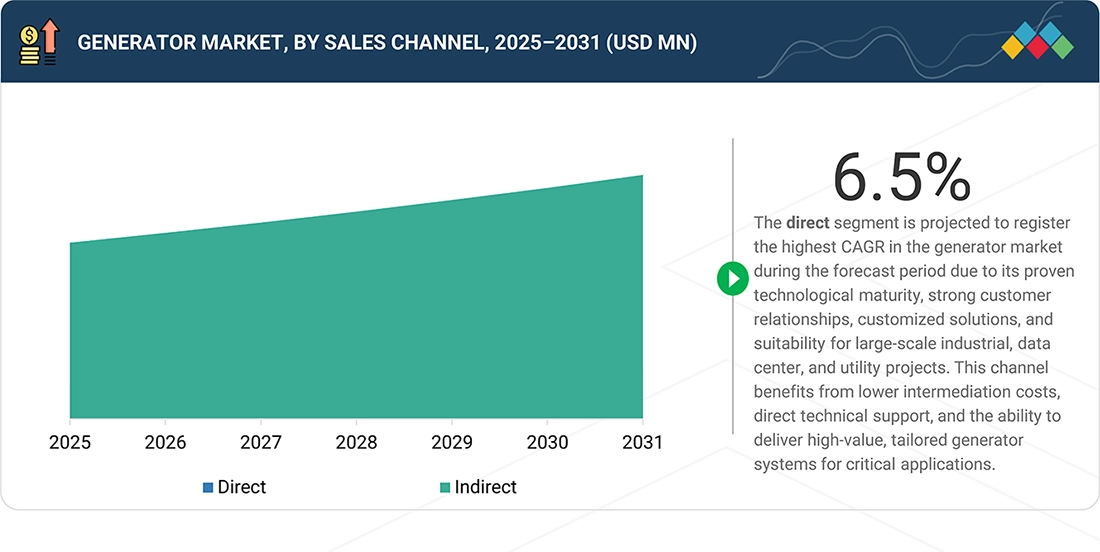
Source: Secondary Research, Interviews with Experts, MarketsandMarkets Analysis
Generator Market, by Fuel Type
The generator market by fuel type is segmented into diesel, gas, LPG, biofuels, coal gas, gasoline, producer gas, and fuel cells. Diesel generators continue to dominate the market due to their high reliability, energy density, fuel availability, and proven performance in demanding industrial, commercial, and backup applications. They remain the preferred choice where consistent power under variable loads is critical. Gas (particularly natural gas) generators are gaining significant traction as a cleaner alternative, driven by lower emissions, regulatory pressures for sustainability, and abundant fuel infrastructure in many regions. Other segments like LPG, biofuels, and fuel cells are emerging, supported by advancements in cleaner technologies and the global push toward decarbonization, though they currently hold smaller shares.
Generator Market, by Design
The generator market, by design, is segmented into stationary and portable. Stationary generators account for the majority of the market share, favored for permanent installations in industrial facilities, data centers, hospitals, and commercial buildings where high-capacity, reliable backup or continuous power is required. They offer robust construction and integration with existing infrastructure. Portable generators are experiencing faster growth due to their flexibility, ease of transport, and quick deployment for temporary needs such as construction sites, outdoor events, residential emergencies, and remote locations. Innovations in compact, lightweight, and inverter-based designs are further boosting demand in the portable segment.
Generator Market, by Application
The generator market by application is segmented into standby, peak shaving, and prime & continuous. Standby power holds the largest share, driven by the need for immediate emergency power during grid outages in critical facilities like hospitals, data centers, telecommunications, and commercial buildings. Peak shaving applications are growing as businesses use generators to reduce peak demand charges from utilities and optimize energy costs. Prime & continuous generators serve remote or off-grid operations, mining, construction, and primary power needs where grid access is limited or unreliable, supporting sustained operation under variable loads.
Generator Market, by Sales Channel
The generator market by sales channel is segmented into direct and indirect. Indirect sales channels (through distributors, dealers, retailers, OEMs, and rental companies) dominate the market due to their extensive geographic reach, localized support, faster availability, and comprehensive after-sales services, particularly appealing to small and medium enterprises as well as residential users. Direct sales are prominent for large-scale industrial, utility, and custom projects, where manufacturers engage directly with clients to provide tailored solutions, engineering support, and long-term service contracts.
Generator Market, by Power Rating
The generator market by power rating is segmented into categories such as up to 62.5 kVA, 62.5–350 kVA, 350-625 kVA, 625-2500 kVA, 2500-4375 kVA, and above 4375 kVA. Mid-range segments often lead in volume due to their suitability for a wide range of commercial and light industrial applications. Lower ratings serve residential and small portable needs, while higher ratings are critical for heavy industrial, utility-scale, and large data center projects. Growth in higher-capacity segments is fueled by expanding infrastructure and data center demand.
Generator Market, by End User
The generator market by end user is segmented into residential, commercial, and industrial. The industrial segment holds a dominant share, driven by continuous operations in manufacturing, mining, oil & gas, construction, and utilities, where power reliability is essential. The commercial segment, including data centers, healthcare, retail, offices, and telecom, is among the fastest-growing due to digitization, rising outages, and the need for uninterrupted power. Residential demand is rising with increasing urbanization, extreme weather events, and backup needs in regions with unreliable grids.
REGION
Asia Pacific to be largest region in generator market during forecast period
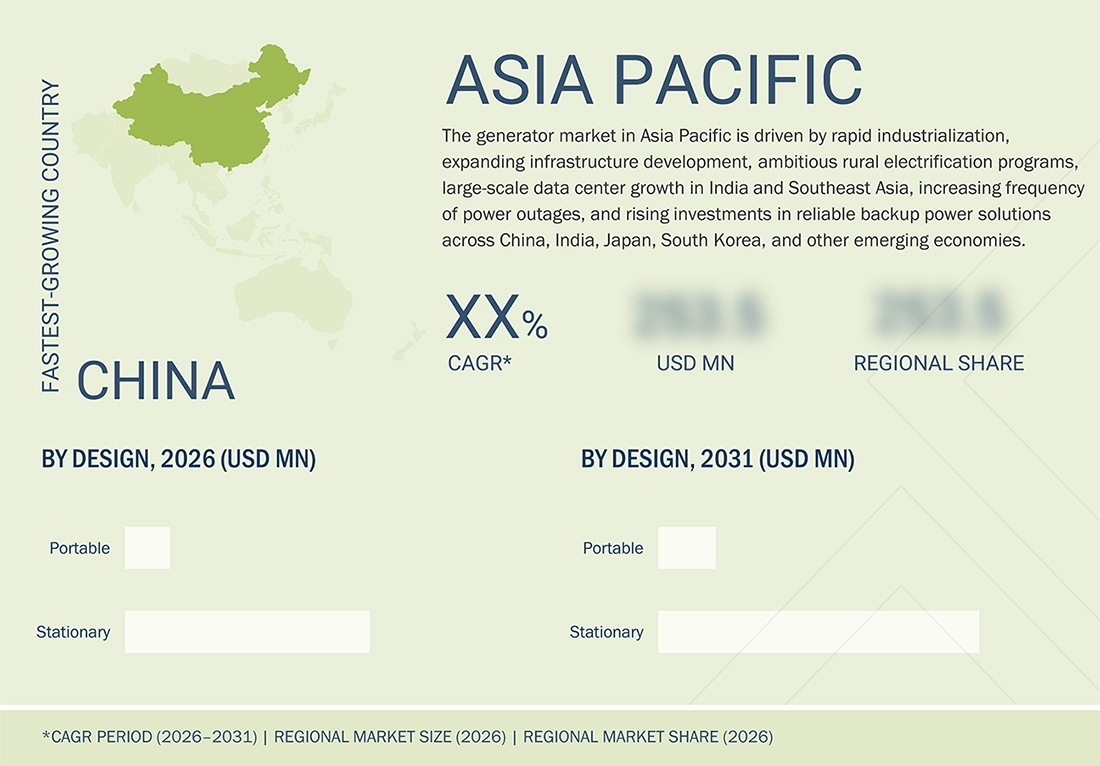
Asia Pacific is the largest regional market for generators due to substantial capacity additions, rapid industrialization, strong government support for infrastructure and rural electrification, and extensive investments in reliable power solutions across countries such as China, India, Japan, South Korea, Indonesia, and other emerging Southeast Asian markets. The region benefits from a robust manufacturing ecosystem for engines, generator sets, and related components, enabling cost-effective project development, widespread deployment, and strong aftermarket support.
GENERATOR MARKET: COMPANY EVALUATION MATRIX
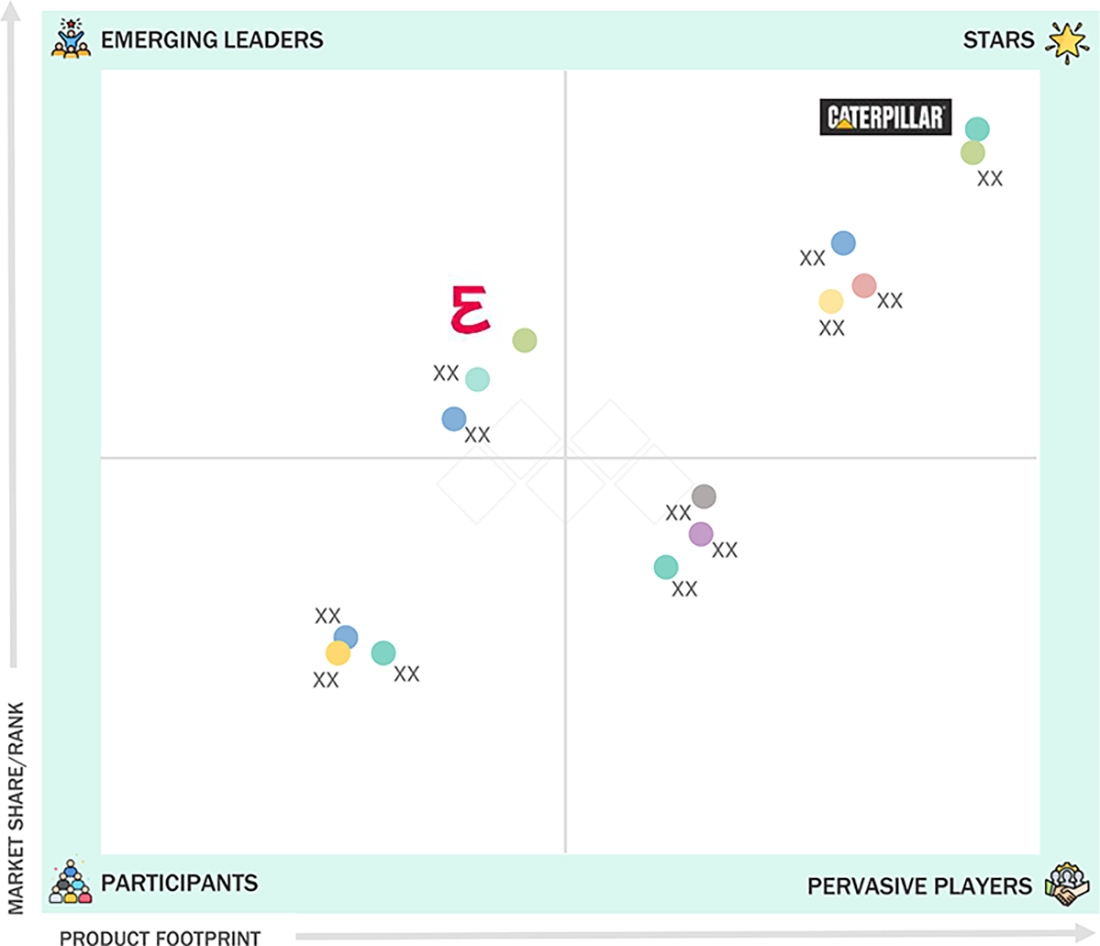
Caterpillar is widely recognized as a key leader in the generator market, leveraging its extensive capabilities in engine manufacturing, integrated power systems, advanced controls, and comprehensive global service networks. Everllence is recognized as a leading player in the generator market, offering high-performance diesel and gas engines with superior reliability and efficiency.
Source: Secondary Research, Interviews with Experts, MarketsandMarkets Analysis
KEY MARKET PLAYERS
- Caterpillar (US)
- Cummins Inc. (US)
- Rolls-Royce plc (UK)
- MITSUBISHI HEAVY INDUSTRIES, LTD. (Japan)
- Generac Power Systems, Inc. (US)
- Wacker Neuson SE (Germany)
- Everllence (Germany)
- Briggs & Stratton (US)
- Atlas Copco (Sweden)
- Kirloskar (India)
- Rehlko (US)
- YANMAR HOLDINGS CO., LTD. (Japan)
- Wärtsilä (Finland)
- Honda India Power Products Ltd. (Japan)
- Siemens Energy (Germany)
- Shanghai New Power Automotive Technology Company Limited (China)
- Denyo co., Ltd. (Japan)
- Doosan Portable Power (South Korea)
- Greaves Cotton Limited (India)
- Aksa Power Generation (China)
- Aggreko (UK)
- Multiquip Inc. (US)
- TAYLOR GROUP INC. (US)
- AB Volvo Penta (Sweden)
- Deere & Company (US)
MARKET SCOPE
| REPORT METRIC | DETAILS |
|---|---|
| Market Size in 2025 (Value) (Base Year) | USD 25.34 Billion |
| Market Size in 2026 (Value) (Estimated Year) | USD 26.79 Billion |
| Market Forecast in 2031 (Value) (Forecast Year) | USD 35.38 Billion |
| CAGR | 5.7% |
| Years Considered | 2022–2031 |
| Base Year | 2025 |
| Forecast Period | 2026–2031 |
| Units Considered | USD Million |
| Report Coverage | Revenue forecast, company ranking, competitive landscape, growth factors, and trends |
| Segments Covered |
|
| Regions Covered | North America, Asia Pacific, Europe, South America, Middle East & Africa |
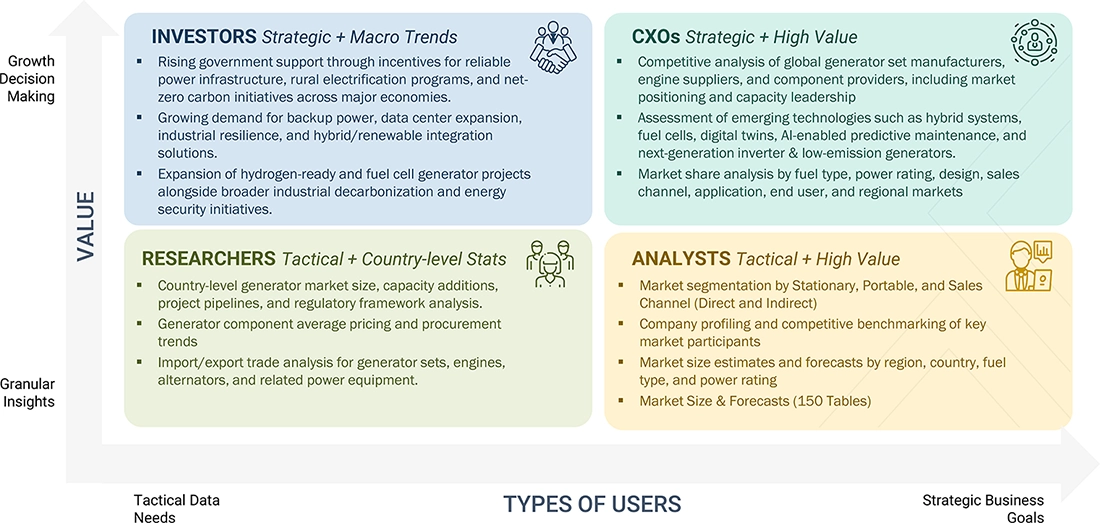
WHAT IS IN IT FOR YOU: GENERATOR MARKET REPORT CONTENT GUIDE
DELIVERED CUSTOMIZATIONS
We have successfully delivered the following deep-dive customizations:
| CLIENT REQUEST | CUSTOMIZATION DELIVERED | VALUE ADDS |
|---|---|---|
| Client requirement for diesel generator report | Market sizing for diesel generator countries | Country-wise market attractiveness analysis, competitive landscape overview, and installation of diesel generators in high-growth economies |
RECENT DEVELOPMENTS
- August 2025 : Caterpillar launched the new Cat D1500 diesel generator set, delivering 1.5 MW of standby power with a compact, space-saving 32.1-liter Cat C32B engine. It offers up to 13% less floor space and 32% less weight, meeting ISO 8528-5, NFPA 110, and EPA Tier 2 standards for reliable standby performance.
- December 2024 : Caterpillar introduced the new Cat G3500K series of gas generator sets, engineered for reliable, quick-response, and high-efficiency power in demanding environments. The first model, the G3520K HR, delivers 2.5 MW of continuous power and reaches full load in just 4.5 minutes—25% faster than the previous G3500H series.
- June 2025 : Cummins Inc. launched the S17 Centum generator set, a 17-liter engine platform delivering up to 1 MW of power in a compact design. Developed for space-constrained urban environments, it combines high performance with reliability across critical sectors.
- October 2025 : Rolls-Royce launched new fast-start mtu gas gensets, including the 20V4000 Series 4000 L64 engine, designed for data centers and grid stabilization. The 2.8 MW unit reaches full power in just 45 seconds for the US market, with global models offering 120-second start capability.
- October 2025 : Rolls-Royce launched the upgraded mtu Series 1600 generator sets for the 50 Hz market, delivering up to 40% more power than previous models. This release completes the rollout of the enhanced Series 1600 platform, following the 60 Hz version introduced in late 2023.
Table of Contents
 Exclusive indicates content/data unique to MarketsandMarkets and not available with any competitors.
TITLE
PAGE NO
1
INTRODUCTION
35
2
EXECUTIVE SUMMARY
42
3
PREMIUM INSIGHTS
47
4
MARKET OVERVIEW
Discover growth prospects in power supply through innovative generator technologies and strategic market moves.
52
4.1
INTRODUCTION
4.2
MARKET DYNAMICS
4.2.1
DRIVERS
4.2.1.1
INCREASING DEMAND FOR UNINTERRUPTED AND RELIABLE POWER SUPPLY
4.2.1.2
RISING FREQUENCY AND SEVERITY OF POWER OUTAGES
4.2.1.3
MOUNTING ADOPTION OF DISTRIBUTED ENERGY RESOURCE MANAGEMENT SYSTEMS
4.2.2
RESTRAINTS
4.2.2.1
HIGH OPERATIONAL COSTS OF DIESEL GENERATORS
4.2.2.2
SIGNIFICANT CAPITAL EXPENDITURE ASSOCIATED WITH HYDROGEN ENERGY STORAGE
4.2.3
OPPORTUNITIES
4.2.3.1
RISING ADOPTION OF FUEL CELL GENERATORS FOR BACKUP POWER ACROSS INDUSTRIES
4.2.3.2
GROWING POPULARITY OF HYBRID, BI-FUEL, AND INVERTER GENERATORS
4.2.4
CHALLENGES
4.2.4.1
IMPOSITION OF STRICT EMISSION STANDARDS FOR FOSSIL FUEL-POWERED GENERATORS
4.3
UNMET NEEDS AND WHITE SPACES
4.4
INTERCONNECTED MARKETS AND CROSS-SECTOR OPPORTUNITIES
4.5
STRATEGIC MOVES BY TIER-1/2/3 PLAYERS
5
INDUSTRY TRENDS
Navigate competitive pressures and economic shifts to capitalize on emerging global industry trends.
60
5.1
PORTER’S FIVE FORCES ANALYSIS
5.1.1
THREAT OF NEW ENTRANTS
5.1.2
THREAT OF SUBSTITUTES
5.1.3
BARGAINING POWER OF SUPPLIERS
5.1.4
BARGAINING POWER OF BUYERS
5.1.5
INTENSITY OF COMPETITIVE RIVALRY
5.2
MACROECONOMIC OUTLOOK
5.2.1
INTRODUCTION
5.2.2
GDP TRENDS AND FORECAST
5.2.3
TRENDS IN GLOBAL DATA CENTER INDUSTRY
5.2.4
TRENDS IN GLOBAL HEALTHCARE INDUSTRY
5.3
VALUE CHAIN ANALYSIS
5.4
ECOSYSTEM ANALYSIS
5.5
PRICING ANALYSIS
AVERAGE SELLING PRICE OF GENERATORS OFFERED BY KEY PLAYERS,
5.5.2
AVERAGE SELLING PRICE TREND OF GENERATORS, BY REGION, 2021–2025
5.6
TRADE ANALYSIS
5.6.1
IMPORT SCENARIO (HS CODE 850161)
5.6.2
EXPORT SCENARIO (HS CODE 850161)
5.7
KEY CONFERENCES AND EVENTS, 2026–2027
5.8
TRENDS/DISRUPTIONS IMPACTING CUSTOMER BUSINESS
5.9
INVESTMENT AND FUNDING SCENARIO
5.10
CASE STUDY ANALYSIS
HYPERSCALE DATA CENTER OPERATOR IN US DEPLOYS CUMMINS
HOSPITAL CHAIN IN INDIA INSTALLS KOHLER DIESEL AND
5.10.3
MINING COMPANY IN AUSTRALIA IMPLEMENTS CATERPILLAR HYBRID GENERATOR SYSTEMS TO POWER REMOTE MINING OPERATIONS
5.11
IMPACT OF US TARIFFS – GENERATOR MARKET
5.11.1
INTRODUCTION
5.11.2
KEY TARIFF RATES
5.11.3
PRICE IMPACT ANALYSIS
5.11.4
IMPACT ON COUNTRIES/REGIONS
5.11.4.1
US
5.11.4.2
EUROPE
5.11.4.3
ASIA PACIFIC
5.11.5
IMPACT ON END USERS
TECHNOLOGICAL ADVANCEMENTS, AI-DRIVEN IMPACT,
6.1
KEY TECHNOLOGIES
6.1.1
INTERNET OF THINGS-BASED REMOTE MONITORING
6.1.2
AUTOMATIC TRANSFER SWITCH
6.2
COMPLEMENTARY TECHNOLOGIES
6.2.1
DUAL-FUEL AND MULTI-FUEL
6.3
TECHNOLOGY/PRODUCT ROADMAP
6.3.1
SHORT-TERM (2025–2027) | FOUNDATION & EARLY COMMERCIALIZATION
6.3.2
MID-TERM (2027–2030) | EXPANSION & STANDARDIZATION
6.3.3
LONG-TERM (2030+) | MASS COMMERCIALIZATION & DISRUPTION
6.4
PATENT ANALYSIS
6.5
FUTURE APPLICATIONS
6.6
IMPACT OF AI/GEN AI ON GENERATOR MARKET
6.6.1
TOP USE CASES AND MARKET POTENTIAL
6.6.2
BEST PRACTICES FOLLOWED BY OEMS IN GENERATOR MARKET
CASE STUDIES RELATED TO AI/GEN AI IMPLEMENTATION IN
6.6.4
INTERCONNECTED ECOSYSTEM AND IMPACT ON MARKET PLAYERS
6.6.5
CLIENTS’ READINESS TO ADOPT AI/GEN AI-INTEGRATED GENERATORS
6.7
SUCCESS STORIES AND REAL-WORLD APPLICATIONS
7
REGULATORY LANDSCAPE AND SUSTAINABILITY INITIATIVES
Navigate global regulatory frameworks to enhance sustainability and reduce generator carbon footprints.
92
7.1
REGIONAL REGULATIONS AND COMPLIANCE
REGULATORY BODIES, GOVERNMENT AGENCIES,
7.1.2
INDUSTRY STANDARDS
7.2
SUSTAINABILITY INITIATIVES
7.2.1
CARBON IMPACT AND ECO-APPLICATIONS OF GENERATORS
7.3
IMPACT OF REGULATORY POLICIES ON SUSTAINABILITY INITIATIVES
7.4
CERTIFICATIONS, LABELING, AND ECO-STANDARDS
8
CUSTOMER LANDSCAPE AND BUYER BEHAVIOR
Unlock revenue potential by understanding stakeholder influence and overcoming adoption barriers.
101
8.1
DECISION-MAKING PROCESS
8.2
KEY STAKEHOLDERS INVOLVED IN BUYING PROCESS AND THEIR EVALUATION CRITERIA
8.2.1
KEY STAKEHOLDERS IN BUYING PROCESS
8.2.2
BUYING CRITERIA
8.3
ADOPTION BARRIERS AND INTERNAL CHALLENGES
8.4
MARKET PROFITABILITY
8.4.1
REVENUE POTENTIAL
8.4.2
COST DYNAMICS
9
GENERATOR MARKET, BY DESIGN
Market Size & Growth Rate Forecast Analysis to 2031 in USD Million | 6 Data Tables
106
9.1
INTRODUCTION
9.2
STATIONARY
9.2.1
REQUIREMENT FOR CONTINUOUS OR LONG-DURATION POWER SUPPORT TO BOLSTER SEGMENTAL GROWTH
9.3
PORTABLE
9.3.1
FLEXIBILITY, EASE OF INSTALLATION, AND QUICK DEPLOYMENT TO ACCELERATE SEGMENTAL GROWTH
10
GENERATOR MARKET, BY SALES CHANNEL
Market Size & Growth Rate Forecast Analysis to 2031 in USD Million | 6 Data Tables
110
10.1
INTRODUCTION
10.2
INDIRECT
10.2.1
NEED FOR RAPID PRODUCT AVAILABILITY, LOCALIZED SUPPORT, AND TURNKEY INSTALLATION AND SERVICE OFFERINGS TO DRIVE MARKET
10.3
DIRECT
TIGHTER CONTROL OVER PRICING, QUALITY ASSURANCE,
11
GENERATOR MARKET, BY FUEL TYPE
Market Size & Growth Rate Forecast Analysis to 2031 in USD Million | 18 Data Tables
115
11.1
INTRODUCTION
11.2
DIESEL
11.2.1
HIGH RELIABILITY, RAPID RESPONSE TIME, AND SUPERIOR OPERATIONAL RESILIENCE TO BOLSTER SEGMENTAL GROWTH
11.3
GAS
11.3.1
TIGHTENING EMISSION REGULATIONS AND COST-EFFECTIVENESS TO AUGMENT SEGMENTAL GROWTH
11.4
LPG
11.4.1
HIGH APPLICATION SCOPE IN REGIONS WITH LIMITED GRID INFRASTRUCTURE TO FACILITATE SEGMENTAL GROWTH
11.5
BIOFUELS
TIGHTENING EMISSION NORMS AND ENFORCEMENT OF RENEWABLE
11.6
COAL GAS
11.6.1
IMPROVEMENTS IN GASIFICATION TECHNOLOGY AND RAPID INDUSTRIALIZATION TO CONTRIBUTE TO SEGMENTAL GROWTH
11.7
GASOLINE
11.7.1
INCREASED DEMAND FOR EMERGENCY POWER APPLIANCES DURING NATURAL DISASTERS TO FUEL SEGMENTAL GROWTH
11.8
PRODUCER GAS
11.8.1
FOCUS ON RURAL ELECTRIFICATION IN DEVELOPING COUNTRIES TO ACCELERATE SEGMENTAL GROWTH
11.9
FUEL CELLS
11.9.1
ABILITY TO PROVIDE CLEAN, EFFICIENT, AND RELIABLE ELECTRICITY GENERATION WITHOUT COMBUSTION TO BOOST SEGMENTAL GROWTH
12
GENERATOR MARKET, BY POWER RATING
Market Size & Growth Rate Forecast Analysis to 2031 in USD Million | 16 Data Tables
126
12.1
INTRODUCTION
12.2
UP TO 62.5 KVA
12.2.1
UP TO 12.5 KVA
12.2.1.1
PORTABILITY, EASE OF USE, AND LOW UPFRONT COST TO AUGMENT SEGMENTAL GROWTH
12.2.2
12.6–25 KVA
12.2.2.1
SUITABILITY FOR TEMPORARY INSTALLATIONS TO CONTRIBUTE TO SEGMENTAL GROWTH
12.2.3
26–37.5 KVA
12.2.3.1
ADOPTION TO SUPPORT SUSTAINED AND HIGHER-CAPACITY BACKUP POWER TO FOSTER SEGMENTAL GROWTH
12.2.4
37.6–50 KVA
12.2.4.1
ADAPTABILITY AND DEPENDABILITY TO ACCELERATE SEGMENTAL GROWTH
12.2.5
51–62.5 KVA
12.2.5.1
USE TO OFFER BACKUP POWER TO SATISFY DEMANDS OF RESIDENTIAL AND BUSINESS ENVIRONMENTS TO FUEL SEGMENTAL GROWTH
12.3
62.6–350 KVA
12.3.1
ADOPTION IN DISTRIBUTED GENERATION FACILITIES, UTILITY PEAKING PLANTS, AND POWER MANAGEMENT TO DRIVE MARKET
12.4
351–625 KVA
12.4.1
USE TO SUPPORT OPERATIONS IN REMOTE AREAS TO BOLSTER SEGMENTAL GROWTH
12.5
626–2,500 KVA
12.5.1
REQUIREMENT FOR RELIABLE AND CONTINUOUS POWER TO FUEL SEGMENTAL GROWTH
12.6
2,501–4,375 KVA
12.6.1
USE IN CRITICAL INFRASTRUCTURE AND LARGE-SCALE MANUFACTURING FACILITIES TO DRIVE MARKET
12.7
ABOVE 4,375 KVA
RESILIENCE TO HARSH AND VARIABLE WEATHER CONDITIONS TO
13
GENERATOR MARKET, BY APPLICATION
Market Size & Growth Rate Forecast Analysis to 2031 in USD Million | 8 Data Tables
137
13.1
INTRODUCTION
13.2
STANDBY
13.2.1
ABILITY TO PROVIDE IMMEDIATE BACKUP POWER DURING GRID OUTAGES TO BOOST SEGMENTAL GROWTH
13.3
PRIME & CONTINUOUS
13.3.1
IMPLEMENTATION IN REMOTE BUILDING SITES AND OFF-GRID LOCATIONS TO ACCELERATE SEGMENTAL GROWTH
13.4
PEAK SHAVING
13.4.1
USE TO AVOID HIGH TARIFFS CHARGED BY UTILITIES TO CONTRIBUTE TO SEGMENTAL GROWTH
14
GENERATOR MARKET, BY END USER
Market Size & Growth Rate Forecast Analysis to 2031 in USD Million | 34 Data Tables
143
14.1
INTRODUCTION
14.2
INDUSTRIAL
14.2.1
UTILITIES/POWER GENERATION
14.2.1.1
STRONG FOCUS ON ADDRESSING LIMITED ACCESS TO TRANSMISSION NETWORKS TO FUEL SEGMENTAL GROWTH
14.2.2
OIL & GAS
14.2.2.1
POWER-INTENSIVE AND OPERATIONAL COMPLEXITY TO ACCELERATE SEGMENTAL GROWTH
14.2.3
CHEMICALS & PETROCHEMICALS
14.2.3.1
REQUIREMENT FOR STABLE POWER SUPPLY TO AVOID SEVERE PRODUCTION LOSSES AND SAFETY HAZARDS TO EXPEDITE SEGMENTAL GROWTH
14.2.4
METALS & MINING
14.2.4.1
DEPENDENCY ON UNINTERRUPTED AND HIGH-CAPACITY POWER SUPPLY TO BOLSTER SEGMENTAL GROWTH
14.2.5
MANUFACTURING
14.2.5.1
EMPHASIS ON MAINTAINING PRODUCTION VOLUME AND PRODUCT QUALITY TO AUGMENT SEGMENTAL GROWTH
14.2.6
MARINE
14.2.6.1
OPERATION IN ISOLATED ENVIRONMENTS WITH NO ACCESS TO EXTERNAL GRID INFRASTRUCTURE TO BOOST SEGMENTAL GROWTH
14.2.7
CONSTRUCTION
14.2.7.1
OPERATION UNDER TIGHT TIMELINES AND DEPENDENCE ON CONTINUOUS ENERGY SUPPLY TO FUEL SEGMENTAL GROWTH
14.2.8
OTHER INDUSTRIAL VERTICALS
14.3
RESIDENTIAL
RAPID EXPANSION OF REAL ESTATE SECTOR AND AWARENESS
14.4
COMMERCIAL
14.4.1
IT & TELECOMMUNICATIONS
14.4.1.1
NEED TO SUPPORT BASE TRANSCEIVER STATIONS, CORE NETWORKS, AND DATA ROUTING EQUIPMENT TO AUGMENT SEGMENTAL GROWTH
14.4.2
HEALTHCARE
14.4.2.1
REQUIREMENT FOR CONTINUOUS OPERATION OF LIFE SUPPORT MACHINES AND CRITICAL EQUIPMENT TO EXPEDITE SEGMENTAL GROWTH
14.4.3
DATA CENTERS
14.4.3.1
HIGH DEMAND FOR DIGITAL SERVICES TO CONTRIBUTE TO SEGMENTAL GROWTH
14.4.4
OTHER COMMERCIAL VERTICALS
15
GENERATOR MARKET, BY REGION
Comprehensive coverage of 8 Regions with country-level deep-dive of 19 Countries | 274 Data Tables.
164
15.1
INTRODUCTION
15.2
ASIA PACIFIC
15.2.1
CHINA
15.2.1.1
RISING INDUSTRIAL ACTIVITY, DIGITAL INFRASTRUCTURE EXPANSION, AND POWER RELIABILITY NEEDS TO ACCELERATE MARKET GROWTH
15.2.2
INDIA
15.2.2.1
RAPID URBANIZATION, INFRASTRUCTURE DEVELOPMENT, AND INDUSTRIAL EXPANSION TO BOLSTER MARKET GROWTH
15.2.3
JAPAN
15.2.3.1
INCREASING DISASTER PREPAREDNESS, CRITICAL INFRASTRUCTURE RELIABILITY, AND NEED FOR UNINTERRUPTED POWER SUPPLY TO DRIVE MARKET
15.2.4
SOUTH KOREA
15.2.4.1
RISING SEMICONDUCTOR MANUFACTURING, ELECTRONICS PRODUCTION, AND DATA CENTER EXPANSION TO FOSTER MARKET GROWTH
15.2.5
AUSTRALIA
15.2.5.1
INCREASING INVESTMENT IN RENEWABLE ENERGY PROJECTS, TRANSPORTATION INFRASTRUCTURE, AND DATA CENTERS TO FUEL MARKET GROWTH
15.2.6
NEW ZEALAND
15.2.6.1
STRONG FOCUS ON ENERGY RELIABILITY, DISASTER PREPAREDNESS, AND CONTINUITY OF ESSENTIAL SERVICES TO EXPEDITE MARKET GROWTH
15.2.7
INDONESIA
15.2.7.1
EXPANDING NICKEL PROCESSING FACILITIES, EV BATTERY SUPPLY CHAINS, AND MANUFACTURING HUBS TO AUGMENT MARKET GROWTH
15.2.8
SINGAPORE
15.2.8.1
INCREASING NEED FOR UNINTERRUPTED POWER SUPPLY FOR COMMERCIAL AND INDUSTRIAL OPERATIONS TO SUPPORT MARKET GROWTH
15.2.9
REST OF ASIA PACIFIC
15.3
NORTH AMERICA
15.3.1
US
15.3.1.1
RISING DEVELOPMENT OF HYPERSCALE AND AI-DRIVEN DATA CENTERS AND GRID RELIABILITY CONCERNS TO AUGMENT MARKET GROWTH
15.3.2
CANADA
15.3.2.1
SURGING ELECTRICITY NEEDS FROM DATA CENTERS, NEARSHORING TRENDS, AND MINING EXPANSION TO CONTRIBUTE TO MARKET GROWTH
15.3.3
MEXICO
15.3.3.1
HIGH ELECTRICITY TARIFFS FOR INDUSTRIAL AND COMMERCIAL USERS AND FREQUENT POWER OUTAGES TO CREATE MARKET GROWTH OPPORTUNITIES
15.4
EUROPE
15.4.1
UK
15.4.1.1
AGING GRID INFRASTRUCTURE AND NEED FOR UNINTERRUPTED POWER TO ACCELERATE MARKET GROWTH
15.4.2
FRANCE
15.4.2.1
EVOLVING POST-NUCLEAR BACKUP STRATEGY, DATA CENTER SURGE, AND ENERGY SECURITY PRIORITIES TO BOOST MARKET GROWTH
15.4.3
GERMANY
15.4.3.1
TIGHTENING EMISSION REGULATIONS AND SHIFT TOWARD RENEWABLE-BASED MICROGRIDS AND BATTERY STORAGE TO DRIVE MARKET
15.4.4
RUSSIA
15.4.4.1
RISING NEED FOR UNINTERRUPTED ENERGY SUPPLY IN EXTREME ENVIRONMENTS TO SUPPORT MARKET GROWTH
15.4.5
REST OF EUROPE
15.5
MIDDLE EAST & AFRICA
15.5.1
GCC
15.5.1.1
SAUDI ARABIA
15.5.1.1.1
INCREASING DEMAND FOR RELIABLE STANDBY AND PRIME POWER SOLUTIONS ACROSS CRITICAL SECTORS TO EXPEDITE MARKET GROWTH
15.5.1.2
UAE
15.5.1.2.1
RAPID EXPANSION OF COMMERCIAL AND INDUSTRIAL FACILITIES AND DATA CENTER INVESTMENTS TO CONTRIBUTE TO MARKET GROWTH
15.5.1.3
REST OF GCC
15.5.2
SOUTH AFRICA
15.5.2.1
INCREASING LOAD-SHEDDING EVENTS AND AGING GRID INFRASTRUCTURE TO BOLSTER MARKET GROWTH
15.5.3
ALGERIA
15.5.3.1
EXPANDING INDUSTRIAL ACTIVITY AND OIL AND GAS INVESTMENTS TO CREATE LUCRATIVE MARKET GROWTH OPPORTUNITIES
15.5.4
NIGERIA
15.5.4.1
PERSISTENT ELECTRICITY SUPPLY SHORTAGES AND RAPID URBANIZATION TO ACCELERATE MARKET GROWTH
15.5.5
REST OF MIDDLE EAST & AFRICA
15.6
SOUTH AMERICA
15.6.1
BRAZIL
15.6.1.1
RAPID EXPANSION OF DATA CENTERS AND TELECOM INFRASTRUCTURE AND RECURRING GRID INSTABILITY TO FOSTER MARKET GROWTH
15.6.2
ARGENTINA
15.6.2.1
FREQUENT POWER DISRUPTIONS AND LIMITED TRANSMISSION CAPACITY TO AUGMENT MARKET GROWTH
15.6.3
REST OF SOUTH AMERICA
16
COMPETITIVE LANDSCAPE
Discover market leaders' strategies and emerging players reshaping industry dynamics through 2025.
267
16.1
OVERVIEW
16.2
KEY PLAYER COMPETITIVE STRATEGIES/RIGHT TO WIN, 2022–2026
16.3
MARKET SHARE ANALYSIS, 2025
16.4
REVENUE ANALYSIS, 2021–2025
16.5
PRODUCT COMPARISON
16.5.1
CATERPILLAR (US)
16.5.2
CUMMINS INC. (US)
16.5.3
ROLLS-ROYCE PLC (UK)
16.5.4
GENERAC POWER SYSTEMS, INC. (US)
16.5.5
MITSUBISHI HEAVY INDUSTRIES, LTD. (JAPAN)
16.6
COMPANY EVALUATION MATRIX: KEY PLAYERS, 2025
16.6.1
STARS
16.6.2
EMERGING LEADERS
16.6.3
PERVASIVE PLAYERS
16.6.4
PARTICIPANTS
16.6.5
COMPANY FOOTPRINT: KEY PLAYERS, 2025
16.6.5.1
COMPANY FOOTPRINT
16.6.5.2
REGION FOOTPRINT
16.6.5.3
DESIGN FOOTPRINT
16.6.5.4
APPLICATION FOOTPRINT
16.6.5.5
END USER FOOTPRINT
16.7
COMPANY EVALUATION MATRIX: STARTUPS/SMES, 2025
16.7.1
PROGRESSIVE COMPANIES
16.7.2
RESPONSIVE COMPANIES
16.7.3
DYNAMIC COMPANIES
16.7.4
STARTING BLOCKS
16.7.5
COMPETITIVE BENCHMARKING: STARTUPS/SMES, 2025
16.7.5.1
DETAILED LIST OF KEY STARTUPS/SMES
16.7.5.2
COMPETITIVE BENCHMARKING OF KEY STARTUPS/SMES
16.8
COMPANY VALUATION AND FINANCIAL METRICS
16.9
COMPETITIVE SCENARIO
16.9.1
PRODUCT LAUNCHES
16.9.2
DEALS
16.9.3
EXPANSIONS
16.9.4
OTHER DEVELOPMENTS
17
COMPANY PROFILES
In-depth Company Profiles of Leading Market Players with detailed Business Overview, Product and Service Portfolio, Recent Developments, and Unique Analyst Perspective (MnM View)
289
17.1
KEY PLAYERS
17.1.1
CATERPILLAR
17.1.1.1
BUSINESS OVERVIEW
17.1.1.2
PRODUCTS/SOLUTIONS/SERVICES OFFERED
17.1.1.3
RECENT DEVELOPMENTS
17.1.1.3.1
PRODUCT LAUNCHES
17.1.1.3.2
DEALS
17.1.1.4
MNM VIEW
17.1.1.4.1
KEY STRENGTHS/RIGHT TO WIN
17.1.1.4.2
STRATEGIC CHOICES
17.1.1.4.3
WEAKNESSES/COMPETITIVE THREATS
17.1.2
CUMMINS INC.
17.1.3
MITSUBISHI HEAVY INDUSTRIES, LTD.
17.1.4
ROLLS-ROYCE PLC
17.1.5
GENERAC POWER SYSTEMS, INC.
17.1.6
WÄRTSILÄ
17.1.7
ATLAS COPCO AB
17.1.8
KIRLOSKAR
17.1.9
WACKER NEUSON SE
17.1.10
SIEMENS ENERGY
17.1.11
GREAVES COTTON LIMITED
17.1.12
HONDA INDIA POWER PRODUCTS LTD.
17.1.13
DOOSAN BOBCAT
17.1.14
AB VOLVO PENTA
17.1.15
SHANGHAI NEW POWER AUTOMOTIVE TECHNOLOGY COMPANY LIMITED
17.1.16
DENYO CO., LTD.
17.2
OTHER PLAYERS
17.2.1
DEERE & COMPANY
17.2.2
AGGREKO
17.2.3
BRIGGS & STRATTON
17.2.4
REHLKO
17.2.5
AKSA POWER GENERATION
17.2.6
MULTIQUIP INC.
17.2.7
THE TAYLOR GROUP INC.
17.2.8
YANMAR HOLDINGS CO., LTD.
17.2.9
EVERLLENCE
18
RESEARCH METHODOLOGY
367
18.1
RESEARCH DATA
18.2
SECONDARY AND PRIMARY RESEARCH
18.2.1
SECONDARY DATA
18.2.1.1
LIST OF KEY SECONDARY SOURCES
18.2.1.2
KEY DATA FROM SECONDARY SOURCES
18.2.2
PRIMARY DATA
18.2.2.1
LIST OF PRIMARY INTERVIEW PARTICIPANTS
18.2.2.2
KEY INDUSTRY INSIGHTS
18.2.2.3
BREAKDOWN OF PRIMARIES
18.2.2.4
KEY DATA FROM PRIMARY SOURCES
18.3
MARKET SIZE ESTIMATION
18.3.1
BOTTOM-UP APPROACH
18.3.2
TOP-DOWN APPROACH
18.4
MARKET FORECAST APPROACH
18.4.1
DEMAND SIDE
18.4.1.1
DEMAND-SIDE ASSUMPTIONS
18.4.1.2
DEMAND-SIDE CALCULATIONS
18.4.2
SUPPLY SIDE
18.4.2.1
SUPPLY-SIDE ASSUMPTIONS
18.4.2.2
SUPPLY-SIDE CALCULATIONS
18.5
FORECAST
18.6
DATA TRIANGULATION
18.7
RESEARCH LIMITATIONS
18.8
RISK ANALYSIS
19
APPENDIX
380
19.1
DISCUSSION GUIDE
19.2
KNOWLEDGESTORE: MARKETSANDMARKETS’ SUBSCRIPTION PORTAL
19.3
CUSTOMIZATION OPTIONS
19.4
RELATED REPORTS
19.5
AUTHOR DETAILS
LIST OF TABLES
TABLE 1
GENERATOR MARKET: INCLUSIONS AND EXCLUSIONS
TABLE 2
GENERATOR MARKET: SUMMARY OF CHANGES
TABLE 3
INTERCONNECTED MARKETS
TABLE 4
STRATEGIC FOCUS OF TIER-1/2/3 PLAYERS
TABLE 5
IMPACT OF PORTER’S FIVE FORCES
TABLE 6
GDP PERCENTAGE CHANGE, BY KEY COUNTRY, 2021–2029
TABLE 7
ROLES OF COMPANIES IN GENERATOR ECOSYSTEM
AVERAGE SELLING PRICE OF GENERATORS OFFERED BY KEY PLAYERS,
2025
(USD/UNIT)
70
TABLE 9
AVERAGE SELLING PRICE TREND OF GENERATORS, BY REGION, 2021–2025 (USD/UNIT)
TABLE 10
IMPORT DATA FOR HS CODE 850161-COMPLIANT PRODUCTS, BY COUNTRY, 2021–2025 (USD MILLION)
TABLE 11
EXPORT DATA FOR HS CODE 850161-COMPLIANT PRODUCTS, BY COUNTRY, 2021–2025 (USD MILLION)
TABLE 12
LIST OF KEY CONFERENCES AND EVENTS, 2026–2027
TABLE 13
CUMMINS HYBRID GENERATOR DEPLOYMENT IMPROVES OPERATIONAL EFFICIENCY IN HYPERSCALE DATA CENTER IN US
TABLE 14
KOHLER STANDBY GENERATOR INSTALLATION ENSURES RELIABLE POWER FOR MAJOR HOSPITAL NETWORK
TABLE 15
CATERPILLAR HYBRID GENERATOR IMPLEMENTATION MAINTAINS CONTINUOUS OPERATIONS IN REMOTE MINING SITE IN AUSTRALIA
TABLE 16
US-ADJUSTED RECIPROCAL TARIFF RATES
TABLE 17
EXPECTED CHANGE IN PRICES AND IMPACT ON END USERS DUE TO TARIFFS
TABLE 18
LIST OF KEY PATENTS, 2015–2025
TABLE 19
DATA CENTER & AI BACKUP POWER
TABLE 20
HYBRID & RENEWABLE INTEGRATION
TABLE 21
SMART & IOT-ENABLED GENERATORS
TABLE 22
CONSTRUCTION & REMOTE SITE POWER
TABLE 23
GREEN & SUSTAINABLE FUEL APPLICATIONS
TABLE 24
USE CASES AND GENERATOR MARKET POTENTIAL
TABLE 25
BEST PRACTICES: USE CASES OF GENERATORS, BY COMPANY
TABLE 26
CASE STUDIES RELATED TO AI/GEN AI IMPLEMENTATION
TABLE 27
INTERCONNECTED ECOSYSTEM AND IMPACT ON GENERATOR MARKET PLAYERS
TABLE 28
NORTH AMERICA: REGULATORY BODIES, GOVERNMENT AGENCIES, AND OTHER ORGANIZATIONS
TABLE 29
EUROPE: LIST OF REGULATORY BODIES, GOVERNMENT AGENCIES, AND OTHER ORGANIZATIONS
TABLE 30
ASIA PACIFIC: LIST OF REGULATORY BODIES, GOVERNMENT AGENCIES, AND OTHER ORGANIZATIONS
TABLE 31
ROW: LIST OF REGULATORY BODIES, GOVERNMENT AGENCIES, AND OTHER ORGANIZATIONS
TABLE 32
GLOBAL: LIST OF REGULATORY BODIES, GOVERNMENT AGENCIES, AND OTHER ORGANIZATIONS
TABLE 33
GLOBAL INDUSTRY STANDARDS
TABLE 34
LABELING AND ECO-STANDARDS
TABLE 35
INFLUENCE OF STAKEHOLDERS ON BUYING PROCESS, BY END USER (%)
TABLE 36
BUYING CRITERIA, BY END USER
TABLE 37
GENERATOR MARKET, BY DESIGN, 2022–2025 (USD MILLION)
TABLE 38
GENERATOR MARKET, BY DESIGN, 2026–2031 (USD MILLION)
TABLE 39
STATIONARY: GENERATOR MARKET, BY REGION, 2022–2025 (USD MILLION)
TABLE 40
STATIONARY: GENERATOR MARKET, BY REGION, 2026–2031 (USD MILLION)
TABLE 41
PORTABLE: GENERATOR MARKET, BY REGION, 2022–2025 (USD MILLION)
TABLE 42
PORTABLE: GENERATOR MARKET, BY REGION, 2026–2031 (USD MILLION)
TABLE 43
GENERATOR MARKET, BY SALES CHANNEL, 2022–2025 (USD MILLION)
TABLE 44
GENERATOR MARKET, BY SALES CHANNEL, 2026–2031 (USD MILLION)
TABLE 45
INDIRECT: GENERATOR MARKET, BY REGION, 2022–2025 (USD MILLION)
TABLE 46
INDIRECT: GENERATOR MARKET, BY REGION, 2026–2031 (USD MILLION)
TABLE 47
DIRECT: GENERATOR MARKET, BY REGION, 2022–2025 (USD MILLION)
TABLE 48
DIRECT: GENERATOR MARKET, BY REGION, 2026–2031 (USD MILLION)
TABLE 49
GENERATOR MARKET, BY FUEL TYPE, 2022–2025 (USD MILLION)
TABLE 50
GENERATOR MARKET, BY FUEL TYPE, 2026–2031 (USD MILLION)
TABLE 51
DIESEL: GENERATOR MARKET, BY REGION, 2022–2025 (USD MILLION)
TABLE 52
DIESEL: GENERATOR MARKET, BY REGION, 2026–2031 (USD MILLION)
TABLE 53
GAS: GENERATOR MARKET, BY REGION, 2022–2025 (USD MILLION)
TABLE 54
GAS: GENERATOR MARKET, BY REGION, 2026–2031 (USD MILLION)
TABLE 55
LPG: GENERATOR MARKET, BY REGION, 2022–2025 (USD MILLION)
TABLE 56
LPG: GENERATOR MARKET, BY REGION, 2026–2031 (USD MILLION)
TABLE 57
BIOFUELS: GENERATOR MARKET, BY REGION, 2022–2025 (USD MILLION)
TABLE 58
BIOFUELS: GENERATOR MARKET, BY REGION, 2026–2031 (USD MILLION)
TABLE 59
COAL GAS: GENERATOR MARKET, BY REGION, 2022–2025 (USD MILLION)
TABLE 60
COAL GAS: GENERATOR MARKET, BY REGION, 2026–2031 (USD MILLION)
TABLE 61
GASOLINE: GENERATOR MARKET, BY REGION, 2022–2025 (USD MILLION)
TABLE 62
GASOLINE: GENERATOR MARKET, BY REGION, 2026–2031 (USD MILLION)
TABLE 63
PRODUCER GAS: GENERATOR MARKET, BY REGION, 2022–2025 (USD MILLION)
TABLE 64
PRODUCER GAS: GENERATOR MARKET, BY REGION, 2026–2031 (USD MILLION)
TABLE 65
FUEL CELLS: GENERATOR MARKET, BY REGION, 2022–2025 (USD MILLION)
TABLE 66
FUEL CELLS: GENERATOR MARKET, BY REGION, 2026–2031 (USD MILLION)
TABLE 67
GENERATOR MARKET, BY POWER RATING, 2022–2025 (USD MILLION)
TABLE 68
GENERATOR MARKET, BY POWER RATING, 2026–2031 (USD MILLION)
TABLE 69
UP TO 62.5 KVA: GENERATOR MARKET, BY TYPE, 2022–2025 (USD MILLION)
TABLE 70
UP TO 62.5 KVA: GENERATOR MARKET, BY TYPE, 2026–2031 (USD MILLION)
TABLE 71
UP TO 62.5 KVA: GENERATOR MARKET, BY REGION, 2022–2025 (USD MILLION)
TABLE 72
UP TO 62.5 KVA: GENERATOR MARKET, BY REGION, 2026–2031 (USD MILLION)
TABLE 73
62.6–350 KVA: GENERATOR MARKET, BY REGION, 2022–2025 (USD MILLION)
TABLE 74
62.6–350 KVA: GENERATOR MARKET, BY REGION, 2026–2031 (USD MILLION)
TABLE 75
351–625 KVA: GENERATOR MARKET, BY REGION, 2022–2025 (USD MILLION)
TABLE 76
351–625 KVA: GENERATOR MARKET, BY REGION, 2026–2031 (USD MILLION)
TABLE 77
626–2,500 KVA: GENERATOR MARKET, BY REGION, 2022–2025 (USD MILLION)
TABLE 78
626–2,500 KVA: GENERATOR MARKET, BY REGION, 2026–2031 (USD MILLION)
TABLE 79
2,501–4,375 KVA: GENERATOR MARKET, BY REGION, 2022–2025 (USD MILLION)
TABLE 80
2,501–4,375 KVA: GENERATOR MARKET, BY REGION, 2026–2031 (USD MILLION)
TABLE 81
ABOVE 4,375 KVA: GENERATOR MARKET, BY REGION, 2022–2025 (USD MILLION)
TABLE 82
ABOVE 4,375 KVA: GENERATOR MARKET, BY REGION, 2026–2031 (USD MILLION)
TABLE 83
GENERATOR MARKET, BY APPLICATION, 2022–2025 (USD MILLION)
TABLE 84
GENERATOR MARKET, BY APPLICATION, 2026–2031 (USD MILLION)
TABLE 85
STANDBY: GENERATOR MARKET, BY REGION, 2022–2025 (USD MILLION)
TABLE 86
STANDBY: GENERATOR MARKET, BY REGION, 2026–2031 (USD MILLION)
TABLE 87
PRIME & CONTINUOUS: GENERATOR MARKET, BY REGION, 2022–2025 (USD MILLION)
TABLE 88
PRIME & CONTINUOUS: GENERATOR MARKET, BY REGION, 2026–2031 (USD MILLION)
TABLE 89
PEAK SHAVING: GENERATOR MARKET, BY REGION, 2022–2025 (USD MILLION)
TABLE 90
PEAK SHAVING: GENERATOR MARKET, BY REGION, 2026–2031 (USD MILLION)
TABLE 91
GENERATOR MARKET, BY END USER, 2022–2025 (USD MILLION)
TABLE 92
GENERATOR MARKET, BY END USER, 2026–2031 (USD MILLION)
TABLE 93
INDUSTRIAL: GENERATOR MARKET, BY VERTICAL, 2022–2025 (USD MILLION)
TABLE 94
INDUSTRIAL: GENERATOR MARKET, BY VERTICAL, 2026–2031 (USD MILLION)
TABLE 95
INDUSTRIAL: GENERATOR MARKET, BY REGION, 2022–2025 (USD MILLION)
TABLE 96
INDUSTRIAL: GENERATOR MARKET, BY REGION, 2026–2031 (USD MILLION)
TABLE 97
UTILITIES/POWER GENERATION: GENERATOR MARKET, BY REGION, 2022–2025 (USD MILLION)
TABLE 98
UTILITIES/POWER GENERATION: GENERATOR MARKET, BY REGION, 2026–2031 (USD MILLION)
TABLE 99
OIL & GAS: GENERATOR MARKET, BY REGION, 2022–2025 (USD MILLION)
TABLE 100
OIL & GAS: GENERATOR MARKET, BY REGION, 2026–2031 (USD MILLION)
TABLE 101
CHEMICALS & PETROCHEMICALS: GENERATOR MARKET, BY REGION, 2022–2025 (USD MILLION)
TABLE 102
CHEMICALS & PETROCHEMICALS: GENERATOR MARKET, BY REGION, 2026–2031 (USD MILLION)
TABLE 103
METALS & MINING: GENERATOR MARKET, BY REGION, 2022–2025 (USD MILLION)
TABLE 104
METALS & MINING: GENERATOR MARKET, BY REGION, 2026–2031 (USD MILLION)
TABLE 105
MANUFACTURING: GENERATOR MARKET, BY REGION, 2022–2025 (USD MILLION)
TABLE 106
MANUFACTURING: GENERATOR MARKET, BY REGION, 2026–2031 (USD MILLION)
TABLE 107
MARINE: GENERATOR MARKET, BY REGION, 2022–2025 (USD MILLION)
TABLE 108
MARINE: GENERATOR MARKET, BY REGION, 2026–2031 (USD MILLION)
TABLE 109
CONSTRUCTION: GENERATOR MARKET, BY REGION, 2022–2025 (USD MILLION)
TABLE 110
CONSTRUCTION: GENERATOR MARKET, BY REGION, 2026–2031 (USD MILLION)
TABLE 111
OTHER INDUSTRIAL VERTICALS: GENERATOR MARKET, BY REGION, 2022–2025 (USD MILLION)
TABLE 112
OTHER INDUSTRIAL VERTICALS: GENERATOR MARKET, BY REGION, 2026–2031 (USD MILLION)
TABLE 113
RESIDENTIAL: GENERATOR MARKET, BY REGION, 2022–2025 (USD MILLION)
TABLE 114
RESIDENTIAL: GENERATOR MARKET, BY REGION, 2026–2031 (USD MILLION)
TABLE 115
COMMERCIAL: GENERATOR MARKET, BY VERTICAL, 2022–2025 (USD MILLION)
TABLE 116
COMMERCIAL: GENERATOR MARKET, BY VERTICAL, 2026–2031 (USD MILLION)
TABLE 117
IT & TELECOMMUNICATIONS: GENERATOR MARKET, BY REGION, 2022–2025 (USD MILLION)
TABLE 118
IT & TELECOMMUNICATIONS: GENERATOR MARKET, BY REGION, 2026–2031 (USD MILLION)
TABLE 119
HEALTHCARE: GENERATOR MARKET, BY REGION, 2022–2025 (USD MILLION)
TABLE 120
HEALTHCARE: GENERATOR MARKET, BY REGION, 2026–2031 (USD MILLION)
TABLE 121
DATA CENTERS: GENERATOR MARKET, BY REGION, 2022–2025 (USD MILLION)
TABLE 122
DATA CENTERS: GENERATOR MARKET, BY REGION, 2026–2031 (USD MILLION)
TABLE 123
OTHER COMMERCIAL VERTICALS: GENERATOR MARKET, BY REGION, 2022–2025 (USD MILLION)
TABLE 124
OTHER COMMERCIAL VERTICALS: GENERATOR MARKET, BY REGION, 2026–2031 (USD MILLION)
TABLE 125
GENERATOR MARKET, BY REGION, 2022–2025 (USD MILLION)
TABLE 126
GENERATOR MARKET, BY REGION, 2026–2031 (USD MILLION)
TABLE 127
GENERATOR MARKET, BY REGION, 2022–2025 (THOUSAND UNITS)
TABLE 128
GENERATOR MARKET, BY REGION, 2026–2031 (THOUSAND UNITS)
TABLE 129
ASIA PACIFIC: GENERATOR MARKET, BY POWER RATING, 2022–2025 (USD MILLION)
TABLE 130
ASIA PACIFIC: GENERATOR MARKET, BY POWER RATING, 2026–2031 (USD MILLION)
TABLE 131
ASIA PACIFIC: GENERATOR MARKET FOR UP TO 62.5 KVA, BY TYPE, 2022–2025 (USD MILLION)
TABLE 132
ASIA PACIFIC: GENERATOR MARKET FOR UP TO 62.5 KVA, BY TYPE, 2026–2031 (USD MILLION)
TABLE 133
ASIA PACIFIC: GENERATOR MARKET, BY FUEL TYPE, 2022–2025 (USD MILLION)
TABLE 134
ASIA PACIFIC: GENERATOR MARKET, BY FUEL TYPE, 2026–2031 (USD MILLION)
TABLE 135
ASIA PACIFIC: GENERATOR MARKET, BY APPLICATION, 2022–2025 (USD MILLION)
TABLE 136
ASIA PACIFIC: GENERATOR MARKET, BY APPLICATION, 2026–2031 (USD MILLION)
TABLE 137
ASIA PACIFIC: GENERATOR MARKET, BY DESIGN, 2022–2025 (USD MILLION)
TABLE 138
ASIA PACIFIC: GENERATOR MARKET, BY DESIGN, 2026–2031 (USD MILLION)
TABLE 139
ASIA PACIFIC: GENERATOR MARKET, BY SALES CHANNEL, 2022–2025 (USD MILLION)
TABLE 140
ASIA PACIFIC: GENERATOR MARKET, BY SALES CHANNEL, 2026–2031 (USD MILLION)
TABLE 141
ASIA PACIFIC: GENERATOR MARKET, BY END USER, 2022–2025 (USD MILLION)
TABLE 142
ASIA PACIFIC: GENERATOR MARKET, BY END USER, 2026–2031 (USD MILLION)
TABLE 143
ASIA PACIFIC: GENERATOR MARKET FOR INDUSTRIAL, BY VERTICAL, 2022–2025 (USD MILLION)
TABLE 144
ASIA PACIFIC: GENERATOR MARKET FOR INDUSTRIAL, BY VERTICAL, 2026–2031 (USD MILLION)
TABLE 145
ASIA PACIFIC: GENERATOR MARKET FOR COMMERCIAL, BY VERTICAL, 2022–2025 (USD MILLION)
TABLE 146
ASIA PACIFIC: GENERATOR MARKET FOR COMMERCIAL, BY VERTICAL, 2026–2031 (USD MILLION)
TABLE 147
ASIA PACIFIC: GENERATOR MARKET, BY COUNTRY, 2022–2025 (USD MILLION)
TABLE 148
ASIA PACIFIC: GENERATOR MARKET, BY COUNTRY, 2026–2031 (USD MILLION)
TABLE 149
CHINA: GENERATOR MARKET, BY END USER, 2022–2025 (USD MILLION)
TABLE 150
CHINA: GENERATOR MARKET, BY END USER, 2026–2031 (USD MILLION)
TABLE 151
CHINA: GENERATOR MARKET FOR INDUSTRIAL, BY VERTICAL, 2022–2025 (USD MILLION)
TABLE 152
CHINA: GENERATOR MARKET FOR INDUSTRIAL, BY VERTICAL, 2026–2031 (USD MILLION)
TABLE 153
CHINA: GENERATOR MARKET FOR COMMERCIAL, BY VERTICAL, 2022–2025 (USD MILLION)
TABLE 154
CHINA: GENERATOR MARKET FOR COMMERCIAL, BY VERTICAL, 2026–2031 (USD MILLION)
TABLE 155
INDIA: GENERATOR MARKET, BY END USER, 2022–2025 (USD MILLION)
TABLE 156
INDIA: GENERATOR MARKET, BY END USER, 2026–2031 (USD MILLION)
TABLE 157
INDIA: GENERATOR MARKET FOR INDUSTRIAL, BY VERTICAL, 2022–2025 (USD MILLION)
TABLE 158
INDIA: GENERATOR MARKET FOR INDUSTRIAL, BY VERTICAL, 2026–2031 (USD MILLION)
TABLE 159
INDIA: GENERATOR MARKET FOR COMMERCIAL, BY VERTICAL, 2022–2025 (USD MILLION)
TABLE 160
INDIA: GENERATOR MARKET FOR COMMERCIAL, BY VERTICAL, 2026–2031 (USD MILLION)
TABLE 161
JAPAN: GENERATOR MARKET, BY END USER, 2022–2025 (USD MILLION)
TABLE 162
JAPAN: GENERATOR MARKET, BY END USER, 2026–2031 (USD MILLION)
TABLE 163
JAPAN: GENERATOR MARKET FOR INDUSTRIAL, BY VERTICAL, 2022–2025 (USD MILLION)
TABLE 164
JAPAN: GENERATOR MARKET FOR INDUSTRIAL, BY VERTICAL, 2026–2031 (USD MILLION)
TABLE 165
JAPAN: GENERATOR MARKET FOR COMMERCIAL, BY VERTICAL, 2022–2025 (USD MILLION)
TABLE 166
JAPAN: GENERATOR MARKET FOR COMMERCIAL, BY VERTICAL, 2026–2031 (USD MILLION)
TABLE 167
SOUTH KOREA: GENERATOR MARKET, BY END USER, 2022–2025 (USD MILLION)
TABLE 168
SOUTH KOREA: GENERATOR MARKET, BY END USER, 2026–2031 (USD MILLION)
TABLE 169
SOUTH KOREA: GENERATOR MARKET FOR INDUSTRIAL, BY VERTICAL, 2022–2025 (USD MILLION)
TABLE 170
SOUTH KOREA: GENERATOR MARKET FOR INDUSTRIAL, BY VERTICAL, 2026–2031 (USD MILLION)
TABLE 171
SOUTH KOREA: GENERATOR MARKET FOR COMMERCIAL, BY VERTICAL, 2022–2025 (USD MILLION)
TABLE 172
SOUTH KOREA: GENERATOR MARKET FOR COMMERCIAL, BY VERTICAL, 2026–2031 (USD MILLION)
TABLE 173
AUSTRALIA: GENERATOR MARKET, BY END USER, 2022–2025 (USD MILLION)
TABLE 174
AUSTRALIA: GENERATOR MARKET, BY END USER, 2026–2031 (USD MILLION)
TABLE 175
AUSTRALIA: GENERATOR MARKET FOR INDUSTRIAL, BY VERTICAL, 2022–2025 (USD MILLION)
TABLE 176
AUSTRALIA: GENERATOR MARKET FOR INDUSTRIAL, BY VERTICAL, 2026–2031 (USD MILLION)
TABLE 177
AUSTRALIA: GENERATOR MARKET FOR COMMERCIAL, BY VERTICAL, 2022–2025 (USD MILLION)
TABLE 178
AUSTRALIA: GENERATOR MARKET FOR COMMERCIAL, BY VERTICAL, 2026–2031 (USD MILLION)
TABLE 179
NEW ZEALAND: GENERATOR MARKET, BY END USER, 2022–2025 (USD MILLION)
TABLE 180
NEW ZEALAND: GENERATOR MARKET, BY END USER, 2026–2031 (USD MILLION)
TABLE 181
NEW ZEALAND: GENERATOR MARKET FOR INDUSTRIAL, BY VERTICAL, 2022–2025 (USD MILLION)
TABLE 182
NEW ZEALAND: GENERATOR MARKET FOR INDUSTRIAL, BY VERTICAL, 2026–2031 (USD MILLION)
TABLE 183
NEW ZEALAND: GENERATOR MARKET FOR COMMERCIAL, BY VERTICAL, 2022–2025 (USD MILLION)
TABLE 184
NEW ZEALAND: GENERATOR MARKET FOR COMMERCIAL, BY VERTICAL, 2026–2031 (USD MILLION)
TABLE 185
INDONESIA: GENERATOR MARKET, BY END USER, 2022–2025 (USD MILLION)
TABLE 186
INDONESIA: GENERATOR MARKET, BY END USER, 2026–2031 (USD MILLION)
TABLE 187
INDONESIA: GENERATOR MARKET FOR INDUSTRIAL, BY VERTICAL, 2022–2025 (USD MILLION)
TABLE 188
INDONESIA: GENERATOR MARKET FOR INDUSTRIAL, BY VERTICAL, 2026–2031 (USD MILLION)
TABLE 189
INDONESIA: GENERATOR MARKET FOR COMMERCIAL, BY VERTICAL, 2022–2025 (USD MILLION)
TABLE 190
INDONESIA: GENERATOR MARKET FOR COMMERCIAL, BY VERTICAL, 2026–2031 (USD MILLION)
TABLE 191
SINGAPORE: GENERATOR MARKET, BY END USER, 2022–2025 (USD MILLION)
TABLE 192
SINGAPORE: GENERATOR MARKET, BY END USER, 2026–2031 (USD MILLION)
TABLE 193
SINGAPORE: GENERATOR MARKET FOR INDUSTRIAL, BY VERTICAL, 2022–2025 (USD MILLION)
TABLE 194
SINGAPORE: GENERATOR MARKET FOR INDUSTRIAL, BY VERTICAL, 2026–2031 (USD MILLION)
TABLE 195
SINGAPORE: GENERATOR MARKET FOR COMMERCIAL, BY VERTICAL, 2022–2025 (USD MILLION)
TABLE 196
SINGAPORE: GENERATOR MARKET FOR COMMERCIAL, BY VERTICAL, 2026–2031 (USD MILLION)
TABLE 197
REST OF ASIA PACIFIC: GENERATOR MARKET, BY END USER, 2022–2025 (USD MILLION)
TABLE 198
REST OF ASIA PACIFIC: GENERATOR MARKET, BY END USER, 2026–2031 (USD MILLION)
TABLE 199
REST OF ASIA PACIFIC: GENERATOR MARKET FOR INDUSTRIAL, BY VERTICAL, 2022–2025 (USD MILLION)
TABLE 200
REST OF ASIA PACIFIC: GENERATOR MARKET FOR INDUSTRIAL, BY VERTICAL, 2026–2031 (USD MILLION)
TABLE 201
REST OF ASIA PACIFIC: GENERATOR MARKET FOR COMMERCIAL, BY VERTICAL, 2022–2025 (USD MILLION)
TABLE 202
REST OF ASIA PACIFIC: GENERATOR MARKET FOR COMMERCIAL, BY VERTICAL, 2026–2031 (USD MILLION)
TABLE 203
NORTH AMERICA: GENERATOR MARKET, BY POWER RATING, 2022–2025 (USD MILLION)
TABLE 204
NORTH AMERICA: GENERATOR MARKET, BY POWER RATING, 2026–2031 (USD MILLION)
TABLE 205
NORTH AMERICA: GENERATOR MARKET FOR UP TO 62.5 KVA, BY TYPE, 2022–2025 (USD MILLION)
TABLE 206
NORTH AMERICA: GENERATOR MARKET FOR UP TO 62.5 KVA, BY TYPE, 2026–2031 (USD MILLION)
TABLE 207
NORTH AMERICA: GENERATOR MARKET, BY FUEL TYPE, 2022–2025 (USD MILLION)
TABLE 208
NORTH AMERICA: GENERATOR MARKET, BY FUEL TYPE, 2026–2031 (USD MILLION)
TABLE 209
NORTH AMERICA: GENERATOR MARKET, BY APPLICATION, 2022–2025 (USD MILLION)
TABLE 210
NORTH AMERICA: GENERATOR MARKET, BY APPLICATION, 2026–2031 (USD MILLION)
TABLE 211
NORTH AMERICA: GENERATOR MARKET, BY DESIGN, 2022–2025 (USD MILLION)
TABLE 212
NORTH AMERICA: GENERATOR MARKET, BY DESIGN, 2026–2031 (USD MILLION)
TABLE 213
NORTH AMERICA: GENERATOR MARKET, BY SALES CHANNEL, 2022–2025 (USD MILLION)
TABLE 214
NORTH AMERICA: GENERATOR MARKET, BY SALES CHANNEL, 2026–2031 (USD MILLION)
TABLE 215
NORTH AMERICA: GENERATOR MARKET, BY END USER, 2022–2025 (USD MILLION)
TABLE 216
NORTH AMERICA: GENERATOR MARKET, BY END USER, 2026–2031 (USD MILLION)
TABLE 217
NORTH AMERICA: GENERATOR MARKET FOR INDUSTRIAL, BY VERTICAL, 2022–2025 (USD MILLION)
TABLE 218
NORTH AMERICA: GENERATOR MARKET FOR INDUSTRIAL, BY VERTICAL, 2026–2031 (USD MILLION)
TABLE 219
NORTH AMERICA: GENERATOR MARKET FOR COMMERCIAL, BY VERTICAL, 2022–2025 (USD MILLION)
TABLE 220
NORTH AMERICA: GENERATOR MARKET FOR COMMERCIAL, BY VERTICAL, 2026–2031 (USD MILLION)
TABLE 221
NORTH AMERICA: GENERATOR MARKET, BY COUNTRY, 2022–2025 (USD MILLION)
TABLE 222
NORTH AMERICA: GENERATOR MARKET, BY COUNTRY, 2026–2031 (USD MILLION)
TABLE 223
US: GENERATOR MARKET, BY END USER, 2022–2025 (USD MILLION)
TABLE 224
US: GENERATOR MARKET, BY END USER, 2026–2031 (USD MILLION)
TABLE 225
US: GENERATOR MARKET FOR INDUSTRIAL, BY VERTICAL, 2022–2025 (USD MILLION)
TABLE 226
US: GENERATOR MARKET FOR INDUSTRIAL, BY VERTICAL, 2026–2031 (USD MILLION)
TABLE 227
US: GENERATOR MARKET FOR COMMERCIAL, BY VERTICAL, 2022–2025 (USD MILLION)
TABLE 228
US: GENERATOR MARKET FOR COMMERCIAL, BY VERTICAL, 2026–2031 (USD MILLION)
TABLE 229
CANADA: GENERATOR MARKET, BY END USER, 2022–2025 (USD MILLION)
TABLE 230
CANADA: GENERATOR MARKET, BY END USER, 2026–2031 (USD MILLION)
TABLE 231
CANADA: GENERATOR MARKET FOR INDUSTRIAL, BY VERTICAL, 2022–2025 (USD MILLION)
TABLE 232
CANADA: GENERATOR MARKET FOR INDUSTRIAL, BY VERTICAL, 2026–2031 (USD MILLION)
TABLE 233
CANADA: GENERATOR MARKET FOR COMMERCIAL, BY VERTICAL, 2022–2025 (USD MILLION)
TABLE 234
CANADA: GENERATOR MARKET FOR COMMERCIAL, BY VERTICAL, 2026–2031 (USD MILLION)
TABLE 235
MEXICO: GENERATOR MARKET, BY END USER, 2022–2025 (USD MILLION)
TABLE 236
MEXICO: GENERATOR MARKET, BY END USER, 2026–2031 (USD MILLION)
TABLE 237
MEXICO: GENERATOR MARKET FOR INDUSTRIAL, BY VERTICAL, 2022–2025 (USD MILLION)
TABLE 238
MEXICO: GENERATOR MARKET FOR INDUSTRIAL, BY VERTICAL, 2026–2031 (USD MILLION)
TABLE 239
MEXICO: GENERATOR MARKET FOR COMMERCIAL, BY VERTICAL, 2022–2025 (USD MILLION)
TABLE 240
MEXICO: GENERATOR MARKET FOR COMMERCIAL, BY VERTICAL, 2026–2031 (USD MILLION)
TABLE 241
EUROPE: GENERATOR MARKET, BY POWER RATING, 2022–2025 (USD MILLION)
TABLE 242
EUROPE: GENERATOR MARKET, BY POWER RATING, 2026–2031 (USD MILLION)
TABLE 243
EUROPE: GENERATOR MARKET FOR UP TO 62.5 KVA, BY TYPE, 2022–2025 (USD MILLION)
TABLE 244
EUROPE: GENERATOR MARKET FOR UP TO 62.5 KVA, BY TYPE, 2026–2031 (USD MILLION)
TABLE 245
EUROPE: GENERATOR MARKET, BY FUEL TYPE, 2022–2025 (USD MILLION)
TABLE 246
EUROPE: GENERATOR MARKET, BY FUEL TYPE, 2026–2031 (USD MILLION)
TABLE 247
EUROPE: GENERATOR MARKET, BY APPLICATION, 2022–2025 (USD MILLION)
TABLE 248
EUROPE: GENERATOR MARKET, BY APPLICATION, 2026–2031 (USD MILLION)
TABLE 249
EUROPE: GENERATOR MARKET, BY DESIGN, 2022–2025 (USD MILLION)
TABLE 250
EUROPE: GENERATOR MARKET, BY DESIGN, 2026–2031 (USD MILLION)
TABLE 251
EUROPE: GENERATOR MARKET, BY SALES CHANNEL, 2022–2025 (USD MILLION)
TABLE 252
EUROPE: GENERATOR MARKET, BY SALES CHANNEL, 2026–2031 (USD MILLION)
TABLE 253
EUROPE: GENERATOR MARKET, BY END USER, 2022–2025 (USD MILLION)
TABLE 254
EUROPE: GENERATOR MARKET, BY END USER, 2026–2031 (USD MILLION)
TABLE 255
EUROPE: GENERATOR MARKET FOR INDUSTRIAL, BY VERTICAL, 2022–2025 (USD MILLION)
TABLE 256
EUROPE: GENERATOR MARKET FOR INDUSTRIAL, BY VERTICAL, 2026–2031 (USD MILLION)
TABLE 257
EUROPE: GENERATOR MARKET FOR COMMERCIAL, BY VERTICAL, 2022–2025 (USD MILLION)
TABLE 258
EUROPE: GENERATOR MARKET FOR COMMERCIAL, BY VERTICAL, 2026–2031 (USD MILLION)
TABLE 259
EUROPE: GENERATOR MARKET, BY COUNTRY, 2022–2025 (USD MILLION)
TABLE 260
EUROPE: GENERATOR MARKET, BY COUNTRY, 2026–2031 (USD MILLION)
TABLE 261
UK: GENERATOR MARKET, BY END USER, 2022–2025 (USD MILLION)
TABLE 262
UK: GENERATOR MARKET, BY END USER, 2026–2031 (USD MILLION)
TABLE 263
UK: GENERATOR MARKET FOR INDUSTRIAL, BY VERTICAL, 2022–2025 (USD MILLION)
TABLE 264
UK: GENERATOR MARKET FOR INDUSTRIAL, BY VERTICAL, 2026–2031 (USD MILLION)
TABLE 265
UK: GENERATOR MARKET FOR COMMERCIAL, BY VERTICAL, 2022–2025 (USD MILLION)
TABLE 266
UK: GENERATOR MARKET FOR COMMERCIAL, BY VERTICAL, 2026–2031 (USD MILLION)
TABLE 267
FRANCE: GENERATOR MARKET, BY END USER, 2022–2025 (USD MILLION)
TABLE 268
FRANCE: GENERATOR MARKET, BY END USER, 2026–2031 (USD MILLION)
TABLE 269
FRANCE: GENERATOR MARKET FOR INDUSTRIAL, BY VERTICAL, 2022–2025 (USD MILLION)
TABLE 270
FRANCE: GENERATOR MARKET FOR INDUSTRIAL, BY VERTICAL, 2026–2031 (USD MILLION)
TABLE 271
FRANCE: GENERATOR MARKET FOR COMMERCIAL, BY VERTICAL, 2022–2025 (USD MILLION)
TABLE 272
FRANCE: GENERATOR MARKET FOR COMMERCIAL, BY VERTICAL, 2026–2031 (USD MILLION)
TABLE 273
GERMANY: GENERATOR MARKET, BY END USER, 2022–2025 (USD MILLION)
TABLE 274
GERMANY: GENERATOR MARKET, BY END USER, 2026–2031 (USD MILLION)
TABLE 275
GERMANY: GENERATOR MARKET FOR INDUSTRIAL, BY VERTICAL, 2022–2025 (USD MILLION)
TABLE 276
GERMANY: GENERATOR MARKET FOR INDUSTRIAL, BY VERTICAL, 2026–2031 (USD MILLION)
TABLE 277
GERMANY: GENERATOR MARKET FOR COMMERCIAL, BY VERTICAL, 2022–2025 (USD MILLION)
TABLE 278
GERMANY: GENERATOR MARKET FOR COMMERCIAL, BY VERTICAL, 2026–2031 (USD MILLION)
TABLE 279
RUSSIA: GENERATOR MARKET, BY END USER, 2022–2025 (USD MILLION)
TABLE 280
RUSSIA: GENERATOR MARKET, BY END USER, 2026–2031 (USD MILLION)
TABLE 281
RUSSIA: GENERATOR MARKET FOR INDUSTRIAL, BY VERTICAL, 2022–2025 (USD MILLION)
TABLE 282
RUSSIA: GENERATOR MARKET FOR INDUSTRIAL, BY VERTICAL, 2026–2031 (USD MILLION)
TABLE 283
RUSSIA: GENERATOR MARKET FOR COMMERCIAL, BY VERTICAL, 2022–2025 (USD MILLION)
TABLE 284
RUSSIA: GENERATOR MARKET FOR COMMERCIAL, BY VERTICAL, 2026–2031 (USD MILLION)
TABLE 285
REST OF EUROPE: GENERATOR MARKET, BY END USER, 2022–2025 (USD MILLION)
TABLE 286
REST OF EUROPE: GENERATOR MARKET, BY END USER, 2026–2031 (USD MILLION)
TABLE 287
REST OF EUROPE: GENERATOR MARKET FOR INDUSTRIAL, BY VERTICAL, 2022–2025 (USD MILLION)
TABLE 288
REST OF EUROPE: GENERATOR MARKET FOR INDUSTRIAL, BY VERTICAL, 2026–2031 (USD MILLION)
TABLE 289
REST OF EUROPE: GENERATOR MARKET FOR COMMERCIAL, BY VERTICAL, 2022–2025 (USD MILLION)
TABLE 290
REST OF EUROPE: GENERATOR MARKET FOR COMMERCIAL, BY VERTICAL, 2026–2031 (USD MILLION)
TABLE 291
MIDDLE EAST & AFRICA: GENERATOR MARKET, BY POWER RATING, 2022–2025 (USD MILLION)
TABLE 292
MIDDLE EAST & AFRICA: GENERATOR MARKET, BY POWER RATING, 2026–2031 (USD MILLION)
TABLE 293
MIDDLE EAST & AFRICA: GENERATOR MARKET FOR UP TO 62.5 KVA, BY TYPE, 2022–2025 (USD MILLION)
TABLE 294
MIDDLE EAST & AFRICA: GENERATOR MARKET FOR UP TO 62.5 KVA, BY TYPE, 2026–2031 (USD MILLION)
TABLE 295
MIDDLE EAST & AFRICA: GENERATOR MARKET, BY FUEL TYPE, 2022–2025 (USD MILLION)
TABLE 296
MIDDLE EAST & AFRICA: GENERATOR MARKET, BY FUEL TYPE, 2026–2031 (USD MILLION)
TABLE 297
MIDDLE EAST & AFRICA: GENERATOR MARKET, BY APPLICATION, 2022–2025 (USD MILLION)
TABLE 298
MIDDLE EAST & AFRICA: GENERATOR MARKET, BY APPLICATION, 2026–2031 (USD MILLION)
TABLE 299
MIDDLE EAST & AFRICA: GENERATOR MARKET, BY DESIGN, 2022–2025 (USD MILLION)
TABLE 300
MIDDLE EAST & AFRICA: GENERATOR MARKET, BY DESIGN, 2026–2031 (USD MILLION)
TABLE 301
MIDDLE EAST & AFRICA: GENERATOR MARKET, BY SALES CHANNEL, 2022–2025 (USD MILLION)
TABLE 302
MIDDLE EAST & AFRICA: GENERATOR MARKET, BY SALES CHANNEL, 2026–2031 (USD MILLION)
TABLE 303
MIDDLE EAST & AFRICA: GENERATOR MARKET, BY END USER, 2022–2025 (USD MILLION)
TABLE 304
MIDDLE EAST & AFRICA: GENERATOR MARKET, BY END USER, 2026–2031 (USD MILLION)
TABLE 305
MIDDLE EAST & AFRICA: GENERATOR MARKET FOR INDUSTRIAL, BY VERTICAL, 2022–2025 (USD MILLION)
TABLE 306
MIDDLE EAST & AFRICA: GENERATOR MARKET FOR INDUSTRIAL, BY VERTICAL, 2026–2031 (USD MILLION)
TABLE 307
MIDDLE EAST & AFRICA: GENERATOR MARKET FOR COMMERCIAL, BY VERTICAL, 2022–2025 (USD MILLION)
TABLE 308
MIDDLE EAST & AFRICA: GENERATOR MARKET FOR COMMERCIAL, BY VERTICAL, 2026–2031 (USD MILLION)
TABLE 309
MIDDLE EAST & AFRICA: GENERATOR MARKET, BY COUNTRY, 2022–2025 (USD MILLION)
TABLE 310
MIDDLE EAST & AFRICA: GENERATOR MARKET, BY COUNTRY, 2026–2031 (USD MILLION)
TABLE 311
GCC: GENERATOR MARKET, BY COUNTRY, 2022–2025 (USD MILLION)
TABLE 312
GCC: GENERATOR MARKET, BY COUNTRY, 2026–2031 (USD MILLION)
TABLE 313
GCC: GENERATOR MARKET, BY END USER, 2022–2025 (USD MILLION)
TABLE 314
GCC: GENERATOR MARKET, BY END USER, 2026–2031 (USD MILLION)
TABLE 315
GCC: GENERATOR MARKET FOR INDUSTRIAL, BY VERTICAL, 2022–2025 (USD MILLION)
TABLE 316
GCC: GENERATOR MARKET FOR INDUSTRIAL, BY VERTICAL, 2026–2031 (USD MILLION)
TABLE 317
GCC: GENERATOR MARKET FOR COMMERCIAL, BY VERTICAL, 2022–2025 (USD MILLION)
TABLE 318
GCC: GENERATOR MARKET FOR COMMERCIAL, BY VERTICAL, 2026–2031 (USD MILLION)
TABLE 319
SAUDI ARABIA: GENERATOR MARKET, BY END USER, 2022–2025 (USD MILLION)
TABLE 320
SAUDI ARABIA: GENERATOR MARKET, BY END USER, 2026–2031 (USD MILLION)
TABLE 321
SAUDI ARABIA: GENERATOR MARKET FOR INDUSTRIAL, BY VERTICAL, 2022–2025 (USD MILLION)
TABLE 322
SAUDI ARABIA: GENERATOR MARKET FOR INDUSTRIAL, BY VERTICAL, 2026–2031 (USD MILLION)
TABLE 323
SAUDI ARABIA: GENERATOR MARKET FOR COMMERCIAL, BY VERTICAL, 2022–2025 (USD MILLION)
TABLE 324
SAUDI ARABIA: GENERATOR MARKET FOR COMMERCIAL, BY VERTICAL, 2026–2031 (USD MILLION)
TABLE 325
UAE: GENERATOR MARKET, BY END USER, 2022–2025 (USD MILLION)
TABLE 326
UAE: GENERATOR MARKET, BY END USER, 2026–2031 (USD MILLION)
TABLE 327
UAE: GENERATOR MARKET FOR INDUSTRIAL, BY VERTICAL, 2022–2025 (USD MILLION)
TABLE 328
UAE: GENERATOR MARKET FOR INDUSTRIAL, BY VERTICAL, 2026–2031 (USD MILLION)
TABLE 329
UAE: GENERATOR MARKET FOR COMMERCIAL, BY VERTICAL, 2022–2025 (USD MILLION)
TABLE 330
UAE: GENERATOR MARKET FOR COMMERCIAL, BY VERTICAL, 2026–2031 (USD MILLION)
TABLE 331
REST OF GCC: GENERATOR MARKET, BY END USER, 2022–2025 (USD MILLION)
TABLE 332
REST OF GCC: GENERATOR MARKET, BY END USER, 2026–2031 (USD MILLION)
TABLE 333
REST OF GCC: GENERATOR MARKET FOR INDUSTRIAL, BY VERTICAL, 2022–2025 (USD MILLION)
TABLE 334
REST OF GCC: GENERATOR MARKET FOR INDUSTRIAL, BY VERTICAL, 2026–2031 (USD MILLION)
TABLE 335
REST OF GCC: GENERATOR MARKET FOR COMMERCIAL, BY VERTICAL, 2022–2025 (USD MILLION)
TABLE 336
REST OF GCC: GENERATOR MARKET FOR COMMERCIAL, BY VERTICAL, 2026–2031 (USD MILLION)
TABLE 337
SOUTH AFRICA: GENERATOR MARKET, BY END USER, 2022–2025 (USD MILLION)
TABLE 338
SOUTH AFRICA: GENERATOR MARKET, BY END USER, 2026–2031 (USD MILLION)
TABLE 339
SOUTH AFRICA: GENERATOR MARKET FOR INDUSTRIAL, BY VERTICAL, 2022–2025 (USD MILLION)
TABLE 340
SOUTH AFRICA: GENERATOR MARKET FOR INDUSTRIAL, BY VERTICAL, 2026–2031 (USD MILLION)
TABLE 341
SOUTH AFRICA: GENERATOR MARKET FOR COMMERCIAL, BY VERTICAL, 2022–2025 (USD MILLION)
TABLE 342
SOUTH AFRICA: GENERATOR MARKET FOR COMMERCIAL, BY VERTICAL, 2026–2031 (USD MILLION)
TABLE 343
ALGERIA: GENERATOR MARKET, BY END USER, 2022–2025 (USD MILLION)
TABLE 344
ALGERIA: GENERATOR MARKET, BY END USER, 2026–2031 (USD MILLION)
TABLE 345
ALGERIA: GENERATOR MARKET FOR INDUSTRIAL, BY VERTICAL, 2022–2025 (USD MILLION)
TABLE 346
ALGERIA: GENERATOR MARKET FOR INDUSTRIAL, BY VERTICAL, 2026–2031 (USD MILLION)
TABLE 347
ALGERIA: GENERATOR MARKET FOR COMMERCIAL, BY VERTICAL, 2022–2025 (USD MILLION)
TABLE 348
ALGERIA: GENERATOR MARKET FOR COMMERCIAL, BY VERTICAL, 2026–2031 (USD MILLION)
TABLE 349
NIGERIA: GENERATOR MARKET, BY END USER, 2022–2025 (USD MILLION)
TABLE 350
NIGERIA: GENERATOR MARKET, BY END USER, 2026–2031 (USD MILLION)
TABLE 351
NIGERIA: GENERATOR MARKET FOR INDUSTRIAL, BY VERTICAL, 2022–2025 (USD MILLION)
TABLE 352
NIGERIA: GENERATOR MARKET FOR INDUSTRIAL, BY VERTICAL, 2026–2031 (USD MILLION)
TABLE 353
NIGERIA: GENERATOR MARKET FOR COMMERCIAL, BY VERTICAL, 2022–2025 (USD MILLION)
TABLE 354
NIGERIA: GENERATOR MARKET FOR COMMERCIAL, BY VERTICAL, 2026–2031 (USD MILLION)
TABLE 355
REST OF MIDDLE EAST & AFRICA: GENERATOR MARKET, BY END USER, 2022–2025 (USD MILLION)
TABLE 356
REST OF MIDDLE EAST & AFRICA: GENERATOR MARKET, BY END USER, 2026–2031 (USD MILLION)
TABLE 357
REST OF MIDDLE EAST & AFRICA: GENERATOR MARKET FOR INDUSTRIAL, BY VERTICAL, 2022–2025 (USD MILLION)
TABLE 358
REST OF MIDDLE EAST & AFRICA: GENERATOR MARKET FOR INDUSTRIAL, BY VERTICAL, 2026–2031 (USD MILLION)
TABLE 359
REST OF MIDDLE EAST & AFRICA: GENERATOR MARKET FOR COMMERCIAL, BY VERTICAL, 2022–2025 (USD MILLION)
TABLE 360
REST OF MIDDLE EAST & AFRICA: GENERATOR MARKET FOR COMMERCIAL, BY VERTICAL, 2026–2031 (USD MILLION)
TABLE 361
SOUTH AMERICA: GENERATOR MARKET, BY POWER RATING, 2022–2025 (USD MILLION)
TABLE 362
SOUTH AMERICA: GENERATOR MARKET, BY POWER RATING, 2026–2031 (USD MILLION)
TABLE 363
SOUTH AMERICA: GENERATOR MARKET FOR UP TO 62.5 KVA, BY TYPE, 2022–2025 (USD MILLION)
TABLE 364
SOUTH AMERICA: GENERATOR MARKET FOR UP TO 62.5 KVA, BY TYPE, 2026–2031 (USD MILLION)
TABLE 365
SOUTH AMERICA: GENERATOR MARKET, BY FUEL TYPE, 2022–2025 (USD MILLION)
TABLE 366
SOUTH AMERICA: GENERATOR MARKET, BY FUEL TYPE, 2026–2031 (USD MILLION)
TABLE 367
SOUTH AMERICA: GENERATOR MARKET, BY APPLICATION, 2022–2025 (USD MILLION)
TABLE 368
SOUTH AMERICA: GENERATOR MARKET, BY APPLICATION, 2026–2031 (USD MILLION)
TABLE 369
SOUTH AMERICA: GENERATOR MARKET, BY DESIGN, 2022–2025 (USD MILLION)
TABLE 370
SOUTH AMERICA: GENERATOR MARKET, BY DESIGN, 2026–2031 (USD MILLION)
TABLE 371
SOUTH AMERICA: GENERATOR MARKET, BY SALES CHANNEL, 2022–2025 (USD MILLION)
TABLE 372
SOUTH AMERICA: GENERATOR MARKET, BY SALES CHANNEL, 2026–2031 (USD MILLION)
TABLE 373
SOUTH AMERICA: GENERATOR MARKET, BY END USER, 2022–2025 (USD MILLION)
TABLE 374
SOUTH AMERICA: GENERATOR MARKET, BY END USER, 2026–2031 (USD MILLION)
TABLE 375
SOUTH AMERICA: GENERATOR MARKET FOR INDUSTRIAL, BY VERTICAL, 2022–2025 (USD MILLION)
TABLE 376
SOUTH AMERICA: GENERATOR MARKET FOR INDUSTRIAL, BY VERTICAL, 2026–2031 (USD MILLION)
TABLE 377
SOUTH AMERICA: GENERATOR MARKET FOR COMMERCIAL, BY VERTICAL, 2022–2025 (USD MILLION)
TABLE 378
SOUTH AMERICA: GENERATOR MARKET FOR COMMERCIAL, BY VERTICAL, 2026–2031 (USD MILLION)
TABLE 379
SOUTH AMERICA: GENERATOR MARKET, BY COUNTRY, 2022–2025 (USD MILLION)
TABLE 380
SOUTH AMERICA: GENERATOR MARKET, BY COUNTRY, 2026–2031 (USD MILLION)
TABLE 381
BRAZIL: GENERATOR MARKET, BY END USER, 2022–2025 (USD MILLION)
TABLE 382
BRAZIL: GENERATOR MARKET, BY END USER, 2026–2031 (USD MILLION)
TABLE 383
BRAZIL: GENERATOR MARKET FOR INDUSTRIAL, BY VERTICAL, 2022–2025 (USD MILLION)
TABLE 384
BRAZIL: GENERATOR MARKET FOR INDUSTRIAL, BY VERTICAL, 2026–2031 (USD MILLION)
TABLE 385
BRAZIL: GENERATOR MARKET FOR COMMERCIAL, BY VERTICAL, 2022–2025 (USD MILLION)
TABLE 386
BRAZIL: GENERATOR MARKET FOR COMMERCIAL, BY VERTICAL, 2026–2031 (USD MILLION)
TABLE 387
ARGENTINA: GENERATOR MARKET, BY END USER, 2022–2025 (USD MILLION)
TABLE 388
ARGENTINA: GENERATOR MARKET, BY END USER, 2026–2031 (USD MILLION)
TABLE 389
ARGENTINA: GENERATOR MARKET FOR INDUSTRIAL, BY VERTICAL, 2022–2025 (USD MILLION)
TABLE 390
ARGENTINA: GENERATOR MARKET FOR INDUSTRIAL, BY VERTICAL, 2026–2031 (USD MILLION)
TABLE 391
ARGENTINA: GENERATOR MARKET FOR COMMERCIAL, BY VERTICAL, 2022–2025 (USD MILLION)
TABLE 392
ARGENTINA: GENERATOR MARKET FOR COMMERCIAL, BY VERTICAL, 2026–2031 (USD MILLION)
TABLE 393
REST OF SOUTH AMERICA: GENERATOR MARKET, BY END USER, 2022–2025 (USD MILLION)
TABLE 394
REST OF SOUTH AMERICA: GENERATOR MARKET, BY END USER, 2026–2031 (USD MILLION)
TABLE 395
REST OF SOUTH AMERICA: GENERATOR MARKET FOR INDUSTRIAL, BY VERTICAL, 2022–2025 (USD MILLION)
TABLE 396
REST OF SOUTH AMERICA: GENERATOR MARKET FOR INDUSTRIAL, BY VERTICAL, 2026–2031 (USD MILLION)
TABLE 397
REST OF SOUTH AMERICA: GENERATOR MARKET FOR COMMERCIAL, BY VERTICAL, 2022–2025 (USD MILLION)
TABLE 398
REST OF SOUTH AMERICA: GENERATOR MARKET FOR COMMERCIAL, BY VERTICAL, 2026–2031 (USD MILLION)
TABLE 399
GENERATOR MARKET: OVERVIEW OF STRATEGIES ADOPTED BY KEY PLAYERS, JANUARY 2022–MARCH 2026
TABLE 400
GENERATOR MARKET: DEGREE OF COMPETITION, 2025
TABLE 401
GENERATOR MARKET: REGION FOOTPRINT
TABLE 402
GENERATOR MARKET: DESIGN FOOTPRINT
TABLE 403
GENERATOR MARKET: APPLICATION FOOTPRINT
TABLE 404
GENERATOR MARKET: END USER FOOTPRINT
TABLE 405
GENERATOR MARKET: DETAILED LIST OF KEY STARTUPS/SMES
TABLE 406
GENERATOR MARKET: COMPETITIVE BENCHMARKING OF KEY STARTUPS/SMES
TABLE 407
GENERATOR MARKET: PRODUCT LAUNCHES, JANUARY 2022–MARCH 2026
TABLE 408
GENERATOR MARKET: DEALS, JANUARY 2022–MARCH 2026
TABLE 409
GENERATOR MARKET: EXPANSIONS, JANUARY 2022–MARCH 2026
TABLE 410
GENERATOR MARKET: OTHER DEVELOPMENTS, JANUARY 2022–MARCH 2026
TABLE 411
CATERPILLAR: COMPANY OVERVIEW
TABLE 412
CATERPILLAR: PRODUCTS/SOLUTIONS/SERVICES OFFERED
TABLE 413
CATERPILLAR: PRODUCT LAUNCHES
TABLE 414
CATERPILLAR: DEALS
TABLE 415
CUMMINS INC.: COMPANY OVERVIEW
TABLE 416
CUMMINS INC.: PRODUCTS/SOLUTIONS/SERVICES OFFERED
TABLE 417
CUMMINS INC.: PRODUCT LAUNCHES
TABLE 418
CUMMINS INC.: DEALS
TABLE 419
CUMMINS INC.: OTHER DEVELOPMENTS
TABLE 420
MITSUBISHI HEAVY INDUSTRIES, LTD.: COMPANY OVERVIEW
TABLE 421
MITSUBISHI HEAVY INDUSTRIES, LTD.: PRODUCTS/SOLUTIONS/ SERVICES OFFERED
TABLE 422
MITSUBISHI HEAVY INDUSTRIES, LTD.: PRODUCT LAUNCHES
TABLE 423
MITSUBISHI HEAVY INDUSTRIES, LTD.: DEALS
TABLE 424
MITSUBISHI HEAVY INDUSTRIES, LTD.: OTHER DEVELOPMENTS
TABLE 425
ROLLS-ROYCE PLC: COMPANY OVERVIEW
TABLE 426
ROLLS-ROYCE PLC: PRODUCTS/SOLUTIONS/SERVICES OFFERED
TABLE 427
ROLLS-ROYCE PLC: PRODUCT LAUNCHES
TABLE 428
ROLLS-ROYCE PLC: DEALS
TABLE 429
ROLLS-ROYCE PLC: OTHER DEVELOPMENTS
TABLE 430
GENERAC POWER SYSTEMS, INC.: COMPANY OVERVIEW
TABLE 431
GENERAC POWER SYSTEMS, INC.: PRODUCTS/SOLUTIONS/SERVICES OFFERED
TABLE 432
GENERAC POWER SYSTEMS, INC.: PRODUCT LAUNCHES
TABLE 433
GENERAC POWER SYSTEMS, INC.: DEALS
TABLE 434
GENERAC POWER SYSTEMS, INC.: EXPANSIONS
TABLE 435
WÄRTSILÄ: COMPANY OVERVIEW
TABLE 436
WÄRTSILÄ: PRODUCTS/SOLUTIONS/SERVICES OFFERED
TABLE 437
WÄRTSILÄ: DEALS
TABLE 438
WÄRTSILÄ: OTHER DEVELOPMENTS
TABLE 439
ATLAS COPCO AB: COMPANY OVERVIEW
TABLE 440
ATLAS COPCO AB: PRODUCTS/SOLUTIONS/SERVICES OFFERED
TABLE 441
ATLAS COPCO AB: PRODUCT LAUNCHES
TABLE 442
ATLAS COPCO AB: DEALS
TABLE 443
KIRLOSKAR: COMPANY OVERVIEW
TABLE 444
KIRLOSKAR: PRODUCTS/SOLUTIONS/SERVICES OFFERED
TABLE 445
KIRLOSKAR: PRODUCT LAUNCHES
TABLE 446
WACKER NEUSON SE: COMPANY OVERVIEW
TABLE 447
WACKER NEUSON SE: PRODUCTS/SOLUTIONS/SERVICES OFFERED
TABLE 448
SIEMENS ENERGY: COMPANY OVERVIEW
TABLE 449
SIEMENS ENERGY: PRODUCTS/SOLUTIONS/SERVICES OFFERED
TABLE 450
SIEMENS ENERGY: DEVELOPMENTS
TABLE 451
GREAVES COTTON LIMITED: COMPANY OVERVIEW
TABLE 452
GREAVES COTTON LIMITED: PRODUCTS/SOLUTIONS/SERVICES OFFERED
TABLE 453
GREAVES COTTON LIMITED: PRODUCT LAUNCHES
TABLE 454
HONDA INDIA POWER PRODUCTS LTD.: COMPANY OVERVIEW
TABLE 455
HONDA INDIA POWER PRODUCTS LTD.: PRODUCTS/SOLUTIONS/ SERVICES OFFERED
TABLE 456
DOOSAN BOBCAT: COMPANY OVERVIEW
TABLE 457
DOOSAN BOBCAT: PRODUCTS/SOLUTIONS/SERVICES OFFERED
TABLE 458
AB VOLVO PENTA: COMPANY OVERVIEW
TABLE 459
AB VOLVO PENTA: PRODUCTS/SOLUTIONS/SERVICES OFFERED
TABLE 460
SHANGHAI NEW POWER AUTOMOTIVE TECHNOLOGY COMPANY LIMITED: COMPANY OVERVIEW
TABLE 461
SHANGHAI NEW POWER AUTOMOTIVE TECHNOLOGY COMPANY LIMITED: PRODUCTS/SOLUTIONS/SERVICES OFFERED
TABLE 462
DENYO CO., LTD.: COMPANY OVERVIEW
TABLE 463
DENYO CO., LTD.: PRODUCTS/SOLUTIONS/SERVICES OFFERED
TABLE 464
DENYO CO., LTD.: EXPANSIONS
TABLE 465
DEERE & COMPANY: COMPANY OVERVIEW
TABLE 466
AGGREKO: COMPANY OVERVIEW
TABLE 467
BRIGGS & STRATTON: COMPANY OVERVIEW
TABLE 468
REHLKO: COMPANY OVERVIEW
TABLE 469
AKSA POWER GENERATION: COMPANY OVERVIEW
TABLE 470
MULTIQUIP INC.: COMPANY OVERVIEW
TABLE 471
THE TAYLOR GROUP INC.: COMPANY OVERVIEW
TABLE 472
YANMAR HOLDINGS CO., LTD.: COMPANY OVERVIEW
TABLE 473
EVERLLENCE: COMPANY OVERVIEW
TABLE 474
MAJOR SECONDARY SOURCES
TABLE 475
PRIMARY INTERVIEW PARTICIPANTS
TABLE 476
DATA CAPTURED FROM PRIMARY SOURCES
TABLE 477
GENERATOR MARKET: RISK ANALYSIS
LIST OF FIGURES
FIGURE 1
GENERATOR MARKET SEGMENTATION AND REGIONAL SCOPE
FIGURE 2
GENERATOR MARKET: DURATION CONSIDERED
FIGURE 3
GENERATOR MARKET SCENARIO
FIGURE 4
GLOBAL GENERATOR MARKET SIZE, 2022–2031
FIGURE 5
MAJOR STRATEGIES ADOPTED BY KEY PLAYERS IN GENERATOR MARKET, 2022–2026
FIGURE 6
DISRUPTIONS INFLUENCING GROWTH OF GENERATOR MARKET
FIGURE 7
HIGH-GROWTH SEGMENTS IN GENERATOR MARKET, 2026–2031
FIGURE 8
ASIA PACIFIC TO REGISTER HIGHEST CAGR BETWEEN 2026 AND 2031
FIGURE 9
INCREASING INVESTMENTS IN DATA CENTERS, INDUSTRIAL INFRASTRUCTURE, AND HYBRID GENERATOR TECHNOLOGIES TO DRIVE GENERATOR MARKET
FIGURE 10
STATIONARY SEGMENT AND ASIA PACIFIC ACCOUNTED FOR LARGEST MARKET SHARE IN 2025
FIGURE 11
ABOVE 4,375 KVA SEGMENT TO EXHIBIT HIGHEST CAGR IN GENERATOR MARKET FROM 2026 TO 2031
FIGURE 12
DIESEL SEGMENT TO HOLD LARGEST MARKET SHARE IN 2031
FIGURE 13
DIRECT SEGMENT TO EXHIBIT HIGHER CAGR BETWEEN 2026 AND 2031
FIGURE 14
STANDBY SEGMENT TO REGISTER HIGHEST CAGR FROM 2026 TO 2031
FIGURE 15
PORTABLE SEGMENT TO RECORD HIGHER CAGR BETWEEN 2026 AND 2031
FIGURE 16
COMMERCIAL SEGMENT TO EXHIBIT HIGHEST GROWTH RATE DURING FORECAST PERIOD
FIGURE 17
CHINA TO REGISTER HIGHEST CAGR IN GLOBAL GENERATOR MARKET DURING FORECAST PERIOD
FIGURE 18
DRIVERS, RESTRAINTS, OPPORTUNITIES, AND CHALLENGES
FIGURE 19
GLOBAL LOW-EMISSION HYDROGEN PRODUCTION, 2021–2026
FIGURE 20
GLOBAL FUEL SUPPLY INVESTMENT, 2016–2025
FIGURE 21
GLOBAL CLEAN ENERGY INVESTMENT, 2018–2025
FIGURE 22
PORTER’S FIVE FORCES ANALYSIS
FIGURE 23
GENERATOR VALUE CHAIN ANALYSIS
FIGURE 24
KEY PARTICIPANTS IN GENERATOR ECOSYSTEM
FIGURE 25
GENERATOR ECOSYSTEM ANALYSIS
FIGURE 26
AVERAGE SELLING PRICE OF GENERATORS PROVIDED BY KEY PLAYERS, BY POWER RATING, 2025
FIGURE 27
ASP TREND OF GENERATORS, BY REGION, 2021–2025
FIGURE 28
IMPORT DATA FOR HS CODE 850161-COMPLIANT PRODUCTS FOR TOP FIVE COUNTRIES, 2021–2025
FIGURE 29
EXPORT DATA FOR HS CODE 850161-COMPLIANT PRODUCTS FOR TOP FIVE COUNTRIES, 2021–2025
FIGURE 30
TRENDS/DISRUPTIONS INFLUENCING CUSTOMER BUSINESS
FIGURE 31
INVESTMENT AND FUNDING SCENARIO, 2025
FIGURE 32
PATENTS APPLIED AND GRANTED, 2015–2025
FIGURE 33
FUTURE APPLICATIONS OF GENERATORS
FIGURE 34
REAL-WORLD APPLICATIONS
FIGURE 35
DECISION-MAKING FACTORS IN GENERATOR MARKET
FIGURE 36
INFLUENCE OF STAKEHOLDERS ON BUYING PROCESS, BY END USER
FIGURE 37
KEY BUYING CRITERIA, BY END USER
FIGURE 38
GENERATOR ADOPTION BARRIERS AND INTERNAL CHALLENGES
FIGURE 39
STATIONARY SEGMENT HELD LARGER SHARE OF GENERATOR MARKET IN 2025
FIGURE 40
INDIRECT SEGMENT CAPTURED LARGER SHARE OF GENERATOR MARKET IN 2025
FIGURE 41
DIESEL SEGMENT ACCOUNTED FOR LARGEST MARKET SHARE IN 2025
FIGURE 42
62.6–350 KVA SEGMENT HELD LARGEST SHARE OF GENERATOR MARKET IN 2025
FIGURE 43
STANDBY SEGMENT ACCOUNTED FOR LARGEST MARKET SHARE IN 2025
FIGURE 44
INDUSTRIAL SEGMENT CAPTURED MAJOR SHARE OF GENERATOR MARKET IN 2025
FIGURE 45
CHINA TO REGISTER HIGHEST CAGR IN GENERATOR MARKET DURING FORECAST PERIOD
FIGURE 46
ASIA PACIFIC HELD LARGEST SHARE OF GENERATOR MARKET IN 2025
FIGURE 47
ASIA PACIFIC: GENERATOR MARKET SNAPSHOT
FIGURE 48
NORTH AMERICA: GENERATOR MARKET SNAPSHOT
FIGURE 49
MARKET SHARE ANALYSIS OF COMPANIES PROVIDING GENERATORS, 2025
FIGURE 50
GENERATOR MARKET: REVENUE ANALYSIS OF TOP FIVE PLAYERS, 2021–2025
FIGURE 51
PRODUCT COMPARISON
FIGURE 52
GENERATOR MARKET: COMPANY EVALUATION MATRIX (KEY PLAYERS), 2025
FIGURE 53
GENERATOR MARKET: COMPANY FOOTPRINT
FIGURE 54
GENERATOR MARKET: COMPANY EVALUATION MATRIX (STARTUPS/SMES), 2025
FIGURE 55
COMPANY VALUATION
FIGURE 56
FINANCIAL METRICS (EV/EBITDA)
FIGURE 57
CATERPILLAR: COMPANY SNAPSHOT
FIGURE 58
CUMMINS INC.: COMPANY SNAPSHOT
FIGURE 59
MITSUBISHI HEAVY INDUSTRIES, LTD.: COMPANY SNAPSHOT
FIGURE 60
ROLLS-ROYCE PLC: COMPANY SNAPSHOT
FIGURE 61
GENERAC POWER SYSTEMS, INC.: COMPANY SNAPSHOT
FIGURE 62
WÄRTSILÄ: COMPANY SNAPSHOT
FIGURE 63
ATLAS COPCO AB: COMPANY SNAPSHOT
FIGURE 64
KIRLOSKAR: COMPANY SNAPSHOT
FIGURE 65
WACKER NEUSON SE: COMPANY SNAPSHOT
FIGURE 66
SIEMENS ENERGY: COMPANY SNAPSHOT
FIGURE 67
GREAVES COTTON LIMITED: COMPANY SNAPSHOT
FIGURE 68
HONDA INDIA POWER PRODUCTS LTD.: COMPANY SNAPSHOT
FIGURE 69
DOOSAN BOBCAT: COMPANY SNAPSHOT
FIGURE 70
AB VOLVO PENTA: COMPANY SNAPSHOT
FIGURE 71
DENYO CO., LTD: COMPANY SNAPSHOT
FIGURE 72
GENERATOR MARKET: RESEARCH DESIGN
FIGURE 73
DATA CAPTURED FROM SECONDARY SOURCES
FIGURE 74
CORE FINDINGS FROM EXPERT INSIGHTS
FIGURE 75
BREAKDOWN OF PRIMARY INTERVIEWS, BY COMPANY TYPE, DESIGNATION, AND REGION
FIGURE 76
GENERATOR MARKET: BOTTOM-UP APPROACH
FIGURE 77
GENERATOR MARKET: TOP-DOWN APPROACH
FIGURE 78
KEY METRICS CONSIDERED TO ANALYZE DEMAND FOR GENERATORS
FIGURE 79
KEY METRICS CONSIDERED TO ASSESS SUPPLY OF GENERATORS
FIGURE 80
GENERATOR MARKET: SUPPLY-SIDE ANALYSIS
FIGURE 81
INDUSTRY CONCENTRATION, 2025
FIGURE 82
GENERATOR MARKET: DATA TRIANGULATION
FIGURE 83
GENERATOR MARKET: RESEARCH LIMITATIONS
Methodology
The study involved major activities in estimating the current size of the generator market. Exhaustive secondary research was done to collect information on the peer and parent markets. The next step was to validate these findings, assumptions, and sizing with industry experts across the value chain through primary research. Both top-down and bottom-up approaches were employed to estimate the complete market size. Thereafter, market breakdown and data triangulation were used to estimate the market size of the segments and subsegments.
Secondary Research
This research study on the generator market involved the use of extensive secondary sources, directories, and databases, such as D&B Hoovers, Bloomberg, Businessweek, Factiva, International Energy Agency, and BP Statistical Review of World Energy, to identify and collect valuable information for a technical, market-oriented, and commercial study of the global generator market. The other secondary sources included annual reports, press releases, and investor presentations of companies, white papers, certified publications, articles by recognized authors, manufacturer associations, trade directories, and databases.
Primary Research
The generator market comprises stakeholders across the value chain, including generator set manufacturers, engine suppliers, component providers, control system developers, EPC contractors, distributors, dealers, rental service operators, project developers, utilities, industrial end users, and operations & maintenance service providers. On the demand side, the market is driven by the increasing need for reliable backup and prime power solutions across residential, commercial, industrial, data center, healthcare, construction, and telecom sectors in key regions such as North America, Europe, Asia Pacific, and South America. Demand comes from utilities, independent power producers, governments, facility managers, and businesses seeking resilient energy solutions. On the supply side, leading manufacturers, technology providers, and service companies benefit from growing project deployments, long-term service contracts, and investments in advanced power generation infrastructure. Various primary sources from both the supply and demand sides of the market were interviewed to obtain qualitative and quantitative insights. The following is the breakdown of primary respondents:
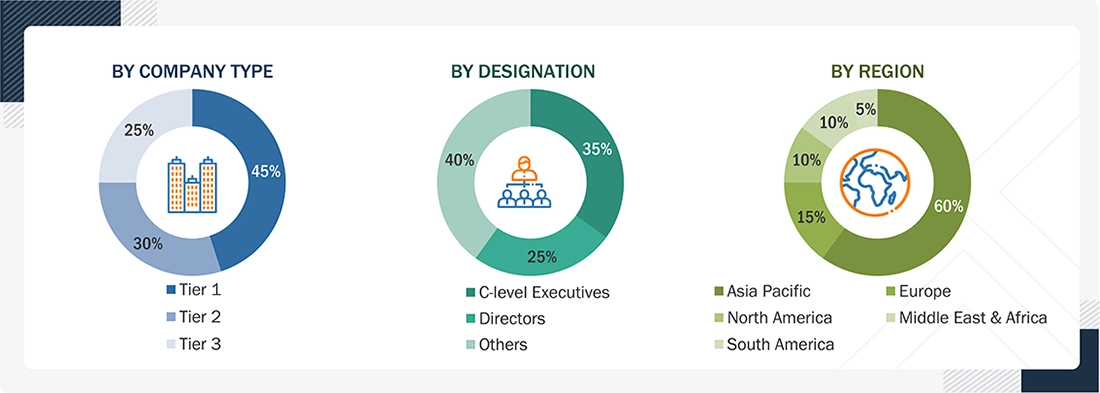
Note: Others include sales managers, engineers, and regional managers.
The tiers of the companies are defined based on their total revenue as of 2024: Tier 1: >USD 1 billion, Tier 2: USD 500 million–1 billion, and Tier 3: <USD 500 million.
To know about the assumptions considered for the study, download the pdf brochure
Market Size Estimation
Both top-down and bottom-up approaches were employed to estimate and validate the size of the generator market and its dependent submarkets. The key players in the market were identified through secondary research, and their market share in the respective regions was determined through a combination of primary and secondary research. The research methodology involves analyzing the annual and financial reports of top market players and conducting interviews with industry experts, including chief executive officers, vice presidents, directors, sales managers, and marketing executives, to gather key quantitative and qualitative insights related to the generator market.
Generator Market : Top-Down and Bottom-Up Approach
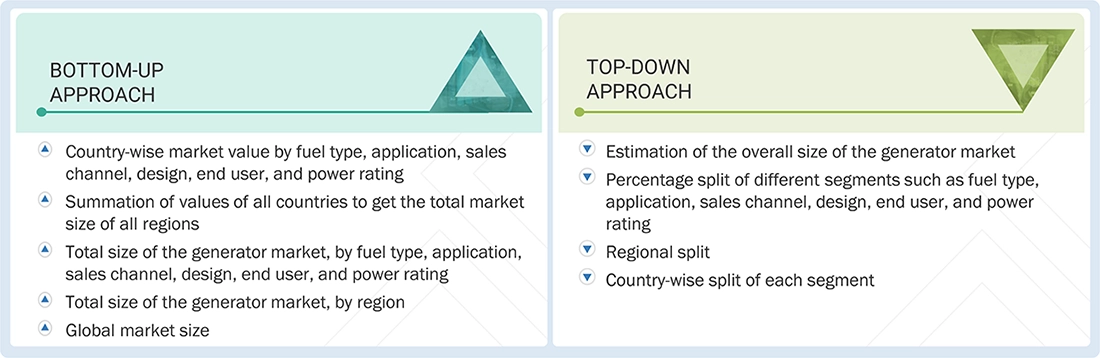
Data Triangulation
After determining the overall market size through the estimation process explained above, the total market has been divided into several segments and subsegments. To complete the overall market engineering process and obtain the exact statistics for all segments and subsegments, data triangulation and market breakdown processes have been employed, where applicable. The data has been triangulated by studying various factors and trends from both the demand and supply sides. Additionally, the market has been validated using both top-down and bottom-up approaches.
Market Definition
After determining the overall market size through the estimation process explained above, the total market has been divided into several segments and subsegments. To complete the overall market engineering process and obtain the exact statistics for all segments and subsegments, data triangulation and market breakdown processes have been employed, where applicable. The data has been triangulated by studying various factors and trends from both the demand and supply sides. Additionally, the market has been validated using both top-down and bottom-up approaches.
Key Stakeholders
- Government organizations and regulatory agencies
- Investors/Shareholders
- Shipping companies
- Organizations, forums, alliances, and associations related to the generator market
- Generator manufacturing companies
- Manufacturers and equipment user associations and groups
- Generator association
- Environmental research institutes
- Consulting companies in the energy and power domain
- Manufacturing industry
- Investment banks
- State and national regulatory authorities
- Venture capital firms
- Financial organizations
- Research institutes and organizations
- Environment associations
Report Objectives
- To describe and forecast the generator market in terms of value based on fuel type, application, sales channel, design, end user, power rating, and region
- To describe and forecast the generator market in terms of volume based on region
- To describe and forecast the generator market for various segments with respect to North America, Europe, Asia Pacific, South America, Middle East & Africa, along with their country-level analysis, in terms of value
- To provide detailed information regarding the major drivers, restraints, opportunities, and challenges influencing the growth of the generator market
- To analyze market opportunities for stakeholders and provide a detailed competitive landscape for market leaders
- To strategically analyze micromarkets with regard to individual growth trends, prospects, and contributions to the total market
- To strategically profile the key players and comprehensively analyze their market shares and core competencies
- To provide a detailed overview of the unmet needs and white spaces, interconnected markets and cross-sector opportunities, strategic moves by tier-1/2/3 players, generator market value chain analysis, ecosystem analysis, key conferences and events, key stakeholders and buying criteria, patent analysis, trends/disruptions impacting customer business, trade analysis, tariff analysis, investment and funding scenario, technology analysis, technology/product roadmap, case study analysis, regulations, future applications, macroeconomic outlook, pricing analysis, Porter’s five forces analysis, sustainability initiatives, adoption barriers and internal challenges, market profitability, impact of regulatory policies on sustainability initiatives, certifications, labeling and eco-standards, decision making process, impact of gen AI, and the 2024 US tariff impact
- To analyze competitive developments, such as agreements, product launches, contracts, investments, partnerships, collaborations, announcements and acquisitions in the market
Available customizations:
MarketsandMarkets offers customizations tailored to the specific needs of companies using the given market data.
The following customization options are available for the report:
Product Analysis
- Product matrix, which gives a detailed comparison of the product portfolio of each company
Regional Analysis
- Further breakdown of the generators, by country
Company Information
- Detailed analysis and profiling of additional market players (up to five)
Key Questions Addressed by the Report
What was the size of the global generator market?
The global generator market was valued at USD 25.34 billion in 2025 and is projected to reach USD 35.38 billion by 2031, growing at a CAGR of 5.7% during the forecast period (2026–2031).
What are the key factors driving the Generator Market?
Growth is driven by increasing demand for reliable backup power, rapid industrialization, infrastructure development, and expansion of data centers.
Which segment holds the largest share of the Generator Market?
The standby application segment holds the largest market share due to growing demand for emergency backup power across commercial and industrial sectors.
Which region dominates the Generator Market?
Asia Pacific dominates the market, driven by rapid urbanization, industrial growth, and increasing investments in power infrastructure.
Who are the key players in the Generator Market?
Leading companies include Caterpillar, Cummins Inc., Rolls-Royce Plc, Mitsubishi Heavy Industries Ltd., and Wacker Neuson SE.
Fact checked
Personalize This Research
- Triangulate with your Own Data
- Get Data as per your Format and Definition
- Gain a Deeper Dive on a Specific Application, Geography, Customer or Competitor
- Any level of Personalization
Let Us Help You
- What are the Known and Unknown Adjacencies Impacting the Generator Market
- What will your New Revenue Sources be?
- Who will be your Top Customer; what will make them switch?
- Defend your Market Share or Win Competitors
- Get a Scorecard for Target Partners

Custom Market Research Services
We Will Customise The Research For You, In Case The Report Listed Above Does Not Meet With Your Requirements
Get 10% Free CustomisationTESTIMONIALS

Kimberly Murphy
GLOBAL MARKETING DIRECTOR
Bently Nevada,
Leading Condition Monitoring & Asset Protectionwww.bakerhughesds.com/bently-nevada

MarketsandMarkets™ showed consistent rigor for success and relentlessly worked with Bently Nevada stakeholders to positively impact go-to-market strategy. Their proactiveness and flexibility has been instrumental in achieving the objectives to grow our sales pipeline in key industrial markets.

DARRICK HUEBER
Business Development Leader
Nexus Controls LLC,
Leading Manufacturer of Automation System & Electrical Panelswww.bakerhughesds.com/nexus-controls

We partnered with MarketsandMarkets to expand our business further by tapping into new industrial segments. It was critical for us to gather crucial business insights about specific markets to achieve this goal. MarketsandMarkets engagement model and client services helped us provide those insights, it was really impressive and valuable for my business. The team was extremely flexible and helpful.

Mike Schoff
Global Industrial Commercial Strategy Leader
Nexus Controls LLC
Leading Manufacturer of Automation System & Electrical Panelswww.bakerhughesds.com/nexus-controls
We consulted MarketsandMarkets for potential Partner Identification. Overall, it was a good experience. The insights provided through interviews conducted by the team helped us put together the questionnaire required for discussion with the selected partners. Their ability to provide insights through interviews with customers in a timely manner was quite impressive.
- US Generator Market
- Canada Generator Market
- Mexico Generator Market
- France Generator Market
- Germany Generator Market
- Russia Generator Market
- UK Generator Market
- China Generator Market
- India Generator Market
- Japan Generator Market
- Australia Generator Market
- South Korea Generator Market
- New Zealand Generator Market
- Indonesia Generator Market
- Saudi Arabia Generator Market
- UAE Generator Market
- South Africa Generator Market
- Nigeria Generator Market
- Brazil Generator Market
- Argentina Generator Market
Growth opportunities and latent adjacency in Generator Market






Jeff
Jun, 2022
What factors are estimated to drive and restrain the generator sales market growth?.
Sztefunyk
May, 2026
availability of new electricity generation facilities .
Ayman
May, 2026
Interested to know about gas engine, generator, diesel engine generator in the field of oil and gas and offshore onshore facilities for my projects in house .