Data Center Backup Power Market by Fuel Type (Diesel, Natural Gas, Dual-Fuel, Hybrid Battery-Genset), Application, End User - Global Forecast to 2032


Data Center Backup Power Market to 2032: Size, Share & Growth Report
The global Data Center Backup Power market is projected to grow from USD 8.2 billion in 2026 to USD 19.0 billion by 2032, at a CAGR of approximately 15% during 2026–2032. Growth is driven by AI rack density multiplying backup power requirements per site, large-genset slot allocation extending to 2028 at major OEMs, and natural gas gensets gaining share for large hyperscale sites.
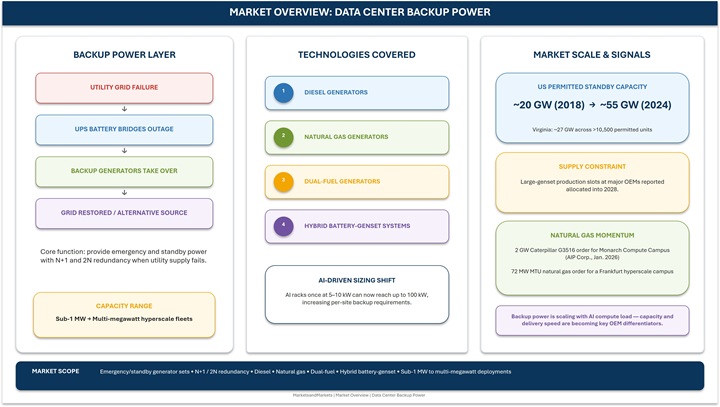
Data Center Backup Power covers the emergency and standby generator sets that provide N+1 and 2N redundant power when the utility grid fails, bridging the gap after UPS batteries are exhausted until grid power is restored or an alternative source takes over. The market spans diesel generators, natural gas generators, dual-fuel generators, and hybrid battery-genset systems, sized from sub-1 MW enterprise installations to multi-megawatt hyperscale campus fleets.
AI has fundamentally changed the sizing math for backup power: racks that once drew 5 to 10 kW now draw up to 100 kW for AI clusters, pushing per-site backup requirements, and genset orders, dramatically higher. Hyperscalers are responding by buying years ahead, with large-genset production slots at major OEMs reported allocated into 2028, leaving allocation-only availability for other buyers. In the United States alone, permitted standby diesel generator nameplate capacity at data centers grew from roughly 20 GW in 2018 to 55 GW in 2024, with Virginia's data center corridor alone accounting for about 27 GW across more than 10,500 permitted units — physical evidence of a market scaling directly alongside AI compute load rather than a niche backup category.
Natural gas gensets are increasingly winning the largest hyperscale orders: in January 2026, Caterpillar, American Intelligence & Power Corporation, and Boyd CAT formed a strategic alliance under which AIP Corp ordered 2 GW of Caterpillar G3516 fast-response natural gas generator sets for the Monarch Compute Campus, an AI-focused hyperscale project in West Virginia with long-term expansion plans of up to 8 GW. Rolls-Royce's MTU Solutions separately secured a 72 MW natural gas genset order for a hyperscale campus in Frankfurt, Germany, integrating microgrid control for grid-export capability. The Data Center Backup Power market is where the emergency power layer of AI infrastructure is scaling to match unprecedented rack density — and the OEMs that can deliver capacity fastest will capture the category's growth.
Top 10 Key Takeaways
- North America holds the largest market share, anchored by Virginia's data center corridor, which alone accounts for roughly 27 GW of permitted standby generator nameplate capacity across more than 10,500 units.
- Asia Pacific is the fastest-growing region, propelled by rapid hyperscale and colocation data center buildout and product launches specifically targeted at the region, including Mitsubishi Heavy Industries' containerized generator solution introduced in Singapore.
- Diesel generators lead by fuel-type revenue, reflecting decades of proven reliability and the established NFPA 110 compliance framework; natural gas generators are the fastest-growing fuel type as large hyperscale sites increasingly specify gas for its emissions and cost advantages at scale.
- Emergency/standby backup (N+1/2N redundancy) dominates by application; continuous/prime power support is the fastest-growing application as dual-rated gensets increasingly supplement primary power alongside UPS and onsite generation.
- US permitted standby diesel generator nameplate capacity at data centers grew from roughly 20 GW in 2018 to 55 GW in 2024, with Virginia's data center corridor alone accounting for about 27 GW across more than 10,500 permitted units.
- Caterpillar, American Intelligence & Power Corporation, and Boyd CAT formed a strategic alliance in January 2026 under which AIP Corp ordered 2 GW of Caterpillar G3516 natural gas generator sets for the Monarch Compute Campus in West Virginia, with long-term expansion plans of up to 8 GW.
- Rolls-Royce's MTU Solutions secured a 72 MW natural gas genset order for a hyperscale data center campus in Frankfurt, Germany in January 2026, integrating microgrid control for grid-export capability.
- Cummins announced a USD 150 million capacity expansion at its Fridley, Minnesota facility in February 2026 to boost production of its QSK95 generator sets by 30%, specifically addressing extended lead times for high-horsepower units.
- The near-term opportunity lies in hybrid battery-genset systems and software-defined power management platforms, which are creating a new layer of value beyond the physical generator itself.
- The near-term risk is that large-genset production slots at major OEMs are reported allocated into 2028, meaning even well-capitalized buyers face multi-year waits for the highest-capacity units regardless of budget.
Why the Data Center Backup Power Market Matters Now
AI has quietly rewritten the sizing assumptions underlying every data center backup power plan. As one 2026 industry procurement analysis puts it, racks that drew 5 to 10 kW now draw up to 100 kW for AI clusters, pushing per-site backup requirements — and genset orders — dramatically higher. Hyperscalers are responding by buying years ahead and reserving production slots in bulk, a dynamic that leaves allocation-only availability for enterprise and colocation buyers who are not placing orders at the same scale or lead time.
This matters commercially because the industry's largest orders are now measured in gigawatts rather than megawatts. Caterpillar's alliance with American Intelligence & Power Corporation and Boyd CAT to supply 2 GW of natural gas generator sets to a single West Virginia campus, and Rolls-Royce MTU's 72 MW order for a Frankfurt hyperscale site, both illustrate how backup power procurement has shifted from a facilities afterthought into a headline infrastructure commitment negotiated years in advance. Diesel remains the dominant fuel type on proven reliability and established NFPA 110 compliance, but natural gas is winning a growing share of the largest hyperscale orders specifically because of its emissions and cost profile at multi-hundred-megawatt scale.
The market covers diesel generators, natural gas generators, dual-fuel generators, and hybrid battery-genset systems. Out of scope are uninterruptible power systems (UPS) evaluated as a separate product category, continuous, grid-independent onsite power generation intended to replace rather than back up a grid connection, and nuclear power generation technologies. The market connects to the
Generator Sales Market — Generator Sales Market.
Power Monitoring Market — Power Monitoring Market.
DERMS Architecture and Edge Control Market — DERMS Architecture and Edge Control Market.
Circuit Breaker Monitoring Systems Market — Circuit Breaker Monitoring Systems Market.
Power Device Analyzer Market — Power Device Analyzer Market.
Report Scope
| Report Metric | Details |
|---|---|
| Market Size in 2026 (Value) | USD 8.2 Billion |
| Market Forecast in 2032 (Value) | USD 19.0 Billion |
| Growth Rate | CAGR of 15% from 2026–2032 |
| Years Considered | 2022–2032 |
| Base Year | 2025 |
| Forecast Period | 2026–2032 |
| Units Considered | Value (USD Billion) |
| Report Coverage | Revenue forecast, company ranking, competitive landscape, growth factors, and trends |
| Top Companies |
|
| Growth Drivers |
|
| Segments Covered |
|
| Regional Scope | North America, Europe, Asia Pacific, Rest of World |
Market Trends Shaping Data Center Backup Power
The defining trend is the shift from diesel-default backup to multi-fuel generator portfolios. Where diesel was once the automatic default for emergency backup, large hyperscale sites are increasingly evaluating natural gas, dual-fuel, and hybrid battery-genset configurations side by side, selecting fuel type based on site-specific emissions targets, gas pipeline access, and total cost of ownership rather than defaulting to a single technology.
A second trend is hyperscalers reserving genset production slots years in advance. Cloud providers are buying years ahead and reserving production slots in bulk, with large-genset slots at major OEMs reported allocated into 2028 — a dynamic that mirrors the gas turbine and transformer backlogs affecting other data center power equipment categories simultaneously.
A third trend is natural gas gensets scaling to gigawatt-class hyperscale campus orders. Caterpillar's 2 GW G3516 order for the Monarch Compute Campus in West Virginia and Rolls-Royce MTU's 72 MW order for a Frankfurt hyperscale campus both illustrate how natural gas generator orders have grown from typical megawatt-scale facility orders into gigawatt-class commitments spanning years of deliveries.
A fourth trend is OEMs investing directly in manufacturing capacity expansion. Cummins' USD 150 million expansion of its Fridley, Minnesota facility, aimed at boosting QSK95 output by 30% to address 18-month lead times for high-horsepower units, illustrates how equipment manufacturers are committing capital to relieve the same backlog dynamics affecting gas turbines and transformers.
A fifth trend is renewable and low-carbon fuel compatibility entering mainstream product lines. Generac's EcoGen HVO series, designed to operate on 100% hydrotreated vegetable oil without engine modifications, and Rolls-Royce MTU's natural gas gensets offering compatibility with biogas, biomethane, and future hydrogen fuel blends, both show how emissions-reduction commitments are shaping new product development even within a fundamentally combustion-based technology category.
Market Drivers Accelerating Growth
The first driver is AI rack density multiplying backup power requirements per site: racks that drew 5 to 10 kW now draw up to 100 kW for AI clusters, directly increasing the generator capacity every new data center campus must specify to maintain N+1 or 2N redundancy.
The second driver is large-genset slot allocation extending to 2028 at major OEMs, as hyperscalers reserve production capacity years in advance, creating sustained order visibility for equipment manufacturers even as the resulting scarcity constrains availability for smaller buyers.
The third driver is natural gas gensets gaining share for large hyperscale sites, evidenced directly by Caterpillar's 2 GW natural gas order for the Monarch Compute Campus and Rolls-Royce MTU's 72 MW Frankfurt order, both reflecting a deliberate shift toward gas for its emissions and cost profile at gigawatt scale.
Market Challenges and Restraints
The most significant restraint is extended lead times for high-horsepower units despite OEM capacity investment. Even Cummins' USD 150 million Fridley, Minnesota expansion, intended to boost QSK95 output by 30%, is explicitly targeted at addressing existing 18-month lead times — illustrating that capacity investment underway today will take years to fully resolve current order backlogs.
A second restraint is NFPA 110 compliance and fuel logistics adding operational complexity. Emergency and standby generator systems must meet NFPA 110 requirements including monthly load testing and annual load-bank testing, and diesel fuel storage and rotation logistics add an ongoing operational burden distinct from the upfront equipment procurement decision.
A third challenge is balancing diesel reliability against natural gas emissions and cost advantages, since diesel's proven reliability and energy density remain compelling for smaller or standby-only applications even as natural gas gains share at the largest hyperscale sites. A related challenge is OEM consolidation and service network scale becoming a competitive differentiator, illustrated by Caterpillar's acquisition of Weichai Baudouin's European distribution network specifically to expand service reach for data center power customers.
Segment Insights
By Fuel Type
Diesel generators lead by fuel-type revenue, reflecting decades of proven reliability, established fuel logistics practices, and the mature NFPA 110 compliance framework that most existing data center backup power fleets are built around.
Natural gas generators are the fastest-growing fuel type, propelled directly by gigawatt-class hyperscale orders such as Caterpillar's 2 GW Monarch Compute Campus commitment and Rolls-Royce MTU's 72 MW Frankfurt order, both reflecting large sites' preference for gas at scale.
By Application
Emergency/standby backup (N+1/2N redundancy) dominates by application, anchored by the fundamental, universal requirement for every data center, regardless of scale, to maintain redundant power capacity for grid outage scenarios.
Continuous/prime power support is the fastest-growing application, as dual-rated gensets increasingly supplement primary power alongside UPS and onsite generation rather than serving purely as emergency-only standby equipment.
Key segmentation insights:
- Diesel generators lead fuel-type revenue; natural gas generators grow fastest on gigawatt-class hyperscale orders.
- Emergency/standby backup dominates by application; continuous/prime power support grows fastest as dual-rated gensets supplement primary power.
- Hyperscale cloud/AI providers lead end users; colocation providers grow fastest as shared facilities scale backup capacity for AI tenant workloads.
- The direct OEM procurement model and the rental/temporary power provider model represent two competing routes to market.
- AI rack density growth and gigawatt-class hyperscale orders are the structural drivers of market growth through 2032.
Regional Analysis: Data Center Backup Power Market by Region
North America
North America holds the largest share, valued at roughly USD 3.69 billion in 2026 and projected to reach about USD 8.05 billion by 2032, growing at a CAGR of approximately 13.9%. The United States dominates through the concentration of hyperscale AI data center campuses, anchored by Virginia's data center corridor, which alone accounts for roughly 27 GW of permitted standby generator nameplate capacity across more than 10,500 units, alongside gigawatt-class orders such as Caterpillar's Monarch Compute Campus commitment in West Virginia. Canada contributes through growing enterprise and colocation backup power demand.
Europe
Europe is valued at approximately USD 2.05 billion in 2026 and forecast to reach around USD 4.90 billion by 2032, expanding at a CAGR of approximately 15.6%. Germany anchors the region through Rolls-Royce MTU's 72 MW natural gas genset order for a Frankfurt hyperscale campus; the United Kingdom and Ireland contribute through growing hyperscale and colocation backup power investment as regional data center capacity expands.
Asia Pacific
Asia Pacific is the fastest-growing region, valued at roughly USD 1.89 billion in 2026 and projected to reach about USD 5.10 billion by 2032, growing at a CAGR of approximately 18.0%. Singapore contributes directly through Mitsubishi Heavy Industries' containerized generator solution, introduced regionally to support reliable backup power demand; Japan and China add growing hyperscale and enterprise backup power investment as regional data center buildout accelerates.
Rest of World
The Rest of World market is valued at USD 0.56 billion in 2026 and is projected to reach about USD 1.15 billion by 2032, growing at a CAGR of approximately 12.8%. The Middle East contributes through growing sovereign AI data center backup power investment, while Latin America adds expanding regional colocation and enterprise backup power adoption.
Key Company Insights
The competitive landscape spans three tiers: global diesel and natural gas generator set manufacturers, specialized containerized and rental power providers, and power management software vendors that layer analytics on top of physical generator fleets. Leading players include Caterpillar Inc., Cummins Inc., Rolls-Royce Power Systems (MTU), Generac Power Systems, Kohler Power Systems, Mitsubishi Heavy Industries Engine & Turbocharger, Himoinsa, Wärtsilä Corporation, Atlas Copco, Aggreko, Pramac, HITEC Power Protection, Weichai Baudouin, Schneider Electric, and Eaton.
- Caterpillar Inc. (diesel and natural gas generator sets)
- Cummins Inc. (diesel and natural gas generator sets)
- Rolls-Royce Power Systems / MTU (diesel and natural gas generator sets)
- Generac Power Systems (generator sets)
- Kohler Power Systems (generator sets)
- Mitsubishi Heavy Industries Engine & Turbocharger (generator sets)
- Himoinsa (generator sets)
- Wärtsilä Corporation (generator sets)
- Atlas Copco (containerized generator solutions)
- Aggreko (rental and temporary power)
- Pramac (generator sets)
- HITEC Power Protection (generator sets)
- Weichai Baudouin (generator sets and distribution)
- Schneider Electric (power management software)
- Eaton (power management software)
Caterpillar anchors the market's largest hyperscale natural gas genset position, having formed a strategic alliance with American Intelligence & Power Corporation and Boyd CAT in January 2026 to supply 2 GW of G3516 fast-response natural gas generator sets to the Monarch Compute Campus in West Virginia, with deliveries scheduled from September 2026 through August 2027. Cummins competes closely across both diesel and natural gas platforms, having committed USD 150 million to expand its Fridley, Minnesota facility specifically to boost output of its QSK95 generator sets by 30%. Rolls-Royce Power Systems, through its MTU brand, anchors a strong position in both diesel and natural gas gensets for hyperscale and edge computing applications, having launched upgraded MTU Series 1600 diesel gensets and fast-start MTU Series 4000 natural gas gensets, and secured a 72 MW natural gas order for a Frankfurt hyperscale campus.
Generac, Kohler, Himoinsa, Wärtsilä, and Mitsubishi Heavy Industries Engine & Turbocharger compete across the broader diesel and gas genset tier serving hyperscale, enterprise, colocation, and edge data center segments, with Mitsubishi Heavy Industries specifically launching a containerized generator solution in Singapore to support Asia Pacific demand. Atlas Copco and Aggreko anchor the containerized and rental/temporary power tier, while Pramac, HITEC Power Protection, and Weichai Baudouin — whose European distribution network Caterpillar acquired to expand service reach — round out the manufacturing and distribution landscape. Schneider Electric and Eaton compete in a parallel software layer, offering cloud platforms that aggregate telemetry from gensets, UPS, and grid interconnections to enable real-time fuel and emissions optimization.
Key company strategy insights:
- Caterpillar holds the clearest position in gigawatt-scale hyperscale natural gas genset orders, validated by its 2 GW Monarch Compute Campus alliance.
- Cummins' direct manufacturing capacity investment in its Fridley, Minnesota facility illustrates how OEMs are committing capital to relieve high-horsepower unit lead times.
- Rolls-Royce Power Systems' MTU brand competes across both diesel and natural gas platforms, with recent product launches spanning both fuel types for hyperscale and edge applications.
- Generac, Kohler, Himoinsa, Wärtsilä, and Mitsubishi Heavy Industries compete on breadth across hyperscale, enterprise, colocation, and edge segments.
- Schneider Electric and Eaton's software-defined power management platforms position them to capture value across generator fleets regardless of which OEM manufactured the underlying hardware.
Recent Developments
- February 2026: Cummins announced a USD 150 million capacity expansion at its Fridley, Minnesota facility to boost production of its QSK95 generator sets by 30%, addressing extended lead times for high-horsepower units.
- January 2026: Caterpillar, American Intelligence & Power Corporation, and Boyd CAT formed a strategic alliance under which AIP Corp ordered 2 GW of Caterpillar G3516 fast-response natural gas generator sets for the Monarch Compute Campus in West Virginia, with deliveries scheduled from September 2026 through August 2027.
- January 2026: Rolls-Royce's MTU Solutions secured a 72 MW natural gas genset order for a hyperscale data center campus in Frankfurt, Germany, integrating microgrid control for grid-export capability.
- October 2025: Rolls-Royce's MTU Solutions introduced fast-start MTU Series 4000 natural gas generator sets designed for AI-driven data centers, with the new 20V4000 platform delivering 2.8 MW output within 45 seconds beginning in 2026.
Real-World Use Cases
- Caterpillar, American Intelligence & Power Corporation, and Boyd CAT's alliance to supply 2 GW of Caterpillar G3516 natural gas generator sets to the Monarch Compute Campus in West Virginia combines onsite natural gas generation, battery energy storage systems, and microgrid infrastructure to support high-density AI workloads, with long-term expansion plans of up to 8 GW capacity — illustrating how a single hyperscale campus can anchor a gigawatt-class backup and onsite power order spanning nearly a full year of scheduled deliveries.
- US permitted standby diesel generator nameplate capacity at data centers grew from roughly 20 GW in 2018 to 55 GW in 2024, with Virginia's data center corridor alone accounting for approximately 27 GW across more than 10,500 permitted units — concrete, permitted evidence that backup power capacity has scaled directly alongside AI compute load rather than remaining a stable, mature category.
Market Segmentation
The Data Center Backup Power market segments across three interlocking axes. By fuel type, it spans diesel, natural gas, dual-fuel, and hybrid battery-genset systems — four categories reflecting different reliability, emissions, and cost profiles. By application, it covers emergency/standby backup, continuous/prime power support, and peak shaving/grid support. By end user, it serves hyperscale cloud/AI providers, colocation providers, enterprise data centers, and edge data centers.
These axes interlock: a hyperscale cloud provider (end user) orders Caterpillar G3516 natural gas generator sets (fuel type: natural gas) to provide N+1 emergency backup (application: emergency/standby backup) for a gigawatt-scale AI training campus — three axes converging in a single, large-scale backup power procurement decision.
Key segmentation insights:
- Diesel generators lead fuel-type revenue; natural gas generators grow fastest on gigawatt-class hyperscale orders.
- Emergency/standby backup dominates by application; continuous/prime power support grows fastest as dual-rated gensets supplement primary power.
- Hyperscale cloud/AI providers lead end users; colocation providers grow fastest as shared facilities scale backup capacity for AI tenant workloads.
- The direct OEM procurement model and the rental/temporary power provider model represent two competing routes to market.
- AI rack density growth and gigawatt-class hyperscale orders are the structural drivers of market growth through 2032.
Opportunities and Future Outlook
Through 2032, data center backup power will mature from a standardized, largely diesel-based facilities category into a diversified, multi-fuel discipline planned alongside primary power and cooling from the earliest stages of site design. The forces driving the market — AI rack density multiplying per-site backup requirements, hyperscalers reserving genset production slots years in advance, and natural gas winning a growing share of the largest orders — are structural and mutually reinforcing, even as extended lead times and NFPA 110 compliance complexity introduce real near-term friction. Continued OEM manufacturing capacity investment and renewable fuel compatibility will be the next catalysts converting today's allocation-constrained backlog into a more predictable, diversified backup power supply chain.
For data center facilities directors, electrical engineers, and investors, the Data Center Backup Power market is where the emergency power layer of AI infrastructure is scaling to match unprecedented rack density in real time, and the OEMs that can deliver capacity fastest across diesel, natural gas, and hybrid technologies alike will determine how reliably the next generation of AI data centers can ride through every grid outage.
Frequently Asked Questions (FAQ)
1. How big is the Data Center Backup Power market?
The Data Center Backup Power market is projected to grow from USD 8.2 billion in 2026 to about USD 19.0 billion by 2032. North America accounts for the largest share, anchored by Virginia's data center corridor and its roughly 27 GW of permitted standby generator capacity.
2. What is the Data Center Backup Power market growth rate?
The market is forecast to grow at a CAGR of approximately 15% from 2026 to 2032. Asia Pacific is the fastest-growing region at around 18.0%, driven by rapid hyperscale and colocation data center buildout.
3. Which segment leads the Data Center Backup Power market?
By fuel type, diesel generators lead; natural gas generators grow fastest. By application, emergency/standby backup dominates; continuous/prime power support grows fastest.
4. Who are the key players in the Data Center Backup Power market?
Leading players include Caterpillar Inc., Cummins Inc., Rolls-Royce Power Systems (MTU), Generac Power Systems, Kohler Power Systems, Mitsubishi Heavy Industries Engine & Turbocharger, Himoinsa, Wärtsilä, Atlas Copco, Aggreko, Pramac, HITEC Power Protection, Weichai Baudouin, Schneider Electric, and Eaton.
5. What are the factors driving the Data Center Backup Power market?
The primary drivers are AI rack density multiplying backup power requirements per site, large-genset slot allocation extending to 2028 at major OEMs, and natural gas gensets gaining share for large hyperscale sites.
 Exclusive indicates content/data unique to MarketsandMarkets and not available with any competitors.
TABLE OF CONTENTS
1 Introduction
1.1 Study Objectives
1.2 Market Definition and Scope
1.2.1 Inclusions and Exclusions
1.3 Study Scope
1.3.1 Markets Covered
1.3.2 Geographic Segmentation
1.3.3 Years Considered
1.4 Currency Considered
1.5 Stakeholders
2 Research Methodology
2.1 Research Approach
2.1.1 Secondary Research
2.1.2 Primary Research
2.1.2.1 Breakdown of Primaries
2.2 Market Size Estimation
2.2.1 Bottom-Up Approach
2.2.2 Top-Down Approach
2.3 Data Triangulation
2.4 Research Assumptions
2.5 Limitations and Risk Assessment
3 Executive Summary
4 Premium Insights
4.1 Attractive Opportunities in the Data Center Backup Power Market
4.2 Market, By Fuel Type
4.3 Market, By Region
4.4 Market, By Application
5 Market Overview
5.1 Introduction
5.2 Market Dynamics
5.2.1 Drivers
5.2.1.1 AI Rack Density Multiplying Backup Power Requirements Per Site
5.2.1.2 Large-Genset Slot Allocation Extending to 2028 at Major OEMs
5.2.1.3 Natural Gas Gensets Gaining Share for Large Hyperscale Sites
5.2.2 Restraints
5.2.2.1 Extended Lead Times for High-Horsepower Units Despite OEM Capacity Investment
5.2.2.2 NFPA 110 Compliance and Fuel Logistics Adding Operational Complexity
5.2.3 Opportunities
5.2.3.1 Hybrid Battery-Genset Systems and Software-Defined Power Management
5.2.3.2 Renewable Fuel Compatibility Creating a Premium Upgrade Path
5.2.4 Challenges
5.2.4.1 Balancing Diesel Reliability Against Natural Gas Emissions and Cost Advantages
5.2.4.2 OEM Consolidation and Service Network Scale Becoming a Competitive Differentiator
5.3 Value Chain Analysis
5.4 Ecosystem Analysis
5.5 Investment and Funding Scenario
5.6 Pricing Analysis
5.7 Trends and Disruptions Impacting Customer Business
5.8 Technology Analysis
5.8.1 Key Technologies (Diesel Generators, Natural Gas Generators, Dual-Fuel Generators)
5.8.2 Complementary Technologies (Hybrid Battery-Genset Systems, Containerized Generator Solutions)
5.8.3 Adjacent Technologies (Software-Defined Power Management, Renewable Fuel Compatibility)
5.9 Porter's Five Forces Analysis
5.10 Key Stakeholders and Buying Criteria
5.11 Case Study Analysis
5.12 Key Conferences and Events
5.13 Regulatory Landscape
5.13.1 NFPA 110 Emergency and Standby Power Systems Standard
5.13.2 EPA Emissions Standards for Standby and Prime Power Generators
5.13.3 State-Level Permitting Requirements for Standby Generator Nameplate Capacity
5.13.4 Uptime Institute Tier Certification Backup Power Redundancy Requirements
5.14 Impact of AI on the Market
5.15 Impact of 2025 US Tariffs on Supply Chains
6 Industry Trends
6.1 From Diesel-Default Backup to Multi-Fuel Generator Portfolios
6.2 Hyperscalers Reserving Genset Production Slots Years in Advance
6.3 Natural Gas Gensets Scaling to Gigawatt-Class Hyperscale Campus Orders
6.4 OEMs Investing Directly in Manufacturing Capacity Expansion
6.5 Renewable and Low-Carbon Fuel Compatibility Entering Mainstream Product Lines
6.6 State-Level Permitted Standby Capacity Concentrating in a Handful of Data Center Hubs
7 Technology Adoption and Strategic Disruption Landscape
7.1 Diesel Generators vs. Natural Gas Generators for Large Hyperscale Sites
7.2 Standby-Rated Gensets vs. Continuous/Prime-Rated Dual-Duty Gensets
7.3 Standalone Generator Fleets vs. Hybrid Battery-Genset Systems
7.4 Site-Built Generator Installations vs. Containerized, Modular Generator Solutions
8 Customer Landscape and Buyer Behavior
8.1 Decision-Making Process — Data Center Facilities Director, Electrical Engineer, Procurement Director
8.2 N+1/2N Redundancy Planning Driving Generator Fleet Sizing
8.3 ROI Framework: Lead Time, Fuel Logistics, Emissions Compliance, Total Cost of Ownership
8.4 Build vs. Buy: Direct OEM Procurement vs. Rental/Temporary Power Providers
9 Data Center Backup Power Market, By Fuel Type
9.1 Introduction
9.2 Diesel Generators
9.3 Natural Gas Generators
9.4 Dual-Fuel Generators
9.5 Hybrid (Battery-Genset) Systems
10 Data Center Backup Power Market, By Application
10.1 Introduction
10.2 Emergency/Standby Backup (N+1/2N Redundancy)
10.3 Continuous/Prime Power Support
10.4 Peak Shaving and Grid Support
11 Data Center Backup Power Market, By End User
11.1 Introduction
11.2 Hyperscale Cloud and AI Providers
11.3 Colocation Providers
11.4 Enterprise Data Centers
11.5 Edge Data Centers
12 Data Center Backup Power Market, By Region
12.1 Introduction
12.2 North America
12.2.1 United States
12.2.2 Canada
12.3 Europe
12.3.1 Germany
12.3.2 United Kingdom
12.3.3 Ireland
12.3.4 Rest of Europe
12.4 Asia Pacific
12.4.1 Singapore
12.4.2 Japan
12.4.3 China
12.4.4 Rest of Asia Pacific
12.5 Rest of World
12.5.1 Middle East
12.5.2 Latin America
13 Competitive Landscape
13.1 Overview
13.2 Key Player Strategies / Right to Win
13.3 Revenue Analysis
13.4 Market Share Analysis
13.5 Company Evaluation Matrix
13.6 Competitive Benchmarking
13.7 Competitive Scenario
14 Company Profiles
14.1 Caterpillar Inc. (Diesel and Natural Gas Generator Sets)
14.2 Cummins Inc. (Diesel and Natural Gas Generator Sets)
14.3 Rolls-Royce Power Systems / MTU (Diesel and Natural Gas Generator Sets)
14.4 Generac Power Systems (Generator Sets)
14.5 Kohler Power Systems (Generator Sets)
14.6 Mitsubishi Heavy Industries Engine & Turbocharger (Generator Sets)
14.7 Himoinsa (Generator Sets)
14.8 Wärtsilä Corporation (Generator Sets)
14.9 Atlas Copco (Containerized Generator Solutions)
14.10 Aggreko (Rental and Temporary Power)
14.11 Pramac (Generator Sets)
14.12 HITEC Power Protection (Generator Sets)
14.13 Weichai Baudouin (Generator Sets and Distribution)
14.14 Schneider Electric (Power Management Software)
14.15 Eaton (Power Management Software)
15 Appendix
15.1 Discussion Guide
15.2 KnowledgeStore: Subscription Portal
15.3 Customization Options
15.4 Related Reports
15.5 Author Details

















Growth opportunities and latent adjacency in Data Center Backup Power Market