Data Center Power Availability Market by Solution Type (Grid Capacity/Siting Advisory, Interconnection Queue Advisory, Bring-Your-Own-Power Co-Development, Risk Assessment Platforms), Application, End User - Global Forecast to 2032


Data Center Power Availability Market to 2032: Size, Share & Growth Report
The global Data Center Power Availability market is projected to grow from USD 1.6 billion in 2026 to USD 5.8 billion by 2032, at a CAGR of approximately 24% during 2026–2032. Growth is driven by power availability, not capital, becoming the primary constraint on data center development, grid interconnection queue backlogs forcing developers toward alternative power strategies, and hyperscaler co-location partnerships demonstrating a replicable model for bypassing grid constraints.
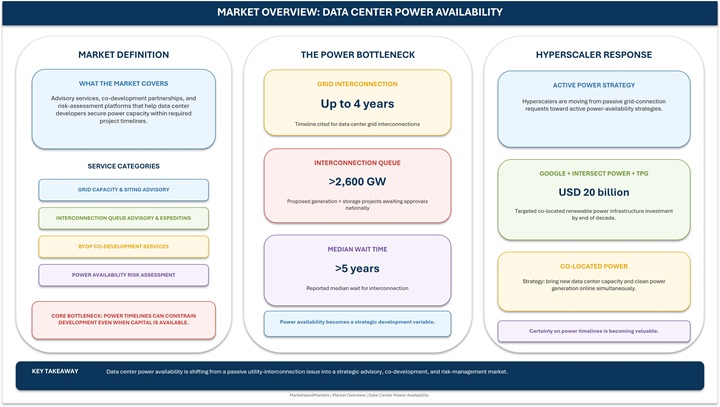
Data Center Power Availability covers the advisory services, co-development partnerships, and risk assessment platforms that help hyperscale, colocation, and enterprise data center developers secure power capacity within the timelines their projects require. The market spans grid capacity and siting advisory, interconnection queue advisory and expediting, Bring-Your-Own-Power (BYOP) co-development services, and power availability risk assessment platforms, addressing what has become the defining infrastructure bottleneck of the AI data center buildout.
As one legal advisory firm active in data center transactions put it plainly in 2026, power availability, not capital, is the primary constraint on data center development, with electrical grid interconnections often taking up to four years — making Bring-Your-Own-Power solutions increasingly attractive despite their complexity. That constraint is not anecdotal: Lawrence Berkeley National Laboratory has reported that more than 2,600 gigawatts of proposed generation and storage projects are waiting for grid interconnection approvals nationally, with median wait times exceeding five years, a backlog more than double the country's entire existing operational capacity.
Hyperscalers have responded by moving from passive grid connection requests to active power availability strategy. In December 2024, Google, Intersect Power, and TPG Rise Climate launched a strategic partnership targeting USD 20 billion in co-located renewable power infrastructure investment by the end of the decade, designed to bring new data center capacity and new clean power generation online simultaneously rather than waiting on conventional grid connection timelines. “This partnership is an evolution of the way hyperscalers and power providers have previously worked together,” said Sheldon Kimber, CEO and Founder of Intersect Power. The Data Center Power Availability market is where AI infrastructure's most acute bottleneck is being addressed directly — and the advisory firms, developers, and platforms that can deliver certainty on power timelines will capture the category's growth.
Top 10 Key Takeaways
- North America holds the largest market share, driven by the concentration of hyperscale AI data center campuses and the most severe, best-documented grid interconnection queue backlogs in the world.
- Asia Pacific is the fastest-growing region, propelled by hyperscalers replicating proven US and European power availability strategies as they expand data center footprints into new, less grid-constrained markets.
- Grid capacity and siting advisory leads by solution-type revenue, reflecting its position as the foundational service every data center developer requires before committing to a site; Bring-Your-Own-Power co-development services are the fastest-growing solution type as hyperscalers increasingly fund generation directly.
- Hyperscale data center site selection dominates by application; behind-the-meter generation co-location is the fastest-growing application as grid-dependent strategies carry unacceptable development risk for operators needing power in 12 to 36 months.
- Lawrence Berkeley National Laboratory reports that more than 2,600 gigawatts of proposed generation and storage projects are waiting for grid interconnection approvals nationally, with median wait times exceeding five years.
- Google, Intersect Power, and TPG Rise Climate's December 2024 partnership, targeting USD 20 billion in co-located renewable power infrastructure investment, established a replicable template other hyperscalers and developers are now following.
- Vantage Data Centers partnered with Volta Grid in February 2025 to deploy more than one gigawatt of on-site generation capacity specifically where grid connections were unavailable, illustrating how quickly Bring-Your-Own-Power has moved from concept to executed deployment.
- Grid operators are responding with dedicated fast-track processes for large loads, including PJM's Bring Your Own New Generation interconnection track and ERCOT's Senate Bill 6 rules, both advancing through 2026.
- The near-term opportunity lies in secondary market site selection, as primary, historically dominant data center markets become transmission-constrained for years — requiring specialized advisory to identify regions with spare substation capacity.
- The near-term risk is that even well-capitalized, well-planned capacity remains vulnerable to delay: equipment shortages and community opposition are each independently capable of delaying or canceling planned data center capacity regardless of power availability strategy.
Why the Data Center Power Availability Market Matters Now
The AI data center buildout has run into a constraint that no amount of capital alone can solve. As one 2026 legal and transaction advisory analysis states directly, power availability—not capital—is the primary constraint on data center development, with electrical grid interconnections often taking up to four years. That single fact has reordered the entire data center development process: site selection is now fundamentally governed by power availability rather than land cost or fiber connectivity, forcing a geographic diversification away from historically dominant but power-constrained primary markets toward secondary regions with spare grid capacity.
This matters commercially because the industry's response has moved well beyond simply waiting in line. Where grid connections are unavailable, operators are now deploying on-site power at scale: in February 2025, Vantage Data Centers partnered with Volta Grid to deploy more than one gigawatt of generation capacity, and Google's partnership with Intersect Power and TPG Rise Climate is designed to bring the first co-located clean energy project online in 2026 and fully complete by 2027 — a timeline that would be unachievable through conventional grid interconnection alone. Sheldon Kimber, CEO of Intersect Power, described the shift directly: “We can and are developing innovative solutions to expand data center capacity while reducing the strain on the grid.”
The market covers grid capacity and siting advisory, interconnection queue advisory and expediting, Bring-Your-Own-Power co-development services, and power availability risk assessment platforms. Out of scope are the underlying power generation equipment and assets themselves sold as capital equipment, power purchase agreement structuring and pricing services evaluated independently of physical power availability, and general commercial real estate site selection unrelated to power capacity.
The market connects to the
Generator Sales Market — https://www.marketsandmarkets.com/Market-Reports/generator-sales-market-47544335.html
Power Monitoring Market — https://www.marketsandmarkets.com/Market-Reports/power-monitoring-market-197503460.html
DERMS Architecture and Edge Control Market — https://www.marketsandmarkets.com/Market-Reports/derms-architecture-and-edge-control-market-206649623.html
Circuit Breaker Monitoring Systems Market — https://www.marketsandmarkets.com/Market-Reports/circuit-breaker-monitoring-systems-market-133358428.html
Power Device Analyzer Market — https://www.marketsandmarkets.com/Market-Reports/power-device-analyzer-market-259267665.html
Report Scope
| Report Metric | Details |
|---|---|
| Market Size in 2026 (Value) | USD 1.6 Billion |
| Market Forecast in 2032 (Value) | USD 5.8 Billion |
| Growth Rate | CAGR of 24% from 2026–2032 |
| Years Considered | 2022–2032 |
| Base Year | 2025 |
| Forecast Period | 2026–2032 |
| Units Considered | Value (USD Billion) |
| Report Coverage | Revenue forecast, company ranking, competitive landscape, growth factors, and trends |
| Top Companies |
|
| Growth Drivers |
|
| Segments Covered |
|
| Regional Scope | North America, Europe, Asia Pacific, Rest of World |
Market Trends Shaping Data Center Power Availability
The defining trend is the shift from passive grid connection requests to active power availability strategy. Companies are now engaged in a proactive scramble for power, forcing a fundamental strategic shift for hyperscalers and developers away from simply submitting an interconnection request and waiting, toward actively shaping where and how power becomes available for their projects.
A second trend is Bring-Your-Own-Power co-location becoming a mainstream hyperscale development model. Google's partnership with Intersect Power and TPG Rise Climate, and Vantage Data Centers' partnership with Volta Grid, both illustrate how BYOP has moved from a niche, last-resort option into a mainstream development strategy pursued proactively by leading hyperscalers and developers alike.
A third trend is secondary markets with spare substation capacity attracting developer attention. As historically dominant primary data center markets become transmission-constrained for years at a time, developers are increasingly directing site selection toward secondary regions where spare grid capacity can de-risk project timelines that primary markets can no longer guarantee.
A fourth trend is grid operators introducing dedicated fast-track interconnection processes for large loads. PJM's Bring Your Own New Generation track and ERCOT's Senate Bill 6 rules, both advancing through 2026, reflect grid operators' recognition that standard interconnection queues cannot accommodate the scale and urgency of AI data center power demand without a dedicated process.
A fifth trend is power availability becoming a premium data center leasing value proposition. Data center capacity that comes with guaranteed power delivery timelines is increasingly commanding premium pricing, making power availability itself — not just floor space or connectivity — a core, quantifiable value proposition that developers and landlords actively market.
Market Drivers Accelerating Growth
The first driver is power availability, not capital, becoming the primary constraint on data center development: with grid interconnections often taking up to four years, developers increasingly need specialized advisory and co-development capability to secure power on a timeline their projects can actually use.
The second driver is grid interconnection queue backlogs, with Lawrence Berkeley National Laboratory reporting more than 2,600 gigawatts of proposed generation and storage projects awaiting approval nationally and median wait times exceeding five years — a backlog that makes grid-dependent development strategies carry unacceptable risk for operators needing power within 12 to 36 months.
The third driver is hyperscaler co-location partnerships demonstrating a replicable bypass model: Google, Intersect Power, and TPG Rise Climate's USD 20 billion partnership and Vantage Data Centers' partnership with Volta Grid have each shown that co-located generation can be deployed on a faster, more certain timeline than conventional grid interconnection, encouraging other developers to pursue similar strategies.
Market Challenges and Restraints
The most significant restraint is Bring-Your-Own-Power solutions carrying significant financing and operational complexity. BYOP requires developers to separately finance, permit, and manage generation assets alongside core data center construction, and market participants are increasingly separating the financing of BYOP solutions from the data center components, tapping both project finance capital markets for power generation and commercial real estate capital markets for the data center itself.
A second restraint is equipment shortages and community opposition independently capable of delaying capacity. Even projects with secured power availability strategies remain vulnerable to delay: recent industry analysis estimates that a substantial share of near-term planned US data center capacity will be delayed or canceled due to a combination of power availability constraints, equipment shortages, and community opposition, meaning power availability alone does not guarantee on-schedule delivery.
A third challenge is balancing speed-to-power against co-located generation ownership complexity, since BYOP fundamentally changes a developer's risk profile from a real estate operator into a power generation asset owner. A related challenge is that regional power availability windows are narrow and shifting: a site with available capacity today may not remain available given the pace of demand growth, requiring continuous reassessment rather than a one-time site selection decision.
Segment Insights
By Solution Type
Grid capacity and siting advisory leads by solution-type revenue, reflecting its position as the foundational service every data center developer requires before committing capital to a specific site, given that power availability now fundamentally governs site selection.
Bring-Your-Own-Power co-development services are the fastest-growing solution type, propelled directly by hyperscaler-led partnerships such as Google/Intersect Power/TPG Rise Climate and Vantage Data Centers/Volta Grid that have converted BYOP from a niche strategy into a mainstream development model.
By Application
Hyperscale data center site selection dominates by application, anchored by the largest, most capital-intensive projects where power availability timelines directly determine site feasibility.
Behind-the-meter generation co-location is the fastest-growing application, as operators needing power in 12 to 36 months increasingly conclude that grid-dependent strategies carry unacceptable development risk given multi-year interconnection queue wait times.
Key segmentation insights:
- Grid capacity/siting advisory leads solution-type revenue; BYOP co-development services grow fastest on hyperscaler-led partnership models.
- Hyperscale site selection dominates by application; behind-the-meter generation co-location grows fastest on unacceptable grid-dependent development risk.
- Hyperscale cloud providers lead end users; private equity/infrastructure investors grow fastest as capital increasingly flows directly into co-located generation.
- The third-party advisory engagement model and the direct hyperscaler-developer co-investment model represent two competing routes to market.
- Grid interconnection queue backlogs and hyperscaler co-location partnership models are the structural drivers of market growth through 2032.
Regional Analysis: Data Center Power Availability Market by Region
North America
North America holds the largest share, valued at roughly USD 0.83 billion in 2026 and projected to reach about USD 2.78 billion by 2032, growing at a CAGR of approximately 22.3%. The United States dominates through the concentration of hyperscale AI data center campuses and the most severe, best-documented grid interconnection queue backlogs, with PJM's Bring Your Own New Generation track and ERCOT's Senate Bill 6 rules both advancing through 2026 to address large-load interconnection specifically. Canada contributes through growing hyperscale power availability advisory demand.
Europe
Europe is valued at approximately USD 0.35 billion in 2026 and forecast to reach around USD 1.23 billion by 2032, expanding at a CAGR of approximately 23.2%. Ireland and Germany contribute through established but increasingly transmission-constrained hyperscale data center clusters; the United Kingdom adds growing power availability advisory demand as regional grid capacity constraints intensify alongside continued hyperscale expansion.
Asia Pacific
Asia Pacific is the fastest-growing region, valued at roughly USD 0.34 billion in 2026 and projected to reach about USD 1.57 billion by 2032, growing at a CAGR of approximately 29.3%. China and India continue to expand hyperscale and enterprise data center capacity requiring dedicated power availability strategies; Japan adds growing demand as hyperscalers replicate proven US and European co-location and site selection models across new regional markets.
Rest of World
The Rest of World market is valued at USD 0.08 billion in 2026 and is projected to reach about USD 0.22 billion by 2032, growing at a CAGR of approximately 18.4%. The Middle East contributes through growing sovereign AI data center power availability planning, while Latin America adds expanding regional hyperscale and colocation site selection activity.
Key Company Insights
The competitive landscape spans three tiers: co-located clean energy developers and capital partners pioneering the Bring-Your-Own-Power model, on-site and modular generation equipment providers, and site selection and interconnection advisory firms. Leading players include Intersect Power, Vantage Data Centers, Volta Grid, TPG Rise Climate, Kevala, LineVision, Bloom Energy, Engie, NRG Energy, Caterpillar Energy Solutions, GE Vernova, CBRE Data Center Solutions, JLL, Burns & McDonnell, and POWER Engineers.
- Intersect Power (co-located clean energy development)
- Vantage Data Centers (hyperscale developer, BYOP adopter)
- Volta Grid (on-site and modular power generation)
- TPG Rise Climate (climate infrastructure investment)
- Kevala (grid capacity data analytics)
- LineVision (dynamic line rating and grid capacity technology)
- Bloom Energy (fuel cell behind-the-meter generation)
- Engie (energy infrastructure co-development)
- NRG Energy (power generation, BYOP partnerships)
- Caterpillar Energy Solutions (on-site generation equipment for BYOP)
- GE Vernova (gas turbines for behind-the-meter generation)
- CBRE Data Center Solutions (site selection and power availability advisory)
- JLL (site selection and power availability advisory)
- Burns & McDonnell (engineering and interconnection advisory)
- POWER Engineers (grid interconnection engineering consultancy)
Intersect Power anchors the market's most closely watched co-located development position, having entered a strategic partnership with Google and TPG Rise Climate in December 2024 targeting USD 20 billion in renewable power infrastructure investment, with a base portfolio of 2.2 GW of operating solar PV and 2.4 GWh of battery storage already representing roughly USD 4 billion in capital investment. TPG Rise Climate, the dedicated climate investing strategy within TPG's broader USD 25 billion global impact investing platform, co-led an USD 800 million financing round for Intersect alongside Google, with Climate Adaptive Infrastructure and Greenbelt Capital Partners also participating.
Vantage Data Centers and Volta Grid represent a second proven BYOP partnership model, having deployed more than one gigawatt of on-site generation capacity beginning in February 2025 specifically at sites where grid connections were unavailable. Bloom Energy, Caterpillar Energy Solutions, GE Vernova, NRG Energy, and Engie compete across the on-site and modular generation equipment tier that BYOP developers depend on, while Kevala and LineVision anchor the grid capacity data analytics and dynamic line rating technology tier that underpins power availability risk assessment. CBRE Data Center Solutions, JLL, Burns & McDonnell, and POWER Engineers round out the competitive field as established site selection, engineering, and interconnection advisory firms extending their practices to address the power availability constraint directly.
Key company strategy insights:
- Intersect Power and TPG Rise Climate hold the clearest position in large-scale, hyperscaler-backed co-located generation development.
- Vantage Data Centers and Volta Grid's proven, executed BYOP partnership gives them a credible reference model other developers are increasingly following.
- Bloom Energy, Caterpillar Energy Solutions, GE Vernova, NRG Energy, and Engie compete on on-site and modular generation equipment supply for BYOP projects.
- Kevala and LineVision's grid capacity data analytics and dynamic line rating technology position them as specialized technical differentiators within the broader advisory landscape.
- CBRE Data Center Solutions, JLL, Burns & McDonnell, and POWER Engineers compete on established site selection and engineering advisory depth extended to address power availability specifically.
Recent Developments
- June 2026: Industry analysis citing Goldman Sachs Research found that only about 60% of the following year's scheduled US data center power capacity is expected to arrive on time, with that share dropping further over the subsequent two years.¹
- February 2025: Vantage Data Centers partnered with Volta Grid to deploy more than one gigawatt of on-site generation capacity at sites where grid connections were unavailable.²
- December 2024: Google, Intersect Power, and TPG Rise Climate launched a strategic partnership targeting USD 20 billion in co-located renewable power infrastructure investment by the end of the decade, with the first project expected operational in 2026 and fully complete by 2027.³
- December 2024: Intersect Power announced an USD 800 million financing round led by Google and TPG Rise Climate, with participation from Climate Adaptive Infrastructure and Greenbelt Capital Partners, to accelerate its co-located clean energy development pipeline.4
Sources:
- ¹ Global Data Center Hub, 2026 — U.S. Data Center Infrastructure: The Binding Constraint (Mid-2026)
- ² Enki AI, April 8, 2026 — Hyperscaler Energy 2026: The Race to Build a Private Grid
- ³ ESG Today, December 10, 2024 — Google, Intersect Power, TPG Launch $20 Billion Data Center Clean Energy Partnership
- 4 TPG, December 10, 2024 — Intersect Power Forms Strategic Partnership With Google and TPG Rise Climate to Co-Locate Data Center Load and Clean Power Generation
Real-World Use Cases
- Google, Intersect Power, and TPG Rise Climate's USD 20 billion co-located energy park partnership is designed to bring data center load and new clean power generation online simultaneously, rather than sequentially through conventional grid interconnection. “The scale of AI presents an opportunity to completely rethink data center development — by co-locating them where possible with the grid-connected carbon-free energy that keeps them up and running,” a Google executive said of the partnership, which Intersect Power's Sheldon Kimber described as “an evolution of the way hyperscalers and power providers have previously worked together.”5
- Vantage Data Centers' partnership with Volta Grid, announced in February 2025, deployed more than one gigawatt of on-site generation capacity specifically at sites where grid connections remained unavailable — a concrete, executed demonstration that Bring-Your-Own-Power strategies can be deployed at gigawatt scale rather than remaining a small-scale pilot approach.6
Sources:
- 5 ESG Today, December 10, 2024 — Google, Intersect Power, TPG Launch $20 Billion Data Center Clean Energy Partnership
- 6 Enki AI, April 8, 2026 — Hyperscaler Energy 2026: The Race to Build a Private Grid
Market Segmentation
The Data Center Power Availability market segments across three interlocking axes. By solution type, it spans grid capacity/siting advisory, interconnection queue advisory/expediting, Bring-Your-Own-Power co-development services, and power availability risk assessment platforms — four categories reflecting different points on the grid-dependency-versus-self-sufficiency curve. By application, it covers hyperscale data center site selection, colocation facility development, behind-the-meter generation co-location, and grid interconnection expediting. By end user, it serves hyperscale cloud providers, colocation developers, enterprise data center operators, and private equity/infrastructure investors.
These axes interlock: a hyperscale cloud provider (end user) partners with Intersect Power for co-located generation development (solution type: BYOP co-development services) to secure power for a new AI training campus (application: behind-the-meter generation co-location) — three axes converging in a single, power-availability-driven infrastructure deployment.
Key segmentation insights:
- Grid capacity/siting advisory leads solution-type revenue; BYOP co-development services grow fastest on hyperscaler-led partnership models.
- Hyperscale site selection dominates by application; behind-the-meter generation co-location grows fastest on unacceptable grid-dependent development risk.
- Hyperscale cloud providers lead end users; private equity/infrastructure investors grow fastest as capital flows directly into co-located generation.
- The third-party advisory engagement model and the direct hyperscaler-developer co-investment model represent two competing routes to market.
- Grid interconnection queue backlogs and hyperscaler co-location partnership models are the structural drivers of market growth through 2032.
Opportunities and Future Outlook
Through 2032, data center power availability will mature from an emerging strategic response into a standard, planned-for-from-day-one component of every major data center development decision. The forces driving the market — power availability displacing capital as the primary development constraint, grid interconnection queue backlogs exceeding 2,600 gigawatts nationally, and hyperscaler co-location partnerships proving the Bring-Your-Own-Power model at gigawatt scale — are structural and mutually reinforcing, even as BYOP's financing and operational complexity and persistent equipment and permitting risk introduce real near-term friction. Continued grid operator fast-track interconnection reform and expanding secondary market site selection will be the next catalysts converting today's ad hoc power availability scrambling into a more predictable, systematized development discipline.
For VP data center development leads, chief power officers, and investors, the Data Center Power Availability market is where AI infrastructure's most acute bottleneck is being addressed directly in real time, and the advisory firms, developers, and platforms that can deliver genuine certainty on power timelines will determine how quickly the next generation of AI data centers can actually be built.
Frequently Asked Questions (FAQ)
1. How big is the Data Center Power Availability market?
The Data Center Power Availability market is projected to grow from USD 1.6 billion in 2026 to about USD 5.8 billion by 2032. North America accounts for the largest share, driven by the concentration of hyperscale AI data center campuses and the most severe documented grid interconnection queue backlogs.
2. What is the Data Center Power Availability market growth rate?
The market is forecast to grow at a CAGR of approximately 24% from 2026 to 2032. Asia Pacific is the fastest-growing region at around 29.3%, driven by hyperscalers replicating proven power availability strategies in new markets.
3. Which segment leads the Data Center Power Availability market?
By solution type, grid capacity/siting advisory leads; Bring-Your-Own-Power co-development services grow fastest. By application, hyperscale site selection leads; behind-the-meter generation co-location grows fastest.
4. Who are the key players in the Data Center Power Availability market?
Leading players include Intersect Power, Vantage Data Centers, Volta Grid, TPG Rise Climate, Kevala, LineVision, Bloom Energy, Engie, NRG Energy, Caterpillar Energy Solutions, GE Vernova, CBRE Data Center Solutions, JLL, Burns & McDonnell, and POWER Engineers.
5. What are the factors driving the Data Center Power Availability market?
The primary drivers are power availability, not capital, becoming the primary constraint on data center development, grid interconnection queue backlogs forcing developers toward alternative strategies, and hyperscaler co-location partnerships demonstrating a replicable bypass model.
Speak With Our Analyst
The Data Center Power Availability market is where AI infrastructure's most acute bottleneck is being addressed in real time, and advisory-level detail on grid capacity data, interconnection timelines, and Bring-Your-Own-Power co-development structures is where strategic decisions are won or lost. MarketsandMarkets can help you go deeper: request a sample of the full study, speak with our analyst about your specific questions, or customize the scope to your target solution types, applications, and geographies. Reach out to explore how this intelligence can inform your site selection strategy, vendor selection, or investment thesis.
 Exclusive indicates content/data unique to MarketsandMarkets and not available with any competitors.
TABLE OF CONTENTS
1 Introduction
1.1 Study Objectives
1.2 Market Definition and Scope
1.2.1 Inclusions and Exclusions
1.3 Study Scope
1.3.1 Markets Covered
1.3.2 Geographic Segmentation
1.3.3 Years Considered
1.4 Currency Considered
1.5 Stakeholders
2 Research Methodology
2.1 Research Approach
2.1.1 Secondary Research
2.1.2 Primary Research
2.1.2.1 Breakdown of Primaries
2.2 Market Size Estimation
2.2.1 Bottom-Up Approach
2.2.2 Top-Down Approach
2.3 Data Triangulation
2.4 Research Assumptions
2.5 Limitations and Risk Assessment
3 Executive Summary
4 Premium Insights
4.1 Attractive Opportunities in the Data Center Power Availability Market
4.2 Market, By Solution Type
4.3 Market, By Region
4.4 Market, By Application
5 Market Overview
5.1 Introduction
5.2 Market Dynamics
5.2.1 Drivers
5.2.1.1 Power Availability, Not Capital, Now the Primary Constraint on Data Center Development
5.2.1.2 Grid Interconnection Queue Backlogs Forcing Developers Toward Alternative Strategies
5.2.1.3 Hyperscaler Co-Location Partnerships Demonstrating a Replicable Bypass Model
5.2.2 Restraints
5.2.2.1 Bring-Your-Own-Power Solutions Carrying Significant Financing and Operational Complexity
5.2.2.2 Equipment Shortages and Community Opposition Independently Capable of Delaying Capacity
5.2.3 Opportunities
5.2.3.1 Regulatory Reform Tracks Creating New, Specialized Interconnection Pathways
5.2.3.2 Secondary Market Site Selection Emerging as a Distinct, High-Value Advisory Niche
5.2.4 Challenges
5.2.4.1 Balancing Speed-to-Power Against Co-Located Generation Ownership Complexity
5.2.4.2 Narrow, Shifting Regional Power Availability Windows Requiring Continuous Reassessment
5.3 Value Chain Analysis
5.4 Ecosystem Analysis
5.5 Investment and Funding Scenario
5.6 Pricing Analysis
5.7 Trends and Disruptions Impacting Customer Business
5.8 Technology Analysis
5.8.1 Key Technologies (Grid Capacity Data Analytics, Interconnection Queue Tracking, Site Selection Platforms)
5.8.2 Complementary Technologies (Dynamic Line Rating, Behind-the-Meter Generation Equipment)
5.8.3 Adjacent Technologies (Modular Gas and Fuel Cell Generation, Co-Located Renewable-Plus-Storage)
5.9 Porter's Five Forces Analysis
5.10 Key Stakeholders and Buying Criteria
5.11 Case Study Analysis
5.12 Key Conferences and Events
5.13 Regulatory Landscape
5.13.1 PJM Bring Your Own New Generation (BYONG) Interconnection Track
5.13.2 ERCOT Senate Bill 6 Large Load Interconnection Rules
5.13.3 FERC Co-Located Load Technical Conference and Policy Direction
5.13.4 Lawrence Berkeley National Laboratory Interconnection Queue Data Standards
5.14 Impact of AI on the Market
5.15 Impact of 2025 US Tariffs on Supply Chains
6 Industry Trends
6.1 From Passive Grid Connection Requests to Active Power Availability Strategy
6.2 Bring-Your-Own-Power Co-Location Becoming a Mainstream Hyperscale Development Model
6.3 Secondary Markets With Spare Substation Capacity Attracting Developer Attention
6.4 Grid Operators Introducing Dedicated Fast-Track Interconnection Processes for Large Loads
6.5 Power Availability Becoming a Premium Data Center Leasing Value Proposition
6.6 Private Capital Flowing Directly Into Co-Located Generation Rather Than Pure Real Estate
7 Technology Adoption and Strategic Disruption Landscape
7.1 Grid-Dependent Site Selection vs. Bring-Your-Own-Power Co-Located Development
7.2 Primary, Transmission-Constrained Markets vs. Secondary Markets With Spare Capacity
7.3 Standard Interconnection Queue vs. Fast-Track Large-Load Interconnection Processes
7.4 Pure Real Estate Financing vs. Integrated Power-Plus-Data-Center Capital Structures
8 Customer Landscape and Buyer Behavior
8.1 Decision-Making Process — VP Data Center Development, Chief Power Officer, Corporate Development Lead
8.2 Power Availability Timeline as the Primary Site Selection Criterion
8.3 ROI Framework: Speed to Power, Capacity Certainty, Co-Location Capital Requirements
8.4 Build vs. Buy: In-House Site Selection Teams vs. Third-Party Power Availability Advisory
9 Data Center Power Availability Market, By Solution Type
9.1 Introduction
9.2 Grid Capacity and Siting Advisory
9.3 Interconnection Queue Advisory and Expediting
9.4 Bring-Your-Own-Power (BYOP) Co-Development Services
9.5 Power Availability Risk Assessment Platforms
10 Data Center Power Availability Market, By Application
10.1 Introduction
10.2 Hyperscale Data Center Site Selection
10.3 Colocation Facility Development
10.4 Behind-the-Meter Generation Co-Location
10.5 Grid Interconnection Expediting
11 Data Center Power Availability Market, By End User
11.1 Introduction
11.2 Hyperscale Cloud Providers
11.3 Colocation Developers
11.4 Enterprise Data Center Operators
11.5 Private Equity and Infrastructure Investors
12 Data Center Power Availability Market, By Region
12.1 Introduction
12.2 North America
12.2.1 United States
12.2.2 Canada
12.3 Europe
12.3.1 Germany
12.3.2 United Kingdom
12.3.3 Ireland
12.3.4 Rest of Europe
12.4 Asia Pacific
12.4.1 China
12.4.2 Japan
12.4.3 India
12.4.4 Rest of Asia Pacific
12.5 Rest of World
12.5.1 Middle East
12.5.2 Latin America
13 Competitive Landscape
13.1 Overview
13.2 Key Player Strategies / Right to Win
13.3 Revenue Analysis
13.4 Market Share Analysis
13.5 Company Evaluation Matrix
13.6 Competitive Benchmarking
13.7 Competitive Scenario
14 Company Profiles
14.1 Intersect Power (Co-Located Clean Energy Development)
14.2 Vantage Data Centers (Hyperscale Developer, BYOP Adopter)
14.3 Volta Grid (On-Site and Modular Power Generation)
14.4 TPG Rise Climate (Climate Infrastructure Investment)
14.5 Kevala (Grid Capacity Data Analytics)
14.6 LineVision (Dynamic Line Rating and Grid Capacity Technology)
14.7 Bloom Energy (Fuel Cell Behind-the-Meter Generation)
14.8 Engie (Energy Infrastructure Co-Development)
14.9 NRG Energy (Power Generation, BYOP Partnerships)
14.10 Caterpillar Energy Solutions (On-Site Generation Equipment for BYOP)
14.11 GE Vernova (Gas Turbines for Behind-the-Meter Generation)
14.12 CBRE Data Center Solutions (Site Selection and Power Availability Advisory)
14.13 JLL (Site Selection and Power Availability Advisory)
14.14 Burns & McDonnell (Engineering and Interconnection Advisory)
14.15 POWER Engineers (Grid Interconnection Engineering Consultancy)
15 Appendix
15.1 Discussion Guide
15.2 KnowledgeStore: Subscription Portal
15.3 Customization Options
15.4 Related Reports
15.5 Author Details

















Growth opportunities and latent adjacency in Data Center Power Availability Market