Defect Detection Market Size, Share & Industry Growth Analysis Report by Offering (Hardware (Camera, Optics, and Processor), Software (Traditional and Deep-Learning); and Service), Application (Manufacturing, Packaging), Vertical, and Geography (2025-2035)


Defect Detection Market Market Summary
The global Defect Detection Market is witnessing rapid expansion due to the increasing adoption of artificial intelligence, industrial automation, smart manufacturing, and digital inspection technologies across industries. In 2025, the market is estimated to be valued at around USD 4.8 billion and is projected to reach nearly USD 12.9 billion by 2036, expanding at a CAGR of 9.4% during the forecast period. Growing quality control requirements in manufacturing, automotive, electronics, semiconductor, food processing, pharmaceuticals, and packaging industries are significantly contributing to market growth.
The integration of AI-powered computer vision, IoT-enabled monitoring systems, cloud-based analytics, and machine learning algorithms has transformed traditional inspection systems into intelligent defect detection platforms capable of real-time analysis and predictive quality management. Industries are increasingly deploying automated inspection technologies to minimize operational costs, improve product consistency, reduce production downtime, and enhance customer satisfaction. Rising demand for zero-defect manufacturing, combined with Industry 4.0 adoption, continues to accelerate the global demand for advanced defect detection systems.
Key Market Trends & Insights
- North America dominates the global Defect Detection Market due to strong adoption of AI-enabled industrial automation and advanced manufacturing technologies.
- Asia Pacific is expected to witness the fastest growth owing to expanding semiconductor, automotive, and electronics manufacturing industries.
- Vision inspection systems remain the dominant product segment because of their high accuracy and scalability in industrial environments.
- AI-driven computer vision and deep learning technologies are reshaping defect identification processes across smart factories.
- Cloud-connected inspection platforms are gaining traction for remote monitoring, predictive maintenance, and real-time analytics.
- Increasing deployment of robotic inspection systems in manufacturing facilities is improving operational efficiency and quality assurance.
Market Size & Forecast
- Base Year Market Size (2025): USD 4.8 Billion
- Forecast Market Value (2036): USD 12.9 Billion
- CAGR (2025–2036): 9.4%
- Growth is driven by increasing industrial automation, AI-powered inspection technologies, smart manufacturing initiatives, and rising quality control requirements across industries.
Defect Detection Market Top 10 key takeaway
- AI-powered defect detection systems are rapidly replacing manual inspection processes.
- Computer vision technology dominates the market due to higher inspection precision.
- Semiconductor and electronics industries are major adopters of automated inspection systems.
- Industry 4.0 transformation is significantly boosting market demand globally.
- Asia Pacific is emerging as the fastest-growing regional market.
- Cloud-based inspection analytics platforms are becoming increasingly popular.
- Automotive manufacturers are investing heavily in real-time quality inspection systems.
- IoT-enabled sensors are improving predictive quality management capabilities.
- Deep learning algorithms are enhancing defect identification accuracy.
- Strategic collaborations between automation and AI companies are accelerating innovation.
Product Insights
Vision inspection systems currently hold the largest share in the Defect Detection Market owing to their ability to identify microscopic flaws, surface defects, dimensional inaccuracies, and assembly issues with exceptional accuracy. These systems are widely utilized across automotive manufacturing, semiconductor fabrication, consumer electronics production, and pharmaceutical packaging applications. The increasing need for precision manufacturing and regulatory compliance has encouraged companies to deploy high-resolution camera systems integrated with AI-based analytics.
Automated optical inspection systems have become particularly important in electronics and semiconductor manufacturing, where even minor defects can result in significant operational and financial losses. Manufacturers are increasingly integrating 3D imaging systems, infrared sensors, and laser-based inspection technologies to improve inspection capabilities and reduce false detection rates.
Another emerging product category includes robotic inspection systems equipped with AI-powered vision sensors. These systems are gaining popularity in smart factories because they offer continuous monitoring, reduced labor dependency, and improved operational consistency. Portable and handheld defect detection devices are also witnessing increased demand in industries such as aerospace, oil & gas, and infrastructure inspection where mobility and flexibility are critical.
AI integration remains one of the most transformative factors in product innovation. Advanced machine learning algorithms enable inspection systems to continuously learn from production data, improve detection accuracy, and identify previously undetectable anomalies. This capability significantly enhances operational efficiency while reducing waste and production downtime.
Technology / Component Insights
The Defect Detection Market is heavily driven by advancements in computer vision, machine learning, deep learning, IoT connectivity, cloud computing, and industrial automation technologies. Computer vision systems remain the backbone of modern defect detection platforms, enabling real-time image processing and accurate quality inspection across high-speed production lines.
Artificial intelligence has emerged as a critical technology component within the market. AI-based algorithms can analyze massive volumes of production data, recognize complex defect patterns, and make intelligent inspection decisions without extensive human intervention. Deep learning models are particularly effective in detecting subtle surface defects, structural irregularities, and material inconsistencies that conventional inspection systems often fail to identify.
IoT-enabled defect detection systems are also becoming increasingly important in smart manufacturing environments. Connected sensors installed across production lines continuously monitor operational parameters and product quality metrics. These systems provide real-time alerts and predictive insights that help manufacturers prevent quality issues before they escalate into large-scale production failures.
Cloud computing technology is further enhancing the scalability and accessibility of defect detection platforms. Cloud-based inspection systems enable centralized data storage, remote monitoring, predictive analytics, and multi-site quality management. Manufacturers can now access inspection reports and operational insights from anywhere, improving decision-making and operational transparency.
Automation technologies, including collaborative robots and autonomous inspection systems, are expected to shape the future of the market. The integration of robotics with AI-driven vision systems allows manufacturers to achieve continuous inspection with minimal human intervention. Future innovations are likely to focus on edge AI processing, digital twin technology, hyperspectral imaging, and real-time predictive quality control solutions.
Application Insights
Manufacturing remains the leading application segment in the Defect Detection Market due to the increasing emphasis on quality assurance, operational efficiency, and zero-defect production strategies. Industries such as automotive, electronics, semiconductor, aerospace, food & beverage, and pharmaceuticals are actively adopting automated inspection technologies to improve product quality and minimize production errors.
The semiconductor and electronics industries represent some of the fastest-growing application areas. As chip architectures become increasingly complex, manufacturers require highly precise inspection systems capable of identifying microscopic defects during wafer fabrication and assembly processes. AI-enabled inspection platforms are becoming indispensable in ensuring product reliability and reducing costly recalls.
Automotive manufacturers are also investing significantly in defect detection systems for component inspection, welding verification, paint quality analysis, and assembly validation. Electric vehicle production is further accelerating demand for battery inspection technologies and advanced quality monitoring systems.
The pharmaceutical and food industries are increasingly utilizing defect detection systems to comply with strict safety regulations and packaging quality standards. Automated inspection solutions help companies identify contamination, labeling errors, and packaging defects while improving operational efficiency.
Future opportunities are expected to emerge in infrastructure monitoring, renewable energy systems, aerospace maintenance, and smart logistics applications. The growing adoption of autonomous inspection drones and AI-enabled predictive maintenance platforms is likely to create new revenue opportunities for market participants.
Regional Insights
North America currently leads the Defect Detection Market due to strong investments in industrial automation, artificial intelligence, robotics, and smart manufacturing technologies. The presence of major technology providers, coupled with high adoption of Industry 4.0 initiatives across manufacturing industries, continues to support regional growth. The United States remains the largest contributor owing to extensive deployment of AI-driven quality inspection systems in automotive, semiconductor, and aerospace industries.
Europe represents a mature and technologically advanced market supported by strict manufacturing quality standards, industrial digitalization programs, and sustainability initiatives. Countries such as Germany and France are witnessing increasing adoption of intelligent inspection systems across automotive, industrial equipment, and pharmaceutical manufacturing sectors.
Asia Pacific is projected to record the highest CAGR during the forecast period. Rapid industrialization, expanding electronics manufacturing, and government initiatives promoting smart factories are driving regional demand. China, Japan, South Korea, and India are emerging as major markets for AI-powered inspection technologies. The strong presence of semiconductor manufacturing facilities and automotive production hubs further accelerates regional growth.
Growing infrastructure investments, rising labor costs, and increasing demand for automation across emerging economies are expected to support long-term market expansion globally.
- North America remains the largest regional market for defect detection technologies.
- Asia Pacific is expected to witness the fastest growth during the forecast period.
- Semiconductor manufacturing expansion is boosting regional demand in Asia.
- Europe benefits from strong industrial quality regulations and automation adoption.
- Smart factory initiatives are driving global investment in AI-powered inspection systems.
United States-Specific Market Trends
The United States continues to dominate the North American market with a projected CAGR of 8.9% through 2036. Strong investments in semiconductor manufacturing, aerospace quality control, and industrial robotics are driving market expansion. Government initiatives supporting domestic chip production and smart manufacturing adoption are accelerating deployment of AI-enabled inspection systems.
Canada-Specific Market Trends
Canada is experiencing growing adoption of automated inspection technologies across automotive, food processing, and pharmaceutical industries. The market is projected to grow at a CAGR of 7.8% due to increasing industrial digitalization and investments in advanced manufacturing technologies.
Mexico-Specific Market Trends
Mexico’s manufacturing sector is increasingly integrating machine vision and automated inspection systems to improve export quality standards. The country is projected to grow at a CAGR of 8.1% driven by automotive and electronics manufacturing expansion.
China-Specific Market Trends
China represents one of the fastest-growing markets globally with a CAGR of 11.2%. Massive investments in semiconductor manufacturing, smart factories, and industrial AI applications continue to support market growth. Government-backed digital transformation initiatives are accelerating adoption of intelligent inspection technologies.
Japan-Specific Market Trends
Japan maintains strong demand for high-precision inspection systems in electronics, robotics, and automotive manufacturing. The market is expected to grow at a CAGR of 9.1% supported by advancements in AI-powered robotics and factory automation technologies.
Germany-Specific Market Trends
Germany remains a key European market due to its leadership in industrial automation and automotive manufacturing. The country is projected to register a CAGR of 8.4% through 2036 driven by Industry 4.0 initiatives and advanced manufacturing investments.
France-Specific Market Trends
France is increasingly adopting AI-based defect detection systems in aerospace, pharmaceuticals, and industrial manufacturing sectors. Government support for digital transformation and smart industrial infrastructure is supporting market growth at a CAGR of 7.9%.
- China is expected to witness the highest country-level growth rate.
- The United States remains the largest revenue contributor globally.
- Japan leads in robotics-integrated inspection technologies.
- Germany continues to invest heavily in Industry 4.0 manufacturing.
- Canada and France are witnessing increasing AI adoption in quality inspection.
Key Defect Detection Market Company Insights
Major companies operating in the Defect Detection Market are focusing on AI integration, strategic partnerships, product innovation, and cloud-based inspection solutions to strengthen their market positions. Companies are investing heavily in machine learning algorithms, high-speed vision systems, and industrial automation platforms to meet the growing demand for intelligent inspection technologies.
Key players such as Cognex Corporation, Keyence Corporation, Omron Corporation, Teledyne Technologies, Basler AG, Siemens AG, ABB Ltd., and Intel Corporation are continuously developing advanced AI-powered inspection systems capable of real-time analysis and predictive quality management.
Several companies are also emphasizing cloud connectivity, edge computing, and digital twin integration to improve operational efficiency and scalability. Strategic collaborations between AI software developers and industrial automation companies are expected to intensify as the market evolves.
- Companies are focusing heavily on AI-powered computer vision technologies.
- Cloud-enabled inspection platforms are becoming a major innovation area.
- Strategic partnerships are accelerating product development and market expansion.
- Robotics integration is improving automated quality inspection capabilities.
- Semiconductor inspection solutions remain a high-priority investment segment.
Recent Developments
Recent developments in the Defect Detection Market highlight the growing emphasis on AI integration and intelligent automation. Several manufacturers have introduced deep learning-enabled vision inspection systems capable of identifying microscopic defects with higher accuracy and reduced false positives.
A leading automation company recently launched an AI-driven 3D inspection platform designed for semiconductor wafer analysis and battery manufacturing applications. The solution enables real-time defect classification and predictive maintenance capabilities.
Another major industry participant announced a strategic partnership with a cloud analytics provider to develop next-generation smart factory inspection solutions. The collaboration aims to improve remote quality monitoring and industrial data intelligence.
Additionally, robotics companies are increasingly integrating autonomous mobile robots with advanced vision systems to automate inspection processes in warehouses, automotive plants, and electronics manufacturing facilities.
Market Segmentation
The Defect Detection Market is segmented by product, technology/component, application, and region. By product, the market includes vision inspection systems, automated optical inspection systems, robotic inspection systems, handheld inspection devices, and sensor-based detection platforms. Vision inspection systems account for the largest market share due to their extensive deployment across industrial automation environments.
Based on technology and component, the market comprises computer vision, artificial intelligence, machine learning, IoT-enabled systems, cloud-based analytics platforms, sensors, and robotics technologies. AI-powered computer vision remains the dominant technology segment owing to its superior inspection accuracy and real-time analytics capabilities.
By application, the market serves manufacturing, automotive, electronics & semiconductor, pharmaceuticals, aerospace, food & beverage, logistics, and energy industries. Manufacturing and semiconductor applications collectively account for a significant share due to increasing quality control requirements and production complexity.
Regionally, the market is divided into North America, Europe, Asia Pacific, Latin America, and the Middle East & Africa. North America currently leads the market, while Asia Pacific is projected to witness the fastest growth during the forecast period.
- Vision inspection systems dominate the product segment.
- AI-powered computer vision leads the technology category.
- Manufacturing remains the largest application segment.
- Semiconductor inspection is emerging as a major revenue contributor.
- Asia Pacific is projected to register the fastest regional growth.
Conclusion
The global Defect Detection Market is expected to experience substantial growth through 2036 driven by rapid industrial automation, AI adoption, Industry 4.0 transformation, and increasing quality assurance requirements across industries. The integration of machine learning, IoT-enabled monitoring, robotics, and cloud analytics is transforming conventional inspection systems into intelligent quality management platforms capable of real-time decision-making and predictive analysis.
As industries continue to prioritize operational efficiency, zero-defect manufacturing, and digital transformation, demand for advanced defect detection technologies is likely to accelerate significantly. Companies investing in AI-powered inspection systems, smart factory infrastructure, and cloud-connected quality management solutions are expected to gain strong competitive advantages in the evolving industrial landscape.
FAQs
1. What is the current size of the Defect Detection Market?
The global Defect Detection Market is estimated to reach approximately USD 4.8 billion in 2025.
2. What is the expected growth rate of the market?
The market is projected to grow at a CAGR of 9.4% during the forecast period from 2025 to 2036.
3. What are the major drivers of the Defect Detection Market?
Key growth drivers include AI adoption, industrial automation, smart manufacturing, IoT integration, and increasing quality control requirements.
4. Which region dominates the Defect Detection Market?
North America currently dominates the market due to advanced industrial automation infrastructure and high AI adoption.
5. Which companies are leading the Defect Detection Market?
Major companies include Cognex Corporation, Keyence Corporation, Omron Corporation, Teledyne Technologies, and Siemens AG.
 Exclusive indicates content/data unique to MarketsandMarkets and not available with any competitors.
TABLE OF CONTENTS
1 INTRODUCTION (Page No. - 27)
1.1 STUDY OBJECTIVES
1.2 MARKET DEFINITION AND SCOPE
1.2.1 INCLUSIONS AND EXCLUSIONS
1.3 STUDY SCOPE
FIGURE 1 DEFECT DETECTION MARKET: SEGMENTATION
1.3.1 YEARS CONSIDERED
1.4 CURRENCY
1.5 VOLUME UNIT CONSIDERED
1.6 LIMITATIONS
1.7 STAKEHOLDERS
2 RESEARCH METHODOLOGY (Page No. - 31)
2.1 RESEARCH DATA
FIGURE 2 DEFECT DETECTION MARKET: RESEARCH DESIGN
2.1.1 SECONDARY DATA
2.1.1.1 Major secondary sources
2.1.1.2 Secondary sources
2.1.2 PRIMARY DATA
2.1.2.1 Primary interviews with experts
2.1.2.2 Key data from primary sources
2.1.2.3 Key industry insights
2.1.2.4 Breakdown of primaries
2.1.3 SECONDARY AND PRIMARY RESEARCH
2.2 MARKET SIZE ESTIMATION
FIGURE 3 RESEARCH FLOW OF MARKET SIZE ESTIMATION
2.2.1 BOTTOM-UP APPROACH
2.2.1.1 Estimating market size by bottom-up approach (demand side)
FIGURE 4 MARKET SIZE ESTIMATION METHODOLOGY: BOTTOM-UP APPROACH
2.2.2 TOP-DOWN APPROACH
2.2.2.1 Estimating market size by top-down approach (supply side)
FIGURE 5 MARKET SIZE ESTIMATION METHODOLOGY: TOP-DOWN APPROACH
2.3 MARKET BREAKDOWN AND DATA TRIANGULATION
FIGURE 6 DATA TRIANGULATION
2.4 RESEARCH ASSUMPTIONS
2.5 RISK ASSESSMENT
TABLE 1 LIMITATIONS AND ASSOCIATED RISKS
3 EXECUTIVE SUMMARY (Page No. - 41)
FIGURE 7 HARDWARE SEGMENT EXPECTED TO DOMINATE DEFECT DETECTION MARKET DURING FORECAST PERIOD
FIGURE 8 MANUFACTURING SEGMENT EXPECTED TO HOLD LARGER MARKET SHARE IN 2026
FIGURE 9 ELECTRONICS & SEMICONDUCTORS SEGMENT TO REGISTER HIGHEST CAGR IN MARKET FROM 2021 TO 2026
FIGURE 10 APAC ACCOUNTED FOR LARGEST SHARE OF MARKET IN 2021
4 PREMIUM INSIGHTS (Page No. - 45)
4.1 DEFECT DETECTION MARKET, 2021–2026
FIGURE 11 STRONG FOCUS OF MANUFACTURERS ON AUTOMATING QUALITY CONTROL AND QUALITY ASSURANCE PROCESSES IS DRIVING MARKET GROWTH
4.2 MARKET, BY OFFERING
FIGURE 12 SOFTWARE SEGMENT TO GROW AT HIGHEST CAGR DURING FORECAST PERIOD
4.3 MARKET, BY VERTICAL
FIGURE 13 ELECTRONICS & SEMICONDUCTORS SEGMENT PROJECTED TO CAPTURE HIGHEST CAGR DURING FORECAST PERIOD
4.4 DEFECT DETECTION MARKET, BY APPLICATION
FIGURE 14 MANUFACTURING SEGMENT PROJECTED TO RECORD HIGHER CAGR DURING FORECAST PERIOD
4.5 DEFECT DETECION MARKET IN APAC, BY APPLICATION & COUNTRY, 2020
FIGURE 15 CHINA ACCOUNTED FOR LARGEST SHARE OF APAC MARKET IN 2020
4.6 DEFECT DETECTION MARKET, BY REGION
FIGURE 16 APAC ESTIMATD TO HOLD LARGEST SHARE OF MARKET IN 2021
5 MARKET OVERVIEW (Page No. - 48)
5.1 INTRODUCTION
5.2 MARKET DYNAMICS
FIGURE 17 IMPACT OF DRIVERS AND OPPORTUNITIES ON MARKET
FIGURE 18 IMPACT OF CHALLENGES AND RESTRAINTS ON DEFECT DETECTION MARKET
5.2.1 DRIVERS
5.2.1.1 Strong focus of manufacturers on automating quality control and quality assurance processes
5.2.1.2 Stringent health and safety measures imposed by governments and standards organizations on global manufacturing firms
5.2.1.3 High demand for application-specific integrated circuits (ASICs)
5.2.2 RESTRAINTS
5.2.2.1 Dearth of skilled professionals in manufacturing factories
5.2.3 OPPORTUNITIES
5.2.3.1 Increasing adoption of artificial intelligence (AI) technology in defect detection
5.2.3.2 Rapid industrialization in emerging economies, along with government initiatives to facilitate adoption of automated tools in manufacturing plants
5.2.4 CHALLENGES
5.2.4.1 Complexity in implementation of defect detection solutions and technologies
5.3 VALUE CHAIN ANALYSIS
FIGURE 19 VALUE CHAIN ANALYSIS: MAXIMUM VALUE IS ADDED BY COMPONENT AND SYSTEM MANUFACTURERS, FOLLOWED BY SYSTEM INTEGRATORS
5.3.1 RESEARCH & DEVELOPMENT ENGINEERS AND RAW MATERIAL SUPPLIERS
5.3.2 COMPONENT AND SYSTEM MANUFACTURERS
5.3.3 SYSTEM INTEGRATORS
5.3.4 SUPPLIERS AND DISTRIBUTORS
5.4 PORTER’S FIVE FORCES ANALYSIS
TABLE 2 IMPACT OF EACH FORCE ON DEFECT DETECTION MARKET
5.5 AVERAGE SELLING PRICE ANALYSIS
TABLE 3 AVERAGE SELLING PRICE OF SMART CAMERAS AND INSPECTION SYSTEMS
TABLE 4 PRICING ANALYSIS OF CAMERAS AND MODULES USED FOR DEFECT DETECTION 57
5.6 TRADE ANALYSIS
5.6.1 IMPORT SCENARIO OF PRODUCTS UNDER HS CODE 852580
TABLE 5 IMPORT DATA FOR PRODUCTS UNDER HS CODE 852580, BY COUNTRY, 2016–2020 (USD MILLION)
5.6.2 EXPORT SCENARIO OF PRODUCTS UNDER HS CODE 852580
TABLE 6 EXPORT DATA FOR PRODUCTS UNDER HS CODE 852580, BY COUNTRY, 2016–2020 (USD MILLION)
5.7 REVENUE SHIFT AND NEW REVENUE POCKETS FOR MARKET PLAYERS
FIGURE 20 REVENUE SHIFT IN DEFECT DETECTION MARKET
5.8 DEFECT DETECTION ECOSYSTEM
5.8.1 ROLE OF COMPANIES IN ECOSYSTEM/VALUE CHAIN
5.9 CASE STUDY ANALYSIS
5.9.1 COGNEX CORPORATION: AVTEX (CANADA)
TABLE 7 COGNEX CORPORATION: COGNEX VISIONPRO SOFTWARE
5.9.2 MICROSOFT: AIRBUS (GERMANY)
TABLE 8 MICROSOFT: AZURE COGNITIVE SERVICES
5.9.3 DATALOGIC: NEWBAZE IRELAND NUTRITION (IRELAND)
TABLE 9 DATALOGIC: MX-E PROCESSOR
5.10 PATENT ANALYSIS
5.10.1 PATENT REGISTRATIONS, 2018–2021
TABLE 10 SOME PATENT REGISTRATIONS, 2018–2021
5.10.2 DEFECT DETECTION: PATENT ANALYSIS
5.10.2.1 Methodology
5.10.2.2 Document type
TABLE 11 PATENTS FILED
FIGURE 21 PATENTS FILED BETWEEN 2018 AND 2020
FIGURE 22 GRANTED PATENT TRENDS, 2015–2020
5.10.2.3 Insight
5.11 TECHNOLOGY TRENDS
5.11.1 AI IN DEFECT DETECTION
5.11.2 DEEP LEARNING
5.11.3 LIQUID LENSES
5.11.4 ROBOTIC VISION
5.11.5 INDUSTRIAL INTERNET OF THINGS AND AI
5.12 TARIFFS AND REGULATIONS
5.12.1 NEGATIVE IMPACT OF TARIFFS ON MACHINE VISION MARKET
5.12.2 POSITIVE IMPACT OF TARIFFS ON MACHINE VISION MARKET
5.12.3 REGULATIONS
5.12.3.1 CAMERA
5.12.3.1.1 EMVA 1288
5.12.3.1.2 ASTM E57
5.12.3.2 Lens
6 DEFECT DETECTION MARKET, BY OFFERING (Page No. - 69)
6.1 INTRODUCTION
FIGURE 23 MARKET FOR SOFTWARE TO GROW AT HIGHEST CAGR DURING FORECAST PERIOD
TABLE 12 MARKET, BY OFFERING, 2018–2020 (USD MILLION)
TABLE 13 MARKET, BY COMPONENT, 2021–2026 (USD MILLION)
6.2 HARDWARE
FIGURE 24 CAMERAS SEGMENT TO GROW AT HIGHEST CAGR IN MARKET FOR HARDWARE DURING FORECAST PERIOD
TABLE 14 DEFECT DETECTION MARKET FOR HARDWARE, BY TYPE, 2018–2020 (USD MILLION)
TABLE 15 MARKET FOR HARDWARE, BY TYPE, 2021–2026 (USD MILLION)
6.2.1 CAMERAS
6.2.1.1 Cameras, by format
6.2.1.1.1 Area scan cameras
6.2.1.1.1.1 Area scan cameras are used for stationary test objects
6.2.1.1.2 Line scan cameras
6.2.1.1.2.1 Line scan cameras provide cost advantage and can offer higher resolution than area scan cameras
6.2.1.2 Cameras, by frame rate
6.2.1.2.1 Frame rates of less than 25 fps are used for applications involving large objects
6.2.1.3 Sensors
6.2.1.3.1 CCD sensor
6.2.1.3.1.1 CCD sensors offer higher sensitivity with lower noise than CMOS sensors
6.2.1.3.2 CMOS sensor
6.2.1.3.2.1 CMOS offers benefits such as low power consumption and high-speed performance
6.2.2 FRAME GRABBERS
6.2.2.1 Frame grabbers are used to capture high-resolution digital still images from analog signal or digital video systems
6.2.3 OPTICS
6.2.3.1 Optics deliver captured images through image sensors present in cameras to end users
6.2.4 PROCESSORS
6.2.4.1 FPGAs are most preferred processors in defect detection market
6.3 SOFTWARE
FIGURE 25 MARKET FOR DEEP LEARNING SOFTWARE TO GROW AT HIGHER CAGR DURING FORECAST PERIOD
TABLE 16 MARKET FOR SOFTWARE, BY TYPE, 2018–2020 (USD MILLION)
TABLE 17 MARKET FOR SOFTWARE, BY TYPE, 2021–2026 (USD MILLION)
6.3.1 TRADITIONAL SOFTWARE
6.3.1.1 Traditional software held largest share of market in 2020
6.3.2 DEEP LEARNING SOFTWARE
6.3.2.1 Deep learning software automates and scales defect detection
6.4 SERVICES
6.4.1 GROWING ADOPTION OF AI AND DEEP LEARNING TECHNOLOGIES TO BOOST DEMAND FOR SERVICES
7 DEFECT DETECTION MARKET, BY APPLICATION (Page No. - 81)
7.1 INTRODUCTION
FIGURE 26 MANUFACTURING APPLICATION EXPECTED TO REGISTER HIGHER CAGR IN MARKET DURING FORECAST PERIOD
TABLE 18 MARKET, BY APPLICATION, 2018–2020 (USD MILLION)
TABLE 19 MARKET, BY APPLICATION, 2021–2026 (USD MILLION)
7.2 MANUFACTURING
TABLE 20 MARKET FOR MANUFACTURING APPLICATION, BY TYPE, 2018–2020 (USD MILLION)
TABLE 21 MARKET FOR MANUFACTURING APPLICATION, BY TYPE, 2021–2026 (USD MILLION)
TABLE 22 MARKET FOR MANUFACTURING, BY VERTICAL, 2018–2020 (USD MILLION)
TABLE 23 MARKET FOR MANUFACTURING, BY VERTICAL, 2021–2026 (USD MILLION)
FIGURE 27 APAC EXPECTED TO REGISTER HIGHEST CAGR IN MARKET FOR MANUFACTURING APPLICATION FROM 2021 TO 2026
TABLE 24 DEFECT DETECTION MARKET FOR MANUFACTURING, BY REGION, 2018–2020 (USD MILLION)
TABLE 25 MARKET FOR MANUFACTURING, BY REGION, 2021–2026 (USD MILLION)
7.2.1 ASSEMBLY VERIFICATION
TABLE 26 USE CASE: COGNEX IN-SIGHT ENSURES QUALITY CONTROL OF GUANGDONG TYCO PRODUCTS
7.2.1.1 Presence/Absence checks
7.2.1.1.1 Defect detection systems ensure completeness of final product and detect missing items before they are distributed 87
TABLE 27 USE CASE: COGNEX’S VISION SYSTEM ENABLES FAST AND INEXPENSIVE UPGRADE OF TABLET PRINTING SYSTEMS
7.2.1.2 Feature location
7.2.1.2.1 Deep learning-based defect detection systems identify complex defects
7.2.1.3 Visual Inspection
7.2.1.3.1 Defect detection system helps in detecting defects related to quantity in vials and dimension in tablets/pills
7.2.2 FLAW DETECTION
7.2.2.1 Measurement (Size outside tolerances)
7.2.2.1.1 Defect detection systems find defects related to measurement in production processes
7.2.2.2 Surface anomalies
7.2.2.2.1 Technologically advanced defect detection systems ensure consistent quality through anomaly detection
TABLE 28 USE CASE: COGNEX’S VIDI MACHINE VISION SYSTEM HELPED IN ENHANCING PART IDENTIFICATION ACCURACY
7.2.3 FABRICATION INSPECTION
7.2.3.1 Welding inspection
7.2.3.1.1 Defect detection systems are capable of identifying complex weld defects
7.2.3.2 Semiconductor device fabrication
7.2.3.2.1 Defect detection systems inspect silicon wafer defects at fabrication stage to avoid errors at later stages
TABLE 29 USE CASE: OMRON CORPORATION: FH SERIES VISION SYSTEM FOR HDI PCB MANUFACTURER
7.3 PACKAGING
TABLE 30 USE CASE: NOVIO PACKAGING REACHED NEW LEVELS OF QUALITY WITH OMRON MACHINE VISION SYSTEM
TABLE 31 DEFECT DETECTION MARKET FOR PACKAGING APPLICATION, BY TYPE, 2018–2020 (USD MILLION)
TABLE 32 MARKET FOR PACKAGING APPLICATION, BY TYPE, 2021–2026 (USD MILLION)
FIGURE 28 FOOD & PACKAGING VERTICAL EXPECTED TO REGISTER HIGHEST CAGR IN MARKET FOR PACKAGING APPLICATION DURING FORECAST PERIOD
TABLE 33 MARKET FOR PACKAGING, BY VERTICAL, 2018–2020 (USD MILLION)
TABLE 34 MARKET FOR PACKAGING, BY VERTICAL, 2021–2026 (USD MILLION)
TABLE 35 MARKET FOR PACKAGING, BY REGION, 2018–2020 (USD MILLION)
TABLE 36 DEFECT DETECTION MARKET FOR PACKAGING, BY REGION, 2021–2026 (USD MILLION)
7.3.1 GRADING
7.3.1.1 Defect detection systems are used for grading based on size, color, and other parameters
7.3.1.2 Organic grading
TABLE 37 USE CASE: NKL CONTACTLENZEN IMPROVED QUALITY AND TRACEABILITY WITH COGNEX’S IN-SIGHT VISION SYSTEMS
7.3.2 LABEL VALIDATION
TABLE 38 USE CASE: COGNEX’S VISION SENSORS VERIFY LABELING LANGUAGE FOR RECONCILE ENGINEERING
7.3.2.1 Product information
7.3.2.1.1 Defect detection systems are used to detect product information defects
7.3.2.2 Barcodes
7.3.2.2.1 Defect detection systems are used to detect barcode defects such as poorly printed code, low-contrast, scratched, or hard-to-read codes
7.3.3 CONTAINER/PACKAGING INSPECTION
TABLE 39 USE CASE: COGNEX CORPORATION: COGNEX IN-SIGHT VISION SYSTEMS USED BY PACKAGING TECHNOLOGIES & INSPECTION (US)
7.3.3.1 Packaging integrity
7.3.3.1.1 Defect detection system caters to detect defects in package assembly and wrapping
TABLE 40 USE CASE: VARTA USES VISIONPRO 3D TO ACHIEVE PRODUCTION SPEED AND PRODUCT QUALITY
8 DEFECT DETECTION MARKET, BY VERTICAL (Page No. - 100)
8.1 INTRODUCTION
FIGURE 29 ELECTRONICS & SEMICONDUCTORS TO REGISTER HIGHEST CAGR BETWEEN 2021 AND 2026
TABLE 41 MARKET, BY VERTICAL, 2018–2020 (USD MILLION)
TABLE 42 MARKET, BY VERTICAL, 2021–2026 (USD MILLION)
8.2 AUTOMOTIVE
8.2.1 DEFECT DETECTION OFFERS IMPROVED ACCURACY IN CRITICAL ACTIVITIES IN AUTOMOTIVE SECTOR
TABLE 43 AUTOMOTIVE: DEFECT DETECTION MARKET, BY APPLICATION, 2018–2020 (USD MILLION)
TABLE 44 AUTOMOTIVE: MARKET, BY APPLICATION, 2021–2026 (USD MILLION)
TABLE 45 AUTOMOTIVE MANUFACTURING: MARKET, BY APPLICATION, 2018–2020 (USD MILLION)
TABLE 46 AUTOMOTIVE MANUFACTURING: MARKET, BY APPLICATION, 2021–2026 (USD MILLION)
TABLE 47 AUTOMOTIVE PACKAGING: MARKET, BY APPLICATION, 2018–2020 (USD MILLION)
TABLE 48 AUTOMOTIVE PACKAGING: MARKET, BY APPLICATION, 2021–2026 (USD MILLION)
8.3 ELECTRONICS & SEMICONDUCTOR
8.3.1 IDENTIFICATION OF MACRO AND MICROSCOPIC DEFECTS BOOST VERTICAL
FIGURE 30 MANUFACTURING OF ELECTRONICS & SEMICONDUCTORS TO GROW AT HIGHEST CAGR (2021–2026)
TABLE 49 ELECTRONICS & SEMICONDUCTOR: DEFECT DETECTION MARKET, BY APPLICATION, 2018–2020 (USD MILLION)
TABLE 50 ELECTRONICS & SEMICONDUCTOR: MARKET, BY APPLICATION, 2021–2026 (USD MILLION)
TABLE 51 ELECTRONICS & SEMICONDUCTOR MANUFACTURING: MARKET, BY APPLICATION, 2018–2020 (USD MILLION)
TABLE 52 ELECTRONICS & SEMICONDUCTOR MANUFACTURING: MARKET, BY APPLICATION, 2021–2026 (USD MILLION)
TABLE 53 ELECTRONICS & SEMICONDUCTOR PACKAGING: MARKET, BY APPLICATION, 2018–2020 (USD MILLION)
TABLE 54 ELECTRONICS & SEMICONDUCTOR PACKAGING: MARKET, BY APPLICATION, 2021–2026 (USD MILLION)
8.4 METALS & MACHINERY
8.4.1 COST-EFFECTIVENESS, EFFICIENCY, AND ACCURACY FUEL GROWTH IN VERTICAL
TABLE 55 METALS & MACHINERY: DEFECT DETECTION MARKET, BY APPLICATION, 2018–2020 (USD MILLION)
TABLE 56 METALS & MACHINERY: MARKET, BY APPLICATION, 2021–2026 (USD MILLION)
TABLE 57 METALS & MACHINERY MANUFACTURING: MARKET, BY APPLICATION, 2018–2020 (USD MILLION)
TABLE 58 METALS & MACHINERY MANUFACTURING: MARKET, BY APPLICATION, 2021–2026 (USD MILLION)
TABLE 59 METALS & MACHINERY PACKAGING: MARKET, BY APPLICATION, 2018–2020 (USD MILLION)
TABLE 60 METALS & MACHINERY PACKAGING: MARKET, BY APPLICATION, 2021–2026 (USD MILLION)
8.5 FOOD & PACKAGING
8.5.1 DEFECT DETECTION SYSTEMS INSPECT PACKAGING PROCESSES AND REDUCE ERRORS
FIGURE 31 FOOD PACKAGING TO DOMINATE DEFECT DETECTION MARKET FROM 2021 TO 2026
TABLE 61 FOOD & PACKAGING: MARKET, BY APPLICATION, 2018–2020 (USD MILLION)
TABLE 62 FOOD & PACKAGING: MARKET, BY APPLICATION, 2021–2026 (USD MILLION)
TABLE 63 FOOD & PACKAGING MANUFACTURING: MARKET, BY APPLICATION, 2018–2020 (USD MILLION)
TABLE 64 FOOD & PACKAGING MANUFACTURING: MARKET, BY APPLICATION, 2021–2026 (USD MILLION)
TABLE 65 FOOD PACKAGING: DEFECT DETECTION MARKET, BY APPLICATION, 2018–2020 (USD MILLION)
TABLE 66 FOOD PACKAGING: MARKET, BY APPLICATION, 2021–2026 (USD MILLION)
8.6 PHARMACEUTICALS
8.6.1 DEMAND DRIVEN BY NEED FOR STRICT QUALITY ASSURANCE IN PHARMACEUTICAL VERTICAL
TABLE 67 PHARMACEUTICALS: MARKET, BY APPLICATION, 2018–2020 (USD MILLION)
TABLE 68 PHARMACEUTICALS: MARKET, BY APPLICATION, 2021–2026 (USD MILLION)
TABLE 69 PHARMACEUTICALS MANUFACTURING: MARKET, BY APPLICATION, 2018–2020 (USD MILLION)
TABLE 70 PHARMACEUTICALS MANUFACTURING: MARKET, BY APPLICATION, 2021–2026 (USD MILLION)
TABLE 71 PHARMACEUTICALS PACKAGING: MARKET, BY APPLICATION, 2018–2020 (USD MILLION)
TABLE 72 PHARMACEUTICALS PACKAGING: MARKET, BY APPLICATION, 2021–2026 (USD MILLION)
9 GEOGRAPHIC ANALYSIS (Page No. - 114)
9.1 INTRODUCTION
FIGURE 32 GEOGRAPHIC SNAPSHOT OF DEFECT DETECTION MARKET, 2021–2026
TABLE 73 MARKET, BY REGION, 2018–2020 (USD MILLION)
TABLE 74 MARKET, BY REGION, 2021–2026 (USD MILLION)
9.2 NORTH AMERICA
FIGURE 33 SNAPSHOT: MARKET IN NORTH AMERICA
TABLE 75 MARKET IN NORTH AMERICA, BY COUNTRY, 2018–2020 (USD MILLION)
TABLE 76 MARKET IN NORTH AMERICA, BY COUNTRY, 2021–2026 (USD MILLION)
TABLE 77 MARKET IN NORTH AMERICA, BY APPLICATION, 2018–2020 (USD MILLION)
TABLE 78 DEFECT DETECTION MARKET IN NORTH AMERICA, BY APPLICATION, 2021–2026 (USD MILLION)
9.2.1 US
9.2.1.1 Presence of prominent players to drive market growth in US
TABLE 79 MARKET IN US, BY APPLICATION, 2018–2020 (USD MILLION)
TABLE 80 MARKET IN US, BY APPLICATION, 2021–2026 (USD MILLION)
9.2.2 CANADA
9.2.2.1 Growing food industry to accelerate demand for defect detection systems for quality assurance in Canada
TABLE 81 MARKET IN CANADA, BY APPLICATION, 2018–2020 (USD MILLION)
TABLE 82 MARKET IN CANADA, BY APPLICATION, 2021–2026 (USD MILLION)
9.2.3 MEXICO
9.2.3.1 Expanding manufacturing sector to create opportunities for defect detection market in Mexico
TABLE 83 MARKET IN MEXICO, BY APPLICATION, 2018–2020 (USD MILLION)
TABLE 84 MARKET IN MEXICO, BY APPLICATION, 2021–2026 (USD MILLION)
9.3 EUROPE
FIGURE 34 SNAPSHOT: DEFECT DETECTION MARKET IN EUROPE
TABLE 85 MARKET IN EUROPE, BY COUNTRY, 2018–2020 (USD MILLION)
TABLE 86 MARKET IN EUROPE, BY COUNTRY, 2021–2026 (USD MILLION)
TABLE 87 MARKET IN EUROPE, BY APPLICATION, 2018–2020 (USD MILLION)
TABLE 88 MARKET IN EUROPE, BY APPLICATION, 2021–2026 (USD MILLION)
9.3.1 GERMANY
9.3.1.1 Germany accounted for largest share of defect detection market in Europe in 2020
TABLE 89 MARKET IN GERMANY, BY APPLICATION, 2018–2020 (USD MILLION)
TABLE 90 MARKET IN GERMANY, BY APPLICATION, 2021–2026 (USD MILLION)
9.3.2 UK
9.3.2.1 Growing investment in AI to accelerate adoption of industrial automation in UK
TABLE 91 MARKET IN UK, BY APPLICATION, 2018–2020 (USD MILLION)
TABLE 92 MARKET IN UK, BY APPLICATION, 2021–2026 (USD MILLION)
9.3.3 FRANCE
9.3.3.1 France likely to be fastest-growing defect detection market in Europe from 2021 to 2026
TABLE 93 MARKET IN FRANCE, BY APPLICATION, 2018–2020 (USD MILLION)
TABLE 94 MARKET IN FRANCE, BY APPLICATION, 2021–2026 (USD MILLION)
9.3.4 REST OF EUROPE
TABLE 95 MARKET IN REST OF EUROPE, BY APPLICATION, 2018–2020 (USD MILLION)
TABLE 96 DEFECT DETECTION MARKET IN REST OF EUROPE, BY APPLICATION, 2021–2026 (USD MILLION)
9.4 APAC
FIGURE 35 SNAPSHOT: MARKET IN ASIA PACIFIC
TABLE 97 MARKET IN APAC, BY COUNTRY, 2018–2020 (USD MILLION)
TABLE 98 MARKET IN APAC, BY COUNTRY, 2021–2026 (USD MILLION)
TABLE 99 MARKET IN APAC, BY APPLICATION, 2018–2020 (USD MILLION)
TABLE 100 DEFECT DETECTION MARKET IN APAC, BY APPLICATION, 2021–2026 (USD MILLION)
9.4.1 CHINA
9.4.1.1 Government initiatives to support industrialization and adoption of advanced technologies are driving growth of market in China
TABLE 101 MARKET IN CHINA, BY APPLICATION, 2018–2020 (USD MILLION)
TABLE 102 MARKET IN CHINA, BY APPLICATION, 2021–2026 (USD MILLION)
9.4.2 JAPAN
9.4.2.1 Surge in adoption of industrial automation to boost demand for defect detection systems in Japan
TABLE 103 MARKET IN JAPAN, BY APPLICATION, 2018–2020 (USD MILLION)
TABLE 104 MARKET IN JAPAN, BY APPLICATION, 2021–2026 (USD MILLION)
9.4.3 SOUTH KOREA
9.4.3.1 Presence of leading electronics and semiconductor manufacturers boost demand for defect detection systems in South Korea
TABLE 105 DEFECT DETECTION MARKET IN SOUTH KOREA, BY APPLICATION, 2018–2020 (USD MILLION)
TABLE 106 MARKET IN SOUTH KOREA, BY APPLICATION, 2021–2026 (USD MILLION)
9.4.4 INDIA
9.4.4.1 Government initiatives to encourage automation in manufacturing to fuel growth of market in India
TABLE 107 MARKET IN INDIA, BY APPLICATION, 2018–2020 (USD MILLION)
TABLE 108 MARKET IN INDIA, BY APPLICATION, 2021–2026 (USD MILLION)
9.4.5 REST OF APAC
TABLE 109 MARKET IN REST OF APAC, BY APPLICATION, 2018–2020 (USD MILLION)
TABLE 110 MARKET IN REST OF APAC, BY APPLICATION, 2021–2026 (USD MILLION)
9.5 ROW
TABLE 111 DEFECT DETECTION MARKET IN ROW, BY REGION, 2018–2020 (USD MILLION)
TABLE 112 MARKET IN ROW, BY REGION, 2021–2026 (USD MILLION)
TABLE 113 MARKET IN ROW, BY APPLICATION, 2018–2020 (USD MILLION)
TABLE 114 MARKET IN ROW, BY APPLICATION, 2021–2026 (USD MILLION)
9.5.1 SOUTH AMERICA
9.5.1.1 South America has significant potential to use defect detection systems
TABLE 115 DEFECT DETECTION MARKET IN SOUTH AMERICA, BY APPLICATION, 2018–2020 (USD MILLION)
TABLE 116 MARKET IN SOUTH AMERICA, BY APPLICATION, 2021–2026 (USD MILLION)
9.5.2 MIDDLE EAST & AFRICA
9.5.2.1 Rising automation in various industries to strengthen market growth in Middle East & Africa
TABLE 117 MARKET IN MIDDLE EAST & AFRICA, BY APPLICATION, 2018–2020 (USD MILLION)
TABLE 118 MARKET IN MIDDLE EAST & AFRICA, BY APPLICATION, 2021–2026 (USD MILLION)
10 COMPETITIVE LANDSCAPE (Page No. - 138)
10.1 OVERVIEW
10.2 MARKET EVALUATION FRAMEWORK
TABLE 119 OVERVIEW OF STRATEGIES ADOPTED BY KEY DEFECT DETECTION SYSTEM PROVIDERS
10.2.1 PRODUCT PORTFOLIO
10.2.2 REGIONAL FOCUS
10.2.3 MANUFACTURING FOOTPRINT
10.2.4 ORGANIC/INORGANIC GROWTH STRATEGIES
10.3 MARKET SHARE ANALYSIS, 2020
TABLE 120 DEFECT DETECTION MARKET: DEGREE OF COMPETITION
10.4 REVENUE ANALYSIS OF TOP PLAYERS IN MARKET
FIGURE 36 5-YEAR REVENUE ANALYSIS OF TOP PLAYERS IN MARKET
10.5 COMPANY EVALUATION QUADRANT
10.5.1 STAR
10.5.2 PERVASIVE
10.5.3 EMERGING LEADER
10.5.4 PARTICIPANT
FIGURE 37 DEFECT DETECTION MARKET (GLOBAL) COMPANY EVALUATION QUADRANT, 2020
10.6 START-UP/SME EVALUATION QUADRANT
10.6.1 PROGRESSIVE COMPANY
10.6.2 RESPONSIVE COMPANY
10.6.3 DYNAMIC COMPANY
10.6.4 STARTING BLOCK
FIGURE 38 DEFECT DETECTION MARKET (GLOBAL), START-UP/SME EVALUATION QUADRANT, 2020
10.7 COMPANY PRODUCT FOOTPRINT
TABLE 121 COMPANY PRODUCT FOOTPRINT (20 COMPANIES)
TABLE 122 FOOTPRINT OF DEFECT DETECTION OFFERINGS BY DIFFERENT COMPANIES
TABLE 123 FOOTPRINT OF APPLICATIONS BY DIFFERENT COMPANIES
TABLE 124 REGION FOOTPRINT OF DIFFERENT COMPANIES
10.8 COMPETITIVE SITUATIONS & TRENDS
10.8.1 PRODUCT LAUNCHES AND DEVELOPMENTS
TABLE 125 MARKET: PRODUCT LAUNCHES, JANUARY 2017–AUGUST 2021
10.8.2 DEALS
TABLE 126 DEFECT DETECTION MARKET: DEALS, JANUARY 2017–AUGUST 2021
11 COMPANY PROFILES (Page No. - 159)
11.1 KEY PLAYERS
(Business Overview, Products/Solutions/Services offered, Recent Developments, and MnM View)*
11.1.1 MICROSOFT
TABLE 127 MICROSOFT: BUSINESS OVERVIEW
FIGURE 39 MICROSOFT: COMPANY SNAPSHOT
11.1.2 IBM
TABLE 128 IBM: BUSINESS OVERVIEW
FIGURE 40 IBM: COMPANY SNAPSHOT
11.1.3 AMAZON WEB SERVICES (AWS)
TABLE 129 AMAZON WEB SERVICES: BUSINESS OVERVIEW
FIGURE 41 AMAZON.COM: COMPANY SNAPSHOT
11.1.4 OMRON CORPORATION
TABLE 130 OMRON CORPORATION: BUSINESS OVERVIEW
FIGURE 42 OMRON CORPORATION: COMPANY SNAPSHOT
11.1.5 COGNEX CORPORATION
TABLE 131 COGNEX CORORATION: BUSINESS OVERVIEW
FIGURE 43 COGNEX CORPORATION: COMPANY SNAPSHOT
11.1.6 TELEDYNE TECHNOLOGIES
TABLE 132 TELEDYNE TECHNOLOGIES: BUSINESS OVERVIEW
FIGURE 44 TELEDYNE TECHNOLOGIES: COMPANY SNAPSHOT
11.1.7 ISRA VISION
TABLE 133 ISRA VISION: BUSINESS OVERVIEW
FIGURE 45 ISRA VISION: COMPANY SNAPSHOT
TABLE 134 ISRA VISION: PRODUCT LAUNCHES
11.1.8 MATROX ELECTRONIC SYSTEMS
TABLE 135 MATROX ELECTRONIC SYSTEMS: BUSINESS OVERVIEW
11.1.9 KEYENCE
TABLE 136 KEYENCE: BUSINESS OVERVIEW
FIGURE 46 KEYENCE: COMPANY SNAPSHOT
11.1.10 DATALOGIC
TABLE 137 DATALOGIC: BUSINESS OVERVIEW
FIGURE 47 DATALOGIC: COMPANY SNAPSHOT
* Business Overview, Products/Solutions/Services offered, Recent Developments, and MnM View might not be captured in case of unlisted companies.
11.2 OTHER PLAYERS
11.2.1 NIKON CORPORATION
11.2.2 ALLIED VISION TECHNOLOGIES
11.2.3 QUALITAS TECHNOLOGIES
11.2.4 BEYONDMINDS
11.2.5 ELUNIC AG
11.2.6 CHOOCH INTELLIGENCE TECHNOLOGIES
11.2.7 KILI TECHNOLOGY
11.2.8 MOBIDEV
11.2.9 DWFRITZ AUTOMATION
11.2.10 RADIANT OPTRONICS PTE LTD
11.2.11 VISIONIFY
12 APPENDIX (Page No. - 224)
12.1 DISCUSSION GUIDE
12.2 KNOWLEDGE STORE: MARKETSANDMARKETS’ SUBSCRIPTION PORTAL
12.3 AVAILABLE CUSTOMIZATIONS
12.4 RELATED REPORTS
12.5 AUTHOR DETAILS
The study involved four major activities for estimating the size of the defect detection market. Exhaustive secondary research has been carried out to collect information relevant to the market, its peer markets, and its child market. Primary research has been undertaken to validate key findings, assumptions, and sizing with the industry experts across the value chain of the defect detection market. Both top-down and bottom-up approaches have been employed to estimate the complete market size. It has been followed by the market breakdown and data triangulation methods to estimate the size of different segments and subsegments of the market.
Secondary Research
The research methodology that has been used to estimate and forecast the size of the defect detection market began with the acquisition of data related to the revenues of key vendor in the market through secondary research. The secondary research referred to for this research study involves Semiconductor Industry Association (SIA), European Machine Vision Association (EMVA), UK Industrial Vision Association, and International Society of Automation (ISA). Moreover, the study involved extensive use of secondary sources, directories, and databases, such as Hoovers, Bloomberg Businessweek, Factiva, and OneSource, to identify and collect information useful for a technical, market-oriented, and commercial study of the defect detection market. Vendor offerings have been taken into consideration to determine the market segmentation. The entire research methodology included the study of annual reports, press releases, and investor presentations of companies; white papers; and certified publications and articles by recognized authors; directories; and databases.
Primary Research
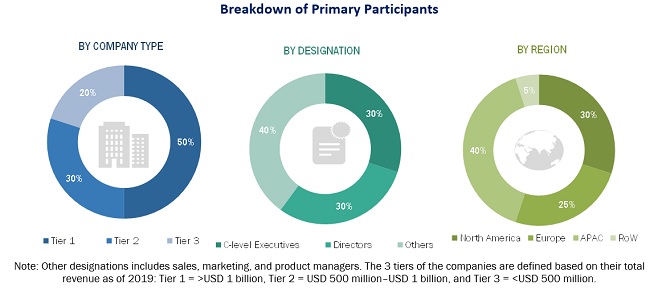
Extensive primary research has been conducted after acquiring an understanding of defect detection market scenario through secondary research. Several primary interviews have been conducted with market experts from both the demand and supply-side players across key regions, namely, North America, Europe, APAC, and Middle East and Africa (MEA), and South America. Various primary sources from both the supply and demand sides of the market have been interviewed to obtain qualitative and quantitative information. Following is the breakdown of the primary respondents.
Primary data has been collected through questionnaires, emails, and telephonic interviews. In the canvassing of primaries, various departments within organizations, such as sales, operations, and administration, were covered to provide a holistic viewpoint in our report. After interacting with industry experts, brief sessions were conducted with highly experienced independent consultants to reinforce the findings from our primaries. This, along with the in-house subject matter experts’ opinions, has led us to the findings as described in the remainder of this report.
To know about the assumptions considered for the study, download the pdf brochure
Market Size Estimation
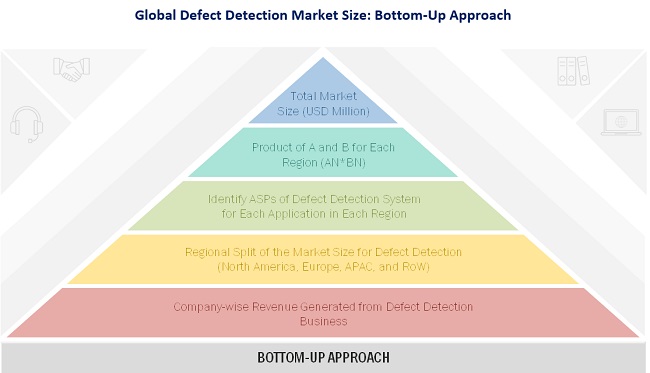
The bottom-up approach has been used to arrive at the overall size of the defect detection market from the revenues of key players in the defect detection market. The research methodology used to estimate the market size includes the following:
- Conducting multiple discussion sessions with the key opinion leaders to understand different defect detection products and their deployment in multiple applications; analyzing the break-up of the work carried out by each key company
- Verifying and crosschecking estimates at every level with key opinion leaders, including chief executive officers (CEO), directors, and operation managers, and then finally with the domain experts at MarketsandMarkets
- Tracking the ongoing and upcoming developments in the defect detection market that include investments, R&D, product launches and developments, collaborations, and partnerships as well as forecasting the market size based on these developments and other critical parameters
- Studying various paid and unpaid sources of information, such as annual reports, press releases, white papers, and databases, for the company- and region-specific developments undertaken in the defect detection market
To know about the assumptions considered for the study, Request for Free Sample Report
Data Triangulation
After arriving at the overall market size through the process explained above, the overall market has been split into several segments. To complete the overall market engineering process and arrive at the exact statistics for all the segments, the market breakdown and data triangulation procedures have been employed, wherever applicable. The data has been triangulated by studying various factors and trends from both the demand and supply sides. The market has also been validated using both top-down and bottom-up approaches.
Report Objectives
- To define, describe, and forecast the defect detection market, in terms of value, on the basis of offering, application, vertical, and region
- To describe and forecast the market size for various segments for four primary regions, namely, North America, Europe, Asia Pacific (APAC), and Rest of the World (RoW), in terms of value
- To provide detailed information regarding major factors including drivers, restraints, opportunities, and challenges that influence the growth of the defect detection market
- To provide a detailed overview of the value chain pertaining to the defect detection market ecosystem
- To analyze various policies and regulations pertaining to the use of machine vision in North America, Europe, and APAC
- To strategically analyze micromarkets1 with respect to individual growth trends, prospects, and contributions to the total market
- To strategically profile key players and comprehensively analyze their market position in terms of revenue and core competencies2, along with detailing the competitive landscape for market leaders
- To analyze competitive developments such as collaborations, agreements, partnerships, and product launches in the defect detection market
Available Customizations
Along with the market data, MarketsandMarkets offers customizations according to the specific requirements of companies. The following customization options are available for the report:
Company Information
- Detailed analysis and profiling of additional market players (up to 5)
- Additional country-level analysis of defect detection market
- Estimation of the market size of the segments of the defect detection market based on different subsegments

 Generating Response ...











Growth opportunities and latent adjacency in Defect Detection Market