



Machine Vision Market Size, Share & Trends
Report Code
SE 5835
Published in
May, 2025, By MarketsandMarkets™
Machine Vision Market Size, Share & Trends by Component (Camera, Frame Grabbers, Optics, LED Lighting, Processors, AI-based Machine Vision Software), Type (PC based, Smart Camera-based), Deployment (General, Robotic Cell), Vision Type (1D, 2D, 3D) - Global Forecast to 2030

USD 23.63
MARKET SIZE, 2030

CAGR 8.3%
(2025-2030)

310
REPORT PAGES

232
MARKET TABLES
MACHINE VISION MARKET SIZE, SHARE & TRENDS
The global machine vision market size was valued at USD 15.83 billion in 2025 and is projected to reach USD 23.63 billion by 2030, growing at a CAGR of 8.3% from 2025 to 2030. Advancements in automation and Industry 4.0, particularly in markets such as automotive, electronics, and pharmaceuticals, are driving the demand for machine vision systems industry to enhance quality control and operational optimization. The integration of AI and deep learning technologies significantly enhances the ability of these systems in terms of defect detection and predictive maintenance, particularly in high-growth industries such as electronics & semiconductors.
MARKET SNAPSHOT TABLE
| REPORT METRIC | DETAILS |
|---|---|
| Market Size in 2025 (Value) | USD 15.83 Billion |
| Market Forecast in 2030 (Value) | USD 23.63 Billion |
| Growth Rate | CAGR of 8.3% from 2025-2030 |
| Years Considered | 2021-2030 |
| Base Year | 2024 |
| Forecast Period | 2025-2030 |
| Units Considered | Value (USD Million/Billion), Volume (Million Unit) |
| Report Coverage | Revenue forecast, company ranking, competitive landscape, growth factors, and trends |
| Top Companies |
|
| Growth Drivers |
|
| Segments Covered |
|
| Regional Scope | North America, Europe, Asia Pacific, Latin America, Middle East, and RoW |
Market Size & Forecast
• 2025 Market Size: USD 15.83 Billion
• 2030 Projected Market Size: USD 23.63 Billion
• CAGR (2025-2030): 8.3%
• AI-based machine vision software: Fastest-growing component
• Asia Pacific : Fastest growing market
MACHINE VISION MARKET KEY TAKEAWAYS
-
BY COMPONENTThe machine vision market share is segmented into cameras, optics, frame grabbers, processors, LED lighting, other hardware components, and software. The software segment, particularly AI-based machine vision software, is the fastest-growing component because it represents the intelligence layer that unlocks the true potential of the system. Advances in deep learning enable software to handle complex, unstructured inspection tasks with greater accuracy and flexibility than traditional rule-based systems, thereby increasing the value derived from fixed hardware components.
-
BY SYSTEM TYPEThe market is bifurcated into PC-based and Smart Camera-based. PC-based systems have historically held the largest market share due to their superior processing power and memory, which are necessary for complex, high-resolution 3D and multi-camera inspection tasks. These systems offer greater flexibility for customized applications and software integration, making them the preferred choice for demanding manufacturing environments in sectors like automotive and electronics.
-
BY INDUSTRYThe market serves a wide range of industries, including automotive, consumer products, electronics & semiconductors, printing, logistics, metals, rubber & plastics, food & beverages, healthcare, machinery, solar panel manufacturing, and other robotic vision industries. The food & beverage sector holds the largest market share, primarily due to stringent quality and safety regulations that mandate comprehensive inspection systems for sorting, grading, and detecting foreign objects. The consistency provided by machine vision is essential in high-speed processing lines to prevent contamination and maintain brand reputation, driving high adoption across packaging and quality control applications.
-
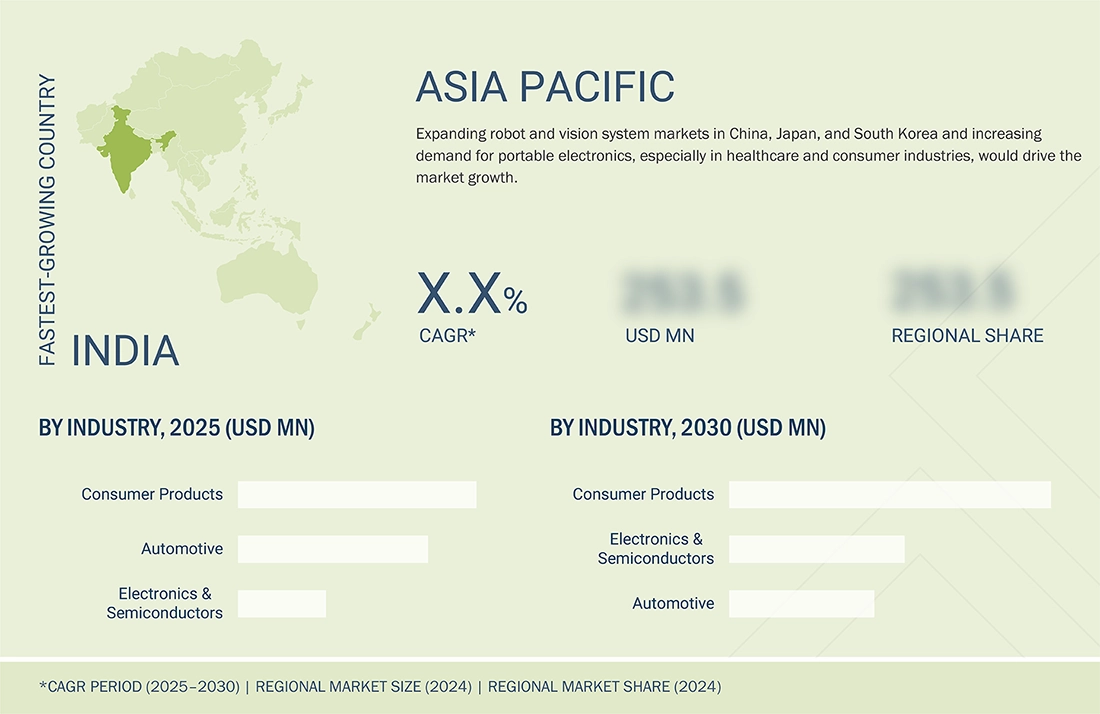
BY REGIONThe Asia Pacific is projected to record the fastest growth, with a CAGR of 9.2%, due to massive ongoing industrial automation efforts across major economies, including China, India, and South Korea. This growth is fueled by large-scale expansion in high-tech manufacturing, especially in electronics and automotive production, which requires high-volume, precision inspection and quality control offered by machine vision systems.
-
COMPETITIVE LANDSCAPEThe leading players in the market are Cognex Corporation, Teledyne Technologies Inc., KEYENCE CORPORATION, Omron Corporation, and Basler AG. Companies are pursuing strategic acquisitions and partnerships to expand their product portfolios and provide machine vision solutions, thereby strengthening their market position.
The machine vision market growth is growing rapidly as manufacturers increasingly demand higher precision, quality, and speed, particularly in sectors such as electronics, automotive, and pharmaceuticals. Technological advancements, including improved sensors, AI/ML, embedded processing, and smart cameras, are making vision systems more reliable and cost-effective. Additionally, labor shortages, rising automation in logistics and e-commerce, and stricter quality/regulatory standards are accelerating adoption.
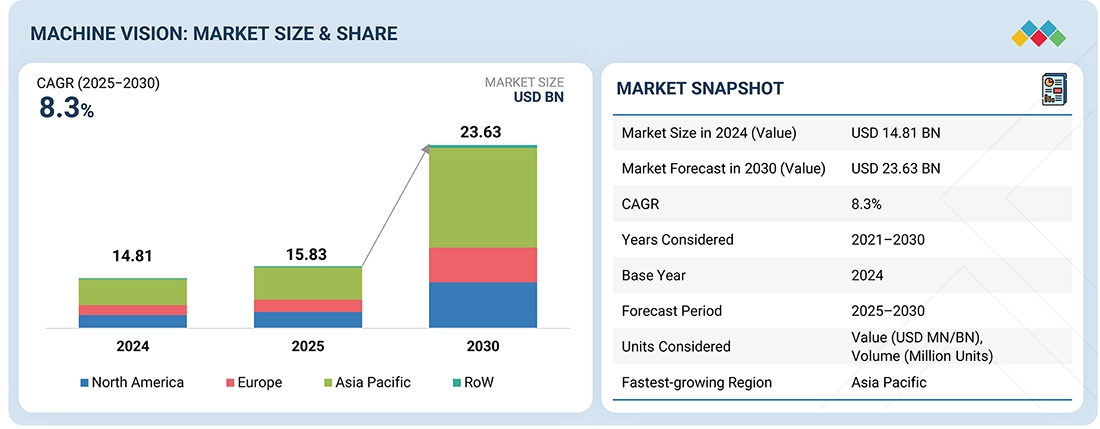
Source: Secondary Research, Interviews with Experts, MarketsandMarkets Analysis
TRENDS & DISRUPTIONS IMPACTING CUSTOMERS' CUSTOMERS
The demand for machine vision systems is expected to increase over the next few years due to the growing need for automation in inspection processes across various industries. Key trends in the machine vision market trends include AI-driven advancements, integration with Industry 4.0 and smart manufacturing, rapid technological innovations, the emergence of embedded vision systems, edge computing, collaborative robots with vision capabilities, customization, a focus on sustainability, and data security. These trends impact customer businesses by enhancing efficiency, enabling real-time decision-making, supporting sustainability goals, and ensuring secure data handling in machine vision applications.
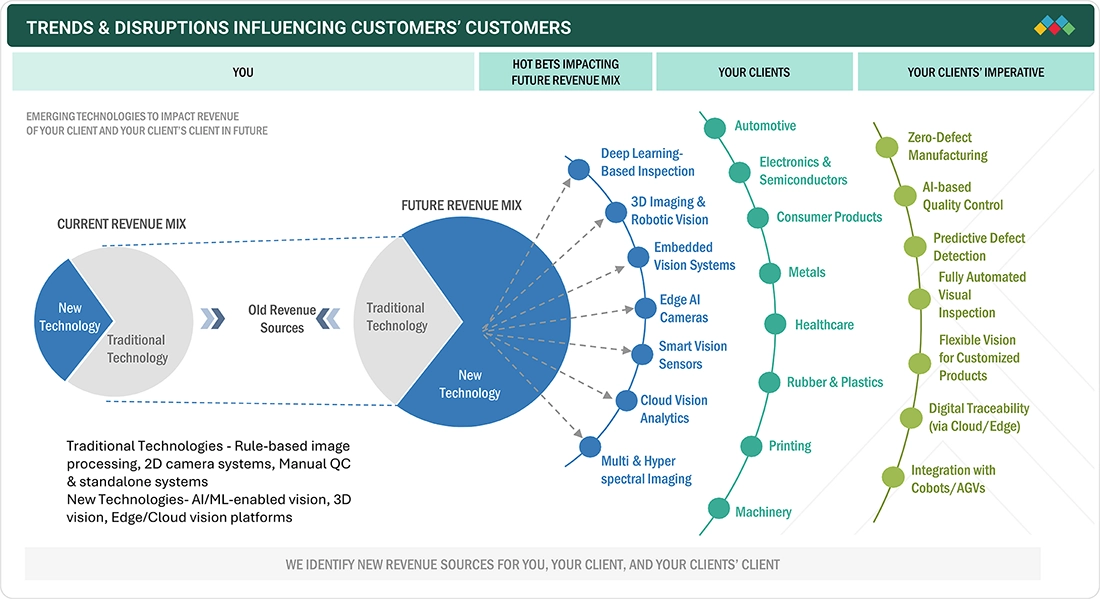
Source: Secondary Research, Interviews with Experts, MarketsandMarkets Analysis
MACHINE VISION MARKET DYNAMICS

Drivers
Impact
Level
Level
-
Increasing demand for quality assurance and automated inspection in manufacturing industry

-
Rising adoption of vision-guided robotic systems across multiple industries


RESTRAINTS
Impact
Level
Level
-
Lack of awareness and high cost associated with machine vision systems


OPPORTUNITIES
Impact
Level
Level
-
Rising adoption in food & beverage industry

-
Government-backed initiatives to support industrial automation


CHALLENGES
Impact
Level
Level
-
Complexities in integrating diverse machine vision components with traditional systems

-
Cyber vulnerabilities in industrial robotic systems

Source: Secondary Research, Interviews with Experts, MarketsandMarkets Analysis
Driver: Increasing demand for quality assurance and automated inspection in manufacturing industry
Manufacturing companies worldwide are increasingly investing in automation. Also, the need for automated quality assurance has increased as industries have realized its importance in manufacturing processes. Quality assurance helps minimize defects, improve production efficiency, and ensure consistent product quality in manufacturing processes. This has led to the widespread adoption of machine vision as an integral part of long-term automation development processes.
Restraint: Lack of awareness and high cost associated with machine vision systems
A key challenge to the wider adoption of machine vision, despite its role in automation, is the lack of user awareness regarding advanced systems. While 3D stereo vision provides vital capabilities—such as precise distance measurement and complex defect identification (e.g., bent pins or irregular bottle shapes)—its sophistication creates barriers. The increasing complexity of 3D technology demands frequent training and workshops, which are costly and time-intensive. Consequently, operators often struggle to utilize these systems effectively, resulting in poor programming, inaccurate results, and unnecessary expenses.
Opportunity: Rising adoption in food & beverage industry
There has been a surge in demand for packaged food products, including biscuits, processed foods, frozen desserts, meat, and noodles. There is increasing adoption of machine vision technologies due to the growing demand for packaged food products. The major applications of AI machine vision systems in the food & beverage industry fall into three broad categories: production and processing, packaging and distribution, and tracking and tracing products through complex supply chains.
Challenge: Complexities in integrating diverse machine vision components with traditional systems
Whether it is a camera, optics, software, lighting, or a frame grabber, versatile solutions can be quickly developed to tackle a wide range of tasks by using multipurpose components. However, there is an urgent need to simplify the integration process of various components in machine vision systems and production lines at application sites. With the increasing need for convenient installation and handling of all technical systems, players in the machine vision industry must develop plug-and-play solutions to meet the demand for easier integration and installation.
Machine Vision Market: COMMERCIAL USE CASES ACROSS INDUSTRIES
| COMPANY | USE CASE DESCRIPTION | BENEFITS |
|---|---|---|
 |
Advanced cameras (2D, 3D, SWIR, line scan, embedded) and AI-enabled vision software for industrial inspection, robotics, logistics, pharma, automotive, and smart infrastructure | High image accuracy, rapid defect detection, modular systems, reliable AI analysis, broad application coverage, easy integration |
 |
Smart cameras/vision sensors for automated assembly, high-speed quality inspection, and robot guidance, widespread in automotive, electronics, and food industries | Consistent accuracy, quick deployment, flexible setups, robust programming, reduced manual oversight, scalable to diverse industries |
 |
Embedded and AI-powered vision platforms for real-time analytics, defect detection, lab automation, packaging, and automotive components | Reliable imaging for demanding environments, multi-format analytics, easy integration, robust data capture, customizable workflows |
 |
Vision systems (2D/3D/AI) for bin picking, object recognition, production quality control, dynamic factory inspection and automation | Flexible calibration, wide industry support, rapid error-proofing, fast deployment, versatile inspection modes, enhanced productivity |
 |
Vision-guided and deep learning systems for defect detection, traceability, barcode reading, robotic guidance, and yield optimization in manufacturing and logistics | Superior speed, robust accuracy, automated learning, minimal manual configuration, seamless traceability, high operational ROI |
Logos and trademarks shown above are the property of their respective owners. Their use here is for informational and illustrative purposes only.
MACHINE VISION MARKET ECOSYSTEM
A robust ecosystem of established hardware and software providers supports the machine vision market, which includes key players like Cognex Corporation (US), Basler AG (Germany), KEYENCE CORPORATION (Japan), Teledyne Technologies Inc. (US), and Omron Corporation (Japan). These companies offer advanced imaging technologies tailored to the needs of diverse industries. The market serves a wide range of potential customers across various sectors, including consumer products, automotive, pharmaceuticals, food & beverages, and machinery, highlighting its cross-sectoral relevance. The strong presence of industrial giants reflects the growing demand for automation, quality control, and intelligent inspection solutions.
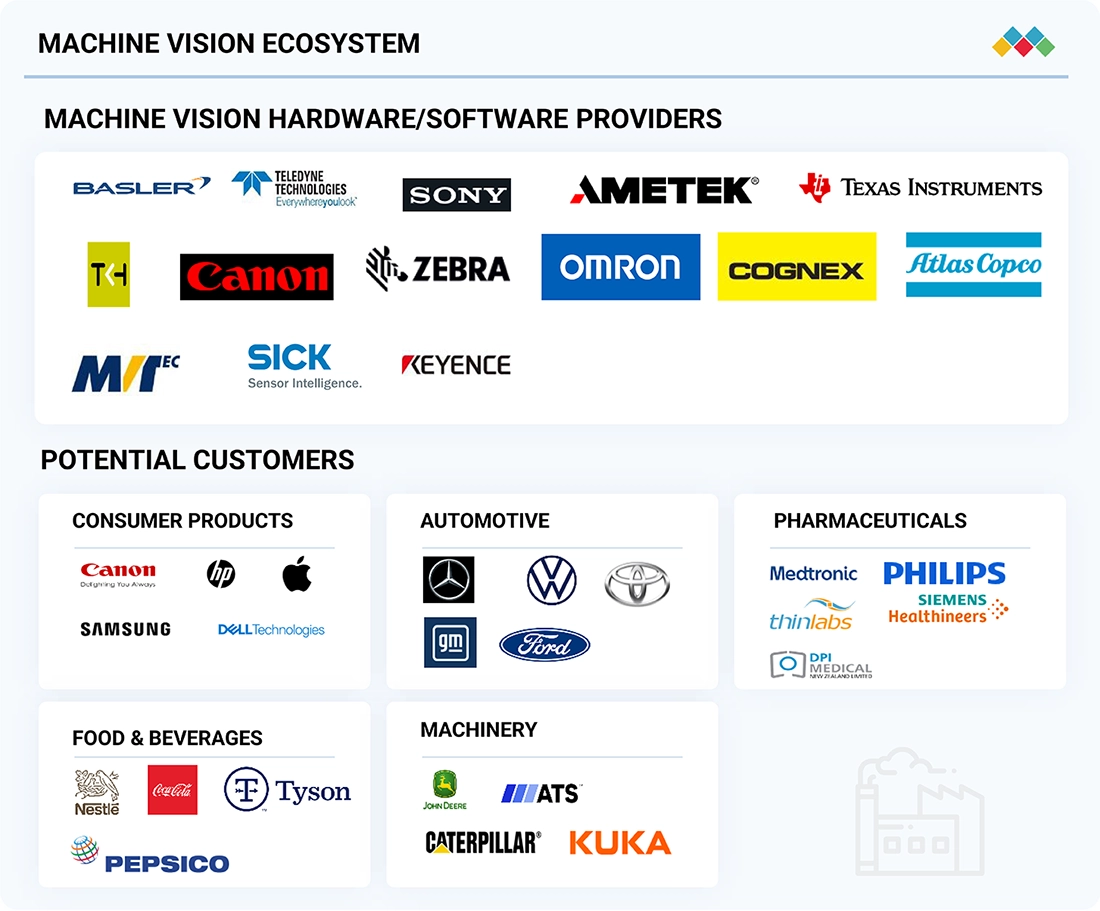
Logos and trademarks shown above are the property of their respective owners. Their use here is for informational and illustrative purposes only.
MACHINE VISION MARKET SEGMENTS
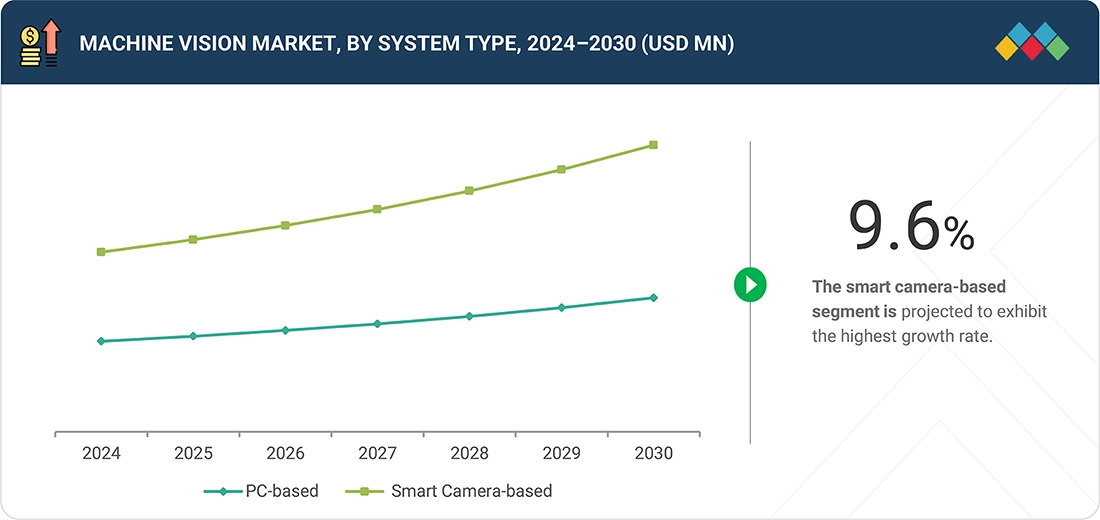
Source: Secondary Research, Interviews with Experts, MarketsandMarkets Analysis
Machine Vision Market, By Component
The cameras segment held the largest market share in 2024, primarily because they are the fundamental, indispensable hardware component at the very start of any machine vision process. The camera is responsible for the crucial initial step of image capture, and its cost forms a substantial portion of the system's total bill of materials. Furthermore, the increasing demand for specialized, high-resolution smart cameras drives up the overall value of this segment.
Machine Vision Market, By System Type
The smart camera-based segment is experiencing the fastest growth because these systems integrate the camera, processor, and software into a single, compact unit. This results in easier installation, reduced integration complexity, and lower overall system costs for simpler inspection tasks, making them highly attractive for small- to medium-scale automation.
Machine Vision Market, By Industry
The Food & Beverage segment is forecast to be the fastest-growing in the machine vision market, primarily due to the increasing focus on strict quality control and traceability across the industry supply chain. Machine vision systems are being rapidly adopted for critical tasks such as high-speed packaging inspection, ensuring product integrity, and complying with complex regulatory standards.
MACHINE VISION MARKET REGION
Asia Pacific is expected to register the highest CAGR in the global machine vision market during the forecast period.
The Asia Pacific is projected to be the fastest-growing market for the machine vision market. The growth can be attributed to the large presence of major players through their subsidiaries, distributors, and resellers. China has a strong export industry. It is a major manufacturing hub for various industries, including electronics, semiconductors, automotive, and other consumer goods. The country has experienced tremendous industrial growth over the past two decades and has surpassed the US to become the world's largest producer of manufactured goods.
The North America machine vision market is projected to reach USD 6.66 billion by 2030 from USD 4.13 billion in 2024, growing at a CAGR of 8.5% from 2025 to 2030. Market growth is driven by the increasing adoption of automation in manufacturing, rising demand for quality inspection, rapid advancements in AI-based vision, and strong investments in smart factories and industrial digitization initiatives across the region.
The machine vision market in Europe is projected to reach USD 5.43 billion by 2030, up from USD 3.61 billion in 2024, with a CAGR of 7.3% from 2025 to 2030. Market growth is driven by the rising adoption of automation across European manufacturing, increasing demand for high-precision inspection, rapid advancements in AI-enabled vision technologies, and strong momentum toward smart factories supported by EU digitalization initiatives.
The Asia Pacific machine vision market is projected to reach USD 9.81 billion by 2030, up from USD 5.85 billion in 2024, growing at a CAGR of 9.2% from 2025 to 2030. Growth is supported by the region’s expanding electronics and semiconductor manufacturing base, accelerating automation in automotive and EV production, rising adoption of AI-driven inspection systems, and increasing investments in smart factory and industrial digitalization initiatives across the Asia Pacific.
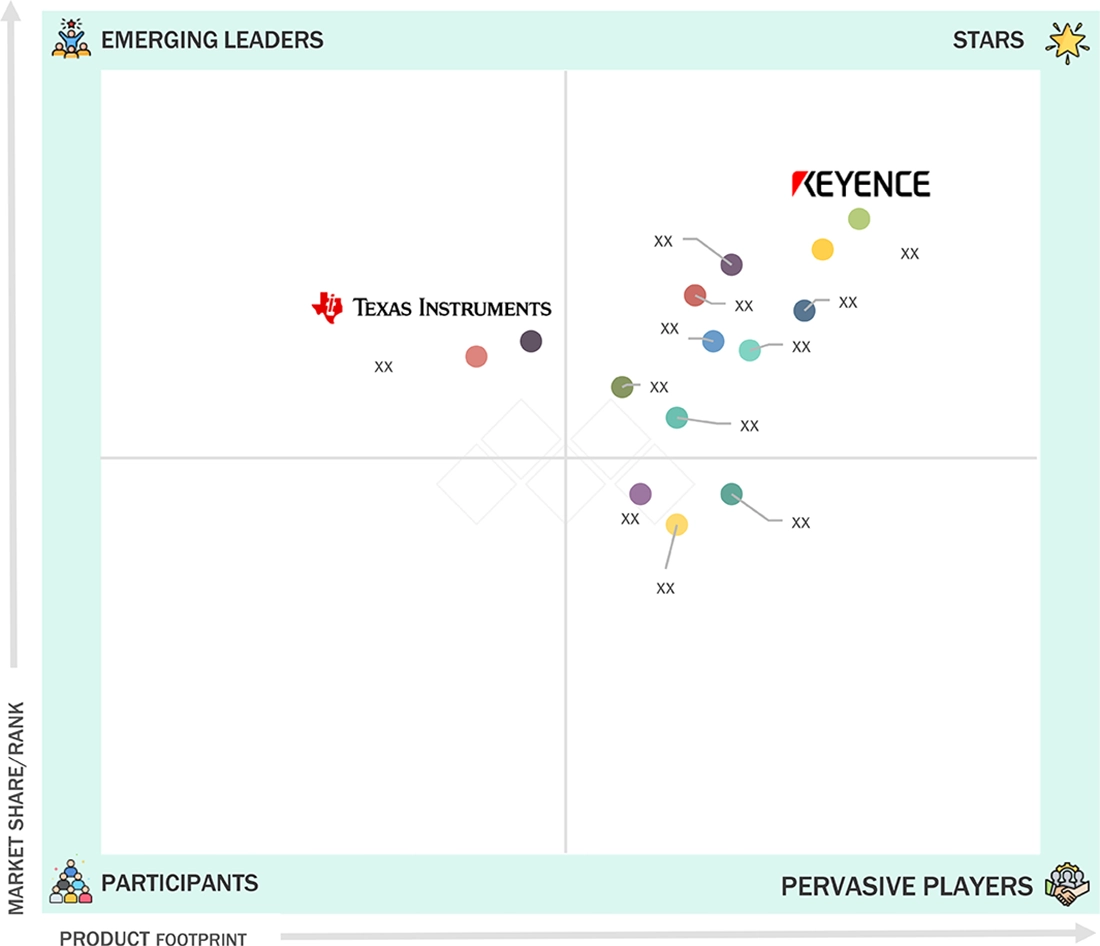
Machine Vision Market: COMPANY EVALUATION MATRIX
In the machine vision market matrix, KEYENCE CORPORATION (Star) and Texas Instruments Incorporated (Emerging Leader) hold strong positions with their broad product portfolios, global presence, and robust financial capabilities. Their continuous innovation and brand equity enable them to lead large-scale adoption of machine vision solutions worldwide.
Source: Secondary Research, Interviews with Experts, MarketsandMarkets Analysis
MACHINE VISION MARKET KEY PLAYERS
WHAT IS IN IT FOR YOU: Machine Vision Market REPORT CONTENT GUIDE
DELIVERED CUSTOMIZATIONS
We have successfully delivered the following deep-dive customizations:
| CLIENT REQUEST | CUSTOMIZATION DELIVERED | VALUE ADDS |
|---|---|---|
| European Automotive OEM |
|
|
| North American Electronics Manufacturer |
|
|
| Asia Pacific Pharmaceutical Packaging Company |
|
|
RECENT DEVELOPMENTS
- May 2026: Cognex Corporation: Cognex launched the In-Sight® 3900 Vision System, an embedded AI machine-vision system powered by Qualcomm Dragonwing platforms. The system provides up to 4× faster processing than previous-generation Cognex vision systems, supports imaging resolutions up to 25 MP, and enables real-time AI inspection directly at the edge without an external PC.
- July 2025: Basler AG: Basler launched its IP67-protected vision system, combining the ace 2 IP67 camera with compatible components to provide a complete machine-vision solution for demanding environments exposed to dust, dirt, and water. The system is designed to provide reliable image acquisition while simplifying integration in industrial applications.
- June 2025: Cognex Corporation: Cognex introduced OneVision™, a cloud-based platform for building, training, and scaling AI-powered machine-vision applications. The platform provides guided AI development workflows, centralized model development and collaboration, and deployment capabilities across multiple production sites and vision systems.
- June 2025 : OMRON Corporation: OMRON's collaboration with DENSO on an AI-equipped visual inspection system received DENSO's Advanced Performance Award. OMRON developed a controller capable of sequentially installing 15 types of AI with different learning methods and 134 new functions, supporting automated visual inspection and helping reproduce high-precision human inspection performance.
- May 2025: Basler AG: Basler introduced pylon AI, new AI-based image-analysis software within its pylon Software Suite. The software provides AI functions for complex vision tasks such as classification and semantic segmentation, while its performance-benchmarking function helps users select suitable processing hardware and AI accelerators for their applications.
Table of Contents
 Exclusive indicates content/data unique to MarketsandMarkets and not available with any competitors.
TITLE
PAGE NO
1
INTRODUCTION
27
2
RESEARCH METHODOLOGY
32
3
EXECUTIVE SUMMARY
44
4
PREMIUM INSIGHTS
49
5
MARKET OVERVIEW
Surging demand for AI-powered vision systems reshapes manufacturing with enhanced quality and safety.
53
5.1
INTRODUCTION
5.2
MARKET DYNAMICS
5.2.1
DRIVERS
5.2.1.1
INCREASING DEMAND FOR QUALITY ASSURANCE AND AUTOMATED INSPECTION IN MANUFACTURING INDUSTRY
5.2.1.2
RISING ADOPTION OF VISION-GUIDED ROBOTIC SYSTEMS ACROSS MULTIPLE INDUSTRIES
5.2.1.3
GROWING EMPHASIS ON SAFETY AND IMPROVED PRODUCT QUALITY
5.2.1.4
GROWING ADOPTION OF AI-POWERED SYSTEMS ACROSS INDUSTRIES
5.2.2
RESTRAINTS
5.2.2.1
LACK OF AWARENESS AND HIGH COST ASSOCIATED WITH MACHINE VISION SYSTEMS
5.2.3
OPPORTUNITIES
5.2.3.1
RISING ADOPTION IN FOOD & BEVERAGE INDUSTRY
5.2.3.2
GOVERNMENT-BACKED INITIATIVES TO SUPPORT INDUSTRIAL AUTOMATION
5.2.3.3
EMERGENCE OF COMPACT SMART CAMERAS AND PROCESSORS
5.2.3.4
SURGING DEMAND FOR HYBRID AND EVS
5.2.4
CHALLENGES
5.2.4.1
COMPLEXITIES IN INTEGRATING DIVERSE MACHINE VISION COMPONENTS WITH TRADITIONAL SYSTEMS
5.2.4.2
CYBER VULNERABILITIES IN INDUSTRIAL ROBOTIC SYSTEMS
5.2.4.3
LACK OF SKILLED WORKFORCE TO OPERATE MACHINE VISION SYSTEMS
5.3
TRENDS/DISRUPTIONS IMPACTING CUSTOMER BUSINESS
5.4
PRICING ANALYSIS
5.4.1
INDICATIVE PRICING OF MACHINE VISION KEY COMPONENT (CAMERA), BY KEY PLAYERS, 2024
5.4.2
AVERAGE SELLING PRICE TREND OF MACHINE VISION HARDWARE COMPONENT, 2021–2024
5.4.3
AVERAGE SELLING PRICE TREND OF MACHINE VISION HARDWARE COMPONENT, BY REGION, 2021–2024
5.5
VALUE CHAIN ANALYSIS
5.6
ECOSYSTEM ANALYSIS
5.7
INVESTMENT AND FUNDING SCENARIO
5.8
TECHNOLOGY ANALYSIS
5.8.1
KEY TECHNOLOGIES
5.8.1.1
ROBOTIC VISION
5.8.1.2
AI IN MACHINE VISION
5.8.2
COMPLEMENTARY TECHNOLOGIES
5.8.2.1
5G
5.8.2.2
EDGE COMPUTING
5.8.3
ADJACENT TECHNOLOGIES
5.8.3.1
CLOUD COMPUTING
5.9
PATENT ANALYSIS
5.10
TRADE ANALYSIS
5.10.1
IMPORT SCENARIO (HS CODE 852580)
5.10.2
EXPORT SCENARIO (HS CODE 852580)
5.11
KEY CONFERENCES AND EVENTS, 2025–2026
5.12
CASE STUDY
5.12.1
PANPASS TECHNOLOGY CO., LTD. AND COGNEX CORPORATION TRANSFORM YUNMEN WINE GROUP'S TRACEABILITY THROUGH MACHINE VISION AND AI-BASED OCR
5.12.2
PRESCRIPTIVE DATA USES TELEDYNE FLIR'S MACHINE VISION SENSORS TO DELIVER ACCURATE OCCUPANCY DATA FOR SMART BUILDINGS
5.12.3
LEADING AUTOMOTIVE SUPPLIER IMPROVES INSPECTION EFFICIENCY WITH FUJIFILM'S 4D HIGH RESOLUTION MACHINE VISION LENSES
5.12.4
ADVANCED DIMENSIONAL AND QUALITY CONTROL WITH 3D MACHINE VISION AT SIDENOR STEEL MILL
5.13
REGULATORY LANDSCAPE
5.13.1
REGULATORY BODIES, GOVERNMENT AGENCIES, AND OTHER ORGANIZATIONS
5.13.2
STANDARDS
5.14
PORTER'S FIVE FORCES ANALYSIS
5.14.1
THREAT OF NEW ENTRANTS
5.14.2
THREAT OF SUBSTITUTES
5.14.3
BARGAINING POWER OF SUPPLIERS
5.14.4
BARGAINING POWER OF BUYERS
5.14.5
INTENSITY OF COMPETITIVE RIVALRY
5.15
KEY STAKEHOLDERS AND BUYING CRITERIA
5.15.1
KEY STAKEHOLDERS IN BUYING PROCESS
5.15.2
BUYING CRITERIA
5.16
IMPACT OF AI/GEN AI ON MACHINE VISION MARKET
5.16.1
INTRODUCTION
5.16.2
IMPACT OF AI/GEN AI ON KEY END-USE INDUSTRIES
5.16.2.1
ELECTRONICS & SEMICONDUCTORS
5.16.2.2
FOOD & BEVERAGES
5.16.3
AI USE CASES
5.16.4
FUTURE OF AI/GEN AI IN MACHINE VISION ECOSYSTEM
5.17
IMPACT OF 2025 US TARIFF ON MACHINE VISION MARKET
5.17.1
INTRODUCTION
5.17.2
KEY TARIFF RATES
5.17.3
PRICE IMPACT ANALYSIS
5.17.4
IMPACT ON COUNTRIES/REGIONS
5.17.4.1
US
5.17.4.2
EUROPE
5.17.4.3
ASIA PACIFIC
5.17.5
IMPACT ON END-USE INDUSTRIES
6
APPLICATIONS OF MACHINE VISION
Revolutionize efficiency and precision with machine vision's diverse, industry-transforming applications.
97
6.1
INTRODUCTION
6.2
QUALITY ASSURANCE AND INSPECTION
6.3
POSITIONING AND GUIDANCE
6.4
MEASUREMENT
6.5
IDENTIFICATION
6.6
PREDICTIVE MAINTENANCE
7
MACHINE VISION MARKET, BY COMPONENT
Market Size & Growth Rate Forecast Analysis to 2030 in USD Million and Units | 24 Data Tables
101
7.1
INTRODUCTION
7.2
CAMERAS
7.2.1
EMERGENCE OF 3D CAMERAS WITH HIGH-PRECISION VISION TO DRIVE MARKET
7.2.2
INTERFACE STANDARDS
7.2.2.1
USB 2.0
7.2.2.2
USB 3.0
7.2.2.3
CAMERA LINK
7.2.2.4
CAMERA LINK HS
7.2.2.5
GIGE
7.2.2.6
10 GIGE & 25 GIGE BANDWIDTH OVER GIGE VISION
7.2.2.7
OTHERS
7.2.3
IMAGING SPECTRUM
7.2.3.1
VISIBLE LIGHT
7.2.3.2
VISIBLE + IR/IR
7.2.4
FRAME RATE
7.2.4.1
LESS THAN 25 FRAMES PER SECOND
7.2.4.2
25–125 FRAMES PER SECOND
7.2.4.3
MORE THAN 125 FRAMES PER SECOND
7.2.5
FORMAT
7.2.5.1
LINE SCAN
7.2.5.2
AREA SCAN
7.2.6
SENSOR
7.2.6.1
COMPLEMENTARY METAL OXIDE SEMICONDUCTOR (CMOS)
7.2.6.2
CHARGED-COUPLED DEVICE (CCD)
7.3
FRAME GRABBERS
7.3.1
INCREASING ADOPTION IN HIGH-SPEED AND LARGE-SCALE MACHINE VISION SYSTEMS TO DRIVE MARKET
7.4
LED LIGHTING
7.4.1
INCREASING ADOPTION OF STRUCTURED LIGHTING SOLUTIONS TO FUEL DEMAND
7.5
OPTICS
7.5.1
GROWING INTEGRATION WITH CAMERA BODIES FOR OBJECT IMAGE CAPTURE TO FUEL DEMAND
7.6
PROCESSORS
7.6.1
ADOPTION OF ADVANCED VISION SYSTEMS FUELING DEMAND FOR HIGH-PERFORMANCE PROCESSORS
7.6.2
FIELD-PROGRAMMABLE GATE ARRAY (FPGA)
7.6.3
DIGITAL SIGNAL PROCESSOR (DSP)
7.6.4
MICROCONTROLLER AND MICROPROCESSOR
7.6.5
VISION PROCESSING UNIT
7.7
OTHER HARDWARE COMPONENTS
7.7.1
NEED TO ENHANCE SYSTEM RELIABILITY AND PERFORMANCE TO FUEL SEGMENTAL GROWTH
7.8
SOFTWARE
7.8.1
AI-BASED MACHINE VISION SOFTWARE
8
MACHINE VISION MARKET, BY VISION TYPE
Market Size & Growth Rate Forecast Analysis
120
8.1
INTRODUCTION
8.2
1D VISION SYSTEMS
8.2.1
APPLICATION IN PRECISE LINEAR INSPECTION IN MANUFACTURING TO DRIVE DEMAND
8.3
2D VISION SYSTEMS
8.3.1
ADVANCEMENTS IN EMBEDDED VISION AND SMART CAMERA TECHNOLOGIES TO SUPPORT MARKET GROWTH
8.4
3D VISION SYSTEMS
8.4.1
RISING ADOPTION IN DEPTH ANALYSIS AND SURFACE INSPECTION TO FUEL DEMAND
9
MACHINE VISION MARKET, BY DEPLOYMENT
Market Size & Growth Rate Forecast Analysis
122
9.1
INTRODUCTION
9.2
GENERAL
9.2.1
RISING DEMAND FOR AUTOMATED INSPECTIONS TO DRIVE MARKET GROWTH
9.3
ROBOTIC CELL
9.3.1
RISING AUTOMATION AND TECHNOLOGICAL ADVANCEMENTS TO PROPEL MACHINE VISION ADOPTION
10
MACHINE VISION MARKET, BY SYSTEM TYPE
Market Size & Growth Rate Forecast Analysis to 2030 in USD Million | 6 Data Tables
124
10.1
INTRODUCTION
10.2
PC-BASED
10.2.1
ADVANCED PROCESSING WITH MULTI-CAMERA SUPPORT TO DRIVE ADOPTION OF PC-BASED VISION SYSTEMS
10.3
SMART CAMERA-BASED
10.3.1
RISING ADOPTION OF SMART CAMERA IN IMAGING AND SECURITY APPLICATIONS TO DRIVE MARKET
11
MACHINE VISION MARKET, BY INDUSTRY
Market Size & Growth Rate Forecast Analysis to 2030 in USD Million | 50 Data Tables
130
11.1
INTRODUCTION
11.2
AUTOMOTIVE
11.2.1
NEED FOR ENHANCING ACCURACY AND PRODUCTIVITY TO INCREASE ADOPTION
11.3
ELECTRONICS & SEMICONDUCTORS
11.3.1
RISING NEED TO IMPROVE ELECTRONIC MANUFACTURING BY IDENTIFYING DEFECTS AND ENHANCING SEMICONDUCTOR PRODUCTION
11.4
CONSUMER PRODUCTS
11.4.1
GROWING DEMAND FOR AUTOMATED INSPECTION TO IMPROVE ELECTRONIC ASSEMBLY TO DRIVE MARKET
11.5
METALS
11.5.1
SHORTAGE OF SKILLED LABOR FUELING ADOPTION OF MACHINE VISION SYSTEMS TO BOOST PRODUCT QUALITY
11.6
HEALTHCARE
11.6.1
STRINGENT GOVERNMENT REGULATION AND GROWING NEED TO COMBAT COUNTERFEIT PRODUCTS TO DRIVE MARKET
11.7
FOOD & BEVERAGES
11.7.1
FOOD
11.7.1.1
NEED TO REDUCE LABOR COST AND ENHANCE FOOD PROCESSING FUELING ADOPTION
11.7.2
BEVERAGES
11.7.2.1
NEED TO ENSURE QUALITY AND HYGIENE IN BEVERAGE PRODUCTION TO FUEL MARKET GROWTH
11.8
RUBBER & PLASTICS
11.8.1
INCREASING CONSUMPTION OF PLASTICS IN VARIOUS INDUSTRIAL SECTORS TO SUPPORT MARKET GROWTH
11.9
PRINTING
11.9.1
MACHINE VISION SYSTEMS INCREASINGLY USED TO MAINTAIN QUALITY IN PRINTING OPERATIONS
11.10
MACHINERY
11.10.1
GROWING NEED TO ENHANCE MACHINERY PERFORMANCE AND SAFETY TO FUEL DEMAND
11.11
SOLAR PANEL MANUFACTURING
11.11.1
NEED FOR INCREASED PRODUCTION AND QUALITY OF SOLAR PANELS TO BOOST MARKET GROWTH
11.12
LOGISTICS
11.12.1
GROWING DEMAND FOR AUTOMATED SORTING AND TRACKING TO DRIVE MARKET
11.13
OTHER INDUSTRIES
11.13.1
INCREASING ADOPTION OF MACHINE VISION FOR DEFECT DETECTION AND QUALITY CONTROL TO SUPPORT MARKET GROWTH
12
MACHINE VISION MARKET, BY REGION
Comprehensive coverage of 8 Regions with country-level deep-dive of 22 Countries | 78 Data Tables.
153
12.1
INTRODUCTION
12.2
NORTH AMERICA
12.2.1
MACROECONOMIC OUTLOOK FOR NORTH AMERICA
12.2.2
US
12.2.2.1
EXPANDING ROLE OF MACHINE VISION IN HEALTHCARE AND AUTOMOTIVE APPLICATIONS TO DRIVE MARKET
12.2.3
CANADA
12.2.3.1
INCREASING ADOPTION IN AUTOMOTIVE, ELECTRONICS, AND HEALTHCARE INDUSTRIES TO BOOST DEMAND
12.2.4
MEXICO
12.2.4.1
GROWING EMPHASIS ON HIGH-QUALITY STANDARDS AND OPERATIONAL EFFICIENCY TO FUEL ADOPTION
12.3
EUROPE
12.3.1
MACROECONOMIC OUTLOOK FOR EUROPE
12.3.2
GERMANY
12.3.2.1
INCREASING ADOPTION TO ENHANCE OPERATIONAL EFFICIENCY AND PRECISION IN INDUSTRIAL APPLICATIONS TO DRIVE MARKET
12.3.3
UK
12.3.3.1
RISING ADOPTION IN AUTOMOTIVE AND MANUFACTURING SECTORS TO FUEL MARKET GROWTH
12.3.4
FRANCE
12.3.4.1
GROWTH IN ELECTRIC VEHICLE MARKET AND PORTABLE ELECTRONICS DRIVING MACHINE VISION ADOPTION
12.3.5
ITALY
12.3.5.1
GOVERNMENT INITIATIVES DRIVING ADOPTION OF ADVANCED MANUFACTURING TECHNOLOGIES
12.3.6
SPAIN
12.3.6.1
GROWTH OF CONSUMER ELECTRONICS AND PHARMACEUTICAL INDUSTRIES FUELING MACHINE VISION ADOPTION
12.3.7
NETHERLANDS
12.3.7.1
RISING ADOPTION IN LOGISTICS, FOOD PROCESSING, AND ELECTRONICS SECTORS TO DRIVE MARKET
12.3.8
SWITZERLAND
12.3.8.1
INCREASED INTEGRATION OF MACHINE VISION IN PRECISION MANUFACTURING AND PHARMACEUTICAL AUTOMATION TO BOOST MARKET
12.3.9
NORDICS
12.3.9.1
STRONG PUSH FOR INDUSTRIAL AUTOMATION FUELING DEMAND ACROSS MANUFACTURING AND ENERGY SECTORS
12.3.10
REST OF EUROPE
12.4
ASIA PACIFIC
12.4.1
MACROECONOMIC OUTLOOK FOR ASIA PACIFIC
12.4.2
CHINA
12.4.2.1
EXPANDING DEPLOYMENT OF MACHINE VISION SYSTEMS FOR HIGHER PRODUCTIVITY AND QUALITY ENHANCEMENT
12.4.3
JAPAN
12.4.3.1
INCREASING ADOPTION IN CONSUMER ELECTRONICS SECTOR TO BOOST MARKET GROWTH
12.4.4
SOUTH KOREA
12.4.4.1
ADOPTION OF MACHINE VISION SYSTEMS EXPANDING IN KEY SECTORS TO ENSURE QUALITY COMPLIANCE
12.4.5
INDIA
12.4.5.1
GOVERNMENT INITIATIVES DRIVING FACTORY AUTOMATION GROWTH
12.4.6
INDONESIA
12.4.6.1
EMERGING INDUSTRIAL BASE AND RISING AUTOMATION NEEDS DRIVING MACHINE VISION ADOPTION
12.4.7
SINGAPORE
12.4.7.1
TECHNOLOGICAL LEADERSHIP AND ADVANCED INFRASTRUCTURE SUPPORTING MARKET GROWTH
12.4.8
AUSTRALIA
12.4.8.1
EXPANDING APPLICATIONS IN FOOD & BEVERAGES AND ELECTRONICS INDUSTRIES TO DRIVE DEMAND
12.4.9
REST OF ASIA PACIFIC
12.5
ROW
12.5.1
MACROECONOMIC OUTLOOK FOR ROW
12.5.2
MIDDLE EAST
12.5.2.1
SAUDI ARABIA
12.5.2.2
UAE
12.5.2.3
BAHRAIN
12.5.2.4
KUWAIT
12.5.2.5
OMAN
12.5.2.6
QATAR
12.5.2.7
REST OF MIDDLE EAST
12.5.3
SOUTH AMERICA
12.5.3.1
BRAZIL
12.5.3.2
ARGENTINA
12.5.3.3
OTHER SOUTH AMERICAN COUNTRIES
12.5.4
AFRICA
12.5.4.1
SOUTH AFRICA
12.5.4.2
OTHER AFRICAN COUNTRIES
13
COMPETITIVE LANDSCAPE
Uncover top players' strategies and market share dynamics shaping the competitive landscape.
218
13.1
INTRODUCTION
13.2
KEY PLAYER STRATEGIES/RIGHT TO WIN, JANUARY 2021–MARCH 2025
13.3
REVENUE ANALYSIS, 2020–2024
13.4
MARKET SHARE ANALYSIS OF TOP FIVE PLAYERS, 2024
13.5
PRODUCT COMPARISON
13.6
COMPANY VALUATION AND FINANCIAL METRICS
13.7
COMPANY EVALUATION MATRIX: KEY PLAYERS, 2024
13.7.1
STARS
13.7.2
EMERGING LEADERS
13.7.3
PERVASIVE PLAYERS
13.7.4
PARTICIPANTS
13.7.5
COMPANY FOOTPRINT: KEY PLAYERS, 2024
13.7.5.1
COMPANY FOOTPRINT
13.7.5.2
REGION FOOTPRINT
13.7.5.3
SYSTEM TYPE FOOTPRINT
13.7.5.4
COMPONENT FOOTPRINT
13.7.5.5
INDUSTRY FOOTPRINT
13.8
COMPANY EVALUATION MATRIX: STARTUPS/SMES, 2024
13.8.1
PROGRESSIVE COMPANIES
13.8.2
RESPONSIVE COMPANIES
13.8.3
DYNAMIC COMPANIES
13.8.4
STARTING BLOCKS
13.8.5
COMPETITIVE BENCHMARKING: STARTUPS/SMES, 2024
13.8.5.1
DETAILED LIST OF KEY STARTUPS/SMES
13.8.5.2
COMPETITIVE BENCHMARKING OF KEY STARTUPS/SMES
13.9
COMPETITIVE SCENARIO
13.9.1
PRODUCT LAUNCHES
13.9.2
DEALS
14
COMPANY PROFILES
In-depth Company Profiles of Leading Market Players with detailed Business Overview, Product and Service Portfolio, Recent Developments, and Unique Analyst Perspective (MnM View)
241
14.1
KEY PLAYERS
14.1.1
COGNEX CORPORATION
14.1.1.1
BUSINESS OVERVIEW
14.1.1.2
PRODUCTS/SOLUTIONS/SERVICES OFFERED
14.1.1.3
RECENT DEVELOPMENTS
14.1.1.4
MNM VIEW
14.1.2
BASLER AG
14.1.3
KEYENCE CORPORATION
14.1.4
TELEDYNE TECHNOLOGIES INC.
14.1.5
OMRON CORPORATION
14.1.6
TKH
14.1.7
SICK AG
14.1.8
SONY GROUP CORPORATION
14.1.9
TEXAS INSTRUMENTS INCORPORATED
14.1.10
ATLAS COPCO AB
14.1.11
AMETEK.INC.
14.1.12
EMERSON ELECTRIC CO.
14.1.13
CANON INC.
14.1.14
ZEBRA TECHNOLOGIES CORP.
14.2
OTHER PLAYERS
14.2.1
QUALITAS TECHNOLOGIES
14.2.2
BAUMER
14.2.3
TORDIVEL AS
14.2.4
MVTEC SOFTWARE GMBH
14.2.5
JAI A/S
14.2.6
INDUSTRIAL VISION SYSTEMS
14.2.7
IVISYS
14.2.8
USS VISION LLC
14.2.9
OPTOTUNE
14.2.10
IDS IMAGING DEVELOPMENT SYSTEMS GMBH
14.2.11
INTELGIC INC.
15
APPENDIX
302
15.1
INSIGHTS FROM INDUSTRY EXPERTS
15.2
DISCUSSION GUIDE
15.3
KNOWLEDGESTORE: MARKETSANDMARKETS’ SUBSCRIPTION PORTAL
15.4
CUSTOMIZATION OPTIONS
15.5
RELATED REPORTS
15.6
AUTHOR DETAILS
LIST OF TABLES
TABLE 1
MACHINE VISION MARKET: RESEARCH ASSUMPTIONS
TABLE 2
MACHINE VISION MARKET: RISK ANALYSIS
TABLE 3
INDICATING PRICING OF MACHINE VISION KEY COMPONENT (CAMERA), BY KEY PLAYERS, 2024
TABLE 4
AVERAGE SELLING PRICE TREND OF MACHINE VISION HARDWARE COMPONENT, 2021–2024 (USD)
TABLE 5
AVERAGE SELLING PRICE TREND OF MACHINE VISION HARDWARE COMPONENT, BY REGION, 2021–2024 (USD)
TABLE 6
MACHINE VISION MARKET: ROLE OF COMPANIES IN ECOSYSTEM
TABLE 7
LIST OF MAJOR PATENTS, 2021–2024
TABLE 8
IMPORT DATA FOR HS CODE 852580-COMPLIANT PRODUCTS, BY COUNTRY, 2019–2023 (USD MILLION)
TABLE 9
EXPORT DATA FOR HS CODE 852580-COMPLIANT PRODUCTS, BY COUNTRY, 2019–2023 (USD MILLION)
TABLE 10
LIST OF KEY CONFERENCES AND EVENTS, 2025–2026
TABLE 11
NORTH AMERICA: LIST OF REGULATORY BODIES, GOVERNMENT AGENCIES, AND OTHER ORGANIZATIONS
TABLE 12
EUROPE: LIST OF REGULATORY BODIES, GOVERNMENT AGENCIES, AND OTHER ORGANIZATIONS
TABLE 13
ASIA PACIFIC: LIST OF REGULATORY BODIES, GOVERNMENT AGENCIES, AND OTHER ORGANIZATIONS
TABLE 14
ROW: LIST OF REGULATORY BODIES, GOVERNMENT AGENCIES, AND OTHER ORGANIZATIONS
TABLE 15
STANDARDS
TABLE 16
MACHINE VISION MARKET: IMPACT OF PORTER'S FIVE FORCES
TABLE 17
INFLUENCE OF STAKEHOLDERS ON BUYING PROCESS FOR TOP THREE INDUSTRIES (%)
TABLE 18
KEY BUYING CRITERIA FOR TOP THREE INDUSTRIES
TABLE 19
US-ADJUSTED RECIPROCAL TARIFF RATES
TABLE 20
KEY PRODUCT-RELATED TARIFF EFFECTIVE FOR MACHINE VISION
TABLE 21
MACHINE VISION MARKET, BY COMPONENT, 2021–2024 (USD MILLION)
TABLE 22
MACHINE VISION MARKET, BY COMPONENT, 2025–2030 (USD MILLION)
TABLE 23
MACHINE VISION MARKET, BY HARDWARE COMPONENT, 2021–2024 (MILLION UNITS)
TABLE 24
MACHINE VISION MARKET, BY HARDWARE COMPONENT, 2025–2030 (MILLION UNITS)
TABLE 25
CAMERAS: MACHINE VISION MARKET, BY REGION, 2021–2024 (USD MILLION)
TABLE 26
CAMERAS: MACHINE VISION MARKET, BY REGION, 2025–2030 (USD MILLION)
TABLE 27
CAMERAS: MACHINE VISION HARDWARE MARKET, BY IMAGING SPECTRUM, 2021–2024 (USD MILLION)
TABLE 28
CAMERAS: MACHINE VISION HARDWARE MARKET, BY IMAGING SPECTRUM, 2025–2030 (USD MILLION)
TABLE 29
CAMERAS: MACHINE VISION HARDWARE MARKET, BY FRAME RATE, 2021–2024 (USD MILLION)
TABLE 30
CAMERAS: MACHINE VISION HARDWARE MARKET, BY FRAME RATE, 2025–2030 (USD MILLION)
TABLE 31
CAMERAS: MACHINE VISION HARDWARE MARKET, BY FORMAT, 2021–2024 (USD MILLION)
TABLE 32
CAMERAS: MACHINE VISION HARDWARE MARKET, BY FORMAT, 2025–2030 (USD MILLION)
TABLE 33
FRAME GRABBERS: MACHINE VISION MARKET, BY REGION, 2021–2024 (USD MILLION)
TABLE 34
FRAME GRABBERS: MACHINE VISION MARKET, BY REGION, 2025–2030 (USD MILLION)
TABLE 35
LED LIGHTING: MACHINE VISION MARKET, BY REGION, 2021–2024 (USD MILLION)
TABLE 36
LED LIGHTING: MACHINE VISION MARKET, BY REGION, 2025–2030 (USD MILLION)
TABLE 37
OPTICS: MACHINE VISION MARKET, BY REGION, 2021–2024 (USD MILLION)
TABLE 38
OPTICS: MACHINE VISION MARKET, BY REGION, 2025–2030 (USD MILLION)
TABLE 39
PROCESSORS: MACHINE VISION MARKET, BY REGION, 2021–2024 (USD MILLION)
TABLE 40
PROCESSORS: MACHINE VISION MARKET, BY REGION, 2025–2030 (USD MILLION)
TABLE 41
OTHER HARDWARE COMPONENTS: MACHINE VISION MARKET, BY REGION, 2021–2024 (USD MILLION)
TABLE 42
OTHER HARDWARE COMPONENTS: MACHINE VISION MARKET, BY REGION, 2025–2030 (USD MILLION)
TABLE 43
SOFTWARE: MACHINE VISION MARKET, BY REGION, 2021–2024 (USD MILLION)
TABLE 44
SOFTWARE: MACHINE VISION MARKET, BY REGION, 2025–2030 (USD MILLION)
TABLE 45
MACHINE VISION MARKET, BY SYSTEM TYPE, 2021–2024 (USD MILLION)
TABLE 46
MACHINE VISION MARKET, BY SYSTEM TYPE, 2025–2030 (USD MILLION)
TABLE 47
PC-BASED: MACHINE VISION MARKET, BY INDUSTRY, 2021–2024 (USD MILLION)
TABLE 48
PC-BASED: MACHINE VISION MARKET, BY INDUSTRY, 2025–2030 (USD MILLION)
TABLE 49
SMART CAMERA-BASED: MACHINE VISION MARKET, BY INDUSTRY, 2021–2024 (USD MILLION)
TABLE 50
SMART CAMERA-BASED: MACHINE VISION MARKET, BY INDUSTRY, 2025–2030 (USD MILLION)
TABLE 51
MACHINE VISION MARKET, BY INDUSTRY, 2021–2024 (USD MILLION)
TABLE 52
MACHINE VISION MARKET, BY INDUSTRY, 2025–2030 (USD MILLION)
TABLE 53
AUTOMOTIVE: MACHINE VISION MARKET, BY SYSTEM TYPE, 2021–2024 (USD MILLION)
TABLE 54
AUTOMOTIVE: MACHINE VISION MARKET, BY SYSTEM TYPE, 2025–2030 (USD MILLION)
TABLE 55
AUTOMOTIVE: MACHINE VISION MARKET, BY REGION, 2021–2024 (USD MILLION)
TABLE 56
AUTOMOTIVE: MACHINE VISION MARKET, BY REGION, 2025–2030 (USD MILLION)
TABLE 57
ELECTRONICS & SEMICONDUCTORS: MACHINE VISION MARKET, BY SYSTEM TYPE, 2021–2024 (USD MILLION)
TABLE 58
ELECTRONICS & SEMICONDUCTORS: MACHINE VISION MARKET, BY SYSTEM TYPE, 2025–2030 (USD MILLION)
TABLE 59
ELECTRONICS & SEMICONDUCTORS: MACHINE VISION MARKET, BY REGION, 2021–2024 (USD MILLION)
TABLE 60
ELECTRONICS & SEMICONDUCTORS: MACHINE VISION MARKET, BY REGION, 2025–2030 (USD MILLION)
TABLE 61
CONSUMER PRODUCTS: MACHINE VISION MARKET, BY SYSTEM TYPE, 2021–2024 (USD MILLION)
TABLE 62
CONSUMER PRODUCTS: MACHINE VISION MARKET, BY SYSTEM TYPE, 2025–2030 (USD MILLION)
TABLE 63
CONSUMER PRODUCTS: MACHINE VISION MARKET, BY REGION, 2021–2024 (USD MILLION)
TABLE 64
CONSUMER PRODUCTS: MACHINE VISION MARKET, BY REGION, 2025–2030 (USD MILLION)
TABLE 65
METALS: MACHINE VISION MARKET, BY SYSTEM TYPE, 2021–2024 (USD MILLION)
TABLE 66
METALS: MACHINE VISION MARKET, BY SYSTEM TYPE, 2025–2030 (USD MILLION)
TABLE 67
METALS: MACHINE VISION MARKET, BY REGION, 2021–2024 (USD MILLION)
TABLE 68
METALS: MACHINE VISION MARKET, BY REGION, 2025–2030 (USD MILLION)
TABLE 69
HEALTHCARE: MACHINE VISION MARKET, BY SYSTEM TYPE, 2021–2024 (USD MILLION)
TABLE 70
HEALTHCARE: MACHINE VISION MARKET, BY SYSTEM TYPE, 2025–2030 (USD MILLION)
TABLE 71
HEALTHCARE: MACHINE VISION MARKET, BY REGION, 2021–2024 (USD MILLION)
TABLE 72
HEALTHCARE: MACHINE VISION MARKET, BY REGION, 2025–2030 (USD MILLION)
TABLE 73
FOOD & BEVERAGE: MACHINE VISION MARKET, BY SYSTEM TYPE, 2021–2024 (USD MILLION)
TABLE 74
FOOD & BEVERAGE: MACHINE VISION MARKET, BY SYSTEM TYPE, 2025–2030 (USD MILLION)
TABLE 75
FOOD & BEVERAGE: MACHINE VISION MARKET, BY REGION, 2021–2024 (USD MILLION)
TABLE 76
FOOD & BEVERAGE: MACHINE VISION MARKET, BY REGION, 2025–2030 (USD MILLION)
TABLE 77
RUBBER & PLASTICS: MACHINE VISION MARKET, BY SYSTEM TYPE, 2021–2024 (USD MILLION)
TABLE 78
RUBBER & PLASTICS: MACHINE VISION MARKET, BY SYSTEM TYPE, 2025–2030 (USD MILLION)
TABLE 79
RUBBER & PLASTICS: MACHINE VISION MARKET, BY REGION, 2021–2024 (USD MILLION)
TABLE 80
RUBBER & PLASTICS: MACHINE VISION MARKET, BY REGION, 2025–2030 (USD MILLION)
TABLE 81
PRINTING: MACHINE VISION MARKET, BY SYSTEM TYPE, 2021–2024 (USD MILLION)
TABLE 82
PRINTING: MACHINE VISION MARKET, BY SYSTEM TYPE, 2025–2030 (USD MILLION)
TABLE 83
PRINTING: MACHINE VISION MARKET, BY REGION, 2021–2024 (USD MILLION)
TABLE 84
PRINTING: MACHINE VISION MARKET, BY REGION, 2025–2030 (USD MILLION)
TABLE 85
MACHINERY: MACHINE VISION MARKET, BY SYSTEM TYPE, 2021–2024 (USD MILLION)
TABLE 86
MACHINERY: MACHINE VISION MARKET, BY SYSTEM TYPE, 2025–2030 (USD MILLION)
TABLE 87
MACHINERY: MACHINE VISION MARKET, BY REGION, 2021–2024 (USD MILLION)
TABLE 88
MACHINERY: MACHINE VISION MARKET, BY REGION, 2025–2030 (USD MILLION)
TABLE 89
SOLAR PANEL MANUFACTURING: MACHINE VISION MARKET, BY SYSTEM TYPE, 2021–2024 (USD MILLION)
TABLE 90
SOLAR PANEL MANUFACTURING: MACHINE VISION MARKET, BY SYSTEM TYPE, 2025–2030 (USD MILLION)
TABLE 91
SOLAR PANEL MANUFACTURING: MACHINE VISION MARKET, BY REGION, 2021–2024 (USD MILLION)
TABLE 92
SOLAR PANEL MANUFACTURING: MACHINE VISION MARKET, BY REGION, 2025–2030 (USD MILLION)
TABLE 93
LOGISTICS: MACHINE VISION MARKET, BY SYSTEM TYPE, 2021–2024 (USD MILLION)
TABLE 94
LOGISTICS: MACHINE VISION MARKET, BY SYSTEM TYPE, 2025–2030 (USD MILLION)
TABLE 95
LOGISTICS: MACHINE VISION MARKET, BY REGION, 2021–2024 (USD MILLION)
TABLE 96
LOGISTICS: MACHINE VISION MARKET, BY REGION, 2025–2030 (USD MILLION)
TABLE 97
OTHER INDUSTRIES: MACHINE VISION MARKET, BY SYSTEM TYPE, 2021–2024 (USD MILLION)
TABLE 98
OTHER INDUSTRIES: MACHINE VISION MARKET, BY SYSTEM TYPE, 2025–2030 (USD MILLION)
TABLE 99
OTHER INDUSTRIES: MACHINE VISION MARKET, BY REGION, 2021–2024 (USD MILLION)
TABLE 100
OTHER INDUSTRIES: MACHINE VISION MARKET, BY REGION, 2025–2030 (USD MILLION)
TABLE 101
MACHINE VISION MARKET, BY REGION, 2021–2024 (USD MILLION)
TABLE 102
MACHINE VISION MARKET, BY REGION, 2025–2030 (USD MILLION)
TABLE 103
NORTH AMERICA: MACHINE VISION MARKET, BY COUNTRY, 2021–2024 (USD MILLION)
TABLE 104
NORTH AMERICA: MACHINE VISION MARKET, BY COUNTRY, 2025–2030 (USD MILLION)
TABLE 105
NORTH AMERICA: MACHINE VISION MARKET, BY COMPONENT, 2021–2024 (USD MILLION)
TABLE 106
NORTH AMERICA: MACHINE VISION MARKET, BY COMPONENT, 2025–2030 (USD MILLION)
TABLE 107
NORTH AMERICA: MACHINE VISION MARKET, BY INDUSTRY, 2021–2024 (USD MILLION)
TABLE 108
NORTH AMERICA: MACHINE VISION MARKET, BY INDUSTRY, 2025–2030 (USD MILLION)
TABLE 109
US: MACHINE VISION MARKET, BY INDUSTRY, 2021–2024 (USD MILLION)
TABLE 110
US: MACHINE VISION MARKET, BY INDUSTRY, 2025–2030 (USD MILLION)
TABLE 111
CANADA: MACHINE VISION MARKET, BY INDUSTRY, 2021–2024 (USD MILLION)
TABLE 112
CANADA: MACHINE VISION MARKET, BY INDUSTRY, 2025–2030 (USD MILLION)
TABLE 113
MEXICO: MACHINE VISION MARKET, BY INDUSTRY, 2021–2024 (USD MILLION)
TABLE 114
MEXICO: MACHINE VISION MARKET, BY INDUSTRY, 2025–2030 (USD MILLION)
TABLE 115
EUROPE: MACHINE VISION MARKET, BY COUNTRY, 2021–2024 (USD MILLION)
TABLE 116
EUROPE: MACHINE VISION MARKET, BY COUNTRY, 2025–2030 (USD MILLION)
TABLE 117
EUROPE: MACHINE VISION MARKET, BY COMPONENT, 2021–2024 (USD MILLION)
TABLE 118
EUROPE: MACHINE VISION MARKET, BY COMPONENT, 2025–2030 (USD MILLION)
TABLE 119
EUROPE: MACHINE VISION MARKET, BY INDUSTRY, 2021–2024 (USD MILLION)
TABLE 120
EUROPE: MACHINE VISION MARKET, BY INDUSTRY, 2025–2030 (USD MILLION)
TABLE 121
GERMANY: MACHINE VISION MARKET, BY INDUSTRY, 2021–2024 (USD MILLION)
TABLE 122
GERMANY: MACHINE VISION MARKET, BY INDUSTRY, 2025–2030 (USD MILLION)
TABLE 123
UK: MACHINE VISION MARKET, BY INDUSTRY, 2021–2024 (USD MILLION)
TABLE 124
UK: MACHINE VISION MARKET, BY INDUSTRY, 2025–2030 (USD MILLION)
TABLE 125
FRANCE: MACHINE VISION MARKET, BY INDUSTRY, 2021–2024 (USD MILLION)
TABLE 126
FRANCE: MACHINE VISION MARKET, BY INDUSTRY, 2025–2030 (USD MILLION)
TABLE 127
ITALY: MACHINE VISION MARKET, BY INDUSTRY, 2021–2024 (USD MILLION)
TABLE 128
ITALY: MACHINE VISION MARKET, BY INDUSTRY, 2025–2030 (USD MILLION)
TABLE 129
SPAIN: MACHINE VISION MARKET, BY INDUSTRY, 2021–2024 (USD MILLION)
TABLE 130
SPAIN: MACHINE VISION MARKET, BY INDUSTRY, 2025–2030 (USD MILLION)
TABLE 131
NETHERLANDS: MACHINE VISION MARKET, BY INDUSTRY, 2021–2024 (USD MILLION)
TABLE 132
NETHERLANDS: MACHINE VISION MARKET, BY INDUSTRY, 2025–2030 (USD MILLION)
TABLE 133
SWITZERLAND: MACHINE VISION MARKET, BY INDUSTRY, 2021–2024 (USD MILLION)
TABLE 134
SWITZERLAND: MACHINE VISION MARKET, BY INDUSTRY, 2025–2030 (USD MILLION)
TABLE 135
NORDICS: MACHINE VISION MARKET, BY INDUSTRY, 2021–2024 (USD MILLION)
TABLE 136
NORDICS: MACHINE VISION MARKET, BY INDUSTRY, 2025–2030 (USD MILLION)
TABLE 137
REST OF EUROPE: MACHINE VISION MARKET, BY INDUSTRY, 2021–2024 (USD MILLION)
TABLE 138
REST OF EUROPE: MACHINE VISION MARKET, BY INDUSTRY, 2025–2030 (USD MILLION)
TABLE 139
ASIA PACIFIC: MACHINE VISION MARKET, BY COUNTRY, 2021–2024 (USD MILLION)
TABLE 140
ASIA PACIFIC: MACHINE VISION MARKET, BY COUNTRY, 2025–2030 (USD MILLION)
TABLE 141
ASIA PACIFIC: MACHINE VISION MARKET, BY COMPONENT, 2021–2024 (USD MILLION)
TABLE 142
ASIA PACIFIC: MACHINE VISION MARKET, BY COMPONENT, 2025–2030 (USD MILLION)
TABLE 143
ASIA PACIFIC: MACHINE VISION MARKET, BY INDUSTRY, 2021–2024 (USD MILLION)
TABLE 144
ASIA PACIFIC: MACHINE VISION MARKET, BY INDUSTRY, 2025–2030 (USD MILLION)
TABLE 145
CHINA: MACHINE VISION MARKET, BY INDUSTRY, 2021–2024 (USD MILLION)
TABLE 146
CHINA: MACHINE VISION MARKET, BY INDUSTRY, 2025–2030 (USD MILLION)
TABLE 147
JAPAN: MACHINE VISION MARKET, BY INDUSTRY, 2021–2024 (USD MILLION)
TABLE 148
JAPAN: MACHINE VISION MARKET, BY INDUSTRY, 2025–2030 (USD MILLION)
TABLE 149
SOUTH KOREA: MACHINE VISION MARKET, BY INDUSTRY, 2021–2024 (USD MILLION)
TABLE 150
SOUTH KOREA: MACHINE VISION MARKET, BY INDUSTRY, 2025–2030 (USD MILLION)
TABLE 151
INDIA: MACHINE VISION MARKET, BY INDUSTRY, 2021–2024 (USD MILLION)
TABLE 152
INDIA: MACHINE VISION MARKET, BY INDUSTRY, 2025–2030 (USD MILLION)
TABLE 153
INDONESIA: MACHINE VISION MARKET, BY INDUSTRY, 2021–2024 (USD MILLION)
TABLE 154
INDONESIA: MACHINE VISION MARKET, BY INDUSTRY, 2025–2030 (USD MILLION)
TABLE 155
SINGAPORE: MACHINE VISION MARKET, BY INDUSTRY, 2021–2024 (USD MILLION)
TABLE 156
SINGAPORE: MACHINE VISION MARKET, BY INDUSTRY, 2025–2030 (USD MILLION)
TABLE 157
AUSTRALIA: MACHINE VISION MARKET, BY INDUSTRY, 2021–2024 (USD MILLION)
TABLE 158
AUSTRALIA: MACHINE VISION MARKET, BY INDUSTRY, 2025–2030 (USD MILLION)
TABLE 159
REST OF ASIA PACIFIC: MACHINE VISION MARKET, BY INDUSTRY, 2021–2024 (USD MILLION)
TABLE 160
REST OF ASIA PACIFIC: MACHINE VISION MARKET, BY INDUSTRY, 2025–2030 (USD MILLION)
TABLE 161
ROW: MACHINE VISION MARKET, BY REGION, 2021–2024 (USD MILLION)
TABLE 162
ROW: MACHINE VISION MARKET, BY REGION, 2025–2030 (USD MILLION)
TABLE 163
ROW: MACHINE VISION MARKET, BY COMPONENT, 2021–2024 (USD MILLION)
TABLE 164
ROW: MACHINE VISION MARKET, BY COMPONENT, 2025–2030 (USD MILLION)
TABLE 165
ROW: MACHINE VISION MARKET, BY INDUSTRY, 2021–2024 (USD MILLION)
TABLE 166
ROW: MACHINE VISION MARKET, BY INDUSTRY, 2025–2030 (USD MILLION)
TABLE 167
MIDDLE EAST: MACHINE VISION MARKET, BY COUNTRY, 2021–2024 (USD MILLION)
TABLE 168
MIDDLE EAST: MACHINE VISION MARKET, BY COUNTRY, 2025–2030 (USD MILLION)
TABLE 169
MIDDLE EAST: MACHINE VISION MARKET, BY INDUSTRY, 2021–2024 (USD MILLION)
TABLE 170
MIDDLE EAST: MACHINE VISION MARKET, BY INDUSTRY, 2025–2030 (USD MILLION)
TABLE 171
SOUTH AMERICA: MACHINE VISION MARKET, BY COUNTRY, 2021–2024 (USD MILLION)
TABLE 172
SOUTH AMERICA: MACHINE VISION MARKET, BY COUNTRY, 2025–2030 (USD MILLION)
TABLE 173
SOUTH AMERICA: MACHINE VISION MARKET, BY INDUSTRY, 2021–2024 (USD MILLION)
TABLE 174
SOUTH AMERICA: MACHINE VISION MARKET, BY INDUSTRY, 2025–2030 (USD MILLION)
TABLE 175
AFRICA: MACHINE VISION MARKET, BY COUNTRY, 2021–2024 (USD MILLION)
TABLE 176
AFRICA: MACHINE VISION MARKET, BY COUNTRY, 2025–2030 (USD MILLION)
TABLE 177
AFRICA: MACHINE VISION MARKET, BY INDUSTRY, 2021–2024 (USD MILLION)
TABLE 178
AFRICA: MACHINE VISION MARKET, BY INDUSTRY, 2025–2030 (USD MILLION)
TABLE 179
MACHINE VISION MARKET: OVERVIEW OF STRATEGIES ADOPTED BY KEY PLAYERS, JANUARY 2021–MARCH 2025
TABLE 180
MACHINE VISION MARKET: DEGREE OF COMPETITION
TABLE 181
MACHINE VISION MARKET: REGION FOOTPRINT
TABLE 182
MACHINE VISION MARKET: SYSTEM TYPE FOOTPRINT
TABLE 183
MACHINE VISION MARKET: COMPONENT FOOTPRINT
TABLE 184
MACHINE VISION MARKET: INDUSTRY FOOTPRINT
TABLE 185
MACHINE VISION MARKET: DETAILED LIST OF KEY STARTUPS/SMES
TABLE 186
MACHINE VISION MARKET: COMPETITIVE BENCHMARKING OF KEY STARTUPS/SMES
TABLE 187
MACHINE VISION MARKET: PRODUCT LAUNCHES, JANUARY 2021–MARCH 2025
TABLE 188
MACHINE VISION MARKET: DEALS, JANUARY 2021–MARCH 2025
TABLE 189
COGNEX CORPORATION: COMPANY OVERVIEW
TABLE 190
COGNEX CORPORATION: PRODUCTS/SOLUTIONS/SERVICES OFFERED
TABLE 191
COGNEX CORPORATION: PRODUCT LAUNCHES
TABLE 192
BASLER AG: COMPANY OVERVIEW
TABLE 193
BASLER AG: PRODUCTS/SOLUTIONS/SERVICES OFFERED
TABLE 194
BASLER AG: PRODUCT LAUNCHES
TABLE 195
BASLER AG: DEALS
TABLE 196
KEYENCE CORPORATION: COMPANY OVERVIEW
TABLE 197
KEYENCE CORPORATION: PRODUCTS/SOLUTIONS/SERVICES OFFERED
TABLE 198
KEYENCE CORPORATION: PRODUCT LAUNCHES
TABLE 199
TELEDYNE TECHNOLOGIES INC.: COMPANY OVERVIEW
TABLE 200
TELEDYNE TECHNOLOGIES INC.: PRODUCTS/SOLUTIONS/SERVICES OFFERED
TABLE 201
TELEDYNE TECHNOLOGIES INC.: PRODUCT LAUNCHES
TABLE 202
OMRON CORPORATION: COMPANY OVERVIEW
TABLE 203
OMRON CORPORATION: PRODUCTS/SOLUTIONS/SERVICES OFFERED
TABLE 204
OMRON CORPORATION: PRODUCT LAUNCHES
TABLE 205
OMRON CORPORATION: DEALS
TABLE 206
TKH: COMPANY OVERVIEW
TABLE 207
TKH: PRODUCTS/SOLUTIONS/SERVICES OFFERED
TABLE 208
TKH: PRODUCT LAUNCHES
TABLE 209
TKH: DEALS
TABLE 210
SICK AG: COMPANY OVERVIEW
TABLE 211
SICK AG: PRODUCTS/SOLUTIONS/SERVICES OFFERED
TABLE 212
SICK AG: PRODUCT LAUNCHES
TABLE 213
SICK AG: DEALS
TABLE 214
SONY GROUP CORPORATION: COMPANY OVERVIEW
TABLE 215
SONY GROUP CORPORATION: PRODUCTS/SOLUTIONS/SERVICES OFFERED
TABLE 216
SONY GROUP CORPORATION: PRODUCT LAUNCHES
TABLE 217
TEXAS INSTRUMENTS INCORPORATED: COMPANY OVERVIEW
TABLE 218
TEXAS INSTRUMENTS INCORPORATED: PRODUCTS/SOLUTIONS/ SERVICES OFFERED
TABLE 219
TEXAS INSTRUMENTS INCORPORATED: PRODUCT LAUNCHES
TABLE 220
ATLAS COPCO AB: COMPANY OVERVIEW
TABLE 221
ATLAS COPCO AB: PRODUCTS/SOLUTIONS/SERVICES OFFERED
TABLE 222
AMETEK.INC.: COMPANY OVERVIEW
TABLE 223
AMETEK.INC.: PRODUCTS/SOLUTIONS/SERVICES OFFERED
TABLE 224
EMERSON ELECTRIC CO.: COMPANY OVERVIEW
TABLE 225
EMERSON ELECTRIC CO.: PRODUCTS/SOLUTIONS/SERVICES OFFERED
TABLE 226
EMERSON ELECTRIC CO.: DEALS
TABLE 227
CANON INC.: COMPANY OVERVIEW
TABLE 228
CANON INC.: PRODUCTS/SOLUTIONS/SERVICES OFFERED
TABLE 229
ZEBRA TECHNOLOGIES CORP.: COMPANY OVERVIEW
TABLE 230
ZEBRA TECHNOLOGIES CORP.: PRODUCTS/SOLUTIONS/SERVICES OFFERED
TABLE 231
ZEBRA TECHNOLOGIES CORP.: PRODUCT LAUNCHES
TABLE 232
ZEBRA TECHNOLOGIES CORP.: DEALS
LIST OF FIGURES
FIGURE 1
MACHINE VISION MARKET SEGMENTATION AND REGIONAL SCOPE
FIGURE 2
MACHINE VISION MARKET: RESEARCH DESIGN
FIGURE 3
MACHINE VISION MARKET: RESEARCH APPROACH
FIGURE 4
MACHINE VISION MARKET: BOTTOM-UP APPROACH
FIGURE 5
MACHINE VISION MARKET: TOP-DOWN APPROACH
FIGURE 6
MACHINE VISION MARKET SIZE ESTIMATION METHODOLOGY
FIGURE 7
MACHINE VISION MARKET: DATA TRIANGULATION
FIGURE 8
MACHINE VISION MARKET SIZE, 2021–2030
FIGURE 9
CAMERAS SEGMENT TO ACCOUNT FOR LARGEST SHARE OF MACHINE VISION MARKET FROM 2025 TO 2030
FIGURE 10
SMART CAMERA-BASED SEGMENT TO LEAD MARKET DURING FORECAST PERIOD
FIGURE 11
FOOD & BEVERAGES SEGMENT TO ACCOUNT FOR LARGEST MARKET SHARE DURING FORECAST PERIOD
FIGURE 12
ASIA PACIFIC ACCOUNTED FOR LARGEST SHARE OF MACHINE VISION MARKET IN 2024
FIGURE 13
GROWING AUTOMATION OF INDUSTRIAL PROCESSES TO DRIVE ADOPTION OF MACHINE VISION SOLUTIONS
FIGURE 14
CAMERAS SEGMENT TO ACCOUNT FOR LARGEST SHARE OF MACHINE VISION MARKET DURING FORECAST PERIOD
FIGURE 15
FOOD & BEVERAGES SEGMENT TO BE LARGEST END USER DURING FORECAST PERIOD
FIGURE 16
US DOMINATED NORTH AMERICAN MACHINE VISION MARKET IN 2024
FIGURE 17
INDIA TO EXHIBIT HIGHEST CAGR IN GLOBAL MACHINE VISION MARKET DURING FORECAST PERIOD
FIGURE 18
DRIVERS, RESTRAINTS, OPPORTUNITIES, AND CHALLENGES
FIGURE 19
ANNUAL INSTALLATION OF INDUSTRIAL ROBOTICS, 2019–2023
FIGURE 20
IMPACT ANALYSIS: DRIVERS
FIGURE 21
IMPACT ANALYSIS: RESTRAINTS
FIGURE 22
IMPACT ANALYSIS: OPPORTUNITIES
FIGURE 23
IMPACT ANALYSIS: CHALLENGES
FIGURE 24
TRENDS/DISRUPTIONS IMPACTING CUSTOMER BUSINESS
FIGURE 25
AVERAGE SELLING PRICE TREND OF MACHINE VISION HARDWARE COMPONENT, 2021–2024
FIGURE 26
AVERAGE SELLING PRICE TREND OF MACHINE VISION HARDWARE COMPONENT, BY REGION, 2020−2024
FIGURE 27
MACHINE VISION MARKET: VALUE CHAIN ANALYSIS
FIGURE 28
MACHINE VISION MARKET: ECOSYSTEM ANALYSIS
FIGURE 29
INVESTMENT AND FUNDING SCENARIO, 2021–2024
FIGURE 30
PATENTS APPLIED AND GRANTED, 2015–2024
FIGURE 31
IMPORT DATA FOR HS CODE 852580-COMPLIANT PRODUCTS FOR TOP FIVE COUNTRIES, 2019–2023
FIGURE 32
EXPORT DATA FOR HS CODE 852580-COMPLIANT PRODUCTS FOR TOP FIVE COUNTRIES, 2019–2023
FIGURE 33
MACHINE VISION MARKET: PORTER'S FIVE FORCES ANALYSIS
FIGURE 34
INFLUENCE OF STAKEHOLDERS ON BUYING PROCESS FOR TOP THREE INDUSTRIES
FIGURE 35
KEY BUYING CRITERIA FOR TOP THREE INDUSTRIES
FIGURE 36
AI USE CASES IN MACHINE VISION
FIGURE 37
MACHINE VISION MARKET, BY APPLICATION
FIGURE 38
MACHINE VISION MARKET, BY COMPONENT
FIGURE 39
SOFTWARE SEGMENT TO WITNESS SIGNIFICANT GROWTH DURING FORECAST PERIOD
FIGURE 40
MACHINE VISION MARKET, BY VISION TYPE
FIGURE 41
MACHINE VISION MARKET, BY DEPLOYMENT
FIGURE 42
MACHINE VISION MARKET, BY SYSTEM TYPE
FIGURE 43
SMART CAMERA-BASED SEGMENT TO REGISTER HIGHER CAGR FROM 2025 TO 2030
FIGURE 44
MACHINE VISION MARKET, BY INDUSTRY
FIGURE 45
FOOD & BEVERAGES SEGMENT TO ACCOUNT FOR LARGEST SHARE OF MACHINE VISION MARKET
FIGURE 46
MACHINE VISION MARKET, BY REGION
FIGURE 47
INDIA TO EXHIBIT HIGHEST CAGR IN GLOBAL MACHINE VISION MARKET DURING FORECAST PERIOD
FIGURE 48
NORTH AMERICA: MACHINE VISION MARKET SNAPSHOT
FIGURE 49
US TO DOMINATE NORTH AMERICAN MACHINE VISION MARKET FROM 2025 TO 2030
FIGURE 50
EUROPE: MACHINE VISION MARKET SNAPSHOT
FIGURE 51
GERMANY TO ACCOUNT FOR LARGEST SHARE OF EUROPEAN MACHINE VISION MARKET DURING FORECAST PERIOD
FIGURE 52
ASIA PACIFIC: MACHINE VISION MARKET SNAPSHOT
FIGURE 53
CHINA TO BE LARGEST MACHINE VISION MARKET IN ASIA PACIFIC BETWEEN 2025 AND 2030
FIGURE 54
SOUTH AMERICA TO DOMINATE MACHINE VISION MARKET IN ROW MARKET DURING FORECAST PERIOD
FIGURE 55
MACHINE VISION MARKET: REVENUE ANALYSIS OF FIVE KEY PLAYERS, 2020–2024
FIGURE 56
MACHINE VISION MARKET SHARE ANALYSIS, 2024
FIGURE 57
PRODUCT COMPARISON
FIGURE 58
COMPANY VALUATION
FIGURE 59
FINANCIAL METRICS (EV/EBITDA)
FIGURE 60
MACHINE VISION MARKET: COMPANY EVALUATION MATRIX (KEY PLAYERS), 2024
FIGURE 61
MACHINE VISION MARKET: COMPANY FOOTPRINT
FIGURE 62
MACHINE VISION MARKET: COMPANY EVALUATION MATRIX (STARTUPS/SMES), 2024
FIGURE 63
COGNEX CORPORATION: COMPANY SNAPSHOT
FIGURE 64
BASLER AG: COMPANY SNAPSHOT
FIGURE 65
KEYENCE CORPORATION: COMPANY SNAPSHOT
FIGURE 66
TELEDYNE TECHNOLOGIES INC.: COMPANY SNAPSHOT
FIGURE 67
OMRON CORPORATION: COMPANY SNAPSHOT
FIGURE 68
TKH: COMPANY SNAPSHOT
FIGURE 69
SICK AG: COMPANY SNAPSHOT
FIGURE 70
SONY GROUP CORPORATION: COMPANY SNAPSHOT
FIGURE 71
TEXAS INSTRUMENTS INCORPORATED: COMPANY SNAPSHOT
FIGURE 72
ATLAS COPCO AB: COMPANY SNAPSHOT
FIGURE 73
AMETEK.INC.: COMPANY SNAPSHOT
FIGURE 74
EMERSON ELECTRIC CO.: COMPANY SNAPSHOT
FIGURE 75
CANON INC.: COMPANY SNAPSHOT
FIGURE 76
ZEBRA TECHNOLOGIES CORP.: COMPANY SNAPSHOT
Methodology
The study involved four major activities for estimating the current size of the machine vision market. Exhaustive secondary research has been done to collect information on the market. The next step is to validate these findings, assumptions, and size with industry experts across the value chain through primary research. Both the top-down and bottom-up approaches have been employed to estimate the complete market size. After that, market breakdown and data triangulation methods have been used to estimate the market size of the segments and subsegments. Two sources of information, secondary and primary, have been used to identify and collect information for an extensive technical and commercial study of the machine vision market.
Secondary Research
Various secondary sources have been referred to in the secondary research process to identify and collect information important for this study. The secondary sources include annual reports, press releases, and investor presentations of companies; white papers; journals and certified publications; and articles from recognized authors, websites, directories, and databases. Secondary research has been conducted to obtain key information about the industry’s supply chain, the market’s value chain, the total pool of key players, market segmentation according to the industry trends (to the bottom-most level), regional markets, and key developments from market- and technology-oriented perspectives. Secondary data has been collected and analyzed to determine the overall market size, which is further validated through primary research.
Primary Research
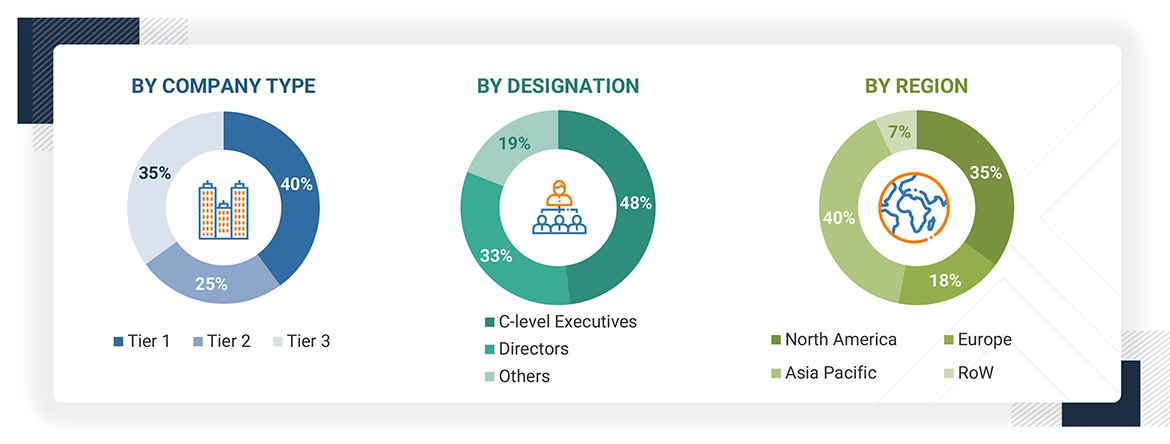
Extensive primary research was conducted after gaining knowledge about the current scenario of the machine vision market through secondary research. Several primary interviews were conducted with experts from the demand and supply sides across four major regions North America, Europe, Asia Pacific, and RoW. This primary data was collected through questionnaires, emails, and telephonic interviews.
To know about the assumptions considered for the study, download the pdf brochure
Market Size Estimation
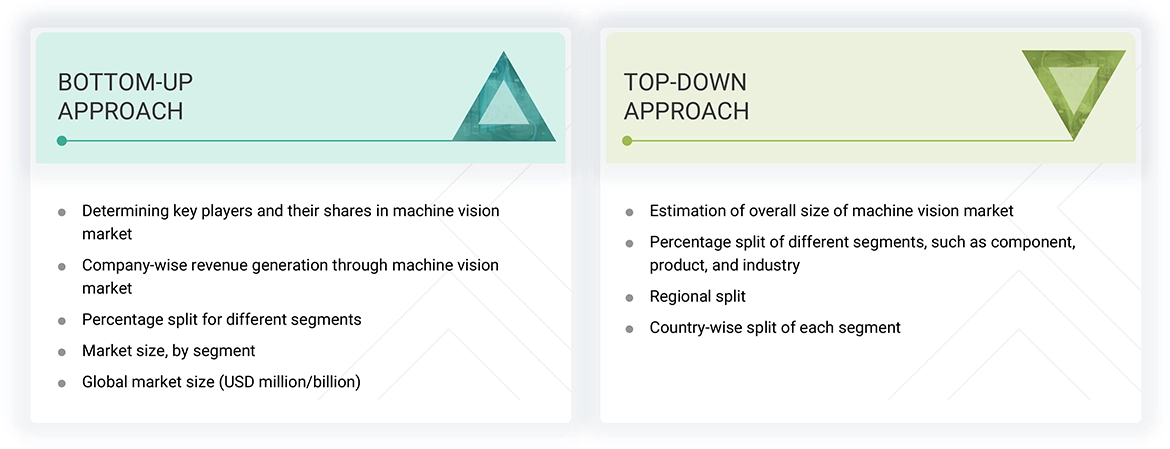
Both the top-down and bottom-up approaches have been used to estimate and validate the total size of the machine vision market. These methods have also been used extensively to estimate the size of various subsegments in the market. The following research methodology has been used to estimate the market size:
- Major players in the market have been identified through extensive secondary research.
- The industry’s value chain and market size (in terms of value) have been determined through primary and secondary research processes.
- All percentage shares, splits, and breakdowns have been determined using secondary sources and verified through primary sources.
Machine Vision Market : Top-Down and Bottom-Up Approach
Data Triangulation
After arriving at the overall size of the machine vision market from the market size estimation process explained above, the total market has been split into several segments and subsegments. Data triangulation and market breakdown procedures have been employed, wherever applicable, to complete the overall market engineering process and arrive at the exact statistics for all segments and subsegments of the market. The data has been triangulated by studying various factors and trends from both the demand and supply sides. Along with this, the market size has been validated using both the top-down and bottom-up approaches.
Market Definition
Machine vision systems use a combination of hardware and software to provide operational guidance to devices in executing their functions. Visual inspections are automated, and product assembly equipment are precisely guided using sensors (cameras), processing hardware, and software algorithms. The system relies on digital sensors installed in cameras with specialized optics to acquire images. These images are then processed, analyzed, and measured by artificial intelligence (AI) technology embedded in the computer hardware for decision-making. AI allows machines to learn from experience, intercept new inputs, and perform human-like tasks. Machine learning and natural language processing (NLP), used to train computers, are also used in machine vision to perform specific tasks by processing large data captured by cameras. Machine vision systems offer fast response, a tailored approach, accurate information, and fewer redundancies—all essential to achieving higher organizational efficiency. Machine vision systems encompass all industrial and non-industrial applications.
Key Stakeholders
- Government bodies and policymakers
- Industry organizations, forums, alliances, and associations
- Raw material suppliers and distributors
- Research institutes and organizations
- Original equipment manufacturers (OEMs)
- Technology, service, and solution providers
- Intellectual property (IP) core and licensing providers
- Market research and consulting firms
Report Objectives
- To describe, segment, and forecast the overall machine vision market by application, vision type, deployment, component, system type, and industry, in terms of value
- To describe and forecast the market for four key regions: North America, Europe, Asia Pacific, and Rest of the World (RoW), along with their respective countries, in terms of value
- To provide an overview of the recent trends in the market
- To provide detailed information regarding the drivers, restraints, opportunities, and challenges influencing the growth of the market
- To analyze the supply chain, trends/disruptions impacting customer business, market/ecosystem map, pricing analysis, and regulatory landscape pertaining to the machine vision market
- To strategically analyze micromarkets with respect to individual growth trends, prospects, and contributions to the overall market size.
- To analyze opportunities in the market for stakeholders and provide a competitive landscape of the market
- To strategically profile the key players and comprehensively analyze their market positions in terms of their ranking and core competencies, along with detailing the competitive landscape for market leaders
- To analyze competitive developments, such as product launches, acquisitions, collaborations, agreements, and partnerships, in the machine vision market
- To provide ecosystem analysis, case study analysis, patent analysis, technology analysis, value chain analysis, trends/disruptions impacting customer business, impact of AI/Gen AI, key conferences and events, pricing analysis, Porter’s five forces analysis, and regulations pertaining to the market under study
- To provide a macroeconomic outlook based on all the regions in the region chapter
Available Customizations:
With the given market data, MarketsandMarkets offers customizations according to the company’s specific needs. The following customization options are available for the report:
Company Information:
- Detailed analysis and profiling of additional market players (up to 5)
Key Questions Addressed by the Report
What is the current size of the Machine Vision Market?
The global Machine Vision Market is estimated at USD 15.83 billion in 2025.
What is the projected market size by 2030?
The market is expected to reach USD 23.63 billion by 2030, driven by increasing industrial automation and AI-powered inspection systems.
What is the CAGR of the Machine Vision Market?
The Machine Vision Market is projected to grow at a CAGR of 8.3% from 2025 to 2030.
What are the key growth drivers of the Machine Vision Market?
Major drivers include industrial automation, automated quality assurance, Industry 4.0 adoption, AI integration, and rising demand for high-precision inspection.
Which industry is the largest adopter of machine vision systems?
The electronics and semiconductor industry is a major adopter due to the need for high-precision inspection and defect detection.
How is AI influencing the Machine Vision Market?
AI and deep learning improve object recognition, defect detection, predictive maintenance, and real-time quality control in manufacturing environments.
Which machine vision technology segment is growing the fastest?
3D machine vision systems are witnessing rapid growth due to their ability to inspect complex shapes and support robotic guidance applications.
Which region dominates the Machine Vision Market?
Asia Pacific holds the largest market share, supported by strong manufacturing activity in China, Japan, South Korea, and India.
Who are the leading companies in the Machine Vision Market?
Key companies include Cognex Corporation, Keyence Corporation, OMRON Corporation, Basler AG, Teledyne Technologies, National Instruments, and SICK AG.
What are the major trends shaping the Machine Vision Market?
Key trends include AI-powered vision systems, smart factory deployment, edge computing, vision-guided robotics, and advanced 3D imaging technologies.
Fact checked
Personalize This Research
- Triangulate with your Own Data
- Get Data as per your Format and Definition
- Gain a Deeper Dive on a Specific Application, Geography, Customer or Competitor
- Any level of Personalization
Let Us Help You
- What are the Known and Unknown Adjacencies Impacting the Machine Vision Market
- What will your New Revenue Sources be?
- Who will be your Top Customer; what will make them switch?
- Defend your Market Share or Win Competitors
- Get a Scorecard for Target Partners

Custom Market Research Services
We Will Customise The Research For You, In Case The Report Listed Above Does Not Meet With Your Requirements
Get 10% Free CustomisationTESTIMONIALS

Tetsuya Ohhira
Business Development Manager-Technology Business
Nikon Corporation,
Leading Japanese MNC specializing in optics and imaging productswww.nikon.com
MarketsandMarkets™ response
is quick. Their attitude is flexible and positive. Analyst Insights are globally considered and
significant. Client Services quickly respond to our inquiry and demand. Their wide range of global
surveys help us make our strategic plan.
We hope Knowledge Store will be easier to search
for a report.
VP - Marketing & Business Development
Leading Provider of Process Control Solutions
We engaged with MarketsandMarkets on a study to perform an analysis and recommend a Go-To-Market strategy for metrology and process control in the semiconductor market. The study was tailored to our targets and needs with well-defined milestones. Our overall experience with the MarketsandMarkets team was very good throughout the project in all aspects including the analysis methodologies used, the quality and depth of primary and secondary data sets, the professionalism and flexibility of the team and the ability to meet the target schedule and milestones. We want to thank MarketsandMarkets team for a job well done.
- US Machine Vision Market
- Canada Machine Vision Market
- Mexico Machine Vision Market
- Germany Machine Vision Market
- UK Machine Vision Market
- France Machine Vision Market
- Italy Machine Vision Market
- Spain Machine Vision Market
- Netherlands Machine Vision Market
- Switzerland Machine Vision Market
- China Machine Vision Market
- Japan Machine Vision Market
- South Korea Machine Vision Market
- India Machine Vision Market
- Indonesia Machine Vision Market
- Singapore Machine Vision Market
- Australia Machine Vision Market
- Nordics Machine Vision Market
- Rest Of Europe Machine Vision Market
- Rest Of Asia Pacific Machine Vision Market
- Bahrain Machine Vision Market
- Kuwait Machine Vision Market
Growth opportunities and latent adjacency in Machine Vision Market






Clark
Apr, 2026
How is deep learning transforming machine vision from rule-based inspection to intelligent decision-making?.
Samuel
Apr, 2026
What’s driving the rapid growth of machine vision in Asia Pacific automation, electronics manufacturing, or labor dynamics?.