Instrument Cluster Market by Application (Speedometer, Odometer, Tachometer, and Others), Vehicle Type (Passenger Car, Commercial, Two-wheeler, Agriculture, Off-highway), Technology (Analog, Hybrid, Digital), and Geography - Global Forecast 2025 to 2035


Instrument Cluster Market Forecast 2025 to 2035
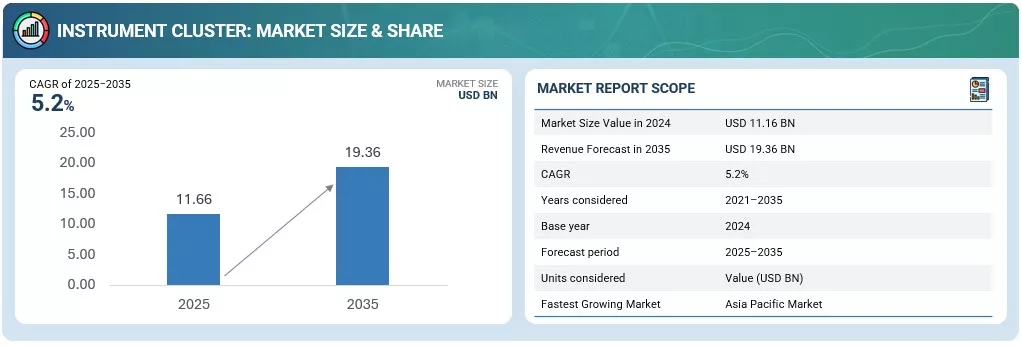
The global instrument cluster market was valued at USD 11.16 billion in 2024 and is estimated to reach USD 19.36 billion by 2035, at a CAGR of 5.2% between 2025 and 2035.
The global instrument cluster market is experiencing a significant transformation driven by rapid advancements in vehicle electronics, the integration of digital technologies, and the evolving expectations of consumers. Instrument clusters serve as the central information display in vehicles, providing essential data such as speed, fuel level, temperature, and engine performance to drivers. Over the years, this component has evolved from a simple mechanical display to a sophisticated digital interface combining functionality, aesthetics, and connectivity. The market growth between 2025 and 2035 will be propelled by increasing vehicle production, rising demand for connected cars, and the shift toward electric and autonomous vehicles that require advanced display and control systems.
Automotive manufacturers are focusing on enhancing the driver experience by introducing advanced instrument clusters that combine real time information, safety alerts, and infotainment features. The integration of smart technologies such as augmented reality, artificial intelligence, and heads up displays is revolutionizing the automotive dashboard experience. These trends are not only improving vehicle safety and convenience but are also reshaping design philosophies across passenger cars, commercial vehicles, and two wheelers.
Market Overview and Key Drivers
One of the main drivers of the instrument cluster market is the growing emphasis on digitalization and driver assistance systems. Modern vehicles are equipped with a variety of sensors and electronic control units that collect vast amounts of data, all of which need to be presented to the driver in a clear and intuitive way. Instrument clusters play a crucial role in this information flow by converting complex data into easy to understand visual representations. The emergence of advanced driver assistance systems, electric vehicle technologies, and smart connectivity features has made digital clusters an integral part of modern vehicles.
Increasing consumer expectations for stylish and user friendly dashboards are also pushing automakers to invest in next generation instrument clusters. The transition from analog to digital and hybrid displays is well underway as consumers demand customizable interfaces, navigation integration, and multimedia access. Additionally, regulatory initiatives for enhanced safety standards and driver information systems are encouraging manufacturers to incorporate warning indicators, blind spot alerts, and collision notifications directly within the cluster display.
The growing adoption of electric and hybrid vehicles further accelerates the demand for sophisticated instrument clusters. Electric vehicles require specific data visualization for battery status, energy consumption, and regenerative braking indicators. As a result, manufacturers are designing clusters with dynamic and interactive graphics that cater to the unique requirements of electric mobility. Moreover, as connected vehicle technologies evolve, instrument clusters are becoming a central hub for communication between the driver, vehicle systems, and the external environment.
By Application
The instrument cluster market can be segmented by application into speedometer, odometer, tachometer, and others. Each of these components plays a critical role in providing essential vehicle information to the driver.
The speedometer remains the most important and widely used element within an instrument cluster. It displays the current speed of the vehicle and helps the driver maintain safe and legal driving speeds. Modern digital speedometers use precise electronic sensors to measure and display speed data in real time. Many vehicles now include customizable digital speedometers that can switch between analog style dials and numerical displays according to driver preference. The integration of GPS based systems has also improved accuracy, ensuring reliable readings even when traditional sensors are affected by terrain or tire variations.
The odometer measures the total distance traveled by a vehicle and serves as a key indicator for maintenance schedules, resale value, and warranty claims. Traditional mechanical odometers have largely been replaced by electronic versions that store data digitally, reducing the risk of tampering and improving long term reliability. In connected vehicles, odometer readings can also be transmitted to service centers or fleet management systems for automated maintenance tracking.
The tachometer indicates engine speed in revolutions per minute and is particularly important in vehicles with manual transmissions or performance oriented engines. It helps the driver maintain optimal engine performance and avoid over revving. In modern digital clusters, tachometers often appear as animated arcs or bars integrated into multifunctional displays. These graphical representations can dynamically adjust based on driving mode, enhancing both functionality and visual appeal.
Other applications within the instrument cluster include indicators for fuel levels, engine temperature, battery status, warning lights, and various driver assistance notifications. As vehicles become more complex, the number of functions integrated into the cluster continues to grow. For instance, advanced models now display navigation maps, tire pressure data, and adaptive cruise control information within the same interface. The ability to consolidate multiple data streams into a single cohesive display is driving innovation and differentiation among manufacturers.
By Vehicle Type
The market segmentation by vehicle type includes passenger cars, commercial vehicles, two wheelers, agricultural vehicles, and off highway vehicles. Each segment has distinct requirements that influence design, functionality, and technology adoption.
Passenger cars account for the largest share of the instrument cluster market due to high production volumes and the ongoing trend toward digitalization. Consumers in this segment expect a combination of style, comfort, and technology. As a result, automakers are incorporating high resolution digital displays, customizable themes, and integrated infotainment systems. Premium and mid range car models increasingly feature full digital clusters with touch sensitive controls and augmented reality displays. The growing popularity of electric cars has further expanded this trend, as these vehicles rely heavily on digital interfaces to convey battery and performance data.
Commercial vehicles including trucks, buses, and delivery vans have unique requirements centered around durability, functionality, and efficiency. Instrument clusters in this segment must withstand harsh operating conditions while providing critical information related to engine performance, fuel consumption, and cargo monitoring. Fleet operators value clusters that can interface with telematics systems for real time tracking and maintenance alerts. As logistics and transportation industries adopt digital transformation, connected clusters are becoming standard for fleet management and operational optimization.
The two wheeler segment is experiencing rapid technological progress driven by the rising demand for connected motorcycles and electric scooters. Compact digital and hybrid clusters are becoming increasingly common, providing riders with navigation data, Bluetooth connectivity, and mobile app integration. Enhanced visibility under varying light conditions and weather resistance are critical design aspects for this segment. Manufacturers are focusing on lightweight yet durable clusters that offer a premium user experience even in entry level models.
Agricultural and off highway vehicles such as tractors, harvesters, and construction equipment represent another emerging area of opportunity. These vehicles operate in rugged environments where reliability and real time performance monitoring are essential. Instrument clusters in these vehicles display parameters such as engine load, hydraulic pressure, and fuel efficiency. With the adoption of smart farming and precision agriculture technologies, digital clusters are being integrated with GPS guidance and telematics systems. Similarly, off highway vehicles benefit from clusters that provide maintenance alerts and diagnostic data to minimize downtime.
By Technology
Based on technology, the instrument cluster market is categorized into analog, hybrid, and digital clusters. Each technology reflects a different stage in the evolution of vehicle display systems.
Analog clusters have been the traditional standard for decades, featuring physical gauges and needles. They are valued for their simplicity, reliability, and cost effectiveness. However, their market share is gradually declining due to limited customization and lack of integration with advanced electronic systems. Despite this, analog clusters remain popular in budget vehicles, motorcycles, and certain commercial vehicles where affordability and straightforward operation are priorities.
Hybrid clusters combine analog and digital elements, offering a transitional solution between traditional and fully digital systems. They typically feature analog speedometers or tachometers alongside digital displays for secondary information such as fuel economy, temperature, or navigation data. Hybrid clusters provide a familiar look for drivers while adding modern functionality. This balance of aesthetics and technology makes them a preferred choice in mid range vehicles where cost and innovation need to coexist. Manufacturers are focusing on improving display resolution and interface design to create seamless integration between analog dials and digital screens.
Digital clusters represent the future of the instrument cluster market. These fully electronic displays use thin film transistor or liquid crystal display technology to present all vehicle data on a single customizable screen. They offer superior flexibility, allowing drivers to choose between different themes, layouts, and modes based on driving conditions. Digital clusters can also integrate navigation maps, driver assistance alerts, and multimedia information, reducing the need for multiple display units within the vehicle. The use of high resolution graphics and intuitive user interfaces enhances driver engagement and situational awareness.
The rapid decline in display costs, along with advancements in microprocessor performance, has accelerated the adoption of digital clusters across all vehicle categories. Luxury car brands were early adopters, but the technology is now making its way into mass market vehicles as well. Future developments are expected to include three dimensional displays, augmented reality integration, and voice controlled interfaces, further redefining the driver vehicle interaction.
Geographical Analysis
Geographically, the instrument cluster market is divided into North America, Europe, Asia Pacific, Latin America, and the Middle East and Africa. Each region presents unique growth opportunities based on vehicle production, technological adoption, and consumer preferences.
North America remains one of the leading markets due to the presence of established automotive manufacturers and strong demand for advanced driver assistance systems. The region’s focus on connected vehicles and smart mobility solutions supports the rapid integration of digital clusters. Additionally, rising sales of electric and autonomous vehicles are driving the adoption of intelligent display technologies. The United States and Canada are expected to maintain steady growth due to the continuous introduction of high performance vehicles and consumer demand for premium features.
Europe is another key market characterized by stringent safety and emission regulations that promote the adoption of advanced driver information systems. Countries such as Germany, France, and the United Kingdom are at the forefront of innovation in automotive electronics. European automakers are known for their focus on design and user experience, which drives strong demand for hybrid and digital clusters. The region’s emphasis on sustainability and electric mobility is also contributing to the rapid expansion of digital display technologies.
The Asia Pacific region is expected to witness the fastest growth between 2025 and 2035. This growth is primarily attributed to the large scale automotive production in China, India, Japan, and South Korea. The rising middle class population, increasing vehicle ownership, and growing preference for feature rich vehicles are fueling demand. Government incentives for electric vehicle adoption are further accelerating the transition to digital clusters. Many regional manufacturers are collaborating with global technology suppliers to introduce affordable yet advanced display systems in both two wheelers and passenger cars.
Latin America and the Middle East and Africa are emerging markets that offer promising opportunities for expansion. Although the adoption of digital clusters is currently limited due to economic constraints, increasing urbanization and consumer interest in modern vehicles are expected to create long term demand. These regions are also experiencing a gradual shift toward electric mobility and connected technologies, which will encourage greater adoption of advanced display solutions.
Technological Innovations and Industry Trends
The instrument cluster industry is undergoing a wave of innovation aimed at enhancing driver experience, safety, and connectivity. One of the most notable trends is the development of fully digital and augmented reality based displays. Augmented reality clusters can project navigation routes, hazard warnings, and driving information directly onto the windshield, allowing drivers to access data without losing focus on the road. This technology is expected to become mainstream in premium and autonomous vehicles.
Another key trend is the integration of artificial intelligence and voice recognition systems, enabling intuitive communication between drivers and their vehicles. Smart clusters can now adjust display settings based on driving behavior, environmental conditions, and user preferences. The rise of over the air software updates ensures that vehicles can receive new features and performance enhancements even after purchase.
Manufacturers are also focusing on sustainability by developing lightweight and energy efficient display components. The use of organic light emitting diode and micro LED technologies is improving brightness and contrast while reducing power consumption. Additionally, the growing ecosystem of connected vehicles and Internet of Things technologies is transforming the instrument cluster into a central node of information exchange within the vehicle network.
Market Outlook
The global instrument cluster market from 2025 to 2035 is expected to grow steadily driven by advancements in digital technologies, rising consumer expectations, and the global shift toward electric and autonomous vehicles. Digital clusters will continue to dominate due to their flexibility, functionality, and design appeal, while hybrid models will serve as a cost effective bridge in emerging markets.
Collaboration among automakers, display manufacturers, and software developers will play a key role in shaping future innovations. As vehicles become more intelligent and connected, instrument clusters will evolve beyond mere information displays into comprehensive command centers managing communication, entertainment, and safety.
Top Key Players
Key players in the instrument cluster market include Continental (Germany), DENSO (Japan), Visteon (US), Nippon Seiki (Japan), Magneti Marelli (Italy), Aptiv (UK), Calsonic Kansei (Japan), Pricol (India), Robert Bosch (Germany), and Yazaki (Japan).
Scope of the Report:
This research report categorizes the instrument cluster market on the basis of application, vehicle type, technology, and region.
Instrument Cluster Market, By Application:
- Speedometer
- Odometer
- Tachometer
- Others (Temperature Gauge, Fuel Gauge, Oil Pressure Gauge)
Instrument Cluster Market, By Vehicle Type:
- Passenger Car
- Commercial
- Two-wheeler
- Agriculture
- Off-highway
Instrument Cluster Market, By Technology:
- Analog
- Hybrid
- Digital
Instrument Cluster Market, By Region:
- North America
- Europe
- APAC
- RoW
To speak to our analyst for a discussion on the above findings, click Speak to Analyst
 Exclusive indicates content/data unique to MarketsandMarkets and not available with any competitors.
Table of Contents
1 Introduction (Page No. - 13)
1.1 Objectives of the Study
1.2 Definition
1.3 Study Scope
1.3.1 Markets Covered
1.3.2 Years Considered for the Study
1.4 Currency
1.5 Stakeholders
2 Research Methodology (Page No. - 16)
2.1 Research Data
2.1.1 Secondary Data
2.1.1.1 Major Secondary Sources
2.1.1.2 Secondary Sources
2.1.2 Primary Data
2.1.2.1 Primary Interviews With Experts
2.1.2.2 Breakdown of Primaries
2.1.2.3 Key Data From Primary Sources
2.1.2.4 Key Industry Insights
2.2 Market Size Estimation
2.2.1 Bottom-Up Approach
2.2.1.1 Approach for Capturing Market Share By Bottom-Up Analysis (Demand Side)
2.2.2 Top-Down Approach
2.2.2.1 Approach for Capturing Market Share By Top-Down Analysis (Supply Side)
2.3 Market Breakdown and Data Triangulation
2.4 Research Assumptions
3 Executive Summary (Page No. - 27)
4 Premium Insights (Page No. - 31)
4.1 Attractive Opportunities in the Instrument Cluster Market
4.2 Market, By Vehicle Type
4.3 Asia Pacific Market, By Vehicle Type and Country (2017)
4.4 Market: Geographical Snapshot (2015-2023)
5 Market Overview (Page No. - 35)
5.1 Introduction
5.2 Market Dynamics
5.2.1 Drivers
5.2.1.1 Increasing Vehicle Production Worldwide
5.2.1.2 Stringent Government Regulations for Vehicle and Passenger Safety Across the Globe
5.2.1.3 Increasing Demand for Instrument Clusters From the APAC Region Due to the Increase in Two-Wheeler Sales
5.2.2 Restraints
5.2.2.1 Rise in Price of Instrument Clusters as Features Become Advanced
5.2.3 Opportunities
5.2.3.1 Rising Demand for Digital Instrument Clusters Across the World
5.2.3.2 Increasing Demand for Luxury Vehicles
5.2.4 Challenges
5.2.4.1 Software Integration Challenges for Digital Instrument Clusters
6 Instrument Cluster Market, By Application (Page No. - 40)
6.1 Introduction
6.2 Speedometer
6.3 Odometer
6.4 Tachometer
6.5 Others
7 Instrument Cluster Market, By Vehicle Type (Page No. - 44)
7.1 Introduction
7.2 Passenger Car
7.3 Commercial
7.4 Two-Wheeler
7.5 Agriculture
7.6 Off-Highway
8 Instrument Cluster Market, By Technology (Page No. - 68)
8.1 Introduction
8.2 Analog
8.3 Hybrid
8.4 Digital
9 Geographic Analysis (Page No. - 74)
9.1 Introduction
9.2 North America
9.2.1 US
9.2.2 Canada
9.2.3 Mexico
9.3 Europe
9.3.1 Germany
9.3.2 UK
9.3.3 France
9.3.4 Italy
9.3.5 Russia
9.3.6 Rest of Europe
9.4 Asia Pacific
9.4.1 China
9.4.2 Japan
9.4.3 India
9.4.4 South Korea
9.4.5 Rest of APAC
9.5 RoW
9.5.1 South & Central America
9.5.2 Middle East & Africa
10 Competitive Landscape (Page No. - 102)
10.1 Introduction
10.2 Market Ranking Analysis, 2017
10.2.1 Product Launches/Developments
10.2.2 Joint Ventures/Partnerships/Collaborations/Agreements
10.2.3 Acquisitions
10.2.4 Expansions
11 Company Profiles (Page No. - 107)
11.1 Introduction
11.2 Key Players
(Business Overview, Products Offered, Recent Developments, MnM View, SWOT Analysis)*
11.2.1 Continental
11.2.2 Denso
11.2.3 Visteon
11.2.4 Nippon Seiki
11.2.5 Magneti Marelli
11.2.6 Aptiv
11.2.7 Calsonic Kansei
11.2.8 Pricol
11.2.9 Robert Bosch
11.2.10 Yazaki
*Business Overview, Products Offered, Recent Developments, MnM View, SWOT Analysis Might Not Be Captured in Case of Unlisted Companies.
11.3 Other Key Companies
11.3.1 Alpine Electronics
11.3.2 Cypress Semiconductor
11.3.3 Dongfeng Electronic Technology
11.3.4 JP Minda
11.3.5 Luxoft
11.3.6 Mini Meters Manufacturing
11.3.7 Nvidia
11.3.8 Panasonic Automotive
11.3.9 Parker Hannifin
11.3.10 Stoneridge
12 Appendix (Page No. - 136)
12.1 Insights From Industry Experts
12.2 Discussion Guide
12.3 Knowledge Store: Marketsandmarkets’ Subscription Portal
12.4 Introducing RT: Real-Time Market Intelligence
12.5 Available Customization
12.6 Related Reports
12.7 Author Details
List of Tables (67 Tables)
Table 1 Instrument Cluster Market, By Application, 2015–2023 (USD Million)
Table 2 Market, By Vehicle Type, 2015–2023 (USD Million)
Table 3 Market, 2015-2023 (Million Units)
Table 4 Market for Passenger Car, By Technology, 2015–2023 (USD Million)
Table 5 Market for Passenger Car, By Region, 2015–2023 (USD Million)
Table 6 Market for Passenger Car in APAC, By Country, 2015–2023 (USD Million)
Table 7 Market for Passenger Car in Europe, By Country, 2015–2023 (USD Million)
Table 8 Market for Passenger Car in North America, By Country, 2015–2023 (USD Million)
Table 9 Market for Passenger Car in RoW, By Region, 2015–2023 (USD Million)
Table 10 Market for Commercial Vehicle, By Technology, 2015–2023 (USD Million)
Table 11 Market for Commercial Vehicle, By Region, 2015–2023 (USD Million)
Table 12 Market for Commercial Vehicle in North America, By Country, 2015–2023 (USD Million)
Table 13 Market for Commercial Vehicle in APAC, By Country, 2015–2023 (USD Million)
Table 14 Market for Commercial Vehicle in Europe, By Country, 2015–2023 (USD Million)
Table 15 Market for Commercial Vehicle in RoW, By Region, 2015–2023 (USD Million)
Table 16 Market for Two-Wheeler, By Technology, 2015–2023 (USD Million)
Table 17 Market for Two-Wheeler, By Region, 2015–2023 (USD Million)
Table 18 Market for Two-Wheeler in APAC, By Country, 2015–2023 (USD Million)
Table 19 Market for Two-Wheeler in Europe, By Country 2015-2023 (USD Million)
Table 20 Market for Two-Wheeler in North America, By Country, 2015–2023 (USD Million)
Table 21 Market for Two-Wheeler in RoW, By Region, 2015–2023 (USD Million)
Table 22 Market for Agriculture Vehicle, By Technology, 2015–2023 (USD Million)
Table 23 Market for Agriculture Vehicle, By Region, 2015–2023 (USD Million)
Table 24 Market for Agriculture Vehicle in APAC, By Country, 2015–2023 (USD Million)
Table 25 Market for Agriculture Vehicle in North America, By Country, 2015–2023 (USD Million)
Table 26 Market for Agriculture Vehicle in Europe, By Country, 2015–2023 (USD Million)
Table 27 Market for Agriculture Vehicle in RoW, By Region, 2015–2023 (USD Million)
Table 28 Market for Off-Highway Vehicle, By Technology, 2015–2023 (USD Million)
Table 29 Market for Off-Highway Vehicle, By Region, 2015–2023 (USD Million)
Table 30 Market for Off-Highway Vehicle in APAC, By Country, 2015–2023 (USD Million)
Table 31 Market for Off-Highway Vehicle in North America, By Country, 2015–2023 (USD Million)
Table 32 Market for Off-Highway Vehicle in Europe, By Country, 2015–2023 (USD Million)
Table 33 Market for Off-Highway Vehicle in RoW, By Region, 2015–2023 (USD Million)
Table 34 Market, By Technology, 2015–2023 (USD Million)
Table 35 Analog Market, By Vehicle Type, 2015–2023 (USD Million)
Table 36 Hybrid IMarket, By Vehicle Type, 2015–2023 (USD Million)
Table 37 Digital Market, By Vehicle Type, 2015–2023 (USD Million)
Table 38 Market, By Region, 2015–2023 (USD Million)
Table 39 North America: Market, By Country, 2015-2023 (USD Million)
Table 40 Market in North America, By Vehicle Type, 2015-2023 (USD Million)
Table 41 Market in US, By Vehicle Type, 2015-2023 (USD Million)
Table 42 Market in Canada, By Vehicle Type, 2015-2023 (USD Million)
Table 43 Market in Mexico, By Vehicle Type, 2015-2023 (USD Million)
Table 44 Market in Europe, By Country, 2015-2023 (USD Million)
Table 45 Market in Europe, By Vehicle Type, 2015-2023 (USD Million)
Table 46 Market in Germany, By Vehicle Type, 2015-2023 (USD Million)
Table 47 Market in UK, By Vehicle Type, 2015-2023 (USD Million)
Table 48 Market in France, By Vehicle Type, 2015-2023 (USD Million)
Table 49 Market in Italy, By Vehicle Type, 2015-2023 (USD Million)
Table 50 Market in Russia, By Vehicle Type, 2015-2023 (USD Million)
Table 51 Market in Rest of Europe, By Vehicle Type, 2015-2023 (USD Million)
Table 52 Market in APAC, By Country, 2015–2023 (USD Million)
Table 53 Market in APAC, By Vehicle Type, 2015-2023 (USD Million)
Table 54 Market in China, By Vehicle Type, 2015-2023 (USD Million)
Table 55 Market in Japan, By Vehicle Type, 2015-2023 (USD Million)
Table 56 Market in India, By Vehicle Type, 2015-2023 (USD Million)
Table 57 Market in South Korea, By Vehicle Type, 2015-2023 (USD Million)
Table 58 Market in Rest of APAC, By Vehicle Type, 2015-2023 (USD Million)
Table 59 Market in RoW, By Region, 2015–2023 (USD Million)
Table 60 Market in RoW, By Vehicle Type, 2015–2023 (USD Million)
Table 61 Market in South & Central America, By Vehicle Type, 2015-2023 (USD Million)
Table 62 Market in Middle East & Africa, By Vehicle Type, 2015-2023 (USD Million)
Table 63 Ranking of Players, 2017
Table 64 Product Launches, 2016–2017
Table 65 Joint Ventures/Partnerships/ Collaborations/Agreements, 2015–2017
Table 66 Acquisitions, 2016–2017
Table 67 Expansions, 2014–2017
List of Figures (57 Figures)
Figure 1 Instrument Cluster Market Segmentation
Figure 2 Market: Process Flow of Market Size Estimation
Figure 3 Market: Research Design
Figure 4 Bottom-Up Approach to Arrive at Market Size
Figure 5 Top-Down Approach to Arrive at Market Size
Figure 6 Data Triangulation
Figure 7 Assumptions for Research Study
Figure 8 Speedometer & Odometer Application Segment Expected to Lead the Instrument Cluster Market During Forecast Period
Figure 9 Hybrid Technology Expected to Lead the Market During the Forecast Period
Figure 10 Passenger Car Segment Expected to Lead the Market Between 2018 and 2023
Figure 11 Instrument Cluster Market, By Region
Figure 12 Digital Instrument Cluster Segment Expected to Provide Significant Growth Opportunities During the Forecast Period
Figure 13 Two-Wheelers Segment Expected to Grow at the Highest Rate During the Forecast Period
Figure 14 Passenger Cars Segment Held the Major Share of the Asia Pacific Market in 2017
Figure 15 The US Accounted for the Largest Share of the Market in 2017
Figure 16 Increase in Vehicle Production Worldwide is Driving the Market
Figure 17 Global Vehicle Production Data, 2010-2016
Figure 18 Speedometer and Odometer Application Expected to Dominate Instrument Cluster Market During Forecast Period
Figure 19 Two-Wheeler Segment Expected to Provide Significant Growth Opportunities for Market During the Forecast Period
Figure 20 Hybrid Technology Expected to Lead the Market for Passenger Car During the Forecast Period
Figure 21 APAC Expected to Dominate the Market for Passenger Car During the Forecast Period
Figure 22 China Expected to Lead the APAC Market for Passenger Car During the Forecast Period
Figure 23 The US Expected to Hold the Largest Share of the North American Market for Passenger Car During the Forecast Period
Figure 24 North America Expected to Lead the Market for Commercial Vehicle During the Forecast Period
Figure 25 The US Expected to Dominate the North American Market for Commercial Vehicle During the Forecast Period
Figure 26 China Expected to Dominate the APAC Market for Commercial Vehicle During the Forecast Period
Figure 27 APAC Expected to Hold the Largest Share of the Market for Two-Wheeler Between 2018 and 2023
Figure 28 China and India Expected to Lead the Market for Two-Wheeler Between 2018 and 2023
Figure 29 APAC Expected to Dominate the Market for Agriculture Vehicle During the Forecast Period
Figure 30 The APAC Market for Off-Highway Vehicle Expected to Grow at the Highest Rate During the Forecast Period
Figure 31 Digital Expected to Grow at the Highest CAGR During the Forecast Period
Figure 32 Two Wheelers Segment Expected to Grow at the Highest CAGR for Analog Market During the Forecast Period
Figure 33 Passenger Car Vehicle Segment Expected to Lead the Hybrid Market During the Forecast Period
Figure 34 Digital Market for Two-Wheelers Expected to Grow at the Highest CAGR During the Forecast Period
Figure 35 The Market in India Expected to Grow at the Highest CAGR During the Forecast Period
Figure 36 The APAC Market Expected to Grow at the Highest CAGR During the Forecast Period
Figure 37 North America Instrument Cluster Market Snapshot
Figure 38 The US Expected to Dominate the North American Market During the Forecast Period
Figure 39 Passenger Car Expected to Dominate the US Market During the Forecast Period
Figure 40 Europe Instrument Cluster Market Snapshot
Figure 41 Germany Expected to Dominate the European Market During the Forecast Period
Figure 42 Passenger Car Vehicle Type Segment Expected to Lead the Germany Market During the Forecast Period
Figure 43 The Passenger Car Vehicle Segment of the UK Market Expected to Grow at the Highest CAGR During the Forecast Period
Figure 44 APAC Instrument Cluster Market: Snapshot
Figure 45 China Expected to Dominate the Market in APAC During the Forecast Period
Figure 46 Passenger Car Vehicle Segment Expected to Dominate the Chinese Market During the Forecast Period
Figure 47 Two-Wheeler Vehicle Segment Expected to Dominate the Indian Market During the Forecast Period
Figure 48 South & Central America Expected to Hold the Largest Share of the in RoW During the Forecast Period
Figure 49 Organic and Inorganic Strategies Adopted By Companies Operating in the Market (2014–2017)
Figure 50 Continental: Company Snapshot
Figure 51 Denso: Company Snapshot
Figure 52 Visteon: Company Snapshot
Figure 53 Nippon Seiki: Company Snapshot
Figure 54 Calsonic Kansei: Company Snapshot
Figure 55 Pricol: Company Snapshot
Figure 56 Robert Bosch: Company Snapshot
Figure 57 Yazaki: Company Snapshot













Growth opportunities and latent adjacency in Instrument Cluster Market
I was looking for some data related to IVI and Cluster market. Is there any common relevance that can be drawn by comparing this data? I need this data for preparing a presentation for my board meeting.
Does the report split the vehicle type market by technology? For instance, instrument cluster market for commercial vehicle by analog, hybrid, and digital.