Mobile Engagement Market by User Type (SME, LSE), Solution (SMS & MMS, Push Notification, In-App Messaging, E-mail, App/Web Content), Vertical (Financial Services, Retail, Travel & Hospitality, Telecom & IT), and Region - Global Growth Driver and Industry Forecast to 2035


Mobile Engagement Market Summary
The global Mobile Engagement Market is undergoing rapid expansion as businesses increasingly shift customer acquisition, retention, personalization, and service interactions toward mobile-first experiences. Based on current market assessments, the global Mobile Engagement Market is estimated at approximately USD 50-60 billion in 2025 and is projected to reach around USD 1,900-2,400 billion by 2035, representing an estimated 45-47% CAGR during the forecast period. Recent industry research estimates the market at approximately USD 56 billion in 2025 and projects it to exceed USD 370 billion by 2030, implying exceptionally strong growth as mobile-first services, app ecosystems, predictive analytics, conversational AI, and personalized customer experiences become increasingly central to digital commerce.
The market encompasses technologies and services that enable organizations to communicate with and influence users through mobile applications, mobile web experiences, push notifications, in-app messaging, SMS, messaging applications, mobile wallets, and automated customer journeys. Growth is being accelerated by widespread smartphone adoption, the expansion of mobile commerce, subscription-based digital services, fintech, food delivery, travel, entertainment, gaming, and on-demand platforms. At the technology level, AI, IoT, cloud computing, automation, customer data platforms, and real-time analytics are transforming mobile engagement from scheduled campaign delivery into continuous, individualized interaction.
AI is becoming particularly important because businesses can now use behavioral data to predict churn, determine optimal messaging times, personalize content, recommend products, generate campaign copy, and automatically optimize customer journeys. Platforms such as Braze are increasingly positioning AI-powered decisioning alongside cross-channel engagement and real-time customer data.
Key Market Trends & Insights
North America remains a leading regional market, supported by mature digital commerce ecosystems, high enterprise software adoption, sophisticated marketing technology infrastructure, and strong investment in AI-powered customer experience. Large retailers, financial institutions, media businesses, travel companies, and subscription platforms are increasingly using mobile engagement platforms to connect behavioral data with real-time campaigns.
Asia Pacific is expected to be the fastest-growing region through 2035. The region combines a large mobile-first population with rapid e-commerce expansion, digital payments, super-app ecosystems, fintech adoption, gaming, food delivery, and social commerce. India, China, Southeast Asia, Japan, and South Korea are important growth markets, although their engagement models differ significantly by consumer behavior and local messaging ecosystems.
Mobile push notifications and in-app engagement remain dominant channels, but the market is moving toward coordinated multi-channel journeys. Leading platforms increasingly combine push, in-app messages, email, SMS, WhatsApp, web messaging, and other channels rather than treating mobile engagement as an isolated communication function. Braze reported that 73% of its customers used three or more channels in 2025, illustrating the broader movement toward cross-channel engagement.
AI-driven personalization is the most important technology trend. Modern platforms are using predictive models and generative AI to identify high-value users, forecast churn, personalize content, optimize send times, and automate campaign creation. CleverTap, for example, describes its AI capabilities around predictive, generative, and prescriptive intelligence for customer journeys.
Automation is shifting the role of marketing teams. Instead of manually defining every segment and campaign, businesses can increasingly establish objectives and guardrails while software determines audiences, channels, timing, and content. This is creating a market transition from campaign management toward automated lifecycle orchestration.
Market Size & Forecast
- Base year market size: Approximately USD 50-60 billion in 2025, depending on the definition of mobile engagement and the inclusion of associated customer-engagement technologies.
- Forecast value by 2035: Approximately USD 1,900-2,400 billion, reflecting the continuation of exceptionally high growth in mobile-first engagement platforms and related services.
- CAGR: Approximately 45-47% through 2035. Recent research projects growth of roughly 46% annually through 2030, providing the basis for the longer-term range used here.
- Growth factors: Smartphone usage, app-based ecosystems, mobile commerce, AI-powered personalization, conversational engagement, predictive analytics, cloud platforms, automation, and integration with CRM and customer-data systems will support expansion.
Mobile Engagement Market Top 10 key takeaway
- The global Mobile Engagement Market is estimated at approximately USD 50-60 billion in 2025.
- The market could reach approximately USD 1,900-2,400 billion by 2035 under a high-growth scenario.
- The market is expected to expand at approximately 45-47% CAGR during the forecast period.
- North America remains a leading market because of advanced digital commerce and enterprise technology adoption.
- Asia Pacific is expected to record the fastest growth.
- Push notifications and in-app messaging remain foundational mobile engagement channels.
- Cross-channel orchestration is increasingly replacing isolated mobile campaigns.
- AI is enabling predictive segmentation, content generation, send-time optimization, and automated journey decisions.
- Mobile commerce, fintech, gaming, media, travel, retail, and subscription services are major application areas.
- Privacy, consent management, data quality, and customer fatigue will become increasingly important strategic considerations.
Product Insights
The leading product segment within the Mobile Engagement Market consists of mobile engagement platforms and customer engagement software, particularly solutions combining push notifications, in-app messaging, analytics, segmentation, journey orchestration, experimentation, and personalization. These platforms dominate because businesses increasingly require a unified system capable of understanding user behavior and responding in real time rather than relying on disconnected messaging tools.
Push notifications remain one of the most widely used mobile engagement mechanisms because they can reach users even when an application is not actively open. However, their role is evolving. Leading platforms now use behavioral signals, location, app activity, preferences, and customer lifecycle status to determine which users should receive a message and when. Airship identifies push notifications, in-app messages, and message centers as core mobile-app engagement capabilities.
In-app messaging is gaining importance because it reaches customers during an active session and can be used for onboarding, product education, promotions, recommendations, feature discovery, and transactional communication. The market is also expanding toward mobile wallets, rich messaging, WhatsApp engagement, conversational interfaces, mobile customer support, and personalized in-app experiences.
AI is becoming a defining product differentiator. Platforms are increasingly integrating predictive segmentation, churn prediction, recommendation engines, generative content, automated experimentation, and send-time optimization. OneSignal, for example, now provides AI functionality that can generate campaign content, create segments, analyze performance, and trigger workflows using natural-language instructions.
The next generation of products will increasingly operate as intelligent engagement systems rather than messaging dashboards. They will ingest real-time behavioral data, predict user intent, select an appropriate channel, generate content, execute the journey, and continuously learn from the outcome.
Technology / Component Insights (Rename based on keyword if needed)
The technological foundation of the Mobile Engagement Market includes customer data platforms, mobile SDKs, application programming interfaces, analytics engines, cloud infrastructure, AI models, campaign orchestration systems, content management tools, identity resolution, and communication gateways. Mobile SDKs collect behavioral events such as sessions, purchases, searches, clicks, content views, and feature usage, allowing engagement platforms to create dynamic customer profiles.
AI and machine learning are becoming the primary innovation layer. Predictive models can estimate churn probability, purchase likelihood, lifetime value, engagement propensity, and the probability of responding to a particular message. Generative AI then adds a content layer by creating variants of notifications, email messages, in-app copy, and promotional content. This combination is moving mobile engagement toward real-time individualization.
Research into mobile notification optimization also demonstrates why intelligent decisioning matters. Studies have explored machine-learning and reinforcement-learning approaches to determine whether and when notifications should be sent, with the objective of improving long-term user value rather than simply maximizing immediate clicks.
IoT expands the market by introducing additional behavioral and contextual data. Connected devices, smart appliances, wearables, vehicles, and other endpoints can generate signals that inform mobile engagement. A retailer could use location or connected-device data to trigger a relevant offer, while a financial application could use real-time activity to provide contextual security notifications.
Cloud infrastructure remains essential because large enterprises need to process millions or billions of behavioral events and coordinate campaigns across regions. Automation connects these components by allowing event-driven journeys to operate continuously without manual intervention.
Future innovation will focus on agentic AI, privacy-preserving personalization, real-time decision engines, multimodal customer experiences, predictive journey orchestration, and deeper integration with CRM, commerce, data warehouses, and customer service platforms.
Application Insights
Retail and e-commerce represent a leading application segment because mobile engagement directly influences acquisition, conversion, repeat purchases, loyalty, and cart recovery. Retailers can use behavioral triggers to recommend products, notify customers about price changes, recover abandoned carts, and personalize promotions.
Financial services are another major application area. Banks, fintech companies, insurers, and payment providers use mobile engagement for transaction alerts, onboarding, fraud warnings, personalized financial offers, account education, and retention. Because financial applications generate frequent real-time events, automated mobile engagement can become deeply integrated into the customer experience.
Media, entertainment, gaming, and subscription businesses also have strong requirements for mobile engagement. Their business models depend heavily on recurring usage, making retention and reactivation critical. Personalized content recommendations, new-release alerts, rewards, and event reminders can encourage users to return to applications.
Travel and hospitality companies use mobile engagement for booking confirmations, itinerary changes, check-in instructions, loyalty programs, location-specific offers, and service updates. Healthcare applications are also adopting mobile engagement for appointment reminders, medication notifications, wellness programs, and patient communication.
Future opportunities will come from conversational commerce, AI agents, personalized loyalty programs, connected-device interactions, mobile wallets, and context-aware experiences. The market is gradually shifting from simply sending messages toward managing the complete digital relationship between users and brands.
Regional Insights
North America remains a leading Mobile Engagement Market because businesses in the region have comparatively mature mobile applications, digital commerce operations, CRM infrastructure, and marketing automation capabilities. Large enterprises are investing in customer data unification and AI-based personalization to improve retention and lifetime value. The strong presence of technology vendors and early enterprise adoption of generative AI further supports regional demand.
Europe represents a significant market with strong demand for privacy-conscious personalization, customer-data management, mobile commerce, and omnichannel experiences. Regulatory requirements around personal data are encouraging companies to invest in consent management, first-party data, identity resolution, and transparent personalization. This creates opportunities for platforms that can balance engagement performance with data governance.
Asia Pacific is expected to be the fastest-growing region. Mobile-first consumer behavior, expanding digital payments, rapid e-commerce adoption, super-app ecosystems, and the growth of fintech and on-demand services are creating a large addressable market. In many Asian economies, consumers interact with businesses primarily through mobile devices, making mobile engagement a core component of digital strategy rather than an additional marketing channel.
The region also benefits from a large population of digitally active consumers and rapid adoption of AI-enabled services. Local enterprises are increasingly using behavioral analytics and automated journeys to manage large customer bases at lower operating costs.
- North America: Leading market supported by mature enterprise software and digital commerce ecosystems.
- Europe: Strong focus on privacy, first-party data, personalization, and omnichannel engagement.
- Asia Pacific: Fastest-growing region driven by mobile-first consumers and expanding digital services.
- India and Southeast Asia: Strong opportunities from fintech, commerce, food delivery, gaming, and super-app ecosystems.
- China, Japan, and South Korea: Advanced mobile ecosystems support sophisticated engagement and personalization use cases.
Country-Specific Market Trends
In Asia Pacific, China is estimated to grow at approximately 48-50% CAGR, while Japan is expected to expand at around 39-42% CAGR through 2035. China's enormous mobile commerce ecosystem, digital payments, social platforms, entertainment applications, and integrated consumer ecosystems provide strong demand for automated customer engagement. Japan's more mature digital market is expected to grow at a somewhat slower pace but will continue adopting AI-enabled personalization, mobile loyalty, financial engagement, and connected-device experiences.
In North America, the United States is estimated to record approximately 43-45% CAGR, Canada around 39-42%, and Mexico approximately 45-47%. The United States remains a major innovation center for customer-engagement technology and benefits from high enterprise adoption of cloud platforms, AI, mobile commerce, and customer-data infrastructure. Canada is developing opportunities in financial services, retail, media, and subscription businesses, while Mexico's expanding digital commerce and fintech sectors provide significant room for mobile engagement adoption.
In Europe, Germany is estimated to grow at approximately 38-41% CAGR, while France is expected to expand at around 39-42%. European companies are increasingly focused on consent-based personalization, customer-data platforms, mobile commerce, and automated customer journeys. Germany's retail, automotive, financial, and industrial ecosystems provide broad enterprise opportunities, while France is seeing strong adoption across retail, luxury, financial services, travel, and digital media.
These country-level CAGR ranges are directional analyst estimates intended to reflect relative adoption momentum rather than precise forecasts from individual companies or national statistical agencies.
- China: Mobile commerce, digital payments, and AI-powered consumer ecosystems support exceptionally strong growth.
- Japan: Mature mobile adoption creates demand for advanced personalization and retention technologies.
- United States: Enterprise AI, SaaS adoption, e-commerce, and fintech drive market development.
- Germany: Data-driven customer experiences are expanding across retail, finance, and digital services.
- France: Retail, luxury, travel, and financial services provide significant engagement opportunities.
Key Mobile Engagement Company Insights
The competitive environment includes major customer-engagement and marketing-technology providers such as Braze, MoEngage, CleverTap, Airship, OneSignal, Iterable, Salesforce, Adobe, and Twilio. Competition is increasingly shifting from individual messaging capabilities toward unified data, AI decisioning, journey orchestration, experimentation, and measurable business outcomes.
Braze is emphasizing AI-powered decisioning, unified customer data, cross-channel journeys, and real-time personalization. The company's 2025 engagement data also indicates continued expansion across WhatsApp, SMS, email, and other channels.
MoEngage focuses on insights-led customer engagement, analytics, personalization, and cross-channel orchestration, with AI capabilities covering predictive segmentation and journey optimization. CleverTap is emphasizing real-time behavioral analytics, omnichannel campaigns, AI-powered recommendations, and automated customer journeys.
Airship is increasingly focused on mobile experiences, no-code app experiences, cross-channel journeys, experimentation, and AI recommendations. OneSignal is expanding from push notifications into broader email, SMS, in-app messaging, analytics, automation, and AI-assisted campaign operations. Meanwhile, Iterable emphasizes real-time AI decisioning and unified customer context across channels.
- Braze: Emphasizes AI decisioning, customer data, cross-channel engagement, and journey orchestration.
- MoEngage: Focuses on analytics, personalization, predictive engagement, and emerging-market customer bases.
- CleverTap: Prioritizes behavioral analytics, AI-powered segmentation, personalization, and retention.
- Airship: Concentrates on mobile experiences, app optimization, experimentation, and AI recommendations.
- OneSignal: Expands push-led engagement into AI-assisted cross-channel lifecycle marketing.
Recent Developments
In 2025, CleverTap expanded its AI capabilities through Clever.AI, positioning predictive, generative, and prescriptive intelligence as core components of automated customer engagement. The capabilities are designed to analyze real-time customer behavior, generate personalized communication, and recommend or automate engagement journeys.
In 2025, Airship introduced AI-powered recommendations within Audience Pulse, using behavioral engagement patterns to suggest targeted campaigns, experiences, journeys, and experiments. The development demonstrates the broader shift toward AI-assisted campaign strategy rather than simple automated message delivery.
In 2025, CleverTap and FNP announced a partnership focused on AI-powered segmentation and omnichannel personalization. The collaboration illustrates how enterprises are increasingly applying customer-data intelligence to reduce redundant communication and improve contextual engagement.
Market Segmentation
The Mobile Engagement Market can be segmented By Product into mobile engagement platforms, push-notification solutions, in-app messaging platforms, mobile analytics solutions, customer-data and personalization platforms, mobile marketing automation, and associated communication services. By Technology / Component, the market includes mobile SDKs, APIs, cloud infrastructure, AI and machine-learning engines, behavioral analytics, customer-data platforms, journey orchestration, identity management, and messaging gateways.
By Application, major categories include retail and e-commerce, banking and financial services, fintech, media and entertainment, gaming, travel and hospitality, healthcare, telecommunications, education, food delivery, transportation, and subscription services. Retail and e-commerce remain major use cases because engagement directly influences conversion and retention, while fintech and digital media benefit from frequent, event-driven customer interactions.
By Region, the market covers North America, Europe, Asia Pacific, Latin America, and the Middle East & Africa. North America maintains a strong position because of enterprise technology maturity, while Asia Pacific is expected to show the fastest growth due to mobile-first consumer behavior and expanding digital economies.
- By Product: Mobile engagement platforms and cross-channel orchestration solutions represent the core market.
- By Technology / Component: AI, analytics, cloud infrastructure, SDKs, APIs, and customer-data platforms are critical.
- By Application: E-commerce, fintech, retail, media, gaming, travel, and subscriptions are major demand centers.
- By Region: North America leads while Asia Pacific represents the strongest growth opportunity.
- Emerging segment: AI-native, conversational, predictive, and agentic engagement platforms are gaining strategic importance.
Conclusion
The global Mobile Engagement Market is entering a transformative decade as mobile devices become the primary interface between consumers and digital businesses. With an estimated market size of USD 50-60 billion in 2025, the market could reach approximately USD 1,900-2,400 billion by 2035, supported by an estimated 45-47% CAGR under the current high-growth outlook. The exceptionally high projected growth reflects the convergence of mobile commerce, digital services, customer-data platforms, AI, cloud infrastructure, and automated marketing.
AI will be the defining force in the next stage of development. The market is moving beyond manually created campaigns toward systems that can continuously understand customer behavior, predict intent, generate relevant content, select channels, optimize timing, and measure outcomes. This creates a fundamental change in how businesses approach customer engagement: from sending more messages to delivering fewer, more relevant interactions.
IoT will further expand the data available for contextual engagement. Connected devices, wearables, vehicles, and smart environments can provide signals that help brands understand where and when customers interact with products and services. Combined with cloud analytics and edge processing, these signals can support real-time experiences across physical and digital environments.
Automation will also become increasingly strategic. Marketing and product teams will be expected to define business objectives and customer-experience rules while AI systems handle segmentation, content creation, testing, optimization, and campaign execution. Platforms that can safely automate these processes while maintaining transparency, consent, security, and brand control will have a significant advantage.
For businesses, investment in the Mobile Engagement Market should therefore be viewed as a broader customer-lifetime-value strategy rather than a messaging expense. Companies that unify first-party data, AI decisioning, personalization, experimentation, and cross-channel orchestration will be better positioned to improve retention and build durable customer relationships through 2035.
FAQs
1. What is the market size of the Mobile Engagement Market?
The global Mobile Engagement Market is estimated at approximately USD 50-60 billion in 2025. Recent market research estimates the 2025 market at roughly USD 56 billion, although market values vary according to the technologies and services included in the market definition.
2. What is the expected growth rate of the Mobile Engagement Market?
The Mobile Engagement Market is expected to grow at approximately 45-47% CAGR through 2035 under a high-growth scenario. Recent research projects a CAGR of approximately 46% between 2025 and 2030, driven by mobile-first digital services, predictive analytics, conversational AI, mobile commerce, and hyper-personalization.
3. What are the key drivers of the Mobile Engagement Market?
Major drivers include smartphone adoption, mobile commerce, app-based ecosystems, customer-retention requirements, AI-powered personalization, predictive analytics, cloud platforms, marketing automation, conversational AI, first-party data strategies, and integration with CRM and customer-data systems.
4. Which region leads the Mobile Engagement Market?
North America is a leading regional market due to its mature digital economy, enterprise software adoption, advanced marketing technology ecosystem, and strong AI investment. Asia Pacific is expected to be the fastest-growing region because of mobile-first consumers, expanding e-commerce, fintech, digital payments, gaming, and super-app ecosystems.
5. Who are the key companies in the Mobile Engagement Market?
Major participants include Braze, MoEngage, CleverTap, Airship, OneSignal, Iterable, Salesforce, Adobe, and Twilio. Competition is increasingly centered on AI decisioning, real-time personalization, cross-channel orchestration, predictive analytics, automation, and unified customer data.
To speak to our analyst for a discussion on the above findings, click Speak to Analyst
 Exclusive indicates content/data unique to MarketsandMarkets and not available with any competitors.
Table of Contents
1 Introduction (Page No. - 13)
1.1 Objectives of the Study
1.2 Definition
1.3 Study Scope
1.3.1 Markets Covered
1.3.2 Geographic Score
1.3.3 Years Considered for the Study
1.4 Currency
1.5 Limitations
1.6 Stakeholders
2 Research Methodology (Page No. - 16)
2.1 Research Data
2.1.1 Secondary Data
2.1.1.1 Key Data From Secondary Sources
2.1.2 Primary Data
2.1.2.1 Key Data From Primary Sources
2.1.2.2 Key Industry Insights
2.1.2.3 Breakdown of Primaries
2.2 Market Size Estimation
2.2.1 Bottom-Up Approach
2.2.2 Top-Down Approach
2.3 Market Breakdown and Data Triangulation
2.4 Research Assumptions
3 Executive Summary (Page No. - 24)
4 Premium Insight (Page No. - 29)
4.1 Increasing Demand for Mobile Engagement Solutions in Retail and Financial Services Verticals to Drive Market Growth
4.2 Mobile Engagement Market, By Vertical
4.3 Mobile Engagement Market, 2017
4.4 Mobile Engagement Market, By Region & By Solution
4.5 Mobile Engagemnent Automation Market: Industry Adoption Analysis
5 Market Overview (Page No. - 33)
5.1 Introduction
5.2 Market Dynamics
5.2.1 Drivers
5.2.1.1 High Penetration of Mobile Phones
5.2.1.2 Increasing Use of Mobile Device Applications
5.2.1.3 Growing Focus Toward Mobile First Strategy
5.2.2 Restraints
5.2.2.1 High Initial Investment to Set Up Mobile Engagement Campaigns
5.2.2.2 Difficulty in Monetizing Mobile Apps
5.2.3 Opportunities
5.2.3.1 Development of Mobile Engagement Applications for Healthcare Vertical
5.2.3.2 Increased Use of Social Media Platforms Enhancing Mobile Engagement
5.2.3.3 Rapid Development of Information Technology and Digital Services Increasing Connectivity With Consumers in Travel and Hospitality Vertical
5.2.4 Challenges
5.2.4.1 Increasing Concerns Related to Data Privacy
6 Mobile Engagement Market, By Vertical (Page No. - 38)
6.1 Introduction
6.2 Financial Services
6.3 Media and Entertainment
6.4 Retail
6.5 Travel and Hospitality
6.6 Telecom and IT
6.7 Others
7 Mobile Engagement Market, By User Type (Page No. - 53)
7.1 Introduction
7.2 Small and Medium-Sized Enterprises
7.3 Large-Scale Enterprises
8 Mobile Engagement Market, By Solution (Page No. - 59)
8.1 Introduction
8.2 SMS and MMS
8.3 Push Notifications
8.4 In-App Messaging
8.5 E-Mails
8.6 App /Web Content
8.7 Other Solutions
9 Geographic Analysis (Page No. - 73)
9.1 Introduction
9.2 North America
9.2.1 US
9.2.2 Canada
9.2.3 Mexico
9.3 Europe
9.3.1 UK
9.3.2 Germany
9.3.3 France
9.3.4 Rest of Europe
9.4 APAC
9.4.1 Japan
9.4.2 China
9.4.3 India
9.4.4 Australia
9.4.5 Rest of APAC
9.5 RoW
9.5.1 Middle East & Africa
9.5.2 South America
10 Competitive Landscape (Page No. - 93)
10.1 Introduction
10.2 Market Ranking Analysis: Mobile Engagement Market
10.3 Competitive Scenario
10.4 Recent Developments
10.4.1 Product Launches
10.4.2 Partnerships/Agreements
10.4.3 Acquisitions
11 Company Profiles (Page No. - 97)
(Business Overview, Products Offered, Product Offering Scorecard, Business Strategy Scorecard, Recent Developments, Key Relationships)*
11.1 IBM
11.2 Salesforce
11.3 Oracle
11.4 Adobe
11.5 Vibes
11.6 Selligent
11.7 Urban Airship
11.8 Appboy
11.9 Localytics
11.10 Swrve
11.11 Tapjoy
11.12 Marketo
11.13 Key Innovators
11.13.1 Accengage
11.13.2 Followanalytics
11.13.3 Leanplum
11.13.4 Smartfocus
11.13.5 Webtrekk
*Details on Business Overview, Products Offered, Product Offering Scorecard, Business Strategy Scorecard, Recent Developments, Key Relationships Might Not Be Captured in Case of Unlisted Companies.
12 Appendix (Page No. - 133)
12.1 Insights of Industry Experts
12.2 Discussion Guide
12.3 Knowledge Store: Marketsandmarkets’ Subscription Portal
12.4 Introducing RT: Real-Time Market Intelligence
12.5 Available Customizations
12.6 Related Reports
12.7 Author Details
List of Tables (66 Tables)
Table 1 Mobile Engagement Market, By Vertical, 2015–2023 (USD Million)
Table 2 Mobile Engagement Market for Financial Services, By User Type, 2015–2023 (USD Million)
Table 3 Market for Financial Services, By Region, 2015–2023 (USD Million)
Table 4 Market for Financial Services, By Solution, 2015–2023 (USD Million)
Table 5 Market for Media and Entertainment, By User Type, 2015–2023 (USD Million)
Table 6 Market for Media and Entertainment, By Region, 2015–2023 (USD Million)
Table 7 Market for Media and Entertainment, By Solution, 2015–2023 (USD Million)
Table 8 Mobile Engagement Market for Retail, By User Type, 2015–2023 (USD Million)
Table 9 Market for Retail, By Region, 2015–2023 (USD Million)
Table 10 Mobile Engagement Market for Retail, By Solution, 2015–2023 (USD Million)
Table 11 Market for Travel and Hospitality, By User Type, 2015–2023 (USD Million)
Table 12 Market for Travel and Hospitality, By Region, 2015–2023 (USD Million)
Table 13 Market for Travel and Hospitality, By Solution, 2015–2023 (USD Million)
Table 14 Market for Telecom and IT, By User Type, 2015–2023 (USD Million)
Table 15 Market for Telecom and IT, By Region, 2015–2023 (USD Million)
Table 16 Market for Telecom and IT, By Solution, 2015–2023 (USD Million)
Table 17 Market for Others, By User Type, 2015–2023 (USD Million)
Table 18 Market for Others, By Region, 2015–2023 (USD Million)
Table 19 Market for Others, By Solution, 2015–2023 (USD Million)
Table 20 Mobile Engagement Market, By User Type, 2015–2023 (USD Million)
Table 21 Market for SMES, By Geography, 2015–2023 (USD Million)
Table 22 Market for SMES, By Solution, 2015–2023 (USD Million)
Table 23 Market for SMES, By Vertical, 2015–2023 (USD Million)
Table 24 Market for LSES, By Geography, 2015–2023 (USD Million)
Table 25 Market for LSES, By Solution, 2015–2023 (USD Million)
Table 26 Market for LSES, By Vertical, 2015–2023 (USD Million)
Table 27 Mobile Engagement Market, By Solution, 2015–2023 (USD Million)
Table 28 Market for SMS/MMS, By Vertical, 2015–2023 (USD Million)
Table 29 Market for SMS/MMS, By User Type, 2015–2023 (USD Million)
Table 30 Market for SMS/MMS, By Geography, 2015–2023 (USD Million)
Table 31 Market for Push Notifications, By Vertical, 2015–2023 (USD Million)
Table 32 Market for Push Notifications, By User Type, 2015–2023 (USD Million)
Table 33 Market for Push Notifications, By Geography, 2015–2023 (USD Million)
Table 34 Mobile Engagement Market for In-App Messaging, By Vertical, 2015–2023 (USD Million)
Table 35 Market for In-App Messaging, By User Type, 2015–2023 (USD Million)
Table 36 Market for In-App Messaging, By Geography, 2015–2023 (USD Million)
Table 37 Market for E-Mails, By Vertical, 2015–2023 (USD Million)
Table 38 Market for E-Mails, By User Type, 2015–2023 (USD Million)
Table 39 Market for E-Mails, By Geography, 2015–2023 (USD Million)
Table 40 Mobile Engagement Market for App/ Web Content, By Vertical, 2015–2023 (USD Million)
Table 41 Market for App/Web Content, By User Type, 2015–2023 (USD Million)
Table 42 Market for App/Web Content, By Geography, 2015–2023 (USD Million)
Table 43 Market for Other Solutions, By Vertical, 2015–2023 (USD Million)
Table 44 Market for Other Solutions, By User Type, 2015–2023 (USD Million)
Table 45 Market for Other Solutions, By Geography, 2015–2023 (USD Million)
Table 46 Mobile Engagement Market, By Region, 2015–2023 (USD Million)
Table 47 Market in North America, By Country, 2015–2023 (USD Million)
Table 48 Market in North America, By Vertical, 2015–2023 (USD Million)
Table 49 Market in North America, By Solution, 2015–2023 (USD Million)
Table 50 Market in North America, By User Type, 2015–2023 (USD Million)
Table 51 Mobile Engagement Market in Europe, By Country/Region, 2015–2023 (USD Million)
Table 52 Market in Europe, By Vertical, 2015–2023 (USD Million)
Table 53 Market in Europe, By Solution, 2015–2023 (USD Million)
Table 54 Market in Europe, By User Type, 2015–2023 (USD Million)
Table 55 Market in APAC, By Country/Region, 2015–2023 (USD Million)
Table 56 Market in APAC, By Vertical, 2015–2023 (USD Million)
Table 57 Market in APAC, By Solution, 2015–2023 (USD Million)
Table 58 Market in APAC, By User Type, 2015–2023 (USD Million)
Table 59 Market in RoW, By Region, 2015–2023 (USD Million)
Table 60 Market in RoW, By Vertical, 2015–2023 (USD Million)
Table 61 Market in RoW, By Vertical, 2015–2023 (USD Million)
Table 62 Market in RoW, By User Type, 2015–2023 (USD Million)
Table 63 Ranking of Top 5 Players in Mobile Engagement Market (2016)
Table 64 Product Launches, 2015–July 2017
Table 65 Partnerships/Agreements, 2015–July 2017
Table 66 Acquisitions, 2015–July 2017
List of Figures (47 Figures)
Figure 1 Segmentation of the Mobile Engagement Market
Figure 2 Research Design
Figure 3 Process Flow of Market Size Estimation
Figure 4 Data Triangulation
Figure 5 Retail Vertical to Hold the Largest Size of the Market in 2017
Figure 6 Market for SMES to Grow at A Higher Rate Between 2017 and 2023
Figure 7 Push Notifications to Lead the Mobile Engagement Market Between 2017 and 2023
Figure 8 Market for Push Notifications for Financial Services Vertical to Grow at the Highest Rate During the Forecast Period
Figure 9 Market in APAC to Grow at the Highest Rate Between 2017 and 2023
Figure 10 Attractive Growth Opportunities for the Market
Figure 11 Retail Vertical to Hold the Largest Size of the Market By 2023
Figure 12 Market in India to Grow at the Highest CAGR During the Forecast Period
Figure 13 Push Notifications to Hold the Largest Share of the Market in 2017
Figure 14 Market for Financial Services Vertical is at ITs Growth Stage
Figure 15 Market Dynamics: Mobile Engagement Market
Figure 16 Penetration of Sim Cards in Different Regions Between 2015 and 2020
Figure 17 Global Average Time Spent in Hours/Day on In-App Messaging Between 2016 and 2017
Figure 18 Mobile Engagement Market, By Vertical
Figure 19 SMES Expected to Lead Mobile Engagement Market for Media and Entertainment During Forecast Period
Figure 20 SMES Expected to Lead Mobile Engagement Market for Retail During Forecast Period
Figure 21 Market for Push Notification Expected to Grow at Highest CAGR During Forecast Period
Figure 22 Market for SMES Expected to Grow at Higher CAGR During Forecast Period
Figure 23 Market for Others in APAC Expected to Grow at Highest CAGR During Forecast Period
Figure 24 Mobile Engagement Market, By User Type
Figure 25 Market for LSES in RoW to Grow at the Highest CAGR During the Forecast Period
Figure 26 Mobile Engagement Market, By Solution
Figure 27 Market for In-App Messaging for Retail Vertical to Grow at the Highest CAGR During the Forecast Period
Figure 28 Market for E-Mails for SMES to Grow at A Higher CAGR During the Forecast Period
Figure 29 Market for App/Web Content for SMES to Grow at A Higher CAGR During the Forecast Period
Figure 30 Market for Other Solutions in APAC to Grow at the Highest CAGR During the Forecast Period
Figure 31 Mobile Engagement Market, By Geography
Figure 32 Geographic Snapshot: Mobile Engagement Market in APAC to Grow at the Highest Rate During the Forecast Period
Figure 33 Market in India to Grow at the Highest CAGR Between 2017 and 2023
Figure 34 Segmentation of the Mobile Engagement Market in North America
Figure 35 North America: Market Snapshot
Figure 36 Segmentation of the Market in Europe
Figure 37 Europe: Mobile Engagement Market Snapshot
Figure 38 Segmentation of the Market in APAC
Figure 39 APAC: Market Snapshot
Figure 40 Segmentation of the Market in RoW
Figure 41 Key Growth Strategies Adopted By Top Companies, 2015–July 2017
Figure 42 Market Evaluation Framework: Product Launches Fueled Growth and Innovation Between 2015 and July 2017
Figure 43 Battle for Market Share: Product Launches Was Considered Key Strategy Between 2015 and July 2017
Figure 44 IBM: Company Snapshot
Figure 45 Salesforce: Company Snapshot
Figure 46 Oracle: Company Snapshot
Figure 47 Adobe: Company Snapshot
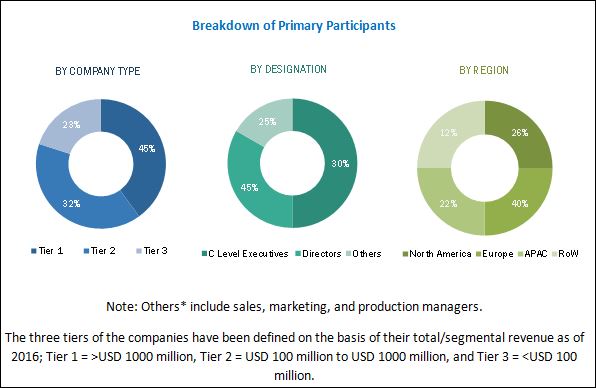
The research methodology used to estimate and forecast the mobile engagement market begins with obtaining data on the revenues of key vendors through secondary research sources such as Mobile Marketing Association, Business Marketing Association, Software and Information Industry Association, and Club Texting, Vendor offerings are taken into consideration to determine the market segmentation. Top-down approach has been employed to arrive at the overall market size of the global mobile engagement market, including integration of software across various verticals and applications and determining the average project cost in terms of USD. After arriving at the overall market size, the total market is split into several segments and subsegments. This is further verified through primary research by conducting extensive interviews with key people—such as CEOs, VPs, directors, and executives. Data triangulation and market breakdown procedures are employed to complete the overall market engineering process and arrive at the exact statistics for all the segments and subsegments.
To know about the assumptions considered for the study, download the pdf brochure
This study also answers several questions, such as which market segments to focus on in the next 2–5 years for prioritizing efforts and investments for stakeholders. Major players operating in the mobile engagement market include IBM (US), Salesforce (US), Oracle (US), Adobe (US), Vibes Media (US), Selligent (Belgium), Urban Airship (US), Appboy (US), Localytics (US), Swrve (US), Tapjoy (US), and Marketo (US).
Target Audience:
- Mobile engagement solution providers
- Small and medium-sized enterprises (SMEs) and large-scale enterprises (LSEs)
- Mobile marketing service providers
- Marketing automation solution providers
- Operations support system (OSS)/business support system (BSS) solution providers
- Cloud computing and software developers
- Advertising agents
- Content providers
- Mobile application developers
Scope of the Report:
The global mobile engagement market, in this research report, has been segmented on the basis of user type, solution, vertical, and geography.
Mobile engagement Market, by User Type:
- SMEs
- LSEs
Mobile engagement Market, by Solution:
- SMS and MMS
- Push Notifications
- In-App Messaging
- E-mails
- App/ Web Content
- Other Solutions
Mobile engagement Market, by Vertical:
- Financial Services
- Media and Entertainment
- Retail
- Travel and Hospitality
- Telecom and IT
- Others
Mobile engagement Market, by Region:
- North America
- Europe
- APAC
- RoW
Available Customizations
With the given market data, MarketsandMarkets offers customizations according to the company’s specific needs. The following customization options are available for the report:
-
Geographic Analysis
- Comprehensive coverage of regulations followed in each region (North America, Europe, APAC, and RoW)
-
Company Information
- Detailed analysis and profiling of additional market players (up to 10)













Growth opportunities and latent adjacency in Mobile Engagement Market