Pre-Shipment Inspection Market by Sourcing Type (In-House and Outsourced), EXIM (Export Goods, Import Goods), Application (Consumer Goods & Retail, Agriculture & Food, Chemicals), and Geography - Global Forecast to 2035


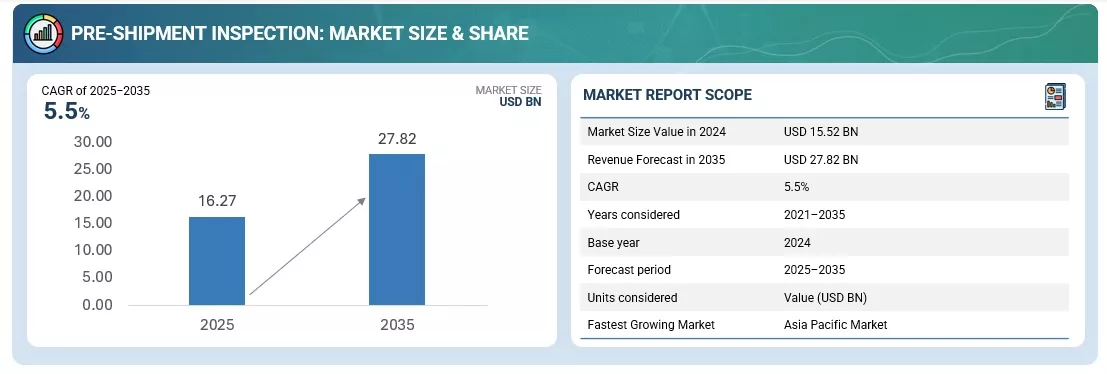
The global pre-shipment inspection market was valued at USD 15.52 billion in 2024 and is estimated to reach USD 27.82 billion by 2035, at a CAGR of 5.5% between 2025 and 2035.
The Pre Shipment Inspection Market represents one of the most essential quality assurance processes in international trade. It ensures that goods meet contractual specifications and regulatory requirements before shipment from the supplier to the buyer. The inspection helps minimize disputes reduces returns and maintains the credibility of exporters and manufacturers. As global trade continues to expand and quality compliance becomes stricter the pre shipment inspection market is evolving from a basic manual check system into a data driven process integrated with digital platforms artificial intelligence and traceability tools. This report offers a detailed analysis of the market structure by sourcing type EXIM flow application segment and regional trends while providing a forecast from 2025 to 2035.
Market Overview
The pre shipment inspection market has become an indispensable part of supply chain management particularly for exporters and importers operating in regulated sectors. The service involves verifying product quality quantity labeling packaging and compliance with international standards before the goods are dispatched from the manufacturing site or warehouse. Traditionally performed by human inspectors the process now benefits from technological integration that enhances accuracy and transparency. In recent years global trade tensions varying quality standards and the need for consumer trust have driven growth in third party inspection services. The pre shipment inspection market is not only about verifying product conformity but also about mitigating risks and ensuring sustainable sourcing practices.
From 2025 to 2035 the global market is projected to experience steady growth fueled by rising international trade volumes increasing outsourcing of inspection activities and the expansion of manufacturing in developing economies. Continuous regulatory evolution especially in food safety chemicals and consumer goods will further boost demand for rigorous pre shipment inspections.
Market Dynamics and Forecast Summary
The overall market outlook remains positive with an expected compound annual growth rate reflecting the increasing emphasis on supply chain transparency and quality compliance. International buyers especially from North America and Europe require detailed inspection certificates before accepting goods from suppliers in Asia Pacific Latin America or Africa. This requirement has expanded the role of inspection agencies which now provide not only on site quality checks but also digital documentation and data analytics. The growing e commerce and cross border retail markets are also major contributors since they rely on verified suppliers to maintain brand reputation.
The integration of remote inspection tools using video verification drones and sensor based quality control is reshaping the market landscape. The ability to monitor inspections remotely in real time shortens lead times and increases trust between buyers and suppliers. Furthermore the rise of sustainability auditing and ethical sourcing verification adds new dimensions to the traditional pre shipment inspection process.
Sourcing Type in House Inspection
In house pre shipment inspection refers to the process conducted by the manufacturing company or the exporter’s internal quality team. These inspections are typically performed by quality engineers and production supervisors using standardized checklists. Companies with mature quality systems and significant production volumes often rely on internal inspection to reduce cost and maintain direct control over product evaluation. In house inspection is prevalent in large scale manufacturing sectors such as automotive electronics and industrial goods where the manufacturers possess the technical expertise to verify specifications.
However in house inspection can be limited by internal bias and resource constraints. Many buyers especially international ones prefer independent third party verification to ensure impartiality. Nevertheless the in house segment remains important as it forms the first line of defense against quality issues before external audits. Technological tools such as digital inspection software and automated defect detection systems are helping internal teams perform faster and more accurate assessments.
Sourcing Type Outsourced Inspection
Outsourced pre shipment inspection is performed by independent agencies or certification bodies specializing in quality verification and compliance services. These organizations provide expertise across multiple industries and are accredited by international standards such as ISO and ASTM. Outsourcing is increasingly preferred by importers and exporters who require objective verification and comprehensive reporting. The outsourced segment dominates the global market as companies seek to avoid costly disputes and non compliance penalties.
Third party inspection firms offer flexible service models including full batch inspections random sampling and container loading supervision. They also help ensure compliance with national and international regulations such as European Union product safety directives United States Food and Drug Administration requirements and customs documentation protocols. Moreover outsourcing reduces administrative burden and allows companies to focus on core operations. The continuous digital transformation in inspection services has further enhanced the efficiency of outsourced providers making them the preferred choice for global trade participants.
EXIM Segmentation Export Goods
Pre shipment inspection of export goods ensures that the products shipped meet the buyer’s specifications and destination country standards. Exporters often undergo these inspections to avoid shipment rejections or delays at customs checkpoints. The inspection process includes checking product design specifications labeling accuracy packaging integrity and conformity to contractual clauses. Exporters who maintain consistent inspection records benefit from enhanced reputation and higher buyer retention rates.
The export inspection market segment is driven by the expansion of trade routes increased global demand for manufactured goods and tighter import regulations in developed markets. Many governments mandate export inspection for specific categories such as food agricultural commodities and hazardous chemicals. Certification of inspection results also helps exporters secure faster clearance and insurance coverage. With trade globalization and regional trade agreements expanding exporters are increasingly investing in advanced pre shipment inspection protocols to maintain competitiveness.
EXIM Segmentation Import Goods
For import goods pre shipment inspection acts as a protective measure for buyers ensuring that the received goods meet contract terms and are free from defects or contamination. Importers rely on inspection agencies to verify that the supplier adheres to agreed standards. The process mitigates risks such as receiving substandard or counterfeit goods and ensures compliance with national regulations on safety and quality. Governments in many developing nations also require pre shipment inspection of imports to control product quality environmental compliance and customs valuation.
The import goods segment experiences high demand in sectors like consumer electronics apparel chemicals and agricultural commodities where quality discrepancies can lead to significant losses. As global supply chains become more diversified importers increasingly depend on independent verification agencies to maintain control over sourcing reliability. With the growing complexity of global trade networks this segment will remain a key driver of overall market expansion through 2035.
Application Consumer Goods and Retail
Consumer goods and retail represent one of the largest application areas for pre shipment inspection. Retailers and e commerce platforms depend on consistent product quality to preserve brand reputation and customer satisfaction. Inspections in this segment cover items such as clothing electronics home appliances toys and furniture. These products are subject to strict safety and labeling standards varying across countries.
Pre shipment inspections verify that items conform to safety codes design specifications and packaging requirements. The retail industry’s focus on minimizing returns and defects has increased the reliance on inspection services particularly as online sales surge globally. Furthermore retailers face consumer scrutiny over ethical sourcing labor conditions and environmental sustainability which adds an additional layer of inspection related to social compliance and supplier auditing. The consumer goods and retail segment is expected to witness continued growth supported by global brand expansion and digital trade.
Application Agriculture and Food
Agriculture and food products require specialized pre shipment inspections to ensure safety freshness and compliance with sanitary and phytosanitary standards. These inspections include visual and laboratory tests to verify quality grading pesticide residue microbiological contamination and packaging integrity. Exporters of perishable goods such as fruits vegetables seafood and grains depend heavily on pre shipment inspections to access foreign markets with strict food safety regulations.
The demand for inspection in this sector is increasing due to rising international food trade growing consumer awareness of food safety and stringent import standards implemented by regulatory agencies like the United States Department of Agriculture and the European Food Safety Authority. Pre shipment inspection plays a crucial role in preventing contamination and ensuring that food shipments comply with cold chain and traceability requirements. With expanding global food trade and sustainability goals this segment is projected to grow steadily throughout the forecast period.
Application Chemicals
The chemical industry relies on pre shipment inspection to confirm product composition labeling packaging and transport safety. Inspections in this segment help prevent shipment of hazardous or non compliant materials that could pose risks during transit or upon arrival. Compliance with international frameworks such as the Globally Harmonized System for Classification and Labeling of Chemicals and the Registration Evaluation Authorization and Restriction of Chemicals regulation in Europe is mandatory for exporters and importers.
The global expansion of specialty chemicals and increasing regulation of hazardous substances have heightened the importance of precise inspection. Suppliers are required to provide accurate safety data sheets and labeling that match shipment documentation. Chemical manufacturers also use pre shipment inspection as a risk mitigation measure to avoid costly recalls and environmental penalties. This application segment benefits from the adoption of digital inspection tools sensors and remote verification technologies that enhance data accuracy and compliance efficiency.
Regional Analysis North America
North America represents a mature market for pre shipment inspection services driven by stringent quality regulations and strong participation in international trade. The United States and Canada rely heavily on third party inspection agencies to verify compliance with domestic and international safety standards. The presence of advanced inspection technologies and data management systems supports the growth of digital inspection solutions. The region’s demand is bolstered by imports of consumer goods electronics and industrial machinery as well as exports of agricultural and high value industrial products.
Regional Analysis Europe
Europe remains one of the leading markets for pre shipment inspection due to its robust regulatory environment and emphasis on product safety and sustainability. The European Union’s compliance frameworks for chemicals food products and consumer goods drive the need for thorough inspection before shipment. European manufacturers and retailers increasingly require proof of inspection from global suppliers to ensure conformity with environmental and ethical sourcing standards. The market also benefits from growing digitalization initiatives that promote transparency and traceability in supply chains.
Regional Analysis Asia Pacific
Asia Pacific dominates the global pre shipment inspection market as it serves as a major hub for manufacturing and export activities. Countries such as China India Vietnam and Indonesia account for a significant share of global exports in textiles electronics machinery and food products. The region has seen strong growth in third party inspection services driven by foreign buyers demanding quality verification. Increasing regional trade agreements and the expansion of export oriented industries create long term growth prospects. Additionally technological advancements and the establishment of local inspection agencies enhance accessibility and cost effectiveness of inspection services in the region.
Regional Analysis Latin America and Middle East Africa
Latin America and the Middle East Africa regions are emerging markets for pre shipment inspection. In Latin America exports of agricultural commodities and minerals drive the demand for inspection services. Governments have implemented regulations requiring pre shipment certification for certain categories to ensure product quality and fair trade practices. In the Middle East Africa region import inspections are vital for verifying product authenticity and preventing entry of counterfeit goods. The growing industrial diversification and trade with Asia and Europe provide additional opportunities for inspection providers in these regions.
Competitive Landscape
The global pre shipment inspection market is highly competitive with both international certification bodies and regional inspection firms operating in various industries. Major players include multinational organizations offering integrated inspection testing and certification services. Competition is based on expertise global coverage digital reporting systems and the ability to provide rapid response times. Partnerships with government agencies and trade organizations enhance credibility and access to regulatory data. The ongoing trend of mergers and acquisitions among inspection firms is aimed at expanding geographic presence and service portfolios.
Market Drivers
The main growth drivers include the rise of global trade the proliferation of quality standards across industries and the growing need for supplier verification in complex supply chains. Increasing consumer awareness and brand accountability have encouraged companies to invest in third party inspections. Additionally the rapid expansion of e commerce requires scalable inspection solutions that can handle high volumes of small parcel shipments. Technological innovation such as remote inspection artificial intelligence based defect detection and digital certification platforms further accelerate market adoption.
Market Challenges
The market faces challenges such as the high cost of inspection services especially for small exporters limited awareness among emerging market participants and inconsistencies in international regulations. Logistical difficulties in reaching remote manufacturing locations and the need for skilled inspectors also affect operational efficiency. Furthermore the transition to digital inspection requires investment in secure data management systems and interoperability standards among agencies and clients.
Opportunities and Innovations
Opportunities lie in the integration of smart inspection systems that leverage cloud platforms and the Internet of Things. Digital twins and real time monitoring can enhance visibility and traceability across the supply chain. The shift toward sustainability and ethical sourcing opens new avenues for inspection providers offering social and environmental audits alongside quality verification. The expansion of regional trade blocs and free trade agreements will continue to drive the need for cross border inspection harmonization and digital documentation.
Report Scope:
By Sourcing Type:
- In-House
- Outsourced
By EXIM:
- Export Goods
- Import Goods
By Application:
- Consumer Goods and Retail
- Agriculture and Food
- Chemicals
- Construction and Infrastructure
- Industrial and Manufacturing
- Medical and Life Sciences
- Mining
- Oil and Gas and Petroleum
- Transportation
- Supply Chain and Logistics
By Geography:
- North America
- Europe
- Asia Pacific (APAC)
- Rest of the World (RoW)
Available Customizations:
With the given market data, MarketsandMarkets offers customizations according to the client’s specific needs. The following customization options are available for the report:
- Geographic Analysis: Further analysis of the pre-shipment inspection market for additional countries
Company Information
- Detailed analysis and profiling of additional market players (up to five)
To speak to our analyst for a discussion on the above findings, click Speak to Analyst
 Exclusive indicates content/data unique to MarketsandMarkets and not available with any competitors.
Table of Contents
1 Introduction (Page No. - 18)
1.1 Objectives of the Study
1.2 Definition
1.3 Study Scope
1.3.1 Markets Covered
1.3.2 Geographic Scope
1.4 Years Considered for the Study
1.5 Currency
1.6 Limitations
1.7 Stakeholders
2 Research Methodology (Page No. - 22)
2.1 Research Data
2.1.1 Secondary Data
2.1.1.1 Secondary Sources
2.1.2 Primary Data
2.1.2.1 Key Data From Primary Sources
2.1.2.2 Key Industry Insights
2.1.2.3 Breakdown of Primaries
2.2 Market Size Estimation
2.2.1 Bottom-Up Approach
2.2.2 Top-Down Approach
2.3 Market Breakdown and Data Triangulation
2.4 Research Assumptions
3 Executive Summary (Page No. - 31)
4 Premium Insights (Page No. - 35)
4.1 Attractive Opportunities in the Market
4.2 Market, By Application
4.3 Market for Export Goods, By Sourcing Type
4.4 In-House Pre-Shipment Inspection Market, By Application
4.5 Market in APAC, By Application and Country
4.6 Market, By Country
5 Market Overview (Page No. - 39)
5.1 Introduction
5.2 Market Dynamics
5.2.1 Drivers
5.2.1.1 Growing Consumer Spending and Ongoing Rapid Urbanization in Emerging Markets
5.2.1.2 Increasing Incidents of Product Recalls Across the World
5.2.1.3 Surging Global Counterfeiting and Piracy Activities
5.2.2 Restraints
5.2.2.1 Pre-Shipment Inspection – Counterproductive for Import Countries and Their Traders
5.2.3 Opportunities
5.2.3.1 Rising Trend of Outsourcing Inspection Services to Third-Party Service Providers
5.2.4 Challenges
5.2.4.1 Long Lead Time for Overseas Qualification Tests
5.3 Value Chain Analysis
5.4 Pre-Shipment Inspection Levels for Acceptance Quality Limit (AQL)
5.4.1 General Inspection Levels
5.4.2 Special Inspection Levels
6 Pre-Shipment Inspection Market, By Sourcing Type (Page No. - 46)
6.1 Introduction
6.2 In-House
6.3 Outsourced
7 Pre-Shipment Inspection Market, By Exim (Page No. - 54)
7.1 Introduction
7.2 Export Goods
7.3 Import Goods
8 Pre-Shipment Inspection Market, By Application (Page No. - 61)
8.1 Introduction
8.2 Consumer Goods and Retail
8.3 Agriculture and Food
8.4 Chemicals
8.5 Construction and Infrastructure
8.6 Industrial and Manufacturing
8.7 Medical Devices and Life Sciences
8.8 Mining
8.9 Oil & Gas and Petroleum
8.10 Transportation
8.10.1 Automotive
8.10.2 Aerospace & Defense
8.10.3 Marine
8.10.4 Rail
8.11 Supply Chain and Logistics
9 Pre-Shipment Inspection Market, By Region (Page No. - 88)
9.1 Introduction
9.2 North America
9.2.1 US
9.2.2 Canada
9.2.3 Mexico
9.3 Europe
9.3.1 UK
9.3.2 Germany
9.3.3 France
9.3.4 Italy
9.3.5 Spain
9.3.6 Rest of Europe
9.4 Asia Pacific
9.4.1 China
9.4.2 Japan
9.4.3 India
9.4.4 South Korea
9.4.5 Australia
9.4.6 Rest of APAC
9.5 Rest of the World
9.5.1 South America
9.5.2 Middle East & Africa
10 Competitive Landscape (Page No. - 110)
10.1 Overview
10.2 Ranking of Players, 2016
10.3 Competitive Scenario
10.3.1 Contracts
10.3.2 Expansions and Service Expansions
10.3.3 Mergers and Acquisitions
11 Company Profiles (Page No. - 116)
11.1 Key Players
(Business Overview, Products Offered, Recent Developments, MnM View, SWOT Analysis)*
11.1.1 SGS
11.1.2 Bureau Veritas
11.1.3 Intertek
11.1.4 TUV SUD
11.1.5 Dekra
11.1.6 TUV Rheinland
11.1.7 UL
11.1.8 Eurofins Scientific
11.1.9 Cotecna
11.1.10 TUV Nord
11.1.11 Applus
11.1.12 ALS
11.1.13 CIS Commodity Inspection Services
11.1.14 DQS CFS
11.1.15 Asiainspection
*Business Overview, Products Offered, Recent Developments, MnM View, SWOT Analysis Might Not Be Captured in Case of Unlisted Companies.
11.2 Key Innovators
11.2.1 Cayley Aerospace
11.2.2 Guangdong Inspection
11.2.3 Asia Quality Focus (AQF)
11.2.4 Soloarbuyer
11.2.5 Aim Control Group
12 Appendix (Page No. - 148)
12.1 Insights of Industry Experts
12.2 Discussion Guide
12.3 Knowledge Store: Marketsandmarkets’ Subscription Portal
12.4 Introducing RT: Real-Time Market Intelligence
12.5 Available Customizations
12.6 Related Reports
12.7 Author Details
List of Tables (65 Tables)
Table 1 Pre-Shipment Inspection Market, By Sourcing Type, 2015–2023 (USD Billion)
Table 2 Market for In-House Services, By Application, 2015–2023 (USD Million)
Table 3 Market for In-House Services, By Exim, 2015–2023 (USD Billion)
Table 4 Market for Outsourced Services, By Application, 2015–2023 (USD Million)
Table 5 Market for Outsourced Serfvices, By Exim, 2015–2023 (USD Million)
Table 6 Market, By Exim, 2015–2023 (USD Billion)
Table 7 Market for Export Goods, By Application, 2015–2023 (USD Million)
Table 8 Market for Export Goods, By Sourcing Type, 2015–2023 (USD Billion)
Table 9 Market for Export Goods, By Region, 2015–2023 (USD Billion)
Table 10 Market for Import Goods, By Application, 2015–2023 (USD Million)
Table 11 Market for Import Goods, By Sourcing Type, 2015–2023 (USD Million)
Table 12 Market for Import Goods, By Region, 2015–2023 (USD Million)
Table 13 Market, By Application, 2015–2023 (USD Million)
Table 14 Market for Consumer Goods and Retail Application, By Exim, 2015–2023 (USD Million)
Table 15 Market for Consumer Goods and Retail Application, By Sourcing Type, 2015–2023 (USD Million)
Table 16 Market for Consumer Goods and Retail Application, By Region, 2015–2023 (USD Million)
Table 17 Market for Agriculture and Food Application, By Exim, 2015–2023 (USD Million)
Table 18 Market for Agriculture and Food Application, By Sourcing Type, 2015-2023 (USD Million)
Table 19 Market for Agriculture and Food Application, By Region, 2015–2023 (USD Million)
Table 20 Market for Chemicals Application, By Exim, 2015–2023 (USD Million)
Table 21 Market for Chemicals Application, By Sourcing Type, 2015-2023 (USD Million)
Table 22 Market for Chemicals Application, By Region, 2015–2023 (USD Million)
Table 23 Market for Construction and Infrastructure Application, By Exim, 2015–2023 (USD Million)
Table 24 Market for Construction and Infrastructure Application, By Sourcing Type, 2015–2023 (USD Million)
Table 25 Market for Construction and Infrastructure Application, By Region, 2015–2023 (USD Million)
Table 26 Market for Industrial and Manufacturing Application, By Exim, 2015–2023 (USD Million)
Table 27 Market for Industrial and Manufacturing Application, By Sourcing Type, 2015–2023 (USD Million)
Table 28 Market for Industrial and Manufacturing Application, By Region, 2015–2023 (USD Million)
Table 29 Pre-Shipment Inspcetion Marketfor Medical and Life Sciences Application, By Exim, 2015–2023 (USD Million)
Table 30 Market for Medical Devices and Life Sciences Application, By Sourcing Type, 2015–2023 (USD Million)
Table 31 Market for Medical Devices and Life Sciences Application, By Region, 2015–2023 (USD Million)
Table 32 Market for Mining Application, By Exim, 2015–2023 (USD Million)
Table 33 Market for Mining Application, By Sourcing Type, 2015–2023 (USD Million)
Table 34 Market for Mining Application, By Region, 2015–2023 (USD Million)
Table 35 Market for Oil & Gas and Petroleum Application, By Exim, 2015–2023 (USD Million)
Table 36 Market for Oil & Gas and Petroleum Application, By Sourcing Type, 2015–2023 (USD Million)
Table 37 Market for Oil & Gas and Petroleum Application, By Region, 2015–2023 (USD Million)
Table 38 Market for Transportation Application, By Type, 2015–2023 (USD Million)
Table 39 Market for Transportation Application, By Exim, 2015–2023 (USD Million)
Table 40 Market for Transportation Application, By Sourcing Type, 2015–2023 (USD Million)
Table 41 Market for Transportation Application, By Region, 2015–2023 (USD Million)
Table 42 Market for Automotive Application, By Exim, 2015-2023 (USD Million)
Table 43 Market for Aerospace & Defense Application, By Exim, 2015–2023 (USD Million)
Table 44 Market for Marine Application, By Exim, 2015–2023 (USD Million)
Table 45 Market for Rail Application, By Exim, 2015–2023 (USD Million)
Table 46 Market for Supply Chain and Logistics Application, By Exim, 2015–2023 (USD Million)
Table 47 Market for Supply Chain and Logistics Application, By Sourcing Type, 2015–2023 (USD Million)
Table 48 Market for Supply Chain and Logistics Application, By Region, 2015–2023 (USD Million)
Table 49 Market, By Region, 2015–2023 (USD Billion)
Table 50 Market in North America, By Country, 2015–2023 (USD Million)
Table 51 Market in North America, By Application, 2015–2023 (USD Million)
Table 52 Market in North America, By Exim, 2015–2023 (USD Million)
Table 53 Market in Europe, By Country, 2015–2023 (USD Million)
Table 54 Market in Europe, By Application, 2015–2023 (USD Million)
Table 55 Market in Europe, By Exim, 2015–2023 (USD Million)
Table 56 Market in APAC, By Country, 2015–2023 (USD Million)
Table 57 Market in APAC, By Application, 2015–2023 (USD Million)
Table 58 Market in APAC, By Exim, 2015–2023 (USD Million)
Table 59 Market in RoW, By Region, 2015–2023 (USD Million)
Table 60 Market in RoW, By Application, 2015–2023 (USD Million)
Table 61 Market in RoW, By Exim, 2015–2023 (USD Million)
Table 62 Ranking Analysis of Top 5 Companies in the Market, 2016
Table 63 Contracts (2014–2017)
Table 64 Expansions and Service Expansions (2016-2017)
Table 65 Mergers and Acquisitions (2017)
List of Figures (52 Figures)
Figure 1 Process Flow of Market Size Estimation
Figure 2 Research Design
Figure 3 Data Triangulation Methodology
Figure 4 Market Snapshot, By Application, 2017–2023 (USD Billion)
Figure 5 Market for Outsourced Services Likely to Grow at A Higher CAGR During the Forecast Period
Figure 6 Export Goods Expected to Hold A Larger Size of the Market During the Forecast Period
Figure 7 APAC Accounted for the Largest Share of the Pre-Shipment Market in 2017
Figure 8 Rising Trend of Outsourcing Inspection Services to Third-Party Service Providers Expected to Provide Lucrative Opportunities During the Forecast Period
Figure 9 Market for Agriculture and Food Application Expected to Grow at the Highest CAGR During the Forecast Period
Figure 10 In-House Segment Expected to Hold A Larger Market Size for Export Goods By 2023
Figure 11 C0nsumer Goods and Retail Application to Hold the Largest Size of the In-House Pre-Shipment Inspection Market During 2018–2023
Figure 12 Consumer Goods and Retail Application Accounted for the Largest Market Share in APAC in 2017
Figure 13 India Expected to Exhibit the Highest CAGR in the Global Pre-Shipment Inspection Market Between 2018 and 2023
Figure 14 Pre-Shipment Inspection Market: Drivers, Challenges, Restraints, Opportunities
Figure 15 Value Chain Analysis: Market
Figure 16 Market for Outsourced Services Expected to Grow at A Higher CAGR During the Forecast Period
Figure 17 Agriculture and Food Segment Expected to Exhibit the Highest CAGR in the Market for In-House Pre-Shipment Inspection Services During the Forecast Period
Figure 18 Consumer Goods and Retail Segment Expected to Hold the Largest Size of the Market for Outsourced Services By 2023
Figure 19 Market for Import Goods Expected to Grow at A Higher CAGR During the Forecast Period
Figure 20 Agriculture and Food Segment Expected to Exhibit the Highest CAGR in the Market for Export Goods During the Forecast Period
Figure 21 Consumer Goods and Retail Segment Expected to Hold the Largest Size of the Market for Import Goods in 2018
Figure 22 Agriculture and Food Application to Exhibit the Highest CAGR in the Market During 2018–2023
Figure 23 Import Goods Expected to Exhibit A Higher CAGR in the Market for Consumer Goods and Retail Application During the Forecast Period
Figure 24 Export Goods to Hold A Larger Size of the Market for Chemicals Application in 2023
Figure 25 APAC to Lead the Market for Construction and Infrastructure Application During 2018–2023
Figure 26 Import Goods to Exhibit A Higher CAGR in the Market for Industrial and Manufacturing Application During the Forecast Period
Figure 27 APAC to Exhibit the Highest CAGR in the Market for Medical Devices and Life Sciences Application During the Forecast Period
Figure 28 APAC to Dominate the Outsourced Pre-Shipment Inspection Market During the Forecast Period
Figure 29 Export Goods to Hold the Largest Size of the Market for Oil & Gas and Petroleum Application During 2018–2023
Figure 30 Import Goods to Claim A Higher CAGR in the Market for Automotive Application During the Forecast Period
Figure 31 Market for Supply Chain and Logistics Application in North America to Grow at the Highest CAGR During the Forecast Period
Figure 32 Geographic Snapshot: Rapidly Growing Countries, Such as India and Japan, and Australia, China are Emerging as Potential New Markets
Figure 33 APAC Likely to Dominate the Market During the Forecast Period
Figure 34 North America: Pre-Shipment Inspection Market Snapshot
Figure 35 Medical Devices and Life Sciences Application to Hold the Largest Size of the Market in North America By 2023
Figure 36 Europe: Pre-Shipment Inspection Market Snapshot
Figure 37 Germany to Hold the Largest Size of the European Pre-Shipment Inspection Market By 2023
Figure 38 Asia Pacific: Pre-Shipment Inspection Market Snapshot
Figure 39 China to Hold the Largest Size of the Market in APAC in 2023
Figure 40 South America to Lead the Market in RoW During the Forecast Period
Figure 41 Companies Adopted Service Launches and Developments as Key Growth Strategies Between 2014 and 2017
Figure 42 Market Evolution Framework: New Expansions and Service Expansions as the Major Strategies Adopted By Key Players
Figure 43 SGS: Company Snapshot
Figure 44 Bureau Veritas: Company Snapshot
Figure 45 Intertek: Company Snapshot
Figure 46 TUV SUD: Company Snapshot
Figure 47 Dekra: Company Snapshot
Figure 48 TUV Rheinland: Company Snapshot
Figure 49 Eurofins Scientific: Company Snapshot
Figure 50 TUV Nord: Company Snapshot
Figure 51 Applus: Company Snapshot
Figure 52 ALS: Company Snapshot













Growth opportunities and latent adjacency in Pre-Shipment Inspection Market