Production Printer Market by Type (Monochrome, Color), Technology (Inkjet, Toner), Production Method (Cut Sheet, Continuous Feed, Sheet Fed, and Web Based), Application and Geography - Global Trends & Forecast to 2035


Production Printer Market Summary
The global Production Printer Market is witnessing steady expansion as enterprises, commercial print service providers, publishing houses, packaging companies, and industrial manufacturers continue investing in high-speed, high-volume digital printing solutions. The market is estimated at USD 7–8 billion in 2025 and is projected to reach USD 12–14 billion by 2035, registering a CAGR of 5%–7% during the forecast period. Growth is driven by rising demand for personalized printing, on-demand publishing, packaging applications, and digital transformation across the printing ecosystem. The integration of artificial intelligence (AI), Internet of Things (IoT), automation, cloud-enabled print management, and predictive maintenance technologies is reshaping production printing operations, enabling higher efficiency, reduced downtime, and improved print quality. Increasing adoption of industrial inkjet technologies, hybrid printing systems, and sustainable printing practices is further supporting market expansion worldwide.
Key Market Trends & Insights
-
North America remains the leading regional market due to advanced printing infrastructure, strong commercial printing demand, and rapid adoption of digital print technologies.
-
Asia Pacific is projected to be the fastest-growing region, supported by industrialization, packaging demand, and expanding publishing sectors in China, Japan, and India.
-
Inkjet production printers dominate the market owing to superior speed, flexibility, and cost efficiency for short-run and variable data printing.
-
AI-powered print analytics, predictive maintenance, and automated workflow management are becoming major technology trends.
-
IoT-enabled production printers are improving operational visibility, remote diagnostics, and equipment uptime.
-
Sustainable printing technologies, energy-efficient systems, and eco-friendly inks are gaining traction among enterprises.
Market Size & Forecast
-
Base Year Market Size (2025): USD 7–8 billion
-
Forecast Market Value (2035): USD 12–14 billion
-
Expected CAGR (2025–2035): 5%–7%
-
Growth is supported by increasing digital printing demand, automation, personalized printing solutions, packaging applications, and AI-enabled workflow optimization.
Production Printer Market Top 10 key takeaway
-
Production printing is shifting rapidly from conventional to digital technologies.
-
Inkjet printers account for the largest market share.
-
Packaging and label printing are key growth applications.
-
AI is improving print quality and predictive maintenance.
-
IoT integration enables real-time printer monitoring.
-
Asia Pacific is expected to witness the highest growth rate.
-
Sustainable printing solutions are gaining importance.
-
Cloud-based workflow management is increasing operational efficiency.
-
Industrial automation is reducing production costs.
-
Strategic partnerships and product innovations are intensifying competition.
Product Insights
The inkjet production printer segment holds the largest share of the Production Printer Market due to its ability to deliver high-speed, cost-effective, and customizable printing solutions. Inkjet technology supports variable data printing, short production runs, and high-quality outputs, making it ideal for publishing, packaging, transactional printing, and commercial applications.
Continuous-feed inkjet printers are increasingly adopted by enterprises handling large-scale printing volumes, while sheet-fed systems remain popular among commercial print providers requiring flexibility and superior image quality. The demand for color production printers is also rising as businesses seek enhanced visual communication and personalized marketing materials.
Emerging product categories include hybrid printing systems that combine offset and digital technologies, industrial inkjet platforms, and AI-integrated printing systems. Smart printers equipped with sensors and machine learning capabilities can automatically optimize print settings, detect errors, and improve workflow efficiency.
Additionally, sustainable products using low-energy consumption systems and eco-friendly inks are becoming key differentiators for manufacturers. As print service providers focus on reducing waste and operational costs, intelligent production printers are expected to gain wider acceptance.
Technology / Component Insights
Technological advancements are transforming the Production Printer Market by improving speed, efficiency, print quality, and automation. Inkjet technology remains the primary growth engine, supported by innovations in printheads, pigment inks, UV-curable inks, and high-resolution imaging systems.
Artificial intelligence is playing a crucial role in print workflow optimization. AI-powered software can analyze print jobs, automate scheduling, reduce waste, and predict maintenance requirements. Predictive analytics helps organizations minimize downtime and improve equipment utilization.
IoT-enabled production printers allow remote diagnostics, real-time monitoring, and cloud-based performance management. Sensors embedded within printers collect operational data, enabling manufacturers and service providers to optimize productivity.
Cloud technologies are supporting centralized print management, remote operations, and integration with enterprise resource planning (ERP) systems. Automation technologies are also reducing manual intervention in print preparation, color management, finishing processes, and job handling.
Future innovations are expected to include autonomous printing systems, AI-based color correction, robotic material handling, digital twin technology, and advanced industrial inkjet platforms designed for high-volume applications.
Application Insights
Commercial printing remains the largest application segment in the Production Printer Market, driven by demand from publishing houses, advertising agencies, direct mail providers, and marketing companies. The shift toward personalized marketing materials and on-demand printing continues to create strong opportunities for production printer manufacturers.
Packaging and label printing is emerging as one of the fastest-growing applications due to increasing e-commerce activities, consumer product packaging requirements, and demand for customized labels. Digital printing enables short production runs and rapid design changes, which are essential for modern packaging needs.
Transactional printing, including invoices, financial statements, and business documents, continues to support market demand, particularly in banking, healthcare, and government sectors. Industrial printing applications such as textiles, ceramics, electronics, and décor printing are also expanding rapidly.
The integration of AI, automation, and digital workflows is creating opportunities for efficient and flexible printing operations across various industries.
Regional Insights
North America dominates the Production Printer Market due to the presence of advanced printing technologies, established commercial printing industries, and strong investments in automation. The United States remains a major contributor, supported by digital transformation initiatives and high adoption of industrial inkjet solutions.
Europe represents a significant market, driven by sustainability initiatives, premium packaging demand, and technological innovation. Germany, France, the United Kingdom, and Italy continue to invest in advanced digital printing systems.
Asia Pacific is expected to register the fastest growth during the forecast period. China, Japan, India, and South Korea are witnessing increasing demand for packaging, publishing, textiles, and industrial printing applications. Expanding manufacturing sectors and rising adoption of smart factory concepts further support market growth.
Latin America and the Middle East & Africa are also experiencing gradual adoption due to improving industrial infrastructure and rising commercial printing activities.
Regional Summary:
-
North America leads the market in technology adoption.
-
Europe focuses on sustainable and premium printing solutions.
-
Asia Pacific records the fastest growth.
-
Packaging applications drive demand in emerging economies.
-
Digital transformation supports global market expansion.
Country-Specific Market Trends
China (CAGR: 7%–9%) is experiencing strong growth due to large-scale manufacturing, packaging demand, and investments in industrial digital printing technologies.
Japan (CAGR: 5%–7%) remains a key market owing to technological advancements and strong presence of printer manufacturers.
United States (CAGR: 4%–6%) leads in AI-enabled printing solutions, automation, and commercial print applications.
Canada (CAGR: 4%–5%) is witnessing increasing adoption of digital print technologies in publishing and packaging sectors.
Mexico (CAGR: 5%–6%) benefits from industrial expansion and packaging demand.
Germany (CAGR: 4%–6%) remains a major European market due to advanced manufacturing and Industry 4.0 initiatives.
France (CAGR: 4%–5%) supports growth through premium packaging and commercial printing demand.
Country-Level Summary:
-
China remains the fastest-growing market.
-
Japan drives technological innovation.
-
The U.S. leads AI and automation adoption.
-
Germany focuses on smart manufacturing integration.
-
Packaging demand supports growth across regions.
Key Production Printer Market Company Insights
Major companies are focusing on product innovation, AI integration, and automation to strengthen their market positions. Leading players are investing in cloud-enabled print management, industrial inkjet technologies, and sustainable printing solutions.
Key companies include:
-
Canon Inc.
-
Xerox Holdings Corporation
-
HP Inc.
-
Ricoh Company Ltd.
-
Konica Minolta Inc.
-
Fujifilm Holdings Corporation
-
Epson Corporation
-
Kodak
-
Kyocera Corporation
-
SCREEN Holdings Co., Ltd.
These companies are emphasizing AI-driven workflow automation, predictive maintenance, strategic partnerships, and expansion into industrial printing applications.
Company Strategy Summary:
-
Increased investments in AI-enabled solutions.
-
Expansion of industrial inkjet portfolios.
-
Focus on sustainable technologies.
-
Strategic partnerships for innovation.
-
Development of cloud-connected printing systems.
Recent Developments
-
Canon introduced AI-based print workflow software to improve productivity and reduce operational costs.
-
HP expanded its industrial inkjet printer portfolio targeting packaging and commercial applications.
-
Fujifilm partnered with automation software providers to develop smart printing ecosystems integrating IoT technologies.
Market Segmentation
The Production Printer Market is segmented by product, technology, application, and region. By product, the market includes inkjet production printers, laser production printers, and hybrid systems. Inkjet printers dominate due to flexibility and lower operating costs. By technology, the market comprises monochrome printing, color printing, cloud-enabled printing, and AI-integrated systems. Applications include commercial printing, packaging, labels, publishing, transactional printing, and industrial printing. Regionally, North America leads, Europe maintains steady growth, and Asia Pacific represents the fastest-expanding market.
Segmentation Summary:
-
Inkjet printers dominate product demand.
-
AI-enabled technologies are growing rapidly.
-
Commercial printing remains the largest application.
-
Packaging is the fastest-growing segment.
-
Asia Pacific offers significant opportunities.
The Production Printer Market is expected to maintain strong growth through 2035, supported by increasing digitalization, packaging demand, and industrial automation. Artificial intelligence, IoT connectivity, cloud computing, and workflow automation are transforming printing operations by improving efficiency, reducing costs, and enabling customized production. Companies investing in smart printing technologies, sustainable solutions, and industrial applications are expected to gain competitive advantages. As businesses increasingly adopt digital transformation strategies, production printers will remain essential tools for modern commercial and industrial printing ecosystems.
FAQs - Production Printer Market
1. What is the market size of the Production Printer Market?
The market is estimated at USD 7–8 billion in 2025.
2. What is the expected growth rate?
The market is projected to grow at a CAGR of 5%–7% from 2025 to 2035.
3. What are the major growth drivers?
Key drivers include digital printing demand, AI integration, IoT-enabled systems, automation, packaging applications, and personalized printing.
4. Which region leads the market?
North America currently holds the largest market share.
5. Who are the major companies in the Production Printer Market?
Major players include Canon Inc., HP Inc., Xerox Holdings Corporation, Ricoh Company, Ltd., and Konica Minolta, Inc..
 Exclusive indicates content/data unique to MarketsandMarkets and not available with any competitors.
Table of Contents
1 Introduction (Page No. - 14)
1.1 Study Objectives
1.2 Market Definition
1.3 Market Scope
1.3.1 Markets Covered
1.3.2 Years Considered for the Study
1.4 Currency
1.5 Limitations
1.6 Stakeholders
2 Research Methodology (Page No. - 18)
2.1 Research Data
2.1.1 Secondary Data
2.1.1.1 Key Data From Secondary Sources
2.1.2 Primary Data
2.1.2.1 Key Data From Primary Sources
2.1.2.2 Key Industry Insights
2.1.2.3 Breakdown of Primaries
2.2 Market Size Estimation
2.3 Market Breakdown & Data Triangulation
2.4 Research Assumptions
2.4.1 Assumptions
3 Executive Summary (Page No. - 26)
4 Premium Insights (Page No. - 32)
4.1 Growth Opportunities in the Production Printer Market
4.2 Market, By Type
4.3 Transactional Application to Hold the Largest Share of the Market
4.4 APAC Market Expected to Grow at the Highest Rate for Production Printer During the Forecast Period
4.5 Market, By Geography
4.6 Life Cycle Analysis, By Geography
5 Market Overview (Page No. - 36)
5.1 Introduction
5.2 Market Segmentation
5.2.1 Market, By Type
5.2.2 Market, By Production Method
5.2.3 Market, By Application
5.2.4 Market, By Technology
5.2.5 Market, By Geography
5.3 Market Dynamics
5.3.1 Drivers
5.3.1.1 Increasing Usage in Publishing Industry
5.3.1.2 High Demand From Media and Advertising Industry
5.3.2 Restraints
5.3.2.1 High Initial Investment Cost
5.3.2.2 Competition From Substitute Technology
5.3.3 Opportunities
5.3.3.1 Demand From Label and Package Printing
5.3.3.2 Availability of A Wide Range of Options
5.3.3.3 Demand From In-Plant Markets
5.3.4 Challenges
5.3.4.1 Rising Demand for Digital Advertisements and E-Books
6 Industry Trends (Page No. - 45)
6.1 Introduction
6.2 Value Chain Analysis
6.3 Porter’s Five Forces Analysis, 2015
6.3.1 Competitive Rivalry
6.3.2 Threat of Substitutes
6.3.3 Bargaining Power of Buyers
6.3.4 Bargaining Power of Suppliers
6.3.5 Threat of New Entrants
7 Market, By Type (Page No. - 52)
7.1 Introduction
7.2 Monochrome
7.3 Color
8 Market, By Production Method (Page No. - 57)
8.1 Introduction
8.2 Cut Sheet
8.3 Continuous Feed
8.4 Sheet Feed
8.5 Web Based
9 Market, By Technology (Page No. - 69)
9.1 Introduction
9.2 Inkjet
9.3 Toner
10 Market, By Application (Page No. - 76)
10.1 Introduction
10.2 Transactional
10.3 Commercial
10.4 Publishing
10.5 Label & Package
10.6 Other
11 Market, By Geography (Page No. - 92)
11.1 Introduction
11.2 North America
11.2.1 The U.S. to Hold the Largest Share of North American Market
11.2.2 U.S.
11.2.2.1 The Transactional Application in the U.S. Held the Largest Market Size in 2015
11.2.3 Canada
11.3 Europe
11.3.1 The French Market is Expected to Witness High Growth Rate in the European Market During the Forecast Period
11.3.2 U.K.
11.3.2.1 High Quality and Mass Print Production Expected to Drive the U.K. Market
11.3.3 Germany
11.3.3.1 Increased Demand for Printing in the Commercial Application is Expected to Drive the Market
11.3.4 France
11.3.5 Rest of Europe
11.4 APAC
11.4.1 Japan is Expected to Dominate the APAC Market During the Forecast Period
11.4.2 China
11.4.2.1 High Demand for Transactional and Publishing Application is Expected to Propel the Growth of the Market in China
11.4.3 Japan
11.4.3.1 Highest Usage in Publishing Application is Driving the Market in Japan
11.4.4 India
11.4.5 Rest of APAC
11.5 RoW
11.5.1 Increased Usage in the Middle East & Africa is Expected to Drive the Market
12 Competitive Landscape (Page No. - 109)
12.1 Overview
12.2 Companies and Their Market Share in the Market, 2015
12.3 Competitive Situation
12.4 Recent Developments
12.4.1 New Product Developments
12.4.2 Partnerships & Agreements
12.4.3 Mergers & Acquisitions
12.4.4 Expansions
13 Company Profiles (Page No. - 115)
(Overview, Products and Services, Financials, Strategy & Development)*
13.1 Introduction
13.2 Xerox Corporation
13.3 Hewlett-Packard Development Company, L.P.
13.4 Ricoh Company Ltd
13.5 Canon Inc.
13.6 Konica Minolta, Inc.
13.7 Agfa-Gevaert N.V.
13.8 Eastman Kodak Company
13.9 EFI Elecronics Corporation
13.10 Inca Digital Printers Ltd.
13.11 Miyakoshi Co., Ltd.
*Details on Overview, Products and Services, Financials, Strategy & Development Might Not Be Captured in Case of Unlisted Companies.
14 Appendix (Page No. - 140)
14.1 Insights of Industry Experts
14.2 Discussion Guide
14.3 Knowledge Store: Marketsandmarkets’ Subscription Portal
14.4 Introducing RT: Real-Time Market Intelligence
14.5 Available Customizations
14.6 Related Reports
List of Tables (75 Tables)
Table 1 Production Printer Market Segmentation, By Type
Table 2 Market Segmentation, By Production Method
Table 3 Market Segmentation, By Application
Table 4 Market Segmentation, By Technology
Table 5 Increased Usage in Publishing Industry to Propel the Growth of the Market During the Forecast Period
Table 6 High Investment Cost Restrains the Market Growth
Table 7 Growing Demand for Label & Package is an Opportunity for the Production Printing Market
Table 8 Porter’s Five Forces Analysis: Threat of New Entrants to Have Medium Impact on the Overall Market
Table 9 Market, By Type, 2013–2022 (USD Million)
Table 10 Monochrome Market, By Production Method, 2013–2022 (USD Million)
Table 11 Monochrome Market, By Application, 2013–2022 (USD Million)
Table 12 Color Market, By Production Method, 2013–2022 (USD Million)
Table 13 Color Market, By Application, 2013–2022 (USD Million)
Table 14 Market, By Production Method, 2013–2022 (USD Million)
Table 15 Cut Sheet Production Printer Market, By Type, 2013–2022 (USD Million)
Table 16 Cut Sheet Market, By Application, 2013–2022 (USD Million)
Table 17 Cut Sheet Market, By Technology, 2013–2022 (USD Million)
Table 18 Cut Sheet Market, By Region, 2013–2022 (USD Million)
Table 19 Continuous Feed Production Printer Market, By Type, 2013–2022 (USD Million)
Table 20 Continuous Feed Market, By Application, 2013–2022 (USD Million)
Table 21 Continuous Feed Market, By Technology, 2013–2022 (USD Million)
Table 22 Continuous Feed Market, By Region, 2013–2022 (USD Million)
Table 23 Sheet-Fed Production Printer Market, By Type, 2013–2022 (USD Million)
Table 24 Sheet-Fed Market, By Application, 2013–2022 (USD Million)
Table 25 Sheet-Fed Market, By Technology, 2013–2022 (USD Million)
Table 26 Sheet-Fed Market, By Region, 2013–2022 (USD Million)
Table 27 Web-Based Production Printer Market, By Type, 2013–2022 (USD Million)
Table 28 Web-Based Market, By Application, 2013–2022 (USD Million)
Table 29 Web-Based Market, By Technology, 2013–2022 (USD Million)
Table 30 Web-Based Market, By Region, 2013–2022 (USD Million)
Table 31 Market, By Technology, 2013–2022 (USD Million)
Table 32 Market, By Printing Technology, 2013–2022 (Thousand Units)
Table 33 Inkjet-Based Production Printer Market, By Production Method, 2013–2022 (USD Million)
Table 34 Inkjet-Based Market, By Application, 2013–2022 (USD Million)
Table 35 Toner-Based Market, By Production Method, 2013–2022 (USD Million)
Table 36 Toner-Based Market, By Application, 2013–2022 (USD Million)
Table 37 Market, By Application, 2013–2022 (USD Million)
Table 38 Market for Transactional Application, By Type, 2013–2022 (USD Million)
Table 39 Market for Transactional Application, By Technology, 2013–2022 (USD Million)
Table 40 Market for Transactional Application, By Production Method, 2013–2022 (USD Million)
Table 41 Market for Transactional Application, By Region, 2013–2022 (USD Million)
Table 42 Market for Commercial Application, By Type, 2013–2022 (USD Million)
Table 43 Market for Commercial Application, By Technology, 2013–2022 (USD Million)
Table 44 Market for Commercial Application, By Production Method, 2013–2022 (USD Million)
Table 45 Market for Commercial Application, By Region, 2013–2022 (USD Million)
Table 46 Market for Publishing Application, By Type, 2013–2022 (USD Million)
Table 47 Market for Publishing Application, By Technology, 2013–2022 (USD Million)
Table 48 Market for Publishing Application, By Production Method, 2013–2022 (USD Million)
Table 49 Market for Publishing Application, By Region, 2013–2022 (USD Million)
Table 50 Market for Label & Package Application, By Type, 2013–2022 (USD Million)
Table 51 Market for Label & Package Application, By Technology, 2013–2022 (USD Million)
Table 52 Market for Label & Package Application, By Production Method, 2013–2022 (USD Million)
Table 53 Market for Label & Package Application, By Region, 2013–2022 (USD Million)
Table 54 Market for Other Application, By Type, 2013–2022 (USD Million)
Table 55 Market for Other Application, By Technology, 2013–2022 (USD Million)
Table 56 Market for Other Application, By Production Method, 2013–2022 (USD Million)
Table 57 Market for Other Application, By Region, 2013–2022 (USD Million)
Table 58 Market, By Region, 2013–2022 (USD Million)
Table 59 Market, By Region, 2013–2022 (Thousand Units)
Table 60 Market in North America, By Application, 2013–2022 (USD Million)
Table 61 Market in North America, By Production Method, 2013–2022 (USD Million)
Table 62 Market in North America, By Country, 2013–2022 (USD Million)
Table 63 Market in Europe, By Application, 2013–2022 (USD Million)
Table 64 Market in Europe, By Production Method, 2013–2022 (USD Million)
Table 65 Market in Europe, By Geography, 2013–2022 (USD Million)
Table 66 Market in APAC, By Application, 2013–2022 (USD Million)
Table 67 Market in APAC, By Production Method, 2013–2022 (USD Million)
Table 68 Market in APAC, By Geography, 2013–2022 (USD Million)
Table 69 Market in RoW, By Application, 2013–2022 (USD Million)
Table 70 Market in RoW, By Production Method, 2013–2022 (USD Million)
Table 71 Market in RoW, By Region, 2013–2022 (USD Million)
Table 72 New Product Developments, 2014–2015
Table 73 Partnerships & Agreements, 2014–2015
Table 74 Acquisition,2013-2014
Table 75 Market Expansion, 2013–2015
List of Figures (69 Figures)
Figure 1 Production Printer Market: Research Design
Figure 2 Market Size Estimation Methodology: Bottom-Up Approach
Figure 3 Market Size Estimation Methodology: Top-Down Approach
Figure 4 Data Triangulation
Figure 5 Global Market Size, (2013-2022)
Figure 6 Market for Color Production Printer Expected to Grow at the Highest Rate During the Forecast Period
Figure 7 Cut Sheet Production Method is Expected to Grow at Highest Rate in the Market
Figure 8 Inkjet Technology is Expected to Grow at Highest Rate During the Forecast Period
Figure 9 Transactional Application Market Estimated to Hold the Largest Share of the Market
Figure 10 APAC Market Expected to Witness Highest Growth During the Forecast Period
Figure 11 Demand for Production Printers to Increase Significantly During the Forecast Period
Figure 12 Market for Color Type Production Printer to Grow at A High Rate During the Forecast Period
Figure 13 Japan Held the Largest Share of the APAC Market in 2015
Figure 14 Market in India Expected to Grow at the Highest CAGR During the Forecast Period
Figure 15 APAC Market for Production Printer to Grow at the Highest Rate During the Forecast Period
Figure 16 North America Held the Largest Share of the Market in 2015
Figure 17 Market : Segmentation
Figure 18 Market Segmentation, By Geography
Figure 19 Increasing Usage in Publishing Industry Expected to Spur the Demand for Production Printer
Figure 20 Largest Book Market Across the World in 2012
Figure 21 Value Chain Analysis: Major Value Added During Manufacturing
Figure 22 Porter’s Five Forces Analysis:
Figure 23 Market: Porter’s Five Forces Analysis
Figure 24 Competitive Rivalry: High Degree of Competition in the Market Due to the Presence of Several Players
Figure 25 Threat of Substitutes in Market, 2015
Figure 26 Bargaining Power of Buyers in Market, 2015
Figure 27 Bargaining Power of Suppliers in Market, 2015
Figure 28 Threat of New Entrants in Market, 2015
Figure 29 Market Segmentation: By Type
Figure 30 Color Production Printer to Grow at High CAGR During the Forecast Period
Figure 31 Market Segmentation: By Production Method
Figure 32 Cut Sheet Production Printers Expected to Grow at the Highest Rate During the Forecast Period
Figure 33 Market for Continuous Feed Production Printer Based on Inkjet Technology Expected to Grow at the Highest Rate During the Forecast Period
Figure 34 Market for Web-Based Production Printer Based on Inkjet Technology Expected to Grow at the Highest Rate During the Forecast Period
Figure 35 Market Segmentation: By Technology
Figure 36 Inkjet Technology Market to Grow at the Highest Rate During the Forecast Period
Figure 37 Transactional Printing Expected to Remain Largest Market for Toner Based Production Printing
Figure 38 Market Segmentation: By Application
Figure 39 Market for Label and Packages Printing Application Expected to Grow at the Highest Rate During the Forecast Period
Figure 40 Inkjet-Based Market to Grow at the Highest Rate for Commercial Application
Figure 41 Color Type Market for Publishing Application Expected to Grow at the Highest Rate During the Forecast Period
Figure 42 APAC Market to Grow at the Highest Rate for Other Application
Figure 43 Market Segmentation: By Geography
Figure 44 Geographic Snapshot: APAC Expected to Register Highest Growth Rate During the Forecast Period
Figure 45 Market in North America: By Country
Figure 46 North America: Snapshot of Market
Figure 47 Market in Europe: By Geography
Figure 48 Europe: Market Snapshot
Figure 49 Market in APAC: By Geography
Figure 50 APAC: Market Snapshot
Figure 51 Market in RoW: By Region
Figure 52 Key Growth Strategies Adopted By Top Companies Over the Past Three Years, 2013–2015
Figure 53 Companies and Their Market Share in 2015
Figure 54 Market Evaluation Framework: New Product Developments Fuelled Growth and Innovation Between 2013 and 2015
Figure 55 Battle for Market Share: New Product Launches Was the Key Strategy
Figure 56 Geographic Revenue Mix of Top 5 Market Players
Figure 57 Xerox Corporation.: Company Snapshot
Figure 58 Xerox Corporation: SWOT Analysis
Figure 59 HP Development Company, L.P.: Company Snapshot
Figure 60 Hewlett-Packard.: SWOT Analysis
Figure 61 Ricoh Group: Company Snapshot
Figure 62 Ricoh Company Ltd: SWOT Analysis
Figure 63 Canon Inc.: Company Snapshot
Figure 64 Canon Inc.: SWOT Analysis
Figure 65 Konika Minolta, Inc: Company Snapshot
Figure 66 Konica Minolta, Inc.: SWOT Analysis
Figure 67 Agfa-Gevaert N.V.: Company Snapshot
Figure 68 Eastman Kodak Company: Company Snapshot
Figure 69 EFI Electronics Corp.: Company Snapshot
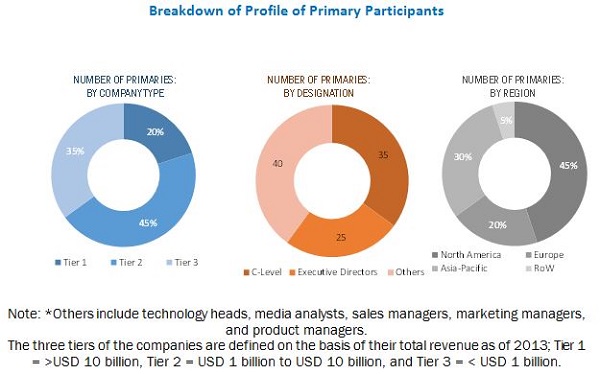
During this research study, major players operating in the production printer market in various regions have been identified, and their offerings, regional presence, and distribution channels have been analyzed through in-depth discussions. Top-down and bottom-up approaches have been used to determine the overall market size. Sizes of the other individual markets have been estimated using the percentage splits obtained through secondary sources such as Hoovers, Bloomberg BusinessWeek, and Factiva, along with primary respondents. The entire procedure includes the study of the annual and financial reports of the top market players and extensive interviews with industry experts such as CEOs, VPs, directors, and marketing executives for key insights (both qualitative and quantitative) pertaining to the market. The figure below shows the breakdown of the primaries on the basis of the company type, designation, and region considered during the research study.
To know about the assumptions considered for the study, download the pdf brochure
The production printer market comprises a network of players involved in the research and product development; raw material supply; component manufacturing; distribution and sale; and post-sales services. Key players considered in the analysis of the reed sensor market are Xerox (US), Hewlett-Packard (US), Ricoh Company (Japan), Konica Minolta (Japan), and Canon (Japan), Agfa and Gevaert (Belgium), EFI Electronics (US), Eastman Kodak Company (US), Inca Digital Printers (UK), and Miyakoshi Co (Japan).
Major Market Developments
- In April 2015, Xerox partnered with Fotoba (US) to develop the industry’s fastest production of full-bleed and multi-up posters, banners, and signage at speeds as fast as five seconds per page.
- In March 2015, Xerox introduced its new digital color devices—the Versant 80 Press and the Color 800i/1000i Presses. The Versant 80 combines new features and functionality for high-end applications. The Color 800i/1000i Presses offers true Pantone metallic gold or silver specialty dry inks, which gives printers a creative and competitive edge.
- In February 2015, Ricoh started a new company in the Middle East as part of its strategy to more directly support customers and partners in key emerging markets globally as well as to meet local needs and the demand for new digital office solutions.
- In June 2014, Konica Minolta signed an agreement with Ergo Asia Pty Limited (Australia), a leading Asian marketing production management services provider, whereby it would acquire all the latter’s shares.
Target Audience
- Publication printing providers
- Label & packaging printing providers
- In-plant printing providers
- Advertisement & promotional print providers
- Security printing providers
- Research organizations and consulting companies
- Technology providers
- Electronic hardware equipment manufacturers
Report Scope:
Production Printer Market, by Type:
- Monochrome
- Color
Production Printer Market, by Technology:
- Inkjet
- Toner
Production Printer Market, b Production method:
- Cut Sheet Production method
- Continuous feed Production method
- Sheet Fed Production method
- Web based Production method
Production Printer Market, by Application Industries
- Transactional
- Commercial
- Publishing
- Label & Packaging
- Others
Production Printer Market, by Geography:
- North America
- Europe
- Asia Pacific (APAC)
- Rest of the World (RoW)
Available customizations:
Based on the given market data, MarketsandMarkets offers customizations in the reports as per the client’s specific requirements. The available customization options are as follows:
Geographical Analysis
- Comprehensive coverage of regulations followed in each region (North America, APAC, Europe, RoW)
Company Information
- Detailed analysis and profiling of additional market players (Up to five)













Growth opportunities and latent adjacency in Production Printer Market