



Disaster Recovery as a Service (DRaaS) Market
Report Code
TC 3490
Published in
Jan, 2026, By MarketsandMarkets™
DRaaS Market by Service Type (Backup & Restore, Real-time Replication, Data Protection, and Professional Services), Deployment Mode (Public Cloud and Private Cloud), Organization Size, Vertical, and Region - Global Forecast to 2032

USD 46,089.9 MN
MARKET SIZE, 2032

CAGR 16.2%
(2025-2032)

320
REPORT PAGES

250
MARKET TABLES
OVERVIEW
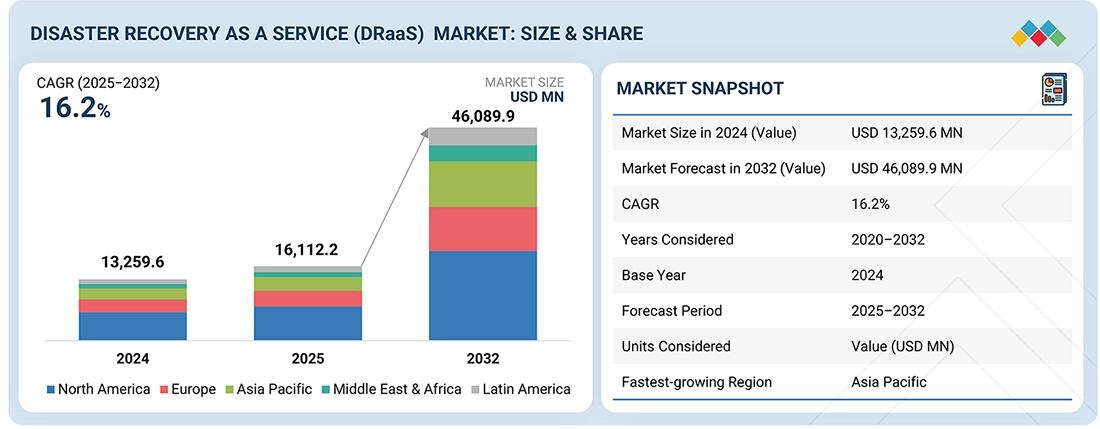
Source: Secondary Research, Interviews with Experts, MarketsandMarkets Analysis
The disaster recovery as a service (DRaaS) market is projected to reach USD 46,089.9 million by 2032, up from USD 16,112.2 million in 2025, at a CAGR of 16.2%. Growth in DRaaS is driven by recovery mandates resulting from ransomware attacks, stricter auditing practices for immutable backups, and enterprises' adoption of cloud-based failover capabilities. Organizations are accelerating DRaaS adoption to achieve sub-minute RTOs, enable cross-region replication, and leverage DRaaS business models that offer consumption-based resilience options without the need to maintain idle secondary infrastructure. Rising ransomware attacks and heightened regulatory scrutiny, combined with contractual uptime commitments, have prompted many enterprises to develop more formalized recovery strategies beyond backup services.
Market Size and Forecast:
- Market Size Value in 2024: USD 13,259.6 Million
- Market Size Value in 2025: USD 16,112.2 Million
- Revenue Forecast in 2032: USD 46,089.9 Million
- Growth Rate: CAGR of 16.2% from 2025 to 2032
- Data available from 2015 to 2030
-
Europe Disaster Recovery as a Service (DRaaS) market
- Market size USD 3.37 billion in 2025
- Market forecast USD 9.54 billion in 2032
- Market Growing at a CAGR of 16.0 %
-
Asia Pacific Disaster Recovery as a Service (DRaaS) market
- Market size USD 2.96 billion in 2025
- Market forecast USD 9.78 billion in 2032
- Market Growing at a CAGR of 18.6 %
-
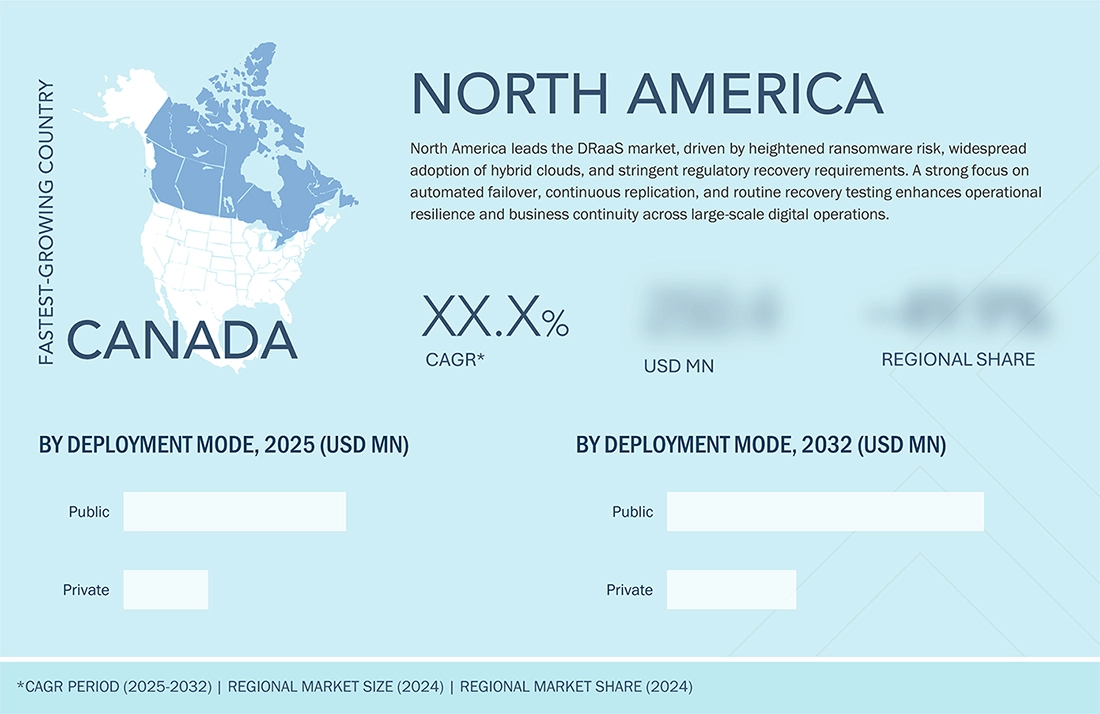
North America Disaster Recovery as a Service (DRaaS) market
- Market size USD 7,425.4 million in 2025
- Market forecast USD 19,389.4 million in 2032
- Market Growing at a CAGR of 14.7 %
Key Market Trends and Insights
- Market Trends: Immutable backups, automated failover, cloud DR, and ransomware recovery drive DRaaS adoption.
-
Growth Drivers: Rising ransomware, cloud adoption, business continuity needs, and compliance fuel market growth.
- Opportunities: AI-driven disaster recovery, hybrid cloud resilience, and SME adoption create growth opportunities.
- AI Impact: AI enables predictive recovery, automated failover, anomaly detection, and faster disaster response.
KEY TAKEAWAYS
-
BY REGIONAsia Pacific is expected to grow at the fastest rate in the DRaaS market, as India, Japan, and Australia tighten cyber recovery obligations for regulated workloads, expand sovereign cloud adoption, and enforce shorter recovery objectives across the BFSI, government, and public sectors.
-
BY SERVICE TYPEBy service type, the backup & restore segment is expected to grow at the fastest rate of 17.9% during the forecast period.
-
BY DEPLOYMENT MODEBy deployment mode, public cloud is expected to account for the largest market share of 71% in 2032 of the global disaster recovery as a service (DRaaS) market
-
BY VERTICALIT and ITeS are expected to grow at the fastest rate in the disaster recovery as a service (DRaaS) market, at a CAGR of 17.9% over the forecast period.
-
BY ORGANIZATION SIZESMEs are expected to grow at the fastest rate, as ransomware exposure, lean IT teams, and limited capital budgets accelerate demand for cloud-delivered DRaaS, automated failover, and recovery testing that eliminates the need for dedicated secondary infrastructure.
-
COMPETITIVE LANDSCAPE - KEY PLAYERSAWS, Microsoft, VMware, IBM, and 11:11 Systems are among the major players in the DRaaS market, collaborating with enterprises to deliver cloud-based replication, automated failover, isolated recovery environments, and compliance-ready resilience across hybrid and multi-cloud architectures.
-
COMPETITIVE LANDSCAPE - STARTUPS/SMEsAptum, Druva, and Hystax have distinguished themselves among startups and SMEs due to their robust product portfolios and effective business strategies.
-
North America Disaster Recovery as a Service (DRaaS) MarketThe North America Disaster Recovery as a Service (DRaaS) market is projected to reach USD 19,389.4 million by 2032 from USD 7,425.4 million in 2025, at a CAGR of 14.7%.
-
Backup and Restore DRaaS MarketThe Backup and Restore DRaaS Market is projected to expand from USD 5.54 billion in 2025 to USD 17.52 billion by 2032 at a CAGR of 17.9%.
The market is currently evolving toward continuous replication, automated failover, and policy-driven orchestration within disaster recovery as a service (DRaaS) platforms to meet stringent recovery objectives. Certain providers are incorporating immutable recovery vaults to safeguard against accidental backups being overwritten by ransomware, utilizing isolated clean-room testing environments, and offering audit-ready reports to mitigate recovery risks associated with these services. DRaaS solutions are now regarded as a fundamental layer of resilience that supports organizations in maintaining operational continuity, ensuring compliance, and achieving cost-effective recovery without the necessity of maintaining additional secondary infrastructure (SI).
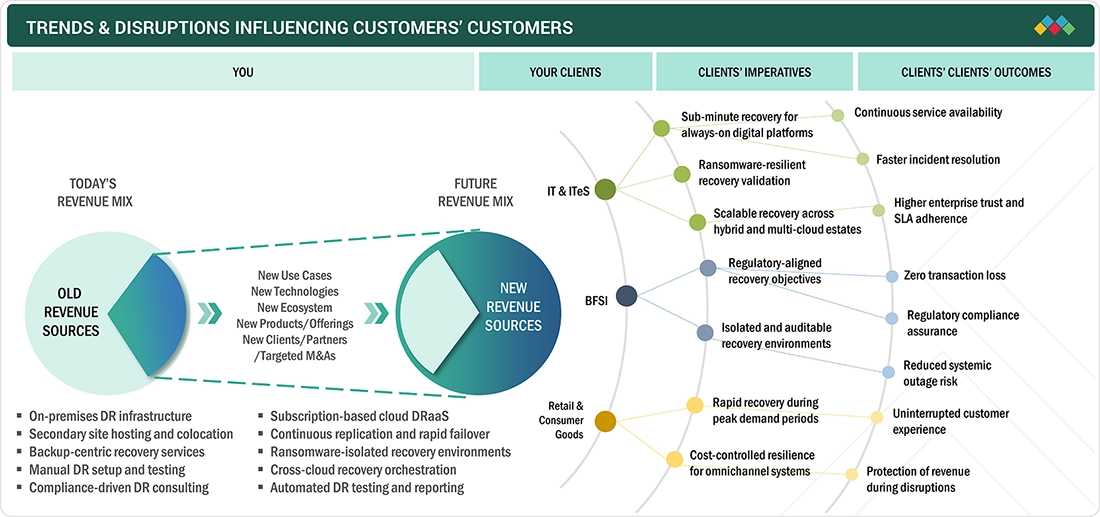
TRENDS & DISRUPTIONS IMPACTING CUSTOMERS' CUSTOMERS
This section examines the significant disruptions and trends that influence how customers shape their disaster recovery as a service (DRaaS) strategy to strengthen cyber resilience. The analysis captures the evolution of the IT and ITeS customer base by reviewing how organizations have adapted their strategies in response to Ransomware exposure, new regulatory requirements for recovery, and the management of an increasing number of distributed cloud-based applications. These strategic shifts are enabling customers to see a direct correlation between improved disaster recovery performance metrics, including faster recovery times, reduced reliance on secondary infrastructure, and increased service availability.
Source: Secondary Research, Interviews with Experts, MarketsandMarkets Analysis
MARKET DYNAMICS

Drivers
Impact
Level
Level
-
Need to lower TCO, save time, and enable IT teams to shift focus to higher-value tasks

-
Rising DRaaS utilization to mitigate risk of cyberattacks on data centers


RESTRAINTS
Impact
Level
Level
-
Concerns over dependency on service providers

-
Reluctance of enterprises in adopting cloud-based DRaaS over traditional methods


OPPORTUNITIES
Impact
Level
Level
-
Emergence of AI and ML in DRaaS solutions to strengthen DRaaS strategies of enterprises

-
SMEs to represent a significant opportunity within the DRaaS market


CHALLENGES
Impact
Level
Level
-
Difficulty in achieving security and compliance in cloud environments

-
Potential performance issues with applications running in the cloud and bandwidth challenges

Source: Secondary Research, Interviews with Experts, MarketsandMarkets Analysis
Driver: Need to lower TCO, save time, and enable IT teams to shift focus to higher-value tasks
Cost pressures and operational inefficiencies continue to drive the rise of disaster recovery (DR) as a service, as organizations seek to reduce recovery costs while maintaining greater flexibility and resilience in their hybrid or cloud environments. The growing frequency of data-loss incidents and the impact of downtime are encouraging organizations to evaluate usage-based recovery or Managed Services Operations, and to pursue a service model that is cost-transparent and helps lower Total Costs of Ownership (TCO).
Restraint: Concerns over dependency on service providers
The primary concern for the disaster recovery as a service marketplace is the dependence on third-party service providers. Organizations rely on third-party providers to deliver on recovery point objectives and execute recovery efforts during times of disaster. However, these organizations often find that gaps in capability are revealed only during a significant incident. Additionally, many organizations prefer to have some control over how quickly they recover from a major outage.
Opportunity: Emergence of AI and ML in DRaaS solutions to strengthen DRaaS strategies of enterprises
New technologies, such as advanced analytics and ML-based tools, are enabling the development of comprehensive strategies to enhance the DRaaS offerings provided by companies. As DRaaS providers integrate these capabilities into their offerings, they can use them to better identify potential threats and develop effective DRaaS recovery plans. Advanced head-to-head assessments and automated or semi-automated workflows for preparing Recovery Actions provide additional efficiencies, enabling DRaaS Service Providers to support organizations with more effective policies for data loss protection and for the design, maintenance, and deployment of DRaaS.
Challenge: Difficulty in achieving security and compliance in cloud environments
The cloud environment poses significant challenges to both security and compliance. Organizations also struggle to demonstrate compliance across multiple providers with varying service level agreements when deploying to the cloud. Concerns about cloud-based data storage have increased, making organizations more aware of the associated risks. A disruption to any of their data could negatively affect their business operations. These issues make organizations hesitant to adopt cloud-based data solutions, while requiring CSPs to provide an extensive, layered security control model and to continuously test and provide audit-ready assurance.
DISASTER RECOVERY AS A SERVICE (DRAAS) MARKET: COMMERCIAL USE CASES ACROSS INDUSTRIES
| COMPANY | USE CASE DESCRIPTION | BENEFITS |
|---|---|---|
 |
Allegany Insurance Group simplified its disaster recovery strategy with iland | Witnessed continuous data availability and business uptime | Gained platform control and flexibility | Predictable pricing with no hidden fees was offered | Provided seamless integration with Veeam | Innovative and comprehensive service was offered in line with company’s objectives |
 |
Computer Driven Solutions deployed Infrascale backup and disaster recovery (IBDR) to protect SME clients’ data and prepare for disasters | CDS received a hybrid cloud backup and disaster recovery service | Infrascale IBDR solution provided CDS with all the backup and disaster recovery functionality | Infrascale Dashboard provided a one-stop-shop for all CDS’ backup and recovery needs, including setting backup settings and schedules |
 |
RMS used TierPoint’s hybrid cloud & DRaaS to improve performance and reliability | Custom DRaaS solution provided RMS with guaranteed 100% uptime and failsafe business continuity protection | RMS can now grow on demand–year-over-year growth in the 30% range. When capacity reaches 80%, RMS can quickly expand by adding nodes to the cloud configuration |
 |
Safeguarding business continuity with disaster recovery from CloudHPT by bios at Waha Capital | Provided a RPO of less than 30 seconds | Provided a RTO of under 45 minutes | 24x7 monitoring of replication | 24x7 monitoring of WAN | DR for Oracle physical machines | Test on demand for compliance |
 |
MSP InfoStream ensured disaster recovery confidence with Axcient Cloud Backup | Full speed data download and upload – no throttling | 24 hours to 100% recovery | 0% of data lost after ransomware | Sleep soundly with BDR confidence| Proactive cloud backups in preparation for a hurricane disaster |
Logos and trademarks shown above are the property of their respective owners. Their use here is for informational and illustrative purposes only.
MARKET ECOSYSTEM
The DRaaS ecosystem comprises stakeholders who collaborate to provide organizations with a cost-effective means of recovering from disasters. The core infrastructure for DRaaS is provided by both private and public cloud providers. DRaaS providers orchestrate failover and testing and manage the entire recovery process. By working together, these stakeholders provide organizations with a scalable DR solution that is less dependent on IT infrastructure and enables organizations to maintain business continuity, regardless of how they operate, whether in a hybrid or multi-cloud environment.
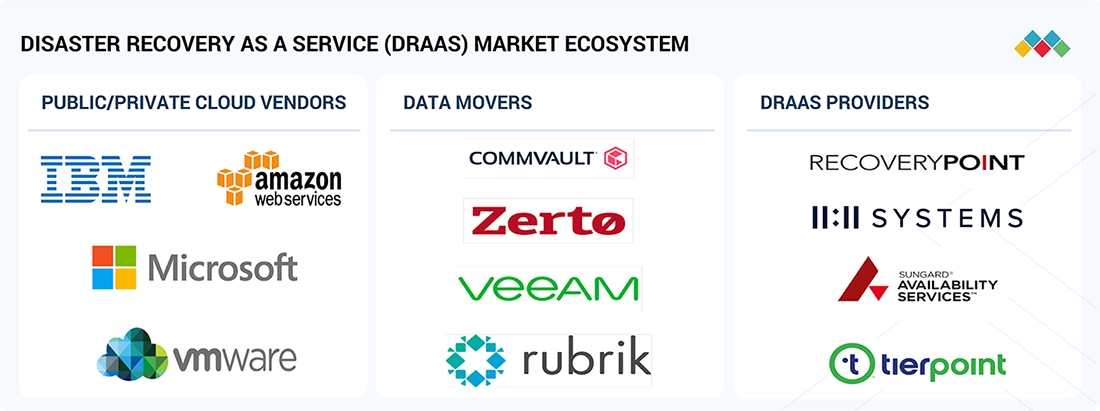
Logos and trademarks shown above are the property of their respective owners. Their use here is for informational and illustrative purposes only.
MARKET SEGMENTS
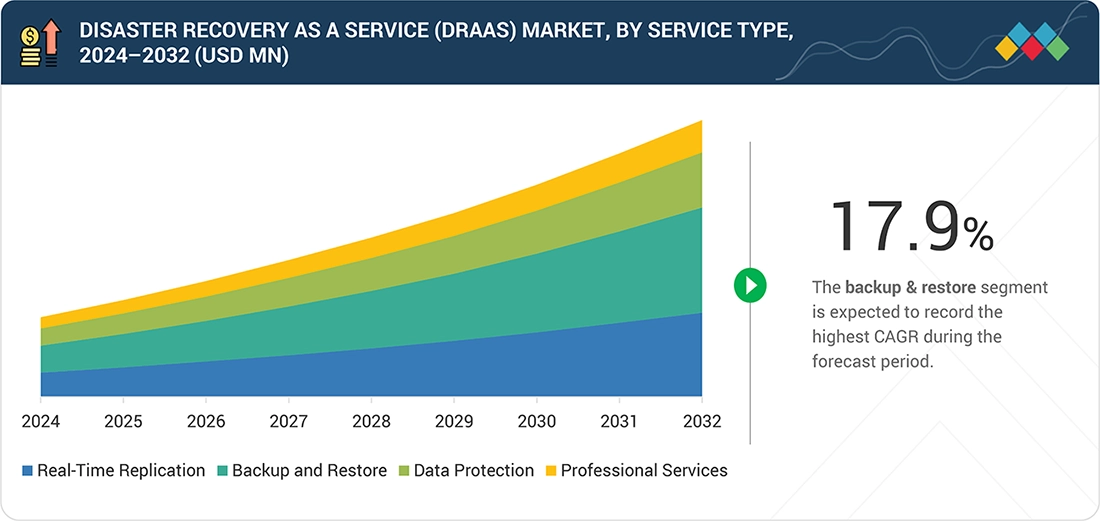
Source: Secondary Research, Interviews with Experts, MarketsandMarkets Analysis
Disaster Recovery as a Service (DRaaS) Market, By Service Type
By service type, real-time replication is expected to account for the second-largest market share in the disaster recovery as a service market, driven by strong demand for minimal data loss and rapid service restoration. Continuous replication supports near-zero recovery objectives, automated failover, and consistent data integrity for mission-critical and transaction-intensive workloads.
Disaster Recovery as a Service (DRaaS) Market, By Deployment Mode
By deployment mode, private cloud is expected to grow fastest in the global DRaaS market, as enterprises require dedicated recovery environments. Private deployments support data residency controls, isolated recovery sites, customized recovery objectives, and audit-aligned failover for regulated and mission-critical workloads.
Disaster Recovery as a Service (DRaaS) Market, By Vertical
Within BFSI, DRaaS is expected to capture the largest share of the global DRaaS market due to stringent regulatory recovery requirements and low tolerance for service disruption. Core banking systems, payment platforms, and digital channels require near-continuous availability. DRaaS supports strict recovery objectives, audit readiness, and controlled failover for transaction-intensive financial operations.
Disaster Recovery as a Service (DRaaS) Market, By Organization Size
By organization size, large enterprises will account for the largest share of the global DRaaS market due to complex application portfolios and high volumes of critical data. Operations span distributed on-premises, private cloud, and public cloud environments, increasing the need for recovery coordination. DRaaS supports controlled execution, consistent testing, and compliance-aligned resilience at enterprise scale.
REGION
North America to be largest region in global disaster recovery as a service (DRaaS) market during forecast period
North America is expected to account for the largest share of the global disaster recovery as a service (DRaaS) market. The proliferation of revenue-generating digital business applications has led to increased prioritization of recovery operations. The North American region is an ideal location for deploying DRaaS solutions that are easily scalable and economically viable, due to the presence of service-level agreements, advanced network infrastructure, and a strong network of business partners supporting their implementations.
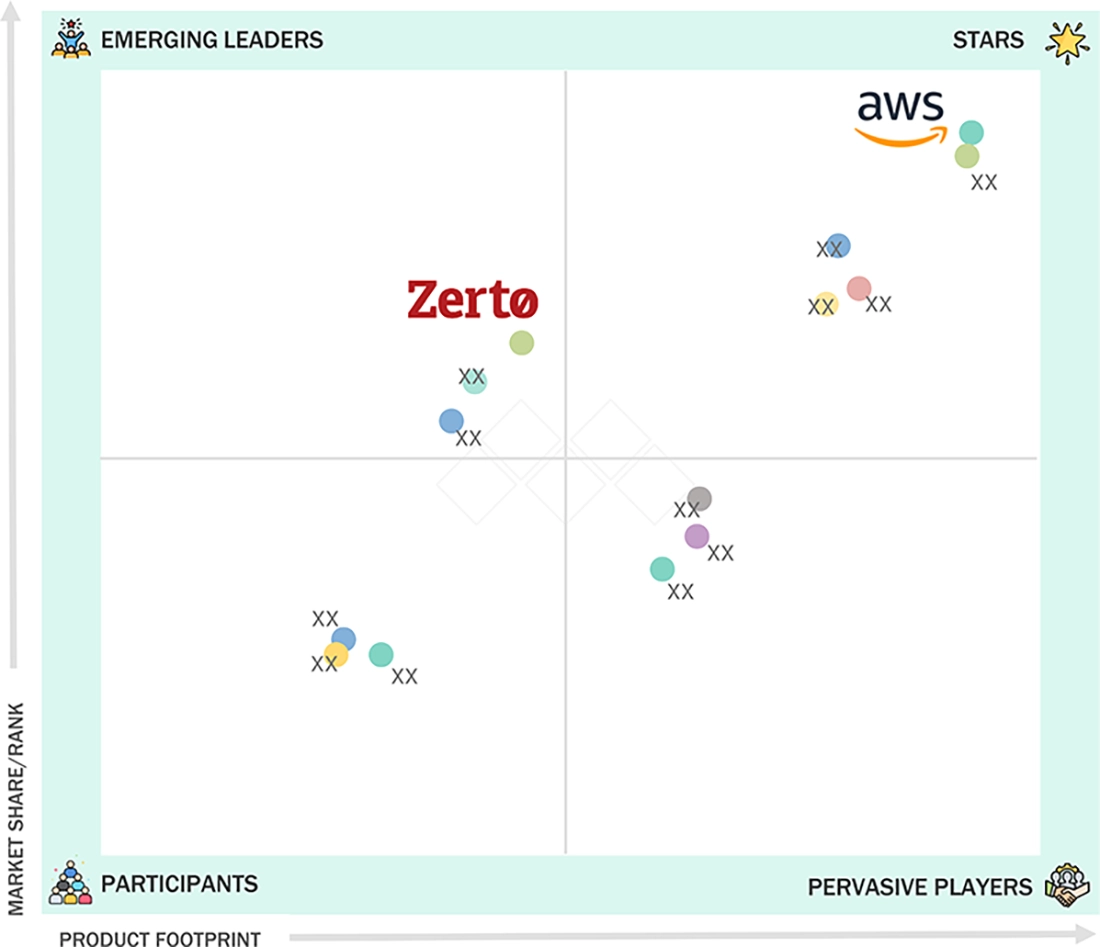
DISASTER RECOVERY AS A SERVICE (DRAAS) MARKET: COMPANY EVALUATION MATRIX
In the disaster recovery as a service market matrix, AWS (Star) supports companies that need to recover and maintain their critical assets by leveraging its native cloud resilience services, global region coverage, and seamless integration with compute, storage, and network services. Zerto (Emerging Leader) is making progress with its use of continuous replication and an emphasis on application restoration. AWS has the highest scale and deepest cloud infrastructure, and Zerto is rapidly moving toward leadership by providing enterprise-level, precise recovery and simplified operations for its customers.
Source: Secondary Research, Interviews with Experts, MarketsandMarkets Analysis
KEY MARKET PLAYERS
- AWS (US)
- Microsoft (US)
- Vmware (US)
- IBM (US)
- 11:11 Systems (US)
- Recovery Point Systems (US)
- Intervision Systems (US)
- TierPoint (US)
- Infrascale (US)
- Zerto (US)
- BIOS Middle East (UAE)
- C&W Business (US)
- Carbonite (US)
- Daisy (UK)
- Databarracks (UK)
MARKET SCOPE
| REPORT METRIC | DETAILS |
|---|---|
| Market Size in 2024 (Value) | USD 13,259.6 Million |
| Market Forecast in 2032 (Value) | USD 46,089.9 Million |
| Growth Rate | CAGR of 16.2% from 2025-2032 |
| Years Considered | 2020-2032 |
| Base Year | 2024 |
| Forecast Period | 2025-2032 |
| Units Considered | Value (USD Million) |
| Report Coverage | Revenue forecast, company ranking, competitive landscape, growth factors, and trends |
| Segments Covered |
|
| Regions Covered | North America, Europe, Asia Pacific, Middle East & Africa, Latin America |
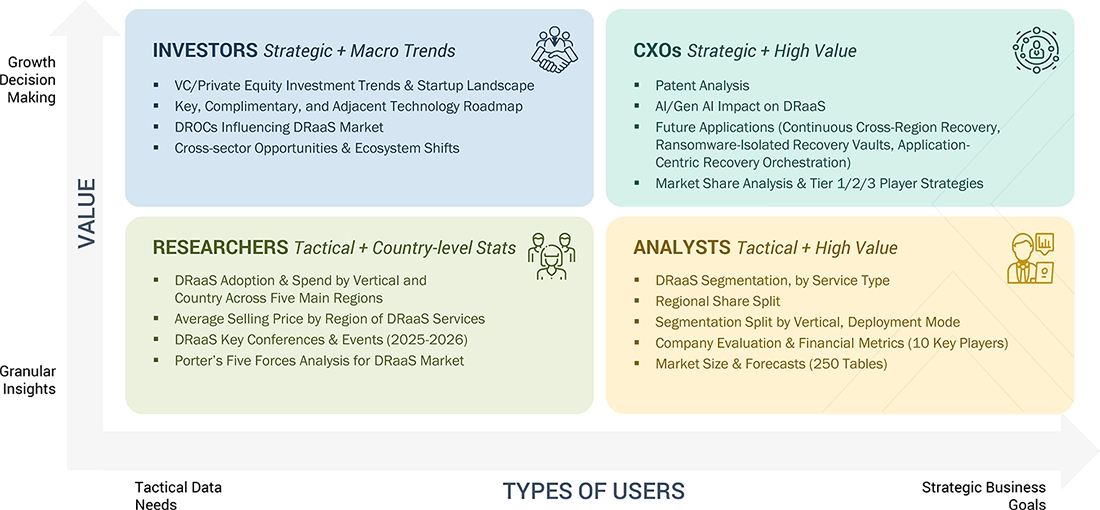
WHAT IS IN IT FOR YOU: DISASTER RECOVERY AS A SERVICE (DRAAS) MARKET REPORT CONTENT GUIDE
DELIVERED CUSTOMIZATIONS
We have successfully delivered the following deep-dive customizations:
| CLIENT REQUEST | CUSTOMIZATION DELIVERED | VALUE ADDS |
|---|---|---|
| Leading BFSI Firm (US) | Additional Vendor Mapping: Evaluation of DRaaS providers offering isolated recovery vaults, regulatory-aligned recovery objectives, and audit-ready controls | Clarified competitive white spaces, refined BFSI-focused value propositions, and strengthened differentiation against established providers |
| Global IT & ITeS Firm (APAC) | Architecture Benchmarking: Comparison of cross-region replication, network-aware failover, and latency-sensitive recovery designs | Improved solution-market fit, enabled region-specific service positioning, and supported entry into carrier and cloud partner ecosystems |
| Global Retail & Consumer Goods Enterprise (US) | Hybrid Stack Assessment: Analysis of DRaaS platforms supporting application-centric recovery, cloud-to-cloud failover, and data governance | Accelerated go-to-market strategy, sharpened messaging for revenue-critical workloads, and improved alignment with enterprise buyer priorities |
RECENT DEVELOPMENTS
- November 2025 : Assured Data Protection expanded its disaster recovery portfolio with a Zerto-powered service for VMware and mixed environments. The offering delivers near-zero recovery objectives, automated failover, and operational flexibility, supporting enterprises through infrastructure transitions while maintaining consistent recovery assurance and reducing downtime risk.
- July 2025 : ICICI Lombard partnered with Amazon Web Services to implement an automated, cloud-native disaster recovery setup using the AWS Hyderabad region. Reported by Analytics India Magazine, the deployment enabled cross-region replication, automated failover, regulatory compliance, and uninterrupted access to business-critical applications during service disruptions.
- June 2025 : Cohesity and 11:11 Systems expanded their partnership with the launch of a fully managed Clean Room Recovery service. Announced by Channel Insider, the offering combines Cohesity’s data security platform with 11:11 Systems’ managed recovery expertise to provide isolated recovery environments, rapid ransomware response, and end-to-end cyber incident recovery for enterprises.
- June 2025 : CrashPlan and Microsoft strengthened their partnership through the integration of Microsoft 365 Backup Storage. Announced via Business Wire, the collaboration facilitates enterprise-grade disaster recovery featuring rapid, large-scale restorations, strict recovery objectives, and unified governance for Microsoft 365 workloads.
- April 2025 : Elastio partnered with JetSweep to strengthen DRaaS and ransomware protection. The collaboration integrates ransomware recovery assurance with AWS-based disaster recovery, enabling validated clean recovery points, rapid failover, and reduced downtime for enterprises facing advanced cyber threats.
Table of Contents
 Exclusive indicates content/data unique to MarketsandMarkets and not available with any competitors.
TITLE
PAGE NO
1
INTRODUCTION
36
2
EXECUTIVE SUMMARY
41
3
PREMIUM INSIGHTS
46
4
MARKET OVERVIEW
Ransomware threats and cloud complexity drive demand for advanced cyber recovery and resilience solutions.
50
4.1
INTRODUCTION
4.2
MARKET DYNAMICS
4.2.1
DRIVERS
4.2.1.1
RANSOMWARE DISRUPTION TO DRIVE BACKUP TARGETING AND DATA LOSS
4.2.1.2
HYBRID AND CLOUD COMPLEXITY INCREASES RECOVERY NEEDS
4.2.1.3
FORMAL RECOVERY AND CONTINUITY PLANNING MANDATED BY REGULATORY AND AUDIT PRESSURE
4.2.1.4
RESILIENCE SPENDING JUSTIFIED BY BUSINESS IMPACT OF BREACHES
4.2.2
RESTRAINTS
4.2.2.1
COST UNCERTAINTY FROM STORAGE, BANDWIDTH, AND TESTING
4.2.2.2
LEGACY AND COMPLEX APPLICATIONS SLOW MIGRATION AND RECOVERY
4.2.2.3
TRUST CONCERNS AROUND THIRD-PARTY ACCESS AND SECURITY
4.2.3
OPPORTUNITIES
4.2.3.1
CYBER RECOVERY SERVICES BEYOND TRADITIONAL DISASTER RECOVERY
4.2.3.2
MANAGED RESILIENCE FOR SMALL AND MID-SIZED ENTERPRISES
4.2.3.3
BUSINESS-ALIGNED BCDR ORCHESTRATION EXTENDING DRAAS VALUE BEYOND INFRASTRUCTURE
4.2.3.4
AI-DRIVEN RECOVERY INTELLIGENCE AND CONTINUOUS ASSURANCE
4.2.4
CHALLENGES
4.2.4.1
MEETING AGGRESSIVE RECOVERY TIME OBJECTIVE AND RECOVERY POINT OBJECTIVE TARGETS
4.2.4.2
SECURITY OF RECOVERY ENVIRONMENTS DURING FAILOVER
4.2.4.3
AVAILABILITY OF ADJACENT SOLUTIONS, SUCH AS BACKUP-AS-A-SERVICE AND SAAS-BASED DR
4.3
UNMET NEEDS AND WHITE SPACES
4.4
INTERCONNECTED MARKETS AND CROSS-SECTOR OPPORTUNITIES
4.4.1
INTERCONNECTED MARKETS
4.4.2
CROSS SECTOR OPPORTUNITIES
4.5
STRATEGIC MOVES BY TIER -1/2/3 PLAYERS
4.5.1
TIER 1 PLAYERS (MARKET LEADERS)
4.5.1.1
VMWARE
4.5.1.2
MICROSOFT
4.5.1.3
AWS
4.5.1.4
ORACLE
4.5.2
TIER 2 PLAYERS (STRONG CHALLENGERS)
4.5.2.1
ZERTO
4.5.2.2
SUNGARD AS
4.5.2.3
NTT COMMUNICATIONS
4.5.3
TIER 3 PLAYERS (SPECIALISTS & EMERGING ENTRANTS)
4.5.3.1
UNITRENDS
4.5.3.2
TIERPOINT
4.5.3.3
ACRONIS
4.5.4
CROSS-TIER STRATEGIC PATTERNS
4.5.5
MARKET IMPLICATIONS
4.5.5.1
CONSOLIDATION PRESSURE ON TIER-3 VENDORS
4.5.5.2
ACCELERATION IMPERATIVE FOR TIER-2 CHALLENGERS
4.5.5.3
INCREASED COMPLEXITY FOR ENTERPRISE CUSTOMERS
4.5.5.4
INTEGRATION BURDEN DRIVING PLATFORM-BASED DRAAS ADOPTION
4.5.6
STRATEGIC TRENDS
4.5.6.1
CLOUD-NATIVE AND SCALABLE RECOVERY ARCHITECTURES
4.5.6.2
INTEGRATED CYBER-RESILIENCE AND RANSOMWARE-AWARE RECOVERY
4.5.6.3
AUTOMATION AND ORCHESTRATION-LED RECOVERY
4.5.6.4
BROAD ECOSYSTEM INTEGRATION AND MULTI-CLOUD SUPPORT
4.5.6.5
COST-EFFECTIVE, CONSUMPTION-BASED MODELS
5
INDUSTRY TRENDS
Navigate evolving industry dynamics with strategic insights from Porter’s Five Forces and macroeconomic trends.
65
5.1
PORTER’S FIVE FORCES ANALYSIS
5.1.1
THREAT OF NEW ENTRANTS
5.1.2
BARGAINING POWER OF SUPPLIERS
5.1.3
BARGAINING POWER OF BUYERS
5.1.4
THREAT OF SUBSTITUTES
5.1.5
INTENSITY OF COMPETITIVE RIVALRY
5.2
MACROECONOMIC INDICATORS
5.2.1
INTRODUCTION
5.2.2
GDP TRENDS AND FORECAST
5.2.3
TRENDS IN GLOBAL ICT INDUSTRY
5.2.4
TRENDS IN GLOBAL CYBERSECURITY INDUSTRY
5.3
VALUE CHAIN ANALYSIS
5.3.1
SOLUTIONS & PLATFORMS
5.3.2
PLANNING AND DESIGNING
5.3.3
DEPLOYMENT & INTEGRATION
5.3.4
SERVICE MANAGEMENT
5.3.5
CONSULTATION/VARS/RESELLERS
5.3.6
VERTICALS
5.4
ECOSYSTEM ANALYSIS
5.5
PRICING ANALYSIS
5.5.1
AVERAGE SELLING PRICE TRENDS OF BUSINESSES, BY DATA VOLUME
5.5.2
INDICATIVE PRICING ANALYSIS OF SERVICES, BY KEY PLAYER
5.6
KEY CONFERENCES & EVENTS
5.7
TRENDS AND DISRUPTIONS IMPACTING CUSTOMER BUSINESS
5.8
INVESTMENT AND FUNDING SCENARIO
5.9
CASE STUDY ANALYSIS
5.9.1
GAMES24X7 ADOPTED AWS BACKUP AND DISASTER RECOVERY TO ENHANCE DATA PROTECTION AND BUSINESS CONTINUITY
5.9.2
TENCATE PROTECTIVE FABRICS ADOPTED HPE ZERTO TO ENHANCE DISASTER RECOVERY, RANSOMWARE PROTECTION, AND HYBRID CLOUD MIGRATION
5.9.3
BAYLEYS REALTY GROUP STRENGTHENED DATA RESILIENCE AND OPERATIONS WITH VEEAM
5.9.4
VMWARE INVOLTA CLOUD DIRECTOR AVAILABILITY SUPPORTED ENTERPRISE MULTI-CLOUD DISASTER RECOVERY
5.9.5
DONOR NETWORK WEST ADOPTED DRUVA CLOUD-NATIVE BACKUP AND DATA PROTECTION TO FOCUS ON MISSION-CRITICAL OPERATIONS
5.10
IMPACT OF 2025 US TARIFFS - DISASTER RECOVERY-AS-A-SERVICE MARKET
5.10.1
INTRODUCTION
5.10.2
KEY TARIFF RATES
5.10.3
PRICE IMPACT ANALYSIS
5.10.4
IMPACT ON COUNTRY/REGION
5.10.4.1
NORTH AMERICA
5.10.4.2
EUROPE
5.10.4.3
ASIA PACIFIC
5.10.5
IMPACT ON END-USE INDUSTRIES
6
TECHNOLOGICAL ADVANCEMENTS, AI-DRIVEN IMPACT, PATENTS, INNOVATIONS, AND FUTURE APPLICATIONS
AI-driven autonomous recovery revolutionizes disaster resilience with predictive, self-optimizing operations and near-zero downtime.
93
6.1
KEY EMERGING TECHNOLOGIES
6.1.1
CYBER RECOVERY VAULTS (IMMUTABLE + AIR-GAPPED RECOVERY)
6.1.2
AI/ML-DRIVEN DR ORCHESTRATION & PREDICTIVE RECOVERY
6.1.3
AUTOMATED DR TESTING (CONTINUOUS & NON-DISRUPTIVE TESTING)
6.1.4
CLOUD-NATIVE DR FOR KUBERNETES & CONTAINERS
6.1.5
ZERO TRUST-ALIGNED DISASTER RECOVERY
6.1.6
MULTI-CLOUD DR ORCHESTRATION
6.1.7
CONTINUOUS DATA PROTECTION (CDP) WITH NEAR-ZERO RPO
6.2
COMPLEMENTARY TECHNOLOGIES
6.2.1
BACKUP-AS-A-SERVICE (BAAS)
6.2.2
BUSINESS CONTINUITY MANAGEMENT (BCM) AND GRC TOOLS
6.2.3
ERP AND FINANCE SYSTEMS INTEGRATION
6.3
ADJACENT TECHNOLOGIES
6.3.1
CLOUD-NATIVE DISASTER RECOVERY SERVICES FROM HYPERSCALERS
6.3.2
HIGH AVAILABILITY CLUSTERING AND FAULT TOLERANCE TECHNOLOGIES
6.3.3
DATA REPLICATION AND STORAGE MIRRORING PLATFORMS
6.3.4
BUSINESS CONTINUITY AND DISASTER RECOVERY APPLIANCES AND INTEGRATED BACKUP DR PLATFORMS
6.3.5
MANAGED INFRASTRUCTURE AND MANAGED CLOUD SERVICES
6.3.6
SAAS APPLICATION BACKUP AND RECOVERY
6.3.7
DATA PROTECTION PLATFORMS (DPP)
6.4
TECHNOLOGY/PRODUCT ROADMAP
6.4.1
SHORT-TERM (2025–2027) | FOUNDATION & EARLY COMMERCIALIZATION
6.4.2
MID-TERM (2027–2030) | EXPANSION AND STANDARDIZATION
6.4.3
LONG-TERM (2030–2035+) | AUTONOMOUS AND CYBER RESILIENT RECOVERY
6.5
PATENT ANALYSIS
6.6
FUTURE APPLICATIONS
6.6.1
CYBER-RESILIENT RECOVERY VAULTS: RANSOMWARE-READY DR ARCHITECTURES
6.6.2
AI-DRIVEN AUTONOMOUS DISASTER RECOVERY: SELF-OPTIMIZING RECOVERY OPERATIONS
6.6.3
KUBERNETES AND CLOUD-NATIVE APPLICATION RECOVERY: MICROSERVICES RESILIENCE
6.6.4
MULTI-CLOUD AND SOVEREIGN DR: REGULATORY-DRIVEN RECOVERY STRATEGIES
6.6.5
CONTINUOUS DATA PROTECTION AND NEAR-ZERO DOWNTIME RECOVERY: MISSION-CRITICAL AVAILABILITY
6.7
IMPACT OF AI/GEN AI ON DISASTER RECOVERY-AS-A-SERVICE MARKET
6.7.1
BEST PRACTICES IN DISASTER RECOVERY-AS-A-SERVICE MARKET
6.7.2
CASE STUDIES OF AI IMPLEMENTATION IN DISASTER RECOVERY-AS-A-SERVICE MARKET
6.7.3
INTERCONNECTED ADJACENT ECOSYSTEM AND IMPACT ON MARKET PLAYERS
6.7.4
CLIENTS’ READINESS TO ADOPT GENERATIVE AI DISASTER RECOVERY-AS-A-SERVICE MARKET
7
REGULATORY LANDSCAPE
Navigate complex global regulations and standards with our comprehensive regional compliance insights.
108
7.1
REGIONAL REGULATIONS AND COMPLIANCE
7.1.1
REGULATORY BODIES, GOVERNMENT AGENCIES, AND OTHER ORGANIZATIONS
7.1.2
INDUSTRY STANDARDS
8
CONSUMER LANDSCAPE & BUYER BEHAVIOR
Uncover profit-driving buyer behaviors and unmet needs across critical industry verticals.
113
8.1
DECISION-MAKING PROCESS
8.2
BUYER STAKEHOLDERS AND BUYING EVALUATION CRITERIA
8.2.1
KEY STAKEHOLDERS IN BUYING PROCESS
8.2.2
BUYING CRITERIA
8.3
ADOPTION BARRIERS & INTERNAL CHALLENGES
8.4
UNMET NEEDS IN VARIOUS END-USE INDUSTRIES
8.5
MARKET PROFITABILITY
8.5.1
REVENUE POTENTIAL
8.5.2
COST DYNAMICS
8.5.3
MARGIN OPPORTUNITIES IN KEY APPLICATIONS
9
DISASTER RECOVERY-AS-A-SERVICE MARKET, BY SOLUTION MODULE
Market Size & Growth Rate Forecast Analysis to 2032 in USD Million | 10 Data Tables
119
9.1
INTRODUCTION
9.1.1
SOLUTION MODULE: DISASTER RECOVERY-AS-A-SERVICE MARKET DRIVERS
9.2
REPLICATION & FAILOVER DRAAS
9.2.1
INCREASING DEMAND FOR CONTINUOUS AVAILABILITY AND MINIMAL DOWNTIME TO DRIVE ADOPTION
9.3
CYBER RECOVERY DRAAS
9.3.1
STRENGTHENING RESILIENCE AGAINST CYBERATTACKS AND DATA COMPROMISE TO DRIVE ADOPTION
9.4
DISASTER RECOVERY TESTING & COMPLIANCE
9.4.1
ENSURING REGULATORY READINESS AND OPERATIONAL ASSURANCE TO DRIVE ADOPTION
9.5
ORCHESTRATION & RUNBOOK AUTOMATION DRAAS
9.5.1
ACCELERATING RECOVERY EFFICIENCY AND REDUCING HUMAN ERROR TO DRIVE MARKET
10
DISASTER RECOVERY-AS-A-SERVICE MARKET, BY DELIVERY MODEL
Market Size & Growth Rate Forecast Analysis to 2032 in USD Million | 8 Data Tables
126
10.1
INTRODUCTION
10.1.1
DELIVERY MODEL: DISASTER RECOVERY-AS-A-SERVICE MARKET DRIVERS
10.2
SELF-SERVICE DRAAS
10.2.1
RISING ADOPTION OF DEVOPS-DRIVEN AUTOMATION AND CLOUD-NATIVE CONTROL TO DRIVE MARKET
10.3
ASSISTED DRAAS
10.3.1
BLENDED PROVIDER EXPERTISE AND CUSTOMER CONTROL TO DRIVE MARKET
10.4
MANAGED DRAAS
10.4.1
HANDS-OFF CONTINUITY ASSURANCE AND OPERATIONAL SIMPLICITY TO DRIVE MARKET
11
DISASTER RECOVERY-AS-A-SERVICE MARKET, BY WORKLOAD PROTECTION
Market Size & Growth Rate Forecast Analysis to 2032 in USD Million | 10 Data Tables
132
11.1
INTRODUCTION
11.1.1
WORKLOAD PROTECTION: DISASTER RECOVERY-AS-A-SERVICE MARKET DRIVERS
11.2
VIRTUALIZED WORKLOAD DRAAS
11.2.1
SECURING VIRTUALIZED WORKLOADS FOR RESILIENCE AND CONTINUITY TO DRIVE MARKET
11.3
PHYSICAL SERVERS DRAAS
11.3.1
SUSTAINING CONTINUITY FOR LEGACY AND NON-VIRTUALIZED INFRASTRUCTURE THROUGH PHYSICAL SERVER DRAAS
11.4
CLOUD WORKLOAD DRAAS
11.4.1
ENSURING CONSISTENT PROTECTION AND RAPID RECOVERY FOR CLOUD WORKLOADS
11.5
BUSINESS-CRITICAL ENTERPRISE APPLICATION DRAAS
11.5.1
MINIMIZING SERVICE DISRUPTIONS IN ENTERPRISE APPLICATION ENVIRONMENTS TO BOOST DEMAND
12
DISASTER RECOVERY-AS-A-SERVICE MARKET, BY ORGANIZATION SIZE
Market Size & Growth Rate Forecast Analysis to 2032 in USD Million | 6 Data Tables
139
12.1
INTRODUCTION
12.1.1
ORGANIZATION SIZE: DISASTER RECOVERY-AS-A-SERVICE MARKET DRIVERS
12.2
LARGE ENTERPRISES
12.2.1
DRAAS TO OFFER ORCHESTRATION, TESTING ENVIRONMENTS, AND HYBRID CLOUD SETUPS TO LARGE ENTERPRISES
12.3
SMALL & MEDIUM-SIZED ENTERPRISES
12.3.1
SMES TO ACCESS COST-EFFECTIVE, FLEXIBLE, AND SCALABLE EASY-TO-MANAGE SOLUTIONS WITH DRAAS
13
DISASTER RECOVERY-AS-A-SERVICE MARKET, BY VERTICAL
Market Size & Growth Rate Forecast Analysis to 2032 in USD Million | 22 Data Tables
144
13.1
INTRODUCTION
13.1.1
VERTICAL: DISASTER RECOVERY-AS-A-SERVICE MARKET DRIVERS
13.2
BFSI
13.2.1
STRENGTHENING FINANCIAL SECTOR RESILIENCE THROUGH SECURE, COMPLIANT, AND RAPID DISASTER RECOVERY
13.3
TELECOMMUNICATIONS
13.3.1
ENSURING ALWAYS-ON NETWORKS AND SERVICE CONTINUITY IN HYPER-CONNECTED TELECOM ECOSYSTEM
13.4
IT & ITES
13.4.1
ENABLING CLIENT-CENTRIC BUSINESS CONTINUITY AND SCALABLE RECOVERY ACROSS DIGITAL SERVICE OPERATIONS
13.5
GOVERNMENT
13.5.1
BUILDING OPERATIONAL RESILIENCE AND DIGITAL CONTINUITY ACROSS MISSION-CRITICAL PUBLIC SERVICES
13.6
RETAIL & ECOMMERCE
13.6.1
MAINTAINING TRANSACTION UPTIME AND DIGITAL COMMERCE RESILIENCE IN OMNICHANNEL RETAIL
13.7
MANUFACTURING
13.7.1
MAINTAINING PRODUCTION UPTIME AND INTELLECTUAL PROPERTY PROTECTION ACROSS DIGITIZED FACTORIES
13.8
ENERGY & UTILITIES
13.8.1
ENSURING OPERATIONAL RESILIENCE FOR CRITICAL INFRASTRUCTURE AND ESSENTIAL PUBLIC SERVICES
13.9
MEDIA & ENTERTAINMENT
13.9.1
DRAAS TO HELP GAIN FASTER TIME-TO-MARKET, MANAGE LARGE VOLUMES OF DATA, AND REDUCE COSTS
13.10
HEALTHCARE
13.10.1
PROTECTING PATIENT-CRITICAL SYSTEMS AND ENABLING CONTINUITY OF CARE UNDER DISRUPTION
13.11
OTHER VERTICALS
14
DISASTER RECOVERY-AS-A-SERVICE MARKET, BY REGION
Comprehensive coverage of 8 Regions with country-level deep-dive of 14 Countries | 244 Data Tables.
158
14.1
INTRODUCTION
14.2
NORTH AMERICA
14.2.1
NORTH AMERICA: DISASTER RECOVERY-AS-A-SERVICE MARKET DRIVERS
14.2.2
US
14.2.2.1
US ENTERPRISES TURN TO DRAAS FOR FASTER RECOVERY AND COMPLIANCE
14.2.3
CANADA
14.2.3.1
DRAAS ADDRESSING COMPLIANCE AND CONTINUITY NEEDS IN CANADA
14.3
EUROPE
14.3.1
EUROPE: DISASTER RECOVERY-AS-A-SERVICE MARKET DRIVERS
14.3.2
UK
14.3.2.1
CLOUD EXPANSION AND ENTERPRISE MODERNIZATION DRIVING DRAAS ADOPTION
14.3.3
GERMANY
14.3.3.1
SOVEREIGN CLOUD INITIATIVES ACCELERATING DRAAS ADOPTION IN GERMANY
14.3.4
FRANCE
14.3.4.1
STRATEGIC CLOUD PARTNERSHIPS TO STRENGTHEN DRAAS ADOPTION IN FRANCE
14.3.5
ITALY
14.3.5.1
ITALY TO REINFORCE BUSINESS CONTINUITY THROUGH DRAAS
14.3.6
REST OF EUROPE
14.4
ASIA PACIFIC
14.4.1
ASIA PACIFIC: DISASTER RECOVERY-AS-A-SERVICE MARKET DRIVERS
14.4.2
CHINA
14.4.2.1
CHINA’S GROWING RELIANCE ON DRAAS FOR SECURE AND RESILIENT IT OPERATIONS TO SUPPORT MARKET
14.4.3
JAPAN
14.4.3.1
RAPID RECOVERY AND DISASTER PREPAREDNESS TO DRIVE DRAAS ADOPTION IN JAPAN
14.4.4
INDIA
14.4.4.1
CLOUD-ENABLED RESILIENCE AND DRAAS INTEGRATION ACROSS CRITICAL SECTORS TO DRIVE MARKET
14.4.5
AUSTRALIA
14.4.5.1
CLOUD MODERNIZATION, DISASTER PREPAREDNESS, AND RISING DRAAS ADOPTION TO FUEL MARKET GROWTH
14.4.6
REST OF ASIA PACIFIC
14.5
MIDDLE EAST & AFRICA
14.5.1
MIDDLE EAST & AFRICA: DISASTER RECOVERY-AS-A-SERVICE MARKET
14.5.2
MIDDLE EAST
14.5.2.1
EXPANDING CLOUD FOOTPRINT AND CYBER RESILIENCE TO DRIVE DRAAS ADOPTION IN MIDDLE EAST
14.5.2.2
GCC
14.5.2.2.1
DATA CENTER INVESTMENTS AND NATIONAL DIGITAL AGENDAS TO ACCELERATE DRAAS IN GCC
14.5.2.2.2
KSA
14.5.2.2.3
UAE
14.5.2.2.4
REST OF GCC
14.5.2.3
REST OF MIDDLE EAST
14.5.3
AFRICA
14.5.3.1
CLOUD INFRASTRUCTURE EXPANSION AND COST-EFFICIENT DIGITAL ADOPTION TO FUEL DRAAS GROWTH ACROSS AFRICA
14.6
LATIN AMERICA
14.6.1
LATIN AMERICA: DISASTER RECOVERY-AS-A-SERVICE MARKET DRIVERS
14.6.2
BRAZIL
14.6.2.1
CLOUD-LED CONTINUITY AND RESILIENCE TO STRENGTHENING DRAAS ADOPTION
14.6.3
MEXICO
14.6.3.1
MEXICO’S EXPANDING CLOUD INFRASTRUCTURE TO STRENGTHEN DEMAND FOR DISASTER RECOVERY SERVICES
14.6.4
REST OF LATIN AMERICA
15
COMPETITIVE LANDSCAPE
Discover strategic insights and market positions of tech giants and startups reshaping the industry.
260
15.1
KEY PLAYER STRATEGIES/RIGHT TO WIN, 2024–2026
15.2
REVENUE ANALYSIS, 2020–2025
15.3
MARKET SHARE ANALYSIS, 2025
15.4
PRODUCT/BRAND COMPARISON
15.4.1
VMWARE
15.4.2
HPE
15.4.3
IBM
15.4.4
AWS
15.4.5
GOOGLE CLOUD
15.5
COMPANY VALUATION AND FINANCIAL METRICS
15.5.1
COMPANY VALUATION
15.5.2
FINANCIAL METRICS USING EV/EBITDA
15.6
COMPANY EVALUATION MATRIX: KEY PLAYERS, 2025
15.6.1
STARS
15.6.2
EMERGING LEADERS
15.6.3
PERVASIVE PLAYERS
15.6.4
PARTICIPANTS
15.6.5
COMPANY FOOTPRINT: KEY PLAYERS, 2025
15.6.5.1
COMPANY FOOTPRINT
15.6.5.2
REGIONAL FOOTPRINT
15.6.5.3
SOLUTION MODULE FOOTPRINT
15.6.5.4
DELIVERY MODEL FOOTPRINT
15.6.5.5
VERTICAL FOOTPRINT
15.7
COMPANY EVALUATION MATRIX: STARTUPS/SMES, 2025
15.7.1
PROGRESSIVE COMPANIES
15.7.2
RESPONSIVE COMPANIES
15.7.3
DYNAMIC COMPANIES
15.7.4
STARTING BLOCKS
15.7.5
COMPETITIVE BENCHMARKING: STARTUPS/SMES
15.7.5.1
DETAILED LIST OF KEY STARTUPS/SMES
15.7.5.2
COMPETITIVE BENCHMARKING OF KEY STARTUPS/SMES
15.8
COMPETITIVE SCENARIO
15.8.1
PRODUCT LAUNCHES AND ENHANCEMENTS
15.8.2
DEALS
16
COMPANY PROFILES
In-depth Company Profiles of Leading Market Players with detailed Business Overview, Product and Service Portfolio, Recent Developments, and Unique Analyst Perspective (MnM View)
288
16.1
INTRODUCTION
16.2
KEY PLAYERS
16.2.1
VMWARE
16.2.1.1
BUSINESS OVERVIEW
16.2.1.2
PRODUCTS/SOLUTIONS/SERVICES OFFERED
16.2.1.3
RECENT DEVELOPMENTS
16.2.1.3.1
PRODUCT LAUNCHES AND ENHANCEMENTS
16.2.1.3.2
DEALS
16.2.1.4
MNM VIEW
16.2.1.4.1
KEY STRENGTHS
16.2.1.4.2
STRATEGIC CHOICES
16.2.1.4.3
WEAKNESSES AND COMPETITIVE THREATS
16.2.2
HPE
16.2.3
AWS
16.2.4
IBM
16.2.5
GOOGLE CLOUD
16.2.6
VEEAM
16.2.7
KYNDRYL
16.2.8
DATTO
16.2.9
PURE STORAGE
16.2.10
TCS
16.2.11
MICROSOFT
16.2.12
11:11 SYSTEMS
16.2.13
INTERVISION SYSTEMS
16.2.14
TIERPOINT
16.2.15
INFRASCALE
16.2.16
DRUVA
16.2.17
ACRONIS
16.2.18
ARCSERVE
16.2.19
NUTANIX
16.2.20
FLEXENTIAL
16.2.21
COHESITY
16.2.22
BETSOL
16.2.23
UNITRENDS
16.2.24
DXC TECHNOLOGY
16.2.25
OPENTEXT
16.2.26
CLOUD4C
16.2.27
RECOVERY POINT SYSTEMS
16.2.28
DATABARRACKS
16.2.29
QUORUM
16.2.30
ISSQUARED
16.2.31
DARZ
16.2.32
ZETTAGRID
16.2.33
LIGHTEDGE
16.2.34
HYSTAX
16.2.35
APTUM TECHNOLOGIES
17
RESEARCH METHODOLOGY
360
17.1
RESEARCH DATA
17.1.1
SECONDARY DATA
17.1.2
PRIMARY DATA
17.1.2.1
BREAKUP OF PRIMARY PROFILES
17.1.2.2
KEY INDUSTRY INSIGHTS
17.2
MARKET SIZE ESTIMATION
17.2.1
TOP-DOWN APPROACH
17.2.2
BOTTOM-UP APPROACH
17.3
MARKET FORECAST
17.4
RESEARCH ASSUMPTIONS
17.5
RESEARCH LIMITATIONS
18
APPENDIX
372
18.1
DISCUSSION GUIDE
18.2
KNOWLEDGESTORE: MARKETSANDMARKETS’ SUBSCRIPTION PORTAL
18.3
CUSTOMIZATION OPTIONS
18.4
RELATED REPORTS
18.5
AUTHOR DETAILS
LIST OF TABLES
TABLE 1
INCLUSIONS & EXCLUSIONS
TABLE 2
USD EXCHANGE RATES, 2020–2024
TABLE 3
UNMET NEEDS AND WHITE SPACES IN DATA RECOVERY-AS-A-SERVICE (DRAAS) MARKET
TABLE 4
INTERCONNECTED MARKETS
TABLE 5
STRATEGIC MOVES BY PLAYERS IN DISASTER RECOVERY-AS-A-SERVICE MARKET
TABLE 6
CROSS-TIER STRATEGIC PATTERNS OF VENDORS
TABLE 7
PORTER’S FIVE FORCES’ IMPACT ON DISASTER RECOVERY-AS-A-SERVICE MARKET
TABLE 8
GDP PERCENTAGE CHANGE, BY KEY COUNTRY, 2021–2030
TABLE 9
DISASTER RECOVERY-AS-A-SERVICE MARKET: ECOSYSTEM ANALYSIS
TABLE 10
AVERAGE MONTHLY DISASTER RECOVERY-AS-A-SERVICE PRICING, BY DATA VOLUME (USD)
TABLE 11
DISASTER RECOVERY-AS-A-SERVICE MARKET: PRICING MODELS, BY KEY PLAYER
TABLE 12
DISASTER RECOVERY-AS-A-SERVICE MARKET: DETAILED LIST OF CONFERENCES & EVENTS, 2026–2027
TABLE 13
KEY TARIFF RATES
TABLE 14
EXPECTED CHANGE IN PRICES AND LIKELY IMPACT ON END-USE MARKET DUE TO TARIFF IMPACT
TABLE 15
LIST OF TOP PATENTS IN DISASTER RECOVERY-AS-A-SERVICE MARKET, 2024–2026
TABLE 16
TOP USE CASES AND MARKET POTENTIAL
TABLE 17
BEST PRACTICES: COMPANIES IMPLEMENTING USE CASES
TABLE 18
DISASTER RECOVERY-AS-A-SERVICE SOLUTIONS MARKET: CASE STUDIES RELATED TO GEN AI IMPLEMENTATION
TABLE 19
INTERCONNECTED ADJACENT ECOSYSTEM AND IMPACT ON MARKET PLAYERS
TABLE 20
NORTH AMERICA: REGULATORY BODIES, GOVERNMENT AGENCIES, AND OTHER ORGANIZATIONS
TABLE 21
EUROPE: LIST OF REGULATORY BODIES, GOVERNMENT AGENCIES, AND OTHER ORGANIZATIONS
TABLE 22
ASIA PACIFIC: LIST OF REGULATORY BODIES, GOVERNMENT AGENCIES, AND OTHER ORGANIZATIONS
TABLE 23
MIDDLE EAST & AFRICA: LIST OF REGULATORY BODIES, GOVERNMENT AGENCIES, AND OTHER ORGANIZATIONS
TABLE 24
LATIN AMERICA: LIST OF REGULATORY BODIES, GOVERNMENT AGENCIES, AND OTHER ORGANIZATIONS
TABLE 25
GLOBAL INDUSTRY STANDARDS IN DISASTER-AS-A-SERVICE MARKET
TABLE 26
INFLUENCE OF STAKEHOLDERS ON BUYING PROCESS FOR TOP THREE VERTICALS
TABLE 27
KEY BUYING CRITERIA FOR TOP THREE VERTICALS
TABLE 28
UNMET NEEDS IN DISASTER RECOVERY-AS-A-SERVICE MARKET BY END-USE INDUSTRY
TABLE 29
DISASTER RECOVERY-AS-A-SERVICE MARKET, BY SOLUTION MODULE, 2020–2025 (USD MILLION)
TABLE 30
DISASTER RECOVERY-AS-A-SERVICE MARKET, BY SOLUTION MODULE, 2026–2032 (USD MILLION)
TABLE 31
REPLICATION & FAILOVER DRAAS MARKET, BY REGION, 2020–2025 (USD MILLION)
TABLE 32
REPLICATION & FAILOVER DRAAS MARKET, BY REGION, 2026–2032 (USD MILLION)
TABLE 33
CYBER RECOVERY DRAAS MARKET, BY REGION, 2020–2025 (USD MILLION)
TABLE 34
CYBER RECOVERY DRAAS MARKET, BY REGION, 2026–2032 (USD MILLION)
TABLE 35
DISASTER RECOVERY TESTING & COMPLIANCE MARKET, BY REGION, 2020–2025 (USD MILLION)
TABLE 36
DISASTER RECOVERY TESTING & COMPLIANCE MARKET, BY REGION, 2026–2032 (USD MILLION)
TABLE 37
ORCHESTRATION & RUNBOOK AUTOMATION DRAAS MARKET, BY REGION, 2020–2025 (USD MILLION)
TABLE 38
ORCHESTRATION & RUNBOOK AUTOMATION DRAAS MARKET, BY REGION, 2026–2032 (USD MILLION)
TABLE 39
DISASTER RECOVERY-AS-A-SERVICE MARKET, BY DELIVERY MODEL, 2020–2025 (USD MILLION)
TABLE 40
DISASTER RECOVERY-AS-A-SERVICE MARKET, BY DELIVERY MODEL, 2026–2032 (USD MILLION)
TABLE 41
SELF-SERVICE DRAAS MARKET, BY REGION, 2020–2025 (USD MILLION)
TABLE 42
SELF-SERVICE DRAAS MARKET, BY REGION, 2026–2032 (USD MILLION)
TABLE 43
ASSISTED DRAAS MARKET, BY REGION, 2020–2025 (USD MILLION)
TABLE 44
ASSISTED DRAAS MARKET, BY REGION, 2026–2032 (USD MILLION)
TABLE 45
MANAGED DRAAS MARKET, BY REGION, 2020–2025 (USD MILLION)
TABLE 46
MANAGED DRAAS MARKET, BY REGION, 2026–2032 (USD MILLION)
TABLE 47
DISASTER RECOVERY-AS-A-SERVICE MARKET, BY WORKLOAD PROTECTION, 2020–2025 (USD MILLION)
TABLE 48
DISASTER RECOVERY-AS-A-SERVICE MARKET, BY WORKLOAD PROTECTION, 2026–2032 (USD MILLION)
TABLE 49
VIRTUALIZED WORKLOAD DRAAS MARKET, BY REGION, 2020–2025 (USD MILLION)
TABLE 50
VIRTUALIZED WORKLOAD DRAAS MARKET, BY REGION, 2026–2032 (USD MILLION)
TABLE 51
PHYSICAL SERVERS DRAAS MARKET, BY REGION, 2020–2025 (USD MILLION)
TABLE 52
PHYSICAL SERVERS DRAAS MARKET, BY REGION, 2026–2032 (USD MILLION)
TABLE 53
CLOUD WORKLOAD DRAAS MARKET, BY REGION, 2020–2025 (USD MILLION)
TABLE 54
CLOUD WORKLOAD DRAAS MARKET, BY REGION, 2026–2032 (USD MILLION)
TABLE 55
BUSINESS-CRITICAL ENTERPRISE APPLICATION DRAAS MARKET, BY REGION, 2020–2025 (USD MILLION)
TABLE 56
BUSINESS-CRITICAL ENTERPRISE APPLICATION DRAAS MARKET, BY REGION, 2026–2032 (USD MILLION)
TABLE 57
DISASTER RECOVERY-AS-A-SERVICE MARKET, BY ORGANIZATION SIZE, 2020–2025 (USD MILLION)
TABLE 58
DISASTER RECOVERY-AS-A-SERVICE MARKET, BY ORGANIZATION SIZE, 2026–2032 (USD MILLION)
TABLE 59
DISASTER RECOVERY-AS-A-SERVICE MARKET FOR LARGE ENTERPRISES, BY REGION, 2020–2025 (USD MILLION)
TABLE 60
DISASTER RECOVERY-AS-A-SERVICE MARKET FOR LARGE ENTERPRISES, BY REGION, 2026–2032 (USD MILLION)
TABLE 61
DISASTER RECOVERY-AS-A-SERVICE MARKET FOR SMALL & MEDIUM-SIZED ENTERPRISES, BY REGION, 2020–2025 (USD MILLION)
TABLE 62
DISASTER RECOVERY-AS-A-SERVICE MARKET FOR SMALL & MEDIUM-SIZED ENTERPRISES, BY REGION, 2026–2032 (USD MILLION)
TABLE 63
DISASTER RECOVERY-AS-A-SERVICE MARKET, BY VERTICAL, 2020–2025 (USD MILLION)
TABLE 64
DISASTER RECOVERY-AS-A-SERVICE MARKET, BY VERTICAL, 2026–2032 (USD MILLION)
TABLE 65
DISASTER RECOVERY-AS-A-SERVICE MARKET IN BFSI VERTICAL, BY REGION, 2020–2025 (USD MILLION)
TABLE 66
DISASTER RECOVERY-AS-A-SERVICE MARKET IN BFSI VERTICAL, BY REGION, 2026–2032 (USD MILLION)
TABLE 67
DISASTER RECOVERY-AS-A-SERVICE MARKET IN TELECOMMUNICATIONS, BY REGION, 2020–2025 (USD MILLION)
TABLE 68
DISASTER RECOVERY-AS-A-SERVICE MARKET IN TELECOMMUNICATIONS, BY REGION, 2026–2032 (USD MILLION)
TABLE 69
DISASTER RECOVERY-AS-A-SERVICE MARKET IN IT & ITES, BY REGION, 2020–2025 (USD MILLION)
TABLE 70
DISASTER RECOVERY-AS-A-SERVICE MARKET IN IT & ITES, BY REGION, 2026–2032 (USD MILLION)
TABLE 71
DISASTER RECOVERY-AS-A-SERVICE MARKET IN GOVERNMENT VERTICAL, BY REGION, 2020–2025 (USD MILLION)
TABLE 72
DISASTER RECOVERY-AS-A-SERVICE MARKET IN GOVERNMENT VERTICAL, BY REGION, 2026–2032 (USD MILLION)
TABLE 73
DISASTER RECOVERY-AS-A-SERVICE MARKET IN RETAIL & ECOMMERCE, BY REGION, 2020–2025 (USD MILLION)
TABLE 74
DISASTER RECOVERY-AS-A-SERVICE MARKET IN RETAIL & ECOMMERCE, BY REGION, 2026–2032 (USD MILLION)
TABLE 75
DISASTER RECOVERY-AS-A-SERVICE MARKET IN MANUFACTURING VERTICAL, BY REGION, 2020–2025 (USD MILLION)
TABLE 76
DISASTER RECOVERY-AS-A-SERVICE MARKET IN MANUFACTURING VERTICAL, BY REGION, 2026–2032 (USD MILLION)
TABLE 77
DISASTER RECOVERY-AS-A-SERVICE MARKET IN ENERGY & UTILITIES VERTICAL, BY REGION, 2020–2025 (USD MILLION)
TABLE 78
DISASTER RECOVERY-AS-A-SERVICE MARKET IN ENERGY & UTILITIES VERTICAL, BY REGION, 2026–2032 (USD MILLION)
TABLE 79
DISASTER RECOVERY-AS-A-SERVICE MARKET IN MEDIA & ENTERTAINMENT VERTICAL, BY REGION, 2020–2025 (USD MILLION)
TABLE 80
DISASTER RECOVERY-AS-A-SERVICE MARKET IN MEDIA & ENTERTAINMENT VERTICAL, BY REGION, 2026–2032 (USD MILLION)
TABLE 81
DISASTER RECOVERY-AS-A-SERVICE MARKET IN HEALTHCARE, BY REGION, 2020–2025 (USD MILLION)
TABLE 82
DISASTER RECOVERY-AS-A-SERVICE MARKET IN HEALTHCARE, BY REGION, 2026–2032 (USD MILLION)
TABLE 83
DISASTER RECOVERY-AS-A-SERVICE MARKET IN OTHER VERTICALS, BY REGION, 2020–2025 (USD MILLION)
TABLE 84
DISASTER RECOVERY-AS-A-SERVICE MARKET IN OTHER VERTICALS, BY REGION, 2026–2032 (USD MILLION)
TABLE 85
DISASTER RECOVERY-AS-A-SERVICE MARKET, BY REGION, 2020–2025 (USD MILLION)
TABLE 86
DISASTER RECOVERY-AS-A-SERVICE MARKET, BY REGION, 2026–2032 (USD MILLION)
TABLE 87
NORTH AMERICA: DISASTER RECOVERY-AS-A-SERVICE MARKET, BY SOLUTION MODULE, 2020–2025 (USD MILLION)
TABLE 88
NORTH AMERICA: DISASTER RECOVERY-AS-A-SERVICE MARKET, BY SOLUTION MODULE, 2026–2032 (USD MILLION)
TABLE 89
NORTH AMERICA: DISASTER RECOVERY-AS-A-SERVICE MARKET, BY DELIVERY MODEL, 2020–2025 (USD MILLION)
TABLE 90
NORTH AMERICA: DISASTER RECOVERY-AS-A-SERVICE MARKET, BY DELIVERY MODEL, 2026–2032 (USD MILLION)
TABLE 91
ORTH AMERICA: DISASTER RECOVERY-AS-A-SERVICE MARKET, BY WORKLOAD PROTECTION, 2020–2025 (USD MILLION)
TABLE 92
NORTH AMERICA: DISASTER RECOVERY-AS-A-SERVICE MARKET, BY WORKLOAD PROTECTION, 2026–2032 (USD MILLION)
TABLE 93
NORTH AMERICA: DISASTER RECOVERY-AS-A-SERVICE MARKET, BY ORGANIZATION SIZE, 2020–2025 (USD MILLION)
TABLE 94
NORTH AMERICA: DISASTER RECOVERY-AS-A-SERVICE MARKET, BY ORGANIZATION SIZE, 2026–2032 (USD MILLION)
TABLE 95
NORTH AMERICA: DISASTER RECOVERY-AS-A-SERVICE MARKET, BY VERTICAL, 2020–2025 (USD MILLION)
TABLE 96
NORTH AMERICA: DISASTER RECOVERY-AS-A-SERVICE MARKET, BY VERTICAL, 2026–2032 (USD MILLION)
TABLE 97
NORTH AMERICA: DISASTER RECOVERY-AS-A-SERVICE MARKET, BY COUNTRY, 2020–2025 (USD MILLION)
TABLE 98
NORTH AMERICA: DISASTER RECOVERY-AS-A-SERVICE MARKET, BY COUNTRY, 2026–2032 (USD MILLION)
TABLE 99
US: DISASTER RECOVERY-AS-A-SERVICE MARKET, BY SOLUTION MODULE, 2020–2025 (USD MILLION)
TABLE 100
US: DISASTER RECOVERY-AS-A-SERVICE MARKET, BY SOLUTION MODULE, 2026–2032 (USD MILLION)
TABLE 101
US: DISASTER RECOVERY-AS-A-SERVICE MARKET, BY DELIVERY MODEL, 2020–2025 (USD MILLION)
TABLE 102
US: DISASTER RECOVERY-AS-A-SERVICE MARKET, BY DELIVERY MODEL, 2026–2032 (USD MILLION)
TABLE 103
US: DISASTER RECOVERY-AS-A-SERVICE MARKET, BY WORKLOAD PROTECTION, 2020–2025 (USD MILLION)
TABLE 104
US: DISASTER RECOVERY-AS-A-SERVICE MARKET, BY WORKLOAD PROTECTION, 2026–2032 (USD MILLION)
TABLE 105
US: DISASTER RECOVERY-AS-A-SERVICE MARKET, BY ORGANIZATION SIZE, 2020–2025 (USD MILLION)
TABLE 106
US: DISASTER RECOVERY-AS-A-SERVICE MARKET, BY ORGANIZATION SIZE, 2026–2032 (USD MILLION)
TABLE 107
US: DISASTER RECOVERY-AS-A-SERVICE MARKET, BY VERTICAL, 2020–2025 (USD MILLION)
TABLE 108
US: DISASTER RECOVERY-AS-A-SERVICE MARKET, BY VERTICAL, 2026–2032 (USD MILLION)
TABLE 109
CANADA: DISASTER RECOVERY-AS-A-SERVICE MARKET, BY SOLUTION MODULE, 2020–2025 (USD MILLION)
TABLE 110
CANADA: DISASTER RECOVERY-AS-A-SERVICE MARKET, BY SOLUTION MODULE, 2026–2032 (USD MILLION)
TABLE 111
CANADA: DISASTER RECOVERY-AS-A-SERVICE MARKET, BY DELIVERY MODEL, 2020–2025 (USD MILLION)
TABLE 112
CANADA: DISASTER RECOVERY-AS-A-SERVICE MARKET, BY DELIVERY MODEL, 2026–2032 (USD MILLION)
TABLE 113
CANADA: DISASTER RECOVERY-AS-A-SERVICE MARKET, BY WORKLOAD PROTECTION, 2020–2025 (USD MILLION)
TABLE 114
CANADA: DISASTER RECOVERY-AS-A-SERVICE MARKET, BY WORKLOAD PROTECTION, 2026–2032 (USD MILLION)
TABLE 115
CANADA: DISASTER RECOVERY-AS-A-SERVICE MARKET, BY ORGANIZATION SIZE, 2020–2025 (USD MILLION)
TABLE 116
CANADA: DISASTER RECOVERY-AS-A-SERVICE MARKET, BY ORGANIZATION SIZE, 2026–2032 (USD MILLION)
TABLE 117
CANADA: DISASTER RECOVERY-AS-A-SERVICE MARKET, BY VERTICAL, 2020–2025 (USD MILLION)
TABLE 118
CANADA: DISASTER RECOVERY-AS-A-SERVICE MARKET, BY VERTICAL, 2026–2032 (USD MILLION)
TABLE 119
EUROPE: DISASTER RECOVERY-AS-A-SERVICE MARKET, BY SOLUTION MODULE, 2020–2025 (USD MILLION)
TABLE 120
EUROPE: DISASTER RECOVERY-AS-A-SERVICE MARKET, BY SOLUTION MODULE, 2026–2032 (USD MILLION)
TABLE 121
EUROPE: DISASTER RECOVERY-AS-A-SERVICE MARKET, BY DELIVERY MODEL, 2020–2025 (USD MILLION)
TABLE 122
EUROPE: DISASTER RECOVERY-AS-A-SERVICE MARKET, BY DELIVERY MODEL, 2026–2032 (USD MILLION)
TABLE 123
EUROPE: DISASTER RECOVERY-AS-A-SERVICE MARKET, BY WORKLOAD PROTECTION, 2020–2025 (USD MILLION)
TABLE 124
EUROPE: DISASTER RECOVERY-AS-A-SERVICE MARKET, BY WORKLOAD PROTECTION, 2026–2032 (USD MILLION)
TABLE 125
EUROPE: DISASTER RECOVERY-AS-A-SERVICE MARKET, BY ORGANIZATION SIZE, 2020–2025 (USD MILLION)
TABLE 126
EUROPE: DISASTER RECOVERY-AS-A-SERVICE MARKET, BY ORGANIZATION SIZE, 2026–2032 (USD MILLION)
TABLE 127
EUROPE: DISASTER RECOVERY-AS-A-SERVICE MARKET, BY VERTICAL, 2020–2025 (USD MILLION)
TABLE 128
EUROPE: DISASTER RECOVERY-AS-A-SERVICE MARKET, BY VERTICAL, 2026–2032 (USD MILLION)
TABLE 129
EUROPE: DISASTER RECOVERY-AS-A-SERVICE MARKET, BY COUNTRY, 2020–2025 (USD MILLION)
TABLE 130
EUROPE: DISASTER RECOVERY-AS-A-SERVICE MARKET, BY COUNTRY, 2026–2032 (USD MILLION)
TABLE 131
UK: DISASTER RECOVERY-AS-A-SERVICE MARKET, BY SOLUTION MODULE, 2020–2025 (USD MILLION)
TABLE 132
UK: DISASTER RECOVERY-AS-A-SERVICE MARKET, BY SOLUTION MODULE, 2026–2032 (USD MILLION)
TABLE 133
UK: DISASTER RECOVERY-AS-A-SERVICE MARKET, BY DELIVERY MODEL, 2020–2025 (USD MILLION)
TABLE 134
UK: DISASTER RECOVERY-AS-A-SERVICE MARKET, BY DELIVERY MODEL, 2026–2032 (USD MILLION)
TABLE 135
UK: DISASTER RECOVERY-AS-A-SERVICE MARKET, BY WORKLOAD PROTECTION, 2020–2025 (USD MILLION)
TABLE 136
UK: DISASTER RECOVERY-AS-A-SERVICE MARKET, BY WORKLOAD PROTECTION, 2026–2032 (USD MILLION)
TABLE 137
UK: DISASTER RECOVERY-AS-A-SERVICE MARKET, BY ORGANIZATION SIZE, 2020–2025 (USD MILLION)
TABLE 138
UK: DISASTER RECOVERY-AS-A-SERVICE MARKET, BY ORGANIZATION SIZE, 2026–2032 (USD MILLION)
TABLE 139
UK: DISASTER RECOVERY-AS-A-SERVICE MARKET, BY VERTICAL, 2020–2025 (USD MILLION)
TABLE 140
UK: DISASTER RECOVERY-AS-A-SERVICE MARKET, BY VERTICAL, 2026–2032 (USD MILLION)
TABLE 141
GERMANY: DISASTER RECOVERY-AS-A-SERVICE MARKET, BY SOLUTION MODULE, 2020–2025 (USD MILLION)
TABLE 142
GERMANY: DISASTER RECOVERY-AS-A-SERVICE MARKET, BY SOLUTION MODULE, 2026–2032 (USD MILLION)
TABLE 143
GERMANY: DISASTER RECOVERY-AS-A-SERVICE MARKET, BY DELIVERY MODEL, 2020–2025 (USD MILLION)
TABLE 144
GERMANY: DISASTER RECOVERY-AS-A-SERVICE MARKET, BY DELIVERY MODEL, 2026–2032 (USD MILLION)
TABLE 145
GERMANY: DISASTER RECOVERY-AS-A-SERVICE MARKET, BY WORKLOAD PROTECTION, 2020–2025 (USD MILLION)
TABLE 146
GERMANY: DISASTER RECOVERY-AS-A-SERVICE MARKET, BY WORKLOAD PROTECTION, 2026–2032 (USD MILLION)
TABLE 147
GERMANY: DISASTER RECOVERY-AS-A-SERVICE MARKET, BY ORGANIZATION SIZE, 2020–2025 (USD MILLION)
TABLE 148
GERMANY: DISASTER RECOVERY-AS-A-SERVICE MARKET, BY ORGANIZATION SIZE, 2026–2032 (USD MILLION)
TABLE 149
GERMANY: DISASTER RECOVERY-AS-A-SERVICE MARKET, BY VERTICAL, 2020–2025 (USD MILLION)
TABLE 150
GERMANY: DISASTER RECOVERY-AS-A-SERVICE MARKET, BY VERTICAL, 2026–2032 (USD MILLION)
TABLE 151
FRANCE: DISASTER RECOVERY-AS-A-SERVICE MARKET, BY SOLUTION MODULE, 2020–2025 (USD MILLION)
TABLE 152
FRANCE: DISASTER RECOVERY-AS-A-SERVICE MARKET, BY SOLUTION MODULE, 2026–2032 (USD MILLION)
TABLE 153
FRANCE: DISASTER RECOVERY-AS-A-SERVICE MARKET, BY DELIVERY MODEL, 2020–2025 (USD MILLION)
TABLE 154
FRANCE: DISASTER RECOVERY-AS-A-SERVICE MARKET, BY DELIVERY MODEL, 2026–2032 (USD MILLION)
TABLE 155
FRANCE: DISASTER RECOVERY-AS-A-SERVICE MARKET, BY WORKLOAD PROTECTION, 2020–2025 (USD MILLION)
TABLE 156
FRANCE: DISASTER RECOVERY-AS-A-SERVICE MARKET, BY WORKLOAD PROTECTION, 2026–2032 (USD MILLION)
TABLE 157
FRANCE: DISASTER RECOVERY-AS-A-SERVICE MARKET, BY ORGANIZATION SIZE, 2020–2025 (USD MILLION)
TABLE 158
FRANCE: DISASTER RECOVERY-AS-A-SERVICE MARKET, BY ORGANIZATION SIZE, 2026–2032 (USD MILLION)
TABLE 159
FRANCE: DISASTER RECOVERY-AS-A-SERVICE MARKET, BY VERTICAL, 2020–2025 (USD MILLION)
TABLE 160
FRANCE: DISASTER RECOVERY-AS-A-SERVICE MARKET, BY VERTICAL, 2026–2032 (USD MILLION)
TABLE 161
ITALY: DISASTER RECOVERY-AS-A-SERVICE MARKET, BY SOLUTION MODULE, 2020–2025 (USD MILLION)
TABLE 162
ITALY: DISASTER RECOVERY-AS-A-SERVICE MARKET, BY SOLUTION MODULE, 2026–2032 (USD MILLION)
TABLE 163
ITALY: DISASTER RECOVERY-AS-A-SERVICE MARKET, BY DELIVERY MODEL, 2020–2025 (USD MILLION)
TABLE 164
ITALY: DISASTER RECOVERY-AS-A-SERVICE MARKET, BY DELIVERY MODEL, 2026–2032 (USD MILLION)
TABLE 165
ITALY: DISASTER RECOVERY-AS-A-SERVICE MARKET, BY WORKLOAD PROTECTION, 2020–2025 (USD MILLION)
TABLE 166
ITALY: DISASTER RECOVERY-AS-A-SERVICE MARKET, BY WORKLOAD PROTECTION, 2026–2032 (USD MILLION)
TABLE 167
ITALY: DISASTER RECOVERY-AS-A-SERVICE MARKET, BY ORGANIZATION SIZE, 2020–2025 (USD MILLION)
TABLE 168
ITALY: DISASTER RECOVERY-AS-A-SERVICE MARKET, BY ORGANIZATION SIZE, 2026–2032 (USD MILLION)
TABLE 169
ITALY: DISASTER RECOVERY-AS-A-SERVICE MARKET, BY VERTICAL, 2020–2025 (USD MILLION)
TABLE 170
ITALY: DISASTER RECOVERY-AS-A-SERVICE MARKET, BY VERTICAL, 2026–2032 (USD MILLION)
TABLE 171
REST OF EUROPE: DISASTER RECOVERY-AS-A-SERVICE MARKET, BY SOLUTION MODULE, 2020–2025 (USD MILLION)
TABLE 172
REST OF EUROPE: DISASTER RECOVERY-AS-A-SERVICE MARKET, BY SOLUTION MODULE, 2026–2032 (USD MILLION)
TABLE 173
REST OF EUROPE: DISASTER RECOVERY-AS-A-SERVICE MARKET, BY DELIVERY MODEL, 2020–2025 (USD MILLION)
TABLE 174
REST OF EUROPE: DISASTER RECOVERY-AS-A-SERVICE MARKET, BY DELIVERY MODEL, 2026–2032 (USD MILLION)
TABLE 175
REST OF EUROPE: DISASTER RECOVERY-AS-A-SERVICE MARKET, BY WORKLOAD PROTECTION, 2020–2025 (USD MILLION)
TABLE 176
REST OF EUROPE: DISASTER RECOVERY-AS-A-SERVICE MARKET, BY WORKLOAD PROTECTION, 2026–2032 (USD MILLION)
TABLE 177
REST OF EUROPE: DISASTER RECOVERY-AS-A-SERVICE MARKET, BY ORGANIZATION SIZE, 2020–2025 (USD MILLION)
TABLE 178
REST OF EUROPE: DISASTER RECOVERY-AS-A-SERVICE MARKET, BY ORGANIZATION SIZE, 2026–2032 (USD MILLION)
TABLE 179
REST OF EUROPE: DISASTER RECOVERY-AS-A-SERVICE MARKET, BY VERTICAL, 2020–2025 (USD MILLION)
TABLE 180
REST OF EUROPE: DISASTER RECOVERY-AS-A-SERVICE MARKET, BY VERTICAL, 2026–2032 (USD MILLION)
TABLE 181
ASIA PACIFIC: DISASTER RECOVERY-AS-A-SERVICE MARKET, BY SOLUTION MODULE, 2020–2025 (USD MILLION)
TABLE 182
ASIA PACIFIC: DISASTER RECOVERY-AS-A-SERVICE MARKET, BY SOLUTION MODULE, 2026–2032 (USD MILLION)
TABLE 183
ASIA PACIFIC: DISASTER RECOVERY-AS-A-SERVICE MARKET, BY DELIVERY MODEL, 2020–2025 (USD MILLION)
TABLE 184
ASIA PACIFIC: DISASTER RECOVERY-AS-A-SERVICE MARKET, BY DELIVERY MODEL, 2026–2032 (USD MILLION)
TABLE 185
ASIA PACIFIC: DISASTER RECOVERY-AS-A-SERVICE MARKET, BY WORKLOAD PROTECTION, 2020–2025 (USD MILLION)
TABLE 186
ASIA PACIFIC: DISASTER RECOVERY-AS-A-SERVICE MARKET, BY WORKLOAD PROTECTION, 2026–2032 (USD MILLION)
TABLE 187
ASIA PACIFIC: DISASTER RECOVERY-AS-A-SERVICE MARKET, BY ORGANIZATION SIZE, 2020–2025 (USD MILLION)
TABLE 188
ASIA PACIFIC: DISASTER RECOVERY-AS-A-SERVICE MARKET, BY ORGANIZATION SIZE, 2026–2032 (USD MILLION)
TABLE 189
ASIA PACIFIC: DISASTER RECOVERY-AS-A-SERVICE MARKET, BY VERTICAL, 2020–2025 (USD MILLION)
TABLE 190
ASIA PACIFIC: DISASTER RECOVERY-AS-A-SERVICE MARKET, BY VERTICAL, 2026–2032 (USD MILLION)
TABLE 191
ASIA PACIFIC: DISASTER RECOVERY-AS-A-SERVICE MARKET, BY COUNTRY, 2020–2025 (USD MILLION)
TABLE 192
ASIA PACIFIC: DISASTER RECOVERY-AS-A-SERVICE MARKET, BY COUNTRY, 2026–2032 (USD MILLION)
TABLE 193
CHINA: DISASTER RECOVERY-AS-A-SERVICE MARKET, BY SOLUTION MODULE, 2020–2025 (USD MILLION)
TABLE 194
CHINA: DISASTER RECOVERY-AS-A-SERVICE MARKET, BY SOLUTION MODULE, 2026–2032 (USD MILLION)
TABLE 195
CHINA: DISASTER RECOVERY-AS-A-SERVICE MARKET, BY DELIVERY MODEL, 2020–2025 (USD MILLION)
TABLE 196
CHINA: DISASTER RECOVERY-AS-A-SERVICE MARKET, BY DELIVERY MODEL, 2026–2032 (USD MILLION)
TABLE 197
CHINA: DISASTER RECOVERY-AS-A-SERVICE MARKET, BY WORKLOAD PROTECTION, 2020–2025 (USD MILLION)
TABLE 198
CHINA: DISASTER RECOVERY-AS-A-SERVICE MARKET, BY WORKLOAD PROTECTION, 2026–2032 (USD MILLION)
TABLE 199
CHINA: DISASTER RECOVERY-AS-A-SERVICE MARKET, BY ORGANIZATION SIZE, 2020–2025 (USD MILLION)
TABLE 200
CHINA: DISASTER RECOVERY-AS-A-SERVICE MARKET, BY ORGANIZATION SIZE, 2026–2032 (USD MILLION)
TABLE 201
CHINA: DISASTER RECOVERY-AS-A-SERVICE MARKET, BY VERTICAL, 2020–2025 (USD MILLION)
TABLE 202
CHINA: DISASTER RECOVERY-AS-A-SERVICE MARKET, BY VERTICAL, 2026–2032 (USD MILLION)
TABLE 203
JAPAN: DISASTER RECOVERY-AS-A-SERVICE MARKET, BY SOLUTION MODULE, 2020–2025 (USD MILLION)
TABLE 204
JAPAN: DISASTER RECOVERY-AS-A-SERVICE MARKET, BY SOLUTION MODULE, 2026–2032 (USD MILLION)
TABLE 205
JAPAN: DISASTER RECOVERY-AS-A-SERVICE MARKET, BY DELIVERY MODEL, 2020–2025 (USD MILLION)
TABLE 206
JAPAN: DISASTER RECOVERY-AS-A-SERVICE MARKET, BY DELIVERY MODEL, 2026–2032 (USD MILLION)
TABLE 207
JAPAN: DISASTER RECOVERY-AS-A-SERVICE MARKET, BY WORKLOAD PROTECTION, 2020–2025 (USD MILLION)
TABLE 208
JAPAN: DISASTER RECOVERY-AS-A-SERVICE MARKET, BY WORKLOAD PROTECTION, 2026–2032 (USD MILLION)
TABLE 209
JAPAN: DISASTER RECOVERY-AS-A-SERVICE MARKET, BY ORGANIZATION SIZE, 2020–2025 (USD MILLION)
TABLE 210
JAPAN: DISASTER RECOVERY-AS-A-SERVICE MARKET, BY ORGANIZATION SIZE, 2026–2032 (USD MILLION)
TABLE 211
JAPAN: DISASTER RECOVERY-AS-A-SERVICE MARKET, BY VERTICAL, 2020–2025 (USD MILLION)
TABLE 212
JAPAN: DISASTER RECOVERY-AS-A-SERVICE MARKET, BY VERTICAL, 2026–2032 (USD MILLION)
TABLE 213
INDIA: DISASTER RECOVERY-AS-A-SERVICE MARKET, BY SOLUTION MODULE, 2020–2025 (USD MILLION)
TABLE 214
INDIA: DISASTER RECOVERY-AS-A-SERVICE MARKET, BY SOLUTION MODULE, 2026–2032 (USD MILLION)
TABLE 215
INDIA: DISASTER RECOVERY-AS-A-SERVICE MARKET, BY DELIVERY MODEL, 2020–2025 (USD MILLION)
TABLE 216
INDIA: DISASTER RECOVERY-AS-A-SERVICE MARKET, BY DELIVERY MODEL, 2026–2032 (USD MILLION)
TABLE 217
INDIA: DISASTER RECOVERY-AS-A-SERVICE MARKET, BY WORKLOAD PROTECTION, 2020–2025 (USD MILLION)
TABLE 218
INDIA: DISASTER RECOVERY-AS-A-SERVICE MARKET, BY WORKLOAD PROTECTION, 2026–2032 (USD MILLION)
TABLE 219
INDIA: DISASTER RECOVERY-AS-A-SERVICE MARKET, BY ORGANIZATION SIZE, 2020–2025 (USD MILLION)
TABLE 220
INDIA: DISASTER RECOVERY-AS-A-SERVICE MARKET, BY ORGANIZATION SIZE, 2026–2032 (USD MILLION)
TABLE 221
INDIA: DISASTER RECOVERY-AS-A-SERVICE MARKET, BY VERTICAL, 2020–2025 (USD MILLION)
TABLE 222
INDIA: DISASTER RECOVERY-AS-A-SERVICE MARKET, BY VERTICAL, 2026–2032 (USD MILLION)
TABLE 223
AUSTRALIA: DISASTER RECOVERY-AS-A-SERVICE MARKET, BY SOLUTION MODULE, 2020–2025 (USD MILLION)
TABLE 224
AUSTRALIA: DISASTER RECOVERY-AS-A-SERVICE MARKET, BY SOLUTION MODULE, 2026–2032 (USD MILLION)
TABLE 225
AUSTRALIA: DISASTER RECOVERY-AS-A-SERVICE MARKET, BY DELIVERY MODEL, 2020–2025 (USD MILLION)
TABLE 226
AUSTRALIA: DISASTER RECOVERY-AS-A-SERVICE MARKET, BY DELIVERY MODEL, 2026–2032 (USD MILLION)
TABLE 227
AUSTRALIA: DISASTER RECOVERY-AS-A-SERVICE MARKET, BY WORKLOAD PROTECTION, 2020–2025 (USD MILLION)
TABLE 228
AUSTRALIA: DISASTER RECOVERY-AS-A-SERVICE MARKET, BY WORKLOAD PROTECTION, 2026–2032 (USD MILLION)
TABLE 229
AUSTRALIA: DISASTER RECOVERY-AS-A-SERVICE MARKET, BY ORGANIZATION SIZE, 2020–2025 (USD MILLION)
TABLE 230
AUSTRALIA: DISASTER RECOVERY-AS-A-SERVICE MARKET, BY ORGANIZATION SIZE, 2026–2032 (USD MILLION)
TABLE 231
AUSTRALIA: DISASTER RECOVERY-AS-A-SERVICE MARKET, BY VERTICAL, 2020–2025 (USD MILLION)
TABLE 232
AUSTRALIA: DISASTER RECOVERY-AS-A-SERVICE MARKET, BY VERTICAL, 2026–2032 (USD MILLION)
TABLE 233
REST OF ASIA PACIFIC: DISASTER RECOVERY-AS-A-SERVICE MARKET, BY SOLUTION MODULE, 2020–2025 (USD MILLION)
TABLE 234
REST OF ASIA PACIFIC: DISASTER RECOVERY-AS-A-SERVICE MARKET, BY SOLUTION MODULE, 2026–2032 (USD MILLION)
TABLE 235
REST OF ASIA PACIFIC: DISASTER RECOVERY-AS-A-SERVICE MARKET, BY DELIVERY MODEL, 2020–2025 (USD MILLION)
TABLE 236
REST OF ASIA PACIFIC: DISASTER RECOVERY-AS-A-SERVICE MARKET, BY DELIVERY MODEL, 2026–2032 (USD MILLION)
TABLE 237
REST OF ASIA PACIFIC: DISASTER RECOVERY-AS-A-SERVICE MARKET, BY WORKLOAD PROTECTION, 2020–2025 (USD MILLION)
TABLE 238
REST OF ASIA PACIFIC: DISASTER RECOVERY-AS-A-SERVICE MARKET, BY WORKLOAD PROTECTION, 2026–2032 (USD MILLION)
TABLE 239
REST OF ASIA PACIFIC: DISASTER RECOVERY-AS-A-SERVICE MARKET, BY ORGANIZATION SIZE, 2020–2025 (USD MILLION)
TABLE 240
REST OF ASIA PACIFIC: DISASTER RECOVERY-AS-A-SERVICE MARKET, BY ORGANIZATION SIZE, 2026–2032 (USD MILLION)
TABLE 241
REST OF ASIA PACIFIC: DISASTER RECOVERY-AS-A-SERVICE MARKET, BY VERTICAL, 2020–2025 (USD MILLION)
TABLE 242
REST OF ASIA PACIFIC: DISASTER RECOVERY-AS-A-SERVICE MARKET, BY VERTICAL, 2026–2032 (USD MILLION)
TABLE 243
MIDDLE EAST & AFRICA: DISASTER RECOVERY-AS-A-SERVICE MARKET, BY SOLUTION MODULE, 2020–2025 (USD MILLION)
TABLE 244
MIDDLE EAST & AFRICA: DISASTER RECOVERY-AS-A-SERVICE MARKET, BY SOLUTION MODULE, 2026–2032 (USD MILLION)
TABLE 245
MIDDLE EAST & AFRICA: DISASTER RECOVERY-AS-A-SERVICE MARKET, BY DELIVERY MODEL, 2020–2025 (USD MILLION)
TABLE 246
MIDDLE EAST & AFRICA: DISASTER RECOVERY-AS-A-SERVICE MARKET, BY DELIVERY MODEL, 2026–2032 (USD MILLION)
TABLE 247
MIDDLE EAST & AFRICA: DISASTER RECOVERY-AS-A-SERVICE MARKET, BY WORKLOAD PROTECTION, 2020–2025 (USD MILLION)
TABLE 248
MIDDLE EAST & AFRICA: DISASTER RECOVERY-AS-A-SERVICE MARKET, BY WORKLOAD PROTECTION, 2026–2032 (USD MILLION)
TABLE 249
MIDDLE EAST & AFRICA: DISASTER RECOVERY-AS-A-SERVICE MARKET, BY ORGANIZATION SIZE, 2020–2025 (USD MILLION)
TABLE 250
MIDDLE EAST & AFRICA: DISASTER RECOVERY-AS-A-SERVICE MARKET, BY ORGANIZATION SIZE, 2026–2032 (USD MILLION)
TABLE 251
MIDDLE EAST & AFRICA: DISASTER RECOVERY-AS-A-SERVICE MARKET, BY VERTICAL, 2020–2025 (USD MILLION)
TABLE 252
MIDDLE EAST & AFRICA: DISASTER RECOVERY-AS-A-SERVICE MARKET, BY VERTICAL, 2026–2032 (USD MILLION)
TABLE 253
MIDDLE EAST & AFRICA: DISASTER RECOVERY-AS-A-SERVICE MARKET, BY REGION, 2020–2025 (USD MILLION)
TABLE 254
MIDDLE EAST & AFRICA: DISASTER RECOVERY-AS-A-SERVICE MARKET, BY REGION, 2026–2032 (USD MILLION)
TABLE 255
MIDDLE EAST: DISASTER RECOVERY-AS-A-SERVICE MARKET, BY SOLUTION MODULE, 2020–2025 (USD MILLION)
TABLE 256
MIDDLE EAST: DISASTER RECOVERY-AS-A-SERVICE MARKET, BY SOLUTION MODULE, 2026–2032 (USD MILLION)
TABLE 257
MIDDLE EAST: DISASTER RECOVERY-AS-A-SERVICE MARKET, BY DELIVERY MODEL, 2020–2025 (USD MILLION)
TABLE 258
MIDDLE EAST: DISASTER RECOVERY-AS-A-SERVICE MARKET, BY DELIVERY MODEL, 2026–2032 (USD MILLION)
TABLE 259
MIDDLE EAST: DISASTER RECOVERY-AS-A-SERVICE MARKET, BY WORKLOAD PROTECTION, 2020–2025 (USD MILLION)
TABLE 260
MIDDLE EAST: DISASTER RECOVERY-AS-A-SERVICE MARKET, BY WORKLOAD PROTECTION, 2026–2032 (USD MILLION)
TABLE 261
MIDDLE EAST: DISASTER RECOVERY-AS-A-SERVICE MARKET, BY ORGANIZATION SIZE, 2020–2025 (USD MILLION)
TABLE 262
MIDDLE EAST: DISASTER RECOVERY-AS-A-SERVICE MARKET, BY ORGANIZATION SIZE, 2026–2032 (USD MILLION)
TABLE 263
MIDDLE EAST: DISASTER RECOVERY-AS-A-SERVICE MARKET, BY VERTICAL, 2020–2025 (USD MILLION)
TABLE 264
MIDDLE EAST: DISASTER RECOVERY-AS-A-SERVICE MARKET, BY VERTICAL, 2026–2032 (USD MILLION)
TABLE 265
MIDDLE EAST: DISASTER RECOVERY-AS-A-SERVICE MARKET, BY REGION, 2020–2025 (USD MILLION)
TABLE 266
MIDDLE EAST: DISASTER RECOVERY-AS-A-SERVICE MARKET, BY REGION, 2026–2032 (USD MILLION)
TABLE 267
GCC: DISASTER RECOVERY-AS-A-SERVICE MARKET, BY SOLUTION MODULE, 2020–2025 (USD MILLION)
TABLE 268
GCC: DISASTER RECOVERY-AS-A-SERVICE MARKET, BY SOLUTION MODULE, 2026–2032 (USD MILLION)
TABLE 269
GCC: DISASTER RECOVERY-AS-A-SERVICE MARKET, BY DELIVERY MODEL, 2020–2025 (USD MILLION)
TABLE 270
GCC: DISASTER RECOVERY-AS-A-SERVICE MARKET, BY DELIVERY MODEL, 2026–2032 (USD MILLION)
TABLE 271
GCC: DISASTER RECOVERY-AS-A-SERVICE MARKET, BY WORKLOAD PROTECTION, 2020–2025 (USD MILLION)
TABLE 272
GCC: DISASTER RECOVERY-AS-A-SERVICE MARKET, BY WORKLOAD PROTECTION, 2026–2032 (USD MILLION)
TABLE 273
GCC: DISASTER RECOVERY-AS-A-SERVICE MARKET, BY ORGANIZATION SIZE, 2020–2025 (USD MILLION)
TABLE 274
GCC: DISASTER RECOVERY-AS-A-SERVICE MARKET, BY ORGANIZATION SIZE, 2026–2032 (USD MILLION)
TABLE 275
GCC: DISASTER RECOVERY-AS-A-SERVICE MARKET, BY VERTICAL, 2020–2025 (USD MILLION)
TABLE 276
GCC: DISASTER RECOVERY-AS-A-SERVICE MARKET, BY VERTICAL, 2026–2032 (USD MILLION)
TABLE 277
AFRICA: DISASTER RECOVERY-AS-A-SERVICE MARKET, BY SOLUTION MODULE, 2020–2025 (USD MILLION)
TABLE 278
AFRICA: DISASTER RECOVERY-AS-A-SERVICE MARKET, BY SOLUTION MODULE, 2026–2032 (USD MILLION)
TABLE 279
AFRICA: DISASTER RECOVERY-AS-A-SERVICE MARKET, BY DELIVERY MODEL, 2020–2025 (USD MILLION)
TABLE 280
AFRICA: DISASTER RECOVERY-AS-A-SERVICE MARKET, BY DELIVERY MODEL, 2026–2032 (USD MILLION)
TABLE 281
AFRICA: DISASTER RECOVERY-AS-A-SERVICE MARKET, BY WORKLOAD PROTECTION, 2020–2025 (USD MILLION)
TABLE 282
AFRICA: DISASTER RECOVERY-AS-A-SERVICE MARKET, BY WORKLOAD PROTECTION, 2026–2032 (USD MILLION)
TABLE 283
AFRICA: DISASTER RECOVERY-AS-A-SERVICE MARKET, BY ORGANIZATION SIZE, 2020–2025 (USD MILLION)
TABLE 284
AFRICA: DISASTER RECOVERY-AS-A-SERVICE MARKET, BY ORGANIZATION SIZE, 2026–2032 (USD MILLION)
TABLE 285
AFRICA: DISASTER RECOVERY-AS-A-SERVICE MARKET, BY VERTICAL, 2020–2025 (USD MILLION)
TABLE 286
AFRICA: DISASTER RECOVERY-AS-A-SERVICE MARKET, BY VERTICAL, 2026–2032 (USD MILLION)
TABLE 287
LATIN AMERICA: DISASTER RECOVERY-AS-A-SERVICE MARKET, BY SOLUTION MODULE, 2020–2025 (USD MILLION)
TABLE 288
LATIN AMERICA: DISASTER RECOVERY-AS-A-SERVICE MARKET, BY SOLUTION MODULE, 2026–2032 (USD MILLION)
TABLE 289
LATIN AMERICA: DISASTER RECOVERY-AS-A-SERVICE MARKET, BY DELIVERY MODEL, 2020–2025 (USD MILLION)
TABLE 290
LATIN AMERICA: DISASTER RECOVERY-AS-A-SERVICE MARKET, BY DELIVERY MODEL, 2026–2032 (USD MILLION)
TABLE 291
LATIN AMERICA: DISASTER RECOVERY-AS-A-SERVICE MARKET, BY WORKLOAD PROTECTION, 2020–2025 (USD MILLION)
TABLE 292
LATIN AMERICA: DISASTER RECOVERY-AS-A-SERVICE MARKET, BY WORKLOAD PROTECTION, 2026–2032 (USD MILLION)
TABLE 293
LATIN AMERICA: DISASTER RECOVERY-AS-A-SERVICE MARKET, BY ORGANIZATION SIZE, 2020–2025 (USD MILLION)
TABLE 294
LATIN AMERICA: DISASTER RECOVERY-AS-A-SERVICE MARKET, BY ORGANIZATION SIZE, 2026–2032 (USD MILLION)
TABLE 295
LATIN AMERICA: DISASTER RECOVERY-AS-A-SERVICE MARKET, BY VERTICAL, 2020–2025 (USD MILLION)
TABLE 296
LATIN AMERICA: DISASTER RECOVERY-AS-A-SERVICE MARKET, BY VERTICAL, 2026–2032 (USD MILLION)
TABLE 297
LATIN AMERICA: DISASTER RECOVERY-AS-A-SERVICE MARKET, BY COUNTRY, 2020–2025 (USD MILLION)
TABLE 298
LATIN AMERICA: DISASTER RECOVERY-AS-A-SERVICE MARKET, BY COUNTRY, 2026–2032 (USD MILLION)
TABLE 299
BRAZIL: DISASTER RECOVERY-AS-A-SERVICE MARKET, BY SOLUTION MODULE, 2020–2025 (USD MILLION)
TABLE 300
BRAZIL: DISASTER RECOVERY-AS-A-SERVICE MARKET, BY SOLUTION MODULE, 2026–2032 (USD MILLION)
TABLE 301
BRAZIL: DISASTER RECOVERY-AS-A-SERVICE MARKET, BY DELIVERY MODEL, 2020–2025 (USD MILLION)
TABLE 302
BRAZIL: DISASTER RECOVERY-AS-A-SERVICE MARKET, BY DELIVERY MODEL, 2026–2032 (USD MILLION)
TABLE 303
BRAZIL: DISASTER RECOVERY-AS-A-SERVICE MARKET, BY WORKLOAD PROTECTION, 2020–2025 (USD MILLION)
TABLE 304
BRAZIL: DISASTER RECOVERY-AS-A-SERVICE MARKET, BY WORKLOAD PROTECTION, 2026–2032 (USD MILLION)
TABLE 305
BRAZIL: DISASTER RECOVERY-AS-A-SERVICE MARKET, BY ORGANIZATION SIZE, 2020–2025 (USD MILLION)
TABLE 306
BRAZIL: DISASTER RECOVERY-AS-A-SERVICE MARKET, BY ORGANIZATION SIZE, 2026–2032 (USD MILLION)
TABLE 307
BRAZIL: DISASTER RECOVERY-AS-A-SERVICE MARKET, BY VERTICAL, 2020–2025 (USD MILLION)
TABLE 308
BRAZIL: DISASTER RECOVERY-AS-A-SERVICE MARKET, BY VERTICAL, 2026–2032 (USD MILLION)
TABLE 309
MEXICO: DISASTER RECOVERY-AS-A-SERVICE MARKET, BY SOLUTION MODULE, 2020–2025 (USD MILLION)
TABLE 310
MEXICO: DISASTER RECOVERY-AS-A-SERVICE MARKET, BY SOLUTION MODULE, 2026–2032 (USD MILLION)
TABLE 311
MEXICO: DISASTER RECOVERY-AS-A-SERVICE MARKET, BY DELIVERY MODEL, 2020–2025 (USD MILLION)
TABLE 312
MEXICO: DISASTER RECOVERY-AS-A-SERVICE MARKET, BY DELIVERY MODEL, 2026–2032 (USD MILLION)
TABLE 313
MEXICO: DISASTER RECOVERY-AS-A-SERVICE MARKET, BY WORKLOAD PROTECTION, 2020–2025 (USD MILLION)
TABLE 314
MEXICO: DISASTER RECOVERY-AS-A-SERVICE MARKET, BY WORKLOAD PROTECTION, 2026–2032 (USD MILLION)
TABLE 315
MEXICO: DISASTER RECOVERY-AS-A-SERVICE MARKET, BY ORGANIZATION SIZE, 2020–2025 (USD MILLION)
TABLE 316
MEXICO: DISASTER RECOVERY-AS-A-SERVICE MARKET, BY ORGANIZATION SIZE, 2026–2032 (USD MILLION)
TABLE 317
MEXICO: DISASTER RECOVERY-AS-A-SERVICE MARKET, BY VERTICAL, 2020–2025 (USD MILLION)
TABLE 318
MEXICO: DISASTER RECOVERY-AS-A-SERVICE MARKET, BY VERTICAL, 2026–2032 (USD MILLION)
TABLE 319
REST OF LATIN AMERICA: DISASTER RECOVERY-AS-A-SERVICE MARKET, BY SOLUTION MODULE, 2020–2025 (USD MILLION)
TABLE 320
REST OF LATIN AMERICA: DISASTER RECOVERY-AS-A-SERVICE MARKET, BY SOLUTION MODULE, 2026–2032 (USD MILLION)
TABLE 321
REST OF LATIN AMERICA: DISASTER RECOVERY-AS-A-SERVICE MARKET, BY DELIVERY MODEL, 2020–2025 (USD MILLION)
TABLE 322
REST OF LATIN AMERICA: DISASTER RECOVERY-AS-A-SERVICE MARKET, BY DELIVERY MODEL, 2026–2032 (USD MILLION)
TABLE 323
REST OF LATIN AMERICA: DISASTER RECOVERY-AS-A-SERVICE MARKET, BY WORKLOAD PROTECTION, 2020–2025 (USD MILLION)
TABLE 324
REST OF LATIN AMERICA: DISASTER RECOVERY-AS-A-SERVICE MARKET, BY WORKLOAD PROTECTION, 2026–2032 (USD MILLION)
TABLE 325
REST OF LATIN AMERICA: DISASTER RECOVERY-AS-A-SERVICE MARKET, BY ORGANIZATION SIZE, 2020–2025 (USD MILLION)
TABLE 326
REST OF LATIN AMERICA: DISASTER RECOVERY-AS-A-SERVICE MARKET, BY ORGANIZATION SIZE, 2026–2032 (USD MILLION)
TABLE 327
REST OF LATIN AMERICA: DISASTER RECOVERY-AS-A-SERVICE MARKET, BY VERTICAL, 2020–2025 (USD MILLION)
TABLE 328
REST OF LATIN AMERICA: DISASTER RECOVERY-AS-A-SERVICE MARKET, BY VERTICAL, 2026–2032 (USD MILLION)
TABLE 329
DISASTER RECOVERY-AS-A-SERVICE MARKET: DEGREE OF COMPETITION, 2025
TABLE 330
DISASTER RECOVERY-AS-A-SERVICE MARKET: REGIONAL FOOTPRINT, 2025
TABLE 331
DISASTER RECOVERY-AS-A-SERVICE MARKET: SOLUTION MODULE FOOTPRINT, 2025
TABLE 332
DISASTER RECOVERY-AS-A-SERVICE MARKET: DELIVERY MODEL FOOTPRINT, 2025
TABLE 333
DISASTER RECOVERY-AS-A-SERVICE MARKET: VERTICAL FOOTPRINT, 2025
TABLE 334
DETAILED LIST OF KEY STARTUPS/SMES, 2025
TABLE 335
COMPETITIVE BENCHMARKING OF KEY STARTUPS/SMES, 2025
TABLE 336
DISASTER RECOVERY-AS-A-SERVICE MARKET: VERTICAL FOOTPRINT OF KEY STARTUPS/SMES, 2025
TABLE 337
DISASTER RECOVERY-AS-A-SERVICE MARKET: REGIONAL FOOTPRINT OF KEY STARTUPS/SMES, 2025
TABLE 338
DISASTER RECOVERY-AS-A-SERVICE MARKET: PRODUCT LAUNCHES AND ENHANCEMENTS, JANUARY 2024–JANUARY 2026
TABLE 339
DISASTER RECOVERY-AS-A-SERVICE MARKET: DEALS, JANUARY 2024–JANUARY 2026
TABLE 340
VMWARE: COMPANY OVERVIEW
TABLE 341
VMWARE: PRODUCTS/SOLUTIONS/SERVICES OFFERED
TABLE 342
VMWARE: PRODUCT LAUNCHES AND ENHANCEMENTS
TABLE 343
VMWARE: DEALS
TABLE 344
HPE: COMPANY OVERVIEW
TABLE 345
HPE: PRODUCTS/SOLUTIONS/SERVICES OFFERED
TABLE 346
HPE: PRODUCT LAUNCHES AND ENHANCEMENTS
TABLE 347
HPE: DEALS
TABLE 348
AWS: COMPANY OVERVIEW
TABLE 349
AWS: PRODUCTS/SOLUTIONS/SERVICES OFFERED
TABLE 350
AWS: PRODUCT LAUNCHES AND ENHANCEMENTS
TABLE 351
AWS: DEALS
TABLE 352
IBM: COMPANY OVERVIEW
TABLE 353
IBM: PRODUCTS/SOLUTIONS/SERVICES OFFERED
TABLE 354
IBM: DEALS
TABLE 355
GOOGLE CLOUD: COMPANY OVERVIEW
TABLE 356
GOOGLE CLOUD: PRODUCTS/SOLUTIONS/SERVICES OFFERED
TABLE 357
GOOGLE CLOUD: PRODUCT LAUNCHES AND ENHANCEMENTS
TABLE 358
VEEAM: COMPANY OVERVIEW
TABLE 359
VEEAM: PRODUCTS/SOLUTIONS/SERVICES OFFERED
TABLE 360
VEEAM: PRODUCT LAUNCHES AND ENHANCEMENTS
TABLE 361
VEEAM: DEALS
TABLE 362
KYNDRYL: COMPANY OVERVIEW
TABLE 363
KYNDRYL: PRODUCTS/SOLUTIONS/SERVICES OFFERED
TABLE 364
KYNDRYL: DEALS
TABLE 365
DATTO: COMPANY OVERVIEW
TABLE 366
DATTO: PRODUCTS/SOLUTIONS/SERVICES OFFERED
TABLE 367
PURE STORAGE: COMPANY OVERVIEW
TABLE 368
PURE STORAGE: PRODUCTS/SOLUTIONS/SERVICES OFFERED
TABLE 369
PURE STORAGE: PRODUCT LAUNCHES AND ENHANCEMENTS
TABLE 370
PURE STORAGE: DEALS
TABLE 371
TCS: COMPANY OVERVIEW
TABLE 372
TCS: PRODUCTS/SOLUTIONS/SERVICES OFFERED
TABLE 373
MICROSOFT: COMPANY OVERVIEW
TABLE 374
MICROSOFT: PRODUCTS/SOLUTIONS/SERVICES OFFERED
TABLE 375
MICROSOFT: PRODUCT LAUNCHES AND ENHANCEMENTS
TABLE 376
MICROSOFT: DEALS
TABLE 377
11:11 SYSTEMS: COMPANY OVERVIEW
TABLE 378
11:11 SYSTEMS: PRODUCTS/SOLUTIONS/SERVICES OFFERED
TABLE 379
11:11 SYSTEMS: DEALS
TABLE 380
INTERVISION SYSTEMS: COMPANY OVERVIEW
TABLE 381
INTERVISION SYSTEMS: PRODUCTS/SOLUTIONS/SERVICES OFFERED
TABLE 382
TIERPOINT: COMPANY OVERVIEW
TABLE 383
TIERPOINT: PRODUCTS/SOLUTIONS/SERVICES OFFERED
TABLE 384
TIERPOINT: PRODUCT LAUNCHES AND ENHANCEMENTS
TABLE 385
INFRASCALE: COMPANY OVERVIEW
TABLE 386
INFRASCALE: PRODUCTS/SOLUTIONS/SERVICES OFFERED
TABLE 387
DRUVA: COMPANY OVERVIEW
TABLE 388
DRUVA: PRODUCTS/SOLUTIONS/SERVICES OFFERED
TABLE 389
DRUVA: PRODUCT LAUNCHES AND ENHANCEMENTS
TABLE 390
ACRONIS: COMPANY OVERVIEW
TABLE 391
ACRONIS: PRODUCTS/SOLUTIONS/SERVICES OFFERED
TABLE 392
ACRONIS: PRODUCT LAUNCHES AND ENHANCEMENTS
TABLE 393
ACRONIS: DEALS
TABLE 394
ARCSERVE: COMPANY OVERVIEW
TABLE 395
ARCSERVE: PRODUCTS/SOLUTIONS/SERVICES OFFERED
TABLE 396
NUTANIX: COMPANY OVERVIEW
TABLE 397
NUTANIX: PRODUCTS/SOLUTIONS/SERVICES OFFERED
TABLE 398
NUTANIX: PRODUCT LAUNCHES AND ENHANCEMENTS
TABLE 399
NUTANIX: DEALS
TABLE 400
FLEXENTIAL: COMPANY OVERVIEW
TABLE 401
FLEXENTIAL: PRODUCTS/SOLUTIONS/SERVICES OFFERED
TABLE 402
FACTOR ANALYSIS
TABLE 403
RESEARCH ASSUMPTIONS
LIST OF FIGURES
FIGURE 1
DISASTER RECOVERY-AS-A-SERVICE MARKET SEGMENTATION
FIGURE 2
STUDY YEARS CONSIDERED
FIGURE 3
MARKET SCENARIO
FIGURE 4
GLOBAL DISASTER RECOVERY-AS-A-SERVICE MARKET, 2020–2032 (USD MILLION)
FIGURE 5
MAJOR STRATEGIES ADOPTED BY KEY PLAYERS IN DISASTER RECOVERY-AS-A-SERVICE MARKET, 2020–2025
FIGURE 6
DISRUPTIONS INFLUENCING GROWTH OF DISASTER RECOVERY-AS-A-SERVICE MARKET
FIGURE 7
HIGH-GROWTH SEGMENTS IN DISASTER RECOVERY-AS-A-SERVICE MARKET, 2026–2032
FIGURE 8
ASIA PACIFIC TO REGISTER HIGHEST CAGR IN DISASTER RECOVERY-AS-A-SERVICE MARKET DURING FORECAST PERIOD
FIGURE 9
WIDESPREAD DIGITAL ONBOARDING, AI-POWERED TRUST CHECKS, AND REGULATORY MANDATES CONTINUE TO DRIVE MARKET
FIGURE 10
REPLICATION & FAILOVER DRAAS SEGMENT TO ACCOUNT FOR LARGER MARKET SHARE DURING FORECAST PERIOD
FIGURE 11
ASSISTED DRAAS SEGMENT TO ACCOUNT FOR LARGEST MARKET SHARE DURING FORECAST PERIOD
FIGURE 12
VIRTUALIZED WORKLOAD TO ACCOUNT FOR SIGNIFICANT SHARE DURING FORECAST PERIOD
FIGURE 13
LARGE ENTERPRISES TO DOMINATE DURING FORECAST PERIOD
FIGURE 14
BFSI VERTICAL TO LEAD DURING FORECAST PERIOD
FIGURE 15
NORTH AMERICA TO EMERGE AS MOST SIGNIFICANT MARKET FOR NEXT FIVE YEARS
FIGURE 16
DISASTER RECOVERY-AS-A-SERVICE MARKET: DRIVERS, RESTRAINTS, OPPORTUNITIES, AND CHALLENGES
FIGURE 17
DISASTER RECOVERY-AS-A-SERVICE MARKET: PORTER’S FIVE FORCES ANALYSIS
FIGURE 18
DISASTER RECOVERY-AS-A-SERVICE MARKET: VALUE CHAIN
FIGURE 19
ECOSYSTEM: DISASTER RECOVERY-AS-A-SERVICE MARKET
FIGURE 20
AVERAGE MONTHLY DISASTER RECOVERY-AS-A-SERVICE PRICING, BY DATA VOLUME (USD)
FIGURE 21
TRENDS/DISRUPTIONS INFLUENCING CUSTOMER BUSINESS
FIGURE 22
LEADING GLOBAL DISASTER RECOVERY-AS-A-SERVICE STARTUPS AND SMES BY NUMBER OF INVESTORS AND NUMBER OF FUNDING ROUNDS
FIGURE 23
PATENTS GRANTED IN DISASTER RECOVERY-AS-A-SERVICE MARKET, 2016–2026
FIGURE 24
REGIONAL ANALYSIS OF PATENTS GRANTED IN DISASTER RECOVERY-AS-A-SERVICE MARKET
FIGURE 25
FUTURE APPLICATIONS OF DISASTER RECOVERY-AS-A-SERVICE
FIGURE 26
DISASTER RECOVERY-AS-A-SERVICE MARKET: DECISION-MAKING FACTORS
FIGURE 27
INFLUENCE OF STAKEHOLDERS ON BUYING PROCESS FOR TOP THREE VERTICALS
FIGURE 28
KEY BUYING CRITERIA FOR TOP THREE VERTICALS
FIGURE 29
ADOPTION BARRIERS AND INTERNAL CHALLENGES
FIGURE 30
CYBER RECOVERY DRAAS TO GROW AT HIGHEST CAGR DURING FORECAST PERIOD
FIGURE 31
MANAGED DRAAS TO GROW AT HIGHER CAGR DURING FORECAST PERIOD
FIGURE 32
CLOUD WORKLOAD TO GROW AT HIGHER CAGR DURING FORECAST PERIOD
FIGURE 33
SMES SEGMENT TO GROW AT HIGHER CAGR DURING FORECAST PERIOD
FIGURE 34
BANKING, FINANCIAL SERVICES, AND INSURANCE VERTICAL TO HOLD LARGEST MARKET DURING FORECAST PERIOD
FIGURE 35
NORTH AMERICA TO ACCOUNT FOR LARGEST MARKET SIZE BY 2032
FIGURE 36
NORTH AMERICA: MARKET SNAPSHOT
FIGURE 37
ASIA PACIFIC: MARKET SNAPSHOT
FIGURE 38
SEGMENTAL REVENUE ANALYSIS OF KEY MARKET PLAYERS, 2020–2025 (USD MILLION)
FIGURE 39
SHARE OF LEADING COMPANIES IN DISASTER RECOVERY-AS-A-SERVICE MARKET, 2025
FIGURE 40
BRAND COMPARISON/VENDOR PRODUCT LANDSCAPE
FIGURE 41
COMPANY VALUATION OF KEY VENDORS, 2026 (USD BILLION)
FIGURE 42
EV/EBIDTA, 2026
FIGURE 43
DISASTER RECOVERY-AS-A-SERVICE MARKET: COMPANY EVALUATION MATRIX (KEY PLAYERS), 2025
FIGURE 44
DISASTER RECOVERY-AS-A-SERVICE MARKET: COMPANY FOOTPRINT, 2025
FIGURE 45
DISASTER RECOVERY-AS-A-SERVICE MARKET: COMPANY EVALUATION MATRIX (STARTUPS/SMES), 2025
FIGURE 46
HPE: COMPANY SNAPSHOT
FIGURE 47
AWS: COMPANY SNAPSHOT
FIGURE 48
IBM: COMPANY SNAPSHOT
FIGURE 49
GOOGLE CLOUD: COMPANY SNAPSHOT
FIGURE 50
KYNDRYL: COMPANY SNAPSHOT
FIGURE 51
PURE STORAGE: COMPANY SNAPSHOT
FIGURE 52
TCS: COMPANY SNAPSHOT
FIGURE 53
MICROSOFT: COMPANY SNAPSHOT
FIGURE 54
NUTANIX: COMPANY SNAPSHOT
FIGURE 55
DISASTER RECOVERY-AS-A-SERVICE MARKET: RESEARCH DESIGN
FIGURE 56
BREAKUP OF PRIMARY PROFILES
FIGURE 57
KEY INDUSTRY INSIGHTS
FIGURE 58
DISASTER RECOVERY-AS-A-SERVICE MARKET: DATA TRIANGULATION
FIGURE 59
DISASTER RECOVERY-AS-A-SERVICE MARKET ESTIMATION: RESEARCH FLOW
FIGURE 60
APPROACH 1 (SUPPLY SIDE): REVENUE FROM SOLUTIONS/SERVICES OFFERED BY DISASTER RECOVERY-AS-A-SERVICE VENDORS
FIGURE 61
APPROACH 2 (SUPPLY-SIDE ANALYSIS)
FIGURE 62
MARKET SIZE ESTIMATION METHODOLOGY (APPROACH 2): BOTTOM-UP (DEMAND SIDE) - PRODUCTS/SOLUTIONS/SERVICES
FIGURE 63
RESEARCH LIMITATIONS
Methodology
This research study involved extensive secondary sources, directories, and paid databases to identify and collect information useful for this technical, market-oriented, and commercial study of the DRaaS market. In-depth interviews were conducted with various primary respondents, including key industry participants, subject matter experts, C-level executives of key market players, and industry consultants, to obtain and verify critical qualitative and quantitative information and assess the market prospects. The following figure highlights the market research methodology in developing this report on the DRaaS market.
Secondary Research
The market size of companies offering DRaaS was based on the secondary data available through paid and unpaid sources and by analyzing the product portfolios of major companies in the ecosystem and rating the companies based on their product capabilities and business strategies. In the secondary research process, various sources were referred to for identifying and collecting information for the study. The secondary sources included annual reports, press releases, investor presentations of companies, product data sheets, white papers, journals, certified publications, articles from recognized authors, government websites, directories, and databases.
Secondary research was mainly used to obtain key information about the industry’s supply chain, the total pool of key players, market classification and segmentation according to industry trends to the bottom-most level, regional markets, and key developments from both market- and technology-oriented perspectives, all of which were further validated by primary sources.
Primary Research
In the primary research process, various primary sources from both the supply and demand sides were interviewed to obtain qualitative and quantitative information on the market. The primary sources from the supply side included various industry experts, including Chief Experience Officers (CXOs); Vice Presidents (VPs); directors from business development, marketing, and product development/innovation teams; and related key executives from DRaaS vendors, industry associations, independent consultants, and key opinion leaders.
Primary interviews were conducted to gather insights, such as market statistics, the latest trends disrupting the market, new use cases implemented, data on revenue collected from products and services, market breakups, market size estimations, market forecasts, and data triangulation. Primary research also helped in understanding various trends related to technology, service type, deployment, and region. Stakeholders from the demand side, such as Chief Information Officers (CIOs), Chief Technology Officers (CTOs), Chief Security Officers (CSOs), the installation teams of governments/end users using DRaaS, and digital initiatives project teams, were interviewed to understand the buyer’s perspective on suppliers, products, service providers, and their current use of solutions, which would affect the overall DRaaS market.
Market Size Estimation
Both top-down and bottom-up approaches were used to estimate and forecast the DRaaS market and other dependent submarkets. The bottom-up procedure was deployed to arrive at the overall market size using the revenues and offerings of the key companies in the market. With data triangulation methods and validation through primary interviews, this study determined and confirmed the exact value of the overall parent market size. The overall market size was then used in the top-down procedure to estimate the size of other individual markets via percentage splits of the market segments.
Top Down and Bottom Up Approach of the DRaaS market.
The top-down and bottom-up approaches were used to estimate and validate the size of the DRaaS market and various other dependent subsegments. The research methodology used to estimate the market size included the following:
Key players in the market were identified through secondary research, and their revenue contributions in respective countries were determined through primary and secondary research.
This entire procedure included the study of the annual and financial reports of top market players and extensive interviews for key insights from industry leaders, such as Chief Executive Officers (CEOs), VPs, directors, and marketing executives.
All percentage splits and breakups were determined using secondary sources and verified through primary sources.
Data Triangulation
After arriving at the overall market size, the market was split into several segments and subsegments—using the market size estimation processes as explained above. Where applicable, data triangulation and market breakdown procedures were employed to complete the overall market engineering process and determine each market segment's and subsegment's exact statistics. The data was triangulated by studying various factors and trends from government agencies’ demand and supply sides.
Market Definition
DRaaS refers to a cloud model that enables replicating enterprise data and applications on a third-party virtual or cloud environment to ensure business continuity during artificial or natural disasters. It is mainly facilitated by System Integrators (SIs) and Managed Service Providers (MSPs). DRaaS is based on three crucial aspects: disaster planning/management, business continuity, and backup.
Key Stakeholders
- Cloud service providers (CSPs)
- Colocation providers
- Technology service providers
- Data center managed service providers
- Government organizations
- Networking companies
- Consultants/consultancies/advisory firms
- Support and maintenance service providers
- Telecom service providers
- Information Technology (IT) infrastructure providers
- System Integrators (SIs)
- Regional associations
- Independent software vendors
- Value-added resellers and distributors
Report Objectives
- To describe and forecast the global Disaster Recovery as a Service (DRaaS) market based on service types, deployment modes, organization size, verticals, and regions
- To forecast the market size of the five major regional segments: North America, Europe, Asia Pacific (APAC), Middle East & Africa (MEA), and Latin America
- To strategically analyze the market subsegments with respect to individual growth trends, prospects, and contributions to the total market
- To provide detailed information related to the major factors influencing the growth of the market (drivers, restraints, opportunities, and challenges)
- To strategically analyze macro and micro markets with respect to growth trends, prospects, and their contributions to the overall market
- To analyze industry trends, patents & innovations, and pricing data related to the DRaaS market
- To analyze the impact of recession impact on service types, deployment modes, organization size, verticals, and regions across the globe
- To analyze the opportunities in the market for stakeholders and provide details of the competitive landscape for major players
- To profile key players in the market and comprehensively analyze their market share/ranking and core competencies
- To track and analyze competitive developments, such as mergers and acquisitions, new product developments, and partnerships and collaborations in the market
Available Customizations
With the given market data, MarketsandMarkets offers customizations per the company’s specific needs. The following customization options are available for the report:
Product Analysis
- The product matrix provides a detailed comparison of the product portfolio of each company.
Geographic Analysis
- Further breakup of the DRaaS market
Company Information
- Detailed analysis and profiling of five additional market players
Key Questions Addressed by the Report
What is the current size of the Disaster Recovery as a Service (DRaaS) Market?
The Disaster Recovery as a Service (DRaaS) Market is valued at USD 16.11 billion in 2025 and is projected to reach USD 46.09 billion by 2032, growing at a CAGR of 16.2% during the forecast period.
What is driving the growth of the Disaster Recovery as a Service (DRaaS) Market?
The market is driven by rising ransomware attacks, stricter auditing requirements for immutable backups, and increasing adoption of cloud-based failover capabilities.
Which service type is expected to grow the fastest in the DRaaS Market?
The backup & restore segment is expected to grow at the fastest rate during the forecast period.
Which deployment mode is expected to lead the DRaaS Market?
The public cloud segment is expected to account for the largest market share due to its scalability, cost efficiency, and rapid recovery capabilities.
Which region is expected to witness the fastest growth in the DRaaS Market?
Asia Pacific is projected to be the fastest-growing regional market due to stronger cyber recovery mandates, sovereign cloud adoption, and increasing digital transformation initiatives.
Why is Disaster Recovery as a Service becoming essential for enterprises?
DRaaS enables organizations to strengthen business resilience through automated failover, continuous replication, faster recovery, and cost-effective protection of critical workloads.
Fact checked
Personalize This Research
- Triangulate with your Own Data
- Get Data as per your Format and Definition
- Gain a Deeper Dive on a Specific Application, Geography, Customer or Competitor
- Any level of Personalization
Let Us Help You
- What are the Known and Unknown Adjacencies Impacting the DRaaS Market
- What will your New Revenue Sources be?
- Who will be your Top Customer; what will make them switch?
- Defend your Market Share or Win Competitors
- Get a Scorecard for Target Partners

Custom Market Research Services
We Will Customise The Research For You, In Case The Report Listed Above Does Not Meet With Your Requirements
Get 10% Free CustomisationTESTIMONIALS
Growth opportunities and latent adjacency in DRaaS Market






Bernie
Dec, 2013
Analyse the Mergers and acquisitions opportunities for the Apple Seagate EVault Downtime Ecosystem and their Strategy Technology partners and suppliers value chain..
Craig
Jun, 2019
Understand the market dynamics impacting the Tier-1, Tier-2, Tier-3 companies in this market.
Vanessa
Mar, 2013
Need insights on cloud disaster recovery and business continuity as a service for SMBs in APAC.
Amy
May, 2017
Detailed understanding of the role of ISPs in DRaaS and redundancy of the internet connections and potential growth opportunities.
Peter
Dec, 2014
Interested in country-level analysis and forecast for Central and Eastern Europe - Slovak Republic, Czech Republic, Poland, Hungaria, Ukraina and baltic countries: Croatia, Romania,Bulgaria, Monte Negro, Serbia.
Yuriy
Sep, 2015
Interested in customer reasoning that leads to purchasing DRaaS offerings.
Yuriy
Sep, 2015
Understand the DRaaS market dynamics.
Callum
Jul, 2017
Understanding the Data backup and recovery for the New Zealand market by various segments including market size and industry verticals..
Priya
Apr, 2016
Need in-depth information on the market segmentation at country-level.