Small Modular Reactor for Data Center Market by Reactor Technology (Light Water SMR, HTGR/TRISO, Molten Salt/Fluoride-Salt-Cooled, Sodium-Cooled Fast Reactor, Microreactor), Application, End User - Global Forecast to 2032


Small Modular Reactor for Data Center Market to 2032: Size, Share & Growth Report
The global Small Modular Reactor for Data Center market is projected to grow from USD 1,300 million in 2026 to USD 6,800 million by 2032, at a CAGR of approximately 32% during 2026–2032. Growth is driven by AI data center power demand outpacing conventional grid expansion, hyperscaler power purchase agreements providing the revenue certainty to unlock major reactor restart and construction decisions, and first-of-a-kind construction and regulatory milestones converting years of announcements into physical progress.
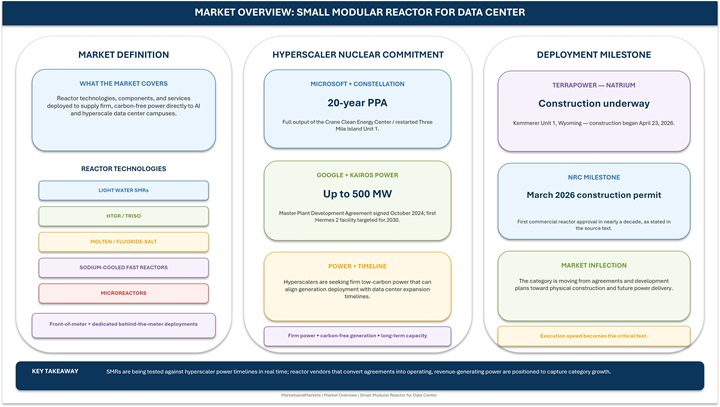
Small Modular Reactor for Data Center covers the reactor technologies, components, and services being deployed to supply firm, carbon-free power directly to AI and hyperscale data center campuses. The market spans light water small modular reactors, high-temperature gas-cooled reactors (HTGR/TRISO), molten salt and fluoride-salt-cooled reactors, sodium-cooled fast reactors, and microreactors, deployed both as front-of-the-meter utility restarts and dedicated behind-the-meter installations co-located with data center campuses.
Every major US hyperscaler has now signed at least one nuclear power agreement for AI data center capacity. Constellation Energy holds a 20-year power purchase agreement to sell Microsoft the full output of the Crane Clean Energy Center, the restarted Three Mile Island Unit 1; the Federal Energy Regulatory Commission approved a transmission waiver on June 1, 2026 that lets Constellation transfer 760 megawatts of grid-connection rights from its Eddystone plant to Crane, clearing the way for the unit to be fully operational ahead of the December 2030 deadline that would otherwise have applied. Google signed a Master Plant Development Agreement with Kairos Power in October 2024 to bring up to 500 MW of advanced nuclear capacity online by 2035, with the first plant — the Hermes 2 facility in Tennessee, selling power to the Tennessee Valley Authority — targeted for 2030.
Physical construction is now underway, not just contracted on paper: TerraPower began construction of Kemmerer Unit 1, its flagship Natrium sodium-cooled fast reactor plant in Wyoming, on April 23, 2026, following the Nuclear Regulatory Commission's March 2026 construction permit — the NRC's first approval of a commercial reactor in nearly a decade and its first approval of a non-light-water reactor design in more than 40 years. “This is the moment our industry has been working toward for a generation,” said TerraPower President and CEO Chris Levesque at the groundbreaking. The Small Modular Reactor for Data Center market is where that generational shift is being tested against hyperscaler timelines in real time — and the reactor vendors that can convert signed agreements into operating, revenue-generating power will capture the category's growth.
Top 10 Key Takeaways
- North America holds the largest market share, driven by the concentration of leading reactor developers — Kairos Power, TerraPower, and Constellation Energy — and the hyperscalers signing nuclear deals with them.
- Asia Pacific is the fastest-growing region, propelled by Japan and South Korea's established nuclear industrial base combining with rapidly expanding AI data center investment across the region.
- Light water small modular reactors lead by reactor-technology revenue; microreactors and advanced non-light-water designs are the fastest-growing reactor technology as hyperscalers pursue behind-the-meter and next-generation deployment models.
- Hyperscale AI training campuses dominate by application; colocation and multi-tenant data centers are the fastest-growing application as shared facilities pursue dedicated nuclear power arrangements.
- Hyperscale cloud and AI providers lead end users; utilities and independent power producers are the fastest-growing end-user category as front-of-the-meter restart and partnership models scale alongside dedicated reactor projects.
- Constellation Energy holds a 20-year power purchase agreement to sell Microsoft the full 835 MW output of the Crane Clean Energy Center, the restarted Three Mile Island Unit 1, with FERC clearing a key transmission obstacle on June 1, 2026.
- Google's October 2024 Master Plant Development Agreement with Kairos Power targets up to 500 MW of advanced nuclear capacity by 2035, with the first plant, Hermes 2 in Tennessee, already under a power purchase agreement with the Tennessee Valley Authority and targeted for 2030.
- TerraPower's April 23, 2026 construction start at Kemmerer Unit 1 in Wyoming followed the NRC's first commercial reactor construction permit in nearly a decade, marking the industry's clearest shift yet from announcements to physical, verifiable construction progress.
- The near-term opportunity lies in the broader profit pool beyond reactor vendors alone, spanning nuclear-grade components, power conversion systems, cooling systems, control software, cybersecurity, grid interconnection, and long-term service contracts.
- The near-term risk is timeline mismatch: TerraPower's Kemmerer Unit 1 is not expected to complete construction until February 2031, illustrating that even first-of-a-kind projects now under construction remain years from commercial operation.
Why the Small Modular Reactor for Data Center Market Matters Now
AI data centers have run into a power problem that conventional grid expansion cannot solve on the timescale hyperscalers need. Google's own framing of its Kairos Power agreement is direct: “the grid needs new electricity sources to support AI technologies,” and the company describes its deal as “the world's first corporate agreement to purchase nuclear energy from multiple small modular reactors,” intended to bring the first unit online “quickly and safely by 2030.” Mike Terrell, Google's Senior Director for Energy and Climate, said the agreement provides “a clean, round-the-clock power source” that can help decarbonize electricity grids while meeting AI-driven demand growth.
This matters commercially because the market has moved from announcements to physical construction and regulatory approval within the same 12-month window. TerraPower's April 2026 groundbreaking at Kemmerer, Wyoming followed the NRC's March 2026 construction permit — the agency's first commercial reactor approval in nearly a decade — while FERC's June 2026 transmission waiver for the Crane Clean Energy Center directly protects a signed 20-year Microsoft power purchase agreement. “We're not just breaking new ground on a first-of-a-kind nuclear plant in Wyoming; we're building the next generation of America's energy infrastructure,” TerraPower CEO Chris Levesque said of the Kemmerer milestone.
The market covers light water small modular reactors, high-temperature gas-cooled reactors, molten salt and fluoride-salt-cooled reactors, sodium-cooled fast reactors, and microreactors, together with the components, fuel supply, and services that support their deployment for data center power. Out of scope are conventional large-scale nuclear power plants not associated with a data center power agreement, non-nuclear power generation technologies, and the data center facilities and IT equipment themselves.
The market connects to the
Generator Sales Market — https://www.marketsandmarkets.com/Market-Reports/generator-sales-market-47544335.html
Power Monitoring Market — https://www.marketsandmarkets.com/Market-Reports/power-monitoring-market-197503460.html
DERMS Architecture and Edge Control Market — https://www.marketsandmarkets.com/Market-Reports/derms-architecture-and-edge-control-market-206649623.html
Circuit Breaker Monitoring Systems Market — https://www.marketsandmarkets.com/Market-Reports/circuit-breaker-monitoring-systems-market-133358428.html
Power Device Analyzer Market — https://www.marketsandmarkets.com/Market-Reports/power-device-analyzer-market-259267665.html
Report Scope
|
Report Metric |
Details |
|
Market Size in 2026 (Value) |
USD 1,300 Million |
|
Market Forecast in 2032 (Value) |
USD 6,800 Million |
|
Growth Rate |
CAGR of 32% from 2026–2032 |
|
Years Considered |
2022–2032 |
|
Base Year |
2025 |
|
Forecast Period |
2026–2032 |
|
Units Considered |
Value (USD Million) |
|
Report Coverage |
Revenue forecast, company ranking, competitive landscape, growth factors, and trends |
|
Top Companies |
• Oklo Inc. |
|
Growth Drivers |
• AI data center power demand outpacing conventional grid expansion |
|
Segments Covered |
• By Reactor Technology: Light Water SMR, HTGR/TRISO, Molten Salt/Fluoride-Salt-Cooled, Sodium-Cooled Fast Reactor, Microreactor |
|
Regional Scope |
North America, Europe, Asia Pacific, Rest of World |
Market Trends Shaping Small Modular Reactor for Data Center
The defining trend is the shift from utility-scale nuclear restarts to purpose-built data center SMR pipelines. Constellation's Crane Clean Energy Center restart, tied to a 20-year Microsoft power purchase agreement, was the market's first major hyperscaler nuclear deal, but subsequent agreements such as Google's Master Plant Development Agreement with Kairos Power have moved decisively toward next-generation SMR technologies purpose-built for utility and data center co-location rather than restarting existing large reactors alone.
A second trend is hyperscalers committing to multi-plant fleet agreements rather than single-site deals. Google's agreement with Kairos Power spans up to seven reactors totaling 500 MW through 2035, while TerraPower has separately reached an agreement with Meta covering up to eight Natrium plants — reflecting a deliberate strategy of securing fleet-scale capacity commitments rather than one-off pilot projects.
A third trend is first-of-a-kind construction and regulatory milestones converting announcements into physical progress. TerraPower's April 23, 2026 construction start at Kemmerer, Wyoming followed the NRC's March 2026 construction permit — the agency's first commercial reactor construction approval in nearly a decade and its first approval of a non-light-water reactor design in more than 40 years — giving the industry its clearest evidence yet that first-of-a-kind SMR projects can clear US regulatory review.
A fourth trend is hyperscalers using PPAs to provide the revenue certainty reactor restarts require. Constellation's 20-year power purchase agreement with Microsoft for the full output of the Crane Clean Energy Center provided the revenue certainty needed to justify a USD 1.6 billion restart investment in a reactor that had been shut down since 2019, illustrating how a single long-term hyperscaler contract can unlock a previously uneconomic nuclear asset.
A fifth trend is regulators actively working to remove grid-side obstacles to hyperscaler nuclear deals. FERC's June 1, 2026 approval of Constellation's transmission waiver, transferring 760 MW of grid-connection rights from its Eddystone plant to Crane, shows regulators treating nuclear-for-AI power delivery as a genuine reliability priority rather than a routine interconnection request.
Market Drivers Accelerating Growth
The first driver is AI data center power demand outpacing conventional grid expansion, positioning small modular reactors as a clean, firm power layer capable of delivering the 24/7 carbon-free baseload power that AI training clusters require — the rationale Google cited directly when describing its Kairos Power agreement as providing “a clean, round-the-clock power source.”
The second driver is hyperscaler revenue certainty unlocking reactor investment decisions: Constellation's 20-year power purchase agreement with Microsoft provided the commercial foundation for its USD 1.6 billion Crane Clean Energy Center restart, while Google's Master Plant Development Agreement with Kairos Power gives the reactor developer, in the words of Kairos Power Vice President Jeff Olson, “a strong customer demand signal” supporting continued investment in its iterative development approach.
The third driver is regulatory momentum clearing first-of-a-kind construction and interconnection hurdles: the NRC's March 2026 construction permit for TerraPower's Kemmerer Unit 1 and FERC's June 2026 transmission waiver for the Crane Clean Energy Center both demonstrate that federal regulators are actively resolving the licensing and grid-access obstacles that have historically slowed nuclear projects.
Market Challenges and Restraints
The most significant restraint is the market remaining early-stage relative to the scale of hyperscaler ambition. TerraPower's own construction timeline for Kemmerer Unit 1 — targeting completion by February 2031, nearly five years after the April 2026 construction start — illustrates that even the most advanced first-of-a-kind SMR project now underway remains years from commercial operation.
A second restraint is nuclear regulatory licensing remaining a multi-year process even for well-resourced projects. The NRC's approval of TerraPower's construction permit in March 2026 was the agency's first commercial reactor construction approval in nearly a decade, underscoring how infrequently the NRC has cleared new reactor designs for construction even as demand for firm nuclear power accelerates.
A third challenge is grid interconnection and transmission capacity remaining a persistent bottleneck even for restart projects, as demonstrated by Constellation's need to secure a FERC waiver specifically because PJM's planned transmission upgrades for the Crane Clean Energy Center were not expected to be complete until after December 2030 without intervention. A related challenge is that reactor restart and construction timelines remain sensitive to project-specific engineering findings, requiring extensive inspection and requalification work — Constellation reported conducting thousands of inspections across Crane's steam generator, main generator, rotor, turbines, and condensers before its planned restart.
Segment Insights
By Reactor Technology
Light water small modular reactors lead by reactor-technology revenue, anchored by NuScale's position as the only developer with a US Nuclear Regulatory Commission-certified SMR design.
Advanced non-light-water reactor technologies — fluoride-salt-cooled, sodium-cooled fast, and high-temperature gas-cooled designs — are the fastest-growing reactor technology category, propelled directly by the Kairos Power/Google, TerraPower/Meta, and X-Energy/Amazon fleet-scale agreements that are steering hyperscaler capital toward next-generation reactor chemistries rather than light water designs alone.
By Application
Hyperscale AI training campuses dominate by application, anchored by the largest, most capital-intensive power agreements — including TerraPower's multi-plant commitment with Meta and Energy Northwest's Amazon-backed X-Energy Xe-100 project, designed to scale up to 12 reactor units and 960 MW.
Colocation and multi-tenant data centers are the fastest-growing application, as shared facility operators pursue dedicated nuclear power arrangements to compete for the same AI tenant workloads that have driven hyperscaler-direct nuclear deals.
Key segmentation insights:
- Light water SMRs lead reactor-technology revenue; microreactors grow fastest on behind-the-meter co-location adoption.
- Hyperscale AI training campuses dominate by application; colocation/multi-tenant data centers grow fastest as shared facilities pursue dedicated nuclear power.
- Hyperscale cloud/AI providers lead end users; utilities/IPPs grow fastest as front-of-the-meter restart models scale.
- The NRC-certified light water model and the advanced non-light-water technology bet represent two competing routes to market.
- Hyperscaler deal flow and first-of-a-kind construction progress are the structural drivers converting committed capacity into recurring, production-scale revenue.
Regional Analysis: Small Modular Reactor for Data Center Market by Region
North America
North America holds the largest share, valued at roughly USD 806 million in 2026 and projected to reach about USD 3,850 million by 2032, growing at a CAGR of approximately 29.8%. The United States dominates through the concentration of leading reactor developers — Kairos Power, TerraPower, and Constellation Energy — and the hyperscalers signing nuclear deals with them, alongside the Crane Clean Energy Center restart and TerraPower's Kemmerer, Wyoming construction. Canada contributes through growing utility and government interest in SMR deployment for grid and industrial power needs.
Europe
Europe is valued at approximately USD 234 million in 2026 and forecast to reach around USD 1,280 million by 2032, expanding at a CAGR of approximately 32.7%. The United Kingdom, France, and other European markets contribute through growing government and utility interest in SMR deployment for both grid decarbonization and, increasingly, dedicated data center power supply.
Asia Pacific
Asia Pacific is the fastest-growing region, valued at roughly USD 208 million in 2026 and projected to reach about USD 1,450 million by 2032, growing at a CAGR of approximately 38.2%. Japan and South Korea combine established nuclear industrial bases and deep component supply chains with rapidly expanding AI data center investment, while China continues to advance its own domestic SMR development programs.
Rest of World
The Rest of World market is valued at USD 52 million in 2026 and is projected to reach about USD 220 million by 2032, growing at a CAGR of approximately 27.2%. The Middle East contributes through growing sovereign investment in advanced nuclear and AI infrastructure, while Latin America adds early-stage exploration of SMR deployment for grid and industrial power needs.
Key Company Insights
The competitive landscape spans three tiers: advanced reactor technology developers pursuing next-generation, non-light-water designs, established nuclear equipment and light water SMR vendors, and utilities and independent power producers structuring direct hyperscaler power agreements. Leading players include Kairos Power, TerraPower, X-Energy, Oklo Inc., NuScale Power, Rolls-Royce SMR, GE Vernova/GE Hitachi Nuclear Energy, Westinghouse Electric Company, Holtec International, Constellation Energy, Talen Energy, BWX Technologies, Centrus Energy, Vistra Corp, and Dominion Energy.
- Kairos Power (KP-FHR fluoride-salt-cooled reactor)
- TerraPower (Natrium sodium-cooled fast reactor)
- X-Energy (Xe-100 high-temperature gas-cooled reactor)
- Oklo Inc. (Aurora microreactor)
- NuScale Power (VOYGR light water SMR)
- Rolls-Royce SMR (light water SMR)
- GE Vernova / GE Hitachi Nuclear Energy (BWRX-300)
- Westinghouse Electric Company (AP300 SMR)
- Holtec International (SMR-300)
- Constellation Energy (Crane Clean Energy Center restart)
- Talen Energy (Susquehanna nuclear campus)
- BWX Technologies (TRISO fuel and reactor components)
- Centrus Energy (HALEU fuel production)
- Vistra Corp (nuclear plant operations)
- Dominion Energy (North Anna nuclear station)
Kairos Power and TerraPower anchor the advanced reactor technology tier with the two most concretely validated hyperscaler agreements in the category: Kairos Power's Master Plant Development Agreement with Google targets up to seven KP-FHR fluoride-salt-cooled reactors totaling 500 MW by 2035, with its first plant, Hermes 2 in Tennessee, already selling power to the Tennessee Valley Authority. TerraPower's sodium-cooled Natrium reactor began physical construction at Kemmerer, Wyoming in April 2026, backed by a separate agreement with Meta covering up to eight Natrium plants. X-Energy's Xe-100 high-temperature gas-cooled reactor is backed by an approximately USD 500 million Series C-1 investment that included participation from Amazon's Climate Pledge Fund, part of a broader collaboration targeting more than 5 GW of new power projects with Amazon by 2039.
NuScale Power remains the only developer with a US NRC-certified SMR design, giving it a distinct regulatory-risk advantage even as competitors pursue more novel reactor chemistries. Rolls-Royce SMR and GE Vernova/GE Hitachi compete in the light water SMR tier outside the United States, while Westinghouse and Holtec round out the light water and advanced light water tier with the AP300 and SMR-300 designs respectively. Constellation Energy, Talen Energy, Vistra, and Dominion Energy represent the utility and independent power producer tier structuring direct hyperscaler power agreements — Constellation through the Crane Clean Energy Center restart backed by a 20-year Microsoft power purchase agreement. BWX Technologies and Centrus Energy anchor the critical fuel and component supply chain, providing TRISO fuel and HALEU enrichment respectively that multiple reactor vendors depend on.
Key company strategy insights:
- Kairos Power and TerraPower hold the clearest position in next-generation reactor technology, each validated by a signed, multi-plant hyperscaler agreement with defined delivery targets.
- NuScale Power's NRC design certification gives it a structural regulatory advantage even as competitors advance alternative reactor chemistries.
- Constellation Energy's utility restart model, anchored by its 20-year Microsoft PPA, offers hyperscalers a faster incremental path to firm power than greenfield SMR construction alone.
- X-Energy's Amazon-backed investment and multi-gigawatt collaboration target illustrates how hyperscaler capital is directly funding reactor developer growth, not just purchasing offtake.
- BWX Technologies and Centrus Energy's fuel and component supply position gives them structural exposure across nearly every reactor vendor's roadmap regardless of which technology ultimately scales fastest.
Recent Developments
- June 2026: FERC approved a transmission waiver allowing Constellation Energy to transfer 760 megawatts of grid-connection rights from its Eddystone plant to the Crane Clean Energy Center, clearing a key obstacle to the restarted Three Mile Island Unit 1 reaching full power under its 20-year Microsoft power purchase agreement.¹
- April 2026: TerraPower officially began construction of Kemmerer Unit 1, its flagship Natrium sodium-cooled fast reactor plant in Wyoming, following the Nuclear Regulatory Commission's construction permit approval the previous month.²
- March 2026: The Nuclear Regulatory Commission authorized a construction permit for TerraPower's Kemmerer Power Station Unit 1, its first approval of a commercial reactor for construction in nearly a decade and its first approval of a non-light-water power reactor design in more than 40 years.³
- August 2025: Google, Kairos Power, and the Tennessee Valley Authority announced a collaboration under which TVA will purchase power from Kairos Power's Hermes 2 plant in Tennessee, the first deployment under Google and Kairos Power's broader 500 MW agreement.4
Sources:
¹ Utility Dive, June 3, 2026 — Constellation's Three Mile Island Nuclear Restart Gets Boost With FERC Waiver
² TerraPower, April 23, 2026 — TerraPower Commences Construction on America's First Utility-Scale Advanced Nuclear Power Plant
³ POWER Magazine, April 27, 2026 — TerraPower's Kemmerer 1 Enters Construction: Timeline of the Natrium Project's Road to First Power
4 ESG Today, August 20, 2025 — Google Signs Deal to Power Data Centers From Advanced Nuclear Plant by 2030
Real-World Use Cases
- Constellation Energy's 20-year power purchase agreement with Microsoft for the full 835 MWe output of the Crane Clean Energy Center gave the company the revenue certainty needed to justify a USD 1.6 billion restart of the reactor formerly known as Three Mile Island Unit 1, shut down since 2019. Constellation has conducted thousands of inspections across the plant's steam generator, main generator, rotor, turbines, and condensers ahead of a targeted second-half-2027 restart, with FERC's June 2026 transmission waiver removing what the company identified as the last major grid obstacle to full deliverability.5
- Google's Master Plant Development Agreement with Kairos Power is designed to deploy a US fleet of advanced nuclear power projects totaling 500 MW by 2035, with the first plant delivered years ahead of the fleet target: the Hermes 2 facility in Tennessee, whose output Kairos Power boosted from 28 MW to 50 MW at Google's request, will sell power to the Tennessee Valley Authority beginning in 2030 under the first utility power purchase agreement for a fourth-generation advanced reactor in the United States.6
Sources:
5 smrintel.com, July 3, 2026 — FERC Clears 835-MWe TMI Restart for 2027 Microsoft PPA
6 ESG Dive, August 21, 2025 — Google, Kairos Power Deal Aims for Tennessee Nuclear Reactor by 2030
Market Segmentation
The Small Modular Reactor for Data Center market segments across three interlocking axes. By reactor technology, it spans light water SMRs, high-temperature gas-cooled reactors, molten salt/fluoride-salt-cooled reactors, sodium-cooled fast reactors, and microreactors — five categories reflecting fundamentally different engineering approaches to the same firm-power problem. By application, it covers hyperscale AI training campuses, colocation/multi-tenant data centers, enterprise/private data centers, and edge/regional data centers. By end user, it serves hyperscale cloud/AI providers, colocation providers, utilities/independent power producers, and government/sovereign AI programs.
These axes interlock: a hyperscale AI provider (end user) contracts TerraPower's Natrium sodium-cooled fast reactor (reactor technology) to supply firm power to a gigawatt-scale training campus (application: hyperscale AI training campuses) — three axes converging in a single, multi-year nuclear power agreement.
Key segmentation insights:
- Light water SMRs lead reactor-technology revenue; microreactors grow fastest on behind-the-meter co-location adoption.
- Hyperscale AI training campuses dominate by application; colocation/multi-tenant data centers grow fastest as shared facilities pursue dedicated nuclear power.
- Hyperscale cloud/AI providers lead end users; utilities/IPPs grow fastest as front-of-the-meter restart models scale.
- The NRC-certified light water model and the advanced non-light-water technology bet represent two competing routes to market.
- Hyperscaler deal flow and first-of-a-kind construction progress are the structural drivers of market growth through 2032.
Opportunities and Future Outlook
Through 2032, small modular reactors for data centers will mature from a portfolio of hyperscaler agreements into an operating, revenue-generating layer of AI infrastructure. The forces driving the market — AI power demand outpacing grid expansion, hyperscaler PPAs providing the revenue certainty to unlock major reactor investment decisions, and first-of-a-kind construction and regulatory milestones at Kemmerer and Crane — are structural and mutually reinforcing, even as the sector works through the multi-year licensing and construction timelines that TerraPower's own schedule, targeting completion only by February 2031, makes concrete. Converting signed agreements into billed megawatts, and doing so on schedule and on budget, will be the next catalyst separating reactor vendors that can deliver from those that cannot.
For infrastructure leaders, corporate development teams, and investors, the Small Modular Reactor for Data Center market is where the industry's boldest bet on firm, carbon-free AI power is being tested in real time, and the vendors and utility partners that can convert today's letters of intent into tomorrow's operating reactors will determine how much of the next wave of AI infrastructure runs on nuclear power.
Frequently Asked Questions (FAQ)
1. How big is the Small Modular Reactor for Data Center market?
The Small Modular Reactor for Data Center market is projected to grow from USD 1,300 million in 2026 to about USD 6,800 million by 2032. North America accounts for the largest share, driven by the concentration of leading reactor developers and hyperscaler nuclear deals.
2. What is the Small Modular Reactor for Data Center market growth rate?
The market is forecast to grow at a CAGR of approximately 32% from 2026 to 2032. Asia Pacific is the fastest-growing region at around 38.2%, driven by the region's nuclear industrial base and AI data center investment.
3. Which segment leads the Small Modular Reactor for Data Center market?
By reactor technology, light water SMRs lead; microreactors grow fastest. By application, hyperscale AI training campuses lead; colocation/multi-tenant data centers grow fastest.
4. Who are the key players in the Small Modular Reactor for Data Center market?
Leading players include Oklo Inc., X-Energy, Kairos Power, TerraPower, NuScale Power, Rolls-Royce SMR, GE Vernova/GE Hitachi Nuclear Energy, Westinghouse, Holtec International, Constellation Energy, Talen Energy, BWX Technologies, Centrus Energy, Vistra Corp, and Dominion Energy.
5. What are the factors driving the Small Modular Reactor for Data Center market?
The primary drivers are AI data center power demand outpacing conventional grid expansion, hyperscaler power purchase agreements such as Microsoft's Crane Clean Energy Center deal and Google's Kairos Power agreement providing the revenue certainty to unlock reactor investment, and NRC/FERC regulatory milestones clearing construction and interconnection hurdles.
Speak With Our Analyst
The Small Modular Reactor for Data Center market is where the industry's boldest bet on firm, carbon-free AI power is being tested in real time, and vendor-level detail on reactor technology readiness, construction progress, and hyperscaler deal structures is where strategic decisions are won or lost. MarketsandMarkets can help you go deeper: request a sample of the full study, speak with our analyst about your specific questions, or customize the scope to your target reactor technologies, applications, and geographies. Reach out to explore how this intelligence can inform your power procurement strategy, vendor selection, or investment thesis.
 Exclusive indicates content/data unique to MarketsandMarkets and not available with any competitors.
TABLE OF CONTENTS
1 Introduction
1.1 Study Objectives
1.2 Market Definition and Scope
1.2.1 Inclusions and Exclusions
1.3 Study Scope
1.3.1 Markets Covered
1.3.2 Geographic Segmentation
1.3.3 Years Considered
1.4 Currency Considered
1.5 Stakeholders
2 Research Methodology
2.1 Research Approach
2.1.1 Secondary Research
2.1.2 Primary Research
2.1.2.1 Breakdown of Primaries
2.2 Market Size Estimation
2.2.1 Bottom-Up Approach
2.2.2 Top-Down Approach
2.3 Data Triangulation
2.4 Research Assumptions
2.5 Limitations and Risk Assessment
3 Executive Summary
4 Premium Insights
4.1 Attractive Opportunities in the Small Modular Reactor for Data Center Market
4.2 Market, By Reactor Technology
4.3 Market, By Region
4.4 Market, By Application
5 Market Overview
5.1 Introduction
5.2 Market Dynamics
5.2.1 Drivers
5.2.1.1 AI Data Center Power Demand Growing Faster Than Grid Systems Can Expand
5.2.1.2 Hyperscaler-Nuclear Deal Flow Scaling to 9.8 GW Committed Across 13 Deals
5.2.1.3 Broader SMR Market Maturing in Parallel Through Policy Support and Financing Milestones
5.2.2 Restraints
5.2.2.1 Market Remains Early-Stage and Milestone-Dependent Ahead of First Commercial Operation
5.2.2.2 Nuclear Regulatory Licensing Timelines Remaining a Critical Bottleneck
5.2.3 Opportunities
5.2.3.1 Broader Profit Pool Beyond Reactor Vendors Across Components, Cooling, and Services
5.2.3.2 Front-of-the-Meter Utility Restart and Partnership Models Offering a Faster Path to Firm Power
5.2.4 Challenges
5.2.4.1 Timeline Mismatch Between Data Center Construction Speed and SMR Licensing Timelines
5.2.4.2 Capital Intensity and Cost Overrun Risk for First-of-a-Kind Reactor Designs
5.3 Value Chain Analysis
5.4 Ecosystem Analysis
5.5 Investment and Funding Scenario
5.6 Pricing Analysis
5.7 Trends and Disruptions Impacting Customer Business
5.8 Technology Analysis
5.8.1 Key Technologies (Light Water SMRs, High-Temperature Gas-Cooled Reactors, Molten Salt Reactors)
5.8.2 Complementary Technologies (HALEU/TRISO Fuel Supply, Passive Safety Systems, Modular Construction)
5.8.3 Adjacent Technologies (Microreactors, Sodium-Cooled Fast Reactors, Grid Interconnection Systems)
5.9 Porter's Five Forces Analysis
5.10 Key Stakeholders and Buying Criteria
5.11 Case Study Analysis
5.12 Key Conferences and Events
5.13 Regulatory Landscape
5.13.1 US Nuclear Regulatory Commission SMR Design Certification and Licensing Pathways
5.13.2 FERC Interconnection and Transmission Waiver Rules for Restarted and New Nuclear Capacity
5.13.3 UK Government SMR Technology Selection and Site Licensing Framework
5.13.4 US Section 45U Nuclear Production Tax Credit and HALEU Fuel Policy
5.14 Impact of AI on the Market
5.15 Impact of 2025 US Tariffs on Supply Chains
6 Industry Trends
6.1 From Utility-Scale Nuclear Restarts to Purpose-Built Data Center SMR Pipelines
6.2 Hyperscalers Diversifying Across Multiple Reactor Technologies and Vendors Simultaneously
6.3 First-of-a-Kind Construction Milestones Converting Announcements Into Physical Progress
6.4 Behind-the-Meter Microreactors Emerging as a Distinct Deployment Category
6.5 Investor Scrutiny Shifting From Signed Announcements to Billed Megawatts
6.6 International SMR Deployment Expanding Beyond the United States
7 Technology Adoption and Strategic Disruption Landscape
7.1 NRC-Certified Light Water SMRs (NuScale) vs. Advanced Non-Light-Water Designs (Kairos, X-Energy, TerraPower)
7.2 Utility Restart and Front-of-the-Meter Models vs. Dedicated Behind-the-Meter Microreactors
7.3 Direct Hyperscaler Investment and Offtake vs. Utility-Intermediated Power Purchase Agreements
7.4 First-of-a-Kind Demonstration Projects vs. Fleet-Scale Standardized Reactor Deployment
8 Customer Landscape and Buyer Behavior
8.1 Decision-Making Process — VP Infrastructure, Chief Power Officer, Corporate Development Lead
8.2 Multi-Vendor, Multi-Technology Portfolio Diversification Before Long-Term Offtake Commitment
8.3 ROI Framework: Levelized Cost of Electricity, Construction Timeline Risk, Grid Independence, Carbon Goals
8.4 Build vs. Buy: Direct Reactor Investment vs. Long-Term Power Purchase Agreement Structures
9 Small Modular Reactor for Data Center Market, By Reactor Technology
9.1 Introduction
9.2 Light Water Small Modular Reactors
9.3 High-Temperature Gas-Cooled Reactors (HTGR/TRISO)
9.4 Molten Salt and Fluoride-Salt-Cooled Reactors
9.5 Sodium-Cooled Fast Reactors
9.6 Microreactors
10 Small Modular Reactor for Data Center Market, By Application
10.1 Introduction
10.2 Hyperscale AI Training Campuses
10.3 Colocation and Multi-Tenant Data Centers
10.4 Enterprise and Private Data Centers
10.5 Edge and Regional Data Centers
11 Small Modular Reactor for Data Center Market, By End User
11.1 Introduction
11.2 Hyperscale Cloud and AI Providers
11.3 Colocation Providers
11.4 Utilities and Independent Power Producers
11.5 Government and Sovereign AI Programs
12 Small Modular Reactor for Data Center Market, By Region
12.1 Introduction
12.2 North America
12.2.1 United States
12.2.2 Canada
12.3 Europe
12.3.1 United Kingdom
12.3.2 Romania
12.3.3 Poland
12.3.4 Rest of Europe
12.4 Asia Pacific
12.4.1 Japan
12.4.2 South Korea
12.4.3 China
12.4.4 Rest of Asia Pacific
12.5 Rest of World
12.5.1 Middle East
12.5.2 Latin America
13 Competitive Landscape
13.1 Overview
13.2 Key Player Strategies / Right to Win
13.3 Revenue Analysis
13.4 Market Share Analysis
13.5 Company Evaluation Matrix
13.6 Competitive Benchmarking
13.7 Competitive Scenario
14 Company Profiles
14.1 Oklo Inc. (Aurora Microreactor)
14.2 X-Energy (Xe-100 High-Temperature Gas-Cooled Reactor)
14.3 Kairos Power (KP-FHR Fluoride-Salt-Cooled Reactor)
14.4 TerraPower (Natrium Sodium-Cooled Fast Reactor)
14.5 NuScale Power (VOYGR Light Water SMR)
14.6 Rolls-Royce SMR (Light Water SMR)
14.7 GE Vernova / GE Hitachi Nuclear Energy (BWRX-300)
14.8 Westinghouse Electric Company (AP300 SMR)
14.9 Holtec International (SMR-300)
14.10 Constellation Energy (Crane Clean Energy Center Restart)
14.11 Talen Energy (Susquehanna Nuclear Campus)
14.12 BWX Technologies (TRISO Fuel and Reactor Components)
14.13 Centrus Energy (HALEU Fuel Production)
14.14 Vistra Corp (Nuclear Plant Operations)
14.15 Dominion Energy (North Anna Nuclear Station)
15 Appendix
15.1 Discussion Guide
15.2 KnowledgeStore: Subscription Portal
15.3 Customization Options
15.4 Related Reports
15.5 Author Details
















Growth opportunities and latent adjacency in Small Modular Reactor for Data Center Market