Transformer Oil Market Size, Share, Industry Analysis

Transformer Oil Market by Oil Type [Mineral (Naphthenic, Paraffinic), Silicone, Bio-based], Application (Transformer, Switchgear, Reactor), End User (Transmission & Distribution, Power Generation, Railways & Metros), Region - Global Forecast to 2031




OVERVIEW
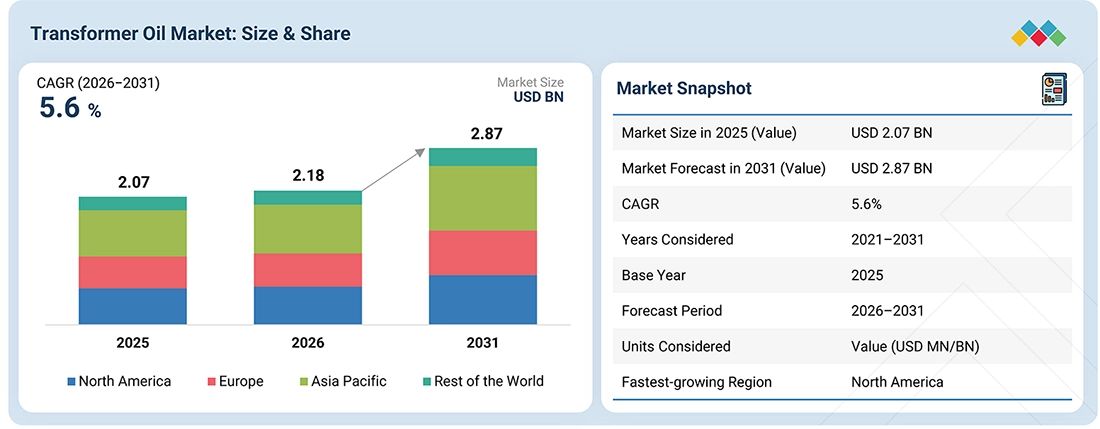
The transformer oil market is projected to grow from USD 2.18 billion in 2026 to USD 2.87 billion by 2031, at a 5.6% CAGR. The market is driven by rising electricity demand, expansion and modernization of power transmission and distribution infrastructure, and growing investments in renewable energy projects. Growing deployment of transformers across utilities, industrial, commercial, and renewable power applications is supporting demand for transformer oils. Furthermore, advancements in high-performance mineral oils, natural and synthetic ester fluids, enhanced thermal stability, and fire-resistant insulating fluids are expanding application opportunities, enabling improved transformer efficiency, longer equipment life, and greater reliability across power networks.
Source: Secondary Research, Interviews with Experts, MarketsandMarkets Analysis
Transformer Oil Market Size and Forecast:
- Market Size (2025): USD 2.07 Billion
- Market Size (2026): USD 2.18 Billion
- Market Forecast (2031): USD 2.87 Billion
- Growth Rate: CAGR of 5.6% from 2026 to 2031
- Base Year: 2025
- Forecast Period: 2026–2031
Key growth drivers
- Rising electricity demand
- Expansion and modernization of power transmission and distribution infrastructure
- Growing investments in renewable energy generation
- Replacement of aging transformer fleets
- Shift toward bio-based and ester transformer fluids
KEY TAKEAWAYS
-
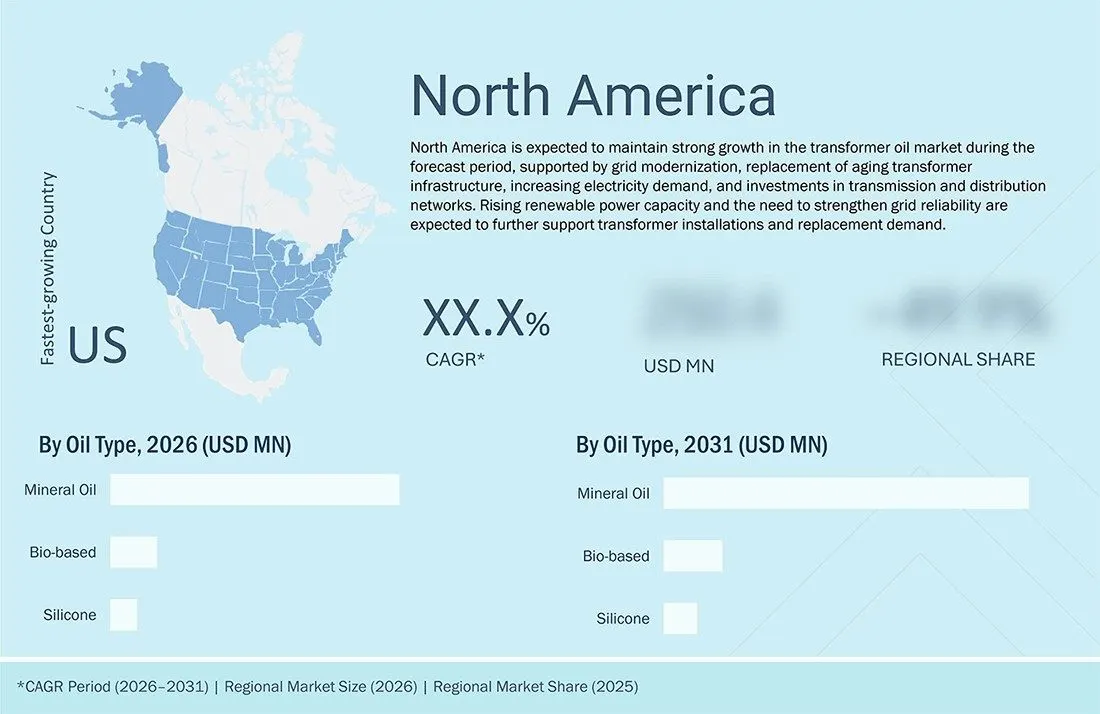
BY REGIONBy region, the North American market is expected to register the highest CAGR of 5.2% during the forecast period.
-
BY TYPEBy type, the bio-based oil segment is expected to register the highest CAGR of 4.3% during the forecast period.
-
BY APPLICATIONBy application, the transformers segment registers the highest CAGR during the forecast period.
-
BY END USERBy end user, the transmission & distribution segment registers the highest CAGR during the forecast period.
-
COMPETITIVE LANDSCAPE - KEY PLAYERSNynas AB (Sweden), APAR Industries (India), Ergon (US), Calumet Specialty Products Partners (US), Cargill (US), Dow (US), Exxon Mobil Corporation(US), Shell (UK), Repsol (Spain), and PetroChina Company Limited (China) have been identified as leading players in the global transformer oil market. These companies are strengthening their market positions through high-performance insulating oils, bio-based and ester fluids, enhanced thermal stability, product innovation, expanded refining capacities, and strategic distribution networks across key regional markets.
-
COMPETITIVE LANDSCAPE - STARTUPS/SMESNYCO (France), Prolec Energy (US), and Insulect (Australia) are emerging players in the transformer oil market, driven by the development and deployment of next-generation synthetic and natural ester dielectric fluids for power, distribution, traction, and renewable-energy transformers.
The transformer oil market is projected to grow significantly during 2026–2031, driven by expanding power transmission and distribution infrastructure, rising electricity demand, and increasing investments in renewable energy generation. Growing transformer deployment across utility, industrial, commercial, and renewable energy applications is supporting demand for insulating fluids. Furthermore, advances in high-performance mineral oils, natural and synthetic ester fluids, enhanced thermal stability, and fire-resistant transformer oils are expanding application opportunities, enabling improved transformer efficiency, longer equipment life, reduced maintenance requirements, and greater power-network reliability.
TRENDS & DISRUPTIONS IMPACTING CUSTOMERS' CUSTOMERS
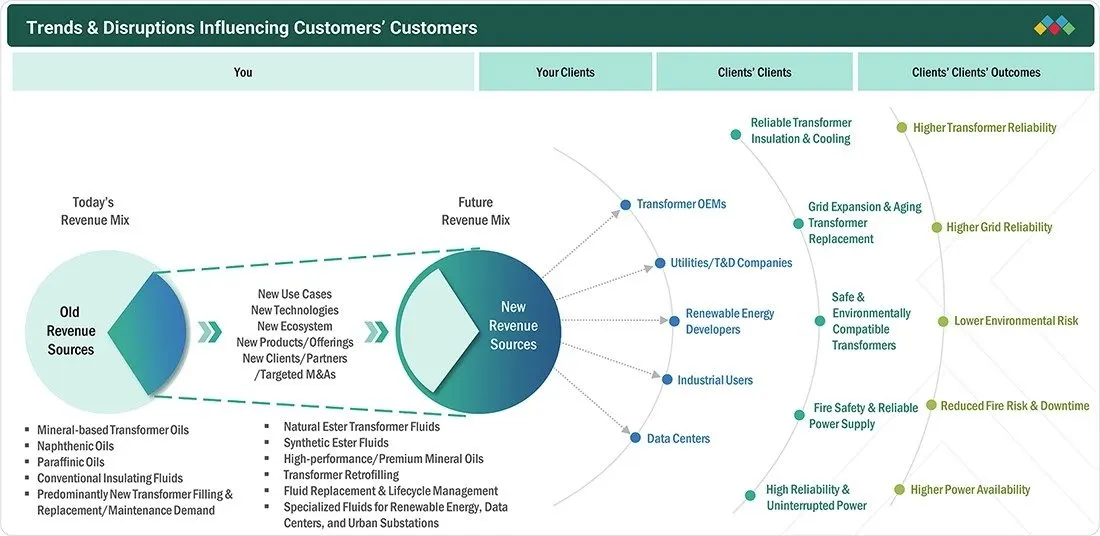
The transformer oil market is estimated to register a CAGR of 5.6% during the forecast period, with Nynas AB, APAR Industries, Cargill, Calumet Specialty Products Partners, L.P., Exxon Mobil Corporation, Shell, Repsol, and PetroChina Company Limited strengthening portfolios across utility, industrial, renewable energy, and commercial applications. Nynas AB, APAR Industries, and Cargill are similarly strengthening transformer-oil portfolios through bio-based ester fluids, high-performance insulating oils, product development, localized production, and strategic expansion, intensifying competition across power transmission, distribution, and industrial applications.
Source: Secondary Research, Interviews with Experts, MarketsandMarkets Analysis
MARKET DYNAMICS

Level
-
Expansion and modernization of transmission & distribution infrastructure

-
Replacement of aging transformer fleets


Level
-
Higher cost of ester-based transformer fluids

-
Availability and volatility of specialty feedstocks


Level
-
Shift toward bio-based and ester transformer fluids

-
Retrofilling of existing mineral-oil transformers


Level
-
Competition from established mineral-based oils

-
Technical compatibility with existing transformer fleets

Source: Secondary Research, Interviews with Experts, MarketsandMarkets Analysis
Driver: Expansion and modernization of transmission & distribution infrastructure
The expansion and modernization of electricity transmission and distribution infrastructure are major drivers of the transformer oil market. Rising electricity consumption, grid expansion, urbanization, and the integration of renewable power are encouraging utilities to install new substations, transformers, and grid equipment. Transformers require insulating and cooling fluids to maintain electrical insulation and dissipate heat during operation, directly supporting demand for transformer oil. In parallel, utilities in developed markets are replacing aging transformer fleets to improve grid reliability and reduce failure-related outages. Emerging economies are also investing in new transmission networks to expand electricity access and accommodate growing industrial and commercial loads. These developments generate demand not only for oil used in newly manufactured transformers but also for replacement oil during maintenance, servicing, and refurbishment. Consequently, continued investment in transmission and distribution infrastructure is expected to sustain transformer oil consumption across utility, industrial, renewable-energy, and commercial applications.
Restraint: Higher cost of ester-based transformer fluids
The relatively high cost of ester-based transformer fluids is a key restraint for the transformer oil market. Natural and synthetic ester fluids provide advantages such as higher fire safety, biodegradability, and improved environmental performance compared with conventional mineral oil. However, these benefits generally come with a higher purchase price. For utilities and industrial users managing large transformer fleets, the initial cost difference can become significant when fluids are required for numerous transformers or large-capacity units. Mineral oil also benefits from established manufacturing infrastructure, mature supply chains, widespread availability, and extensive historical use, making it a cost-effective option for many applications. As a result, customers that prioritize upfront procurement costs may continue using conventional mineral oils rather than shifting to ester fluids. Although lifecycle benefits can partly offset the initial premium in specific applications, the higher upfront investment remains a barrier, particularly in price-sensitive developing markets and standard transformer installations where advanced fire-safety or environmental characteristics are not mandatory.
Opportunity: Shift toward bio-based and ester transformer fluids
Growing adoption of bio-based and ester transformer fluids represents a significant opportunity for market participants. Growing emphasis on environmental sustainability, fire safety, and reduced ecological risk is encouraging utilities, transformer manufacturers, and industrial users to consider alternatives to conventional mineral oil. Natural ester fluids, particularly those derived from renewable, plant-based feedstocks, offer biodegradability and a higher fire point, making them attractive for applications where environmental or fire-safety considerations matter. Potential demand is particularly strong in urban substations, renewable-energy installations, indoor facilities, and other locations where minimizing fire and environmental risks is a priority. Retrofitting existing transformers with ester fluids also creates an opportunity because customers can potentially improve the environmental and safety profile of installed assets without replacing the entire transformer. As awareness of lifecycle costs and sustainability increases, manufacturers can expand premium-fluid portfolios and develop application-specific solutions. This shift gives transformer oil suppliers opportunities to diversify beyond traditional mineral-based products and capture higher-value applications.
Challenge: Competition from established mineral-based oils
The continued dominance of conventional mineral oil presents a major challenge to transformer oil manufacturers seeking to expand alternative-fluid adoption. Mineral oil has been used extensively in power and distribution transformers for decades and benefits from established production capacity, global availability, well-developed supply chains, and extensive operating experience. Transformer OEMs and utilities are familiar with its performance characteristics, maintenance requirements, and compatibility with existing transformer designs. This established ecosystem creates switching barriers for customers considering natural or synthetic ester alternatives. In addition, mineral oil generally offers a lower upfront cost, which remains important for large-scale utility procurement and standard transformer applications. Alternative fluids may therefore need additional technical validation, compatibility assessment, and customer approval before adoption. Manufacturers of ester-based fluids must demonstrate sufficient performance, reliability, economic value, and compatibility to overcome customer hesitation. Consequently, although sustainability and fire-safety considerations support gradual diversification, the large installed base and cost advantages of mineral oil will continue to make market penetration of alternative transformer fluids challenging.
TRANSFORMER OIL MARKET SIZE, SHARE, INDUSTRY ANALYSIS: COMMERCIAL USE CASES ACROSS INDUSTRIES
| COMPANY | USE CASE DESCRIPTION | BENEFITS |
|---|---|---|
 |
Cargill – FR3™ Natural Ester Dielectric Fluid: FR3™ is a natural ester transformer fluid derived from renewable vegetable oil and is used in distribution and power-generation transformers across voltage classes | It is also suitable for applications such as renewable-energy projects, data centers, switchgear, and transformer retrofilling | Its higher thermal capability allows transformers to handle increased loading, while its moisture-management properties help protect insulation | The fluid is particularly relevant where fire safety and environmental performance are priorities, including densely populated areas and renewable-energy installations. | FR3™ provides multiple operational and sustainability benefits | Its high flash and fire points significantly improve transformer fire safety compared with mineral oil | The fluid can enable up to 20% higher loading capacity and can help extend transformer insulation life by reducing moisture-related degradation | Its renewable, readily biodegradable formulation also reduces environmental risks from leaks or spills | These characteristics can support improved grid resilience, longer asset life, lower maintenance requirements, and potentially lower total cost of ownership | Cargill also positions FR3™ for retrofitting existing transformers, allowing utilities to improve performance without replacing the entire asset. |
 |
Nynas – NYTRO® Transformer Oils: Nynas supplies NYTRO® transformer fluids for insulating and cooling power, distribution, and industrial transformers | Its portfolio includes conventional naphthenic oils as well as sustainable solutions such as NYTRO® RR 900X, a re-refined circular transformer fluid, and NYTRO® BIO 300X, a renewable and biodegradable transformer fluid | These products are designed for different transformer designs, climates, and operating conditions, with applications extending to renewable-energy infrastructure such as wind and solar projects. | NYTRO® fluids provide reliable insulation, heat transfer, oxidation stability, and long service life | NYTRO® RR 900X enables circular use of end-of-life transformer oil while maintaining performance comparable to virgin mineral oil and requiring no transformer design modifications | NYTRO® BIO 300X provides ultra-low viscosity and enhanced cooling, helping reduce winding temperatures and improve transformer operating flexibility | The portfolio therefore supports transformer reliability, reduced maintenance, improved thermal performance, and sustainability objectives | Nynas reports that RR 900X can reduce greenhouse-gas emissions by at least 70% over its lifetime compared with virgin transformer oil, strengthening its value for circularity-focused utilities and OEMs. |
Logos and trademarks shown above are the property of their respective owners. Their use here is for informational and illustrative purposes only.
MARKET ECOSYSTEM
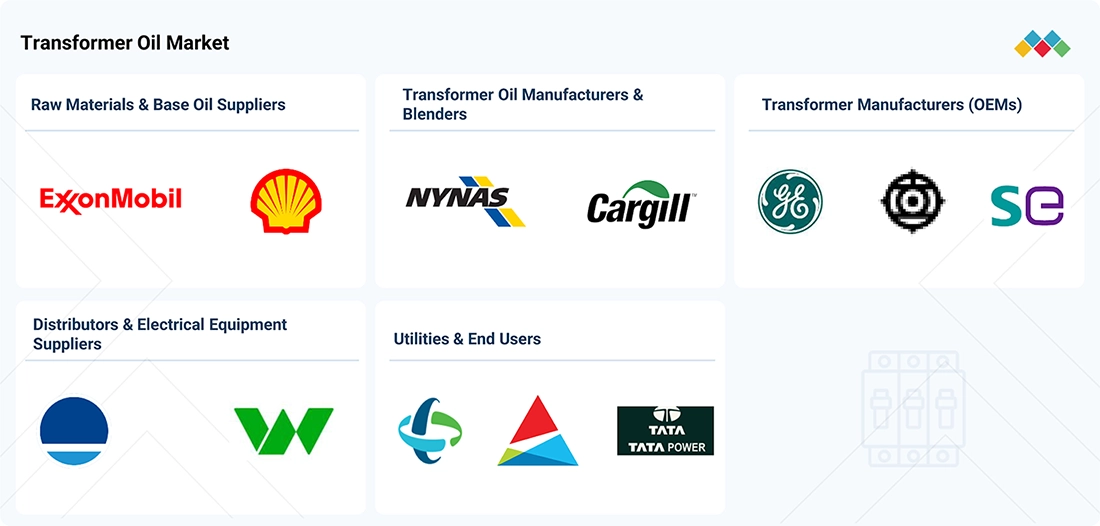
The transformer oil ecosystem includes base oil and chemical suppliers, transformer oil manufacturers, transformer OEMs, distributors, testing/service providers, utilities, and industrial users. Upstream companies supply mineral oils, silicone fluids, bio-based esters, and additives, while oil manufacturers formulate and distribute dielectric fluids. Transformer OEMs and service providers use these fluids for insulation, cooling, testing, purification, and regeneration. Downstream demand is led by transmission & distribution, power generation, railways and metros, renewable energy, and industrial applications. Regulations and standards increasingly influence product quality, fire safety, and environmental performance.
Logos and trademarks shown above are the property of their respective owners. Their use here is for informational and illustrative purposes only.
MARKET SEGMENTS
Source: Secondary Research, Interviews with Experts, MarketsandMarkets Analysis
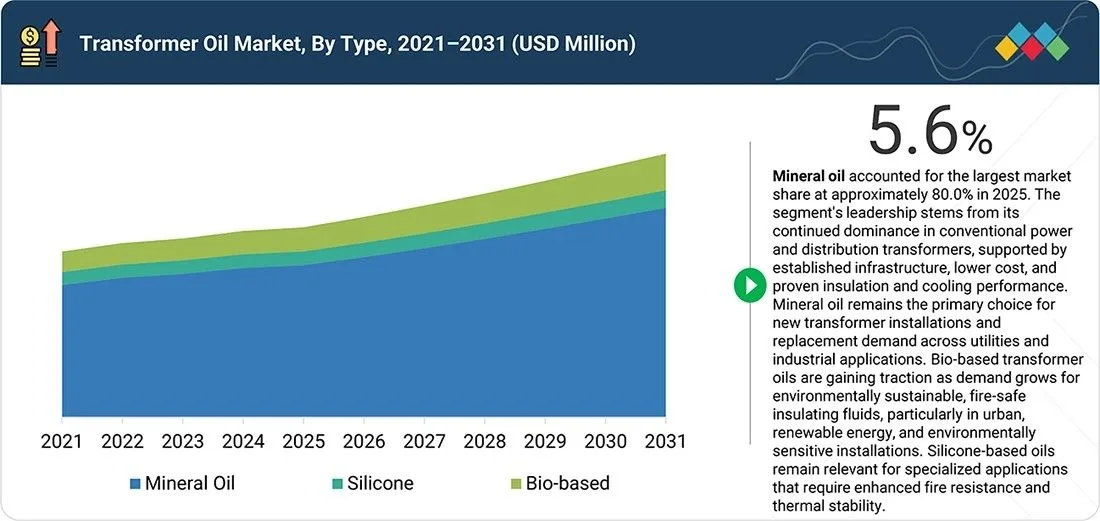
By Type — Mineral oil is projected to register the highest CAGR during the forecast period
Mineral oil dominates the transformer oil market because it is widely used in conventional power and distribution transformers and is the industry-standard insulating fluid. The segment benefits from strong dielectric properties, effective heat dissipation, chemical stability, and cost advantages compared with silicone and bio-based alternatives. Mineral oil is also supported by well-established global supply chains, technical standards, maintenance practices, and compatibility with the large installed base of oil-filled transformers. Utilities and transformer manufacturers continue to prefer mineral oil for high-volume applications because of its proven operational performance and availability. Growing investments in transmission and distribution infrastructure, replacement of aging transformers, and expansion of electricity networks further support demand.
By Application — Transformers are projected to register the highest CAGR during the forecast period
The largest application segment is transformers, since transformer oil is mainly used to provide electrical insulation and cooling in oil-filled transformers. It aids in heat dissipation during transformer operation, maintains the transformer's dielectric strength, and prevents internal components from breaking down and deteriorating due to electrical stress. Power and distribution transformers can consume a great deal of insulating fluid compared with switchgear and reactors. Demand is also being fueled by the ongoing growth of electricity transmission and distribution networks, the integration of more renewable energy and the replacement of the aging transformer fleet. Transformers are also used in renewable energy projects to step up the voltage of electrical generation and to link generation resources to electrical transmission networks, thus increasing transformer oil consumption.
By End User — Transmission & distribution is expected to register the highest CAGR during the forecast period
Mineral oil dominates the transformer oil market because it is widely used in traditional and distribution transformers and is the industry-standard insulating liquid. The segment benefits from superior dielectric properties, good heat resistance, chemical stability, and a cost advantage over silicone and bio-based alternatives. Mineral oil's popularity is supported by well-established global supply chains, technical standards, maintenance practices, and compatibility with the large installed base of oil-filled transformers. Utilities and transformer manufacturers still view mineral oil as the first choice for mass-market applications because it has delivered strong business performance and customer satisfaction. The increasing investment in transmission and distribution infrastructure, the replacement of old transformers, and the growth of electricity networks further drive demand.
REGION
North America to account for fastest growing region during forecast period
North America is a significant, mature transformer oil market, supported by grid modernization, replacement of aging transformer fleets, renewable-energy integration, and rising electricity demand from data centers and industrial electrification. The US remains the primary demand center, while Canada contributes through transmission upgrades and renewable power projects. Demand continues to favor mineral oils, although natural and synthetic ester fluids are gaining traction where fire safety, biodegradability, and environmental performance are priorities. North America's position as the fastest-growing region, even as Asia Pacific remains the largest market by overall market size.
TRANSFORMER OIL MARKET SIZE, SHARE, INDUSTRY ANALYSIS: COMPANY EVALUATION MATRIX
The transformer oil market is moderately consolidated, with established players competing through broad product portfolios, technical expertise, global distribution networks, and long-standing utility relationships. Shell, Nynas AB, PetroChina Company Limited, Cargill Incorporated, and APAR Industries are among the prominent participants. Competition is increasingly influenced by the shift toward bio-based and ester fluids, alongside continued demand for conventional mineral oils. Leading companies are expanding production capacity, strengthening regional supply capabilities, developing higher-performance fluids, and pursuing partnerships and acquisitions. Regional players such as APAR and Savita remain competitive through cost-effective offerings and a strong presence in Asia, while global companies leverage diversified portfolios and international reach.
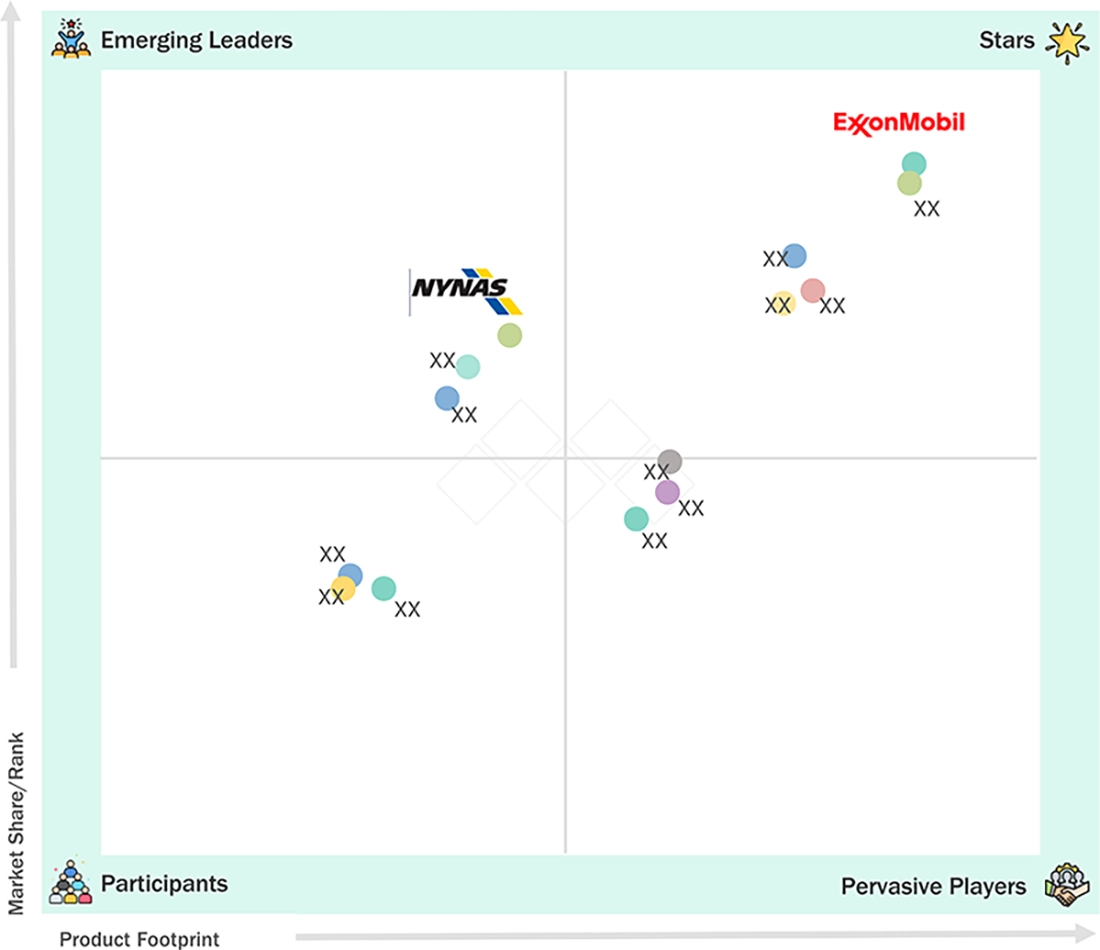
Source: Secondary Research, Interviews with Experts, MarketsandMarkets Analysis
KEY MARKET PLAYERS
- Nynas AB
- APAR Industries
- Calumet Specialty Products Partners, L.P.
- Cargill, Incorporated.
- Phillips 66 Company
- Dow
- Repsol
- Chevron Corporation
- Gandhar Oil Refinery (India) Limited
- PetroChina Company Limited
- Sasol
- Exxon Mobil Corporation
- Shell
MARKET SCOPE
| REPORT METRIC | DETAILS |
|---|---|
| Market Size in 2025 (Value) | USD 2.07 Billion |
| Market Forecast in 2026 (Value) | USD 2.18 Billion |
| Market Forecast in 2031 (Value) | USD 2.87 Billion |
| Growth Rate | CAGR of 5.6% from 2026–2031 |
| Years Considered | 2021–2031 |
| Base Year | 2025 |
| Forecast Period | 2026–2031 |
| Units Considered | Value (USD Million/Billion) |
| Report Coverage | Market Size and Forecast, Company Profiling, Competitive Landscape, Market Dynamics (Drivers, Restraints, Opportunities, and Challenges), Technology Trends, Ecosystem Analysis, Commercial Use Cases, and Regional Analysis |
| Segments Covered |
|
| Regions Covered | North America, Europe, Asia Pacific, Rest of the World |
WHAT IS IN IT FOR YOU: TRANSFORMER OIL MARKET SIZE, SHARE, INDUSTRY ANALYSIS REPORT CONTENT GUIDE
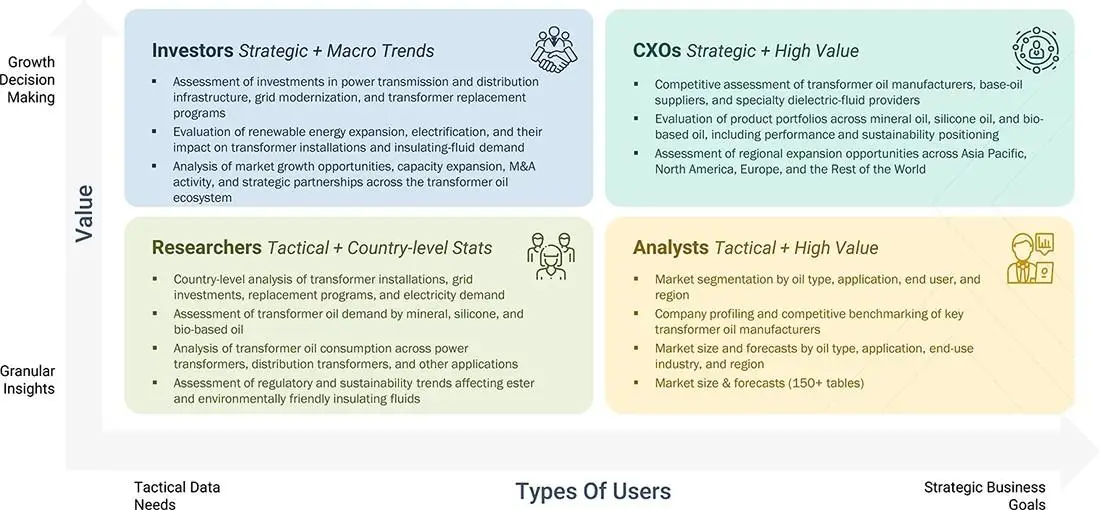
DELIVERED CUSTOMIZATIONS
We have successfully delivered the following deep-dive customizations:
| CLIENT REQUEST | CUSTOMIZATION DELIVERED | VALUE ADDS |
|---|---|---|
| European Transformer Oil |
|
Provides a focused view of the European market, enabling assessment of country-level growth opportunities, demand from transmission & distribution, power generation, and railways & metros, as well as the shift toward bio-based and ester transformer fluids driven by fire-safety and environmental requirements. |
RECENT DEVELOPMENTS
- August 2026 : Cargill doubled production capacity for its FR3™ natural ester dielectric fluid at its Dilovasi, Türkiye facility. The expansion adds a new production line to meet increasing demand from transformer manufacturers and critical infrastructure applications, including data centers, renewable energy, battery storage, and electrification. FR3 contains more than 99% bio-based content and has a high fire point, positioning the expansion as a safer, more sustainable alternative to conventional mineral transformer oil. The investment also strengthens Türkiye's role as a regional manufacturing and supply hub for advanced transformer fluids.
- March 2026 : Cargill opened a new FR3™ natural ester dielectric fluid production plant in Gouda, Netherlands, investing approximately USD 30 million and tripling its European production capacity. The facility is intended to improve regional supply availability and logistics as demand increases from grid expansion, renewable energy, battery storage, and data centers. The development strengthens Cargill's position in bio-based transformer fluids and supports customers seeking high-performance insulating fluids with improved fire safety, biodegradability, and grid-resilience characteristics.
- March 2026 : Nynas and Hitachi Energy advanced the adoption of circular transformer fluids through the first retrofit of NYTRO® RR 900X in a critical 117 MVA transformer at Hitachi Energy's Córdoba, Spain, facility. Electrical and thermal testing confirmed performance comparable to virgin mineral oil. The fully re-refined fluid is produced from used transformer oils and complies with IEC 60296:2020. The development demonstrates the commercial potential of circular transformer oil solutions, supports lower-carbon transformer manufacturing, and reduces dependence on virgin feedstocks.
- April 2025 : Shell launched the Shell MIDEL brand worldwide as part of its expanded portfolio of transformer liquids. The addition brings natural and synthetic ester insulating liquids alongside Shell Diala products, broadening Shell's offering beyond conventional transformer oils. Shell positioned the expanded portfolio for power and distribution transformers as well as renewable energy, rail, mining, and industrial applications. The development strengthens Shell's presence in higher-value transformer fluid applications where fire safety, environmental performance, reliability, and energy-transition requirements increasingly influence fluid selection.
Table of Contents
 Exclusive indicates content/data unique to MarketsandMarkets and not available with any competitors.
Methodology
The research process for this technical, market-oriented, and commercial study of the transformer oil market involved systematically collecting, validating, and analyzing information on transformer oil technologies, oil types, applications, end users, transformer installations, grid infrastructure, and industry developments. We conducted extensive secondary research using annual reports, investor presentations, technical papers, regulatory publications, industry databases, company websites, and financial reports to identify key market participants, technology trends, market developments, and competitive strategies. The team further validated the findings through primary interviews with executives from transformer oil manufacturers, transformer OEMs, utilities, distributors, electrical equipment manufacturers, and industry experts to assess market estimates, product adoption, pricing trends, customer requirements, and competitive positioning. The team established key market players and their market positions through a combination of secondary and primary research involving senior executives, business development managers, product specialists, and technical experts across the transformer oil ecosystem.
Secondary Research
In the secondary research process, we referred to various sources to identify and collect information relevant to the study. Secondary sources included annual reports, investor presentations, press releases, company websites, technical papers, industry journals, regulatory publications, and recognized market databases. Publications and datasets from organizations such as the International Energy Agency (IEA), International Electrotechnical Commission (IEC), IEEE, CIGRE, and national energy and electricity regulatory authorities were reviewed to understand developments in power transmission and distribution, transformer installations, grid modernization, renewable energy integration, and transformer oil standards and regulations. Secondary research primarily focused on the transformer oil value chain, key market participants, product developments, oil-type trends, application trends, end-user demand, production capacities, distribution networks, and regional market dynamics. The study also assessed mineral, silicone, and bio-based transformer oils, along with developments in natural and synthetic ester fluids, to understand evolving product preferences and technology adoption.
Primary Research
During the primary research phase, we interviewed transformer oil manufacturers, transformer OEMs, utilities, electrical equipment manufacturers, distributors, and industry experts to gather qualitative and quantitative insights into the transformer oil market. Interviews validated market estimates, product adoption, pricing trends, regional demand, competitive positioning, customer requirements, and technology developments. Primary interviews also helped assess transformer installation and replacement trends, demand for mineral versus bio-based and silicone oils, adoption of ester-based fluids, transformer maintenance requirements, utility procurement practices, and emerging opportunities across transmission & distribution, power generation, and railways & metros. The findings were validated against company disclosures, industry statistics, regulatory publications, and technical sources to refine market estimates, segment shares, regional forecasts, and competitive assessments.
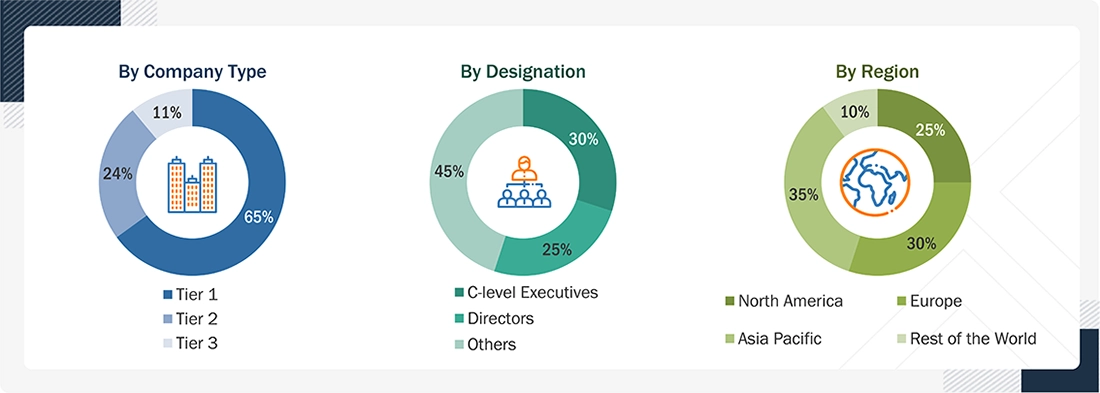
Note 1: Others include sales managers, engineers, and regional managers.
Note 2: Tier 1 Company Revenue: >USD 5 billion, Tier 2 Company Revenue: Between USD 1 and USD 5 billion, and Tier 3 Company Revenue: <USD 1 billion.
To know about the assumptions considered for the study, download the pdf brochure
Market Size Estimation
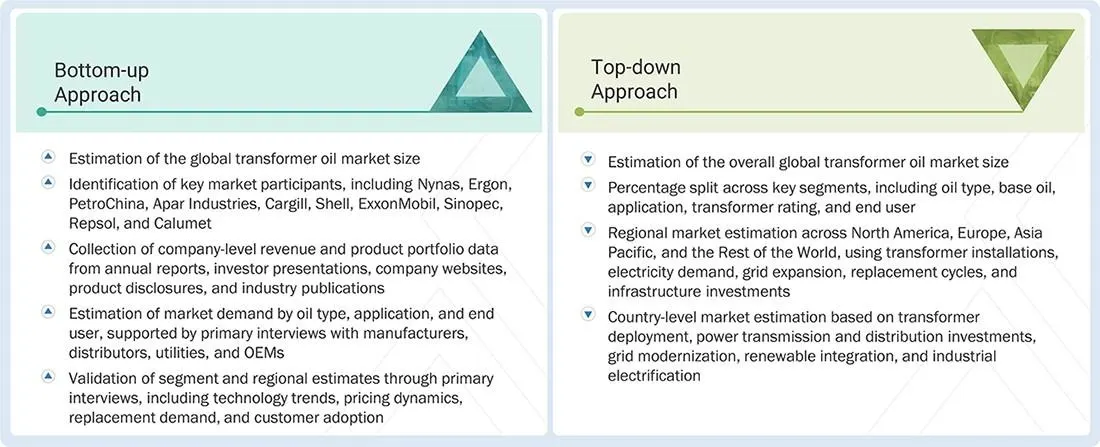
We used both top-down and bottom-up approaches to estimate and validate the size of the transformer oil market and its dependent submarkets. The key players in the market were identified through secondary research, and their market shares in the respective regions were obtained through both primary and secondary research. The research methodology includes reviewing the annual and financial reports of the top market players and interviewing industry experts, such as chief executive officers, vice presidents, directors, sales managers, and marketing executives, to gather key quantitative and qualitative insights on the transformer oil market.
Bottom-up Approach
- Market size is estimated based on the total demand for oil-filled transformers, switchgears, and reactors across individual countries.
- The number of relevant transformers, switchgears, and reactors/substations is identified for each country using secondary research and industry data.
- The number of units is multiplied by the average transformer oil capacity per unit/application to estimate total oil demand in liters.
- Estimated oil consumption is then multiplied by the average cost of transformer oil in the respective country/region to derive the market value.
- The country-level estimates are aggregated to determine regional and global transformer oil market size.
- Key assumptions, including average oil capacity and oil pricing, are validated through primary interviews with transformer manufacturers, oil suppliers, utilities, and industry experts.
- The resulting market size is further cross-checked and validated through secondary research and data triangulation.
Top-down Approach
- Estimating the overall global transformer oil market by analyzing transformer installations, electricity transmission and distribution investments, power generation capacity additions, grid expansion, and transformer replacement demand.
- Allocating the market across oil type, application, and end user based on adoption patterns, transformer oil consumption, product preferences, industry trends, and company-level data.
- Distributing market estimates across North America, Europe, Asia Pacific, and the Rest of the World based on transformer deployment, power infrastructure investments, electricity demand, renewable energy capacity additions, and regional market dynamics.
- Further splitting regional markets into country-level markets based on transformer installations, grid infrastructure development, power generation capacity, railway electrification, and market penetration of different transformer oil types.
- Validating the final market estimates through primary interviews with transformer oil manufacturers, transformer OEMs, utilities, distributors, and industry experts to validate regional demand trends, product adoption, pricing, and end-user requirements, followed by data triangulation to ensure consistency and accuracy.
Global Transformer Oil Market Size: Bottom-up Approach and Top-down Approach
Data Triangulation
The process of determining the overall market size involved the methodologies described earlier, followed by segmenting the market into multiple segments and subsegments. To finalize the comprehensive market analysis and obtain precise statistics for each market segment and subsegment, we applied data triangulation and market breakdown procedures where appropriate. Data triangulation was accomplished by examining factors and trends from both the demand and supply sides of the transformer oil ecosystem, including transformer installations, transformer oil sales and consumption, power transmission and distribution investments, power generation capacity additions, transformer replacement and maintenance demand, product adoption, pricing trends, and regional market dynamics.
Market Definition
Transformer oil is a specialized insulating fluid used in oil-filled electrical equipment, primarily to provide electrical insulation and heat dissipation. It circulates within transformers to transfer heat generated by the core and windings while maintaining dielectric strength between energized components. Transformer oils are primarily classified as mineral oils, silicone oils, and bio-based oils, with mineral oils further categorized as naphthenic and paraffinic.
The transformer oil market encompasses total global revenue from transformer oil sales across various oil types, including mineral (naphthenic and paraffinic), silicone, and bio-based oils. The market covers applications such as transformers, switchgears, and reactors, serving end users, including transmission & distribution, power generation, and railways & metros. The study covers transformer oils used in power, distribution, and traction transformers, as well as other oil-filled electrical equipment, across North America, Europe, Asia Pacific, and the Rest of the World.
Key Stakeholders
- Transformer oil manufacturers
- Technicians and repair personnel
- T&D utilities
- Companies in the railways & metro industry
- Industrial sector end users
- Commercial sector end users
- Power generation plants
- Power and energy associations
- Government and research organizations
- State and national regulatory authorities
- Switchgear component manufacturers
Report Objectives
- To define and describe the transformer oil market, based on oil type, application, end user, and region, in terms of value
- To describe and forecast the market for five key regions: North America, Europe, Asia Pacific, South America, and the Middle East & Africa, along with their country-level market sizes, in terms of value and volume
- To provide detailed information regarding key drivers, restraints, opportunities, and challenges influencing the growth of the transformer oil market
- To provide the supply chain analysis, trends/disruptions impacting customer business, ecosystem analysis, regulatory landscape, patent analysis, case study analysis, technology analysis, key conferences & events, the impact of AI/Gen AI, macroeconomic outlook, pricing analysis, Porter’s Five Forces analysis, regulatory analysis, and the impact of the 2025 US tariffs on the market
- To analyze opportunities for stakeholders in the transformer oil market and draw a competitive landscape of the market
- To benchmark market players using the company evaluation matrix, which analyzes market players on broad categories of business and product strategies adopted by them
- To compare key market players for market shares, product specifications, and applications
- To strategically profile key players and comprehensively analyze their market ranking and core competencies.
- To analyze competitive developments, such as contracts, agreements, partnerships, and expansions in the transformer oil market
Available customizations:
With the given market data, MarketsandMarkets offers customizations based on the company’s specific needs. The following customization options are available for the report:
PRODUCT ANALYSIS
- Product Matrix, which provides a detailed comparison of the product portfolio of each company
COMPANY INFORMATION
- Detailed analyses and profiling of additional market players (up to 5)


Personalize This Research
- Triangulate with your Own Data
- Get Data as per your Format and Definition
- Gain a Deeper Dive on a Specific Application, Geography, Customer or Competitor
- Any level of Personalization
Let Us Help You
- What are the Known and Unknown Adjacencies Impacting the Transformer Oil Market
- What will your New Revenue Sources be?
- Who will be your Top Customer; what will make them switch?
- Defend your Market Share or Win Competitors
- Get a Scorecard for Target Partners

Custom Market Research Services
We Will Customise The Research For You, In Case The Report Listed Above Does Not Meet With Your Requirements
Get 10% Free CustomisationTESTIMONIALS

Kimberly Murphy
GLOBAL MARKETING DIRECTOR
Bently Nevada,
Leading Condition Monitoring & Asset Protectionwww.bakerhughesds.com/bently-nevada

MarketsandMarkets™ showed consistent rigor for success and relentlessly worked with Bently Nevada stakeholders to positively impact go-to-market strategy. Their proactiveness and flexibility has been instrumental in achieving the objectives to grow our sales pipeline in key industrial markets.

DARRICK HUEBER
Business Development Leader
Nexus Controls LLC,
Leading Manufacturer of Automation System & Electrical Panelswww.bakerhughesds.com/nexus-controls

We partnered with MarketsandMarkets to expand our business further by tapping into new industrial segments. It was critical for us to gather crucial business insights about specific markets to achieve this goal. MarketsandMarkets engagement model and client services helped us provide those insights, it was really impressive and valuable for my business. The team was extremely flexible and helpful.

Mike Schoff
Global Industrial Commercial Strategy Leader
Nexus Controls LLC
Leading Manufacturer of Automation System & Electrical Panelswww.bakerhughesds.com/nexus-controls
We consulted MarketsandMarkets for potential Partner Identification. Overall, it was a good experience. The insights provided through interviews conducted by the team helped us put together the questionnaire required for discussion with the selected partners. Their ability to provide insights through interviews with customers in a timely manner was quite impressive.






Growth opportunities and latent adjacency in Transformer Oil Market