Unmanned Ground Vehicles Market Size, Share & Trends by Mobility (Wheeled, Tracked, Hybrid), Application (Military, Commercial, Law Enforcement, Federal Law Enforcement), Size (10-200lbs, 200-500lbs, Others), Mode of Operation, System, and Region-Global Forecast to 2036


Unmanned Ground Vehicles Market Summary
The Unmanned Ground Vehicles (UGV) Market is witnessing robust expansion as defense organizations, public safety agencies, industrial enterprises, and logistics providers increasingly deploy autonomous and remotely operated ground platforms for surveillance, reconnaissance, explosive ordnance disposal (EOD), border security, material transportation, and hazardous environment operations. The market is estimated at approximately USD 3.8 billion in 2025 and is projected to reach nearly USD 9.9 billion by 2036, growing at a CAGR of 9.1% during the forecast period. Continuous investments in military modernization, artificial intelligence, autonomous navigation, robotics, computer vision, and advanced sensor technologies are transforming the capabilities of unmanned ground vehicles across commercial and defense applications.
Growing geopolitical tensions, increasing defense budgets, and rising emphasis on protecting personnel in high-risk environments are accelerating adoption worldwide. AI-powered navigation systems, LiDAR, machine vision, edge computing, and autonomous mission planning enable UGVs to operate with greater efficiency and minimal human intervention. Integration with IoT-enabled battlefield management systems, cloud-based mission control platforms, and real-time data analytics further enhances operational effectiveness. Commercial industries are also adopting autonomous ground robots for warehouse automation, mining, agriculture, infrastructure inspection, and smart manufacturing, creating new growth opportunities. As governments prioritize digital transformation and autonomous defense capabilities, the UGV market is expected to experience sustained long-term expansion.
Key Market Trends & Insights
- North America dominates the global Unmanned Ground Vehicles Market due to substantial defense spending, advanced robotics research, and widespread adoption of autonomous military systems.
- Asia Pacific is projected to register the fastest CAGR through 2036, supported by increasing defense modernization programs in China, India, Japan, and South Korea.
- Military UGVs remain the dominant product segment owing to growing demand for reconnaissance, combat support, logistics, and explosive disposal missions.
- Artificial intelligence, machine learning, sensor fusion, LiDAR, and autonomous navigation technologies are significantly improving operational efficiency and mission accuracy.
- Commercial adoption of autonomous mobile robots for logistics, mining, agriculture, and industrial automation is creating substantial revenue opportunities.
- Swarm robotics, edge AI computing, and human-machine teaming represent the next generation of unmanned ground vehicle innovation.
Market Size & Forecast
- Base Year Market Size (2025): USD 3.8 Billion
- Forecast Market Value (2036): USD 9.9 Billion
- CAGR (2025–2036): 9.1%
- Growth Outlook: Rising defense modernization, AI-powered autonomous navigation, smart battlefield technologies, industrial automation, robotics investments, and increased deployment of autonomous systems continue to fuel long-term market growth.
Unmanned Ground Vehicles Market Top 10 key takeaway
- Growing defense modernization programs remain the largest market growth driver.
- Military applications account for the highest revenue share globally.
- AI-powered autonomous navigation significantly improves operational capabilities.
- North America continues to lead global market revenues.
- Asia Pacific records the fastest market expansion through increasing defense investments.
- Commercial logistics and warehouse automation are emerging high-growth opportunities.
- Sensor fusion and computer vision technologies enhance mission safety and efficiency.
- Autonomous convoy operations are becoming increasingly common across military logistics.
- Integration with IoT, cloud computing, and edge AI enables real-time decision-making.
- Increasing investments in robotics and autonomous systems will sustain market growth through 2036.
Product Insights
Military unmanned ground vehicles continue to dominate the Unmanned Ground Vehicles Market due to increasing deployment across intelligence gathering, surveillance, reconnaissance (ISR), logistics support, explosive ordnance disposal, combat engineering, and border patrol operations. Governments are investing heavily in robotic combat support platforms capable of operating in dangerous environments while minimizing risks to military personnel. Advanced tracked and wheeled robotic systems equipped with AI-based obstacle avoidance, autonomous navigation, multi-sensor payloads, thermal imaging, and secure communication systems have become essential assets for modern armed forces. These systems significantly improve operational awareness while reducing casualties during hazardous missions.
Small and medium-sized tactical UGVs account for a significant share because of their portability, operational flexibility, and lower deployment costs. Defense agencies increasingly prefer modular platforms capable of carrying multiple payloads, including surveillance cameras, robotic arms, electronic warfare equipment, communication relays, and weapon stations. Heavy-duty unmanned combat ground vehicles are also witnessing growing demand as armed forces evaluate autonomous battlefield support systems capable of transporting equipment, evacuating casualties, and supporting frontline operations.
Commercial unmanned ground vehicles are rapidly emerging across logistics, manufacturing, mining, agriculture, and public safety applications. Autonomous mobile robots (AMRs) and autonomous guided vehicles (AGVs) are becoming integral components of Industry 4.0 initiatives. Warehouses increasingly rely on intelligent robotic systems to improve inventory management, material handling, and last-mile logistics. Mining companies deploy autonomous ground vehicles for transporting materials in hazardous environments, while agriculture benefits from robotic platforms capable of autonomous spraying, harvesting, soil monitoring, and precision farming operations.
Artificial intelligence continues transforming product innovation across the market. Modern UGVs integrate AI-powered perception systems, predictive maintenance algorithms, digital twin technology, autonomous route optimization, and collaborative robotics to improve operational efficiency. Multi-mission modular platforms capable of switching between military, industrial, and emergency response applications are becoming increasingly attractive to both government agencies and commercial enterprises.
The emergence of hybrid-electric propulsion systems, lightweight composite materials, and energy-efficient battery technologies is further improving vehicle endurance and operational flexibility. As AI, robotics, and automation continue advancing, future UGV platforms will demonstrate higher autonomy levels, improved situational awareness, and seamless integration with unmanned aerial and maritime systems, creating highly connected autonomous ecosystems.
Technology / Component Insights
Artificial intelligence has become the backbone of the Unmanned Ground Vehicles (UGV) Market, enabling autonomous navigation, obstacle detection, mission planning, target recognition, and predictive decision-making. Modern UGVs combine AI algorithms with machine learning models to analyze terrain, identify threats, optimize routes, and perform missions with minimal human intervention. These intelligent systems improve operational efficiency while reducing response times in complex military and industrial environments. Defense organizations increasingly deploy AI-enabled UGVs capable of collaborative operations with unmanned aerial vehicles (UAVs), command-and-control systems, and digital battlefield networks.
Autonomous navigation technologies represent one of the fastest-evolving components within the market. Global Navigation Satellite Systems (GNSS), inertial navigation systems (INS), LiDAR, radar, computer vision, stereo cameras, ultrasonic sensors, and simultaneous localization and mapping (SLAM) technologies enable UGVs to operate safely in GPS-denied or hazardous environments. Sensor fusion combines data from multiple sensing platforms to improve environmental awareness and increase navigation accuracy under adverse weather or battlefield conditions.
Internet of Things (IoT) connectivity continues to transform UGV deployment by enabling real-time communication between vehicles, command centers, cloud platforms, and other autonomous systems. IoT-enabled sensors continuously transmit operational data related to vehicle health, mission status, environmental conditions, and equipment performance. Edge computing allows mission-critical decisions to be processed locally, minimizing latency while ensuring uninterrupted operations even in communication-constrained environments.
Communication technologies are becoming increasingly sophisticated through secure tactical radios, 5G connectivity, satellite communications (SATCOM), mesh networking, and encrypted wireless data transmission. These technologies enable coordinated operations between multiple autonomous vehicles, allowing swarm robotics and collaborative mission execution across military, industrial, and emergency response applications.
Cloud computing supports fleet management, software updates, predictive maintenance, mission analytics, and digital twin simulations. Digital twins allow defense agencies and industrial operators to simulate vehicle performance under different operational conditions before field deployment. Predictive maintenance platforms leverage AI analytics to monitor component wear, battery health, motor efficiency, and system reliability, minimizing downtime and reducing lifecycle costs.
Future innovation will increasingly focus on cognitive autonomy, human-machine teaming, autonomous convoy operations, modular payload integration, quantum-resistant cybersecurity, hybrid-electric propulsion systems, and advanced energy storage technologies. As AI continues evolving, future UGV platforms will become more adaptive, collaborative, and capable of executing highly complex missions with minimal operator supervision.
Application Insights
The defense and military sector remains the largest application segment within the Unmanned Ground Vehicles Market, accounting for the highest share of global revenue. Armed forces worldwide increasingly deploy UGVs for intelligence, surveillance, reconnaissance (ISR), explosive ordnance disposal (EOD), logistics support, casualty evacuation, perimeter security, urban warfare, and combat engineering operations. These platforms significantly reduce risks to military personnel while improving mission effectiveness in hostile environments. AI-powered autonomous navigation, real-time situational awareness, and integrated battlefield communication systems continue enhancing military UGV capabilities.
Explosive ordnance disposal (EOD) remains one of the most established applications, with bomb disposal robots becoming essential equipment for military and homeland security agencies. Equipped with robotic manipulators, high-definition cameras, thermal sensors, and AI-assisted navigation, these systems safely neutralize explosive threats while protecting personnel from dangerous situations.
The logistics and transportation sector is emerging as one of the fastest-growing commercial applications. Warehouses, fulfillment centers, manufacturing plants, and distribution hubs increasingly deploy autonomous mobile robots (AMRs) for inventory movement, pallet transportation, automated material handling, and warehouse optimization. Integration with AI-based warehouse management systems enables higher productivity, reduced labor costs, and improved operational efficiency.
Mining companies utilize unmanned ground vehicles for transporting materials, conducting geological inspections, monitoring hazardous environments, and operating in underground mines where human access is difficult. Similarly, agriculture increasingly benefits from autonomous robotic platforms capable of precision spraying, soil monitoring, crop inspection, harvesting, and fertilizer application. AI-powered agricultural robots improve productivity while supporting sustainable farming practices.
Public safety organizations and emergency responders deploy UGVs during disaster response, firefighting support, hazardous material handling, search and rescue operations, infrastructure inspection, and nuclear facility monitoring. Their ability to operate in environments unsafe for human responders significantly enhances emergency management capabilities.
Growing investments in smart cities, industrial automation, critical infrastructure protection, and autonomous logistics will continue expanding commercial UGV adoption. Future applications will increasingly leverage AI, computer vision, digital twins, and cloud robotics to deliver highly autonomous, connected, and intelligent ground vehicle operations across diverse industries.
Regional Insights
North America dominates the global Unmanned Ground Vehicles Market, supported by the presence of leading defense contractors, robotics developers, AI technology companies, and significant government investments in autonomous defense systems. The United States remains the largest contributor due to continuous military modernization programs, increasing procurement of robotic combat vehicles, and investments in AI-enabled battlefield technologies. The U.S. Department of Defense continues integrating autonomous systems into logistics, surveillance, reconnaissance, and combat support missions. Canada contributes through defense innovation, mining automation, and advanced robotics research, while Mexico is witnessing increasing adoption of autonomous industrial vehicles across manufacturing and logistics sectors.
Europe represents a mature and technologically advanced market characterized by strong investments in defense modernization, industrial automation, and robotics innovation. Germany leads regional demand due to its advanced manufacturing industry, autonomous vehicle research, and military modernization initiatives. The United Kingdom continues investing in robotic combat support systems and AI-enabled defense technologies. France focuses on autonomous military platforms and homeland security applications, while Italy, Spain, and Nordic countries are expanding investments in industrial robotics, border surveillance, and emergency response systems. European Union digital transformation initiatives and increasing NATO defense spending continue supporting long-term market growth.
Asia Pacific is projected to register the fastest CAGR during the forecast period due to rapid defense modernization, industrial automation, and government investments in robotics technologies. China continues expanding autonomous military capabilities while strengthening domestic robotics manufacturing. Japan focuses on AI-driven robotics, autonomous mobility, and advanced manufacturing technologies. India is increasing procurement of unmanned defense platforms under indigenous defense manufacturing initiatives while expanding industrial automation across logistics and manufacturing sectors. South Korea and Singapore continue investing heavily in smart factories, AI research, and autonomous logistics systems. Australia supports market growth through defense modernization programs and mining automation technologies.
The Rest of the World, including the Middle East, Latin America, and Africa, presents emerging opportunities supported by increasing defense procurement, border security investments, mining automation, oil and gas operations, and infrastructure development. Gulf countries are particularly investing in autonomous military technologies and smart security systems to strengthen national defense capabilities.
Regional Insights Summary
- North America leads the global market through high defense expenditure and advanced robotics innovation.
- Asia Pacific is expected to record the fastest CAGR due to military modernization and industrial automation.
- Europe benefits from strong manufacturing capabilities, NATO defense investments, and AI-driven robotics research.
- Smart factories, warehouse automation, and mining robotics continue driving commercial adoption globally.
- Growing investments in autonomous technologies, AI, IoT, and digital transformation support sustained regional market expansion.
Country-Specific Market Trends
China (CAGR: ~10.4%)
China is expected to remain one of the fastest-growing markets for unmanned ground vehicles, driven by significant investments in defense modernization, intelligent warfare technologies, and indigenous robotics development. Government-backed initiatives supporting AI, autonomous systems, and military-civil fusion are accelerating the deployment of UGVs across surveillance, border security, logistics, and combat support operations. China's rapidly expanding manufacturing sector is also adopting autonomous mobile robots (AMRs) and industrial UGVs to improve production efficiency. The integration of AI, computer vision, and 5G communication technologies is further strengthening the country's autonomous ground vehicle ecosystem.
Japan (CAGR: ~8.7%)
Japan continues to invest heavily in robotics innovation and autonomous mobility technologies. The country's expertise in industrial robotics, artificial intelligence, and sensor technologies supports growing adoption of UGVs across defense, manufacturing, disaster response, and infrastructure inspection applications. Government initiatives promoting Society 5.0 and smart manufacturing encourage the deployment of autonomous robotic platforms capable of operating safely in complex industrial environments. Japan is also developing next-generation autonomous military vehicles for surveillance and reconnaissance missions.
United States (CAGR: ~8.5%)
The United States remains the largest individual market due to continuous investments in autonomous defense platforms, robotic combat vehicles, AI-enabled battlefield systems, and logistics automation. The U.S. Department of Defense is actively deploying unmanned ground vehicles for intelligence, surveillance, reconnaissance, explosive ordnance disposal, and autonomous logistics operations. Commercial industries are simultaneously adopting autonomous mobile robots for warehouse automation, manufacturing, and transportation. Strong collaboration between defense agencies, technology companies, and robotics startups continues driving innovation across the UGV ecosystem.
Canada (CAGR: ~7.9%)
Canada is steadily expanding its unmanned ground vehicle market through investments in defense modernization, mining automation, public safety robotics, and industrial automation. The country's mining industry increasingly deploys autonomous ground vehicles to improve worker safety and operational efficiency in remote locations. Research institutions and robotics companies are developing AI-powered autonomous navigation systems suitable for harsh environmental conditions.
Mexico (CAGR: ~7.5%)
Mexico's growing aerospace, automotive, and manufacturing sectors are creating demand for industrial unmanned ground vehicles used in warehouse logistics, production automation, and material handling. Foreign investments in smart manufacturing facilities and industrial robotics are encouraging wider adoption of autonomous mobile platforms. Government support for industrial digitalization is expected to further strengthen long-term market prospects.
Germany (CAGR: ~8.2%)
Germany remains Europe's leading market for unmanned ground vehicles due to its advanced industrial automation capabilities, strong defense industry, and leadership in Industry 4.0 technologies. Autonomous mobile robots are widely deployed across automotive manufacturing, logistics, and smart factories. Defense modernization initiatives and AI-driven robotics research continue accelerating development of autonomous military ground vehicles equipped with advanced sensing and navigation capabilities.
France (CAGR: ~7.8%)
France continues strengthening its autonomous defense capabilities through investments in robotic combat support systems, border security technologies, and AI-enabled surveillance platforms. The country also supports industrial robotics adoption through smart manufacturing initiatives and digital transformation programs. Collaboration between defense agencies, research organizations, and robotics companies continues fostering innovation in autonomous ground mobility solutions.
Country-Level Insights Summary
- China records the fastest market growth due to aggressive defense modernization and AI-driven robotics investments.
- Japan emphasizes robotics innovation, disaster response, and autonomous industrial mobility.
- The United States leads global UGV deployment across military, logistics, and industrial automation applications.
- Germany remains Europe's largest industrial robotics and autonomous manufacturing market.
- Canada, France, and Mexico continue expanding investments in autonomous mobility, industrial robotics, and defense technologies.
Key Unmanned Ground Vehicles Market Company Insights
The competitive landscape of the Unmanned Ground Vehicles Market is characterized by rapid technological innovation, increasing defense contracts, and strategic investments in artificial intelligence, autonomous navigation, and advanced robotics. Leading companies are focusing on modular vehicle architectures, AI-enabled mission autonomy, advanced sensor integration, secure communication systems, and multi-domain interoperability to enhance operational capabilities across military and commercial sectors. Manufacturers are also emphasizing lightweight materials, hybrid-electric propulsion, predictive maintenance, and cloud-based fleet management platforms to improve vehicle performance and reduce operational costs.
Major market participants include General Dynamics Corporation, BAE Systems plc, Rheinmetall AG, L3Harris Technologies, Teledyne FLIR Defense, QinetiQ Group plc, Oshkosh Defense, Lockheed Martin Corporation, Elbit Systems Ltd., and Northrop Grumman Corporation. These companies continue expanding their autonomous ground vehicle portfolios through extensive research and development, strategic defense partnerships, AI software integration, and next-generation robotic mobility solutions. Increasing collaboration with defense agencies, AI software developers, and sensor manufacturers is accelerating innovation in autonomous combat support, reconnaissance, logistics, and industrial robotics applications.
AI-powered perception systems, computer vision, sensor fusion, autonomous navigation, and machine learning algorithms are becoming central to product differentiation. Companies are increasingly investing in swarm robotics, unmanned teaming technologies, edge computing, cybersecurity, and human-machine collaboration platforms to meet evolving military and industrial requirements. Commercial manufacturers are simultaneously expanding autonomous warehouse robots, mining vehicles, agricultural robots, and public safety platforms to capitalize on growing demand beyond defense applications.
Company Strategy Summary
- Leading companies prioritize AI-enabled autonomous navigation and intelligent mission planning.
- Continuous R&D investments focus on modular robotic platforms and multi-mission vehicle capabilities.
- Strategic partnerships with defense organizations accelerate deployment of next-generation UGV technologies.
- Integration of cloud computing, IoT connectivity, and predictive analytics improves fleet management and operational efficiency.
- Expansion into industrial automation, logistics, mining, agriculture, and smart infrastructure creates diversified long-term growth opportunities.
 Exclusive indicates content/data unique to MarketsandMarkets and not available with any competitors.
TABLE OF CONTENTS
-
INTRODUCTION
- OBJECTIVES OF THE STUDY
- MARKET DEFINITION
-
STUDY SCOPE
- MARKETS COVERED
- REGIONAL SCOPE
- YEARS CONSIDERED FOR THE STUDY
- CURRENCY AND PRICING
- MARKET STAKEHOLDERS
-
EXECUTIVE SUMMARY
- KEY INSIGHTS AND MARKET HIGHLIGHTS
- KEY MARKET PARTICIPANTS: INSIGHTS AND STRATEGIC DEVELOPMENTS
- DISRUPTIVE TRENDS SHAPING THE MARKET
- HIGH-GROWTH SEGMENTS & EMERGING FRONTIERS
- SNAPSHOT: GLOBAL MARKET SIZE, GROWTH RATE, AND FORECAST
- BUSINESS MODELS
- TOTAL COST OF OWNERSHIP
- BILL OF MATERIALS
- PREMIUM INSIGHTS
-
MARKET OVERVIEW
- INTRODUCTION
-
MARKET DYNAMICS
- DRIVERS
- RESTRAINTS
- OPPORTUNITIES
- CHALLENGES
- UNMET NEEDS AND WHITE SPACES
- INTERCONNECTED MARKETS AND CROSS-SECTOR OPPORTUNITIES
- STRATEGIC MOVES BY TIER-1/2/3 PLAYERS
- OPERATIONAL DATA (VOLUME IN UNITS)
-
INDUSTRY TRENDS
-
MACROECONOMIC OUTLOOK
- INTRODUCTION
- GDP TRENDS AND FORECAST
- TRENDS IN THE GLOBAL UNMANNED GROUND VEHICLE INDUSTRY
- VALUE CHAIN ANALYSIS
- ECOSYSTEM ANALYSIS
- INVESTMENT AND FUNDING SCENARIO
-
PRICING ANALYSIS
- PRICING ANALYSIS, BY MOBILITY, 2025
- PRICING ANALYSIS, BY REGION, 2025
-
TRADE ANALYSIS
- IMPORT SCENARIO
- EXPORT SCENARIO
- KEY CONFERENCES AND EVENTS, 2026-2027
- TRENDS/DISRUPTIONS IMPACTING CUSTOMER BUSINESS
- CASE STUDY ANALYSIS
-
IMPACT OF 2025 US TARIFF – UNMANNED GROUND VEHICLES (UGVS) MARKET
- INTRODUCTION
- KEY TARIFF RATES
- PRICE IMPACT ANALYSIS
-
IMPACT ON COUNTRIES/REGIONS
- US
- EUROPE
- APAC
- IMPACT ON DIFFERENT APPLICATIONS
-
MACROECONOMIC OUTLOOK
-
TECHNOLOGICAL ADVANCEMENTS, AI-DRIVEN IMPACT, PATENTS, INNOVATIONS, AND FUTURE APPLICATIONS
- KEY EMERGING TECHNOLOGIES
- COMPLEMENTARY TECHNOLOGIES
- TECHNOLOGY/PRODUCT ROADMAP
- PATENT ANALYSIS
- FUTURE APPLICATIONS
-
IMPACT OF AI/GEN AI ON UNMANNED GROUND VEHICLES (UGVS) MARKET
- TOP USE CASES AND MARKET POTENTIAL
- CASE STUDIES OF AI IMPLEMENTATION IN THE UNMANNED GROUND VEHICLES (UGVS) MARKET
- INTERCONNECTED ADJACENT ECOSYSTEM AND IMPACT ON MARKET PLAYERS
- CLIENTS’ READINESS TO ADOPT GENERATIVE AI IN UNMANNED GROUND VEHICLES (UGVS) MARKET
-
SUSTAINABILITY AND REGULATORY LANDSCAPE
-
REGIONAL REGULATIONS AND COMPLIANCE
- REGULATORY BODIES, GOVERNMENT AGENCIES, AND OTHER ORGANIZATIONS
- REGULATORY FRAMEWORK
- INDUSTRY STANDARDS
- CERTIFICATIONS, LABELING, ECO-STANDARDS
-
REGIONAL REGULATIONS AND COMPLIANCE
-
CUSTOMER LANDSCAPE & BUYER BEHAVIOR
- DECISION-MAKING PROCESS
- BUYER STAKEHOLDERS AND BUYING EVALUATION CRITERIA
- ADOPTION BARRIERS & INTERNAL CHALLENGES
- UNMET NEEDS FROM VARIOUS END-USES
-
UNMANNED GROUND VEHICLES (UGVS) MARKET, BY MOBILITY (MARKET SIZE & FORECAST TO 2036-USD MILLION)
- INTRODUCTION
- WHEELED
- TRACKED
- HYBRID
- LEGGED
-
UNMANNED GROUND VEHICLES (UGVS) MARKET, BY SIZE (MARKET SIZE & FORECAST TO 2036-USD MILLION)
- INTRODUCTION
- SMALL (10–200 LBS)
- MEDIUM (200–500 LBS)
- LARGE (500–1,000 LBS)
- VERY LARGE (1,000–2,000 LBS)
- EXTREMELY LARGE (>2,000 LBS)
-
UNMANNED GROUND VEHICLES (UGVS) MARKET, BY MODE OF OPERATION (MARKET SIZE & FORECAST TO 2036-USD MILLION)
- INTRODUCTION
- TETHERED
- TELEOPERATED
-
AUTONOMOUS
- FULLY AUTONOMOUS
- SEMI-AUTONOMOUS
-
UNMANNED GROUND VEHICLES (UGVS) MARKET, BY SYSTEM (MARKET SIZE & FORECAST TO 2036-USD MILLION)
- INTRODUCTION
-
2 PAYLOADS
- SENSORS
- RADARS
- LASERS
- CAMERAS
- MOTOR ENCODERS
- ARTICULATED ARMS
- GPS ANTENNAS
- LIGHT REMOTE WEAPON SYSTEMS
- OTHER PAYLOADS
- CONTROLLER SYSTEMS
- NAVIGATION SYSTEMS
-
POWER SYSTEMS
- SOLAR RECHARGEABLE BATTERY
-
ELECTRIC NON-SOLAR RECHARGEABLE BATTERY
- LITHIUM-ION BATTERY
- SEALED LEAD-ACID BATTERY
- NICKEL CADMIUM
- NICKEL METAL HYDRIDE BATTERY
- OTHER SYSTEMS
-
UNMANNED GROUND VEHICLES (UGVS) MARKET, BY APPLICATION (MARKET SIZE & FORECAST TO 2036-USD MILLION)
- INTRODUCTION
-
MILITARY
- INTELLIGENCE, SURVEILLANCE, AND RECONNAISSANCE (ISR)
- SEARCH & RESCUE
- COMBAT SUPPORT
- TRANSPORTATION
- EXPLOSIVE ORDNANCE DISPOSAL (EOD)
- MINE CLEARANCE
- FIREFIGHTING
- OTHER MILITARY APPLICATIONS
- LAW ENFORCEMENT
-
COMMERCIAL
- FIREFIGHTING
- OIL & GAS
- AGRICULTURE
- CHEMICAL, BIOLOGICAL, RADIOLOGICAL, AND NUCLEAR (CBRN)
- AUTONOMOUS DELIVERY
- PHYSICAL SECURITY
- FORESTRY
- OTHER COMMERCIAL APPLICATIONS
-
UNMANNED GROUND VEHICLES (UGVS) MARKET, BY REGION (MARKET SIZE & FORECAST TO 2036-USD MILLION)
- INTRODUCTION
-
NORTH AMERICA
- US
- CANADA
-
EUROPE
- FRANCE
- GERMANY
- UK
- POLAND
- RUSSIA
- REST OF EUROPE
-
ASIA PACIFIC
- CHINA
- INDIA
- JAPAN
- AUSTRALIA
- SOUTH KOREA
- REST OF ASIA PACIFIC
-
MIDDLE EAST
-
GCC
- UAE
- SAUDI ARABIA
-
REST OF MIDDLE EAST
- ISRAEL
- TURKEY
-
REST OF THE WORLD
- LATIN AMERICA
- AFRICA
-
GCC
-
COMPETITIVE LANDSCAPE
- INTRODUCTION
- KEY PLAYER COMPETITIVE STRATEGIES/RIGHT TO WIN
- REVENUE ANALYSIS
- MARKET SHARE ANALYSIS
- BRAND COMPARISON
- COMPANY VALUATION AND FINANCIAL METRICS
-
COMPANY EVALUATION MATRIX: KEY PLAYERS, 2025
- STARS
- EMERGING LEADERS
- PERVASIVE PLAYERS
- PARTICIPANTS
-
COMPANY FOOTPRINT, KEY PLAYERS, 2025
- COMPANY FOOTPRINT
- REGION FOOTPRINT
- MOBILITY FOOTPRINT
- SIZE FOOTPRINT
- APPLICATION FOOTPRINT
-
COMPANY EVALUATION MATRIX: STARTUPS/SMES, 2025
- PROGRESSIVE COMPANIES
- RESPONSIVE COMPANIES
- DYNAMIC COMPANIES
- STARTING BLOCKS
-
COMPETITIVE BENCHMARKING: STARTUPS/SMES, 2025
- DETAILED LIST OF KEY STARTUPS/SMES
- COMPETITIVE BENCHMARKING OF KEY STARTUPS/SMES
-
COMPETITIVE SCENARIO
- PRODUCT LAUNCHES
- DEALS
- OTHER DEVELOPMENTS
-
COMPANY PROFILE
-
KEY PLAYERS
- BAE SYSTEMS
- RHEINMETALL AG
- QINETIQ
- GENERAL DYNAMICS
- L3HARRIS TECHNOLOGIES
- ASELSAN A.S.
- TELEDYNE TECHNOLOGIES
- ISRAEL AEROSPACE INDUSTRIES
- ST ENGINEERING
- ELBIT SYSTEMS
- EXAIL TECHNOLOGIES
- LIG NEX 1
- OSHKOSH CORP.
- TEXTRON INC.
- AEROVIRONMENT, INC.
- OTHER PLAYERS
-
KEY PLAYERS
Details on Business Overview, Products Offered, Recent Developments, SWOT Analysis, MnM View might not be captured in case of unlisted companies.
** Only few key players are mentioned above, however top 15 key players and 10 other players will be profiled during the course of research study
*** The above tentative TOC is based on preliminary secondary data and could improve based on primary data in the course of research study
**** All segments above will be further assessed & considered to be a part of market breakdown. The breakdown of segments will be finalized during the course of research.
***** Request for addition of company profiles or countries in the scope can be considered and included post feasibility
The study involved four major activities in estimating the current size of the unmanned ground vehicles market. Exhaustive secondary research was done to collect information on the market, peer market, and parent market. The next step was to validate these findings, assumptions, and sizing with industry experts across the value chain through primary research. Both top-down and bottom-up approaches were employed to estimate the complete market size. After that, market breakdown and data triangulation were used to estimate the market size of segments and subsegments.
Secondary Research
In the secondary research process, various sources were referred to for identifying and collecting information for this study. The secondary sources included government sources, such as SIPRI; corporate filings such as annual reports, press releases, and investor presentations of companies; white papers, journals, and certified publications; and articles from recognized authors, directories, and databases.
Primary Research
In the primary research process, various primary sources from both supply and demand sides were interviewed to obtain qualitative and quantitative information on the market. The primary sources from the supply side included various industry experts, such as Chief X Officers (CXOs), Vice Presidents (VPs), Directors, from business development, marketing, product development/innovation teams, and related key executives from unmanned ground vehicles vendors; system integrators; component providers; distributors; and key opinion leaders.
Primary interviews were conducted to gather insights such as market statistics, data of revenue collected from the products and services, market breakdowns, market size estimations, market forecasting, and data triangulation. Primary research also helped in understanding the various trends related to technology, application, vertical, and region. Stakeholders from the demand side, such as CIOs, CTOs, and CSOs, and installation teams of the customer/end users who are using unmanned ground vehicles were interviewed to understand the buyer’s perspective on the suppliers, products, component providers, and their current usage of unmanned ground vehicles and future outlook of their business which will affect the overall market.
The breakup of Primary Research :
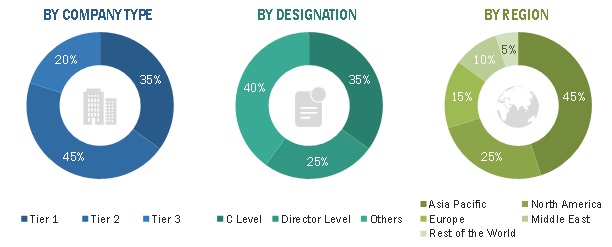
|
Unmanned Ground Vehicles OEM |
Others |
|
Rheinmetall AG |
Teledyne FLIR |
|
QinetiQ |
Thales Group |
|
BAE Systems |
SAAB AB |
|
Lockheed Martin |
Elbit Systems |
Market Size Estimation
Both top-down and bottom-up approaches were used to estimate and validate the total size of the unmanned ground vehicles market. These methods were also used extensively to estimate the size of various segments and subsegments of the market. The research methodology used to estimate the market size included the following:
- Key players in the industry and market were identified through extensive secondary research of their product matrix and geographical presence and developments undertaken by them.
- All percentage shares, splits, and breakdowns were determined using secondary sources and verified through primary sources.
Global Unmanned Ground Vehicles Market Size: Bottom-Up Approach
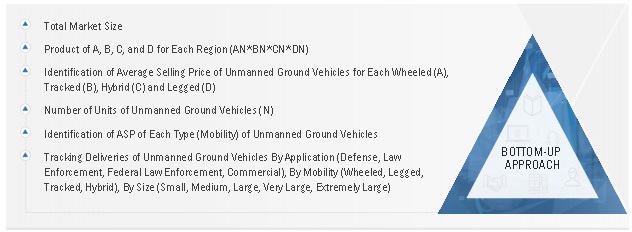
To know about the assumptions considered for the study, download the pdf brochure
Data Triangulation
After arriving at the overall size of the unmanned ground vehicles market using the market size estimation processes explained above, the market was split into several segments and subsegments. To complete the overall market engineering process and arrive at the exact statistics of each market segment and subsegment, data triangulation, and market breakdown procedures were employed, wherever applicable. The data was triangulated by studying various factors and trends from demand as well as supply sides of the unmanned ground vehicles market.
Revolutionizing Transportation: The Growing Market for Unmanned Ground Vehicles (UGVs)
The unmanned ground vehicles market, also known as the UGV market, is an ever-growing industry that is set to revolutionize the way we move and transport goods. These vehicles are commonly referred to as uncrewed ground vehicles (UGV) or autonomous ground vehicles (AGV), and they are essentially ground-based robots that can operate without a human driver.
UGVs have been used in various industries, including the military, agriculture, logistics, and healthcare. The demand for these vehicles has been driven by several factors, including the need for more efficient and safer transportation, the rising demand for automation, and advancements in technology.
One of the primary benefits of UGVs is that they can operate in environments that are too hazardous or difficult for human drivers. For example, in the military, UGVs are used for tasks such as surveillance, reconnaissance, and bomb disposal. They are also used in agriculture to automate tasks such as planting, spraying, and harvesting.
In the logistics industry, UGVs are used for material handling, inventory management, and transportation. These vehicles can operate around the clock, increasing efficiency and reducing the need for human labor. In addition, UGVs can also reduce the risk of accidents, as they can be programmed to avoid obstacles and other hazards.
The healthcare industry is also starting to embrace UGVs, with applications such as telemedicine and patient transportation. These vehicles can be used to transport patients between hospital departments, reducing the need for human staff and potentially decreasing the spread of infectious diseases.
Niche Threats to Ensure the Safe and Responsible Growth of the UGV Industry:
The UGV industry is rapidly growing and innovating, but it also faces several niche threats that could impact its development and adoption. These include the potential for UGVs to be hacked or controlled by malicious actors, job loss in industries such as logistics and agriculture, safety and reliability concerns, and ethical issues in military applications. To address these threats, the industry must prioritize safety and security, invest in robust cybersecurity measures and testing protocols, and work with policymakers to address concerns about job loss and ethical implications. By doing so, the UGV industry can continue to grow and innovate while minimizing potential risks.
Report Objectives
- To define, describe, and forecast the unmanned ground vehicles market by Application, Mobility, Size, Mode of Operation, System, and region
- To analyze the demand- and supply-side indicators influencing the growth of the unmanned ground vehicles market
- To provide in-depth market intelligence regarding key market dynamics, such as drivers, restraints, opportunities, and industry-specific challenges, which influence the growth of the unmanned ground vehicles market
- To forecast the size of various segments of the unmanned ground vehicles market across five main regions, namely, North America, Europe, Asia Pacific, the Middle East, and Rest of the World.
- To analyze micromarkets 1 with respect to individual growth trends, prospects, and their contribution to the unmanned ground vehicles market
- To analyze technological advancements and new product launches in the unmanned ground vehicles market
- To strategically profile key players in the unmanned ground vehicles market and comprehensively analyze their core competencies 2
- To identify products and key developments of leading companies operating in the unmanned ground vehicles market
- To provide a comprehensive analysis of business and corporate strategies adopted by key players operating in the unmanned ground vehicles market
- To provide a detailed competitive landscape of the unmanned ground vehicles market, along with market share ranking of leading players in the market
Available Customizations
With the given market data, MarketsandMarkets offers customizations according to the specific requirements of companies.
Product Analysis
- Product matrix, which gives a detailed comparison of the product portfolio of each company
Company Information
- Detailed analysis and profiles of additional market players (up to 5)

 Generating Response ...








Growth opportunities and latent adjacency in Unmanned Ground Vehicles Market
I would like to find out what is the projected growth % in Asia Pacific UGVs market between 2018 and 2025; and the growth % in North America, Europe, ME, and RoW.