



Vaccines Market
Report Code
PH 6528
Published in
Aug, 2026, By MarketsandMarkets™
Vaccines Market Size by Technology (Conjugate, Recombinant, Inactivated, Live Attenuated, mRNA), Type (Multivalent, Monovalent), Disease (Pneumococcal, Flu, Hepatitis, MMR, Rotavirus, RSV, HPV, Polio), ROA (IM, SC, Oral), Competition - Global Forecast to 2031

$55.68B
MARKET SIZE, 2026
$71.14B
MARKET SIZE, 2031

5.0%
CAGR (2026-2031)

2026-2031
FORECAST PERIOD
VACCINES MARKET SIZE, SHARE & GROWTH SNAPSHOT
Source: Secondary Research, Interviews with Experts, MarketsandMarkets Analysis
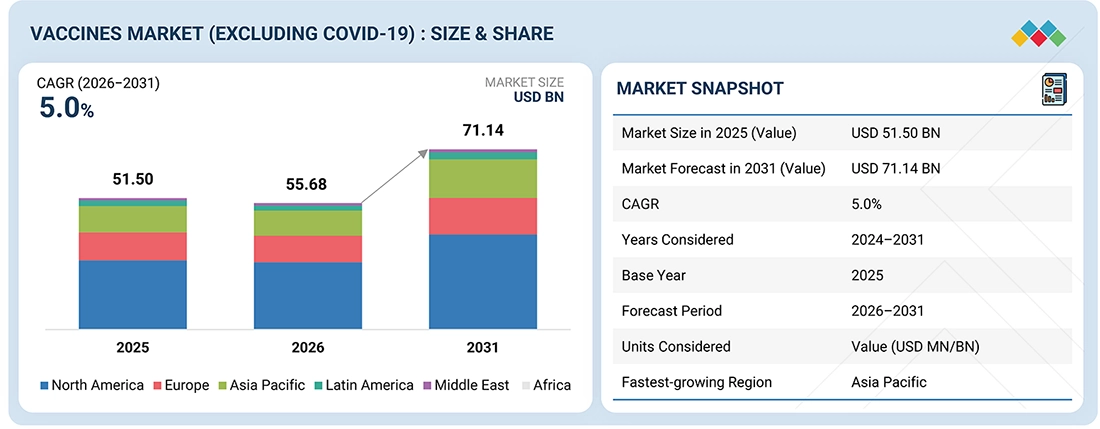
The global vaccines market size (excluding COVID-19 vaccines) is projected to grow from USD 55.68 billion in 2026 to USD 71.14 billion by 2031, at a CAGR of 5.0% during the forecast period. The market was valued at USD 51.50 billion in 2025. The vaccines market is expanding due to factors such as the rapid development and commercialization of vaccines worldwide, the increasing prevalence of infectious diseases requiring vaccines for prevention, the rising number of immunization programs, and technological advancements supporting vaccine development.
KEY TAKEAWAYS
-
MARKET SNAPSHOT:
Base Year Market Size (2025): USD 51.50 Billion
Current Market Size (2026): USD 55.68 Billion
Forecast Market Size (2031): USD 71.14 Billion
CAGR (2026–2031): 5.0% -
SEGMENT LEADERSHIP:
Regional Leader: North American vaccines market accounted for a 51.1% revenue share in 2025.
Disease Indication Leader: Pneumococcal disease segment is expected to dominate the market, with a share of 16.6% in 2025.
Technology Leader: Recombinant vaccines segment dominated the market with a share of 33.6%.
Type Leader: Multivalent vaccines are expected to register the highest CAGR during the forecast period.
Route of Administration Leader: Intramuscular & subcutaneous routes are projected to experience the highest growth rate during the forecast period.
End User Leader: Adult vaccines segment accounted for 69.6% of the market in 2025. -
MARKET OUTLOOK & COMPETITIVE LANDSCAPE:
Pfizer Inc., GSK Plc, Merck & Co., Inc., and Sanofi were identified as star players in the global vaccines market, given their strong market share and product footprint.
Sinovac, Incepta Pharmaceuticals Ltd., and Valneva SE, among others, have distinguished themselves among startups and SMEs by securing strong footholds in specialized niche areas, underscoring their potential as emerging market leaders.
The vaccines market is expected to expand significantly in the next decade owing to factors such as the growing focus on development and commercialization of vaccines at a global scale, increasing prevalence of infectious diseases requiring vaccines for prevention, a rising number of immunization programs, technological advancements supporting vaccine development, and greater government support through investments and funding for creating new vaccines targeting various disease indications.
TRENDS & DISRUPTIONS IMPACTING CUSTOMERS' CUSTOMERS
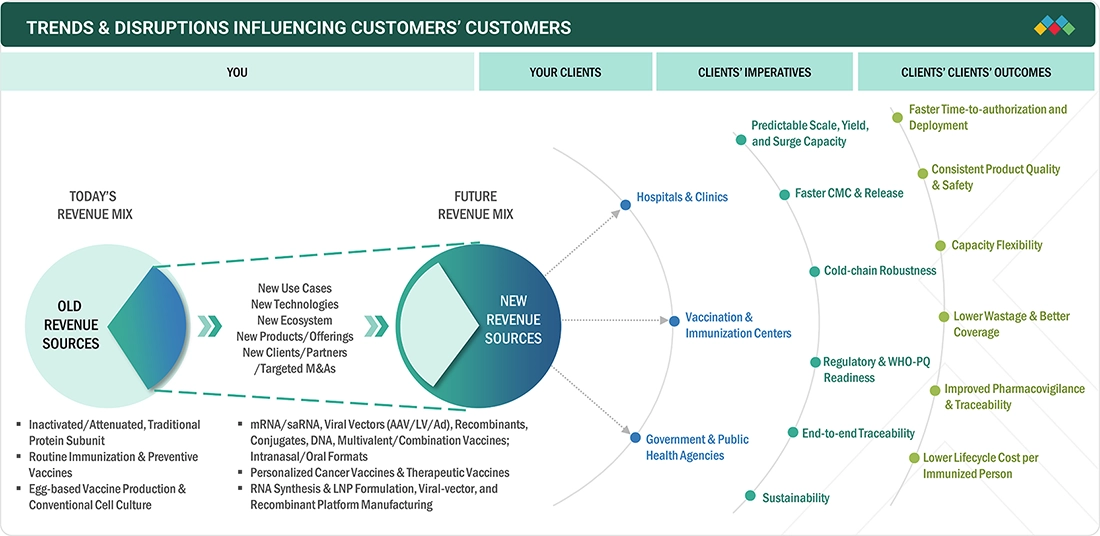
The impact of customer-side business trends in the vaccines market is shaped by expanding immunization priorities, pandemic preparedness, and increasing demand for broader and more durable protection. Key trends include growth in adult and maternal immunization, adoption of mRNA and other next-generation platforms, localization of vaccine manufacturing, and increased outsourcing to CDMOs. Digital vaccination tracking, improved cold-chain systems, supply-chain resilience, and affordability considerations are also influencing vaccine development, procurement, distribution, and purchasing decisions.
Source: Secondary Research, Interviews with Experts, MarketsandMarkets Analysis
MARKET DYNAMICS

Drivers
Impact
Level
Level
-
Focus on vaccine development and launches

-
Rising prevalence of infectious diseases


RESTRAINTS
Impact
Level
Level
-
High cost of vaccine development


OPPORTUNITIES
Impact
Level
Level
-
Rising focus on therapeutic vaccines

-
Extensive R&D for vaccines and increased investments in clinical trials


CHALLENGES
Impact
Level
Level
-
Stringent regulatory processes

-
Product recalls

Source: Secondary Research, Interviews with Experts, MarketsandMarkets Analysis
Driver: Focus on vaccine development and launches
The vaccines market is experiencing sustained growth, driven by new product approvals, label expansions, and launches that broaden eligible populations and geographic reach. Recent regulatory activity includes the US FDA’s February 2025 approval of GSK’s PENMENVY for protection against five meningococcal serogroups in individuals aged 10–25 years and the May 2025 approval of Moderna’s next-generation mRNA COVID-19 vaccine, MNEXSPIKE. Merck’s CAPVAXIVE, first approved for adults in June 2024, was further expanded in June 2026 to include certain children and adolescents at increased pneumococcal-disease risk. Overall, continued pipeline investment, wider age-group coverage, and commercialization of differentiated vaccines remain important growth drivers for the market.
Restraint: High cost of vaccine development
Vaccine research and development (R&D) is typically a lengthy process that is prone to failures and requires significant capital investment. Additionally, scaling up production carries high risks. Factors such as yield variability, complex analytics, and strict quality assurance and quality control (QA/QC) increase the likelihood of batch failures and the need for working capital. Unlike small-molecule drugs, vaccines require specialized process development, facilities that meet Biosafety Level (BSL) standards, and sterile biologics manufacturing, all of which are costly to build, validate, and maintain. Furthermore, regulatory requirements mandate large, well-structured prophylactic trials, leading to higher trial sizes and costs compared to many therapeutic products. This is because endpoints must demonstrate effectiveness in preventing disease within healthy populations. All of these factors contribute to a high break-even point in vaccine development.
Opportunity: Rising focus on therapeutic vaccines
Therapeutic vaccines are shifting the focus from disease prevention to treatment, creating valuable opportunities in oncology, chronic infections, and immune-mediated disorders. These vaccines aim to enhance T-cell responses that are specific to tumors or pathogens, making them effective partners for checkpoint inhibitors and standard treatments. As a result, clinical successes can lead to higher pricing and broader adoption. In addition to cancer, therapeutic candidates for hepatitis B virus (HBV), herpes simplex virus (HSV), and tuberculosis (TB) target large populations of chronic patients. Even achieving partial functional cures or reducing relapses in these patients would be economically beneficial and supported by health policies. The transition from public tender pediatric channels to specialty pharmacy and oncology delivery models allows for higher average selling prices (ASPs), improved outcome tracking, and bundled contracting with immunotherapies.
Challenge: Stringent regulatory processes
Vaccines are subject to stricter regulations than most other medicines, primarily because they are often administered to children. Regulators typically require extensive, multi-year studies to demonstrate that a vaccine effectively prevents disease, rather than just alleviating symptoms. This necessity leads to longer development timelines. Additionally, safety databases must be comprehensive enough to identify very rare side effects, which increases the size and cost of trials. On the manufacturing side, the Chemistry-Manufacturing-Controls (CMC) package is significant and includes components like sterility, potency, consistency, and stability, all of which require complete validation. Each batch of vaccine may also need to undergo official control or lot release testing, which can add weeks to the process and tie up inventory. Furthermore, cold-chain qualification, packaging, and country-specific labeling require separate approvals and detailed documentation.
VACCINES MARKET: COMMERCIAL USE CASES ACROSS INDUSTRIES
| COMPANY | USE CASE DESCRIPTION | BENEFITS |
|---|---|---|
 |
Moderna’s new center at the Harwell science campus, which is home to over 250 organizations in health, technology, and energy, will manufacture mRNA vaccines for the NHS’s seasonal immunization programs | The facility already has a license to produce COVID-19 vaccines and is preparing to apply for regulatory approval to manufacture flu vaccines as well. | Strengthens domestic mRNA vaccine manufacturing capacity, enhancing the UK’s preparedness against emerging infectious diseases and seasonal threats | Accelerates the availability of advanced vaccines within the NHS, reducing reliance on international supply chains | The new facility also encourages further innovation in mRNA vaccine technology and supports rapid scale-up during future public health emergencies. |
 |
After a series of vaccine expansion projects, Sanofi is pursuing a new strategy to extend the reach of its immunizations in Vietnam | Partnering with the Vietnam Vaccine Company (VNVC), Sanofi has initiated a technology transfer for vaccine production, aiming to eventually manufacture select Sanofi vaccines locally within Vietnam. | Crucial as it expands local manufacturing capabilities, reducing dependence on imports and strengthening supply chain resilience in Southeast Asia | Access and affordability could significantly improve, helping to address public health needs more efficiently. |
Logos and trademarks shown above are the property of their respective owners. Their use here is for informational and illustrative purposes only.
MARKET ECOSYSTEM
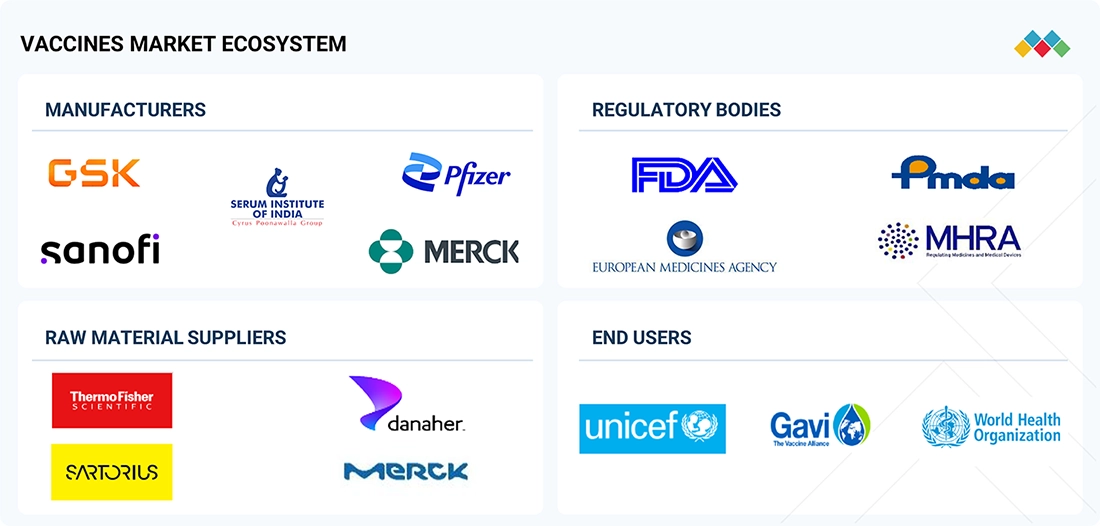
The ecosystem for the vaccines market includes major players providing vaccines, regulatory agencies, and end users such as academic and research institutes, hospitals and diagnostic labs, pharmaceutical and biotech companies, and medical device manufacturers. These stakeholders interact and collaborate to drive growth and innovation in the vaccine landscape.
Logos and trademarks shown above are the property of their respective owners. Their use here is for informational and illustrative purposes only.
MARKET SEGMENTS
Source: Secondary Research, Interviews with Experts, MarketsandMarkets Analysis
Vaccines Market, by Disease Indication
Based on disease indication, the vaccines market is segmented into pneumococcal disease, influenza, combination vaccines, HPV, meningococcal disease, rotavirus, MMR, varicella, hepatitis, herpes zoster, DTP, polio, RSV, COVID-19, and other Indications. In 2025, the pneumococcal disease segment held the largest share of the vaccines market. This is due to several key factors: a rising incidence of pneumococcal infections worldwide, increased government funding for vaccination programs, and heightened public awareness of the serious health risks associated with pneumococcal-related complications such as pneumonia, meningitis, and bloodstream infections. Additionally, ongoing innovation and the development of next-generation pneumococcal vaccines, such as the recently approved 20-valent and 21-valent conjugate vaccines, are expanding immunization options, thereby further boosting market growth and public health benefits.
Vaccines Market, by Type
By type, the vaccines market is categorized into monovalent and multivalent vaccines. In 2025, the multivalent vaccines segment accounted for the largest share of the market. This is primarily because multivalent vaccines simplify immunization programs by offering broad protection in a single formulation. Additionally, advancements in vaccine technologies, such as recombinant and conjugate platforms, have made multivalent formulations more feasible and effective immunologically, further contributing to their market growth. Economically and logistically, multivalent vaccines also provide greater efficiency in production, distribution, and administration, ultimately reducing costs and alleviating the burden on healthcare systems.
Vaccines Market, by Technology
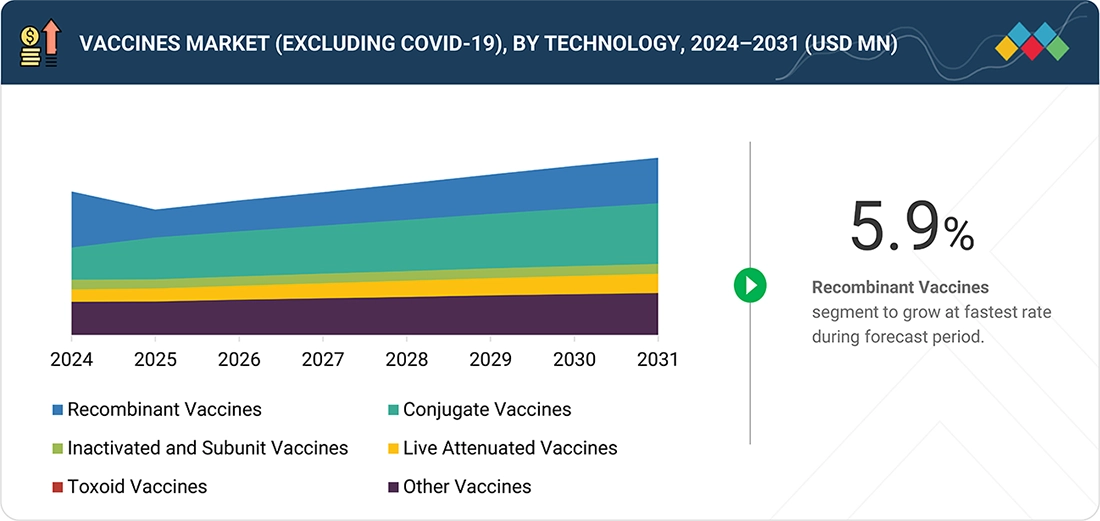
The vaccines market is categorized by technology into several types: conjugate vaccines, recombinant vaccines, inactivated & subunit vaccines, live attenuated vaccines, toxoid vaccines, viral vector vaccines, mRNA vaccines, and other technologies. Among these, conjugate vaccines hold the largest market share. This is primarily due to their ability to generate strong, long-lasting immunity by linking weak polysaccharide antigens to potent protein carriers. This process elicits powerful T-cell-dependent responses and creates lasting immunologic memory, which leads to high-affinity antibody formation and sustained immune response.
Vaccines Market, by Route of Administration
By route of administration, the vaccines market is segmented into intramuscular & subcutaneous administration, oral administration, and other routes of administration. The intramuscular & subcutaneous segment holds the largest market share due to its ability to enable rapid and reliable absorption, resulting in strong and consistent immune responses. These administration methods are well-established and supported by decades of clinical experience. Additionally, they are compatible with most current vaccine formulations, making them the preferred choice for routine immunizations.
Vaccines Market, by End user
The vaccines market is segmented based on end users into two categories: adults and pediatrics. Adult end users represent the largest share of the vaccines market. This is largely due to the increasing incidence of infectious diseases among adults and the significant rise in the global aging population, which is more vulnerable to severe infections. Additionally, widespread government immunization initiatives, heightened awareness of the importance of booster and catch-up vaccinations, and a growing range of vaccines targeted at adults contribute to this trend.
REGION
Asia Pacific to be fastest-growing region in global vaccines market during forecast period
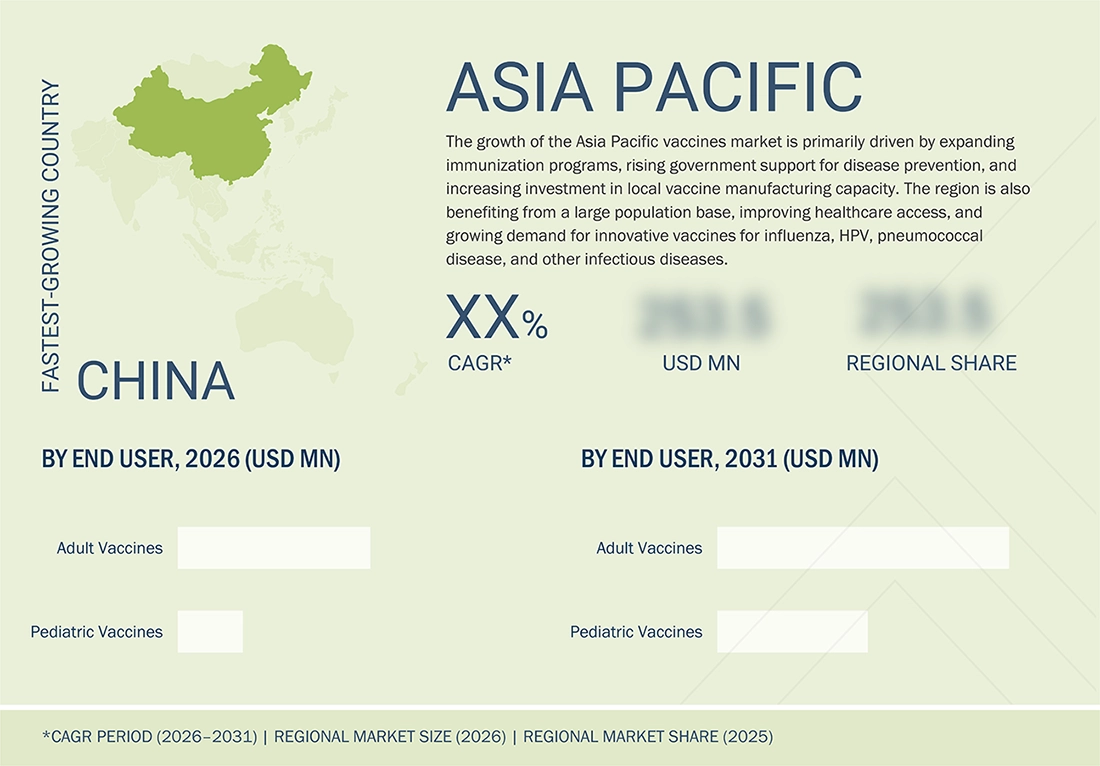
The Asia Pacific region is expected to grow at a significant CAGR during the forecast period. This increase is driven by greater public health awareness, the expansion of national immunization programs, and increased government investment in healthcare infrastructure. Supporting these efforts are public–private partnerships, international collaborations aimed at improving vaccine equity, and technological advancements that enable advanced vaccine development and more affordable production. Additionally, the region’s large and growing populations, especially in countries such as China and India, present a substantial target market for both established and new vaccines. These factors highlight the Asia Pacific’s leadership in the vaccine industry market.
VACCINES MARKET: COMPANY EVALUATION MATRIX
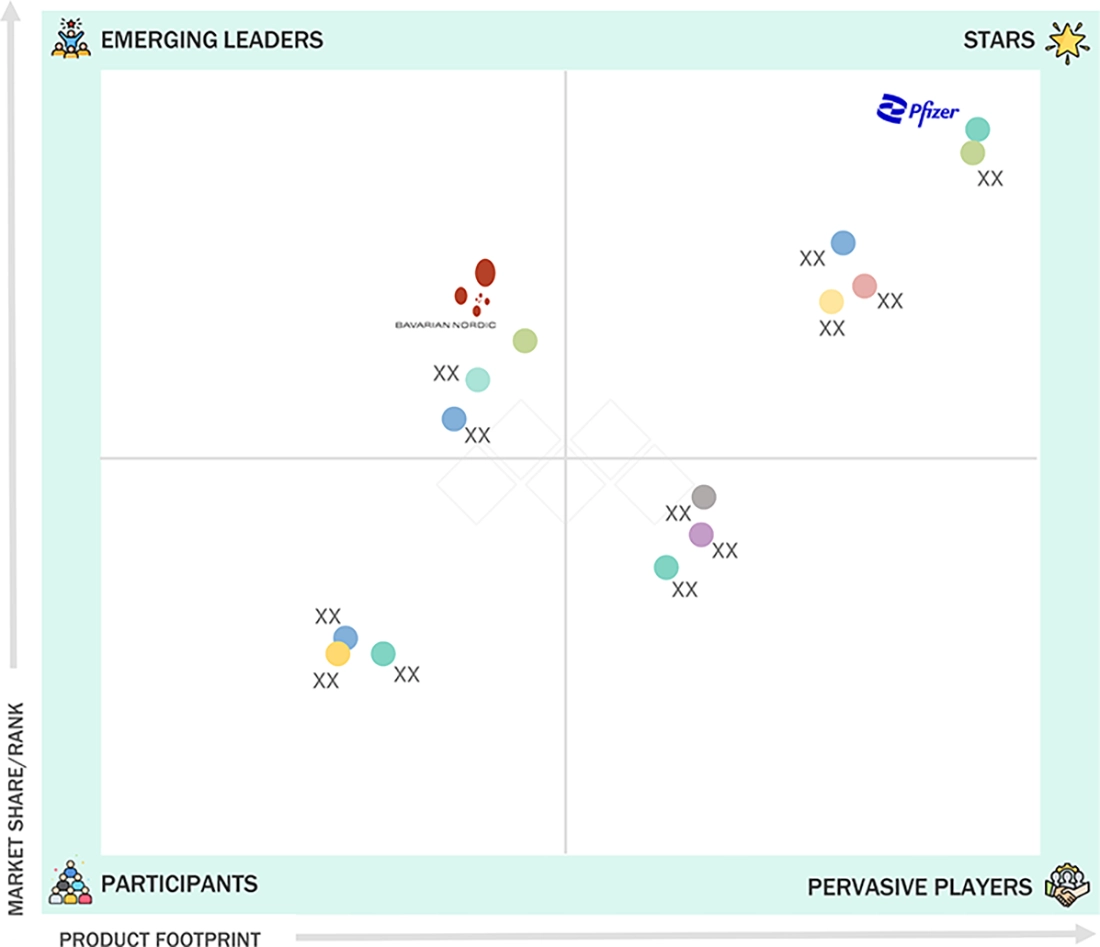
The company evaluation matrix provides information on the top 16 players offering vaccines and related products and outlines findings on each vendor's performance. In the vaccines market, Pfizer Inc. (US) leads with a strong market presence and a wide product portfolio. Bavarian Nordic (Denmark) (Emerging Leader) is gaining traction with sustainable growth in terms of revenue as well as geographic presence.
Source: Secondary Research, Interviews with Experts, MarketsandMarkets Analysis
KEY MARKET PLAYERS
- Merck & Co., Inc. (US)
- Pfizer, Inc. (US)
- GSK Plc. (UK)
- Sanofi (France)
- CSL (Australia)
- Emergent BioSolutions (US)
- Johnson & Johnson Services, Inc. (US)
- AstraZeneca (UK)
- Serum Institute of India Pvt. Ltd. (India)
- Bavarian Nordic (Denmark)
- Mitsubishi Tanabe Pharma Corporation (Japan)
- Daichi Sankyo (Japan)
- Panacea Biotec (India)
- Biological E Limited (India)
- Bharat Biotech (India)
- Novavax (US)
- Inovio Pharmaceuticals (US)
MARKET SCOPE
| REPORT METRIC | DETAILS |
|---|---|
| Market Size in 2025 (Value) | USD 51.50 Billion |
| Market Forecast in 2026 (Value) | USD 55.68 Billion |
| Market Forecast in 2031 (Value) | USD 71.14 Billion |
| Growth Rate | CAGR of 5.0% from 2026–2031 |
| Years Considered | 2024–2031 |
| Base Year | 2025 |
| Forecast Period | 2026–2031 |
| Units Considered | Value (USD Million/Billion), Volume (Doses) |
| Report Coverage | Revenue Forecast, Company Ranking, Competitive Landscape, Growth Factors, Trends |
| Segments Covered | By Disease Indication: Pneumococcal Disease, Influenza, Combination Vaccines, HPV, Meningococcal Disease, Herpes Zoster, Rotavirus, MMR, Varicella, Hepatitis, DTP, Polio, RSV, COVID-19, Other Disease Indications I By Technology: Conjugate Vaccines, Inactivated & Subunit Vaccines, Live Attenuated Vaccines, Recombinant Vaccines, Toxoid Vaccines, Other Vaccines I By Route of Administration: Intramuscular & Subcutaneous Administration, Oral Administration, Other Routes of Administration I By End User: Pediatric Vaccines, Adult Vaccines |
| Regions Covered | North America, Europe, Asia Pacific, Latin America, Middle East, Africa |
WHAT IS IN IT FOR YOU: VACCINES MARKET REPORT CONTENT GUIDE
DELIVERED CUSTOMIZATIONS
We have successfully delivered the following deep-dive customizations:
| CLIENT REQUEST | CUSTOMIZATION DELIVERED | VALUE ADDS |
|---|---|---|
| China, India, and Southeast Asia Vaccines Volume Estimation (Doses) |
|
|
| Latin America Vaccines Market |
|
|
| Market Growth Trends, Pipeline Analysis, and Manufacturing Capacity Trends |
|
|
RECENT DEVELOPMENTS
- March 2026 : GSK Plc (UK) announced that the US Food and Drug Administration (FDA) has expanded the approved age indication of Arexvy (RSV vaccine) to adults aged 18 to 49 years at increased risk for lower respiratory tract disease (LRTD) caused by RSV.
- April 2025 : Pfizer Inc. (US) announced that the European Commission (EC) has issued a decision amending the marketing authorization for ABRYSVO, to extend the indication to include prevention of lower respiratory tract disease (LRTD) caused by RSV in individuals 18 through 59 years of age.
- January 2025 : GSK Plc (UK) invested ~USD 67 million in a collaboration with the University of Oxford (UK) to advance in the science of the immune system, vaccine development, and cancer biology.
Table of Contents
 Exclusive indicates content/data unique to MarketsandMarkets and not available with any competitors.
TITLE
PAGE NO
1
INTRODUCTION
39
2
EXECUTIVE SUMMARY
44
3
PREMIUM INSIGHTS
51
4
MARKET OVERVIEW
Vaccine market growth fueled by tech advances, government support, and rising disease prevalence.
55
4.1
INTRODUCTION
4.2
MARKET DYNAMICS
4.2.1
DRIVERS
4.2.1.1
FOCUS ON VACCINE DEVELOPMENT AND LAUNCHES
4.2.1.2
RISING PREVALENCE OF INFECTIOUS DISEASES
4.2.1.3
INCREASING IMMUNIZATION PROGRAMS
4.2.1.4
ADVANCEMENTS IN VACCINE TECHNOLOGY
4.2.1.5
GOVERNMENT SUPPORT AND FUNDING FOR VACCINE DEVELOPMENT
4.2.2
RESTRAINTS
4.2.2.1
HIGH COST OF VACCINE DEVELOPMENT
4.2.3
OPPORTUNITIES
4.2.3.1
RISING FOCUS ON THERAPEUTIC VACCINES
4.2.3.2
EXTENSIVE R&D FOR VACCINES AND INCREASED INVESTMENTS IN CLINICAL TRIALS
4.2.4
CHALLENGES
4.2.4.1
STRINGENT REGULATORY PROCESSES
4.2.4.2
PRODUCT RECALLS
4.3
UNMET NEEDS & WHITE SPACES
4.4
INTERCONNECTED MARKETS & CROSS-SECTOR OPPORTUNITIES
4.5
STRATEGIC MOVES BY TIER-1/2/3 PLAYERS
5
INDUSTRY TRENDS
Navigate competitive and economic shifts shaping the future of the global vaccines market.
72
5.1
PORTER’S FIVE FORCES ANALYSIS
5.1.1
BARGAINING POWER OF SUPPLIERS
5.1.2
BARGAINING POWER OF BUYERS
5.1.3
THREAT OF NEW ENTRANTS
5.1.4
THREAT OF SUBSTITUTES
5.1.5
INTENSITY OF COMPETITIVE RIVALRY
5.2
MACROECONOMIC OUTLOOK
5.2.1
INTRODUCTION
5.2.2
GDP TRENDS & FORECAST
5.2.3
TRENDS IN GLOBAL VACCINES INDUSTRY
5.3
VALUE CHAIN ANALYSIS
5.4
PIPELINE ANALYSIS
5.4.1
VACCINES MARKET: CLINICAL TRIALS, BY PHASE
5.4.2
VACCINES MARKET: CLINICAL TRIALS, BY DISEASE INDICATION
5.4.3
VACCINES MARKET: PHASE 2/3 CLINICAL TRIALS, BY COMPANY
5.5
ECOSYSTEM ANALYSIS
5.6
PRICING ANALYSIS
5.6.1
AVERAGE SELLING PRICE TREND, BY KEY PLAYER, 2024–2026
5.6.2
AVERAGE SELLING PRICE TREND, BY DISEASE INDICATION, 2024–2026
5.6.3
AVERAGE SELLING PRICE TREND, BY REGION, 2022–2024
5.7
TRADE ANALYSIS
5.7.1
IMPORT SCENARIO (HS CODE 300220)
5.7.2
EXPORT SCENARIO (HS CODE 300220)
5.8
KEY CONFERENCES AND EVENTS, 2026–2027
5.9
TRENDS/DISRUPTIONS IMPACTING CUSTOMERS’ BUSINESS
5.10
INVESTMENT AND FUNDING SCENARIO
5.10.1
VC/PRIVATE EQUITY INVESTMENT TRENDS & STARTUP LANDSCAPE
5.11
IMPACT OF 2025 US TARIFFS—VACCINES MARKET
5.11.1
INTRODUCTION
5.11.2
KEY TARIFF RATES
5.11.3
PRICE IMPACT ANALYSIS
5.11.4
IMPACT ON COUNTRIES/REGIONS
5.11.4.1
US
5.11.4.2
EUROPE
5.11.4.3
ASIA PACIFIC
5.11.5
IMPACT ON END-USE INDUSTRIES
5.11.5.1
PUBLIC HEALTH & GOVERNMENT BODIES
5.11.5.2
HEALTHCARE PROVIDERS & INSTITUTIONS
5.12
VACCINE PROCUREMENT DATA
5.12.1
NUMBER OF VACCINES DELIVERED BY UNICEF, 2024–2026
5.12.2
WHO: VACCINE PURCHASE DATABASE, 2022–2024
5.13
VACCINE MANUFACTURING PROCESS
5.13.1
OVERVIEW
5.13.1.1
R&D AND PROCESS DEVELOPMENT
5.13.1.2
UPSTREAM PRODUCTION (ANTIGEN GENERATION)
5.13.1.3
DOWNSTREAM PROCESSING
5.13.1.4
FORMULATION & FILL-FINISH
5.13.1.5
QUALITY CONTROL & REGULATORY RELEASE
5.13.1.6
PACKAGING, COLD CHAIN, AND DISTRIBUTION
5.13.2
MANUFACTURING MODELS & CAPACITY DYNAMICS
6
TECHNOLOGICAL ADVANCEMENTS, AI-DRIVEN IMPACT, PATENTS, AND INNOVATIONS
AI-driven technologies revolutionize vaccine innovation, patent landscapes, and market readiness for future applications.
108
6.1
TECHNOLOGY ANALYSIS
6.1.1
KEY EMERGING TECHNOLOGIES
6.1.1.1
RECOMBINANT TECHNOLOGY
6.1.1.2
CONJUGATION TECHNOLOGY
6.1.1.3
VIRAL VECTOR TECHNOLOGY
6.1.2
COMPLEMENTARY TECHNOLOGIES
6.1.2.1
ENCAPSULATION & DELIVERY TECHNOLOGY
6.1.2.2
AUTOMATION & CONTROL
6.1.2.3
AI & MACHINE LEARNING FOR VACCINE DESIGN
6.1.3
ADJACENT TECHNOLOGIES
6.1.3.1
SINGLE-USE TECHNOLOGY
6.1.3.2
CELL LINE DEVELOPMENT
6.2
TECHNOLOGY/PRODUCT ROADMAP
6.3
PATENT ANALYSIS
6.3.1
TOP APPLICANTS/OWNERS (COMPANIES) FOR VACCINE PATENTS
6.4
FUTURE APPLICATIONS
6.5
IMPACT OF AI/GEN AI—VACCINES MARKET
6.5.1
BEST PRACTICES IN VACCINES WORKFLOW
6.5.2
CASE STUDIES OF AI IMPLEMENTATION IN VACCINES MARKET
6.5.3
INTERCONNECTED ADJACENT ECOSYSTEMS & IMPACT ON MARKET PLAYERS
6.5.4
CLIENTS’ READINESS TO ADOPT GENERATIVE AI IN VACCINES MARKET
7
REGULATORY LANDSCAPE AND SUSTAINABILITY INITIATIVES
Navigate global regulatory complexities to drive sustainable practices and industry compliance.
119
7.1
REGIONAL REGULATIONS AND COMPLIANCE
7.1.1
REGULATORY BODIES, GOVERNMENT AGENCIES, AND OTHER ORGANIZATIONS
7.1.2
REGULATORY FRAMEWORK
7.1.2.1
NORTH AMERICA
7.1.2.2
EUROPE
7.1.2.3
ASIA PACIFIC
7.1.2.4
LATIN AMERICA
7.1.2.5
MIDDLE EAST & AFRICA
7.1.3
REGULATORY CHALLENGES IN VACCINES MARKET
7.1.4
INDUSTRY STANDARDS
7.2
SUSTAINABILITY INITIATIVES
7.3
IMPACT OF REGULATORY POLICIES ON SUSTAINABILITY
7.4
CERTIFICATIONS, LABELING, AND ECO-STANDARDS
8
CUSTOMER LANDSCAPE & BUYER BEHAVIOR
Unlock strategic insights into stakeholder influence and unmet needs shaping buyer decisions.
127
8.1
DECISION-MAKING PROCESS
8.2
BUYER STAKEHOLDERS & BUYING EVALUATION CRITERIA
8.2.1
KEY STAKEHOLDERS IN BUYING PROCESS
8.2.2
KEY BUYING CRITERIA, BY END USER
8.3
ADOPTION BARRIERS & INTERNAL CHALLENGES
8.4
UNMET NEEDS FROM VARIOUS END-USE INDUSTRIES
8.5
MARKET PROFITABILITY
9
VACCINES MARKET, BY DISEASE INDICATION
Market Size & Growth Rate Forecast Analysis to 2031 in USD Million | 90 Data Tables
132
9.1
INTRODUCTION
9.2
PNEUMOCOCCAL DISEASE
9.2.1
EXPANDING ADULT IMMUNIZATION PROGRAMS AND HIGHER-VALENCY VACCINES TO DRIVE MARKET
9.3
INFLUENZA
9.3.1
SEASONAL IMMUNIZATION PROGRAMS AND EXPANDING ADULT VACCINATION TO DRIVE MARKET
9.4
HPV
9.4.1
EXPANDING NATIONAL HPV IMMUNIZATION PROGRAMS AND RISING ADOPTION OF GENDER-NEUTRAL VACCINATION TO DRIVE THE FASTEST-GROWING SEGMENT
9.5
HERPES ZOSTER
9.5.1
RISING AGING POPULATION TO DRIVE DEMAND FOR HERPES ZOSTER VACCINES
9.6
COMBINATION VACCINES
9.6.1
EXPANDING NATIONAL IMMUNIZATION PROGRAMS AND GROWING PREFERENCE FOR MULTI-ANTIGEN VACCINES TO DRIVE MARKET
9.7
MENINGOCOCCAL DISEASE
9.7.1
EXPANDING IMMUNIZATION RECOMMENDATIONS AND BROADER SEROGROUP COVERAGE TO SUPPORT MARKET GROWTH
9.8
ROTAVIRUS
9.8.1
RISING INFANT IMMUNIZATION PROGRAMS TO DRIVE ROTAVIRUS MARKET GROWTH
9.9
RSV
9.9.1
INITIAL VACCINE UPTAKE AND EXPANDING IMMUNIZATION RECOMMENDATIONS SUPPORT MARKET PENETRATION
9.10
DTP
9.10.1
CONTINUED ROUTINE CHILDHOOD IMMUNIZATION AND BOOSTER VACCINATION PROGRAMS TO SUPPORT MARKET
9.11
HEPATITIS
9.11.1
EXPANDING HEPATITIS B IMMUNIZATION AND GLOBAL ELIMINATION INITIATIVES TO SUPPORT MARKET GROWTH
9.12
VARICELLA
9.12.1
EXPANDING CHILDHOOD IMMUNIZATION PROGRAMS AND INCREASING ADOPTION OF VARICELLA VACCINES TO SUPPORT MARKET GROWTH
9.13
MMR
9.13.1
RISING MEASLES OUTBREAKS AND IMMUNIZATION RECOVERY EFFORTS TO SUPPORT MARKET GROWTH
9.14
POLIO
9.14.1
GLOBAL POLIO ERADICATION INITIATIVES AND CONTINUED VACCINATION CAMPAIGNS TO SUSTAIN MARKET DEMAND
9.15
COVID-19
9.15.1
SHIFT FROM PANDEMIC-DRIVEN DEMAND TO ENDURING HIGH-RISK POPULATION VACCINATION, RESULTING IN MARKET NORMALIZATION
9.16
OTHER DISEASE INDICATIONS
10
VACCINES MARKET, BY TECHNOLOGY
Market Size & Growth Rate Forecast Analysis to 2031 in USD Million | 52 Data Tables
188
10.1
INTRODUCTION
10.2
VACCINES MARKET (EXCLUDING COVID-19 VACCINES), BY TECHNOLOGY
10.2.1
RECOMBINANT VACCINES
10.2.1.1
BROADER ADULT IMMUNIZATION AND CONTINUED RECOMBINANT VACCINE LAUNCHES TO DRIVE MARKET
10.2.2
CONJUGATE VACCINES
10.2.2.1
HIGHER-VALENCY PNEUMOCOCCAL VACCINES AND LARGE PUBLIC IMMUNIZATION PROGRAMS TO DRIVE MARKET
10.2.3
INACTIVATED & SUBUNIT VACCINES
10.2.3.1
RECURRING INFLUENZA DEMAND AND WIDER ACCESS TO ESTABLISHED NON-LIVE VACCINES TO SUPPORT MARKET
10.2.4
LIVE ATTENUATED VACCINES
10.2.4.1
DURABLE IMMUNE PROTECTION AND CONVENIENT ORAL OR NASAL ADMINISTRATION TO SUPPORT MARKET
10.2.5
TOXOID VACCINES
10.2.5.1
ROUTINE PEDIATRIC BOOSTERS AND MATERNAL IMMUNIZATION PROGRAMS TO SUSTAIN MARKET
10.2.6
OTHER VACCINES
10.3
COVID-19 VACCINES MARKET, BY TECHNOLOGY
10.3.1
MRNA VACCINES
10.3.1.1
RAPID VARIANT ADAPTATION AND CONTINUED VACCINATION OF HIGH-RISK POPULATIONS TO DRIVE MARKET
10.3.2
VIRAL VECTOR VACCINES
10.3.2.1
WITHDRAWAL OF FIRST-GENERATION PRODUCTS AND SHIFT TOWARD UPDATED VACCINE PLATFORMS TO ACCELERATE MARKET DECLINE
10.3.3
OTHER COVID-19 VACCINES
11
VACCINES MARKET (EXCLUDING COVID-19 VACCINES), BY TYPE
Market Size & Growth Rate Forecast Analysis to 2031 in USD Million | 13 Data Tables
219
11.1
INTRODUCTION
11.2
MULTIVALENT VACCINES
11.2.1
BROADER SEROTYPE COVERAGE AND INCREASING ADOPTION OF COMBINATION IMMUNIZATION SCHEDULES TO DRIVE MARKET
11.3
MONOVALENT VACCINES
11.3.1
ESTABLISHED SINGLE-DISEASE PROGRAMS AND EXPANDING ADULT IMMUNIZATION INDICATIONS TO SUPPORT MARKET
12
VACCINES MARKET (EXCLUDING COVID-19 VACCINES), BY ROUTE OF ADMINISTRATION
Market Size & Growth Rate Forecast Analysis to 2031 in USD Million | 17 Data Tables
229
12.1
INTRODUCTION
12.2
INTRAMUSCULAR & SUBCUTANEOUS ADMINISTRATION
12.2.1
EASE OF ABSORPTION AND BETTER IMMUNE RESPONSE TO DRIVE ADOPTION
12.3
ORAL ADMINISTRATION
12.3.1
NEEDLE-FREE DELIVERY AND HIGH-VOLUME DISEASE-CONTROL CAMPAIGNS TO SUPPORT MARKET
12.4
OTHER ROUTES OF ADMINISTRATION
13
VACCINES MARKET (EXCLUDING COVID-19 VACCINES), BY END USER
Market Size & Growth Rate Forecast Analysis to 2031 in USD Million | 11 Data Tables
241
13.1
INTRODUCTION
13.2
ADULT VACCINES
13.2.1
AGING POPULATIONS, BROADER ADULT INDICATIONS, AND GROWING LIFE-COURSE IMMUNIZATION TO DRIVE MARKET
13.3
PEDIATRIC VACCINES
13.3.1
EXPANDING CHILDHOOD IMMUNIZATION SCHEDULES AND NEW VACCINE INTRODUCTIONS TO DRIVE MARKET GROWTH
14
VACCINES MARKET (EXCLUDING COVID-19 VACCINES), BY REGION
Comprehensive coverage of 7 Regions with country-level deep-dive of 13 Countries | 115 Data Tables.
249
14.1
INTRODUCTION
14.2
NORTH AMERICA
14.2.1
US
14.2.1.1
US TO DOMINATE NORTH AMERICAN MARKET DURING FORECAST PERIOD
14.2.2
CANADA
14.2.2.1
EXPANSION OF LIFE-COURSE IMMUNIZATION TO SUPPORT MARKET GROWTH
14.3
EUROPE
14.3.1
GERMANY
14.3.1.1
ADULT IMMUNIZATION AND UPDATED NATIONAL RECOMMENDATIONS TO DRIVE MARKET GROWTH
14.3.2
UK
14.3.2.1
EXPANSION OF ADULT AND MATERNAL IMMUNIZATION PROGRAMS TO SUPPORT MARKET GROWTH
14.3.3
FRANCE
14.3.3.1
FAVORABLE GOVERNMENT INITIATIVES FOR MASS IMMUNIZATION TO DRIVE MARKET
14.3.4
ITALY
14.3.4.1
HIGHER INVESTMENTS BY COMPANIES FOR INCREASED PRODUCTION CAPACITIES TO DRIVE MARKET
14.3.5
SPAIN
14.3.5.1
RISING INVESTMENTS IN VACCINE DEVELOPMENT BY PRIVATE ORGANIZATIONS TO DRIVE MARKET
14.3.6
REST OF EUROPE
14.4
ASIA PACIFIC
14.4.1
CHINA
14.4.1.1
CHINA TO HOLD LARGEST SHARE OF APAC VACCINES MARKET
14.4.2
JAPAN
14.4.2.1
AGING POPULATION AND GRADUAL EXPANSION OF ROUTINE VACCINATION TO DRIVE DEMAND
14.4.3
INDIA
14.4.3.1
LARGE IMMUNIZATION REQUIREMENTS AND MANUFACTURING LEADERSHIP TO SUPPORT STRONG GROWTH
14.4.4
SOUTH KOREA
14.4.4.1
STRONG GOVERNMENT STRATEGIES FOR IMPROVED VACCINE HUBS TO DRIVE MARKET
14.4.5
REST OF ASIA PACIFIC
14.5
LATIN AMERICA
14.5.1
BRAZIL
14.5.1.1
STRONG PUBLIC PROCUREMENT AND DOMESTIC MANUFACTURING TO DRIVE MARKET
14.5.2
MEXICO
14.5.2.1
TRAINED WORKFORCE AND ETHNICALLY VARIED POPULATION BASE FOR CLINICAL TRIALS TO PROPEL MARKET GROWTH
14.5.3
REST OF LATIN AMERICA
14.6
MIDDLE EAST
14.6.1
GOVERNMENT-LED LOCALIZATION AND EXPANDING ADULT AND TRAVEL IMMUNIZATION TO SUPPORT MARKET GROWTH
14.7
AFRICA
14.7.1
HIGH UNMET IMMUNIZATION NEEDS AND LOCAL MANUFACTURING INITIATIVES TO DRIVE MARKET EXPANSION
15
COMPETITIVE LANDSCAPE
Discover top strategies and emerging leaders shaping the vaccine market's competitive landscape.
317
15.1
OVERVIEW
15.2
KEY PLAYER STRATEGIES/RIGHT TO WIN
15.2.1
OVERVIEW OF STRATEGIES ADOPTED BY PLAYERS IN VACCINES MARKET
15.3
REVENUE ANALYSIS, 2021–2025
15.4
MARKET SHARE ANALYSIS, 2025
15.5
COMPANY EVALUATION MATRIX: KEY PLAYERS, 2025
15.5.1
STARS
15.5.2
EMERGING LEADERS
15.5.3
PERVASIVE PLAYERS
15.5.4
PARTICIPANTS
15.5.5
COMPANY FOOTPRINT: KEY PLAYERS, 2025
15.5.5.1
COMPANY FOOTPRINT
15.5.5.2
REGION FOOTPRINT
15.5.5.3
TECHNOLOGY FOOTPRINT
15.5.5.4
TYPE FOOTPRINT
15.5.5.5
ROUTE OF ADMINISTRATION FOOTPRINT
15.6
COMPANY EVALUATION MATRIX: STARTUPS/SMES, 2025
15.6.1
PROGRESSIVE COMPANIES
15.6.2
RESPONSIVE COMPANIES
15.6.3
DYNAMIC COMPANIES
15.6.4
STARTING BLOCKS
15.6.5
COMPETITIVE BENCHMARKING: STARTUPS/SMES, 2025
15.6.5.1
DETAILED LIST OF KEY STARTUPS/SMES
15.6.5.2
COMPETITIVE BENCHMARKING OF KEY STARTUPS/SMES
15.7
COMPANY VALUATION & FINANCIAL METRICS
15.7.1
FINANCIAL METRICS
15.7.2
COMPANY VALUATION
15.8
PRODUCT COMPARISON
15.8.1
PRODUCT COMPARATIVE ANALYSIS
15.9
COMPETITIVE SCENARIO
15.9.1
PRODUCT LAUNCHES & APPROVALS
15.9.2
DEALS
15.9.3
EXPANSIONS
16
COMPANY PROFILES
In-depth Company Profiles of Leading Market Players with detailed Business Overview, Product and Service Portfolio, Recent Developments, and Unique Analyst Perspective (MnM View)
337
16.1
KEY PLAYERS
16.1.1
PFIZER INC.
16.1.1.1
BUSINESS OVERVIEW
16.1.1.2
PRODUCTS OFFERED
16.1.1.3
RECENT DEVELOPMENTS
16.1.1.3.1
PRODUCT APPROVALS
16.1.1.4
MNM VIEW
16.1.1.4.1
KEY STRENGTHS
16.1.1.4.2
STRATEGIC CHOICES
16.1.1.4.3
WEAKNESSES & COMPETITIVE THREATS
16.1.2
GSK PLC
16.1.3
MERCK & CO., INC.
16.1.4
SANOFI
16.1.5
CSL
16.1.6
EMERGENT
16.1.7
JOHNSON & JOHNSON SERVICES, INC.
16.1.8
ASTRAZENECA
16.1.9
SERUM INSTITUTE OF INDIA PVT. LTD.
16.1.10
BAVARIAN NORDIC
16.1.11
TANABE PHARMA CORPORATION
16.1.12
DAIICHI SANKYO COMPANY, LIMITED
16.1.13
PANACEA BIOTEC
16.1.14
BIOLOGICAL E. LIMITED
16.1.15
BHARAT BIOTECH
16.1.16
NOVAVAX
16.1.17
INOVIO PHARMACEUTICALS
16.2
OTHER PLAYERS
16.2.1
SINOVAC
16.2.2
INCEPTA PHARMACEUTICALS LTD.
16.2.3
VALNEVA SE
16.2.4
EUBIOLOGICS CO., LTD.
16.2.5
BIO FARMA
16.2.6
MICROGEN
16.2.7
CHONGQING ZHIFEI BIOLOGICAL PRODUCTS CO., LTD.
16.2.8
INDIAN IMMUNOLOGICALS LIMITED
17
RESEARCH METHODOLOGY
417
17.1
RESEARCH DATA
17.1.1
SECONDARY DATA
17.1.1.1
KEY SECONDARY SOURCES
17.1.1.2
KEY DATA FROM SECONDARY RESEARCH
17.1.2
PRIMARY DATA
17.1.2.1
KEY PRIMARY PARTICIPANTS
17.1.2.2
BREAKDOWN OF PRIMARY INTERVIEWS
17.1.2.3
KEY DATA FROM PRIMARY SOURCES
17.2
MARKET SIZE ESTIMATION
17.2.1
GLOBAL VACCINES MARKET SIZE ESTIMATION, 2025
17.2.1.1
APPROACH 1: COMPANY REVENUE ANALYSIS-BASED ESTIMATION (BOTTOM-UP APPROACH)
17.2.1.2
APPROACH 2: PRIMARY RESEARCH
17.2.1.2.1
KEY INDUSTRY INSIGHTS
17.2.1.3
APPROACH 3: SECONDARY ANALYSIS
17.2.1.4
APPROACH 4: BOTTOM-UP APPROACH (DISEASE INDICATION-BASED ANALYSIS)
17.2.1.5
APPROACH 5: MARKETSANDMARKETS REPOSITORY ANALYSIS
17.2.2
SEGMENTAL MARKET SIZE ESTIMATION (TOP-DOWN APPROACH), 2025
17.3
MARKET GROWTH RATE PROJECTIONS
17.4
DATA TRIANGULATION
17.5
RESEARCH ASSUMPTIONS
17.6
RESEARCH LIMITATIONS & RISK ASSESSMENT
18
APPENDIX
432
18.1
DISCUSSION GUIDE
18.2
KNOWLEDGESTORE: MARKETSANDMARKETS’ SUBSCRIPTION PORTAL
18.3
CUSTOMIZATION OPTIONS
18.4
RELATED REPORTS
18.5
AUTHOR DETAILS
LIST OF TABLES
TABLE 1
VACCINES MARKET: INCLUSIONS & EXCLUSIONS
TABLE 2
VACCINES MARKET: IMPACT ANALYSIS OF MARKET DYNAMICS
TABLE 3
NIH FUNDING FOR VACCINE RESEARCH, 2020–2025 (USD MILLION)
TABLE 4
MAJOR COST DRIVERS AND IMPACT ON COST OF GOODS SOLD (COGS)
TABLE 5
NOTABLE CANCER VACCINES IN CLINICAL TRIALS
TABLE 6
VACCINES MARKET: IMPACT OF PORTER’S FIVE FORCES
TABLE 7
VACCINE PIPELINE PRODUCTS UNDER PHASE 3 CLINICAL TRIALS FOR RSV
TABLE 8
VACCINE PIPELINE PRODUCTS UNDER PHASE 3 CLINICAL TRIALS FOR CANCER
TABLE 9
VACCINE PIPELINE PRODUCTS UNDER PHASE 3 CLINICAL TRIALS FOR INFLUENZA
TABLE 10
KEY PIPELINE VACCINES: GSK PLC
TABLE 11
KEY PIPELINE VACCINES: MERCK & CO., INC.
TABLE 12
KEY PIPELINE VACCINES: PFIZER INC.
TABLE 13
KEY PIPELINE VACCINES: SANOFI
TABLE 14
VACCINES MARKET: ROLE IN ECOSYSTEM
TABLE 15
AVERAGE SELLING PRICE TREND OF PEDIATRIC VACCINES, BY KEY PLAYER, 2024–2026 (USD)
TABLE 16
AVERAGE SELLING PRICE TREND OF ADULT VACCINES, BY KEY PLAYER, 2024–2026 (USD)
TABLE 17
AVERAGE SELLING PRICE TREND OF VACCINES, BY REGION, 2022–2024 (USD)
TABLE 18
IMPORT DATA FOR HS CODE 300220, 2021–2025 (USD THOUSAND)
TABLE 19
IMPORT DATA FOR HS CODE 300220, 2021–2025 (TONS)
TABLE 20
EXPORT DATA FOR HS CODE 300220, 2021–2025 (USD THOUSAND)
TABLE 21
EXPORT DATA FOR HS CODE 300220, 2021–2025 (TONS)
TABLE 22
VACCINES MARKET: KEY CONFERENCES AND EVENTS, 2026–2027
TABLE 23
US ADJUSTED RECIPROCAL TARIFF RATES
TABLE 24
NUMBER OF VACCINES DELIVERED BY UNICEF, 2024–2026
TABLE 25
WHO VACCINE PURCHASE DATABASE, BY PROCUREMENT MECHANISM, 2022–2024
TABLE 26
WHO VACCINE PURCHASE DATABASE, BY MANUFACTURER, 2022–2024
TABLE 27
WHO VACCINE PURCHASE DATABASE, BY INDICATION, 2022–2024
TABLE 28
WHO VACCINE PURCHASE DATABASE, BY REGION, 2022–2024
TABLE 29
VACCINE PRODUCTION CAPACITY, BY KEY PLAYER, 2025
TABLE 30
KEY VACCINE MANUFACTURING CAPACITY EXPANSIONS, 2025–2026
TABLE 31
VACCINES MARKET: INDICATIVE LIST OF PATENTS, 2026
TABLE 32
CASE STUDIES OF AI IMPLEMENTATION IN VACCINES MARKET
TABLE 33
CLIENT’S READINESS TO ADOPT GENERATIVE AI IN VACCINES
TABLE 34
NORTH AMERICA: REGULATORY BODIES, GOVERNMENT AGENCIES, AND OTHER ORGANIZATIONS
TABLE 35
EUROPE: REGULATORY BODIES, GOVERNMENT AGENCIES, AND OTHER ORGANIZATIONS
TABLE 36
ASIA PACIFIC: REGULATORY BODIES, GOVERNMENT AGENCIES, AND OTHER ORGANIZATIONS
TABLE 37
REST OF THE WORLD: REGULATORY BODIES, GOVERNMENT AGENCIES, AND OTHER ORGANIZATIONS
TABLE 38
INFLUENCE OF STAKEHOLDERS ON BUYING PROCESS, BY VACCINES
TABLE 39
KEY BUYING CRITERIA, BY END USER
TABLE 40
VACCINES MARKET, BY DISEASE INDICATION, 2024–2031 (USD MILLION)
TABLE 41
LIST OF COMMERCIALLY AVAILABLE PNEUMOCOCCAL DISEASE VACCINES
TABLE 42
PNEUMOCOCCAL DISEASE VACCINES MARKET, BY REGION, 2024–2031 (USD MILLION)
TABLE 43
NORTH AMERICA: PNEUMOCOCCAL DISEASE VACCINES MARKET, BY COUNTRY, 2024–2031 (USD MILLION)
TABLE 44
EUROPE: PNEUMOCOCCAL DISEASE VACCINES MARKET, BY COUNTRY, 2024–2031 (USD MILLION)
TABLE 45
ASIA PACIFIC: PNEUMOCOCCAL DISEASE VACCINES MARKET, BY COUNTRY, 2024–2031 (USD MILLION)
TABLE 46
LATIN AMERICA: PNEUMOCOCCAL DISEASE VACCINES MARKET, BY COUNTRY, 2024–2031 (USD MILLION)
TABLE 47
LIST OF COMMERCIALLY AVAILABLE INFLUENZA VACCINES
TABLE 48
INFLUENZA VACCINES MARKET, BY REGION, 2024–2031 (USD MILLION)
TABLE 49
NORTH AMERICA: INFLUENZA VACCINES MARKET, BY COUNTRY, 2024–2031 (USD MILLION)
TABLE 50
EUROPE: INFLUENZA VACCINES MARKET, BY COUNTRY, 2024–2031 (USD MILLION)
TABLE 51
ASIA PACIFIC: INFLUENZA VACCINES MARKET, BY COUNTRY, 2024–2031 (USD MILLION)
TABLE 52
LATIN AMERICA: INFLUENZA VACCINES MARKET, BY COUNTRY, 2024–2031 (USD MILLION)
TABLE 53
LIST OF COMMERCIALLY AVAILABLE HPV VACCINES
TABLE 54
HPV VACCINES MARKET, BY REGION, 2024–2031 (USD MILLION)
TABLE 55
NORTH AMERICA: HPV VACCINES MARKET, BY COUNTRY, 2024–2031 (USD MILLION)
TABLE 56
EUROPE: HPV VACCINES MARKET, BY COUNTRY, 2024–2031 (USD MILLION)
TABLE 57
ASIA PACIFIC: HPV VACCINES MARKET, BY COUNTRY, 2024–2031 (USD MILLION)
TABLE 58
LATIN AMERICA: HPV VACCINES MARKET, BY COUNTRY, 2024–2031 (USD MILLION)
TABLE 59
LIST OF COMMERCIALLY AVAILABLE HERPES ZOSTER VACCINES
TABLE 60
HERPES ZOSTER VACCINES MARKET, BY REGION, 2024–2031 (USD MILLION)
TABLE 61
NORTH AMERICA: HERPES ZOSTER VACCINES MARKET, BY COUNTRY, 2024–2031 (USD MILLION)
TABLE 62
EUROPE: HERPES ZOSTER VACCINES MARKET, BY COUNTRY, 2024–2031 (USD MILLION)
TABLE 63
ASIA PACIFIC: HERPES ZOSTER VACCINES MARKET, BY COUNTRY, 2024–2031 (USD MILLION)
TABLE 64
LATIN AMERICA: HERPES ZOSTER VACCINES MARKET, BY COUNTRY, 2024–2031 (USD MILLION)
TABLE 65
LIST OF COMMERCIALLY AVAILABLE COMBINATION VACCINES
TABLE 66
COMBINATION VACCINES MARKET, BY REGION, 2024–2031 (USD MILLION)
TABLE 67
NORTH AMERICA: COMBINATION VACCINES MARKET, BY COUNTRY, 2024–2031 (USD MILLION)
TABLE 68
EUROPE: COMBINATION VACCINES MARKET, BY COUNTRY, 2024–2031 (USD MILLION)
TABLE 69
ASIA PACIFIC: COMBINATION VACCINES MARKET, BY COUNTRY, 2024–2031 (USD MILLION)
TABLE 70
LATIN AMERICA: COMBINATION VACCINES MARKET, BY COUNTRY, 2024–2031 (USD MILLION)
TABLE 71
LIST OF COMMERCIALLY AVAILABLE MENINGOCOCCAL DISEASE VACCINES
TABLE 72
MENINGOCOCCAL DISEASE VACCINES MARKET, BY REGION, 2024–2031 (USD MILLION)
TABLE 73
NORTH AMERICA: MENINGOCOCCAL DISEASE VACCINES MARKET, BY COUNTRY, 2024–2031 (USD MILLION)
TABLE 74
EUROPE: MENINGOCOCCAL DISEASE VACCINES MARKET, BY COUNTRY, 2024–2031 (USD MILLION)
TABLE 75
ASIA PACIFIC: MENINGOCOCCAL DISEASE VACCINES MARKET, BY COUNTRY, 2024–2031 (USD MILLION)
TABLE 76
LATIN AMERICA: MENINGOCOCCAL DISEASE VACCINES MARKET, BY COUNTRY, 2024–2031 (USD MILLION)
TABLE 77
LIST OF COMMERCIALLY AVAILABLE ROTAVIRUS VACCINES
TABLE 78
ROTAVIRUS VACCINES MARKET, BY REGION, 2024–2031 (USD MILLION)
TABLE 79
NORTH AMERICA: ROTAVIRUS VACCINES MARKET, BY COUNTRY, 2024–2031 (USD MILLION)
TABLE 80
EUROPE: ROTAVIRUS VACCINES MARKET, BY COUNTRY, 2024–2031 (USD MILLION)
TABLE 81
ASIA PACIFIC: ROTAVIRUS VACCINES MARKET, BY COUNTRY, 2024–2031 (USD MILLION)
TABLE 82
LATIN AMERICA: ROTAVIRUS VACCINES MARKET, BY COUNTRY, 2024–2031 (USD MILLION)
TABLE 83
LIST OF COMMERCIALLY AVAILABLE RSV VACCINES
TABLE 84
RSV VACCINES MARKET, BY REGION, 2024–2031 (USD MILLION)
TABLE 85
NORTH AMERICA: RSV VACCINES MARKET, BY COUNTRY, 2024–2031 (USD MILLION)
TABLE 86
EUROPE: RSV VACCINES MARKET, BY COUNTRY, 2024–2031 (USD MILLION)
TABLE 87
ASIA PACIFIC: RSV VACCINES MARKET, BY COUNTRY, 2024–2031 (USD MILLION)
TABLE 88
LATIN AMERICA: RSV VACCINES MARKET, BY COUNTRY, 2024–2031 (USD MILLION)
TABLE 89
LIST OF COMMERCIALLY AVAILABLE DTP VACCINES
TABLE 90
DTP VACCINES MARKET, BY REGION, 2024–2031 (USD MILLION)
TABLE 91
NORTH AMERICA: DTP VACCINES MARKET, BY COUNTRY, 2024–2031 (USD MILLION)
TABLE 92
EUROPE: DTP VACCINES MARKET, BY COUNTRY, 2024–2031 (USD MILLION)
TABLE 93
ASIA PACIFIC: DTP VACCINES MARKET, BY COUNTRY, 2024–2031 (USD MILLION)
TABLE 94
LATIN AMERICA: DTP VACCINES MARKET, BY COUNTRY, 2024–2031 (USD MILLION)
TABLE 95
LIST OF COMMERCIALLY AVAILABLE HEPATITIS VACCINES
TABLE 96
HEPATITIS VACCINES MARKET, BY REGION, 2024–2031 (USD MILLION)
TABLE 97
NORTH AMERICA: HEPATITIS VACCINES MARKET, BY COUNTRY, 2024–2031 (USD MILLION)
TABLE 98
EUROPE: HEPATITIS VACCINES MARKET, BY COUNTRY, 2024–2031 (USD MILLION)
TABLE 99
ASIA PACIFIC: HEPATITIS VACCINES MARKET, BY COUNTRY, 2024–2031 (USD MILLION)
TABLE 100
LATIN AMERICA: HEPATITIS VACCINES MARKET, BY COUNTRY, 2024–2031 (USD MILLION)
TABLE 101
LIST OF COMMERCIALLY AVAILABLE VARICELLA VACCINES
TABLE 102
VARICELLA VACCINES MARKET, BY REGION, 2024–2031 (USD MILLION)
TABLE 103
NORTH AMERICA: VARICELLA VACCINES MARKET, BY COUNTRY, 2024–2031 (USD MILLION)
TABLE 104
EUROPE: VARICELLA VACCINES MARKET, BY COUNTRY, 2024–2031 (USD MILLION)
TABLE 105
ASIA PACIFIC: VARICELLA VACCINES MARKET, BY COUNTRY, 2024–2031 (USD MILLION)
TABLE 106
LATIN AMERICA: VARICELLA VACCINES MARKET, BY COUNTRY, 2024–2031 (USD MILLION)
TABLE 107
TOP 10 COUNTRIES WITH MEASLES OUTBREAKS, JANUARY 2025–JULY 2025
TABLE 108
LIST OF COMMERCIALLY AVAILABLE MMR VACCINES
TABLE 109
MMR VACCINES MARKET, BY REGION, 2024–2031 (USD MILLION)
TABLE 110
NORTH AMERICA: MMR VACCINES MARKET, BY COUNTRY, 2024–2031 (USD MILLION)
TABLE 111
EUROPE: MMR VACCINES MARKET, BY COUNTRY, 2024–2031 (USD MILLION)
TABLE 112
ASIA PACIFIC: MMR VACCINES MARKET, BY COUNTRY, 2024–2031 (USD MILLION)
TABLE 113
LATIN AMERICA: MMR VACCINES MARKET, BY COUNTRY, 2024–2031 (USD MILLION)
TABLE 114
POLIO VACCINES MARKET, BY REGION, 2024–2031 (USD MILLION)
TABLE 115
NORTH AMERICA: POLIO VACCINES MARKET, BY COUNTRY, 2024–2031 (USD MILLION)
TABLE 116
EUROPE: POLIO VACCINES MARKET, BY COUNTRY, 2024–2031 (USD MILLION)
TABLE 117
ASIA PACIFIC: POLIO VACCINES MARKET, BY COUNTRY, 2024–2031 (USD MILLION)
TABLE 118
LATIN AMERICA: POLIO VACCINES MARKET, BY COUNTRY, 2024–2031 (USD MILLION)
TABLE 119
COVID-19 VACCINES MARKET, BY REGION, 2024–2031 (USD MILLION)
TABLE 120
NORTH AMERICA: COVID-19 VACCINES MARKET, BY COUNTRY, 2024–2031 (USD MILLION)
TABLE 121
EUROPE: COVID-19 VACCINES MARKET, BY COUNTRY, 2024–2031 (USD MILLION)
TABLE 122
ASIA PACIFIC: COVID-19 VACCINES MARKET, BY COUNTRY, 2024–2031 (USD MILLION)
TABLE 123
LATIN AMERICA: COVID-19 VACCINES MARKET, BY COUNTRY, 2024–2031 (USD MILLION)
TABLE 124
LIST OF COMMERCIALLY AVAILABLE VACCINES FOR OTHER DISEASE INDICATIONS
TABLE 125
VACCINES MARKET FOR OTHER DISEASE INDICATIONS, BY REGION, 2024–2031 (USD MILLION)
TABLE 126
NORTH AMERICA: VACCINES MARKET FOR OTHER DISEASE INDICATIONS, BY COUNTRY, 2024–2031 (USD MILLION)
TABLE 127
EUROPE: VACCINES MARKET FOR OTHER DISEASE INDICATIONS, BY COUNTRY, 2024–2031 (USD MILLION)
TABLE 128
ASIA PACIFIC: VACCINES MARKET FOR OTHER DISEASE INDICATIONS, BY COUNTRY, 2024–2031 (USD MILLION)
TABLE 129
LATIN AMERICA: VACCINES MARKET FOR OTHER DISEASE INDICATIONS, BY COUNTRY, 2024–2031 (USD MILLION)
TABLE 130
VACCINES MARKET (EXCLUDING COVID-19 VACCINES), BY TECHNOLOGY, 2024–2031 (USD MILLION)
TABLE 131
EXAMPLES OF RECOMBINANT VACCINES
TABLE 132
RECOMBINANT VACCINES MARKET (EXCLUDING COVID-19 VACCINES), BY REGION, 2024–2031 (USD MILLION)
TABLE 133
NORTH AMERICA: RECOMBINANT VACCINES MARKET (EXCLUDING COVID-19 VACCINES), BY COUNTRY, 2024–2031 (USD MILLION)
TABLE 134
EUROPE: RECOMBINANT VACCINES MARKET (EXCLUDING COVID-19 VACCINES), BY COUNTRY, 2024–2031 (USD MILLION)
TABLE 135
ASIA PACIFIC: RECOMBINANT VACCINES MARKET (EXCLUDING COVID-19 VACCINES), BY COUNTRY, 2024–2031 (USD MILLION)
TABLE 136
LATIN AMERICA: RECOMBINANT VACCINES MARKET (EXCLUDING COVID-19 VACCINES), BY COUNTRY, 2024–2031 (USD MILLION)
TABLE 137
EXAMPLES OF CONJUGATE VACCINES
TABLE 138
CONJUGATE VACCINES MARKET (EXCLUDING COVID-19 VACCINES), BY REGION, 2024–2031 (USD MILLION)
TABLE 139
NORTH AMERICA: CONJUGATE VACCINES MARKET (EXCLUDING COVID-19 VACCINES), BY COUNTRY, 2024–2031 (USD MILLION)
TABLE 140
EUROPE: CONJUGATE VACCINES MARKET (EXCLUDING COVID-19 VACCINES), BY COUNTRY, 2024–2031 (USD MILLION)
TABLE 141
ASIA PACIFIC: CONJUGATE VACCINES MARKET (EXCLUDING COVID-19 VACCINES), BY COUNTRY, 2024–2031 (USD MILLION)
TABLE 142
LATIN AMERICA: CONJUGATE VACCINES MARKET (EXCLUDING COVID-19 VACCINES), BY COUNTRY, 2024–2031 (USD MILLION)
TABLE 143
EXAMPLES OF INACTIVATED & SUBUNIT VACCINES
TABLE 144
INACTIVATED & SUBUNIT VACCINES MARKET (EXCLUDING COVID-19 VACCINES), BY REGION, 2024–2031 (USD MILLION)
TABLE 145
NORTH AMERICA: INACTIVATED & SUBUNIT VACCINES MARKET (EXCLUDING COVID-19 VACCINES), BY COUNTRY, 2024–2031 (USD MILLION)
TABLE 146
EUROPE: INACTIVATED & SUBUNIT VACCINES MARKET (EXCLUDING COVID-19 VACCINES), BY COUNTRY, 2024–2031 (USD MILLION)
TABLE 147
ASIA PACIFIC: INACTIVATED & SUBUNIT VACCINES MARKET (EXCLUDING COVID-19 VACCINES), BY COUNTRY, 2024–2031 (USD MILLION)
TABLE 148
LATIN AMERICA: INACTIVATED & SUBUNIT VACCINES MARKET (EXCLUDING COVID-19 VACCINES), BY COUNTRY, 2024–2031 (USD MILLION)
TABLE 149
EXAMPLES OF LIVE ATTENUATED VACCINES
TABLE 150
LIVE ATTENUATED VACCINES MARKET (EXCLUDING COVID-19 VACCINES), BY REGION, 2024–2031 (USD MILLION)
TABLE 151
NORTH AMERICA: LIVE ATTENUATED VACCINES MARKET (EXCLUDING COVID-19 VACCINES), BY COUNTRY, 2024–2031 (USD MILLION)
TABLE 152
EUROPE: LIVE ATTENUATED VACCINES MARKET (EXCLUDING COVID-19 VACCINES), BY COUNTRY, 2024–2031 (USD MILLION)
TABLE 153
ASIA PACIFIC: LIVE ATTENUATED VACCINES MARKET (EXCLUDING COVID-19 VACCINES), BY COUNTRY, 2024–2031 (USD MILLION)
TABLE 154
LATIN AMERICA: LIVE ATTENUATED VACCINES MARKET (EXCLUDING COVID-19 VACCINES), BY COUNTRY, 2024–2031 (USD MILLION)
TABLE 155
EXAMPLES OF TOXOID VACCINES
TABLE 156
TOXOID VACCINES MARKET (EXCLUDING COVID-19 VACCINES), BY REGION, 2024–2031 (USD MILLION)
TABLE 157
NORTH AMERICA: TOXOID VACCINES MARKET (EXCLUDING COVID-19 VACCINES), BY COUNTRY, 2024–2031 (USD MILLION)
TABLE 158
EUROPE: TOXOID VACCINES MARKET (EXCLUDING COVID-19 VACCINES), BY COUNTRY, 2024–2031 (USD MILLION)
TABLE 159
ASIA PACIFIC: TOXOID VACCINES MARKET (EXCLUDING COVID-19 VACCINES), BY COUNTRY, 2024–2031 (USD MILLION)
TABLE 160
LATIN AMERICA: TOXOID VACCINES MARKET (EXCLUDING COVID-19 VACCINES), BY COUNTRY, 2024–2031 (USD MILLION)
TABLE 161
OTHER VACCINES MARKET (EXCLUDING COVID-19 VACCINES), BY REGION, 2024–2031 (USD MILLION)
TABLE 162
NORTH AMERICA: OTHER VACCINES MARKET (EXCLUDING COVID-19 VACCINES), BY COUNTRY, 2024–2031 (USD MILLION)
TABLE 163
EUROPE: OTHER VACCINES MARKET (EXCLUDING COVID-19 VACCINES), BY COUNTRY, 2024–2031 (USD MILLION)
TABLE 164
ASIA PACIFIC: OTHER VACCINES MARKET (EXCLUDING COVID-19 VACCINES), BY COUNTRY, 2024–2031 (USD MILLION)
TABLE 165
LATIN AMERICA: OTHER VACCINES MARKET (EXCLUDING COVID-19 VACCINES), BY COUNTRY, 2024–2031 (USD MILLION)
TABLE 166
COVID-19 VACCINES MARKET, BY TECHNOLOGY, 2024–2031 (USD MILLION)
TABLE 167
MRNA COVID-19 VACCINES MARKET, BY REGION, 2024–2031 (USD MILLION)
TABLE 168
NORTH AMERICA: MRNA COVID-19 VACCINES MARKET, BY COUNTRY, 2024–2031 (USD MILLION)
TABLE 169
EUROPE: MRNA COVID-19 VACCINES MARKET, BY COUNTRY, 2024–2031 (USD MILLION)
TABLE 170
ASIA PACIFIC: MRNA COVID-19 VACCINES MARKET, BY COUNTRY, 2024–2031 (USD MILLION)
TABLE 171
LATIN AMERICA: MRNA COVID-19 VACCINES MARKET, BY COUNTRY, 2024–2031 (USD MILLION)
TABLE 172
VIRAL VECTOR COVID-19 VACCINES MARKET, BY REGION, 2024–2031 (USD MILLION)
TABLE 173
NORTH AMERICA: VIRAL VECTOR COVID-19 VACCINES MARKET, BY COUNTRY, 2024–2031 (USD MILLION)
TABLE 174
EUROPE: VIRAL VECTOR COVID-19 VACCINES MARKET, BY COUNTRY, 2024–2031 (USD MILLION)
TABLE 175
ASIA PACIFIC: VIRAL VECTOR COVID-19 VACCINES MARKET, BY COUNTRY, 2024–2031 (USD MILLION)
TABLE 176
LATIN AMERICA: VIRAL VECTOR COVID-19 VACCINES MARKET, BY COUNTRY, 2024–2031 (USD MILLION)
TABLE 177
OTHER COVID-19 VACCINES MARKET, BY REGION, 2024–2031 (USD MILLION)
TABLE 178
NORTH AMERICA: OTHER COVID-19 VACCINES MARKET, BY COUNTRY, 2024–2031 (USD MILLION)
TABLE 179
EUROPE: OTHER COVID-19 VACCINES MARKET, BY COUNTRY, 2024–2031 (USD MILLION)
TABLE 180
ASIA PACIFIC: OTHER COVID-19 VACCINES MARKET, BY COUNTRY, 2024–2031 (USD MILLION)
TABLE 181
LATIN AMERICA: OTHER COVID-19 VACCINES MARKET, BY COUNTRY, 2024–2031 (USD MILLION)
TABLE 182
VACCINES MARKET (EXCLUDING COVID-19 VACCINES), BY TYPE, 2024–2031 (USD MILLION)
TABLE 183
EXAMPLES OF MULTIVALENT VACCINES
TABLE 184
MULTIVALENT VACCINES MARKET (EXCLUDING COVID-19 VACCINES), BY REGION, 2024–2031 (USD MILLION)
TABLE 185
NORTH AMERICA: MULTIVALENT VACCINES MARKET (EXCLUDING COVID-19 VACCINES), BY COUNTRY, 2024–2031 (USD MILLION)
TABLE 186
EUROPE: MULTIVALENT VACCINES MARKET (EXCLUDING COVID-19 VACCINES), BY COUNTRY, 2024–2031 (USD MILLION)
TABLE 187
ASIA PACIFIC: MULTIVALENT VACCINES MARKET (EXCLUDING COVID-19 VACCINES), BY COUNTRY, 2024–2031 (USD MILLION)
TABLE 188
LATIN AMERICA: MULTIVALENT VACCINES MARKET (EXCLUDING COVID-19 VACCINES), BY COUNTRY, 2024–2031 (USD MILLION)
TABLE 189
EXAMPLES OF MONOVALENT VACCINES
TABLE 190
MONOVALENT VACCINES MARKET (EXCLUDING COVID-19 VACCINES), BY REGION, 2024–2031 (USD MILLION)
TABLE 191
NORTH AMERICA: MONOVALENT VACCINES MARKET (EXCLUDING COVID-19 VACCINES), BY COUNTRY, 2024–2031 (USD MILLION)
TABLE 192
EUROPE: MONOVALENT VACCINES MARKET (EXCLUDING COVID-19 VACCINES), BY COUNTRY, 2024–2031 (USD MILLION)
TABLE 193
ASIA PACIFIC: MONOVALENT VACCINES MARKET (EXCLUDING COVID-19 VACCINES), BY COUNTRY, 2024–2031 (USD MILLION)
TABLE 194
LATIN AMERICA: MONOVALENT VACCINES MARKET (EXCLUDING COVID-19 VACCINES), BY COUNTRY, 2024–2031 (USD MILLION)
TABLE 195
VACCINES MARKET (EXCLUDING COVID-19 VACCINES), BY ROUTE OF ADMINISTRATION, 2024–2031 (USD MILLION)
TABLE 196
ADVANTAGES AND DISADVANTAGES OF INTRAMUSCULAR & SUBCUTANEOUS ADMINISTRATION
TABLE 197
VACCINES MARKET FOR INTRAMUSCULAR & SUBCUTANEOUS ADMINISTRATION (EXCLUDING COVID-19 VACCINES), BY REGION, 2024–2031 (USD MILLION)
TABLE 198
NORTH AMERICA: VACCINES MARKET FOR INTRAMUSCULAR & SUBCUTANEOUS ADMINISTRATION (EXCLUDING COVID-19 VACCINES), BY COUNTRY, 2024–2031 (USD MILLION)
TABLE 199
EUROPE: VACCINES MARKET FOR INTRAMUSCULAR & SUBCUTANEOUS ADMINISTRATION (EXCLUDING COVID-19 VACCINES), BY COUNTRY, 2024–2031 (USD MILLION)
TABLE 200
ASIA PACIFIC: VACCINES MARKET FOR INTRAMUSCULAR & SUBCUTANEOUS ADMINISTRATION (EXCLUDING COVID-19 VACCINES), BY COUNTRY, 2024–2031 (USD MILLION)
TABLE 201
LATIN AMERICA: VACCINES MARKET FOR INTRAMUSCULAR & SUBCUTANEOUS ADMINISTRATION (EXCLUDING COVID-19 VACCINES), BY COUNTRY, 2024–2031 (USD MILLION)
TABLE 202
VACCINES MARKET FOR ORAL ADMINISTRATION (EXCLUDING COVID-19 VACCINES), BY REGION, 2024–2031 (USD MILLION)
TABLE 203
NORTH AMERICA: VACCINES MARKET FOR ORAL ADMINISTRATION (EXCLUDING COVID-19 VACCINES), BY COUNTRY, 2024–2031 (USD MILLION)
TABLE 204
EUROPE: VACCINES MARKET FOR ORAL ADMINISTRATION (EXCLUDING COVID-19 VACCINES), BY COUNTRY, 2024–2031 (USD MILLION)
TABLE 205
ASIA PACIFIC: VACCINES MARKET FOR ORAL ADMINISTRATION (EXCLUDING COVID-19 VACCINES), BY COUNTRY, 2024–2031 (USD MILLION)
TABLE 206
LATIN AMERICA: VACCINES MARKET FOR ORAL ADMINISTRATION (EXCLUDING COVID-19 VACCINES), BY COUNTRY, 2024–2031 (USD MILLION)
TABLE 207
VACCINES MARKET FOR OTHER ROUTES OF ADMINISTRATION (EXCLUDING COVID-19 VACCINES), BY REGION, 2024–2031 (USD MILLION)
TABLE 208
NORTH AMERICA: VACCINES MARKET FOR OTHER ROUTES OF ADMINISTRATION (EXCLUDING COVID-19 VACCINES), BY COUNTRY, 2024–2031 (USD MILLION)
TABLE 209
EUROPE: VACCINES MARKET FOR OTHER ROUTES OF ADMINISTRATION (EXCLUDING COVID-19 VACCINES), BY COUNTRY, 2024–2031 (USD MILLION)
TABLE 210
ASIA PACIFIC: VACCINES MARKET FOR OTHER ROUTES OF ADMINISTRATION (EXCLUDING COVID-19 VACCINES), BY COUNTRY, 2024–2031 (USD MILLION)
TABLE 211
LATIN AMERICA: VACCINES MARKET FOR OTHER ROUTES OF ADMINISTRATION (EXCLUDING COVID-19 VACCINES), BY COUNTRY, 2024–2031 (USD MILLION)
TABLE 212
VACCINES MARKET (EXCLUDING COVID-19 VACCINES), BY END USER, 2024–2031 (USD MILLION)
TABLE 213
ADULT VACCINES MARKET (EXCLUDING COVID-19 VACCINES), BY REGION, 2024–2031 (USD MILLION)
TABLE 214
NORTH AMERICA: ADULT VACCINES MARKET (EXCLUDING COVID-19 VACCINES), BY COUNTRY, 2024–2031 (USD MILLION)
TABLE 215
EUROPE: ADULT VACCINES MARKET (EXCLUDING COVID-19 VACCINES), BY COUNTRY, 2024–2031 (USD MILLION)
TABLE 216
ASIA PACIFIC: ADULT VACCINES MARKET (EXCLUDING COVID-19 VACCINES), BY COUNTRY, 2024–2031 (USD MILLION)
TABLE 217
LATIN AMERICA: ADULT VACCINES MARKET (EXCLUDING COVID-19 VACCINES), BY COUNTRY, 2024–2031 (USD MILLION)
TABLE 218
PEDIATRIC VACCINES MARKET (EXCLUDING COVID-19 VACCINES), BY REGION, 2024–2031 (USD MILLION)
TABLE 219
NORTH AMERICA: PEDIATRIC VACCINES MARKET (EXCLUDING COVID-19 VACCINES), BY COUNTRY, 2024–2031 (USD MILLION)
TABLE 220
EUROPE: PEDIATRIC VACCINES MARKET (EXCLUDING COVID-19 VACCINES), BY COUNTRY, 2024–2031 (USD MILLION)
TABLE 221
ASIA PACIFIC: PEDIATRIC VACCINES MARKET (EXCLUDING COVID-19 VACCINES), BY COUNTRY, 2024–2031 (USD MILLION)
TABLE 222
LATIN AMERICA: PEDIATRIC VACCINES MARKET (EXCLUDING COVID-19 VACCINES), BY COUNTRY, 2024–2031 (USD MILLION)
TABLE 223
VACCINES MARKET (EXCLUDING COVID-19 VACCINES), BY REGION, 2024–2031 (USD MILLION)
TABLE 224
NORTH AMERICA: VACCINES MARKET (EXCLUDING COVID-19 VACCINES), BY COUNTRY, 2024–2031 (USD MILLION)
TABLE 225
NORTH AMERICA: VACCINES MARKET (EXCLUDING COVID-19 VACCINES), BY TECHNOLOGY, 2024–2031 (USD MILLION)
TABLE 226
NORTH AMERICA: VACCINES MARKET (EXCLUDING COVID-19 VACCINES), BY TYPE, 2024–2031 (USD MILLION)
TABLE 227
NORTH AMERICA: VACCINES MARKET (EXCLUDING COVID-19 VACCINES), BY DISEASE INDICATION, 2024–2031 (USD MILLION)
TABLE 228
NORTH AMERICA: VACCINES MARKET (EXCLUDING COVID-19 VACCINES), BY ROUTE OF ADMINISTRATION, 2024–2031 (USD MILLION)
TABLE 229
NORTH AMERICA: VACCINES MARKET (EXCLUDING COVID-19 VACCINES), BY END USER, 2024–2031 (USD MILLION)
TABLE 230
US: VACCINES MARKET (EXCLUDING COVID-19 VACCINES), BY TECHNOLOGY, 2024–2031 (USD MILLION)
TABLE 231
US: VACCINES MARKET (EXCLUDING COVID-19 VACCINES), BY TYPE, 2024–2031 (USD MILLION)
TABLE 232
US: VACCINES MARKET (EXCLUDING COVID-19 VACCINES), BY DISEASE INDICATION, 2024–2031 (USD MILLION)
TABLE 233
US: VACCINES MARKET (EXCLUDING COVID-19 VACCINES), BY ROUTE OF ADMINISTRATION, 2024–2031 (USD MILLION)
TABLE 234
US: VACCINES MARKET (EXCLUDING COVID-19 VACCINES), BY END USER, 2024–2031 (USD MILLION)
TABLE 235
CANADA: VACCINES MARKET (EXCLUDING COVID-19 VACCINES), BY TECHNOLOGY, 2024–2031 (USD MILLION)
TABLE 236
CANADA: VACCINES MARKET (EXCLUDING COVID-19 VACCINES), BY TYPE, 2024–2031 (USD MILLION)
TABLE 237
CANADA: VACCINES MARKET (EXCLUDING COVID-19 VACCINES), BY DISEASE INDICATION, 2024–2031 (USD MILLION)
TABLE 238
CANADA: VACCINES MARKET (EXCLUDING COVID-19 VACCINES), BY ROUTE OF ADMINISTRATION, 2024–2031 (USD MILLION)
TABLE 239
CANADA: VACCINES MARKET (EXCLUDING COVID-19 VACCINES), BY END USER, 2024–2031 (USD MILLION)
TABLE 240
EUROPE: VACCINES MARKET (EXCLUDING COVID-19 VACCINES), BY COUNTRY, 2024–2031 (USD MILLION)
TABLE 241
EUROPE: VACCINES MARKET (EXCLUDING COVID-19 VACCINES), BY TECHNOLOGY, 2024–2031 (USD MILLION)
TABLE 242
EUROPE: VACCINES MARKET (EXCLUDING COVID-19 VACCINES), BY TYPE, 2024–2031 (USD MILLION)
TABLE 243
EUROPE: VACCINES MARKET (EXCLUDING COVID-19 VACCINES), BY DISEASE INDICATION, 2024–2031 (USD MILLION)
TABLE 244
EUROPE: VACCINES MARKET (EXCLUDING COVID-19 VACCINES), BY ROUTE OF ADMINISTRATION, 2024–2031 (USD MILLION)
TABLE 245
EUROPE: VACCINES MARKET (EXCLUDING COVID-19 VACCINES), BY END USER, 2024–2031 (USD MILLION)
TABLE 246
GERMANY: VACCINES MARKET (EXCLUDING COVID-19 VACCINES), BY TECHNOLOGY, 2024–2031 (USD MILLION)
TABLE 247
GERMANY: VACCINES MARKET (EXCLUDING COVID-19 VACCINES), BY TYPE, 2024–2031 (USD MILLION)
TABLE 248
GERMANY: VACCINES MARKET (EXCLUDING COVID-19 VACCINES), BY DISEASE INDICATION, 2024–2031 (USD MILLION)
TABLE 249
GERMANY: VACCINES MARKET (EXCLUDING COVID-19 VACCINES), BY ROUTE OF ADMINISTRATION, 2024–2031 (USD MILLION)
TABLE 250
GERMANY: VACCINES MARKET (EXCLUDING COVID-19 VACCINES), BY END USER, 2024–2031 (USD MILLION)
TABLE 251
UK: VACCINES MARKET (EXCLUDING COVID-19 VACCINES), BY TECHNOLOGY, 2024–2031 (USD MILLION)
TABLE 252
UK: VACCINES MARKET (EXCLUDING COVID-19 VACCINES), BY TYPE, 2024–2031 (USD MILLION)
TABLE 253
UK: VACCINES MARKET (EXCLUDING COVID-19 VACCINES), BY DISEASE INDICATION, 2024–2031 (USD MILLION)
TABLE 254
UK: VACCINES MARKET (EXCLUDING COVID-19 VACCINES), BY ROUTE OF ADMINISTRATION, 2024–2031 (USD MILLION)
TABLE 255
UK: VACCINES MARKET (EXCLUDING COVID-19 VACCINES), BY END USER, 2024–2031 (USD MILLION)
TABLE 256
FRANCE: VACCINES MARKET (EXCLUDING COVID-19 VACCINES), BY TECHNOLOGY, 2024–2031 (USD MILLION)
TABLE 257
FRANCE: VACCINES MARKET (EXCLUDING COVID-19 VACCINES), BY TYPE, 2024–2031 (USD MILLION)
TABLE 258
FRANCE: VACCINES MARKET (EXCLUDING COVID-19 VACCINES), BY DISEASE INDICATION, 2024–2031 (USD MILLION)
TABLE 259
FRANCE: VACCINES MARKET (EXCLUDING COVID-19 VACCINES), BY ROUTE OF ADMINISTRATION, 2024–2031 (USD MILLION)
TABLE 260
FRANCE: VACCINES MARKET (EXCLUDING COVID-19 VACCINES), BY END USER, 2024–2031 (USD MILLION)
TABLE 261
ITALY: VACCINES MARKET (EXCLUDING COVID-19 VACCINES), BY TECHNOLOGY, 2024–2031 (USD MILLION)
TABLE 262
ITALY: VACCINES MARKET (EXCLUDING COVID-19 VACCINES), BY TYPE, 2024–2031 (USD MILLION)
TABLE 263
ITALY: VACCINES MARKET (EXCLUDING COVID-19 VACCINES), BY DISEASE INDICATION, 2024–2031 (USD MILLION)
TABLE 264
ITALY: VACCINES MARKET (EXCLUDING COVID-19 VACCINES), BY ROUTE OF ADMINISTRATION, 2024–2031 (USD MILLION)
TABLE 265
ITALY: VACCINES MARKET (EXCLUDING COVID-19 VACCINES), BY END USER, 2024–2031 (USD MILLION)
TABLE 266
SPAIN: VACCINES MARKET (EXCLUDING COVID-19 VACCINES), BY TECHNOLOGY, 2024–2031 (USD MILLION)
TABLE 267
SPAIN: VACCINES MARKET (EXCLUDING COVID-19 VACCINES), BY TYPE, 2024–2031 (USD MILLION)
TABLE 268
SPAIN: VACCINES MARKET (EXCLUDING COVID-19 VACCINES), BY DISEASE INDICATION, 2024–2031 (USD MILLION)
TABLE 269
SPAIN: VACCINES MARKET (EXCLUDING COVID-19 VACCINES), BY ROUTE OF ADMINISTRATION, 2024–2031 (USD MILLION)
TABLE 270
SPAIN: VACCINES MARKET (EXCLUDING COVID-19 VACCINES), BY END USER, 2024–2031 (USD MILLION)
TABLE 271
REST OF EUROPE: VACCINES MARKET (EXCLUDING COVID-19 VACCINES), BY TECHNOLOGY, 2024–2031 (USD MILLION)
TABLE 272
REST OF EUROPE: VACCINES MARKET (EXCLUDING COVID-19 VACCINES), BY TYPE, 2024–2031 (USD MILLION)
TABLE 273
REST OF EUROPE: VACCINES MARKET (EXCLUDING COVID-19 VACCINES), BY DISEASE INDICATION, 2024–2031 (USD MILLION)
TABLE 274
REST OF EUROPE: VACCINES MARKET (EXCLUDING COVID-19 VACCINES), BY ROUTE OF ADMINISTRATION, 2024–2031 (USD MILLION)
TABLE 275
REST OF EUROPE: VACCINES MARKET (EXCLUDING COVID-19 VACCINES), BY END USER, 2024–2031 (USD MILLION)
TABLE 276
ASIA PACIFIC: VACCINES MARKET (EXCLUDING COVID-19 VACCINES), BY COUNTRY, 2024–2031 (USD MILLION)
TABLE 277
ASIA PACIFIC: VACCINES MARKET (EXCLUDING COVID-19 VACCINES), BY TECHNOLOGY, 2024–2031 (USD MILLION)
TABLE 278
ASIA PACIFIC: VACCINES MARKET (EXCLUDING COVID-19 VACCINES), BY TYPE, 2024–2031 (USD MILLION)
TABLE 279
ASIA PACIFIC: VACCINES MARKET (EXCLUDING COVID-19 VACCINES), BY DISEASE INDICATION, 2024–2031 (USD MILLION)
TABLE 280
ASIA PACIFIC: VACCINES MARKET (EXCLUDING COVID-19 VACCINES), BY ROUTE OF ADMINISTRATION, 2024–2031 (USD MILLION)
TABLE 281
ASIA PACIFIC: VACCINES MARKET (EXCLUDING COVID-19 VACCINES), BY END USER, 2024–2031 (USD MILLION)
TABLE 282
CHINA: VACCINES MARKET (EXCLUDING COVID-19 VACCINES), BY TECHNOLOGY, 2024–2031 (USD MILLION)
TABLE 283
CHINA: VACCINES MARKET (EXCLUDING COVID-19 VACCINES), BY TYPE, 2024–2031 (USD MILLION)
TABLE 284
CHINA: VACCINES MARKET (EXCLUDING COVID-19 VACCINES), BY DISEASE INDICATION, 2024–2031 (USD MILLION)
TABLE 285
CHINA: VACCINES MARKET (EXCLUDING COVID-19 VACCINES), BY ROUTE OF ADMINISTRATION, 2024–2031 (USD MILLION)
TABLE 286
CHINA: VACCINES MARKET (EXCLUDING COVID-19 VACCINES), BY END USER, 2024–2031 (USD MILLION)
TABLE 287
JAPAN: VACCINES MARKET (EXCLUDING COVID-19 VACCINES), BY TECHNOLOGY, 2024–2031 (USD MILLION)
TABLE 288
JAPAN: VACCINES MARKET (EXCLUDING COVID-19 VACCINES), BY TYPE, 2024–2031 (USD MILLION)
TABLE 289
JAPAN: VACCINES MARKET (EXCLUDING COVID-19 VACCINES), BY DISEASE INDICATION, 2024–2031 (USD MILLION)
TABLE 290
JAPAN: VACCINES MARKET (EXCLUDING COVID-19 VACCINES), BY ROUTE OF ADMINISTRATION, 2024–2031 (USD MILLION)
TABLE 291
JAPAN: VACCINES MARKET (EXCLUDING COVID-19 VACCINES), BY END USER, 2024–2031 (USD MILLION)
TABLE 292
INDIA: VACCINES MARKET (EXCLUDING COVID-19 VACCINES), BY TECHNOLOGY, 2024–2031 (USD MILLION)
TABLE 293
INDIA: VACCINES MARKET (EXCLUDING COVID-19 VACCINES), BY TYPE, 2024–2031 (USD MILLION)
TABLE 294
INDIA: VACCINES MARKET (EXCLUDING COVID-19 VACCINES), BY DISEASE INDICATION, 2024–2031 (USD MILLION)
TABLE 295
INDIA: VACCINES MARKET (EXCLUDING COVID-19 VACCINES), BY ROUTE OF ADMINISTRATION, 2024–2031 (USD MILLION)
TABLE 296
INDIA: VACCINES MARKET (EXCLUDING COVID-19 VACCINES), BY END USER, 2024–2031 (USD MILLION)
TABLE 297
SOUTH KOREA: VACCINES MARKET (EXCLUDING COVID-19 VACCINES), BY TECHNOLOGY, 2024–2031 (USD MILLION)
TABLE 298
SOUTH KOREA: VACCINES MARKET (EXCLUDING COVID-19 VACCINES), BY TYPE, 2024–2031 (USD MILLION)
TABLE 299
SOUTH KOREA: VACCINES MARKET (EXCLUDING COVID-19 VACCINES), BY DISEASE INDICATION, 2024–2031 (USD MILLION)
TABLE 300
SOUTH KOREA: VACCINES MARKET (EXCLUDING COVID-19 VACCINES), BY ROUTE OF ADMINISTRATION, 2024–2031 (USD MILLION)
TABLE 301
SOUTH KOREA: VACCINES MARKET (EXCLUDING COVID-19 VACCINES), BY END USER, 2024–2031 (USD MILLION)
TABLE 302
REST OF ASIA PACIFIC: VACCINES MARKET (EXCLUDING COVID-19 VACCINES), BY TECHNOLOGY, 2024–2031 (USD MILLION)
TABLE 303
REST OF ASIA PACIFIC: VACCINES MARKET (EXCLUDING COVID-19 VACCINES), BY TYPE, 2024–2031 (USD MILLION)
TABLE 304
REST OF ASIA PACIFIC: VACCINES MARKET (EXCLUDING COVID-19 VACCINES), BY DISEASE INDICATION, 2024–2031 (USD MILLION)
TABLE 305
REST OF ASIA PACIFIC: VACCINES MARKET (EXCLUDING COVID-19 VACCINES), BY ROUTE OF ADMINISTRATION, 2024–2031 (USD MILLION)
TABLE 306
REST OF ASIA PACIFIC: VACCINES MARKET (EXCLUDING COVID-19 VACCINES), BY END USER, 2024–2031 (USD MILLION)
TABLE 307
LATIN AMERICA: VACCINES MARKET (EXCLUDING COVID-19 VACCINES), BY COUNTRY, 2024–2031 (USD MILLION)
TABLE 308
LATIN AMERICA: VACCINES MARKET (EXCLUDING COVID-19 VACCINES), BY TECHNOLOGY, 2024–2031 (USD MILLION)
TABLE 309
LATIN AMERICA: VACCINES MARKET (EXCLUDING COVID-19 VACCINES), BY TYPE, 2024–2031 (USD MILLION)
TABLE 310
LATIN AMERICA: VACCINES MARKET (EXCLUDING COVID-19 VACCINES), BY DISEASE INDICATION, 2024–2031 (USD MILLION)
TABLE 311
LATIN AMERICA: VACCINES MARKET (EXCLUDING COVID-19 VACCINES), BY ROUTE OF ADMINISTRATION, 2024–2031 (USD MILLION)
TABLE 312
LATIN AMERICA: VACCINES MARKET (EXCLUDING COVID-19 VACCINES), BY END USER, 2024–2031 (USD MILLION)
TABLE 313
BRAZIL: VACCINES MARKET (EXCLUDING COVID-19 VACCINES), BY TECHNOLOGY, 2024–2031 (USD MILLION)
TABLE 314
BRAZIL: VACCINES MARKET (EXCLUDING COVID-19 VACCINES), BY TYPE, 2024–2031 (USD MILLION)
TABLE 315
BRAZIL: VACCINES MARKET (EXCLUDING COVID-19 VACCINES), BY DISEASE INDICATION, 2024–2031 (USD MILLION)
TABLE 316
BRAZIL: VACCINES MARKET (EXCLUDING COVID-19 VACCINES), BY ROUTE OF ADMINISTRATION, 2024–2031 (USD MILLION)
TABLE 317
BRAZIL: VACCINES MARKET (EXCLUDING COVID-19 VACCINES), BY END USER, 2024–2031 (USD MILLION)
TABLE 318
MEXICO: VACCINES MARKET (EXCLUDING COVID-19 VACCINES), BY TECHNOLOGY, 2024–2031 (USD MILLION)
TABLE 319
MEXICO: VACCINES MARKET (EXCLUDING COVID-19 VACCINES), BY TYPE, 2024–2031 (USD MILLION)
TABLE 320
MEXICO: VACCINES MARKET (EXCLUDING COVID-19 VACCINES), BY DISEASE INDICATION, 2024–2031 (USD MILLION)
TABLE 321
MEXICO: VACCINES MARKET (EXCLUDING COVID-19 VACCINES), BY ROUTE OF ADMINISTRATION, 2024–2031 (USD MILLION)
TABLE 322
MEXICO: VACCINES MARKET (EXCLUDING COVID-19 VACCINES), BY END USER, 2024–2031 (USD MILLION)
TABLE 323
REST OF LATIN AMERICA: VACCINES MARKET (EXCLUDING COVID-19 VACCINES), BY TECHNOLOGY, 2024–2031 (USD MILLION)
TABLE 324
REST OF LATIN AMERICA: VACCINES MARKET (EXCLUDING COVID-19 VACCINES), BY TYPE, 2024–2031 (USD MILLION)
TABLE 325
REST OF LATIN AMERICA: VACCINES MARKET (EXCLUDING COVID-19 VACCINES), BY DISEASE INDICATION, 2024–2031 (USD MILLION)
TABLE 326
REST OF LATIN AMERICA: VACCINES MARKET (EXCLUDING COVID-19 VACCINES), BY ROUTE OF ADMINISTRATION, 2024–2031 (USD MILLION)
TABLE 327
REST OF LATIN AMERICA: VACCINES MARKET (EXCLUDING COVID-19 VACCINES), BY END USER, 2024–2031 (USD MILLION)
TABLE 328
MIDDLE EAST: VACCINES MARKET (EXCLUDING COVID-19 VACCINES), BY TECHNOLOGY, 2024–2031 (USD MILLION)
TABLE 329
MIDDLE EAST: VACCINES MARKET (EXCLUDING COVID-19 VACCINES), BY TYPE, 2024–2031 (USD MILLION)
TABLE 330
MIDDLE EAST: VACCINES MARKET (EXCLUDING COVID-19 VACCINES), BY DISEASE INDICATION, 2024–2031 (USD MILLION)
TABLE 331
MIDDLE EAST: VACCINES MARKET (EXCLUDING COVID-19 VACCINES), BY ROUTE OF ADMINISTRATION, 2024–2031 (USD MILLION)
TABLE 332
MIDDLE EAST: VACCINES MARKET (EXCLUDING COVID-19 VACCINES), BY END USER, 2024–2031 (USD MILLION)
TABLE 333
AFRICA: VACCINES MARKET (EXCLUDING COVID-19 VACCINES), BY TECHNOLOGY, 2024–2031 (USD MILLION)
TABLE 334
AFRICA: VACCINES MARKET (EXCLUDING COVID-19 VACCINES), BY TYPE, 2024–2031 (USD MILLION)
TABLE 335
AFRICA: VACCINES MARKET (EXCLUDING COVID-19 VACCINES), BY DISEASE INDICATION, 2024–2031 (USD MILLION)
TABLE 336
AFRICA: VACCINES MARKET (EXCLUDING COVID-19 VACCINES), BY ROUTE OF ADMINISTRATION, 2024–2031 (USD MILLION)
TABLE 337
AFRICA: VACCINES MARKET (EXCLUDING COVID-19 VACCINES), BY END USER, 2024–2031 (USD MILLION)
TABLE 338
OVERVIEW OF STRATEGIES ADOPTED BY KEY PLAYERS IN VACCINES MARKET, JANUARY 2023−JULY 2025
TABLE 339
VACCINES MARKET: DEGREE OF COMPETITION
TABLE 340
VACCINES MARKET: REGION FOOTPRINT
TABLE 341
VACCINES MARKET: TECHNOLOGY FOOTPRINT
TABLE 342
VACCINES MARKET: TYPE FOOTPRINT
TABLE 343
VACCINES MARKET: ROUTE OF ADMINISTRATION FOOTPRINT
TABLE 344
VACCINES MARKET: DETAILED LIST OF KEY STARTUPS/SMES
TABLE 345
VACCINES MARKET: COMPETITIVE BENCHMARKING OF KEY STARTUPS/SMES
TABLE 346
VACCINES MARKET: PRODUCT LAUNCHES & APPROVALS, JANUARY 2023–JULY 2026
TABLE 347
VACCINES MARKET: DEALS, JANUARY 2023–JULY 2026
TABLE 348
VACCINES MARKET: EXPANSIONS, JANUARY 2023–JULY 2026
TABLE 349
PFIZER INC.: COMPANY OVERVIEW
TABLE 350
PFIZER INC.: PRODUCTS OFFERED
TABLE 351
PFIZER INC.: PRODUCT APPROVALS, JANUARY 2023–JULY 2026
TABLE 352
GSK PLC: COMPANY OVERVIEW
TABLE 353
GSK PLC: PRODUCTS OFFERED
TABLE 354
GSK PLC: PRODUCT LAUNCHES & APPROVALS, JANUARY 2023–JULY 2026
TABLE 355
GSK PLC: DEALS, JANUARY 2023–JULY 2026
TABLE 356
GSK PLC: EXPANSIONS, JANUARY 2023–JULY 2026
TABLE 357
MERCK & CO., INC.: COMPANY OVERVIEW
TABLE 358
MERCK & CO., INC.: PRODUCTS OFFERED
TABLE 359
MERCK & CO., INC.: PRODUCT APPROVALS, JANUARY 2023–JULY 2026
TABLE 360
MERCK & CO., INC.: EXPANSIONS, JANUARY 2023–JULY 2026
TABLE 361
SANOFI: COMPANY OVERVIEW
TABLE 362
SANOFI: PRODUCTS OFFERED
TABLE 363
SANOFI: PRODUCT APPROVALS, JANUARY 2023–JULY 2026
TABLE 364
SANOFI: DEALS, JANUARY 2023–JULY 2026
TABLE 365
SANOFI: EXPANSIONS, JANUARY 2023–JULY 2026
TABLE 366
SANOFI: OTHER DEVELOPMENTS, JANUARY 2023–JULY 2026
TABLE 367
CSL: COMPANY OVERVIEW
TABLE 368
CSL: PRODUCTS OFFERED
TABLE 369
CSL: PRODUCT APPROVALS, JANUARY 2023–JULY 2026
TABLE 370
CSL: DEALS, JANUARY 2023–JULY 2026
TABLE 371
CSL: EXPANSIONS, JANUARY 2023–JULY 2026
TABLE 372
EMERGENT: COMPANY OVERVIEW
TABLE 373
EMERGENT: PRODUCTS OFFERED
TABLE 374
EMERGENT: PRODUCT APPROVALS, JANUARY 2023–JULY 2026
TABLE 375
EMERGENT: DEALS, JANUARY 2023–JULY 2026
TABLE 376
EMERGENT: OTHER DEVELOPMENTS, JANUARY 2023–JULY 2026
TABLE 377
JOHNSON & JOHNSON SERVICES, INC.: COMPANY OVERVIEW
TABLE 378
JOHNSON & JOHNSON SERVICES, INC.: PRODUCTS OFFERED
TABLE 379
JOHNSON & JOHNSON SERVICES, INC.: DEALS, JANUARY 2023–JULY 2026
TABLE 380
ASTRAZENECA: COMPANY OVERVIEW
TABLE 381
ASTRAZENECA: PRODUCTS OFFERED
TABLE 382
ASTRAZENECA: DEALS, JANUARY 2023–JULY 2026
TABLE 383
ASTRAZENECA: EXPANSIONS, JANUARY 2023–JULY 2026
TABLE 384
SERUM INSTITUTE OF INDIA PVT. LTD.: COMPANY OVERVIEW
TABLE 385
SERUM INSTITUTE OF INDIA PVT. LTD.: PRODUCTS OFFERED (SUPPLIED OVERSEAS)
TABLE 386
SERUM INSTITUTE OF INDIA PVT. LTD.: PRODUCTS OFFERED (SUPPLIED IN INDIA)
TABLE 387
SERUM INSTITUTE OF INDIA PVT. LTD.: PRODUCTS LAUNCHES & APPROVALS, JANUARY 2023–JULY 2026
TABLE 388
SERUM INSTITUTE OF INDIA PVT. LTD.: DEALS, JANUARY 2023–JULY 2026
TABLE 389
SERUM INSTITUTE OF INDIA PVT. LTD.: EXPANSIONS, JANUARY 2023–JULY 2026
TABLE 390
BAVARIAN NORDIC: COMPANY OVERVIEW
TABLE 391
BAVARIAN NORDIC: PRODUCTS OFFERED
TABLE 392
BAVARIAN NORDIC: PRODUCT APPROVALS, JANUARY 2023–JULY 2026
TABLE 393
BAVARIAN NORDIC: DEALS, JANUARY 2023–JULY 2026
TABLE 394
BAVARIAN NORDIC: OTHER DEVELOPMENTS, JANUARY 2023–JULY 2026
TABLE 395
TANABE PHARMA CORPORATION: COMPANY OVERVIEW
TABLE 396
TANABE PHARMA CORPORATION: PRODUCTS OFFERED
TABLE 397
TANABE PHARMA CORPORATION: PRODUCT LAUNCHES & APPROVALS, JANUARY 2023–JULY 2026
TABLE 398
TANABE PHARMA CORPORATION: DEALS, JANUARY 2023–JULY 2026
TABLE 399
DAIICHI SANKYO COMPANY, LIMITED: COMPANY OVERVIEW
TABLE 400
DAIICHI SANKYO COMPANY, LIMITED: PRODUCTS OFFERED
TABLE 401
DAIICHI SANKYO COMPANY, LIMITED: DEALS, JANUARY 2023–JULY 2026
TABLE 402
PANACEA BIOTEC: COMPANY OVERVIEW
TABLE 403
PANACEA BIOTEC: PRODUCTS OFFERED
TABLE 404
PANACEA BIOTEC: OTHER DEVELOPMENTS, JANUARY 2023–JULY 2026
TABLE 405
BIOLOGICAL E. LIMITED: COMPANY OVERVIEW
TABLE 406
BIOLOGICAL E. LIMITED: PRODUCTS OFFERED (INDIAN MARKET)
TABLE 407
BIOLOGICAL E. LIMITED: PRODUCTS OFFERED (INTERNATIONAL MARKET)
TABLE 408
BIOLOGICAL E. LIMITED: PRODUCT APPROVALS, JANUARY 2023–JULY 2026
TABLE 409
BIOLOGICAL E. LIMITED: DEALS, JANUARY 2023–JULY 2026
TABLE 410
BIOLOGICAL E. LIMITED: OTHER DEVELOPMENTS, JANUARY 2023–JULY 2026
TABLE 411
BHARAT BIOTECH: COMPANY OVERVIEW
TABLE 412
BHARAT BIOTECH: PRODUCTS OFFERED
TABLE 413
BHARAT BIOTECH: PRODUCT LAUNCHES & APPROVALS, JANUARY 2023–JULY 2026
TABLE 414
BHARAT BIOTECH: DEALS, JANUARY 2023–JULY 2026
TABLE 415
NOVAVAX: COMPANY OVERVIEW
TABLE 416
NOVAVAX: PRODUCTS OFFERED
TABLE 417
NOVAVAX: PRODUCT APPROVALS, JANUARY 2023–JULY 2026
TABLE 418
NOVAVAX: DEALS, JANUARY 2023–JULY 2026
TABLE 419
INOVIO PHARMACEUTICALS: COMPANY OVERVIEW
TABLE 420
INOVIO PHARMACEUTICALS: PRODUCTS OFFERED
TABLE 421
INOVIO PHARMACEUTICALS: OTHER DEVELOPMENTS, JANUARY 2023–JULY 2026
TABLE 422
SINOVAC: COMPANY OVERVIEW
TABLE 423
INCEPTA PHARMACEUTICALS LTD.: COMPANY OVERVIEW
TABLE 424
VALNEVA SE: COMPANY OVERVIEW
TABLE 425
EUBIOLOGICS CO., LTD.: COMPANY OVERVIEW
TABLE 426
BIO FARMA: COMPANY OVERVIEW
TABLE 427
MICROGEN: COMPANY OVERVIEW
TABLE 428
CHONGQING ZHIFEI BIOLOGICAL PRODUCTS CO., LTD: COMPANY OVERVIEW
TABLE 429
INDIAN IMMUNOLOGICALS LIMITED: COMPANY OVERVIEW
TABLE 430
IMPACT ANALYSIS OF SUPPLY-SIDE AND DEMAND-SIDE FACTORS
TABLE 431
VACCINES MARKET: RISK ASSESSMENT
LIST OF FIGURES
FIGURE 1
VACCINES MARKET SEGMENTATION & REGIONS COVERED
FIGURE 2
MARKET SCENARIO
FIGURE 3
GLOBAL VACCINES MARKET (INCLUDING COVID-19 VACCINES), 2024–2031
FIGURE 4
MAJOR STRATEGIES ADOPTED BY KEY PLAYERS IN VACCINES MARKET, 2023–2026
FIGURE 5
DISRUPTIONS INFLUENCING GROWTH OF VACCINES MARKET
FIGURE 6
HIGH-GROWTH SEGMENTS IN VACCINES MARKET (EXCLUDING COVID-19 VACCINES), 2026–2031
FIGURE 7
ASIA PACIFIC TO REGISTER HIGHEST CAGR IN VACCINES MARKET (EXCLUDING COVID-19 VACCINES), IN TERMS OF VALUE, DURING FORECAST PERIOD
FIGURE 8
FOCUS ON VACCINE DEVELOPMENT AND LAUNCHES TO DRIVE MARKET GROWTH
FIGURE 9
US AND MULTIVALENT VACCINES ACCOUNTED FOR THE LARGEST SHARE OF THE VACCINES MARKET IN NORTH AMERICA IN 2025
FIGURE 10
ASIA PACIFIC IS LIKELY TO BE FASTEST-GROWING MARKET DURING 2026–2031
FIGURE 11
INTRAMUSCULAR AND SUBCUTANEOUS ROUTE TO DOMINATE MARKET DURING FORECAST PERIOD
FIGURE 12
VACCINES MARKET: DRIVERS, RESTRAINTS, OPPORTUNITIES, AND CHALLENGES
FIGURE 13
US: NOVEL INFLUENZA A VIRUS CASES, BY SEASON (2010–2011 TO 2025–2026 SEASON)
FIGURE 14
MANUFACTURING-RELATED PARAMETERS INCLUDED IN COST MODEL
FIGURE 15
US: ESTIMATED NUMBER OF NEW CANCER CASES AND DEATHS BY SITE, 2025
FIGURE 16
VACCINES MARKET: PORTER’S FIVE FORCES ANALYSIS
FIGURE 17
GLOBAL GDP GROWTH, 2020–2030
FIGURE 18
VACCINES MARKET: VALUE CHAIN ANALYSIS
FIGURE 19
VACCINES MARKET: CLINICAL TRIALS, BY PHASE
FIGURE 20
VACCINES MARKET: CLINICAL TRIALS, BY DISEASE INDICATION
FIGURE 21
VACCINES MARKET ECOSYSTEM
FIGURE 22
AVERAGE SELLING PRICE TREND OF VACCINES, BY DISEASE INDICATION, 2024–2026 (USD)
FIGURE 23
REVENUE SHIFT AND NEW REVENUE POCKETS FOR PLAYERS IN VACCINES MARKET
FIGURE 24
VACCINES MARKET: PHARMACEUTICAL M&A DEAL ACTIVITY, NUMBER, AND AGGREGATE TOTAL VALUE, 2021–2025
FIGURE 25
TOP APPLICANTS/OWNERS (COMPANIES) FOR VACCINE PATENTS, 2015–2025
FIGURE 26
IMPACT OF AI/GEN AI ON VACCINES MARKET
FIGURE 27
INFLUENCE OF STAKEHOLDERS ON BUYING PROCESS OF VACCINES
FIGURE 28
KEY BUYING CRITERIA, BY END USER
FIGURE 29
NORTH AMERICA: VACCINES MARKET SNAPSHOT (EXCLUDING COVID-19 VACCINES)
FIGURE 30
ASIA PACIFIC: VACCINES MARKET SNAPSHOT (EXCLUDING COVID-19 VACCINES)
FIGURE 31
REVENUE ANALYSIS OF KEY PLAYERS IN VACCINES MARKET, 2021–2025 (USD BILLION)
FIGURE 32
MARKET SHARE ANALYSIS OF KEY PLAYERS IN VACCINES MARKET, 2025
FIGURE 33
VACCINES MARKET: COMPANY EVALUATION MATRIX (KEY PLAYERS), 2025
FIGURE 34
VACCINES MARKET: COMPANY FOOTPRINT
FIGURE 35
VACCINES MARKET: COMPANY EVALUATION MATRIX (STARTUPS/SMES), 2025
FIGURE 36
EV/EBITDA OF KEY VENDORS
FIGURE 37
YEAR-TO-DATE (YTD) PRICE TOTAL RETURN AND 5-YEAR STOCK BETA OF KEY VENDORS
FIGURE 38
VACCINES MARKET: PRODUCT COMPARATIVE ANALYSIS
FIGURE 39
PFIZER INC.: COMPANY SNAPSHOT (2025)
FIGURE 40
GSK PLC: COMPANY SNAPSHOT (2025)
FIGURE 41
MERCK & CO., INC.: COMPANY SNAPSHOT (2025)
FIGURE 42
SANOFI: COMPANY SNAPSHOT (2025)
FIGURE 43
CSL: COMPANY SNAPSHOT (2025)
FIGURE 44
EMERGENT: COMPANY SNAPSHOT (2025)
FIGURE 45
JOHNSON & JOHNSON SERVICES, INC.: COMPANY SNAPSHOT (2025)
FIGURE 46
ASTRAZENECA: COMPANY SNAPSHOT (2025)
FIGURE 47
BAVARIAN NORDIC: COMPANY SNAPSHOT (2025)
FIGURE 48
DAIICHI SANKYO COMPANY, LIMITED: COMPANY SNAPSHOT (2025)
FIGURE 49
PANACEA BIOTEC: COMPANY SNAPSHOT (2024)
FIGURE 50
NOVAVAX: COMPANY SNAPSHOT (2025)
FIGURE 51
INOVIO PHARMACEUTICALS: COMPANY SNAPSHOT (2025)
FIGURE 52
VACCINES MARKET: RESEARCH DESIGN
FIGURE 53
VACCINES MARKET: BREAKDOWN OF PRIMARIES
FIGURE 54
GLOBAL VACCINES MARKET SIZE ESTIMATION (SUPPLY-SIDE ANALYSIS), 2025
FIGURE 55
GLOBAL VACCINES MARKET: COMPANY REVENUE ANALYSIS (BOTTOM-UP APPROACH), 2025
FIGURE 56
ILLUSTRATIVE EXAMPLE OF PFIZER INC.: REVENUE ANALYSIS, 2025
FIGURE 57
VACCINES MARKET: INSIGHTS FROM PRIMARIES
FIGURE 58
ILLUSTRATIVE EXAMPLE OF INFLUENZA VACCINES: COMPANY REVENUE ANALYSIS (BOTTOM-UP APPROACH), 2025
FIGURE 59
SEGMENTAL MARKET SIZE ESTIMATION: TOP-DOWN APPROACH
FIGURE 60
VACCINES MARKET: CAGR PROJECTIONS
FIGURE 61
VACCINES MARKET: DATA TRIANGULATION
Methodology
This research study involved the extensive use of secondary sources, directories, and databases to identify and collect valuable information for the analysis of the global vaccines market. In-depth interviews were conducted with various primary respondents, including key industry participants, subject-matter experts (SMEs), C-level executives of key market players, and industry consultants, to obtain and verify critical qualitative and quantitative information and assess the growth prospects of the market. The global market size estimated through secondary research was then triangulated with inputs from primary research to arrive at the final market size.
Secondary Research
Secondary research was used mainly to identify and collect information for the extensive technical, market-oriented, and commercial study of the vaccines market. The secondary sources used for this study include World Health Organization (WHO), the Organisation for Economic Co-operation and Development (OECD), National Center for Biotechnology Information (NCBI), Centers for Disease Control and Prevention (CDC), the Global Cancer Observatory (GLOBOCAN), the National Institutes of Health (NIH), Center of Disease Control & Prevention (CDC), US Department of Health and Human Services, National Institutes of Health (NIH), National Library of Medicine, National Center for Biotechnology Information (NCBI), National Institute of Allergy and Infectious Diseases (NIAID), World Cancer Research Fund International (WCRF International), European Medicines Agency (EMA), The National Medical Products Administration (NMPA), Global Alliance for Vaccines and Immunization (GAVI), United States Food & Drug Administration (US FDA), Orange book, Purple book, Clinical trials.gov, Pan American Health Organization (PAHO), United Nation International Children’s Emergency Fund (UNICEF), Department of health and Human Services (HHS), and International Society for Vaccines (ISV). Corporate filings include annual reports, SEC filings, investor presentations, and financial statements; research journals; press releases; and trade, business, and professional associations. Secondary data was collected and analyzed to determine the overall size of the global vaccines market, which was validated through primary research. These sources were also used to obtain key information about major players, market classification, and segmentation according to industry trends, regional/country-level markets, market developments, and technology perspectives.
Primary Research
In-depth interviews were conducted with various primary respondents, including key industry participants, subject-matter experts (SMEs), C-level executives of key market players, and industry consultants, among other experts, to obtain and verify critical qualitative and quantitative information and assess future market prospects. Various primary sources from both the supply and demand sides of the market were interviewed to obtain qualitative and quantitative information. The following is a breakdown of the primary respondents:
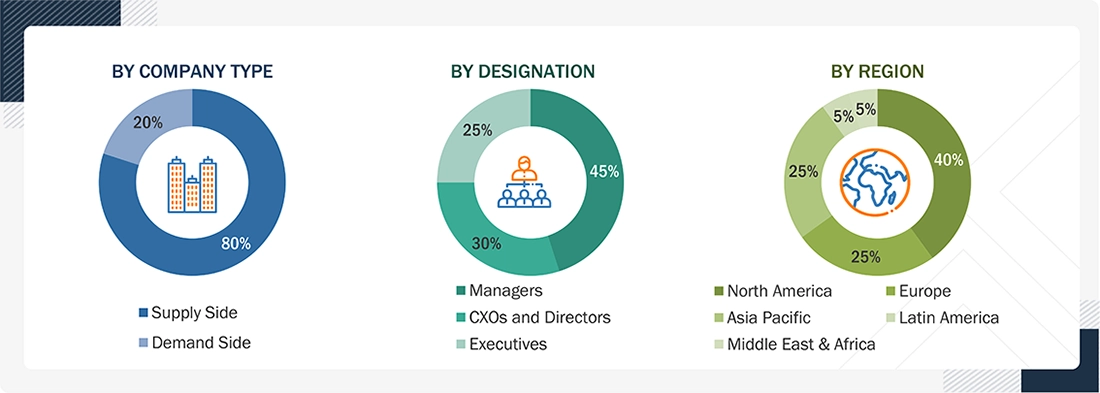
To know about the assumptions considered for the study, download the pdf brochure
Market Size Estimation
Both top-down and bottom-up approaches were employed to estimate and validate the overall size of the vaccines market. These methods were also widely used to determine the size of various market segments. The research methodology used to estimate the market size includes the following:
Vaccines Market: Top-Down and Bottom-Up Approach
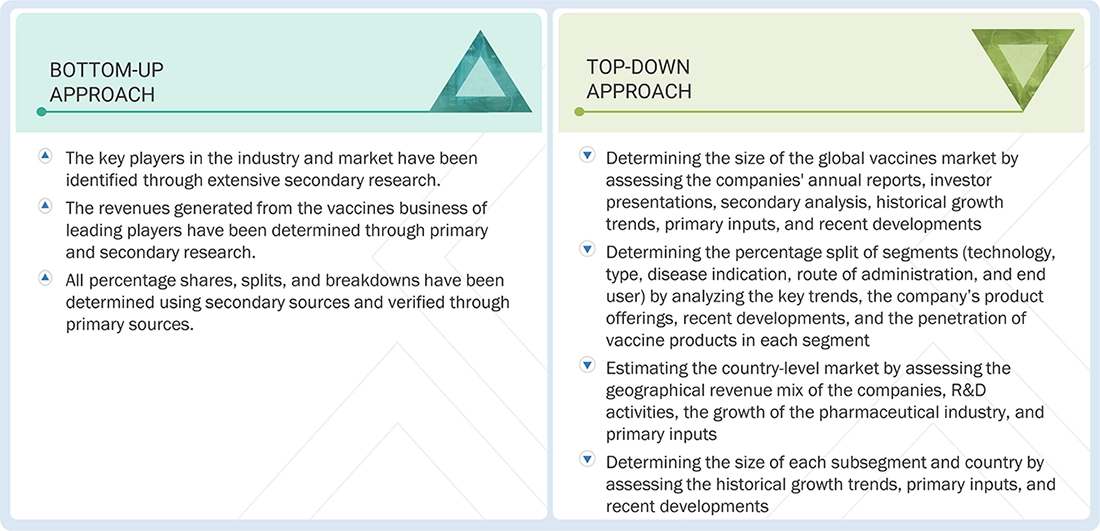
Data Triangulation
After estimating the overall market size through the market size estimation process, the total market was divided into several segments and subsegments. Data triangulation and market breakdown techniques were used where applicable to finalize the overall market analysis and obtain precise statistics for all segments and subsegments. The data was triangulated by examining various factors and trends from both demand and supply sides.
Market Definition
A vaccine is a biologically formulated product designed to trigger active acquired immunity against a specific infectious or malignant disease. Vaccines work by stimulating the immune system to identify and fight harmful agents, such as viruses or bacteria. They generally consist of parts that resemble the disease-causing microorganism, often in weakened or deactivated forms, along with their toxins or surface proteins.
The vaccines market comprises commercially available biological preparations administered to humans to stimulate active immunity against specific infectious diseases. The report solely focuses on human vaccines and does not include veterinary vaccines, which are outside the scope of this study. The scope of this report includes conjugate vaccines, inactivated & subunit vaccines, live attenuated vaccines, recombinant vaccines, toxoid vaccines, and other vaccines.
Key Stakeholders
- Vaccine product manufacturers and suppliers
- Distributors and suppliers of vaccine products
- Vaccine research institutes
- Biotechnology and biopharmaceutical companies
- Contract manufacturing organizations (CMOs)
- Contract development and manufacturing organizations (CDMO)
- Suppliers and distributors of pharmaceutical products
- Research and development (R&D) companies
- Drug Manufacturers, Vendors, and Distributors
- Immunization centres
- Hospitals and laboratories
- Trade associations and industry bodies
- Regulatory bodies and government organizations
- Venture capitalists and investors
- Hospitals
- Specialty Clinics
Report Objectives
- To define, describe, and forecast the vaccines market by technology, type, disease indication, route of administration, end user, and region
- To provide detailed information regarding the major factors influencing the market growth (such as drivers, restraints, opportunities, and challenges)
- To analyze the micromarkets with respect to individual growth trends, prospects, and contributions to the overall vaccines market
- To analyze the opportunities for stakeholders and provide details of the competitive landscape for market leaders
- To forecast the size of the market segments with respect to six regions: North America, Europe, the Asia Pacific, Latin America, Middle East, and Africa
- To profile the key players and analyze their market shares and core competencies
- To track and analyze competitive developments, such as product launches, agreements, partnerships, acquisitions, regulatory approvals, and research & development activities
- To analyze and provide funding & investment activities, brand/product comparative analysis, and vendor valuation & financial metrics of the vaccines market
Available customizations:
With the given market data, MarketsandMarkets offers customizations to meet the company’s specific needs. The following customization options are available for this report:
Portfolio Assesment
- Product Matrix gives a detailed comparison of the product portfolios of the top five companies.
Company Information
- Detailed analysis and profiling of additional market players (up to five).
Geographic Analysis
- Further breakdown of the Rest of Europe vaccines market, by country
- Further breakdown of the Rest of Asia Pacific vaccines market, by country
- Further breakdown of the Rest of Latin America vaccines market, by country
Key Questions Addressed by the Report
Who are the key players in the vaccines market?
Key players include GSK plc (UK), Merck & Co Inc (US), Pfizer Inc (US), Sanofi (France), CSL (Australia), Emergent (US), Johnson and Johnson Services, Inc. (US), AstraZeneca (UK), Serum Institute of India Pvt Ltd (India), Bavarian Nordic (Denmark), Mitsubishi Tanabe Pharma Corporation (Japan), and Daiichi Sankyo Company, Limited (Japan).
Which type of vaccine is expected to grow at the highest rate during the forecast period?
The multivalent vaccines segment is expected to grow at the highest rate during the forecast period of 2025 to 2030.
Which disease indication held the largest share in the vaccines market in 2024?
Pneumococcal disease indication held the largest share in the vaccines market in 2024.
Which route of administration segment held the largest share in the vaccines market?
In 2024, the intramuscular and subcutaneous routes segment held the largest share of the vaccines market by routes of administration.
What is the vaccines market size and CAGR for the forecast period 2025–2030?
The global vaccines market is expected to reach USD 63.66 million by 2030 from USD 50.46 million in 2025, at a CAGR of 4.8% over the forecast period.
Fact checked
Personalize This Research
- Triangulate with your Own Data
- Get Data as per your Format and Definition
- Gain a Deeper Dive on a Specific Application, Geography, Customer or Competitor
- Any level of Personalization
Let Us Help You
- What are the Known and Unknown Adjacencies Impacting the Vaccines Market
- What will your New Revenue Sources be?
- Who will be your Top Customer; what will make them switch?
- Defend your Market Share or Win Competitors
- Get a Scorecard for Target Partners

Custom Market Research Services
We Will Customise The Research For You, In Case The Report Listed Above Does Not Meet With Your Requirements
Get 10% Free CustomisationTESTIMONIALS

JAYANT RAJPUROHIT
Director of Market Insights, Data and Analytics
SFI Health,
Leading Pharmaceutical Companywww.sfihealth.com/

We at SFI Health approached MarketsandMarkets for an Opportunity Assessment on "Incidence and Prevalence of Focus Indications" as we wanted to know the most attractive HCPs like Physician, Functional MD, Naturopath and Pharmacist. The project was critical for us to ensure our focus on the right target which would enable sustainable growth and profitability for SFI Health. The business insights provided exceeded our expectations and we were extremely impressed. The team at MarketsandMarkets is highly professional and detail oriented and very well understood our business needs. MarketsandMarkets offers a unique combination of expertise and dedicated engagement model. We identified 2 new products to be launched in coming months, based on the research findings provided by MarketsandMarkets. We are happy with the services and would strongly recommend MarketsandMarkets to my peers in the industry.

BEATRIZ DE LA CALLE
Head of Commercial Analytics
Qualicaps,
Leading Pharmaceutical Companywww.qualicaps.com/

We partnered with MarketsandMarkets for an assessment study on hard empty capsules. The team was extremely professional in understanding our business requirements and we received timely responses to all our queries. The market intelligence and the recommendations has met our business requirements. We were extremely impressed to see the final study results; it really exceeded our expectations. The market intelligence offered by MarketsandMarkets, and clarity on next steps will help us achieve our business objective for the Year 2021. We are happy with the services and would strongly recommend MarketsandMarkets to my peers in the industry.

Bob Williams,
Senior Director Business Development & Innovation
Bracco Diagnostics Inc.,
Italian Multinational in life sciences sector and a World Leader in imaging diagnosticsimaging.bracco.com/us-en
We were pleased with targeted insights that MarketsandMarkets identified from a custom study on the 'Radiation Dose Management Solutions Market'. Your team identified and characterized the market participants as well as underlying trends accurately. This study was useful to Bracco in formulating business strategies for our dose monitoring product lines and we thank MarketsandMarkets for the job well done.
Cody Coonradt,
Market Development and Strategy Manager
3M Health Information Systems,
Leader in Health care Coding, Payment & Analytics Solutions.www.3m.com/3M/en_US/health-information-systems-us
The value for our organization comes from three things: depth of research, specificity of segments and being easy to work with. As important as the first two are, the third can't be underestimated. MarketsandMarkets, maybe more than any other research vendor, wants to know what is top of mind for our team and what big questions we are grappling to answer.
Their customer first approach and high value engagement model, have given us great analysis and excellent value for money
- Canada Vaccines Market
- US Vaccines Market
- France Vaccines Market
- Germany Vaccines Market
- Italy Vaccines Market
- Spain Vaccines Market
- UK Vaccines Market
- China Vaccines Market
- India Vaccines Market
- Japan Vaccines Market
- South Korea Vaccines Market
- Brazil Vaccines Market
- Mexico Vaccines Market
- Rest Of Europe Vaccines Market
- Rest Of Latin America Vaccines Market
- Rest Of Asia Pacific Vaccines Market
Growth opportunities and latent adjacency in Vaccines Market






Frederick
May, 2022
What are the growing opportunities in Vaccines Market Size, Share, Growth, Covid-19 Impact Analysis, forecasts to 2028 ?.
Ross
Dec, 2022
Which are some of the significant growth strategies adopted by leading companies in this market?.
Harry
Dec, 2022
According to this report which are the top 3 companies operating in the global vaccine market?.
Edward
Jun, 2026
After reviewing the Vaccines Market report, I found the breakdown of technology trends and regional immunization demand especially useful for evaluating long-term growth opportunities across public and private healthcare sectors..
Ronald
Jun, 2026
I went through the Vaccines Market analysis to better understand how evolving vaccine platforms and manufacturing capabilities are influencing supply chain planning and competitive positioning worldwide..
Timothy
Jun, 2026
The insights from the Vaccines Market study gave me a clearer perspective on investment activity, regulatory developments, and how emerging economies are shaping future vaccine adoption patterns..
Ralph
Mar, 2022
How the Asia Pacific region in the Global Vaccines Market is Expecting a Highest Growth Rate During the Forecast Period?.
Eugene
Mar, 2022
Which end user segment holds the largest share of the Global Vaccines Market?.