



Allergy Diagnostics Market
Report Code
MD 2955
Published in
Feb, 2026, By MarketsandMarkets™
Allergy Diagnostics Market by Product & Service (Consumables, Instruments [Immunoassay Analyzers, Luminometers]), Test Type (In Vivo Tests, In Vitro Tests), Allergen (Food Allergens), End User (Hospital-Based Laboratories) - Global Forecast to 2031

$6.80B
MARKET SIZE, 2026
$10.77B
MARKET SIZE, 2031

9.6%
CAGR (2026-2031)

2026-2031
FORECAST PERIOD
OVERVIEW
Source: Secondary Research, Interviews with Experts, MarketsandMarkets Analysis
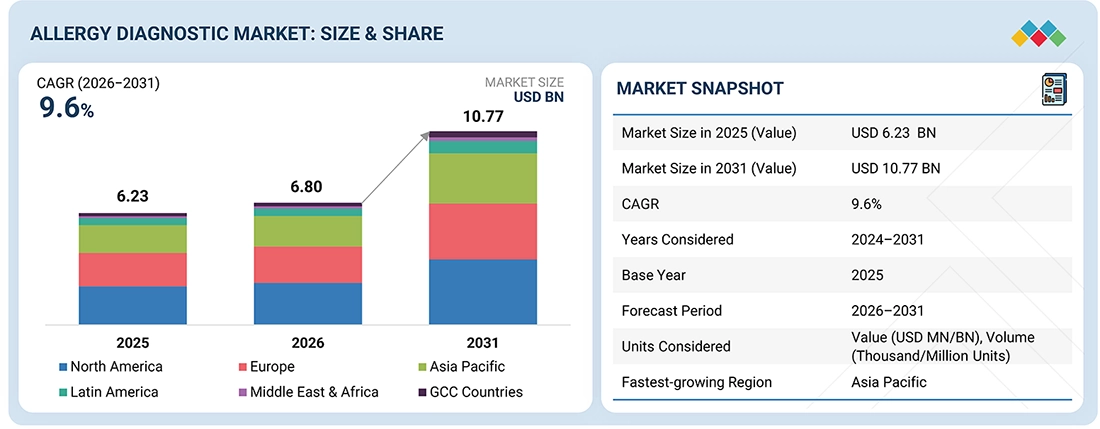
The global Allergy Diagnostics market, valued at USD 6.23 billion in 2025, stood at USD 6.80 billion in 2026 and is projected to advance at a resilient CAGR of 9.6% from 2026 to 2031, culminating in a forecasted valuation of USD 10.77 billion by the end of the period. Healthcare systems worldwide are shifting from reactive to preventive care models, recognizing that early identification of health risks reduces long-term costs and improves patient outcomes. Allergy diagnostics fit squarely into this paradigm by enabling early detection of sensitization before severe clinical manifestations occur. Routine allergy screening, particularly in high-risk populations such as children with a family history of atopy or individuals living in polluted urban areas, enables interventions that prevent disease progression, such as environmental control measures, allergen avoidance, and early immunotherapy. Public health campaigns and school health programs increasingly include allergy awareness and screening components, especially for food allergies that can pose acute risks. Preventive check-ups for occupational allergies in industries with high exposure to sensitizers (e.g., healthcare, agriculture, chemical manufacturing) are also gaining traction, driving demand for standardized diagnostic panels. Insurers and payers encouraging preventive services through coverage incentives further bolster utilization, as early diagnosis can reduce emergency visits and chronic therapy costs associated with unmanaged allergies. This alignment between healthcare policy and population health strategies reinforces diagnostics as an integral part of preventive care, scaling the market beyond symptomatic treatment and toward holistic long-term health management.
KEY TAKEAWAYS
-
MARKET SNAPSHOT:
Base Year Market Size (2025): USD 6.23 Billion
Current Market Size (2026): USD 6.80 Billion
Forecast Market Size (2031): USD 10.77 Billion
CAGR (2026–2031): 9.6% -
SEGMENT LEADERSHIP:
Regional Leader: Asia Pacific is expected to register the highest CAGR of 10.4% during the forecast period.
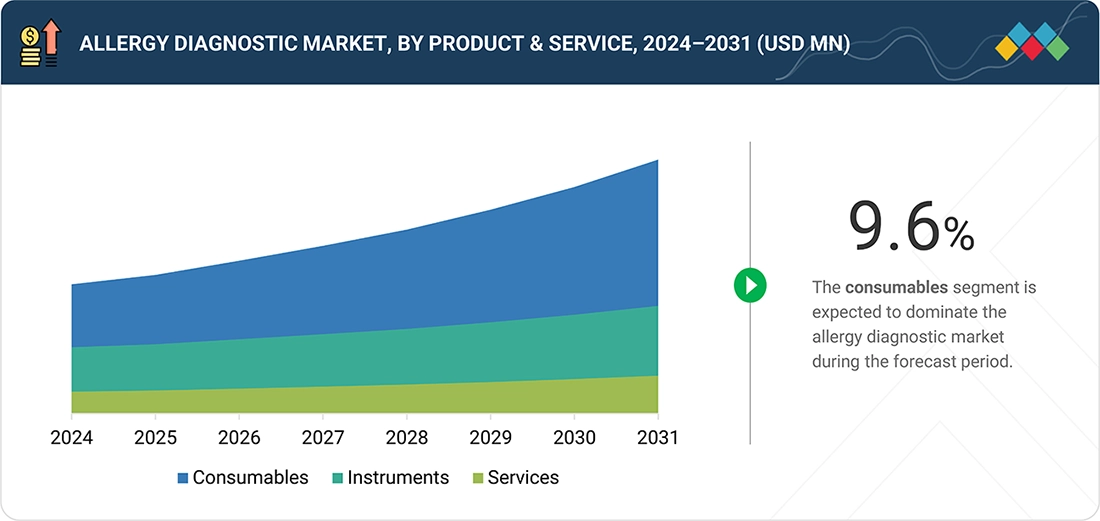
Product Leader: Consumables led the market, accounting for a 60.0% share in 2025.
Test Type Leader: In vivo dominated the market with a 55.0% share in 2025.
Allergen Leader: Food allergens are expected to record a higher CAGR during the forecast period.
End User Leader: Diagnostic laboratories are likely to register the highest CAGR during the forecast period. -
MARKET OUTLOOK & COMPETITIVE LANDSCAPE:
Thermo Fisher Scientific Inc. (US), Siemens Healthineers AG (Germany), and Danaher Corporation (US) were identified as star players in the allergy diagnostics market, as they emphasize innovation, have broad industry coverage, and possess strong operational and financial strength.
ACON Laboratories, Inc. (US), Biopanda Reagents Ltd. (UK), and Lincoln Diagnostics, Inc. (US) are among the key startups and SMEs due to their strong product portfolios and business strategies.
Environmental factors like air pollution, climate change, and altered ecosystems are increasing exposure to airborne allergens, intensifying allergic disease prevalence and severity. Pollutants such as particulate matter (PM2.5), ozone, and diesel exhaust particles exacerbate respiratory inflammation, making individuals more susceptible to pollen, mold, and other aeroallergens. Climate change has extended pollen seasons in many regions, while rising atmospheric carbon dioxide levels increase plant biomass and the allergenicity of pollen grains. These environmental stressors contribute to higher clinic visits for allergic rhinitis, asthma flares, and sinusitis, prompting physicians to rely more on precise diagnostic tests to distinguish between irritant-driven symptoms versus true allergic sensitization. Allergy diagnostics help identify specific triggers in polluted environments; for example, distinguishing between dust mite and ragweed sensitization informs tailored avoidance and therapeutic strategies. Environmental allergen monitoring programs, often linked with health advisories, indirectly drive diagnostic demand by raising public consciousness about exposure risk. Urbanization trends concentrate populations in areas with poor air quality, shifting greater demand toward comprehensive allergy screening and targeted interventions. As environmental pressures persist, allergy diagnostics become essential tools in both clinical practice and public health planning to mitigate disease burdens tied to ecological change.
TRENDS & DISRUPTIONS IMPACTING CUSTOMERS' CUSTOMERS
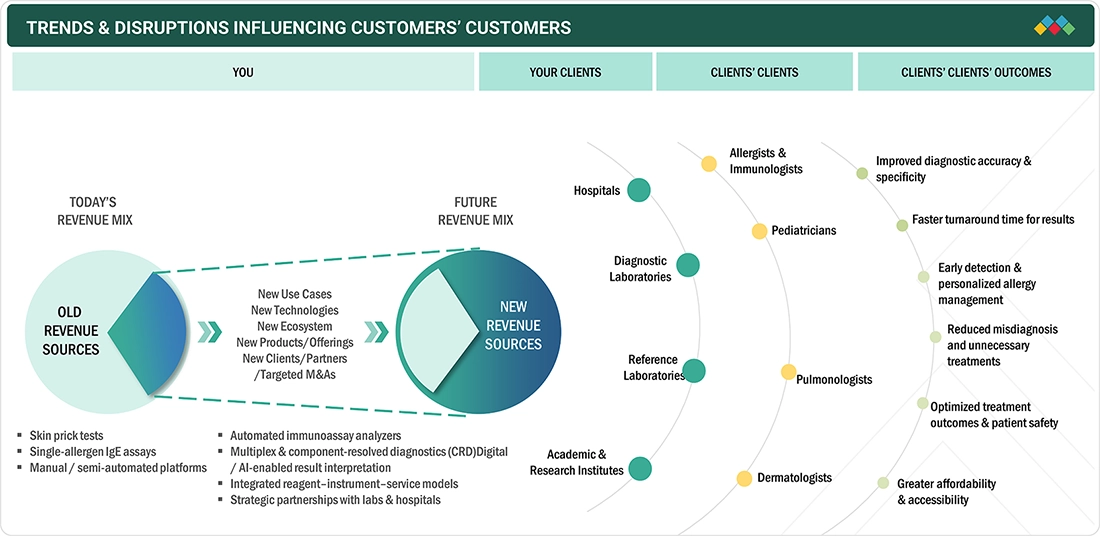
The allergy diagnostics market is transitioning from conventional, single-parameter testing toward integrated, technology-enabled diagnostic ecosystems that improve accuracy, speed, and clinical decision-making. The rising prevalence of allergic diseases, the increasing demand for component-resolved diagnostics, and the shift toward personalized allergy management are reshaping customer expectations. Automation, multiplex immunoassays, and AI-enabled data interpretation are increasingly adopted across diagnostic laboratories and reference centers to enhance workflow efficiency and standardize results. Digital platforms that connect testing, clinical interpretation, and treatment pathways are accelerating adoption among hospitals and specialists. As healthcare systems prioritize early diagnosis, optimized treatment outcomes, and cost efficiency, manufacturers are focusing on innovation, strategic partnerships, and scalable, customizable diagnostic solutions to meet evolving end-user and patient needs.
Source: Secondary Research, Interviews with Experts, MarketsandMarkets Analysis
MARKET DYNAMICS

Drivers
Impact
Level
Level
-
High incidence and heavy economic burden of allergic diseases

-
Increasing awareness about allergies


RESTRAINTS
Impact
Level
Level
-
Premium cost of allergy diagnostic instruments

-
Lack of adequate knowledge and poor implementation of allergy testing methods


OPPORTUNITIES
Impact
Level
Level
-
Use of mHealth in allergy diagnosis

-
Integration of artificial intelligence in allergy diagnosis


CHALLENGES
Impact
Level
Level
-
Shortage of allergists and lack of training programs

-
Diagnostic challenges in allergic patients

Source: Secondary Research, Interviews with Experts, MarketsandMarkets Analysis
Driver: High incidence and heavy economic burden of allergic diseases
Allergy diagnostics is an important step in treating patients suffering from allergic diseases. Major allergic diseases include asthma, rhinitis, angioedema, urticaria, conjunctivitis, and eczema. At the same time, conditions such as food allergies and drug & insect allergies also affect many people across the globe. Globally, the increasing prevalence of allergies and related diseases has continued for more than 50 years in the industrialized world. According to data from CDC’s (June 2023) National Center for Health Statistics. 27.2% of children and 31.8% of adults show allergy symptoms, which tallies over 100 million people. Cases of allergy are found to be high among children; sensitization rates to one or more common allergens among school children are currently approaching 40–50% A steady increase in the prevalence of allergic diseases globally has occurred, with about 30–40% of the world population now being affected by one or more allergic conditions. According to WHO, hundreds of millions of subjects in the world suffer from rhinitis, and it is estimated that more than 300 million have asthma, markedly affecting the quality of life of these individuals and their families and negatively impacting the socio-economic welfare of society. According to the European Association of Allergy and Immunology, allergies are among the most common chronic diseases in Europe. 150 million Europeans currently have allergies, and by 2025, it is estimated that 50% of the population of Europe will suffer from some or other sensitivity or aversion. Besides, a rise in cases of food allergy has also been observed worldwide in recent years. Food allergy occurs when the body has a specific and reproducible immune response to certain foods. Eight foods or food groups account for the most serious allergic reactions in the US: milk, eggs, fish, crustacean shellfish, wheat, soy, peanuts, and tree nuts. Other than the high incidence rate among children, allergy cases are considerably high among adults. For instance, according to the CDC (January 2023), in 2021, 27.2% of children had one or more selected allergic conditions, of which 1 in 20 had a food allergy (5.8%). With the growing burden of allergic diseases, the new diagnostic market is expected to grow significantly. Furthermore, the latest diagnostic strategies for allergies and research on new treatment approaches are expected to drive the market studied over the forecast period.
Restraint: Premium cost of allergy diagnostic instruments
Several allergy diagnostic instruments, such as luminometers, blot analyzers, scanners, ELISA analyzers, and immunoassay analyzers, are periodically updated by market players. As these instruments are equipped with advanced features and functionalities, they are priced at a premium (the price of each instrument varies based on its accuracy, flexibility, and TAT). For instance, Phadia 2500+ by Thermo Fisher Scientific Inc. (US) costs USD 1,185,895, IMMULITE 2000 xpi by Siemens costs USD 20,953.8, while luminometers cost USD 3,000 and USD 14,000. Semi-automated ELISA readers cost USD 2,000 and USD 5,000, while fully automated analyzers cost around USD 14,000. Furthermore, maintenance and insurance, laboratory supervision, and overheads (including utilities, space, and administration) are additional expenses required to operate this equipment. Large hospitals and diagnostic laboratories have a larger share of this market as they have good capital budgets to afford high-volume systems. However, most small laboratories, physicians’ clinics, and independent practitioners have budget constraints owing to which they generally cannot afford large or very large systems. Thus, high fixed-cost requirements are expected to limit the growth of the allergy diagnostics market.
Opportunity: Use of mHealth in allergy diagnosis
The use of mHealth for the diagnosis of rhinitis is currently limited, with a small number of mHealth tools for allergic rhinitis (AR) diagnoses published in peer-reviewed journals. Recent developments in integrated biosensors, wireless communication, and power harvesting techniques generate a new breed of point-of-care devices. However, AR is a very common disease. Any diagnostic device connected to a smartphone (e.g., peak nasal inspiratory flow meters or intranasal biosensors) would need to be inexpensive to be affordable. Several applications have aimed to monitor the control of allergic multimorbidity (rhinitis, conjunctivitis, and asthma). Allergymonitor, for example, monitors the symptoms and medication intake, which is then matched to local pollen concentrations. Similarly, the MASK (Mobile Airways Sentinel Network) MASK-Air, initially called Allergy Diary, uses a visual analog scale (VAS) for eye, nose, and asthma symptoms, work impairment, and a global assessment. The data collected by the users of this app have led to new insights into work productivity, treatment patterns, and phenotypes of allergic diseases. Mobile health in food allergy plays a promising role for different stakeholders, including patients and patient organizations, doctors, allergy organizations, and the food industry. Within food allergy, different levels of medical management can be approached by mHealth tools. Mobile health tools can support patients in documenting symptoms during allergy diagnosis. Mobile health in food allergy may play a role for different stakeholders, including patients and patient organizations, doctors, allergy organizations, and the food industry. Within food allergy, different levels of medical management can be approached by mHealth tools. At the diagnostic level, mobile health tools can support patients in documenting symptoms.
Challenge: Shortage of allergists and lack of training programs
For several decades, the shortage of a skilled workforce has been a challenge, resulting in an aging workforce and declining enrollment in training programs. Technicians need almost five to ten years of continuous clinical laboratory work experience to gain expertise. The diagnosis and treatment of allergic disorders such as asthma, rhinitis, food allergies, urticaria, and others is multi-faceted and complicated, requires the prowess of a dedicated allergy specialist, and cannot be ideally managed by a general practitioner. Allergists play a vital role in maintaining good health for people of all ages. However, there is now a growing shortage of allergists. For instance, according to the American Academy of Allergy, Asthma & Immunology (AAAAI), it is the leading membership organization of more than 7,000 allergists/immunologists and patients' trusted resource for allergies, asthma, and immune deficiency disorders. Various rural areas have a shortage of allergists. There are long scheduling waits in most areas to see allergists, with one San Francisco study reporting mean wait times to see an allergist of more than 60 days (Source: Barton Associates). In Europe, the UK has already reported low numbers of clinical technicians. The Gatsby Foundation stated in 2019 that over 1.5 million are serving in the health, engineering, science, and technology domains. Over 50,000 people retire every year, and 700,000 technicians will be required to meet the soaring demands in the next decade. The AAMC study projects a shortage of 46,100 to 90,400 physicians by 2025, including 12,500 to 31,100 primary care physicians (PCPs) and 28,200 to 63,700 surgeons and other specialists.
ALLERGY DIAGNOSTICS MARKET: COMMERCIAL USE CASES ACROSS INDUSTRIES
| COMPANY | USE CASE DESCRIPTION | BENEFITS |
|---|---|---|
 |
Comprehensive allergy testing portfolio (ImmunoCAP, component-resolved diagnostics) for accurate identification of specific allergens across respiratory, food, and drug allergies | High diagnostic accuracy | Personalized allergy profiling | Reduced misdiagnosis |
 |
Automated immunoassay-based allergy testing integrated into high-throughput laboratory workflows for hospitals and reference labs | Faster turnaround time | Workflow efficiency | Scalable testing |
 |
Multiplex and single-allergen testing solutions enabling simultaneous detection of multiple allergen sensitivities | Broad allergen coverage | Efficient sample utilization | Improved clinical insights |
 |
Allergy testing solutions integrated with laboratory automation and data management systems for routine and specialty diagnostics | Standardized results | Streamlined lab operations | Improved reproducibility |
 |
Cost-effective allergy testing systems designed for small to mid-sized laboratories and emerging markets | Affordable testing | Ease of use | Expanded access to allergy diagnostics |
Logos and trademarks shown above are the property of their respective owners. Their use here is for informational and illustrative purposes only.
MARKET ECOSYSTEM
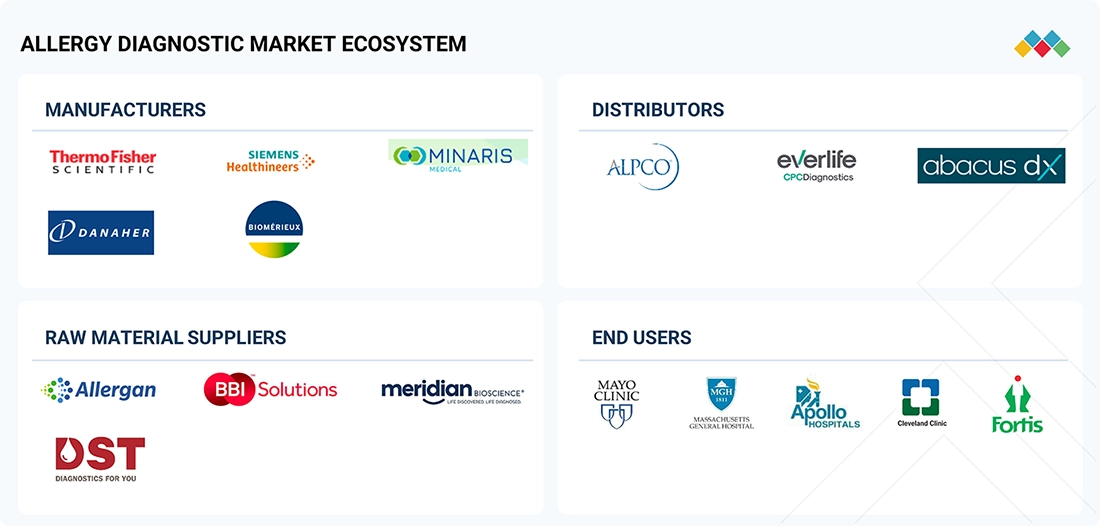
The ecosystem market map of the overall allergy diagnostic market comprises the elements present in this market and defines them, demonstrating the bodies involved. It includes analyzers, assay kits, and services. The manufacturers of various allergy diagnostics include organizations involved in research and product development, optimization, and launch. Distributors include third parties and e-commerce sites linked with the organization for marketing these devices. The research and product development phase includes in-house research facilities, contract research organizations, and contract development and manufacturing organizations, all of which are key to outsourcing partners for product development services. The end user segment refers to the application areas where these assays are used. These end customers are the key stakeholders in the allergy diagnostics market supply chain. On the other hand, investors and funders, as well as health regulatory bodies, are the major influencers in this market.
Logos and trademarks shown above are the property of their respective owners. Their use here is for informational and illustrative purposes only.
MARKET SEGMENTS
Source: Secondary Research, Interviews with Experts, MarketsandMarkets Analysis
Allergy Diagnostic Market, by Product & Service
The increasing adoption of broad allergen panels and multiplex testing platforms has substantially increased consumables usage in allergy diagnostics. Modern diagnostic approaches aim to identify sensitivity to multiple allergens in a single testing cycle, requiring a wide array of allergen-specific reagents and assay components. Component-resolved diagnostics, in particular, use highly specific molecular allergens, increasing the number and complexity of consumables required per test. Even though multiplex testing reduces testing time, it significantly increases reagent density and the value of consumables per diagnostic episode. Laboratories offering comprehensive allergy profiling rely heavily on high-value consumables, reinforcing their revenue contribution. This trend toward precision and personalized allergy diagnostics continues to favor consumables over capital equipment.
Allergy Diagnostic Market, by Test Type
In vivo tests demonstrate high sensitivity for frequently encountered allergens, especially inhalant allergens such as pollen, dust mites, and pet dander. For these allergy types, skin testing is often more clinically representative because it measures the immediate hypersensitivity reaction in the patient’s body. This physiological relevance enhances diagnostic confidence and accuracy. Due to their strong performance in detecting common allergies, in vivo tests are widely used as the first diagnostic step before confirming with advanced in vitro methods, sustaining high utilization rates across allergy clinics.
Allergy Diagnostic Market, by Allergen
Inhaled allergens such as pollen, dust mites, mold, and animal dander are the leading triggers of allergic rhinitis and allergic asthma, which represent the most common allergy-related disorders globally. Increasing urbanization, air pollution, climate change–driven pollen exposure, and indoor allergen accumulation have significantly expanded the patient population requiring diagnosis, driving higher testing volumes for inhaled allergens.
Allergy Diagnostic Market, by End User
Hospital-based laboratories are embedded within comprehensive healthcare settings that provide direct access to allergists, pulmonologists, pediatricians, and ENT specialists. This close integration enables timely referral, diagnosis, and treatment of allergic conditions, particularly for complex, chronic, or pediatric cases. Hospitals often act as primary referral centers, resulting in consistently high patient inflow and test volumes. The ability to align diagnostic results with clinical evaluation in a single care pathway significantly drives demand for allergy testing within hospital-based laboratories.
REGION
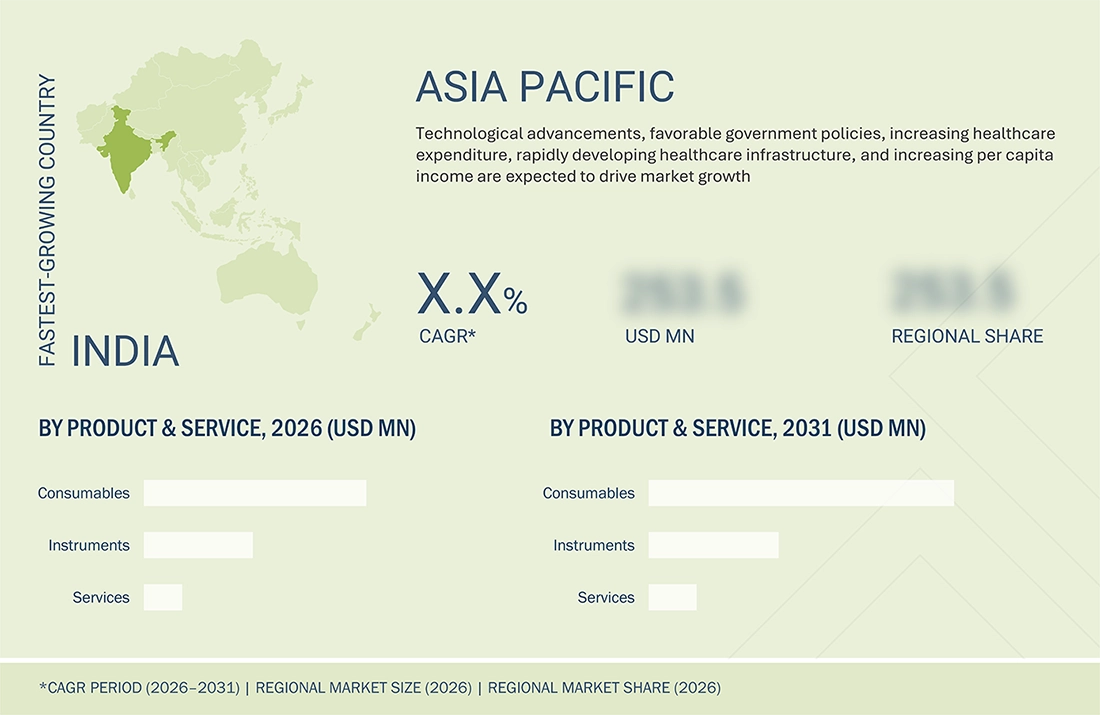
India to be fastest-growing region in APAC surgical staplers market during forecast period
Economic growth across Asia Pacific is enabling both governments and private healthcare providers to increase investments in diagnostic services. Rising per-capita healthcare spending improves affordability and access to allergy testing, particularly in emerging economies. Expansion of private insurance coverage and employer-sponsored health plans further supports diagnostic uptake. As healthcare systems shift toward early diagnosis and preventive care, allergy diagnostics are increasingly incorporated into routine clinical evaluation, accelerating market growth faster than in mature regions.
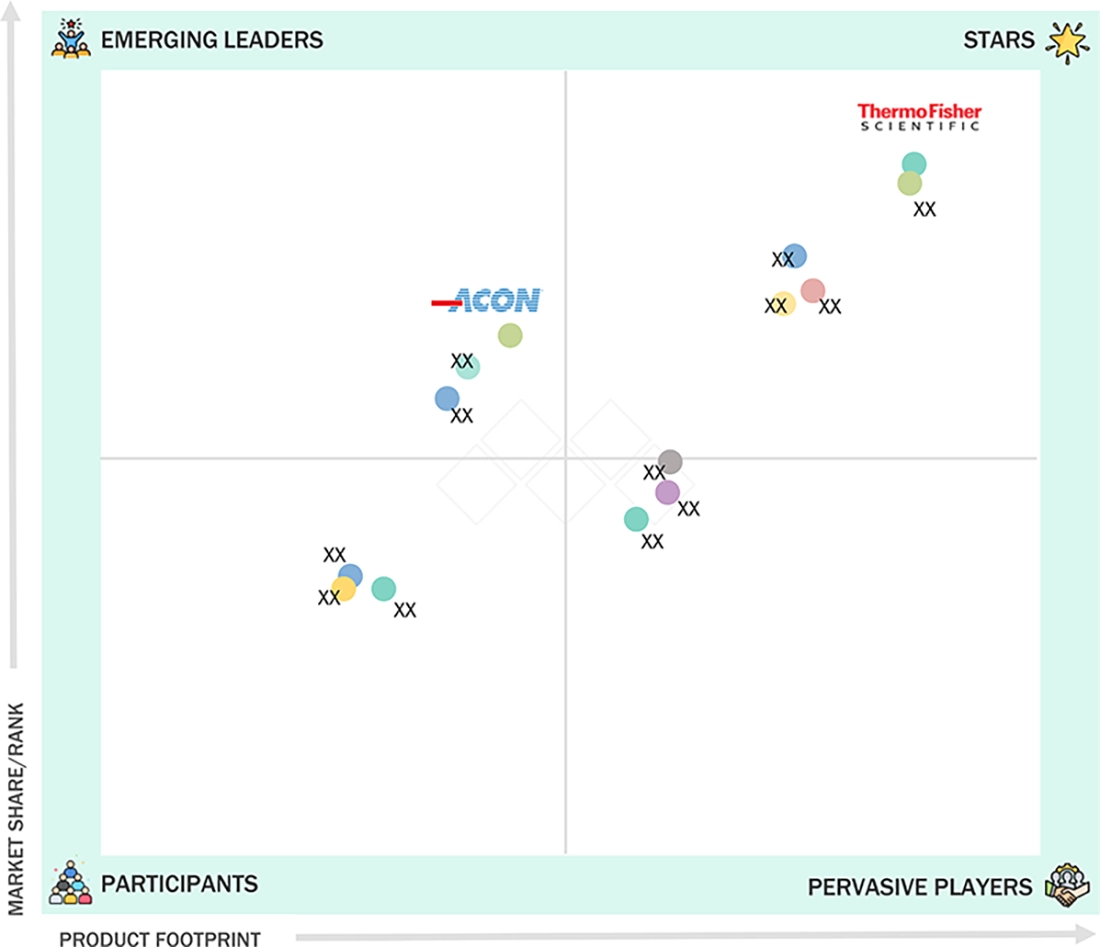
ALLERGY DIAGNOSTICS MARKET: COMPANY EVALUATION MATRIX
In the allergy diagnostic market, Thermo Fisher Scientific Inc. (Star) has a strong and established product portfolio and a broad geographic presence. ACON Laboratories, Inc. (Emerging Leader) has substantial product innovations compared to its competitors. While the company maintains a broad product portfolio, there is an opportunity to further strengthen and refine its growth strategy for business development.
Source: Secondary Research, Interviews with Experts, MarketsandMarkets Analysis
KEY MARKET PLAYERS
- Thermo Fisher Scientific Inc. (US)
- Siemens Healthineers AG (Germany)
- Danaher Corporation (US)
- Canon (Minaris Medical America, Inc. (US))
- Revvity (EUROIMMUN Medizinische Labordiagnostika AG (Germany))
- bioMérieux SA (France)
- Romer Labs Division Holding (Austria)
- Omega Diagnostics Group Plc (UK)
- HollisterStier Allergy (US)
- Eurofins Scientific (Luxembourg)
- Stallergenes Greer (UK)
- HOB Biotech Group Corp., Ltd. (China)
- HYCOR Biomedical (US)
- R-Biopharm AG (Germany)
- AESKU.GROUP GmbH (Germany)
- ACON Laboratories, Inc. (US)
- Lincoln Diagnostics, Inc. (US)
- Astra Biotech GmbH (Germany)
- Erba Group (UK)
- Alcit India Pvt. Ltd. (India)
- Biopanda Reagents (UK)
- Bioside S.r.l. (Italy)
- Creative Diagnostic Medicare Pvt. Ltd. (India)
- DST Diagnostische Systeme & Technologien GmbH (Germany)
- Dr. Fooke Laboratorien GmbH (Germany)
MARKET SCOPE
| REPORT METRIC | DETAILS |
|---|---|
| Market Size in 2025 (Value) | USD 6.23 BN |
| Revenue Size in 2031 (Value) | USD 10.77 BN |
| Growth Rate | CAGR of 9.6% 2026-2031 |
| Years Considered | 2024–2031 |
| Base Year | 2025 |
| Forecast Period | 2026–2031 |
| Units Considered | Value (USD MN/BN), Volume (Thousand/Million Units) |
| Report Coverage | Revenue Forecast, Company Ranking, Competitive Landscape, Growth Factors, and Trends |
| Segments Covered |
|
| Regions Covered | North America, Europe, Asia Pacific, Latin America, Middle East & Africa, and GCC Countries |
WHAT IS IN IT FOR YOU: ALLERGY DIAGNOSTICS MARKET REPORT CONTENT GUIDE
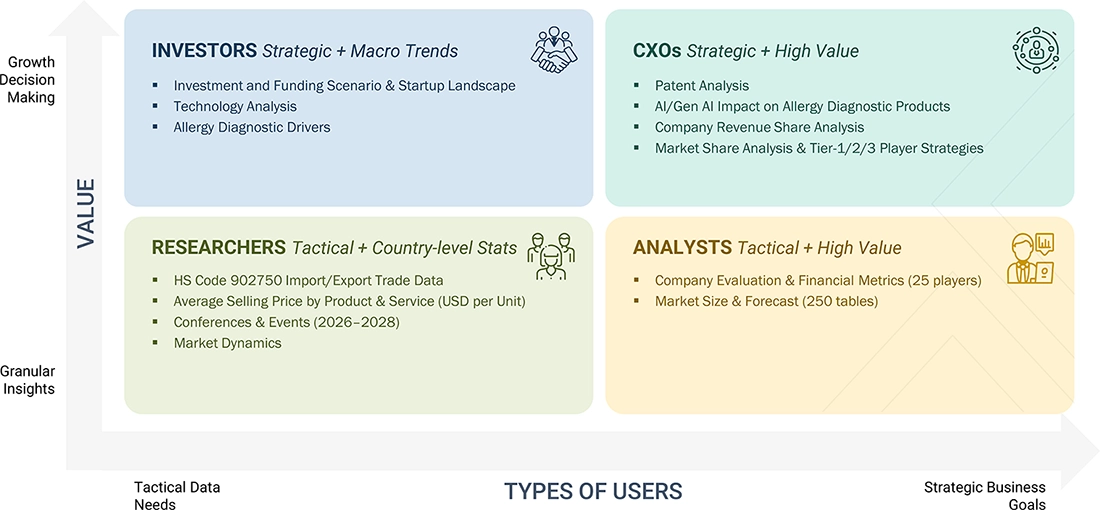
DELIVERED CUSTOMIZATIONS
We have successfully delivered the following deep-dive customizations:
| CLIENT REQUEST | CUSTOMIZATION DELIVERED | VALUE ADDS |
|---|---|---|
| Product Analysis | Comparative analysis of allergy diagnostic tests by type, including in vivo (skin prick, intradermal) and in vitro assays (specific IgE, component-resolved diagnostics, multiplex immunoassays), along with evaluation by allergen category, such as inhaled, food, drug, and venom allergens | Assessment of diagnostic accuracy, sensitivity/specificity, turnaround time, workflow complexity, and cost per test to support optimal test selection and improved clinical decision-making |
| Company Information | Detailed profiles of leading global and regional allergy diagnostics manufacturers, covering test portfolios, technology platforms, regulatory approvals, geographic presence, partnerships, and recent product launches | Competitive benchmarking across key players highlighting positioning by technology sophistication, test menu breadth, automation level, and pricing strategy |
| Geographic Analysis | In-depth regional assessment of the global allergy diagnostics market covering North America, Europe, Asia Pacific, Latin America, and the Middle East & Africa | Country-level market sizing, CAGR forecasts, testing volume analysis, reimbursement landscape, and adoption trends across major markets such as the US, Germany, UK, China, India, and Japan |
RECENT DEVELOPMENTS
- September 2023 : Stallergenes signed a global agreement with Nestlé to harness the peanut allergy oral immunotherapy treatment Palforzia.
- July 2023 : Canon completed the share transfer procedures with Resonac Corporation. This share transfer aims to acquire Resonac subsidiaries Minaris Medical Co., Ltd. and Minaris Medical America, Inc. (hereinafter referred to collectively as "Minaris Medical"). Upon completion of this share acquisition, Canon Medical will begin the consolidation of Minaris Medical, which operates businesses in in vitro diagnostic reagents and automated analytical instruments.
- August 2022 : Thermo Fisher announced the clearance of ImmunoCAP Specific IgE (sIgE) Allergen Components for wheat and sesame allergies by the US Food & Drug Administration (FDA) for in vitro diagnostic purposes.
- May 2022 : Thermo Fisher launched the Phadia 2500+ Instrument family in the US for autoimmune testing.
Table of Contents
 Exclusive indicates content/data unique to MarketsandMarkets and not available with any competitors.
TITLE
PAGE NO
1
INTRODUCTION
27
2
EXECUTIVE SUMMARY
32
3
PREMIUM INSIGHTS
38
4
MARKET OVERVIEW
Allergy diagnostics market thrives on AI integration and mHealth, despite high costs and knowledge gaps.
42
4.1
INTRODUCTION
4.2
MARKET DYNAMICS
4.2.1
DRIVERS
4.2.1.1
HIGH INCIDENCE AND HEAVY ECONOMIC BURDEN OF ALLERGIC DISEASES
4.2.1.2
INCREASING AWARENESS ABOUT ALLERGIES
4.2.1.3
RISING ENVIRONMENTAL POLLUTION LEVELS
4.2.1.4
COVERAGE OF ALLERGY DIAGNOSIS UNDER HEALTH INSURANCE SCHEMES
4.2.2
RESTRAINTS
4.2.2.1
PREMIUM COST OF ALLERGY DIAGNOSTIC INSTRUMENTS
4.2.2.2
LACK OF ADEQUATE KNOWLEDGE AND POOR IMPLEMENTATION OF ALLERGY TESTING METHODS
4.2.2.3
LIMITED ACCESS TO HEALTHCARE SERVICES
4.2.3
OPPORTUNITIES
4.2.3.1
USE OF MHEALTH IN ALLERGY DIAGNOSIS
4.2.3.2
INTEGRATION OF ARTIFICIAL INTELLIGENCE IN ALLERGY DIAGNOSIS
4.2.4
CHALLENGES
4.2.4.1
SHORTAGE OF ALLERGISTS AND LACK OF TRAINING PROGRAMS
4.2.4.2
DIAGNOSTIC CHALLENGES IN ALLERGIC PATIENTS
4.3
UNMET NEEDS & WHITE SPACES
4.3.1
UNMET NEEDS IN ALLERGY DIAGNOSTIC MARKET
4.3.2
WHITE SPACE OPPORTUNITIES
4.4
INTERCONNECTED MARKETS & CROSS-SECTOR OPPORTUNITIES
4.4.1
INTERCONNECTED MARKETS
4.4.2
CROSS-SECTOR OPPORTUNITIES
4.5
STRATEGIC MOVES BY TIER-1/2/3 PLAYERS
5
INDUSTRY TRENDS
Navigate competitive dynamics and emerging market opportunities in the evolving global allergy diagnostics industry.
52
5.1
PORTER’S FIVE FORCES ANALYSIS
5.1.1
INTENSITY OF COMPETITIVE RIVALRY
5.1.2
BARGAINING POWER OF SUPPLIERS
5.1.3
BARGAINING POWER OF BUYERS
5.1.4
THREAT OF SUBSTITUTES
5.1.5
THREAT OF NEW ENTRANTS
5.2
MACROECONOMIC OUTLOOK
5.2.1
INTRODUCTION
5.2.2
GDP TRENDS AND FORECAST
5.2.3
TRENDS IN GLOBAL IVD INDUSTRY
5.2.4
TRENDS IN GLOBAL IMMUNOASSAY INDUSTRY
5.3
SUPPLY CHAIN ANALYSIS
5.4
VALUE CHAIN ANALYSIS
5.5
ECOSYSTEM ANALYSIS
5.6
PRICING ANALYSIS
5.6.1
AVERAGE SELLING PRICE OF ALLERGY DIAGNOSTIC PRODUCTS, BY PRODUCT & SERVICE, 2025
5.6.2
AVERAGE SELLING PRICE TREND OF ALLERGY DIAGNOSTIC PRODUCTS, BY REGION, 2024–2026
5.7
TRADE ANALYSIS
5.7.1
IMPORT DATA FOR HS CODE 902750, 2020–2024
5.7.2
EXPORT DATA FOR HS CODE 902750, 2020–2024
5.8
KEY CONFERENCES & EVENTS, 2026–2027
5.9
TRENDS/DISRUPTIONS IMPACTING CUSTOMER’S BUSINESS
5.10
INVESTMENT & FUNDING SCENARIO
5.11
CASE STUDY ANALYSIS
5.11.1
EXPANDING ACCESS TO ALLERGY DIAGNOSTICS IN EMERGING MARKETS
5.11.2
SCALING HIGH-THROUGHPUT ALLERGY TESTING IN CENTRALIZED LABORATORIES
5.11.3
IMPROVING PEDIATRIC ALLERGY DIAGNOSIS THROUGH MULTIPLEX TESTING
5.12
IMPACT OF 2025 US TARIFF ON ALLERGY DIAGNOSTIC MARKET
5.12.1
INTRODUCTION
5.12.2
KEY TARIFF RATES
5.12.3
PRICE IMPACT ANALYSIS
5.12.4
IMPACT ON COUNTRIES/REGIONS
5.12.4.1
NORTH AMERICA
5.12.4.2
EUROPE
5.12.4.3
ASIA PACIFIC
5.12.5
END-USE INDUSTRY IMPACT
6
TECHNOLOGICAL ADVANCEMENTS, AI-DRIVEN IMPACT, PATENTS, INNOVATIONS, AND FUTURE APPLICATIONS
AI-driven innovations redefine allergy diagnostics, paving the way for personalized and automated solutions.
69
6.1
KEY EMERGING TECHNOLOGIES
6.1.1
SPECIFIC IGE IMMUNOASSAYS
6.1.2
SKIN PRICK TESTING (SPT)
6.2
COMPLEMENTARY TECHNOLOGIES
6.2.1
AUTOMATED IMMUNOASSAY ANALYZERS
6.3
TECHNOLOGY/PRODUCT ROADMAP
6.3.1
SHORT-TERM (2025–2027) | FOUNDATION & EARLY COMMERCIALIZATION
6.3.2
MID-TERM (2027–2030) | EXPANSION & STANDARDIZATION
6.3.3
LONG-TERM (2030–2035+) | MASS COMMERCIALIZATION & DISRUPTION
6.4
PATENT ANALYSIS
6.4.1
INSIGHTS: JURISDICTION AND TOP APPLICANT ANALYSIS
6.5
FUTURE APPLICATIONS
6.5.1
ADVANCED MULTIPLEX AND PERSONALIZED ALLERGY DIAGNOSTICS
6.5.2
DIGITAL & AI-ENABLED ALLERGY MONITORING PLATFORMS
6.5.3
AI-INTEGRATED DIGITAL SURGICAL ECOSYSTEMS FOR IOLS
6.6
IMPACT OF AI/GEN AI ON ALLERGY DIAGNOSTIC MARKET
6.6.1
TOP USE CASES AND MARKET POTENTIAL
6.6.2
CASE STUDIES OF AI IMPLEMENTATION
6.6.3
INTERCONNECTED ADJACENT ECOSYSTEM AND IMPACT ON MARKET PLAYERS
6.6.4
CLIENTS’ READINESS TO ADOPT GENERATIVE AI
7
REGULATORY LANDSCAPE
Navigate complex global regulations with insights into regional compliance and industry standards.
78
7.1
REGIONAL REGULATIONS & COMPLIANCE
7.1.1
REGULATORY BODIES, GOVERNMENT AGENCIES, AND OTHER ORGANIZATIONS
7.1.2
INDUSTRY STANDARDS
8
CUSTOMER LANDSCAPE & BUYER BEHAVIOR
Unlock market profitability by addressing unmet needs and stakeholder-driven buying criteria in allergy diagnostics.
81
8.1
DECISION-MAKING PROCESS
8.2
KEY STAKEHOLDERS AND BUYING EVALUATION CRITERIA
8.2.1
KEY STAKEHOLDERS IN BUYING PROCESS
8.2.2
KEY BUYING CRITERIA
8.3
ADOPTION BARRIERS & INTERNAL CHALLENGES
8.4
UNMET NEEDS FROM VARIOUS END-USE INDUSTRIES
8.5
MARKET PROFITABILITY
8.5.1
REVENUE POTENTIAL
8.5.2
COST DYNAMICS
8.5.3
MARGIN OPPORTUNITIES IN KEY APPLICATIONS
9
ALLERGY DIAGNOSTIC MARKET, BY PRODUCT & SERVICE
Market Size & Growth Rate Forecast Analysis to 2031 in USD Million and Units | 10 Data Tables
85
9.1
INTRODUCTION
9.2
CONSUMABLES
9.2.1
RECURRENT USE OF CONSUMABLES FOR ALLERGY DIAGNOSTICS TO DRIVE MARKET
9.3
INSTRUMENTS
9.3.1
IMMUNOASSAY ANALYZERS
9.3.1.1
HIGH PREFERENCE FOR TESTING TO BOOST MARKET DEMAND
9.3.2
LUMINOMETERS
9.3.2.1
CONVENIENCE AND EASE OF USE TO PROPEL MARKET GROWTH
9.3.3
OTHER INSTRUMENTS
9.4
SERVICES
9.4.1
RISING NEED TO ENSURE EFFECTIVE UTILIZATION OF ALLERGY DIAGNOSTIC PRODUCTS TO SUPPORT MARKET GROWTH
10
ALLERGY DIAGNOSTIC MARKET, BY TEST TYPE
Market Size & Growth Rate Forecast Analysis to 2031 in USD Million | 8 Data Tables
95
10.1
INTRODUCTION
10.2
IN VIVO TESTS
10.2.1
SKIN PRICK TESTS
10.2.1.1
SKIN PRICK TESTS TO BE MOST WIDELY PREFERRED IN VIVO ALLERGY TESTS
10.2.2
PATCH TESTS
10.2.2.1
RAPID DIAGNOSIS OF CONTACT DERMATITIS TO BOOST MARKET DEMAND
10.2.3
OTHER IN VIVO TESTS
10.3
IN VITRO TESTS
10.3.1
ABILITY TO IDENTIFY ALLERGEN-SPECIFIC IGE MOLECULES IN PATIENT SERUM TO DRIVE MARKET
11
ALLERGY DIAGNOSTIC MARKET, BY ALLERGEN
Market Size & Growth Rate Forecast Analysis to 2031 in USD Million | 6 Data Tables
104
11.1
INTRODUCTION
11.2
INHALED ALLERGENS
11.2.1
HIGH INCIDENCE OF ASTHMA TO BOOST MARKET GROWTH
11.3
FOOD ALLERGENS
11.3.1
HIGH PREVALENCE OF FOOD-RELATED ALLERGIES AMONG YOUNG CHILDREN TO SUPPORT MARKET GROWTH
11.4
DRUG ALLERGENS
11.4.1
INCREASING INCIDENCE OF DRUG ALLERGIES AND ADVERSE REACTIONS TO DRIVE MARKET
11.5
OTHER ALLERGENS
12
ALLERGY DIAGNOSTIC MARKET, BY END USER
Market Size & Growth Rate Forecast Analysis to 2031 in USD Million | 5 Data Tables
111
12.1
INTRODUCTION
12.2
HOSPITAL-BASED LABORATORIES
12.2.1
HOSPIATAL-BASED LABORATORIES TO BE MORE ACCESSIBLE TO PATIENTS AND OFFER RAPID RESULTS
12.3
DIAGNOSTIC LABORATORIES
12.3.1
DIAGNOSTIC LABORATORIES TO PIVOTAL FOR DIAGNOSIS AND MANAGEMENT OF ALLERGIES
12.4
ACADEMIC RESEARCH INSTITUTES
12.4.1
RISING NUMBER OF INSTITUTES FOR ALLERGY TESTING TRAINING TO SUPPORT MARKET GROWTH
12.5
OTHER END USERS
13
ALLERGY DIAGNOSTIC MARKET, BY REGION
Comprehensive coverage of 8 Regions with country-level deep-dive of 14 Countries | 143 Data Tables.
119
13.1
INTRODUCTION
13.2
NORTH AMERICA
13.2.1
US
13.2.1.1
US TO DOMINATE NORTH AMERICAN ALLERGY DIAGNOSTIC MARKET
13.2.2
CANADA
13.2.2.1
RISING FUNDING ACTIVITIES IN ALLERGY DIAGNOSTICS TO DRIVE MARKET
13.3
EUROPE
13.3.1
GERMANY
13.3.1.1
INCREASING PREVALENCE OF ALLERGIC CONDITIONS AND RISING PRESENCE OF ALLERGY DIAGNOSTIC PRODUCT MANUFACTURERS TO AID MARKET GROWTH
13.3.2
UK
13.3.2.1
INCREASING PREVALENCE OF FOOD ANAPHYLAXIS TO SUPPORT MARKET GROWTH
13.3.3
FRANCE
13.3.3.1
INCREASING REIMBURSEMENTS FOR ALLERGY TESTING TO SPUR MARKET GROWTH
13.3.4
ITALY
13.3.4.1
PRESENCE OF ALLERGY DIAGNOSTIC ORGANIZATIONS TO SUPPORT INCREASED DEMAND FOR PRODUCTS
13.3.5
SPAIN
13.3.5.1
GOVERNMENT INITIATIVES AND HEALTHCARE INFRASTRUCTURAL DEVELOPMENT TO DRIVE MARKET
13.3.6
REST OF EUROPE
13.4
ASIA PACIFIC
13.4.1
CHINA
13.4.1.1
RISING ALLERGY PREVALENCE AND GROWING RESEARCH ACTIVITIES TO AUGMENT MARKET GROWTH
13.4.2
JAPAN
13.4.2.1
INCREASING PREVALENCE OF ALLERGIES AMONG CHILDREN TO PROPEL DEMAND FOR ALLERGY DIAGNOSTICS
13.4.3
INDIA
13.4.3.1
LIMITED AWARENESS REGARDING ALLERGY MANAGEMENT TO LIMIT MARKET GROWTH
13.4.4
SOUTH KOREA
13.4.4.1
RISING ALLERGY BURDEN AND HIGH DIAGNOSTIC UPTAKE TO FUEL SOUTH KOREAN MARKET GROWTH
13.4.5
AUSTRALIA
13.4.5.1
HIGH PREVALENCE OF FOOD ALLERGIES AND MAJOR LIFESTYLE CHANGES TO DRIVE MARKET
13.4.6
REST OF ASIA PACIFIC
13.5
LATIN AMERICA
13.5.1
BRAZIL
13.5.1.1
HIGH PREVALENCE OF CHILDHOOD ASTHMA TO AUGMENT MARKET GROWTH
13.5.2
MEXICO
13.5.2.1
GROWING FOCUS ON AWARENESS TRAINING PROGRAMS TO BOOST MARKET DEMAND
13.5.3
REST OF LATIN AMERICA
13.6
MIDDLE EAST & AFRICA
13.7
GCC COUNTRIES
13.7.1
RISING HEALTHCARE SPENDING TO SPUR MARKET GROWTH
14
COMPETITIVE LANDSCAPE
Uncover strategic insights on market leaders and emerging players shaping future competitive dynamics.
183
14.1
INTRODUCTION
14.2
KEY PLAYER STRATEGY/RIGHT TO WIN
14.3
REVENUE ANALYSIS, 2021–2025
14.4
MARKET SHARE ANALYSIS
14.5
COMPANY EVALUATION MATRIX: KEY PLAYERS, 2025
14.5.1
STARS
14.5.2
EMERGING LEADERS
14.5.3
PERVASIVE PLAYERS
14.5.4
PARTICIPANTS
14.5.5
COMPANY FOOTPRINT: KEY PLAYERS, 2025
14.5.5.1
COMPANY FOOTPRINT
14.5.5.2
REGION FOOTPRINT
14.5.5.3
PRODUCT & SERVICE FOOTPRINT
14.5.5.4
TEST TYPE FOOTPRINT
14.5.5.5
ALLERGEN FOOTPRINT
14.6
COMPETITIVE EVALUATION MATRIX: STARTUPS/SMES, 2025
14.6.1
PROGRESSIVE COMPANIES
14.6.2
RESPONSIVE COMPANIES
14.6.3
DYNAMIC COMPANIES
14.6.4
STARTING BLOCKS
14.6.5
COMPETITIVE BENCHMARKING: STARTUPS/SMES, 2025
14.6.5.1
DETAILED LIST OF KEY STARTUPS/SMES
14.6.5.2
COMPETITIVE BENCHMARKING OF STARTUPS/SMES
14.7
COMPANY VALUATION & FINANCIAL METRICS
14.7.1
FINANCIAL METRICS
14.7.2
COMPANY VALUATION
14.8
BRAND/PRODUCT COMPARISON
14.9
COMPETITIVE SCENARIO
14.9.1
PRODUCT LAUNCHES & APPROVALS
14.9.2
DEALS
14.9.3
EXPANSIONS
15
COMPANY PROFILES
In-depth Company Profiles of Leading Market Players with detailed Business Overview, Product and Service Portfolio, Recent Developments, and Unique Analyst Perspective (MnM View)
199
15.1
KEY PLAYERS
15.1.1
THERMO FISHER SCIENTIFIC INC.
15.1.1.1
BUSINESS OVERVIEW
15.1.1.2
PRODUCTS OFFERED
15.1.1.3
RECENT DEVELOPMENTS
15.1.1.3.1
PRODUCT LAUNCHES & APPROVALS
15.1.1.3.2
DEALS
15.1.1.4
MNM VIEW
15.1.1.4.1
RIGHT TO WIN
15.1.1.4.2
STRATEGIC CHOICES
15.1.1.4.3
WEAKNESSES & COMPETITIVE THREATS
15.1.2
DANAHER CORPORATION
15.1.3
SIEMENS HEALTHINEERS AG
15.1.4
CANON, INC. (MINARIS MEDICAL AMERICA, INC.)
15.1.5
REVVITY, INC. (EUROIMMUN MEDIZINISCHE LABORDIAGNOSTIKA AG)
15.1.6
EUROFINS SCIENTIFIC
15.1.7
BIOMÉRIEUX SA
15.1.8
DSM ROYAL (ROMER LABS DIVISION HOLDING GMBH)
15.1.9
HOLLISTERSTIER ALLERGY (JUBILANT PHARMA)
15.1.10
OMEGA DIAGNOSTICS GROUP PLC
15.1.11
STALLERGENES GREER LTD.
15.2
OTHER PLAYERS
15.2.1
HOB BIOTECH GROUP CORP., LTD.
15.2.2
HYCOR BIOMEDICAL
15.2.3
LINCOLN DIAGNOSTICS, INC.
15.2.4
R-BIOPHARM AG
15.2.5
ASTRA BIOTECH GMBH
15.2.6
ERBA GROUP
15.2.7
AESKU.GROUP GMBH
15.2.8
ACON LABORATORIES, INC.
15.2.9
ALCIT INDIA PVT. LTD.
15.2.10
BIOPANDA REAGENTS LTD.
15.2.11
BIOSIDE S.R.L.
15.2.12
CREATIVE DIAGNOSTIC MEDICARE PVT. LTD.
15.2.13
DST DIAGNOSTISCHE SYSTEME & TECHNOLOGIEN GMBH
15.2.14
DR. FOOKE LABORATORIEN GMBH
16
RESEARCH METHODOLOGY
236
16.1
RESEARCH DATA
16.1.1
SECONDARY DATA
16.1.1.1
KEY SECONDARY SOURCES
16.1.1.2
KEY DATA FROM SECONDARY SOURCES
16.1.2
PRIMARY DATA
16.1.2.1
OBJECTIVES OF PRIMARY RESEARCH
16.1.2.2
KEY DATA FROM PRIMARY SOURCES
16.1.2.3
KEY INDUSTRY INSIGHTS
16.1.2.4
BREAKDOWN OF PRIMARIES
16.2
MARKET SIZE ESTIMATION
16.2.1
SUPPLY-SIDE ANALYSIS (REVENUE SHARE ANALYSIS)
16.2.2
COMPANY INVESTOR PRESENTATIONS AND PRIMARY INTERVIEWS
16.2.3
TOP-DOWN APPROACH
16.2.4
DEMAND-SIDE ANALYSIS
16.3
DATA TRIANGULATION
16.4
MARKET SHARE ESTIMATION
16.5
STUDY ASSUMPTIONS
16.6
RISK ANALYSIS
16.7
RESEARCH LIMITATIONS
17
APPENDIX
250
17.1
DISCUSSION GUIDE
17.2
KNOWLEDGESTORE: MARKETSANDMARKETS. SUBSCRIPTION PORTAL
17.3
CUSTOMIZATION OPTIONS
17.4
RELATED REPORTS
17.5
AUTHOR DETAILS
LIST OF TABLES
TABLE 1
ALLERGY DIAGNOSTIC MARKET: INCLUSIONS & EXCLUSIONS
TABLE 2
STANDARD CURRENCY CONVERSION RATES (USD)
TABLE 3
IMPACT OF PORTER’S FIVE FORCES IN ALLERGY DIAGNOSTIC MARKET
TABLE 4
GDP PERCENTAGE CHANGE, BY COUNTRY, 2021–2030
TABLE 5
AVERAGE SELLING PRICE OF ALLERGY DIAGNOSTIC PRODUCTS, BY PRODUCT & SERVICE, 2025 (USD)
TABLE 6
AVERAGE PRICING TREND OF ALLERGY DIAGNOSTIC PRODUCTS, BY REGION, 2024–2026 (USD)
TABLE 7
IMPORT DATA FOR HS CODE 902750, BY COUNTRY, 2020–2024 (USD THOUSAND)
TABLE 8
EXPORT DATA FOR HS CODE 902750, BY COUNTRY, 2020–2024 (USD THOUSAND)
TABLE 9
KEY MAJOR CONFERENCES AND EVENTS IN ALLERGY DIAGNOSTIC MARKET, JANUARY 2026–DECEMBER 2027
TABLE 10
CASE STUDY 1: EXPANDING ACCESS TO ALLERGY DIAGNOSTICS IN EMERGING MARKETS
TABLE 11
CASE STUDY 2: SCALING HIGH-THROUGHPUT ALLERGY TESTING IN CENTRALIZED LABORATORIES
TABLE 12
CASE STUDY 3: IMPROVING PEDIATRIC ALLERGY DIAGNOSIS THROUGH MULTIPLEX TESTING
TABLE 13
US-ADJUSTED RECIPROCAL TARIFF RATES
TABLE 14
KEY PRODUCT-RELATED TARIFF EFFECTIVE FOR ALLERGY DIAGNOSTIC
TABLE 15
TOP USE CASES AND POTENTIAL IN ALLERGY DIAGNOSTIC MARKET
TABLE 16
CASE STUDIES RELATED TO AI IMPLEMENTATION IN ALLERGY DIAGNOSTIC MARKET
TABLE 17
INTERCONNECTED ADJACENT ECOSYSTEM AND IMPACT ON MARKET PLAYERS IN ALLERGY DIAGNOSTIC MARKET
TABLE 18
NORTH AMERICA: REGULATORY BODIES, GOVERNMENT AGENCIES, AND OTHER ORGANIZATIONS
TABLE 19
EUROPE: REGULATORY BODIES, GOVERNMENT AGENCIES, AND OTHER ORGANIZATIONS
TABLE 20
ASIA PACIFIC: REGULATORY BODIES, GOVERNMENT AGENCIES, AND OTHER ORGANIZATIONS
TABLE 21
LATIN AMERICA: REGULATORY BODIES, GOVERNMENT AGENCIES, AND OTHER ORGANIZATIONS
TABLE 22
MIDDLE EAST & AFRICA AND GCC COUNTRIES: REGULATORY BODIES, GOVERNMENT AGENCIES, AND OTHER ORGANIZATIONS
TABLE 23
GLOBAL STANDARDS IN ALLERGY DIAGNOSTIC MARKET
TABLE 24
INFLUENCE OF KEY STAKEHOLDERS ON BUYING PROCESS OF ALLERGY DIAGNOSTIC PRODUCTS
TABLE 25
KEY BUYING CRITERIA FOR ALLERGY DIAGNOSTIC PRODUCTS
TABLE 26
UNMET NEEDS IN ALLERGY DIAGNOSTIC MARKET
TABLE 27
ALLERGY DIAGNOSTIC MARKET, BY PRODUCT & SERVICE, 2024–2031 (USD MILLION)
TABLE 28
ALLERGY DIAGNOSTIC CONSUMABLES MARKET, BY COUNTRY, 2024–2031 (USD MILLION)
TABLE 29
ALLERGY DIAGNOSTIC INSTRUMENTS MARKET, BY TYPE, 2024–2031 (USD MILLION)
TABLE 30
ALLERGY DIAGNOSTIC INSTRUMENTS MARKET, BY COUNTRY, 2024–2031 (USD MILLION)
TABLE 31
ALLERGY DIAGNOSTIC INSTRUMENTS MARKET FOR IMMUNOASSAY ANALYZERS, BY COUNTRY, 2024–2031 (USD MILLION)
TABLE 32
ALLERGY DIAGNOSTIC INSTRUMENTS MARKET FOR IMMUNOASSAY ANALYZERS, BY REGION, 2024–2031 (UNITS)
TABLE 33
ALLERGY DIAGNOSTIC INSTRUMENTS MARKET FOR LUMINOMETERS, BY COUNTRY, 2024–2031 (USD MILLION)
TABLE 34
ALLERGY DIAGNOSTIC INSTRUMENTS MARKET FOR LUMINOMETERS, BY REGION, 2024–2031 (UNITS)
TABLE 35
OTHER ALLERGY DIAGNOSTIC INSTRUMENTS MARKET, BY COUNTRY, 2024–2031 (USD MILLION)
TABLE 36
ALLERGY DIAGNOSTIC SERVICES MARKET, BY COUNTRY, 2024–2031 (USD MILLION)
TABLE 37
ADVANTAGES AND LIMITATIONS OF ALLERGY TESTS
TABLE 38
ALLERGY DIAGNOSTIC MARKET, BY TEST TYPE, 2024–2031 (USD MILLION)
TABLE 39
ALLERGY DIAGNOSTIC MARKET FOR IN VIVO TESTS, BY TYPE, 2024–2031 (USD MILLION)
TABLE 40
ALLERGY DIAGNOSTIC MARKET FOR IN VIVO TESTS, BY COUNTRY, 2024–2031 (USD MILLION)
TABLE 41
ALLERGY DIAGNOSTIC MARKET FOR SKIN PRICK TESTS, BY COUNTRY, 2024–2031 (USD MILLION)
TABLE 42
ALLERGY DIAGNOSTIC MARKET FOR PATCH TESTS, BY COUNTRY, 2024–2031 (USD MILLION)
TABLE 43
ALLERGY DIAGNOSTIC MARKET FOR OTHER IN VIVO TESTS, BY COUNTRY, 2024–2031 (USD MILLION)
TABLE 44
ALLERGY DIAGNOSTIC MARKET FOR IN VITRO TESTS, BY COUNTRY, 2024–2031 (USD MILLION)
TABLE 45
ALLERGY DIAGNOSTIC MARKET, BY ALLERGEN, 2024–2031 (USD MILLION)
TABLE 46
ALLERGY DIAGNOSTIC MARKET FOR INHALED ALLERGENS, BY COUNTRY, 2024–2031 (USD MILLION)
TABLE 47
SPECIFIC FOOD-INDUCED ALLERGIC CONDITIONS
TABLE 48
ALLERGY DIAGNOSTIC MARKET FOR FOOD ALLERGENS, BY COUNTRY, 2024–2031 (USD MILLION)
TABLE 49
ALLERGY DIAGNOSTIC MARKET FOR DRUG ALLERGENS, BY COUNTRY, 2024–2031 (USD MILLION)
TABLE 50
ALLERGY DIAGNOSTIC MARKET FOR OTHER ALLERGENS, BY COUNTRY, 2024–2031 (USD MILLION)
TABLE 51
ALLERGY DIAGNOSTIC MARKET, BY END USER, 2024–2031 (USD MILLION)
TABLE 52
ALLERGY DIAGNOSTIC MARKET FOR HOSPITAL-BASED LABORATORIES, BY COUNTRY, 2024–2031 (USD MILLION)
TABLE 53
ALLERGY DIAGNOSTIC MARKET FOR DIAGNOSTIC LABORATORIES, BY COUNTRY, 2024–2031 (USD MILLION)
TABLE 54
ALLERGY DIAGNOSTIC MARKET FOR ACADEMIC RESEARCH INSTITUTES, BY COUNTRY, 2024–2031 (USD MILLION)
TABLE 55
ALLERGY DIAGNOSTIC MARKET FOR OTHER END USERS, BY COUNTRY, 2024–2031 (USD MILLION)
TABLE 56
ALLERGY DIAGNOSTIC MARKET, BY REGION, 2024–2031 (USD MILLION)
TABLE 57
NORTH AMERICA: ALLERGY DIAGNOSTIC MARKET, BY COUNTRY, 2024–2031 (USD MILLION)
TABLE 58
NORTH AMERICA: ALLERGY DIAGNOSTIC MARKET, BY PRODUCT & SERVICE, 2024–2031 (USD MILLION)
TABLE 59
NORTH AMERICA: ALLERGY DIAGNOSTIC INSTRUMENTS MARKET, BY TYPE, 2024–2031 (USD MILLION)
TABLE 60
NORTH AMERICA: ALLERGY DIAGNOSTIC MARKET, BY TEST TYPE, 2024–2031 (USD MILLION)
TABLE 61
NORTH AMERICA: ALLERGY DIAGNOSTIC MARKET FOR IN VIVO TESTS, BY TYPE, 2024–2031 (USD MILLION)
TABLE 62
NORTH AMERICA: ALLERGY DIAGNOSTIC MARKET, BY ALLERGEN, 2024–2031 (USD MILLION)
TABLE 63
NORTH AMERICA: ALLERGY DIAGNOSTIC MARKET, BY END USER, 2024–2031 (USD MILLION)
TABLE 64
US: ALLERGY DIAGNOSTIC MARKET, BY PRODUCT & SERVICE, 2024–2031 (USD MILLION)
TABLE 65
US: ALLERGY DIAGNOSTICS INSTRUMENTS MARKET, BY TYPE, 2024–2031 (USD MILLION)
TABLE 66
US: ALLERGY DIAGNOSTIC MARKET, BY TEST TYPE, 2024–2031 (USD MILLION)
TABLE 67
US: ALLERGY DIAGNOSTIC MARKET FOR IN VIVO TESTS, BY TYPE, 2024–2031 (USD MILLION)
TABLE 68
US: ALLERGY DIAGNOSTIC MARKET, BY ALLERGEN, 2024–2031 (USD MILLION)
TABLE 69
US: ALLERGY DIAGNOSTIC MARKET, BY END USER, 2024–2031 (USD MILLION)
TABLE 70
CANADA: ALLERGY DIAGNOSTIC MARKET, BY PRODUCT & SERVICE, 2024–2031 (USD MILLION)
TABLE 71
CANADA: ALLERGY DIAGNOSTIC INSTRUMENTS MARKET, BY TYPE, 2024–2031 (USD MILLION)
TABLE 72
CANADA: ALLERGY DIAGNOSTIC MARKET, BY TEST TYPE, 2024–2031 (USD MILLION)
TABLE 73
CANADA: ALLERGY DIAGNOSTIC MARKET FOR IN VIVO TESTS, BY TYPE, 2024–2031 (USD MILLION)
TABLE 74
CANADA: ALLERGY DIAGNOSTIC MARKET, BY ALLERGEN, 2024–2031 (USD MILLION)
TABLE 75
CANADA: ALLERGY DIAGNOSTIC MARKET, BY END USER, 2024–2031 (USD MILLION)
TABLE 76
EUROPE: ALLERGY DIAGNOSTIC MARKET, BY COUNTRY, 2024–2031 (USD MILLION)
TABLE 77
EUROPE: ALLERGY DIAGNOSTIC MARKET, BY PRODUCT & SERVICE, 2024–2031 (USD MILLION)
TABLE 78
EUROPE: ALLERGY DIAGNOSTIC INSTRUMENTS MARKET, BY TYPE, 2024–2031 (USD MILLION)
TABLE 79
EUROPE: ALLERGY DIAGNOSTIC MARKET, BY TEST TYPE, 2024–2031 (USD MILLION)
TABLE 80
EUROPE: ALLERGY DIAGNOSTIC MARKET FOR IN VIVO TESTS, BY TYPE, 2024–2031 (USD MILLION)
TABLE 81
EUROPE: ALLERGY DIAGNOSTIC MARKET, BY ALLERGEN, 2024–2031 (USD MILLION)
TABLE 82
EUROPE: ALLERGY DIAGNOSTIC MARKET, BY END USER, 2024–2031 (USD MILLION)
TABLE 83
GERMANY: ALLERGY DIAGNOSTIC MARKET, BY PRODUCT & SERVICE, 2024–2031 (USD MILLION)
TABLE 84
GERMANY: ALLERGY DIAGNOSTIC INSTRUMENTS MARKET, BY TYPE, 2024–2031 (USD MILLION)
TABLE 85
GERMANY: ALLERGY DIAGNOSTIC MARKET, BY TEST TYPE, 2024–2031 (USD MILLION)
TABLE 86
GERMANY: ALLERGY DIAGNOSTIC MARKET FOR IN VIVO TESTS, BY TYPE, 2024–2031 (USD MILLION)
TABLE 87
GERMANY: ALLERGY DIAGNOSTIC MARKET, BY ALLERGEN, 2024–2031 (USD MILLION)
TABLE 88
GERMANY: ALLERGY DIAGNOSTIC MARKET, BY END USER, 2024–2031 (USD MILLION)
TABLE 89
UK: ALLERGY DIAGNOSTIC MARKET, BY PRODUCT & SERVICE, 2024–2031 (USD MILLION)
TABLE 90
UK: ALLERGY DIAGNOSTIC INSTRUMENTS MARKET, BY TYPE, 2024–2031 (USD MILLION)
TABLE 91
UK: ALLERGY DIAGNOSTIC MARKET, BY TEST TYPE, 2024–2031 (USD MILLION)
TABLE 92
UK: ALLERGY DIAGNOSTIC MARKET FOR IN VIVO TESTS, BY TYPE, 2024–2031 (USD MILLION)
TABLE 93
UK: ALLERGY DIAGNOSTIC MARKET, BY ALLERGEN, 2024–2031 (USD MILLION)
TABLE 94
UK: ALLERGY DIAGNOSTIC MARKET, BY END USER, 2024–2031 (USD MILLION)
TABLE 95
FRANCE: ALLERGY DIAGNOSTIC MARKET, BY PRODUCT & SERVICE, 2024–2031 (USD MILLION)
TABLE 96
FRANCE: ALLERGY DIAGNOSTIC INSTRUMENTS MARKET, BY TYPE, 2024–2031 (USD MILLION)
TABLE 97
FRANCE: ALLERGY DIAGNOSTIC MARKET, BY TEST TYPE, 2024–2031 (USD MILLION)
TABLE 98
FRANCE: ALLERGY DIAGNOSTIC MARKET FOR IN VIVO TESTS, BY TYPE, 2024–2031 (USD MILLION)
TABLE 99
FRANCE: ALLERGY DIAGNOSTIC MARKET, BY ALLERGEN, 2024–2031 (USD MILLION)
TABLE 100
FRANCE: ALLERGY DIAGNOSTIC MARKET, BY END USER, 2024–2031 (USD MILLION)
TABLE 101
ITALY: ALLERGY DIAGNOSTIC MARKET, BY PRODUCT & SERVICE, 2024–2031 (USD MILLION)
TABLE 102
ITALY: ALLERGY DIAGNOSTIC INSTRUMENTS MARKET, BY TYPE, 2024–2031 (USD MILLION)
TABLE 103
ITALY: ALLERGY DIAGNOSTIC MARKET, BY TEST TYPE, 2024–2031 (USD MILLION)
TABLE 104
ITALY: ALLERGY DIAGNOSTIC MARKET FOR IN VIVO TESTS, BY TYPE, 2024–2031 (USD MILLION)
TABLE 105
ITALY: ALLERGY DIAGNOSTIC MARKET, BY ALLERGEN, 2024–2031 (USD MILLION)
TABLE 106
ITALY: ALLERGY DIAGNOSTIC MARKET, BY END USER, 2024–2031 (USD MILLION)
TABLE 107
SPAIN: ALLERGY DIAGNOSTIC MARKET, BY PRODUCT & SERVICE, 2024–2031 (USD MILLION)
TABLE 108
SPAIN: ALLERGY DIAGNOSTIC INSTRUMENTS MARKET, BY TYPE, 2024–2031 (USD MILLION)
TABLE 109
SPAIN: ALLERGY DIAGNOSTIC MARKET, BY TEST TYPE, 2024–2031 (USD MILLION)
TABLE 110
SPAIN: ALLERGY DIAGNOSTIC MARKET FOR IN VIVO TESTS, BY TYPE, 2024–2031 (USD MILLION)
TABLE 111
SPAIN: ALLERGY DIAGNOSTIC MARKET, BY ALLERGEN, 2024–2031 (USD MILLION)
TABLE 112
SPAIN: ALLERGY DIAGNOSTIC MARKET, BY END USER, 2024–2031 (USD MILLION)
TABLE 113
REST OF EUROPE: ALLERGY DIAGNOSTIC MARKET, BY PRODUCT & SERVICE, 2024–2031 (USD MILLION)
TABLE 114
REST OF EUROPE: ALLERGY DIAGNOSTIC INSTRUMENTS MARKET, BY TYPE, 2024–2031 (USD MILLION)
TABLE 115
REST OF EUROPE: ALLERGY DIAGNOSTIC MARKET, BY TEST TYPE, 2024–2031 (USD MILLION)
TABLE 116
REST OF EUROPE: ALLERGY DIAGNOSTIC MARKET FOR IN VIVO TESTS, BY TYPE, 2024–2031 (USD MILLION)
TABLE 117
REST OF EUROPE: ALLERGY DIAGNOSTIC MARKET, BY ALLERGEN, 2024–2031 (USD MILLION)
TABLE 118
REST OF EUROPE: ALLERGY DIAGNOSTIC MARKET, BY END USER, 2024–2031 (USD MILLION)
TABLE 119
ASIA PACIFIC: ALLERGY DIAGNOSTIC MARKET, BY COUNTRY, 2024–2031 (USD MILLION)
TABLE 120
ASIA PACIFIC: ALLERGY DIAGNOSTIC MARKET, BY PRODUCT & SERVICE, 2024–2031 (USD MILLION)
TABLE 121
ASIA PACIFIC: ALLERGY DIAGNOSTIC INSTRUMENTS MARKET, BY TYPE, 2024–2031 (USD MILLION)
TABLE 122
ASIA PACIFIC: ALLERGY DIAGNOSTIC MARKET, BY TEST TYPE, 2024–2031 (USD MILLION)
TABLE 123
ASIA PACIFIC: ALLERGY DIAGNOSTIC MARKET FOR IN VIVO TESTS, BY TYPE, 2024–2031 (USD MILLION)
TABLE 124
ASIA PACIFIC: ALLERGY DIAGNOSTIC MARKET, BY ALLERGEN, 2024–2031 (USD MILLION)
TABLE 125
ASIA PACIFIC: ALLERGY DIAGNOSTIC MARKET, BY END USER, 2024–2031 (USD MILLION)
TABLE 126
CHINA: ALLERGY DIAGNOSTIC MARKET, BY PRODUCT & SERVICE, 2024–2031 (USD MILLION)
TABLE 127
CHINA: ALLERGY DIAGNOSTIC INSTRUMENTS MARKET, BY TYPE, 2024–2031 (USD MILLION)
TABLE 128
CHINA: ALLERGY DIAGNOSTIC MARKET, BY TEST TYPE, 2024–2031 (USD MILLION)
TABLE 129
CHINA: ALLERGY DIAGNOSTIC MARKET FOR IN VIVO TESTS, BY TYPE, 2024–2031 (USD MILLION)
TABLE 130
CHINA: ALLERGY DIAGNOSTIC MARKET, BY ALLERGEN, 2024–2031 (USD MILLION)
TABLE 131
CHINA: ALLERGY DIAGNOSTIC MARKET, BY END USER, 2024–2031 (USD MILLION)
TABLE 132
JAPAN: ALLERGY DIAGNOSTIC MARKET, BY PRODUCT & SERVICE, 2024–2031 (USD MILLION)
TABLE 133
JAPAN: ALLERGY DIAGNOSTIC INSTRUMENTS MARKET, BY TYPE, 2024–2031 (USD MILLION)
TABLE 134
JAPAN: ALLERGY DIAGNOSTIC MARKET, BY TEST TYPE, 2024–2031 (USD MILLION)
TABLE 135
JAPAN: ALLERGY DIAGNOSTIC MARKET FOR IN VIVO TESTS, BY TYPE, 2024–2031 (USD MILLION)
TABLE 136
JAPAN: ALLERGY DIAGNOSTIC MARKET, BY ALLERGEN, 2024–2031 (USD MILLION)
TABLE 137
JAPAN: ALLERGY DIAGNOSTIC MARKET, BY END USER, 2024–2031 (USD MILLION)
TABLE 138
INDIA: ALLERGY DIAGNOSTIC MARKET, BY PRODUCT & SERVICE, 2024–2031 (USD MILLION)
TABLE 139
INDIA: ALLERGY DIAGNOSTIC INSTRUMENTS MARKET, BY TYPE, 2024–2031 (USD MILLION)
TABLE 140
INDIA: ALLERGY DIAGNOSTIC MARKET, BY TEST TYPE, 2024–2031 (USD MILLION)
TABLE 141
INDIA: ALLERGY DIAGNOSTIC MARKET FOR IN VIVO TESTS, BY TYPE, 2024–2031 (USD MILLION)
TABLE 142
INDIA: ALLERGY DIAGNOSTIC MARKET, BY ALLERGEN, 2024–2031 (USD MILLION)
TABLE 143
INDIA: ALLERGY DIAGNOSTIC MARKET, BY END USER, 2024–2031 (USD MILLION)
TABLE 144
SOUTH KOREA: ALLERGY DIAGNOSTIC MARKET, BY PRODUCT & SERVICE, 2024–2031 (USD MILLION)
TABLE 145
SOUTH KOREA: ALLERGY DIAGNOSTIC INSTRUMENTS MARKET, BY TYPE, 2024–2031 (USD MILLION)
TABLE 146
SOUTH KOREA: ALLERGY DIAGNOSTIC MARKET, BY TEST TYPE, 2024–2031 (USD MILLION)
TABLE 147
SOUTH KOREA: ALLERGY DIAGNOSTIC MARKET FOR IN VIVO TESTS, BY TYPE, 2024–2031 (USD MILLION)
TABLE 148
SOUTH KOREA: ALLERGY DIAGNOSTIC MARKET, BY ALLERGEN, 2024–2031 (USD MILLION)
TABLE 149
SOUTH KOREA: ALLERGY DIAGNOSTIC MARKET, BY END USER, 2024–2031 (USD MILLION)
TABLE 150
AUSTRALIA: ALLERGY DIAGNOSTIC MARKET, BY PRODUCT & SERVICE, 2024–2031 (USD MILLION)
TABLE 151
AUSTRALIA: ALLERGY DIAGNOSTIC INSTRUMENTS MARKET, BY TYPE, 2024–2031 (USD MILLION)
TABLE 152
AUSTRALIA: ALLERGY DIAGNOSTIC MARKET, BY TEST TYPE, 2024–2031 (USD MILLION)
TABLE 153
AUSTRALIA: ALLERGY DIAGNOSTIC MARKET FOR IN VIVO TESTS, BY TYPE, 2024–2031 (USD MILLION)
TABLE 154
AUSTRALIA: ALLERGY DIAGNOSTIC MARKET, BY ALLERGEN, 2024–2031 (USD MILLION)
TABLE 155
AUSTRALIA: ALLERGY DIAGNOSTIC MARKET, BY END USER, 2024–2031 (USD MILLION)
TABLE 156
REST OF ASIA PACIFIC: ALLERGY DIAGNOSTIC MARKET, BY PRODUCT & SERVICE, 2024–2031 (USD MILLION)
TABLE 157
REST OF ASIA PACIFIC: ALLERGY DIAGNOSTIC INSTRUMENTS MARKET, BY TYPE, 2024–2031 (USD MILLION)
TABLE 158
REST OF ASIA PACIFIC: ALLERGY DIAGNOSTIC MARKET, BY TEST TYPE, 2024–2031 (USD MILLION)
TABLE 159
REST OF ASIA PACIFIC: ALLERGY DIAGNOSTIC MARKET FOR IN VIVO TESTS, BY TYPE, 2024–2031 (USD MILLION)
TABLE 160
REST OF ASIA PACIFIC: ALLERGY DIAGNOSTIC MARKET, BY ALLERGEN, 2024–2031 (USD MILLION)
TABLE 161
REST OF ASIA PACIFIC: ALLERGY DIAGNOSTIC MARKET, BY END USER, 2024–2031 (USD MILLION)
TABLE 162
LATIN AMERICA: ALLERGY DIAGNOSTIC MARKET, BY COUNTRY, 2024–2031 (USD MILLION)
TABLE 163
LATIN AMERICA: ALLERGY DIAGNOSTIC MARKET, BY PRODUCT & SERVICE, 2024–2031 (USD MILLION)
TABLE 164
LATIN AMERICA: ALLERGY DIAGNOSTIC INSTRUMENTS MARKET, BY TYPE, 2024–2031 (USD MILLION)
TABLE 165
LATIN AMERICA: ALLERGY DIAGNOSTIC MARKET, BY TEST TYPE, 2024–2031 (USD MILLION)
TABLE 166
LATIN AMERICA: ALLERGY DIAGNOSTIC MARKET FOR IN VIVO TESTS, BY TYPE, 2024–2031 (USD MILLION)
TABLE 167
LATIN AMERICA: ALLERGY DIAGNOSTIC MARKET, BY ALLERGEN, 2024–2031 (USD MILLION)
TABLE 168
LATIN AMERICA: ALLERGY DIAGNOSTIC MARKET, BY END USER, 2024–2031 (USD MILLION)
TABLE 169
BRAZIL: ALLERGY DIAGNOSTIC MARKET, BY PRODUCT & SERVICE, 2024–2031 (USD MILLION)
TABLE 170
BRAZIL: ALLERGY DIAGNOSTIC INSTRUMENTS MARKET, BY TYPE, 2024–2031 (USD MILLION)
TABLE 171
BRAZIL: ALLERGY DIAGNOSTIC MARKET, BY TEST TYPE, 2024–2031 (USD MILLION)
TABLE 172
BRAZIL: ALLERGY DIAGNOSTIC MARKET FOR IN VIVO TESTS, BY TYPE, 2024–2031 (USD MILLION)
TABLE 173
BRAZIL: ALLERGY DIAGNOSTIC MARKET, BY ALLERGEN, 2024–2031 (USD MILLION)
TABLE 174
BRAZIL: ALLERGY DIAGNOSTIC MARKET, BY END USER, 2024–2031 (USD MILLION)
TABLE 175
MEXICO: ALLERGY DIAGNOSTIC MARKET, BY PRODUCT & SERVICE, 2024–2031 (USD MILLION)
TABLE 176
MEXICO: ALLERGY DIAGNOSTIC INSTRUMENTS MARKET, BY TYPE, 2024–2031 (USD MILLION)
TABLE 177
MEXICO: ALLERGY DIAGNOSTIC MARKET, BY TEST TYPE, 2024–2031 (USD MILLION)
TABLE 178
MEXICO: ALLERGY DIAGNOSTIC MARKET FOR IN VIVO TESTS, BY TYPE, 2024–2031 (USD MILLION)
TABLE 179
MEXICO: ALLERGY DIAGNOSTIC MARKET, BY ALLERGEN, 2024–2031 (USD MILLION)
TABLE 180
MEXICO: ALLERGY DIAGNOSTIC MARKET, BY END USER, 2024–2031 (USD MILLION)
TABLE 181
REST OF LATIN AMERICA: ALLERGY DIAGNOSTIC MARKET, BY PRODUCT & SERVICE, 2024–2031 (USD MILLION)
TABLE 182
REST OF LATIN AMERICA: ALLERGY DIAGNOSTIC INSTRUMENTS MARKET, BY TYPE, 2024–2031 (USD MILLION)
TABLE 183
REST OF LATIN AMERICA: ALLERGY DIAGNOSTIC MARKET, BY TEST TYPE, 2024–2031 (USD MILLION)
TABLE 184
REST OF LATIN AMERICA: ALLERGY DIAGNOSTIC MARKET FOR IN VIVO TESTS, BY TYPE, 2024–2031 (USD MILLION)
TABLE 185
REST OF LATIN AMERICA: ALLERGY DIAGNOSTIC MARKET, BY ALLERGEN, 2024–2031 (USD MILLION)
TABLE 186
REST OF LATIN AMERICA: ALLERGY DIAGNOSTIC MARKET, BY END USER, 2024–2031 (USD MILLION)
TABLE 187
MIDDLE EAST & AFRICA: ALLERGY DIAGNOSTIC MARKET, BY PRODUCT & SERVICE, 2024–2031 (USD MILLION)
TABLE 188
MIDDLE EAST & AFRICA: ALLERGY DIAGNOSTIC INSTRUMENTS MARKET, BY TYPE, 2024–2031 (USD MILLION)
TABLE 189
MIDDLE EAST & AFRICA: ALLERGY DIAGNOSTIC MARKET, BY TEST TYPE, 2024–2031 (USD MILLION)
TABLE 190
MIDDLE EAST & AFRICA: ALLERGY DIAGNOSTIC MARKET FOR IN VIVO TESTS, BY TYPE, 2024–2031 (USD MILLION)
TABLE 191
MIDDLE EAST & AFRICA: ALLERGY DIAGNOSTIC MARKET, BY ALLERGEN, 2024–2031 (USD MILLION)
TABLE 192
MIDDLE EAST & AFRICA: ALLERGY DIAGNOSTIC MARKET, BY END USER, 2024–2031 (USD MILLION)
TABLE 193
GCC COUNTRIES: ALLERGY DIAGNOSTIC MARKET, BY PRODUCT & SERVICE, 2024–2031 (USD MILLION)
TABLE 194
GCC COUNTRIES: ALLERGY DIAGNOSTIC INSTRUMENTS MARKET, BY TYPE, 2024–2031 (USD MILLION)
TABLE 195
GCC COUNTRIES: ALLERGY DIAGNOSTIC MARKET, BY TEST TYPE, 2024–2031 (USD MILLION)
TABLE 196
GCC COUNTRIES: ALLERGY DIAGNOSTIC MARKET FOR IN VIVO TESTS, BY TYPE, 2024–2031 (USD MILLION)
TABLE 197
GCC COUNTRIES: ALLERGY DIAGNOSTIC MARKET, BY ALLERGEN, 2024–2031 (USD MILLION)
TABLE 198
GCC COUNTRIES: ALLERGY DIAGNOSTIC MARKET, BY END USER, 2024–2031 (USD MILLION)
TABLE 199
KEY DEVELOPMENTS IN ALLERGY DIAGNOSTIC MARKET, JANUARY 2021–JANUARY 2026
TABLE 200
ALLERGY DIAGNOSTIC MARKET: DEGREE OF COMPETITION
TABLE 201
ALLERGY DIAGNOSTIC MARKET: REGION FOOTPRINT
TABLE 202
ALLERGY DIAGNOSTIC MARKET: PRODUCT & SERVICE FOOTPRINT
TABLE 203
ALLERGY DIAGNOSTIC MARKET: TEST TYPE FOOTPRINT
TABLE 204
ALLERGY DIAGNOSTIC MARKET: ALLERGEN FOOTPRINT
TABLE 205
ALLERGY DIAGNOSTIC MARKET: DETAILED LIST OF KEY STARTUPS/SME PLAYERS
TABLE 206
ALLERGY DIAGNOSTIC MARKET: COMPETITIVE BENCHMARKING OF STARTUPS/SME PLAYERS, BY PRODUCT & SERVICE AND REGION
TABLE 207
ALLERGY DIAGNOSTIC MARKET: PRODUCT LAUNCHES & APPROVALS, JANUARY 2021–JANUARY 2026
TABLE 208
ALLERGY DIAGNOSTIC MARKET: DEALS, JANUARY 2021–JANUARY 2026
TABLE 209
ALLERGY DIAGNOSTIC MARKET: EXPANSIONS, JANUARY 2021–JANUARY 2026
TABLE 210
THERMO FISHER SCIENTIFIC INC.: COMPANY OVERVIEW
TABLE 211
THERMO FISHER SCIENTIFIC INC.: PRODUCTS OFFERED
TABLE 212
THERMO FISHER SCIENTIFIC INC.: PRODUCT LAUNCHES & APPROVALS, JANUARY 2021–JANUARY 2026
TABLE 213
THERMO FISHER SCIENTIFIC INC.: DEALS, JANUARY 2021–JANUARY 2026
TABLE 214
DANAHER CORPORATION: COMPANY OVERVIEW
TABLE 215
DANAHER CORPORATION: PRODUCTS OFFERED
TABLE 216
SIEMENS HEALTHINEERS AG: COMPANY OVERVIEW
TABLE 217
SIEMENS HEALTHINEERS AG: PRODUCTS OFFERED
TABLE 218
CANON, INC. (MINARIS MEDICAL AMERICA, INC.): COMPANY OVERVIEW
TABLE 219
CANON, INC. (MINARIS MEDICAL AMERICA, INC.): PRODUCTS OFFERED
TABLE 220
CANON, INC. (MINARIS MEDICAL AMERICA, INC.): DEALS, JANUARY 2021–JANUARY 2026
TABLE 221
REVVITY, INC. (EUROIMMUN MEDIZINISCHE LABORDIAGNOSTIKA AG): COMPANY OVERVIEW
TABLE 222
REVVITY, INC. (EUROIMMUN MEDIZINISCHE LABORDIAGNOSTIKA AG): PRODUCTS OFFERED
TABLE 223
REVVITY, INC. (EUROIMMUN MEDIZINISCHE LABORDIAGNOSTIKA AG): DEALS, JANUARY 2021–JANUARY 2026
TABLE 224
EUROFINS SCIENTIFIC: COMPANY OVERVIEW
TABLE 225
EUROFINS SCIENTIFIC: PRODUCTS OFFERED
TABLE 226
EUROFINS SCIENTIFIC: EXPANSIONS, JANUARY 2021–JANUARY 2026
TABLE 227
BIOMÉRIEUX SA: COMPANY OVERVIEW
TABLE 228
BIOMÉRIEUX SA: PRODUCTS OFFERED
TABLE 229
DSM ROYAL (ROMER LABS DIVISION HOLDING GMBH): COMPANY OVERVIEW
TABLE 230
DSM ROYAL (ROMER LABS DIVISION HOLDING GMBH): PRODUCTS OFFERED
TABLE 231
DSM ROYAL (ROMER LABS DIVISION HOLDING GMBH): DEALS, JANUARY 2021–JANUARY 2026
TABLE 232
HOLLISTERSTIER ALLERGY (JUBILANT PHARMA): COMPANY OVERVIEW
TABLE 233
HOLLISTERSTIER ALLERGY (JUBILANT PHARMA): PRODUCTS OFFERED
TABLE 234
OMEGA DIAGNOSTICS GROUP PLC: COMPANY OVERVIEW
TABLE 235
OMEGA DIAGNOSTICS GROUP PLC: PRODUCTS OFFERED
TABLE 236
STALLERGENES GREER LTD.: COMPANY OVERVIEW
TABLE 237
STALLERGENES GREER LTD.: PRODUCTS OFFERED
TABLE 238
STALLERGENES GREER LTD.: DEALS, JANUARY 2021–JANUARY 2026
TABLE 239
HOB BIOTECH GROUP CORP., LTD.: COMPANY OVERVIEW
TABLE 240
HYCOR BIOMEDICAL: COMPANY OVERVIEW
TABLE 241
LINCOLN DIAGNOSTICS, INC.: COMPANY OVERVIEW
TABLE 242
R-BIOPHARM AG: COMPANY OVERVIEW
TABLE 243
ASTRA BIOTECH GMBH: COMPANY OVERVIEW
TABLE 244
ERBA GROUP: COMPANY OVERVIEW
TABLE 245
AESKU.GROUP GMBH: COMPANY OVERVIEW
TABLE 246
ACON LABORATORIES, INC.: COMPANY OVERVIEW
TABLE 247
ALCIT INDIA PVT. LTD.: COMPANY OVERVIEW
TABLE 248
BIOPANDA REAGENTS LTD.: COMPANY OVERVIEW
TABLE 249
BIOSIDE S.R.L.: COMPANY OVERVIEW
TABLE 250
CREATIVE DIAGNOSTIC MEDICARE PVT. LTD.: COMPANY OVERVIEW
TABLE 251
DST DIAGNOSTISCHE SYSTEME & TECHNOLOGIEN GMBH: COMPANY OVERVIEW
TABLE 252
DR. FOOKE LABORATORIEN GMBH: COMPANY OVERVIEW
TABLE 253
ALLERGY DIAGNOSTIC MARKET: STUDY ASSUMPTIONS
TABLE 254
ALLERGY DIAGNOSTIC MARKET: RISK ANALYSIS
LIST OF FIGURES
FIGURE 1
ALLERGY DIAGNOSTIC MARKET SEGMENTATION & REGIONAL SCOPE
FIGURE 2
ALLERGY DIAGNOSTIC MARKET: YEARS CONSIDERED
FIGURE 3
KEY INSIGHTS & MARKET HIGHLIGHTS
FIGURE 4
ALLERGY DIAGNOSTIC MARKET SIZE, 2026–2031 (USD MILLION)
FIGURE 5
MAJOR STRATEGIES ADOPTED BY KEY PLAYERS IN ALLERGY DIAGNOSTIC MARKET
FIGURE 6
DISRUPTIVE TRENDS IMPACTING GROWTH OF ALLERGY DIAGNOSTIC MARKET
FIGURE 7
HIGH-GROWTH SEGMENTS & EMERGING FRONTIERS IN ALLERGY DIAGNOSTIC MARKET, BY PRODUCT & SERVICE, TEST TYPE, END USER, AND REGION (2025)
FIGURE 8
NORTH AMERICA TO REGISTER HIGHEST GROWTH DURING FORECAST PERIOD
FIGURE 9
INCREASING GOVERNMENT INITIATIVES AND RISING INVESTMENTS TO IMPROVE MARKET GROWTH
FIGURE 10
CHINA AND HOSPITAL-BASED LABORATORIES ACCOUNTED FOR LARGEST MARKET SHARE IN 2025
FIGURE 11
INDIA TO REGISTER HIGHEST CAGR DURING FORECAST PERIOD
FIGURE 12
NORTH AMERICA ACCOUNTED FOR LARGEST MARKET SHARE FROM 2024 TO 2031
FIGURE 13
EMERGING ECONOMIES TO REGISTER HIGHER GROWTH RATES DURING STUDY PERIOD
FIGURE 14
ALLERGY DIAGNOSTIC MARKET: DRIVERS, RESTRAINTS, OPPORTUNITIES, AND CHALLENGES
FIGURE 15
ALLERGY DIAGNOSTIC MARKET: PORTER’S FIVE FORCES ANALYSIS
FIGURE 16
ALLERGY DIAGNOSTIC MARKET: SUPPLY CHAIN ANALYSIS
FIGURE 17
ALLERGY DIAGNOSTIC MARKET: VALUE CHAIN ANALYSIS
FIGURE 18
ALLERGY DIAGNOSTIC MARKET: ECOSYSTEM ANALYSIS
FIGURE 19
TRENDS/DISRUPTIONS IMPACTING CUSTOMER’S BUSINESS IN ALLERGY DIAGNOSTIC MARKET
FIGURE 20
FUNDING AND NUMBER OF DEALS IN ALLERGY DIAGNOSTIC MARKET (USD MILLION)
FIGURE 21
NUMBER OF PATENTS PUBLISHED IN ALLERGY DIAGNOSTIC MARKET, JANUARY 2016-JANUARY 2026
FIGURE 22
TOP APPLICANT COUNTRIES/REGIONS FOR ALLERGY DIAGNOSTIC (JANUARY 2015−JANUARY 2026)
FIGURE 23
INFLUENCE OF KEY STAKEHOLDERS ON BUYING PROCESS OF ALLERGY DIAGNOSTIC PRODUCTS
FIGURE 24
KEY BUYING CRITERIA FOR ALLERGY DIAGNOSTIC PRODUCTS
FIGURE 25
NORTH AMERICA: ALLERGY DIAGNOSTIC MARKET SNAPSHOT
FIGURE 26
ASIA PACIFIC: ALLERGY DIAGNOSTIC MARKET SNAPSHOT
FIGURE 27
REVENUE ANALYSIS OF TOP PLAYERS IN ALLERGY DIAGNOSTIC MARKET, 2021–2025 (USD MILLION)
FIGURE 28
MARKET SHARE ANALYSIS OF KEY PLAYERS IN ALLERGY DIAGNOSTIC MARKET, 2025
FIGURE 29
ALLERGY DIAGNOSTIC MARKET: COMPANY EVALUATION MATRIX (KEY PLAYERS), 2025
FIGURE 30
ALLERGY DIAGNOSTIC MARKET: COMPANY FOOTPRINT
FIGURE 31
ALLERGY DIAGNOSTIC MARKET: COMPANY EVALUATION MATRIX (STARTUPS/SMES), 2025
FIGURE 32
EV/EBITDA OF KEY VENDORS
FIGURE 33
YEAR-TO-DATE (YTD) PRICE TOTAL RETURN AND 5-YEAR STOCK BETA OF KEY VENDORS
FIGURE 34
ALLERGY DIAGNOSTIC MARKET: BRAND/PRODUCT COMPARATIVE ANALYSIS
FIGURE 35
THERMO FISHER SCIENTIFIC INC.: COMPANY SNAPSHOT
FIGURE 36
DANAHER CORPORATION: COMPANY SNAPSHOT
FIGURE 37
SIEMENS HEALTHINEERS AG: COMPANY SNAPSHOT
FIGURE 38
CANON, INC. (MINARIS MEDICAL AMERICA, INC.): COMPANY SNAPSHOT
FIGURE 39
REVVITY, INC. (EUROIMMUN MEDIZINISCHE LABORDIAGNOSTIKA AG): COMPANY SNAPSHOT
FIGURE 40
EUROFINS SCIENTIFIC: COMPANY SNAPSHOT
FIGURE 41
BIOMÉRIEUX SA: COMPANY SNAPSHOT
FIGURE 42
DSM ROYAL (ROMER LABS DIVISION HOLDING GMBH): COMPANY SNAPSHOT
FIGURE 43
HOLLISTERSTIER ALLERGY (JUBILANT PHARMA): COMPANY SNAPSHOT
FIGURE 44
OMEGA DIAGNOSTICS GROUP PLC: COMPANY SNAPSHOT
FIGURE 45
ALLERGY DIAGNOSTIC MARKET: RESEARCH DESIGN
FIGURE 46
ALLERGY DIAGNOSTIC MARKET: KEY DATA FROM SECONDARY SOURCES
FIGURE 47
ALLERGY DIAGNOSTIC MARKET: PRIMARY SOURCES
FIGURE 48
ALLERGY DIAGNOSTIC MARKET: KEY DATA FROM PRIMARY SOURCES
FIGURE 49
ALLERGY DIAGNOSTIC MARKET: KEY INSIGHTS FROM INDUSTRY EXPERTS
FIGURE 50
BREAKDOWN OF PRIMARY INTERVIEWS: SUPPLY/DEMAND-SIDE PARTICIPANTS
FIGURE 51
BREAKDOWN OF PRIMARY INTERVIEWS: SUPPLY-SIDE PARTICIPANTS, BY COMPANY TYPE, DESIGNATION, AND REGION
FIGURE 52
BREAKDOWN OF PRIMARY INTERVIEWS: DEMAND-SIDE PARTICIPANTS, BY END USER, DESIGNATION, AND REGION
FIGURE 53
ALLERGY DIAGNOSTIC MARKET SIZE ESTIMATION
FIGURE 54
REVENUE SHARE ANALYSIS ILLUSTRATION: THERMO FISHER SCIENTIFIC INC. (2025)
FIGURE 55
SUPPLY-SIDE ANALYSIS OF KEY PLAYERS IN ALLERGY DIAGNOSTIC MARKET (2025)
FIGURE 56
ALLERGY DIAGNOSTIC MARKET: TOP-DOWN APPROACH
FIGURE 57
ALLERGY DIAGNOSTIC MARKET: CAGR PROJECTIONS OF DRIVERS, RESTRAINTS, OPPORTUNITIES, AND CHALLENGES (2024–2031)
FIGURE 58
ALLERGY DIAGNOSTIC MARKET: CAGR PROJECTIONS (SUPPLY-SIDE ANALYSIS)
FIGURE 59
ALLERGY DIAGNOSTIC MARKET: DATA TRIANGULATION
Methodology
The study involved major activities in estimating the current market size for the global Allergy Diagnostic market. Exhaustive secondary research was done to collect information on the allergy diagnostic market. The next step was to validate these findings, assumptions, and sizing with industry experts across the value chain using primary research. Different approaches, such as top-down and bottom-up, were employed to estimate the total market size. After that, the market breakup and data triangulation procedures were used to estimate the market sizes of the allergy diagnostic market's segments and subsegments.
Secondary Research
This research study involved the wide use of secondary sources, directories, databases such as Dun & Bradstreet, Bloomberg Businessweek, Factiva, whitepapers, and companies’ in-house documents. Secondary research was undertaken to identify and collect information for this extensive, technical, market-oriented, and commercial study of the allergy diagnostic market. It was also used to obtain important information about the top players, market classification, and segmentation according to industry trends to the bottom-most level, geographic markets, and key developments related to the market. A database of the key industry leaders was also prepared using secondary research.
Primary Research
In the primary research process, various supply- and demand-side sources were interviewed to obtain qualitative and quantitative information for this report. Primary sources from the supply side included industry experts such as CEOs, VPs/managing directors, marketing heads/directors and sales directors, marketing/sales managers, regional/area sales managers, export/import heads/managers, and other market-related personnel from various companies and organizations operating in the allergy diagnostic market. Primary sources from the demand side included vice presidents in hospitals & clinics, C-level executives, department heads, doctors/physicians, hospital supply management teams, clinic personnel, and laboratory technicians.
Breakdown of Primary Interviews
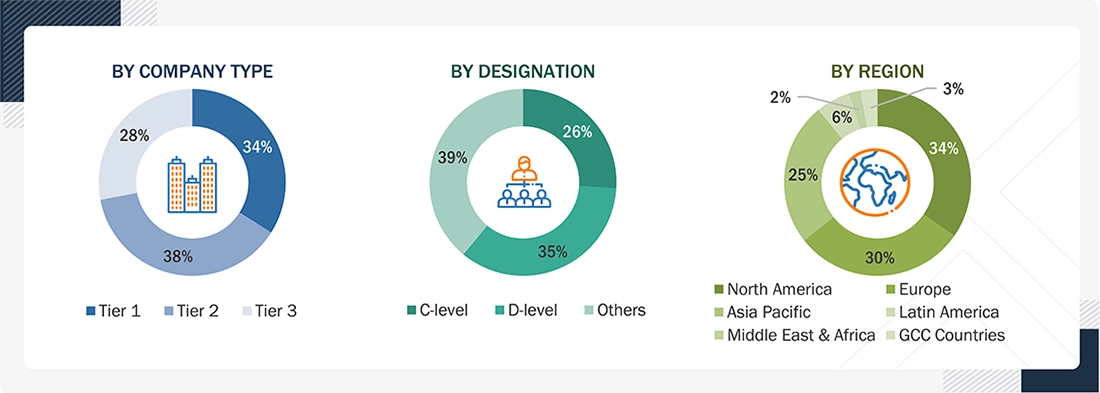
Note 1: C-level primaries include CEOs, COOs, and CTOs.
Note 2: Others include sales managers, marketing managers, and product managers.
Note 3: Companies are classified into tiers based on their total revenue. As of 2025: Tier 1 = >USD 1 billion, Tier 2 = USD 500 million to USD 1 billion, Tier 3 = <USD 500 million
To know about the assumptions considered for the study, download the pdf brochure
Market Size Estimation
Both top-down and bottom-up approaches were used to estimate and validate the total size of the allergy diagnostic market. These methods were also widely used to estimate the sizes of various subsegments in the market. The research methodology used to estimate the market size includes the following:
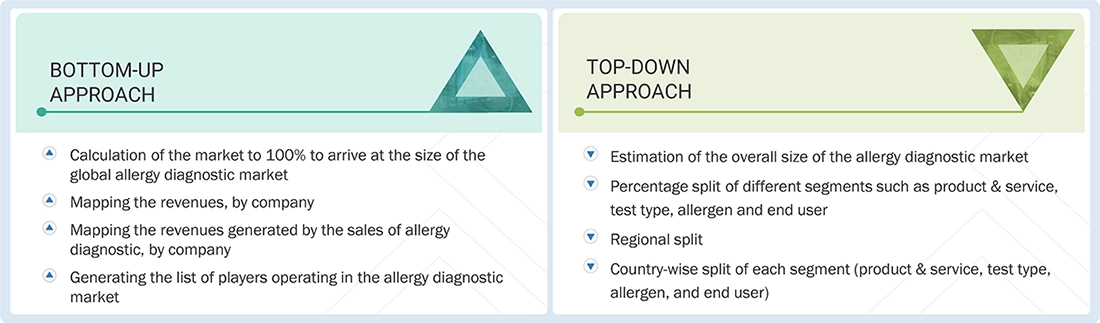
Data Triangulation
The market was divided into four segments when the market size was determined. Data triangulation and market breakdown processes were used where necessary to complete the market engineering process and arrive at precise statistics for all segments.
Approach to derive the market size and estimate market growth: Using secondary data from paid and unpaid sources, the market rankings for the major players were determined following a thorough analysis of their sales of allergy diagnostic products. Due to data restrictions, the revenue share in certain cases was determined after a thorough analysis of the product portfolio of big corporations and their individual sales performance. This information was verified at each stage by in-depth interviews with professionals in the field.
Market Definition
Allergy testing helps determine the substances causing a patient's allergy symptoms. Tests include skin tests, intradermal tests, challenge tests, blood tests, and patch tests. Allergists commonly conduct challenge tests, including food, inhalation, drug, and physical challenges. Blood tests are generally used when unsafe or unapplicable skin tests are required, such as when consuming certain medications or having a skin condition that may interfere with skin testing. Allergy tests, such as in vitro & in vivo tests, are performed to determine the cause, stage, prognosis, and treatment course for allergic diseases.
Key Stakeholders
- Allergy Diagnostic Reagents, Kits, and Instrument Manufacturers
- Allergy Diagnostic Vendors and Distributors
- Hospitals
- Diagnostic Laboratories
- Allergy Diagnostic Service Providers
- Academic Research Institutes
- Venture Capitalists and Investors
- Contract Research Organizations (CROs)
Report Objectives
- To describe, analyze, and forecast the allergy diagnostic market, by product & service, test type, allergen, end user, and region
- To describe and forecast the allergy diagnostic market for key regions, namely, North America, Europe, Asia Pacific, Latin America, the Middle East & Africa, and GCC countries
- To provide detailed information regarding drivers, restraints, opportunities, and challenges influencing the growth of the allergy diagnostic market
- To strategically analyze the ecosystem, regulations, patenting trend, value chain, Porter’s Five Forces, and prices pertaining to the market under study
- To strategically analyze micromarkets with respect to individual growth trends, prospects, and contributions to the overall market
- To analyze market opportunities for stakeholders and provide details of the competitive landscape for market players
- To profile key players and comprehensively analyze their market shares and core competencies in the allergy diagnostic market
- To analyze competitive developments such as collaborations, acquisitions, product launches, expansions, and R&D activities in the allergy diagnostic market
Available customizations:
With the given market data, MarketsandMarkets offers customizations as per your company’s specific needs. The following customization options are available for the report:
Company Information
- Detailed analysis and profiling of additional market players (up to 5)
Product Analysis
- Product matrix, which gives a detailed comparison of the product portfolios of each company
Geographic Analysis
- Further breakdown of the Rest of Asia Pacific allergy diagnostic market into Vietnam, New Zealand, and others
- Further breakdown of the Rest of Latin America allergy diagnostic market into Colombia, Chile, Ecuador, and others
- Further breakdown of the Rest of Europe allergy diagnostic market into Belgium, Russia, the Netherlands, Switzerland, and others
Fact checked
Personalize This Research
- Triangulate with your Own Data
- Get Data as per your Format and Definition
- Gain a Deeper Dive on a Specific Application, Geography, Customer or Competitor
- Any level of Personalization
Let Us Help You
- What are the Known and Unknown Adjacencies Impacting the Allergy Diagnostics Market
- What will your New Revenue Sources be?
- Who will be your Top Customer; what will make them switch?
- Defend your Market Share or Win Competitors
- Get a Scorecard for Target Partners

Custom Market Research Services
We Will Customise The Research For You, In Case The Report Listed Above Does Not Meet With Your Requirements
Get 10% Free CustomisationTESTIMONIALS

JAYANT RAJPUROHIT
Director of Market Insights, Data and Analytics
SFI Health,
Leading Pharmaceutical Companywww.sfihealth.com/

We at SFI Health approached MarketsandMarkets for an Opportunity Assessment on "Incidence and Prevalence of Focus Indications" as we wanted to know the most attractive HCPs like Physician, Functional MD, Naturopath and Pharmacist. The project was critical for us to ensure our focus on the right target which would enable sustainable growth and profitability for SFI Health. The business insights provided exceeded our expectations and we were extremely impressed. The team at MarketsandMarkets is highly professional and detail oriented and very well understood our business needs. MarketsandMarkets offers a unique combination of expertise and dedicated engagement model. We identified 2 new products to be launched in coming months, based on the research findings provided by MarketsandMarkets. We are happy with the services and would strongly recommend MarketsandMarkets to my peers in the industry.

BEATRIZ DE LA CALLE
Head of Commercial Analytics
Qualicaps,
Leading Pharmaceutical Companywww.qualicaps.com/

We partnered with MarketsandMarkets for an assessment study on hard empty capsules. The team was extremely professional in understanding our business requirements and we received timely responses to all our queries. The market intelligence and the recommendations has met our business requirements. We were extremely impressed to see the final study results; it really exceeded our expectations. The market intelligence offered by MarketsandMarkets, and clarity on next steps will help us achieve our business objective for the Year 2021. We are happy with the services and would strongly recommend MarketsandMarkets to my peers in the industry.

Bob Williams,
Senior Director Business Development & Innovation
Bracco Diagnostics Inc.,
Italian Multinational in life sciences sector and a World Leader in imaging diagnosticsimaging.bracco.com/us-en
We were pleased with targeted insights that MarketsandMarkets identified from a custom study on the 'Radiation Dose Management Solutions Market'. Your team identified and characterized the market participants as well as underlying trends accurately. This study was useful to Bracco in formulating business strategies for our dose monitoring product lines and we thank MarketsandMarkets for the job well done.
Cody Coonradt,
Market Development and Strategy Manager
3M Health Information Systems,
Leader in Health care Coding, Payment & Analytics Solutions.www.3m.com/3M/en_US/health-information-systems-us
The value for our organization comes from three things: depth of research, specificity of segments and being easy to work with. As important as the first two are, the third can't be underestimated. MarketsandMarkets, maybe more than any other research vendor, wants to know what is top of mind for our team and what big questions we are grappling to answer.
Their customer first approach and high value engagement model, have given us great analysis and excellent value for money
- Canada Allergy Diagnostics Market
- US Allergy Diagnostics Market
- Germany Allergy Diagnostics Market
- UK Allergy Diagnostics Market
- France Allergy Diagnostics Market
- Italy Allergy Diagnostics Market
- Spain Allergy Diagnostics Market
- China Allergy Diagnostics Market
- Japan Allergy Diagnostics Market
- India Allergy Diagnostics Market
- South Korea Allergy Diagnostics Market
- Australia Allergy Diagnostics Market
- Brazil Allergy Diagnostics Market
- Mexico Allergy Diagnostics Market
- GCC Countries Allergy Diagnostics Market
- Rest Of Europe Allergy Diagnostics Market
- Rest Of Asia Pacific Allergy Diagnostics Market
Growth opportunities and latent adjacency in Allergy Diagnostics Market






Mason
Jun, 2026
After reviewing the Allergy Diagnostics Market report, I found the breakdown of testing modalities and regional demand patterns particularly useful for evaluating where diagnostic labs can expand their service portfolios over the next few years..
Harper
Jun, 2026
I was interested in how the Allergy Diagnostics Market analysis connects advancements in immunoassay techniques with shifting clinical preferences, which helped me better understand the technical drivers behind test adoption..
Grayson
Jun, 2026
From a strategic standpoint, the Allergy Diagnostics Market insights gave me a clearer view of competitive positioning and investment opportunities, especially in emerging markets where allergy prevalence and diagnostic awareness are rising..