

Vertical Lift Module Market Size, Share, Industry Growth, 2035

Vertical Lift Module Market by Delivery Type (Single-Level, Dual-Level), Storage Type (Non-Refrigerated, Refrigerated), Industry (Automotive, Metals & Machinery, Food & Beverages, Chemicals, Healthcare), and Region - Global Forecast to 2025 - 2035

Report Code: SE 6003 Jan, 2026, by marketsandmarkets.com

Vertical Lift Module Market Overview (2025 - 2035)

The global vertical lift module market was valued at USD 1.79 billion in 2024 and is estimated to reach USD 4.34 billion by 2035, at a CAGR of 8.5% between 2025 and 2035.
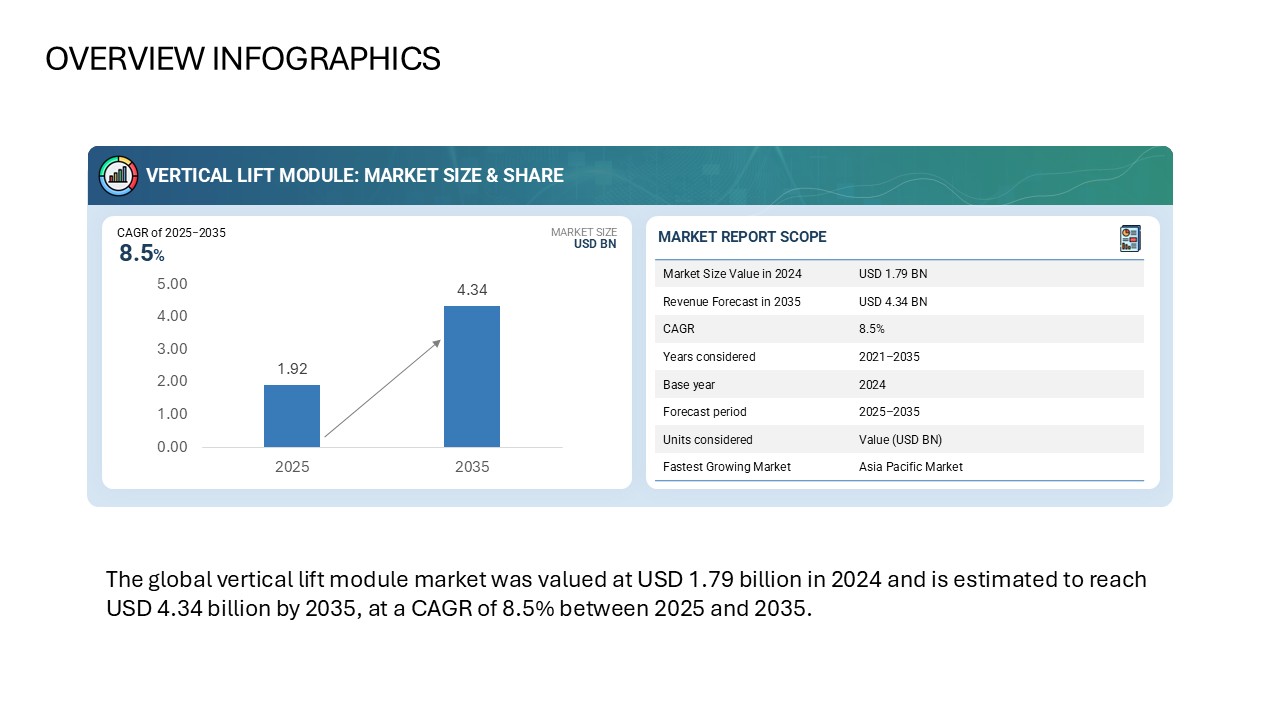
 

Vertical Lift Module Market Size

The global vertical lift module market is witnessing strong expansion as industries focus on achieving better space utilization, faster retrieval systems, and higher productivity. A vertical lift module (VLM) is an automated storage and retrieval system that stores goods on trays arranged vertically and delivers them to an access opening through an automatic elevator mechanism. This vertical design allows businesses to store more items in a smaller footprint, improving space efficiency and reducing manual handling. From manufacturing plants to e-commerce warehouses, VLMs are increasingly becoming the preferred choice for streamlining inventory management and enhancing operational flow. Between 2025 and 2035, the market is expected to experience significant growth due to the rising need for automation and smart storage solutions in logistics, production, and healthcare sectors.

Key Market Drivers

The growth of the vertical lift module market is driven by multiple factors. One of the primary drivers is the growing need for space optimization. Industrial real estate costs are rising worldwide, compelling companies to adopt solutions that make better use of available height rather than horizontal space. Automation is another major driver, as VLMs reduce human error, minimize labor dependency, and ensure faster access to stored goods.

E-commerce and omnichannel retailing have also accelerated the demand for quick and accurate picking systems, and VLMs meet this need efficiently. Furthermore, global labor shortages, especially in logistics and manufacturing, are pushing industries to invest in automated systems that can work continuously with minimal supervision. Lastly, the increased focus on employee safety and ergonomics by reducing bending, lifting, and walking distances—has made VLMs more attractive to industries seeking long-term operational efficiency.

Market Challenges

Despite the positive outlook, several challenges may restrain the vertical lift module market’s growth. The initial investment cost for installation is relatively high, making it difficult for small and medium enterprises to adopt the technology. Integrating VLMs with existing enterprise software such as warehouse management systems and ERP solutions can also be complex. Moreover, for sectors requiring temperature-controlled storage, the need for customized refrigerated VLMs adds to capital expenditure.

Maintenance and downtime are also concerns, especially in large-scale operations where any system failure can delay production or order fulfillment. In developing regions, lack of skilled technicians and awareness about automation technology further limits adoption. Addressing these barriers will be crucial for sustained market growth through 2035.

Delivery Type Insights

Single-Level Delivery

Single-level delivery VLMs are designed to present one tray at a time to the operator. They are suitable for facilities with moderate throughput requirements and limited space. These systems are commonly used in spare parts storage, maintenance workshops, and low-volume picking environments. Their simple design makes them cost-effective, reliable, and easier to maintain, which appeals to small and medium enterprises that need automation without complex integration.

Dual-Level Delivery

Dual-level delivery VLMs, on the other hand, are engineered for high throughput operations. They have two tray openings that allow one tray to be picked while another is being retrieved, minimizing idle time and improving efficiency. These systems are ideal for e-commerce fulfillment centers, automotive manufacturing, and distribution hubs that handle large order volumes. As the global trend shifts toward faster order processing and lean operations, the dual-level segment is expected to dominate future installations due to its superior productivity and reduced picking time.

Storage Type Insights

Non-Refrigerated VLMs

Non-refrigerated vertical lift modules account for the majority of installations worldwide. They are used in industries such as automotive, electronics, aerospace, and machinery where goods can be stored at ambient temperature. These VLMs provide quick access to components, enhance inventory accuracy, and reduce handling damage. Their relatively low setup cost and wide application scope continue to drive growth in this segment.

Refrigerated VLMs

Refrigerated VLMs are gaining momentum as industries such as food and beverage, healthcare, and pharmaceuticals expand their cold chain logistics. These systems are designed with advanced insulation, temperature sensors, and humidity controls to preserve the integrity of perishable goods. In healthcare, refrigerated VLMs are used to store vaccines, blood samples, and biologics safely. The rising global focus on food safety and healthcare compliance will accelerate the adoption of temperature-controlled VLMs in the coming decade.

Industry Applications

Automotive Industry

The automotive industry heavily relies on vertical lift modules for efficient storage and retrieval of parts, tools, and components. By using VLMs, automotive manufacturers can reduce part retrieval time, improve space utilization, and enhance production flexibility. The systems also support lean manufacturing by ensuring that components are readily available at the point of assembly. As electric vehicles and component diversity increase, automotive plants are expected to further automate their storage processes using advanced VLM systems.

Metals and Machinery

In metals and heavy machinery industries, vertical lift modules are used for storing heavy tools, dies, spare parts, and maintenance equipment. These industries benefit from the high load capacity and rugged design of VLMs. The use of automation helps minimize downtime by ensuring that critical tools and spare parts are always accessible. With a growing emphasis on predictive maintenance and efficient spare part logistics, this sector will continue to invest in intelligent storage systems.

Food and Beverages

The food and beverage sector uses both non-refrigerated and refrigerated VLMs depending on the type of product. Automated storage ensures proper inventory rotation, improved hygiene, and temperature consistency. Supermarkets, food processors, and distribution centers are integrating VLMs to streamline storage of ingredients, packaging materials, and finished products. The increasing adoption of automated systems in cold storage warehouses will boost the growth of this segment through 2035.

Chemicals and Healthcare

Both the chemical and healthcare sectors demand strict control over product storage conditions. In chemical plants, VLMs help manage hazardous or sensitive materials with controlled access and proper documentation. In healthcare, hospitals, pharmacies, and laboratories use VLMs for storing surgical tools, medical devices, and pharmaceuticals. These systems support traceability, regulatory compliance, and protection against contamination. The global rise in healthcare infrastructure investment is expected to further fuel demand for these systems.

The major players in the VLM market are Kardex (Switzerland), Haenel (Germany), System Spa (Italy), Ferretto (Italy), and ICAM S.r.l. (Italy).   

Regional Analysis

North America

North America represents one of the largest markets for vertical lift modules due to advanced manufacturing practices and strong adoption of automation technologies. The United States, in particular, leads in e-commerce fulfillment and warehouse automation. High labor costs, coupled with an emphasis on operational efficiency, continue to drive installations across industries such as automotive, healthcare, and logistics.

Europe

Europe has been a pioneer in adopting automated storage solutions, driven by high space costs and strict safety regulations. Countries like Germany, France, and Italy have well-established manufacturing sectors that rely on vertical storage for optimizing production and maintenance operations. The presence of key automation companies and integrators further strengthens the regional market.

Asia Pacific

Asia Pacific is the fastest-growing regional market, led by countries such as China, Japan, India, and South Korea. Rapid industrialization, booming e-commerce, and government incentives for smart manufacturing have accelerated VLM adoption. As more factories modernize their operations and warehouse automation gains traction, Asia Pacific will become a key contributor to global market revenue by 2035.

Middle East, Africa, and Latin America

These regions are emerging markets for vertical lift modules. Industrial growth, new logistics hubs, and infrastructure development in the Middle East and Latin America are creating opportunities for automated storage systems. However, high initial costs and limited local manufacturing still pose challenges to large-scale adoption. As awareness and investment in automation increase, gradual growth is expected.

Technological Advancements

The future of vertical lift modules is closely tied to digital transformation. Integration with artificial intelligence, Internet of Things, and predictive analytics allows real-time monitoring, remote diagnostics, and predictive maintenance. Smart sensors enhance accuracy, while machine vision ensures correct tray retrieval and placement.

In addition, cloud-based software and advanced warehouse management systems are enabling centralized control of multiple VLM units across locations. Collaborative robots and automated guided vehicles are being combined with VLMs for seamless goods movement, further enhancing automation levels in warehouses and manufacturing floors. Energy-efficient motors and regenerative drives are also being introduced to reduce power consumption and support sustainability goals.

Market Outlook from 2025 to 2035

The global vertical lift module market is expected to grow steadily between 2025 and 2035, driven by industrial automation, digitalization, and the shift toward smart warehouses. Dual-level systems will see faster adoption due to their higher throughput capacity, while refrigerated systems will grow rapidly in healthcare and food sectors.

As companies move toward Industry 4.0, the integration of VLMs with robotics, digital twins, and AI-driven analytics will become a standard practice. Investments in warehouse modernization, particularly in Asia and North America, will keep market growth strong. The focus on energy efficiency, system scalability, and cloud connectivity will define competitive differentiation among manufacturers.

Competitive Landscape

The market is moderately fragmented, with several global and regional players offering customized VLM solutions. Leading manufacturers are focusing on product innovation, modular designs, and user-friendly software interfaces. Strategic partnerships with system integrators and logistics firms are helping companies expand their global reach. After-sales services, predictive maintenance capabilities, and customer training programs are increasingly becoming important differentiators in vendor selection.

As demand grows, new entrants are likely to emerge, particularly in emerging economies, offering cost-effective and localized solutions. The trend toward flexible financing options such as leasing and subscription-based models is also expected to make advanced automation accessible to mid-sized enterprises.

The vertical lift module market is poised for long-term growth, supported by global trends in automation, digitalization, and sustainability. By addressing challenges related to cost and integration, manufacturers and system providers can unlock significant opportunities in both developed and developing markets.

From automotive to healthcare, every major industry is recognizing the advantages of compact, automated storage solutions that enhance efficiency and safety. With continued innovation and the adoption of smart technologies, the vertical lift module market will play a central role in shaping the future of intelligent warehousing and industrial automation through 2035.




Exclusive indicates content/data unique to MarketsandMarkets and not available with any competitors.


Table of Contents

1 Introduction (Page No. - 13)
    1.1 Objectives of Study
    1.2 Definition
    1.3 Scope of Study
           1.3.1 Years Considered for Study
    1.4 Currency
    1.5 Limitations
    1.6 Stakeholders

2 Research Methodology (Page No. - 16)
    2.1 Research Data
           2.1.1 Secondary Data
                    2.1.1.1 List of Major Secondary Sources
                    2.1.1.2 Secondary Sources
           2.1.2 Primary Data
                    2.1.2.1 Primary Interviews With Experts
                    2.1.2.2 Primary Sources
           2.1.3 Secondary & Primary Research
                    2.1.3.1 Key Industry Insights
                    2.1.3.2 Breakdown of Primaries
    2.2 Market Size Estimation
           2.2.1 Bottom-Up Approach
                    2.2.1.1 Approach for Arriving at Market Share By Bottom-Up Analysis (Demand Side)
           2.2.2 Top-Down Approach
                    2.2.2.1 Approach for Capturing Market Share By Top-Down Analysis (Supply Side)
    2.3 Market Breakdown & Data Triangulation
    2.4 Research Assumptions

3 Executive Summary (Page No. - 27)

4 Premium Insights (Page No. - 32)
    4.1 Attractive Growth Opportunities in VLM Market
    4.2 Vertical Lift Module Market, By Delivery Type
    4.3 Vertical Lift Module Market, By Storage Type
    4.4 VLM Market, By Industry
    4.5 VLM Market, By Geography

5 Market Overview (Page No. - 36)
    5.1 Introduction
    5.2 Market Dynamics
           5.2.1 Drivers
                    5.2.1.1 Growing Need to Optimize Warehouse Floor Space
                    5.2.1.2 Benefits of Deploying VLM Compared to Traditional Shelving Systems
                    5.2.1.3 Rising Warehouse Rentals
                    5.2.1.4 Increasing Focus on Worker Safety and Security
           5.2.2 Restraints
                    5.2.2.1 Availability of Used VLMs in the Market
           5.2.3 Opportunities
                    5.2.3.1 Increasing Demand for Customized Solutions
                    5.2.3.2 Integration of Robots With VLMs
           5.2.4 Challenges
                    5.2.4.1 Risk of Downtime and Interrupted Operations in Case of Equipment Malfunction
                    5.2.4.2 Reluctance Among End-User Industries to Adopt VLM Due to the Necessary Changes in Infrastructure
    5.3 Value Chain Analysis

6 Load Capacities of VLMs (Page No. - 42)
    6.1 Introduction
    6.2 Up to 20 Ton
    6.3 Up to 40 Ton
    6.4 Up to 60 Ton

7 Functions of VLMs (Page No. - 44)
    7.1 Introduction
    7.2 Order Picking
    7.3 Batch Picking
    7.4 Consolidation
    7.5 Sortation
    7.6 Storage

8 VLM Market, By Delivery Type (Page No. - 46)
    8.1 Introduction
    8.2 Single-Level Delivery
           8.2.1 Launch of Modula’s Single-Level VLM for Valuable and Susceptible Products
    8.3 Dual-Level Delivery
           8.3.1 Dual-Level VLM By Icam S.R.L. for Improving Picking Performance

9 VLM Market, By Storage Type (Page No. - 53)
    9.1 Introduction
    9.2 Non-Refrigerated Storage
    9.3 Refrigerated Storage

10 VLM Market, By Industry (Page No. - 57)
     10.1 Introduction
     10.2 Automotive
     10.3 Metals & Heavy Machinery
     10.4 Food & Beverages
     10.5 Chemicals
     10.6 Healthcare
     10.7 Semiconductor & Electronics
     10.8 Aviation
     10.9 E-Commerce
     10.10 Other Industries

11 VLM Market, By Geography (Page No. - 73)
     11.1 Introduction
     11.2 North America
             11.2.1 US
             11.2.2 Canada
             11.2.3 Mexico
     11.3 Europe
             11.3.1 Germany
             11.3.2 UK
             11.3.3 France
             11.3.4 Italy
             11.3.5 Rest of Europe
     11.4 APAC
             11.4.1 China
             11.4.2 Japan
             11.4.3 Australia
             11.4.4 India
             11.4.5 Rest of APAC
     11.5 RoW
             11.5.1 South America
             11.5.2 Middle East
             11.5.3 Africa

12 Competitive Landscape (Page No. - 89)
     12.1 Overview
     12.2 Market Ranking Analysis for VLM Manufacturers
     12.3 Competitive Situations & Trends
             12.3.1 Contracts
             12.3.2 Product Launches & Developments
             12.3.3 Expansions, Partnerships, & Acquisitions
             12.3.4 Certifications

13 Company Profiles (Page No. - 95)
(Business Overview, Products and Services Offered, Recent Developments, SWOT Analysis & MnM View)*
     13.1 Introduction
     13.2 Key Players
             13.2.1 Kardex
             13.2.2 Haenel
             13.2.3 System Spa
             13.2.4 Ferretto
             13.2.5 Icam S.R.L.
             13.2.6 Toyota Industries
             13.2.7 Autocrib
             13.2.8 Automha
             13.2.9 Constructor Group
             13.2.10 Conveyor Handling Company
             13.2.11 Green Automated Solutions
             13.2.12 Lista
             13.2.13 Mecalux
             13.2.14 Stanley Vidmar
             13.2.15 Weland Lagersystem
*Details on Business Overview, Products and Services Offered, Recent Developments, SWOT Analysis & MnM View Might Not Be Captured in Case of Unlisted Companies.
     13.3 Key Innovators
             13.3.1 Midas Metcons
             13.3.2 Vidir Machine
             13.3.3 Effimat Storage Technology
             13.3.4 Jungheinrich Ag
             13.3.5 Ssi Schaefer

14 Appendix (Page No. - 126)
     14.1 Insights of Industry Experts
     14.2 Discussion Guide
     14.3 Knowledge Store: Marketsandmarkets’ Subscription Portal
     14.4 Introducing RT: Real-Time Market Intelligence
     14.5 Available Customizations
     14.6 Related Reports
     14.7 Author Details


List of Tables (40 Tables)

Table 1 Vertical Lift Module Market, in Terms of Value and Volume, 2015–2023 (USD Million and Units)
Table 2 VLM Market, By Delivery Type, 2015–2023 (USD Million)
Table 3 VLM Market for Single-Level Delivery, By Industry, 2015–2023 (USD Million)
Table 4 VLM Market for Single-Level Delivery, By Region, 2015–2023 (USD Million)
Table 5 Vertical Lift Module Market for Dual-Level Delivery, By Industry, 2015–2023 (USD Million)
Table 6 VLM Market for Dual-Level Delivery, By Region, 2015–2023 (USD Million)
Table 7 Vertical Lift Module Market, By Storage Type, 2015–2023 (USD Million)
Table 8 VLVertical Lift Module Market, By Industry, 2015–2023 (USD Million)
Table 9 VLM Market for Automotive Industry, By Delivery Type, 2015–2023 (USD Million)
Table 10 VLM Market for Automotive Industry, By Region, 2015–2023 (USD Million)
Table 11 Vertical Lift Module Market for Metals and Heavy Machinery Industry, By Delivery Type, 2015–2023 (USD Million)
Table 12 VLM Market for Metals and Heavy Machinery Industry, By Region, 2015–2023 (USD Million)
Table 13 Vertical Lift Module Market for Food & Beverages Industry, By Delivery Type, 2015–2023 (USD Million)
Table 14 VLM Market for Food and Beverages Industry, By Region, 2015–2023 (USD Million)
Table 15 VLM Market for Chemicals Industry, By Delivery Type, 2015–2023 (USD Million)
Table 16 Vertical Lift Module Market for Chemicals Industry, By Region, 2015–2023 (USD Million)
Table 17 VLM Market for Healthcare, By Delivery Type, 2015–2023 (USD Million)
Table 18 Vertical Lift Module Market for Healthcare Industry, By Region, 2015–2023 (USD Million)
Table 19 VLM Market for Semiconductor and Electronics Industry, By Delivery Type, 2015–2023 (USD Million)
Table 20 VLM Market for Semiconductor and Electronics Industry, By Region, 2015–2023 (USD Million)
Table 21 Vertical Lift Module Market for Aviation Industry, By Delivery Type, 2015–2023 (USD Million)
Table 22 VLM Market for Aviation Industry, By Region, 2015–2023 (USD Million)
Table 23 Vertical Lift Module Market for E-Commerce Industry, By Delivery Type, 2015–2023 (USD Million)
Table 24 VLM Market for E-Commerce Industry, By Region, 2015–2023 (USD Million)
Table 25 VLM Market for Other Industries, By Delivery Type, 2015–2023 (USD Million)
Table 26 Vertical Lift Module Market for Other Industries, By Region, 2015–2023 (USD Million)
Table 27 VLM Market, By Region, 2015–2023 (USD Million)
Table 28 Vertical Lift Module Market in North America, By Country, 2015–2023 (USD Million)
Table 29 VLM Market in North America, By Delivery Type, 2015–2023 (USD Million)
Table 30 VLM Market in Europe, By Country, 2015–2023 (USD Million)
Table 31 VLM Market in Europe, By Delivery Type, 2015–2023 (USD Million)
Table 32 Vertical Lift Module Market in APAC, By Country, 2015–2023 (USD Million)
Table 33 VLM Market in APAC, By Delivery Type, 2015–2023 (USD Million)
Table 34 VLM Market in RoW, By Region, 2015–2023 (USD Million)
Table 35 Vertical Lift Module Market in RoW, By Delivery Type, 2015–2023 (USD Million)
Table 36 Ranking of Top 5 Players: VLM Market, 2016
Table 37 Contracts, 2015–2017
Table 38 Product Launches and Developments, 2015–2017
Table 39 Expansions, Partnerships, and Acquisitions, 2016–2017
Table 40 Certifications, 2015–2017


List of Figures (43 Figures)

Figure 1 Vertical Lift Module Market Segmentation
Figure 2 VLM Market: Research Design
Figure 3 Bottom-Up Approach to Arrive at Market Size
Figure 4 Top-Down Approach to Arrive at the Market Size
Figure 5 Data Triangulation
Figure 6 Assumptions of Research Study
Figure 7 VLM Market Segmentation
Figure 8 Single-Level Delivery to Hold Larger Size of VLM Market in 2018
Figure 9 VLM Market for Refrigerated Storage to Grow at Higher CAGR During Forecast Period
Figure 10 Vertical Lift Module Market for Aviation Industry Expected to Grow at the Highest CAGR Between 2018 and 2023
Figure 11 Europe to Hold Largest Share of VLM Market in 2018
Figure 12 Growing Need to Optimize Warehouse Floor Space Expected to Boost the Adoption of VLMs
Figure 13 VLM Market for Dual-Level Delivery to Grow at Higher CAGR Between 2018 and 2023
Figure 14 Non–Refrigerated Storage Expected to Hold Larger Share of VLM Market in 2018
Figure 15 Automotive to Hold Largest Share of VLM Market in 2018
Figure 16 US to Hold Largest Share of VLM Market in 2018
Figure 17 Market Dynamics: VLM Market, 2018
Figure 18 VLM Value Chain: Major Value Added During Manufacturing and Assembly Stage
Figure 19 Load Capacities of VLMs
Figure 20 Functions Served By VLMs
Figure 21 Market Segmentation, By Delivery Type
Figure 22 Single-Level Delivery Type to Hold Larger Size of VLM Market By 2023
Figure 23 Dual-Level Delivery VLM Market for Aviation Industry to Grow at Highest CAGR During Forecast Period
Figure 24 VLM Market Segmentation, By Storage Type
Figure 25 Non-Refrigerated Storage to Hold Larger Size of VLM Market Between 2018 and 2023
Figure 26 VLM Market Segmentation, By Industry
Figure 27 APAC to Lead VLM Market for Metals and Heavy Machinery Industry Between 2018 and 2023
Figure 28 Dual-Level Delivery VLM Market for Healthcare Industry to Grow at Higher Rate From 2018 to 2023
Figure 29 Single-Level Delivery to Hold Larger Size of VLM Market for Aviation Industry By 2023
Figure 30 North America to Hold Largest Size of VLM Market for E-Commerce Industry Between 2018 and 2023
Figure 31 VLM Market in India is Expected to Grow at Highest CAGR During Forecast Period
Figure 32 Snapshot: VLM Market in North America
Figure 33 US to Hold Largest Size of VLM Market in North America Between By 2023
Figure 34 Snapshot: VLM Market in Europe
Figure 35 VLM Market in France to Grow at Highest CAGR During Forecast Period
Figure 36 Snapshot: VLM Market in APAC
Figure 37 VLM Market in RoW
Figure 38 VLM Market in Middle East Expected to Grow at Highest CAGR During Forecast Period
Figure 39 Key Players in VLM Market Adopted Contracts as Key Growth Strategy Between 2015 and 2017
Figure 40 Market Evolution Framework: Contracts Fueled Growth of VLM Market During 2015–2017
Figure 41 Contracts Was Key Strategy Adopted Between 2015 and 2017
Figure 42 Kardex: Company Snapshot
Figure 43 Toyota Industries: Company Snapshot


Request for detailed methodology, assumptions & how numbers were triangulated.

Please share your problem/objectives in greater details so that our analyst can verify if they can solve your problem(s).
8 4 6 9 1  
  • Select all
  • News-Letters with latest Market insights
  • Information & discussion on the relevant new products and services
  • Information & discussion on Market insights and Market information
  • Information & discussion on our events and conferences
    • Select all
    • Email Phone Professional and social network (Linkedin, etc)
Custom Market Research Services

We will customize the research for you, in case the report listed above does not meet with your exact requirements. Our custom research will comprehensively cover the business information you require to help you arrive at strategic and profitable business decisions.

Request Customization
Report Code
SE 6003
Available for Pre-Book
Choose License Type
BUY NOW
  • SHARE
X
Request Customization
Speak to Analyst
Speak to Analyst
OR FACE-TO-FACE MEETING
PERSONALIZE THIS RESEARCH
  • Triangulate with your Own Data
  • Get Data as per your Format and Definition
  • Gain a Deeper Dive on a Specific Application, Geography, Customer or Competitor
  • Any level of Personalization
REQUEST A FREE CUSTOMIZATION
LET US HELP YOU!
  • What are the Known and Unknown Adjacencies Impacting the Vertical Lift Module Market
  • What will your New Revenue Sources be?
  • Who will be your Top Customer; what will make them switch?
  • Defend your Market Share or Win Competitors
  • Get a Scorecard for Target Partners
CUSTOMIZED WORKSHOP REQUEST
knowledgestore logo

Want to explore hidden markets that can drive new revenue in Vertical Lift Module Market?

Find Hidden Markets
  • Call Us
  • +1-888-600-6441 (Corporate office hours)
  • +1-888-600-6441 (US/Can toll free)
  • +44-800-368-9399 (UK office hours)
CONNECT WITH US
ABOUT TRUST ONLINE
©2025 MarketsandMarkets Research Private Ltd. All rights reserved
DMCA.com Protection Status
Website Feedback






