Automotive ECU Market

Automotive ECU Market by ICE & EV Application (ADAS & Safety, BMS, Infotainment, Powertrain, Telematics & Others), ECU Capacity (16, 32 & 64 bit), Vehicle Type (PC, LCV, HCV), EV Type, Autonomy, Technology, ECU Type, and Region - Global Forecast to 2033




OVERVIEW
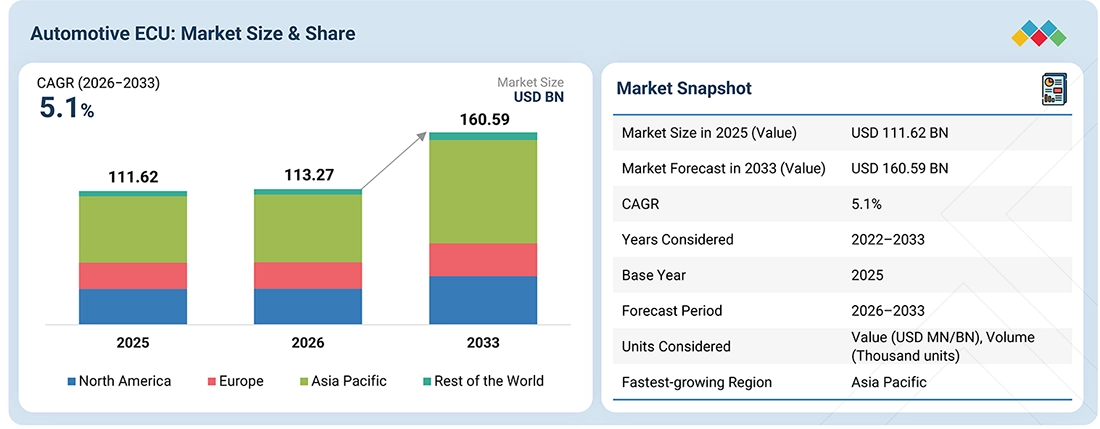
Source: Secondary Research, Interviews with Experts, MarketsandMarkets Analysis
The automotive ECU market is projected to reach USD 160.59 billion by 2033 from USD 113.27 billion in 2026, at a CAGR of 5.1% from 2026 to 2033. ADAS is becoming a major pool of ECU value as multiple safety functions are increasingly integrated into high-performance controllers. The growing combination of perception, sensor fusion, decision-making, and vehicle-motion control requires ECUs with high processing capability, deterministic response, functional safety, and low-latency communication. This is shifting ECU value toward high-performance, safety-certified compute platforms rather than individual function-specific controllers, while increasing the importance of software flexibility and scalability. Zonal and centralized architectures are further supporting the aggregation of ADAS and other vehicle functions, requiring controllers to handle software aggregation, OTA updates, functional safety, cybersecurity, and platform reuse. As a result, purchasing decisions are increasingly favoring suppliers that can provide integrated platforms covering MCUs/SoCs, networking, hypervisors, middleware, and software-development environments.
KEY TAKEAWAYS
-
BY REGIONThe Asia Pacific is projected to account for 49.9% of the market in 2026.
-
BY VEHICLE TYPEPassenger cars are expected to dominate the market, accounting for 82.2% in 2026.
-
BY APPLICATIONInfotainment and communication systems are expected to register the highest CAGR of 8.9% during the forecast period.
-
BY ECU CAPACITY64-bit ECUs are projected to grow at the fastest rate during the forecast period.
-
COMPETITIVE LANDSCAPE (KEY PLAYERS)Robert Bosch GmbH (Germany), Denso Corporation (Japan), and ZF Friedrichshafen AG (Germany) are key players that are developing advanced ECUs, domain controllers, software platforms, and integrated vehicle electronics solutions to support increasing ECU content and the transition toward centralized E/E architectures.
-
COMPETITIVE LANDSCAPE (STARTUPS/SMES)Lear Corporation (US), and Astemo, Ltd. (Japan), among others, have distinguished themselves among startups and SMEs by securing strong footholds in specialized niche areas, underscoring their potential as emerging market leaders.
Next-generation ECU platforms are increasingly optimized for predictable response times, with hardware acceleration, low-latency interconnects, lockstep processing, and deterministic communication becoming key design priorities. This is particularly important for integrated ADAS and vehicle-motion applications, where sensor and vehicle-state data must be processed within tightly controlled latency windows. Automotive Ethernet is also moving into the core architecture, driven by the bandwidth requirements of zonal and centralized systems; 5-Gbit/s Ethernet, 10BASE-T1S, CAN-XL, PCIe, and time-sensitive networking are being integrated directly into emerging MCUs and ECUs. At the same time, embedded AI acceleration is expanding across sensor processing, radar processing, anomaly detection, and predictive control, enabling time-sensitive inference to be executed locally rather than transmitting every data stream to a central processor or cloud.
TRENDS & DISRUPTIONS IMPACTING CUSTOMERS' CUSTOMERS
The automotive ECU market is transitioning from highly distributed, function-specific ECUs toward consolidated domain and zonal architectures, where fewer high-performance controllers manage multiple vehicle functions. Leading players such as Robert Bosch GmbH (Germany), DENSO Corporation (Japan), Aumovio SE (Germany), Aptiv (Ireland), and ZF Friedrichshafen AG (Germany) are investing in domain controllers, zone controllers, high-performance computing platforms, AUTOSAR-based software, and integrated ECU solutions to support this architectural shift. ECU consolidation is particularly evident in powertrain, chassis, body, ADAS, and vehicle gateway functions, where multiple standalone controllers are being integrated into higher-capability platforms. OEMs are also increasing the use of software-updatable ECUs, centralized vehicle computers, and OTA software architectures to reduce hardware complexity and enable faster feature deployment. As ECU architectures move toward domain and zonal control, the market is expected to see greater value contribution from high-performance processors, embedded software, middleware, cybersecurity, functional safety, and ECU integration, creating opportunities across semiconductor suppliers, Tier-1 ECU manufacturers, software providers, and testing companies.
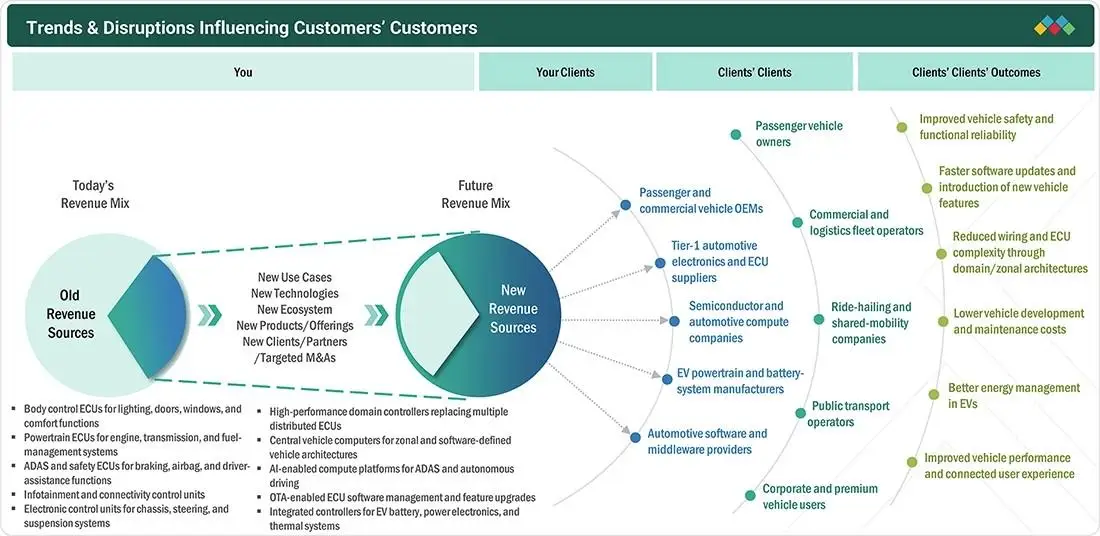
Source: Secondary Research, Interviews with Experts, MarketsandMarkets Analysis
MARKET DYNAMICS

Level
-
Electrification creating demand for safety-critical power electronics control for powertrain, battery, and energy management systems

-
Regulatory mandates for vehicle safety, emissions, and cybersecurity


Level
-
Semiconductor dependency and long automotive qualification cycles

-
Transition toward centralized and zonal E/E architectures reducing ECU count per vehicle


Level
-
AI-enabled centralized vehicle computers opening new premium revenue streams beyond traditional ECU hardware

-
48 V electrical architectures creating demand for intelligent power distribution and next-generation ECUs


Level
-
Managing software integration across increasingly heterogeneous automotive computing ecosystems

-
Increasing vertical integration by OEMs and semiconductor companies

Source: Secondary Research, Interviews with Experts, MarketsandMarkets Analysis
Driver: Electrification creating demand for safety-critical power electronics control for powertrain, battery, and energy management systems
Electrification is increasing demand for safety-critical ECUs that control powertrain and energy functions, including battery management, inverter control, onboard charging, and DC-DC conversion. These ECUs require precise monitoring of voltage, current, temperature, and state of charge to maintain reliable power delivery and protect electrical components. The growing electronic content of electrified powertrains is therefore increasing ECU requirements per vehicle.
Restraint: Transition toward centralized and zonal E/E architectures reducing ECU count per vehicle
The shift toward centralized and zonal E/E architectures reduces the number of dedicated ECUs required per vehicle. Functions previously managed by multiple domain-specific ECUs are increasingly consolidated into high-performance computing units and zone controllers. This consolidation lowers ECU content per vehicle, limiting volume growth for conventional standalone ECUs. The trend is particularly relevant in premium EVs and software-defined vehicle platforms adopting centralized computing architectures.
Opportunity: AI-enabled centralized vehicle computers opening new premium revenue streams beyond traditional ECU hardware
AI-enabled centralized vehicle computers create opportunities to combine multiple vehicle functions within high-performance computing platforms. These systems support AI-based ADAS, predictive diagnostics, personalized cockpit functions, and real-time vehicle optimization. This increases the value of ECU platforms beyond conventional hardware, creating premium revenue opportunities through computing capacity, software features, and continuous feature upgrades.
Challenge: Managing software integration across increasingly heterogeneous automotive computing ecosystems
Automotive ECU suppliers face increasing complexity in integrating software across heterogeneous processors, operating systems, communication protocols, and legacy ECUs. Centralized and zonal architectures require seamless coordination between domain controllers, zone controllers, and high-performance computers. Managing software compatibility, real-time communication, and functional safety across these platforms increases development and validation requirements.
AUTOMOTIVE ECU MARKET: COMMERCIAL USE CASES ACROSS INDUSTRIES
| COMPANY | USE CASE DESCRIPTION | BENEFITS |
|---|---|---|
 |
Develops ECUs for powertrain, chassis, ADAS, body electronics, and vehicle connectivity, including centralized and domain-control architectures. | Improves vehicle control, supports advanced functions, and enables ECU consolidation. |
 |
Supplies domain and zone control units for body, vehicle motion, ADAS, and cockpit applications in modern E/E architectures. | Reduces ECU count and wiring complexity while enabling centralized vehicle computing. |
 |
Uses high-performance ECUs and vehicle control units for ADAS, automated driving, chassis, and vehicle motion applications. | Enables real-time control, improves driving safety, and supports higher levels of vehicle automation. |
 |
Develops vehicle computing and zonal control solutions that consolidate multiple ECU functions and connect vehicle domains. | Reduces hardware complexity, lowers wiring weight, and supports software-defined vehicle architectures. |
 |
Provides ECUs and domain controllers for ADAS, powertrain electrification, thermal management, and vehicle body functions. | Enables intelligent vehicle control, improves energy efficiency, and supports EV and ADAS adoption. |
Logos and trademarks shown above are the property of their respective owners. Their use here is for informational and illustrative purposes only.
MARKET ECOSYSTEM
The automotive ECU market ecosystem includes automotive ECU manufacturers, raw material & electronic component suppliers, OEMs, semiconductor manufacturers, ECU software & middleware providers, and ECU testing & validation. Some of the major automotive ECU providers include Robert Bosch GmbH (Germany), Denso Corporation (Japan), ZF Friedrichshafen AG (Germany), Aptiv (Ireland), and Aumovio SE (Germany). These companies are focusing on developing domain and zonal controllers, centralized computing platforms, software-defined vehicle solutions, and cybersecurity capabilities while expanding strategic partnerships with semiconductor suppliers, software providers, and OEMs to strengthen their position in the global automotive ECU market.
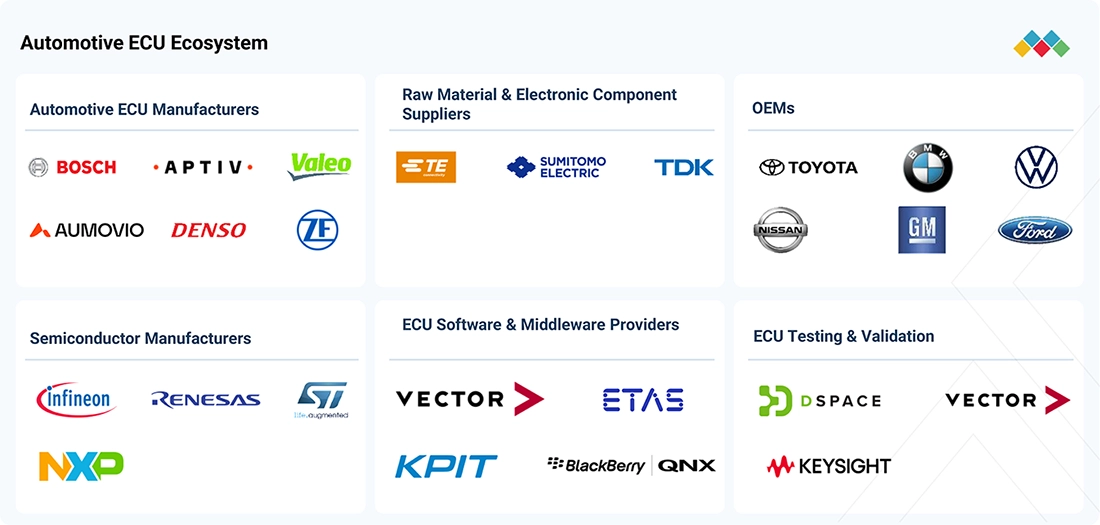
Logos and trademarks shown above are the property of their respective owners. Their use here is for informational and illustrative purposes only.
MARKET SEGMENTS
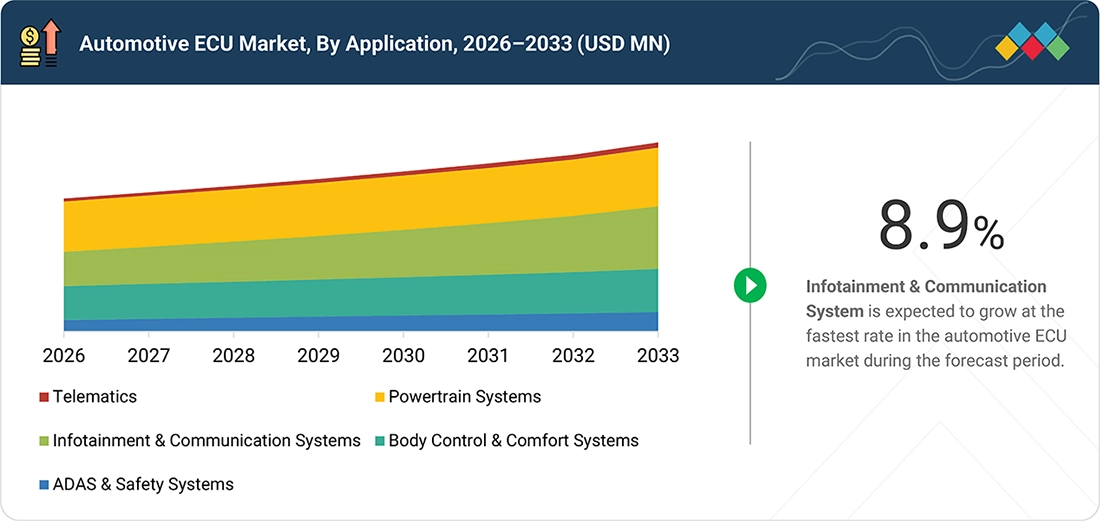
Source: Secondary Research, Interviews with Experts, MarketsandMarkets Analysis
Automotive ECU Market, By Vehicle Type
Passenger cars are expected to lead the automotive ECU market due to their higher production volumes and increasing electronic content per vehicle. The growing adoption of ADAS, infotainment, connectivity, electrification, and advanced body-control functions is increasing ECU requirements in passenger vehicles. Premium and mid-range models are also adopting centralized computing and multiple domain controllers, supporting higher ECU value per vehicle.
Automotive ECU Market, By Application
Infotainment and communication systems are expected to lead the automotive ECU market due to rising demand for connected cockpits, integrated infotainment, and cloud-based vehicle services. Increasing adoption of large displays, smartphone connectivity, voice assistants, and OTA updates is driving higher computing requirements. The integration of connectivity and infotainment functions into high-performance cockpit controllers is also increasing ECU value.
Automotive ECU Market, By EV Type
BEVs are expected to lead the automotive ECU market due to their higher electronic content across battery, powertrain, thermal management, charging, and energy management systems. Battery management systems, inverter control, onboard chargers, and DC-DC converters require dedicated electronic control functions. The growing adoption of advanced ADAS, connected features, and centralized vehicle computing further increases ECU demand in BEVs.
Automotive ECU Market, By EV Application
ADAS & safety systems are expected to lead the automotive ECU market in EVs because camera, radar, and other sensing functions are increasingly integrated into dedicated control units. EV platforms increasingly support functions such as automatic emergency braking, adaptive cruise control, lane keeping, and driver monitoring. Higher levels of vehicle automation also require greater processing capability and multiple safety-critical ECUs, increasing ECU content per EV.
Automotive ECU Market, By ECU Capacity
64-bit ECUs are expected to grow at the fastest rate due to their ability to handle higher computational workloads required by ADAS, connected vehicle functions, and software-defined architectures. Their larger address space and processing capability support complex software stacks, high-resolution sensor data, and AI-based applications. Increasing adoption of high-performance domain and zonal controllers is further accelerating the shift toward 64-bit processing.
Automotive ECU Market, By Autonomy
Semi-autonomous vehicles are expected to lead the automotive ECU market due to the growing adoption of Level 2 and Level 2+ ADAS functions in mass-market vehicles. These vehicles require multiple ECUs to process inputs from cameras, radar, and other sensors for functions such as adaptive cruise control and lane centering. Increasing integration of automated driving and safety functions is also raising ECU processing and control requirements.
REGION
Asia Pacific to be the fastest growing region in the automotive ECU market during forecast period
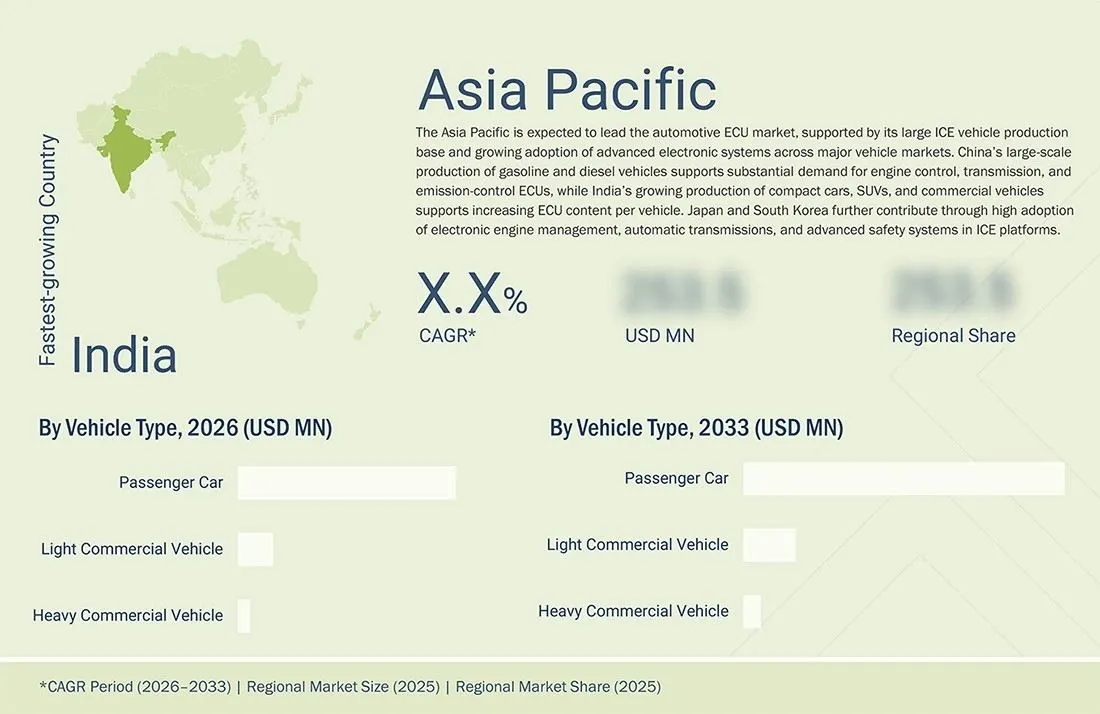
The Asia Pacific is expected to grow at the fastest rate in the automotive ECU market. In China, vehicles are adopting more advanced engine management, transmission control, ADAS, and connected infotainment systems. Japan is strengthening the use of electronic control systems for fuel-efficient engines, hybridized ICE powertrains, and advanced safety functions. South Korean automakers are integrating higher-level driver assistance, connectivity, and electronic body-control functions into ICE models. In India, growing adoption of electronically controlled engines, automatic transmissions, safety systems, and connected features is increasing ECU content in vehicles.
AUTOMOTIVE ECU MARKET: COMPANY EVALUATION MATRIX
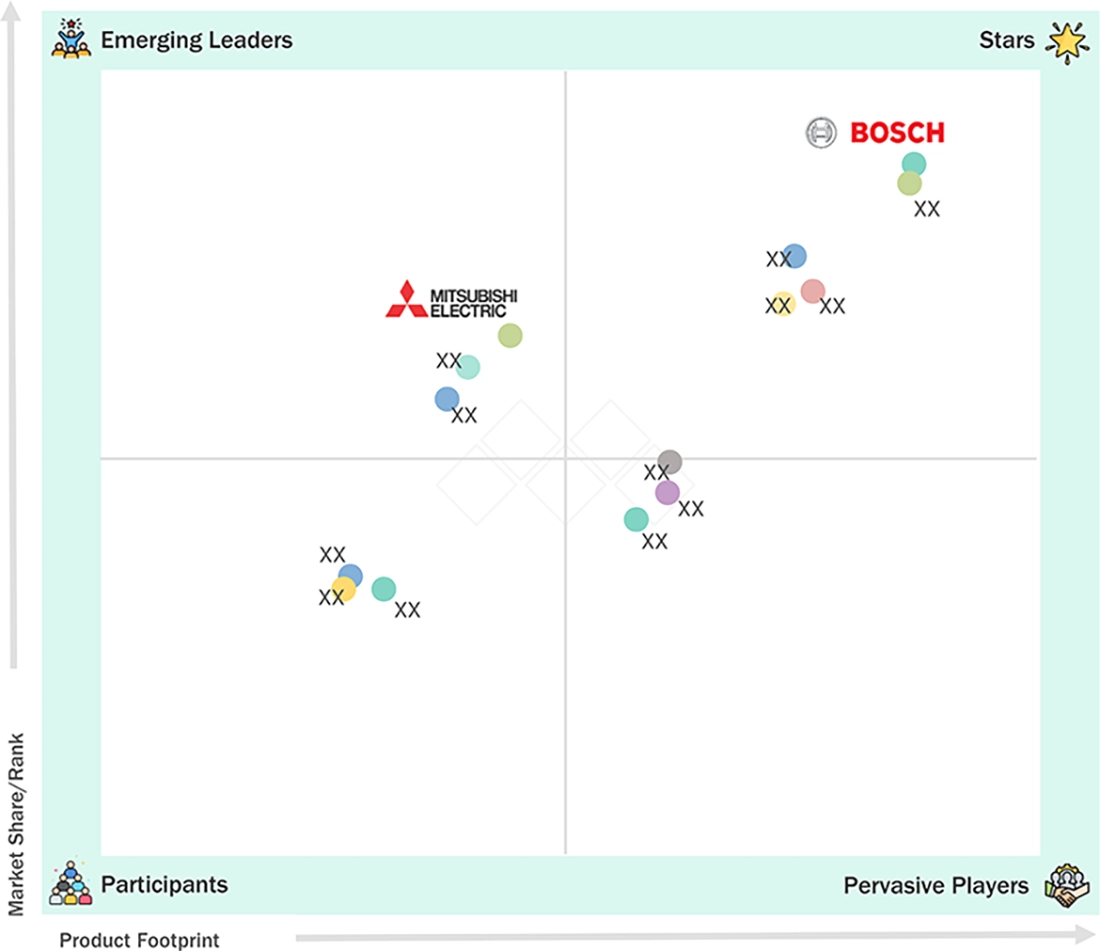
In the automotive ECU market matrix, Robert Bosch GmbH (Star) leads with its broad ECU portfolio spanning powertrain, body control, ADAS, and vehicle computing applications. The company continues to strengthen its market position through investments in centralized and zonal E/E architectures, software-defined vehicles, and high-performance computing platforms. Mitsubishi Electric Corporation (Emerging Leader) is gaining momentum through its ECU capabilities for engine control, transmission control, electric power steering, and advanced vehicle electronics. The company has strong growth potential to move toward the leaders' quadrant by expanding its portfolio of next-generation vehicle controllers and strengthening partnerships with global OEMs.
Source: Secondary Research, Interviews with Experts, MarketsandMarkets Analysis
KEY MARKET PLAYERS
- Robert Bosch GmbH (Germany)
- Denso Corporation (Japan)
- ZF Friedrichshafen AG (Germany)
- Aptiv (Ireland)
- Aumovio SE (Germany)
- Mitsubishi Electric Corporation (Japan)
- Hyundai Mobis (South Korea)
- HELLA GmbH & Co. KGaA (Germany)
- Mobileye (Israel)
- Magna International Inc. (Canada)
- Valeo (France)
- Panasonic Holdings Corporation (Japan)
MARKET SCOPE
| REPORT METRIC | DETAILS |
|---|---|
| Market Size in 2025 (Value) | USD 111.62 Billion |
| Market Forecast in 2026 (Value) | USD 113.27 Billion |
| Market Forecast in 2033 (Value) | USD 160.59 Billion |
| Growth Rate | CAGR of 5.1% from 2026-2033 |
| Years Considered | 2022-2033 |
| Base Year | 2025 |
| Forecast Period | 2026-2033 |
| Units Considered | Value (USD Million/Billion), Volume (Thousand units) |
| Report Coverage | Revenue forecast, company ranking, competitive landscape, growth factors, and trends |
| Segments Covered |
|
| Regions Covered | Asia Pacific, Europe, North America, Rest of the World |
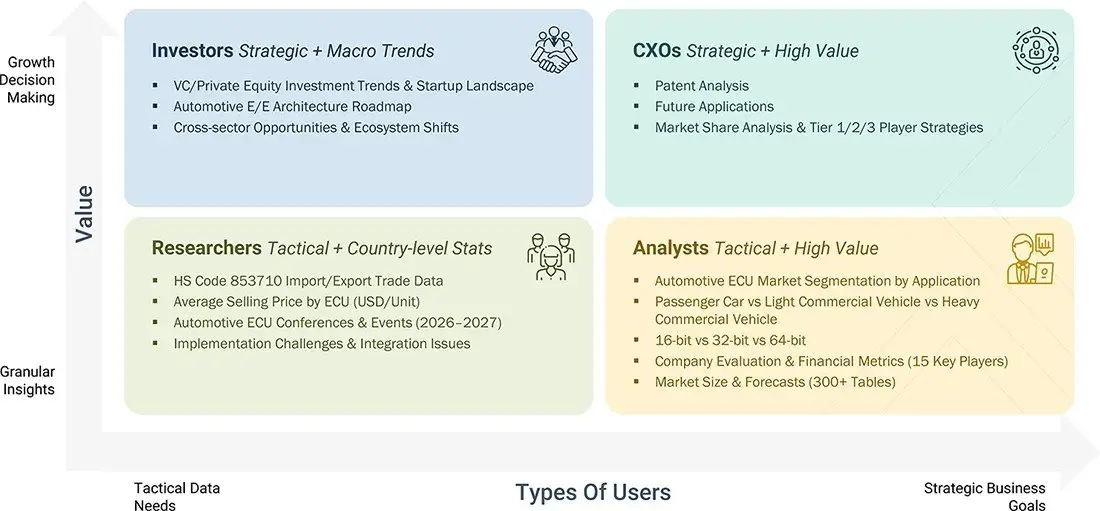
WHAT IS IN IT FOR YOU: AUTOMOTIVE ECU MARKET REPORT CONTENT GUIDE
DELIVERED CUSTOMIZATIONS
We have successfully delivered the following deep-dive customizations:
| CLIENT REQUEST | CUSTOMIZATION DELIVERED | VALUE ADDS |
|---|---|---|
| Global Automotive OEM (Europe) |
|
|
| Tier-1 ECU Supplier (Germany) |
|
|
| EV Manufacturer (China) |
|
|
| Automotive Semiconductor Company (Japan) |
|
|
| ADAS Technology Provider (US) |
|
|
RECENT DEVELOPMENTS
- July 2026 : AUMOVIO SE (Germany) and BMW Group (Germany) entered into a long-term supply and development agreement to expand their collaboration in automotive electronics and braking technologies. The agreement covers supplying and developing the MK C2 integrated brake system, brake calipers, and other electronic control solutions for future vehicle platforms.
- July 2026 : HELLA GmbH & Co. KGaA (Germany) announced that its first headlamp ECU using fully domestically developed chips has entered mass production in China. The ECU has a compact, lightweight design, similar in size to a standard bank card and weighing 87 grams. Its modular architecture reduces space requirements and material costs. The ECU uses a symmetrical left-right architecture to centrally control more than ten lighting functions, including low beams, high beams, and turn indicators.
- June 2026 : Aptiv (Ireland) signed a strategic cooperation agreement with Cornex Automobile to collaborate on developing and expanding the market for intelligent cockpit domain controllers and related products. The partnership combines Aptiv’s expertise in central computing platforms, domain controller development and manufacturing, and full-stack solutions to improve vehicle control capabilities and overall vehicle performance.
- May 2026 : Denso Corporation (Japan) showcased its Cross-Domain Computer and Zone ECU, at JSAE Yokohama 2026. The system supports next-generation mobility by integrating AI and various vehicle services. The Zone ECU connects with vehicle functions and manages power and communications. It also collects data from multiple sensors and sends it to the Integrated Mobility Computer to support vehicle control.
- March 2026 : Infineon Technologies AG (Germany) and Subaru Corporation collaborated to improve safety, confidence, and comfort in future Subaru vehicles. Infineon supports Subaru’s integrated ECU for next-generation ADAS and vehicle motion control. Its latest AURIX MCU improves the ECU’s real-time performance, enabling faster and more reliable processing of vehicle and sensor data.
Table of Contents
 Exclusive indicates content/data unique to MarketsandMarkets and not available with any competitors.
Methodology
The study involved four major activities in estimating the current size of the automotive ECU market. Exhaustive secondary research was done to collect information on the market, peer, and child markets. The next step was to validate these findings and assumptions and size them with industry experts across value chains through primary research. The top-down and bottom-up approaches were employed to estimate the complete market size. Thereafter, market breakdown and data triangulation processes were used to estimate the market size of segments and subsegments.
Secondary Research
In the secondary research process, various secondary sources such as company annual reports, investor presentations, press releases, industry association publications [for example, International Organization of Motor Vehicle Manufacturers (OICA), European Automobile Manufacturers’ Association (ACEA), National Highway Traffic Safety Administration (NHTSA), European Commission, Society of Automotive Engineers (SAE International), United Nations Economic Commission for Europe (UNECE), International Energy Agency (IEA)], government publications, technical articles, white papers, journals, trade websites, company product brochures, technical handbooks, and databases (for example, MarkLines, and Factiva) have been used to identify and collect information for an extensive commercial study of the global automotive ECU market.
Primary Research
Extensive primary research was conducted after understanding the scenario of the automotive ECU market through secondary research. Several primary interviews were conducted with market experts from both demand (automotive OEMs, commercial vehicle manufacturers, EV manufacturers, and fleet operators) and supply (ECU manufacturers, Tier-1 automotive suppliers, semiconductor companies, embedded software providers, and system integrators) sides across Asia Pacific, Europe, North America, and the Rest of the World. Approximately 21% and 79% of primary interviews were conducted from the demand and supply sides, respectively. Primary data were collected through questionnaires, emails, and telephonic interviews. The interviews focused on ECU adoption by vehicle type, ECU content per vehicle, application-wise demand, pricing, centralized and zonal architectures, EV and ADAS applications, technology adoption, and supplier strategies.
In the canvassing of primary data, various departments within organizations, such as sales, operations, and administration, were covered to provide a holistic viewpoint in this report. After interacting with industry experts, brief sessions with highly experienced independent consultants were also conducted to reinforce the findings from primary data. These, along with the in-house subject matter experts’ opinions, led to the findings described in the remainder of this report.
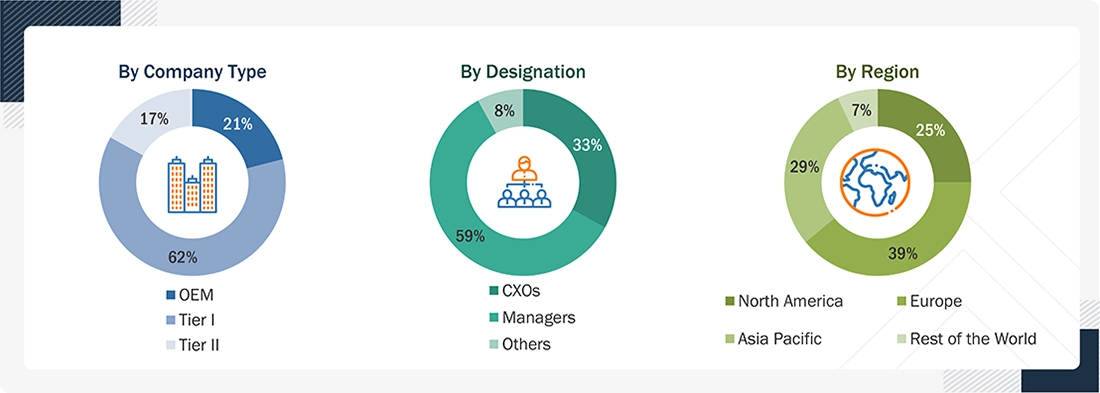
Note: Others include subject matter experts (SMEs), engineers, consultants, and business development professionals.
Company Tiers are based on the Value Chain; company revenue is not considered.
To know about the assumptions considered for the study, download the pdf brochure
Market Size Estimation
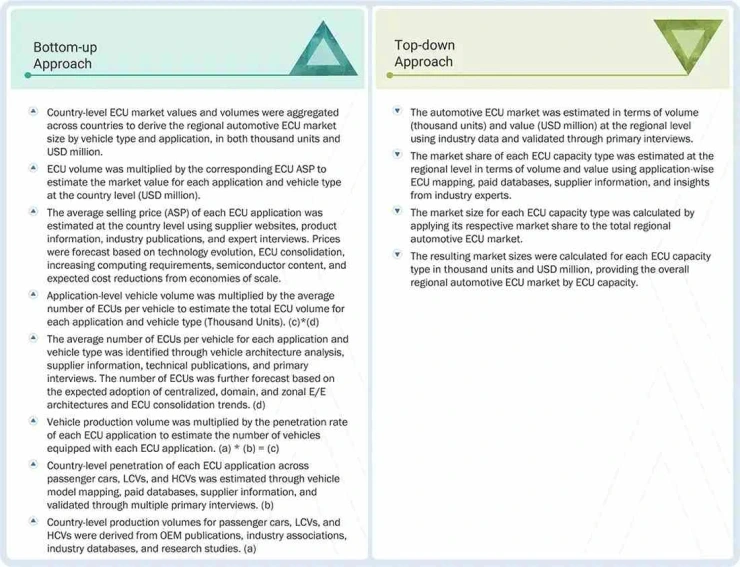
Both top-down and bottom-up approaches were used to estimate and validate the total size of the automotive ECU market. These methods were also used extensively to estimate the size of various subsegments in the market. The research methodology used to estimate the market size includes the following:
Data Triangulation
After arriving at the overall market size using the market size estimation processes as explained above, the market was split into several segments and subsegments. To complete the overall market engineering process and arrive at the exact statistics of each market segment and subsegment, data triangulation and market breakdown procedures were employed, wherever applicable. The data was triangulated by studying various factors and trends from both the demand and supply sides.
Market Definition
An Automotive Electronic Control Unit (ECU) is an embedded electronic device that controls and manages specific functions or systems within a vehicle. It receives inputs from sensors, processes the information using programmed software, and sends commands to actuators or other vehicle systems. ECUs are used across powertrain, body, chassis, safety, infotainment, ADAS, and other vehicle applications. Modern vehicles increasingly use domain controllers, zone ECUs, and centralized computing platforms to integrate multiple functions and reduce the number of individual ECUs.
Key Stakeholders
- ADAS and Autonomous Driving Technology Providers
- Automotive Aftermarket and Service Providers
- Automotive Component Manufacturers
- Automotive E/E Architecture and System Integrators
- Automotive ECU Manufacturers
- Automotive Embedded Software and Platform Providers
- Automotive Industry Associations and Standardization Bodies
- Automotive Original Equipment Manufacturers (OEMs)
- Automotive Research Organizations
- Automotive Semiconductor Manufacturers
- Automotive Testing, Validation, and Certification Organizations
- Commercial Vehicle and Fleet Manufacturers
- Electric Vehicle (EV) and EV Component Manufacturers
- Vehicle Safety and Regulatory Authorities
Report Objectives
- To define, segment, and forecast the size of the automotive ECU market in terms of volume (thousand units) and value (USD million) based on the following categories:
- Vehicle type (Passenger Car, Light Commercial Vehicle, and Heavy Commercial Vehicle)
- Application (ADAS & safety system, body control & comfort system, infotainment & communication system, powertrain system, and telematics)
- EV type [(Battery electric vehicle (BEV) and Plug-in hybrid electric vehicle (PHEV)]
- EV application (ADAS & safety system, Battery Management System, Power Electronics Control, Charging Systems, Vehicle Energy Management)
- ECU Capacity (16-bit, 32-bit, and 64-bit)
- Region [North America, Europe, Asia Pacific, and the Rest of the World (RoW)]
- To segment and forecast the size of the automotive ECU market, by value, based on autonomy
- Non-autonomous, semi-autonomous, and autonomous
- Technology [(Microcontroller, digital signal processor, application-specific integrated circuit, field-programmable gate array, system-on-chip (SOC)] and type [smart actuator/edge node ECU, central ECU / domain controller ECU, zonal ECU, and others] are covered qualitatively
- To evaluate the key market dynamics influencing the automotive ECU market, including strategic drivers, restraints, opportunities, challenges, and emerging technology trends shaping future market growth across ICE, hybrid, and electric vehicles
- To study the following with respect to the market:
- Supply Chain Analysis
- Ecosystem Analysis
- Technology Analysis
- Trade Analysis
- Investment and Funding Scenario
- Pricing Analysis
- Case Study Analysis
- Patent Analysis
- Regulatory Landscape
- Key Stakeholders and Buying Criteria
- Emerging business models and ecosystem shifts
- Supplier analysis
- OEM insights and strategic analysis
- Impact of AI on automotive ECU market
- Europe-India trade deals: Impact Analysis
- Israel-Iran war impact on automotive ECU market
- To benchmark the competitive positioning of key players in the automotive ECU market through a comprehensive analysis of market share, revenue performance, strategic initiatives, innovation capabilities, product differentiation, and competitive strengths across the automotive ECU value chain.
- To map the competitive ecosystem of the automotive ECU market by categorizing market participants into Stars, Emerging Leaders, Pervasive Players, and Participants using a robust evaluation framework based on the strength of their automotive ECU portfolio, business strategy, innovation capability, geographic footprint, and market presence.
- To assess the competitive landscape of the automotive ECU market by profiling leading global manufacturers based on their business overview, automotive ECU product portfolio, geographic presence, financial performance, and recent strategic developments such as product launches, partnerships, acquisitions, capacity expansions, and technological advancements.
Available customizations:
With the given market data, MarketsandMarkets offers customizations to meet company-specific needs.
- Automotive ECU market by vehicle type at country-level
- Profiling of additional market players (Up to 5)


Personalize This Research
- Triangulate with your Own Data
- Get Data as per your Format and Definition
- Gain a Deeper Dive on a Specific Application, Geography, Customer or Competitor
- Any level of Personalization
Let Us Help You
- What are the Known and Unknown Adjacencies Impacting the Automotive ECU Market
- What will your New Revenue Sources be?
- Who will be your Top Customer; what will make them switch?
- Defend your Market Share or Win Competitors
- Get a Scorecard for Target Partners

Custom Market Research Services
We Will Customise The Research For You, In Case The Report Listed Above Does Not Meet With Your Requirements
Get 10% Free CustomisationTESTIMONIALS

JIM NAAS
PRODUCT DIRECTOR, WEASLER
Weasler Engineering, a CentroMotion organization
Global Provider of Industrial Actuation & Control Solutionswww.weasler.com
Our organization was interested in learning more about the attractiveness of a particular market space. We contacted MarketsandMarkets to help us based on previous positive experiences we had with them. The results did not disappoint! We discussed our objectives with them, and the team at MarketsandMarkets developed and executed a proposal that met our needs precisely. We were very impressed by their level of expertise, the quality of the analysis and their insightful recommendations. We would not hesitate in working with them again in the future.

Matt Kardel,
Vice President
Aptiv,
A global technology company that develops safer, greener and more connected solutions.www.aptiv.com
We contracted with
MarketsandMarkets to evaluate the value chain and potential go-to-market partners related to our
interest in the Fleet Management space. The team successfully completed the work on time and at the
pricing agreed. MarketsandMarkets listened and understood our objectives and collaborated well with
us to help us get the visibility we needed to make an investment.
We have subsequently used
MarketsandMarkets again related to Smart Cities to good results.






Growth opportunities and latent adjacency in Automotive ECU Market