Customer Data Platform (CDP) Market Size, Share, Growth, Trends & Opportunities

Customer Data Platform Market by Platform (Traditional CDPs, Marketing Cloud, Composable, Hybrid), Application (Customer Data Management, Personalization & Recommendations, Analytics & Customer Intelligence), Vertical, Region - Global Forecast to 2031




OVERVIEW
Source: Secondary Research, Interviews with Experts, MarketsandMarkets Analysis
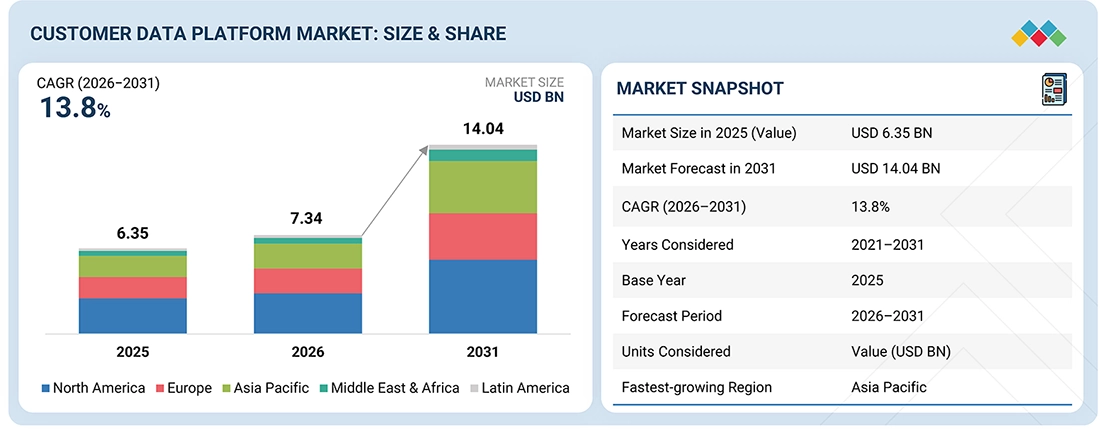
The Customer Data Platform (CDP) Market is projected to grow from USD 7.34 billion in 2026 to USD 14.04 billion by 2031, at a CAGR of 13.8%. The market expansion is supported by enterprise investments in unified, governed, activation-ready customer data environments. Organizations increasingly consolidate information from CRM, ecommerce, mobile applications, contact centers, loyalty systems, and advertising platforms. Demand is strengthening for unified profiles, identity resolution, consent management, audience segmentation, and real-time personalization. Enterprises also deploy CDPs to improve customer retention, marketing effectiveness, journey orchestration, and lifetime value. Continued cloud adoption, first-party data strategies, and AI-enabled decisioning will accelerate market development.
Market Size and Forecast:
- 2025 Market Size: USD 6.35 Billion
- 2026 Projected Market Size: USD 7.34 Billion
- 2031 Forecasted Market Size: USD 14.04 Billion
- Growth Rate (2026-2031): CAGR of 13.8%
- Data available from 2025 to 2031
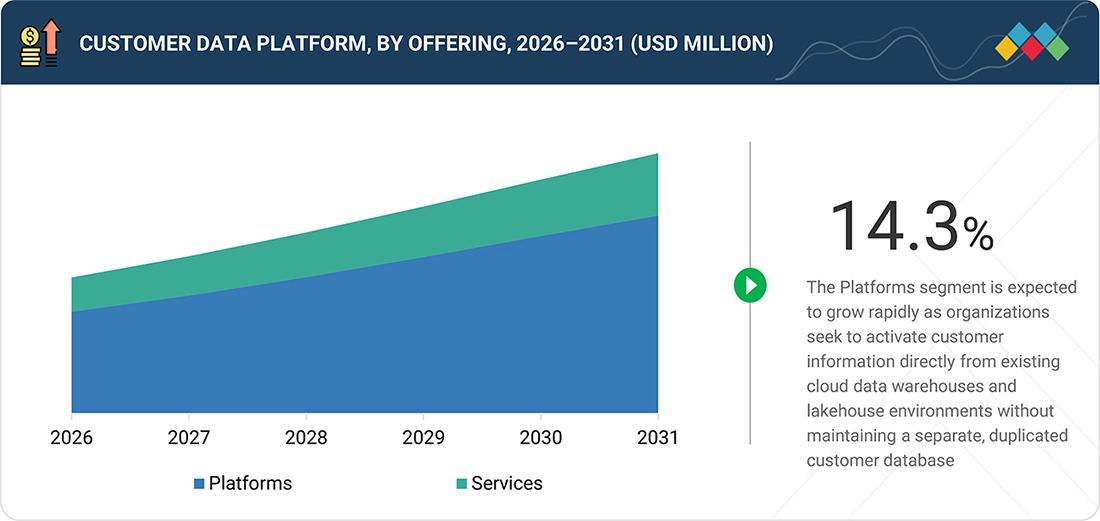
- Platform Segments dominates customer data platforms market with growing CAGR of 14.3%
Key Market Trends and Insights
- Fastest Growing region: Asia Pacific
-
Driving Factors: AI-driven personalization, zero-party data adoption, real-time activation, composable CDPs, and privacy-first customer engagement.
- Latest Trends: AI automation, global e-invoicing mandates, and a shift toward cloud platforms.
- Emerging Opportunities: offers enterprises opportunities in hyper-personalization, customer retention, predictive analytics, and cross-channel marketing optimization
- AI Impact: AI is reshaping the Customer Data Platform Market by automating insights, personalization, and predictive customer engagement.
- Leading Companies: Oracle (US), SAP (Germany), Adobe (US), Salesforce (US), Twilio (US), Microsoft (US)
KEY TAKEAWAYS
-
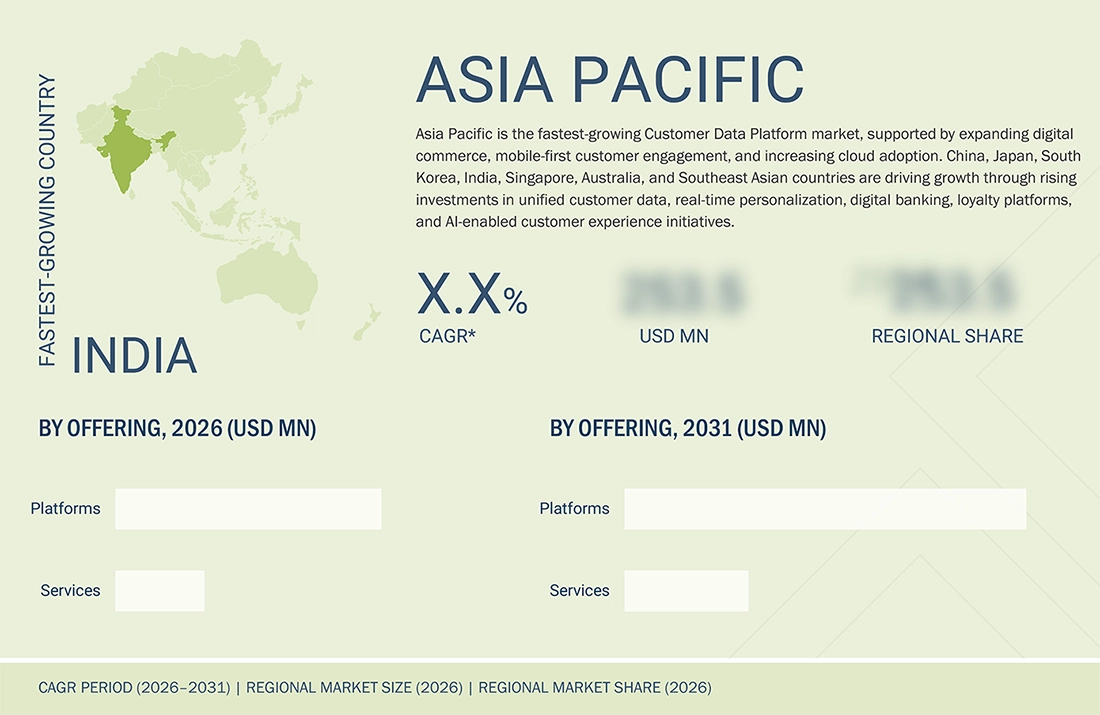
BY REGIONThe Asia Pacific region is poised to register the highest CAGR of 15.8% over the forecast period.
-
BY OFFERINGBy offering, the platforms segment is estimated to account for the largest share of 74.7% in 2026.
-
BY DEPLOYMENTBy deployment, the cloud deployment segment is expected to capture a larger market share of 70.2% in 2026.
-
BY ENTERPRISE SIZEBy enterprise size, SMEs are slated to grow at the fastest rate between 2026 and 2031.
-
BY APPLICATIONBy application, the AI-driven customer experience segment is expected to witness the fastest growth rate over the forecast period.
-
BY VERTICALBy vertical, the manufacturing segment is expected to witness the fastest growth rate over the forecast period.
-
BY COMPETITIVE LANDSCAPE - KEY PLAYERSThe competitive landscape is characterized by strategic alliances and continuous innovation, with major players such as Salesforce, Adobe, Oracle Corporation, SAP SE, Tealium Inc., and Microsoft Corporation expanding customer data platform capabilities to unify customer information, strengthen identity resolution, enable real-time personalization, improve audience activation, and support AI-driven customer engagement across enterprise channels.
-
BY COMPETITIVE LANDSCAPE - STARTUPS/SMESFirstHive Technologies Pvt. Ltd., NGDATA NV, Supermetrics Oy, Meiro, and Lexer, among others, have differentiated themselves among startups and SMEs by establishing strong positions in specialized areas such as composable customer data activation, sovereign data management, telecommunications-focused CDPs, restaurant customer intelligence, and real-time journey orchestration, underscoring their potential as emerging participants in the customer data platform market.
The customer data platform market in 2026 extends beyond traditional marketing technology deployments. Key adoption drivers include digital transformation, AI-enabled personalization, and first-party data strategies. These factors are moving CDPs from marketing silos into enterprise-wide data environments. Advances in identity resolution improve profile accuracy across fragmented customer interaction channels. Real-time data processing enables faster segmentation, activation, and personalized customer engagement. Composable architectures reduce duplication by activating data within existing cloud environments. Zero-copy connectivity also improves governance across warehouses, applications, and operational systems. Enterprises increasingly connect CRM, commerce, service, advertising, and loyalty data sources. Unified profiles support coordinated experiences across marketing, sales, commerce, and service functions. Privacy controls are becoming central to customer data collection and activation strategies. AI-driven decisioning helps organizations deliver more relevant offers and customer interactions. These capabilities strengthen customer retention, marketing efficiency, and long-term customer value.
TRENDS & DISRUPTIONS IMPACTING CUSTOMERS' CUSTOMERS
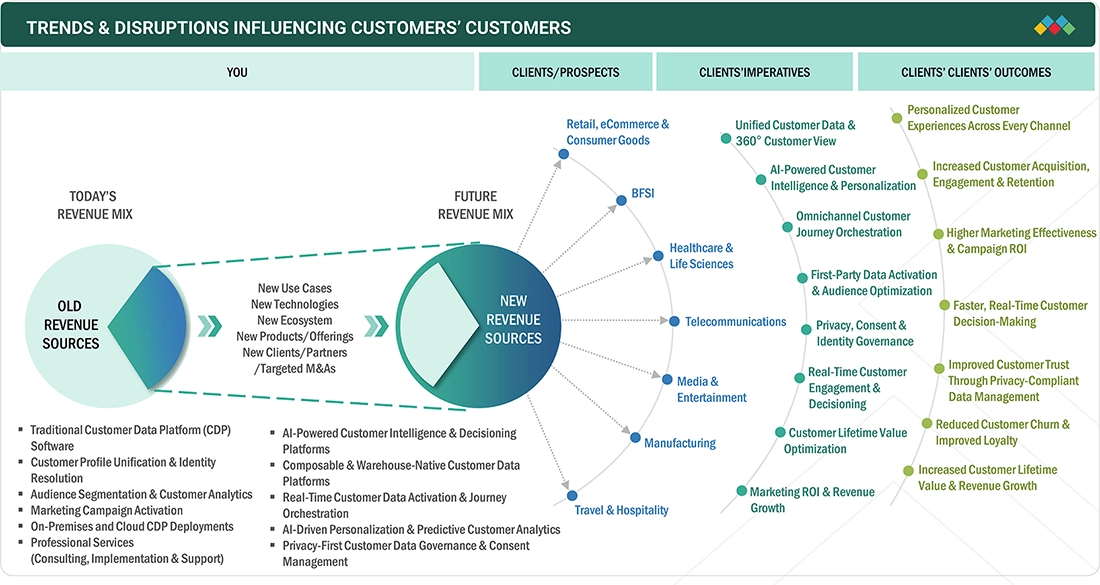
The customer data platform market is shifting from fragmented databases toward unified, activation-ready customer ecosystems. Enterprises connect behavioral, transactional, service, commerce, and consent data across channels. Composable architectures are reducing duplication while improving control across data environments. Real-time identity resolution is replacing static profiles with updated customer intelligence. AI-driven decisioning is strengthening segmentation, personalization, recommendations, and next-best-action execution. Privacy, consent, and governance are becoming embedded requirements across every deployment model. Retail, BFSI, telecommunications, manufacturing, media, healthcare, and travel are accelerating adoption. New entrants are challenging suites with warehouse-native and industry-specific platform offerings. Agentic workflows are extending CDPs beyond marketing into sales, service, and commerce operations. Customer journey orchestration is becoming more adaptive, measurable, and contextually responsive. Enterprises increasingly prioritize trusted profiles, faster activation, and measurable customer lifetime value. These disruptions are reshaping competitive positioning, partnership strategies, and long-term platform economics.
Source: Secondary Research, Interviews with Experts, MarketsandMarkets Analysis
MARKET DYNAMICS

Level
-
Growing shift toward first-party and consented zero-party data strategies

-
Expanding adoption of AI and predictive analytics for customer intelligence


Level
-
Increasing complexity of data privacy, consent management, and regulatory compliance

-
High implementation cost due to integration with legacy enterprise systems


Level
-
Emergence of composable and warehouse-native CDP architectures

-
Growing CDP adoption among mid-market enterprises and digital-native brands


Level
-
Complex identity resolution and customer profile unification across fragmented data sources

-
Maintaining data quality, governance, and lineage across expanding customer data ecosystems

Source: Secondary Research, Interviews with Experts, MarketsandMarkets Analysis
Driver: Growing shift toward first-party and consented zero-party data strategies
The retirement of third-party identifiers and tighter consent regulations are accelerating customer-supplied data strategies. Zero-party data captures information customers intentionally provide, including preferences, intentions, and profile details. Its explicit-consent foundation makes it reliable for personalization and audience engagement. This shift reflects a consent economy requiring transparent, mutually beneficial data exchanges. Companies failing to communicate data usage risk weakening trust and customer relationships. Zero-party data differs from behavioral first-party data collected through observed customer interactions. However, both require persistent, governed records supporting consented data activation across customer channels. GDPR reinforces this transition through purpose limitation, data minimization, and explicit consent requirements. Browser restrictions and cookie deprecation further reduce dependence on third-party audience tracking. Consequently, marketers are redesigning customer data stacks around owned and consented information. CDPs provide the operational layer for capturing, unifying, governing, and activating these records. This market driver will intensify as privacy standards expand and third-party identifiers decline.
Restraint: Increasing complexity of data privacy, consent management, and regulatory compliance
Increasing privacy, consent management, and regulatory complexity restrain customer data platform adoption. CDPs consolidate personally identifiable information across channels, increasing exposure to overlapping legal requirements. Regulations require explicit consent, audit-ready lineage, and enforceable data-subject rights. Compliance burdens intensify as obligations vary across jurisdictions and evolve. FTC enforcement highlights risks involving unfair practices, sensitive data, and inadequate disclosures. European requirements mandate purpose limitation, data minimization, and justified retention periods. CDPs can become central regulatory risk points because they unify multiple sources. Consent captured within one system must remain consistent across downstream activation channels. Failures to propagate opt-outs or deletion requests can trigger enforcement and reputational damage. Location, behavioral, and other sensitive data require rigorous governance and documentation. Vendors and enterprises must maintain consistent controls across fragmented regulatory environments. This complexity increases deployment costs, extends implementation timelines, and limits operational flexibility. Consequently, privacy and compliance risks remain persistent restraints on market expansion worldwide.
Opportunity: Emergence of composable and warehouse-native CDP architectures
Composable and warehouse-native CDP architecture creates opportunities across the customer data platform market. These models activate customer intelligence directly within cloud data infrastructure. Organizations avoid duplicating sensitive information inside separate proprietary CDP databases. Databricks’ CustomerLake illustrates this shift through governed, lakehouse-native customer profiles and activation. Its Profile Agents prepare data, identify quality issues, and unify fragmented records. Campaign Agents then build audiences, recommend actions, and support continuous engagement. This approach benefits enterprises already using Snowflake, Databricks, or BigQuery environments. It reduces duplicate storage, shortens integration timelines, and strengthens governance boundaries. Data-platform vendors can expand into customer engagement and marketing activation use cases. Systems integrators can design governed, warehouse-native customer intelligence architectures for enterprise deployments. Enterprises also gain scalable CDP capabilities without purchasing disconnected marketing data stores. Industry momentum increasingly favors embedded or composable deployment within existing data platforms. Consequently, warehouse-native architectures represent an opportunity for vendors, integrators, and data-mature enterprises.
Challenge: Complex identity resolution and customer profile unification across fragmented data sources
Complex identity resolution and profile unification remain persistent customer data platform market challenges. Enterprises must determine whether fragmented records represent the same individual across disconnected systems. This process requires deterministic matching, probabilistic inference, deduplication, and continuous record reconciliation. Enterprise-scale execution remains costly because pairwise comparisons demand substantial computational resources. Real-world data quality issues further intensify complexity across production customer-data environments. Customers frequently use multiple emails, shared devices, guest checkouts, and inconsistent identifiers. These behaviors complicate matching and weaken unified profile accuracy across channels. Inaccurate resolution reduces personalization, segmentation, attribution, and AI model reliability. Consequently, vendors must continuously refine identity graphs, matching logic, and governance controls. This remains technically demanding worldwide.
CUSTOMER DATA PLATFORM (CDP) MARKET: COMMERCIAL USE CASES ACROSS INDUSTRIES
| COMPANY | USE CASE DESCRIPTION | BENEFITS |
|---|---|---|
 |
The Home Depot implemented Adobe Real-Time CDP to combine customer information from website activity, in-store purchases, call-center interactions, returns, order cancellations, and other touchpoints into unified customer profiles. The retailer uses real-time behavioral signals and profile information to understand customer projects, develop high-value audience segments, and deliver relevant media campaigns, offers, recommendations, and digital customer journeys. | Established unified profiles across online and offline channels. | Managed approximately 170 million customer profiles | Reduced audience-to-experience deployment time from as long as 10 days to approximately 24 hours | Improved personalized offers, messaging, and project-related recommendations (Adobe Business) |
 |
FedEx deployed Salesforce Data 360 to unify sales, shipping, website, marketing, and customer interaction data that was previously distributed across separate systems. The unified environment enables the company to identify inactive business customers, develop actionable audience segments, and coordinate personalized marketing and sales follow-up for international shipping and other relevant services. | Achieved more than 2,000% return on investment | Improved customer activation by 13% | Supported approximately one billion personalized emails annually | Reduced the time required to identify inactive customers from weeks to hours (Salesforce) |
 |
Iberia implemented Tealium to unify CRM, transactional, behavioral, and digital interaction data into a consistent customer view. The airline uses improved customer identification, real-time data, and audience orchestration to recognize abandoned booking journeys, retarget relevant travelers, and coordinate personalized engagement across customer touchpoints. | Increased recovery of users abandoning bookings by 57% | Generated a 12% sales uplift from retargeting flows | Improved customer identification across booking journeys | Strengthened collaboration among marketing, data, and customer experience teams (Tealium) |
Logos and trademarks shown above are the property of their respective owners. Their use here is for informational and illustrative purposes only.
MARKET ECOSYSTEM
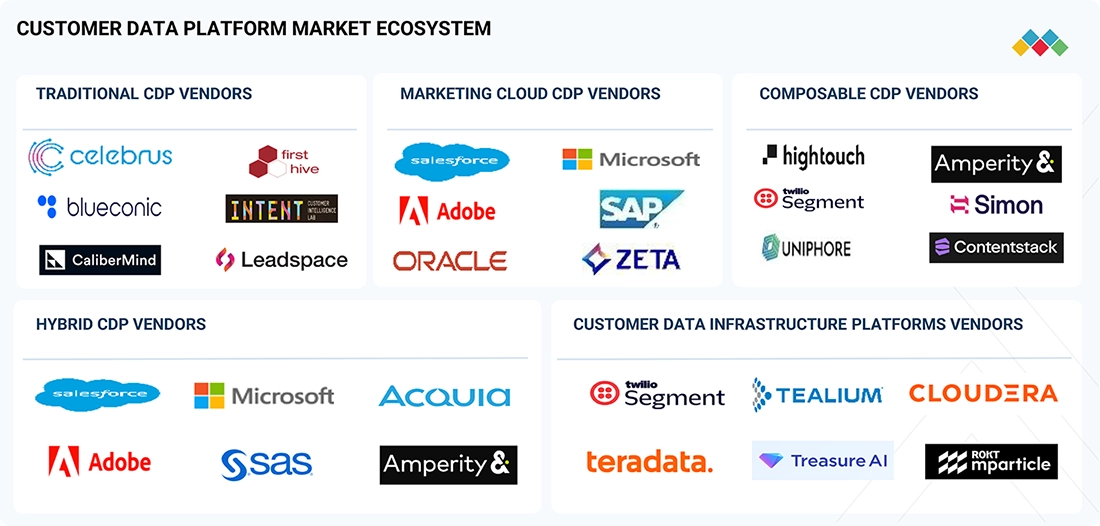
The customer data platform ecosystem brings together platforms supporting unified customer intelligence and activation. Traditional CDPs consolidate customer records, resolve identities, and support profile management. Marketing cloud CDPs connect customer data with campaigns, analytics, commerce, and service workflows. Composable CDPs activate governed warehouse data without requiring separate proprietary customer databases. Hybrid CDPs combine packaged capabilities with flexible connections across enterprise data environments. Customer data infrastructure platforms collect, standardize, route, and govern behavioral information. Salesforce, Adobe, Oracle, Microsoft, SAP, and Zeta support marketing ecosystems. Hightouch, Amperity, Simon Data, Uniphore, and Contentstack strengthen composable deployment alternatives. Segment, Cloudera, Teradata, Tealium, mParticle, and Treasure Data support data operations. Together, these participants enable segmentation, personalization, analytics, consent management, and real-time activation. Increasing AI adoption and cloud investment are making the ecosystem more interoperable. This evolution improves customer engagement, governance, scalability, and business outcomes.
Logos and trademarks shown above are the property of their respective owners. Their use here is for informational and illustrative purposes only.
MARKET SEGMENTS
Source: Secondary Research, Interviews with Experts, MarketsandMarkets Analysis
Customer Data Platform Market, By Offering
By offering, the platforms segment is estimated to account for the largest market share. Enterprises increasingly prioritize integrated platforms supporting customer data unification, identity resolution, and activation. These platforms consolidate customer information across CRM, commerce, service, and marketing systems. They also enable segmentation, personalization, analytics, consent management, and journey orchestration capabilities. Cloud-native architectures further improve scalability, interoperability, and real-time customer profile processing. Vendors continue enhancing platforms through AI-driven decisioning and zero-copy data connectivity. Large enterprises prefer centralized platforms supporting governance across multiple customer engagement functions. These capabilities collectively strengthen platform demand across diverse verticals and deployment environments.
Customer Data Platform Market, By Deployment
The cloud deployment segment is expected to capture a larger market share. Enterprises increasingly adopt cloud-based CDPs for scalability, flexibility, and faster implementation. Cloud deployment simplifies integration across distributed customer data sources and applications. It also supports real-time processing, continuous updates, and centralized data governance. Organizations benefit from lower infrastructure requirements and reduced platform maintenance complexity. Cloud-native services improve connectivity with warehouses, CRM platforms, and marketing applications. Vendors also deliver frequent enhancements through subscription-based software delivery models. Growing adoption of AI, composable architectures, and remote operations further supports demand. These factors collectively reinforce cloud deployment as the preferred market model.
Customer Data Platform Market, By Enterprise Size
By enterprise size, large enterprises are estimated to account for the largest market share. These organizations manage substantial customer data volumes across multiple brands, regions, and channels. Large enterprises require scalable CDPs supporting identity resolution, governance, analytics, and activation. They also integrate platforms with CRM, commerce, service, advertising, and data warehouses. Stronger technology budgets enable broader deployments across marketing and customer experience functions. Regulatory obligations further increase demand for consent management and auditable customer profiles. Large enterprises also prioritize real-time personalization, AI-driven decisioning, and journey orchestration. These requirements collectively strengthen their contribution to overall customer data platform market revenue.
Customer Data Platform Market, By Application
By application, AI-driven customer experience is expected to witness the fastest growth. Enterprises increasingly apply AI to personalize interactions across marketing, sales, commerce, and service. CDPs provide unified profiles supporting predictive analytics, recommendations, and next-best-action decisioning. AI models also improve audience prioritization, churn prediction, and customer lifetime value analysis. Real-time customer signals enable more contextual and responsive engagement across channels. Vendors continue embedding generative AI, machine learning, and agentic capabilities within platforms. These tools automate campaign execution, journey optimization, and customer service recommendations. Growing demand for intelligent personalization and measurable engagement outcomes strengthens adoption. Consequently, AI-driven customer experience represents a high-growth application area.
Customer Data Platform Market, By Vertical
By vertical, the manufacturing segment is expected to witness the fastest growth. Manufacturers increasingly unify dealer, distributor, customer, service, warranty, and product data. CDPs help improve channel visibility, account intelligence, and personalized customer engagement. Connected product data also supports proactive service and lifecycle communication strategies. Manufacturers use unified profiles to identify cross-selling and aftermarket revenue opportunities. Digital commerce expansion further strengthens direct customer relationships and data availability. Subscription models and outcome-based services increase requirements for continuous customer intelligence. CDPs also support partner engagement, retention, and installed-base analytics capabilities. These factors collectively accelerate platform adoption across manufacturing organizations during the forecast period.
REGION
Asia Pacific to be fastest-growing region in Customer Data Platform market during forecast period
Asia Pacific is projected to register the highest CAGR in the customer data platform market during the forecast period. Rapid ecommerce expansion is increasing customer data volumes across digital and mobile engagement channels. Enterprises are adopting CDPs to unify fragmented profiles across commerce, banking, and telecommunications ecosystems. Rising cloud adoption improves deployment scalability, integration flexibility, and real-time customer data activation. Mobile-first consumer behavior is strengthening demand for personalized experiences across diverse regional markets. Digital payment growth further expands transactional data available for segmentation, analytics, and decisioning. Investments in AI, loyalty platforms, and omnichannel engagement are accelerating enterprise adoption. China, India, Japan, South Korea, Australia, and Southeast Asia remain key growth contributors. Comparatively lower platform penetration also creates significant headroom for sustained regional market expansion.
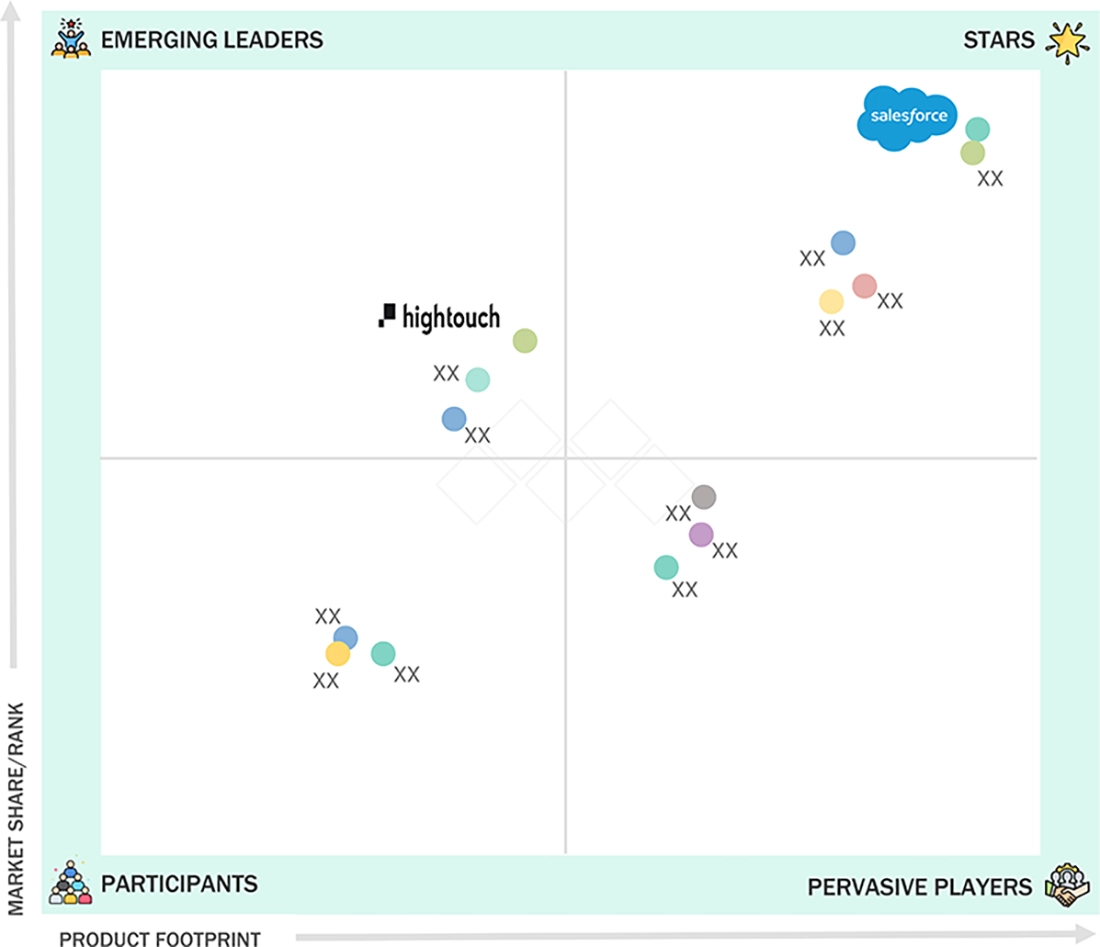
CUSTOMER DATA PLATFORM (CDP) MARKET: COMPANY EVALUATION MATRIX
Salesforce is one of the leading customer data platform vendors through its integrated Data Cloud ecosystem. The company unifies customer data across sales, service, marketing, commerce, and analytics environments. Its zero-copy architecture, identity resolution, segmentation, and real-time activation strengthen enterprise adoption. AI-enabled capabilities also support personalization, decisioning, automation, and agent-driven customer engagement. Salesforce reinforces its leadership through broad integrations, industry solutions, and recurring cloud revenues. Hightouch is an emerging CDP player through its composable, warehouse-native customer data architecture. The company activates governed data directly from existing cloud warehouses and lakehouses. Its platform supports audience building, reverse ETL, identity resolution, and real-time decisioning. Hightouch is expanding through AI-driven orchestration, strong data-platform partnerships, and enterprise adoption. These capabilities continue strengthening its position within the evolving global customer data platform market.
Source: Secondary Research, Interviews with Experts, MarketsandMarkets Analysis
KEY MARKET PLAYERS
- Salesforce (US)
- Adobe (US)
- Oracle Corporation (US)
- Publicis Groupe (Epsilon) (France)
- SAP SE (Germany)
- Zeta Global Holdings Corp. (US)
- Microsoft Corporation (US)
- Tealium Inc. (US)
- Klaviyo (US)
- Twilio, Inc. (US)
- Bloomreach, Inc. (US)
- Teradata Corporation (US)
- Teradata Corporation (US)
- SAS Institute Inc. (US)
- Hightouch (US)
MARKET SCOPE
| REPORT METRIC | DETAILS |
|---|---|
| Market Size in 2025 (Value) | USD 6.35 Billion |
| Market Forecast in 2026 (Value) | USD 7.34 Billion |
| Market Forecast in 2031 (Value) | USD 14.04 Billion |
| Growth Rate | 13.8% |
| Years Considered | 2021–2031 |
| Base Year | 2025 |
| Forecast Period | 2026–2031 |
| Units Considered | Value (USD Billion) |
| Report Coverage | Revenue forecast, company ranking, competitive landscape, growth factors, and trends |
| Segments Covered |
|
| Regions Covered | North America, Europe, Asia Pacific, Middle East & Africa, Latin America |
WHAT IS IN IT FOR YOU: CUSTOMER DATA PLATFORM (CDP) MARKET REPORT CONTENT GUIDE
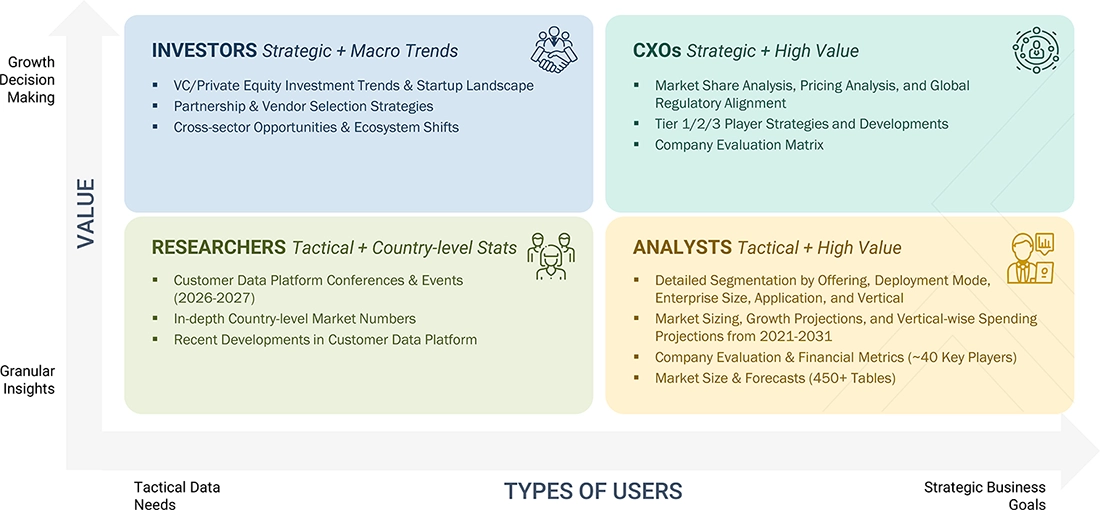
DELIVERED CUSTOMIZATIONS
We have successfully delivered the following deep-dive customizations:
| CLIENT REQUEST | CUSTOMIZATION DELIVERED | VALUE ADDS |
|---|---|---|
| Leading Customer Data Platform provider (North America) |
|
|
| Leading Customer Data Platform provider (Europe) |
|
|
RECENT DEVELOPMENTS
- May 2026 : Salesforce enhanced Data 360 and Agentforce through expanded trusted-data connectivity and agent interoperability capabilities. New updates enabled Agentforce Data Libraries, additional data connectors, and governed enterprise knowledge access. These developments allow AI agents to use unified information, automate workflows, and deliver more contextual customer engagement across Salesforce environments.
- April 2026 : Salesforce expanded its partnership with Informatica by integrating Informatica’s Intelligent Data Management Cloud with Salesforce Data 360. The partnership strengthens data quality, lineage, governance, metadata management, and master data capabilities, enabling trusted, AI-ready customer profiles for Agentforce, analytics, personalization, and enterprise decision-making workflows.
- March 2026 : Oracle expanded its collaboration with NVIDIA to strengthen scalable AI deployment on Oracle Cloud Infrastructure. The development combines OCI Superclusters, NVIDIA infrastructure, accelerated vector indexing, and Nemotron models. These capabilities support large-scale AI training, inference, enterprise applications, and faster retrieval-based workloads using governed business data.
- March 2026 : Adobe expanded Real-Time CDP Collaboration with generally available campaign measurement capabilities and Amazon Marketing Cloud connectivity. The offering supports privacy-safe audience discovery, activation, overlap analysis, and campaign measurement. Brands can collaborate using governed customer information while limiting direct exposure of sensitive user-level data across advertising environments.
- March 2026 : Zeta Global launched Athena by Zeta for general availability within the Zeta Marketing Platform. The AI-powered agent converts enterprise data into predictive insights, supports conversational analytics, identifies audiences, diagnoses campaign performance, and recommends optimization actions. These capabilities help marketers accelerate decisions and demonstrate measurable revenue outcomes.
Table of Contents
 Exclusive indicates content/data unique to MarketsandMarkets and not available with any competitors.
Methodology
The research methodology for the customer data platform market report involved extensive secondary research using company publications, regulatory documents, industry association materials, standards publications, peer-reviewed journals, and reputable corporate technology portals to identify and collect relevant information for this technology-driven market study. In-depth interviews were conducted with various primary respondents, including CDP platform providers, marketing technology companies, customer data management vendors, cloud service providers, systems integrators, consulting firms, implementation partners, data privacy specialists, and senior executives from organizations deploying customer data platforms. These interviews, along with inputs from customers and industry consultants, were used to obtain and validate critical qualitative and quantitative information and assess market trends, technology advancements, deployment models, adoption patterns, and demand across key verticals and regions.
Secondary Research
During the secondary research process, various sources were consulted to identify, collect, and validate information for the study. The secondary sources included annual reports, press releases, investor presentations, product documentation, technical white papers, customer case studies, regulatory publications, corporate blogs, and official company websites. Additional information was obtained from peer-reviewed publications covering customer analytics, data management, marketing technology, artificial intelligence, privacy engineering, identity resolution, customer experience, and information systems.
Recognized associations, standards bodies, regulators, and government organizations consulted included, but were not limited to, the International Association of Privacy Professionals, World Wide Web Consortium, Organisation for Economic Co-operation and Development, US Federal Trade Commission, National Institute of Standards and Technology, European Data Protection Board, European Commission, UK Information Commissioner’s Office, Asia-Pacific Economic Cooperation, and relevant national data protection authorities. These sources were used to obtain and validate technical information, market developments, regulatory requirements, privacy frameworks, platform capabilities, competitive intelligence, and adoption patterns across the global customer data platform ecosystem. Secondary research was also used to gather information on the industry value chain, supply chain, vendor landscape, market classification, segmentation, regional adoption, deployment models, technology developments, partnerships, acquisitions, product launches, and evolving customer requirements. No syndicated market research websites were used as information sources.
Primary Research
In the primary research process, a diverse range of stakeholders from the supply and demand sides of the customer data platform ecosystem were interviewed to gather qualitative and quantitative insights specific to the market. From the supply side, key industry experts, including chief executive officers, vice presidents, marketing directors, technology and innovation directors, product managers, data architects, solution consultants, and technical specialists from companies offering CDP platforms, customer data infrastructure, marketing technology solutions, identity resolution, consent management, analytics, and personalization capabilities, were consulted. Additionally, cloud service providers, system integrators, implementation partners, consulting firms, managed service providers, and digital agencies involved in deploying customer data platform solutions were included in the study. On the demand side, inputs were obtained from chief marketing officers, chief data officers, customer experience leaders, CRM managers, digital commerce heads, data engineers, marketing operations teams, privacy professionals, and enterprise technology decision-makers across retail, BFSI, healthcare, telecommunications, media, travel, manufacturing, and other verticals to understand adoption patterns, implementation challenges, budget priorities, and future investment plans.
The primary research ensured that all critical parameters influencing the Customer Data Platform market, including customer data unification requirements, real-time activation, AI-driven personalization, data privacy, cloud adoption, composable architectures, identity resolution, and evolving enterprise use cases, were thoroughly assessed. Each factor was carefully analyzed, verified through primary interviews, and evaluated to obtain precise qualitative and quantitative inputs for the study.
Once the initial phase of market engineering was completed, including detailed calculations for market statistics, segment-specific growth forecasts, vendor revenue estimates, and data triangulation, a second round of primary research was conducted. This stage was crucial for refining and validating key data points, including platform and services adoption, cloud and on-premises deployment patterns, enterprise-size distribution, vertical demand, regional penetration, vendor positioning, and key market dynamics such as drivers, opportunities, challenges, and restraints. Additional validation covered increasing adoption of AI-enabled decisioning, zero-copy data access, privacy-safe collaboration, customer journey orchestration, real-time profile management, and managed CDP services across major industries.
The comprehensive market engineering process, together with top-down and bottom-up approaches and multiple data triangulation methods, was extensively employed to estimate and forecast the overall market, as well as all major segments and subsegments. Extensive qualitative and quantitative validation was conducted throughout the market engineering process to capture critical information and insights across the entire customer data platform value chain.
Breakdown of Primary Interviews
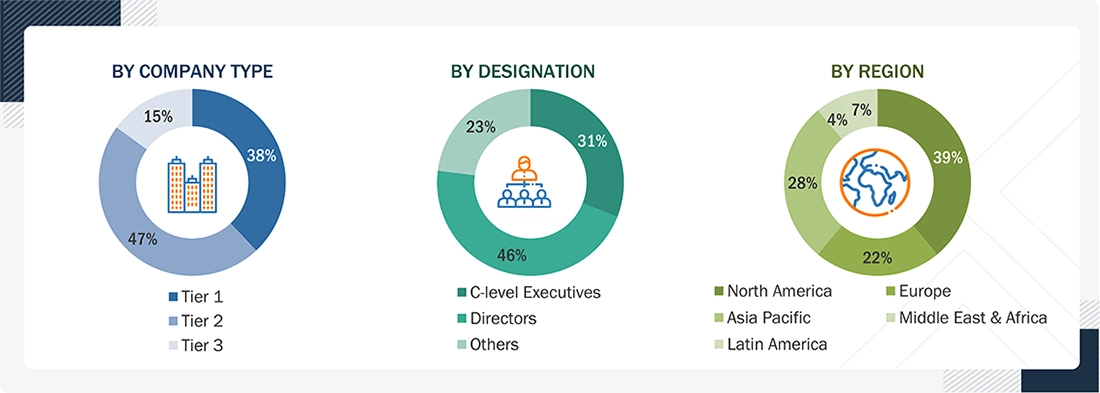
Note: Others include sales, marketing, and product managers; tier 1 companies’ revenues are more than USD 500 million, tier 2 companies’ revenues range between USD 500 and 100 million, and tier 3 companies’ revenues are equals to or less than USD 100 million.
To know about the assumptions considered for the study, download the pdf brochure
Market Size Estimation
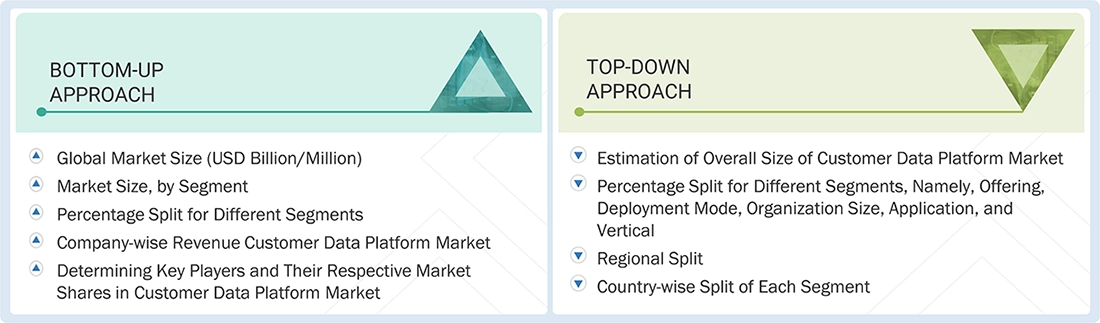
The top-down and bottom-up approaches were employed to estimate and forecast the customer data platform market, as well as its dependent submarkets. This multi-layered analysis was further reinforced through data triangulation, which incorporated primary and secondary research inputs. The market figures were also validated against the existing MarketsandMarkets repository for accuracy.
Customer Data Platform Market : Top-Down and Bottom-Up Approach
Data Triangulation
The market was divided into several segments and subsegments after determining the overall market size using the market size estimation processes described above. To complete the overall market engineering process and determine the exact statistics for each market segment and subsegment, data triangulation and market segmentation procedures were employed, wherever applicable. The overall market size was then used in the top-down approach to estimate the size of other individual markets by applying percentage splits to the market segmentation.
Market Definition
A customer data platform (CDP) is packaged software that collects and integrates customer data from multiple online and offline sources, applies identity resolution to create persistent and unified customer profiles, and makes these profiles accessible to other enterprise systems. CDPs connect previously fragmented data from customer relationship management, marketing automation, ecommerce, customer service, mobile applications, websites, transaction systems, and other engagement channels within a governed customer data environment. The platform supports real-time or near-real-time profile updates, segmentation, analytics, personalization, journey orchestration, and activation across marketing, sales, commerce, service, and advertising channels. By providing a consistent, user-level view of customer interactions and attributes, CDPs enable organizations to improve customer intelligence, coordinate omnichannel engagement, and support AI-driven decision-making. The category was introduced by David Raab in 2013 and is commonly defined as packaged software that builds a persistent, unified customer database accessible to other systems. Salesforce emphasizes the role of CDPs in consolidating data from multiple channels and systems into real-time customer profiles, while Oracle highlights their ability to create comprehensive customer databases that support interaction tracking, analysis, and engagement across touchpoints.
Key Stakeholders
- Customer data platform vendors
- Customer data infrastructure providers
- CRM and marketing automation platform providers
- Cloud service and data warehouse providers
- Identity resolution and customer identity providers
- Consent management and data privacy solution providers
- Customer analytics and intelligence platform providers
- Personalization and recommendation solution providers
- Customer journey orchestration providers
- System integrators and implementation service providers
- Consulting and managed service providers
- Digital agencies, value-added resellers, and technology partners
Report Objectives
- To define, describe, and predict the customer data platform market by offering, deployment mode, enterprise size, application, vertical, and region
- To provide detailed information related to major factors (drivers, restraints, opportunities, and industry-specific challenges) influencing market growth
- To analyze opportunities in the market and provide details of the competitive landscape for stakeholders and market leaders
- To forecast the market size of segments with respect to five main regions: North America, Europe, Asia Pacific, the Middle East & Africa, and Latin America
- To analyze each submarket with respect to individual growth trends, prospects, and contributions to the overall customer data platform market
- To analyze competitive developments, such as partnerships, new product launches, mergers & acquisitions, in the customer data platform market
- To analyze the impact of macroeconomic factors on the customer data platform market across all regions
Available customizations:
Using the provided market data, MarketsandMarkets offers customizations tailored to the company’s specific needs. The following customization options are available for the report.
Product Analysis
-
Product comparative analysis, which gives a detailed comparison of innovative products being offered by prominent vendors
Geographic Analysis
-
Further breakup of additional European countries by offering, deployment mode, enterprise size, application, and vertical
-
Further breakup of additional Asia Pacific countries by offering, deployment mode, enterprise size, application, and vertical
-
Further breakup of additional Middle Eastern & African countries by offering, deployment mode, enterprise size, application, and vertical
-
Further breakup of additional Latin American countries by offering, deployment mode, enterprise size, application, and vertical
Company Information
- Product comparative analysis, which gives a detailed comparison of innovative products being offered by prominent vendors
Key Questions Addressed by the Report
What is a customer data platform?
A Customer Data Platform (CDP) is a type of software that collects and unifies customer data from various sources such as websites, mobile apps, CRM systems, and other touchpoints into a single, centralized database. It creates comprehensive customer profiles by ingesting and standardizing first-party data, matching individual customer identities across systems, and transforming them into a consistent and accurate profile. The CDP then reformats the profile data to support a variety of marketing processes and systems, including CRM, analytics, marketing automation, A/B testing, content creation, personalization, and social media outreach. These profiles can be accessed and utilized by other systems to personalize marketing efforts, enhance customer experience, and drive data-informed decisions.
What are the major drivers of the customer data platform market?
The CDP market is driven by the need for personalized experience, growth in omnichannel marketing, the rise in customer data volume, and the adoption of AI and machine learning. Compliance with data privacy laws also pushes businesses to centralize and manage customer data more effectively.
How is AI impacting the customer data platform market?
AI enhances CDPs by enabling predictive analytics, real-time personalization, and smarter customer segmentation. It also improves data quality through automation and supports dynamic customer journeys based on behavior and preferences.
What challenges are limiting the widespread adoption of customer data platforms?
High costs, integration complexity, and data privacy concerns are key barriers. Many businesses also lack the technical expertise to use CDPs effectively, and the wide variety of vendor offerings can make it hard to choose the right solution.
Which industries are adopting customer data platforms the most?
CDPs are gaining traction across various industries, with retail, e-commerce, and financial services leading the way. These sectors rely heavily on personalized customer interactions and benefit from unified data to drive targeted marketing. Other growing adopters include healthcare, media, travel, and telecommunications, where customer engagement and data privacy are equally critical.


Personalize This Research
- Triangulate with your Own Data
- Get Data as per your Format and Definition
- Gain a Deeper Dive on a Specific Application, Geography, Customer or Competitor
- Any level of Personalization
Let Us Help You
- What are the Known and Unknown Adjacencies Impacting the Customer Data Platform Market
- What will your New Revenue Sources be?
- Who will be your Top Customer; what will make them switch?
- Defend your Market Share or Win Competitors
- Get a Scorecard for Target Partners

Custom Market Research Services
We Will Customise The Research For You, In Case The Report Listed Above Does Not Meet With Your Requirements
Get 10% Free CustomisationTESTIMONIALS
- US Customer Data Platform Market
- UK Customer Data Platform Market
- Germany Customer Data Platform Market
- France Customer Data Platform Market
- Italy Customer Data Platform Market
- Spain Customer Data Platform Market
- China Customer Data Platform Market
- Japan Customer Data Platform Market
- India Customer Data Platform Market
- South Korea Customer Data Platform Market
- Saudi Arabia Customer Data Platform Market
- UAE Customer Data Platform Market
- Turkey Customer Data Platform Market
- South Africa Customer Data Platform Market
- Brazil Customer Data Platform Market
- Mexico Customer Data Platform Market
- Argentina Customer Data Platform Market
- Rest Of Europe Customer Data Platform Market
- Anz Customer Data Platform Market
- Rest Of Asia Pacific Customer Data Platform Market
- Rest Of Latin America Customer Data Platform Market
- Canada Customer Data Platform Market






Growth opportunities and latent adjacency in Customer Data Platform Market