Marine Lubricants Market

Marine Lubricants Market by Base Oil (Mineral Oil, Synthetic Oil, and Bio-based Oil), Product Type (Engine Oil, Hydraulic Fluid, Compressor Oil), Ship Type (Bulk Carriers, Container Ships, Tankers), and Region - Global Forecast to 2030




OVERVIEW
Source: Secondary Research, Interviews with Experts, MarketsandMarkets Analysis
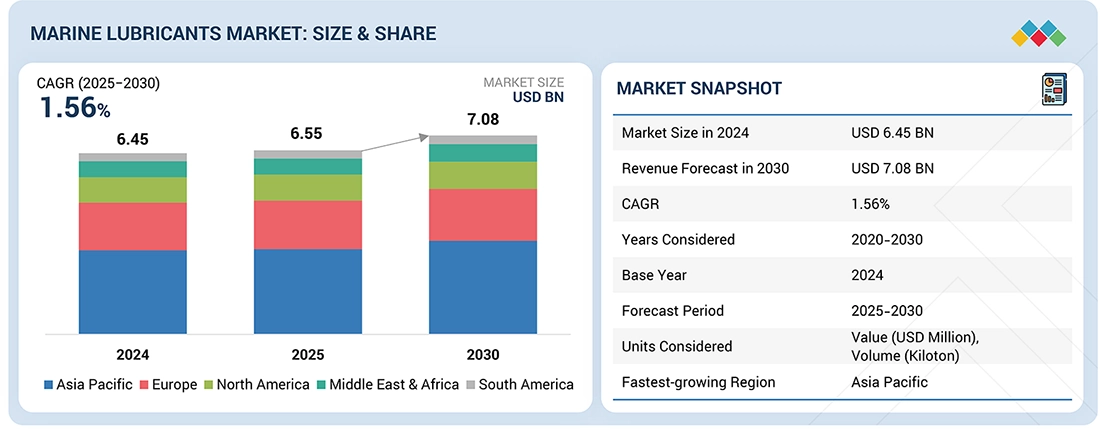
The marine lubricants market is projected to grow from USD 6.55 billion in 2025 to USD 7.08 billion by 2030, at a CAGR of 1.56%. This growth in the market is backed by the expansion of global seaborne trade and an increase in vessel operational hours. Increasing demand for engine efficiency, equipment protection, and extended maintenance intervals are the key drivers of this market. Stricter environmental regulations have encouraged the adoption of low-emission and ecologically compliant marine lubricants.
KEY TAKEAWAYS
-
BY REGIONAsia Pacific dominated the global marine lubricants market in 2024, accounting for a market share of 46.2%, in terms of value
-
BY BASE OILThe synthetic oil segment is projected to be the fastest-growing base oil type of marine lubricants, at a CAGR of 2.11%, in terms of value, between 2025 and 2030
-
BY PRODUCT TYPEThe engine oil segment dominated the global marine lubricants market, in terms of value, in 2024
-
BY SHIP TYPEThe tankers segment is projected to register the highest CAGR of 1.70%, in terms of value, during the forecast period
-
COMPETITIVE LANDSCAPE - KEY PLAYERSExxon Mobil Corporation, Shell plc, and China Petroleum & Chemical Corporation are identified as key players in the global marine lubricants market. These companies have strong market presence and extensive product portfolios.
-
COMPETITIVE LANDSCAPE - STARTUPSPenrite Oil Company, SK Enmove Co., Ltd., and Gandhar Oil Refinery (India) Limited, among other emerging players, have carved out solid positions within specialized niche segments, highlighting their potential to evolve into future market leaders.
The marine lubricants market has significant growth potential in the coming years due to increasing demand in the commercial marine business and vessel maintenance activities. There is an emerging trend towards improved engine efficiency, equipment protection, and regulatory compliance. The industry is constantly moving towards high-performance lubricating solutions. Marine lubricants provide maximum engine efficiency, reduce wear, and extend equipment life, making them a preferred choice for vessel operation.
TRENDS & DISRUPTIONS IMPACTING CUSTOMERS' CUSTOMERS
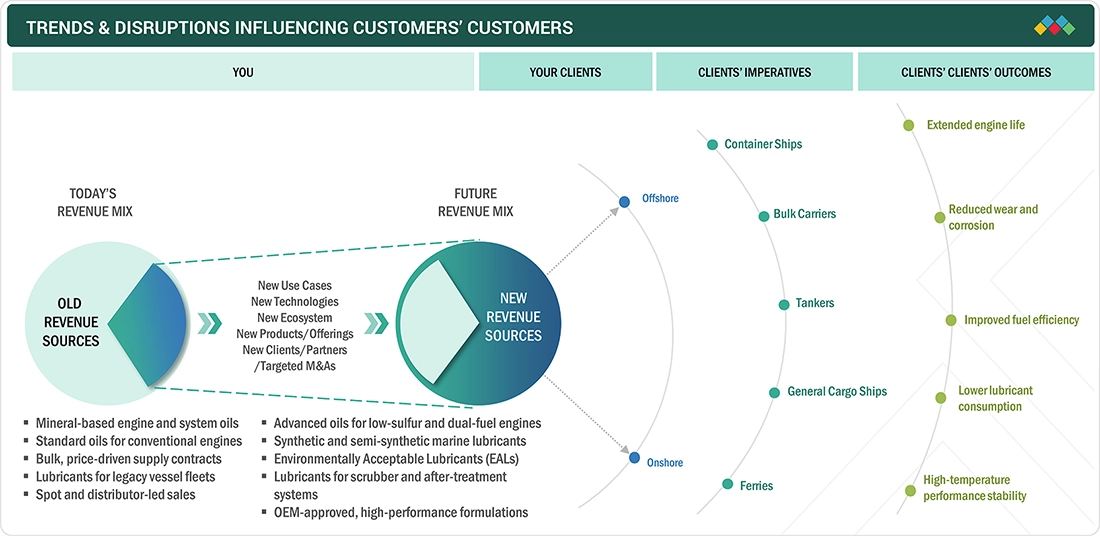
The impact on consumers' business emerges from customer trends or disruptions. The target end-use ship operators and fleet owners across ship segments such as container ships, bulk carriers, and tankers are the customers of marine lubricants' manufacturers. Shifts, which are changing trends or disruptions, will impact the revenues of end users. The revenue impact on end users will affect the revenue of hotbets, which will further affect the revenues of marine lubricant manufacturers.
Source: Secondary Research, Interviews with Experts, MarketsandMarkets Analysis
MARKET DYNAMICS

Level
-
Growth in global seaborne trade and vessel utilization

-
Aging global fleet increasing demand for maintenance and lubricant replacement


Level
-
High cost of synthetic and environmentally acceptable marine lubricants

-
Complex approval and OEM certification requirements for new formulations


Level
-
Rising demand for environmentally acceptable and biodegradable lubricants

-
Lubricants tailored for alternative fuels such as LNG, methanol, and ammonia


Level
-
Compliance with evolving and fragmented environmental regulations

-
Volatility in crude oil and base oil prices affecting formulation economics

Source: Secondary Research, Interviews with Experts, MarketsandMarkets Analysis
Driver: Growth in global seaborne trade and vessel utilization
Global growth in seaborne trade propels demand for marine fuels and lubricants as increased shipping activity requires higher vessel operations. Increased vessel utilization rates, fueled by the growth of trade routes and cargo, result in higher usage of engines, which drives demand for high-performance marine lubricants. This trend has created a stable and repetitive market for lubricant suppliers, encouraging the production of value-added products that ensure efficiency, reliability, and compliance with changing maritime regulations. Overall, trade growth and the intensification of vessel deployment are driving revenue growth in the marine lubricants market.
Restraint: High cost of synthetic and environmentally acceptable marine lubricants
The adoption of synthetic and environmentally acceptable marine lubricants is limited by their high costs. These products provide superior performance and offer regulatory compliance, but their premium pricing increases operational expenses, creating a barrier to widespread use, especially among small and mid-sized shipping operators. This price sensitivity slows the market growth and leads some operators to continue dependence on conventional lubricants despite the stricter environmental norms. Price remains one of the critical restraints to the growth of the marine lubricants market.
Opportunity: Rising demand for environmentally acceptable and biodegradable lubricants
Increasing demand for environmentally friendly and biodegradable marine lubricants also provides a major growth opportunity in this industry. Stringent regulations regarding maritime activities, combined with environmental awareness, are encouraging shipping companies to adopt environmentally friendly products. This trend prompts lubricant manufacturers to innovate and create sustainable products that enable market differentiation and premiumization of product pricing. As a result, companies investing in green lubricant technologies have opportunities to capture new market segments and improve their competitive position in the global market.
Challenge: Compliance with evolving and fragmented environmental regulations
One of the major challenges in the marine lubricants market is to comply with evolving and diversified environmental regulations. The variation in regulatory standards across regions affects product development and deployment. These differences in regulatory standards across various regions complicate product development and deployment. Continuous monitoring and adjustments due to frequent regulatory updates increase the operational and compliance costs. This kind of uncertainty may result in delayed product launch and limiting scalability, which could create a significant challenge in achieving market growth and profitability.
MARINE LUBRICANTS MARKET: COMMERCIAL USE CASES ACROSS INDUSTRIES
| COMPANY | USE CASE DESCRIPTION | BENEFITS |
|---|---|---|
 |
Use of marine engine oils and hydraulic lubricants across container, bulk, and tanker vessels | Improved equipment reliability, enhanced corrosion protection, optimized lubricant consumption |
 |
Use of cylinder oils, system oils, and auxiliary engine lubricants across container vessels operating on long-haul and high-utilization routes | Extended engine life, improved fuel efficiency, reduced maintenance frequency |
 |
Application of marine lubricants for main engines, generators, and deck machinery across a diversified global fleet | Reliable engine performance, reduced wear, consistent lubrication under variable operating conditions |
 |
Use of marine lubricants for propulsion systems and onboard equipment under fuel-efficient and emissions-focused operations | Improved thermal stability, lower lubricant degradation, reduced operating costs |
Logos and trademarks shown above are the property of their respective owners. Their use here is for informational and illustrative purposes only.
MARKET ECOSYSTEM
The marine lubricants market ecosystem ranges from base oil suppliers, additive producers, lubricant formulators, and end users. Demand is influenced by the need to ensure the performance of the engine and other machinery under the harsh marine operational conditions, while aligning with the regulatory standards and meeting the environmental concerns. It enables continuous collaboration throughout the value chain for the development of lubricants that can achieve better operational efficiency with reduced maintenance needs.
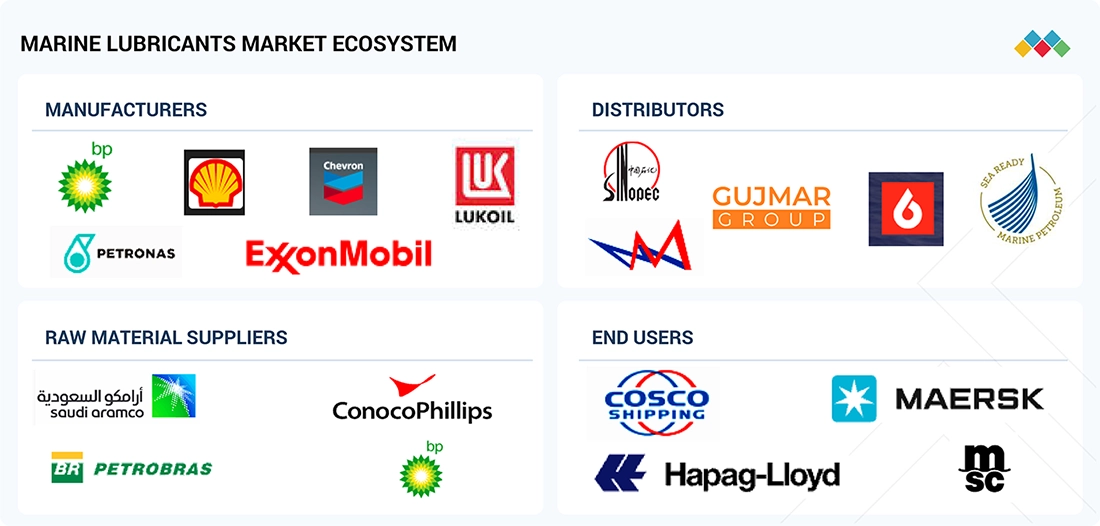
Logos and trademarks shown above are the property of their respective owners. Their use here is for informational and illustrative purposes only.
MARKET SEGMENTS
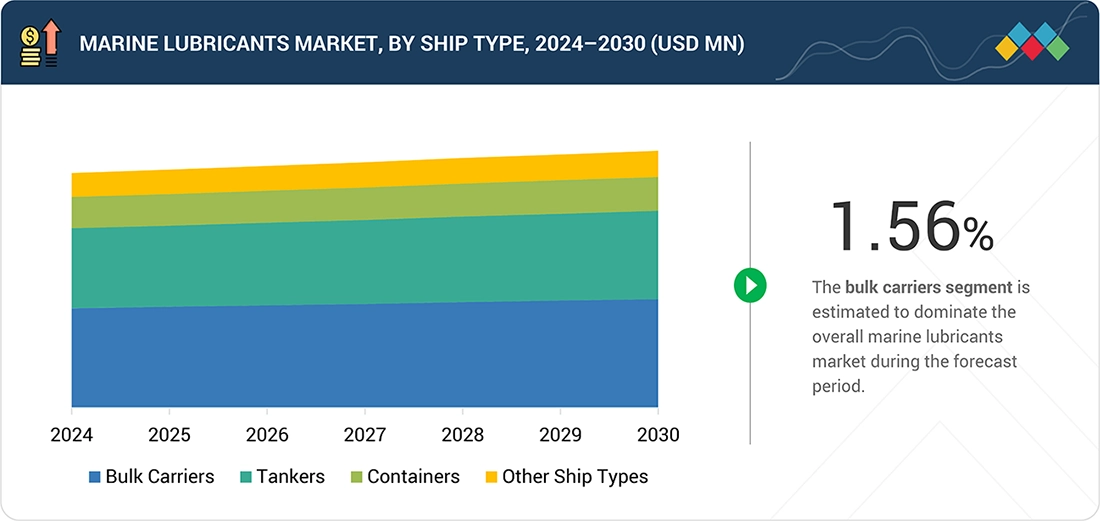
Source: Secondary Research, Interviews with Experts, MarketsandMarkets Analysis
Marine Lubricants Market, By Base Oil
The mineral oil segment held the largest market share in the marine lubricants market in terms of value in 2024. This is largely due to its affordable price, accessibility, and effectiveness with conventional marine engines. Being less expensive than synthetic variants, it is the preferred option for many shipping operators, sustaining demand and supporting the dominance in the market.
Marine Lubricants Market, By Product Type
In 2024, the engine oil segment accounted for the largest market share by value because of its critical role in ensuring the efficient and smooth operation of the marine engines. Marine vessels require lubrication to protect their engines from wear and tear, corrosion risks, and high temperatures, which creates a high demand for engine oils. This is because the vessels require replacement quite often to ensure their efficient operation and to withstand extreme maritime environmental conditions. All these factors make engine oils the most valuable segment of the marine lubricants market.
Marine Lubricants Market, By Ship Type
The bulk carriers segment held the largest market share of the global marine lubricants market, in terms of value, in 2024. This is due to the large number of vessels operating under this category and their higher lubrication requirements. Due to their frequent long-distance operations with heavy cargo transportation, bulk carriers require higher consumption of marine lubricants. This makes bulk carriers one of the leading segments in the market, owing to the steady demand for protection of the engines and machinery.
REGION
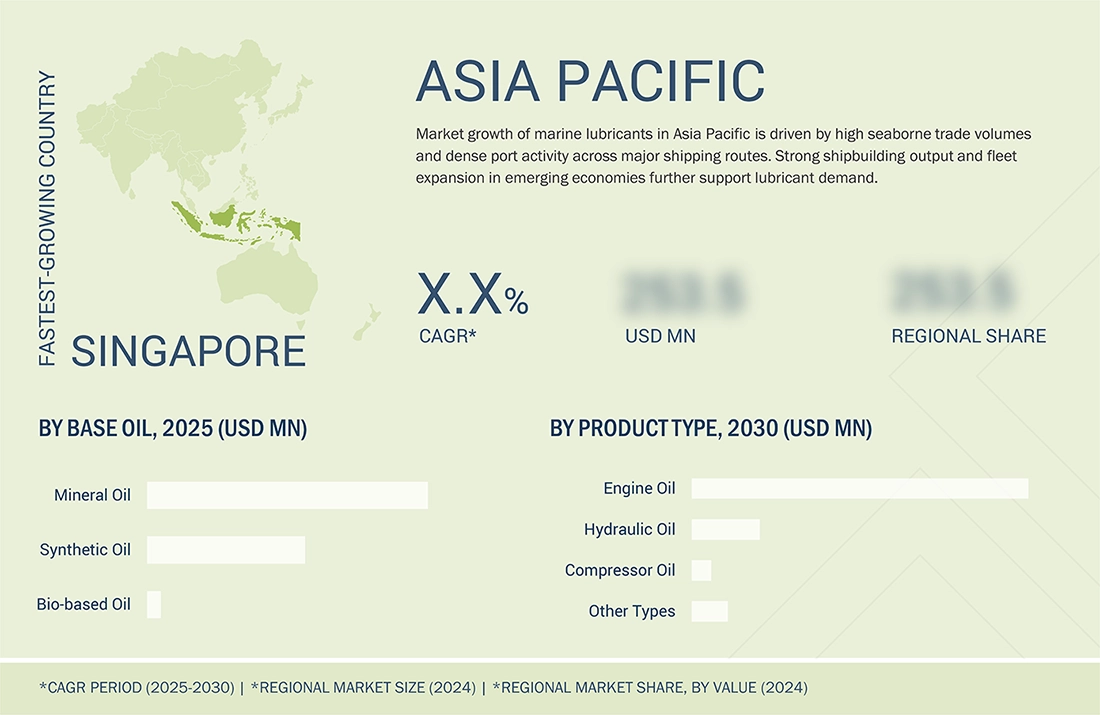
Asia Pacific accounted for the largest share of the global marine lubricants market in 2024
Asia Pacific held the largest share of the marine lubricants market in 2024 based on value. An active shipbuilding industry, a growth in commercial fleets, and a rise in ship traffic in the region contributed to the lubricant market growth. In addition, rising industrialization and maritime trade in emerging economies also helped to consolidate the position of Asia Pacific as a leading market.
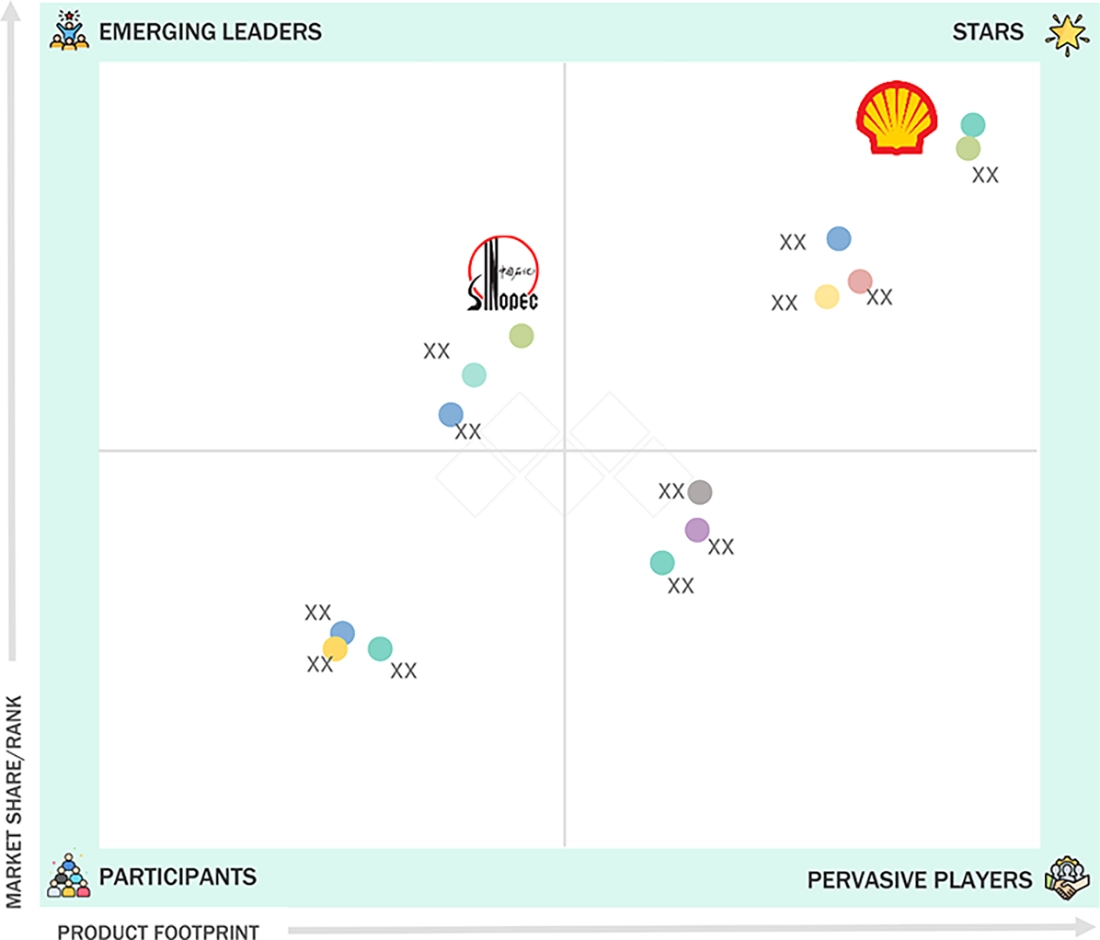
MARINE LUBRICANTS MARKET: COMPANY EVALUATION MATRIX
Shell plc (Star) has the largest market share in the marine lubricants market owing to the company’s broad global presence and a wide range of high-performance product offerings. Its leadership position is established due to its expertise in advanced lubricants and its focus on sustainable product offerings for its customers. China Petroleum & Chemical Corporation (Emerging) is gaining traction through its increasing emphasis on sustainable and high-efficiency marine lubricants. The company has the potential to shift towards the leaders’ quadrant as there is a growing requirement in eco-friendly solutions.
Source: Secondary Research, Interviews with Experts, MarketsandMarkets Analysis
KEY MARKET PLAYERS
- BP p.l.c. (UK)
- Chevron Corporation (US)
- Exxon Mobil Corporation (US)
- Shell plc (UK)
- TotalEnergies SE (France)
- Petronas (Malaysia)
- LUKOIL (Russia)
- Idemitsu Kosan Co., Ltd (Japan)
- China Petroleum & Chemical Corporation (China)
- ENEOS Holdings, Inc. (Japan)
- Gulf Oil International Ltd. (UK)
- Emirates National Oil Company (UAE)
- ENI S.p.A (Italy)
- Indian Oil Corporation Limited (India)
- PetroChina Company Limited (China)
MARKET SCOPE
| REPORT METRIC | DETAILS |
|---|---|
| Market Size Value in 2024 | USD 6.45 Billion |
| Revenue Forecast in 2030 | USD 7.08 Billion |
| Growth Rate | CAGR of 1.56% from 2025 to 2030 |
| Years Considered | 2020–2030 |
| Base Year | 2024 |
| Forecast Period | 2025–2030 |
| Units Considered | Value (USD Million), Volume (Kiloton) |
| Report Coverage | Revenue forecast, company ranking, competitive landscape, growth factors, and trends |
| Segments Covered |
|
| Regional Scope | Asia Pacific, Europe, North America, Middle East & Africa, South America |
WHAT IS IN IT FOR YOU: MARINE LUBRICANTS MARKET REPORT CONTENT GUIDE
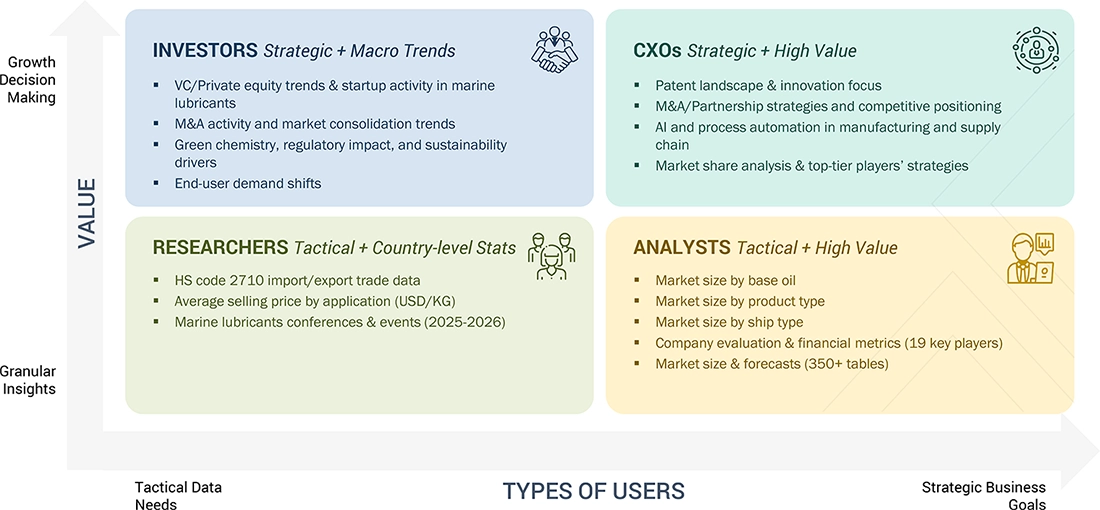
DELIVERED CUSTOMIZATIONS
We have successfully delivered the following deep-dive customizations:
| CLIENT REQUEST | CUSTOMIZATION DELIVERED | VALUE ADDS |
|---|---|---|
| Europe-based Marine Lubricant Manufacturer |
|
|
| Asia Pacific-based Marine Lubricant Manufacturer |
|
|
RECENT DEVELOPMENTS
- December 2025 : TotalEnergies SE launched Aurelia NGX 40, a new generation low-ash lubricant. This lubricant is specifically developed to offer extended service life of four-stroke engines operating on gas and ULS fuels.
- December 2025 : ENOC signed an MOU with HMS Bergbau AG to distribute marine lubricants in Spain and Türkiye, expanding presence across Southern Europe and Mediterranean shipping corridors with wider port coverage.
- August 2025 : Chevron Marine Lubricants partnered with Closelink to automate and modernize the procurement process for marine lubricants. This integration enables near-instant order processing, real-time inventory checks, and improved customer experience through Chevron’s OnePort digital platform.
- July 2025 : Exxon Mobil Corporation’s authorized distributor Habot Marine Services (HMS) renewed and expanded its agreement to supply ExxonMobil marine lubricants across major South African ports (Durban, Port Elizabeth, Cape Town) and Indian Ocean islands, ensuring better regional availability and service
- June 2025 : Shell Marine inaugurated a state-of-the-art lubricant storage/tank facility in Busan, South Korea, in June 2025. This investment enhances Shell’s marine lubricant supply infrastructure at a major global maritime hub, helping reduce delivery times (to ~48 hours), improve logistics efficiency, and better serve shipping lines and shipyards in Asia and beyond.
Table of Contents
 Exclusive indicates content/data unique to MarketsandMarkets and not available with any competitors.
Methodology
The study involved four major activities in estimating the Marine Lubricants Market size. Exhaustive secondary research was done to collect information on the market, the peer market, and the parent market. The next step was to validate these findings, assumptions, and sizing with industry experts across the value chain through primary research. Both top-down and bottom-up approaches were employed to estimate the complete market size. After that, the market breakdown and data triangulation procedures were used to estimate the market size of the segments and subsegments.
Secondary Research
Secondary sources used in this study included annual reports, press releases, and investor presentations of companies; white papers; certified publications; articles from recognized authors; and gold standard & silver standard websites such as Factiva, ICIS, Bloomberg, and others. The findings of this study were verified through primary research by conducting extensive interviews with key officials such as CEOs, VPs, directors, and other executives. The breakdown of profiles of the primary interviewees is illustrated in the figure below.
Primary Research
The Marine Lubricants Market comprises several stakeholders, such as raw material suppliers, end-product manufacturers, and regulatory organizations in the supply chain. The demand side of this market is characterized by engine oil, turbine oil, gear oil, grease, hydraulic oil, compressor oil, metalworking fluid, and others. Advancements in technology and diverse application industries characterize the supply side. Various primary sources from the supply and demand sides of the market were interviewed to obtain qualitative and quantitative information.
Market Size Estimation
Top-down and bottom-up approaches were used to estimate and validate the total size of theMarine Lubricants Market. These methods were also used extensively to estimate the size of various subsegments in the market. The research methodology used to estimate the market size includes the following parameters:
- The key players in the industry have been identified through extensive secondary research.
- The supply chain of the industry has been determined through primary and secondary research.
- All percentage shares, splits, and breakdowns have been determined using secondary sources and verified through primary sources.
- All possible parameters that affect the markets covered in this research study have been accounted for, viewed in extensive detail, verified through primary research, and analyzed to obtain the final quantitative and qualitative data.
Data Triangulation
After arriving at the overall market size—using the market size estimation processes as explained above—the market was split into several segments and subsegments. Data triangulation and market breakdown procedures were employed to complete the overall market engineering process and arrive at the exact statistics of each market segment and subsegment, wherever applicable. The data was triangulated by studying various factors and trends from both the demand and supply sides in the lubricants industry.
Market Definition
The Marine Lubricants Market encompasses a range of substances engineered to diminish friction between surfaces, thereby reducing heat generation and facilitating the transmission of forces during movement. These substances also serve to transport foreign particles and regulate surface temperatures. Employed across diverse applications, from industrial machinery and cooking to bioapplications such as artificial joints, medical procedures, and intimate relations, lubricants are pivotal in mitigating friction, wear, heat generation, noise, and vibrations within mechanical systems.
Stakeholders
- Lubricants manufacturers
- Lubricants suppliers
- Raw material suppliers
- Service providers
- Application sector companies
- Government bodies
Report Objectives
- To define, describe, and forecast the Marine Lubricants Market in terms of value and volume
- To provide detailed information regarding the drivers, opportunities, restraints, and challenges influencing market growth
- To estimate and forecast the market size by base oil type, product type, end-use industry, and region
- To forecast the size of the market for five main regions: Asia Pacific, Europe, North America, South America, and the Middle East & Africa, along with their key countries
- To strategically analyze micromarkets1 with respect to their growth trends, prospects, and contribution to the overall market
- To analyze opportunities in the market for stakeholders and provide a competitive landscape for market leaders
- To analyze competitive developments, such as deals and expansions, in the market
- To analyze the impact of the recession on the market
- To strategically profile key players and comprehensively analyze their growth strategies.
Key Questions Addressed by the Report
What is driving the Marine Lubricants Market growth?
Increasing global seaborne trade and expanding shipping activities are major factors driving the Marine Lubricants Market.
Which types of lubricants are commonly used in ships?
Engine oils, hydraulic oils, and cylinder lubricants are widely used products in the Marine Lubricants Market.
How do environmental regulations impact the market?
Strict emission and environmental regulations are encouraging the use of eco-friendly products in the Marine Lubricants Market.
Which industries rely on marine lubricants the most?
The shipping, offshore oil & gas, and marine transportation sectors are key end-users of the Marine Lubricants Market.
How does global shipping influence the market?
Growth in international trade and maritime transportation directly supports expansion of the Marine Lubricants Market.


Personalize This Research
- Triangulate with your Own Data
- Get Data as per your Format and Definition
- Gain a Deeper Dive on a Specific Application, Geography, Customer or Competitor
- Any level of Personalization
Let Us Help You
- What are the Known and Unknown Adjacencies Impacting the Marine Lubricants Market
- What will your New Revenue Sources be?
- Who will be your Top Customer; what will make them switch?
- Defend your Market Share or Win Competitors
- Get a Scorecard for Target Partners

Custom Market Research Services
We Will Customise The Research For You, In Case The Report Listed Above Does Not Meet With Your Requirements
Get 10% Free CustomisationTESTIMONIALS
We at Nissan Chemicals Corporation have been clients of MarketsandMarkets for more than a year now. We recently consulted MarketsandMarkets for a study, the team at MarketsandMarkets was extremely professional and organized. The business insights were very detailed and aligned well with our expectations that really helped us formulate the Business Plans and device new strategies for development themes. MarketsandMarkets offers a unique combination of expertise and dedicated engagement model. Their research findings have helped us in designing our Pricing Strategy which will make it easier for us to predict the future sales and profits for the next ten years. We look forward to working with MarketsandMarkets in the future.
VP of Strategy & New Business Development
Leading Specialty Chemical Company
The MarketsandMarkets Engagement Model, composed of both the Knowledge Store and advisory custom research, has greatly helped us in understanding our markets and making strategic decisions. The Knowledge Store is a fast way to allow everyone in our organization to understand more about most any market they are interested in. The ability to then get custom research done and get answers to specific strategic questions and market insight has been spectacular. The Markets and Markets team feel more like colleagues than vendors and their services have helped us change our culture where statements of things like growth opportunities and competitive position are always backed by industry research.

Rich Gibson,
Director, Corporate Strategy
Milliken & Company,
Leading Industrial Manufacturer of specialty chemical, floor covering, performance and protective textile materials, and healthcaremilliken.com
MarketsandMarkets is a trusted resource that helps us to better understand markets that are near-adjacencies-whether its technology, value chain or geography. Their Knowledge Store platform provides a dashboard of markets and their characteristics which is easy to use and saves us time.
Adam Shaw,
Market Development and Strategy Manager
AdvanSix Inc. USA,
An American Leader in Chemicalswww.advansix.com
The Knowledge Store from MarketsandMarkets is a valuable tool which has helped my team acquire greater insight in to the end markets that our business serves. This has enabled us to help our company build stronger strategies throughout our planning process.
TOSHIO KINOSHITA
Senior Chif Consultion Research & Consulting Division
Mitsubishi Chemical Research Corporation,
Leading Manufacturer of Chemical Productswww.mitsubishichem-res.co.jp/en/

We recently engaged with MarketsandMarkets for a study, the team not only clearly understood our business objectives but was also extremely professional in the way they handled the entire project. The study was efficiently conducted in a phase-wise manner, and the engagement model furnished us with high-quality business insights that far exceeded our expectations at each phase. We were especially happy that MarketsandMarkets could provide us with both, an English as well as a Japanese version of the study. A special thanks to the Analyst Team and Client Services Team, whose fluency in Japanese enhanced our comfort level, as we could converse with them in our preferred language.
Independent entrepreneurs
Arrow Precision
We approached MarketsandMarkets for study on Proppants Market, and their work exceeded our expectations. The study conducted was comprehensive and enabled us to view the market through the various dimensions. In addition, the team was extraordinarily responsive throughout the process and resolved our queries on time. I strongly recommend MarketsandMarkets and will certainly consider them for additional market assessments we will need in the future.
Global engineering company, Japan
Deputy Manager,
Strategic Planning OfficeThe high-quality insights shared by the MarketsandMarkets team helped us understand the pharmaceutical plant designers in a specific geography. It also captured the risks that we may likely face in communicating with our potential partners. The study would enable us identify partners, which would impact our future growth.
- China Marine Lubricants Market
- Singapore Marine Lubricants Market
- Hong Kong Marine Lubricants Market
- South Korea Marine Lubricants Market
- Malaysia Marine Lubricants Market
- Japan Marine Lubricants Market
- Taiwan Marine Lubricants Market
- India Marine Lubricants Market
- Australia Marine Lubricants Market
- Canada Marine Lubricants Market
- Mexico Marine Lubricants Market
- US Marine Lubricants Market
- Germany Marine Lubricants Market
- Netherlands Marine Lubricants Market
- Belgium Marine Lubricants Market
- Spain Marine Lubricants Market
- UK Marine Lubricants Market
- Italy Marine Lubricants Market
- France Marine Lubricants Market
- Greece Marine Lubricants Market
- Turkey Marine Lubricants Market
- Russia Marine Lubricants Market
- UAE Marine Lubricants Market
- Saudi Arabia Marine Lubricants Market
- South Africa Marine Lubricants Market
- Brazil Marine Lubricants Market
- Argentina Marine Lubricants Market
- Rest Of Europe Marine Lubricants Market
- Rest Of Asia Pacific Marine Lubricants Market






Growth opportunities and latent adjacency in Marine Lubricants Market