Mobile Mass Spectrometers Market

Mobile Mass Spectrometers Market by Application [Lab (Env, food, forensics, Disaster mngt), Outside lab (Narcotics, CBRN, Military, Homeland Security), Handheld], Product Type (Portable, Field Deployable, Benchtop) & Component Global Forecast to 2031



MOBILE MASS SPECTROMETERS MARKET SIZE, SHARE & GROWTH SNAPSHOT

Source: Secondary Research, Interviews with Experts, MarketsandMarkets Analysis
The global mobile mass spectrometers market is projected to grow from USD 1.68 billion in 2026 to USD 2.87 billion by 2031, at a CAGR of 11.3% during the forecast period. The market was valued at USD 1.55 billion in 2025. The mobile mass spectrometers market is growing rapidly, driven by the shift toward real-time, on-site detection and the need for faster, more actionable insights across various industries. Increased regulatory pressure on environmental monitoring and rising demand to identify pollutants in air, water, and soils are driving adoption among government and industrial users. Also, increasing focus on public safety and chemical threat detection is driving strong procurement from defence and security agencies is generating a significant demand for mobile mass spectrometers.
KEY TAKEAWAYS
-
MARKET SNAPSHOT:
Base Year Market Size (2025): USD 1.55 Billion
Current Market Size (2026): USD 1.68 Billion
Forecast Market Size (2031): USD 2.87 Billion
CAGR (2026–2031): 11.3% -
SEGMENT LEADERSHIP:
Regional Outlook: Asia Pacific is projected to register the highest CAGR of 11.9% during the forecast period.
Component Leader: Ion sources components acquired the largest share of 26.0% of the mobile mass spectrometers market in 2025.
Application Leader: Outside lab-based applications acquired the largest share of 38.2% of the mobile mass spectrometers market in 2025.
Product Type Leader: Field-deployable/backpack-based platforms accounted for the largest market share in 2025. -
MARKET OUTLOOK & COMPETITIVE LANDSCAPE:
1st Detect Corporation (US), 908 Devices (US), Agilent Technologies (US), BaySpec, Inc. (US), Bruker (US), Detect Ion (US), Fluid Inclusion Technology (US), Focused Photonics (China), Hiden Analytical (UK), Inficon Holding (Switzerland), and Jeol (Japan) are some of the key players in the competitive landscape for mobile mass spectrometers. They show depth in the product portfolio with a strong customer footprint in the developed and emerging markets.
Companies such as Teledyne (US), Purespec (US), Masstech (US), Metrohm (Switzerland), Microsaic Systems (UK), and various regional OEMs are active in niche segments of the mobile mass spectrometers ecosystem, supplying mobile mass spectrometers to potential customers.
The way instruments are designed and used is undergoing a fundamental shift. As companies shift from centralized laboratory testing to on-site analysis, the demand for portable, field-ready solutions has grown significantly. This transition, driven by the need for faster results, greater operational efficiency, and the integration of digital technologies, is reshaping how mobile mass spectrometry evolves as a field. Global supply chain disruptions and geopolitical uncertainties have further accelerated this shift, pushing companies to bring more of their manufacturing and quality control closer to home. In this environment, the ability to test materials and products at the point of production, rather than shipping samples to a remote laboratory, has become not just convenient, but essential. Mobile mass spectrometry is increasingly stepping in to meet this need, offering accurate, real-time analysis wherever it is needed most.
TRENDS & DISRUPTIONS IMPACTING CUSTOMERS' CUSTOMERS
Mobile mass spectrometry is evolving from a niche, field-based analytical tool/technique into a strategic enabler of real-time, decentralized chemical analysis across critical industries. It allows end users to achieve four key objectives: rapid on-site detection, high-sensitivity identification, continuous monitoring, and operational flexibility outside traditional laboratory settings. This transformation is enabling stakeholders such as defense agencies, environmental testing labs, food and beverage companies, and clinical & forensic laboratories to generate faster, more actionable insights directly at the point of need. Environmental agencies benefit from real-time pollutant monitoring, improving regulatory compliance and risk mitigation. In the food & beverages sector, mobile systems enable rapid contamination detection, strengthening product safety and minimizing recall risks. Similarly, clinical and forensic users leverage these systems for accelerated diagnostics and substance identification, improving decision-making timelines. Overall, the shift toward portable and connected analytical platforms is reducing reliance on centralized labs, shortening analysis cycles, and driving more efficient, data-driven operations across end-use industries.

Source: Secondary Research, Interviews with Experts, MarketsandMarkets Analysis
MARKET DYNAMICS

Level
-
Increased demand for real-time and on-site chemical analysis.

-
Advancements in miniaturization and portable system design


Level
-
Performance limitations due to miniaturization

-
Power and vacuum system constraints


Level
-
Expansion into point-of-care diagnostics

-
Integration with AI-driven analytics and connected data ecosystems


Level
-
Data reliability & regulatory acceptance

-
Limited field usability due to skill dependency on operators

Source: Secondary Research, Interviews with Experts, MarketsandMarkets Analysis
Driver: Advancements in miniaturization and portable system design
Conventionally, instruments/systems manufactured around technologies such as Quadrupole Mass Spectrometry were constrained by bulky vacuum systems, high power requirements, and complex infrastructure requirement and cost. However, recent innovations in microfabricated mass analyzers, compact vacuum pumps, and low-power electronics have significantly reduced system size and energy consumption without completely compromising analytical performance. The adoption of more portable-friendly architectures such as Ion Trap Mass Spectrometry has enabled the development of handheld and backpack-based systems that can operate reliably in field conditions. Parallel improvements in battery technology, embedded processing, and ruggedized system design are further enhancing device mobility, uptime, and usability in harsh environments. These advancements are lowering the barriers to commercialization by enabling modular system design, faster product development cycles, and broader application targeting
Restraint: Performance limitations due to miniaturization
With portable options available in the market, there is an inherent trade-off between portability and analytical performance. As systems are reduced in size or miniaturized to enable handheld or field-deployable features, key components such as mass analyzers, ion optics, and detectors are scaled down, directly impacting resolution, sensitivity, and mass accuracy. For instance, compact architectures like Ion Trap Mass Spectrometry are well-suited for portability and rapid analysis, but they may not consistently match the high-resolution capabilities of larger, lab-based systems. All these limitations become particularly pronounced when dealing with critical samples or when there is a requirement for ultra-trace-level detection, where precise compound differentiation is essential. As a result, end users in highly regulated or precision-driven environments, such as pharmaceutical quality control or advanced research, may hesitate to fully rely on mobile systems for critical decision-making. Additionally, lower sensitivity can lead to false positives or negatives, further impacting confidence in field-based results.
Opportunity: Expansion into point-of-care diagnostics
Expansion into point-of-care (PoC) diagnostics and decentralized healthcare delivery models is a promising niche where mobile mass spectrometers are projected to witness high demand in the future. In such a space peed and accessibility of testing are going to play an important role. Earlier, advanced analytical techniques were confined to centralized laboratories due to infrastructure and expertise requirements. However, with ongoing advancements in compact, portable platforms, particularly those leveraging technologies such as Ion Trap Mass Spectrometry, mobile mass spectrometers are increasingly capable of delivering rapid, on-site biochemical and toxicological analyses. This evolution aligns with the broader healthcare shift toward decentralization, where diagnostics are moving closer to the patient, across emergency rooms, ambulances, outpatient clinics, and even remote or resource-limited settings. In such environments, mobile MS systems can enable real-time drug screening, therapeutic drug monitoring, detection of toxins or metabolites, and rapid clinical decision-making.
Challenge: Limited field usability due to skill dependency on operators
Despite advances in miniaturization, mobile mass spectrometry systems continue to face significant usability limitations in field conditions. Effective operation still requires a solid understanding of sample handling, calibration procedures, and spectral interpretation—skills that are not always available outside of a laboratory setting. In non-routine or complex scenarios, even relatively user-friendly platforms demand operator expertise to interpret results accurately, limiting their practical utility in field deployments where trained personnel may not be readily available.
MOBILE MASS SPECTROMETERS MARKET: COMMERCIAL USE CASES ACROSS INDUSTRIES
| COMPANY | USE CASE DESCRIPTION | BENEFITS |
|---|---|---|
 |
The MX908 helps in immediate identification of unknown substances in the field, enabling faster and safer decision-making | Handheld device (e.g., MX908) used by law enforcement and hazmat teams for on-site detection of narcotics, explosives, and chemical threats |
 |
Portable GC-MS systems used for environmental monitoring and field-based chemical analysis (air, soil, water contaminants) | Real-time environmental assessment, allowing quicker regulatory compliance and faster response to contamination events |
 |
Portable GC-MS systems deployed in military and homeland security operations for the detection of hazardous chemicals and toxic industrial compounds | Enhanced situational awareness in mission-critical environments, enabling rapid response and minimizing exposure to dangerous substances |
 |
Field-deployable MS systems (Bruker MM2) for chemical warfare agent (CWA) detection and forensic analysis | Reduces the need for specialized in-house column-packing expertise and labor, reducing the need for specialized workflow |
Logos and trademarks shown above are the property of their respective owners. Their use here is for informational and illustrative purposes only.
MARKET ECOSYSTEM
The mobile mass spectrometers ecosystem is a multi-layered value chain connecting platform manufacturers (on-field deployable, handheld, benchtop), specialty material suppliers, distributor partners, and end users spanning biopharmaceutical, food/nutraceutical, and research sectors. Manufacturers such as Thermo Fisher Scientific, 908 Devices, and Teledyne deliver platforms with a wide range of applications. Raw material and component suppliers such as Leybold and Roth provide hardware, materials, circuits, and diodes that are essential to manufacturing these mass spectrometers. Distributors and channel partners, including Thomas Scientific, Advion, Narwastu, and regional scientific-supply networks extend manufacturer reach into mid-market and emerging-region biotech facilities.

Logos and trademarks shown above are the property of their respective owners. Their use here is for informational and illustrative purposes only.
MARKET SEGMENTS

Source: Secondary Research, Interviews with Experts, MarketsandMarkets Analysis
Mobile Mass Spectrometers Market, By Component
The ion source, as a component of mobile mass spectrometers, acquired the largest market share. Ion sources are widely used in portable and mobile mass spectrometers because they convert the sample into ions, which are then separated based on their mass-to-charge ratios. Therefore, ion sources enable analytical processes. Mobile MS adoption is heavily driven by ambient ionization techniques (e.g., DESI, DART), which allow minimal or no sample preparation and direct analysis in open environments. Ion sources, as components of mobile spectrometers, are highly application-specific compared to other components. Manufacturers compete heavily on ease of use and speed, which are largely driven by ion source design. All these factors have helped ion sources to acquire a dominant share of the mobile mass spectrometers market.
Mobile Mass Spectrometers Market, By Application
The outside lab-based applications accounted for the largest share of the mobile mass spectrometers market in 2025. The advent of mobile mass spectrometry as a technique gained major traction due to the point-of-use and on-site analysis end-use applications. These applications fall under the broader area of outside lab-based applications. Therefore, for the same reason, field-based and on-site point-of-detection is gaining in demand, particularly in developed economies, as there are more stringent regulations for pollution control testing. Most mobile MS devices are procured, calibrated, and validated in laboratory standards, but used on-site, which is significantly distant from the lab, particularly in environmental testing applications. All these factors have helped outside lab-based applications acquire a larger share of the global mobile mass spectrometers market.
Mobile Mass Spectrometers Market, By Product Type
Field-deployable/backpack-based platforms account for the largest share of the mobile mass spectrometers market because they most directly fulfill the technology's core value proposition: real-time, on-site chemical analysis with maximum flexibility and minimal infrastructure. These systems are increasingly preferred across key end users from the defense, environmental monitoring, and forensic sectors, where rapid decision-making in field conditions is critical. Unlike larger, vehicle-mounted, or benchtop systems, field-deployable platforms offer ease of deployment, lower operational complexity, and faster time-to-result, enabling users to conduct immediate screening without relying on centralized laboratories.
REGION
Asia Pacific to be fastest-growing region in Mobile mass spectrometers market during the forecast period
The Asia Pacific region is experiencing rapid industrialization, particularly in China, India, and Southeast Asia. This growth is driving an increased demand for on-site environmental, process, and industrial safety testing. The region faces significant pollution control and compliance challenges, with specific needs for environmental remediation, pollution monitoring, and industrial emission tracking. These factors are accelerating the adoption of portable mass spectrometers (MS) in the region. Additionally, the expansion of the pharmaceuticals, biotechnology, and advanced manufacturing sectors is creating substantial demand for mobile mass spectrometers. These instruments are increasingly utilized for quality assurance and control (QA/QC), process monitoring, and rapid screening. As a result, these developments are likely to position the Asia Pacific region for the highest growth rate in this market.

MOBILE MASS SPECTROMETERS MARKET: COMPANY EVALUATION MATRIX
In the mobile mass spectrometers market, Thermo Fisher Scientific is positioned in the "stars" quadrant, backed by a comprehensive and integrated portfolio that meets the demands for on-site detection and portability. This advantage has allowed the company to capture a dominant position in the global market while maintaining strong customer relationships across the pharmaceutical, food and beverage, and defense sectors. At the same time, emerging players are targeting high-growth niches, particularly in environmental testing and point-of-use applications. Leco is one of these emerging companies that is consistently working to position its products as portable, and it may focus more on portable systems in the near future.

Source: Secondary Research, Interviews with Experts, MarketsandMarkets Analysis
KEY MARKET PLAYERS
- Agilent Technologies, Inc (US)
- Thermo Fisher Scientific, Inc (US)
- 1st Detect Corporation (US)
- Waters Corporation (US)
- 908 Devices (US)
- BaySpec, Inc.
- Bruker (US)
- Fluid Inclusion Technology (US)
- Inficon Holding (Switzerland)
- Hiden Analytical (UK)
MARKET SCOPE
| REPORT METRIC | DETAILS |
|---|---|
| Market Size in 2025 (Value) | USD 1.55 Billion |
| Market Size in 2026 (Value) | USD 1.68 Billion |
| Market Forecast in 2031 (Value) | USD 2.87 Billion |
| Growth Rate | CAGR of 11.3% from 2026–2031 |
| Years Considered | 2024–2031 |
| Base Year | 2025 |
| Forecast Period | 2026–2031 |
| Units Considered | Value (USD Billion) |
| Report Coverage | Revenue forecast, company ranking, competitive landscape, growth factors, and trends |
| Segments Covered |
|
WHAT IS IN IT FOR YOU: MOBILE MASS SPECTROMETERS MARKET REPORT CONTENT GUIDE

DELIVERED CUSTOMIZATIONS
We have successfully delivered the following deep-dive customizations:
| CLIENT REQUEST | CUSTOMIZATION DELIVERED | VALUE ADDS |
|---|---|---|
| Biopharmaceutical Companies |
|
|
RECENT DEVELOPMENTS
- February 2026 : 908 Devices (US) launched a new generation of MX908 with added and improved features supporting trace chemical identification, which will be helpful in hazardous vapor sampling.
- June 2025 : Bruker Corporation launched the Tims Metabo mass spectrometer, enhancing sensitivity, specificity, and analytical confidence for small molecule analysis and expanding its applied mass spectrometry capabilities.
- April 2024 : 908 Devices (US) acquired RedWave Technology (US) to expand capabilities in technologies for chemical identification of all physical phases—solids, liquids, gases, and aerosols.
Table of Contents
 Exclusive indicates content/data unique to MarketsandMarkets and not available with any competitors.
Methodology
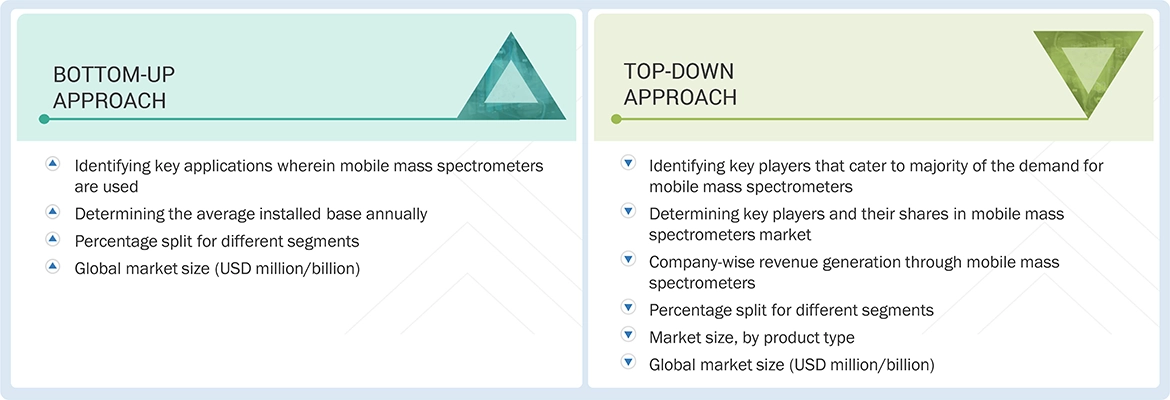
This study balanced primary and secondary research for the mobile mass spectrometers market by analyzing various market variables affecting small, medium, and large businesses. The next step involved conducting primary research with industry experts along the value chain to validate the findings, assumptions, and market sizing. Multiple methodologies, including both top-down and bottom-up approaches, were employed to estimate the overall market size.
The study encompasses market segments, evolving trends, regulatory frameworks, and competitive dynamics. It also examines leading market players and the strategies they employ in this sector. In conclusion, the total market size was estimated using a combination of top-down and bottom-up approaches, with data triangulation to finalize the market size. Primary research was conducted throughout the study to validate and test each hypothesis.
Secondary Research
During the study, secondary research was conducted using a range of sources, including directories and databases such as Bloomberg Businessweek, D&B Hoovers, and Factiva. Additional materials included white papers, annual reports, SEC filings, and investor presentations. This research approach was adopted to collect and analyze data that provides comprehensive, technical, and market-focused insights into the mobile mass spectrometers market. The findings offer insights into key players and market segmentation, informed by recent industry trends and significant developments. A database comprising leading industry figures was also created as part of this secondary research.
Primary Research
Primary research involved activities designed to gather both qualitative and quantitative data. A variety of individuals from both the supply and demand sides were interviewed during this phase. On the supply side, key figures such as CEOs, vice presidents, directors of marketing and sales, directors of technology and innovation, and other important leaders were interviewed by industry experts. On the demand side, primary sources included academic institutions and research organizations. This research aimed to validate market segmentation, identify prominent market participants, and gain insights into significant industry trends and market dynamics through a real-world primary study.

To know about the assumptions considered for the study, download the pdf brochure
Market Size Estimation
This report provides an analysis of the global mobile mass spectrometers market size by reviewing the revenue shares of prominent companies. Key players with significant market shares were identified through secondary research, and their revenue from mobile mass spectrometers sales was calculated and subsequently validated through primary research. The secondary research included an analysis of annual and financial reports from leading market participants. Meanwhile, the primary research involved in-depth interviews with key thought leaders, such as directors, CEOs, and marketing executives.
To calculate the global market value, segmental revenues were derived from revenue mappings provided by service and product providers. The process involved the following steps:
- Generating a list of key players that operate in the mobile mass spectrometers market at the regional or global levels
- Mapping the products of manufacturers of mobile mass spectrometers and related product lines at the regional level
- Mapping the revenues of listed players through the sales of mobile mass spectrometers and related products
- Mapping the revenues of major players to cover at least ~90% of the global market share as of 2024
- Extrapolating the mapped revenues of players to arrive at the global market value for the respective segment
- Summing up the market value for all segments and subsegments to achieve the actual value of the global mobile mass spectrometers market
Data Triangulation
After estimating the overall market size, the mobile mass spectrometers market was classified into subsegments. The overall market engineering process was finalized through data triangulation and market segmentation, yielding accurate statistics for all segments and subsegments. This triangulation involved analyzing various trends and factors on both the demand and supply sides. Furthermore, the mobile mass spectrometers market data was verified and validated using both top-down and bottom-up approaches.
Market Definition
A mobile mass spectrometer is a portable device that identifies chemicals on-site by measuring the mass-to-charge ratio of ions. The mobile mass spectrometers market encompasses product types, e.g., handheld and portable platforms; field-deployable, backpack-based platforms used in lab-based applications; point-of-use, lab-based applications; and handheld applications.
Key Stakeholders
- Pharmaceutical companies
- Biopharmaceutical companies
- Contract research organizations (CROs)
- Contract development and manufacturing organizations (CDMOs)
- Defense organizations
- Narcotics testing facilities
- Academic & research institutes
- Regulatory authorities and industry associations
- Venture capitalists and investment firms
- Research labs
Report Objectives
- To define, describe, and forecast the size of the mobile mass spectrometers market based on product type, application, component, and region
- To provide detailed information regarding the major factors influencing the growth potential of the global mobile mass spectrometers market (drivers, restraints, opportunities, challenges, and trends)
- To analyze the micromarkets with respect to individual growth trends, prospects, and contributions to the global mobile mass spectrometers market
- To analyze key growth opportunities in the global mobile mass spectrometers market for key stakeholders and provide details of the competitive landscape for market leaders
- To forecast the size of market segments and/or subsegments with respect to five major regions: North America (US and Canada), Europe (Germany, France, the UK, Spain, Italy, and the RoE), Asia Pacific (Japan, China, India, Australia, South Korea, and RoAPAC), Latin America (Brazil, Mexico, RoLA), and the Middle East & Africa (GCC and RoMEA)
- To profile the key players in the mobile mass spectrometers market and comprehensively analyze their market shares and core competencies
- To analyze the competitive developments undertaken in the global mobile mass spectrometers market, such as product launches, agreements, expansions, and mergers & acquisitions.
Available customizations:
With the market data provided, MarketsandMarkets offers customizations tailored to your company’s specific needs. The following customization options are available for the present global mobile mass spectrometers market report:
Product Analysis
- Product matrix, which gives a detailed comparison of the product portfolios of the top 15 companies
Company Information
- Detailed analysis and profiling of additional market players (up to 13)
Geographic Analysis
- Further breakdown of the Rest of Europe mobile mass spectrometers market into Russia, Belgium, the Netherlands, Switzerland, Austria, Finland, Sweden, Poland, and Portugal
- Further breakdown of the Rest of Asia Pacific mobile mass spectrometers market into Singapore, Taiwan, New Zealand, the Philippines, Malaysia, and other Asia Pacific countries
- Further breakdown of the Rest of Latin America mobile mass spectrometers into Argentina, Chile, Peru, and Colombia.


Personalize This Research
- Triangulate with your Own Data
- Get Data as per your Format and Definition
- Gain a Deeper Dive on a Specific Application, Geography, Customer or Competitor
- Any level of Personalization
Let Us Help You
- What are the Known and Unknown Adjacencies Impacting the Mobile Mass Spectrometers Market
- What will your New Revenue Sources be?
- Who will be your Top Customer; what will make them switch?
- Defend your Market Share or Win Competitors
- Get a Scorecard for Target Partners

Custom Market Research Services
We Will Customise The Research For You, In Case The Report Listed Above Does Not Meet With Your Requirements
Get 10% Free CustomisationTESTIMONIALS

JAYANT RAJPUROHIT
Director of Market Insights, Data and Analytics
SFI Health,
Leading Pharmaceutical Companywww.sfihealth.com/

We at SFI Health approached MarketsandMarkets for an Opportunity Assessment on "Incidence and Prevalence of Focus Indications" as we wanted to know the most attractive HCPs like Physician, Functional MD, Naturopath and Pharmacist. The project was critical for us to ensure our focus on the right target which would enable sustainable growth and profitability for SFI Health. The business insights provided exceeded our expectations and we were extremely impressed. The team at MarketsandMarkets is highly professional and detail oriented and very well understood our business needs. MarketsandMarkets offers a unique combination of expertise and dedicated engagement model. We identified 2 new products to be launched in coming months, based on the research findings provided by MarketsandMarkets. We are happy with the services and would strongly recommend MarketsandMarkets to my peers in the industry.

BEATRIZ DE LA CALLE
Head of Commercial Analytics
Qualicaps,
Leading Pharmaceutical Companywww.qualicaps.com/

We partnered with MarketsandMarkets for an assessment study on hard empty capsules. The team was extremely professional in understanding our business requirements and we received timely responses to all our queries. The market intelligence and the recommendations has met our business requirements. We were extremely impressed to see the final study results; it really exceeded our expectations. The market intelligence offered by MarketsandMarkets, and clarity on next steps will help us achieve our business objective for the Year 2021. We are happy with the services and would strongly recommend MarketsandMarkets to my peers in the industry.

Bob Williams,
Senior Director Business Development & Innovation
Bracco Diagnostics Inc.,
Italian Multinational in life sciences sector and a World Leader in imaging diagnosticsimaging.bracco.com/us-en
We were pleased with targeted insights that MarketsandMarkets identified from a custom study on the 'Radiation Dose Management Solutions Market'. Your team identified and characterized the market participants as well as underlying trends accurately. This study was useful to Bracco in formulating business strategies for our dose monitoring product lines and we thank MarketsandMarkets for the job well done.
Cody Coonradt,
Market Development and Strategy Manager
3M Health Information Systems,
Leader in Health care Coding, Payment & Analytics Solutions.www.3m.com/3M/en_US/health-information-systems-us
The value for our organization comes from three things: depth of research, specificity of segments and being easy to work with. As important as the first two are, the third can't be underestimated. MarketsandMarkets, maybe more than any other research vendor, wants to know what is top of mind for our team and what big questions we are grappling to answer.
Their customer first approach and high value engagement model, have given us great analysis and excellent value for money
- Australia Mobile Mass Spectrometers Market
- South Korea Mobile Mass Spectrometers Market
- Brazil Mobile Mass Spectrometers Market
- Mexico Mobile Mass Spectrometers Market
- Rest Of Europe Mobile Mass Spectrometers Market
- Rest Of Asia Pacific Mobile Mass Spectrometers Market
- Rest Of Latin America Mobile Mass Spectrometers Market
- GCC Countries Mobile Mass Spectrometers Market
- US Mobile Mass Spectrometers Market
- Canada Mobile Mass Spectrometers Market
- Germany Mobile Mass Spectrometers Market
- UK Mobile Mass Spectrometers Market
- France Mobile Mass Spectrometers Market
- Italy Mobile Mass Spectrometers Market
- Spain Mobile Mass Spectrometers Market
- China Mobile Mass Spectrometers Market
- Japan Mobile Mass Spectrometers Market
- India Mobile Mass Spectrometers Market






Growth opportunities and latent adjacency in Mobile Mass Spectrometers Market