Optoelectronic Components Market by Component (Sensor, LED, Laser Diode, and Infrared Components), Application (Measurement, Lighting, Communications, and Security & Surveillance), Material, Vertical, and Region - Global Forecast to 2035


Optoelectronic Components Market Market Summary
The global Optoelectronic Components Market is experiencing substantial growth driven by rapid digital transformation, increasing adoption of advanced communication technologies, and rising demand for energy-efficient electronic systems. In 2025, the market is estimated to be valued at approximately USD 48.6 billion and is projected to reach nearly USD 116.4 billion by 2036, registering a CAGR of 8.3% during the forecast period. The growing integration of optoelectronic devices in consumer electronics, automotive systems, industrial automation, healthcare equipment, and telecommunications infrastructure is significantly accelerating market expansion worldwide.
The increasing deployment of artificial intelligence, IoT-enabled devices, cloud computing infrastructure, and smart automation technologies has amplified the demand for high-speed data transmission and energy-efficient electronic components. Optoelectronic technologies such as LEDs, laser diodes, image sensors, infrared components, and photodetectors are becoming essential for modern electronic systems due to their superior performance, faster signal processing, and reduced power consumption. Furthermore, the rapid expansion of 5G networks, autonomous vehicles, smart cities, and advanced semiconductor manufacturing continues to create significant opportunities for optoelectronic component manufacturers globally.
Key Market Trends & Insights
- North America dominates the Optoelectronic Components Market due to advanced semiconductor and telecommunications infrastructure.
- Asia Pacific is projected to witness the fastest growth driven by electronics manufacturing and expanding 5G deployment.
- LEDs and image sensors remain the dominant product segments because of widespread use in consumer electronics and automotive applications.
- AI-enabled optical sensing and machine vision technologies are rapidly transforming industrial automation systems.
- Increasing demand for fiber optic communication systems is boosting adoption of laser diodes and photodetectors.
- Automotive LiDAR, AR/VR devices, and smart healthcare systems are emerging as high-growth application areas.
Market Size & Forecast
- Base Year Market Size (2025): USD 48.6 Billion
- Forecast Market Value (2036): USD 116.4 Billion
- CAGR (2025–2036): 8.3%
- Market growth is driven by increasing adoption of AI, IoT, industrial automation, 5G infrastructure, and energy-efficient electronic technologies.
Optoelectronic Components Market Top 10 key takeaway
- LEDs continue to dominate the market due to strong demand across lighting and display applications.
- Asia Pacific is emerging as the fastest-growing regional market.
- AI-powered machine vision systems are increasing demand for advanced image sensors.
- 5G network expansion is accelerating demand for fiber optic communication components.
- Automotive LiDAR adoption is creating significant opportunities for laser diode manufacturers.
- Healthcare imaging technologies are driving innovation in photodetectors and sensors.
- Industrial automation is increasing demand for optical sensing technologies.
- Cloud computing and hyperscale data centers are boosting optical communication infrastructure.
- Smart consumer electronics remain a major revenue contributor.
- Semiconductor advancements are improving component efficiency and miniaturization.
Product Insights
LEDs account for the largest share of the Optoelectronic Components Market due to their extensive use in consumer electronics, automotive lighting, smart displays, industrial equipment, and residential lighting systems. The growing global shift toward energy-efficient lighting solutions and sustainable electronic products continues to support strong demand for LED technologies. High brightness, low energy consumption, longer lifespan, and compact design make LEDs highly suitable for modern electronic and industrial applications.
Image sensors also represent a significant market segment owing to their increasing integration into smartphones, surveillance systems, automotive safety systems, and industrial automation platforms. CMOS image sensors have gained substantial popularity due to their improved resolution, low power consumption, and compatibility with AI-enabled machine vision applications.
Emerging product categories include laser diodes, phototransistors, infrared components, optocouplers, and advanced optical sensors. The rapid growth of autonomous vehicles and advanced driver assistance systems is accelerating the adoption of LiDAR sensors and laser-based communication technologies. Infrared sensors are increasingly utilized in biometric authentication, thermal imaging, healthcare diagnostics, and security applications.
AI integration is becoming a transformative trend across the product landscape. Modern optoelectronic components are increasingly designed with embedded intelligence, enabling real-time sensing, predictive analytics, and automated signal processing. Manufacturers are focusing on developing highly efficient miniaturized components that support next-generation AI-driven applications in robotics, smart manufacturing, and connected devices.
Technology / Component Insights
The Optoelectronic Components Market is driven by continuous advancements in semiconductor fabrication, photonics, fiber optic communication, AI-enabled sensing technologies, and integrated circuit design. Photonics technology remains a core foundation of the market, enabling efficient conversion between electrical and optical signals for high-speed communication and sensing applications.
Artificial intelligence is playing an increasingly important role in improving the functionality and performance of optoelectronic systems. AI-powered image processing, machine vision, and optical recognition technologies are significantly enhancing industrial automation, healthcare diagnostics, and autonomous vehicle systems. Advanced AI algorithms allow image sensors and optical systems to perform complex real-time data analysis with higher precision and reduced latency.
IoT connectivity is another major technology driver. Billions of connected devices require high-speed optical communication and intelligent sensing capabilities, creating strong demand for optoelectronic components such as optical transceivers, photodetectors, and infrared sensors. IoT-enabled smart homes, industrial automation platforms, and wearable healthcare devices are contributing significantly to market growth.
Cloud computing infrastructure and hyperscale data centers are increasing investments in fiber optic communication systems. Optical transceivers and laser-based communication technologies are essential for enabling high-speed data transmission with lower power consumption and higher bandwidth efficiency. As cloud services continue to expand globally, the demand for advanced optoelectronic communication components is expected to rise substantially.
Automation technologies are also reshaping the market. Smart factories increasingly rely on machine vision systems, optical sensors, and AI-driven robotics for real-time monitoring and precision manufacturing. Future innovations are expected to focus on silicon photonics, quantum optoelectronics, edge AI integration, flexible photonic devices, and ultra-miniaturized optical components for next-generation electronic systems.
Application Insights
Consumer electronics remain the largest application segment in the Optoelectronic Components Market due to the widespread use of LEDs, image sensors, laser diodes, and optical communication technologies in smartphones, televisions, wearable devices, laptops, and gaming systems. Continuous innovation in display technology and mobile imaging capabilities is driving strong demand for high-performance optoelectronic components.
Telecommunications is another major application area driven by rapid deployment of 5G networks, fiber optic communication systems, and cloud computing infrastructure. Optical transceivers, photodiodes, and laser communication components are critical for enabling ultra-fast data transmission and low-latency network performance.
The automotive industry is rapidly emerging as a high-growth application segment due to increasing adoption of autonomous driving technologies, advanced driver assistance systems, and smart vehicle lighting solutions. LiDAR systems, infrared cameras, and optical sensors are becoming integral components of modern connected vehicles.
Healthcare applications are also witnessing significant growth. Optoelectronic components are increasingly used in medical imaging devices, biosensors, wearable health monitors, and diagnostic systems. AI-driven optical imaging technologies are improving diagnostic accuracy and enabling advanced telemedicine solutions.
Future opportunities are expected in industrial robotics, smart infrastructure, aerospace communication systems, augmented reality, virtual reality, and defense applications. The growing adoption of AI-powered machine vision and intelligent sensing platforms will continue to create new market opportunities over the forecast period.
Regional Insights
North America currently dominates the Optoelectronic Components Market due to strong investments in semiconductor technology, advanced telecommunications infrastructure, and AI-driven industrial automation. The United States leads the regional market with substantial demand from cloud computing providers, defense organizations, automotive manufacturers, and consumer electronics companies. The rapid adoption of AI-enabled optical sensing and machine vision technologies is further accelerating regional market growth.
Europe represents a technologically advanced market supported by strong automotive manufacturing, industrial automation, and sustainability initiatives. Countries such as Germany and France are heavily investing in smart mobility, photonics research, and energy-efficient electronic systems. The region’s focus on green technology and advanced manufacturing continues to support demand for high-performance optoelectronic components.
Asia Pacific is projected to witness the highest CAGR during the forecast period due to rapid industrialization, expanding electronics manufacturing, and increasing investments in 5G infrastructure. China, Japan, South Korea, and India are major manufacturing hubs for semiconductors, displays, and consumer electronics. Government initiatives promoting domestic semiconductor production and digital transformation are significantly accelerating regional growth.
Increasing adoption of connected devices, smart city infrastructure, and industrial automation technologies across emerging economies is expected to create substantial growth opportunities globally.
- North America remains the leading regional market for optoelectronic components.
- Asia Pacific is expected to register the fastest growth through 2036.
- Europe benefits from strong automotive and industrial automation demand.
- China and Japan continue to dominate electronics manufacturing globally.
- 5G infrastructure deployment is accelerating regional investments in optical communication technologies.
United States-Specific Market Trends
The United States continues to lead the North American market with a projected CAGR of 7.9% through 2036. Rising investments in AI infrastructure, cloud computing, semiconductor manufacturing, and defense communication systems are driving strong demand for advanced optoelectronic technologies.
Canada-Specific Market Trends
Canada is witnessing increasing adoption of optical sensing technologies across telecommunications, healthcare, and industrial automation sectors. The market is projected to grow at a CAGR of 7.1% due to expanding smart infrastructure investments.
Mexico-Specific Market Trends
Mexico’s growing electronics manufacturing sector is driving adoption of LEDs, image sensors, and optical communication components. The country is expected to register a CAGR of 7.5% supported by increasing automotive production activities.
China-Specific Market Trends
China represents one of the largest and fastest-growing markets globally with a CAGR of 10.2%. Massive investments in semiconductor fabrication, 5G infrastructure, and consumer electronics manufacturing are fueling market expansion.
Japan-Specific Market Trends
Japan continues to maintain strong demand for advanced photonics technologies, optical sensors, and semiconductor devices. The market is projected to grow at a CAGR of 8.4% supported by robotics and automotive innovation.
Germany-Specific Market Trends
Germany remains a key European market owing to its strong industrial automation and automotive sectors. The country is expected to witness a CAGR of 7.8% through 2036 due to increasing deployment of smart manufacturing technologies.
France-Specific Market Trends
France is increasingly investing in AI-enabled healthcare imaging, aerospace communication systems, and industrial photonics technologies. The market is projected to grow at a CAGR of 7.3% during the forecast period.
- China is projected to witness the highest growth rate globally.
- The United States remains the largest revenue contributor in North America.
- Japan leads in photonics and robotics-related optoelectronic innovation.
- Germany continues strong investments in industrial automation technologies.
- Canada and France are expanding smart infrastructure and AI-driven optical systems.
Key Optoelectronic Components Market Company Insights
Leading companies operating in the Optoelectronic Components Market are focusing on product innovation, semiconductor miniaturization, AI integration, and strategic collaborations to strengthen their market presence. Companies are investing heavily in research and development activities to improve optical efficiency, enhance data transmission speeds, and support emerging applications such as autonomous vehicles and smart industrial systems.
Major industry participants such as Sony Group Corporation, Samsung Electronics, OSRAM GmbH, Broadcom Inc., Hamamatsu Photonics, Texas Instruments, Intel Corporation, and Infineon Technologies are actively expanding their AI-enabled sensing and optical communication portfolios.
Several companies are also focusing on silicon photonics, LiDAR systems, and high-performance image sensors to capitalize on growing demand from automotive, industrial automation, and telecommunications industries.
- Companies are heavily investing in AI-enabled optical sensing technologies.
- Silicon photonics development remains a major strategic focus.
- Partnerships are accelerating innovation in autonomous vehicle applications.
- Semiconductor miniaturization is improving device efficiency and performance.
- Optical communication technologies remain a high-growth investment segment.
Recent Developments
The Optoelectronic Components Market has witnessed several strategic developments driven by advancements in AI, telecommunications, and semiconductor technologies. A leading semiconductor company recently launched a next-generation AI-powered image sensor designed for automotive safety and industrial machine vision applications. The new sensor improves low-light imaging performance and real-time object recognition capabilities.
Another major industry participant announced a partnership with a cloud infrastructure provider to develop high-speed optical transceiver solutions for hyperscale data centers. The collaboration aims to improve bandwidth efficiency and reduce energy consumption in next-generation cloud networks.
Additionally, several automotive technology companies are increasing investments in LiDAR-based sensing systems and infrared imaging technologies to support autonomous vehicle development and advanced driver assistance systems.
Market Segmentation
The Optoelectronic Components Market is segmented by product, technology/component, application, and region. By product, the market includes LEDs, image sensors, laser diodes, photodetectors, infrared components, optocouplers, and optical communication devices. LEDs and image sensors account for the largest market share due to their extensive adoption in consumer electronics and industrial applications.
Based on technology and component, the market comprises photonics, semiconductor devices, fiber optic communication systems, AI-enabled sensing technologies, IoT-connected optical systems, and cloud-integrated communication platforms. Photonics and optical communication technologies remain the dominant segments due to increasing demand for high-speed data transmission and intelligent sensing.
By application, the market serves consumer electronics, telecommunications, automotive, healthcare, industrial automation, aerospace & defense, and energy sectors. Consumer electronics and telecommunications remain the primary revenue-generating segments owing to continuous innovation in mobile devices, displays, and cloud infrastructure.
Regionally, the market is segmented into North America, Europe, Asia Pacific, Latin America, and the Middle East & Africa. North America leads the market, while Asia Pacific is expected to record the fastest growth during the forecast period.
- LEDs dominate the product category globally.
- Photonics technology leads the technology segment.
- Consumer electronics remain the largest application segment.
- Telecommunications infrastructure is driving optical communication demand.
- Asia Pacific is projected to achieve the highest regional growth rate.
Conclusion
The global Optoelectronic Components Market is expected to witness strong and sustained growth through 2036 driven by rapid advancements in AI, IoT, industrial automation, cloud computing, and next-generation communication technologies. Increasing adoption of smart devices, connected infrastructure, and energy-efficient electronic systems is creating substantial demand for advanced optoelectronic components across multiple industries.
Technologies such as AI-powered image sensing, silicon photonics, LiDAR systems, and optical communication networks are transforming the future of digital connectivity and industrial automation. Companies investing in semiconductor innovation, high-speed optical communication, and intelligent sensing technologies are expected to gain significant competitive advantages in the evolving market landscape.
As industries continue prioritizing digital transformation and intelligent automation, optoelectronic components will remain strategically important for enabling high-performance communication, sensing, imaging, and smart electronic systems worldwide through 2036.
FAQs
1. What is the current size of the Optoelectronic Components Market?
The global Optoelectronic Components Market is estimated to be valued at approximately USD 48.6 billion in 2025.
2. What is the expected growth rate of the market?
The market is projected to grow at a CAGR of 8.3% from 2025 to 2036.
3. What are the major drivers of the Optoelectronic Components Market?
Major growth drivers include AI adoption, IoT expansion, 5G deployment, industrial automation, and increasing demand for energy-efficient electronic systems.
4. Which region dominates the Optoelectronic Components Market?
North America currently dominates the market due to strong semiconductor infrastructure and advanced telecommunications technologies.
5. Which companies are leading the Optoelectronic Components Market?
Leading companies include Sony Group Corporation, Samsung Electronics, Broadcom Inc., Hamamatsu Photonics, and Intel Corporation.
 Exclusive indicates content/data unique to MarketsandMarkets and not available with any competitors.
Table of Contents
1 Introduction (Page No. - 23)
1.1 Objectives of the Study
1.2 Market Definition and Scope
1.2.1 Inclusions & Exclusions
1.3 Scope of the Study
1.3.1 Markets Covered
1.3.2 Geographic Scope
1.3.3 Years Considered for the Study
1.4 Currency Considered
1.5 Limitations
1.6 Unit Considered
1.7 Stakeholders
2 Research Methodology (Page No. - 28)
2.1 Introduction
2.1.1 Secondary and Primary Research
2.1.1.1 Key Industry Insights
2.1.2 Secondary Data
2.1.2.1 List of Major Secondary Sources
2.1.2.2 Secondary Sources
2.1.3 Primary Data
2.1.3.1 Primary Interviews With Experts
2.1.3.2 Breakdown of Primaries
2.1.3.3 Primary Sources
2.2 Market Size Estimation
2.2.1 Bottom-Up Approach
2.2.1.1 Approach for Bottom-Up Analysis (Demand Side)
2.2.2 Top-Down Approach
2.2.2.1 Approach for Top-Down Analysis (Supply Side)
2.3 Market Breakdown and Data Triangulation
2.4 Research Assumptions
3 Executive Summary (Page No. - 37)
4 Premium Insights (Page No. - 43)
4.1 Attractive Opportunities in Optoelectronic Components Market
4.2 Market in APAC, By Country and Vertical
4.3 Market, By Material
4.4 Market, By Application
4.5 Market, By Component, 2025
4.6 Market, By Vertical
4.7 Market, By Country
5 Market Overview (Page No. - 47)
5.1 Introduction
5.2 Market Dynamics
5.2.1 Drivers
5.2.1.1 Increased use of Infrared Components in Consumer Electronics and Automobiles
5.2.1.2 Long Life and Low Power Consumption
5.2.1.3 Demand for Improved Imaging and Optical Sensing Solutions in Healthcare Vertical
5.2.1.4 Ability to Operate in Extreme Environment
5.2.2 Restraints
5.2.2.1 Availability of Cheaper Substitute Technologies to LED
5.2.3 Opportunities
5.2.3.1 Advancements in Technology Such as Li-Fi
5.2.3.2 Innovation for Improvements in Functional Capabilities
5.2.3.3 Promising Industrial IoT Applications
5.2.4 Challenges
5.2.4.1 High Cost of Raw Materials
5.2.4.2 Regulatory Barriers
5.3 Value Chain Analysis
6 Optoelectronic Components Market, By Component (Page No. - 57)
6.1 Introduction
6.2 Sensors
6.2.1 Phototransistor
6.2.1.1 Low Cost and High Current Amplification Property Boost Demand for Phototransistors
6.2.2 Photodiode
6.2.2.1 Quick Response Time and Ability to Operate in High Temperatures Drive Demand for Photodiodes
6.2.3 Photo Relay
6.2.3.1 Ability to Work as Both, Forward and Reserve-Biased Components Boosts the Demand for Photo Relays
6.2.4 Image Sensor
6.2.4.1 CMOS Image Sensor
6.2.4.1.1 Low Price and Less Expensive Fabrication Drive the Demand for CMOS Image Sensors
6.2.4.2 CCD Image Sensor
6.2.4.2.1 Applications in Medical and Machine Vision Drive the Demand for CCD Image Sensors
6.2.4.3 Hybrid Image Sensor
6.2.4.3.1 Key Performance Parameters of Hybrid Image Sensors Include Sensitivity, Speed, Dynamic Range, High Efficiency & Resolution, and Field of View
6.2.5 Optical Sensor
6.2.5.1 Advantages Such as High Sensitivity, Electrical Passiveness, and Wide Dynamic Range Drive Market Growth for Optical Sensors
6.2.6 UV Sensor
6.2.6.1 UV Sensors Find Wide Application in Automobiles, Pharmaceuticals, and Robotics
6.3 LED
6.3.1 General LED
6.3.1.1 Lower Power Consumption and Longer Life Expectancy Boosting Demand for LEDs
6.3.2 UV LED
6.3.2.1 Applications Such as Sterilization and Counterfeit Detection Boost UV LED Demand
6.3.3 Organic LED
6.3.3.1 Low Power Consumption of Oled Drives the Market for This Segment
6.4 Laser Diode
6.4.1 Lightweight, Energy-Efficient, and Low Intensity Properties Drive Demand for Laser Diode
6.5 Infrared Components
6.5.1 Infrared (IR) Detector
6.5.1.1 Applications Such as Flame & Gas Detection and Night Vision Boost the Demand for IR Detectors
6.5.2 Infrared Emitting Diode (IRED)
6.5.2.1 Applications in Security Cameras and Surveillance Boost Demand for IRED
6.5.3 Irda Transceiver
6.5.3.1 Application in Telecommunication is Boosting the Demand for Irda Transceivers
7 Optoelectronic Components Market, By Material (Page No. - 70)
7.1 Introduction
7.2 Gallium Nitride
7.2.1 Gan Accounted for the Largest Share in the Market
7.3 Gallium Arsenide
7.3.1 Gaas has Application in Diodes, Field Effect Transistors (FETS), and Integrated Circuits (ICS)
7.4 Indium Phosphide
7.4.1 Indium Phosphide Serves as a Substrate for Epitaxial Indium Gallium Arsenide, Which is Used in Optoelectronic Components
7.5 Silicon Germanium
7.5.1 Sige is a Commonly Used Compound Semiconductor Material in Integrated Circuits
7.6 Gallium Phosphide
7.6.1 a Short Life Span at High Current Makes Gallium Phosphide Suitable for Low Current and Low Power Applications
7.7 Silicon Carbide
7.7.1 Silicon Carbide to Have the Highest Growth Rate
8 Optoelectronic Components Market, By Application (Page No. - 80)
8.1 Introduction
8.2 MEAsurement
8.2.1 Measurement Application to Grow at the Highest Growth Rate
8.3 Lighting
8.3.1 LEDs are Widely Used in Several Lighting Applications
8.4 Communications
8.4.1 Optoelectronic Components Such as Infrared Detectors and Laser Diodes are Widely Used for Communication Applications
8.5 Security & Surveillance
8.5.1 Optoelectronic Components are Being Used for Security & Surveillance in CCTV Cameras and for Facial Recognition
8.6 Others
8.6.1 Laser Diodes, Image Sensors, Infrared Transmitters, and Detectors are Used in Scanning and Spectrometry Applications
9 Optoelectronic Components Market, By Vertical (Page No. - 88)
9.1 Introduction
9.2 Consumer Electronics
9.2.1 Consumer Electronic Devices
9.2.1.1 Optoelectronic Components Such as LEDs, Image Sensors, IR Components, Laser Diodes, and Phototransistors are Extensively Used in
Consumer Electronic Devices
9.2.2 Smart Home Devices
9.2.2.1 Optoelectronic Components Such as Sensors, LEDs, and IR Components are Used for Smart Home Devices
9.2.3 Wearable Devices
9.2.3.1 LEDs, Image Sensors, and Optical Sensors are Used By Wearable Devices
9.3 Residential
9.3.1 LED is One of the Prominent Components Used in the Residential Vertical
9.4 Commercial
9.4.1 Laser Didoes, Image Sensors, Phototransistors, Photo Diodes, Photo Relays are Widely Used in the Commercial Vertical
9.5 Industrial
9.5.1 Cameras Supported By Infrared Sensors are Used in Industrial Vertical for Applications Like Machine Vision, Industrial Surveillance, and Robotic Vision
9.6 Automotive
9.6.1 LEDs and Image Sensors Find Application in Autonomous and Semi-Autonomous Vehicles
9.7 Telecommunication
9.7.1 Optoelectronic Components Find Application in Transmitters, Receivers, and Optical Amplifiers
9.8 Military & Aerospace
9.8.1 Military
9.8.1.1 Flexibility, Easy Integration, Ability to Work in Harsh Environments, and Durability Make Optoelectronic Components Suitable in the Military Vertical
9.8.2 Aerospace
9.8.2.1 Optoelectronic Components Find Usage in Aerospace for Distance Measurement Applications
9.9 Medical
9.9.1 Optoelectronic Components Such as LEDs and CCD & CMOS Image Sensors are Used Extensively Across a Wide Range of Medical Devices
9.10 Others
9.10.1 Utility
9.10.1.1 Optical Sensors are Used in Cable Tunnels, Cable Bridges, and Substation & Transformer Cables
9.10.2 Food & Beverages
9.10.2.1 LED Fixtures Find Application in Food & Beverage Companies
9.10.3 Pulp & Paper
9.10.3.1 Optical Sensors Can be Used to Measure Wood-Free Pulp
10 Geographic Analysis (Page No. - 118)
10.1 Introduction
10.2 North America
10.2.1 US
10.2.1.1 US Held Largest Share of Optoelectronic Components Market in North America
10.2.2 Canada
10.2.2.1 Robust Aviation Industry and Presence of Prominent Manufacturing and Automotive Players Likely to Increase Demand for Pressure Sensors in Canada
10.2.3 Mexico
10.2.3.1 Market in Mexico to Grow at the Highest Rate in North America
10.3 Europe
10.3.1 Germany
10.3.1.1 Germany Held the Largest Share of Market in Europe in 2019
10.3.2 UK
10.3.2.1 Automotive Sector and Industrial Automation are Likely to Propel Demand for Optoelectronic Components in the UK
10.3.3 France
10.3.3.1 Presence of Prominent Automotive, Aerospace & Defense, and Healthcare Companies to Drive Demand for Optoelectronic Components in France
10.3.4 Rest of Europe
10.3.4.1 Optoelectronic Components Market in RoE Will be Driven By Supportive Government Programs and Incentives
10.4 Asia Pacific
10.4.1 China
10.4.1.1 China Held the Largest Share of Market in APAC in 2019
10.4.2 Japan
10.4.2.1 Rapid Industrialization and Modernization Expected to Boost Demand for Optoelectronic Components in Japan
10.4.3 South Korea
10.4.3.1 Electronics and Automotive Verticals to Drive Demand for Optoelectronic Components in South Korea
10.4.4 India
10.4.4.1 Increasing Manufacturing Activity in India is Expected to Boost Growth in Demand for Optoelectronic Components
10.4.5 Rest of APAC
10.4.5.1 RoAPAC is an Attractive Destination for Investments in the Electronics Industry
10.5 Rest of the World
10.5.1 Middle East & Africa (MEA)
10.5.1.1 MEA Held a Larger Share of Market
in RoW 156
10.5.2 South America
10.5.2.1 Market in South America Expected to Grow at Higher CAGR in RoW
11 Competitive Landscape (Page No. - 158)
11.1 Introduction
11.2 Ranking Analysis of Players in Optoelectronic Components Market
11.3 Competitive Leadership Mapping
11.3.1 Visionary Leaders
11.3.2 Dynamic Differentiators
11.3.3 Innovators
11.3.4 Emerging Companies
11.4 Strength of Product Portfolio (25 Companies)
11.5 Business Strategy Excellence (25 Companies)
11.6 Competitive Scenario
11.6.1 Expansions
11.6.2 Product Launches
11.6.3 Mergers & Acquisitions
11.6.4 Partnerships, Collaborations, Joint Ventures, Strategic Alliances, Contracts
12 Company Profiles (Page No. - 175)
12.1 Key Players
(Business Overview, Products Offered, Recent Developments, SWOT Analysis, and MnM View)*
12.1.1 Hamamatsu
12.1.2 Osram
12.1.3 TT Electronics
12.1.4 Vishay
12.1.5 ON Semiconductor
12.1.6 Cree
12.1.7 Trumpf
12.1.8 SICK AG
12.1.9 Samsung
12.1.10 Sony
12.1.11 Broadcom
* Business Overview, Products Offered, Recent Developments, SWOT Analysis, and MnM View Might Not be Captured in Case of Unlisted Companies.
12.2 Right to Win
12.2.1 Hamamatsu
12.2.2 Osram
12.2.3 TT Electronics
12.2.4 Vishay
12.2.5 ON Semiconductor
12.3 Other Key Players
12.3.1 Omnivision
12.3.2 Micropac
12.3.3 Rohm
12.3.4 OSI System
12.3.5 Sharp
12.3.6 Newport
12.3.7 Himax
12.3.8 Renesas
12.3.9 Lite-On
12.3.10 SK Hynix
13 Appendix (Page No. - 232)
13.1 Insights of Industry Experts
13.2 Discussion Guide
13.3 Knowledge Store: Marketsandmarkets’ Subscription Portal
13.4 Available Customizations
13.5 Related Reports
13.6 Author Details
List of Tables (110 Tables)
Table 1 Optoelectronic Components Market, By Component, 2017–2025 (USD Million)
Table 2 Market for Sensors, By Region, 2017–2025 (USD Million)
Table 3 Market for LED, By Region, 2017–2025 (USD Million)
Table 4 Market for Laser Diode, By Region, 2017–2025 (USD Million)
Table 5 Market for Infrared Components, By Subcomponent, 2017–2025 (USD Million)
Table 6 Market for Infrared Components, By Region, 2017–2025 (USD Million)
Table 7 Market, By Material, 2017–2025 (USD Million)
Table 8 Gallium Nitride Market, By Region, 2017–2025 (USD Million)
Table 9 Gallium Arsenide Market, By Region, 2017–2025 (USD Million)
Table 10 Indium Phosphide Market, By Region, 2017–2025 (USD Million)
Table 11 Silicon Germanium Market, By Region, 2017–2025 (USD Million)
Table 12 Gallium Phosphide Market, By Region, 2017–2025 (USD Million)
Table 13 Silicon Carbide Market, By Region, 2017–2025 (USD Million)
Table 14 Market, By Application, 2017–2025 (USD Million)
Table 15 Market for Measurement, By Region, 2017–2025 (USD Million)
Table 16 Market for Lighting, By Region, 2017–2025 (USD Million)
Table 17 Market for Communications, By Region, 2017–2025 (USD Million)
Table 18 Market for Security & Surveillance, By Region, 2017–2025 (USD Million)
Table 19 Market for Other Applications, By Region, 2017–2025 (USD Million)
Table 20 Market, By Vertical, 2017–2025 (USD Million)
Table 21 Optoelectronic Components Market for Consumer Electronics, By Region, 2017–2025 (USD Million)
Table 22 APAC: Market for Consumer Electronics Vertical, By Country, 2017–2025 (USD Million)
Table 23 North America: Market for Consumer Electronics Vertical, By Country, 2017–2025 (USD Million)
Table 24 Europe: Market for Consumer Electronics Vertical, By Country, 2017–2025 (USD Million)
Table 25 RoW: Market for Consumer Electronics Vertical, By Region, 2017–2025 (USD Million)
Table 26 Market for Residential Vertical, By Region, 2017–2025 (USD Million)
Table 27 APAC: Market for Residential Vertical, By Country, 2017–2025 (USD Million)
Table 28 North America: Market for Residential Vertical, By Country, 2017–2025 (USD Million)
Table 29 Europe: Market for Residential Vertical, By Country, 2017–2025 (USD Million)
Table 30 RoW: Market for Residential Vertical, By Region, 2017–2025 (USD Million)
Table 31 Optoelectronic Components Market for Commercial Vertical, By Region, 2017–2025 (USD Million)
Table 32 APAC: Market for Commercial Vertical, By Country, 2017–2025 (USD Million)
Table 33 North America: Market for Commercial Vertical, By Country, 2017–2025 (USD Million)
Table 34 Europe: Market for Commercial Vertical, By Country, 2017–2025 (USD Million)
Table 35 RoW: Market for Commercial Vertical, By Region, 2017–2025 (USD Million)
Table 36 Market for Industrial Vertical, By Region, 2017–2025 (USD Million)
Table 37 APAC: Market for Industrial Vertical, By Country, 2017–2025 (USD Million)
Table 38 North America: Market for Industrial Vertical, By Country, 2017–2025 (USD Million)
Table 39 Europe: Market for Industrial Vertical, By Country, 2017–2025 (USD Million)
Table 40 RoW: Market for Industrial Vertical, By Region, 2017–2025 (USD Million)
Table 41 Optoelectronic Components Market for Automotive Vertical, By Region, 2017–2025 (USD Million)
Table 42 APAC: Market for Automotive Vertical, By Country, 2017–2025 (USD Million)
Table 43 North America: Market for Automotive Vertical, By Country, 2017–2025 (USD Million)
Table 44 Europe: Market for Automotive Vertical, By Country, 2017–2025 (USD Million)
Table 45 RoW: Market for Automotive Vertical, By Region, 2017–2025 (USD Million)
Table 46 Market for Telecommunication Vertical, By Region, 2017–2025 (USD Million)
Table 47 APAC: Market for Telecommunication, By Country, 2017–2025 (USD Million)
Table 48 North America: Market for Telecommunication Vertical, By Country, 2017–2025 (USD Million)
Table 49 Europe: Market for Telecommunication Vertical, By Country, 2017–2025 (USD Million)
Table 50 RoW: Market for Telecommunication, By Region, 2017–2025 (USD Million)
Table 51 Market for Military & Aerospace Vertical, By Region, 2017–2025 (USD Million)
Table 52 APAC: Market for Military & Aerospace Vertical, By Country, 2017–2025 (USD Million)
Table 53 North America: Market for Military & Aerospace Vertical, By Country, 2017–2025 (USD Million)
Table 54 Europe: Market for Military & Aerospace Vertical, By Country, 2017–2025 (USD Million)
Table 55 RoW: Market for Military & Aerospace Vertical, By Region, 2017–2025 (USD Million)
Table 56 Optoelectronic Components Market for Medical, By Region, 2017–2025 (USD Million)
Table 57 APAC: Market for Medical Vertical, By Country, 2017–2025 (USD Million)
Table 58 North America: Market for Medical Vertical, By Country, 2017–2025 (USD Million)
Table 59 Europe: Market for Medical Vertical, By Country, 2017–2025 (USD Million)
Table 60 RoW: Market for Medical Vertical, By Region, 2017–2025 (USD Million)
Table 61 Market for Other Verticals, By Region, 2017–2025 (USD Million)
Table 62 APAC: Market for Other Verticals, By Country, 2017–2025 (USD Million)
Table 63 North America: Market for Other Verticals, By Country, 2017–2025 (USD Million)
Table 64 Europe: Market for Other Verticals, By Country, 2017–2025 (USD Million)
Table 65 RoW: Market for Other Verticals, By Region, 2017–2025 (USD Million)
Table 66 Optoelectronic Components Market, By Region, 2017–2025 (USD Million)
Table 67 North America: Market, By Country, 2017–2025 (USD Million)
Table 68 North America: Market, By Component, 2017–2025 (USD Million)
Table 69 North America: Market, By Application, 2017–2025 (USD Million)
Table 70 North America: Market, By Material, 2017–2025 (USD Million)
Table 71 North America: Market, By Vertical, 2017–2025 (USD Million)
Table 72 US: Market, By Vertical, 2017–2025 (USD Million)
Table 73 US: Market, By Component, 2017–2025 (USD Million)
Table 74 Canada: Market, By Vertical, 2017–2025 (USD Million)
Table 75 Mexico: Market, By Vertical, 2017–2025 (USD Million)
Table 76 Europe: Optoelectronic Components Market, By Country, 2017–2025 (USD Million)
Table 77 Europe: Market, By Component, 2017–2025 (USD Million)
Table 78 Europe: Market, By Application, 2017–2025 (USD Million)
Table 79 Europe: Market, By Material, 2017–2025 (USD Million)
Table 80 Europe: Market, By Vertical, 2017–2025 (USD Million)
Table 81 Germany: Market, By Vertical, 2017–2025 (USD Million)
Table 82 Germany: Market, By Component, 2017–2025 (USD Million)
Table 83 UK: Optoelectronic Components Market, By Vertical, 2017–2025 (USD Million)
Table 84 UK: Market, By Component, 2017–2025 (USD Million)
Table 85 France: Market, By Vertical, 2017–2025 (USD Million)
Table 86 France: Market, By Component, 2017–2025 (USD Million)
Table 87 RoE: Market, By Vertical, 2017–2025 (USD Million)
Table 88 APAC: Market, By Country, 2017–2025 (USD Million)
Table 89 APAC: Market, By Component, 2017–2025 (USD Million)
Table 90 APAC: Market, By Application, 2017–2025 (USD Million)
Table 91 APAC: Market, By Material, 2017–2025 (USD Million)
Table 92 APAC: Market, By Vertical, 2017–2025 (USD Million)
Table 93 China: Market, By Vertical, 2017–2025 (USD Million)
Table 94 China: Market, By Component, 2017–2025 (USD Million)
Table 95 Japan: Market, By Vertical, 2017–2025 (USD Million)
Table 96 Japan: Market, By Component, 2017–2025 (USD Million)
Table 97 South Korea: Market, By Vertical, 2017–2025 (USD Million)
Table 98 India: Market, By Vertical, 2017–2025 (USD Million)
Table 99 RoAPAC: Market, By Vertical, 2017–2025 (USD Million)
Table 100 Optoelectronic Components Market in RoW, By Region, 2017–2025 (USD Million)
Table 101 RoW: Market, By Component, 2017–2025 (USD Million)
Table 102 RoW: Market, By Application, 2017–2025 (USD Million)
Table 103 RoW: Market, By Material, 2017–2025 (USD Million)
Table 104 RoW: Market, By Vertical, 2017–2025 (USD Million)
Table 105 MEA: Market, By Vertical, 2017–2025 (USD Million)
Table 106 South America: Market, By Vertical, 2017–2025 (USD Million)
Table 107 Expansions, 2016–2019
Table 108 Product Launches, 2016–2019
Table 109 Mergers & Acquisitions, 2016–2019
Table 110 Partnerships, Collaborations, Joint Ventures, Strategic Alliances, Contracts, 2016–2019
List of Figures (74 Figures)
Figure 1 Optoelectronic Components Market: Research Design
Figure 2 Market Size Estimation Methodology: Bottom-Up Approach
Figure 3 Market Size Estimation Methodology: Top-Down Approach
Figure 4 Data Triangulation
Figure 5 Assumptions for the Research Study
Figure 6 Optoelectronic Components Market, 2017–2025 (USD Million)
Figure 7 Consumer Electronics Vertical Accounted for Largest Share of Market in 2019
Figure 8 Measurement Application Held Largest Market Share in 2019
Figure 9 Gallium Nitride Accounted for Largest Market Share in 2019
Figure 10 Sensors Held Largest Share of Market, By Component, in 2019
Figure 11 Market, By Region, 2019
Figure 12 Increased use of Infrared Components in Consumer Electronics and Automobiles Drives Growth of Market
Figure 13 China and Consumer Electronics Held Largest Share of APAC Market in 2019
Figure 14 Gallium Nitride to Account for Largest Share of Market Based on Material During 2020–2025
Figure 15 Measurement Segment Expected to Exhibit Highest CAGR in Market, 2020–2025
Figure 16 Sensors Expected to Capture Largest Share of Market By 2025, By Component
Figure 17 Consumer Electronics Expected to Hold Largest Share of Market By 2025
Figure 18 China Accounted for Largest Share of Market in 2019
Figure 19 Impact of Drivers on the Market
Figure 20 Impact of Opportunities on the Market
Figure 21 Impact of Challenges and Restraints on Market
Figure 22 Smartphone Units Sold, By Region, Million Units (FY 2017)
Figure 23 Number of Visually Impaired Across the Globe, Million (FY 2010)
Figure 24 Value Chain Analysis: Major Value Added During Manufacturing and Assembly Phase
Figure 25 Optoelectronic Components Market, By Component
Figure 26 Market for Sensors to Grow at Highest CAGR During Forecast Period
Figure 27 Market for Sensors to Grow at Highest CAGR in North America During Forecast Period
Figure 28 Global LED Shipment, 2017–2025 (Million Units)
Figure 29 Market, By Material
Figure 30 Market for Silicon Carbide to Grow at Highest CAGR During Forecast Period
Figure 31 Gallium Nitride Market in North America to Grow at Highest CAGR During Forecast Period
Figure 32 Silicon Germanium Market in North America to Grow at Highest CAGR During Forecast Period
Figure 33 Optoelectronic Components, By Application
Figure 34 Optoelectronic Components Market for Measurement to Grow at Highest CAGR During Forecast Period
Figure 35 Measurement Market in North America to Grow at Highest CAGR During Forecast Period
Figure 36 Security & Surveillance Market in North America to Grow at Highest CAGR During Forecast Period
Figure 37 Market, By Vertical
Figure 38 Market for Automotive to Grow at Highest CAGR During Forecast Period
Figure 39 Market for Consumer Electronics in North America to Grow at Highest CAGR During Forecast Period
Figure 40 Residential Market in North America to Grow at Highest CAGR During Forecast Period
Figure 41 Commercial Market in North America to Grow at Highest CAGR During Forecast Period
Figure 42 Industrial Market in North America to Grow at Highest CAGR During Forecast Period
Figure 43 Automotive Market in North America to Grow at Highest CAGR During Forecast Period
Figure 44 Telecommunication Market in North America to Grow at Highest CAGR During Forecast Period
Figure 45 Military & Aerospace Market in North America to Grow at Highest CAGR During Forecast Period
Figure 46 Medical Market in North America to Grow at Highest CAGR During Forecast Period
Figure 47 Optoelectronic Components Market for Other Verticals in North America to Grow at Highest CAGR During Forecast Period
Figure 48 Geographic Snapshot: Market in Mexico to Grow at Highest CAGR During Forecast Period
Figure 49 North America to Witness Highest CAGR in Market During Forecast Period
Figure 50 Snapshot of Market in North America
Figure 51 Market in Mexico to Witness Highest CAGR in North America During Forecast Period
Figure 52 US Market for Automotive to Witness Highest CAGR During Forecast Period
Figure 53 Snapshot of Market in Europe
Figure 54 Market in Germany to Hold Largest Share in Europe During the Forecast Period
Figure 55 Germany Market for Automotive to Witness Highest CAGR During Forecast Period
Figure 56 Snapshot of Market in APAC
Figure 57 Market in India to Witness Highest CAGR During Forecast Period
Figure 58 China Market for Automotive to Witness Highest CAGR During Forecast Period
Figure 59 Market in South America to Witness Highest CAGR During Forecast Period
Figure 60 Major Players in Market Adopted Product Launches as Key Growth Strategy From 2016 to 2019
Figure 61 Top 5 Companies in Optoelectronic Components Market
Figure 62 Market (Global) Competitive Leadership Mapping, 2019
Figure 63 Market Evolution Framework: Product Launches, Followed By Expansions, Fueled Market Growth (2016–2018)
Figure 64 Hamamatsu: Company Snapshot
Figure 65 Osram: Company Snapshot
Figure 66 TT Electronics: Company Snapshot
Figure 67 Vishay: Company Snapshot
Figure 68 ON Semiconductor: Company Snapshot
Figure 69 Cree: Business Overview
Figure 70 Trumpf: Company Snapshot
Figure 71 SICK AG: Company Snapshot
Figure 72 Samsung: Company Snapshot
Figure 73 Sony Corporation: Company Snapshot
Figure 74 Broadcom: Company Snapshot
The study involved four major activities in estimating the current size of the optoelectronic components market. Exhaustive secondary research was done to collect information on the market, the peer market, and the parent market. The next step was to validate these findings, assumptions, and sizing with industry experts from across the value chain through primary research. Both top-down and bottom-up approaches were employed to estimate the complete market size. After that, market breakdown and data triangulation methods were used to estimate the market sizes of segments and subsegments.
Secondary Research
The research methodology used to estimate and forecast the optoelectronic components market begins with capturing data on the revenues of key vendors in the market through secondary research. This study involves the use of extensive secondary sources, directories, and databases such as Hoovers, Bloomberg Businessweek, Factiva, and OneSource to identify and collect information useful for the technical, market-oriented, and commercial study of market. Vendor offerings were also taken into consideration to determine the market segmentation. This entire research methodology includes studying annual and financial reports of top players, presentations, press releases, journals, paid databases, trade directories, regulatory bodies, and safety standard organizations.
Primary Research
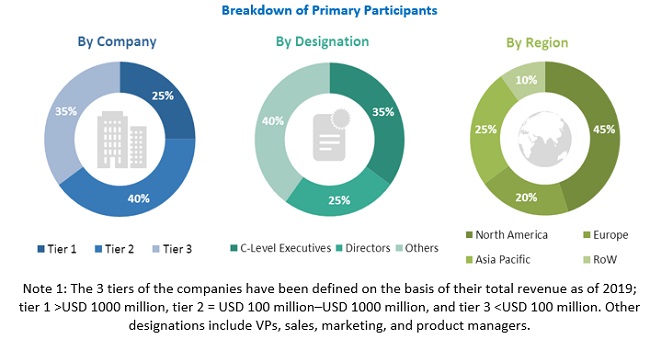
The supply chain in the optoelectronic components market comprises several stakeholders, such as suppliers of standard components, original equipment manufacturers (OEMs), component providers, solutions providers, and system integrators. The supply side is characterized by advancements in optoelectronic components and their applications in diverse end-user industries. Various primary sources from both the supply and demand sides of the market were interviewed to obtain qualitative and quantitative information. The breakdown of primary respondents is as follows.
Market Size Estimation
Both, the top-down and bottom-up approaches were used to estimate and validate the size of the optoelectronic components market and various market subsegments. The research methodology used to estimate the market sizes includes the following.
- Key players providing optoelectronic components to different verticals were identified through extensive secondary research.
- The industry’s supply chain and market size, in terms of value, were determined through primary and secondary research processes.
- All percentage shares, splits, and breakdowns were determined using secondary sources and verified through primary sources.
Data Triangulation
After arriving at the overall market size—using the estimation processes as explained above—the market was split into several segments and subsegments. To complete the overall market engineering process and arrive at the exact statistics of each market segment and subsegment, data triangulation, and market breakdown procedures were employed, wherever applicable. The data was triangulated by studying various factors and trends from both, the demand and supply sides of the optoelectronic components.
Research Objective
- To define and forecast the optoelectronic components market, by component, application, material, and vertical, in terms of value
- To define and forecast the LED market, in terms of volume
- To forecast the market size for various segments with regard to four main regions—North America, Europe, Asia Pacific (APAC), and the Rest of the World (RoW)
- To provide detailed information regarding major factors (drivers, restraints, opportunities, and challenges) influencing the growth of market
- To provide a detailed overview of the optoelectronic components value chain
- To strategically analyze the micromarkets with respect to individual growth trends, prospects, and contribution to the market
- To analyze opportunities in market for stakeholders by identifying high-growth segments
- To strategically profile key players, comprehensively analyze their market rankings and core competencies, and provide a detailed competitive landscape of market leaders
- To analyze competitive developments, such as contracts, mergers & acquisitions, product launches, and research & development (R&D) activities in market
Available Customizations:
Along with the market data, MarketsandMarkets offers customizations according to a company’s specific needs. The following customization options are available for the report:
Company Information
- Detailed analysis and profiling of additional market players (Up to 5)
Critical Questions:
- What will be the new end-user industries in which optoelectronic components can be used?
- Who are the key players in the market, and how intense is the competition?













Growth opportunities and latent adjacency in Optoelectronic Components Market
We're working about an assessment concerning the optoelectronics market, so we needed your report to improve the accuracy of our data.