Thermal Scanners Market by Wavelength (LWIR, MWIR, SWIR), Application (Thermography, Security & Surveillance, Search & Rescue), Vertical (Industrial, Commercial, Aerospace & Defense, Automotive, Healthcare), Technology, Region - Global Growth Driver and Industry Forecast to 2036


Thermal Scanners Market
Thermal Scanners Market and Top Companies
- FLIR Systems Inc. (US) – The Company is a global leading technology company focused on intelligent sensing solutions for defense, industrial, and commercial applications. The company designs, develops, markets, and distributes technologies used to enhance the user’s perception and awareness. It offers thermal imaging systems, threat detection systems, locator systems, and measurement and diagnostic systems to cater to the demand from its customers from verticals, such as military and defense, energy and utilities, construction, transportation, and industrial manufacturing. The company has a geographic presence worldwide, including North and South (Latin) America, APAC, Europe, and RoW. FLIR has manufacturing and R&D facilities in more than 94 countries
- Fluke Corporation (US) −The Company operates as a wholly-owned subsidiary of Fortive Corporation. The company is involved in the manufacturing, distributing, and servicing of electronic test tools and software. It has more than 70 years of experience in developing and manufacturing thermal imaging cameras and modules for various applications, including industrial/electronic service installation and maintenance, indoor air quality, calibration, and biomedical.
- Leonardo SPA (Italy) − The Company is one of the major players in the aerospace & defense and security markets. The company is involved in the designing and manufacturing of defense & security electronics, helicopters, aeronautics, and aerospace & defense solutions for various end users, such as governments, aerial & terrestrial, institutions, naval & maritime, and space & cyberspace. The thermal product portfolio offered by the company includes thermal cameras for MWIR and LWIR wavelengths, thermal modules, sights, and navigation systems. In addition, the company offers thermal core products through one of its subsidiary— Leonardo DRS
- L3 HARRIS TECHNOLOGIES (US) − The Company operates through its L3 Space & Sensors (formerly known as L3 Cincinnati Electronics (L3 CE)) subsidiary, which is a manufacturer of IR imaging systems and surveillance products. The company designs, develops, and incorporates IR thermal imaging products mainly for military and commercial verticals. The company has expertise in cooled thermal imagers, which enables the user to view a clear picture of actual and potential threats. Moreover, the company holds patented InSb focal plane array architecture on which the cooled MWIR imaging systems are based. These products are mainly adopted for classification, detection, and identification.
- Opgal (Israel) – The Company is one of the major providers of innovative thermal camera solutions and near-infrared illumination camera solutions for wide-ranging aviation, defense, industrial, and security applications. The company offers a wide range of high-performance and versatile visualization hardware, as well as software products that are designed using thermal and active imaging technologies and created using advanced electrooptics and image processing expertise.
- Axis Communications AB (Sweden) – The Company is one of the major providers of innovative thermal camera solutions and near-infrared illumination camera solutions for wide-ranging aviation, defense, industrial, and security applications. The company offers a wide range of high-performance and versatile visualization hardware, as well as software products that are designed using thermal and active imaging technologies and created using advanced electrooptics and image processing expertise.
- Optotherm Inc. (US) – The Company is a US-based company that manufactures and supplies photographic equipment. The company primarily performs software development, design engineering, and the manufacturing of thermal imaging microscopes and radiometric infrared cameras. The company develops cameras and microscopes based on uncooled, long-wavelength infrared detector technology. The company develops system software in-house, which can be integrated with all its cameras and other system components to provide a modern user interface.
Thermal Scanner Market and Top End-user Industries
- Industrial−The industrial vertical includes electronics & semiconductors, manufacturing and process, steel, metallurgical, and energy & utility industries. In the industrial segment, thermal scanners are used as preventive maintenance tools for monitoring, inspection, detection, and measurement applications. They enable the continuous monitoring and inspection of electricity grids in power plants, pipelines in process industries, and steel ladle in the steel industry to detect haphazard events and avoid accidents. Thermal scanners are non-invasive tools that are mounted in any place or area, enabling easy detection and providing sharp and clear thermal images of the targeted object.
- Automotive −Thermal imaging and scanning systems are used in the automotive industry to perform the continuous monitoring, inspection, and detection of the heat generated by abnormal friction in vehicles so that proper maintenance can be performed before a problem escalates. Currently, numerous automotive manufacturing companies such as Audi, Mercedes, BMW, and General Motors (GM) are deploying thermal imaging solutions in advanced driver-assistance systems (ADAS). These solutions provide day and night driver assistance, pedestrian and obstacle alerts, and respond rapidly to potential danger. Moreover, in luxurious cars, thermal cameras are deployed in the driver cabin to detect drowsy drivers.
- Aerospace & Defense − Thermal scanning products including thermal cameras and modules are mainly used by the aerospace & defense industry as they are effective in temperature measurement. Over a period of time, there is an increase in the utilization of unique and advanced thermal scanning products in this industry. Due to increasing conflicts between nations wars have increased. Well-equipped military forces and technologically advanced methods are required in such situations. In order to cope with these distinctly asymmetric, multidimensional, and highly lethal needs of the battlefield, global armies are modernizing their military arsenal and equipping soldiers with the latest combat and surveillance technology.
- Oil & Gas− In the oil & gas sector, process handling equipment work in an environment of high pressure, temperature, and oxidization. Any malfunction such as gas leakage can cause huge loss. Many oil & gas production industries release chemical compounds and gases that are invisible to the naked eye and can be detected accurately using thermal scanning systems.
- Commercial − In the commercial segment, thermal imaging solutions are used for security and surveillance monitoring, inspection, and the detection of commercial buildings and public places that include airports, stadiums, and others. The security and surveillance of building infrastructures are of prime importance in commercial buildings. This can be achieved by using thermal scanners and imaging systems as they comprise onboard video analytics capable of sorting human or vehicular intrusions, which significantly reduces false alarms.
Thermal Scanners Market and Top Technologies
- Cooled− Cooled thermal scanning systems have imaging sensors, interfacing and image processing electronics, cryocoolers, and an optional zoom lens. The cryocooler is used to lower the imaging sensor temperature to cryogenic temperature, which is essential to reduce thermally induced noise and support the image formation. The image produced by the cooled thermal scanning system is clear, has high spectral filtering, and improved magnification performance.
- Uncooled− Uncooled thermal cameras are based on the microbolometer design. They do not use cryocoolers or thermoelectric coolers for cooling the imaging sensor temperature, whereas they operate at room temperature. Thermal scanners based on uncooled technology function on the long-wave infrared (LWIR) band in which most of the targeted terrestrial temperature is emitted by the infrared energy.
Updated on : April 04, 2024
Thermal Scanners Market Summary
The Thermal Scanners Market was valued at approximately USD 4.0–4.8 billion in 2024 and is projected to reach around USD 10.5–12.5 billion by 2036, growing at a CAGR of 8–10% during the forecast period (2025–2036). The market is witnessing steady expansion as industries increasingly adopt non-contact temperature measurement technologies for safety, surveillance, and operational efficiency. The growth of the Thermal Scanners Market is driven by rising demand across healthcare, industrial, defense, and public safety sectors, where accurate temperature detection and monitoring are critical. The integration of advanced technologies such as artificial intelligence (AI), Internet of Things (IoT), and automation is transforming thermal scanners into intelligent systems capable of real-time analytics, anomaly detection, and predictive insights. Increasing investments in smart infrastructure, industrial automation, and digital transformation initiatives are further accelerating the adoption of thermal scanning solutions globally.
Key Market Trends & Insights
The Thermal Scanners Market is led by North America, supported by strong adoption in healthcare, defense, and industrial sectors, along with advanced technological infrastructure. Asia Pacific is the fastest-growing region, driven by rapid urbanization, expanding manufacturing base, and government investments in smart city initiatives. Fixed thermal scanners dominate the market due to their extensive use in industrial monitoring and surveillance applications. A major trend shaping the Thermal Scanners Market is the integration of AI-based analytics, enabling automated temperature detection and real-time alerts. IoT-enabled thermal scanners are facilitating remote monitoring and data sharing, enhancing operational efficiency. Automation is also playing a critical role, particularly in industrial and public safety applications, where thermal scanners are integrated into automated systems for continuous monitoring.
Market Size & Forecast
- Base Year Market Size (2024): USD 4.0–4.8 Billion
- Forecast Market Size (2036): USD 10.5–12.5 Billion
- CAGR (2025–2036): 8–10%
- Growth Factors: Increasing demand for non-contact temperature measurement, rising adoption in healthcare and industrial sectors, integration of AI and IoT technologies, and expansion of smart infrastructure
To know about the assumptions considered for the study, Request for Free Sample Report
Thermal Scanners Market Top 10 key takeaway
- The Thermal Scanners Market is expected to more than double by 2036.
- North America leads due to strong technological adoption.
- Asia Pacific is the fastest-growing region driven by urbanization.
- Fixed thermal scanners dominate due to continuous monitoring needs.
- AI integration enhances real-time detection and analytics.
- IoT connectivity enables remote monitoring and data sharing.
- Automation improves efficiency in industrial applications.
- Healthcare sector is a major contributor to market growth.
- Smart city projects are expanding application scope.
- Technological advancements are improving accuracy and affordability.
Product Insights
Fixed thermal scanners represent the leading product segment in the Thermal Scanners Market, primarily due to their ability to provide continuous monitoring in industrial, security, and public safety environments. These systems are widely deployed in manufacturing facilities, airports, and critical infrastructure, where real-time temperature monitoring is essential. Their dominance is further supported by their integration with automated systems, enabling seamless operation and enhanced efficiency.
Handheld and portable thermal scanners also hold a significant share in the Thermal Scanners Market, particularly in applications requiring mobility and flexibility, such as field inspections and emergency response. These devices are gaining popularity due to their ease of use, compact design, and affordability. Emerging product categories include wearable thermal scanners and smartphone-integrated devices, which are expanding the accessibility and usability of thermal scanning technology.
AI integration is transforming product capabilities by enabling features such as automated anomaly detection, facial recognition in low-light conditions, and predictive maintenance alerts. These advancements are enhancing the functionality and value of thermal scanners, making them indispensable tools across various industries.
Technology / Component Insights
The Thermal Scanners Market is driven by advancements in infrared sensor technology, imaging systems, and data processing capabilities. Key components include infrared detectors, optical lenses, signal processing units, and display interfaces. Uncooled infrared detectors are widely used due to their cost-effectiveness and ease of operation, while cooled detectors offer higher sensitivity and are used in specialized applications.
Artificial intelligence is playing a transformative role in the Thermal Scanners Market by enabling advanced analytics, pattern recognition, and real-time decision-making. AI-powered systems can analyze thermal data to detect anomalies, predict equipment failures, and improve operational efficiency. IoT integration allows thermal scanners to connect with centralized systems, enabling remote monitoring, data sharing, and predictive maintenance.
Automation technologies are enhancing the efficiency of thermal scanning applications by enabling continuous, high-speed operation with minimal human intervention. Cloud computing further supports these capabilities by providing scalable storage and advanced analytics. Future innovation trends in the Thermal Scanners Market include the development of high-resolution sensors, integration with augmented reality (AR) systems, and the use of edge computing for faster data processing.
Application Insights
The healthcare sector is the leading application segment in the Thermal Scanners Market, driven by the need for non-contact temperature screening and monitoring. Thermal scanners are widely used in hospitals, clinics, and public spaces to detect elevated body temperatures and prevent the spread of infectious diseases. The demand for thermal scanning solutions in healthcare has increased significantly in recent years, highlighting their importance in public health management.
Industrial applications are also a major contributor to the Thermal Scanners Market, where these devices are used for predictive maintenance, equipment monitoring, and quality control. The ability to detect temperature anomalies allows organizations to identify potential issues before they lead to costly failures. In the defense and security sector, thermal scanners are used for surveillance, border security, and target detection.
The automotive industry is increasingly adopting thermal scanning technology for advanced driver assistance systems (ADAS) and autonomous vehicles, enhancing safety by detecting pedestrians and obstacles in low-visibility conditions. Future opportunities in the Thermal Scanners Market include smart buildings, renewable energy, and environmental monitoring, where thermal scanners can provide valuable insights for efficient resource management.
Regional Insights
North America dominates the Thermal Scanners Market due to its advanced technological infrastructure, strong presence of key market players, and high adoption of thermal imaging solutions in healthcare and defense sectors. Europe follows with steady growth, supported by industrial automation and stringent safety regulations. Asia Pacific is the fastest-growing region, driven by rapid urbanization, expanding manufacturing sector, and government initiatives promoting smart cities and digital transformation.
The increasing demand for advanced monitoring and safety solutions is driving market growth across all regions. The integration of AI, IoT, and automation technologies is further enhancing the capabilities of thermal scanners, making them essential tools in modern industrial and public safety applications.
- North America leads due to strong healthcare and defense sectors
- Europe benefits from industrial automation and regulations
- Asia Pacific shows highest growth due to urbanization
- Increasing adoption of smart technologies boosts demand
- Government initiatives support infrastructure development
Country-Specific Market Trends
In Asia Pacific, China leads the Thermal Scanners Market with a CAGR of 10–12%, driven by large-scale industrialization and investments in smart city projects. Japan follows with a CAGR of 8–9%, focusing on advanced manufacturing and automation technologies. In North America, the United States dominates with a CAGR of 9–10%, supported by strong demand from healthcare and defense sectors, while Canada and Mexico are experiencing steady growth due to increasing adoption in industrial applications. In Europe, Germany and France are key markets, with CAGRs of 8–9% and 7–8% respectively, driven by industrial innovation and safety regulations.
Governments across these regions are actively promoting the adoption of advanced technologies, further driving the growth of the Thermal Scanners Market. Industry demand is being fueled by the need for efficient, reliable, and cost-effective monitoring solutions.
- China leads with strong industrial and infrastructure investments
- Japan emphasizes automation and advanced technologies
- United States drives demand through healthcare and defense
- Germany focuses on industrial innovation and safety
- France supports growth through regulatory frameworks
Key Thermal Scanners Company Insights
The Thermal Scanners Market is highly competitive, with key players focusing on innovation, product development, and strategic partnerships. Major companies include FLIR Systems (Teledyne Technologies), Honeywell International Inc., Hikvision Digital Technology Co., Ltd., Axis Communications AB, Dahua Technology Co., Ltd., Bosch Security Systems, and Leonardo S.p.A. These companies are investing heavily in research and development to enhance product performance, integrate AI capabilities, and expand their market presence.
Innovation is centered around developing high-resolution thermal scanners with improved sensitivity and faster processing speeds. AI adoption is enabling advanced analytics and automated decision-making, while IoT integration is enhancing connectivity and real-time monitoring. Product strategies are increasingly focused on offering compact, affordable, and user-friendly devices to cater to a broader customer base. Strategic collaborations and acquisitions are helping companies strengthen their market position and drive innovation.
- Companies are investing in AI-driven thermal scanning technologies
- Focus on high-resolution and portable devices is increasing
- Strategic partnerships are driving market expansion
- R&D investments are enhancing product capabilities
- Companies are targeting emerging markets for growth
Recent Developments
In 2025, a leading manufacturer launched an AI-powered thermal scanner capable of real-time anomaly detection and predictive analytics, significantly improving operational efficiency. Another notable development includes a partnership between a technology provider and a smart city developer to integrate thermal scanning systems into urban surveillance infrastructure. Additionally, advancements in sensor technology are enabling higher resolution and improved accuracy, further enhancing the capabilities of thermal scanners.
Market Segmentation
The Thermal Scanners Market is segmented based on product, technology/component, application, and region. By product, the market includes fixed thermal scanners, handheld devices, and wearable systems, each catering to different application needs. In terms of technology, it encompasses infrared sensors, AI-based analytics, IoT-enabled connectivity, and cloud-based platforms that enhance functionality and performance. Applications span healthcare, industrial, defense and security, automotive, and other sectors, reflecting the versatility of thermal scanning technology. Regionally, the market is divided into North America, Europe, Asia Pacific, and the rest of the world, each exhibiting unique growth patterns influenced by technological adoption and infrastructure development.
- Product segmentation includes fixed, handheld, and wearable scanners
- Technology segmentation highlights AI, IoT, and infrared sensors
- Applications cover healthcare, industrial, and defense sectors
- Regional segmentation reflects diverse growth dynamics
- Integration of advanced technologies drives market expansion
Conclusion
The Thermal Scanners Market is poised for strong growth through 2036, driven by increasing demand for non-contact temperature measurement, enhanced safety solutions, and advanced monitoring technologies. The integration of AI, IoT, and automation is transforming thermal scanners into intelligent systems capable of delivering real-time insights and improving operational efficiency. As industries continue to embrace digital transformation and smart infrastructure, thermal scanning technology will play a critical role in ensuring safety, reliability, and efficiency. Businesses that invest in innovative thermal scanning solutions will be well-positioned to capitalize on emerging opportunities and maintain a competitive edge in this evolving market.
FAQs
What is the current size of the Thermal Scanners Market?
The market was valued at approximately USD 4.0–4.8 billion in 2024.
What is the expected growth rate of the Thermal Scanners Market?
The market is expected to grow at a CAGR of 8–10% from 2025 to 2036.
What are the key drivers of the Thermal Scanners Market?
Key drivers include demand for non-contact temperature measurement, adoption in healthcare and industrial sectors, and integration of AI and IoT technologies.
Which region leads the Thermal Scanners Market?
North America currently holds the largest market share.
Who are the key players in the Thermal Scanners Market?
Major companies include FLIR Systems, Honeywell International Inc., Hikvision, Axis Communications, and Bosch Security Systems.
To speak to our analyst for a discussion on the above findings, click Speak to Analyst
 Exclusive indicates content/data unique to MarketsandMarkets and not available with any competitors.
Table of Contents
1 Introduction (Page No. - 18)
1.1 Study Objectives
1.2 Market Definition
1.3 Scope
1.3.1 Markets Covered
1.3.2 Years Considered
1.4 Currency
1.5 Limitations
1.6 Market Stakeholders
2 Research Methodology (Page No. - 21)
2.1 Research Data
2.1.1 Secondary Data
2.1.1.1 Secondary Sources
2.1.2 Primary Data
2.1.2.1 Primary Sources
2.1.2.2 Key Industry Insights
2.1.2.3 Breakdown of Primaries
2.2 Market Size Estimation
2.2.1 Bottom-Up Approach
2.2.1.1 Approach for Capturing Market Size By Bottom-Up Analysis (Demand Side)
2.2.2 Top-Down Approach
2.2.2.1 Approach for Capturing Market Share By Top-Down Analysis (Supply Side)
2.3 Market Breakdown and Data Triangulation
2.3.1 Research Assumptions
3 Executive Summary (Page No. - 30)
4 Premium Insights (Page No. - 34)
4.1 Attractive Opportunities in Thermal Scanners Market
4.2 Thermal Scanner Market, By Application and Country
4.3 Country-Wise Thermal Scanner Market
5 Market Overview (Page No. - 37)
5.1 Introduction
5.2 Market Dynamics
5.2.1 Drivers
5.2.1.1 Increasing Demand for Thermal Scanners at Airports for Coronavirus Detection
5.2.1.2 Rising Expenditure in Aerospace and Defense Sector From Governments Worldwide
5.2.1.3 Growing Adoption of Thermal Scanners in Automotive Industry
5.2.1.4 Rising R&D Investments By Companies, Governments, and Capital Firms to Develop Innovative Thermal Scanning Solutions
5.2.2 Restraints
5.2.2.1 Export Restrictions Imposed on Thermal Imaging Products
5.2.3 Opportunities
5.2.3.1 Increase in Adoption of Thermal Scanners in Healthcare Applications
5.2.3.2 Use of Thermal Scanners to Diagnose Defects in Building Structures
5.2.4 Challenges
5.2.4.1 Inapplicable for Glass and Water
5.2.4.2 Impractical for See-Through Wall Applications
6 Thermal Scanners Market, By Type (Page No. - 45)
6.1 Introduction
6.2 Portable
6.2.1 Firefighters and Law Enforcement Personnel Benefit From Using Handheld Thermal Scanners
6.3 Fixed
6.3.1 High Adoption of Fixed-Mounted Thermal Scanners in Fever Scanning Application Accelerates Market Growth
7 Thermal Scanners Market, By Technology (Page No. - 49)
7.1 Introduction
7.2 Cooled
7.2.1 Highly Sensitive Cooled Thermal Cameras are Used to Monitor Minute Temperature Differences
7.3 Uncooled
7.3.1 Uncooled Thermal Scanners are Being Used to Screen Large Groups of People for Fever
8 Thermal Scanners Market, By Wavelength (Page No. - 52)
8.1 Introduction
8.2 Short-Wave Infrared
8.2.1 SWIR Thermal Scanners are Capable of Producing Detailed Images With High Resolution
8.3 Mid-Wave Infrared
8.3.1 MWIR Thermal Scanners are Used to Provide High-Contrast Thermal Images
8.4 Long-Wave Infrared
8.4.1 LWIR Thermal Scanners are Used to Monitor Human Activities and Vehicles
9 Thermal Scanners Market, By Application (Page No. - 57)
9.1 Introduction
9.2 Thermography
9.2.1 Process Industry
9.2.1.1 Rising Deployment of Thermal Cameras in Process Industry is Fueling Market Growth
9.2.2 Discrete Industry
9.2.2.1 Requirement of Monitoring and Inspection to Assess Quality of Manufactured Device Drives Adoption of Thermal Scanners
9.2.3 Building Inspection
9.2.3.1 Thermal Scanners Enable Detection of Building Defects By Screening Temperature Distribution of Surfaces
9.2.4 Inspection & Quarantine
9.2.4.1 Thermal Scanners have Emerged as Widely Used Tool to Detect Fever in Response to Covid-19
9.2.5 Medical Diagnosis
9.2.5.1 Panoramic Thermal Imaging System Enables Tracking in Wide Areas
9.3 Security & Surveillance
9.3.1 City Monitoring
9.3.1.1 Increasing Awareness Regarding Safety of Chief Areas in Cities Helps in Deployment of Thermal Scanners
9.3.2 Border & Coastal Surveillance
9.3.2.1 Rising Adoption of Thermal Cameras to Safeguard Building Structures is Propelling Thermal Scanner Market
9.3.3 Ports and Wharfs Monitoring
9.3.3.1 Need for Human Safety Increases Demand for Thermal Imaging Technology
9.3.4 Key Infrastructure Monitoring
9.3.4.1 Thermal Scanners Play Important Role in Safeguarding Key Infrastructure Areas
9.4 Search and Rescue
9.4.1 Law Enforcement
9.4.1.1 Thermal Scanners Can Provide Better Execution of Tasks in Poor Vision Situations in Law Enforcement Activities
9.4.2 Firefighting and First Response
9.4.2.1 Deployment of Thermal Cameras to Reduce Human, Material, and Property Losses is Expected to Boost Market Growth
9.4.3 Forest Protection
9.4.3.1 Increase in Use of Thermal Cameras for Detection of Animals and Humans Using Body Temperatures
9.4.4 Maritime Rescue
9.4.4.1 Thermal Cameras Help Maritime Rescue Operators to Find Humans in Case of Any Accidents
9.5 Others
10 Thermal Scanners Market, By Vertical (Page No. - 69)
10.1 Introduction
10.2 Industrial
10.2.1 Rise in Adoption of Thermal Scanners in Industrial Vertical for Safety of Industrial Assets and Human Lives
10.3 Commercial
10.3.1 High Adoption of Thermal Scanners in Fever Scanning at Airports Accelerates Market Growth
10.4 Aerospace & Defense
10.4.1 High Adoption of Thermal Scanners Across Aerospace & Defense Industry is Fueling Market Growth
10.5 Automotive
10.5.1 High Adoption of Thermal Scanners in Automotive Industry for Monitoring, Inspection, and Detection
10.6 Healthcare & Lifesciences
10.6.1 Simple, Non-Invasive, and Less Expensive Thermal Imaging Technique Increases Demand for Thermal Cameras in Healthcare & Life Sciences
10.7 Oil & Gas
10.7.1 Use of Thermal Scanners for Predictive Maintenance to Fuel Market Growth
10.8 Others
11 Geographic Analysis of Thermal Scanners Market (Page No. - 76)
11.1 Introduction
11.2 North America
11.2.1 US
11.2.1.1 Presence of Thermal Scanner Manufacturing Companies to Boost Market Growth in US
11.2.2 Canada
11.2.2.1 Investment in R&D of Thermal Imaging By Government and Non-Government to Spur Growth of Market in Canada
11.2.3 Mexico
11.2.3.1 Wide Distribution Network in Mexico to Propel Market Growth
11.3 Europe
11.3.1 UK
11.3.1.1 Increasing Use of Thermal Scanners for Diagnosing Diseases in Healthcare Sector
11.3.2 Germany
11.3.2.1 Market for Thermal Scanners in Germany to Grow at Highest CAGR During Forecast Period
11.3.3 France
11.3.3.1 Presence of Automobile Manufacturers in France to Spur Growth of Thermal Scanners Market
11.3.4 Rest of Europe
11.3.4.1 Emerging Economy, Increasing Infrastructure Facilities, and Funding Contributes to Growth of Market in Rest of Europe (RoE)
11.4 APAC
11.4.1 China
11.4.1.1 China is Experiencing High Demand for Thermal Scanners Due to the Outbreak of Coronavirus
11.4.2 Japan
11.4.2.1 Increase in Use of Thermal Cameras in Healthcare Industry LED to Increase in Demand for Thermal Scanners in Japan
11.4.3 India
11.4.3.1 Airport Measures Against Coronavirus in India Drives the Market
11.4.4 Rest of APAC
11.4.4.1 Increasing Implementation of Thermal Scanners at Airports Across the Region is Driving the Market in Rest of APAC
11.5 RoW
11.5.1 Middle East & Africa
11.5.1.1 Ongoing Investments in Oil & Gas and Aerospace & Defense Industry Support Growth of Market
11.5.2 South America
11.5.2.1 Increasing Demand for Monitoring & Inspection in Healthcare & Life Sciences, Aerospace & Defense, and Industrial Sectors Creates Growth Opportunity
12 Competitive Landscape (Page No. - 110)
12.1 Overview
12.2 Market Ranking Analysis
12.2.1 Product Launches
12.2.2 Mergers & Acquisitions
12.2.3 Expansions
12.3 Competitive Leadership Mapping
12.3.1 Visionary Leaders
12.3.2 Innovators
12.3.3 Dynamic Differentiators
12.3.4 Emerging Players
13 Company Profiles (Page No. - 116)
13.1 Introduction
(Business Overview, Products/Solutions/Services Offered, Recent Developments, SWOT Analysis, MnM View)*
13.2 Key Players
13.2.1 FLIR Systems, Inc.
13.2.2 Fluke Corporation
13.2.3 Leonardo S.P.A.
13.2.4 L3HARRIS TECHNOLOGIES, Inc.
13.2.5 Opgal
13.2.6 Axis Communications Ab
13.2.7 Optotherm, Inc.
13.2.8 Seek Thermal Inc.
13.2.9 Thermoteknix Systems LTD.
13.2.10 3M (3M Scott)
13.3 Other Key Players
13.3.1 COX
13.3.2 C-THERMAL
13.3.3 HGH Infrared Systems
13.3.4 Tonbo Imaging
13.3.5 Terabee
13.3.6 Xenics
13.3.7 Vumii Imaging
13.3.8 Infratec GmbH
13.3.9 AMETEK Land
13.3.10 Testo Se & Co. KGaA
*Details on Business Overview, Products/Solutions/Services Offered, Recent Developments, SWOT Analysis, MnM View Might Not Be Captured in Case of Unlisted Companies.
14 Appendix (Page No. - 150)
14.1 Discussion Guide
14.2 Knowledge Store: Marketsandmarkets’ Subscription Portal
14.3 Available Customizations
14.4 Related Reports
14.5 Author Details
List of Tables (104 Tables)
Table 1 Thermal Scanners Market, By Type, 2017–2025 (USD Million)
Table 2 Portable Thermal Scanner Market, By Application, 2017–2025 (USD Million)
Table 3 Fixed Thermal Scanner Market, By Application, 2017–2025 (USD Million)
Table 4 Thermal Scanner Market, By Technology, 2017–2025 (USD Million)
Table 5 Thermal Scanner Market, By Wavelength, 2017–2025 (USD Million)
Table 6 Thermal Scanner Market for SWIR Wavelength, By Application, 2017–2025 (USD Million)
Table 7 Thermal Scanner Market for MWIR Wavelength, By Application, 2017–2025 (USD Million)
Table 8 Thermal Scanner Market for LWIR Wavelength, By Application, 2017–2025 (USD Million)
Table 9 Thermal Scanner Market, By Application, 2017–2025 (USD Million)
Table 10 Thermal Scanner Market for Thermography, By Application Type, 2017–2025 (USD Million)
Table 11 Thermal Scanner Market for Thermography, By Region, 2017–2025 (USD Million)
Table 12 Thermal Scanner Market for Thermography, By Wavelength, 2017–2025 (USD Million)
Table 13 Thermal Scanner Market for Thermography, By Type, 2017–2025 (USD Million)
Table 14 Thermal Scanner Market for Security & Surveillance, By Application Type, 2017–2025 (USD Million)
Table 15 Thermal Scanner Market for Security & Surveillance, By Region, 2017–2025 (USD Million)
Table 16 Thermal Scanner Market for Security & Surveillance, By Wavelength, 2017–2025 (USD Million)
Table 17 Thermal Scanner Market for Security & Surveillance, By Type, 2017–2025 (USD Million)
Table 18 Thermal Scanner Market for Search & Rescue, By Application Type, 2017–2025 (USD Million)
Table 19 Thermal Scanner Market for Search & Rescue, By Region, 2017–2025 (USD Million)
Table 20 Thermal Scanner Market for Search & Rescue, By Wavelength, 2017–2025 (USD Million)
Table 21 Thermal Scanner Market for Search & Rescue, By Type, 2017–2025 (USD Million)
Table 22 Thermal Scanner Market for Other Applications, By Region, 2017–2025 (USD Million)
Table 23 Thermal Scanner Market for Other Applications, By Wavelength, 2017–2025 (USD Million)
Table 24 Thermal Scanner Market for Other Applications, By Type, 2017–2025 (USD Million)
Table 25 Thermal Scanner Market, By Vertical, 2017–2025 (USD Million)
Table 26 Thermal Scanner Market for Industrial Vertical, By Region, 2017–2025 (USD Million)
Table 27 Thermal Scanner Market for Commercial Vertical, By Region, 2017–2025 (USD Million)
Table 28 Thermal Scanner Market for Aerospace & Defense Vertical, By Region, 2017–2025 (USD Million)
Table 29 Thermal Scanner Market for Automotive Vertical, By Region, 2017–2025 (USD Million)
Table 30 Thermal Scanner Market for Healthcare & Lifesciences Vertical, By Region, 2017–2025 (USD Million)
Table 31 Thermal Scanner Market for Oil & Gas Vertical, By Region, 2017–2025 (USD Million)
Table 32 Thermal Scanner Market for Other Verticals, By Region, 2017–2025 (USD Million)
Table 33 Thermal Scanners Market, By Region, 2017–2025 (USD Million)
Table 34 Market in North America, By Country, 2017–2025 (USD Million)
Table 35 Market in North America, By Application, 2017–2025 (USD Million)
Table 36 Market in North America, By Vertical, 2017–2025 (USD Million)
Table 37 Market for Industrial Vertical in North America, By Country, 2017–2025 (USD Million)
Table 38 Market for Commercial Vertical in North America, By Country, 2017–2025 (USD Million)
Table 39 Market for Aerospace & Defense Vertical in North America, By Country, 2017–2025 (USD Million)
Table 40 Market for Automotive Vertical in North America, By Country, 2017–2025 (USD Million)
Table 41 Market for Healthcare & Lifesciences Vertical in North America, By Country, 2017–2025 (USD Million)
Table 42 Market for Oil & Gas Vertical in North America, By Country, 2017–2025 (USD Million)
Table 43 Market for Other Verticals in North America, By Country, 2017–2025 (USD Million)
Table 44 Market in US, By Application, 2017–2025 (USD Million)
Table 45 Market in US, By Vertical, 2017–2025 (USD Million)
Table 46 Market in Canada, By Application, 2017–2025 (USD Million)
Table 47 Market in Canada, By Vertical, 2017–2025 (USD Million)
Table 48 Market in Mexico, By Application, 2017–2025 (USD Million)
Table 49 Market in Mexico, By Vertical, 2017–2025 (USD Million)
Table 50 Market in Europe, By Country, 2017–2025 (USD Million)
Table 51 Market in Europe, By Application, 2017–2025 (USD Million)
Table 52 Market in Europe, By Vertical, 2017–2025 (USD Million)
Table 53 Market for Industrial Vertical in Europe, By Country, 2017–2025 (USD Million)
Table 54 Market for Commercial Vertical in Europe, By Country, 2017–2025 (USD Million)
Table 55 Market for Aerospace & Defense Vertical in Europe, By Country, 2017–2025 (USD Million)
Table 56 Market for Automotive Vertical in Europe, By Country, 2017–2025 (USD Million)
Table 57 Market for Healthcare & Lifesciences Vertical in Europe, By Country, 2017–2025 (USD Million)
Table 58 Market for Oil & Gas Vertical in Europe, By Country, 2017–2025 (USD Million)
Table 59 Market for Other Verticals in Europe, By Country, 2017–2025 (USD Million)
Table 60 Market in UK, By Application, 2017–2025 (USD Million)
Table 61 Market in UK, By Vertical, 2017–2025 (USD Million)
Table 62 Market in Germany, By Application, 2017–2025 (USD Million)
Table 63 Market in Germany, By Vertical, 2017–2025 (USD Million)
Table 64 Market in France, By Application, 2017–2025 (USD Million)
Table 65 Market in France, By Vertical, 2017–2025 (USD Million)
Table 66 Thermal Scanners Market in Rest of Europe, By Application, 2017–2025 (USD Million)
Table 67 Market in Rest of Europe, By Vertical, 2017–2025 (USD Million)
Table 68 Market in APAC, By Country, 2017–2025 (USD Million)
Table 69 Market in APAC, By Application, 2017–2025 (USD Million)
Table 70 Market in APAC, By Vertical, 2017–2025 (USD Million)
Table 71 Market for Industrial Vertical in APAC, By Country, 2017–2025 (USD Million)
Table 72 Market for Commercial Vertical in APAC, By Country, 2017–2025 (USD Million)
Table 73 Market for Aerospace & Defense Vertical in APAC, By Country, 2017–2025 (USD Million)
Table 74 Market for Automotive Vertical in APAC, By Country, 2017–2025 (USD Million)
Table 75 Market for Healthcare & Lifesciences Vertical in APAC, By Country, 2017–2025 (USD Million)
Table 76 Market for Oil & Gas Vertical in APAC, By Country, 2017–2025 (USD Million)
Table 77 Market for Other Verticals in APAC, By Country, 2017–2025 (USD Million)
Table 78 Market in China, By Application, 2017–2025 (USD Million)
Table 79 Market in China, By Vertical, 2017–2025 (USD Million)
Table 80 Market in Japan, By Application, 2017–2025 (USD Million)
Table 81 Market in Japan, By Vertical, 2017–2025 (USD Million)
Table 82 Market in India, By Application, 2017–2025 (USD Million)
Table 83 Market in India, By Vertical, 2017–2025 (USD Million)
Table 84 Market in Rest of APAC, By Application, 2017–2025 (USD Million)
Table 85 Market in Rest of APAC, By Vertical, 2017–2025 (USD Million)
Table 86 Market in RoW, By Region, 2017–2025 (USD Million)
Table 87 Market in RoW, By Application, 2017–2025 (USD Million)
Table 88 Market in RoW, By Vertical, 2017–2025 (USD Million)
Table 89 Market for Industrial Vertical in RoW, By Region, 2017–2025 (USD Million)
Table 90 Market for Commercial Vertical in RoW, By Region, 2017–2025 (USD Million)
Table 91 Market for Aerospace & Defense Vertical in RoW, By Region, 2017–2025 (USD Million)
Table 92 Market for Automotive Vertical in RoW, By Region, 2017–2025 (USD Million)
Table 93 Market for Healthcare & Lifesciences Vertical in RoW, By Region, 2017–2025 (USD Million)
Table 94 Market for Oil & Gas Vertical in RoW, By Region, 2017–2025 (USD Million)
Table 95 Market for Other Verticals in RoW, By Region, 2017–2025 (USD Million)
Table 96 Market in Middle East & Africa, By Application, 2017–2025 (USD Million)
Table 97 Market in Middle East & Africa, By Vertical, 2017–2025 (USD Million)
Table 98 Market in South America, By Application, 2017–2025 (USD Million)
Table 99 Thermal Scanners Market in South America, By Vertical, 2017–2025 (USD Million)
Table 100 Market Player Ranking, 2019
Table 101 Product Launches, 2019
Table 102 Agreements/Collaborations/Partnerships/Contracts, 2019
Table 103 Mergers & Acquisitions, 2019
Table 104 Expansions, 2019
List of Figures (40 Figures)
Figure 1 Thermal Scanners Market: Research Design
Figure 2 Market Size Estimation Methodology: Bottom-Up Approach
Figure 3 Market Size Estimation Methodology: Top-Down Approach
Figure 4 Data Triangulation
Figure 5 Portable Thermal Scanner Market to Grow at Higher CAGR During Forecast Period
Figure 6 Thermal Scanner Market for LWIR Wavelength Segment to Hold Largest Share in 2025
Figure 7 Thermography Application to Dominate Thermal Scanner Market During Forecast Period
Figure 8 Thermal Scanner Market for Commercial Vertical to Grow at Highest CAGR During Forecast Period
Figure 9 North America to Hold Largest Share of Thermal Scanner Market in 2025
Figure 10 Growing Demand for Thermal Scanners at Airports for Coronavirus Detection to Drive Market Growth
Figure 11 Thermography and US to Be Largest Shareholders of Thermal Scanner Market in 2025
Figure 12 Thermal Scanner Market in China to Grow at Highest CAGR During Forecast Period
Figure 13 Thermal Scanner Market: Drivers, Restraints, Opportunities, and Challenges
Figure 14 Thermal Scanner Market Drivers and Their Impact
Figure 15 Thermal Scanner Market Restraint and Its Impact
Figure 16 Thermal Scanner Market Opportunities and Their Impact
Figure 17 Thermal Scanner Market Challenge and Its Impact
Figure 18 Thermal Scanners Market, By Type
Figure 19 Portable Thermal Scanners to Exhibit Higher CAGR From 2020 to 2025
Figure 20 Thermal Scanner Market, By Technology
Figure 21 Uncooled Thermal Scanner Market is Expected to Grow at Higher CAGR From 2020 to 2025
Figure 22 Thermal Scanner Market, By Wavelength
Figure 23 Thermal Scanner Market for SWIR Segment is Expected to Grow at Highest CAGR From 2020 to 2025
Figure 24 Thermal Scanner Market, By Application
Figure 25 Thermal Scanner Market for Thermography is Expected to Grow at Highest CAGR From 2020 to 2025
Figure 26 Thermal Scanner Market for Commercial Vertical is Expected to Grow at Highest CAGR From 2020 to 2025
Figure 27 Geographic Segmentation of Thermal Scanners Market
Figure 28 APAC to Witness Highest Growth During Forecast Period (USD Million)
Figure 29 North America: Thermal Scanner Market Snapshot
Figure 30 Europe: Thermal Scanner Market Snapshot
Figure 31 Germany to Witness the Highest CAGR During Forecast Period
Figure 32 APAC: Thermal Scanners Market Snapshot
Figure 33 China to Dominate the Thermal Scanner Market in APAC During the Forecast Period
Figure 34 Middle East and Africa to Hold the Largest Share of the Thermal Scanner Market in RoW
Figure 35 Organic and Inorganic Strategies Adopted By Companies Operating in Thermal Scanner Market
Figure 36 Thermal Scanner (Global) Competitive Leadership Mapping
Figure 37 FLIR Systems, Inc.: Company Snapshot
Figure 38 Leonardo S.P.A.: Company Snapshot
Figure 39 L3HARRIS TECHNOLOGIES, Inc.: Company Snapshot
Figure 40 3M: Company Snapshot
The study involved four major activities for estimating the size of the global thermal scanners market. Exhaustive secondary research has been carried out to collect information relevant to the market, the peer market, and the parent market. Primary research has been undertaken to validate these findings, assumptions, and sizing with the industry experts across the value chain of the thermal scanners market. Both top-down and bottom-up approaches have been employed to estimate the complete market size. After that, the market breakdown and data triangulation methods have been used to estimate the size of different segments and subsegments of the market.
Secondary Research
The research methodology used to estimate and forecast the size of the thermal scanners market began by capturing data related to the revenues of key vendors in the market through secondary research. This study involved the extensive use of secondary sources, directories, and databases (such as Hoovers, Bloomberg Businessweek, Factiva, and OneSource) to identify and collect information useful for a technical, market-oriented, and commercial study of the thermal scanners market. Vendor offerings have been taken into consideration to determine the market segmentation. The entire research methodology included the study of annual reports, press releases, and investor presentations of companies; white papers; and certified publications and articles by recognized authors, directories, and databases.
Primary Research
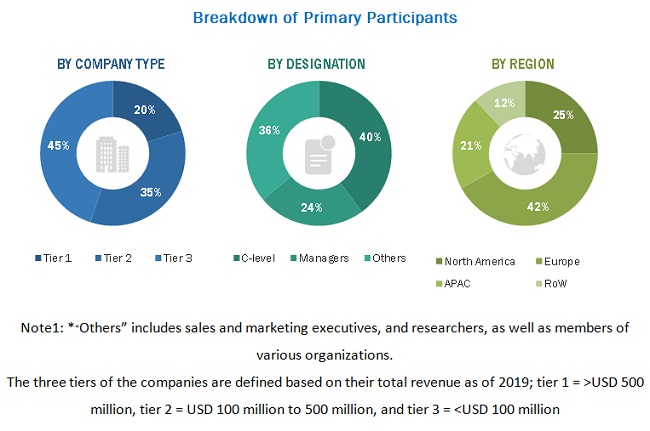
The thermal scanners market comprises several stakeholders, such as suppliers of standard components and original equipment manufacturers (OEMs). The demand side of this market is characterized by the development and manufacture of thermal scanning applications as well as by different verticals. Various primary sources from both the supply and demand sides of the market have been interviewed to obtain qualitative and quantitative information. Following is the breakdown of primary respondents.
To know about the assumptions considered for the study, download the pdf brochure
Market Size Estimation
Both top-down and bottom-up approaches have been used to estimate and validate the size of the thermal scanners market and its segments. The research methodology used to estimate the market size included the following:
- Key players in the market have been identified through extensive secondary research.
- The supply chain of the manufacturing industry and the size of the thermal scanners market, in terms of value, have been determined through primary and secondary research processes.
- All percentage shares, splits, and breakdowns have been determined using secondary sources and verified through primary sources.
Data Triangulation
After arriving at the overall market size—using the market size estimation process explained above—the total market has been split into several segments and subsegments. Data triangulation and market breakdown procedures have been employed, wherever applicable, to complete the overall market engineering process and arrive at the exact statistics of each market segment and subsegment. The data has been triangulated by studying various factors and trends from both the demand and supply sides of the thermal scanners market.
Research Objectives
- To describe and forecast the overall size of the thermal scanners market by technology, wavelength, type, application, and vertical, in terms of value
- To describe and forecast the size of the market, by regions—North America, Europe, Asia Pacific (APAC), and the Rest of the World (RoW) in terms of value
- To provide detailed information regarding the major factors such as drivers, restraints, opportunities, and challenges influencing the market growth
- To strategically analyze micromarkets with respect to individual growth trends, prospects, and contributions to the overall market
- To strategically profile the key players and comprehensively analyze their position in the thermal scanners market in terms of their ranking and core competencies as well as provide detailed information on the competitive landscape of the market
- To analyze competitive developments such as product launches and developments, expansions, partnerships, agreements, contracts, and mergers & acquisitions undertaken in the thermal scanners market
Available Customizations
Along with the market data, MarketsandMarkets offers customizations according to the specific requirements of companies. The following customization options are available for the report:
Company Information
- Detailed analysis and profiling of additional market players (up to 5)
Critical Questions
- What are new application areas being explored by the providers of thermal scanning products?
- Who are the key players in the thermal scanning market, and how intense is the competition in this market?













Growth opportunities and latent adjacency in Thermal Scanners Market