Water Quality Monitoring Market

Water Quality Monitoring Market by Product Type (TOC Analyzers, pH Meters, Dissolved Oxygen Analyzers, Conductivity Sensors, Turbidity Meters), Application (Laboratories, Industrial, Commercial Spaces, Government Buildings), and Region - Global Forecast to 2025


Report Code: SE 5020 Feb, 2026, by marketsandmarkets.com

Water Quality Monitoring Market Market Summary

The global water quality monitoring market was valued at approximately USD 5 billion in 2025 and is projected to reach nearly USD 10 billion by 2036, expanding at a CAGR of around 7% during the forecast period. The market is experiencing strong momentum due to increasing concerns regarding water pollution, industrial wastewater discharge, and rising demand for safe drinking water across urban and rural regions. Governments worldwide are strengthening environmental regulations and investing in smart water infrastructure, which is significantly boosting adoption of advanced monitoring systems.

Rapid integration of Artificial Intelligence (AI), Internet of Things (IoT), cloud analytics, and automation technologies is reshaping the industry landscape. Smart sensors capable of real-time monitoring, predictive maintenance, and automated data reporting are improving operational efficiency for utilities, industrial facilities, and municipalities. The growing use of connected devices for remote monitoring and data-driven water management is expected to remain a major growth catalyst through 2036. Additionally, rising investments in smart cities, industrial automation, and sustainable water management initiatives are supporting long-term market expansion.

Key Market Trends & Insights

The North American region currently dominates the global water quality monitoring market due to strong environmental regulations, advanced infrastructure, and high adoption of smart monitoring technologies.

Asia Pacific is expected to register the fastest growth during the forecast period, supported by rapid urbanization, industrialization, and increasing investments in wastewater treatment infrastructure.

Sensors and online monitoring systems remain the dominant product segment because of their ability to deliver real-time water quality analysis and automated reporting.

AI-enabled predictive analytics and IoT-connected monitoring platforms are emerging as transformative technologies across industrial and municipal water management applications.

Cloud-based water data management systems are witnessing rapid adoption as utilities increasingly focus on remote operations and digital transformation.

Growing emphasis on sustainability, ESG compliance, and smart city development is accelerating deployment of intelligent water quality monitoring solutions globally.

Market Size & Forecast

  • Base year market size (2025): USD 5 billion
  • Forecast market value by 2036: USD 10 billion
  • Expected CAGR (2025–2036): 7%
  • Growth is driven by increasing water contamination concerns, stricter environmental regulations, adoption of AI and IoT technologies, and rising smart infrastructure investments.

Water Quality Monitoring Market Market Top 10 key takeaway

  • Real-time monitoring solutions are becoming essential for municipal and industrial water management.
  • AI-powered analytics is improving predictive maintenance and contamination detection capabilities.
  • IoT-enabled sensors are transforming remote water quality monitoring operations.
  • North America maintains market leadership due to strong environmental compliance standards.
  • Asia Pacific is emerging as the fastest-growing regional market.
  • Industrial wastewater monitoring is generating significant demand across manufacturing sectors.
  • Smart city initiatives are increasing investments in digital water infrastructure.
  • Cloud-based monitoring platforms are improving operational visibility and reporting efficiency.
  • Portable and wireless monitoring devices are gaining popularity in field applications.
  • Sustainability goals and water conservation policies are strengthening long-term market growth potential.

Product Insights

The sensor-based monitoring systems segment dominates the water quality monitoring market due to its extensive application across municipal water treatment facilities, industrial plants, environmental agencies, and commercial infrastructure. Advanced sensors capable of measuring parameters such as pH, turbidity, dissolved oxygen, conductivity, chlorine levels, and biological contaminants are increasingly preferred for continuous monitoring applications. Their ability to provide real-time insights, automated alerts, and remote accessibility significantly enhances operational efficiency and regulatory compliance.

Online monitoring systems are also witnessing robust demand because industries are moving toward automated water management systems that reduce manual intervention and improve accuracy. These systems are particularly important in sectors such as pharmaceuticals, food & beverage, power generation, chemicals, and oil & gas where maintaining water quality standards is critical.

Portable water quality monitoring devices are emerging as a rapidly growing category due to increasing field testing requirements and disaster management applications. Compact and battery-powered systems are enabling environmental agencies and utility providers to conduct fast and efficient testing in remote locations.

AI-enabled smart monitoring solutions are further transforming the product landscape. Modern systems now integrate machine learning algorithms capable of identifying contamination patterns, forecasting equipment failures, and optimizing treatment processes. These innovations are helping utilities reduce operational costs while improving water safety and sustainability outcomes.

Technology / Component Insights

The water quality monitoring market is heavily influenced by advancements in sensor technology, cloud computing, IoT connectivity, and data analytics platforms. IoT-based monitoring systems are playing a central role in enabling continuous and remote water quality assessment. Connected sensors installed across pipelines, reservoirs, lakes, and treatment plants provide real-time data transmission, helping operators respond quickly to contamination risks and operational issues.

Artificial Intelligence is becoming increasingly important for predictive analysis and intelligent decision-making. AI algorithms can analyze large volumes of water quality data to identify anomalies, predict pollution events, and optimize chemical dosing processes in treatment facilities. This capability is particularly beneficial for large municipal utilities seeking to improve efficiency and reduce resource wastage.

Cloud computing platforms are enabling centralized monitoring and seamless data integration across multiple facilities. Utilities and industrial operators are increasingly adopting cloud-based dashboards for remote management, compliance reporting, and operational analytics. These platforms also support mobile accessibility, allowing operators to monitor water systems from any location.

Automation technologies are further enhancing system efficiency by enabling self-calibration, automated sampling, and remote maintenance functions. Robotics and autonomous water monitoring drones are also gaining traction in environmental monitoring applications, especially in rivers, reservoirs, and coastal regions.

Future innovation trends are expected to focus on digital twins, AI-driven predictive maintenance, blockchain-enabled water data security, and integration of advanced biosensors for biological contaminant detection. The convergence of smart technologies with sustainable water management strategies is likely to define the next phase of market growth.

Application Insights

Municipal water treatment remains the leading application segment in the water quality monitoring market due to rising urban populations and increasing demand for safe drinking water. Governments and local authorities are investing heavily in advanced monitoring systems to ensure compliance with public health standards and environmental regulations. Continuous monitoring solutions are helping utilities detect contamination early, optimize treatment efficiency, and improve public confidence in water safety.

Industrial wastewater monitoring is another major growth area. Industries including chemicals, mining, food processing, pharmaceuticals, and energy production are increasingly required to monitor wastewater discharge to comply with strict environmental regulations. Automated monitoring systems are helping companies minimize environmental impact and avoid regulatory penalties.

Environmental monitoring applications are also expanding significantly as governments and research organizations focus on preserving rivers, lakes, oceans, and groundwater resources. Real-time monitoring technologies are being deployed to assess pollution levels, detect harmful contaminants, and support climate resilience initiatives.

The agriculture sector is emerging as a promising opportunity area due to growing concerns regarding irrigation water quality and sustainable farming practices. Smart water monitoring systems are helping farmers optimize water usage and improve crop productivity through data-driven irrigation management.

Regional Insights

North America leads the global water quality monitoring market due to strong regulatory frameworks, high investments in smart water infrastructure, and early adoption of advanced technologies. The United States remains the largest contributor in the region as municipalities and industries increasingly deploy AI-enabled monitoring systems to improve water safety and regulatory compliance. Rising investments in aging water infrastructure modernization are also supporting market growth.

Europe represents a mature yet steadily growing market driven by stringent environmental policies and sustainability initiatives. Countries such as Germany and France are emphasizing smart wastewater management and industrial water treatment solutions. The European Union’s strong focus on environmental protection and circular economy practices continues to stimulate demand for advanced monitoring systems.

Asia Pacific is projected to witness the fastest growth during the forecast period. Rapid urbanization, industrial expansion, and increasing water pollution levels are driving significant investments in water treatment and monitoring infrastructure. China and Japan are actively adopting smart water management technologies to address rising environmental challenges and support sustainable urban development.

Latin America and the Middle East & Africa are also experiencing gradual growth as governments focus on improving access to clean water and expanding wastewater treatment infrastructure. Increasing foreign investments and public-private partnerships are expected to create new market opportunities in these regions.

  • North America remains the largest revenue-generating regional market.
  • Asia Pacific is expected to record the highest CAGR through 2036.
  • Europe benefits from strict environmental compliance regulations.
  • Smart city investments are boosting regional adoption of IoT-enabled systems.
  • Emerging economies are investing heavily in water infrastructure modernization.

Country-Specific Market Trends

In China, the water quality monitoring market is expanding rapidly with an expected CAGR of approximately 9% through 2036. Government initiatives aimed at controlling industrial pollution and improving urban water infrastructure are significantly increasing demand for smart monitoring technologies. China’s large-scale smart city projects are also accelerating adoption of IoT-enabled water management systems.

Japan continues to focus on advanced automation and precision monitoring technologies. The country’s strong emphasis on sustainability and disaster resilience is driving investments in intelligent water monitoring solutions. AI-based predictive systems are increasingly being integrated into municipal water infrastructure.

The United States dominates the North American market due to strong environmental regulations enforced by federal and state authorities. Utilities are modernizing aging water infrastructure with cloud-based monitoring platforms and AI-enabled analytics tools. Increasing cybersecurity integration in smart water systems is also becoming a key trend.

Canada is witnessing rising adoption of remote monitoring solutions across municipal and industrial sectors. Government investments in environmental sustainability and clean water initiatives are supporting market growth.

Mexico is gradually expanding its water treatment infrastructure to address increasing urbanization and industrial pollution challenges. Adoption of cost-effective sensor technologies is rising among municipalities and manufacturing industries.

Germany remains one of Europe’s most technologically advanced markets, with strong adoption of automated wastewater monitoring systems across industrial facilities. The country’s industrial sector is increasingly investing in sustainable water management technologies.

France is emphasizing environmental sustainability and digital water management initiatives. Smart monitoring systems are gaining traction across public utilities and environmental monitoring agencies.

  • China is the fastest-growing country-level market in Asia Pacific.
  • Japan leads in automation-driven water monitoring innovation.
  • The United States dominates global revenue contribution.
  • Germany focuses strongly on industrial wastewater monitoring solutions.
  • Canada and France are increasing investments in sustainable water infrastructure.

Key Water Quality Monitoring Market Company Insights

Major companies operating in the water quality monitoring market are focusing heavily on innovation, digital transformation, and strategic partnerships to strengthen their market presence. Industry leaders are investing in AI-enabled monitoring systems, advanced sensor technologies, and cloud-based analytics platforms to improve operational efficiency and customer value.

Key companies such as Danaher Corporation, Xylem Inc., Thermo Fisher Scientific, Honeywell International, ABB Ltd., Emerson Electric Co., Siemens AG, and Yokogawa Electric Corporation are actively expanding their smart water portfolios.

These companies are prioritizing research and development activities to enhance sensor accuracy, wireless connectivity, and predictive analytics capabilities. Strategic acquisitions and collaborations with municipal utilities, industrial operators, and technology firms are also helping companies accelerate innovation and expand their customer base.

The competitive landscape is increasingly shaped by integration of AI and IoT technologies. Companies are developing intelligent platforms capable of delivering real-time alerts, remote diagnostics, and automated reporting functionalities. Sustainability-focused product strategies are also becoming critical as organizations align with global environmental and ESG goals.

  • Companies are investing heavily in AI-powered monitoring solutions.
  • IoT integration remains a major competitive differentiator.
  • Strategic partnerships are accelerating smart water innovation.
  • Cloud-based analytics platforms are expanding rapidly.
  • Sustainability and regulatory compliance are driving product development strategies.

Recent Developments

In 2025, several leading water technology companies introduced AI-enabled water quality monitoring platforms capable of predictive contamination analysis and automated reporting for municipal utilities.

A major partnership between industrial automation providers and municipal water authorities was announced to deploy IoT-connected smart sensors for real-time water infrastructure monitoring across multiple urban regions.

In 2026, advanced biosensor technologies capable of detecting microbial contaminants in real time were introduced for industrial and environmental applications, improving early contamination detection and operational safety.

Market Segmentation

The water quality monitoring market is segmented by product, technology/component, application, and region. By product, the market includes sensors, online monitoring systems, portable monitoring devices, and software platforms. Sensor-based systems dominate due to their extensive use in continuous and real-time monitoring applications.

By technology/component, the market covers IoT-enabled systems, AI-powered analytics platforms, cloud-based monitoring solutions, wireless communication technologies, and automated sampling systems. IoT and AI technologies are witnessing the fastest adoption as utilities and industries pursue digital transformation strategies.

Based on application, the market is segmented into municipal water treatment, industrial wastewater monitoring, environmental monitoring, agriculture, and commercial applications. Municipal water treatment remains the leading segment because of increasing investments in public water infrastructure and regulatory compliance initiatives.

Regionally, the market is divided into North America, Europe, Asia Pacific, Latin America, and the Middle East & Africa. North America currently dominates the market, while Asia Pacific is projected to experience the highest growth rate during the forecast period.

  • Sensors remain the dominant product category.
  • AI and IoT technologies are driving technological transformation.
  • Municipal water treatment leads application demand.
  • Asia Pacific is expected to witness the highest regional growth.
  • Cloud-based monitoring platforms are becoming increasingly important.

Conclusion

The global water quality monitoring market is poised for strong growth through 2036 as governments, utilities, and industries prioritize safe water management and environmental sustainability. Increasing adoption of AI, IoT, cloud computing, and automation technologies is fundamentally transforming the market by enabling real-time monitoring, predictive analytics, and intelligent decision-making capabilities.

Rising investments in smart cities, wastewater treatment infrastructure, and industrial sustainability programs are expected to create significant long-term opportunities for market participants. As water scarcity and pollution challenges continue to intensify worldwide, advanced water quality monitoring solutions will become strategically essential for businesses, municipalities, and governments seeking to ensure operational efficiency, regulatory compliance, and sustainable resource management.

FAQs

1. What is the current size of the Water Quality Monitoring Market?

The global water quality monitoring market was valued at approximately USD 5 billion in 2025.

2. What is the expected growth rate of the market?

The market is expected to grow at a CAGR of around 7% between 2025 and 2036.

3. What are the major drivers of the Water Quality Monitoring Market?

Key growth drivers include increasing water pollution concerns, rising adoption of AI and IoT technologies, stricter environmental regulations, and growing investments in smart water infrastructure.

4. Which region leads the Water Quality Monitoring Market?

North America currently leads the market due to advanced infrastructure, strong regulatory compliance standards, and early adoption of smart monitoring technologies.

5. Which companies are prominent in the Water Quality Monitoring Market?

Major companies include Danaher Corporation, Xylem Inc., Thermo Fisher Scientific, Honeywell International, and Siemens AG.


Exclusive indicates content/data unique to MarketsandMarkets and not available with any competitors.


Table of Content

1 Introduction
    1.1 Objectives of the Study
    1.2 Market Definition
    1.3 Stakeholders
    1.4 Currency

2 Research Methodology
    2.1 Research Design
           2.1.1 Primary Research Methodology
                    2.1.1.1 Key Data From Primary Sources
    2.2 Key Data From Secondary Sources
    2.3 Market Size Estimation
           2.3.1 Bottom Up Approach
           2.3.2 Top Down Approach
    2.4 Market Breakdown & Data Triangulation
    2.5 Research Assumption

3 Executive Summary
    3.1 Introduction to the Water Quality Monitoring Market
    3.2 Current Scenario
    3.3 Conclusion

4 Market Overview
    4.1 Drivers
           4.1.1 Development of Policies and Initiatives to Reduce Environmental Pollution Levels
           4.1.2 Increasing Government Funding for Pollution Monitoring and Control
           4.1.3 Rising Global Levels of Water Pollution
           4.1.4 Growing Industrial Applications Spur the Market for Water Testing & Analysis Instruments
    4.2 Restraints
           4.2.1 High Cost of Environmental Monitoring Solutions
           4.2.2 Technical Limitations Associated With Water Monitoring Products
           4.2.3 Limited Market Penetration for Water Testing & Analysis Instruments in Non-Industrial Applications
    4.3 Opportunities
           4.3.1 Greenfield Opportunity
           4.3.2 Brownfield Opportunity
    4.4 Challenges
           4.4.1 Uncertain and Inconsistent Environmental Regulations and Funding Across Emerging Countries

5 Industry Trends
    5.1 Introduction
    5.2 Value Chain Analysis
    5.3 Supply Chain Analysis
    5.4 Porter’s Five Forces Analysis
           5.4.1 Threats of New Entrants
           5.4.2 Threats of Substitutes
           5.4.3 Bargaining Power of Buyers
           5.4.4 Bargaining Power of Suppliers
           5.4.5 Intensity of Competitive Rivalry

6 Market Outlook, By Product
    6.1 Introduction
    6.2 Water Quality Monitor Asp Analysis
    6.3 Water Quality Monitoring Market, By Product Type
           6.3.1 TOC Analyzer
                    6.3.1.1 Market for TOC Analyzers, By Application
                    6.3.1.2 Market for TOC Analyzers, By Region
           6.3.2 Ph Meters
                    6.3.2.1 Market for Ph Meters, By Application
                    6.3.2.2 Market for Ph Meters, By Region
                    6.3.2.3 Market for Ph Meters in Terms of Value and Volume
           6.3.3 Dissolved Oxygen Analyzers
                    6.3.3.1 Market for Dissolved Oxygen Analyzers, By Application
                    6.3.3.2 Market for Dissolved Oxygen Analyzers, By Region
                    6.3.3.3 Market for Dissolved Oxygen Analyzers in Terms of Value and Volume
           6.3.4 Conductivity Sensor
                    6.3.4.1 Water Quality Monitoring Market for Conductivity Sensors, By Application
                    6.3.4.2 Market for Conductivity Sensors, By Region
                    6.3.4.3 Market for Conductivity Sensors in Terms of Value and Volume
           6.3.5 Turbidity Meter
                    6.3.5.1 Market for Turbidity Meters, By Application
                    6.3.5.2 Market for Turbidity Meters, By Region
                    6.3.5.3 Market for Turbidity Meters in Terms of Value and Volume
           6.3.6 Other Product Types
                    6.3.6.1 Water Quality Monitoring Market for Other Product Types, By Application
                    6.3.6.2 Market for Other Product Types, By Region

7 Market Outlook, By Application
    7.1 Market, By Application
    7.2 Laboratory
           7.2.1 Market for Laboratories, By Region
    7.3 Industrial
           7.3.1 Market for Industrial Application, By Region
    7.4 Government Building
           7.4.1 Market for Government Buildings, By Region
    7.5 Commercial Space 
           7.5.1 Market for Commercial Spaces, By Region
    7.6 Other Applications
           7.6.1 Water Quality Monitoring Market for Other Applications, By Region

8 Market Outlook, By Region
    8.1 Water Quality Monitoring Market, By Region
    8.2 North America 
           8.2.1 Market in North America, By Country
    8.3 Europe 
           8.3.1 Market in Europe, By Region
    8.4 Asia–Pacific 
           8.4.1 Market in APAC, By Region
    8.5 Rest of the World (RoW) 
           8.5.1 Market in RoW, By Region

9 Competitive Landscape
    9.1 Introduction 
    9.2 New Product Launches and Developments
    9.3 Agreements, Collaborations, and Partnerships
    9.4 Acquisitions and Contracts
    9.5 Expansion and Awards

10 Company Profiles
     10.1 Thermo Fisher Scientific, Inc. 
     10.2 Teledyne Technologies Inc. 
     10.3 General Electric Company
     10.4 Horiba, Ltd.
     10.5 Xylem Inc.
     10.6 Agilent Technologies
     10.7 Danaher Corporation
     10.8 Libelium
     10.9 Geotech Environmental Equipment, Inc.
     10.10 Optiqua Technologies PTE Ltd.


List of Tables (47 Tables)

Table 3.1 Global Water Quality Monitoring Market Size, By Product , 2014 -2025 (USD Million)
Table 3.2 Global Market, By Application, 2014 -2025 (USD Million)
Table 3.3 Global Market, By Region, 2015 -2025 (USD Million)
Table 6.1 Global Market, By Product Type , 2014–2025 (USD Million)
Table 6.2 Water Quality Monitor Asp Analysis, 2014–2025
Table 6.3 Market for TOC Analyzers, By Application, 2014–2025 (USD Million)
Table 6.4 Market for TOC Analyzers, By Region, 2014–2025 (USD Million)
Table 6.5 Market for Ph Meters, By Application, 2014–2025 (USD Million)
Table 6.6 Market for Ph Meters, By Region, 2014–2025 (USD Million)
Table 6.7 Market for Ph Meters in Terms of Value and Volume, 2014–2025
Table 6.8 Market for Dissolved Oxygen Analyzers, By Application, 2014–2025 (USD Million)
Table 6.9 Market for Dissolved Oxygen Analyzers, By Region, 2014–2025 (USD Million)
Table 6.10 Market for Dissolved Oxygen Analyzers in Terms of Value and Volume, 2014–2025
Table 6.11 Market for Conductivity Sensors, By Application, 2014–2025 (USD Million)
Table 6.12 Market for Conductivity Sensors, By Region, 2014–2025 (USD Million)
Table 6.13 Market for Conductivity Sensors in Terms of Value and Volume, 2014–2025
Table 6.14 Market for Turbidity Meters, By Application, 2014–2025 (USD Million)
Table 6.15 Market for Turbidity Meters, By Region, 2014–2025 (USD Million)
Table 6.16 Market for Turbidity Meters in Terms of Value and Volume, 2014–2025
Table 6.17 Market for Other Product Types, By Application, 2014–2025 (USD Million)
Table 6.18 Market for Other Product Types, By Region, 2014–2025 (USD Million)
Table 7.1 Global Water Quality Monitoring Market, By Application, 2014 -2025 (USD Million)
Table 7.2 Market for Laboratory Application, By Region, 2014-2025 (USD Million)
Table 7.3 Market for Industrial Application, By Region, 2014-2025 (USD Million)
Table 7.4 Market for Government Building Application, By Region, 2014-2025 (USD Million)
Table 7.5 Market for Commercial Space Application, By Region, 2014-2025 (USD Million)
Table 7.6 Market for Other Applications, By Region, 2014-2025 (USD Million)
Table 8.1 Global Market, By Region, 2014 -2025 (USD Million)
Table 8.2 North America Market, By Country, 2014 -2025 (USD Million)
Table 8.3 Europe Market, By Country, 2014 -2025 (USD Million)
Table 8.4 Asia–Pacific Market, By Country, 2014 -2025 (USD Million)
Table 8.5 RoW Market, By Country, 2014 -2025 (USD Million)
Table 9.1 New Product Launches and Developments
Table 9.2 Agreements, Collaborations, and Partnerships
Table 9.3 Acquisitions and Contracts
Table 9.4 Expansion and Awards
Table 10.1 Thermo Fisher Scientific, Inc.: Recent Developments
Table 10.2 Teledyne Technologies Inc. : Recent Developments
Table 10.3 General Electric Company: Recent Developments
Table 10.4 Horiba, Ltd.: Recent Developments
Table 10.5 Xylem Inc.: Recent Developments
Table 10.6 Agilent Technologies: Recent Developments
Table 10.7 Thermo Fisher Scientific, Inc.: Recent Developments
Table 10.8 Danaher Corporation: Recent Developments
Table 10.9 Libelium: Recent Developments
Table 10.10 Geotech Environmental Equipment, Inc.: Recent Developments
Table 10.11 Optiqua Technologies PTE Ltd.: Recent Developments


List of Figures (42 Figures)

Figure 1.1 Market Covered & Scope of the Study
Figure 2.1 Breakdown of Primary Interviews
Figure 2.2 Water Quality Monitoring
Figure 2.3 Water Quality Monitoring Market
Figure 3.1 Overview of Market , By Product Type
Figure 3.2 Overview of Market With CAGR, By Application
Figure 3.3 Overview of Market With CAGR, By Region
Figure 4.1 Market Dynamics
Figure 4.2 Impact Analysis: Drivers
Figure 4.3 Impact Analysis: Restraints
Figure 4.4 Impact Analysis: Opportunities
Figure 5.1 Water Quality Monitoring Market Value Chain
Figure 5.2 Market Supply Chain
Figure 5.3 Market- Porter’s Five Forces Analysis
Figure 6.1 Water Quality Monitoring Product Types
Figure 6.2 Water Quality Monitoring Overview, By Product Types (USD Million)
Figure 6.3 Water Quality Monitor Asp Analysis, 2014–2025 (USD)
Figure 6.4 Market for PH Meters in Terms of Value and Volume
Figure 6.5 Market for Dissolved Oxygen Analyzers in Terms of Value and Volume
Figure 6.6 Market for Conductivity Sensors in Terms of Value and Volume
Figure 6.7 Market for Turbidity Meters in Terms of Value and Volume
Figure 7.1 Water Quality Monitoring, By Application, (USD Million)
Figure 7.2 Market for Laboratories, By Region (USD Million)
Figure 7.3 Market for Industrial Application, By Region (USD Million)
Figure 7.4 Market for Government Buildings, By Region (USD Million)
Figure 7.5 Market for Commercial Spaces, By Region (USD Million)
Figure 8.1 Water Quality Monitoring, By Region (USD Million)
Figure 8.2 Market in North America, By Country, (USD Million)
Figure 8.3 Market in Europe, By Country (USD Million)
Figure 8.4 Market in APAC, By Country (USD Million)
Figure 8.5 Market in RoW, By Region (USD Million)
Figure 10.1 Thermo Fisher Scientific, Inc.: Company Overview
Figure 10.2 Teledyne Technologies Inc.: Company Overview
Figure 10.3 General Electric Company: Company Overview
Figure 10.4 Horiba, Ltd.: Company Overview
Figure 10.5 Xylem Inc.: Company Overview
Figure 10.6 Agilent Technologies: Company Overview
Figure 10.7 Danaher Corporation: Company Overview
Figure 10.8 Libelium: Company Overview
Figure 10.9 Company Overview
Figure 10.10 Geotech Environmental Equipment, Inc.: Company Overview
Figure 10.11 Optiqua Technologies PTE Ltd. : Company Overview

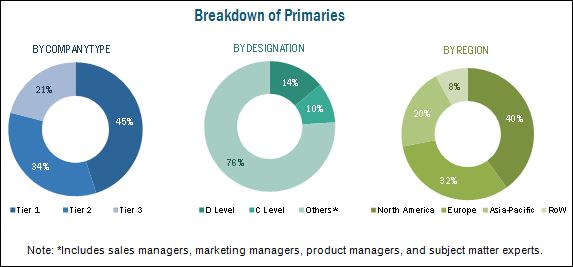
The research methodology used to estimate and forecast this market begins with capturing data on key vendor revenue through secondary sources. The vendor offerings have also been taken into consideration to determine the market segmentation. A combination of top-down and bottom-up procedures has been employed to arrive at the overall size of the water quality monitoring market from the revenues of key players in the market. After arriving at the overall market size, the total market has been split into several segments and subsegments, which have been verified through primary research by conducting extensive interviews with key experts such as CEOs, VPs, directors, and executives. Market breakdown and data triangulation procedures have been employed to complete the overall market engineering process and arrive at the exact statistics for all segments and subsegments. The breakdown of profiles of primaries is depicted in the figure below:
Water Quality Monitoring Market

To know about the assumptions considered for the study, download the pdf brochure

This report provides valuable insights regarding the ecosystem of this market such as water quality testing product suppliers and manufacturers, and end consumers. The ecosystem of the market consists of companies such as Xylem, Inc. (U.S.), Optiqua Technologies Pte. Ltd. (Singapore), and Libelium (Spain) that manufacture water quality monitoring products.

Key Target Audience:

  • Water quality monitoring software developers
  • Water treatment stakeholders
  • Environmental protection and monitoring agencies
  • Manufacturers and distributors of water quality monitoring products
  • Water pollution monitoring committees
  • Academic and research institutes
  • Pharmaceutical and biotechnology industries
  • National and regional water pollution control boards and organizations
  • Food & beverages industries
  • Pulp & paper industries
  • Chemical & petrochemical industries
  • Oil & gas and power generation plants
  • Wastewater treatment plants
  • Water pumping plants
  • Government agencies
  • Market research and consulting firms

The study answers several questions for the stakeholders, primarily which market segments to focus on in the next two to nine years for prioritizing the efforts and investments.

Report Scope:

In this report, the water quality monitoring market has been segmented as follows:

Water Quality Monitoring Market, by Region:

Water Quality Monitoring Market, by Application:

    • North America
    • Europe
    • APAC
    • RoW
    • Laboratories
    • Industrial
    • Government Buildings
    • Commercial Spaces
    • Others (agricultural, household, and general applications)

On the basis of Region, the market has been subsegmented as follows:

Water Quality Monitoring Market, by North America

Water Quality Monitoring Market, by Europe

    • U.S.
    • Canada
    • Mexico
    • Germany
    • U.K.
    • France
    • Rest of Europe
  • Market, by APAC:
    • China
    • Japan
    • India
    • Rest of APAC
  • Market, by RoW:
    • Latin America
    • Africa
    • Others (UAE, Saudi Arabia, Iraq, Syria, and Yemen, among others)

On the basis of Product Type, the water quality monitoring market has been segmented as follows:

  • Market, by Product Type:
  • TOC Analyzers
  • pH Meters
  • Dissolved Oxygen Analyzers
  • Conductivity sensors
  • Turbidity Meters
  • Others

Available Customizations:

With the given market data, MarketsandMarkets offers customizations according the company’s specific needs. The following customization options are available for the report:

Company Information

  • Detailed analysis and profiling of additional market players (up to five)

Custom Market Research Services

We will customize the research for you, in case the report listed above does not meet with your exact requirements. Our custom research will comprehensively cover the business information you require to help you arrive at strategic and profitable business decisions.

Request Customization

TESTIMONIALS

Report Code
SE 5020
Published ON
Feb, 2026
Choose License Type
BUY NOW
  • SHARE
X
Request Customization
Speak to Analyst
Speak to Analyst
OR FACE-TO-FACE MEETING
PERSONALIZE THIS RESEARCH
  • Triangulate with your Own Data
  • Get Data as per your Format and Definition
  • Gain a Deeper Dive on a Specific Application, Geography, Customer or Competitor
  • Any level of Personalization
REQUEST A FREE CUSTOMIZATION
LET US HELP YOU!
  • What are the Known and Unknown Adjacencies Impacting the Water Quality Monitoring Market
  • What will your New Revenue Sources be?
  • Who will be your Top Customer; what will make them switch?
  • Defend your Market Share or Win Competitors
  • Get a Scorecard for Target Partners
CUSTOMIZED WORKSHOP REQUEST
knowledgestore logo

Want to explore hidden markets that can drive new revenue in Water Quality Monitoring Market?

Find Hidden Markets
  • Call Us
  • +1-888-600-6441 (Corporate office hours)
  • +1-888-600-6441 (US/Can toll free)
  • +44-800-368-9399 (UK office hours)
CONNECT WITH US
ABOUT TRUST ONLINE
©2026 MarketsandMarkets Research Private Ltd. All rights reserved
DMCA.com Protection Status
Website Feedback






