This research study involved the extensive use of secondary sources, directories, and databases, such as Dun & Bradstreet (D&B) Hoovers and Bloomberg BusinessWeek, to identify and collect information useful for a technical, market-oriented, and commercial study of the 5G services market. The primary sources were mainly industry experts from the core and related industries and preferred suppliers, manufacturers, distributors, service providers, technology developers, alliances, and organizations related to all segments of the value chain of this market. In-depth interviews were conducted with various primary respondents, including key industry participants, subject matter experts, C-level executives of key market players, and industry consultants to obtain and verify critical qualitative and quantitative information.
Secondary Research
The market for companies offering 5G services and solutions to different verticals was estimated and projected based on the secondary data made available through paid and unpaid sources, as well as by analyzing their product portfolios in the ecosystem of the 5G services market. It also involved rating company products based on their performance and quality. In the secondary research process, various sources such as the European 5G Annual Journal, 5G Americas, 5G Infrastructure Association (5G-IA), Global Mobile Suppliers Association (GSA), and International Journal of Communication Systems (IJCS) were referred to for identifying and collecting information for this study on the 5G services market. The secondary sources included annual reports, press releases, investor presentations of companies, white papers, journals, certified publications, articles by recognized authors, directories, and databases. Secondary research was mainly used to obtain key information about the supply chain of the market, the total pool of key players, market classification, segmentation according to industry trends to the bottommost level, regional markets, and key developments from both market- and technology-oriented perspectives that were further validated by primary sources.
Primary Research
In the primary research process, various primary sources from both the supply and demand sides were interviewed to obtain qualitative and quantitative information on the market. The primary sources from the supply side included various industry experts, including Chief Experience Officers (CXOs); Vice Presidents (VPs); directors from business development, marketing, and product development/innovation teams; related key executives from 5G service and solution vendors, SIs, professional service providers, and industry associations; and key opinion leaders. Primary interviews were conducted to gather insights, such as market statistics, revenue data collected from solutions and services, market breakups, market size estimations, market forecasts, and data triangulation. Primary research also helped in understanding various trends related to technologies, applications, deployments, and regions. Stakeholders from the demand side, such as Chief Information Officers (CIOs), Chief Technology Officers (CTOs), Chief Strategy Officers (CSOs), and end users using 5G Services/solutions, were interviewed to understand the buyer’s perspective on suppliers, products, service providers, and their current usage of 5G services/solutions which would impact the overall 5G services market.
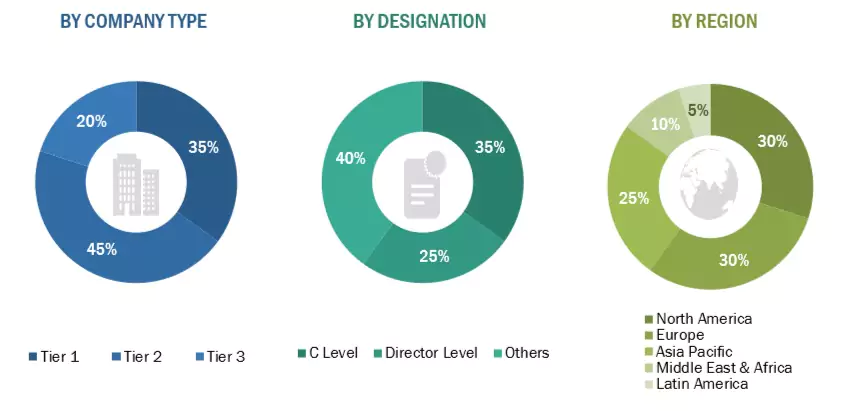
Note: Tier 1 companies’ revenue is more than USD 1 billion; Tier 2 companies ‘revenue ranges between
USD 500 million and USD 1 billion; and Tier 3 companies’ revenue ranges between USD 100 million and USD 500 million.
Other designations include sales managers, marketing managers, and product managers.
To know about the assumptions considered for the study, download the pdf brochure
Market Size Estimation
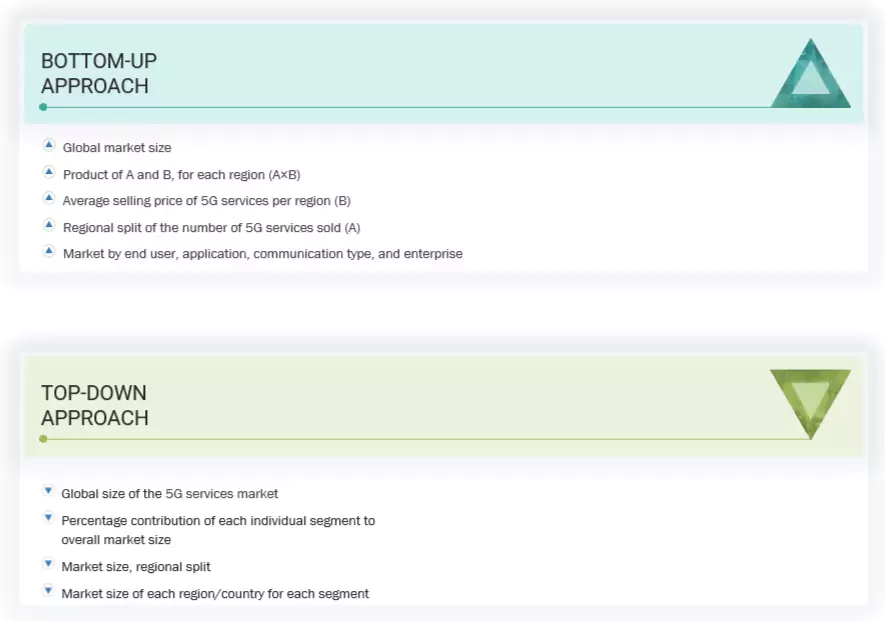
Both top-down and bottom-up approaches were used to estimate and validate the total size of the 5G services market. These methods were extensively used to estimate the size of various segments in the market.
5G Services Market : Top-Down and Bottom-Up Approach
Data Triangulation
After arriving at the overall market size, the 5G services market was divided into several segments and subsegments. A data triangulation procedure was used to complete the overall market engineering process and arrive at the exact statistics for all segments and subsegments, wherever applicable. The data was triangulated by studying various factors and trends from the demand and supply sides. Along with data triangulation and market breakdown, the market size was validated by the top-down and bottom-up approaches.
Market Definition
The 5G service market refers to the economic ecosystem that encompasses the provision and consumption of fifth-generation wireless technology services. It includes a spectrum of offerings such as high-speed data transmission, low-latency connectivity, and enhanced network capabilities provided by telecommunications operators. This market extends beyond traditional voice and data services, incorporating diverse applications like IoT connectivity, augmented reality, virtual reality, and other innovative solutions. As businesses and consumers increasingly adopt 5G technology, the 5G service market is characterized by its role in shaping the digital landscape, fostering technological advancements, and enabling a wide range of applications across various industries. The market dynamics involve intense competition among service providers, infrastructure development, and the continuous evolution of services to meet the demands of an interconnected and digitally driven world.
Stakeholders
-
5G service providers
-
Government organizations, forums, alliances, and associations
-
Consulting service providers
-
Value-added resellers (VARs)
-
End users
-
System integrators
-
Research organizations
-
Consulting companies
Report Objectives
-
To determine and forecast the 5G services market by communication type (eMBB, URLLC, mMTC), end user, application, enterprise, and region from 2023 to 2028, and analyze the various macroeconomic and microeconomic factors affecting market growth
-
To forecast the size of the market segments with respect to five main regions: North America, Europe, Asia Pacific, Latin America, and the Middle East & Africa
-
To provide detailed information about the major factors (drivers, restraints, opportunities, and challenges) influencing the growth of the market
-
To analyze each submarket with respect to individual growth trends, prospects, and contributions to the overall market
-
To analyze the opportunities in the market for stakeholders by identifying the high-growth segments of the market
-
To profile the key market players; provide a comparative analysis based on business overviews, regional presence, product offerings, business strategies, and key financials; and illustrate the market's competitive landscape
-
To track and analyze competitive developments in the market, such as mergers and acquisitions, product developments, partnerships and collaborations, and research and development (R&D) activities.
Available Customizations
With the given market data, MarketsandMarkets offers customizations as per the company’s specific needs. The following customization options are available for the report:
Country-wise information
-
Analysis for additional countries (up to five)
Company Information
-
Detailed analysis and profiling of additional market players (up to 5)




 LARGEST MARKET SHARE IN 2023
 INDIA: FASTEST-GROWING MARKET IN THE REGION









Growth opportunities and latent adjacency in 5G Services Market