Digital Shipyard Market Size, Share & Trends

Digital Shipyard Market by Technology (AR/VR, Digital Twin, Additive Manufacturing, AI/Big Data, Automation, IIoT, Cybersecurity, Blockchain, Cloud/Master Data), Shipyard, Capacity, End Use, Process, Digitalization Level, Region - Global Forecast to 2030




OVERVIEW
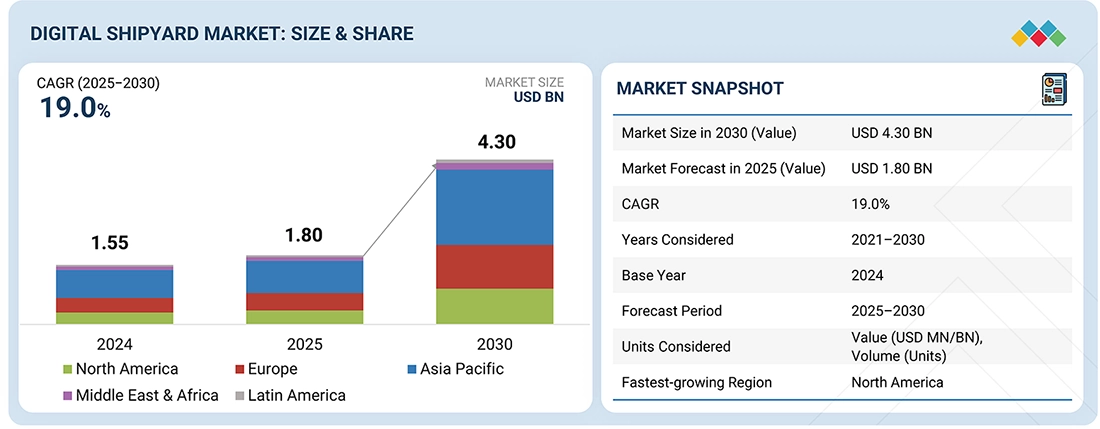
Source: Secondary Research, Interviews with Experts, MarketsandMarkets Analysis
The Digital Shipyard Market is expected to register USD 1.80 billion in 2025 and is projected to reach USD 4.30 billion by 2030 with a CAGR of 19.0%. Market growth is driven by the need to improve efficiency and reduce costs in shipbuilding. Shipyards are using digital tools such as automation, digital twins, and data analytics to improve their processes. There is also a growing focus on upgrading existing shipyard infrastructure.
Market Size & Forecast
• 2025 Market Size (Value): USD 1.80 BN
• 2030 Market Forecast (Value): USD 4.30 BN
• CAGR: 19.0% from 2025 to 2030
• North America: Account for 46.7% Share
• Artificial Intelligence & Big Data Analytics Systems Segment: Highest CAGR of 25.9%
KEY TAKEAWAYS
-
By RegionThe Asia Pacific region dominated the digital shipyard market, accounting for 46.7% in 2025.
-
By Shipyard TypeCommercial shipyards are expected to register the highest CAGR of 19.4% during the forecast period.
-
By TechnologyThe artificial intelligence & big data analytics systems segment is projected to grow at the highest CAGR of 25.9% from 2025 to 2030.
-
By Digitalization LevelThe fully digital shipyard segment will grow the fastest during the forecast period.
-
Competitive LandscapeSiemens, Dassault Systèmes, Accenture, SAP, and BAE Systems are all recognized as key players in the global Digital Shipyard market. These companies hold strong positions due to their established product portfolios and wide operational presence.
-
Competitive LandscapeSSI and iBase-t are considered Progressive Companies among others and have distinguished themselves in the Digital Shipyard market due to strong product innovation and technological advancement.
The Global Digital Shipyard Industry is supported by strong demand factors. Demand for naval and commercial vessels is rising. This is increasing the need for better efficiency and higher capacity. Governments are focusing more on digital transformation and automation. They are also upgrading old shipyard infrastructure. This helps improve operations and reduce delays.
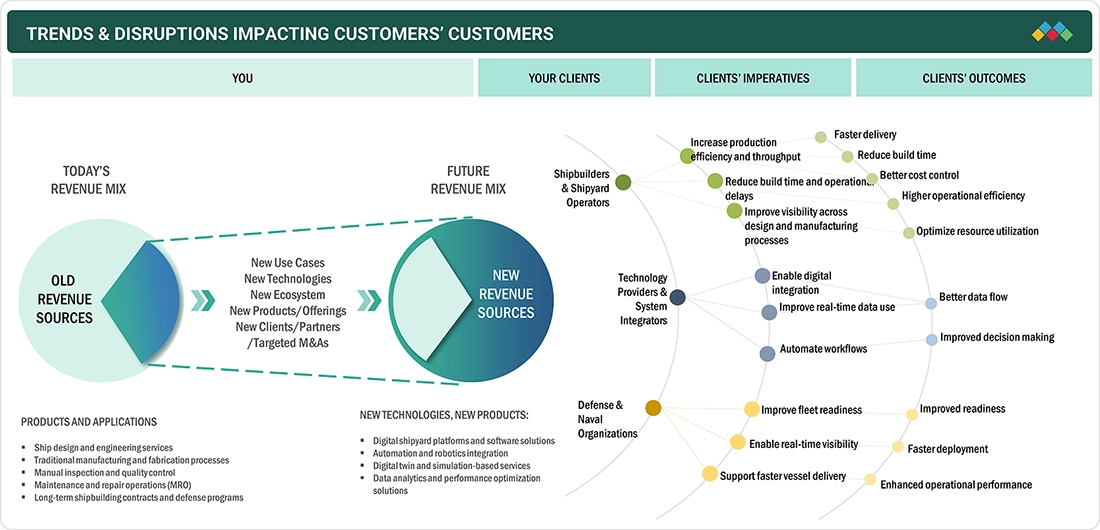
TRENDS & DISRUPTIONS IMPACTING CUSTOMERS' CUSTOMERS
The digital shipyard market is undergoing a fundamental shift. This is driven by shipyard modernization and increasing demand for advanced vessels. To handle this change, stakeholders are using digital twins, automation, and artificial intelligence (AI) systems. These tools help boost production efficiency and quality. Smart manufacturing technologies and integrated platforms are enhancing coordination across design, production, and maintenance. Meanwhile, investments are increasingly focused on software-driven solutions. These solutions improve efficiency and support long-term resilience.
Source: Secondary Research, Interviews with Experts, MarketsandMarkets Analysis
MARKET DYNAMICS

Level
-
Naval modernization and defense fleet expansion

-
Demand for higher production efficiency and cost optimization


Level
-
High capital investment requirements

-
Integration complexity with legacy infrastructure


Level
-
Emergence of autonomous and smart vessel programs

-
Integration of artificial intelligence and predictive analytics in production


Level
-
Managing complex multi-vendor technology integration

-
Ensuring continuous production during digital transformation

Source: Secondary Research, Interviews with Experts, MarketsandMarkets Analysis
Driver: Naval modernization and defense fleet expansion
Governments are increasing spending on naval modernization and expanding defense fleets. This is creating strong demand for advanced shipbuilding and better shipyard efficiency. Shipyards are adopting digital tools to handle complex builds and improve timelines.
Restraint: High capital investment requirements
Digital shipyard solutions require a high initial investment. Costs involve hardware, software, and system integration. Implementation takes time due to approvals and testing. This delays adoption, especially in developing markets.
Opportunity: Emergence of autonomous and smart vessel programs
Demand for autonomous and smart vessels is growing. This is creating new requirements for ship design and production. Digital shipyards can meet these needs with flexible, scalable solutions. Companies offering advanced platforms can benefit from this shift.
Challenge: Managing complex multi-vendor technology integration.
Shipyards use systems from multiple vendors. Integrating these systems is complex and time-consuming. There are also risks related to data flow and system compatibility. Managing this integration remains a key challenge for stakeholders.
DIGITAL SHIPYARD MARKET SIZE, SHARE & TRENDS: COMMERCIAL USE CASES ACROSS INDUSTRIES
| COMPANY | USE CASE DESCRIPTION | BENEFITS |
|---|---|---|
 |
Integrated digital shipyard platforms for design planning and production using digital twin and automation tools | Improves production efficiency and reduces build time. Helps in better planning and real time monitoring of shipbuilding processes |
 |
Virtual ship design and lifecycle management using 3DEXPERIENCE platform for modeling simulation and collaboration | Improves design accuracy and coordination across teams. Reduces rework and supports faster decision making |
 |
Digital transformation services for shipyards including data analytics AI and smart manufacturing solutions | Improves operational efficiency and supports predictive maintenance. Helps reduce costs and improve productivity |
 |
End-to-end enterprise software for shipyard operations including supply chain project management and asset tracking | Improves resource planning and inventory management. Enhances visibility across operations and reduces delays |
 |
Advanced digital engineering and smart manufacturing solutions for naval shipbuilding programs | Improves build quality and supports complex defense projects. Enhances production control and reduces risks |
Logos and trademarks shown above are the property of their respective owners. Their use here is for informational and illustrative purposes only.
MARKET ECOSYSTEM
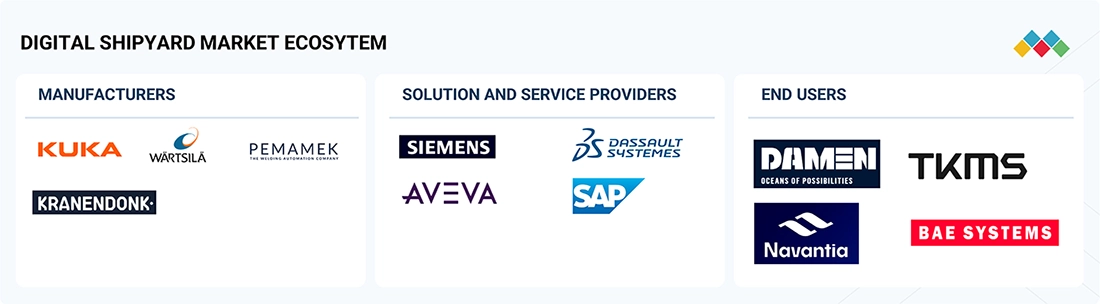
The digital shipyard market includes system manufacturers, technology providers, and software companies. These players support shipbuilding and shipyard operations. They offer solutions like automation systems, digital twins, Product Lifecycle Management (PLM), and data analytics tools. This helps improve efficiency and coordination. Shipbuilders and shipyard operators are the primary end users. They use these solutions to manage design, production, and maintenance work. The ecosystem is highly interconnected, with increasing collaboration between technology providers and shipyards. This drives digital transformation and modernization.
Logos and trademarks shown above are the property of their respective owners. Their use here is for informational and illustrative purposes only.
MARKET SEGMENTS
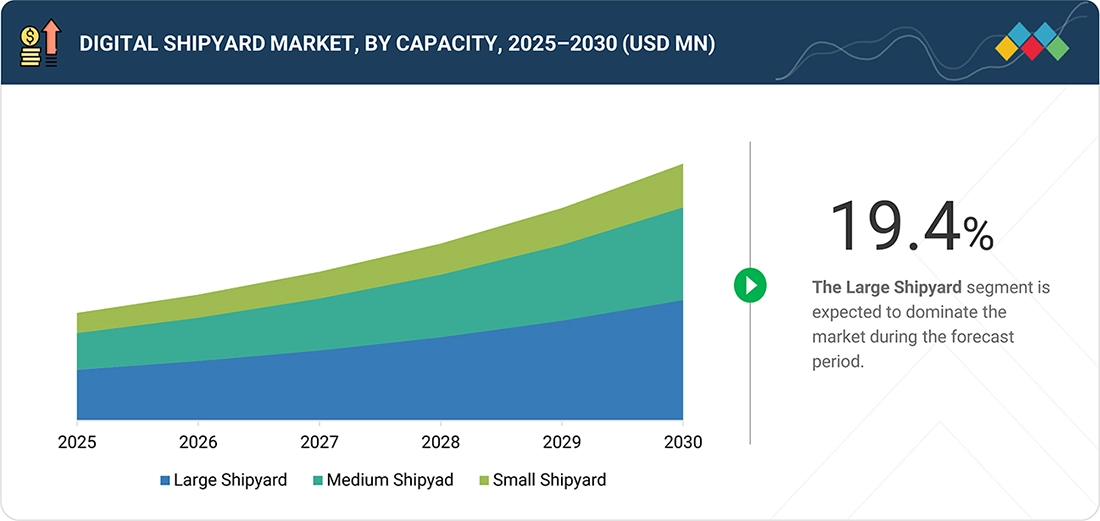
Source: Secondary Research, Interviews with Experts, MarketsandMarkets Analysis
Digital Shipyard Market,By Shipyard Type
Commercial shipyards are leading due to the steady demand for cargo and passenger vessels. Operators focus on faster delivery and cost control. This is pushing the adoption of digital solutions to improve production efficiency. It also helps them stay competitive in a price-sensitive market.
Digital Shipyard Market,By Technology
Cloud platforms are growing in popularity because they enable easy data access across teams. Master data management helps maintain consistent and accurate information. This improves coordination and decision-making. It also supports better integration across different systems.
Digital Shipyard Market,By Capacity
Large shipyards lead as they handle complex and high-volume projects. They invest more in advanced digital tools. This helps improve efficiency and manage large-scale operations better. Strong financial capacity also supports long-term digital investments.
Digital Shipyard Market,By Process
Manufacturing and planning are key areas where digital tools create a direct impact. Shipyards use these solutions to reduce delays and improve workflow. This leads to better resource use and faster production. It also helps in improving overall project visibility.
Digital Shipyard Market, By Digitalization Level
Partially digital shipyards dominate, as many players are still in transition. They are gradually adopting digital tools without full transformation. This allows controlled investment and lower risk. It also gives flexibility to scale digital adoption over time.
Digital Shipyard Market, By End Use
Upgrades and services lead due to the need to modernize existing shipyards. Many operators prefer to improve existing systems over new builds. This helps enhance performance while keeping costs under control. It also reduces disruption to ongoing operations.
REGION
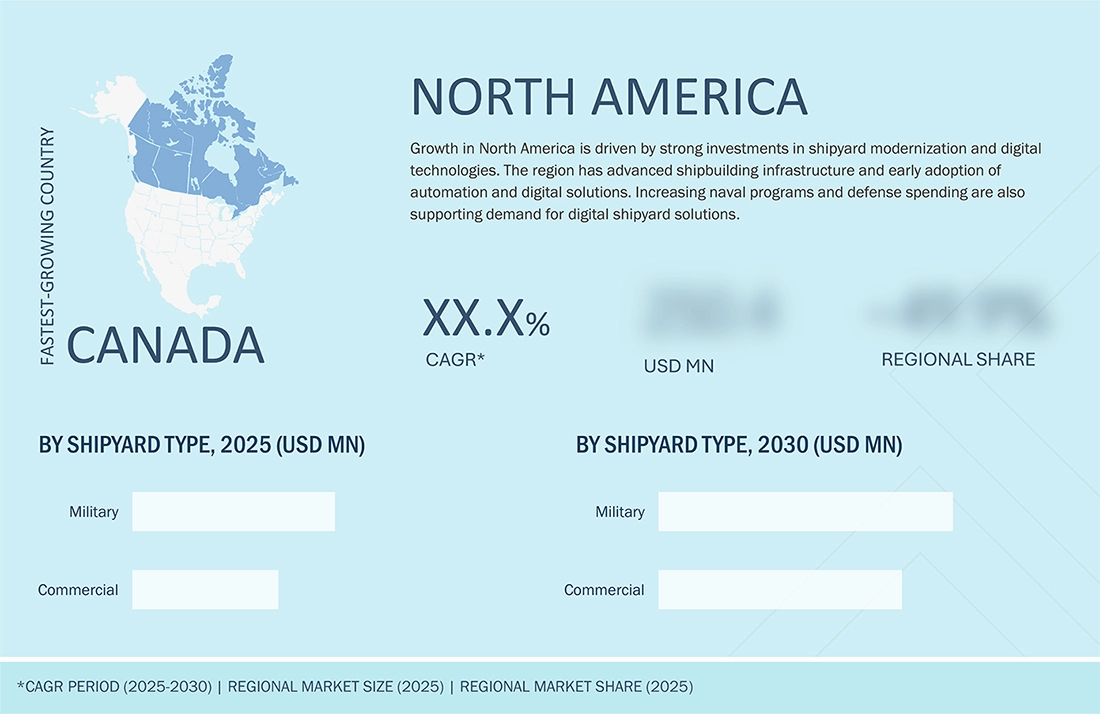
North America to be fastest-growing region in global Digital Shipyard market during forecast period
Growth in North America is driven by strong investments in shipyard modernization and digital technologies. The region has a strong presence of technology providers and advanced shipbuilding infrastructure. Increasing defense spending and naval programs are also supporting the adoption of digital shipyard solutions.
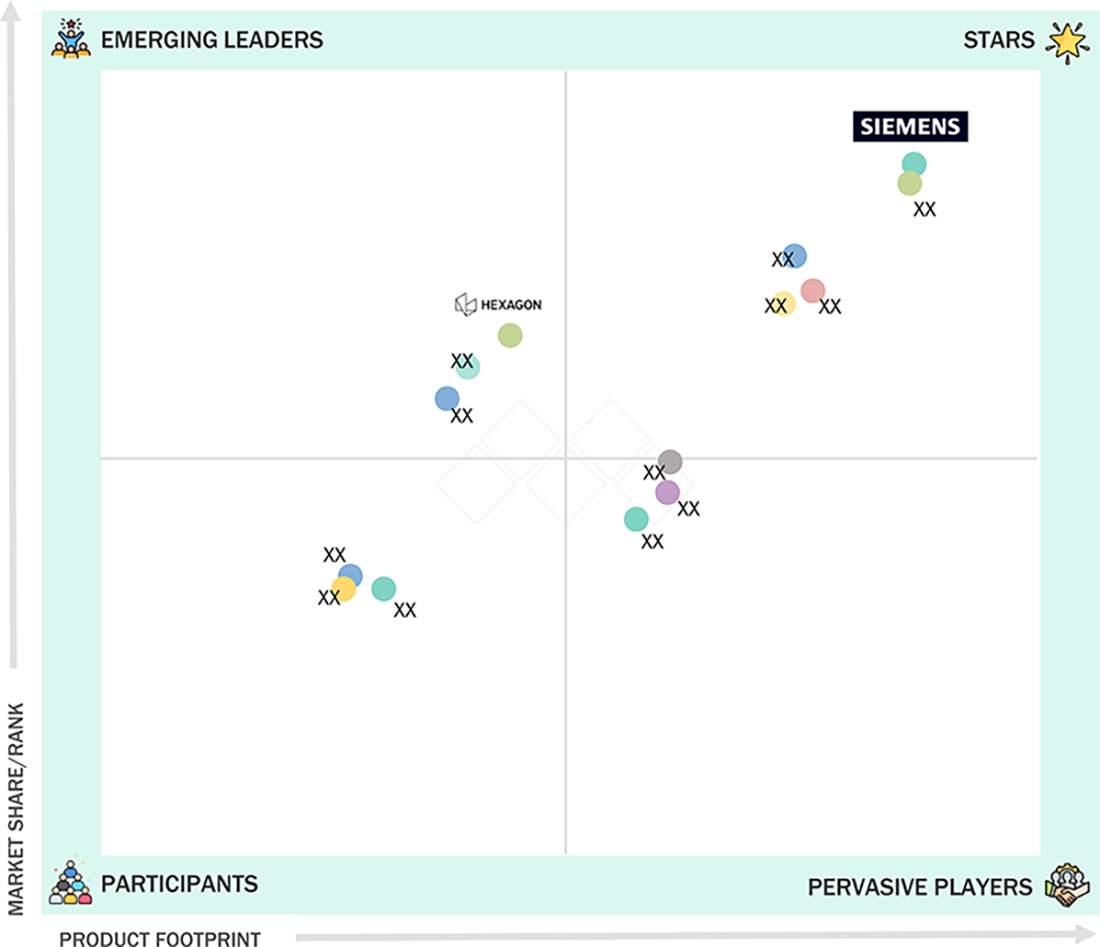
DIGITAL SHIPYARD MARKET SIZE, SHARE & TRENDS: COMPANY EVALUATION MATRIX
Siemens is a key player in the digital shipyard market. It has strong capabilities in automation, digital twin, and Product Lifecycle Management (PLM) solutions. These are used across global shipbuilding programs. Its role in shipyard modernization also supports its strong position. Hexagon AB is an emerging player. It is growing with its strengths in digital reality and metrology. It also focuses on data-driven solutions. These support shipyard design, production, and optimization.
Source: Secondary Research, Interviews with Experts, MarketsandMarkets Analysis
KEY MARKET PLAYERS
List od Top Digital Shipyard Market Companies
- Siemens
- Dassault Systemes
- Accenture
- SAP
- BAE Systems
- Hexagon AB
- Wartsila
- KUKA AG
- IFS
- Pemamek
- Prostep AG
- Kranedonk
- Damen Shipyards Group
- THYSSENKRUPP MARINE SYSTEMS
- NAVANTIA S.A.
- Bureau Veritas
MARKET SCOPE
| REPORT METRIC | DETAILS |
|---|---|
| Market Size in 2025 (Value) | USD 1.80 Billion |
| Market Forecast in 2030 (Value) | USD 4.30 Billion |
| Growth Rate | CAGR of 19.0% from 2025-2030 |
| Years Considered | 2021-2030 |
| Base Year | 2024 |
| Forecast Period | 2025-2030 |
| Units Considered | Value (USD Million/Billion), Volume (Unit) |
| Report Coverage | Revenue forecast, company ranking, competitive landscape, growth factors, and trends |
| Segments Covered |
|
| Regions Covered | North America, Europe, Asia Pacific, Middle East, and Rest of the World |
WHAT IS IN IT FOR YOU: DIGITAL SHIPYARD MARKET SIZE, SHARE & TRENDS REPORT CONTENT GUIDE
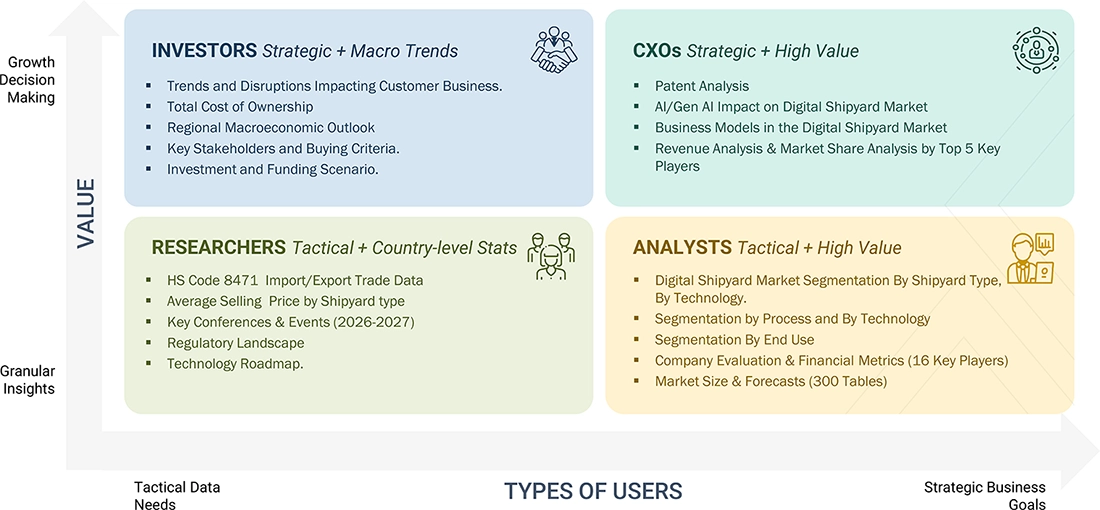
DELIVERED CUSTOMIZATIONS
We have successfully delivered the following deep-dive customizations:
| CLIENT REQUEST | CUSTOMIZATION DELIVERED | VALUE ADDS |
|---|---|---|
| Leading Manufacturer | Additional segment breakdown for countries | Additional country-level market sizing tables for segments/sub-segments covered at the regional/global level to gain an understanding of market potential by each country |
| Emerging Leader | Additional company profiles | Competitive information on targeted players to gain granular insights on direct competition |
| Regional Market Leader | Additional country market estimates | Additional country-level deep dive for a more targeted understanding of the total addressable market |
RECENT DEVELOPMENTS
- February 2026 : Siemens partnered with HD Hyundai to develop an integrated digital platform for its “Future of Shipyard” initiative. The solution connects design, engineering, and production through a unified data flow, improving efficiency and enabling digital twin-based shipbuilding operations.
- November 2025 : Siemens and HD Hyundai signed a Memorandum of Understanding (MoU) to accelerate the digital transformation of shipyards in the United States. The collaboration focuses on automation, digital twin, and Product Lifecycle Management (PLM) technologies to enhance shipyard productivity and workforce capabilities.
- November 2025 : The American Bureau of Shipping (ABS) and Siemens Digital Industries Software entered into a strategic collaboration to digitalize ship classification processes. The initiative integrates digital twin and model-based verification to improve compliance, design validation, and data exchange across shipbuilding workflows.
- October 2025 : Hindustan Shipyard Limited announced multiple partnerships to advance smart and green shipbuilding. The company is investing in modernization initiatives, automation, and digital technologies to improve shipyard efficiency and support next-generation vessel development.
- September 2025 : HD Hyundai advanced its smart shipyard strategy by expanding digital shipbuilding capabilities, including automation and integrated engineering platforms. The initiative focuses on improving production efficiency, reducing build time, and enabling scalable digital shipyard operations across global facilities.
Table of Contents
 Exclusive indicates content/data unique to MarketsandMarkets and not available with any competitors.
Methodology
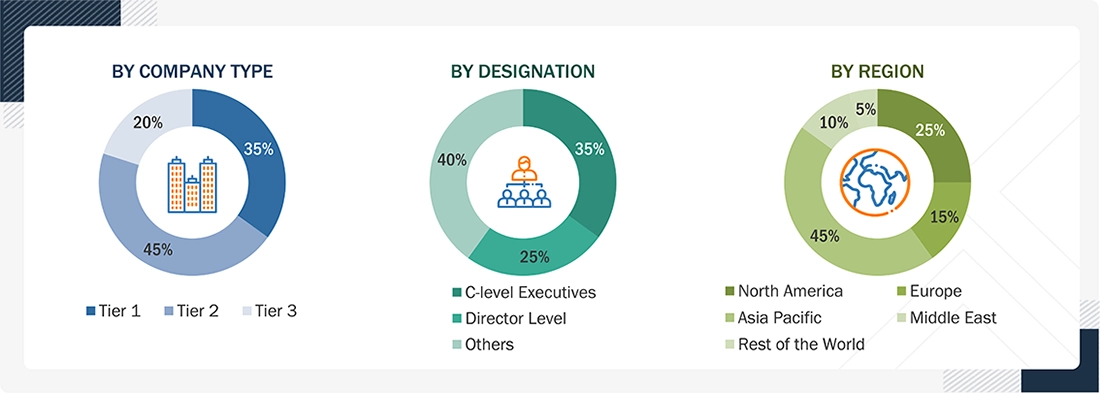
The study used four main steps to estimate the size of the Digital Shipyard market. Secondary research was conducted to collect data on shipbuilding operations, digital technologies, automation systems, and shipyard modernization programs across regions. These findings were validated through primary interviews with shipbuilders, shipyard operators, technology providers, system integrators, and industry experts. The research team reviewed shipbuilding volumes, trade data, government investments, procurement plans, and ongoing modernization initiatives to assess market demand. Market estimates were then segmented by shipyard type, technology, capacity, process, digitalization level, and end use. Data triangulation was applied to validate the final figures for each segment and sub-segment.
Secondary Research
Secondary research was used to build the base for this study. Information was collected from maritime authorities, shipbuilding regulators, and national shipyard modernization programs. Company data was reviewed from annual reports, certification updates, press releases, and investor disclosures of digital shipyard solution providers. The study also reviewed white papers, maritime journals, and published research on shipbuilding technologies, automation, and digital shipyard systems. Additional input was obtained from industry platforms and maritime associations to understand market trends and regional adoption.
Primary Research
Primary research was conducted after key findings from the secondary analysis were identified. The study team engaged with executives, engineers, shipyard operators, and technology providers active in the Digital Shipyard ecosystem. Discussions included shipbuilders, system integrators, infrastructure partners, and regulatory experts across major regions. Interviews were conducted through calls and written interactions to validate market size estimates and user requirements. These inputs helped refine views on competition, deployment plans, and technology adoption. Feedback was also used to adjust assumptions and improve data accuracy.
To know about the assumptions considered for the study, download the pdf brochure
Market Size Estimation
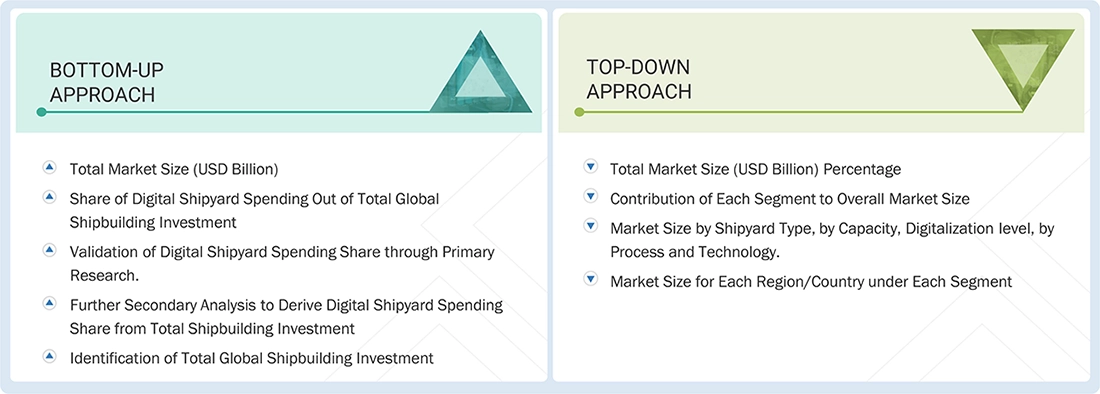
Top-down and bottom-up methods were used to estimate and validate the size of the Digital Shipyard market. The research approach included several steps to ensure accuracy:
- Key companies active in the Digital Shipyard market were identified through secondary research. Their market shares were assessed using a mix of primary inputs and published data. This included reviewing annual reports, financial disclosures, certification updates, and public filings from various organizations. Interviews were also conducted with industry participants, including company executives, program managers, operators, infrastructure providers, and aviation experts. These inputs were used to validate assumptions and refine market size estimates across regions.
- All percentage shares, segment splits, and market breakdowns were first developed using secondary information. These values were then verified through primary discussions with industry participants.
- Key factors affecting the Digital Shipyard market were assessed in the analysis. These included regulatory frameworks, certification timelines, technology progress, infrastructure readiness, and investment activity. Each factor was reviewed through primary research and used to finalize both quantitative and qualitative market estimates for this report.
Digital Shipyard Market: Top-Down and Bottom-Up Approach
Data Triangulation
After determining the overall market size, the total market was divided into several segments and subsegments. The data triangulation and market breakdown procedures explained below were implemented, wherever applicable, to complete the overall market engineering process and arrive at the estimated market numbers for the market segments and subsegments. The data was triangulated by examining various factors and trends on both the demand and supply sides. Additionally, the market size was validated using top-down and bottom-up approaches.
Market Definition
A digital shipyard is the integration of advanced systems and technologies or system-based solutions used to coordinate, monitor, and improve all processes related to ship manufacturing, maintenance, and support. A digital shipyard replaces outdated technology platforms and their compartmentalized technologies with AR & VR, digital twins, the Internet of Things, and robotic process automation, among others. The implementation of these cutting-edge technologies ensures increased productivity and efficiency for the shipyard across all processes throughout its service life.
This study covers the technologies mentioned above used in small, medium, and large commercial and military digital shipyards. It also covers processes such as research & development, design & engineering, manufacturing & planning, maintenance & support, training & simulation in shipyards, and the implementation and upgrades to the technologies mentioned. The shipyards considered are fully, semi, and partially digitalized.
Key Stakeholders
- Shipbuilders and shipyard operators are responsible for vessel design, manufacturing, and maintenance
- Maritime authorities and regulatory bodies overseeing safety, compliance, and standards
- Digital shipyard solution providers and original equipment manufacturers (OEMs)
- Automation and robotics solution providers for shipyard operations
- Software providers offering Product Lifecycle Management (PLM), Enterprise Resource Planning (ERP), and digital twin solutions
- Industrial Internet of Things (IIoT) and data analytics solution providers
- System integrators and engineering service providers
- Defense and naval organizations operating military shipyards
- Infrastructure and equipment suppliers supporting shipyard modernization
- Cloud service providers and cybersecurity solution providers
- Maintenance, support, and lifecycle service providers
- Classification societies and certification bodies ensure vessel and process compliance
- Training and simulation solution providers for workforce development
- Research institutes and technology development organizations
- Logistics and supply chain service providers supporting shipyard operations
Report Objectives
- To define, describe, and forecast the size of the Digital Shipyard market based on shipyard type, technology, capacity, process, digitalization level, and end use.
- To forecast the sizes of market segments with respect to key countries in the following regions: North America, Europe, Asia Pacific, the Middle East, and the Rest of the World
- To identify and analyze drivers, restraints, opportunities, and challenges influencing the growth of the market
- To identify industry trends, market trends, and technology trends currently prevailing in the market
- To provide an overview of the regulatory landscape with respect to global Digital Shipyard regulations
- To analyze micromarkets with respect to individual growth trends, prospects, and their contribution to the overall market
- To analyze opportunities in the market for stakeholders by identifying key market trends
- To profile key market players and comprehensively analyze their market shares and core competencies
- To analyze the degree of competition in the market by identifying growth strategies, such as agreements, acquisitions, partnerships, collaborations, and product launches,adopted by leading market players
- To identify detailed financial positions, key products, and unique selling points of leading market players
Available customizations:
MarketsandMarkets offers the following customizations for this market report:
- Additional country-level analysis of the Digital Shipyard market
- Profiling of other market players (up to 5)
Product Analysis
- Product matrix, which provides a detailed comparison of the product portfolio of each company in the Digital Shipyard market
Key Questions Addressed by the Report
What is the projected size of the global digital shipyard market by 2030?
The global digital shipyard market is projected to grow from USD 1.80 billion in 2025 to USD 4.30 billion by 2030, registering a CAGR of 19.0%. Growth is driven by the need to improve shipbuilding efficiency, reduce costs, modernize infrastructure, and adopt digital technologies. Pasted text
What are the major factors driving the digital shipyard market?
Key growth drivers include naval modernization and defense fleet expansion, rising demand for production efficiency, and cost optimization. Governments are increasing investments in naval programs, while shipyards are adopting digital tools to manage complex builds and improve production timelines. Pasted text Pasted text
Which region is expected to grow the fastest in the digital shipyard market?
North America is expected to be the fastest growing region during the forecast period. Growth is supported by investments in shipyard modernization and digital technologies, advanced shipbuilding infrastructure, technology providers, increasing defense spending, and naval programs. Pasted text
Which technology segment is expected to register the highest growth?
The artificial intelligence and big data analytics systems segment is projected to register the highest CAGR of 25.9% from 2025 to 2030. AI and data analytics support production efficiency, predictive maintenance, decision making, and smarter shipyard operations. Pasted text Pasted text
Which shipyard type is expected to register the highest growth?
Commercial shipyards are expected to register the highest CAGR of 19.4% during the forecast period. Steady demand for cargo and passenger vessels is encouraging operators to adopt digital solutions that improve production efficiency, delivery timelines, and cost control. Pasted text Pasted text
What is the fastest growing digitalization level in the digital shipyard market?
The fully digital shipyard segment is expected to grow the fastest during the forecast period. At the same time, partially digital shipyards currently dominate because many operators are still transitioning gradually toward broader digital transformation. Pasted text Pasted text
What are the major opportunities in the digital shipyard market?
The emergence of autonomous and smart vessel programs represents a major opportunity for digital shipyards. The integration of AI and predictive analytics into production also creates opportunities for flexible, scalable, and advanced digital platforms that can support evolving ship design and manufacturing requirements. Pasted text Pasted text
What are the major challenges facing the digital shipyard market?
Complex multi vendor technology integration is a key challenge because shipyards use systems from multiple providers that must work together effectively. High capital investment requirements and the need to maintain continuous production during digital transformation can also slow adoption. Pasted text Pasted text
Which digital technologies are shaping the digital shipyard market?
Digital twins, automation, artificial intelligence, big data analytics, cloud platforms, Product Lifecycle Management, and smart manufacturing are increasingly shaping digital shipyard operations. These technologies support better coordination across design, production, and maintenance while improving efficiency and decision making. Pasted text Pasted text Pasted text
Which companies are recognized as leading players in the global digital shipyard market?
Key companies include Siemens, Dassault Systèmes, Accenture, SAP, BAE Systems, Hexagon AB, Wärtsilä, KUKA AG, IFS, Pemamek, Prostep AG, Kranendonk, Damen Shipyards Group, thyssenkrupp Marine Systems, Navantia, and Bureau Veritas. Siemens, Dassault Systèmes, Accenture, SAP, and BAE Systems are identified as key players, while Hexagon AB is described as an emerging player. Pasted text Pasted text Pasted text


Personalize This Research
- Triangulate with your Own Data
- Get Data as per your Format and Definition
- Gain a Deeper Dive on a Specific Application, Geography, Customer or Competitor
- Any level of Personalization
Let Us Help You
- What are the Known and Unknown Adjacencies Impacting the Digital Shipyard Market
- What will your New Revenue Sources be?
- Who will be your Top Customer; what will make them switch?
- Defend your Market Share or Win Competitors
- Get a Scorecard for Target Partners

Custom Market Research Services
We Will Customise The Research For You, In Case The Report Listed Above Does Not Meet With Your Requirements
Get 10% Free CustomisationTESTIMONIALS
- South Korea Digital Shipyard Market
- Japan Digital Shipyard Market
- India Digital Shipyard Market
- Australia Digital Shipyard Market
- UAE Digital Shipyard Market
- Turkey Digital Shipyard Market
- Rest Of Europe Digital Shipyard Market
- Rest Of Asia Pacific Digital Shipyard Market
- Rest Of Middle East Digital Shipyard Market
- Canada Digital Shipyard Market
- US Digital Shipyard Market
- UK Digital Shipyard Market
- Germany Digital Shipyard Market
- France Digital Shipyard Market
- Italy Digital Shipyard Market
- Netherlands Digital Shipyard Market
- Spain Digital Shipyard Market
- China Digital Shipyard Market
Growth opportunities and latent adjacency in Digital Shipyard Market






Albert
May, 2026
Does the report identify key demand-side drivers and supply-side constraints impacting digital shipyard adoption?.
Richard
May, 2026
Can I explore how digital twin and simulation are being used to optimize ship design, manufacturing, and maintenance?.