Display Material Market by Technology (LCD, OLED), Component & Material (Substrate, Polarizer, Color Filter, Liquid Crystals, BLU, Emitter & Organic Layer, Encapsulation), Panel Type, Application (Smartphone, Television), Region - Global Forecast to 2035


Global Display Material Market Overview 2025 to 2035
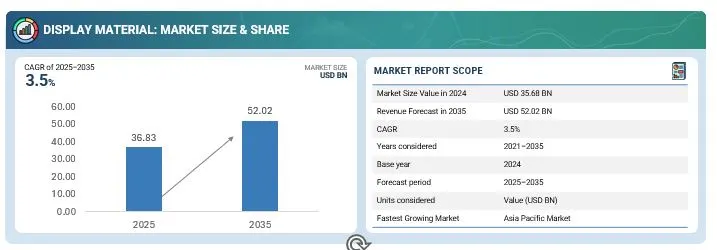
The global display material market was valued at USD 35.68 billion in 2024 and is estimated to reach USD 52.02 billion by 2035, at a CAGR of 3.5% between 2025 and 2035.The global display material market is poised for significant growth between 2025 and 2035. Fueled by rising demand for high definition and advanced display technologies in consumer electronics, automotive, and other sectors, the market is expected to expand steadily throughout this period. The transition from traditional liquid crystal displays to organic light emitting diode technologies is a major driver shaping market dynamics. Increasing consumer preference for smartphones and televisions with superior display quality energy efficiency and innovative form factors is propelling the need for advanced display materials. Market participants are investing heavily in research and development to enhance component performance reduce production costs and enable flexible and foldable display solutions. By 2035 the market value is forecast to reach substantial figures indicating robust growth potential driven by technological innovations and expanded application areas.
Technology Segment Analysis: LCD and OLED
The research report segments the display material market into following subsegments:
Display Technology
- LCD
- OLED
OLED Display Material Market, by Component and Material
-
Emitter and Organic Layer Materials
- Emitting Layer (EML)/Emissive Material/RGB
- Hole Transport Layer (HTL)/Hole Injection Layer (HIL)
- Electron Transport Layer (ETL)/Electron Injection Layer (EIL)
-
Substrate
- Rigid
- Flexible
-
Encapsulation
- Metal
- Glass
- TFE
- Hybrid
- Polarizer
- Electrodes - Anode & Cathode (Qualitative)
OLED Display Material Market, by Panel Type
- Rigid
- Flexible
LCD Material Market, by Component and Material
- Polarizer
- Substrate
- Color Filter Layer
- Liquid Crystals
- Backlighting Unit (BLU)
- Other LCD Materials
LCD Material Market, by Application
- Television
- Smartphone & Tablet
- Laptop
- Desktop
- Signage/Large Format Display
- Automotive
- Others
OLED Display Material Market, by Application
- Television
- Smartphone & Tablet
- Signage/Large Format Display
- Smart Wearables
Display Material Market, by Region
- South Korea
- China
- Japan
- Taiwan
- Rest of APAC
Available Customizations:
With the given market data, MarketsandMarkets offers customizations according to the company’s specific needs. The following customization options are available for the report:
- Detailed analysis and profiling of additional market players (up to 5)
Get more insight on other verticals of Semiconductor and Electronics Market Research Reports & Consulting
To speak to our analyst for a discussion on the above findings, click Speak to Analyst
 Exclusive indicates content/data unique to MarketsandMarkets and not available with any competitors.
Table of Contents
1 Introduction (Page No. - 17)
1.1 Objectives of Study
1.2 Definition
1.3 Scope of Study
1.3.1 Markets Covered
1.3.2 Geographic Segmentation
1.4 Years Considered for Study
1.5 Currency
1.6 Limitations
1.7 Stakeholders
2 Research Methodology (Page No. - 21)
2.1 Research Data
2.1.1 Secondary Data
2.1.1.1 Key Data From Secondary Sources
2.1.2 Primary Data
2.1.2.1 Key Data From Primary Sources
2.1.2.2 Breakdown of Primaries
2.1.2.3 Key Industry Insights
2.2 Market Size Estimation
2.2.1 Bottom-Up Approach
2.2.2 Top-Down Approach
2.3 Data Triangulation
2.4 Research Assumptions
3 Executive Summary (Page No. - 30)
4 Premium Insights (Page No. - 38)
4.1 Attractive Growth Opportunities for Display Material Market
4.2 Market, By Display Technology
4.3 Display Panel Production Share, By Country
4.4 Display Panel Production Share, By Display Technology
4.5 OLED Display Panel Production Share, By Panel Type
4.6 LCD Display Material Market, By Component & Material
4.7 OLED Market, By Component & Material
4.8 OLED Market, By Panel Type
4.9 OLED Market, By Application
4.10 Market, By Geography
4.11 Market, By Application and Country
4.12 LCD Display Material Market, By Application and Country
5 Market Overview (Page No. - 45)
5.1 Introduction
5.2 Market Dynamics
5.2.1 Drivers
5.2.1.1 Construction and Upgrade of New and Existing Display Panel Manufacturing Plants in APAC
5.2.1.2 Increased Adoption of OLED Display Technology in Various Applications
5.2.1.3 Ever-Increasing Average Screen Size & Resolution of LCD Television
5.2.2 Restraints
5.2.2.1 Exclusivity and Ip Protection of Emerging and Advanced Display Materials
5.2.3 Opportunities
5.2.3.1 High Growth of OLED and Quantum Dot LCD Displays
5.2.3.2 Emerging Display Technologies Such as Micro-Led and True Quantum Dot
5.2.4 Challenges
5.2.4.1 High Prices of New and Advanced Materials
5.2.4.2 Low Material Utilization Or Throughput in Displays Based on New Technologies Such as OLED
5.2.4.3 Complex Value Chain for OLED Displays
6 Industry Trends (Page No. - 52)
6.1 Introduction
6.2 Value Chain Analysis
6.2.1 Research & Development
6.2.2 Raw Material & Component Manufacturing
6.2.3 Panel Manufacturing
6.2.4 Brand Product Integration
6.3 Key Industry Trends
6.3.1 Leading OLED Display Panel Suppliers—Current and Future Scenarios
6.3.2 OLED Production Capacity Share, By Player
6.3.3 Manufacturing Cost Comparison: Rigid vs Flexible OLED Panels
7 Display Material Market, By Display Technology (Page No. - 56)
7.1 Introduction
7.2 LCD
7.3 OLED
8 LCD Material Market, By Component & Material (Page No. - 61)
8.1 Introduction
8.2 Polarizer
8.3 Substrate
8.4 Color Filter Layer
8.5 Liquid Crystals
8.6 Backlighting Unit (BLU)
8.7 Other LCD Materials
9 LCD Material Market, By Application (Page No. - 75)
9.1 Introduction
9.2 Television
9.3 Smartphone & Tablet
9.4 Laptop
9.5 Desktop
9.6 Signage/Large Format Display
9.7 Automotive
9.8 Others
10 OLED Display Material Market, By Component and Material (Page No. - 80)
10.1 Introduction
10.2 Emitter & Organic Layer Materials
10.2.1 Emitting Layer (EML)/Emissive Material/RGB
10.2.2 Hole Transport Layer (HTL)/Hole Injection Layer (HIL)
10.2.3 Electron Transport Layer (ETL)/Electron Injection Layer (EIL)
10.3 Substrate
10.3.1 Rigid
10.3.2 Flexible
10.4 Encapsulation
10.4.1 Metal
10.4.2 Glass
10.4.3 TFE
10.4.4 Hybrid
10.5 Polarizer
10.6 Electrodes—Anode & Cathode
11 OLED Display Material Market, By Application (Page No. - 94)
11.1 Introduction
11.2 Television
11.3 Smartphone & Tablet
11.4 Signage/Large Format Display
11.5 Smart Wearables
12 OLED Display Material Market, By Display Panel Type (Page No. - 99)
12.1 Introduction
12.2 Rigid
12.3 Flexible
13 Quantum Dot (QD) Film Market, By Structure Type (Page No. - 106)
13.1 Introduction
13.2 QDEF/QD LCD/QD on Glass Lgp/Photo-Enhanced
13.3 QD Filter/QDCF/QDpr/Photo-Emissive
13.4 Amqled/True QD/Self-Emitting QD/Electro-Emissive
14 Geographic Analysis (Page No. - 113)
14.1 Introduction
14.2 APAC
14.2.1 South Korea
14.2.2 China
14.2.3 Japan
14.2.4 Taiwan
14.2.5 Rest of APAC
15 Competitive Landscape (Page No. - 130)
15.1 Overview
15.2 Ranking of Players, 2016
15.3 Competitive Scenario
15.3.1 Product Development
15.3.2 Agreement, Collaboration, Contract, Partnership, & Alliance
15.3.3 Expansions
15.3.4 Merger, Acquisition, & Investment
16 Company Profiles (Page No. - 136)
(Business Overview, Products Offered, Recent Developments, SWOT Analysis, and MnM View)*
16.1 Key Players
16.1.1 Corning
16.1.2 Nitto Denko
16.1.3 Sumitomo Chemical
16.1.4 Merck
16.1.5 LG Chem
16.1.6 Samsung Sdi
16.1.7 Universal Display Corporation
16.1.8 Asahi Glass
16.1.9 Idemitsu Kosan
16.1.10 Dowdupont
16.1.11 Toray Industries
16.1.12 DIC Corporation
16.1.13 Hodogaya Chemical
16.1.14 JSR Corporation
16.1.15 Nissan Chemical
16.2 Key Innovators
16.2.1 Duksan Neolux
16.2.2 Doosan
16.2.3 Jnc Corporation
16.2.4 Cynora
16.2.5 Luminescence Technology
*Details on Business Overview, Products Offered, Recent Developments, SWOT Analysis, and MnM View Might Not Be Captured in Case of Unlisted Companies.
17 Appendix (Page No. - 178)
17.1 Discussion Guide
17.2 Knowledge Store: Marketsandmarkets’ Subscription Portal
17.3 Introducing RT: Real-Time Market Intelligence
17.4 Available Customization
17.5 Related Reports
17.6 Author Details
List of Tables (65 Tables)
Table 1 Major Secondary Sources
Table 2 Display Panel Supplier & Their Rigid and Flexible OLED Capabilities
Table 3 Display Material Market, By Display Technology, 2014–2023 (USD Billion)
Table 4 Display Production, By Technology, 2014–2023 (Million Square Meter)
Table 5 Display Production in APAC, By Country, 2014–2023 (Million Square Meter)
Table 6 Glass Substrate Market, By Display Technology, 2014–2023 (Million Square Meter)
Table 7 LCD Material Market, By Component and Material, 2014–2023 (USD Billion)
Table 8 LCD Material Market for Polarizer, By Application, 2014–2023 (USD Million)
Table 9 LCD Material Market for Polarizer in APAC, By Country, 2014–2023 (USD Billion)
Table 10 LCD Glass Substrate Demand, By Application, 2014–2023 (Million Square Meter)
Table 11 LCD Material Market for Substrate, By Application, 2014–2023 (USD Million)
Table 12 LCD Material Market for Substrate in APAC, By Country, 2014–2023 (USD Billion)
Table 13 LCD Material Market for Color Filter Layer, By Application, 2014–2023 (USD Million)
Table 14 LCD Material Market for Color Filter Layer, By Component and Material, 2014–2023 (USD Million)
Table 15 LCD Material Market for Color Resist, By Country, 2014–2023 (Thousand Ton)
Table 16 LCD Material Market for Color Filter Layer in APAC, By Country, 2014–2023 (USD Million)
Table 17 LCD Material Market for Liquid Crystals, By Application, 2014–2023 (USD Million)
Table 18 LCD Material Market for Liquid Crystals in APAC, By Country, 2014–2023 (USD Million)
Table 19 LCD Material Market for Backlighting Unit (BLU), By Application, 2014–2023 (USD Million)
Table 20 LCD Material Market for Backlighting Unit (BLU) in APAC, By Country, 2014–2023 (USD Million)
Table 21 Other LCD Material Market, By Application, 2014–2023 (USD Million)
Table 22 Other LCD Material Market in APAC, By Country, 2014–2023 (USD Million)
Table 23 LCD Material Market, By Application 2014–2023 (USD Billion)
Table 24 OLED Market, By Component and Material, 2014–2023 (USD Million)
Table 25 OLED Market for Emitter and Organic Layer Materials, By Application, 2014–2023 (USD Million)
Table 26 Market for Emitter and Organic Layer Materials in APAC, By Country, 2014–2023 (USD Million)
Table 27 Market for Emitter and Organic Layer Materials, By Display Panel Type, 2014–2023 (USD Million)
Table 28 OLED Market, By Substrate Type, 2014–2023 (USD Million)
Table 29 OLED Market for Glass Substrate, By Application, 2014–2023 (Million Square Meter)
Table 30 OLED Market for Substrate in APAC, By Country, 2014–2023 (USD Million)
Table 31 OLED Market for Rigid Substrate, By Application, 2014–2023 (USD Million)
Table 32 OLED Market for Flexible Substrate, By Application, 2014–2023 (USD Million)
Table 33 OLED Market, By Encapsulation Type, 2014–2023 (USD Million)
Table 34 Market for Encapsulation in APAC, By Country, 2014–2023 (USD Million)
Table 35 OLED Market for Encapsulation, By Display Panel Type, 2014–2023 (USD Million)
Table 36 OLED Market for Polarizer, By Application, 2014–2023 (USD Million)
Table 37 OLED Market for Polarizer, in APAC, By Country, 2014–2023 (USD Million)
Table 38 Market for Polarizer, By Display Panel Type, 2014–2023 (USD Million)
Table 39 OLED Market, By Application, 2014–2023 (USD Million)
Table 40 OLED Display Production, By Application, 2014–2023 (Million Square Meter)
Table 41 OLED Market, By Display Panel Type, 2014–2023 (USD Million)
Table 42 OLED Display Production, By Panel Type, 2014–2023 (Million Square Meter)
Table 43 OLED Market for Rigid Display Panel, By Component and Material, 2014–2023 (USD Million)
Table 44 Rigid OLED Display Panel Production, By Application, 2014–2023 (Thousand Square Meter)
Table 45 Flexible OLED Market, By Component and Material, 2014–2023 (USD Million)
Table 46 Flexible OLED Display Panel Production, By Application, 2014–2023 (Thousand Square Meter)
Table 47 QLED TV Market, By QD Structure Type, 2015–2023 (Million Units)
Table 48 QD Film Market, By Structure Type, 2015–2023 (USD Million)
Table 49 Market, By Country, 2014–2023 (USD Billion)
Table 50 LCD Market, By Country (USD Billion)
Table 51 OLED Market in APAC, By Country, 2014–2023 (USD Million)
Table 52 Market in South Korea, By Display Technology, 2014–2023 (USD Billion)
Table 53 LCD Market in South Korea, By Component and Material, 2014–2023 (USD Billion)
Table 54 OLED Market in South Korea, By Component and Material, 2014–2023 (USD Million)
Table 55 Market in China, By Display Technology, 2014–2023 (USD Billion)
Table 56 LCD Market in China, By Component and Material, 2014–2023 (USD Billion)
Table 57 Market in China, By Component and Material, 2014–2023 (USD Million)
Table 58 Market in Japan, By Display Technology, 2014–2023 (USD Million)
Table 59 LCD Market in Japan, By Component and Material, 2017–2023 (USD Million)
Table 60 OLED Market in Japan, By Component and Material, 2014–2023 (USD Million)
Table 61 Market in Taiwan, By Display Technology, 2014–2023 (USD Million)
Table 62 LCD Market in Taiwan, By Component and Material, 2014–2023 (USD Billion)
Table 63 OLED Market in Taiwan, By Component and Material, 2014–2023 (USD Million)
Table 64 Market in Rest of APAC, By Display Technology, 2014–2023 (USD Million)
Table 65 Corning, Nitto Denko, and Sumitomo Emerged as Top Players in Market, 2016
List of Figures (79 Figures)
Figure 1 Display Material Market: Process Flow of Market Size Estimation
Figure 2 Research Design
Figure 3 Market Size Estimation Methodology: Bottom-Up Approach
Figure 4 Market Size Estimation Methodology: Top-Down Approach
Figure 5 Data Triangulation
Figure 6 Market, 2014–2023 (USD Billion)
Figure 7 Polarizers to Hold Largest Size of LCD Material Market During Forecast Period
Figure 8 Emitter and Organic Layer Materials to Hold Largest Size of Market During Forecast Period
Figure 9 Rigid Display Panels to Dominate OLED Display , in Terms of Size, During Forecast Period
Figure 10 Television Application to Hold Largest Size of LCD Display During Forecast Period
Figure 11 Smartphone & Tablet Application to Account for Largest Demand of OLED Materials During Forecast Period
Figure 12 Display Material Demand From China to Grow at Highest CAGR During Forecast Period
Figure 13 OLED Material Market to Grow at High CAGR During the Forecast Period
Figure 14 LCD to Hold Larger Share of Market During Forecast Period
Figure 15 Display Panel Production Capacity in China to Grow at Highest Rate During Forecast Period
Figure 16 OLED Production Share to Increase Significantly Between 2017 & 2023
Figure 17 Flexible OLED Panel Production Capacity to Increase at Faster Rate During Forecast Period
Figure 18 Polarizer to Hold the Largest Share of LCD Material Market During Forecast Period
Figure 19 Emitter and Organic Layer Materials to Hold Largest Size of OLED Market During Forecast Period
Figure 20 OLED Display Material Market for Flexible Display Panels to Grow at Higher Rate During Forecast Period
Figure 21 Smartphone and Tablet Application to Account for Largest Demand of OLED Display Materials During Forecast Period
Figure 22 China to Hold Largest Share of Market, With Highest Demand, By 2023
Figure 23 Smartphone and Tablet Application Accounted for Largest Share of OLED Market in 2016
Figure 24 Television Application Accounted for Largest Share of LCD Market in 2016
Figure 25 Construction and Upgrade of Manufacturing Plants in APAC Drives Growth of Market
Figure 26 LCD TV Panel Size Breakdown and Average Panel Size, 2009–2020
Figure 27 LCD TV Shipment Breakdown, By Resolution, 2009–2020
Figure 28 OLED Display Market, 2014–2023 (USD Billion)
Figure 29 Micro-Led Display Market, 2017–2025 (USD Billion)
Figure 30 Value Chain of Market
Figure 31 OLED Panel Production Share of Samsung Display and LG Display Expected to Change Significantly Between 2017 and 2020
Figure 32 Materials Account for Largest Share of Overall Manufacturing Cost in Rigid and Flexible OLED Panels, 2016
Figure 33 Market, By Display Technology, 2014–2023 (USD Billion)
Figure 34 Display Production in APAC, By Country, 2014–2023 (Million Square Meter)
Figure 35 LCD Material Market, By Component and Material
Figure 36 LCD Material Market, By Component and Material, 2017 vs 2023 (USD Billion)
Figure 37 LCD Material Market, By Application, 2017–2023 (USD Billion)
Figure 38 OLED Market for Substrate to Grow at Highest CAGR During Forecast Period
Figure 39 OLED Material Market for Emitter and Organic Layer Materials, By Application, 2017 vs 2023
Figure 40 OLED Substrate Market for Flexible Display Panel to Grow at Higher CAGR During Forecast Period
Figure 41 OLED Market for Hybrid Encapsulation to Grow at Highest CAGR During Forecast Period
Figure 42 OLED Polarizer Market for Television Application to Grow at Highest CAGR During Forecast Period
Figure 43 Television Application to Account for Highest Demand of OLED Display Materials By 2023
Figure 44 OLED Market for Flexible OLED Display Panels to Grow at Higher CAGR During Forecast Period
Figure 45 Emitter and Organic Layer Materials to Hold Largest Size of OLED Market for Rigid Display Panels By 2023
Figure 46 Emitter and Organic Layer Materials to Dominate OLED Market for Flexible Display Panels During Forecast Period
Figure 47 QD Films, By Structure Type
Figure 48 QLED Televisions Based on QDEF Film & QD on Glass LGP to Dominate Market During Forecast Year
Figure 49 QD Film Market, By Structure Type, 2015–2023 (USD Million)
Figure 50 QD Film Market Share Comparison, By Structure Type, 2017 vs 2020 vs 2023
Figure 51 QDEF Market for Television Application, 2015–2023
Figure 52 QDCF Market for Television Application, 2019–2023
Figure 53 True QD Market for Television Application, 2021–2023
Figure 54 Display Material Market, By Geography
Figure 55 Geographic Snapshot of Market (LCD and OLED)
Figure 56 Geographic Snapshot of LCD Material Market
Figure 57 Geographic Snapshot of OLED Market
Figure 58 APAC: Market Snapshot, 2017–2023
Figure 59 Market in China to Grow at Highest CAGR Between 2017 and 2023
Figure 60 OLED Market in South Korea to Grow at Higher CAGR During Forecast Period
Figure 61 Demand for OLED and LCD Materials From China to Grow Rapidly During Forecast Period
Figure 62 Japan to Witness Decline in Demand for LCD Materials During Forecast Period
Figure 63 Market in Taiwan to Witness Negligible Growth in Terms of Demand for LCD Materials During Forecast Period
Figure 64 Key Developments in the Market (2015–2017)
Figure 65 Corning: Company Snapshot
Figure 66 Nitto Denko: Company Snapshot
Figure 67 Sumitomo Chemical: Company Snapshot
Figure 68 Merck: Company Snapshot
Figure 69 LG Chem: Company Snapshot
Figure 70 Samsung SDI: Company Snapshot
Figure 71 Universal Display Corp.: Company Snapshot
Figure 72 Asahi Glass: Company Snapshot
Figure 73 Idemitsu Kosan: Company Snapshot
Figure 74 Dowdupont: Company Snapshot
Figure 75 Toray Industries: Company Snapshot
Figure 76 DIC Corporation: Company Snapshot
Figure 77 Hodogaya Chemical: Company Snapshot
Figure 78 JSR Corporation: Company Snapshot
Figure 79 Nissan Chemical: Company Snapshot













Growth opportunities and latent adjacency in Display Material Market