Event Management Software Market

Event Management Software Market by Software (Event Planning & Operations, Event Marketing, Virtual & Hybrid Platform, and Analytics, AI & Event Intelligence), Event Type (Product Launches, Corporate Meetings, and Conferences) - Global Forecast to 2031




OVERVIEW
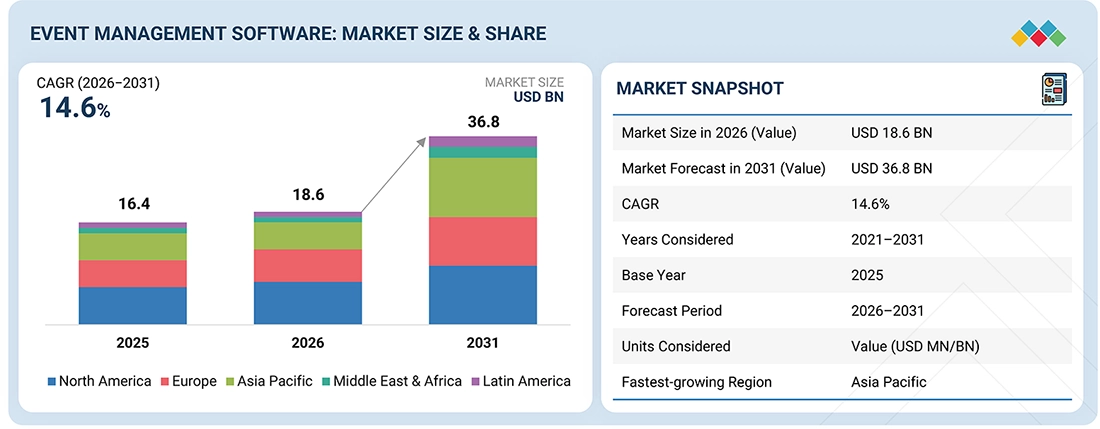
Source: Secondary Research, Interviews with Experts, MarketsandMarkets Analysis
The Event Management Software (EMS) market is undergoing a structural transformation, evolving from a fragmented collection of point tools into the connected engagement operating system of the modern enterprise. The global addressable market is projected to expand from USD 18.6 billion in 2026 to USD 36.8 billion by 2031, registering a CAGR of 14.6%. While the underlying base of standalone registration and ticketing tools grows only incrementally, market value is expanding horizontally through integration with CRM and marketing automation ecosystems, and vertically through the rising complexity of AI-personalized, always-on attendee experiences. Enterprises are shifting investment from basic registration and ticketing toward platforms that unify planning, marketing, engagement, and post-event analytics into a single connected system.
Market Size and Forecast:
- 2025 Market Size: USD 16.4 billion
- 2026 Market Size: USD 18.6 billion
- 2031 Forecasted Market Size: USD 36.8 billion
- Growth Rate (2026-2031): CAGR of 14.6%
- Data available from 2021 to 2031
- Base year: 2025
- Forecast period: 2026–2031
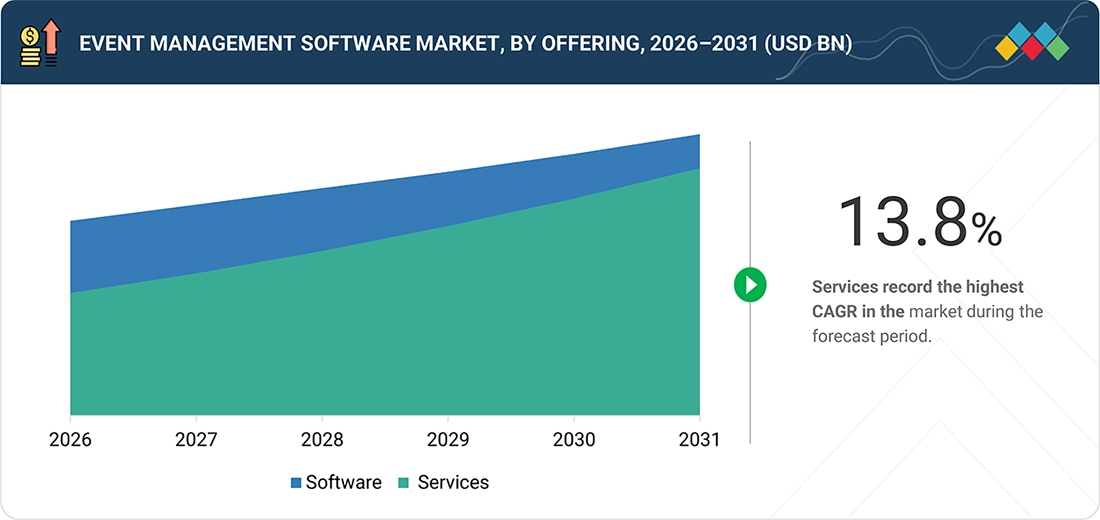
- The service segment is expected to grow at the highest rate of 13.8% CAGR.
Key Market Trends and Insights
- Key Trend: AI-driven personalization, SaaS deployments, mobile event apps, integrated marketing, and hybrid event platforms are shaping the market.
- Key Technologies: AI, virtual reality (VR), blockchain, cloud-based platforms, mobile applications, live streaming, and event analytics.
-
Opportunity: Expanding adoption across corporate, exhibition, education, government, and healthcare sectors is creating growth opportunities for data-driven event platforms.
- AI Impact: AI is enhancing event management through personalized attendee experiences, workflow automation, improved analytics, and stronger audience engagement.
KEY TAKEAWAYS
-
BY REGIONAsia Pacific is estimated to grow at the highest CAGR in the event management software market during 2026–2031, driven by increasing corporate event activity, mobile-first ticketing, expanding exhibition infrastructure, and growing software adoption among organizers in China, India, Southeast Asia, Australia, and Japan.
-
BY OFFERINGBy offering, the service segment is expected to grow at the highest rate of 13.8% in the event management software market during the forecast period.
-
BY SOFTWAREBy software, event planning & operations software will account for the largest market share in the global event management software market.
-
BY ORGANIZATION SIZEBy organization size, SMEs are expected to grow at the highest rate of 13.3% during the forecast period.
-
BY DEPLOYMENT TYPEBy deployment type, cloud deployment is expected to hold the largest share in the event management software market. Growth is driven by rapid deployment, remote accessibility, subscription pricing, scalability, automatic upgrades, and easier integration with CRM and marketing platforms.
-
BY EVENT TYPEBy event type, conferences are estimated to account for the largest market share of approximately 24.7% in 2025, due to their complex requirements for registration, agenda management, networking, sponsorship, mobile applications, and analytics.
-
BY END USERCorporate enterprises are estimated to account for the largest share of approximately 46.2% in 2025, driven by frequent conferences, corporate meetings, product launches, customer events, employee engagement programs, and sales events. Event management companies and agencies are expected to grow at the highest CAGR of approximately 17.3%, supported by their need to manage multiple clients and events through centralized platforms.
-
BY TECHNOLOGYAI-enabled event management software is expected to grow at the highest CAGR, driven by AI-assisted planning, content generation, attendee matchmaking, personalization, chatbots, forecasting, and automated analytics.
-
COMPETITIVE LANDSCAPE - KEY PLAYERSKey event management software vendors such as Cvent, Eventbrite, Zoom Video Communications, Cisco, RingCentral, Bizzabo, Stova, Momentus Technologies, ON24, RainFocus, and Kaltura compete through integrated event platforms, AI-enabled automation, attendee engagement, registration and ticketing, virtual event delivery, onsite management, and advanced event analytics.
-
COMPETITIVE LANDSCAPE - STARTUPS/SMEsWhova, InEvent, Airmeet, EventMobi, EventX, Circa, Planning Pod, Grenadine Technologies, EventBoost, and idloom are some of the small and mid-sized event organizers.
As event programs expand across in-person, virtual, and hybrid formats, event-related data is becoming increasingly fragmented across planning, registration, marketing, attendee engagement, onsite operations, payment, and analytics systems. This fragmentation increases manual work, limits real-time visibility, and makes it difficult for organizers to measure attendee outcomes and event ROI. Organizations are therefore adopting integrated event management software platforms that centralize workflows, automate registration and communications, support mobile engagement, and connect event data with CRM, marketing automation, finance, and payment systems. AI-enabled capabilities such as agenda generation, attendee matchmaking, demand forecasting, personalized recommendations, content creation, and automated reporting are further increasing platform value.
TRENDS & DISRUPTIONS IMPACTING CUSTOMERS' CUSTOMERS
The impact on businesses is shaped by changing event formats, attendee expectations, and digital engagement requirements. Event management companies, corporate enterprises, professional conference organizers, exhibition organizers, educational institutions, and sports and cultural organizations represent the key customers of event management software providers, while attendees, sponsors, exhibitors, and speakers are the ultimate beneficiaries. Rising event complexity, demand for personalized experiences, AI-enabled automation, and the shift toward integrated planning, registration, engagement, onsite management, and analytics platforms will influence customer technology spending and, in turn, affect the revenue growth of event management software vendors.
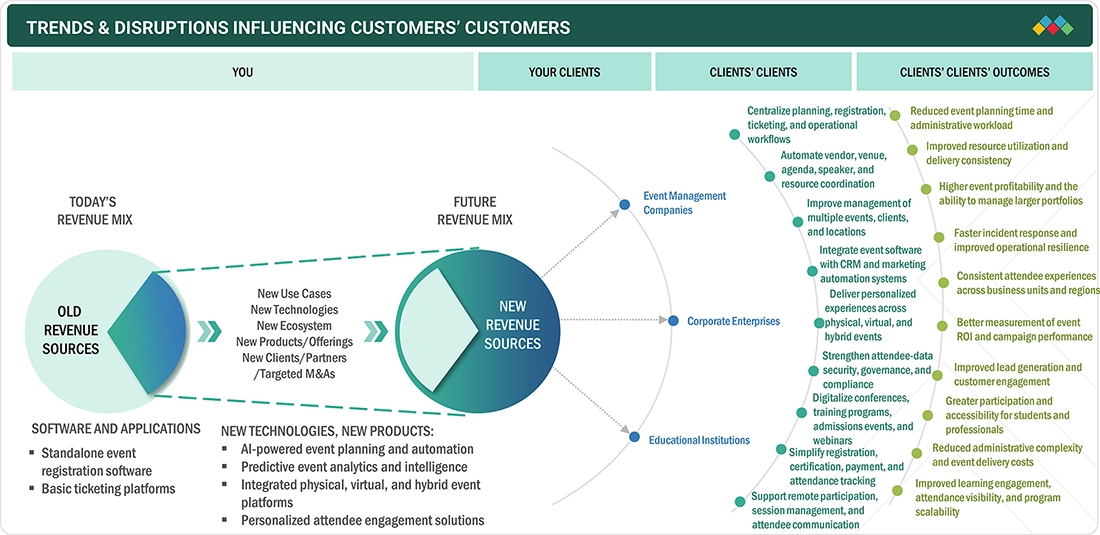
Source: Secondary Research, Interviews with Experts, MarketsandMarkets Analysis
MARKET DYNAMICS

Level
-
Shift from fragmented tools to unified event platforms

-
Increasing enterprise investment in customer and employee events


Level
-
Dependence on third-party platform integrations

-
Lengthy enterprise sales and deployment cycles


Level
-
AI-powered event orchestration and predictive intelligence

-
Integration with CRM and marketing automation ecosystems


Level
-
Differentiating offerings in a crowded vendor landscape

-
Supporting large-scale events without performance disruption

Source: Secondary Research, Interviews with Experts, MarketsandMarkets Analysis
Driver: Shift from fragmented tools to unified event platforms
Enterprises have traditionally used separate tools for event planning, registration, email marketing, virtual delivery, mobile engagement, onsite check-in, and post-event reporting. This fragmented structure creates duplicate data, disconnected attendee journeys, and limited visibility into event performance. As corporate event portfolios expand, buyers are increasingly consolidating in-person, virtual, webinar, and hybrid workflows onto fewer platforms. Cvent reported that 59% of planners expected an increase in onsite events and 60% anticipated more offsite events in 2025, increasing the operational workload handled by event teams. This is expected to drive the event management software market by encouraging vendors to provide integrated platforms that connect planning, marketing, engagement, onsite execution, and analytics. Vendors offering unified data models and end-to-end workflow management can capture larger enterprise contracts and expand revenue across multiple event use cases.
Restraint: Dependence on third-party platform integrations
Event management software must exchange data with CRM, marketing automation, payment, finance, webinar, travel, identity management, and business intelligence systems. Differences in APIs, data formats, security requirements, and update schedules can make these integrations costly to develop and maintain. MuleSoft reported that the average enterprise operates nearly 1,000 applications, but only 28% are integrated, illustrating the broader connectivity challenge faced by enterprise software providers. Integration failures can cause inaccurate attendee records, delayed lead transfers, payment reconciliation problems, and incomplete ROI reporting. Consequently, event management software vendors must invest continuously in connectors, API management, testing, and partner ecosystems. Smaller vendors may struggle to support the extensive integration requirements of large enterprises, slowing deployments and limiting their ability to compete for complex, high-value contracts in the event management software market.
Opportunity: AI-powered event orchestration and predictive intelligence
AI creates an opportunity for event management software vendors to move beyond workflow digitization and support event-related decisions. Platforms can use AI to generate agendas and marketing content, recommend sessions, match attendees, identify registration risks, forecast attendance, summarize feedback, and recommend follow-up actions. More than 90% of meeting planners surveyed by PCMA were using AI in some part of event planning in 2025, indicating strong user readiness, although adoption remains concentrated in basic productivity tasks. Vendors can monetize this opportunity by embedding specialized AI assistants into planning, marketing, engagement, and analytics modules rather than offering generic content-generation tools. AI-powered orchestration can increase platform usage across the event lifecycle, strengthen customer retention, and support premium subscription tiers. It also enables event management software providers to differentiate through proprietary event data, predictive models, and role-specific recommendations.
Challenge: Differentiating offerings in a crowded vendor landscape
The event management software market includes comprehensive enterprise platforms, registration and ticketing providers, virtual-event platforms, mobile engagement vendors, and specialized tools for specific event formats. Buyers can compare platforms such as Cvent, Bizzabo, Swoogo, Whova, vFairs, Eventbrite, Splash, and SpotMe, while many vendors offer increasingly similar capabilities across registration, mobile applications, networking, onsite check-in, and analytics. This feature convergence makes it difficult for vendors to establish clear differentiation and can shift purchasing decisions toward pricing, existing integrations, implementation support, and brand recognition. To protect market share and subscription margins, vendors must develop stronger differentiation through industry-specific workflows, measurable event ROI, AI-enabled intelligence, scalable onsite capabilities, and integrated attendee data. Vendors unable to demonstrate distinctive business outcomes may face longer sales cycles, higher customer-acquisition costs, and increased competitive pricing pressure.
EVENT MANAGEMENT SOFTWARE MARKET: COMMERCIAL USE CASES ACROSS INDUSTRIES
| COMPANY | USE CASE DESCRIPTION | BENEFITS |
|---|---|---|
 |
Cvent and Capital Group centralized and scaled the company’s global meetings and events program through an integrated event management platform covering registration, attendee engagement, venue sourcing, onsite management, workflow automation, and reporting. | Executed 3 times more events | Increased client engagement through events by 30 times | Reduced average event cost by 66% | Established a unified source of attendee and event data | Automated venue sourcing, registration, badge printing, attendance tracking, and reporting processes. |
 |
Bizzabo and Experity planned, executed, and measured the company’s inaugural two-day Urgent Care Connect healthcare conference using Bizzabo’s Event Experience OS, registration, onsite management, and reporting capabilities. | Generated 19 times ROI from the event | Influenced USD 9 million in sales pipeline | Generated USD 5.4 million in post-event pipeline | Increased the closed/won rate by 30% | Generated USD 80,000 in sponsorship revenue | Hosted 365 attendees. |
 |
RainFocus and Ellucian enhanced the Ellucian Live conference through a mobile event application, integrated attendee agendas, session catalogs, surveys, meeting scheduling, and chat-based networking capabilities. | Achieved 87.6% mobile application adoption among attendees | Increased the odds of attendees registering for meetings by 231% | Increased the likelihood of attendees attending meetings by 134% | Improved session participation and networking | Increased sponsorship and exhibitor engagement value |
 |
vFairs and Semex transformed the company’s annual distributor and seller conference into an interactive global virtual event featuring customized virtual spaces, exhibitor booths, live sessions, chatrooms, networking, and single sign-on registration. | Increased attendance from approximately 150 to 500 participants | Expanded the event’s geographic reach to global distributors and partners | Delivered a stronger and more engaging sales message | Enabled attendees to access recorded sessions conveniently | Improved international networking and knowledge exchange. |
Logos and trademarks shown above are the property of their respective owners. Their use here is for informational and illustrative purposes only.
MARKET ECOSYSTEM
The event management software ecosystem comprises a broad range of interconnected software categories that support the complete event lifecycle. It includes event planning & operations software, registration & ticketing software, event marketing software, attendee engagement & networking software, onsite event management software, and analytics & event intelligence software. The ecosystem also covers integration & workflow automation, sponsor & exhibitor management, mobile event applications, payment processing, event websites, email campaigns, social media promotion, badge printing, attendance tracking, session scanning, live polling, community management, and revenue analytics. Together, these software solutions enable organizers to plan, promote, execute, monitor, and evaluate conferences, trade shows, corporate meetings, product launches, association events, government events, and entertainment and sports events across in-person, virtual, and hybrid formats.
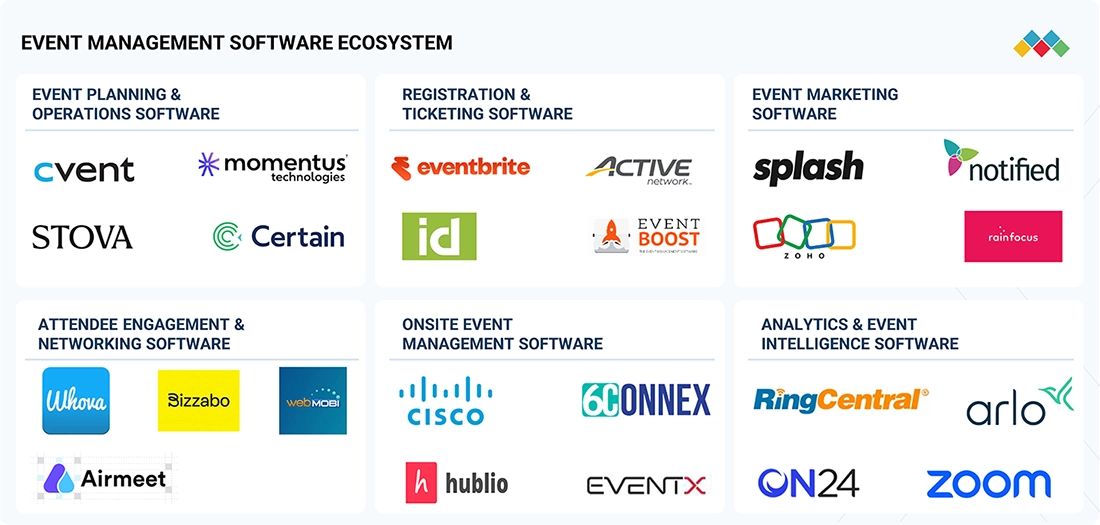
Logos and trademarks shown above are the property of their respective owners. Their use here is for informational and illustrative purposes only.
MARKET SEGMENTS
Source: Secondary Research, Interviews with Experts, MarketsandMarkets Analysis
Event Management Software Market, By Offering
The software segment will account for the largest market share of approximately 71.5% in 2025 in the event management software market. Organizations are investing in integrated platforms that combine event planning, registration, marketing, attendee engagement, onsite operations, payment processing, and post-event analytics. Cvent, for example, connects budgeting, venue sourcing, registration, event applications, check-in, networking, surveys, integrations, and attendee insights across the event lifecycle. The services segment is expected to grow at a comparatively higher CAGR of approximately 16.8% as enterprises require consulting, platform deployment, workflow configuration, integrations, technical support, and managed event operations for increasingly complex event portfolios.
Event Management Software Market, By Service
Professional services will account for approximately 74.0% of event management software service revenue in 2025, supported by demand for consulting, deployment & integration, and support & maintenance services. Large organizations commonly require integration with CRM, marketing automation, payment, finance, identity management, and business intelligence systems before platforms can be deployed across multiple business units. Managed services are expected to register the highest CAGR of approximately 18.1% during 2026–2031, as event organizers increasingly outsource platform administration, technical support, registration management, virtual-event production, onsite technology operations, and post-event reporting to reduce pressure on internal event teams.
Event Management Software Market, By Software
Event planning & operations software will hold the largest market share of approximately 27.8% in 2025, as planning, budgeting, venue and resource management, agenda development, and team collaboration form the operational foundation of most events. Registration & ticketing software will remain another major revenue contributor because it supports attendee data capture, payments, QR-code registration, and access management. However, analytics & event intelligence software is expected to register the highest CAGR of approximately 19.2% as organizers increase their focus on attendance, engagement, revenue, sponsor performance, and event ROI. Bizzabo supports lifecycle measurement through registration, session-attendance, mobile-app, networking, and real-time reporting data.
Event Management Software Market, By Deployment Type
Cloud deployment will account for approximately 78.5% of the event management software market in 2025 and is expected to register a CAGR of approximately 17.0% during 2026–2031. Cloud platforms allow organizers to configure events rapidly, support geographically distributed teams, scale registration capacity, provide mobile access, and deliver automatic feature upgrades without maintaining dedicated infrastructure. Subscription-based deployment also enables customers to add registration, marketing, engagement, onsite management, analytics, and integration capabilities as their event portfolios expand. Leading platforms including Cvent, Bizzabo, and RainFocus provide centralized environments for managing in-person, virtual, webinar, and hybrid event programs.
Event Management Software Market, By Organization Size
Large enterprises will hold the largest market share of approximately 63.8% in 2025, owing to their global event portfolios, higher technology budgets, complex approval structures, and need to integrate event data with enterprise CRM, marketing, sales, and finance systems. These organizations commonly manage conferences, customer events, sales kick-offs, employee meetings, product launches, webinars, and trade shows through centralized platforms. Small & medium-sized enterprises are expected to register the highest CAGR of approximately 17.1% as cloud subscriptions, configurable templates, self-service registration, automated communications, and simplified event-building tools lower implementation costs. Cvent Essentials, launched for high-volume and relatively simple in-person events, demonstrates the growing focus on streamlined event creation.
Event Management Software Market, By Event Type
Conferences will account for the largest market share of approximately 24.7% in 2025, as they require coordinated registration, multi-track agenda management, speaker workflows, attendee networking, mobile applications, sponsor management, onsite check-in, session scanning, and post-event analytics. Trade shows & exhibitions are expected to register the highest CAGR of approximately 17.3% during 2026–2031, supported by increasing demand for exhibitor management, lead retrieval, appointment scheduling, floor-plan management, badge printing, and sponsor ROI measurement. The recovery and expansion of physical meetings will reinforce software demand, with 59% of surveyed planners expecting more onsite events and 60% anticipating more offsite events in 2025.
REGION
North America to hold the largest market share in the global event management software market during the forecast period
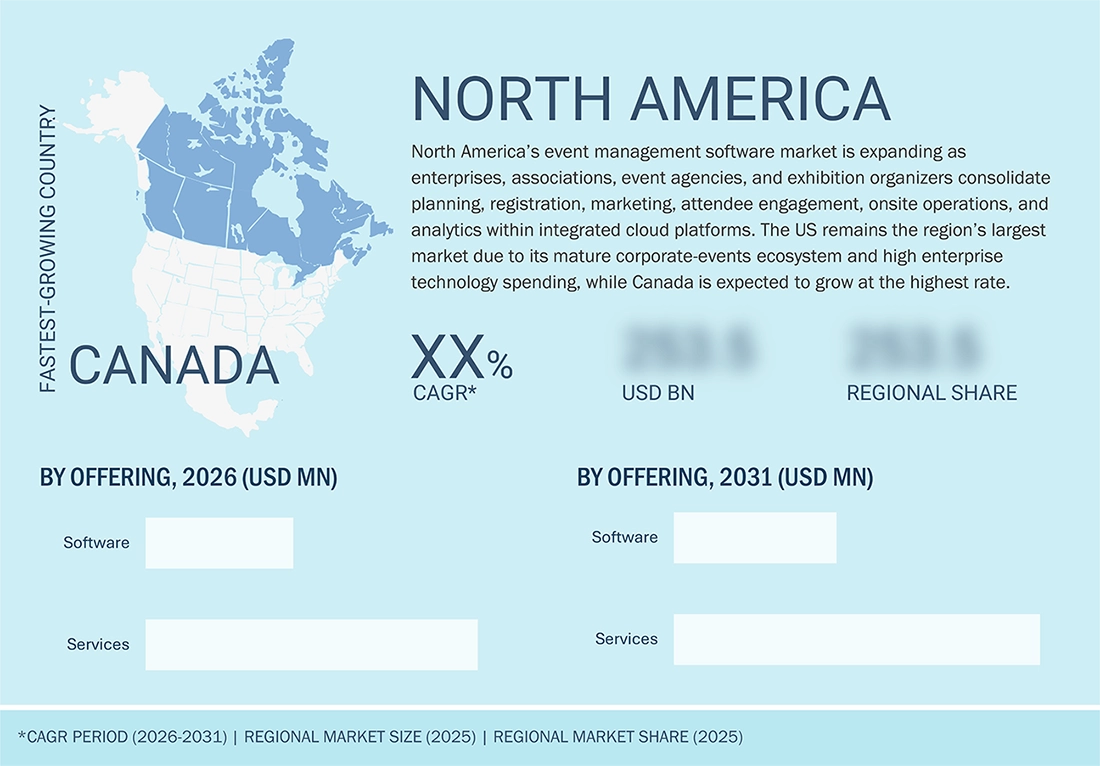
North America is expected to lead the event management software market in 2025. The US is estimated to account for the largest market share in North America in 2025 in the event management software market, and the trend is expected to continue until 2031. In the US region, event management software plays a pivotal role in revolutionizing the way events are planned, executed, and analyzed. These software platforms streamline various aspects of event management, including registration, ticketing, marketing, venue selection, scheduling, and attendee engagement. With the diverse range of events hosted across the country, from corporate conferences and trade shows to music festivals and sports events, event management software empowers organizers to coordinate logistics efficiently, engage attendees, and ensure the success of their events.
EVENT MANAGEMENT SOFTWARE MARKET: COMPANY EVALUATION MATRIX
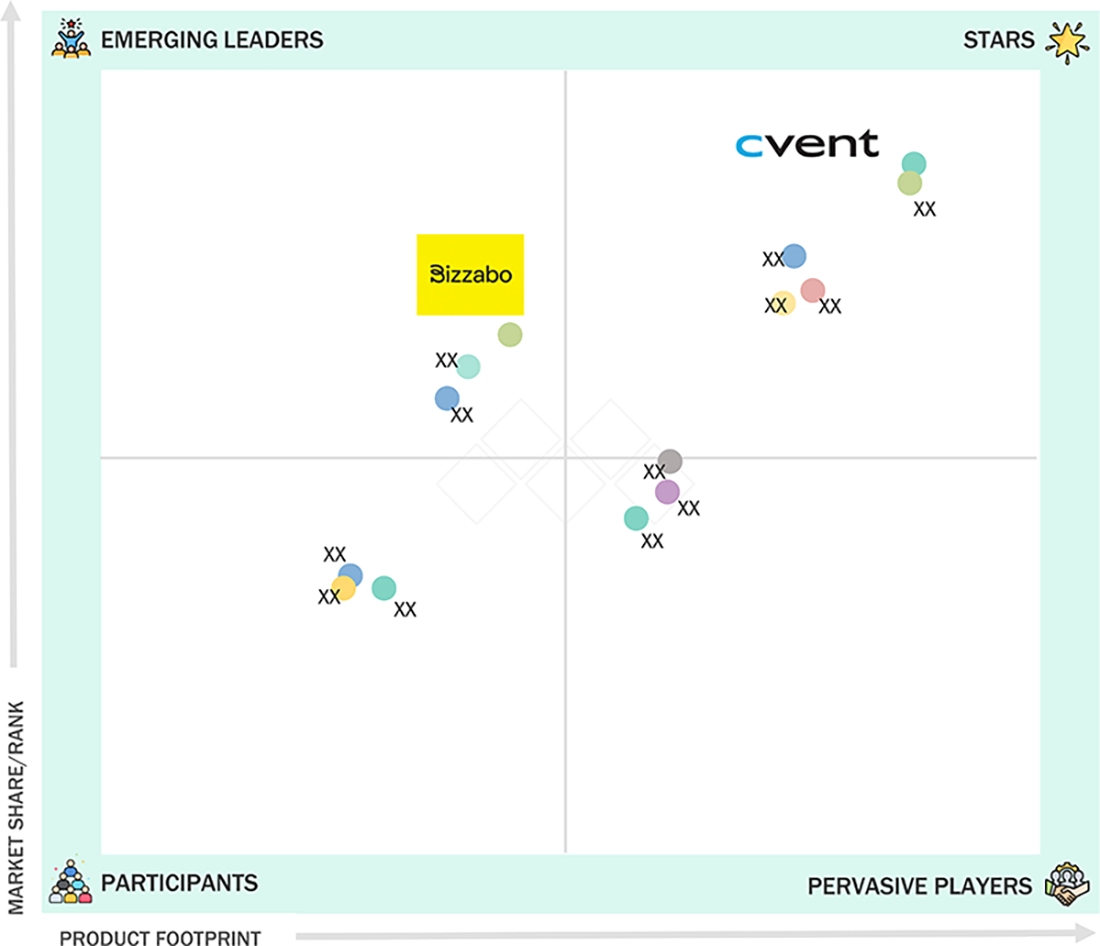
In the event management software market matrix, Cvent (Star) leads with a strong market share and extensive software footprint, supported by its integrated capabilities across event planning, registration, marketing, attendee engagement, venue sourcing, onsite management, and analytics. The company is further strengthening its position through CventIQ, which embeds AI-driven content creation, recommendations, workflow guidance, and event intelligence across its platform. Bizzabo (Emerging Leader) is expanding its market position through its AI-powered event platform, which combines registration, mobile attendee engagement, networking, onsite solutions, integrations, and event ROI analytics. Its increasing focus on personalized attendee experiences, first-party event data, and AI-assisted engagement supports its growing visibility among enterprises managing conferences and large-scale B2B events.
Source: Secondary Research, Interviews with Experts, MarketsandMarkets Analysis
KEY MARKET PLAYERS
MARKET SCOPE
| REPORT METRIC | DETAILS |
|---|---|
| Market Size in 2025 (Base Value) | USD 16.4 Billion |
| Market Forecast in 2026 (Value) | USD 18.6 Billion |
| Market Forecast in 2031 (value) | USD 36.8 Billion |
| Growth Rate | CAGR of 14.6% from 2026-2031 |
| Years Considered | 2021-2031 |
| Base Year | 2025 |
| Forecast Period | 2026-2031 |
| Units Considered | Value (USD Million/Billion) |
| Report Coverage | Revenue forecast, company ranking, competitive landscape, growth factors, and trends. |
| Segments Covered |
|
| Regions Covered | North America, Europe, Asia Pacific, Middle East & Africa, Latin America |
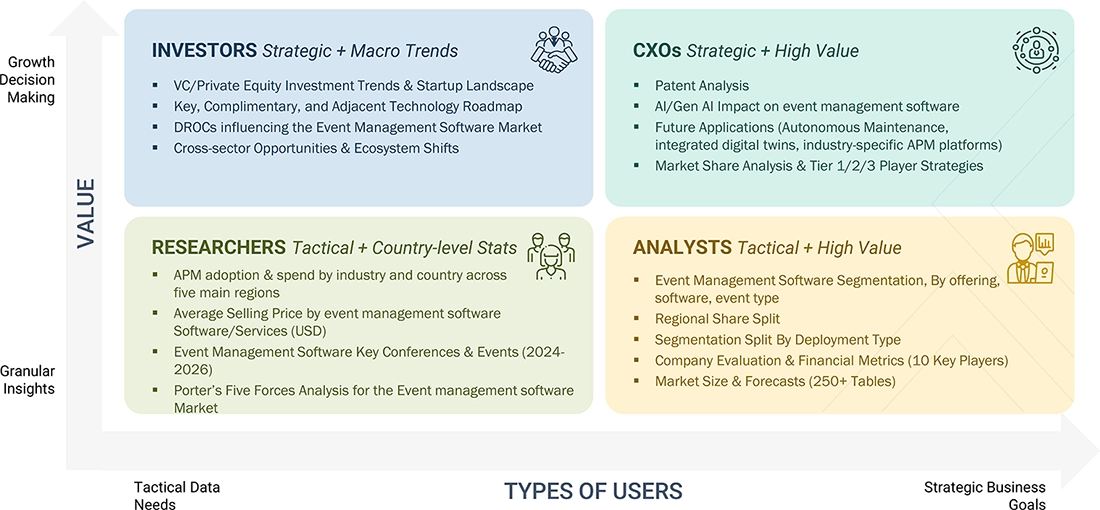
WHAT IS IN IT FOR YOU: EVENT MANAGEMENT SOFTWARE MARKET REPORT CONTENT GUIDE
DELIVERED CUSTOMIZATIONS
We have successfully delivered the following deep-dive customizations:
| CLIENT REQUEST | CUSTOMIZATION DELIVERED | VALUE ADDS |
|---|---|---|
| Corporate Enterprise—IT & Telecom Company (North America) | Enterprise Event Technology Assessment: Evaluation of software platforms across event planning, registration, marketing, mobile applications, onsite check-in, attendee engagement, analytics, and CRM integration. The customization also includes vendor benchmarking, deployment models, AI capabilities, pricing structures, and suitability for conferences, product launches, customer events, and internal meetings. | Identifies suitable integrated platform vendors, supports consolidation of fragmented event tools, improves attendee-data visibility, reduces manual event-management processes, strengthens CRM and marketing automation integration, and enables consistent event execution across business units. |
| Event Management Agency (Europe) | Event Management Software Vendor and Opportunity Mapping: Identification and profiling of software providers supporting conferences, exhibitions, corporate meetings, association events, and entertainment events. The assessment covers registration, ticketing, exhibitor management, networking, badge printing, session scanning, payment processing, mobile applications, and event intelligence capabilities. | Expands the qualified vendor pool, supports platform selection for different event formats, improves multi-client and multi-event management, identifies technology partnership opportunities, and enables the agency to provide more scalable, data-driven, and differentiated event services. |
RECENT DEVELOPMENTS
- July 2026 : RainFocus launched MCP Profiles as part of RainFocus Nexus, enabling authorized AI agents to securely access live event data through OAuth-based controls. The capability allows event teams to query session capacity, check attendee status, validate speaker or exhibitor data, and update event records using natural-language instructions. (RainFocus)
- June 2026 : RainFocus introduced upgrades to Base Webinar, integrating webinar engagement information into its Global Attendee Profile. The enhanced solution connects attendance duration, polling responses, intent signals, and other engagement data with Salesforce, Marketo, Eloqua, and HubSpot to unify virtual and in-person event intelligence. (RainFocus)
- March 2026 : Bizzabo introduced Bizzy, an AI attendee copilot embedded in its mobile event application. Bizzy provides real-time answers, personalized agenda and session guidance, venue navigation, speaker information, and networking recommendations while reducing repetitive attendee-support requests for event teams. (Bizzabo)
- January 2026 : RainFocus introduced RainFocus Nexus, a secure and cloud-agnostic system of specialized AI agents for event marketers, planners, and sales teams. The system combines orchestration, contextual intelligence, human oversight, and interoperability with enterprise technology environments to automate event configuration and decision-making workflows. (RainFocus)
- June 2025 : RainFocus launched its Base Module for managing small and repeatable events such as roadshows, sales activations, kickoffs, webinars, and field marketing programs. The module includes reusable templates, registration, agenda management, automated communications, branding, hotel management, governance, and marketing technology integrations. (RainFocus)
Table of Contents
 Exclusive indicates content/data unique to MarketsandMarkets and not available with any competitors.
Methodology
This research study on the event management software market involved extensive secondary sources, directories, IEEE Communication-Efficient: Algorithms and Systems, International Journal of Innovation and Technology Management, and paid databases. Primary sources were mainly industry experts from the core and related industries, preferred event management software providers, third-party service providers, consulting service providers, end users, and other commercial enterprises. In-depth interviews with primary respondents, including key industry participants and subject matter experts, were conducted to obtain and verify critical qualitative and quantitative information and assess the market’s prospects.
Secondary Research
In the secondary research process, various sources were referred to identify and collect information for this study. Secondary sources included annual reports, press releases, and investor presentations of companies; white papers, journals, and certified publications; and articles from recognized authors, directories, and databases. The data was also collected from other secondary sources, such as journals, government websites, blogs, and vendors’ websites. Additionally, the event management software spending of various countries was extracted from the respective sources.
Primary Research
In the primary research process, various sources from the supply and demand sides were interviewed to obtain qualitative and quantitative information on the market. The primary sources from the supply side included various industry experts, such as Chief Experience Officers (CXOs), Vice Presidents (VPs), and directors specializing in business development, marketing, and event management software service providers. It also included key executives from event management software vendors, system integrators (SIs), professional service providers, industry associations, and other key opinion leaders.
Breakup of primary profiles:
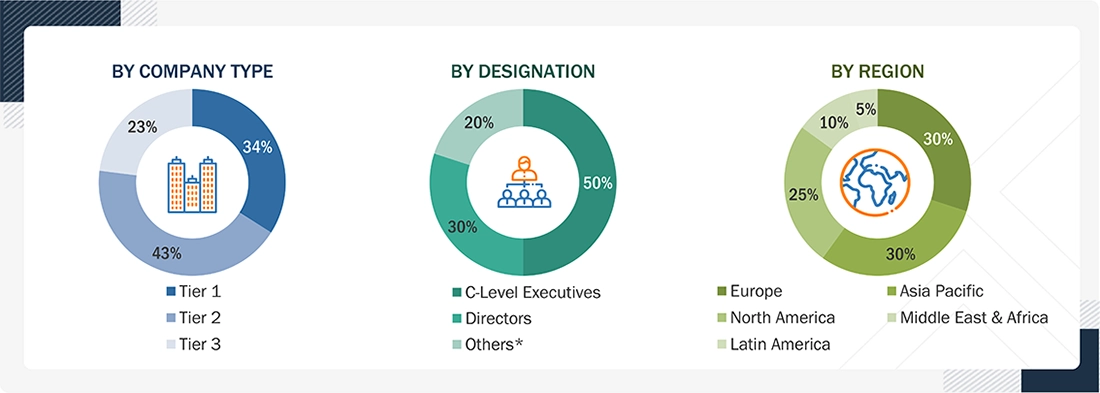
Note: Tier 1 companies’ revenues are more than USD 10 billion; tier 2 companies’ revenues range between USD 1 and 10 billion; and tier 3 companies’ revenues range between USD 500 million and USD 1 billion. Other designations include sales managers, marketing managers, and product managers.
Source: Industry Experts
To know about the assumptions considered for the study, download the pdf brochure
Market Size Estimation
Multiple approaches were adopted to estimate and forecast the event management software market. The first approach involved estimating the market size by companies’ revenue generated through the sale of event management software products.
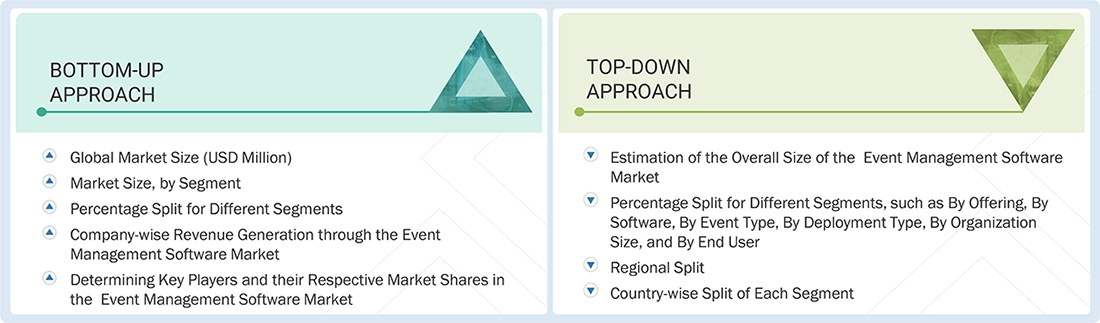
Market Size Estimation Methodology: Top-down Approach
The top-down approach prepared an exhaustive list of all the vendors offering products in the event management software market. The revenue contribution of the market vendors was estimated through annual reports, press releases, funding, investor presentations, paid databases, and primary interviews. Each vendor’s offerings were evaluated based on platform, degree of customization, type, application, end user, and region. The markets were triangulated through primary and secondary research. The primary procedure included extensive interviews for key insights from industry leaders, such as CIOs, CEOs, VPs, directors, and marketing executives. The market numbers were further triangulated with the existing MarketsandMarkets’ repository for validation.
Market Size Estimation Methodology: Bottom-up Approach
The bottom-up approach identified the adoption rate of the event management software products among different verticals in key countries, considering their regions contributing the most to the market share. For cross-validation, the adoption of event management software products among enterprises and other use cases for their regions was identified and extrapolated. Use cases identified in different areas were weighed for the market size calculation.
Based on the market numbers, the regional split was determined by primary and secondary sources. The procedure included an analysis of the event management software market’s regional penetration. Based on secondary research, the regional spending on Information and Communications Technology (ICT), socioeconomic analysis of each country, strategic vendor analysis of major event management software service providers, and organic and inorganic business development activities of regional and global players were estimated.
Event Management Software Market : Top-Down and Bottom-Up Approach
Data Triangulation
After determining the overall market size using the market size estimation processes as explained above, the market was split into several segments and subsegments. Data triangulation and market breakup procedures were employed, wherever applicable, to complete the overall market engineering process and arrive at the exact statistics of each market segment and subsegment. The overall market size was then used in the top-down procedure to estimate the size of other individual markets via percentage splits of the market segmentation.
Market Definition
The event management software market comprises digital platforms, tools, and services that enable organizations to plan, promote, execute, and analyze events across in-person, virtual, and hybrid formats. The market includes solutions for event planning and operations, registration and ticketing, event marketing, attendee engagement and networking, onsite event management, and analytics and event intelligence, powered by technologies such as artificial intelligence, cloud computing, mobile applications, and data analytics. These platforms facilitate end-to-end event workflows through centralized registration, automated marketing campaigns, mobile event apps, and real-time engagement tools, creating measurable marketing return for event organizers and enhancing attendee participation across corporate, association, and public sector events.
Key Stakeholders
- Event Management Software Vendors
- Event Management Companies & Agencies
- Corporate Enterprises & Marketing Teams
- Professional Conference Organizers
- Exhibition & Trade Show Organizers
- Associations & Non-Profit Organizations
- Education Institutions
- Government Bodies & Public Sector Agencies
- System Integrators & Consulting Firms
- Cloud & Infrastructure Providers
- Payment Gateway & Ticketing Partners
- CRM & Marketing Automation Providers
- Venue Owners & Hospitality Providers
Report Objectives
- To define, describe, and forecast the event management software market based on offering, software, event type, technology, organization size, end user, and region,
- To forecast the market size of the five major regional segments: North America, Europe, Asia Pacific, the Middle East & Africa, and Latin America
- To strategically analyze the market subsegments with respect to individual growth trends, prospects, and contributions to the total market
- To provide detailed information related to the major factors influencing market growth (drivers, restraints, opportunities, and challenges)
- To strategically analyze macro and micro markets with respect to growth trends, prospects, and their contribution to the overall market
- To analyze industry trends, patents and innovations, and pricing data related to the market
- To analyze the opportunities in the market for stakeholders and provide details of the competitive landscape for major players
- To profile key players in the market and comprehensively analyze their market share/ranking and core competencies
- To track and analyze competitive developments, such as mergers & acquisitions, product developments, and partnerships & collaborations in the market
Available customizations:
With the given market data, MarketsandMarkets offers customizations as per the company’s specific needs. The following customization options are available for the report:
Product Analysis
- The product matrix provides a detailed comparison of the product portfolio of each company.
Regional Analysis
- Further breakup of the North American event management software market
- Further breakup of the European event management software market
- Further breakup of the Asia Pacific event management software market
- Further breakup of the Middle East & African event management software market
- Further breakup of the Latin American event management software market
Company Information
- Detailed analysis and profiling of additional market players (up to five)
Key Questions Addressed by the Report
What is the projected size of the Event Management Software Market by 2031?
The Event Management Software market is projected to grow from USD 18.6 billion in 2026 to USD 36.8 billion by 2031, at a CAGR of 14.6% during the forecast period.
Which software segment holds the largest share of the Event Management Software Market?
Event Planning & Operations Software is expected to account for the largest market share in 2025.
Which deployment type dominates the Event Management Software Market?
Cloud deployment is expected to hold the largest market share, accounting for approximately 78.5% in 2025.
Which event type holds the largest share of the Event Management Software Market?
Conferences are expected to account for the largest market share, representing approximately 24.7% in 2025.
Which end-user segment leads the Event Management Software Market?
Corporate enterprises are expected to account for the largest market share, representing approximately 46.2% in 2025.
Which technology is expected to grow the fastest in the Event Management Software Market?
AI-enabled event management software is expected to register the highest growth during the forecast period.


Personalize This Research
- Triangulate with your Own Data
- Get Data as per your Format and Definition
- Gain a Deeper Dive on a Specific Application, Geography, Customer or Competitor
- Any level of Personalization
Let Us Help You
- What are the Known and Unknown Adjacencies Impacting the Event Management Software Market
- What will your New Revenue Sources be?
- Who will be your Top Customer; what will make them switch?
- Defend your Market Share or Win Competitors
- Get a Scorecard for Target Partners

Custom Market Research Services
We Will Customise The Research For You, In Case The Report Listed Above Does Not Meet With Your Requirements
Get 10% Free CustomisationTESTIMONIALS
- US Event Management Software Market
- Canada Event Management Software Market
- UK Event Management Software Market
- Germany Event Management Software Market
- France Event Management Software Market
- Italy Event Management Software Market
- China Event Management Software Market
- India Event Management Software Market
- Japan Event Management Software Market
- South Korea Event Management Software Market
- Brazil Event Management Software Market
- Mexico Event Management Software Market
- UAE Event Management Software Market
- South Africa Event Management Software Market
- Rest Of Europe Event Management Software Market
- Rest Of Asia Pacific Event Management Software Market
- Rest Of Latin America Event Management Software Market
- GCC Event Management Software Market
- Ksa Event Management Software Market
- Other GCC Countries Event Management Software Market






Growth opportunities and latent adjacency in Event Management Software Market