



Fire-resistant Fabrics Market
Report Code
CH 3366
Published in
Jun, 2025, By MarketsandMarkets™
Fire-resistant Fabrics Market by Type (Treated and Inherent), Application (Apparel and Non-apparel), End-use Industry (Industrial, Defense & Public Safety Services, and Transport), Region - Global Forecast to 2030

USD 5.65 BN
MARKET SIZE, 2030

CAGR 7.24%
(2025-2030)

256
REPORT PAGES

320
MARKET TABLES
FIRE-RESISTANT FABRICS MARKET SIZE & SHARE
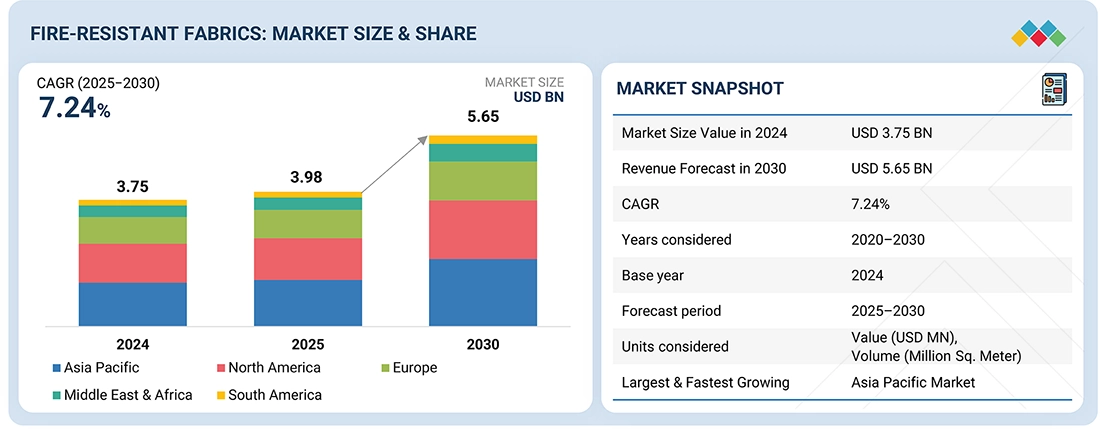
Source: Secondary Research, Interviews with Experts, MarketsandMarkets Analysis | Updated on : April 29, 2026
The fire-resistant fabrics market is estimated to grow from USD 3.75 billion in 2024 to USD 5.65 billion by 2030, at a CAGR of 7.24%. The fire-resistant fabrics market size is increasing due to the rising trend of heightened safety regulations and the expansion of high-risk industries such as the industrial sector, defense, public safety services, and transport, among others. As companies emphasize workforce safety and regulatory compliance, the demand for advanced fire-resistant fabrics is constantly growing in emerging as well as developed markets.
KEY TAKEAWAYS
-
BY TYPEThe fire-resistant fabrics market is segmented into treated and inherent fire-resistant fabrics. Among these, the treated fire-resistant fabric segment accounted for the larger market share, in terms of value, in 2024 and continues to dominate the market during the forecast period. Its cost-effectiveness, ease of processing, and broad application across diverse industrial sectors are the main factors driving this supremacy.
-
BY APPLICATIONThe fire-resistant fabrics market is segmented into apparel and non-apparel applications. Among these, the apparel segment accounted for the larger market share, in terms of value, in 2024 and will continue to dominate the market during the forecast period. This leadership is driven by strong demand from industries such as defense & public safety services, oil & gas, and electrical utilities, where flame-resistant protective clothing is mandated for worker safety.
-
BY END-USE INDUSTRYThe fire-resistant fabrics market is segmented into industrial, defense & public safety services, transport, and other end-use industries. The industrial sector, including construction, manufacturing, oil & gas, and metal production, is the largest end-user of fire-resistant fabrics. This supremacy is mainly led by the high-risk nature of manufacturing operations, where workers are routinely exposed to fires and extreme temperatures. Strict regulatory standards, rising focus on worker safety, and operational continuity further contribute to sustained demand for fire-resistant fabrics in this sector.
-
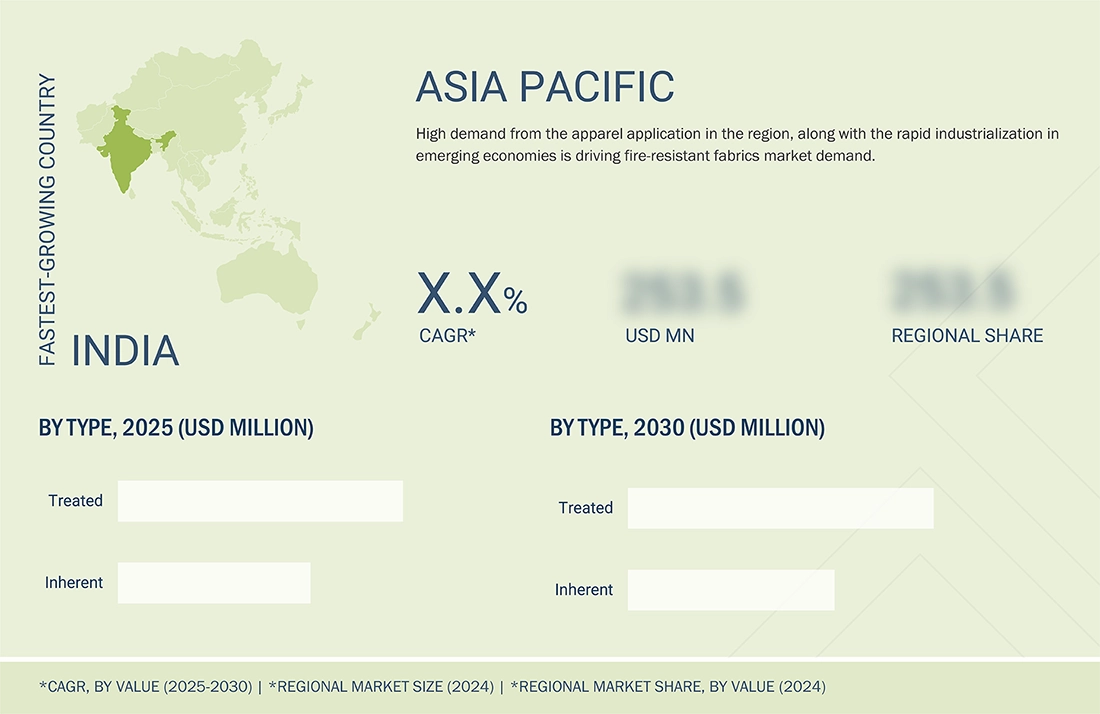
BY REGIONAsia Pacific is the largest market for fire-resistant fabrics and is projected to register the highest CAGR of 7.63% in terms of value during the forecast period. This growth is primarily fueled by the strict occupational safety regulations, high consciousness of workplace safety standards, and high demand from industrial sectors, defense & public safety services, and transport.
-
COMPETITIVE LANDSCAPELeading market participants focus on innovation, sustainable product offerings, and strategic partnerships, including collaborations, acquisitions, and product launches. Major players such asDuPont de Nemours, Inc., Teijin Limited, Indorama Ventures Public Company Limited, Syensqo SA/NV , and TenCate Protective Fabrics, are expanding their portfolio of fire-resisance fabrics to meet growing demand for high-performance, eco-friendly packaging solutions across apparel and non-apparel applications.
Fire-resistant fabrics are designed to resist fire initiation, slow the progress of flames, and mitigate the severity of burns, and thus play a valuable role in manufacturing, oil & gas, defense & public safety services, and transport. As regulatory standards become more stringent and workplace safety awareness spreads across the world, organizations are increasingly looking to deploy certified high-performance fire-resistant fabrics to ensure operational safety and compliance.
TRENDS & DISRUPTIONS IMPACTING CUSTOMERS' CUSTOMERS
The impact on consumers’ business emerges from changing safety standards and industry-specific disruptions. Fire-resistant fabric consumers include industrial apparel producers, defense & safety services, and transportation OEMs, which use these fabrics in protective clothing, seat covers, and interior applications. Shifts such as stricter occupational safety regulations, increased infrastructure development, and rising sustainability requirements influence the operational costs and compliance priorities of these end users. Changes in these downstream industries directly impact the demand, procurement volumes, and revenue patterns of fabric consumers, which subsequently affect the sales and growth prospects of fire-resistant fabric suppliers.
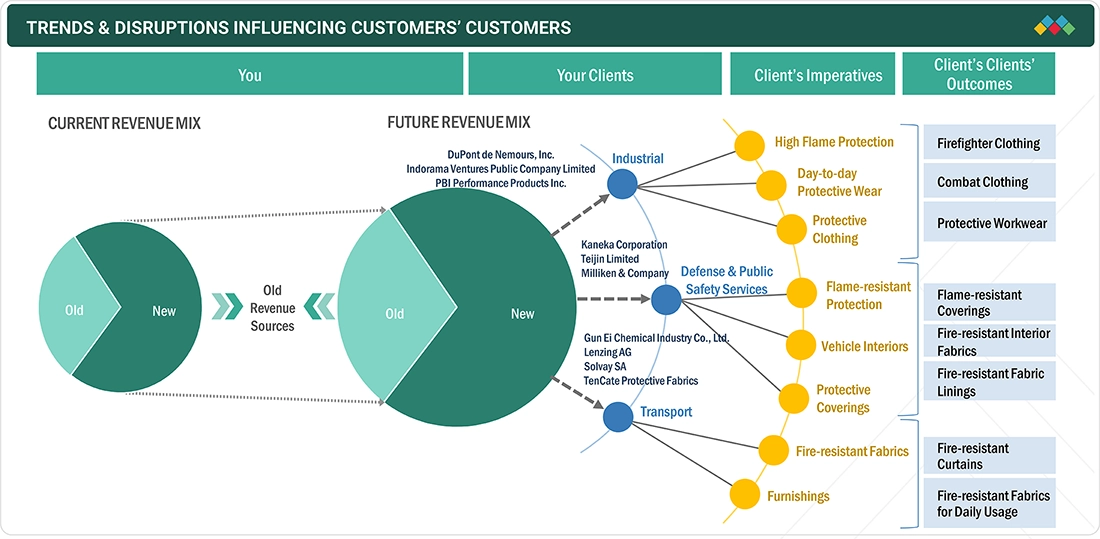
Source: Secondary Research, Interviews with Experts, MarketsandMarkets Analysis
MARKET DYNAMICS

Drivers
Impact
Level
Level
-
Stringent workplace safety regulations in developed countries

-
Increasing use of fire-resistant fabrics in oil & gas industry


RESTRAINTS
Impact
Level
Level
-
High cost of production and huge investment in R&D

-
Lack of safety regulations in developing regions


OPPORTUNITIES
Impact
Level
Level
-
Technological innovations in product development


CHALLENGES
Impact
Level
Level
-
Fluctuating raw material costs

Source: Secondary Research, Interviews with Experts, MarketsandMarkets Analysis
Driver: Stringent workplace safety regulations in developed countries
The market for fire-resistant fabrics has been significantly impacted by strict workplace safety standards in developed nations. These rules are intended to protect employees from the risks of fire-related incidents in diverse sectors, including construction, manufacturing, oil & gas, and defense & public safety services. Fire-resistant clothing has a very important function of keeping workers safe by protecting them with clothing that is resistant to heat and prevents burns. Safety policies in the workplace are enforced more strictly in developed economies than they are in developing economies. These policies aim to reduce the number of accidents and injuries in the workplace, including fire accidents. They generally set out conditions that employers must comply with, including the issuance of suitable PPE to workers.
Restraints: High cost of production and huge investment in R&D
The high cost of production of fire-resistant fabrics is one of the major restraints that affect the growth of the market. The high cost of raw materials and advanced processes involved in the production of these fabrics increases the production cost. The complexity of the production technology and the high R&D costs put pressure on fire-resistant fabric manufacturers. Fluctuation in energy prices also has an impact on the cost of fire-resistant fabrics. Thus, increasing prices of raw materials, energy, weaving technology, and transportation have a direct and substantial impact on the cost of fire-resistant fabrics.
Opportunities: Technological innovations in product development
The current market is concentrated on fire-resistant fabrics that are cost-effective and meet the minimum standards or regulations mandated in a specific region. With the changing nature of end-use applications, customers demand more functions apart from fire resistance. Customers are becoming more focused on multifunctional fire-resistant protective clothing that serves more than one function. Generally, fire-resistant clothing is fire-resistant but may not provide adequate (or any) protection against mechanical hazards. However, industries such as oil & gas and chemicals may pose multiple hazards to workers. In such situations, workers and operators need multifunctional protective clothing. Changing environments in the defense sector also demand additional comfort in protective suits in terms of increased flexibility, reduced weight, and incorporation of cooling technologies such as phase-change materials (PCM) in suits.
Challenges: Fluctuating raw material costs
The volatile raw material prices are a major challenge to the industry players in the fire-resistant fabrics market. It has the potential to affect different facets of the industry, from the cost of production to pricing strategy, profitability, and competitiveness. This could result in increased manufacturing costs, which could eventually affect the end price of fire-resistant textiles. If raw material prices increase considerably, manufacturers may not be able to sustain competitive pricing, and demand for their products could decrease. Second, the volatility of raw material prices makes it difficult for firms to plan and budget. The volatility of raw material prices can affect long-term planning and strategic planning since companies may not be able to forecast and respond to sudden changes in raw material prices.
Fire-resistant Fabrics Market: COMMERCIAL USE CASES ACROSS INDUSTRIES
| COMPANY | USE CASE DESCRIPTION | BENEFITS |
|---|---|---|
 |
Inherently flame- and heat-resistant aramid fabrics for industrial FR workwear, oil and gas, transportation, and firefighter gear where protection must not wash out | Won’t melt or drip, maintains FR for life of the garment, and delivers long wear life versus FRT cotton due to superior durability and tear resistance |
 |
Westex DH and UltraSoft fabrics for arc-flash and flash-fire garments with breathability and moisture management for comfort-critical daily wear | Certified to NFPA 2112/NFPA 70E with guaranteed flame resistance for the life of the garment and proven arc-flash performance in Westex programs |
 |
Cellulosic-origin FR fibers used in multilayer firefighter, military, oil and gas, and metal industry PPE to add comfort and moisture management in blends | Layered systems with LENZING FR can reduce second/third-degree burns versus conventional garments while lowering heat stress through superior moisture transport |
 |
Meta-aramid fibers for protective clothing across high-heat environments requiring materials that resist melting and sticking with >400°C heat resistance | High flame and chemical resistance with low thermal conductivity, enabling lighter garments via high tenacity while maintaining thermal protection |
Logos and trademarks shown above are the property of their respective owners. Their use here is for informational and illustrative purposes only.
MARKET ECOSYSTEM
The fire-resistant fabrics ecosystem comprises raw material suppliers, fabric manufacturers, distributors, and end users. Suppliers provide flame-retardant chemicals, fibers, yarns, and textile finishes to manufacturers, who process them through weaving, coating, and lamination technologies to produce fabrics with enhanced fire resistance, durability, and comfort. Distributors connect manufacturers with industrial safety, defense, oil & gas, transportation, and construction sectors, ensuring steady supply, quality standards, and regulatory compliance. End users utilize these fabrics in protective apparel, uniforms, furnishings, and automotive interiors, creating a connected value chain driven by safety regulations, technological innovation, and sustainability requirements.
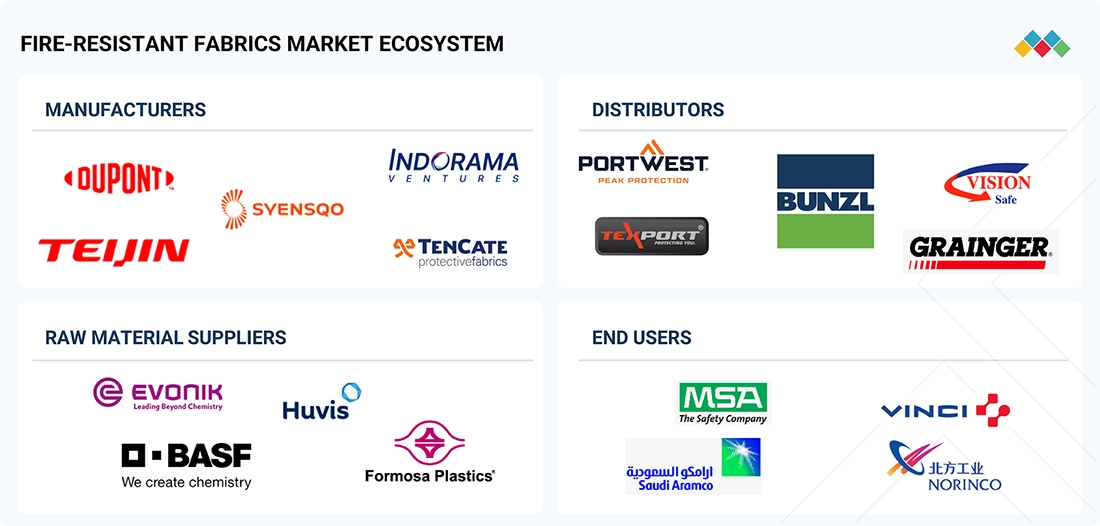
Logos and trademarks shown above are the property of their respective owners. Their use here is for informational and illustrative purposes only.
MARKET SEGMENTS
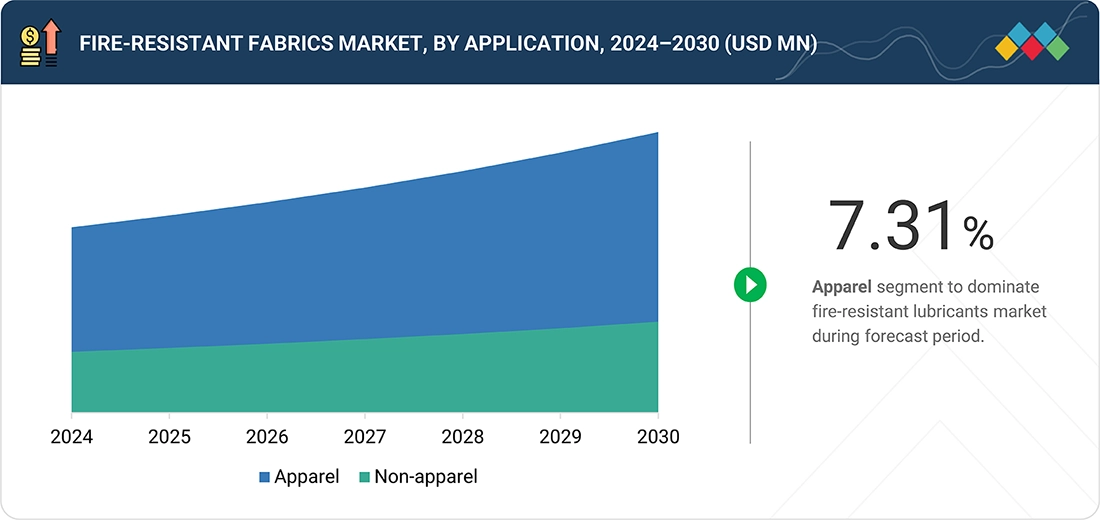
Source: Secondary Research, Interviews with Experts, MarketsandMarkets Analysis
Fire-Resistant Fabric Market, By Type
The inherent fire-resistant fabrics segment is projected to be the fastest-growing type in the global fire-resistant fabrics market in terms of value during the forecast period. The need for long-lasting, high-performing protective fabrics in sectors like emergency services, oil & gas, utilities, defense & public safety services, and aerospace is the main factor driving market growth. Unlike treated fabrics, inherent fire-resistant fabrics feature built-in flame resistance at the fiber level that does not deteriorate with time or repeated washings, making them a preferred choice for long-term use and critical safety applications. Because of their improved thermal stability, lightweight design, increased comfort, and longer lifespan, industries are gradually shifting to inherent fire-resistant fabrics.
Fire-Resistant Fabric Market, By Application
The apparel application held the largest share of the global fire-resistant fabrics market in terms of value due to the increasing demand for protective gear in high-risk industries such as industrial production, defense, firefighting, oil & gas, and utilities. Fire-resistant apparel is critical in environments where workers are exposed to heat, flames, arc flashes, and molten metal splashes. Increasing regulatory enforcement of occupational safety standards by organizations such as OSHA, NFPA, and ISO has significantly influenced the adoption of flame-retardant clothing, especially in North America, Europe, and the Asia Pacific.
Fire-Resistant Fabric Market, By End-Use
The industrial sector held the largest share of the global fire-resistant fabrics market, in terms of value, in 2024. This is mainly due to the high risk of operation in the industry, where open flames and high temperatures heavily raise the risk of accidents and workforce injuries. Industries such as oil & gas, metal processing, chemicals, electrical utility, and manufacturing that operate in conditions where fire risk, arc flash, and high temperature are the real concerns, which make flame-resistant apparel and protective equipment crucial. The rising number of industrial accidents has compelled the governing agencies of major economies to introduce regulations for the application of certified fire-retardant fabrics, further bolstering the demand.
REGION
Asia Pacific to be largest & fastest-growing region in global fire-resistat fabrics market during forecast period
Asia Pacific was the largest market for fire-resistant fabrics, in terms of value, in 2024, boosted by high demand in industrial, defense & public safety services, and transport industries. The dominance of the region is largely due to industrialization, workplace safety laws, and the rise of manufacturing and infrastructure development. China held the largest market share within the region due to its massive capacity for production, growing investment in protective clothing, and government regulations for fire safety compliance in oil & gas, construction, railways, and public infrastructure industries.
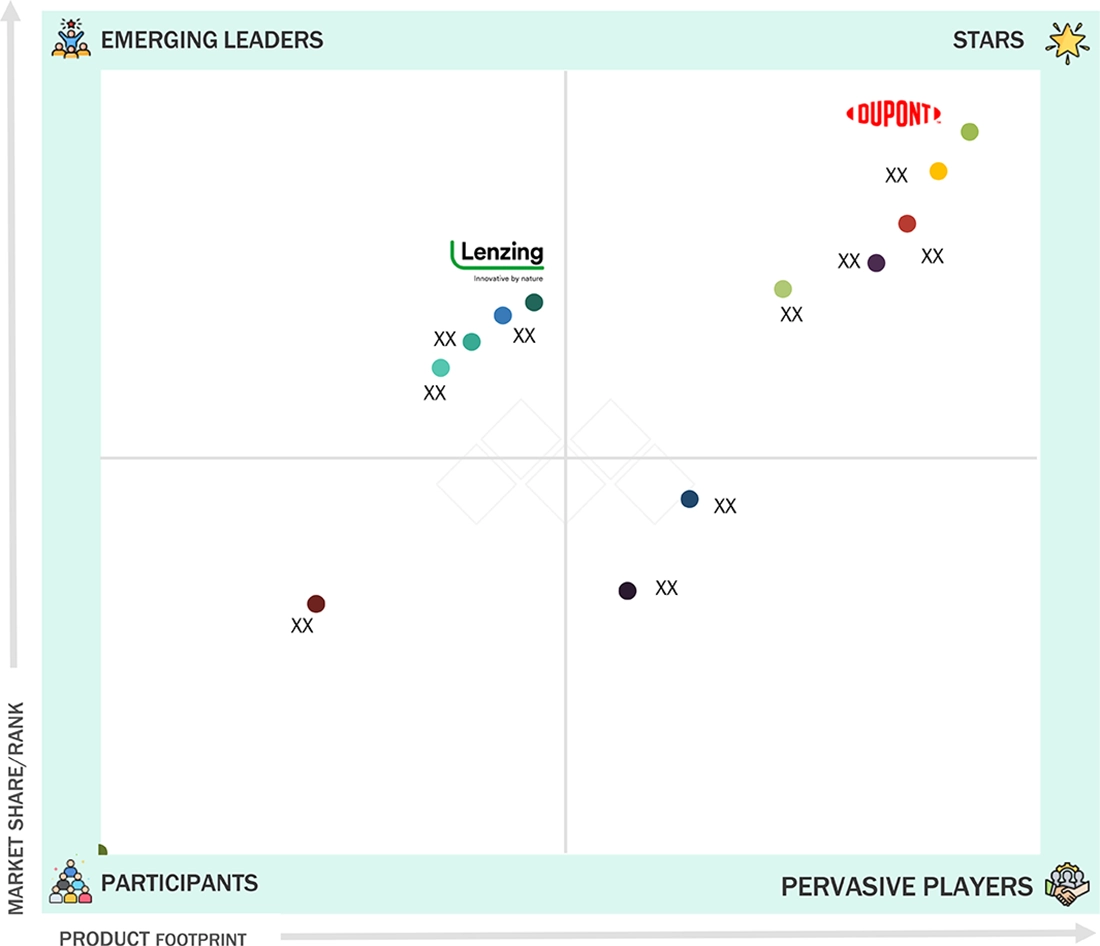
Fire-resistant Fabrics Market: COMPANY EVALUATION MATRIX
In the fire-resistant fabrics market, DuPont leads with a strong global footprint and a pioneering portfolio of advanced flame-retardant fibers and fabrics, including Nomex, Kevlar, and Tychem. The company’s focus on thermal protection, durability, and comfort, combined with its commitment to sustainability and innovation, has positioned it as a trusted partner across critical industries such as industrial safety, defense, firefighting, and oil & gas. DuPont’s continuous R&D advancements in meta-aramid and para-aramid technologies, along with its efforts to develop lightweight, breathable, and recyclable protective fabrics, enable superior performance while meeting stringent international safety standards. Its strategic collaborations with apparel manufacturers, OEMs, and safety gear providers strengthen its market reach and application diversity.
Source: Secondary Research, Interviews with Experts, MarketsandMarkets Analysis
KEY MARKET PLAYERS
- DuPont de Nemours, Inc. (US)
- Teijin Limited (Japan)
- Indorama Ventures Public Company Limited (Thailand)
- Syensqo SA/NV (Belgium)
- TenCate Protective Fabrics (Netherlands)
- Lenzing AG (Austria)
- PBI Performance Products, Inc. (US)
- Kaneka Corporation (Japan)
- Gun Ei Chemical Industry Co., Ltd. (Japan)
- W. L. Gore & Associates, Inc. (US)
- Milliken & Company (US)
MARKET SCOPE
| REPORT METRIC | DETAILS |
|---|---|
| Market Size Value in 2024 | USD 3.75 Billion |
| Revenue Forecast in 2030 | USD 5.65 Billion |
| Growth Rate | CAGR of 7.24% from 2025-2030 |
| Years Considered | 2020-2030 |
| Base year | 2024 |
| Forecast period | 2025-2030 |
| Units considered | Value (USD Million), Volume (Million Sq. Meter) |
| Report Coverage | Revenue forecast, company ranking, competitive landscape, growth factors, and trends |
| Segments Covered | By Type: Treated, and Inherent By Application: Apparel, and Non-apparel By End-Use: Industrial, Defense & Public Safety Services, Transportation, and Other End-Use Industries |
| Regional Scope | Asia Pacific, Europe, North America, Middle East & Africa, and South America |
WHAT IS IN IT FOR YOU: Fire-resistant Fabrics Market REPORT CONTENT GUIDE
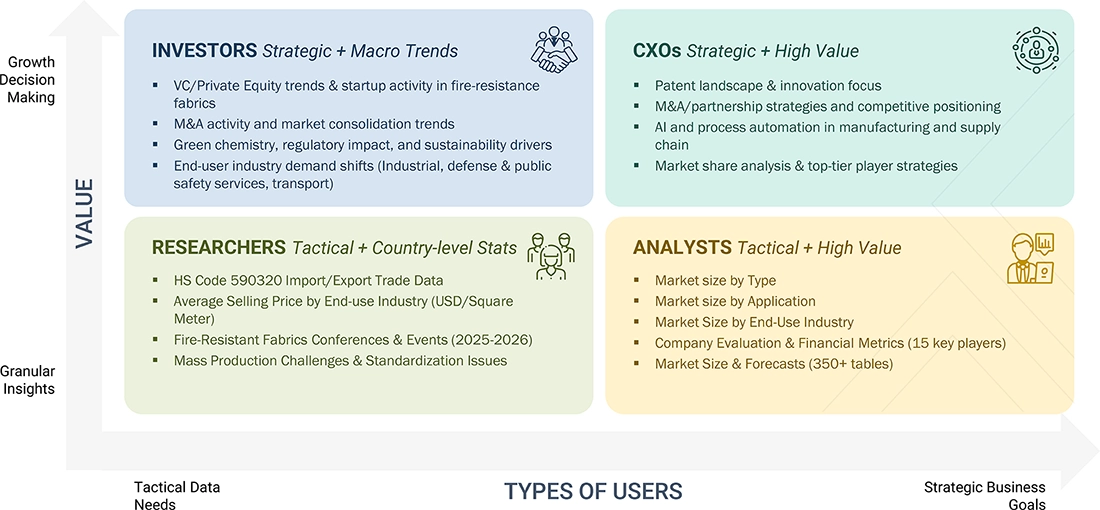
DELIVERED CUSTOMIZATIONS
We have successfully delivered the following deep-dive customizations:
| CLIENT REQUEST | CUSTOMIZATION DELIVERED | VALUE ADDS |
|---|---|---|
| Europe-based Fire-Resistant Fabrics Manufacturer |
|
|
| Asia Pacific-based Fire-Resistant Fabrics Manufacturer |
|
|
RECENT DEVELOPMENTS
- July 2024 : PBI Performance Products, Inc. and TenCate Protective Fabrics formed a partnership to launch PBI Peak5, an ultra-lightweight fire-resistant outer shell fabric specifically designed for firefighters
- May 2024 : Milliken & Company, a global leader in diversified manufacturing, collaborated with NASA to develop and produce flame-resistant intimate apparel fabric for the upcoming Artemis missions.
- May 2023 : Indorama Ventures Public Company Limited renamed Trevira GmbH as Indorama Ventures Fibers Germany GmbH as part of its global brand alignment strategy aimed at establishing a unified corporate identity across its 147 sites in 35 countries.
- February 2022 : DuPont Personal Protection, a subsidiary of DuPont de Nemours, Inc., formed a partnership with Bulwark, the world’s largest flame-resistant (FR) apparel brand
- February 2021 : Teijin Limited launched a new fire-resistant fabric named Tenax. This is a woven carbon fiber fabric coated with a thermoplastic polymer and is completely impregnated.
Table of Contents
 Exclusive indicates content/data unique to MarketsandMarkets and not available with any competitors.
TITLE
PAGE NO
1
INTRODUCTION
27
2
RESEARCH METHODOLOGY
32
3
EXECUTIVE SUMMARY
42
4
PREMIUM INSIGHTS
46
5
MARKET OVERVIEW
Fire-resistant fabrics market growth driven by safety regulations, urbanization, and technological innovation.
49
5.1
INTRODUCTION
5.2
MARKET DYNAMICS
5.2.1
DRIVERS
5.2.1.1
STRINGENT WORKPLACE SAFETY REGULATIONS IN DEVELOPED COUNTRIES
5.2.1.2
INCREASING USE OF FIRE-RESISTANT FABRICS IN OIL & GAS INDUSTRY
5.2.1.3
INCREASING URBANIZATION & INFRASTRUCTURE DEVELOPMENT
5.2.2
RESTRAINTS
5.2.2.1
HIGH COST OF PRODUCTION AND HUGE INVESTMENT IN R&D
5.2.2.2
LACK OF SAFETY REGULATIONS IN DEVELOPING REGIONS
5.2.3
OPPORTUNITIES
5.2.3.1
TECHNOLOGICAL INNOVATIONS IN PRODUCT DEVELOPMENT
5.2.4
CHALLENGES
5.2.4.1
FLUCTUATING RAW MATERIAL COSTS
5.3
PORTER’S FIVE FORCES ANALYSIS
5.3.1
THREAT OF SUBSTITUTES
5.3.2
THREAT OF NEW ENTRANTS
5.3.3
BARGAINING POWER OF SUPPLIERS
5.3.4
BARGAINING POWER OF BUYERS
5.3.5
INTENSITY OF COMPETITIVE RIVALRY
5.4
KEY STAKEHOLDERS AND BUYING CRITERIA
5.4.1
KEY STAKEHOLDERS IN BUYING PROCESS
5.4.2
BUYING CRITERIA
5.5
MACROECONOMIC INDICATORS
5.5.1
GDP TRENDS AND FORECAST
6
INDUSTRY TRENDS
Navigate supply chain shifts and pricing trends to leverage fire-resistant fabric market opportunities.
60
6.1
SUPPLY CHAIN ANALYSIS
6.1.1
RAW MATERIAL SUPPLIERS
6.1.2
MANUFACTURERS
6.1.3
DISTRIBUTORS
6.1.4
END-USE INDUSTRIES
6.2
PRICING ANALYSIS
6.2.1
AVERAGE SELLING PRICE OF FIRE-RESISTANT FABRICS OFFERED BY KEY PLAYERS
6.2.2
AVERAGE SELLING PRICE TREND OF FIRE-RESISTANT FABRICS, BY REGION
6.3
TRENDS/DISRUPTIONS IMPACTING CUSTOMER BUSINESS
6.4
ECOSYSTEM ANALYSIS
6.5
TECHNOLOGY ANALYSIS
6.5.1
KEY TECHNOLOGIES
6.5.1.1
INHERENT FLAME-RESISTANT FIBERS
6.5.1.2
TREATED FLAME-RETARDANT FABRICS
6.5.2
COMPLIMENTARY TECHNOLOGIES
6.5.2.1
RADIANT BARRIER TECHNOLOGY
6.6
CASE STUDY ANALYSIS
6.6.1
CASE STUDY ON MCR SAFETY
6.6.2
CASE STUDY ON G.D. INTERNATIONAL
6.7
TRADE ANALYSIS
6.7.1
IMPORT SCENARIO (HS CODE 590320)
6.7.2
EXPORT SCENARIO (HS CODE 590320)
6.8
REGULATORY LANDSCAPE
6.8.1
REGULATORY BODIES, GOVERNMENT AGENCIES, AND OTHER ORGANIZATIONS
6.8.2
REGULATORY FRAMEWORK
6.8.2.1
ISO 11612: PROTECTIVE CLOTHING — CLOTHING TO PROTECT AGAINST HEAT AND FLAME — MINIMUM PERFORMANCE REQUIREMENTS
6.8.2.2
ISO 15025: PROTECTIVE CLOTHING — PROTECTION AGAINST FLAME — METHOD OF TEST FOR LIMITED FLAME SPREAD
6.9
KEY CONFERENCES AND EVENTS
6.10
INVESTMENT AND FUNDING SCENARIO
6.11
PATENT ANALYSIS`
6.11.1
APPROACH
6.11.2
DOCUMENT TYPES
6.11.3
TOP APPLICANTS
6.11.4
JURISDICTION ANALYSIS
6.12
IMPACT OF 2025 US TARIFF – OVERVIEW
6.12.1
INTRODUCTION
6.12.2
KEY TARIFF RATES
6.12.3
PRICE IMPACT ANALYSIS
6.12.4
IMPACT ON COUNTRY/REGION
6.12.4.1
US
6.12.4.2
EUROPE
6.12.4.3
ASIA PACIFIC
6.12.5
IMPACT ON END-USE INDUSTRIES
6.13
IMPACT OF AI/GEN AI ON FIRE-RESISTANT FABRICS MARKET
7
FIRE-RESISTANT FABRICS MARKET, BY TYPE
Market Size & Growth Rate Forecast Analysis to 2030 in USD Million and Square Meters | 12 Data Tables
88
7.1
INTRODUCTION
7.2
TREATED
7.2.1
COST-EFFECTIVENESS OF TREATED FIRE-RESISTANT FABRICS TO DRIVE DEMAND
7.2.2
FIRE-RESISTANT COTTON
7.2.3
FIRE-RESISTANT VISCOSE
7.2.4
FIRE-RESISTANT POLYESTER
7.2.5
FIRE-RESISTANT NYLON 6
7.3
INHERENT
7.3.1
INCREASING PREFERENCE FOR DURABLE AND PERMANENT FIRE-RESISTANT SOLUTIONS TO DRIVE MARKET
7.3.2
ARAMID
7.3.3
POLYBENZIMIDAZOLE
7.3.4
MODACRYLIC
7.3.5
POLYAMIDE
7.3.6
POLYIMIDE
8
FIRE-RESISTANT FABRICS MARKET, BY APPLICATION
Market Size & Growth Rate Forecast Analysis to 2030 in USD Million and Square Meters | 12 Data Tables
96
8.1
INTRODUCTION
8.2
APPAREL
8.2.1
STRINGENT REGULATIONS FOR WORKPLACE SAFETY TO DRIVE MARKET
8.2.2
PROTECTIVE CLOTHING
8.3
NON-APPAREL
8.3.1
RISING AWARENESS IN AUTOMOTIVE AND FURNITURE APPLICATIONS TO DRIVE DEMAND
8.3.2
INTERIOR FABRIC FOR TRANSPORTATION
8.3.3
HOUSEHOLD & INDUSTRIAL
9
FIRE-RESISTANT FABRICS MARKET, BY PROCESSING
Market Size & Growth Rate Forecast Analysis
103
9.1
INTRODUCTION
9.2
WOVEN FIRE-RESISTANT FABRICS
9.2.1
REGULATORY PRESSURE AND INDUSTRIAL SAFETY MANDATES TO FUEL MARKET GROWTH
9.3
NON-WOVEN FIRE-RESISTANT FABRICS
9.3.1
RISING DEMAND FOR DISPOSABLE AND SCALABLE FIRE PROTECTION SOLUTIONS TO DRIVE MARKET
9.4
KNITTED FIRE-RESISTANT FABRICS
9.4.1
SHIFT TOWARD ERGONOMIC AND LAYERED FIRE-RESISTANT APPAREL TO DRIVE DEMAND
10
FIRE-RESISTANT FABRICS MARKET, BY END-USE INDUSTRY
Market Size & Growth Rate Forecast Analysis to 2030 in USD Million and Square Meters | 36 Data Tables
105
10.1
INTRODUCTION
10.2
INDUSTRIAL
10.2.1
HIGH DEMAND FROM OIL & GAS AND CHEMICAL INDUSTRIES TO DRIVE MARKET
10.2.2
CONSTRUCTION & MANUFACTURING
10.2.3
OIL & GAS
10.2.4
OTHERS
10.3
DEFENSE & PUBLIC SAFETY SERVICES
10.3.1
RISING NUMBER OF FIRE BREAKOUTS TO BOOST DEMAND
10.3.2
MILITARY
10.3.3
FIREFIGHTING & LAW ENFORCEMENT
10.4
TRANSPORT
10.4.1
ASIA PACIFIC TO BE LARGEST AND FASTEST-GROWING MARKET DURING FORECAST PERIOD
10.4.2
RAILWAYS
10.4.3
AEROSPACE
10.4.4
MARINE
10.4.5
AUTOMOTIVE
10.5
OTHER END-USE INDUSTRIES
11
FIRE-RESISTANT FABRICS MARKET, BY REGION
Comprehensive coverage of 7 Regions with country-level deep-dive of 17 Countries | 156 Data Tables.
123
11.1
INTRODUCTION
11.2
ASIA PACIFIC
11.2.1
CHINA
11.2.1.1
GROWING MANUFACTURING SECTOR TO DRIVE MARKET
11.2.2
JAPAN
11.2.2.1
STRINGENT SAFETY REGULATIONS ACROSS AUTOMOTIVE AND MARINE SECTORS TO DRIVE MARKET
11.2.3
INDIA
11.2.3.1
IMPROVEMENTS IN INDUSTRIAL INFRASTRUCTURE AND BUSINESS ENVIRONMENT TO SUPPORT MARKET GROWTH
11.2.4
SOUTH KOREA
11.2.4.1
GOVERNMENT INITIATIVES IN THE INDUSTRIAL SECTOR TO DRIVE DEMAND
11.2.5
AUSTRALIA & NEW ZEALAND
11.2.5.1
HIGH DEMAND FROM BUILDING & CONSTRUCTION AND ELECTRONICS INDUSTRIES TO DRIVE MARKET
11.3
NORTH AMERICA
11.3.1
US
11.3.1.1
HIGH DEMAND FROM DEFENSE AND FIREFIGHTING SECTORS TO DRIVE MARKET
11.3.2
MEXICO
11.3.2.1
INCREASING FOREIGN INVESTMENTS TO FUEL MARKET GROWTH
11.3.3
CANADA
11.3.3.1
SHIFT TOWARD ADVANCED TEXTILE MANUFACTURING TO SUPPORT MARKET GROWTH
11.4
EUROPE
11.4.1
GERMANY
11.4.1.1
INCREASING DOMESTIC DEMAND TO DRIVE MARKET
11.4.2
FRANCE
11.4.2.1
PRESENCE OF DOMESTIC APPAREL MANUFACTURERS AND INCREASED INDUSTRIAL PRODUCTION TO DRIVE MARKET
11.4.3
UK
11.4.3.1
RISE IN CONSTRUCTION ACTIVITIES TO FUEL DEMAND
11.4.4
ITALY
11.4.4.1
HIGH LEVEL OF INNOVATION IN END-USE PRODUCTS TO SUPPORT MARKET GROWTH
11.4.5
RUSSIA
11.4.5.1
STRONG OIL & GAS INDUSTRY TO DRIVE DEMAND
11.5
SOUTH AMERICA
11.5.1
BRAZIL
11.5.1.1
IMPLEMENTATION OF STRINGENT REGULATIONS TO DRIVE MARKET
11.5.2
ARGENTINA
11.5.2.1
RISING DEMAND FROM PROTECTIVE APPAREL APPLICATIONS TO FUEL MARKET
11.6
MIDDLE EAST & AFRICA
11.6.1
SAUDI ARABIA
11.6.1.1
DOWNSTREAM OIL & GAS ACTIVITIES TO DRIVE DEMAND
11.6.2
UAE
11.6.2.1
POTENTIAL FOREIGN INVESTMENTS AND RAPID URBANIZATION TO POSITIVELY INFLUENCE MARKET
11.6.3
IRAN
11.6.3.1
INVESTMENTS IN INFRASTRUCTURE DEVELOPMENT, ENERGY PROJECTS, AND INDUSTRIAL MODERNIZATION TO DRIVE MARKET
12
COMPETITIVE LANDSCAPE
Discover how key players dominate market share and revenue through strategic positioning in 2024.
186
12.1
INTRODUCTION
12.2
KEY PLAYER STRATEGIES/RIGHT TO WIN
12.3
MARKET SHARE ANALYSIS
12.4
REVENUE ANALYSIS
12.5
COMPANY EVALUATION MATRIX: KEY PLAYERS, 2024
12.5.1
STARS
12.5.2
EMERGING LEADERS
12.5.3
PERVASIVE PLAYERS
12.5.4
PARTICIPANTS
12.5.5
COMPANY FOOTPRINT: KEY PLAYERS, 2024
12.5.5.1
COMPANY FOOTPRINT
12.5.5.2
REGION FOOTPRINT
12.5.5.3
TYPE FOOTPRINT
12.5.5.4
APPLICATION FOOTPRINT
12.5.5.5
END-USE INDUSTRY FOOTPRINT
12.6
COMPANY EVALUATION MATRIX: STARTUPS/SMES, 2024
12.6.1
PROGRESSIVE COMPANIES
12.6.2
RESPONSIVE COMPANIES
12.6.3
DYNAMIC COMPANIES
12.6.4
STARTING BLOCKS
12.6.5
COMPETITIVE BENCHMARKING: STARTUPS/SMES, 2024
12.6.5.1
DETAILED LIST OF KEY STARTUPS/SMES
12.6.5.2
COMPETITIVE BENCHMARKING OF KEY STARTUPS/SMES
12.7
BRAND/PRODUCT COMPARISON ANALYSIS
12.8
COMPANY VALUATION AND FINANCIAL METRICS
12.9
COMPETITIVE SCENARIO
12.9.1
PRODUCT LAUNCHES
12.9.2
DEALS
12.9.3
OTHER DEVELOPMENTS
13
COMPANY PROFILES
In-depth Company Profiles of Leading Market Players with detailed Business Overview, Product and Service Portfolio, Recent Developments, and Unique Analyst Perspective (MnM View)
206
13.1
KEY PLAYERS
13.1.1
DUPONT DE NEMOURS, INC.
13.1.1.1
BUSINESS OVERVIEW
13.1.1.2
PRODUCTS OFFERED
13.1.1.3
RECENT DEVELOPMENTS
13.1.1.4
MNM VIEW
13.1.2
TEIJIN LIMITED
13.1.3
INDORAMA VENTURES PUBLIC COMPANY LIMITED
13.1.4
SYENSQO SA/NV
13.1.5
TENCATE PROTECTIVE FABRICS
13.1.6
LENZING AG
13.1.7
PBI PERFORMANCE PRODUCTS, INC.
13.1.8
KANEKA CORPORATION
13.1.9
GUN EI CHEMICAL INDUSTRY CO., LTD.
13.1.10
MILLIKEN & COMPANY
13.1.11
W. L. GORE & ASSOCIATES, INC.
13.2
OTHER PLAYERS
13.2.1
GLEN RAVEN, INC.
13.2.2
XM TEXTILES
13.2.3
BANSWARA SYNTEX LIMITED
13.2.4
AUBURN MANUFACTURING, INC.
13.2.5
TAIWAN K.K. CORPORATION
13.2.6
ADA & INA LTD.
13.2.7
NEWTEX INDUSTRIES
13.2.8
TOYOBO CO., LTD.
13.2.9
DRAPER KNITTING COMPANY
13.2.10
ARVIND HUMAN PROTECTION
13.2.11
AGRU AMERICA INC.
13.2.12
HENAN TIANYU GARMENT
13.2.13
MARINA TEXTIL
13.2.14
SAPPHIRE TEXTILES
14
ADJACENT & RELATED MARKETS
240
14.1
INTRODUCTION
14.2
LIMITATION
14.3
META-ARAMID FIBER MARKET
14.3.1
MARKET DEFINITION
14.3.2
MARKET OVERVIEW
14.3.3
META-ARAMID FIBER MARKET, BY REGION
14.3.3.1
ASIA PACIFIC
14.3.3.2
EUROPE
14.3.3.3
NORTH AMERICA
14.3.3.4
MIDDLE EAST & AFRICA
14.3.3.5
SOUTH AMERICA
15
APPENDIX
249
15.1
DISCUSSION GUIDE
15.2
KNOWLEDGESTORE: MARKETSANDMARKETS’ SUBSCRIPTION PORTAL
15.3
CUSTOMIZATION OPTIONS
15.4
RELATED REPORTS
15.5
AUTHOR DETAILS
LIST OF TABLES
TABLE 1
FIRE-RESISTANT FABRICS MARKET: RISK ASSESSMENT
TABLE 2
REGULATIONS IN FIRE-RESISTANT FABRICS MARKET
TABLE 3
FIRE-RESISTANT FABRICS MARKET: PORTER’S FIVE FORCES ANALYSIS
TABLE 4
IMPACT OF STAKEHOLDERS ON BUYING PROCESS OF TOP THREE END-USE INDUSTRIES (%)
TABLE 5
KEY BUYING CRITERIA FOR TOP THREE END-USE INDUSTRIES
TABLE 6
GDP TRENDS AND FORECAST OF MAJOR ECONOMIES, 2021–2030 (USD BILLION)
TABLE 7
AVERAGE SELLING PRICE OF FIRE-RESISTANT FABRICS OFFERED BY KEY PLAYERS, BY END-USE INDUSTRY, 2024 (USD/SQUARE METER)
TABLE 8
AVERAGE SELLING PRICE TREND OF FIRE-RESISTANT FABRICS, BY REGION, 2022–2030 (USD/SQUARE METER)
TABLE 9
ROLE OF COMPANIES IN FIRE-RESISTANT FABRICS ECOSYSTEM
TABLE 10
IMPORT DATA RELATED TO FIRE-RESISTANT FABRICS, BY REGION, 2019–2024 (USD MILLION)
TABLE 11
EXPORT DATA RELATED TO FIRE-RESISTANT FABRICS, BY REGION, 2019–2024 (USD MILLION)
TABLE 12
GLOBAL: REGULATORY BODIES, GOVERNMENT AGENCIES, AND OTHER ORGANIZATIONS
TABLE 13
NORTH AMERICA: REGULATORY BODIES, GOVERNMENT AGENCIES, AND OTHER ORGANIZATIONS
TABLE 14
EUROPE: REGULATORY BODIES, GOVERNMENT AGENCIES, AND OTHER ORGANIZATIONS
TABLE 15
ASIA PACIFIC: REGULATORY BODIES, GOVERNMENT AGENCIES, AND OTHER ORGANIZATIONS
TABLE 16
SOUTH AMERICA: REGULATORY BODIES, GOVERNMENT AGENCIES, AND OTHER ORGANIZATIONS
TABLE 17
MIDDLE EAST & AFRICA: REGULATORY BODIES, GOVERNMENT AGENCIES, AND OTHER ORGANIZATIONS
TABLE 18
FIRE-RESISTANT FABRICS MARKET: LIST OF KEY CONFERENCES AND EVENTS, 2025–2026
TABLE 19
FIRE-RESISTANT FABRICS MARKET: FUNDING/INVESTMENT SCENARIO, 2023
TABLE 20
PATENT STATUS: PATENT APPLICATIONS, LIMITED PATENTS, AND GRANTED PATENTS, 2014–2024
TABLE 21
LIST OF MAJOR PATENTS RELATED TO FIRE-RESISTANT FABRICS, 2014–2024
TABLE 22
PATENTS BY BASF SE
TABLE 23
US ADJUSTED RECIPROCAL TARIFF RATES
TABLE 24
FIRE-RESISTANT FABRICS MARKET, BY TYPE, 2020–2024 (USD MILLION)
TABLE 25
FIRE-RESISTANT FABRICS MARKET, BY TYPE, 2025–2030 (USD MILLION)
TABLE 26
FIRE-RESISTANT FABRICS MARKET, BY TYPE, 2020–2024 (MILLION SQUARE METER)
TABLE 27
FIRE-RESISTANT FABRICS MARKET, BY TYPE, 2025–2030 (MILLION SQUARE METER)
TABLE 28
TREATED FIRE-RESISTANT FABRICS MARKET, BY REGION, 2020–2024 (USD MILLION)
TABLE 29
TREATED FIRE-RESISTANT FABRICS MARKET, BY REGION, 2025–2030 (USD MILLION)
TABLE 30
TREATED FIRE-RESISTANT FABRICS MARKET, BY REGION, 2020–2024 (MILLION SQUARE METER)
TABLE 31
TREATED FIRE-RESISTANT FABRICS MARKET, BY REGION, 2025–2030 (MILLION SQUARE METER)
TABLE 32
INHERENT FIRE-RESISTANT FABRICS MARKET, BY REGION, 2020–2024 (USD MILLION)
TABLE 33
INHERENT FIRE-RESISTANT FABRICS MARKET, BY REGION, 2025–2030 (USD MILLION)
TABLE 34
INHERENT FIRE-RESISTANT FABRICS MARKET, BY REGION, 2020–2024 (MILLION SQUARE METER)
TABLE 35
INHERENT FIRE-RESISTANT FABRICS MARKET, BY REGION, 2025–2030 (MILLION SQUARE METER)
TABLE 36
FIRE-RESISTANT FABRICS MARKET, BY APPLICATION, 2020–2024 (USD MILLION)
TABLE 37
FIRE-RESISTANT FABRICS MARKET, BY APPLICATION, 2025–2030 (USD MILLION)
TABLE 38
FIRE-RESISTANT FABRICS MARKET, BY APPLICATION, 2020–2024 (MILLION SQUARE METER)
TABLE 39
FIRE-RESISTANT FABRICS MARKET, BY APPLICATION, 2025–2030 (MILLION SQUARE METER)
TABLE 40
FIRE-RESISTANT FABRICS MARKET FOR APPAREL APPLICATIONS, BY REGION, 2020–2024 (USD MILLION)
TABLE 41
FIRE-RESISTANT FABRICS MARKET FOR APPAREL APPLICATIONS, BY REGION, 2025–2030 (USD MILLION)
TABLE 42
FIRE-RESISTANT FABRICS MARKET FOR APPAREL APPLICATIONS, BY REGION, 2020–2024 (MILLION SQUARE METER)
TABLE 43
FIRE-RESISTANT FABRICS MARKET FOR APPAREL APPLICATIONS, BY REGION, 2025–2030 (MILLION SQUARE METER)
TABLE 44
FIRE-RESISTANT FABRICS MARKET FOR NON-APPAREL APPLICATIONS, BY REGION, 2020–2024 (USD MILLION)
TABLE 45
FIRE-RESISTANT FABRICS MARKET FOR NON-APPAREL APPLICATIONS, BY REGION, 2025–2030 (USD MILLION)
TABLE 46
FIRE-RESISTANT FABRICS MARKET FOR NON-APPAREL APPLICATIONS, BY REGION, 2020–2024 (MILLION SQUARE METER)
TABLE 47
FIRE-RESISTANT FABRICS MARKET FOR NON-APPAREL APPLICATIONS, BY REGION, 2025–2030 (MILLION SQUARE METER)
TABLE 48
FIRE-RESISTANT FABRICS MARKET, BY END-USE INDUSTRY, 2020–2024 (USD MILLION)
TABLE 49
FIRE-RESISTANT FABRICS MARKET, BY END-USE INDUSTRY, 2025–2030 (USD MILLION)
TABLE 50
FIRE-RESISTANT FABRICS MARKET, BY END-USE INDUSTRY, 2020–2024 (MILLION SQUARE METER)
TABLE 51
FIRE-RESISTANT FABRICS MARKET, BY END-USE INDUSTRY, 2025–2030 (MILLION SQUARE METER)
TABLE 52
FIRE-RESISTANT FABRICS MARKET IN INDUSTRIAL, BY REGION, 2020–2024 (USD MILLION)
TABLE 53
FIRE-RESISTANT FABRICS MARKET IN INDUSTRIAL, BY REGION, 2025–2030 (USD MILLION)
TABLE 54
FIRE-RESISTANT FABRICS MARKET IN INDUSTRIAL, BY REGION, 2020–2024 (MILLION SQUARE METER)
TABLE 55
FIRE-RESISTANT FABRICS MARKET IN INDUSTRIAL, BY REGION, 2025–2030 (MILLION SQUARE METER)
TABLE 56
FIRE-RESISTANT FABRICS MARKET IN DEFENSE & PUBLIC SAFETY SERVICES, BY REGION, 2020–2024 (USD MILLION)
TABLE 57
FIRE-RESISTANT FABRICS MARKET IN DEFENSE & PUBLIC SAFETY SERVICES, BY REGION, 2025–2030 (USD MILLION)
TABLE 58
FIRE-RESISTANT FABRICS MARKET IN DEFENSE & PUBLIC SAFETY SERVICES, BY REGION, 2020–2024 (MILLION SQUARE METER)
TABLE 59
FIRE-RESISTANT FABRICS MARKET IN DEFENSE & PUBLIC SAFETY SERVICES, BY REGION, 2025–2030 (MILLION SQUARE METER)
TABLE 60
FIRE-RESISTANT FABRICS MARKET IN TRANSPORT, BY REGION, 2020–2024 (USD MILLION)
TABLE 61
FIRE-RESISTANT FABRICS MARKET IN TRANSPORT, BY REGION, 2025–2030 (USD MILLION)
TABLE 62
FIRE-RESISTANT FABRICS MARKET IN TRANSPORT, BY REGION, 2020–2024 (MILLION SQUARE METER)
TABLE 63
FIRE-RESISTANT FABRICS MARKET IN TRANSPORT, BY REGION, 2025–2030 (MILLION SQUARE METER)
TABLE 64
FIRE-RESISTANT FABRICS MARKET IN RAILWAYS, BY REGION, 2020–2024 (USD MILLION)
TABLE 65
FIRE-RESISTANT FABRICS MARKET IN RAILWAYS, BY REGION, 2025–2030 (USD MILLION)
TABLE 66
FIRE-RESISTANT FABRICS MARKET IN RAILWAYS, BY REGION, 2020–2024 (MILLION SQUARE METER)
TABLE 67
FIRE-RESISTANT FABRICS MARKET IN RAILWAYS, BY REGION, 2025–2030 (MILLION SQUARE METER)
TABLE 68
FIRE-RESISTANT FABRICS MARKET IN AEROSPACE, BY REGION, 2020–2024 (USD MILLION)
TABLE 69
FIRE-RESISTANT FABRICS MARKET IN AEROSPACE, BY REGION, 2025–2030 (USD MILLION)
TABLE 70
FIRE-RESISTANT FABRICS MARKET IN AEROSPACE, BY REGION, 2020–2024 (MILLION SQUARE METER)
TABLE 71
FIRE-RESISTANT FABRICS MARKET IN AEROSPACE, BY REGION, 2025–2030 (MILLION SQUARE METER)
TABLE 72
FIRE-RESISTANT FABRICS MARKET IN MARINE, BY REGION, 2020–2024 (USD MILLION)
TABLE 73
FIRE-RESISTANT FABRICS MARKET IN MARINE, BY REGION, 2025–2030 (USD MILLION)
TABLE 74
FIRE-RESISTANT FABRICS MARKET IN MARINE, BY REGION, 2020–2024 (MILLION SQUARE METER)
TABLE 75
FIRE-RESISTANT FABRICS MARKET IN MARINE, BY REGION, 2025–2030 (MILLION SQUARE METER)
TABLE 76
FIRE-RESISTANT FABRICS MARKET IN AUTOMOTIVE, BY REGION, 2020–2024 (USD MILLION)
TABLE 77
FIRE-RESISTANT FABRICS MARKET IN AUTOMOTIVE, BY REGION, 2025–2030 (USD MILLION)
TABLE 78
FIRE-RESISTANT FABRICS MARKET IN AUTOMOTIVE, BY REGION, 2020–2024 (MILLION SQUARE METER)
TABLE 79
FIRE-RESISTANT FABRICS MARKET IN AUTOMOTIVE, BY REGION, 2025–2030 (MILLION SQUARE METER)
TABLE 80
FIRE-RESISTANT FABRICS MARKET IN OTHER END-USE INDUSTRIES, BY REGION, 2020–2024 (USD MILLION)
TABLE 81
FIRE-RESISTANT FABRICS MARKET IN OTHER END-USE INDUSTRIES, BY REGION, 2025–2030 (USD MILLION)
TABLE 82
FIRE-RESISTANT FABRICS MARKET IN OTHER END-USE INDUSTRIES, BY REGION, 2020–2024 (MILLION SQUARE METER)
TABLE 83
FIRE-RESISTANT FABRICS MARKET IN OTHER END-USE INDUSTRIES, BY REGION, 2025–2030 (MILLION SQUARE METER)
TABLE 84
FIRE-RESISTANT FABRICS MARKET, BY REGION, 2020–2024 (USD MILLION)
TABLE 85
FIRE-RESISTANT FABRICS MARKET, BY REGION, 2025–2030 (USD MILLION)
TABLE 86
FIRE-RESISTANT FABRICS MARKET, BY REGION, 2020–2024 (MILLION SQUARE METER)
TABLE 87
FIRE-RESISTANT FABRICS MARKET, BY REGION, 2025–2030 (MILLION SQUARE METER)
TABLE 88
ASIA PACIFIC: FIRE-RESISTANT FABRICS MARKET, BY APPLICATION, 2020–2024 (USD MILLION)
TABLE 89
ASIA PACIFIC: FIRE-RESISTANT FABRICS MARKET, BY APPLICATION, 2025–2030 (USD MILLION)
TABLE 90
ASIA PACIFIC: FIRE-RESISTANT FABRICS MARKET, BY APPLICATION, 2020–2024 (MILLION SQUARE METER)
TABLE 91
ASIA PACIFIC: FIRE-RESISTANT FABRICS MARKET, BY APPLICATION, 2025–2030 (MILLION SQUARE METER)
TABLE 92
ASIA PACIFIC: FIRE-RESISTANT FABRICS MARKET, BY TYPE, 2020–2024 (USD MILLION)
TABLE 93
ASIA PACIFIC: FIRE-RESISTANT FABRICS MARKET, BY TYPE, 2025–2030 (USD MILLION)
TABLE 94
ASIA PACIFIC: FIRE-RESISTANT FABRICS MARKET, BY TYPE, 2020–2024 (MILLION SQUARE METER)
TABLE 95
ASIA PACIFIC: FIRE-RESISTANT FABRICS MARKET, BY TYPE, 2025–2030 (MILLION SQUARE METER)
TABLE 96
ASIA PACIFIC: FIRE-RESISTANT FABRICS MARKET, BY END-USE INDUSTRY, 2020–2024 (USD MILLION)
TABLE 97
ASIA PACIFIC: FIRE-RESISTANT FABRICS MARKET, BY END-USE INDUSTRY, 2025–2030 (USD MILLION)
TABLE 98
ASIA PACIFIC: FIRE-RESISTANT FABRICS MARKET, BY END-USE INDUSTRY, 2020–2024 (MILLION SQUARE METER)
TABLE 99
ASIA PACIFIC: FIRE-RESISTANT FABRICS MARKET, BY END-USE INDUSTRY, 2025–2030 (MILLION SQUARE METER)
TABLE 100
ASIA PACIFIC: FIRE-RESISTANT FABRICS MARKET, BY COUNTRY, 2020–2024 (USD MILLION)
TABLE 101
ASIA PACIFIC: FIRE-RESISTANT FABRICS MARKET, BY COUNTRY, 2025–2030 (USD MILLION)
TABLE 102
ASIA PACIFIC: FIRE-RESISTANT FABRICS MARKET, BY COUNTRY, 2020–2024 (MILLION SQUARE METER)
TABLE 103
ASIA PACIFIC: FIRE-RESISTANT FABRICS MARKET, BY COUNTRY, 2025–2030 (MILLION SQUARE METER)
TABLE 104
CHINA: FIRE-RESISTANT FABRICS MARKET, BY END-USE INDUSTRY, 2020–2024 (USD MILLION)
TABLE 105
CHINA: FIRE-RESISTANT FABRICS MARKET, BY END-USE INDUSTRY, 2025–2030 (USD MILLION)
TABLE 106
CHINA: FIRE-RESISTANT FABRICS MARKET, BY END-USE INDUSTRY, 2020–2024 (MILLION SQUARE METER)
TABLE 107
CHINA: FIRE-RESISTANT FABRICS MARKET, BY END-USE INDUSTRY, 2025–2030 (MILLION SQUARE METER)
TABLE 108
JAPAN: FIRE-RESISTANT FABRICS MARKET, BY END-USE INDUSTRY, 2020–2024 (USD MILLION)
TABLE 109
JAPAN: FIRE-RESISTANT FABRICS MARKET, BY END-USE INDUSTRY, 2025–2030 (USD MILLION)
TABLE 110
JAPAN: FIRE-RESISTANT FABRICS MARKET, BY END-USE INDUSTRY, 2020–2024 (MILLION SQUARE METER)
TABLE 111
JAPAN: FIRE-RESISTANT FABRICS MARKET, BY END-USE INDUSTRY, 2025–2030 (MILLION SQUARE METER)
TABLE 112
INDIA: FIRE-RESISTANT FABRICS MARKET, BY END-USE INDUSTRY, 2020–2024 (USD MILLION)
TABLE 113
INDIA: FIRE-RESISTANT FABRICS MARKET, BY END-USE INDUSTRY, 2025–2030 (USD MILLION)
TABLE 114
INDIA: FIRE-RESISTANT FABRICS MARKET, BY END-USE INDUSTRY, 2020–2024 (MILLION SQUARE METER)
TABLE 115
INDIA: FIRE-RESISTANT FABRICS MARKET, BY END-USE INDUSTRY, 2025–2030 (MILLION SQUARE METER)
TABLE 116
SOUTH KOREA: FIRE-RESISTANT FABRICS MARKET, BY END-USE INDUSTRY, 2020–2024 (USD MILLION)
TABLE 117
SOUTH KOREA: FIRE-RESISTANT FABRICS MARKET, BY END-USE INDUSTRY, 2025–2030 (USD MILLION)
TABLE 118
SOUTH KOREA: FIRE-RESISTANT FABRICS MARKET, BY END-USE INDUSTRY, 2020–2024 (MILLION SQUARE METER)
TABLE 119
SOUTH KOREA: FIRE-RESISTANT FABRICS MARKET, BY END-USE INDUSTRY, 2025–2030 (MILLION SQUARE METER)
TABLE 120
AUSTRALIA & NEW ZEALAND: FIRE-RESISTANT FABRICS MARKET, BY END-USE INDUSTRY, 2020–2024 (USD MILLION)
TABLE 121
AUSTRALIA & NEW ZEALAND: FIRE-RESISTANT FABRICS MARKET, BY END-USE INDUSTRY, 2025–2030 (USD MILLION)
TABLE 122
AUSTRALIA & NEW ZEALAND: FIRE-RESISTANT FABRICS MARKET, BY END-USE INDUSTRY, 2020–2024 (MILLION SQUARE METER)
TABLE 123
AUSTRALIA & NEW ZEALAND: FIRE-RESISTANT FABRICS MARKET, BY END-USE INDUSTRY, 2025–2030 (MILLION SQUARE METER)
TABLE 124
NORTH AMERICA: FIRE-RESISTANT FABRICS MARKET, BY APPLICATION, 2020–2024 (USD MILLION)
TABLE 125
NORTH AMERICA: FIRE-RESISTANT FABRICS MARKET, BY APPLICATION, 2025–2030 (USD MILLION)
TABLE 126
NORTH AMERICA: FIRE-RESISTANT FABRICS MARKET, BY APPLICATION, 2020–2024 (MILLION SQUARE METER)
TABLE 127
NORTH AMERICA: FIRE-RESISTANT FABRICS MARKET, BY APPLICATION, 2025–2030 (MILLION SQUARE METER)
TABLE 128
NORTH AMERICA: FIRE-RESISTANT FABRICS MARKET, BY TYPE, 2020–2024 (USD MILLION)
TABLE 129
NORTH AMERICA: FIRE-RESISTANT FABRICS MARKET, BY TYPE, 2025–2030 (USD MILLION)
TABLE 130
NORTH AMERICA: FIRE-RESISTANT FABRICS MARKET, BY TYPE, 2020–2024 (MILLION SQUARE METER)
TABLE 131
NORTH AMERICA: FIRE-RESISTANT FABRICS MARKET, BY TYPE, 2025–2030 (MILLION SQUARE METER)
TABLE 132
NORTH AMERICA: FIRE-RESISTANT FABRICS MARKET, BY END-USE INDUSTRY, 2020–2024 (USD MILLION)
TABLE 133
NORTH AMERICA: FIRE-RESISTANT FABRICS MARKET, BY END-USE INDUSTRY, 2025–2030 (USD MILLION)
TABLE 134
NORTH AMERICA: FIRE-RESISTANT FABRICS MARKET, BY END-USE INDUSTRY, 2020–2024 (MILLION SQUARE METER)
TABLE 135
NORTH AMERICA: FIRE-RESISTANT FABRICS MARKET, BY END-USE INDUSTRY, 2025–2030 (MILLION SQUARE METER)
TABLE 136
NORTH AMERICA: FIRE-RESISTANT FABRICS MARKET, BY COUNTRY, 2020–2024 (USD MILLION)
TABLE 137
NORTH AMERICA: FIRE-RESISTANT FABRICS MARKET, BY COUNTRY, 2025–2030 (USD MILLION)
TABLE 138
NORTH AMERICA: FIRE-RESISTANT FABRICS MARKET, BY COUNTRY, 2020–2024 (MILLION SQUARE METER)
TABLE 139
NORTH AMERICA: FIRE-RESISTANT FABRICS MARKET, BY COUNTRY, 2025–2030 (MILLION SQUARE METER)
TABLE 140
US: FIRE-RESISTANT FABRICS MARKET, BY END-USE INDUSTRY, 2020–2024 (USD MILLION)
TABLE 141
US: FIRE-RESISTANT FABRICS MARKET, BY END-USE INDUSTRY, 2025–2030 (USD MILLION)
TABLE 142
US: FIRE-RESISTANT FABRICS MARKET, BY END-USE INDUSTRY, 2020–2024 (MILLION SQUARE METER)
TABLE 143
US: FIRE-RESISTANT FABRICS MARKET, BY END-USE INDUSTRY, 2025–2030 (MILLION SQUARE METER)
TABLE 144
MEXICO: FIRE-RESISTANT FABRICS MARKET, BY END-USE INDUSTRY, 2020–2024(USD MILLION)
TABLE 145
MEXICO: FIRE-RESISTANT FABRICS MARKET, BY END-USE INDUSTRY, 2025–2030 (USD MILLION)
TABLE 146
MEXICO: FIRE-RESISTANT FABRICS MARKET, BY END-USE INDUSTRY, 2020–2024(MILLION SQUARE METER)
TABLE 147
MEXICO: FIRE-RESISTANT FABRICS MARKET, BY END-USE INDUSTRY, 2025–2030 (MILLION SQUARE METER)
TABLE 148
CANADA: FIRE-RESISTANT FABRICS MARKET, BY END-USE INDUSTRY, 2020–2024 (USD MILLION)
TABLE 149
CANADA: FIRE-RESISTANT FABRICS MARKET, BY END-USE INDUSTRY, 2025–2030 (USD MILLION)
TABLE 150
CANADA: FIRE-RESISTANT FABRICS MARKET, BY END-USE INDUSTRY, 2020–2024 (MILLION SQUARE METER)
TABLE 151
CANADA: FIRE-RESISTANT FABRICS MARKET, BY END-USE INDUSTRY, 2025–2030 (MILLION SQUARE METER)
TABLE 152
EUROPE: FIRE-RESISTANT FABRICS MARKET, BY APPLICATION, 2020–2024 (USD MILLION)
TABLE 153
EUROPE: FIRE-RESISTANT FABRICS MARKET, BY APPLICATION, 2025–2030 (USD MILLION)
TABLE 154
EUROPE: FIRE-RESISTANT FABRICS MARKET, BY APPLICATION, 2020–2024 (MILLION SQUARE METER)
TABLE 155
EUROPE: FIRE-RESISTANT FABRICS MARKET, BY APPLICATION, 2025–2030 (MILLION SQUARE METER)
TABLE 156
EUROPE: FIRE-RESISTANT FABRICS MARKET, BY TYPE, 2020–2024(USD MILLION)
TABLE 157
EUROPE: FIRE-RESISTANT FABRICS MARKET, BY TYPE, 2025–2030 (USD MILLION)
TABLE 158
EUROPE: FIRE-RESISTANT FABRICS MARKET, BY TYPE, 2020–2024 (MILLION SQUARE METER)
TABLE 159
EUROPE: FIRE-RESISTANT FABRICS MARKET, BY TYPE, 2025–2030 (MILLION SQUARE METER)
TABLE 160
EUROPE: FIRE-RESISTANT FABRICS MARKET, BY END-USE INDUSTRY, 2020–2024(USD MILLION)
TABLE 161
EUROPE: FIRE-RESISTANT FABRICS MARKET, BY END-USE INDUSTRY, 2025–2030 (USD MILLION)
TABLE 162
EUROPE: FIRE-RESISTANT FABRICS MARKET, BY END-USE INDUSTRY, 2020–2024 (MILLION SQUARE METER)
TABLE 163
EUROPE: FIRE-RESISTANT FABRICS MARKET, BY END-USE INDUSTRY, 2025–2030 (MILLION SQUARE METER)
TABLE 164
EUROPE: FIRE-RESISTANT FABRICS MARKET, BY COUNTRY, 2020–2024 (USD MILLION)
TABLE 165
EUROPE: FIRE-RESISTANT FABRICS MARKET, BY COUNTRY, 2025–2030 (USD MILLION)
TABLE 166
EUROPE: FIRE-RESISTANT FABRICS MARKET, BY COUNTRY, 2020–2024 (MILLION SQUARE METER)
TABLE 167
EUROPE: FIRE-RESISTANT FABRICS MARKET, BY COUNTRY, 2025–2030 (MILLION SQUARE METER)
TABLE 168
GERMANY: FIRE-RESISTANT FABRICS MARKET, BY END-USE INDUSTRY, 2020–2024(USD MILLION)
TABLE 169
GERMANY: FIRE-RESISTANT FABRICS MARKET, BY END-USE INDUSTRY, 2025–2030 (USD MILLION)
TABLE 170
GERMANY: FIRE-RESISTANT FABRICS MARKET, BY END-USE INDUSTRY, 2020–2024 (MILLION SQUARE METER)
TABLE 171
GERMANY: FIRE-RESISTANT FABRICS MARKET, BY END-USE INDUSTRY, 2025–2030 (MILLION SQUARE METER)
TABLE 172
FRANCE: FIRE-RESISTANT FABRICS MARKET, BY END-USE INDUSTRY, 2020–2024 (USD MILLION)
TABLE 173
FRANCE: FIRE-RESISTANT FABRICS MARKET, BY END-USE INDUSTRY, 2025–2030 (USD MILLION)
TABLE 174
FRANCE: FIRE-RESISTANT FABRICS MARKET, BY END-USE INDUSTRY, 2020–2024 (MILLION SQUARE METER)
TABLE 175
FRANCE: FIRE-RESISTANT FABRICS MARKET, BY END-USE INDUSTRY, 2025–2030 (MILLION SQUARE METER)
TABLE 176
UK: FIRE-RESISTANT FABRICS MARKET, BY END-USE INDUSTRY, 2020–2024 (USD MILLION)
TABLE 177
UK: FIRE-RESISTANT FABRICS MARKET, BY END-USE INDUSTRY, 2025–2030 (USD MILLION)
TABLE 178
UK: FIRE-RESISTANT FABRICS MARKET, BY END-USE INDUSTRY, 2020–2024 (MILLION SQUARE METER)
TABLE 179
UK: FIRE-RESISTANT FABRICS MARKET, BY END-USE INDUSTRY, 2025–2030 (MILLION SQUARE METER)
TABLE 180
ITALY: FIRE-RESISTANT FABRICS MARKET, BY END-USE INDUSTRY, 2020–2024 (USD MILLION)
TABLE 181
ITALY: FIRE-RESISTANT FABRICS MARKET, BY END-USE INDUSTRY, 2025–2030 (USD MILLION)
TABLE 182
ITALY: FIRE-RESISTANT FABRICS MARKET, BY END-USE INDUSTRY, 2020–2024 (MILLION SQUARE METER)
TABLE 183
ITALY: FIRE-RESISTANT FABRICS MARKET, BY END-USE INDUSTRY, 2025–2030 (MILLION SQUARE METER)
TABLE 184
RUSSIA: FIRE-RESISTANT FABRICS MARKET, BY END-USE INDUSTRY, 2020–2024 (USD MILLION)
TABLE 185
RUSSIA: FIRE-RESISTANT FABRICS MARKET, BY END-USE INDUSTRY, 2025–2030 (USD MILLION)
TABLE 186
RUSSIA: FIRE-RESISTANT FABRICS MARKET, BY END-USE INDUSTRY, 2020–2024 (MILLION SQUARE METER)
TABLE 187
RUSSIA: FIRE-RESISTANT FABRICS MARKET, BY END-USE INDUSTRY, 2025–2030 (MILLION SQUARE METER)
TABLE 188
SOUTH AMERICA: FIRE-RESISTANT FABRICS MARKET, BY APPLICATION, 2020–2024 (USD MILLION)
TABLE 189
SOUTH AMERICA: FIRE-RESISTANT FABRICS MARKET, BY APPLICATION, 2025–2030 (USD MILLION)
TABLE 190
SOUTH AMERICA: FIRE-RESISTANT FABRICS MARKET, BY APPLICATION, 2020–2024 (MILLION SQUARE METER)
TABLE 191
SOUTH AMERICA: FIRE-RESISTANT FABRICS MARKET, BY APPLICATION, 2025–2030 (MILLION SQUARE METER)
TABLE 192
SOUTH AMERICA: FIRE-RESISTANT FABRICS MARKET, BY TYPE, 2020–2024 (USD MILLION)
TABLE 193
SOUTH AMERICA: FIRE-RESISTANT FABRICS MARKET, BY TYPE, 2025–2030 (USD MILLION)
TABLE 194
SOUTH AMERICA: FIRE-RESISTANT FABRICS MARKET, BY TYPE, 2020–2024 (MILLION SQUARE METER)
TABLE 195
SOUTH AMERICA: FIRE-RESISTANT FABRICS MARKET, BY TYPE, 2025–2030 (MILLION SQUARE METER)
TABLE 196
SOUTH AMERICA: FIRE-RESISTANT FABRICS MARKET, BY END-USE INDUSTRY, 2020–2024 (USD MILLION)
TABLE 197
SOUTH AMERICA: FIRE-RESISTANT FABRICS MARKET, BY END-USE INDUSTRY, 2025–2030 (USD MILLION)
TABLE 198
SOUTH AMERICA: FIRE-RESISTANT FABRICS MARKET, BY END-USE INDUSTRY, 2020–2024(MILLION SQUARE METER)
TABLE 199
SOUTH AMERICA: FIRE-RESISTANT FABRICS MARKET, BY END-USE INDUSTRY, 2025–2030 (MILLION SQUARE METER)
TABLE 200
SOUTH AMERICA: FIRE-RESISTANT FABRICS MARKET, BY COUNTRY, 2020–2024 (USD MILLION)
TABLE 201
SOUTH AMERICA: FIRE-RESISTANT FABRICS MARKET, BY COUNTRY, 2025–2030 (USD MILLION)
TABLE 202
SOUTH AMERICA: FIRE-RESISTANT FABRICS MARKET, BY COUNTRY, 2020–2024 (MILLION SQUARE METER)
TABLE 203
SOUTH AMERICA: FIRE-RESISTANT FABRICS MARKET, BY COUNTRY, 2025–2030 (MILLION SQUARE METER)
TABLE 204
BRAZIL: FIRE-RESISTANT FABRICS MARKET, BY END-USE INDUSTRY, 2020–2024 (USD MILLION)
TABLE 205
BRAZIL: FIRE-RESISTANT FABRICS MARKET, BY END-USE INDUSTRY, 2025–2030 (USD MILLION)
TABLE 206
BRAZIL: FIRE-RESISTANT FABRICS MARKET, BY END-USE INDUSTRY, 2020–2024 (MILLION SQUARE METER)
TABLE 207
BRAZIL: FIRE-RESISTANT FABRICS MARKET, BY END-USE INDUSTRY, 2025–2030 (MILLION SQUARE METER)
TABLE 208
ARGENTINA: FIRE-RESISTANT FABRICS MARKET, BY END-USE INDUSTRY, 2020–2024 (USD MILLION)
TABLE 209
ARGENTINA: FIRE-RESISTANT FABRICS MARKET, BY END-USE INDUSTRY, 2025–2030 (USD MILLION)
TABLE 210
ARGENTINA: FIRE-RESISTANT FABRICS MARKET, BY END-USE INDUSTRY, 2020–2024 (MILLION SQUARE METER)
TABLE 211
ARGENTINA: FIRE-RESISTANT FABRICS MARKET, BY END-USE INDUSTRY, 2025–2030 (MILLION SQUARE METER)
TABLE 212
MIDDLE EAST & AFRICA: FIRE-RESISTANT FABRICS MARKET, BY APPLICATION, 2020–2024 (USD MILLION)
TABLE 213
MIDDLE EAST & AFRICA: FIRE-RESISTANT FABRICS MARKET, BY APPLICATION, 2025–2030 (USD MILLION)
TABLE 214
MIDDLE EAST & AFRICA: FIRE-RESISTANT FABRICS MARKET, BY APPLICATION, 2020–2024 (MILLION SQUARE METER)
TABLE 215
MIDDLE EAST & AFRICA: FIRE-RESISTANT FABRICS MARKET, BY APPLICATION, 2025–2030 (MILLION SQUARE METER)
TABLE 216
MIDDLE EAST & AFRICA: FIRE-RESISTANT FABRICS MARKET, BY TYPE, 2020–2024 (USD MILLION)
TABLE 217
MIDDLE EAST & AFRICA: FIRE-RESISTANT FABRICS MARKET, BY TYPE, 2025–2030 (USD MILLION)
TABLE 218
MIDDLE EAST & AFRICA: FIRE-RESISTANT FABRICS MARKET, BY TYPE, 2020–2024 (MILLION SQUARE METER)
TABLE 219
MIDDLE EAST & AFRICA: FIRE-RESISTANT FABRICS MARKET, BY TYPE, 2025–2030 (MILLION SQUARE METER)
TABLE 220
MIDDLE EAST & AFRICA: FIRE-RESISTANT FABRICS MARKET, BY END-USE INDUSTRY, 2020–2024 (USD MILLION)
TABLE 221
MIDDLE EAST & AFRICA: FIRE-RESISTANT FABRICS MARKET, BY END-USE INDUSTRY, 2025–2030 (USD MILLION)
TABLE 222
MIDDLE EAST & AFRICA: FIRE-RESISTANT FABRICS MARKET, BY END-USE INDUSTRY, 2020–2024 (MILLION SQUARE METER)
TABLE 223
MIDDLE EAST & AFRICA: FIRE-RESISTANT FABRICS MARKET, BY END-USE INDUSTRY, 2025–2030 (MILLION SQUARE METER)
TABLE 224
MIDDLE EAST & AFRICA: FIRE-RESISTANT FABRICS MARKET, BY COUNTRY, 2020–2024 (USD MILLION)
TABLE 225
MIDDLE EAST & AFRICA: FIRE-RESISTANT FABRICS MARKET, BY COUNTRY, 2025–2030 (USD MILLION)
TABLE 226
MIDDLE EAST & AFRICA: FIRE-RESISTANT FABRICS MARKET, BY COUNTRY, 2020–2024 (MILLION SQUARE METER)
TABLE 227
MIDDLE EAST & AFRICA: FIRE-RESISTANT FABRICS MARKET, BY COUNTRY, 2025–2030 (MILLION SQUARE METER)
TABLE 228
SAUDI ARABIA: FIRE-RESISTANT FABRICS MARKET, BY END-USE INDUSTRY, 2020–2024 (USD MILLION)
TABLE 229
SAUDI ARABIA: FIRE-RESISTANT FABRICS MARKET, BY END-USE INDUSTRY, 2025–2030 (USD MILLION)
TABLE 230
SAUDI ARABIA: FIRE-RESISTANT FABRICS MARKET, BY END-USE INDUSTRY, 2020–2024 (MILLION SQUARE METER)
TABLE 231
SAUDI ARABIA: FIRE-RESISTANT FABRICS MARKET, BY END-USE INDUSTRY, 2025–2030 (MILLION SQUARE METER)
TABLE 232
UAE: FIRE-RESISTANT FABRICS MARKET, BY END-USE INDUSTRY, 2020–2024 (USD MILLION)
TABLE 233
UAE: FIRE-RESISTANT FABRICS MARKET, BY END-USE INDUSTRY, 2025–2030 (USD MILLION)
TABLE 234
UAE: FIRE-RESISTANT FABRICS MARKET, BY END-USE INDUSTRY, 2020–2024 (MILLION SQUARE METER)
TABLE 235
UAE: FIRE-RESISTANT FABRICS MARKET, BY END-USE INDUSTRY, 2025–2030 (MILLION SQUARE METER)
TABLE 236
IRAN: FIRE-RESISTANT FABRICS MARKET, BY END-USE INDUSTRY, 2020–2024 (USD MILLION)
TABLE 237
IRAN: FIRE-RESISTANT FABRICS MARKET, BY END-USE INDUSTRY, 2025–2030 (USD MILLION)
TABLE 238
IRAN: FIRE-RESISTANT FABRICS MARKET, BY END-USE INDUSTRY, 2020–2024 (MILLION SQUARE METER)
TABLE 239
IRAN: FIRE-RESISTANT FABRICS MARKET, BY END-USE INDUSTRY, 2025–2030 (MILLION SQUARE METER)
TABLE 240
STRATEGIES ADOPTED BY KEY FIRE-RESISTANT FABRIC MANUFACTURERS, JANUARY 2020–MAY 2025
TABLE 241
FIRE-RESISTANT FABRICS MARKET: DEGREE OF COMPETITION
TABLE 242
FIRE-RESISTANT FABRICS MARKET: REGION FOOTPRINT
TABLE 243
FIRE-RESISTANT FABRICS MARKET: TYPE FOOTPRINT
TABLE 244
FIRE-RESISTANT FABRICS MARKET: APPLICATION FOOTPRINT
TABLE 245
FIRE-RESISTANT FABRICS MARKET: END-USE INDUSTRY FOOTPRINT
TABLE 246
FIRE-RESISTANT FABRICS MARKET: DETAILED LIST OF KEY STARTUPS/SMES
TABLE 247
FIRE-RESISTANT FABRICS MARKET: COMPETITIVE BENCHMARKING OF KEY STARTUPS/SMES
TABLE 248
FIRE-RESISTANT FABRICS MARKET: PRODUCT LAUNCHES, JANUARY 2020–MAY 2025
TABLE 249
FIRE-RESISTANT FABRICS MARKET: DEALS, JANUARY 2020–MAY 2025
TABLE 250
FIRE-RESISTANT FABRICS MARKET: OTHER DEVELOPMENTS, JANUARY 2020–MAY 2025
TABLE 251
DUPONT DE NEMOURS, INC.: COMPANY OVERVIEW
TABLE 252
DUPONT DE NEMOURS, INC.: PRODUCTS OFFERED
TABLE 253
DUPONT DE NEMOURS, INC.: PRODUCT LAUNCHES
TABLE 254
DUPONT DE NEMOURS, INC.: DEALS
TABLE 255
TEIJIN LIMITED: COMPANY OVERVIEW
TABLE 256
TEIJIN LIMITED: PRODUCTS OFFERED
TABLE 257
TEIJIN LIMITED: PRODUCT LAUNCHES
TABLE 258
INDORAMA VENTURES PUBLIC COMPANY LIMITED: COMPANY OVERVIEW
TABLE 259
INDORAMA VENTURES PUBLIC COMPANY LIMITED: PRODUCTS OFFERED
TABLE 260
INDORAMA VENTURES PUBLIC COMPANY LIMITED: OTHER DEVELOPMENTS
TABLE 261
SYENSQO SA/NV: COMPANY OVERVIEW
TABLE 262
SYENSQO SA/NV: PRODUCTS OFFERED
TABLE 263
TENCATE PROTECTIVE FABRICS: COMPANY OVERVIEW
TABLE 264
TENCATE PROTECTIVE FABRICS: PRODUCTS OFFERED
TABLE 265
TENCATE PROTECTIVE FABRICS: PRODUCT LAUNCHES
TABLE 266
TENCATE PROTECTIVE FABRICS: DEALS
TABLE 267
LENZING AG: COMPANY OVERVIEW
TABLE 268
LENZING AG: PRODUCTS OFFERED
TABLE 269
LENZING AG: DEALS
TABLE 270
PBI PERFORMANCE PRODUCTS, INC.: COMPANY OVERVIEW
TABLE 271
PBI PERFORMANCE PRODUCTS, INC.: PRODUCTS OFFERED
TABLE 272
PBI PERFORMANCE PRODUCTS, INC.: DEALS
TABLE 273
KANEKA CORPORATION: COMPANY OVERVIEW
TABLE 274
KANEKA CORPORATION: PRODUCTS OFFERED
TABLE 275
GUN EI CHEMICAL INDUSTRY CO., LTD.: COMPANY OVERVIEW
TABLE 276
GUN EI CHEMICAL INDUSTRY CO., LTD.: PRODUCTS OFFERED
TABLE 277
MILLIKEN & COMPANY: COMPANY OVERVIEW
TABLE 278
MILLIKEN & COMPANY: PRODUCT OFFERED
TABLE 279
MILLIKEN & COMPANY: PRODUCT LAUNCHES
TABLE 280
MILLIKEN & COMPANY: DEALS
TABLE 281
W. L. GORE & ASSOCIATES, INC.: COMPANY OVERVIEW
TABLE 282
W. L. GORE & ASSOCIATES, INC.: PRODUCTS OFFERED
TABLE 283
GLEN RAVEN, INC.: COMPANY OVERVIEW
TABLE 284
XM TEXTILES: COMPANY OVERVIEW
TABLE 285
BANSWARA SYNTEX LIMITED: COMPANY OVERVIEW
TABLE 286
AUBURN MANUFACTURING, INC.: COMPANY OVERVIEW
TABLE 287
TAIWAN K.K. CORPORATION: COMPANY OVERVIEW
TABLE 288
ADA & INA LTD.: COMPANY OVERVIEW
TABLE 289
NEWTEX INDUSTRIES: COMPANY OVERVIEW
TABLE 290
TOYOBO CO., LTD.: COMPANY OVERVIEW
TABLE 291
DRAPER KNITTING COMPANY: COMPANY OVERVIEW
TABLE 292
ARVIND HUMAN PROTECTION: COMPANY OVERVIEW
TABLE 293
AGRU AMERICA INC.: COMPANY OVERVIEW
TABLE 294
HENAN TIANYU GARMENT: COMPANY OVERVIEW
TABLE 295
MARINA TEXTIL: COMPANY OVERVIEW
TABLE 296
SAPPHIRE TEXTILES: COMPANY OVERVIEW
TABLE 297
META-ARAMID FIBER MARKET, BY REGION, 2017–2020 (USD MILLION)
TABLE 298
META-ARAMID FIBER MARKET, BY REGION, 2021–2027 (USD MILLION)
TABLE 299
META-ARAMID FIBER MARKET, BY REGION, 2017–2020 (TON)
TABLE 300
META-ARAMID FIBER MARKET, BY REGION, 2021–2027 (TON)
TABLE 301
ASIA PACIFIC: META-ARAMID FIBER MARKET, BY COUNTRY, 2017–2020 (USD MILLION)
TABLE 302
ASIA PACIFIC: META-ARAMID FIBER MARKET, BY COUNTRY, 2021–2027 (USD MILLION)
TABLE 303
ASIA PACIFIC: META-ARAMID FIBER MARKET, BY COUNTRY, 2017–2020 (TON)
TABLE 304
ASIA PACIFIC: META-ARAMID FIBER MARKET, BY COUNTRY, 2021–2027 (TON)
TABLE 305
EUROPE: META-ARAMID FIBER MARKET, BY COUNTRY, 2017–2020 (USD MILLION)
TABLE 306
EUROPE: META-ARAMID FIBER MARKET, BY COUNTRY, 2021–2027 (USD MILLION)
TABLE 307
EUROPE: META-ARAMID FIBER MARKET, BY COUNTRY, 2017–2020 (TON)
TABLE 308
EUROPE: META-ARAMID FIBER MARKET, BY COUNTRY, 2021–2027 (TON)
TABLE 309
NORTH AMERICA: META-ARAMID FIBER MARKET, BY COUNTRY, 2017–2020 (USD MILLION)
TABLE 310
NORTH AMERICA: META-ARAMID FIBER MARKET, BY COUNTRY, 2021–2027 (USD MILLION)
TABLE 311
NORTH AMERICA: META-ARAMID FIBER MARKET, BY COUNTRY, 2017–2020 (TON)
TABLE 312
NORTH AMERICA: META-ARAMID FIBER MARKET, BY COUNTRY, 2021–2027 (TON)
TABLE 313
MIDDLE EAST & AFRICA: META-ARAMID FIBER MARKET, BY COUNTRY, 2017–2020 (USD MILLION)
TABLE 314
MIDDLE EAST & AFRICA: META-ARAMID FIBER MARKET, BY COUNTRY, 2021–2027 (USD MILLION)
TABLE 315
MIDDLE EAST & AFRICA: META-ARAMID FIBER MARKET, BY COUNTRY, 2017–2020 (TON)
TABLE 316
MIDDLE EAST & AFRICA: META-ARAMID FIBER MARKET, BY COUNTRY, 2021–2027 (TON)
TABLE 317
SOUTH AMERICA: META-ARAMID FIBER MARKET, BY COUNTRY, 2017–2020 (USD MILLION)
TABLE 318
SOUTH AMERICA: META-ARAMID FIBER MARKET, BY COUNTRY, 2021–2027 (USD MILLION)
TABLE 319
SOUTH AMERICA: META-ARAMID FIBER MARKET, BY COUNTRY, 2017–2020 (TON)
TABLE 320
SOUTH AMERICA: META-ARAMID FIBER MARKET, BY COUNTRY, 2021–2027 (TON)
LIST OF FIGURES
FIGURE 1
FIRE-RESISTANT FABRICS MARKET SEGMENTATION AND REGIONAL SCOPE
FIGURE 2
FIRE-RESISTANT FABRICS MARKET: RESEARCH DESIGN
FIGURE 3
MARKET SIZE ESTIMATION METHODOLOGY: APPROACH 1 (SUPPLY SIDE): COLLECTIVE MARKET SHARE OF KEY PLAYERS
FIGURE 4
MARKET SIZE ESTIMATION METHODOLOGY: APPROACH 2 - BOTTOM-UP (SUPPLY SIDE): COLLECTIVE REVENUE OF ALL PRODUCTS
FIGURE 5
MARKET SIZE ESTIMATION METHODOLOGY: APPROACH 3 – BOTTOM-UP (DEMAND SIDE)
FIGURE 6
MARKET SIZE ESTIMATION METHODOLOGY: APPROACH 4 - TOP-DOWN
FIGURE 7
FIRE-RESISTANT FABRICS MARKET: DATA TRIANGULATION
FIGURE 8
MARKET CAGR PROJECTIONS FROM SUPPLY SIDE
FIGURE 9
MARKET GROWTH PROJECTIONS FROM DEMAND-SIDE DRIVERS AND OPPORTUNITIES
FIGURE 10
TREATED SEGMENT ACCOUNTED FOR LARGEST MARKET SHARE IN 2024
FIGURE 11
APPAREL SEGMENT TO REGISTER HIGHER GROWTH DURING FORECAST PERIOD
FIGURE 12
INDUSTRIAL SEGMENT TO REGISTER HIGHEST GROWTH DURING FORECAST PERIOD
FIGURE 13
ASIA PACIFIC ACCOUNTED FOR LARGEST SHARE OF FIRE-RESISTANT FABRICS MARKET IN 2024
FIGURE 14
RAPID INDUSTRIALIZATION TO CREATE GROWTH OPPORTUNITIES FOR MARKET PLAYERS
FIGURE 15
ASIA PACIFIC TO RECORD HIGHEST GROWTH DURING FORECAST PERIOD
FIGURE 16
TREATED FIRE-RESISTANT FABRICS ACCOUNTED FOR LARGEST SHARE OF ASIA PACIFIC MARKET IN 2024
FIGURE 17
APPAREL SEGMENT DOMINATED MARKET ACROSS ALL REGIONS
FIGURE 18
INDUSTRIAL SEGMENT LED MARKET ACROSS ALL REGIONS
FIGURE 19
INDIA TO BE FASTEST-GROWING FIRE-RESISTANT FABRICS MARKET DURING FORECAST PERIOD
FIGURE 20
FIRE-RESISTANT FABRICS MARKET: DRIVERS, RESTRAINTS, OPPORTUNITIES, AND CHALLENGES
FIGURE 21
FIRE-RESISTANT FABRICS MARKET: PORTER’S FIVE FORCES ANALYSIS
FIGURE 22
INFLUENCE OF STAKEHOLDERS ON BUYING PROCESS FOR TOP THREE END-USE INDUSTRIES
FIGURE 23
KEY BUYING CRITERIA FOR TOP THREE END-USE INDUSTRIES
FIGURE 24
FIRE-RESISTANT FABRICS MARKET: SUPPLY CHAIN ANALYSIS
FIGURE 25
AVERAGE SELLING PRICE OF FIRE-RESISTANT FABRICS OFFERED BY KEY PLAYERS FOR TOP THREE END-USE INDUSTRIES, 2024
FIGURE 26
AVERAGE SELLING PRICE TREND OF FIRE-RESISTANT FABRICS, BY REGION, 2022–2030 (USD/SQUARE METER)
FIGURE 27
TRENDS/DISRUPTIONS IMPACTING CUSTOMER BUSINESS
FIGURE 28
FIRE-RESISTANT FABRICS MARKET: ECOSYSTEM ANALYSIS
FIGURE 29
IMPORT DATA FOR FIRE-RESISTANT FABRICS, BY KEY COUNTRY, 2019–2024 (USD MILLION)
FIGURE 30
EXPORT DATA FOR FIRE-RESISTANT FABRICS, BY KEY COUNTRY, 2019–2024 (USD MILLION)
FIGURE 31
PATENTS REGISTERED FOR FIRE-RESISTANT FABRICS, 2014–2024
FIGURE 32
MAJOR PATENTS RELATED TO FIRE-RESISTANT FABRICS, 2014–2024
FIGURE 33
LEGAL STATUS OF PATENTS FILED RELATED TO FIRE-RESISTANT FABRICS, 2014–2024
FIGURE 34
MAXIMUM PATENTS FILED IN JURISDICTION OF US, 2014–2024
FIGURE 35
IMPACT OF AI/GEN AI ON FIRE-RESISTANT FABRICS MARKET
FIGURE 36
TREATED FABRICS SEGMENT TO ACCOUNT FOR LARGER MARKET SHARE IN 2025
FIGURE 37
APPAREL SEGMENT TO DOMINATE MARKET DURING FORECAST PERIOD
FIGURE 38
INDUSTRIAL SEGMENT TO DOMINATE MARKET DURING FORECAST PERIOD
FIGURE 39
ASIA PACIFIC TO DOMINATE MARKET IN 2025
FIGURE 40
ASIA PACIFIC: FIRE-RESISTANT FABRICS MARKET SNAPSHOT
FIGURE 41
NORTH AMERICA: FIRE-RESISTANT FABRICS MARKET SNAPSHOT
FIGURE 42
EUROPE: FIRE-RESISTANT FABRICS MARKET SNAPSHOT
FIGURE 43
FIRE-RESISTANT FABRICS MARKET SHARE ANALYSIS OF TOP FIVE PLAYERS, 2024
FIGURE 44
FIRE-RESISTANT FABRICS MARKET: REVENUE ANALYSIS OF KEY PLAYERS, 2021–2024 (USD MILLION)
FIGURE 45
FIRE-RESISTANT FABRICS MARKET: COMPANY EVALUATION MATRIX (KEY PLAYERS), 2024
FIGURE 46
FIRE-RESISTANT FABRICS MARKET: COMPANY FOOTPRINT
FIGURE 47
FIRE-RESISTANT FABRICS MARKET: COMPANY EVALUATION MATRIX (STARTUPS/SMES), 2024
FIGURE 48
BRAND/PRODUCT COMPARISON
FIGURE 49
FIRE-RESISTANT FABRICS MARKET: EV/EBITDA OF KEY MANUFACTURERS
FIGURE 50
FIRE-RESISTANT FABRICS MARKET: ENTERPRISE VALUATION (EV) OF KEY PLAYERS
FIGURE 51
DUPONT DE NEMOURS, INC.: COMPANY SNAPSHOT
FIGURE 52
TEIJIN LIMITED: COMPANY SNAPSHOT
FIGURE 53
INDORAMA VENTURES PUBLIC COMPANY LIMITED: COMPANY SNAPSHOT
FIGURE 54
SYENSQO SA/NV: COMPANY SNAPSHOT
FIGURE 55
LENZING AG: COMPANY SNAPSHOT
FIGURE 56
KANEKA CORPORATION: COMPANY SNAPSHOT
FIGURE 57
GUN EI CHEMICAL INDUSTRY CO., LTD.: COMPANY SNAPSHOT
Methodology
The study involved four major activities in estimating the market size for fire-resistant fabrics. Exhaustive secondary research was done to collect information on the market, the peer market, and the parent market. The next step was to validate these findings, assumptions, and sizing with industry experts across the value chain through primary research. Both top-down and bottom-up approaches were employed to estimate the complete market size. After that, the market breakdown and data triangulation procedures were used to estimate the market size of the segments and subsegments.
Secondary Research
Secondary sources used in this study included annual reports, press releases, and investor presentations of companies; white papers; certified publications; articles from recognized authors; and gold standard & silver standard websites such as Factiva, ICIS, Bloomberg, and others. The findings of this study were verified through primary research by conducting extensive interviews with key officials such as CEOs, VPs, directors, and other executives. The breakdown of the profiles of the primary interviewees is illustrated in the figure below.
Primary Research
The fire-resistant fabrics market comprises several stakeholders, such as raw material suppliers, end-product manufacturers, and regulatory organizations in the supply chain. The demand side of this market is characterized by key opinion leaders in various applications for the fire-resistant fabrics market. The supply side is characterized by advancements in technology and diverse application industries. Various primary sources from both the supply and demand sides of the market were interviewed to obtain qualitative and quantitative information.
Breakdown of Primary Participants
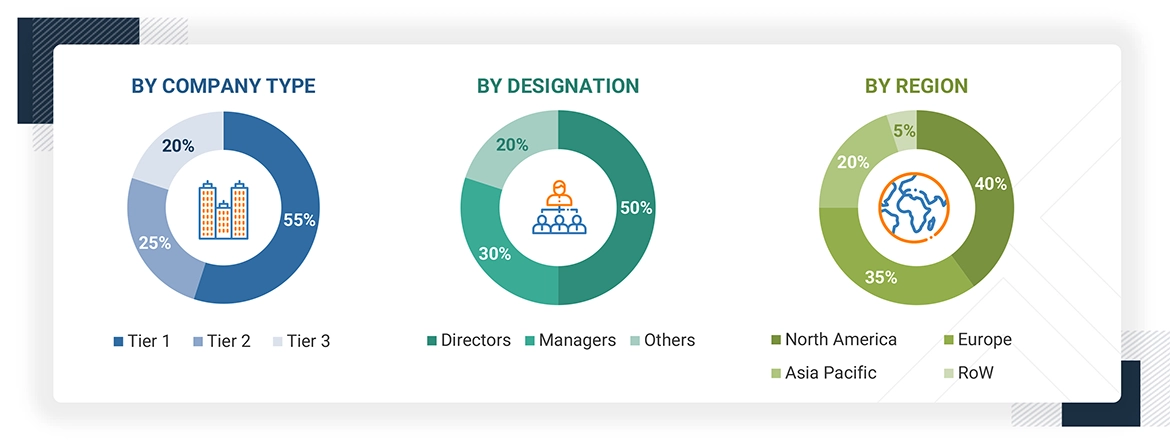
Note: Tier 1, Tier 2, and Tier 3 companies are classified based on their market revenue in 2023/2024, available in the public domain, product portfolios, and geographical presence.
Other designations include consultants and sales, marketing, and procurement managers.
To know about the assumptions considered for the study, download the pdf brochure
| COMPANY NAME | DESIGNATION | |
|---|---|---|
| DuPont de Nemours, Inc. | Senior Manager | |
| Teijin Limited | Innovation Manager | |
| Indorama Ventures Public Company Limited | Vice President | |
| Syensqo SA/NV | Production Supervisor | |
| TenCate Protective Fabrics | Sales Manager | |
Market Size Estimation
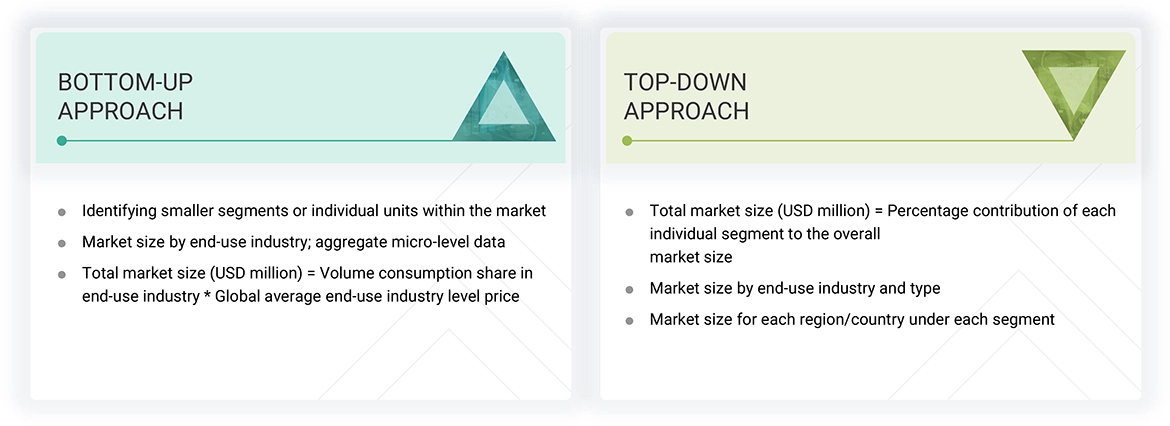
Both top-down and bottom-up approaches were used to estimate and validate the total size of the fire-resistant fabrics market. These methods were also used extensively to estimate the size of various subsegments in the market. The research methodology used to estimate the market size includes the following:
- The key players in the industry have been identified through extensive secondary research.
- The supply chain of the industry has been determined through primary and secondary research.
- All percentage shares, splits, and breakdowns have been determined using secondary sources and verified through primary sources.
- All possible parameters that affect the markets covered in this research study have been accounted for, viewed in extensive detail, verified through primary research, and analyzed to obtain the final quantitative and qualitative data.
Data Triangulation
After arriving at the overall market size—using the market size estimation processes as explained above—the market was split into several segments and subsegments. To complete the overall market engineering process and arrive at the exact statistics of each market segment and subsegment, data triangulation and market breakdown procedures were employed, wherever applicable. The data was triangulated by studying various factors and trends from both the demand and supply sides in the fire-resistant fabrics industry.
Market Definition
According to Comité International de la Rayonne et des Fibres Synthétiques (CIRFS), “Fire-resistant fabrics are materials that do not burn when exposed to fire due to their chemical structure.
Fire-resistant fabrics are used as the last-level protection barrier in case of direct exposure to fire. They do not catch fire or melt when exposed to fire. This type of fabric can have inherent fire resistance properties or be treated to make it fire resistant. Fire-resistant fabrics are also used to manufacture personal protective equipment (PPE) to safeguard personnel working in harsh, high-temperature environments.
Stakeholders
- Transfection products manufacturing companies
- Pharmaceutical & Biopharmaceutical Companies
- Chemical Companies
- Biopharmaceutical Companies
- Contract Research Organizations (CROs)
- Contract Development and Manufacturing Organizations (CDMOs)
- Research Institutes and Universities
- Venture Capitalists & Investors
- Government Associations
Report Objectives
- To define, describe, and forecast the fire-resistant fabrics market in terms of value and volume
- To provide detailed information regarding the major factors (drivers, opportunities, restraints, and challenges) influencing the market growth
- To estimate and forecast the market size by type, application, end-use industry, and region
- To forecast the size of the market with respect to five main regions (along with key countries of each region): Asia Pacific, North America, Europe, the Middle East & Africa, and South America
- To strategically analyze micromarkets with respect to individual growth trends, prospects, and their contribution to the overall market
- To analyze opportunities in the market for stakeholders and provide a competitive landscape of the market leaders
- To analyze competitive developments, such as product launches, acquisitions, partnerships, and expansions
- To strategically profile the key players and comprehensively analyze their core competencies
Key Questions Addressed by the Report
Who are the major players in the fire-resistant fabrics market?
DuPont de Nemours, Inc. (US), Teijin Limited (Japan), Indorama Ventures Public Company Limited (Thailand), Syensqo SA/NV (Belgium), TenCate Protective Fabrics (Netherlands), Lenzing AG (Austria), PBI Performance Products, Inc. (US), Kaneka Corporation (Japan), Gun Ei Chemical Industry Co., Ltd. (Japan), W. L. Gore & Associates, Inc. (US), and Milliken & Company (US).
What are the drivers and opportunities for the fire-resistant fabrics market?
Major drivers include stringent workplace safety regulations in developed countries, increased use in the oil & gas industry, and growing urbanization & infrastructure development. Technological innovations in product development are expected to create new opportunities.
Which strategies are the key players focusing on in the fire-resistant fabrics market?
Key strategies include product launches, partnerships, collaborations, mergers & acquisitions, agreements, and expansions to enhance global presence.
What is the expected growth rate of the fire-resistant fabrics market between 2025 and 2030?
The market is projected to grow at a CAGR of 7.24% in terms of value during the forecast period.
Which major factors are expected to restrain the growth of the fire-resistant fabrics market?
High production costs, significant R&D investment requirements, and lack of safety regulations in developing regions are expected to restrain market growth.
Fact checked
Personalize This Research
- Triangulate with your Own Data
- Get Data as per your Format and Definition
- Gain a Deeper Dive on a Specific Application, Geography, Customer or Competitor
- Any level of Personalization
Let Us Help You
- What are the Known and Unknown Adjacencies Impacting the Fire-resistant Fabrics Market
- What will your New Revenue Sources be?
- Who will be your Top Customer; what will make them switch?
- Defend your Market Share or Win Competitors
- Get a Scorecard for Target Partners

Custom Market Research Services
We Will Customise The Research For You, In Case The Report Listed Above Does Not Meet With Your Requirements
Get 10% Free CustomisationTESTIMONIALS

We at Nissan Chemicals Corporation have been clients of MarketsandMarkets for more than a year now. We recently consulted MarketsandMarkets for a study, the team at MarketsandMarkets was extremely professional and organized. The business insights were very detailed and aligned well with our expectations that really helped us formulate the Business Plans and device new strategies for development themes. MarketsandMarkets offers a unique combination of expertise and dedicated engagement model. Their research findings have helped us in designing our Pricing Strategy which will make it easier for us to predict the future sales and profits for the next ten years. We look forward to working with MarketsandMarkets in the future.
VP of Strategy & New Business Development
Leading Specialty Chemical Company
The MarketsandMarkets Engagement Model, composed of both the Knowledge Store and advisory custom research, has greatly helped us in understanding our markets and making strategic decisions. The Knowledge Store is a fast way to allow everyone in our organization to understand more about most any market they are interested in. The ability to then get custom research done and get answers to specific strategic questions and market insight has been spectacular. The Markets and Markets team feel more like colleagues than vendors and their services have helped us change our culture where statements of things like growth opportunities and competitive position are always backed by industry research.

Rich Gibson,
Director, Corporate Strategy
Milliken & Company,
Leading Industrial Manufacturer of specialty chemical, floor covering, performance and protective textile materials, and healthcaremilliken.com
MarketsandMarkets is a trusted resource that helps us to better understand markets that are near-adjacencies-whether its technology, value chain or geography. Their Knowledge Store platform provides a dashboard of markets and their characteristics which is easy to use and saves us time.
Adam Shaw,
Market Development and Strategy Manager
AdvanSix Inc. USA,
An American Leader in Chemicalswww.advansix.com
The Knowledge Store from MarketsandMarkets is a valuable tool which has helped my team acquire greater insight in to the end markets that our business serves. This has enabled us to help our company build stronger strategies throughout our planning process.
TOSHIO KINOSHITA
Senior Chif Consultion Research & Consulting Division
Mitsubishi Chemical Research Corporation,
Leading Manufacturer of Chemical Productswww.mitsubishichem-res.co.jp/en/

We recently engaged with MarketsandMarkets for a study, the team not only clearly understood our business objectives but was also extremely professional in the way they handled the entire project. The study was efficiently conducted in a phase-wise manner, and the engagement model furnished us with high-quality business insights that far exceeded our expectations at each phase. We were especially happy that MarketsandMarkets could provide us with both, an English as well as a Japanese version of the study. A special thanks to the Analyst Team and Client Services Team, whose fluency in Japanese enhanced our comfort level, as we could converse with them in our preferred language.
Independent entrepreneurs
Arrow Precision
We approached MarketsandMarkets for study on Proppants Market, and their work exceeded our expectations. The study conducted was comprehensive and enabled us to view the market through the various dimensions. In addition, the team was extraordinarily responsive throughout the process and resolved our queries on time. I strongly recommend MarketsandMarkets and will certainly consider them for additional market assessments we will need in the future.
Global engineering company, Japan
Deputy Manager,
Strategic Planning OfficeThe high-quality insights shared by the MarketsandMarkets team helped us understand the pharmaceutical plant designers in a specific geography. It also captured the risks that we may likely face in communicating with our potential partners. The study would enable us identify partners, which would impact our future growth.
- China Fire-resistant Fabrics Market
- Japan Fire-resistant Fabrics Market
- India Fire-resistant Fabrics Market
- South Korea Fire-resistant Fabrics Market
- US Fire-resistant Fabrics Market
- Canada Fire-resistant Fabrics Market
- Mexico Fire-resistant Fabrics Market
- Germany Fire-resistant Fabrics Market
- France Fire-resistant Fabrics Market
- UK Fire-resistant Fabrics Market
- Italy Fire-resistant Fabrics Market
- Russia Fire-resistant Fabrics Market
- Brazil Fire-resistant Fabrics Market
- Argentina Fire-resistant Fabrics Market
- Saudi Arabia Fire-resistant Fabrics Market
- UAE Fire-resistant Fabrics Market
- Iran Fire-resistant Fabrics Market
- South America Fire-resistant Fabrics Market
- Rest Of Europe Fire-resistant Fabrics Market
Growth opportunities and latent adjacency in Fire-resistant Fabrics Market






Enric
Jul, 2015
Interested in Aramid Fibre market.
Edson
Aug, 2019
flame retardant yarn Market.
Lee
Dec, 2018
Interested in market size, competition in Industrial setting (oil and gas, chemical, petrochemical, and mining) in GCC /Middle east region for Fire resistant clothing market..
Victor
Oct, 2016
Interested in Singapore, Indonesia, Thailand, Malaysia and Vietnam country level information..