



Identity Verification Market
Report Code
TC 7096
Published in
Oct, 2026, By MarketsandMarkets™
Identity Verification Market Application (Access Control & User Monitoring, KYC, KYB and Onboarding, Identity Fraud Compliance & Forensics), Type (Biometrics, Non-biometrics) – Global Forecast to 2031

USD 33.36 Billion
MARKET SIZE, 2031

CAGR 15.1%
(2026-2031)

350
REPORT PAGES

400
MARKET TABLES
OVERVIEW
Source: Secondary Research, Interviews with Experts, MarketsandMarkets Analysis
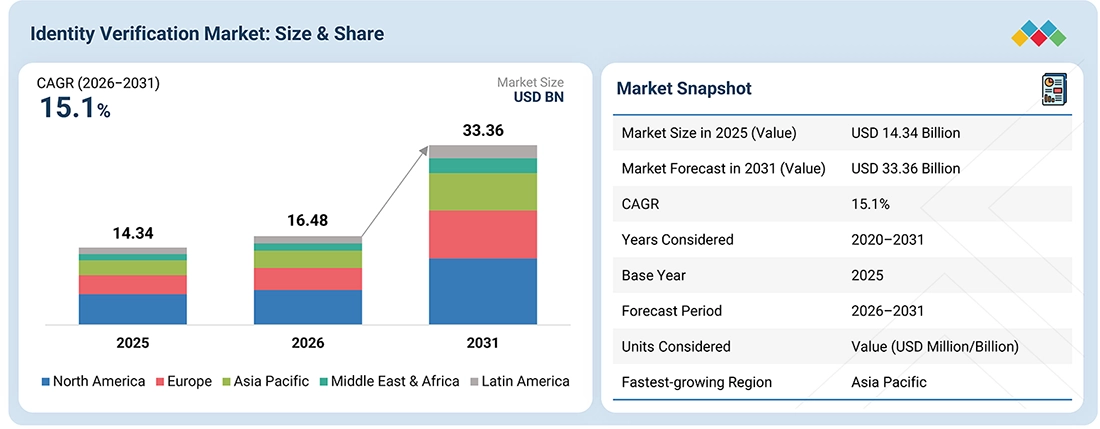
The global identity verification market size is projected to grow from USD 16.48 billion in 2026 to USD 33.36 billion by 2031, at a compound annual growth rate (CAGR) of 15.1% during the forecast period. Market growth is driven by the rapid shift toward digital onboarding and remote transactions across financial services, retail, telecommunications, healthcare, and government. In 2025, 8.3% of digital account creation attempts were suspected of fraud, increasing demand for stronger identity verification and authentication. The growing use of synthetic identities, deepfakes, and AI-generated fraud is further driving adoption of biometric, liveness, and document verification technologies, with 72% of businesses expecting AI-generated fraud and deepfakes to be major challenges by 2026. Increasing digital payments, regulatory requirements, and demand for faster, low-friction onboarding are further supporting adoption of identity verification solutions and services.
KEY TAKEAWAYS
-
BY REGIONNorth America is estimated to account for the largest share of the identity verification market, at 39.26%, in 2026.
-
BY OFFERINGBy offering, the solutions segment is expected to dominate the market in 2026.
-
BY TYPEBy type, the biometric segment is expected to dominate the market in 2026.
-
BY ORGANIZATION SIZEBy organization size, the SMEs segment is expected to grow the fastest, at a CAGR of 16.2%.
-
BY DEPLOYMENT MODEBy deployment mode, the on-premises segment is expected to have the largest market size during the forecast period.
-
BY APPLICATIONBy application, the access control segment is expected to grow at the fastest rate, with the highest CAGR of 17%.
-
BY VERTICALBy vertical, the gaming and gambling segment is expected to grow at the fastest rate, with the highest CAGR of 20%.
-
COMPETITIVE LANDSCAPE - KEY PLAYERSThe key players in the identity verification market include LexisNexis Risk Solutions, IDEMIA, Experian, Thales, GBG, and Jumio, which provide identity verification capabilities spanning biometric authentication, document verification, identity intelligence, fraud detection, digital onboarding, and compliance solutions across multiple industries.
-
COMPETITIVE LANDSCAPE - STARTUPS/SMEsEmerging identity verification providers such as Veriff, Sumsub, Persona, Shufti Pro, IDfy, and HyperVerge are expanding capabilities in AI-powered identity verification, biometric authentication, document verification, liveness detection, fraud prevention, and digital onboarding to address the growing demand for secure and frictionless digital identity verification.
The identity verification market is projected to witness rapid growth, driven by rising identity theft, digital fraud, and data breaches. As digital transactions expand, organizations are adopting biometric authentication, AI-based identity matching, and real-time document verification to secure onboarding and ensure compliance. Increasing KYC and AML regulations, coupled with a global focus on digital trust and data protection, are further accelerating market adoption across industries.
TRENDS & DISRUPTIONS IMPACTING CUSTOMERS' CUSTOMERS
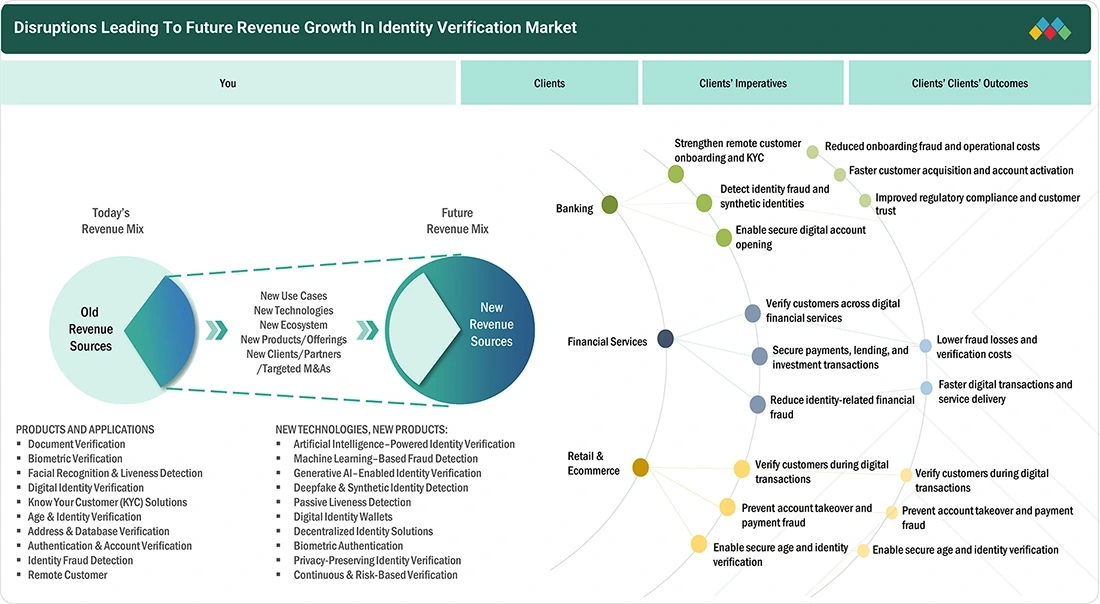
The identity verification market is shifting from static onboarding checks toward continuous, AI-enabled digital trust as organizations seek to secure increasingly digital customer journeys. The rapid evolution of deepfakes, synthetic identities, AI-generated documents, and automated fraud attacks is challenging traditional verification methods and increasing demand for multilayered identity intelligence, biometric authentication, liveness detection, and behavioral analytics. At the same time, organizations are prioritizing frictionless verification, with adaptive and risk-based authentication helping balance security with customer experience. The emergence of digital identity wallets, reusable credentials, interoperable identity networks, and continuous verification is further transforming the market, extending identity verification beyond initial onboarding into account recovery, transactions, and other high-risk interactions.
Source: Secondary Research, Interviews with Experts, MarketsandMarkets Analysis
MARKET DYNAMICS

Drivers
Impact
Level
Level
-
Growing digitalization initiatives

-
Rising occurrences of identity theft and fraud


RESTRAINTS
Impact
Level
Level
-
High implementation and maintenance costs

-
Lack of technical expertise and requirement for security awareness and training


OPPORTUNITIES
Impact
Level
Level
-
Proliferation of advanced technologies in identity verification

-
Adoption of biometric devices in identity verification systems


CHALLENGES
Impact
Level
Level
-
Disparities in the cost of identity verification solutions

-
Privacy and data breach challenges

Source: Secondary Research, Interviews with Experts, MarketsandMarkets Analysis
Driver: Growing digitalization initiatives
With rising identity fraud amid global digitization, businesses and governments are prioritizing secure identity verification for areas such as border control and digital services. Initiatives like electronic ID cards, facial recognition at smart borders, and video analytics in smart cities highlight its importance. The adoption of AI, ML, and automation creates growth opportunities, while expanding internet use and e-commerce fuel demand for biometric and other secure verification solutions, driving market growth.
Restraint: High implementation and maintenance costs
Organizations across industries are increasingly adopting identity verification solutions due to rising cyberattacks and identity fraud. However, high implementation costs, including expensive hardware and software for biometrics, facial recognition, and blockchain-based KYC, pose challenges, particularly for SMEs. Limited funding often delays security investments until after a breach, leaving small businesses vulnerable and hindering widespread deployment of effective identity verification systems.
Opportunity: Proliferation of advanced technologies in identity verification
Fraudulent transactions and data breaches are rising due to increasingly sophisticated cybercriminal tactics. AI-powered ID scanning and security methods, leveraging machine learning and deep learning, enable automated, reliable identity verification at scale. Sectors like government, banking, and credit agencies are adopting blockchain for secure, decentralized identity management, giving users control over their data. The integration of AI, ML, and blockchain in identity verification is expected to generate significant business opportunities.
Challenge: Disparities in the cost of identity verification solutions
Identity verification pricing varies widely due to factors like language support, technology, and data storage, leading to inconsistent costs. Different plans with varying check limits often confuse customers and create uncertainty about value. This complexity can cause dissatisfaction if services don’t meet needs. Clearer, transparent pricing models are essential to build trust, simplify decision-making, and drive broader adoption of identity verification solutions.
IDENTITY VERIFICATION MARKET: COMMERCIAL USE CASES ACROSS INDUSTRIES
| COMPANY | USE CASE DESCRIPTION | BENEFITS |
|---|---|---|
 |
Banco do Brasil deployed IBM watsonx.governance to centralize AI oversight, enabling real-time monitoring, proactive alerts, transparent compliance, and stronger governance across its expanding AI environment. | Unified AI oversight, improved monitoring and alerting, greater compliance transparency, stronger trust, and increased agility in AI deployment |
 |
Mastercard partnered with Credo AI to govern hundreds of generative AI use cases through centralized AI registries, automated risk assessments, stakeholder reviews, and third-party vendor assessments. | Reduced governance effort, improved visibility into AI adoption, accelerated reviews, strengthened collaboration, and enabled enterprise-wide control over AI risks |
|
|
Infosys deployed IBM watsonx.governance to govern more than 2,700 AI use cases, streamlining risk assessments, compliance processes, lifecycle oversight, and centralized governance across functions and geographies. | Achieved a 150% improvement in operational efficiency, accelerated AI project delivery, and maintained consistent governance across enterprise AI deployments |
|
|
The US Open used IBM watsonx.governance to identify and mitigate bias in tournament data, applying post-processing techniques to improve fairness without compromising overall accuracy. | Increased court fairness from 71% to 82%, representing an 11% improvement while maintaining overall model accuracy |
 |
The US Army deployed BigID to discover and classify sensitive data, identify vulnerable information, automate retention, and establish stronger governance and risk controls across its complex cloud and enterprise data environment. | Improved sensitive-data visibility, reduced data risk, accelerated secure cloud migration, minimized redundant data, and strengthened automated data retention |
Logos and trademarks shown above are the property of their respective owners. Their use here is for informational and illustrative purposes only.
MARKET ECOSYSTEM
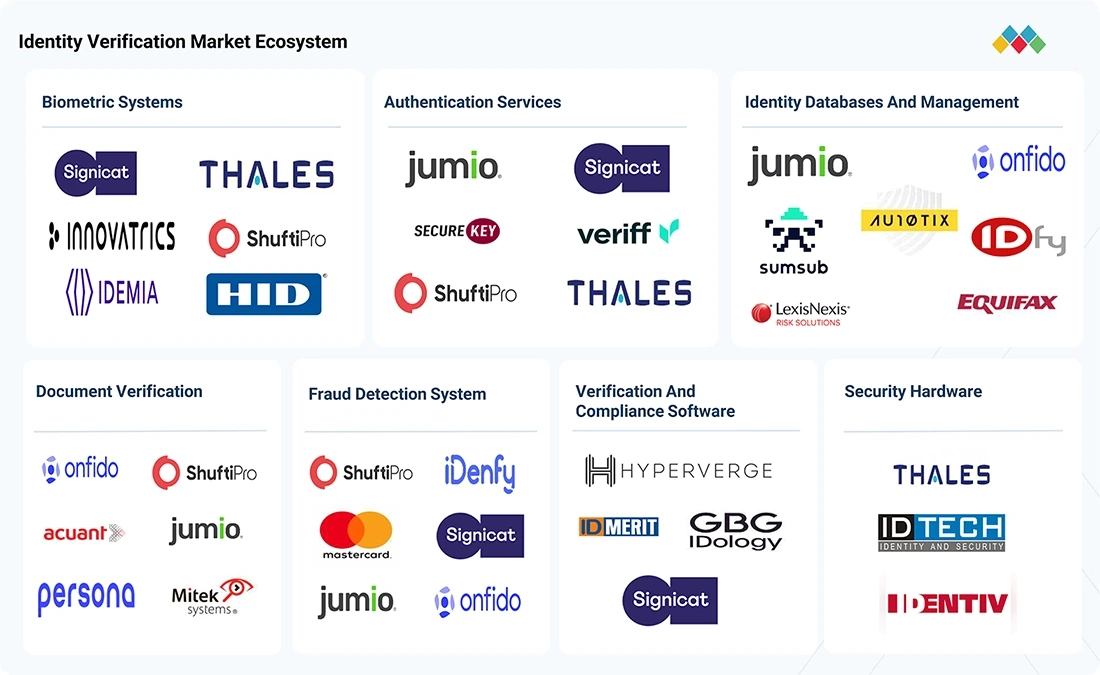
The identity verification ecosystem spans biometric systems, authentication services, identity databases and management, document verification, fraud detection, verification and compliance software, and security hardware. The ecosystem is evolving toward integrated identity solutions that combine biometric and document checks with identity intelligence, fraud analytics, and compliance capabilities. Increasing digital transactions and security requirements are driving greater interoperability across these solution categories.
Logos and trademarks shown above are the property of their respective owners. Their use here is for informational and illustrative purposes only.
MARKET SEGMENTS
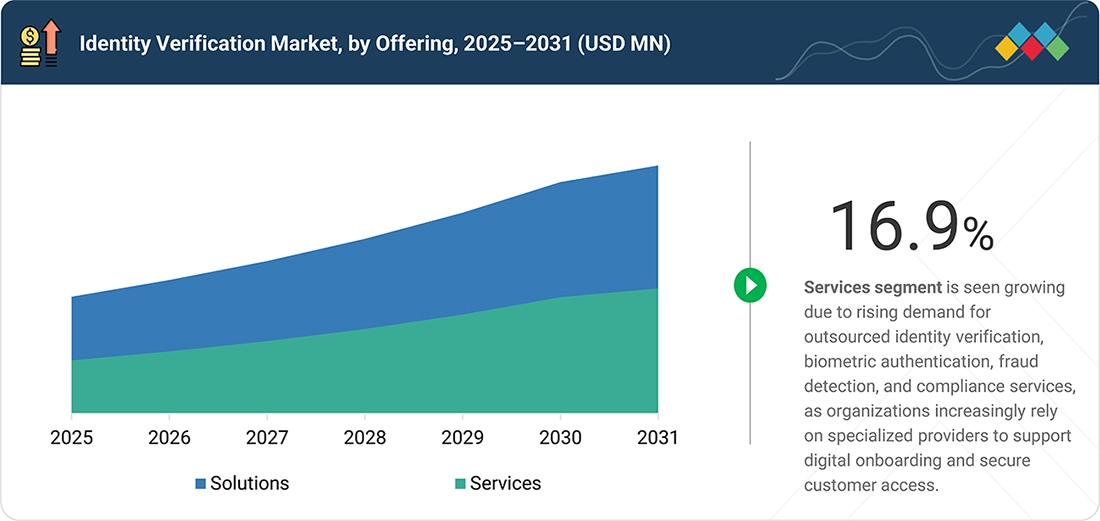
Source: Secondary Research, Interviews with Experts, MarketsandMarkets Analysis
Identity Verification Market, By Offering
The solutions segment is expected to hold the largest market revenue share, driven by the growing need for secure, frictionless, and real-time identity verification across digital interactions. Solutions enable organizations to authenticate users through biometrics, document verification, authentication, and fraud detection capabilities. Meanwhile, the services segment is expected to register the highest growth rate, supported by increasing demand for specialized implementation, integration, managed verification, and compliance services.
Identity Verification Market, By Type
The biometric segment is expected to hold the largest market revenue share, supported by growing demand for secure and convenient identity authentication. Technologies such as facial recognition, fingerprint scanning, iris recognition, and voice recognition enable accurate and real-time identity verification across digital environments. Meanwhile, the non-biometric segment is expected to register the highest growth rate, driven by increasing adoption of document verification, data verification, and authentication-based solutions.
Identity Verification Market, By Organization Size
The large enterprises segment is expected to hold the largest market revenue share, driven by the need to manage complex operations, secure large user bases, and comply with stringent regulatory requirements. These organizations increasingly adopt identity verification to strengthen access controls, detect fraudulent activities, and support secure digital operations. Meanwhile, the SMEs segment is expected to register the highest growth rate, supported by increasing digitalization, cloud adoption, and growing demand for cost-effective identity verification solutions.
Identity Verification Market, By Deployment Mode
The large enterprises segment is expected to hold the largest market revenue share, driven by the need to manage complex operations, secure large user bases, and comply with stringent regulatory requirements. These organizations increasingly adopt identity verification to strengthen access controls, detect fraudulent activities, and support secure digital operations. Meanwhile, the SMEs segment is expected to register the highest growth rate, supported by increasing digitalization, cloud adoption, and growing demand for cost-effective identity verification solutions.
Identity Verification Market, By Application
The KYC, KYB, and onboarding segment is expected to hold the largest market revenue share, driven by increasing regulatory requirements, digital customer acquisition, and demand for seamless identity verification during onboarding. Identity verification solutions help organizations authenticate customers and businesses while supporting compliance and fraud prevention. Meanwhile, the access control and user monitoring segment is expected to register the highest growth rate, driven by growing demand for secure digital access, continuous authentication, and real-time user verification.
Identity Verification Market, By Vertical
The gaming and online gambling segment is expected to register the highest growth rate, driven by increasing digital participation, stringent age and identity verification requirements, and growing concerns around fraud, account takeover, and regulatory compliance. The expansion of online gaming and gambling platforms is further increasing demand for secure and seamless identity verification across digital customer journeys.
REGION
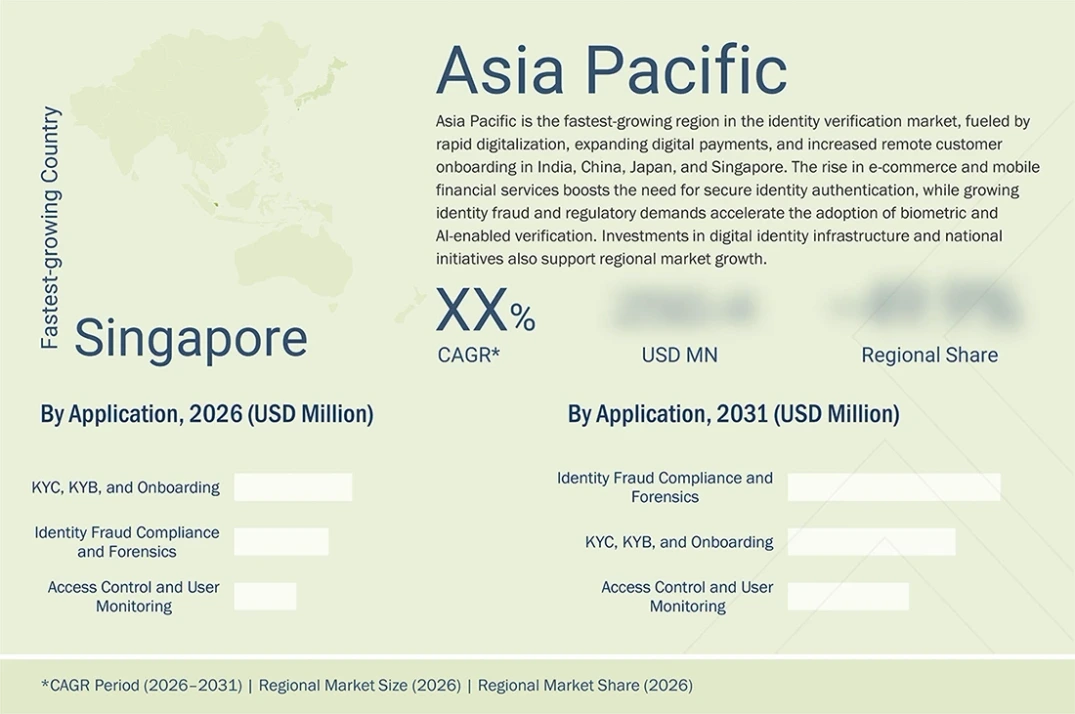
Asia Pacific to be fastest-growing region in global identity verification market during forecast period
Asia Pacific will be the fastest-growing region in the identity verification market during the forecast period, driven by rapid digitalization, expanding digital payments, and increasing adoption of remote customer onboarding across India, China, Japan, and Singapore. Rising e-commerce and mobile financial services are increasing the need for secure identity authentication, while growing identity fraud and regulatory requirements are accelerating adoption of biometric, document, and AI-enabled verification. Investments in digital identity infrastructure and national digital identity initiatives are further supporting market growth across the region.
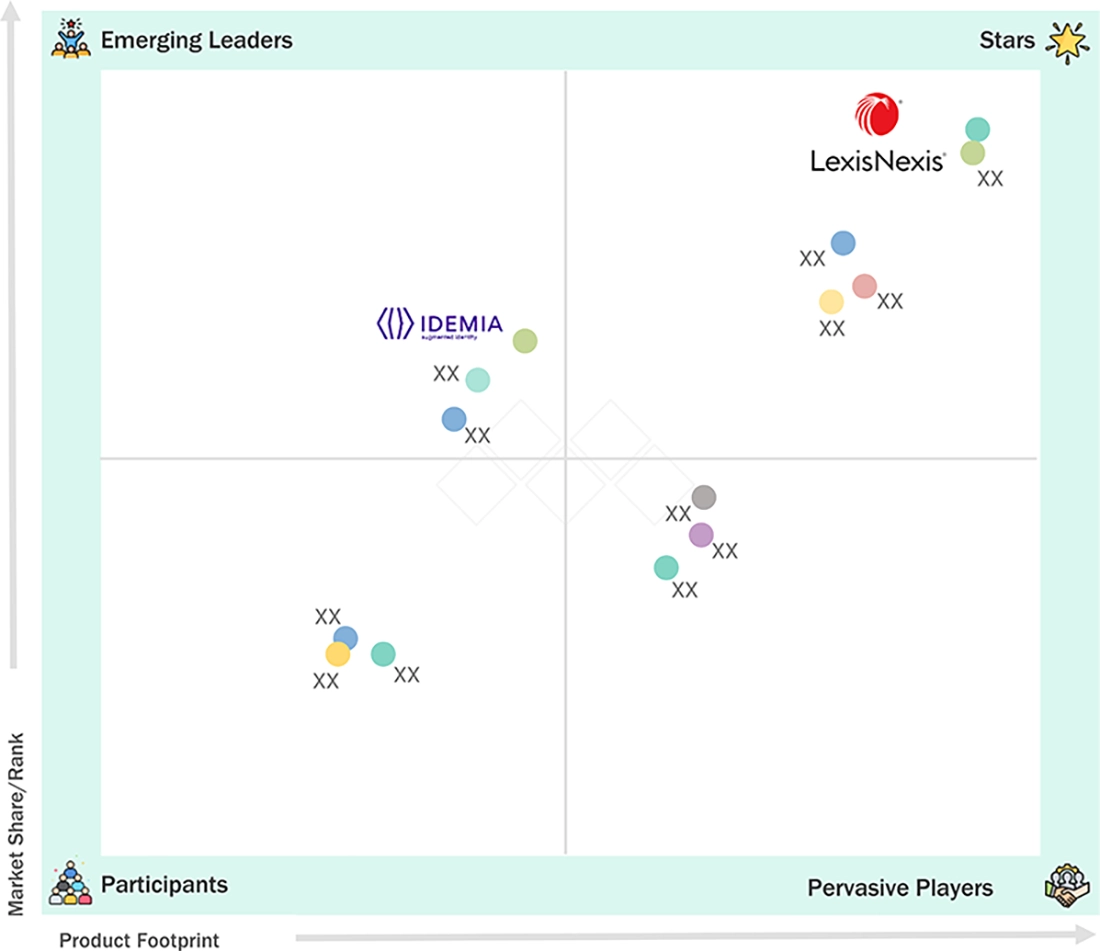
IDENTITY VERIFICATION MARKET: COMPANY EVALUATION MATRIX
In the identity verification market matrix, LexisNexis Risk Solutions (Star) leads with a strong market share and extensive solution portfolio, driven by its advanced AI-powered identity matching, fraud detection, and compliance offerings widely adopted across BFSI, healthcare, and government sectors. IDEMIA (Emerging Leader) is gaining visibility with its biometric and secure identity solutions, strengthening its position through innovation and specialized offerings. While LexisNexis dominates through scale and diverse capabilities, IDEMIA shows significant potential to move toward the leaders' quadrant as demand for biometric and advanced verification solutions continues to rise.
Source: Secondary Research, Interviews with Experts, MarketsandMarkets Analysis
KEY MARKET PLAYERS
- Experian (Ireland)
- LexisNexis Risk Solutions (US)
- Equifax (US)
- Thales (France)
- GBG (UK)
- TransUnion (US)
- Mastercard (US)
- Entrust (US)
- Onfido (UK)
- Trulioo (Canada)
- Acuant (US)
- Mitek Systems (US)
- IDEMIA (France)
- Jumio (US)
- HyperVerge (India)
- AU10TIX (Israel)
- Innovatrics (Slovakia)
- Intellicheck (US)
- Signicat (Norway)
- SecureKey Technologies (Canada)
- IDfy (India)
- IDMERIT (US)
- Veriff (Estonia)
- AuthenticID (US)
- TruNarrative (UK)
- Sumsub (UK)
- IDology (US)
- PXL Vision (Switzerland)
- Shufti Pro (UK)
- iDenfy (Lithuania)
- Persona (US)
MARKET SCOPE
| REPORT METRIC | DETAILS |
|---|---|
| Market Size in 2025 (Value) | USD 14.34 Billion |
| Market Forecast in 2026 (Value) | USD 16.48 Billion |
| Market Forecast in 2031 (Value) | USD 33.36 Billion |
| Growth Rate | CAGR of 15.1% from 2026–2031 |
| Years Considered | 2020–2031 |
| Base Year | 2025 |
| Forecast Period | 2026–2031 |
| Units Considered | Value (USD Million/Billion) |
| Report Coverage | Revenue forecast, company ranking, competitive landscape, growth factors, and trends |
| Segments Covered |
|
| Regions Covered | North America, Europe, Asia Pacific, Middle East & Africa, Latin America |
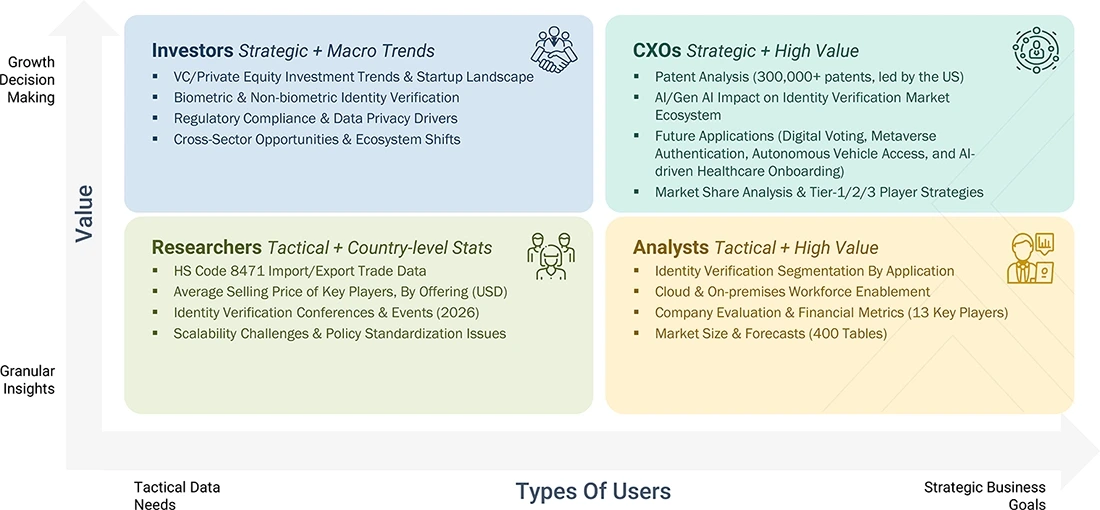
WHAT IS IN IT FOR YOU: IDENTITY VERIFICATION MARKET REPORT CONTENT GUIDE
DELIVERED CUSTOMIZATIONS
We have successfully delivered the following deep-dive customizations:
| CLIENT REQUEST | CUSTOMIZATION DELIVERED | VALUE ADDS |
|---|---|---|
| Leading Solution Provider (US) | Product Analysis: Comprehensive comparison of leading identity verification solutions, including biometric verification, document verification, authentication, liveness detection, identity databases, fraud detection, and AI-enabled identity verification capabilities across digital onboarding, financial services, e-commerce, telecommunications, healthcare, and government applications | Stronger understanding of vendor positioning, verification capabilities, biometric and AI maturity, fraud prevention features, deployment flexibility, compliance capabilities, and integration options—supporting technology selection, competitive benchmarking, and identity security investment planning |
| Leading Service Provider (EU) | Company Information: Detailed profiling and evaluation of additional identity verification vendors (up to 5), covering identity verification portfolios, biometric and document verification capabilities, authentication services, fraud detection, compliance solutions, regional presence, strategic partnerships, industry focus, and competitive positioning across the global identity verification market | Comprehensive perspective of the evolving identity verification ecosystem, highlighting the shift toward continuous verification, multimodal biometrics, AI-enabled fraud detection, digital identity infrastructure, and integrated compliance capabilities, supporting vendor evaluation and strategic partnership decisions |
RECENT DEVELOPMENTS
- September 2026 : Jumio launched selfie.DONE across Asia Pacific, extending its reusable identity solution into the region. The offering uses Jumio’s Global Identity Graph to enable trusted returning users to complete onboarding with a selfie, reducing reliance on repeated document verification.
- September 2026 : Unico agreed to acquire Valida, an Argentine biometric identity verification platform, to expand its presence in Latin America. The transaction is intended to strengthen Unico’s identity verification capabilities and establish operations in Argentina.
- July 2026 : GBG expanded its technology partnership with Intellias to accelerate AI-enabled identity and fraud intelligence. The collaboration builds on GBG Foresight and GBG Go, using AI engineering capabilities to improve identity signals, customer onboarding, and decision-making for financial services and gaming.
- May 2026 : Equifax and GBG expanded their global partnership into the US, integrating Equifax Identity and Fraud solutions with GBG Go. The collaboration combines Equifax data and analytics with GBG’s adaptive identity platform to strengthen identity verification and fraud protection.
- April 2026 : Trulioo partnered with Phoenix Digital Health to provide identity verification for virtual healthcare in Canada. Phoenix selected Trulioo KYC Documents to verify patient identities during onboarding, supporting fraud reduction, regulatory compliance, and faster access to digital healthcare services.
Table of Contents
 Exclusive indicates content/data unique to MarketsandMarkets and not available with any competitors.
TITLE
PAGE NO
1
INTRODUCTION
15
2
EXECUTIVE SUMMARY
3
PREMIUM INSIGHTS
4
MARKET OVERVIEW
Covers the key developments, trend analysis, and actionable insights to support strategic planning and positioning.
(IDENTIFY GROWTH OPPORTUNITIES AND STRATEGIC GAPS IN THE IDENTITY VERIFICATION MARKET)
4.1
INTRODUCTION
4.2
MARKET DYNAMICS
4.2.1
DRIVERS
4.2.2
RESTRAINTS
4.2.3
OPPORTUNITIES
4.2.4
CHALLENGES
4.3
INTERCONNECTED MARKETS AND CROSS-SECTOR OPPORTUNITIES
4.4
STRATEGIC MOVES BY TIER-1/2/3 PLAYERS
5
INDUSTRY TRENDS
Captures industry movement, adoption patterns, and strategic signals across key end-use segments and regions.
(NAVIGATE INDUSTRY SHIFTS WITH STRATEGIC INSIGHTS FROM COMPETITIVE FORCES AND EVOLVING IDENTITY VERIFICATION TRENDS.)
5.1
PORTER’S FIVE FORCES ANALYSIS
5.1.1
BARGAINING POWER OF SUPPLIERS
5.1.2
THREAT OF NEW ENTRANTS
5.1.3
THREAT OF SUBSTITUTES
5.1.4
BARGAINING POWER OF BUYERS
5.1.5
INTENSITY OF RIVALRY
5.2
MACROECONOMIC OUTLOOK
5.2.1
INTRODUCTION
5.2.2
GDP TRENDS AND FORECAST
5.2.3
TRENDS IN THE GLOBAL CYBERSECURITY INDUSTRY
5.2.4
TRENDS IN THE GLOBAL IDENTITY VERIFICATION INDUSTRY
5.3
VALUE CHAIN ANALYSIS
5.4
ECOSYSTEM ANALYSIS
5.5
PRICING ANALYSIS
5.6
KEY CONFERENCES AND EVENTS, 2026-2027
5.7
TRENDS/DISTURBANCES IMPACTING CUSTOMER BUSINESS
5.8
INVESTMENT FUNDING SCENARIO
5.9
CASE STUDY ANALYSIS
6
STRATEGIC DISRUPTION: PATENTS, DIGITAL, AND AI ADOPTION
(HARNESS AI-DRIVEN SYNTHETIC IDENTITY DETECTION TECHNOLOGIES TO STRENGTHEN TRUST, SECURE CUSTOMER ONBOARDING, AND MITIGATE EVOLVING IDENTITY FRAUD RISKS.)
6.1
KEY EMERGING TECHNOLOGIES
6.2
COMPLEMENTARY TECHNOLOGIES
6.3
TECHNOLOGY/PRODUCT ROADMAP
6.4
PATENT ANALYSIS
6.4.1
LIST OF MAJOR PATENTS
6.5
FUTURE APPLICATIONS
6.6
IMPACT OF GEN AI ON THE IDENTITY VERIFICATION MARKET
6.6.1
TOP USE CASES AND MARKET POTENTIAL
6.6.2
BEST PRACTICES IN IDENTITY VERIFICATION
6.6.3
CASE STUDIES OF AI IMPLEMENTATION IN THE IDENTITY VERIFICATION MARKET
6.6.4
INTERCONNECTED ADJACENT ECOSYSTEM AND IMPACT ON MARKET PLAYERS
6.6.5
CLIENT READINESS TO ADOPT GENERATIVE AI IN THE IDENTITY VERIFICATION MARKET
7
REGULATORY LANDSCAPE
(NAVIGATE COMPLEX GLOBAL REGULATIONS WITH A COMPREHENSIVE GUIDE TO REGIONAL COMPLIANCE AND INDUSTRY STANDARDS.)
7.1
REGIONAL REGULATION AND COMPLIANCE
7.1.1
REGULATORY BODIES, GOVERNMENT AGENCIES, AND OTHER ORGANIZATIONS
7.1.2
INDUSTRY STANDARDS
8
CUSTOMER LANDSCAPE & BUYER BEHAVIOR
(UNCOVER HOW STAKEHOLDER DYNAMICS SHAPE PURCHASING DECISIONS AND REVEAL CRITICAL UNMET INDUSTRY NEEDS)
8.1
DECISION-MAKING PROCESS
8.2
BUYER STAKEHOLDERS AND BUYING EVALUATION CRITERIA
8.3
ADOPTION BARRIERS & INTERNAL CHALLENGES
8.4
UNMET NEEDS FROM VARIOUS END-USE INDUSTRIES
9
IDENTITY VERIFICATION MARKET, BY OFFERING (MARKET SIZE & FORECAST ANALYSIS TO 2031– IN VALUE, USD MILLION)
9.1
INTRODUCTION
9.1.1
OFFERING: IDENTITY VERIFICATION MARKET DRIVERS
9.2
SOLUTIONS
9.3
SERVICES
9.3.1
CONSULTING SERVICES
9.3.2
INTEGRATION SERVICES
9.3.3
TRAINING & SUPPORT SERVICES
9.3.4
OTHER SERVICES
9.3.4.1
ONBOARDING & KYC SERVICES
9.3.4.2
FRAUD DETECTION & PREVENTION SERVICES
9.3.4.3
CONTINUOUS AUTHENTICATION & MONITORING SERVICES
10
IDENTITY VERIFICATION MARKET, BY TYPE (MARKET SIZE & FORECAST ANALYSIS TO 2031– IN VALUE, USD MILLION)
10.1
INTRODUCTION
10.1.1
TYPE: IDENTITY VERIFICATION MARKET DRIVERS
10.2
BIOMETRIC
10.2.1
FACE RECOGNITION
10.2.2
FINGERPRINT SCANNING
10.2.3
IRIS RECOGNITION
10.2.4
VOICE RECOGNITION
10.2.5
PALM RECOGNITION
10.2.6
OTHERS (VEIN PATTERN, GAIT ANALYSIS)
10.3
NON-BIOMETRIC
10.3.1
DOCUMENT VERIFICATION
10.3.2
KNOWLEDGE-BASED AUTHENTICATION (KBA)
10.3.3
POSSESSION-BASED AUTHENTICATION
10.3.4
INHERENCE-BASED AUTHENTICATION
10.3.5
DATA VERIFICATION
11
IDENTITY VERIFICATION MARKET, BY APPLICATION (MARKET SIZE & FORECAST ANALYSIS TO 2031– IN VALUE, USD MILLION)
11.1
INTRODUCTION
11.1.1
APPLICATIONS: IDENTITY VERIFICATION MARKET DRIVERS
11.2
ACCESS CONTROL & USER MONITORING
11.3
KYC, KYB AND ONBOARDING
11.4
IDENTITY FRAUD COMPLIANCE & FORENSICS
12
IDENTITY VERIFICATION MARKET, BY ORGANIZATION SIZE (MARKET SIZE & FORECAST ANALYSIS TO 2031– IN VALUE, USD MILLION)
12.1
INTRODUCTION
12.1.1
ORGANIZATION SIZE: IDENTITY VERIFICATION MARKET DRIVERS
12.2
LARGE ENTERPRISES
12.3
SMES
13
IDENTITY VERIFICATION MARKET, BY DEPLOYMENT MODE (MARKET SIZE & FORECAST ANALYSIS TO 2031– IN VALUE, USD MILLION)
13.1
INTRODUCTION
13.1.1
DEPLOYMENT MODE: IDENTITY VERIFICATION MARKET DRIVERS
13.2
ON-PREMISES
13.3
CLOUD
14
IDENTITY VERIFICATION MARKET, BY VERTICAL (MARKET SIZE & FORECAST ANALYSIS TO 2031– IN VALUE, USD MILLION)
14.1
INTRODUCTION
14.1.1
VERTICAL: IDENTITY VERIFICATION MARKET DRIVERS
14.2
BANKING
14.3
FINANCIAL SERVICES
14.3.1
CROSS-BORDER PAYMENTS & REMITTANCE PROVIDERS (MONEY TRANSFER OPERATORS, FX PLATFORMS)
14.3.2
P2P PAYMENT PLATFORMS (WALLETS, APPS NOT DIRECTLY CLASSIFIED AS BANKS)
14.3.3
LENDING & BUY NOW PAY LATER (BNPL) PAYMENT FLOWS
14.3.4
CRYPTO PAYMENTS & DIGITAL ASSET EXCHANGE
14.3.5
INVESTMENT & BROKERAGE ACCOUNT VERIFICATION
14.4
INSURANCE (BFSI)
14.5
RETAIL & ECOMMERCE
14.6
TELECOMMUNICATIONS
14.7
GAMING AND ONLINE GAMBLING
14.8
HEALTHCARE
14.9
GOVERNMENT & PUBLIC SECTOR
14.10
OTHERS
(PLEASE NOTE: CHAPTERS 9 TO 13 MAY CHANGE SLIGHTLY DURING THE MARKET STUDY, AND ALL MARKET SIZE ESTIMATES AND FORECAST DATA WILL BE IN USD MILLION.) THE BASE YEAR CONSIDERED WOULD BE 2025; 2026 WILL BE THE ESTIMATED YEAR, AND FORECAST TABLES UNTIL 2031 WI
15
IDENTITY VERIFICATION MARKET BY REGION (MARKET SIZE & FORECAST ANALYSIS TO 2031– IN VALUE, USD MILLION)
(COMPREHENSIVE COVERAGE OF 5 REGIONS WITH A COUNTRY-LEVEL DEEP DIVE OF 14+ COUNTRIES)
15.1
INTRODUCTION
15.2
NORTH AMERICA
15.2.1
UNITED STATES
15.2.2
CANADA
15.3
EUROPE
15.3.1
UNITED KINGDOM
15.3.2
GERMANY
15.3.3
FRANCE
15.3.4
ITALY
15.3.5
REST OF EUROPE
15.4
ASIA PACIFIC
15.4.1
CHINA
15.4.2
JAPAN
15.4.3
INDIA
15.4.4
SINGAPORE
15.4.5
REST OF ASIA PACIFIC
15.5
MIDDLE EAST & AFRICA
15.5.1
MIDDLE EAST
15.5.1.1
GCC
15.5.1.1.1
UAE
15.5.1.1.2
KSA
15.5.1.1.3
REST OF GCC
15.5.1.2
REST OF THE MIDDLE EAST
15.5.2
AFRICA
15.6
LATIN AMERICA
15.6.1
BRAZIL
15.6.2
MEXICO
15.6.3
REST OF LATIN AMERICA
16
COMPETITIVE LANDSCAPE
(UNCOVER KEY PLAYERS' WINNING STRATEGIES AND MARKET DOMINANCE IN THE EVOLVING COMPETITIVE LANDSCAPE)
16.1
INTRODUCTION
16.2
KEY PLAYER STRATEGIES/RIGHT TO WIN
16.3
REVENUE ANALYSIS (2021-2025)
16.4
MARKET SHARE ANALYSIS,
16.5
BRAND/PRODUCT COMPARISON
16.6
COMPANY EVALUATION MATRIX: KEY PLAYERS,
16.6.1
STARS
16.6.2
EMERGING LEADERS
16.6.3
PERVASIVE PLAYERS
16.6.4
PARTICIPANTS
16.6.5
COMPANY FOOTPRINT: KEY PLAYERS,
16.6.5.1
OVERALL COMPANY FOOTPRINT
16.6.5.2
OFFERING FOOTPRINT
16.6.5.3
APPLICATION FOOTPRINT
16.6.5.4
VERTICAL FOOTPRINT
16.6.5.5
REGION FOOTPRINT
16.7
COMPANY EVALUATION MATRIX: STARTUPS/SMES,
16.7.1
PROGRESSIVE COMPANIES
16.7.2
RESPONSIVE COMPANIES
16.7.3
DYNAMIC COMPANIES
16.7.4
STARTING BLOCKS
16.7.5
COMPETITIVE BENCHMARKING: STARTUPS/SMES,
16.7.5.1
DETAILED LIST OF KEY STARTUPS/SMES
16.7.5.2
COMPETITIVE BENCHMARKING OF KEY STARTUPS/SMES
16.8
COMPANY VALUATION AND FINANCIAL METRICS
16.9
COMPETITIVE SCENARIOS
16.9.1
PRODUCT LAUNCHES AND DEVELOPMENT
16.9.2
DEALS
16.9.3
OTHERS
17
COMPANY PROFILES
(IN-DEPTH COMPANY PROFILES OF LEADING MARKET PLAYERS WITH DETAILED BUSINESS OVERVIEW, PRODUCT AND SERVICE PORTFOLIO, RECENT DEVELOPMENTS, AND UNIQUE ANALYST PERSPECTIVE (MNM VIEW) FOR THE TOP 5 VENDORS)
17.1
KEY PLAYERS
17.1.1
EXPERIAN
17.1.2
LEXISNEXIS RISK SOLUTIONS
17.1.3
EQUIFAX
17.1.4
THALES
17.1.5
GBG
17.1.6
TRANSUNION
17.1.7
MASTERCARD
17.1.8
ONFIDO
17.1.9
TRULIOO
17.1.10
ACUANT
17.1.11
MITEK SYSTEMS
17.1.12
IDEMIA
17.1.13
JUMIO
17.1.14
HYPERVERGE
17.1.15
AU10TIX
17.1.16
INNOVATRICS
17.1.17
INTELLICHECK
17.1.18
SIGNICAT
17.1.19
SECUREKEY TECHNOLOGIES
17.1.20
IDFY
17.1.21
IDMERIT
17.1.22
VERIFF
17.1.23
AUTHENTICID
17.1.24
TRUNARATIVE
17.1.25
SUMSUB
17.1.26
IDOLOGY
17.1.27
PXL VISION
17.1.28
SHUFTI PRO
17.1.29
IDENFY
17.1.30
PERSONA
18
RESEARCH METHODOLOGY
18.1
RESEARCH DATA
18.1.1
SECONDARY DATA
18.1.1.1
KEY DATA FROM SECONDARY SOURCES
18.1.2
PRIMARY DATA
18.1.2.1
KEY DATA FROM PRIMARY SOURCES
18.1.2.2
KEY PRIMARY PARTICIPANTS
18.1.2.3
BREAKDOWN OF PRIMARY INTERVIEWS
18.1.2.4
KEY INDUSTRY INSIGHTS
18.2
MARKET SIZE ESTIMATION
18.2.1
BOTTOM-UP APPROACH
18.2.2
TOP-DOWN APPROACH
18.2.3
BASE NUMBER CALCULATIONS
18.3
RESEARCH ASSUMPTIONS
18.4
RESEARCH LIMITATIONS
19
APPENDIX
19.1
DISCUSSION GUIDE
19.2
KNOWLEDGE STORE: MARKETSANDMARKETS’ SUBSCRIPTION PORTAL
19.3
CUSTOMIZATION OPTIONS
19.4
RELATED REPORTS
19.5
AUTHOR DETAILS
Methodology
This study involved estimating the current identity verification market size. Exhaustive secondary research was carried out to collect information on the identity verification industry. The next step was to validate these findings, assumptions, and sizing with industry experts across the value chain using primary research. Different approaches, such as top-down and bottom-up, were employed to estimate the total market size. After that, the market breakup and data triangulation procedures were used to estimate the market size of the segments and subsegments of the identity verification market.
Secondary Research
The market for companies offering identity verification solutions and services was arrived at by using secondary data available through paid and unpaid sources, analyzing the product portfolios of the major companies in the ecosystem, and rating the companies by their performance and quality. Various sources were referred to in the secondary research process to identify and collect information for this study. The secondary sources included annual reports, press releases, investor presentations of companies, white papers, journals, certified publications, and articles from recognized authors, directories, and databases.
In the secondary research process, various secondary sources were referred to to identify and collect information related to the study. Secondary sources included annual reports, press releases, and investor presentations of identity verification vendors, forums, certified publications, and whitepapers. Secondary research was used to obtain essential information on the industry’s value chain, the total pool of key players, market classification, and segmentation from the market and technology-oriented perspectives.
Primary Research
In the primary research process, various supply and demand sources were interviewed to obtain qualitative and quantitative information for this report. The primary sources from the supply side included industry experts, such as Chief Executive Officers (CEOs), Vice Presidents (VPs), marketing directors, technology and innovation directors, and related key executives from various key companies and organizations operating in the identity verification market.
After the complete market engineering (calculations for market statistics, market breakdown, market size estimations, market forecasting, and data triangulation), extensive primary research was conducted to gather information and verify and validate the critical numbers arrived at. Primary research was also undertaken to identify the segmentation types, industry trends, competitive landscape of identity verification hardware, software, and services offered by various market players, and fundamental market dynamics, such as drivers, restraints, opportunities, challenges, industry trends, and key player strategies.
In the complete market engineering process, the top-down and bottom-up approaches and several data triangulation methods were extensively used to perform the market estimation and market forecasting for the overall market segments and subsegments listed in this report. Extensive qualitative and quantitative analysis was performed on the complete market engineering process to list the key information/insights throughout the report.
Following is the breakup of the primary study:
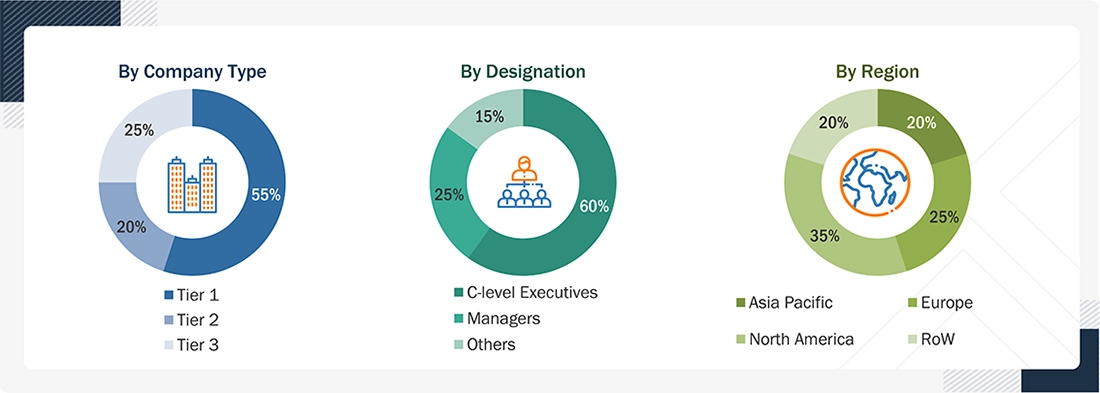
Note: The companies have been categorized based on their total annual revenue; tier 1 companies = revenue greater than USD 10 billion; tier 2 companies = revenue between USD 1 billion and USD 10 billion; and tier 3 companies = revenue between USD 500 million and USD 1 billion.
Source: MarketsandMarkets Analysis
To know about the assumptions considered for the study, download the pdf brochure
Market Size Estimation
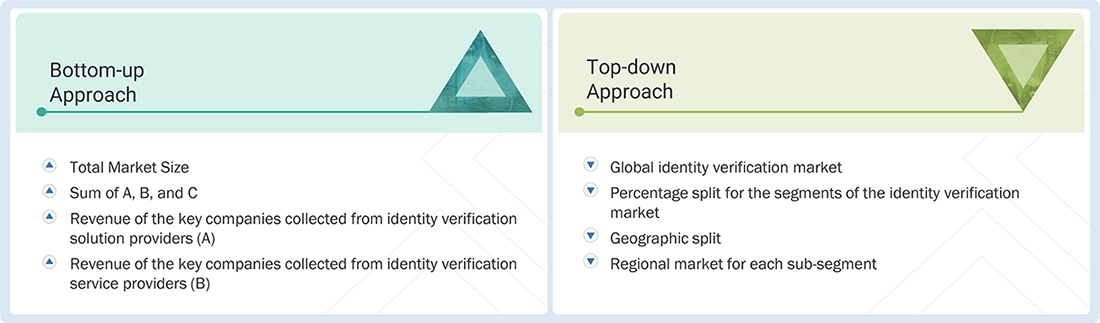
Top-down and bottom-up approaches were used to estimate and validate the size of the identity verification market and the size of various other dependent sub-segments. The research methodology used to estimate the market size included the following details: key players in the market were identified through secondary research, and their market shares in the respective regions were determined through primary and secondary research. This entire procedure included the study of the annual and financial reports of the top market players, as well as extensive interviews for key insights with industry leaders, such as CEOs, VPs, directors, and marketing executives.
All percentage splits and breakdowns were determined using secondary sources and verified through primary sources. All possible parameters that affect the market covered in this research study were accounted for, viewed in extensive detail, verified through primary research, and analyzed to get the final quantitative and qualitative data. This data was consolidated and added to detailed inputs and analysis from MarketsandMarkets.
Identity Verification Market: Top-Down and Bottom-Up Approach
Data Triangulation
After arriving at the overall market size using the market size estimation processes explained above, the market was split into several segments and subsegments. The data triangulation and market breakup procedures were employed, wherever applicable, to complete the overall market engineering process and arrive at the exact statistics of each market segment and subsegment. The data was triangulated by studying various factors and trends from both the demand and supply sides.
Market Definition
According to MarketsandMarkets, identity verification is a process of verifying an individual’s identity by using publicly or privately available databases. The solutions offered in the identity verification market help organizations verify an individual's identity quickly and easily, thereby actively improving customer experience and complying with privacy laws, anti-money laundering (AML) legislation, and know-your-customer (KYC) requirements.
Key Stakeholders
- Government agencies
- Consulting firms
- Information technology (IT) security agencies
- Raw material/component suppliers
- Research organizations and consulting companies
- Government bodies, such as regulating authorities and policymakers
- Venture capitalists and private equity firms
- Chief technology and data officers
- Identity verification service professionals
- Business analysts
- Information technology (IT) professionals
- Consultants/consultancies/advisory firms
Report Objectives
- To define, describe, and forecast the identity verification market based on offering, type, deployment mode, organization size, application, vertical, and region
- To forecast the market size of five main regions: North America, Europe, Asia Pacific (APAC), Middle East & Africa (MEA), and Latin America
- To analyze the subsegments of the market concerning individual growth trends, prospects, and contributions to the overall market
- To provide detailed information related to the primary factors (drivers, restraints, opportunities, and challenges) influencing the growth of the market
- To analyze opportunities in the market for stakeholders by identifying high-growth segments of the market
- To profile the key players of the market and comprehensively analyze their market size and core competencies
- To track and analyze competitive developments, such as product launches, mergers and acquisitions, partnerships, agreements, and collaborations in the identity verification market
Available customizations:
With the given market data, MarketsandMarkets offers customizations based on company-specific needs. The following customization options are available for the report:
Geographic Analysis
- Further breakup of the Asia Pacific market into countries contributing 75% to the regional market size
- Further breakup of the North American market into countries contributing 75% to the regional market size
- Further breakup of the Latin American market into countries contributing 75% to the regional market size
- Further breakup of the Middle Eastern and African market into countries contributing 75% to the regional market size
- Further breakup of the European market into countries contributing 75% to the regional market size
Company Information
- Detailed analysis and profiling of additional market players (up to 5)
Country Information
-
Additional country-level analysis of the dermatology devices market
Key Questions Addressed by the Report
What is the projected size of the Identity Verification Market by 2031?
The global Identity Verification Market is projected to grow from USD 16.48 billion in 2026 to USD 33.36 billion by 2031, at a CAGR of 15.1% during 2026–2031.
Which region is expected to account for the largest share of the Identity Verification Market?
North America is estimated to account for the largest share of the market, at 39.26% in 2026. Asia Pacific is projected to be the fastest-growing region during the forecast period.
Which offering and verification type are expected to dominate the market?
Solutions are expected to account for the largest market size by offering, while biometrics is expected to hold the largest market revenue share by type.
Which segments are projected to grow at the fastest rates in the Identity Verification Market?
The access control and user monitoring application is projected to grow at the highest CAGR of 17%. The gaming and online gambling vertical is projected to grow at a CAGR of 20%, while SMEs are expected to grow at a CAGR of 16.2%.
Which companies are profiled in the Identity Verification Market?
The report profiles companies including Experian, LexisNexis Risk Solutions, Equifax, Thales, GBG, TransUnion, Mastercard, Entrust, Onfido, Trulioo, Acuant, Mitek Systems, IDEMIA, Jumio, HyperVerge, AU10TIX, Innovatrics, Intellicheck, Signicat, SecureKey Technologies, IDfy, IDMERIT, Veriff, AuthenticID, TruNarrative, Sumsub, IDology, PXL Vision, Shufti Pro, iDenfy, and Persona.
Fact checked
Personalize This Research
- Triangulate with your Own Data
- Get Data as per your Format and Definition
- Gain a Deeper Dive on a Specific Application, Geography, Customer or Competitor
- Any level of Personalization
Let Us Help You
- What are the Known and Unknown Adjacencies Impacting the Identity Verification Market
- What will your New Revenue Sources be?
- Who will be your Top Customer; what will make them switch?
- Defend your Market Share or Win Competitors
- Get a Scorecard for Target Partners

Custom Market Research Services
We Will Customise The Research For You, In Case The Report Listed Above Does Not Meet With Your Requirements
Get 10% Free CustomisationTESTIMONIALS
- Canada Identity Verification Market
- US Identity Verification Market
- UK Identity Verification Market
- Germany Identity Verification Market
- France Identity Verification Market
- Italy Identity Verification Market
- Austria Identity Verification Market
- Romania Identity Verification Market
- China Identity Verification Market
- Japan Identity Verification Market
- India Identity Verification Market
- Singapore Identity Verification Market
- Philippines Identity Verification Market
- Indonesia Identity Verification Market
- UAE Identity Verification Market
- South Africa Identity Verification Market
- Brazil Identity Verification Market
- Mexico Identity Verification Market
- Rest Of Europe Identity Verification Market
Growth opportunities and latent adjacency in Identity Verification Market






Willie
Jul, 2026
Why are enterprises prioritizing identity verification capabilities within SOC modernization strategies?.
Albert
Jul, 2026
What are the biggest trends currently driving growth in the eIDV (electronic identity verification) market?.
Ricardo
Jul, 2026
Interesting to see KYC, KYB, and onboarding emerging as major application segments. Is BFSI still the largest adopter of identity verification solutions globally?.
Erick
Jul, 2026
The report mentions rapid growth across Asia Pacific. Are digital identity programs and fintech expansion the primary drivers behind the region’s growth?.