IoT in Manufacturing Market

IoT in Manufacturing Market by Application (Predictive Maintenance, Business Process Optimization, Asset Tracking & Management, Logistics & Supply Chain Management, Real-time Workforce Tracking & Management) - Global Forecast to 2031




OVERVIEW
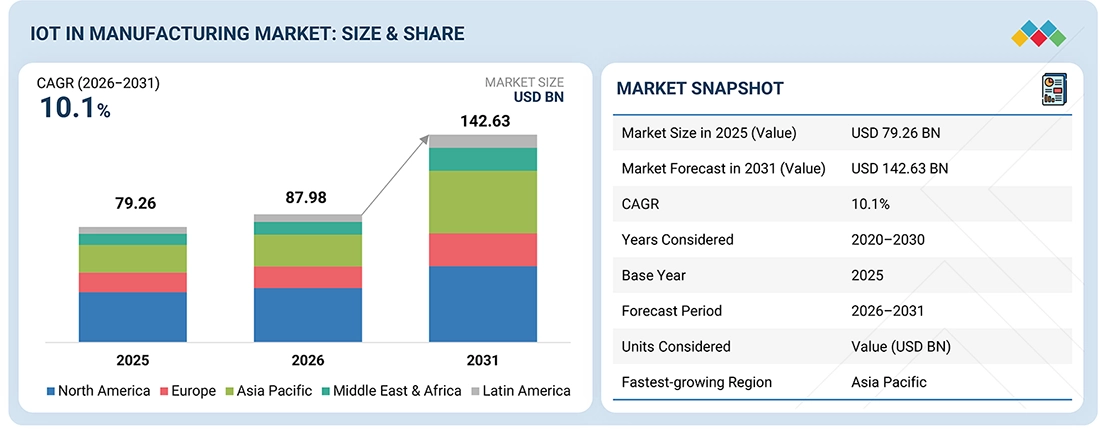
Source: Secondary Research, Interviews with Experts, MarketsandMarkets Analysis
The global IoT in manufacturing market is estimated to reach USD 87.98 billion in 2026 and is projected to grow to USD 142.63 billion by 2031, registering a CAGR of 10.1% during the forecast period. The manufacturing sector is currently navigating a major shift where digital tools are moving from the periphery to the very center of production. We are seeing a move away from isolated machinery toward an interconnected ecosystem powered by AI and edge computing. This transition is purely practical; it allows operators to monitor live output and address mechanical wear before a breakdown even occurs. When hardware communicates autonomously, it naturally smoothens out the friction that typically leads to expensive idle time.
Market Size and Forecast:
- Market Size Value in 2025: USD 79.26 Billion
- Market Size Value in 2026: USD 87.98 Billion
- Revenue Forecast in 2031: USD 142.63 Billion
- Growth Rate: CAGR of 10.1% from 2025 to 2031
- Forecast period: 2025–2031
- The services segment is expected to register the highest CAGR of 10.9%.
- Asia Pacific will be the fastest-growing region in the IoT in manufacturing market.
Key Market Trends and Insights
- By Application: The Predictive Maintenance segment accounts for a significant share of the IoT in Manufacturing market, driven by the increasing need to monitor equipment health, minimize unplanned downtime, optimize asset performance, and reduce maintenance costs through real-time IoT data.
- Market Trends: Manufacturers are increasingly adopting IoT-enabled predictive maintenance solutions to monitor machine performance in real time, leverage AI-powered analytics, extend equipment lifespan, and improve overall production efficiency.
- Market Drivers: Rising adoption of Industrial IoT (IIoT), growing demand for smart manufacturing, increasing focus on reducing operational downtime, expanding deployment of connected sensors, and the need for real-time asset monitoring are supporting market growth.
- Future Opportunities: Significant opportunities are emerging in AI-powered predictive maintenance, digital twins, edge computing, cloud-based industrial IoT platforms, and advanced condition monitoring solutions designed to improve manufacturing productivity and operational resilience.
KEY TAKEAWAYS
-
By OfferingThe services segment is expected to register the highest CAGR of 10.9%.
-
By Deployment ModeThe cloud segment is projected to grow the fastest from 2026 to 2031.
-
By ApplicationThe asset tracking and management segment is expected to be the largest in 2026.
-
By Organization sizeThe large enterprises segment is expected to dominate the market.
-
By VerticalDiscrete manufacturing is projected to grow the fastest from 2026 to 2031
-
By RegionAsia Pacific will be the fastest-growing region in the IoT in manufacturing market.
-
Competitive Landscape - Key PlayersCisco, IBM, PTC, Microsoft, Siemens, GE, SAP, and Huawei were identified as some of the star players in the IoT in manufacturing market, given their strong market share and product footprint.
-
Competitive Landscape - Startups/SMEsSciencesoft, Telit, Litmus Automation, Impinj, and HQ Software have distinguished themselves among startups and SMEs in the IoT in manufacturing market.
IoT platforms have evolved into the digital backbone of modern manufacturing, moving far beyond simple device connectivity. They function as a central hub where data from every machine and system is synthesized instantly, giving operators the clarity needed to make split-second adjustments. As production scales across multiple sites and complex supply chains, traditional, fragmented monitoring methods often fail to provide the level of visibility required to remain agile. Because of this, the IoT in manufacturing market is shifting toward high-impact tools like digital twins, remote monitoring, and automated maintenance schedules.
MARKET DYNAMICS

Level
-
Growing demand for industrial automation in the manufacturing industry

-
Increased adoption of cloud computing platforms


Level
-
Issues related to data security and privacy in IoT

-
Absence of standardization in the IoT protocol


Level
-
Emerging 5G technology to help IoT adoption globally

-
Increase in smart manufacturing initiatives worldwide


Level
-
Lack of skilled workforce for operating IoT-based equipment

-
Huge initial investment required for implementing IoT in smart manufacturing

Source: Secondary Research, Interviews with Experts, MarketsandMarkets Analysis
Driver: Growing demand for industrial automation in the manufacturing industry
One key reason for the growth of this market is the rising demand for better automation in manufacturing. Companies face pressure to produce more while keeping costs in check. As a result, they are adopting connected systems that simplify production processes. There is also a strong need for real-time data to support better planning, the effective use of resources, and fewer human errors.
Restraint: Issues related to data security and privacy in IoT
A major issue slowing down the market is concern about data security and privacy in IoT systems. As more devices get connected within factories, the risk of cyberattacks also increases, which creates fear about losing important business data or intellectual property. Because of this, many companies are careful when adopting IoT solutions, as they have to balance the advantages of connectivity with the risks of data breaches, cyber threats, and legal compliance issues.
Opportunity: Emerging 5G technology to help IoT adoption globally
The growth of 5G technology creates a strong opportunity for IoT in manufacturing. It offers faster speed, low delay, and reliable connectivity, which are important for advanced industrial use. Compared to older technologies, 5G can handle a large number of connected devices at once, making it suitable for applications like real-time monitoring, remote operations, and digital twin usage.
Challenge: Lack of skilled workforce for operating IoT-based equipment
One of the biggest challenges in the industry is the lack of skilled workers who understand and can manage advanced IoT systems. Technology is changing very quickly, and training systems are not able to keep up at the same speed. This has created a gap in skills related to IoT systems, data analysis, and industrial cybersecurity.
IOT IN MANUFACTURING MARKET: COMMERCIAL USE CASES ACROSS INDUSTRIES
| COMPANY | USE CASE DESCRIPTION | BENEFITS |
|---|---|---|
 |
Cisco plays an important role in creating connected factory environments by providing secure industrial networking solutions. Its systems connect machines, sensors, and control units, which allows manufacturers to monitor operations in real time and manage equipment remotely. With edge capabilities, data can be processed near the source, which helps in reducing delays and improving efficiency on the shop floor. | Better system uptime and connectivity | Real-time visibility across operations | Reduced machine failures | Strong security for industrial networks |
 |
IBM helps manufacturers improve how they manage machines and assets by using IoT data along with artificial intelligence. Its platform collects data from equipment and studies it to find patterns, predict failures, and suggest improvements. This helps companies move from reactive maintenance to a more planned and predictive approach. | Lower maintenance expenses | Better use of assets | Smarter decision-making | Improved overall efficiency |
 |
PTC, through its ThingWorx platform, allows manufacturers to connect devices and keep track of operations continuously. It also uses augmented reality to support workers in tasks like maintenance and training. By linking product and production data, companies get a better understanding of performance and can respond quickly when problems occur. | Faster problem-solving | Increased worker efficiency | Continuous monitoring of operations | Better product lifecycle control |
 |
Microsoft provides IoT solutions through Azure, which helps manufacturers create systems that are more connected and easier to manage. By using cloud-based data from machines, companies can keep track of performance, identify possible issues early, and improve coordination across different parts of the supply chain. It also makes remote monitoring possible, which becomes important when operations are spread across different locations. | Flexible and scalable systems | Improved insights through analytics | Cost savings in operations | Better coordination across supply chains |
 |
Siemens has essentially built a bridge between the physical workshop and the digital world by blending automation with IoT and digital twin tech. This setup is a game-changer because it lets manufacturers run a virtual dry run of their entire production line to work out the kinks before a single machine even starts humming. Once the real work begins, the system stays active, tracking every movement in real-time. Instead of the old-school approach of waiting for something to break before fixing it, teams can spot tiny inefficiencies and make quick, meaningful adjustments on the fly. | Higher production efficiency | Reduced delays in product launch | Improved product quality | Smooth integration across processes |
Logos and trademarks shown above are the property of their respective owners. Their use here is for informational and illustrative purposes only.
MARKET ECOSYSTEM
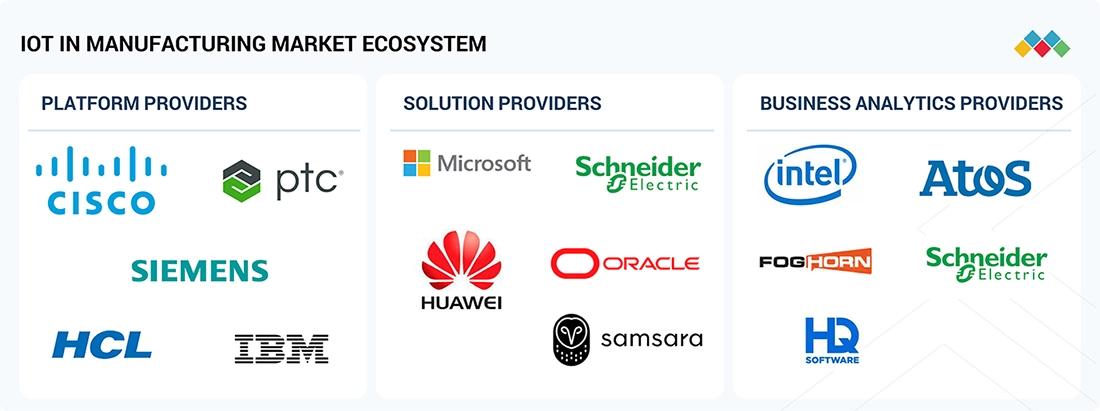
Companies such as Microsoft, Schneider Electric, Oracle, Huawei, and Samsara act as the bridge to the factory floor. They deploy the specific applications and automation tools needed for actual industrial use cases. Meanwhile, the ecosystem is rounded out by firms like Intel, Atos, Hitachi, and FogHorn, which specialize in edge analytics and performance tuning.
Logos and trademarks shown above are the property of their respective owners. Their use here is for informational and illustrative purposes only.
MARKET SEGMENTS
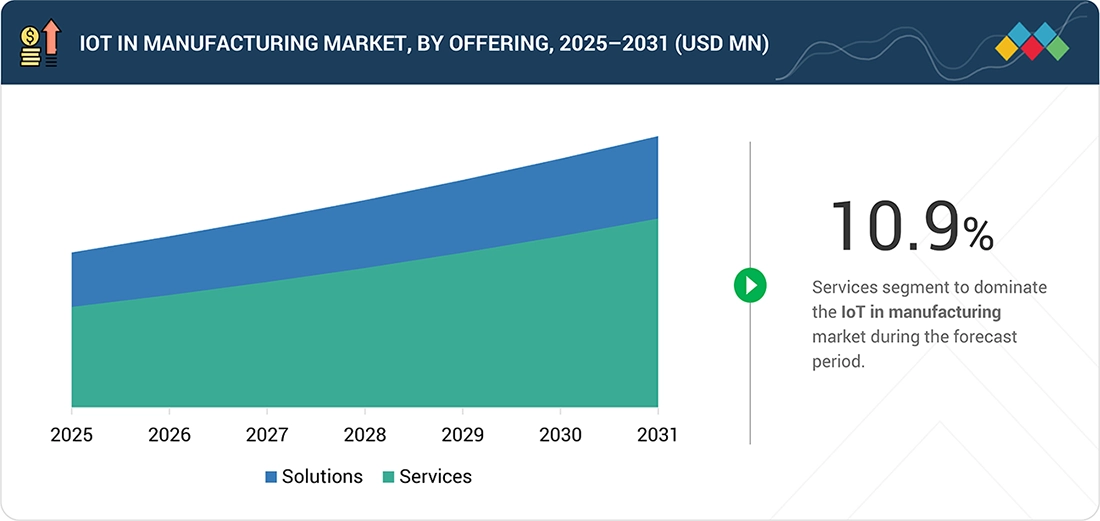
Source: Secondary Research, Interviews with Experts, MarketsandMarkets Analysis
IoT in Manufacturing Market, By Offering
Solutions are the digital backbone of the modern smart factory. From advanced data analytics and asset tracking to edge computing and predictive maintenance, IoT solutions bridge the gap between legacy machinery and intelligent automation. By transforming raw industrial data into actionable real-time insights, robust solutions empower manufacturers to optimize floor operations, reduce costly downtime, and achieve unprecedented levels of production efficiency.
IoT in Manufacturing Market, By Deployment Mode
Transitioning to a cloud-based infrastructure cuts out large upfront hardware costs and provides the scalability needed to handle vast amounts of industrial data. By centralizing operations, cloud deployment enables real-time global monitoring, instant system updates, and AI-driven analytics.
IoT in Manufacturing Market, By Organization Size
Large enterprises are leading the global move toward Industry 4.0. With extensive global supply chains and complex, multi-site operations, large manufacturers need complete IoT integration to stay competitive. The customized enterprise solutions work smoothly with existing ERP systems, optimizing large data streams to support strategic decision-making, maximize asset use, and achieve significant economies of scale.
IoT in Manufacturing Market, By Application
In modern manufacturing, people are the greatest asset. Leveraging wearable IoT devices and smart sensors, this application ensures maximum worker safety, optimizes shift schedules, and eliminates floor bottlenecks in real-time. This helps empower managers with the live visibility required to boost labor productivity, maintain strict compliance, and orchestrate a highly synchronized, secure workspace.
IoT in Manufacturing Market, By Vertical
Discrete manufacturing is going through a major digital transformation. Whether it’s car assembly lines or complex electronics production, handling highly customized, high-volume operations requires total precision. IoT solutions help discrete manufacturers easily track inventory, predict machine failures before they occur, and maintain high-quality control. This helps use the advantages of connected devices to meet the increasing demand for mass customization while protecting profits.
REGION
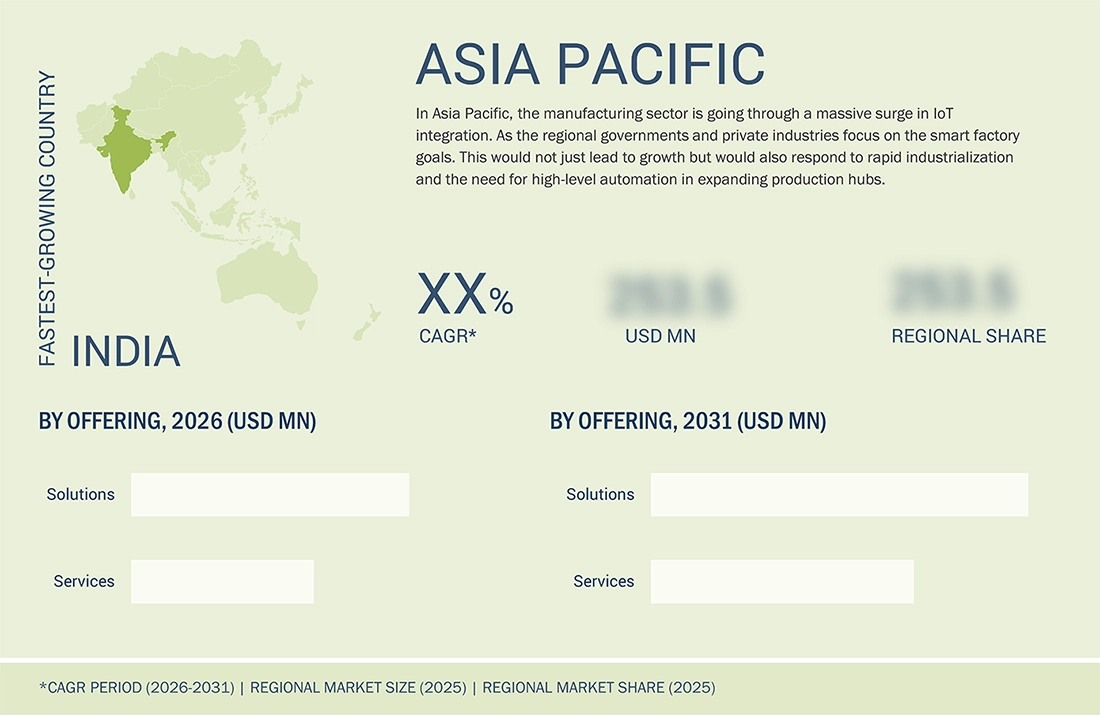
Asia Pacific to be the fastest-growing region in the global IoT in manufacturing market during forecast period
The Asia Pacific region is essentially becoming the global epicenter for industrial IoT as digital tools move from the margins to the mainstream. This growth is not just happening in high-tech hubs; it is spreading across the entire regional landscape, fueled by a massive rollout of 5G and better connectivity. On the factory floor, the sheer volume of connected devices has created an urgent need for data that flows without lag or interruption.
IOT IN MANUFACTURING MARKET: COMPANY EVALUATION MATRIX
Cisco has managed to carve out a massive footprint in the industrial IoT world by leaning on its deep roots in global networking. It has essentially taken years of expertise in edge computing and cybersecurity and baked those capabilities directly into the factory floor. This approach makes it simpler for a manufacturer to bridge the gap between isolated machines and a fully integrated digital system.
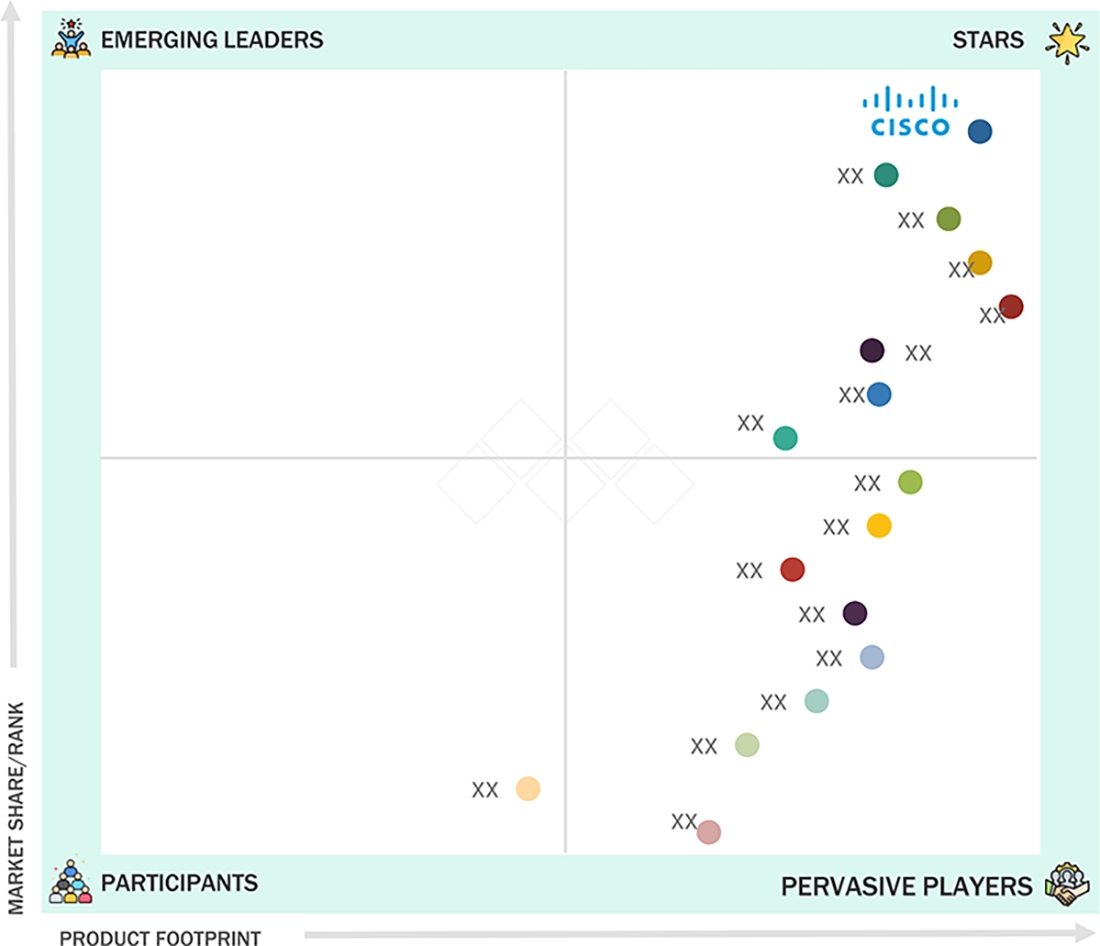
Source: Secondary Research, Interviews with Experts, MarketsandMarkets Analysis
KEY MARKET PLAYERS
- CISCO (US)
- IBM (US)
- PTC (US)
- MICROSOFT (US)
- SIEMENS (GERMANY)
- GE (US)
- SAP (GERMANY)
- HUAWEI (CHINA)
- ATOS (FRANCE)
- HCL (INDIA)
- INTEL (US)
- ORACLE (US)
- SCHNEIDER ELECTRIC (FRANCE)
- ZEBRA TECHNOLOGIES (US)
- SOFTWARE AG (GERMANY)
- WINDRIVER (US)
- SAMSARA (US)
- Telit (UK)
- Sciencesoft (US)
- Impinj (US)
- Bosch.IO (Germany)
- Litmus (US)
- Uptake (US)
- Mocana (US)
- HQ Software (Estonia)
- Foghorn (US)
- Clearblade (US)
MARKET SCOPE
| REPORT METRIC | DETAILS |
|---|---|
| Market Size in 2025 (Value) | USD 79.26 Billion |
| Market Forecast in 2031 (Value) | USD 142.63 Billion |
| Growth Rate | CAGR of 10.1% during 2026-2031 |
| Years Considered | 2020-2031 |
| Base Year | 2025 |
| Forecast Period | 2026-2031 |
| Units Considered | Value (USD Billion) |
| Report Coverage | Revenue forecast, company ranking, competitive landscape, growth factors, and trends |
| Segments Covered |
|
| Regions Covered | North America, Europe, Asia Pacific, the Middle East & Africa, and Latin America |
WHAT IS IN IT FOR YOU: IOT IN MANUFACTURING MARKET REPORT CONTENT GUIDE
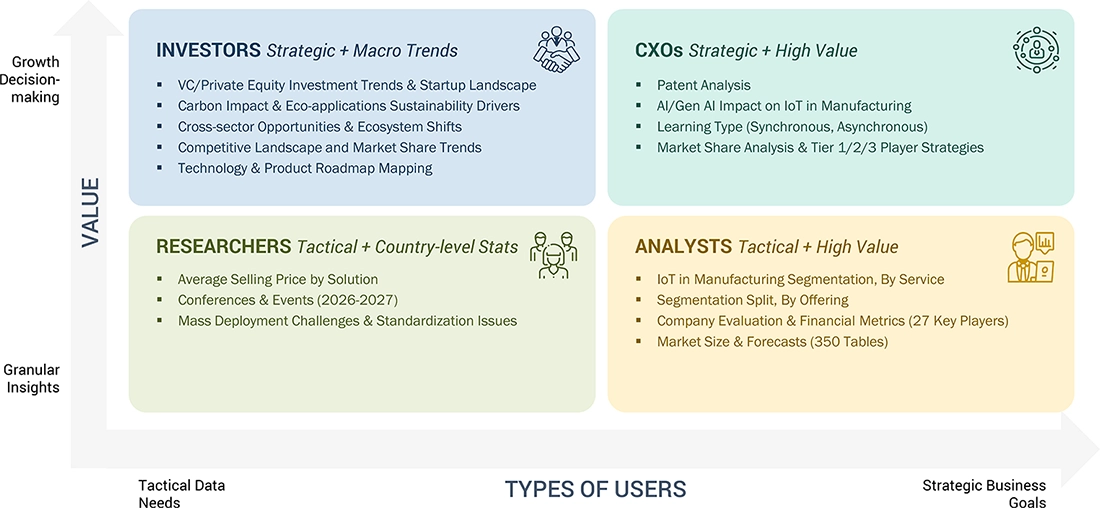
DELIVERED CUSTOMIZATIONS
We have successfully delivered the following deep-dive customizations:
| CLIENT REQUEST | CUSTOMIZATION DELIVERED | VALUE ADDS |
|---|---|---|
| Leading Service Provider (US) | Regional Analysis: • Further breakdown of the North American IoT in manufacturing market • Further breakdown of the European IoT in manufacturing market • Further breakdown of the Asia Pacific IoT in manufacturing market • Further breakdown of the Middle East & African IoT in manufacturing market • Further breakdown of the Latin American IoT in manufacturing market | • Identifies high-growth regional opportunities, enabling tailored market entry strategies. • Optimizes resource allocation and investment based on region-specific demand and trends. |
| Company Information | Detailed analysis and profiling of additional market players (up to 5) | • Broadens competitive insights, helping clients make informed strategic and investment decisions. • Reveals market gaps and opportunities, supporting differentiation and targeted growth initiatives. |
RECENT DEVELOPMENTS
- July 2025 : Microsoft collaborated with Siemens to integrate Azure IoT capabilities with industrial platforms. This focuses on improving how systems work together, giving better access to IoT data and helping manufacturers improve operations using cloud-based analytics and AI tools.
- January 2026 : Siemens expanded its partnership with NVIDIA to develop an Industrial AI Operating System aimed at improving manufacturing processes. This focuses on using AI across the full production cycle, from design to operations, helping companies simulate, optimize, and automate processes more effectively.
- February 2026 : Cisco expanded its partnership with AT&T to support advanced IoT use cases using 5G Standalone technology. This partnership focuses on providing secure and scalable connectivity solutions that support real-time industrial applications, especially where low delay and reliable communication are important.
- October 2025 : Oracle collaborated with Microsoft to integrate its Fusion Cloud Supply Chain & Manufacturing solutions with Azure IoT Operations. This helps manufacturers capture real-time data from machines and sensors, improving visibility across production and supply chain activities. It also supports faster decision-making and helps reduce downtime and operational issues.
Table of Contents
 Exclusive indicates content/data unique to MarketsandMarkets and not available with any competitors.
Methodology
This research study involved the use of extensive secondary sources, directories, and databases, such as D&B Hoovers and Bloomberg BusinessWeek, to identify and collect information useful for this technical, market-oriented, and commercial study of the global IoT in Manufacturing market. The primary sources were mainly several industry experts from core and related industries and preferred suppliers, manufacturers, distributors, Service Providers (SPs), technology developers, alliances, and organizations related to all the segments of this industry’s value chain. In-depth interviews were conducted with various primary respondents that included key industry participants, subject-matter experts, C-level executives of key market players, and industry consultants to obtain and verify critical qualitative and quantitative information as well as assess prospects.
Secondary Research
The market size of companies that offer IoT in manufacturing solutions and services globally was arrived at based on the secondary data available through paid and unpaid sources. It was also arrived at by analyzing the product portfolios of the major companies and rating the companies based on their performance and quality.
In the secondary research process, various secondary sources were referred to, for identifying and collecting information for this study. The secondary sources included annual reports; press releases and investor presentations of companies; and white papers, certified publications, and articles from recognized associations and government publishing sources; journals and various associations, have also been referred to for consolidating the report. The data was also collected from secondary sources, such as The Association of International Internet of Things Consortium, Europe Research Cluster on Internet of Things, Bitkom-Germany’s Digital Association, and China Association for Science and Technology.
Secondary research was used to obtain key information about industry insights, market’s monetary chain, the overall pool of key players, and market classification and segmentation according to industry trends to the bottom-most level, regional markets, and key developments from both market-and technology-oriented perspectives.
Primary Research
In the primary research process, various primary sources from both supply and demand sides of the IoT in Manufacturing market ecosystem were interviewed to obtain qualitative and quantitative information for this study. The primary sources from the supply side included industry experts, such as Chief Executive Officers (CEOs), Vice Presidents (VPs), marketing directors, technology and innovation directors, and related key executives from various vendors providing IoT for manufacturing software, associated service providers, and system integrators operating in the targeted regions. All possible parameters that affect the market covered in this research study have been accounted for, viewed in extensive detail, verified through primary research, and analyzed to get the final quantitative and qualitative data. After the complete market engineering (including calculations for market statistics, market breakdown, market size estimations, market forecast, and data triangulation), extensive primary research was conducted to gather information, and verify and validate the critical numbers arrived at. Primary research was also conducted to identify and validate the segmentation types; industry trends; key players; the competitive landscape of the market; and key market dynamics, such as drivers, restraints, opportunities, challenges, industry trends, and key strategies.
Given below is the breakup of the primary respondents:
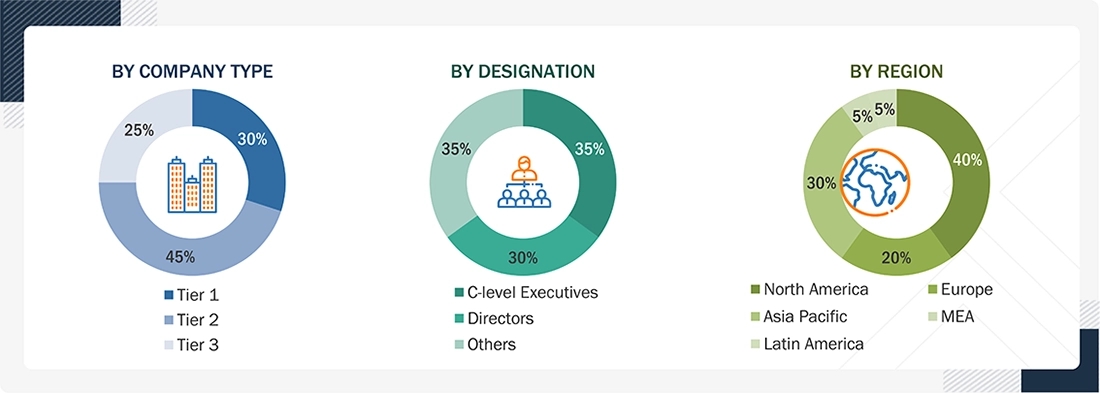
To know about the assumptions considered for the study, download the pdf brochure
Market Size Estimation
Multiple approaches were adopted for the estimation and forecasting of the IoT in Manufacturing Market. The first approach involves the estimation of the market size by summation of companies’ revenue generated through the IoT in manufacturing solutions and services. This entire procedure has studied the annual and financial reports of top market players and extensive interviews of industry leaders, such as CEOs, VPs, directors, and marketing executives of leading companies for key insights. All percentage splits and breakups have been determined using secondary sources and verified through primary sources. All possible parameters that affect the market covered in this research study have been accounted for, viewed in extensive detail, verified through primary research, and analyzed to arrive at the final quantitative and qualitative data. This data has been consolidated and enhanced with detailed inputs and analysis from MarketsandMarkets.
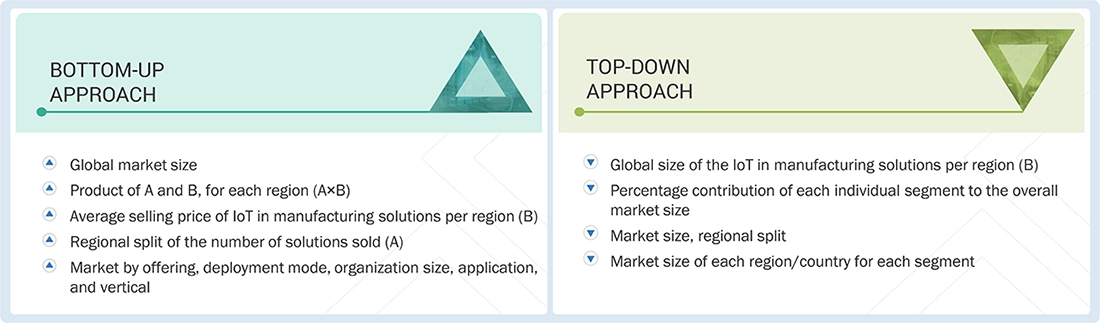
Key Market Players
Top-down and bottom-up approaches were used to estimate and validate the size of the global IoT in manufacturing market and various other dependent subsegments. The key players such as Cisco (US), IBM (US), PTC (US), Microsoft (US), Siemens AG (Germany), GE (US), SAP (Germany), Huawei (China), ATOS (France), HCL (India), Intel (US), Oracle (US), Schneider Electric (France), Zebra Technologies (US), Software AG (Germany), Wind River (US), and Samsara (US), contribute almost 60% to the global IoT in manufacturing market. The major players in the market were identified through extensive secondary research, and their revenue contribution in the respective regions were determined through primary and secondary research. The entire procedure included the study of the annual and financial reports of top market players and extensive interviews for key insights from industry leaders, such as CEOs, VPs, directors, and marketing executives. All percentage splits and breakups were determined using secondary sources and verified through primary sources.
The collective revenue of key companies that offer IoT in manufacturing solutions comprised 60–65% of the market, which was further confirmed through primary interviews with industry experts. With the assumption that the rest of the market is contributed by smaller players (part of the unorganized market), the market size of organized players (55–60%), and unorganized players (40–45%) collectively was assumed to be the market size of the global IoT in manufacturing market for the Financial Year (FY) 2021.
Data Triangulation
After arriving at the overall market size using the market size estimation processes as explained above, the market was split into several segments and sub segments. The data triangulation and market breakup procedures were employed, wherever applicable, to complete the overall market engineering process and arrive at the exact statistics of each market segment and sub segment. The data was triangulated by studying various factors and trends from both the demand and supply sides.
Report Objectives
- To determine and forecast the global Internet of Things (IoT) in manufacturing market based on component (solutions and services), deployment mode, organization size, application, vertical, and region from 2021 to 2026, and analyze various macro and microeconomic factors that affect the market growth.
- To forecast the size of the market segments with respect to five main regions: North America, Europe, Asia Pacific (APAC), Middle East and Africa (MEA), and Latin America.
- To provide detailed information about the major factors (drivers, opportunities, threats, and challenges) influencing the growth of IoT in manufacturing market
- To analyze each subsegment with respect to individual growth trends, prospects, and contribution to the total market
- To analyze opportunities in the market for stakeholders by identifying the high-growth segments of the IoT in manufacturing market
- To profile key market players comprising top vendors and startups; provide comparative analysis based on business overview, regional presence, product offerings, business strategies, and key financials; and illustrate the market’s competitive landscape
- To track and analyze competitive developments, such as mergers and acquisitions, product developments, partnerships and collaborations, and Research and Development (R&D) activities, in the market
Available Customizations
Along with the market data, MarketsandMarkets offers customizations as per the company’s specific needs. The following customization options are available for the report:
Company Information
- Detailed analysis and profiling of additional market players (Up to 5)
Geographic Analysis
- Further breakdown of the European IoT in Manufacturing Market
- Further breakdown of the APAC Market
- Further breakdown of the MEA Market
- Further breakdown of the Latin American Market.
Key Questions Addressed by the Report
What is the projected size of the global IoT in manufacturing market?
The global IoT in manufacturing market is projected to grow from USD 87.98 billion in 2026 to USD 142.63 billion by 2031, at a CAGR of 10.1% during the forecast period. Growth is driven by increasing adoption of Industry 4.0, AI-powered automation, predictive maintenance, and connected manufacturing solutions.
Which segment holds the largest share of the IoT in manufacturing market?
The asset tracking and management segment is expected to hold the largest share of the IoT in manufacturing market in 2026. Large enterprises account for the dominant organizational segment, while the solutions segment leads the market by offering.
What are the key trends driving the IoT in manufacturing market?
Key trends include the adoption of AI and edge computing, digital twins, predictive maintenance, cloud-based IoT platforms, real-time production monitoring, 5G-enabled industrial connectivity, and smart factory automation to improve operational efficiency.
Which region is expected to witness the fastest growth in the IoT in manufacturing market?
Asia Pacific is projected to be the fastest-growing region during the forecast period, driven by rapid industrial digitalization, expanding manufacturing capacity, increasing 5G deployment, and strong investments in smart factory technologies.
Who are the key players in the IoT in manufacturing market?
Key companies operating in the IoT in manufacturing market include Cisco (US), IBM (US), PTC (US), Microsoft (US), Siemens (Germany), GE (US), SAP (Germany), Huawei (China), Oracle (US), Schneider Electric (France), Intel (US), Zebra Technologies (US), Software AG (Germany), HCL (India), and ATOS (France).


Personalize This Research
- Triangulate with your Own Data
- Get Data as per your Format and Definition
- Gain a Deeper Dive on a Specific Application, Geography, Customer or Competitor
- Any level of Personalization
Let Us Help You
- What are the Known and Unknown Adjacencies Impacting the IoT in Manufacturing Market
- What will your New Revenue Sources be?
- Who will be your Top Customer; what will make them switch?
- Defend your Market Share or Win Competitors
- Get a Scorecard for Target Partners

Custom Market Research Services
We Will Customise The Research For You, In Case The Report Listed Above Does Not Meet With Your Requirements
Get 10% Free CustomisationTESTIMONIALS






Growth opportunities and latent adjacency in IoT in Manufacturing Market