AI Impact Analysis on Dual-Axis Gyro-Stabilized Platforms Market
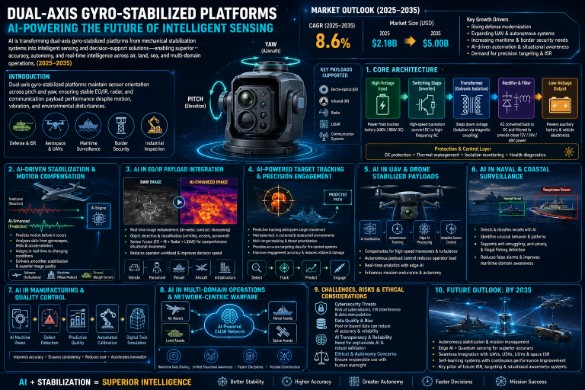
The Dual-Axis Gyro-Stabilized Platforms Market is experiencing a major technological transformation as artificial intelligence becomes a critical component in modern surveillance, reconnaissance, targeting, navigation, and situational awareness systems. These platforms have long served as the foundation for maintaining sensor stability across dynamic environments, enabling electro-optical, infrared, radar, and communication payloads to operate with precision despite movement, vibration, and environmental disturbances. As military and commercial operators demand greater accuracy, automation, and real-time intelligence, AI is emerging as the catalyst that elevates gyro-stabilized platforms from mechanical stabilization systems to intelligent sensing and decision-support solutions.
The growing deployment of unmanned aerial vehicles, autonomous naval systems, armored vehicles, border security installations, and airborne ISR platforms is creating unprecedented demand for advanced stabilization technologies. Traditional stabilization systems rely heavily on gyroscopes, inertial measurement units, and control algorithms to compensate for movement. However, modern operational environments require systems capable of adapting to unpredictable conditions, identifying targets autonomously, fusing data from multiple sensors, and supporting mission-critical decisions in real time. AI provides these capabilities by introducing predictive analytics, machine learning, computer vision, and autonomous optimization into stabilization architectures.
Between 2025 and 2035, AI will significantly influence the design, performance, deployment, and operational value of dual-axis gyro-stabilized platforms. The convergence of stabilization technology and artificial intelligence will reshape surveillance operations, improve targeting precision, strengthen border security, enhance maritime domain awareness, and support next-generation autonomous defense systems.
Introduction to the Dual-Axis Gyro-Stabilized Platforms Market
Dual-axis gyro-stabilized platforms are specialized systems designed to maintain sensor orientation and stability across two independent axes, typically pitch and yaw. These platforms are widely used in defense, aerospace, homeland security, maritime surveillance, border monitoring, and industrial inspection applications. Their primary purpose is to ensure that cameras, sensors, communication equipment, and targeting systems remain stable and focused despite motion caused by vehicles, aircraft, ships, or environmental disturbances.
Historically, gyro-stabilized platforms relied on mechanical systems and traditional control algorithms to compensate for motion. While these systems provided acceptable performance, their effectiveness was often limited in highly dynamic environments involving rapid movement, turbulence, vibration, or unpredictable target behavior. The increasing complexity of modern military operations has exposed the limitations of conventional stabilization technologies.
Artificial intelligence introduces a new dimension to stabilization by enabling systems to anticipate movement, adapt to changing conditions, and optimize performance continuously. AI-driven stabilization systems analyze operational data in real time, learn from previous conditions, and improve performance throughout missions. This shift is transforming gyro-stabilized platforms into intelligent systems capable of supporting advanced ISR, surveillance, targeting, and autonomous mission execution.
As defense modernization programs continue worldwide, AI-enhanced stabilization technologies are becoming increasingly important for maintaining operational superiority across multiple domains.
AI-Driven Stabilization and Motion Compensation
Stabilization remains the fundamental function of dual-axis gyro-stabilized platforms, and AI is significantly enhancing this capability. Traditional stabilization systems react to motion after it occurs, whereas AI-enabled systems can predict movement patterns before they impact sensor performance. This predictive capability allows platforms to compensate proactively rather than reactively.
Machine learning algorithms continuously analyze motion data generated by gyroscopes, accelerometers, and inertial measurement units. By identifying recurring patterns and environmental influences, AI predicts future disturbances and adjusts stabilization parameters accordingly. This results in smoother sensor operation and improved image quality.
In airborne applications, AI compensates for turbulence, sudden maneuvers, and wind disturbances. In naval environments, AI mitigates the effects of wave motion, vessel roll, and sea-state variations. Ground vehicles operating in rough terrain benefit from AI-driven stabilization that reduces sensor vibration and maintains target focus.
AI-enhanced motion compensation not only improves image stability but also extends the operational effectiveness of surveillance and targeting systems. As missions become increasingly complex, predictive stabilization will become a key differentiator in the performance of next-generation gyro-stabilized platforms.
AI in Electro-Optical and Infrared Payload Integration
Electro-optical and infrared payloads are among the most common sensors mounted on dual-axis stabilized platforms. These sensors provide critical intelligence, surveillance, reconnaissance, and targeting capabilities. AI significantly enhances the value of EO/IR systems by improving image processing, target recognition, and sensor fusion.
AI-powered image enhancement algorithms automatically correct distortions, improve contrast, reduce noise, and sharpen imagery in real time. This enables operators to identify objects more accurately under challenging conditions such as darkness, fog, smoke, or adverse weather.
Machine learning models trained on extensive image datasets can recognize vehicles, personnel, infrastructure, vessels, and airborne objects with remarkable accuracy. AI allows EO/IR systems to distinguish between potential threats and non-threatening objects, reducing operator workload and improving decision-making speed.
Sensor fusion capabilities further enhance performance by combining data from EO, IR, radar, LiDAR, and other sources. AI processes this information simultaneously, creating a comprehensive operational picture that improves situational awareness and mission effectiveness.
The integration of AI with EO/IR payloads transforms stabilized platforms into intelligent observation systems capable of supporting increasingly autonomous operations.
AI-Powered Target Tracking and Precision Engagement
Target tracking is one of the most critical functions of dual-axis gyro-stabilized platforms, particularly in defense applications. Traditional tracking systems often struggle with rapidly moving targets, cluttered environments, and unpredictable movements. AI dramatically improves target tracking accuracy through predictive analytics and advanced computer vision.
AI continuously analyzes target behavior, speed, direction, and movement patterns to predict future positions. This predictive capability enables tracking systems to maintain lock on moving targets even when temporary obstructions occur. AI also improves multi-target tracking by simultaneously monitoring numerous objects and prioritizing threats based on mission requirements.
Precision engagement systems benefit significantly from AI-enhanced tracking. Fire-control systems receive more accurate targeting information, resulting in improved weapon effectiveness and reduced collateral damage. AI helps identify optimal engagement windows and continuously adjusts targeting solutions as conditions evolve.
The ability to maintain accurate target tracking in highly dynamic environments makes AI an indispensable component of modern stabilization platforms deployed in defense, border security, and maritime surveillance missions.
AI in UAV and Drone Stabilized Payload Systems
The rapid growth of unmanned aerial systems has created substantial demand for advanced gyro-stabilized payload platforms. Drones perform a wide range of missions, including surveillance, reconnaissance, border monitoring, target acquisition, and disaster response. AI significantly enhances the performance of stabilized payloads mounted on these platforms.
Drone operations often involve high-speed maneuvers, varying altitudes, and challenging environmental conditions. AI-driven stabilization systems compensate for these factors by continuously adapting to flight dynamics. This ensures stable imagery and accurate sensor performance throughout missions.
AI also supports autonomous payload management by controlling camera orientation, tracking targets, and optimizing sensor settings without requiring constant operator input. Edge AI processing allows drones to analyze data locally, reducing latency and enabling real-time decision-making.
As military and commercial drone fleets expand, AI-enabled stabilized payload systems will play a central role in maximizing mission effectiveness and operational autonomy.
AI in Naval, Maritime, and Coastal Surveillance Applications
Maritime environments present unique challenges for surveillance systems due to vessel motion, wave action, weather conditions, and vast operational areas. Dual-axis gyro-stabilized platforms are essential for maintaining sensor performance in these conditions, and AI further enhances their effectiveness.
AI improves maritime target detection by analyzing vessel behavior, identifying unusual movement patterns, and distinguishing between legitimate and suspicious activities. Coastal security agencies use AI-enhanced platforms to monitor illegal fishing, smuggling, piracy, and unauthorized border crossings.
Machine learning algorithms process data from multiple sensors to generate maritime intelligence that supports situational awareness and operational planning. AI also reduces false alarms by accurately classifying targets and filtering irrelevant data.
As maritime security becomes increasingly important, AI-powered stabilization systems will strengthen coastal surveillance networks and improve maritime domain awareness.
AI in Manufacturing, Calibration, and Quality Control
Artificial intelligence is transforming the manufacturing and testing processes used to produce dual-axis gyro-stabilized platforms. Precision engineering is essential for these systems because even minor inaccuracies can impact stabilization performance.
AI-powered machine vision systems inspect components during production, identifying defects that may be invisible to human inspectors. Predictive quality assurance algorithms analyze manufacturing data to detect potential problems before they affect final products.
Automated calibration systems powered by AI improve alignment accuracy and reduce production time. Digital twin technologies simulate platform performance under various operational conditions, enabling manufacturers to optimize designs before physical prototypes are built.
AI-driven manufacturing improves consistency, reduces costs, and accelerates innovation cycles, allowing companies to meet growing demand for advanced stabilization systems.
AI in Multi-Domain Military Operations and Network-Centric Warfare
Modern military operations require seamless coordination across air, land, sea, space, and cyber domains. Dual-axis gyro-stabilized platforms serve as critical sensing nodes within these interconnected networks. AI enhances their contribution by enabling intelligent data sharing and real-time collaboration.
AI processes information collected by stabilized sensors and distributes relevant intelligence across command networks. This improves situational awareness and enables faster decision-making. Stabilized platforms integrated into C4ISR architectures support reconnaissance, target acquisition, force protection, and mission planning.
AI-driven systems facilitate coordination between manned and unmanned assets, creating highly responsive surveillance and targeting networks. As military organizations adopt network-centric warfare concepts, AI-enabled stabilization platforms will become increasingly important for achieving information superiority.
Challenges, Risks, and Ethical Considerations
Despite its benefits, AI integration introduces challenges that must be addressed. Cybersecurity remains a primary concern, as AI-enabled systems may become targets for electronic warfare, cyberattacks, and data manipulation attempts.
Data quality is another critical issue. AI systems rely on large datasets for training and operation. Poor-quality or biased data can reduce performance and lead to inaccurate assessments. Ensuring reliability and transparency in AI decision-making is essential.
Ethical concerns also arise when AI enables increasing levels of autonomy in surveillance and targeting systems. Policymakers, defense organizations, and manufacturers must establish frameworks that ensure responsible deployment while maintaining human oversight.
Addressing these challenges will be essential for sustaining trust and maximizing the benefits of AI-enhanced stabilization technologies.
Future Outlook: AI-Powered Dual-Axis Gyro-Stabilized Platforms by 2035
The future of the dual-axis gyro-stabilized platforms market will be defined by increasing intelligence, autonomy, and connectivity. By 2035, stabilization systems will evolve beyond simple motion compensation devices into intelligent mission-support platforms capable of autonomous operation.
AI-driven systems will continuously learn from operational environments, improving stabilization performance and target recognition capabilities over time. Integration with advanced UAVs, autonomous vehicles, naval vessels, and space-based ISR networks will create highly interconnected surveillance ecosystems.
Edge AI processing, quantum sensing technologies, and autonomous mission management systems will further enhance platform capabilities. These advancements will support faster decision-making, improved situational awareness, and greater operational effectiveness across multiple domains.
As AI continues to mature, dual-axis gyro-stabilized platforms will become indispensable components of future intelligence, surveillance, reconnaissance, and targeting architectures, driving significant growth across the global market through 2035.
Related Reports:
Dual-Axis Gyro-Stabilized Platforms Market by Gyro (RLG, FOG, MEMS), Deployment (Airborne, Land, Marine, Ground Infrastructure), Payload (EO/IR, Radar & Antenna, Laser, Acoustic, Weapon, Scientific), System Component, Application, and Region - Global Forecast to 2030
Contact:
Mr. Rohan Salgarkar
MarketsandMarkets™ INC.
1615 South Congress Ave.
Suite 103, Delray Beach, FL 33445
USA : 1-888-600-6441
[email protected]

This FREE sample includes market data points, ranging from trend analyses to market estimates & forecasts. See for yourself.
SEND ME A FREE SAMPLE






