AI Impact Analysis on the Artillery Ammunition Market (2025–2035)
The Global Artillery Ammunition Market is undergoing a significant transformation as artificial intelligence begins to reshape how modern militaries design, deploy, and utilize munitions on the battlefield. Artillery has long been a cornerstone of land based warfare, valued for its ability to deliver high impact firepower over long distances. Traditional artillery systems relied heavily on manual calculations, limited targeting accuracy, and large volumes of ammunition to achieve desired effects. This approach is no longer sustainable in an era where precision, efficiency, and rapid decision making define military superiority.
Artificial intelligence is emerging as a powerful force multiplier in artillery operations, enabling smarter ammunition, improved targeting, optimized logistics, and enhanced battlefield coordination. The integration of AI into artillery ammunition systems is driving a shift from quantity based firepower to precision based engagement. Between 2025 and 2035, AI will play a pivotal role in transforming artillery systems into highly intelligent, networked, and adaptive weapons capable of delivering unprecedented accuracy and effectiveness.
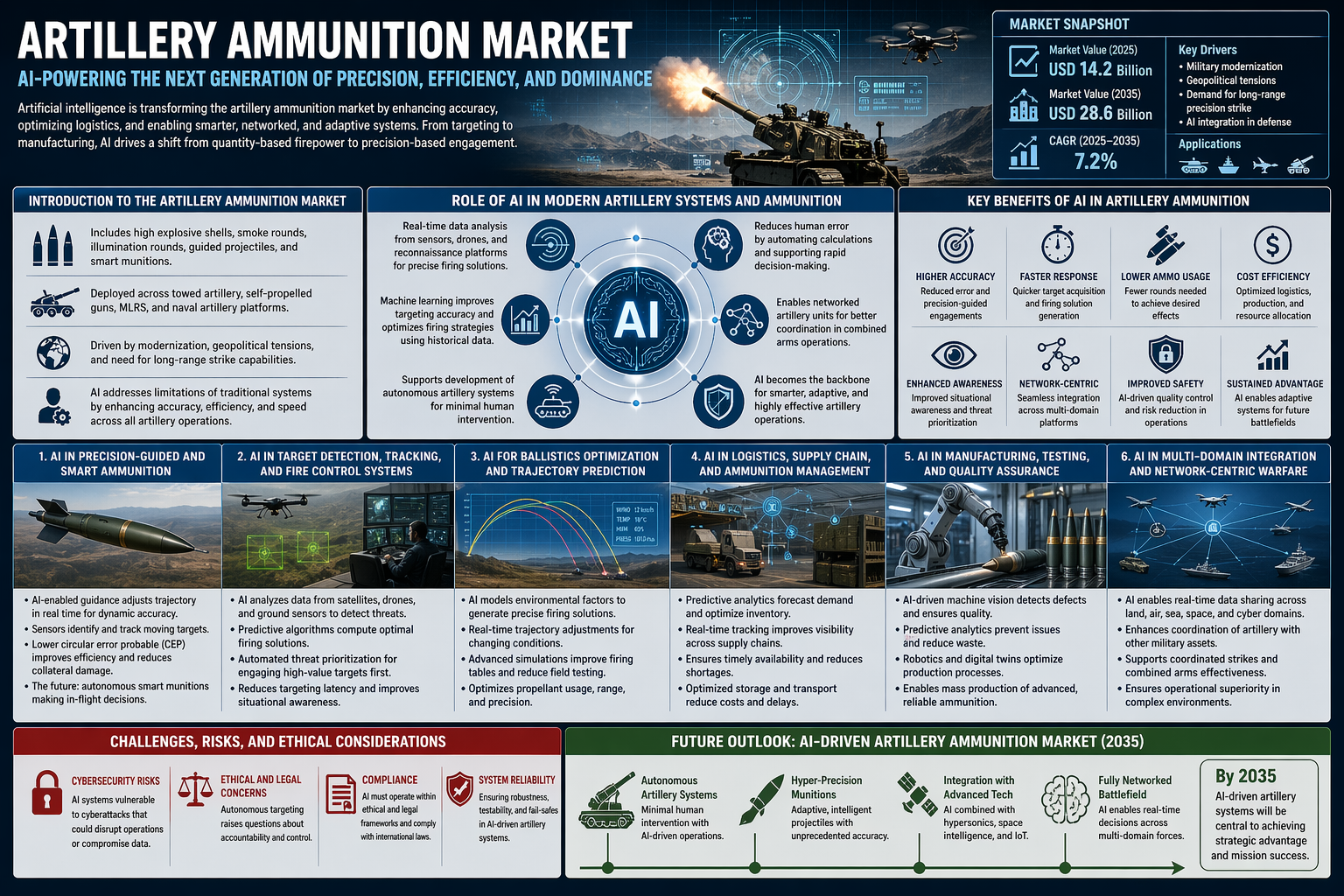
Introduction to the Artillery Ammunition Market
Artillery ammunition includes a wide range of munitions such as high explosive shells, smoke rounds, illumination rounds, guided projectiles, and specialized smart munitions. These systems are deployed across various platforms, including towed artillery, self propelled guns, multiple launch rocket systems, and naval artillery. The demand for artillery ammunition is driven by ongoing military modernization programs, geopolitical tensions, and the need for long range strike capabilities.
Traditional artillery operations required significant human involvement, from calculating firing solutions to adjusting trajectories based on environmental conditions. This often resulted in inefficiencies, slower response times, and increased ammunition expenditure. The growing complexity of modern warfare, characterized by urban combat environments, mobile targets, and electronic warfare, has highlighted the limitations of conventional artillery systems.
Artificial intelligence is addressing these challenges by introducing advanced computational capabilities that enhance every aspect of artillery operations. From improving targeting accuracy to optimizing logistics and manufacturing processes, AI is redefining the artillery ammunition market and enabling militaries to achieve greater operational efficiency and effectiveness.
Role of AI in Modern Artillery Systems and Ammunition
AI is becoming the backbone of modern artillery systems, enabling real time data analysis and decision making that significantly enhances operational performance. By integrating AI with fire control systems, militaries can process vast amounts of data from sensors, drones, and reconnaissance platforms to generate precise firing solutions.
AI reduces human error by automating calculations and providing decision support to operators. This is particularly important in high pressure combat scenarios where rapid and accurate decision making is critical. Machine learning algorithms analyze historical data and battlefield conditions to improve targeting accuracy and optimize firing strategies.
The integration of AI also enables better coordination between artillery units, allowing them to operate as part of a cohesive network. This enhances the effectiveness of combined arms operations, where artillery supports infantry, armored units, and air assets.
As AI continues to evolve, it will enable the development of autonomous artillery systems capable of identifying targets, calculating firing solutions, and executing missions with minimal human intervention.
AI in Precision-Guided and Smart Artillery Ammunition
Precision guided munitions represent one of the most significant advancements in artillery technology. AI enhances these systems by improving guidance, navigation, and targeting capabilities. Machine learning algorithms enable smart munitions to adjust their trajectory during flight, ensuring accurate engagement of targets even in dynamic environments.
AI enabled sensors allow munitions to identify and track moving targets, increasing the probability of a successful strike. By integrating data from GPS, inertial navigation systems, and onboard sensors, AI ensures that munitions can adapt to changing conditions and maintain accuracy.
The reduction in circular error probable achieved through AI driven systems significantly improves operational efficiency. Fewer rounds are required to achieve the desired effect, reducing logistical burdens and minimizing collateral damage.
The development of autonomous smart munitions represents the next frontier in artillery technology, where AI enables projectiles to make real time decisions during flight.
AI in Target Detection, Tracking, and Fire Control Systems
Accurate target detection and tracking are critical for effective artillery operations. AI enhances these capabilities by analyzing data from multiple sources, including satellites, drones, and ground based sensors. Machine learning algorithms identify patterns and anomalies, enabling the detection of potential threats.
AI powered fire control systems use predictive algorithms to determine optimal firing solutions, taking into account factors such as target movement, terrain, and environmental conditions. This reduces the time required to engage targets and improves overall accuracy.
The integration of AI also enables automated threat prioritization, ensuring that high value targets are engaged first. This is particularly important in complex combat scenarios where multiple threats must be addressed simultaneously.
By reducing targeting latency and improving situational awareness, AI enhances the effectiveness of artillery systems and ensures that they can respond quickly to evolving battlefield conditions.
AI for Ballistics Optimization and Trajectory Prediction
Ballistics play a crucial role in artillery accuracy, and AI significantly enhances trajectory prediction and optimization. Machine learning models analyze environmental factors such as wind speed, temperature, humidity, and air pressure to generate precise firing solutions.
AI enables real time adjustments to trajectories, ensuring that projectiles remain on course even when conditions change. This improves accuracy and reduces dispersion, increasing the likelihood of hitting the intended target.
Advanced simulations powered by AI allow militaries to model projectile behavior under various conditions, improving the accuracy of firing tables and reducing the need for extensive field testing.
By optimizing propellant usage and trajectory calculations, AI enhances both range and precision, enabling artillery systems to operate more effectively in diverse environments.
Get AI Impact Analysis on Artillery Ammunition Market, Request Pdf Brochure: https://www.marketsandmarkets.com/pdfdownloadNew.asp?id=261760271
AI in Logistics, Supply Chain, and Ammunition Management
Efficient logistics and supply chain management are essential for sustaining artillery operations. AI enhances these processes by providing predictive analytics that optimize inventory management and distribution.
Machine learning algorithms analyze consumption patterns and operational requirements to forecast demand, ensuring that ammunition is available where and when it is needed. This reduces the risk of shortages and improves operational readiness.
AI also enables real time tracking of ammunition, providing visibility into stock levels and movement across supply chains. This enhances coordination and reduces delays in resupply operations.
By optimizing storage and transportation, AI reduces costs and improves efficiency, ensuring that artillery units can maintain sustained operations in challenging environments.
AI in Manufacturing, Testing, and Quality Assurance of Ammunition
The production of artillery ammunition requires precision and consistency to ensure reliability and safety. AI enhances manufacturing processes by automating quality control and improving production efficiency.
Machine vision systems powered by AI detect defects in components, ensuring that only high quality products are delivered. Predictive analytics identify potential issues before they occur, reducing waste and improving efficiency.
AI driven robotics streamline assembly processes, ensuring consistent production standards. Digital twin technology allows manufacturers to simulate production processes and optimize performance.
By improving quality assurance and reducing production costs, AI enables the mass production of advanced ammunition systems that meet the demands of modern warfare.
AI in Multi-Domain Integration and Network-Centric Warfare
Modern warfare relies on the integration of multiple domains, including land, air, sea, and cyber. AI enables artillery systems to operate as part of a network centric environment, where data is shared across platforms to enhance coordination and effectiveness.
AI driven communication systems enable real time data sharing between artillery units and other military assets, improving situational awareness and decision making. This integration allows for coordinated strikes and enhances the effectiveness of combined arms operations.
By enabling seamless communication and coordination, AI ensures that artillery systems can operate effectively in complex and dynamic environments.
Challenges, Risks, and Ethical Considerations
The integration of AI into artillery systems presents several challenges and risks. Cybersecurity is a major concern, as AI driven systems may be vulnerable to attacks that could disrupt operations or compromise data.
Ethical considerations also arise from the use of autonomous systems in warfare. The potential for AI to make targeting decisions raises questions about accountability and control.
Ensuring that AI systems operate within established ethical and legal frameworks is essential for maintaining trust and compliance with international regulations.
Future Outlook: AI-Driven Artillery Ammunition Market (2035)
The future of the artillery ammunition market will be defined by the continued integration of AI and advanced technologies. Autonomous artillery systems capable of operating with minimal human intervention will become increasingly common.
AI will enable the development of hyper precision munitions that can adapt to changing conditions and engage targets with unprecedented accuracy. The integration of AI with other technologies, such as hypersonic systems and space based intelligence, will further enhance capabilities.
By 2035, AI driven artillery systems will play a central role in modern warfare, providing militaries with the tools needed to achieve strategic advantage.
Related Reports:
155 MM Ammunition (Artillery Ammunition) Market by Product (Howitzers, Truck-Mounted Artillery), Technology (Conventional Ballistic Projectiles, Base Bleed Projectiles), Component (Shell, Fuze, Propellant, Others), and Region – Global Forecast to 2031

This FREE sample includes market data points, ranging from trend analyses to market estimates & forecasts. See for yourself.
SEND ME A FREE SAMPLE






