AI Impact Analysis on Naval Communication Industry
The naval communication market is undergoing a significant transformation, primarily driven by the integration of artificial intelligence (AI). Historically reliant on rigid communication protocols and manual signal interpretation, today’s naval operations are rapidly adopting AI enabled tools to enhance speed, accuracy, and security across platforms. From ship-to-ship communication to satellite links and undersea acoustics, AI is enabling smarter, faster, and more autonomous decision making. The global maritime defense sector is recognizing AI's capacity to modernize naval communication architecture, allowing for real time interoperability and high bandwidth coordination across multiple domains. As threats become more digital and asymmetric, AI provides the edge required for tactical superiority in the increasingly complex marine theater.
AI-Powered Signal Processing in Naval Communication
Signal processing has traditionally been a labor intensive and time consuming element of naval communication. AI, especially machine learning and deep learning algorithms, is revolutionizing this aspect by automating signal classification, decoding, and transmission optimization. AI based systems can detect and process signals that are either weak or embedded in noise, significantly improving reliability and range. These capabilities are critical for naval vessels operating in high interference environments or conducting stealth operations. The deployment of AI enhanced signal intelligence platforms allows navies to intercept, decrypt, and act upon enemy communications faster than ever before, thereby reshaping the landscape of naval electronic warfare.
Enhancing Cybersecurity in Naval Networks Using AI
The complexity and connectivity of modern naval fleets have introduced new cybersecurity vulnerabilities. AI is now a cornerstone of defense grade cybersecurity for naval communication networks. Through behavioral analysis and anomaly detection, AI can flag and respond to suspicious activities in real time, offering proactive threat mitigation. AI algorithms are also being trained to detect advanced persistent threats (APTs) that may compromise encrypted naval data links. The use of AI powered cybersecurity in maritime communications ensures the protection of tactical data links, onboard networks, and command and control centers from sophisticated cyberattacks. As data becomes a weapon in modern warfare, AI enabled cybersecurity tools are indispensable for naval dominance.
AI in Satellite-Based Maritime Communication
Satellite based communication forms the backbone of long range naval connectivity. With the integration of AI, satellite systems are becoming more adaptive and efficient. AI can optimize bandwidth allocation based on operational priorities and environmental conditions, ensuring seamless connectivity across naval task forces spread over vast oceanic regions. Intelligent algorithms manage satellite handovers, latency, and signal loss due to atmospheric disturbances. This level of automation is crucial for uninterrupted communications, especially during joint operations involving multinational fleets. Furthermore, AI is facilitating the development of satellite constellations dedicated to naval operations, enhancing resilience and redundancy in communication channels.
Integration of AI in Naval Tactical Data Links and C4ISR Systems
Command, Control, Communications, Computers, Intelligence, Surveillance, and Reconnaissance (C4ISR) systems are central to modern naval operations. AI is amplifying the performance of these systems by automating data fusion, decision support, and situational awareness. Tactical data links such as Link 16 and Link 22, which enable real time information exchange among platforms, are being upgraded with AI to support faster, more secure communications. AI systems can predict communication bottlenecks, recommend alternate routing, and facilitate interoperability across different naval platforms. This capability is especially vital during high tempo operations where decision latency can determine mission success or failure. AI integration in C4ISR is pushing the boundaries of naval combat management systems, making them more responsive and adaptable.
AI-Driven Decision Support in Naval Command and Control
Decision making in naval operations involves processing vast amounts of data under intense time pressure. AI is increasingly being utilized to provide decision support to commanders by analyzing sensor data, identifying patterns, and simulating outcomes. AI driven dashboards and decision support systems can assess threat levels, suggest tactical maneuvers, and optimize resource allocation across fleets. These tools are particularly useful during multi domain operations involving air, surface, and sub surface assets. By reducing cognitive load and providing actionable intelligence, AI empowers naval commanders to make faster, better informed decisions. The evolution of AI from an advisory tool to a semi autonomous partner in decision making is transforming the very fabric of naval command structures.
Autonomous Naval Vessels and AI-Enabled Communication
The rise of autonomous surface and underwater vessels is reshaping naval strategy and operational doctrine. These platforms rely heavily on AI enabled communication systems to coordinate with manned ships, satellites, and command centers. AI facilitates the real time exchange of navigational, situational, and mission critical data between autonomous and crewed platforms. Swarming operations, where multiple unmanned vessels operate in coordination, depend on AI for decentralized communication and decision making. Additionally, AI helps in maintaining secure and covert communications in contested environments. As navies invest in unmanned capabilities for mine countermeasures, ISR, and logistics, the demand for AI based communication architectures is set to rise exponentially.
Get AI Impact Analysis on Naval Communication Market, Request Pdf Brochure: https://www.marketsandmarkets.com/pdfdownloadNew.asp?id=169952427
Predictive Maintenance and AI in Naval Communication Infrastructure
AI is also playing a transformative role in the maintenance of naval communication infrastructure. Predictive maintenance models powered by machine learning analyze sensor data to forecast equipment failures before they occur. This approach reduces downtime, enhances mission readiness, and lowers lifecycle costs of critical communication systems. From antenna arrays to satellite terminals and onboard routers, AI can monitor the health of all components in real time. These insights allow for optimized maintenance schedules and inventory management, ensuring that communication systems remain operational during extended deployments. The shift from reactive to predictive maintenance is a testament to AI’s growing influence on naval logistics and asset management.
AI-Enhanced Communication Interoperability Across Allied Naval Forces
Joint naval operations involving allied forces require seamless communication and data exchange. AI is enhancing interoperability by translating and standardizing communication protocols in real time. AI algorithms can reconcile differences in legacy systems, frequencies, and data formats to facilitate integrated operations. This capability is critical for NATO led missions and multinational task forces where communication compatibility can affect operational cohesion. AI supports multilingual communication and signal encryption, enabling secure and intelligible exchanges between diverse fleets. As global maritime threats demand collaborative responses, AI enhanced interoperability is emerging as a strategic necessity.
Future Outlook: Market Trends and Forecast of AI in Naval Communication
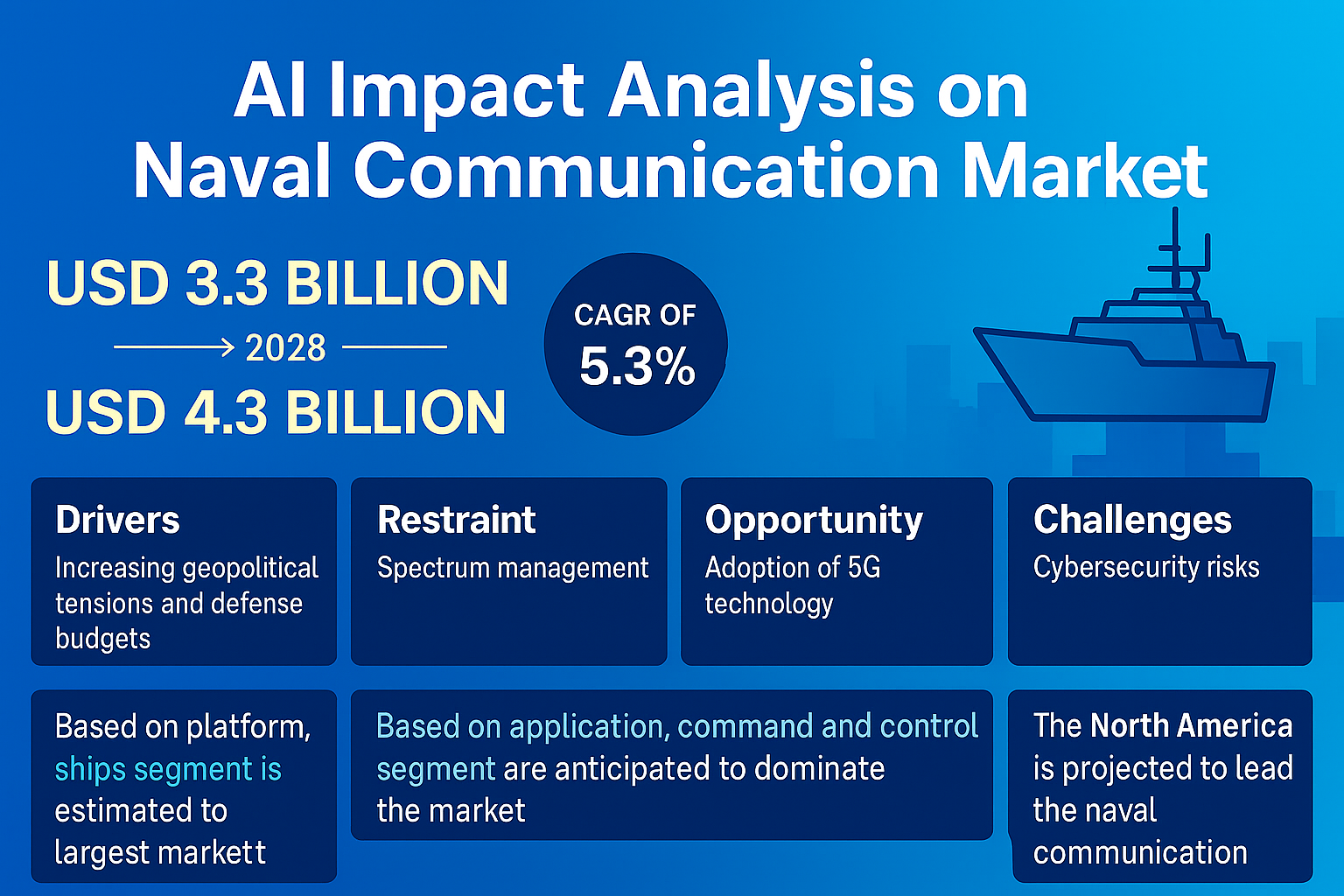
The market for AI in naval communication is poised for substantial growth in the coming decade. Driven by increasing investments in naval modernization, rising geopolitical tensions, and advancements in AI technologies, the sector is attracting attention from both defense contractors and technology providers. Emerging trends include the integration of 5G and AI, development of quantum communication protocols, and expansion of AI trained naval personnel. Defense budgets are being allocated towards AI R&D, especially in the United States, China, and European nations. The convergence of AI with naval communication is not just a technological shift but a strategic transformation that will define the next generation of maritime warfare.
The application of AI in the naval communication market is not a futuristic concept but a present day reality. From enhancing signal processing to securing networks and enabling autonomous coordination, AI is revolutionizing how navies operate and communicate. This transformation is equipping naval forces with the agility, intelligence, and resilience needed to navigate an increasingly complex maritime threat environment. As innovation accelerates and adoption expands, AI will remain a cornerstone of naval communication strategies, propelling the industry into a new era of smart, secure, and scalable maritime operations.
Related Report:
Naval Communication Market by Platform (Ships, Submarines, Unmanned Systems)), System Technology (Naval Satcom Systems, Naval Radio Systems, Naval Security Systems, and Communication Management Systems), Application and Region - Global Forecast to 2028

This FREE sample includes market data points, ranging from trend analyses to market estimates & forecasts. See for yourself.
SEND ME A FREE SAMPLE






