AI Impact Analysis on the Airport Navigation Aids (NAVAIDs) Market
The global Airport Navigation Aids (NAVAIDs) market is entering a new era of technological transformation as artificial intelligence reshapes the way airports manage navigation infrastructure, aircraft guidance, air traffic coordination, and operational safety. For decades, navigation aids such as Instrument Landing Systems (ILS), Distance Measuring Equipment (DME), Very High Frequency Omnidirectional Range (VOR), Non Directional Beacons (NDB), Ground Based Augmentation Systems (GBAS), and Satellite Based Augmentation Systems (SBAS) have formed the backbone of safe aircraft operations. These technologies have enabled millions of successful departures, arrivals, and en route flights while maintaining high levels of aviation safety. However, the rapid growth of global air traffic, increasing airport congestion, changing weather patterns, and the transition toward digital aviation ecosystems are creating new operational challenges that conventional navigation systems alone cannot fully address.
Artificial intelligence is emerging as the catalyst that transforms traditional navigation aids into intelligent aviation infrastructure capable of continuous learning, predictive decision making, and autonomous optimization. Rather than operating as isolated hardware systems, future navigation aids will function as interconnected digital assets that exchange information with aircraft, air traffic control towers, weather monitoring stations, airport operations centers, and airline management platforms.
Governments worldwide continue investing heavily in airport modernization programs to accommodate growing passenger demand while improving operational efficiency. These modernization efforts increasingly incorporate AI driven analytics, digital twins, cloud computing, edge processing, machine learning, and advanced sensor technologies to enhance navigation accuracy and minimize operational disruptions.
Artificial intelligence improves every stage of the Airport Navigation Aids market. Machine learning enhances runway approach planning, predictive maintenance reduces equipment downtime, intelligent calibration improves signal accuracy, computer vision supports autonomous navigation, and AI powered analytics optimize airport capacity without compromising safety.
Between 2025 and 2035, AI will fundamentally redefine how airports deploy, maintain, and operate navigation systems. Intelligent navigation infrastructure will become an essential pillar supporting smart airports, autonomous aviation, sustainable operations, and next generation air traffic management.
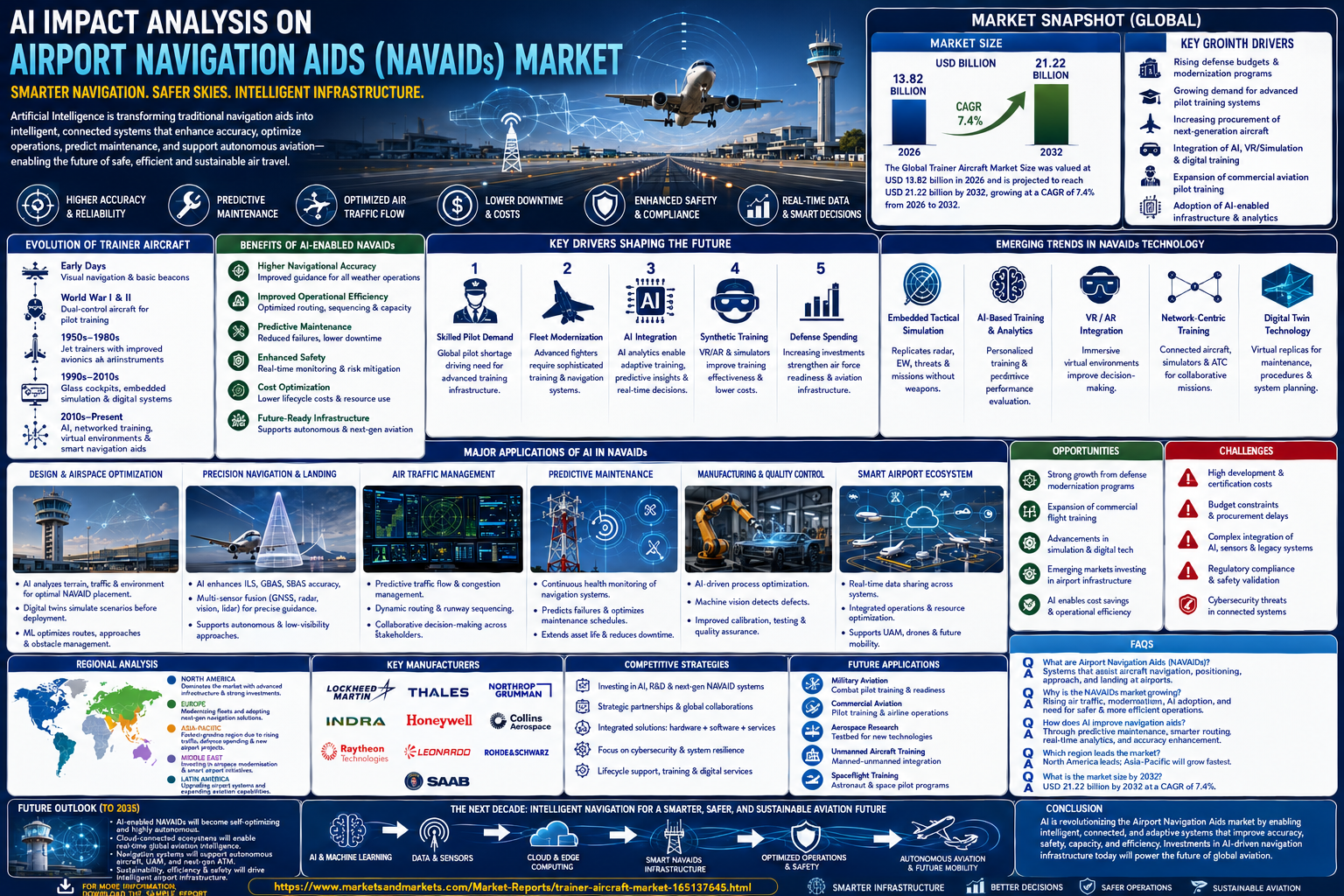
Introduction to the Airport Navigation Aids (NAVAIDs) Market
The Evolution of Airport Navigation Technologies
Airport navigation systems have evolved continuously since the earliest days of commercial aviation. Initial navigation relied primarily on visual landmarks and basic radio beacons that provided limited guidance under favorable weather conditions. As aviation expanded globally, increasingly sophisticated navigation technologies emerged to improve flight safety, support instrument flight operations, and enable reliable aircraft movements during poor visibility.
Modern airports employ numerous navigation aids that collectively provide accurate positioning, approach guidance, runway alignment, distance measurement, and communication support. Instrument Landing Systems guide aircraft during precision approaches, Distance Measuring Equipment provides accurate range information, VOR stations support en route navigation, while GBAS and SBAS enhance satellite navigation accuracy.
The continued expansion of international aviation has significantly increased dependence on these systems. Larger aircraft fleets, higher flight frequencies, expanding airport infrastructure, and increasingly complex airspace require navigation technologies capable of supporting greater operational efficiency while maintaining exceptionally high safety standards.
Artificial intelligence represents the next major milestone in this technological evolution by enabling navigation systems that continuously learn from operational data, adapt to changing conditions, and improve overall airport performance.
Growing Demand for Modern Navigation Infrastructure
Global passenger traffic continues recovering and expanding, placing increasing pressure on airport infrastructure worldwide. Major international airports handle thousands of aircraft movements every day, requiring highly reliable navigation systems capable of supporting continuous operations under varying weather and operational conditions.
Emerging economies are investing heavily in new airports while developed nations modernize existing facilities through digital transformation initiatives. Airport expansion projects increasingly prioritize intelligent navigation infrastructure that improves operational flexibility while supporting long term traffic growth.
Beyond commercial aviation, military airports, cargo terminals, business aviation facilities, and regional airports also require advanced navigation systems to improve operational safety and efficiency.
Artificial intelligence enables these organizations to maximize existing infrastructure by improving navigation accuracy, optimizing runway utilization, reducing delays, and enhancing maintenance efficiency without requiring complete infrastructure replacement.
The Importance of Navigation Aids in Aviation Safety
Navigation aids represent one of the most important safety components within modern aviation.
Pilots depend upon accurate navigation information during departure, cruise, approach, and landing phases. Air traffic controllers rely on navigation infrastructure to manage aircraft separation, coordinate arrivals and departures, and maintain orderly traffic flow within increasingly congested airspace.
Failures or inaccuracies within navigation systems may significantly affect operational safety, particularly during adverse weather conditions when pilots rely heavily on instrument guidance.
Artificial intelligence improves safety by continuously monitoring navigation system performance, detecting anomalies before failures occur, identifying calibration deviations, and recommending corrective actions before operational disruptions develop.
This predictive capability allows airports to maintain exceptionally high system availability while minimizing unexpected equipment failures.
Artificial Intelligence Driving the Future of Airport Navigation
Artificial intelligence is transforming airport navigation from a collection of independent electronic systems into an intelligent operational ecosystem.
Machine learning analyzes enormous volumes of operational information generated by navigation equipment, aircraft movements, weather systems, maintenance records, radar networks, satellite positioning systems, and airport operations.
Rather than responding only after problems arise, AI predicts equipment degradation, optimizes runway usage, recommends maintenance schedules, improves navigation accuracy, and supports operational decision making across the entire airport environment.
This transition from reactive management to predictive intelligence represents one of the most significant technological advances in airport navigation history.
AI Driven Navigation System Design and Airspace Optimization
Revolutionizing Navigation Infrastructure Design
Traditional navigation infrastructure design involves extensive engineering studies, terrain analysis, signal propagation modeling, obstacle assessments, environmental evaluations, and regulatory compliance reviews. While these methods remain essential, they often require lengthy development timelines and substantial engineering resources.
Artificial intelligence significantly accelerates this process by analyzing massive datasets containing airport layouts, aircraft movement patterns, terrain characteristics, weather histories, electromagnetic interference profiles, and operational requirements.
Machine learning identifies optimal locations for navigation equipment while minimizing signal interference, reducing infrastructure costs, and maximizing operational coverage.
Engineers receive AI generated recommendations that significantly reduce planning time while improving overall navigation performance.
Digital Twins Supporting Airport Planning
Digital twin technology has become one of the most valuable applications of artificial intelligence within airport infrastructure development.
A digital twin creates a highly accurate virtual representation of airport navigation systems, runways, taxiways, terminal areas, surrounding terrain, and airspace.
Artificial intelligence continuously updates these digital models using operational data collected from navigation equipment, aircraft movements, maintenance activities, and environmental sensors.
Airport planners evaluate proposed infrastructure modifications inside virtual environments before physical construction begins.
Engineers can simulate new runway configurations, navigation equipment locations, approach procedures, obstacle clearances, and traffic patterns under countless operational scenarios.
This capability significantly reduces project risks while accelerating airport modernization initiatives.
Optimizing Airspace Through Machine Learning
Airspace surrounding major airports has become increasingly congested due to continuous growth in global aviation.
Artificial intelligence improves airspace efficiency by analyzing historical flight trajectories, aircraft performance characteristics, weather conditions, runway capacities, and controller workload.
Machine learning recommends optimized arrival routes, departure procedures, holding patterns, and sequencing strategies that reduce delays while maintaining safe aircraft separation.
Rather than relying exclusively on fixed procedures, future navigation systems will continuously adapt according to changing operational conditions.
This intelligent optimization improves airport capacity while reducing fuel consumption and emissions.
Intelligent Obstacle Assessment
Obstacle management remains essential for maintaining safe navigation procedures.
Buildings, communication towers, wind turbines, cranes, terrain changes, and temporary construction activities may influence navigation performance or create hazards for aircraft operations.
Artificial intelligence continuously evaluates obstacle information using satellite imagery, drone surveys, lidar measurements, and digital terrain models.
Machine learning automatically identifies potential conflicts with instrument procedures, approach paths, and navigation signals before operational risks develop.
Airport authorities therefore gain greater confidence that navigation infrastructure remains compliant with evolving safety requirements.
Future AI Designed Airport Navigation Networks
Future airport navigation infrastructure will increasingly rely upon autonomous engineering platforms capable of generating complete system designs.
Artificial intelligence will evaluate airport expansion plans, passenger growth forecasts, aircraft fleet changes, regulatory requirements, environmental conditions, and operational objectives before recommending optimal navigation architectures.
Rather than designing individual systems independently, AI will optimize entire airport navigation ecosystems simultaneously.
This holistic engineering approach will improve operational efficiency while reducing infrastructure investment costs.
AI in Precision Navigation and Landing Systems
Enhancing Instrument Landing Systems
Instrument Landing Systems remain among the most important navigation technologies supporting precision aircraft approaches during reduced visibility conditions.
Artificial intelligence enhances ILS performance by continuously monitoring signal stability, antenna alignment, electromagnetic interference, environmental influences, and equipment calibration.
Machine learning detects subtle deviations that conventional monitoring systems may overlook, allowing maintenance personnel to correct issues before operational performance deteriorates.
This predictive monitoring improves system reliability while reducing unexpected outages.
Improving Satellite Based Navigation
Satellite navigation has become increasingly important for modern aviation operations.
Artificial intelligence enhances Global Navigation Satellite System performance through intelligent error correction, atmospheric modeling, signal quality assessment, and multi source data fusion.
Machine learning continuously evaluates satellite integrity, ground augmentation systems, weather influences, and aircraft positioning information to improve navigation accuracy.
This enhanced precision supports safer approaches while reducing dependence upon traditional ground based infrastructure.
Computer Vision Supporting Autonomous Landing
Artificial intelligence increasingly combines satellite navigation with computer vision to improve aircraft landing capabilities.
High resolution cameras, infrared sensors, lidar systems, and machine learning algorithms identify runway markings, lighting systems, taxiways, terrain features, and surrounding obstacles during final approach.
Rather than relying solely on radio navigation signals, AI integrates multiple sensor inputs to generate comprehensive situational awareness.
This technology supports safer operations during low visibility while laying the foundation for increasingly autonomous aircraft.
Multi Sensor Navigation Fusion
Modern aircraft generate enormous volumes of navigation information through inertial navigation systems, GPS receivers, radar altimeters, weather radar, terrain databases, satellite communications, and onboard sensors.
Artificial intelligence integrates these diverse information sources into unified navigation solutions that are significantly more accurate than individual systems operating independently.
Machine learning continuously compares sensor outputs, identifies inconsistencies, filters erroneous information, and recommends the most reliable navigation solution for current operational conditions.
This intelligent sensor fusion significantly improves navigation resilience.
Preparing for Autonomous Precision Approaches
As autonomous aviation technologies mature, precision navigation systems will evolve accordingly.
Artificial intelligence will support increasingly automated approach procedures by continuously evaluating aircraft performance, environmental conditions, navigation accuracy, obstacle clearance, runway occupancy, and traffic conflicts.
Although human pilots and air traffic controllers will remain essential for the foreseeable future, AI will assume growing responsibility for assisting precision approach operations while maintaining the industry's uncompromising commitment to aviation safety.
AI Powered Air Traffic Management and Real Time Navigation
Transforming Air Traffic Management Through Artificial Intelligence
Global aviation continues to experience steady growth in passenger traffic, cargo operations, and aircraft movements. Major international airports handle hundreds or even thousands of arrivals and departures every day, placing tremendous pressure on air traffic controllers and airport infrastructure. Conventional air traffic management systems rely heavily on predefined procedures, human expertise, and static operational planning. While these systems have maintained excellent safety records, increasing traffic density demands more intelligent methods of managing complex airspace.
Artificial intelligence is transforming air traffic management into a dynamic, predictive, and highly adaptive system capable of continuously optimizing aircraft movements based on changing operational conditions. Machine learning analyzes aircraft trajectories, weather conditions, runway availability, airport congestion, and aircraft performance simultaneously to support faster and more informed operational decisions.
Instead of reacting to congestion after it develops, AI predicts traffic bottlenecks well in advance, allowing airports to implement proactive traffic management strategies that improve safety and operational efficiency.
Intelligent Flight Routing
Traditional flight routing follows predefined airways and standard arrival or departure procedures established by aviation authorities. While these procedures ensure safety and predictability, they do not always represent the most efficient routing under changing weather, traffic, or operational conditions.
Artificial intelligence continuously evaluates multiple operational variables before recommending optimized flight paths.
Machine learning considers aircraft performance, prevailing winds, fuel consumption, runway occupancy, weather systems, restricted airspace, and neighboring airport activity to identify routes that reduce delays while maintaining safe aircraft separation.
Dynamic routing improves airport throughput, reduces airborne holding patterns, lowers operational costs, and decreases environmental emissions.
As AI models continue learning from millions of completed flights, routing recommendations become increasingly accurate and efficient.
Predictive Traffic Flow Management
One of the greatest strengths of artificial intelligence lies in its ability to forecast future operational conditions.
Rather than monitoring only current aircraft positions, AI predicts traffic flow several hours in advance using historical flight schedules, airline operations, passenger demand, weather forecasts, aircraft turnaround times, and seasonal traffic patterns.
These predictive capabilities allow airport operators to allocate gates, schedule runway usage, coordinate ground services, and optimize staffing before congestion develops.
Controllers receive advance warnings regarding potential traffic conflicts, enabling earlier intervention with minimal operational disruption.
Predictive traffic management significantly improves airport resilience during periods of high demand.
Dynamic Runway Utilization
Runways represent one of the most valuable resources at any airport.
Artificial intelligence continuously analyzes wind conditions, aircraft types, arrival sequences, departure priorities, runway occupancy times, and weather information before recommending optimal runway assignments.
Machine learning identifies opportunities to improve runway utilization without compromising safety margins established by aviation regulations.
Future AI systems will coordinate runway operations across multiple airports within metropolitan regions, reducing regional congestion while maximizing available infrastructure.
This intelligent resource management supports increasing passenger demand without requiring immediate construction of additional runways.
Collaborative Decision Making Across Airport Operations
Modern airports involve numerous organizations including airlines, airport authorities, air navigation service providers, maintenance teams, ground handling companies, security agencies, customs authorities, and emergency response organizations.
Artificial intelligence facilitates collaborative decision making by integrating operational information from every participating stakeholder.
Machine learning analyzes aircraft schedules, gate assignments, maintenance activities, fueling operations, passenger processing, baggage handling, and weather conditions before recommending coordinated operational plans.
This shared situational awareness improves communication while reducing delays caused by fragmented decision making.
Future airports will increasingly rely upon AI to synchronize activities across all operational departments.
AI in Predictive Maintenance and Navigation Infrastructure Management
Moving Beyond Scheduled Maintenance
Airport navigation aids operate continuously under demanding environmental conditions including temperature fluctuations, humidity, precipitation, wind, electromagnetic interference, and continuous operational use.
Traditional maintenance strategies rely primarily on scheduled inspections and periodic equipment servicing regardless of actual system condition.
Artificial intelligence transforms maintenance into a predictive discipline that continuously evaluates equipment health using operational data collected directly from navigation systems.
Machine learning identifies subtle performance changes that indicate developing faults long before equipment failures occur.
Maintenance personnel therefore intervene only when necessary while maintaining exceptionally high operational reliability.
Continuous Health Monitoring
Artificial intelligence enables continuous monitoring of every major navigation aid deployed throughout airport infrastructure.
Instrument Landing Systems, Distance Measuring Equipment, VOR stations, radar installations, GBAS equipment, lighting systems, communication networks, and power supplies generate enormous volumes of operational data during normal operation.
Machine learning analyzes signal stability, transmitter performance, antenna characteristics, electrical parameters, environmental influences, and calibration accuracy continuously.
Rather than relying on periodic inspections alone, airports maintain complete visibility into equipment health at every moment.
This continuous awareness significantly improves operational confidence.
Predicting Equipment Failures
Unexpected failures of navigation equipment may disrupt airport operations, delay flights, increase maintenance costs, and potentially affect aviation safety.
Artificial intelligence predicts failures before they occur by recognizing patterns associated with gradual equipment degradation.
Machine learning compares current equipment behavior with historical failure records, identifying abnormalities that indicate future maintenance requirements.
Maintenance teams receive early warnings allowing repairs during planned maintenance windows rather than emergency operational situations.
This predictive approach minimizes downtime while extending equipment service life.
Digital Twins Supporting Infrastructure Management
Digital twins continue providing value long after navigation systems enter operational service.
Every major navigation aid maintains a virtual representation that reflects its actual operating condition, maintenance history, environmental exposure, calibration status, and performance characteristics.
Artificial intelligence continuously updates these digital models using live operational information.
Engineers evaluate maintenance strategies, equipment upgrades, component replacements, and operational changes inside virtual environments before implementing physical modifications.
This capability reduces maintenance risks while improving long term infrastructure planning.
Lifecycle Optimization Through Artificial Intelligence
Navigation systems represent substantial long term investments requiring careful lifecycle management.
Artificial intelligence analyzes equipment age, maintenance costs, operational reliability, technological obsolescence, spare parts availability, manufacturer support, and airport modernization plans before recommending optimal replacement schedules.
Rather than replacing equipment according to predetermined timelines, AI supports evidence based investment decisions that maximize operational value while minimizing lifecycle costs.
This intelligent asset management approach improves financial efficiency while supporting continuous airport modernization.
AI in Manufacturing, Calibration, and Quality Assurance of Navigation Systems
Smart Manufacturing for Aviation Navigation Equipment
Manufacturing airport navigation aids requires exceptional engineering precision because even minor variations may influence navigation accuracy, signal stability, or equipment reliability.
Artificial intelligence transforms manufacturing facilities into intelligent production environments capable of continuously monitoring quality while optimizing production processes.
Machine learning analyzes production equipment, environmental conditions, material properties, assembly operations, calibration procedures, and quality inspection data simultaneously.
Manufacturers achieve greater consistency while reducing production costs and minimizing product defects.
This intelligent manufacturing approach strengthens global supply chains supporting airport modernization.
Machine Vision for Precision Inspection
Computer vision has become one of the most valuable AI applications within navigation equipment manufacturing.
High resolution imaging systems inspect antennas, transmitters, electronic assemblies, circuit boards, connectors, sensors, and precision mechanical components throughout production.
Deep learning algorithms identify microscopic manufacturing defects, dimensional deviations, soldering imperfections, surface contamination, alignment errors, and structural anomalies that may affect long term operational reliability.
Continuous automated inspection improves manufacturing quality while reducing dependence upon manual visual examination.
Artificial Intelligence Enhancing Calibration
Calibration represents one of the most critical processes within airport navigation systems.
Every navigation aid must transmit highly accurate signals that satisfy strict international aviation standards.
Artificial intelligence improves calibration by continuously analyzing signal performance during laboratory testing and operational deployment.
Machine learning automatically detects calibration drift, environmental influences, frequency deviations, and signal distortions before they exceed regulatory limits.
Engineers receive precise calibration recommendations that improve navigation accuracy while reducing maintenance effort.
Automation in Production and Validation
Artificial intelligence increasingly coordinates robotic manufacturing systems responsible for assembling complex navigation equipment.
Robots perform precision assembly, component installation, wiring, testing, packaging, and quality verification with exceptional consistency.
Machine learning continuously optimizes production workflows by identifying bottlenecks, improving resource allocation, and minimizing material waste.
Finished products undergo automated validation using AI powered testing platforms capable of evaluating thousands of operational parameters before shipment.
These intelligent manufacturing processes improve both productivity and product reliability.
Continuous Manufacturing Improvement
Artificial intelligence enables manufacturers to improve continuously through operational learning.
Every manufactured component contributes additional information that strengthens future machine learning models.
Quality data collected during production, laboratory testing, airport installation, maintenance activities, and operational deployment collectively improve engineering knowledge.
Manufacturers therefore refine designs, optimize manufacturing methods, improve component selection, and reduce future defects through continuous AI driven analysis.
This ongoing learning cycle accelerates innovation throughout the Airport Navigation Aids market.
AI Integration with Smart Airports and Connected Aviation Ecosystems
Building Intelligent Airport Ecosystems
Airport modernization extends well beyond navigation systems alone.
Future airports operate as highly connected digital ecosystems where navigation aids, surveillance systems, passenger processing, baggage handling, security operations, maintenance facilities, energy management, and airline operations exchange information continuously.
Artificial intelligence serves as the coordinating technology integrating these diverse operational systems into unified airport management platforms.
Instead of functioning independently, navigation aids become intelligent contributors to overall airport performance.
Airport Collaborative Decision Making
Airport Collaborative Decision Making has become increasingly important for improving operational efficiency.
Artificial intelligence strengthens collaborative decision making by analyzing operational information collected from airlines, airport authorities, air traffic control organizations, maintenance providers, and ground service companies.
Machine learning identifies optimal operational strategies that balance aircraft scheduling, gate utilization, maintenance activities, passenger flows, and navigation infrastructure availability.
This coordinated planning reduces delays while improving passenger experience and airline efficiency.
Supporting Airport Digital Twins
Digital twins are becoming central components of smart airport development.
Artificial intelligence continuously updates comprehensive digital airport models using operational information collected from navigation systems, aircraft movements, weather sensors, surveillance equipment, terminal operations, and maintenance activities.
Airport managers evaluate infrastructure expansion, runway modifications, navigation upgrades, emergency response procedures, and operational improvements within virtual environments before implementing physical changes.
Digital twins reduce planning risks while accelerating airport modernization.
Artificial Intelligence Supporting Airport Surface Operations
Aircraft movements continue after landing and before departure through complex taxiway networks shared with service vehicles, maintenance equipment, fueling trucks, baggage handlers, and emergency response teams.
Artificial intelligence coordinates airport surface movements by monitoring vehicle positions, aircraft routing, runway occupancy, and operational priorities simultaneously.
Machine learning identifies potential conflicts, recommends efficient taxi routes, reduces aircraft waiting times, and improves overall airport efficiency.
Future autonomous airport vehicles will rely heavily upon AI enabled navigation infrastructure for safe and efficient operation.
Toward Fully Connected Aviation Infrastructure
Artificial intelligence is gradually connecting every aspect of airport operations into integrated aviation ecosystems.
Navigation aids, aircraft, weather monitoring systems, satellite networks, communication platforms, maintenance organizations, airline operations centers, and air traffic management systems will increasingly exchange information continuously.
This comprehensive operational awareness supports faster decision making, improved safety, reduced delays, greater sustainability, and enhanced passenger experience.
The Airport Navigation Aids market therefore becomes a critical foundation supporting the broader transformation toward intelligent aviation infrastructure.
Challenges, Risks, and Regulatory Considerations
Cybersecurity Challenges in AI Driven Navigation Systems
As airport navigation aids become increasingly connected through artificial intelligence, cloud computing, edge processing, and digital communication networks, cybersecurity has emerged as one of the most critical challenges facing the aviation industry. Traditional navigation systems operated largely as standalone infrastructure with limited external connectivity. Modern AI enabled navigation ecosystems, however, exchange continuous streams of operational data among navigation equipment, air traffic management systems, airport operations centers, airline control centers, weather services, and aircraft.
While this interconnected environment significantly improves operational efficiency and situational awareness, it also expands potential cyberattack surfaces. Unauthorized access to navigation systems, communication networks, or AI decision support platforms could affect airport operations, disrupt flight schedules, compromise navigation accuracy, or expose sensitive operational information.
Artificial intelligence itself is increasingly being employed as a defensive technology. Machine learning continuously monitors network activity, identifies unusual communication patterns, detects malicious software behavior, and responds rapidly to cyber threats before operational disruption occurs.
Future airport navigation systems will incorporate multiple layers of cybersecurity including encrypted communications, secure authentication, continuous monitoring, zero trust architectures, and AI powered threat detection to ensure resilient and secure aviation operations.
Regulatory Approval of AI Based Navigation Technologies
The aviation industry operates under some of the strictest regulatory requirements of any global sector. Every navigation aid, communication system, software platform, and operational procedure must satisfy rigorous certification standards before deployment.
Artificial intelligence introduces additional complexity because machine learning algorithms continuously evolve through operational learning. Regulatory authorities must therefore establish new frameworks capable of evaluating adaptive software systems while maintaining the uncompromising safety standards that define global aviation.
Organizations responsible for aviation oversight are gradually developing guidance covering AI validation, algorithm transparency, software lifecycle management, operational verification, and cybersecurity assurance.
Manufacturers must demonstrate that AI enabled navigation systems consistently perform under every expected operational condition before certification is granted.
International harmonization of certification standards will become increasingly important as intelligent navigation technologies are deployed across airports worldwide.
Integrating AI with Legacy Airport Infrastructure
Many airports continue operating navigation systems installed decades ago. These legacy systems remain reliable and compliant with existing aviation standards but were not originally designed to support artificial intelligence, cloud connectivity, or digital analytics.
Replacing complete navigation infrastructures is often economically impractical and operationally disruptive.
Artificial intelligence therefore must integrate gradually with existing equipment while preserving operational continuity.
Manufacturers increasingly develop hybrid architectures that combine conventional navigation hardware with AI powered monitoring platforms capable of collecting operational information without requiring immediate infrastructure replacement.
This phased modernization approach allows airports to benefit from intelligent technologies while maximizing the value of existing investments.
Data Quality and Algorithm Reliability
Artificial intelligence depends upon accurate, comprehensive, and representative datasets for successful operation.
Airport navigation systems generate enormous volumes of operational information including aircraft trajectories, navigation signal performance, weather observations, maintenance histories, runway operations, communication records, and surveillance information.
If this information contains inconsistencies, incomplete records, calibration errors, or operational biases, machine learning models may produce inaccurate recommendations.
Consequently, airports must establish comprehensive data governance strategies covering data collection, validation, storage, cybersecurity, and quality assurance.
Continuous comparison between AI predictions and actual operational outcomes enables machine learning systems to improve progressively while maintaining operational reliability.
Human Oversight in Intelligent Aviation Systems
Despite remarkable advances in artificial intelligence, aviation remains fundamentally centered on human expertise and professional judgment.
Pilots, air traffic controllers, airport managers, maintenance engineers, and navigation specialists continue making critical operational decisions based upon their experience, regulatory knowledge, and situational awareness.
Artificial intelligence should function as a decision support technology rather than replacing human responsibility.
AI rapidly analyzes enormous quantities of operational information, identifies emerging risks, recommends optimized solutions, and predicts future operational conditions.
Human operators evaluate these recommendations within broader operational contexts before implementing final decisions.
Maintaining meaningful human oversight ensures aviation continues benefiting from technological innovation without compromising accountability, safety, or public confidence.
Ethical Considerations for Autonomous Aviation
As navigation technologies become increasingly intelligent, important ethical questions emerge regarding responsibility, transparency, and operational accountability.
Future autonomous navigation systems may support highly automated aircraft operations, autonomous ground vehicles, intelligent airport logistics, and advanced air mobility platforms.
Developers must ensure AI decision making remains transparent, explainable, unbiased, and consistent with internationally accepted aviation regulations.
Ethical governance frameworks will play a central role in ensuring artificial intelligence strengthens aviation safety while maintaining public trust in increasingly autonomous transportation systems.
Future Outlook: AI Powered Airport Navigation Aids Market (2035)
Toward Autonomous Airport Navigation
The Airport Navigation Aids market is steadily progressing toward autonomous navigation ecosystems capable of supporting increasingly automated aircraft operations.
Artificial intelligence will continuously analyze aircraft movements, navigation system health, weather conditions, airspace congestion, runway utilization, and operational priorities while coordinating navigation infrastructure with minimal manual intervention.
Future airports will increasingly depend upon intelligent navigation systems capable of adapting automatically to changing operational environments.
This evolution will improve efficiency while supporting growing global aviation demand.
Self Optimizing Navigation Infrastructure
Traditional navigation systems require periodic calibration, maintenance, and operational adjustments performed manually by technical specialists.
Future AI enabled navigation infrastructure will increasingly optimize itself.
Machine learning will monitor signal quality continuously, detect performance degradation, initiate recalibration procedures, recommend maintenance actions, and optimize operational parameters automatically.
Self optimizing navigation systems will significantly reduce maintenance requirements while maintaining exceptional operational reliability.
Cloud Connected Aviation Networks
Cloud computing will become an essential foundation supporting intelligent airport navigation.
Navigation aids deployed across thousands of airports will securely exchange operational information through protected aviation cloud environments.
Artificial intelligence will analyze aggregated information collected worldwide, identifying operational trends, predicting equipment failures, improving navigation algorithms, and accelerating technological innovation.
Manufacturers will continuously improve future navigation products using operational knowledge generated from global deployments.
This continuous learning ecosystem will dramatically increase the pace of technological advancement.
Artificial Intelligence Supporting Next Generation Air Traffic Management
Programs such as the United States NextGen initiative and the European SESAR modernization program seek to transform global air traffic management using advanced digital technologies.
Artificial intelligence will become one of the primary technologies supporting these initiatives.
Machine learning will optimize flight trajectories, improve arrival sequencing, coordinate multiple airports simultaneously, predict weather impacts, minimize delays, reduce fuel consumption, and maximize airspace utilization.
AI powered navigation infrastructure will therefore become an essential component supporting future global aviation modernization.
Navigation for Autonomous Aircraft
The rapid emergence of autonomous aircraft, urban air mobility vehicles, cargo drones, and advanced air mobility platforms introduces entirely new navigation requirements.
Future navigation aids must support aircraft capable of making increasingly autonomous operational decisions.
Artificial intelligence will integrate satellite navigation, computer vision, radar, lidar, inertial navigation, digital terrain databases, weather intelligence, and communication systems into unified navigation solutions that provide exceptional reliability.
These intelligent navigation capabilities will enable safe autonomous operations within increasingly complex urban and regional airspaces.
Quantum Computing and Future Navigation Intelligence
Although still emerging, quantum computing may eventually transform navigation optimization through unprecedented computational capabilities.
Future quantum enhanced AI systems could evaluate millions of flight routing possibilities simultaneously while optimizing global airspace management, airport scheduling, weather avoidance, and navigation infrastructure planning.
While commercial implementation remains several years away, ongoing research indicates significant long term opportunities for combining artificial intelligence with quantum computing across aviation.
Sustainable Airport Operations Through Artificial Intelligence
Environmental sustainability has become a strategic priority throughout global aviation.
Artificial intelligence contributes directly by optimizing aircraft routing, reducing holding patterns, improving runway utilization, minimizing taxi times, and enhancing airport energy management.
Intelligent navigation systems reduce unnecessary fuel consumption while lowering carbon emissions and operational costs.
As sustainability regulations become increasingly stringent, AI driven navigation optimization will play a growing role in supporting environmentally responsible airport operations.
Long Term Market Outlook
Between 2025 and 2035, artificial intelligence will fundamentally reshape the Airport Navigation Aids market.
Traditional navigation infrastructure will evolve into intelligent, interconnected digital ecosystems capable of predictive maintenance, autonomous optimization, real time decision support, cloud based collaboration, and continuous operational learning.
Manufacturers investing aggressively in artificial intelligence, digital twins, advanced analytics, computer vision, and machine learning will establish competitive advantages while supporting the aviation industry's transition toward safer, more efficient, and increasingly autonomous airport operations.
The Airport Navigation Aids market will no longer be defined solely by hardware performance but by the intelligence, adaptability, resilience, and connectivity of the navigation ecosystems supporting global aviation.
Artificial intelligence is redefining the future of the Airport Navigation Aids market by transforming conventional navigation infrastructure into intelligent operational ecosystems capable of supporting the rapidly evolving needs of global aviation. Across every stage of the navigation lifecycle, from system design and airport planning to precision landing, air traffic management, predictive maintenance, manufacturing, cybersecurity, and long term asset management, AI is introducing unprecedented levels of intelligence, automation, and operational efficiency.
Machine learning enables navigation systems to process enormous volumes of operational information, predict equipment failures before they occur, optimize aircraft routing, improve runway utilization, strengthen aviation safety, and support increasingly complex airport environments. Digital twins, computer vision, cloud computing, predictive analytics, and edge intelligence further accelerate innovation while reducing operational costs and improving infrastructure resilience.
Looking toward 2035, the Airport Navigation Aids market will continue evolving alongside smart airport initiatives, autonomous aircraft, advanced air mobility platforms, and next generation air traffic management programs. Navigation systems will become increasingly connected, self optimizing, and capable of adapting automatically to changing operational conditions without compromising the industry's rigorous safety standards.
Organizations that embrace AI driven innovation today will be best positioned to lead the future of intelligent aviation infrastructure. As global air transportation continues expanding, artificial intelligence will become a defining force behind safer, more efficient, more sustainable, and highly connected airport navigation systems that support the next generation of commercial, military, and autonomous aviation.

This FREE sample includes market data points, ranging from trend analyses to market estimates & forecasts. See for yourself.
SEND ME A FREE SAMPLE






