AI Impact Analysis on the UAV Radar Market Through 2035
The global UAV Radar Market is entering a significant technological transformation as artificial intelligence becomes increasingly integrated with airborne sensing, target detection, navigation, surveillance, signal processing, electronic warfare, predictive maintenance, and autonomous flight operations. Radar has traditionally provided unmanned aerial vehicles with an important sensing capability by enabling detection and tracking beyond the limitations of conventional optical systems. The integration of AI is now expanding this role by allowing UAV radar systems to interpret complex environments, distinguish relevant targets from clutter, optimize sensing parameters, and provide actionable information in real time.
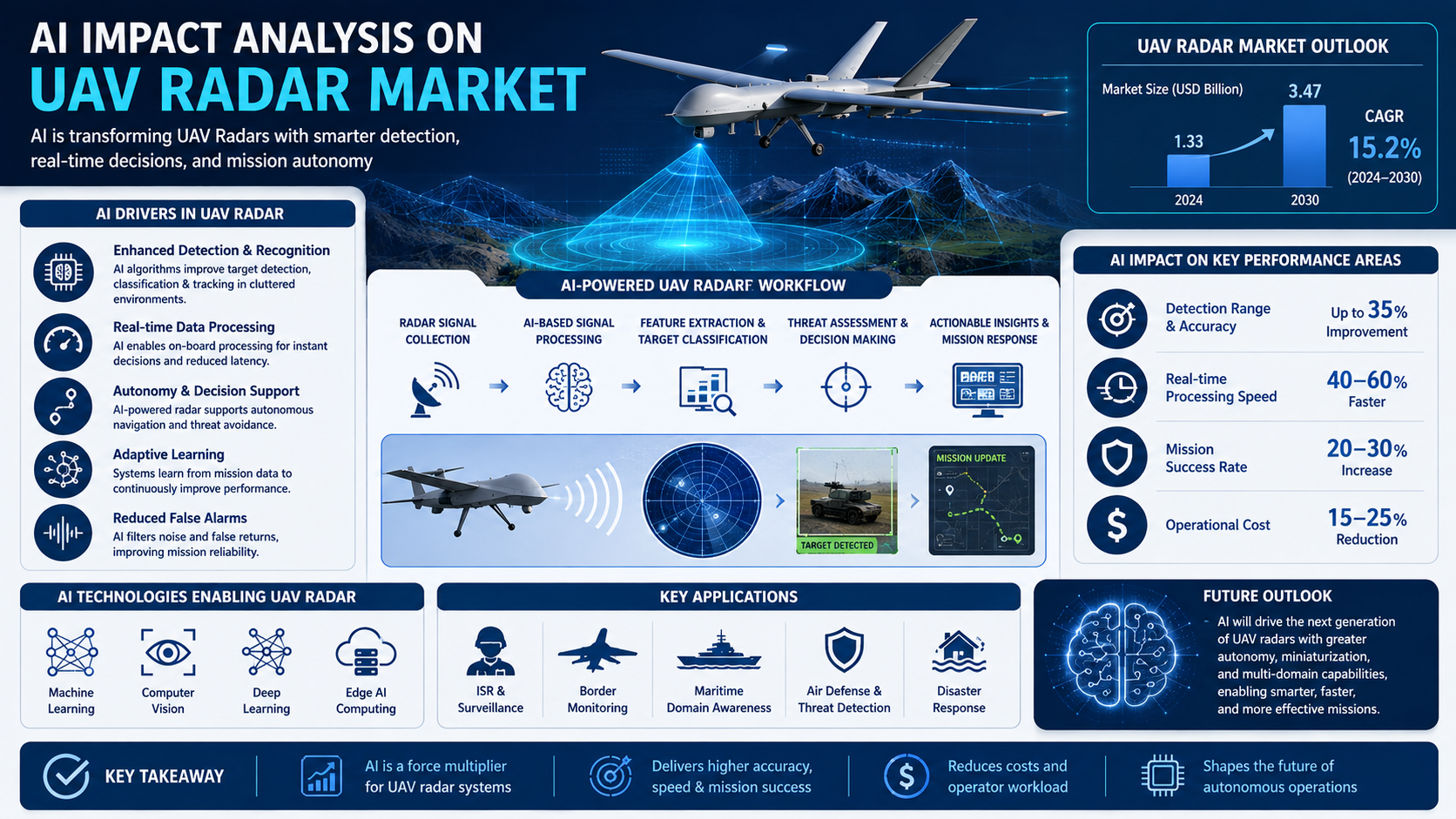
The growing deployment of unmanned aerial vehicles across defense, homeland security, border surveillance, maritime monitoring, disaster management, infrastructure inspection, agriculture, and other applications is increasing demand for compact, lightweight, low power, and high performance radar systems. UAV operators increasingly require sensing technologies that can function during darkness, adverse weather, smoke, dust, and other conditions where optical sensors may experience limitations.
Artificial intelligence addresses several of these challenges by combining radar data with machine learning, computer vision, edge computing, digital signal processing, and autonomous flight technologies. AI algorithms can identify subtle radar patterns, classify objects, suppress unwanted clutter, predict target movements, and improve the quality of information delivered to operators.
The convergence of AI and UAV radar is particularly important because unmanned aircraft have limited size, weight, power, and computing resources. Advanced algorithms must therefore provide sophisticated sensing capabilities without significantly increasing onboard hardware requirements. Edge AI is emerging as an important solution because it allows radar data to be processed directly onboard the UAV, reducing latency and dependence on remote processing infrastructure.
Between 2025 and 2035, AI is expected to influence almost every stage of the UAV radar value chain. It will reshape radar design, signal processing, target recognition, autonomous navigation, multi sensor fusion, spectrum management, electronic warfare resilience, manufacturing, predictive maintenance, and networked UAV operations. The result will be a transition from conventional radar payloads toward intelligent sensing systems capable of continuously adapting to their operating environment.
Introduction to the UAV Radar Market
Evolution of UAV Radar Technology
Early unmanned aerial vehicles primarily relied on electro optical and infrared sensors for surveillance and reconnaissance. These systems provided valuable imagery but faced limitations in darkness, fog, clouds, smoke, precipitation, and other challenging environmental conditions. Radar introduced a complementary sensing capability capable of detecting and tracking objects using radio frequency energy.
As UAV technology matured, radar systems became smaller, lighter, and more energy efficient. Advances in solid state electronics, phased array architectures, digital signal processing, and software defined systems enabled radar payloads to be integrated into increasingly compact unmanned aircraft.
Modern UAV radar systems can support surveillance, mapping, target detection, maritime monitoring, terrain sensing, weather observation, and navigation. Synthetic aperture radar can generate detailed ground imagery, while active electronically scanned technologies can provide rapid electronic beam steering without relying on mechanical movement.
Artificial intelligence represents the next major stage in this evolution. Instead of simply transmitting signals and returning processed measurements, AI enabled radar systems can interpret data and identify meaningful patterns autonomously.
Growing Adoption of Radar Equipped UAVs
The growing use of UAVs across military and commercial applications is generating new opportunities for airborne radar.
Defense organizations use unmanned aircraft for intelligence, surveillance, and reconnaissance missions, border monitoring, maritime surveillance, battlefield observation, and situational awareness. Civilian organizations increasingly use drones for infrastructure inspection, disaster response, environmental monitoring, mapping, and other applications.
Radar provides a valuable sensing capability because it can operate in conditions where optical systems may be degraded. When combined with AI, radar can provide more accurate and timely information while reducing the workload required from human operators.
Demand for Compact and Lightweight Radar
Size, weight, and power remain fundamental constraints for UAV platforms. Every additional kilogram of payload can influence flight endurance, range, maneuverability, and operating cost.
AI helps address these constraints by improving the efficiency of radar processing. Advanced algorithms can extract more useful information from relatively compact radar hardware, potentially reducing the need for larger sensing architectures.
The combination of miniaturized electronics and AI based processing will support increasingly capable radar payloads for small and medium sized UAVs.
Radar as a Foundation for All Weather Sensing
Optical sensors provide high quality imagery but can be affected by environmental conditions. Radar can complement these systems by maintaining sensing capabilities in darkness and degraded visibility.
AI further improves radar interpretation by identifying environmental clutter and separating relevant objects from background signals.
This combination makes AI enhanced radar particularly valuable for missions requiring continuous monitoring regardless of time of day or weather conditions.
AI Driven Radar Detection, Classification, and Target Recognition
AI Enhanced Target Detection
Target detection is one of the most important areas where artificial intelligence can influence UAV radar.
Traditional radar systems identify objects by analyzing signal characteristics such as range, velocity, direction, and reflected energy. AI adds an additional layer of interpretation by recognizing patterns within these measurements.
Machine learning models can be trained using large radar datasets containing different object types and environmental conditions. Once trained, these systems can identify patterns associated with aircraft, vehicles, vessels, structures, or other objects.
This enables UAV radar systems to move beyond basic detection toward intelligent object recognition.
Machine Learning for Target Classification
Radar returns can vary significantly depending on object shape, material, movement, distance, and viewing angle. Environmental clutter can make classification even more difficult.
Machine learning helps identify patterns across these variables.
Deep learning algorithms can analyze radar signatures and classify detected objects based on previously learned characteristics. As more data becomes available, models can become increasingly capable of distinguishing relevant objects from background clutter.
This capability is particularly valuable in surveillance applications where operators may otherwise need to examine large volumes of radar information manually.
Reducing False Alarms
False alarms remain a major challenge in radar based surveillance. Weather phenomena, terrain features, buildings, vegetation, birds, and other environmental factors can generate radar returns that resemble genuine targets.
AI can learn the characteristics of these recurring patterns and improve discrimination between meaningful targets and environmental clutter.
Reducing false alarms allows operators to focus attention on higher priority detections while improving the efficiency of UAV surveillance missions.
Real Time Target Recognition
UAVs often operate in environments where communication bandwidth may be limited. Transmitting all raw radar data to a remote command center can consume substantial bandwidth and introduce delays.
Edge AI allows radar data to be processed onboard the aircraft.
Instead of transmitting complete datasets, the UAV can send processed information such as detected object categories, locations, movement patterns, and confidence levels.
This approach reduces communication requirements and enables faster operational responses.
AI in Radar Signal Processing and Advanced Sensing
Intelligent Digital Signal Processing
Digital signal processing is central to modern radar performance.
AI can complement conventional signal processing by identifying complex patterns that are difficult to model using fixed algorithms. Machine learning can support noise reduction, clutter suppression, signal classification, and anomaly detection.
This improves the quality of radar information available to downstream applications.
AI for Clutter Suppression
Ground and environmental clutter can make radar interpretation difficult, particularly when UAVs operate at low altitudes.
Artificial intelligence can learn the characteristics of common clutter patterns and distinguish them from moving or otherwise relevant objects.
Machine learning models can continuously adapt to different terrain and environmental conditions, improving detection performance across diverse operating environments.
AI Assisted Doppler Analysis
Doppler information provides valuable insight into object movement. AI can analyze Doppler signatures to identify motion patterns and distinguish stationary objects from moving targets.
Machine learning may also identify characteristic movement patterns associated with different object categories.
This improves radar based situational awareness while reducing the amount of manual analysis required.
Synthetic Aperture Radar and AI
Synthetic aperture radar is increasingly important for UAV based mapping and surveillance because it can generate high resolution imagery regardless of many conventional visibility limitations.
Artificial intelligence can enhance SAR imagery through object recognition, image classification, change detection, and feature extraction.
AI algorithms can compare current radar imagery with historical datasets to identify changes in infrastructure, terrain, vegetation, or other areas of interest.
This creates opportunities for highly automated aerial mapping and surveillance.
AI Powered UAV Navigation and Situational Awareness
Radar Based Navigation
UAV navigation increasingly depends upon multiple sensors. GPS and inertial navigation systems provide positioning information, while optical sensors provide visual awareness.
Radar adds another layer of environmental perception.
AI combines radar measurements with navigation data to build more comprehensive environmental models. This enables UAVs to understand their surroundings and make better informed navigation decisions.
Obstacle Detection and Avoidance
Safe autonomous flight requires reliable detection of obstacles.
Radar can identify obstacles that may be difficult to detect through optical sensors under poor visibility conditions. AI analyzes radar returns and determines whether detected objects represent potential collision risks.
Machine learning can predict object trajectories and recommend avoidance actions.
The integration of radar and AI therefore represents an important foundation for increasingly autonomous UAV operations.
GPS Denied Navigation
Dependence on satellite navigation can create challenges in environments where signals are unavailable or unreliable.
Radar can support alternative navigation by detecting terrain and environmental features. AI can compare observed radar patterns with digital maps to estimate UAV position.
Combined with inertial sensors, optical systems, and other navigation technologies, AI enhanced radar can contribute to more resilient navigation architectures.
Weather and Environmental Awareness
Radar can also provide information about environmental conditions.
AI can analyze radar returns associated with precipitation, atmospheric conditions, terrain, and other environmental factors to support route planning and operational decisions.
This can improve UAV safety and help autonomous systems avoid hazardous conditions.
AI in Multi Sensor Fusion and Autonomous UAV Operations
Integrating Radar with EO and IR Sensors
No individual sensor can provide complete environmental awareness under every operational condition.
Radar provides range and motion information, while electro optical and infrared sensors can provide high resolution visual and thermal information.
Artificial intelligence combines these complementary data streams into a unified representation of the environment.
This sensor fusion improves object identification and reduces uncertainty associated with individual sensor limitations.
AI Based Multi Sensor Tracking
Tracking an object across multiple sensors requires coordination of measurements with different resolutions, update rates, and fields of view.
Machine learning can associate observations from radar, optical, infrared, and other sensors and determine whether they represent the same object.
This creates more stable tracking information while improving situational awareness.
Autonomous Target Tracking
AI allows UAV radar systems to maintain attention on relevant objects automatically.
Machine learning predicts target movement and helps maintain tracking even when temporary signal interruptions or environmental clutter occur.
Autonomous tracking reduces operator workload and allows human personnel to concentrate on higher level mission management.
Cooperative UAV Sensing
Multiple UAVs can share radar information to create a broader operational picture.
AI can coordinate these observations and identify overlapping detections across multiple aircraft.
Distributed sensing creates opportunities for more comprehensive surveillance while reducing dependence on any single UAV.
AI Enabled Swarm Intelligence
Future UAV fleets may operate collaboratively rather than independently.
AI can coordinate sensor coverage, flight paths, information sharing, and mission priorities among multiple UAVs.
Radar equipped UAVs can contribute distributed sensing information to a shared operational model.
This creates a foundation for intelligent aerial networks capable of adapting to changing mission conditions.
AI in Electronic Warfare, Spectrum Management, and Radar Resilience
Intelligent Spectrum Analysis
The electromagnetic environment is becoming increasingly crowded and complex.
UAV radar systems must operate alongside communication networks, other radars, satellite systems, and electronic devices.
AI can analyze spectrum conditions continuously and identify patterns associated with interference or congestion.
This allows radar systems to adapt their operating parameters according to environmental conditions.
Cognitive Radar
Cognitive radar represents an important area of AI driven development.
A cognitive radar can observe its environment, evaluate sensing performance, and modify selected parameters to improve results.
Machine learning provides the intelligence required to determine how radar operation should adapt to changing conditions.
This creates a more flexible sensing architecture compared with conventional fixed parameter systems.
AI Based Interference Recognition
Interference can degrade radar performance and reduce detection accuracy.
Artificial intelligence can distinguish environmental clutter from patterns associated with external interference.
By identifying interference characteristics, AI can help operators understand why radar performance has changed and support appropriate system adjustments.
Radar Resilience
AI can improve radar resilience by continuously monitoring system performance and adapting processing strategies to changing conditions.
Machine learning models can identify unexpected changes in signal behavior and recommend modifications to sensing configurations.
This creates radar systems that are more capable of maintaining useful performance across diverse operating environments.
AI in UAV Radar Manufacturing, Testing, and Predictive Maintenance
Intelligent Radar Manufacturing
The complexity of modern UAV radar systems creates opportunities for artificial intelligence throughout manufacturing.
AI can monitor electronic assembly, identify manufacturing variations, optimize production workflows, and improve quality assurance.
Machine learning can analyze historical manufacturing data to identify patterns associated with defects and improve future production processes.
Machine Vision for Component Inspection
High resolution machine vision systems can inspect radar components, circuit boards, antennas, connectors, and other assemblies.
AI identifies defects such as alignment errors, surface imperfections, soldering issues, and component placement problems.
Automated inspection increases consistency while reducing production delays.
AI Assisted Radar Calibration
Radar systems require precise calibration to maintain accurate sensing performance.
Artificial intelligence can analyze calibration data and identify small deviations from expected performance.
Machine learning can support calibration processes by identifying trends that may indicate component degradation or environmental effects.
Predictive Maintenance
Radar systems contain electronic components that can degrade over time.
AI can continuously monitor parameters such as temperature, power consumption, signal quality, processor performance, and other system indicators.
Machine learning predicts potential failures before they occur, enabling maintenance teams to intervene proactively.
This reduces unexpected downtime and improves UAV availability.
Digital Twins for Radar Development
Digital twins provide virtual representations of radar systems that can be evaluated under different operating conditions.
AI enhanced digital twins allow engineers to simulate performance before physical prototypes are completed.
They can also support lifecycle management after deployment by incorporating real world operational data.
AI Integration with Defense Networks and Real Time Intelligence
Network Centric UAV Radar Operations
Modern UAVs increasingly function as nodes within larger information networks.
Radar information can be shared with command centers, other UAVs, aircraft, ground platforms, and maritime systems.
AI helps organize and prioritize this information so that relevant intelligence reaches users quickly.
Edge and Cloud Computing
Edge AI processes information directly onboard UAVs, reducing latency and communication requirements.
Cloud computing provides greater computational resources for large scale analysis.
Future UAV radar architectures will likely combine both approaches, with urgent information processed at the edge and more complex historical analysis performed through secure remote infrastructure.
Real Time ISR
Intelligence, surveillance, and reconnaissance missions generate enormous amounts of information.
AI can automatically process radar data and identify objects or changes requiring attention.
This accelerates the conversion of raw sensor data into actionable intelligence.
Satellite Network Integration
Satellite communications can extend UAV connectivity beyond line of sight.
AI enabled radar systems can use these networks to transmit selected information to remote operators while processing time critical information locally.
This combination supports long range UAV missions across large geographic areas.
Challenges, Risks, and Regulatory Considerations
Cybersecurity Risks
AI enabled radar systems introduce additional software and connectivity vulnerabilities.
Attackers may attempt to compromise onboard processing systems, manipulate sensor data, or interfere with communication networks.
Strong cybersecurity architecture will therefore be essential.
AI Reliability
Machine learning models may perform differently when exposed to conditions that were not represented in their training data.
Unexpected environmental conditions, unusual objects, or previously unseen radar signatures can reduce classification accuracy.
Continuous validation and human oversight will remain important.
False Positives and False Negatives
AI systems must balance sensitivity with accuracy.
Excessive false alarms can overwhelm operators, while missed detections can reduce operational effectiveness.
Advanced training datasets and continuous model improvement will be required to maintain reliable performance.
Processing and Power Constraints
UAV platforms have limited onboard energy and computing capacity.
AI algorithms must therefore deliver high performance without consuming excessive power.
Specialized AI processors and efficient machine learning models will become increasingly important.
Regulatory Considerations
Commercial and civil UAV operations must comply with aviation regulations concerning autonomous flight, spectrum utilization, safety, and beyond visual line of sight operations.
AI enabled radar systems must operate within these regulatory frameworks.
As autonomous UAV operations expand, regulators will increasingly address certification and validation requirements for intelligent sensing systems.
Future Outlook: AI Powered UAV Radar Market to 2035
Fully Autonomous Radar Enabled UAVs
By 2035, artificial intelligence is expected to enable increasingly autonomous UAV radar operations.
Aircraft will be capable of detecting objects, classifying environmental conditions, optimizing sensing parameters, and adapting navigation strategies with reduced operator intervention.
Human operators will increasingly transition from direct control toward mission supervision.
Self Optimizing Radar Architectures
Future radar systems will continuously evaluate their own performance.
AI will analyze environmental conditions and modify sensing configurations to maintain optimal detection and tracking performance.
This self optimization will improve radar effectiveness across changing operational environments.
Distributed UAV Radar Networks
Multiple UAVs equipped with radar will increasingly operate as distributed sensor networks.
AI will coordinate these platforms to optimize coverage, avoid redundant sensing, and share relevant information.
Distributed networks will create broader situational awareness than individual aircraft can provide.
AI Enabled Autonomous UAV Swarms
The combination of AI, radar, communications, and autonomous flight will enable increasingly sophisticated UAV swarms.
Individual UAVs will share sensing information and coordinate their behavior according to mission objectives.
Radar will provide an important perception layer for these distributed systems.
Edge AI and Real Time Analytics
Edge computing will become increasingly important because UAVs often operate far from centralized infrastructure.
AI processors onboard UAVs will analyze radar data in real time, enabling immediate responses while reducing communication requirements.
Advances in specialized processors will allow increasingly sophisticated models to operate within UAV power constraints.
Next Generation Radar Development
AI will also accelerate radar hardware development.
Machine learning will support optimization of antenna configurations, signal processing architectures, power consumption, cooling requirements, and overall system design.
Manufacturers will increasingly use AI driven engineering to develop smaller, lighter, and more capable radar payloads.
Long Term Market Opportunities
The UAV Radar Market is expected to benefit from the convergence of several major technology trends including artificial intelligence, autonomous flight, edge computing, sensor fusion, advanced communications, and digital engineering.
Demand for intelligent sensing will extend beyond military applications into infrastructure monitoring, maritime surveillance, disaster response, environmental monitoring, mapping, and other emerging UAV use cases.
Companies capable of combining compact radar hardware with advanced AI software will be well positioned to capture future market opportunities.
Artificial intelligence is becoming one of the most important technological forces shaping the UAV Radar Market. Radar has traditionally provided UAVs with reliable sensing capabilities under conditions where optical technologies may face limitations. AI now adds a new level of intelligence by allowing radar systems to interpret complex signals, classify targets, suppress clutter, optimize sensing parameters, support autonomous navigation, and integrate information from multiple sensors.
Across target detection, signal processing, navigation, autonomous operations, spectrum management, manufacturing, predictive maintenance, and networked intelligence, AI is creating opportunities to improve radar performance while reducing operator workload and system complexity.
The convergence of AI and radar will be particularly important as UAVs become increasingly autonomous. Future unmanned aircraft will require onboard sensing systems capable of understanding their environments and making rapid decisions without relying continuously on remote operators. Radar combined with edge AI can provide the environmental perception required for these capabilities.
Between 2025 and 2035, the market will increasingly move toward intelligent, compact, software driven, and networked radar systems. Manufacturers will focus on developing solutions that provide greater sensing performance within strict size, weight, power, and cost constraints. Digital twins, AI assisted manufacturing, predictive maintenance, and machine learning based signal processing will further improve the efficiency of the UAV radar ecosystem.
Ultimately, AI will transform UAV radar from a sensor that primarily detects objects into an intelligent perception platform capable of understanding environments, predicting changes, supporting autonomous decisions, and sharing actionable information across connected networks. As defense organizations, governments, and commercial operators expand their use of unmanned aircraft, this convergence will create significant opportunities for innovation throughout the global UAV Radar Market.

This FREE sample includes market data points, ranging from trend analyses to market estimates & forecasts. See for yourself.
SEND ME A FREE SAMPLE






