AI Impact Analysis on World Defense Budget Industry
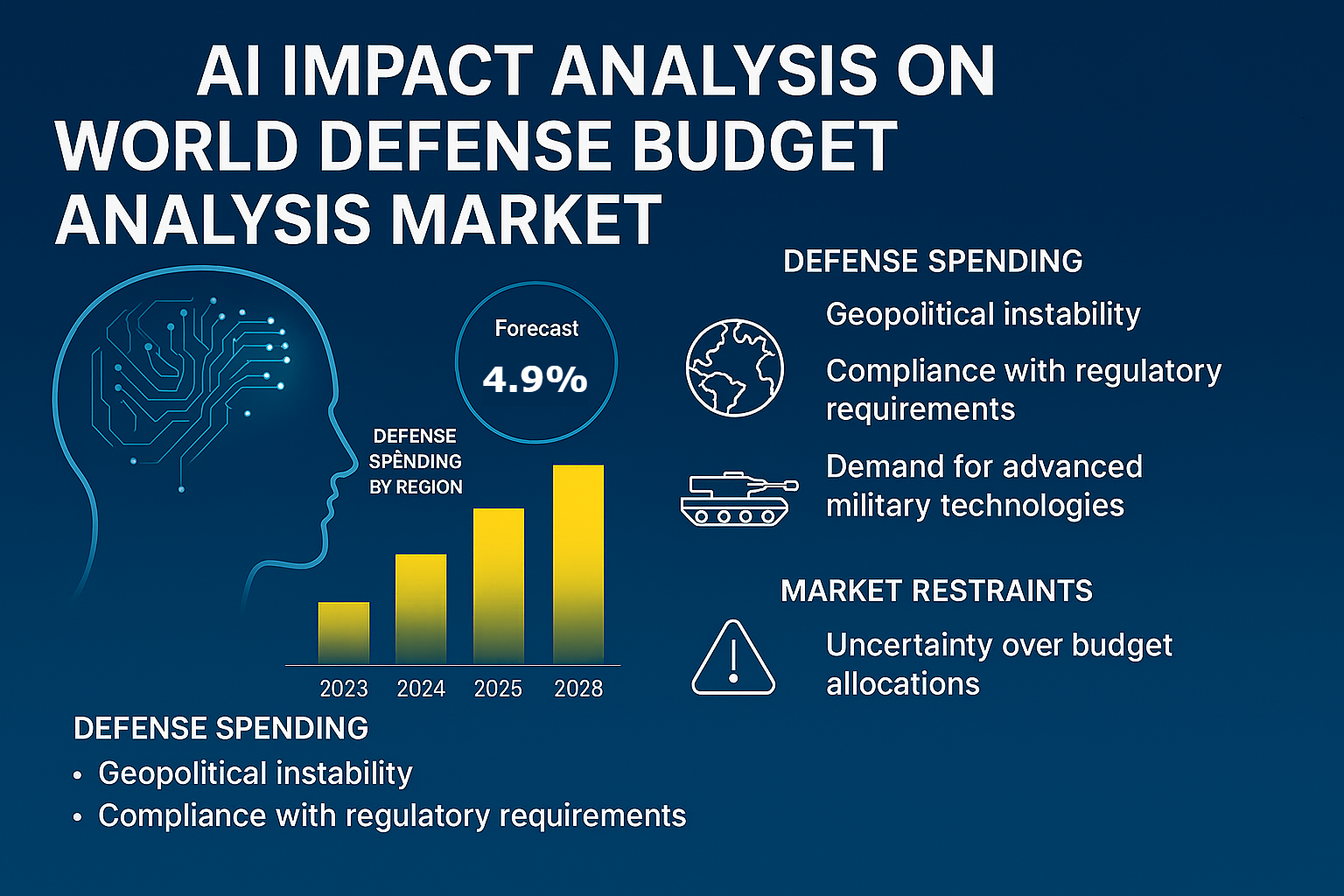
Artificial intelligence has emerged as one of the most transformative technologies in modern defense. As countries race to maintain military superiority, AI is not only reshaping how wars are fought but also how defense budgets are allocated. The integration of AI into defense systems from surveillance and cyberwarfare to unmanned vehicles and decision making algorithms has begun to alter the very structure of global defense spending. This article provides an in depth examination of how AI is influencing the World Defense Budget Analysis Market, outlining regional shifts, strategic changes, and the rise of predictive military planning using AI tools.
Overview of the Global Defense Budget Landscape
The global defense budget exceeded $2.2 trillion in 2024 and continues to grow, driven by geopolitical tensions, modernization needs, and emerging threats. The United States remains the highest spender, with over $850 billion allocated annually, followed by China, India, Russia, and several NATO countries. However, the composition of these budgets is evolving. A greater proportion is being directed toward cyber capabilities, unmanned systems, and AI powered technologies. Defense ministries are increasingly focused not only on kinetic strength ships, jets, and tanks but also on software driven warfare, advanced sensors, and smart command systems. The baseline structure of defense budgeting is now being redefined to reflect a digital first approach.
Rise of Artificial Intelligence in Military Planning
Military planning has always relied on intelligence, forecasting, and strategic resource allocation. AI has accelerated and amplified these processes. Advanced analytics platforms can now assess massive amounts of battlefield data, simulate war gaming scenarios, and recommend optimal responses in real time. Military organizations, including the U.S. Department of Defense and NATO, are investing in AI labs and AI integrated command systems. These systems inform budget priorities highlighting gaps in cyber defense, predicting adversary moves, and automating threat assessments. As AI becomes embedded in command and control systems, budget decisions increasingly rely on algorithmic recommendations rather than traditional assessments.
AI as a Cost Saving or Cost Inflating Force
One of the biggest debates in military finance is whether AI ultimately saves money or adds significant cost burdens. On one hand, AI can reduce manpower needs, automate logistics, improve supply chains, and minimize maintenance downtime through predictive systems. This operational efficiency translates into long term cost reductions. However, on the other hand, AI implementation requires massive upfront investment in R&D, infrastructure, testing, and talent acquisition. Defense contractors charge premium rates for AI integrated systems, and procurement of AI capable hardware and platforms often far exceeds the cost of legacy systems. Consequently, while AI offers promise for cost effectiveness, it initially drives up budgetary requirements, particularly in the development phase.
Budget Allocation Shifts Toward Autonomous Systems
The shift toward autonomous systems in air, land, and sea warfare is significantly reshaping defense budget allocations. Unmanned Aerial Vehicles (UAVs), Unmanned Underwater Vehicles (UUVs), and autonomous ground combat units are now prioritized in military acquisitions. AI serves as the core operating system for these platforms enabling real time decision making, object recognition, navigation, and threat neutralization. Countries are diverting budget lines from manned fighter aircraft and traditional artillery toward the development and deployment of smart, networked unmanned systems. For example, the Pentagon’s FY2025 budget allocates over $12 billion toward unmanned systems and AI autonomy programs, a trend mirrored by China's PLA and European defense consortia.
Cybersecurity Spending Driven by AI Integration
As AI tools become embedded across the defense spectrum, they simultaneously expose militaries to new cybersecurity risks. AI enhanced systems, if compromised, could lead to catastrophic consequences ranging from misfired missiles to stolen intelligence. Consequently, nations are increasing their cybersecurity budgets not only to protect conventional systems but also to defend AI infrastructure. This includes investing in AI based firewalls, adversarial AI testing platforms, and secure communication systems that resist algorithmic manipulation. The U.S. Cyber Command, for example, has seen a 25% budget increase over two years, with AI based counter threat initiatives accounting for a large portion of new spending. This trend is mirrored in Israel, the UK, South Korea, and NATO’s joint cyber operations.
AI in Threat Assessment and Intelligence Budgeting
Intelligence agencies worldwide are now leveraging AI to perform data fusion, satellite image analysis, and sentiment monitoring from open source platforms. AI enables these agencies to detect patterns invisible to human analysts such as unusual troop movement, financial transactions hinting at arms procurement, or social media signals suggesting unrest. As a result, budget allocation for human centric intelligence gathering is being reallocated toward AI software development, cloud computing capabilities, and quantum AI research. The integration of AI into SIGINT (Signals Intelligence) and HUMINT (Human Intelligence) workflows is becoming standard practice, leading to a structural shift in intelligence funding across national budgets.
Get AI Impact Analysis on World Defense Budget Analysis Market, Request Pdf Brochure: https://www.marketsandmarkets.com/pdfdownloadNew.asp?id=31573133
Impact of AI on Legacy System Modernization Budgets
A significant portion of global defense budgets traditionally goes toward upgrading legacy systems like tanks, aircraft, and warships. With the rise of AI, these systems require digital transformation not just hardware refurbishment. Militaries are now investing in AI retrofitting packages that include sensors, communication modules, and smart diagnostics. These packages allow legacy equipment to operate in digitally coordinated battle environments. For instance, tanks fitted with AI can identify targets autonomously, optimize fuel usage, and predict component failures. This transformation affects procurement cycles and budgetary planning by reducing the need for full system replacements while increasing expenditure on software, data integration, and AI testing labs.
AI’s Role in Predictive Budget Modeling
AI is not just transforming military hardware it is also revolutionizing the very process of defense budgeting. Defense departments are now using AI driven financial modeling tools to forecast future needs based on multiple variables like geopolitical tension, inflation rates, equipment lifespans, and personnel deployment cycles. These predictive models help decision makers allocate resources more effectively, avoiding over budgeting or under preparing. AI also enables “what if” scenario simulations, allowing policymakers to test the financial impact of strategic decisions such as new alliances, deployment surges, or technology shifts. As a result, defense budgeting is becoming more responsive, dynamic, and data driven than ever before.
Geopolitical Rivalry and the Global AI Arms Race
The strategic competition between nations, especially the U.S. and China, is at the heart of the AI arms race. Each nation is using defense budgets to fund AI research hubs, military AI startups, and collaborative academic projects. China’s “Next Generation Artificial Intelligence Development Plan” includes heavy defense components, while the U.S. has launched the Joint Artificial Intelligence Center (JAIC) to coordinate AI integration across all military branches. Meanwhile, NATO countries are standardizing AI ethics frameworks to ensure interoperability and control. This global race is accelerating investment in AI based military tools, leading to rapid shifts in budget priorities across regions. Even mid tier military powers are following suit to stay technologically relevant.
Future Outlook: AI Driven Budget Prioritization in Defense
Looking ahead to 2035, AI will become not just a technology line item but a foundational layer in every defense budget. Future conflicts are expected to be hybrid blending physical, cyber, and information warfare and AI will serve as the connective tissue across these domains. Defense budgets will increasingly focus on AI capability maturity, interoperability between allied systems, and resilience against adversarial AI. Public private partnerships will flourish as commercial AI startups and defense ministries collaborate. Ethical considerations, such as AI in lethal autonomous weapons systems, will also shape budgetary decisions. Ultimately, the world defense budget landscape will become a reflection of AI readiness and strategic alignment, making artificial intelligence the core driver of 21st century military finance.
From Strategy to Spend AI at the Center
The influence of AI on global defense budgets is both deep and broad. It touches every aspect of military finance from asset procurement and operations to cybersecurity and intelligence. As AI continues to mature, it will reshape not only the composition of military forces but also the way nations conceptualize and implement national security spending. Countries that prioritize AI integration within their defense budgets will gain operational edge, strategic foresight, and technological superiority. In contrast, those lagging behind may find themselves outpaced in future conflicts. The World Defense Budget Analysis Market is now inseparable from AI, and understanding this convergence is essential for policymakers, investors, and defense industry stakeholders.
Related Report:
World Defense Budget Analysis Market by Allocation Type (Military Expense, Admin Expense), Departmental Allocation, Platform Allocation, System Allocation, Domain Allocation, Technology Allocation, Sales Allocation and Region - Global Forecast

This FREE sample includes market data points, ranging from trend analyses to market estimates & forecasts. See for yourself.
SEND ME A FREE SAMPLE






