How Germany’s €300 Million Commitment to Ukraine’s Ammunition Supply Effort Signals Long-Term Growth in the Ammunition Market
Europe’s defense landscape continues to undergo a historic transformation. Germany’s decision to contribute an additional €300 million to the Czech-led initiative supplying artillery ammunition to Ukraine is more than a short-term military support measure it is another indicator of a broader structural shift reshaping defense procurement priorities across Europe and beyond.
Announced by German Defense Minister Boris Pistorius during talks with his Czech counterpart in Berlin, the funding aims to strengthen the supply of artillery ammunition for Ukraine as the conflict enters another critical phase. The contribution follows a series of coordinated efforts by European nations to replenish ammunition stockpiles, enhance industrial production capacity, and improve long-term defense readiness.
For defense manufacturers, investors, military planners, and policymakers, the announcement highlights an increasingly important reality: ammunition is no longer viewed as a consumable resource to be maintained at minimum operational levels. Instead, governments are treating ammunition stockpiles as strategic assets requiring sustained investment, domestic manufacturing resilience, and secure supply chains.
The implications extend far beyond Ukraine. The latest funding commitment reinforces growing demand across the global Ammunition Market, where military modernization programs, geopolitical uncertainty, and stockpile replenishment efforts are driving one of the strongest growth cycles the industry has witnessed in decades.
As governments reassess defense preparedness and industrial capacity, the ammunition sector is emerging as a critical pillar of national security strategy.
Breaking Down the News
Germany announced an additional €300 million contribution to the Czech-led ammunition initiative supporting Ukraine. The program was established to secure artillery ammunition from international suppliers and deliver it to Ukrainian forces facing sustained operational demands.
The latest funding expands Germany’s support for the initiative and underscores Europe’s ongoing commitment to strengthening Ukraine’s defense capabilities.
Several factors make the announcement particularly significant:
-
Continued demand for artillery ammunition in modern warfare
-
Growing emphasis on stockpile replenishment
-
Expansion of European defense cooperation
-
Increased investment in ammunition production capacity
-
Recognition of ammunition as a strategic national security asset
The Czech initiative has become a prominent example of multinational defense collaboration, enabling participating nations to pool resources and accelerate ammunition procurement.
For the broader defense industry, the announcement provides additional evidence that ammunition demand remains elevated and is likely to stay strong for years rather than months.
Why This News Matters Beyond the Headlines
The immediate focus of the announcement is support for Ukraine. However, its strategic significance extends well beyond the battlefield.
For decades, many Western nations operated under the assumption that large-scale ammunition consumption was unlikely. Stockpile levels were often optimized for limited operations rather than prolonged high-intensity conflicts.
The conflict in Ukraine has fundamentally challenged those assumptions.
Military planners have witnessed unprecedented rates of artillery ammunition consumption, exposing gaps in manufacturing capacity and highlighting vulnerabilities in supply chains.
Germany’s additional investment reflects three broader realities:
Ammunition Stockpiles Are Being Reassessed
Governments are revisiting ammunition reserve requirements and increasing procurement budgets to ensure readiness for future contingencies.
Industrial Capacity Has Become a Strategic Priority
Defense ministries are recognizing that manufacturing capacity itself can be a strategic advantage. Countries are investing in production facilities, workforce development, and supply chain resilience.
Long-Term Demand Appears Sustainable
Rather than representing a temporary surge, current procurement activity may signal a structural increase in ammunition demand driven by changing geopolitical realities.
The result is a significantly different outlook for the global ammunition industry than existed only a few years ago.
What This Means for the Ammunition Market
Germany’s latest commitment aligns directly with key growth drivers shaping the global Ammunition Market.
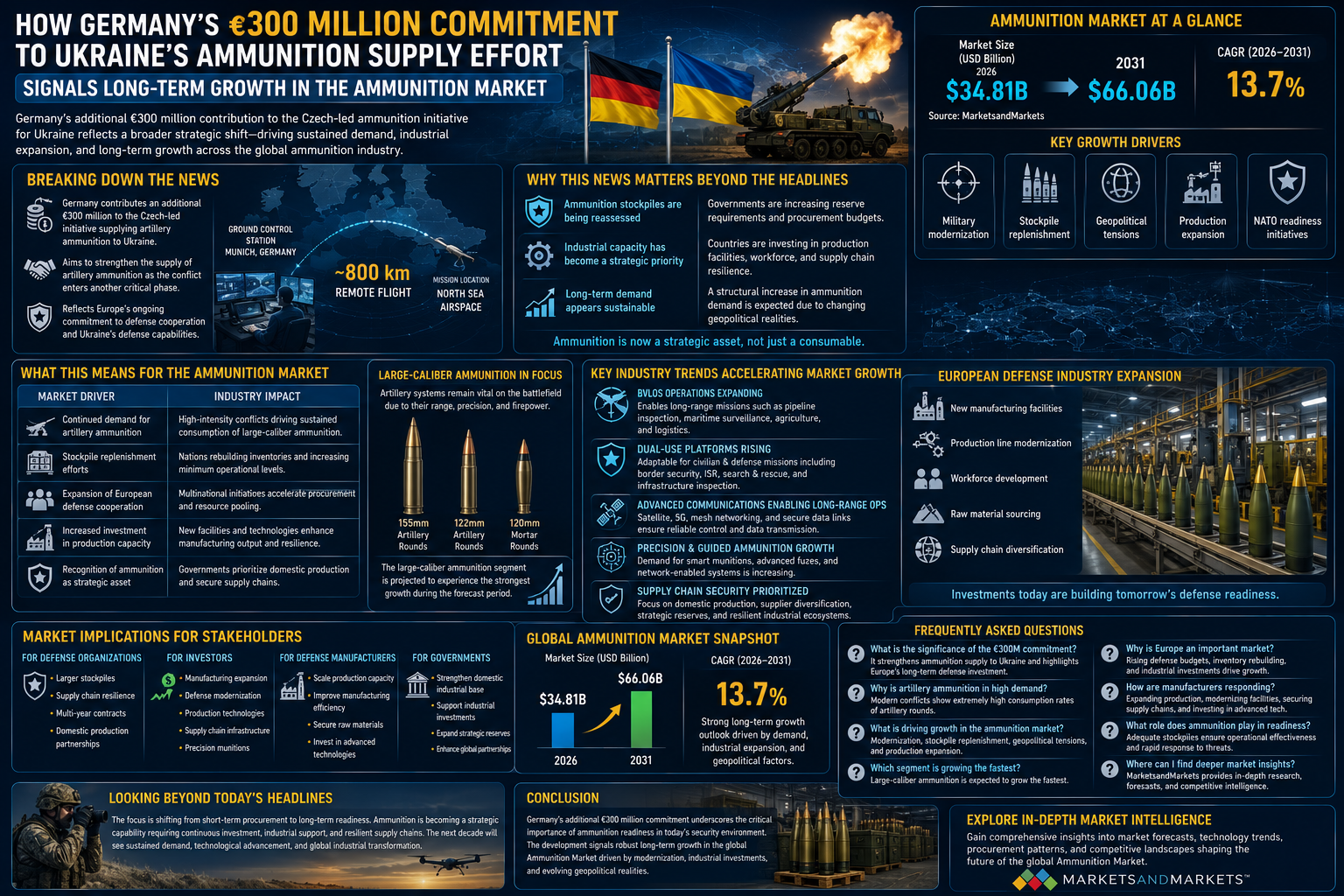
According to MarketsandMarkets, the Ammunition Market is projected to grow from USD 34.81 billion in 2026 to USD 66.06 billion by 2031, registering a CAGR of 13.7%.
This projected growth reflects a combination of geopolitical, industrial, and technological factors.
| Market Driver | Industry Impact |
|---|---|
| Military modernization | Increased procurement across all ammunition categories |
| Stockpile replenishment | Sustained demand for large-caliber ammunition |
| Geopolitical tensions | Expanded defense budgets globally |
| Production expansion | Investment in manufacturing infrastructure |
| NATO readiness initiatives | Greater procurement consistency among member states |
Germany’s funding announcement directly supports several of these trends.
Particularly noteworthy is the growing emphasis on artillery ammunition, a segment that has experienced substantial demand increases due to ongoing military operations and defense preparedness initiatives.
The announcement also highlights Europe’s increasingly important role in shaping future ammunition procurement strategies.
Organizations monitoring defense industrial developments can explore broader trends within the Ammunition Market and assess how changing security priorities are influencing procurement decisions worldwide.
Related Resource: Read about the Ammunition Market: https://www.marketsandmarkets.com/Market-Reports/ammunition-market-923.html
Key Industry Trends Accelerating Market Growth
Large-Caliber Ammunition Demand Is Surging
One of the most significant trends influencing the market is the growing demand for large-caliber ammunition.
Artillery systems continue to play a critical role in modern military operations due to their range, precision, and effectiveness.
As governments seek to replenish inventories and expand operational readiness, procurement of artillery ammunition is increasing significantly.
The large caliber ammunition market is projected to experience some of the strongest growth rates within the broader industry.
Defense Industrial Base Expansion Is Accelerating
The conflict in Eastern Europe has highlighted limitations in existing production capacity.
As a result, governments and defense contractors are investing heavily in:
-
New manufacturing facilities
-
Production line modernization
-
Workforce development
-
Supply chain diversification
-
Raw material sourcing capabilities
These investments are expected to support long-term market growth while improving industrial resilience.
European Defense Spending Continues to Rise
Europe has emerged as one of the most active regions for defense investment.
Many countries are increasing defense budgets to strengthen military readiness, modernize equipment, and rebuild ammunition stockpiles.
The European ammunition market accounted for a significant share of global revenue and is expected to remain a key growth engine throughout the forecast period.
Precision and Guided Ammunition Adoption Is Growing
Modern military forces increasingly seek enhanced accuracy and effectiveness.
This trend is driving investment in:
-
Precision-guided artillery rounds
-
Smart munitions
-
Advanced fuze technologies
-
Network-enabled ammunition systems
These capabilities improve mission effectiveness while reducing collateral damage and logistical burdens.
Supply Chain Security Has Become a Strategic Focus
The ammunition industry depends on complex global supply chains involving specialized materials, components, and manufacturing processes.
Recent geopolitical developments have prompted governments to prioritize:
-
Domestic production capabilities
-
Supplier diversification
-
Strategic reserves
-
Regional manufacturing ecosystems
Supply chain resilience is now viewed as a national security imperative rather than merely an operational consideration.
Market Implications for Stakeholders
For Defense Organizations
Military forces worldwide are reassessing ammunition requirements.
The experience of recent conflicts has demonstrated the importance of maintaining sufficient inventories across multiple ammunition categories.
Future procurement strategies are likely to emphasize:
-
Larger stockpiles
-
Greater supply chain resilience
-
Multi-year procurement contracts
-
Domestic production partnerships
For Investors
Germany’s announcement reinforces confidence in long-term growth opportunities within the Ammunition Industry.
Several investment themes continue to attract attention:
-
Manufacturing expansion
-
Defense modernization
-
Ammunition production technologies
-
Supply chain infrastructure
-
Precision-guided munitions
Companies positioned to support increased production capacity may benefit from sustained demand over the coming decade.
For Defense Manufacturers
Defense contractors face unprecedented opportunities to expand production and strengthen customer relationships.
Key priorities include:
-
Scaling production capacity
-
Improving manufacturing efficiency
-
Securing raw material supply
-
Expanding international partnerships
-
Investing in advanced ammunition technologies
Manufacturers capable of delivering both volume and innovation are likely to gain competitive advantages.
For Governments
Governments face the challenge of balancing immediate operational needs with long-term industrial development objectives.
The current environment is encouraging policymakers to:
-
Strengthen domestic production ecosystems
-
Support industrial investments
-
Expand strategic reserves
-
Enhance multinational defense cooperation
These initiatives are expected to shape defense procurement policies for years to come.
Frequently Asked Questions
Why is Germany providing additional funding to the Czech ammunition initiative?
Germany’s contribution supports the procurement and delivery of artillery ammunition to Ukraine. The funding also reflects broader European efforts to strengthen defense cooperation and address growing ammunition requirements resulting from ongoing security challenges.
Why is artillery ammunition receiving so much attention?
Artillery remains one of the most important battlefield systems in modern warfare. Recent conflicts have demonstrated extremely high rates of ammunition consumption, prompting governments to increase procurement and expand stockpile levels.
What is driving growth in the Ammunition Market?
Growth is being fueled by military modernization programs, rising geopolitical tensions, stockpile replenishment efforts, increasing defense budgets, and investments in manufacturing capacity expansion.
Which ammunition segment is expected to grow the fastest?
Large-caliber ammunition is projected to experience some of the highest growth rates during the forecast period due to strong demand from military modernization initiatives and artillery stockpile replenishment programs.
Why is Europe becoming an important ammunition market?
European nations are significantly increasing defense spending, rebuilding military inventories, and investing in domestic defense manufacturing capabilities. These factors are driving substantial demand across multiple ammunition categories.
How are defense manufacturers responding to increased demand?
Manufacturers are expanding production capacity, modernizing facilities, strengthening supply chains, and investing in advanced technologies to meet growing customer requirements.
What role does ammunition play in military readiness?
Ammunition availability directly affects operational effectiveness and force readiness. Maintaining adequate stockpiles ensures military organizations can respond quickly to evolving security threats.
Where can decision-makers find deeper ammunition market insights?
Industry stakeholders often rely on specialized market intelligence to evaluate procurement trends, production capacity developments, competitive landscapes, technological innovations, and regional growth opportunities.
Looking Beyond Today's Headlines
Germany’s additional €300 million commitment may ultimately be remembered as part of a larger transformation occurring within the global defense ecosystem.
The focus is shifting from short-term procurement cycles toward long-term readiness strategies. Governments are increasingly viewing ammunition not simply as a consumable product but as a strategic capability requiring continuous investment and industrial support.
This evolution is expected to influence defense policies, manufacturing investments, and procurement strategies well into the next decade.
The ammunition industry is entering a period characterized by sustained demand, production expansion, and technological advancement. Organizations capable of adapting to this new environment will play a critical role in supporting national security objectives around the world.
Future Outlook
Germany’s decision to contribute an additional €300 million to the Czech-led ammunition initiative underscores the growing importance of ammunition readiness in today’s security environment. While the announcement directly supports Ukraine’s defense efforts, it also highlights broader trends reshaping global defense procurement and industrial strategy.
The development reinforces several key market drivers, including stockpile replenishment, military modernization, production capacity expansion, and increasing geopolitical uncertainty. Together, these factors are contributing to robust growth across the global Ammunition Market.
For defense organizations, manufacturers, investors, and policymakers, understanding these evolving dynamics will be essential for making informed strategic decisions. The industry is undergoing significant transformation, creating both opportunities and challenges across the defense value chain.
For readers seeking deeper insights into market forecasts, procurement trends, technology developments, and competitive dynamics, MarketsandMarkets provides comprehensive research on the global Ammunition Market and the forces shaping its future growth trajectory.
Download Sample Report: https://www.marketsandmarkets.com/requestsampleNew.asp?id=923
Explore the Ammunition Market: https://www.marketsandmarkets.com/Market-Reports/ammunition-market-923.html

This FREE sample includes market data points, ranging from trend analyses to market estimates & forecasts. See for yourself.
SEND ME A FREE SAMPLE





