How Three Commercial Trends Driving a $1.8 Trillion Space Economy Are Accelerating Growth in the Space Situational Awareness Market
The global space industry is entering a period of unprecedented expansion. According to a recent World Economic Forum (WEF) analysis, the space economy could reach an estimated value of $1.8 trillion by 2035, fueled by increasing private investment, rapid commercialization of satellite-enabled services, and deeper collaboration between governments and commercial space operators. What was once a government-dominated sector is rapidly evolving into a vibrant commercial ecosystem supporting industries ranging from telecommunications and agriculture to logistics, climate monitoring, and national security.
This transformation is creating extraordinary opportunities across the space value chain. However, it is also generating new challenges. As launch activity accelerates and satellite deployments reach record levels, Earth's orbital environment is becoming increasingly crowded. Thousands of active satellites, growing mega-constellations, and millions of pieces of orbital debris are creating unprecedented complexity in space operations.
In this new era, understanding what is happening in orbit is no longer optional it is essential. This is where Space Situational Awareness (SSA) plays a critical role. SSA encompasses the technologies, systems, and services used to detect, track, monitor, and predict the behavior of objects in space. As the commercial space economy expands, demand for real-time space intelligence, orbital risk assessment, and collision avoidance capabilities is growing rapidly.
The same commercial trends highlighted by the World Economic Forum are now emerging as major catalysts for the Space Situational Awareness Market, making SSA one of the most strategically important segments of the modern space industry.
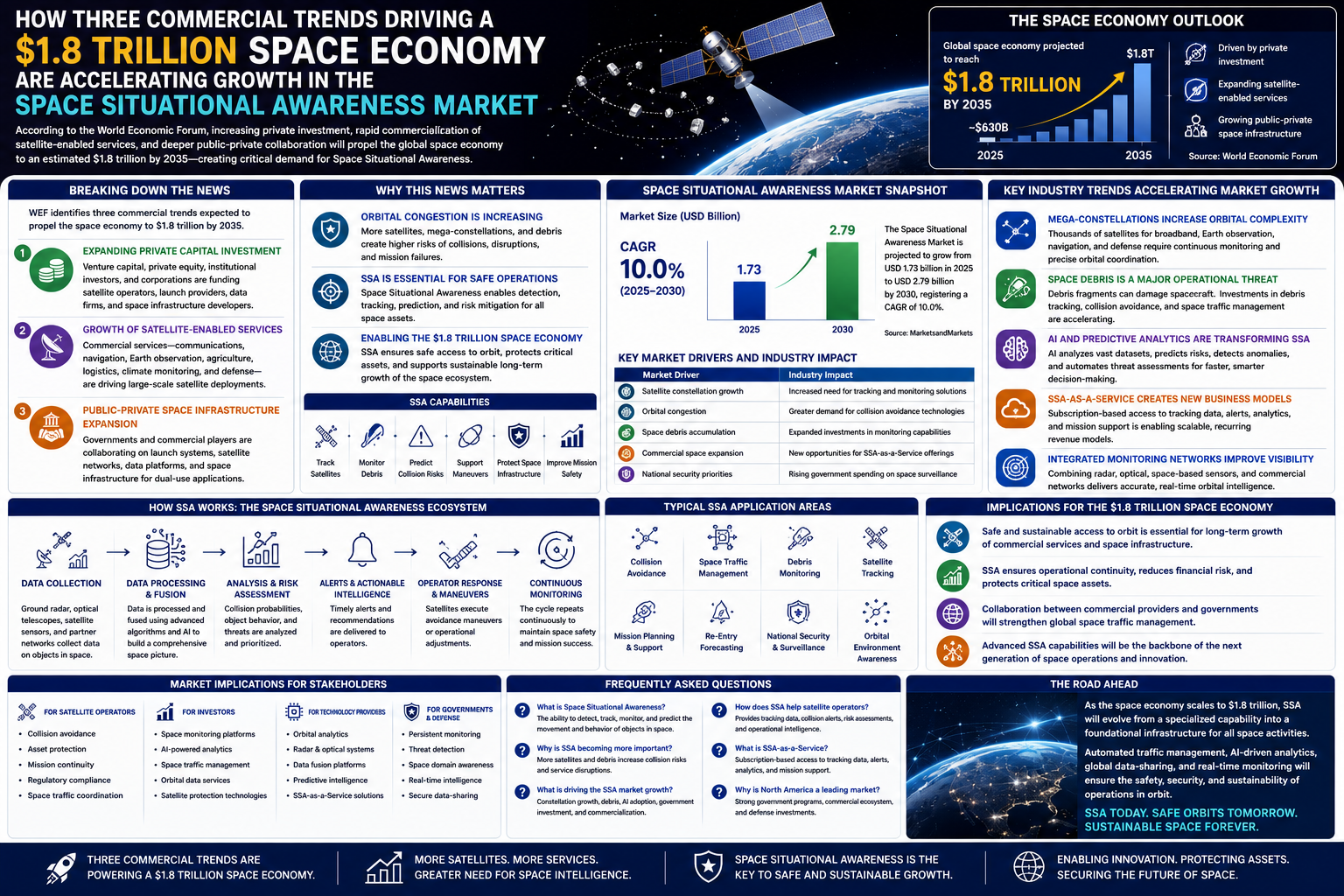
Breaking Down the News
The World Economic Forum recently identified three major trends expected to propel the global space economy toward $1.8 trillion by 2035.
Trend 1: Expanding Private Capital Investment
The first trend is the growing availability of private capital supporting space ventures.
Investors are increasingly funding:
- Satellite operators
- Launch providers
- Earth observation companies
- Space data firms
- Space infrastructure developers
The influx of venture capital, private equity, and institutional investment is enabling faster technology development and accelerating commercialization across the industry.
Trend 2: Growth of Satellite-Enabled Services
The second trend is the rapid expansion of commercial services powered by satellite infrastructure.
These services support:
- Broadband connectivity
- Navigation systems
- Precision agriculture
- Logistics management
- Environmental monitoring
- Defense communications
As demand for satellite-enabled services grows, operators are deploying larger and more sophisticated satellite constellations.
Trend 3: Public-Private Space Infrastructure Expansion
The third trend involves increasing collaboration between governments and commercial organizations.
Launch systems, satellite networks, Earth observation platforms, and space-based communications systems are increasingly funded and utilized through hybrid public-private models.
This convergence is accelerating innovation while creating new operational demands across the orbital environment.
Why This News Matters Beyond the Headlines
The projected expansion of the space economy creates a significant challenge that often receives less attention than launch activity or satellite deployments: orbital congestion.
Every new satellite launched into orbit adds complexity to the operational environment.
As more satellites are deployed, the risks increase:
- Satellite collisions
- Orbital debris generation
- Service disruptions
- Mission failures
- National security vulnerabilities
The success of a trillion-dollar space economy depends on maintaining safe and sustainable access to orbital space.
This is precisely why Space Situational Awareness is becoming increasingly important.
SSA provides the intelligence required to:
- Track active satellites
- Monitor orbital debris
- Predict collision risks
- Support satellite maneuver planning
- Protect critical space infrastructure
- Improve mission safety
The three trends identified by the World Economic Forum effectively increase the need for advanced SSA capabilities.
More satellites, more operators, and more commercial activity inevitably create greater demand for orbital monitoring and space traffic management solutions.
What This Means for the Space Situational Awareness Market
The rapid commercialization of space directly supports long-term growth in the Space Situational Awareness Market.
According to MarketsandMarkets, the Space Situational Awareness Market is projected to grow from USD 1.73 billion in 2025 to USD 2.79 billion by 2030, registering a CAGR of 10.0%.
The market is benefiting from several interconnected growth drivers.
| Market Driver | Industry Impact |
|---|---|
| Satellite constellation growth | Increased need for tracking and monitoring solutions |
| Orbital congestion | Greater demand for collision avoidance technologies |
| Space debris accumulation | Expanded investments in monitoring capabilities |
| Commercial space expansion | New opportunities for SSA-as-a-Service offerings |
| National security priorities | Rising government spending on space surveillance |
The World Economic Forum's projection of a $1.8 trillion space economy suggests these drivers are likely to remain relevant for years to come.
As commercial operators continue deploying new assets into orbit, Space Situational Awareness will become increasingly essential for ensuring safe and efficient operations.
Organizations seeking a deeper understanding of market developments can explore broader trends within the Space Situational Awareness Market and evaluate how space monitoring technologies are supporting the future of the global space economy.
Related Resource: Read about the Space Situational Awareness Market: https://www.marketsandmarkets.com/Market-Reports/space-situational-awareness-market-150269456.html
Key Industry Trends Accelerating Market Growth
Mega-Constellations Are Increasing Orbital Complexity
One of the most significant trends driving SSA demand is the rapid deployment of satellite mega-constellations.
Operators are launching thousands of satellites to support:
- Global broadband services
- Earth observation networks
- Navigation systems
- Defense communications
Managing these constellations requires continuous monitoring and precise orbital coordination.
As constellation sizes increase, demand for advanced tracking systems grows accordingly.
Space Debris Is Becoming a Major Operational Concern
Orbital debris represents one of the greatest threats to future space operations.
Even small debris fragments can damage or destroy operational spacecraft due to extremely high orbital velocities.
This challenge is driving investments in:
- Debris tracking systems
- Collision avoidance software
- Predictive analytics platforms
- Space traffic management solutions
Space debris monitoring is increasingly becoming a core component of mission planning.
AI and Predictive Analytics Are Transforming SSA
Artificial intelligence is emerging as a critical technology within the SSA ecosystem.
AI-powered systems can:
- Analyze vast orbital datasets
- Predict collision probabilities
- Detect unusual spacecraft behavior
- Improve tracking accuracy
- Automate threat assessments
As orbital activity becomes more complex, AI-driven analytics will play an increasingly important role in maintaining space safety.
SSA-as-a-Service Is Creating New Business Models
The commercialization of space is creating demand for outsourced monitoring services.
Many satellite operators prefer subscription-based access to:
- Tracking data
- Collision alerts
- Risk assessments
- Orbital analytics
- Mission support services
SSA-as-a-Service models are becoming an attractive opportunity for commercial providers seeking recurring revenue streams.
Integrated Monitoring Networks Are Improving Visibility
Modern SSA systems increasingly combine data from multiple sources, including:
- Ground-based radar systems
- Optical telescopes
- Satellite-based sensors
- Tracking networks
- Commercial monitoring platforms
This integrated approach improves detection accuracy and enhances real-time space intelligence capabilities.
Market Implications for Stakeholders
For Satellite Operators
Satellite operators face growing operational complexity as orbital environments become more congested.
Key priorities include:
- Collision avoidance
- Asset protection
- Mission continuity
- Regulatory compliance
- Space traffic coordination
Advanced SSA solutions help reduce operational risks while improving fleet management efficiency.
For Investors
The World Economic Forum's space economy projections highlight significant opportunities across the broader space ecosystem.
The SSA sector is particularly attractive because it serves as an enabling technology supporting virtually every commercial and government space activity.
Key investment themes include:
- Space monitoring platforms
- AI-powered analytics
- Space traffic management systems
- Orbital data services
- Satellite protection technologies
For Technology Providers
Companies developing SSA technologies are positioned to benefit from increasing demand across both commercial and government markets.
Areas of opportunity include:
- Orbital analytics
- Radar systems
- Optical tracking technologies
- Data fusion platforms
- Predictive intelligence solutions
Continuous innovation will be essential as orbital activity continues to increase.
For Governments and Defense Organizations
National security agencies increasingly view SSA as a strategic capability.
Protecting critical space assets requires:
- Persistent monitoring
- Threat detection
- Space domain awareness
- Real-time intelligence
- Secure data-sharing frameworks
Governments are therefore expected to remain major contributors to SSA market growth.
Frequently Asked Questions
What is Space Situational Awareness (SSA)?
Space Situational Awareness refers to the ability to detect, track, monitor, and predict the movement and behavior of objects in space, including satellites, debris, and other orbital assets.
Why is SSA becoming more important?
The growing number of satellites and increasing orbital congestion create greater risks of collisions and service disruptions. SSA helps operators manage these risks and maintain safe operations.
What is driving growth in the Space Situational Awareness Market?
Growth is being driven by satellite constellation expansion, rising orbital debris levels, increasing government investments, AI adoption, and the continued commercialization of space.
How does SSA support satellite operators?
SSA provides tracking data, collision warnings, orbital analytics, and operational intelligence that help operators protect assets and optimize mission performance.
What role does artificial intelligence play in SSA?
AI improves data analysis, threat prediction, collision forecasting, anomaly detection, and decision-making, enabling more effective space monitoring and risk management.
What is SSA-as-a-Service?
SSA-as-a-Service provides subscription-based access to tracking data, collision alerts, orbital analytics, and monitoring services, allowing operators to access advanced capabilities without developing them internally.
Why are mega-constellations increasing SSA demand?
Large satellite constellations significantly increase the number of active objects in orbit, creating greater operational complexity and increasing the need for tracking and coordination systems.
Where can organizations find deeper insights into SSA industry trends?
Industry stakeholders often rely on specialized market intelligence to evaluate technology developments, competitive dynamics, investment opportunities, regulatory frameworks, and future growth prospects.
Looking Beyond Today's Headlines
The World Economic Forum’s projection of a $1.8 trillion space economy highlights an exciting future for commercial space activities. However, this future will depend not only on launching more satellites but also on managing them safely and efficiently.
As orbital environments become increasingly crowded, SSA will evolve from a specialized capability into a foundational requirement for space operations.
Future developments are likely to include:
- Automated space traffic management
- AI-driven collision avoidance
- Global orbital data-sharing networks
- Advanced space surveillance systems
- Real-time space intelligence platforms
The success of the next generation of commercial space ventures will depend heavily on these capabilities.
In many ways, Space Situational Awareness may become the digital infrastructure that enables the trillion-dollar space economy to function safely.
Future Outlook
The World Economic Forum’s identification of three major commercial trends driving the global space economy toward $1.8 trillion by 2035 underscores the remarkable momentum behind the commercialization of space. Increased private investment, expanding satellite-enabled services, and growing public-private collaboration are transforming space into a major economic platform.
These same trends are creating significant opportunities for the Space Situational Awareness Market. As satellite deployments accelerate and orbital environments become more complex, demand for monitoring, tracking, collision avoidance, and space traffic management solutions is expected to grow substantially.
For satellite operators, governments, investors, and technology providers, understanding the role of SSA will be essential for navigating the next phase of industry growth. The future of the commercial space economy depends not only on innovation in orbit but also on the ability to monitor and protect the increasingly valuable assets operating there.
For readers seeking deeper insights into technology trends, market forecasts, competitive developments, and growth opportunities, MarketsandMarkets provides comprehensive research on the global Space Situational Awareness Market and the factors driving its continued expansion.
Download Sample Report: https://www.marketsandmarkets.com/requestsampleNew.asp?id=150269456
Explore the Space Situational Awareness Market: https://www.marketsandmarkets.com/Market-Reports/space-situational-awareness-market-150269456.html

This FREE sample includes market data points, ranging from trend analyses to market estimates & forecasts. See for yourself.
SEND ME A FREE SAMPLE






