Future Trends of Counter UAS Market: AI and Smart Drone Defense
In the rapidly evolving world of unmanned aviation, Counter UAS technology has emerged as a critical component of modern airspace security. The widespread availability of commercial and military drones has created new opportunities for surveillance, logistics, inspection, agriculture, and defense while also introducing significant security challenges. Unauthorized drones can enter restricted airspace, conduct surveillance, disrupt airport operations, compromise critical infrastructure, or support hostile activities.
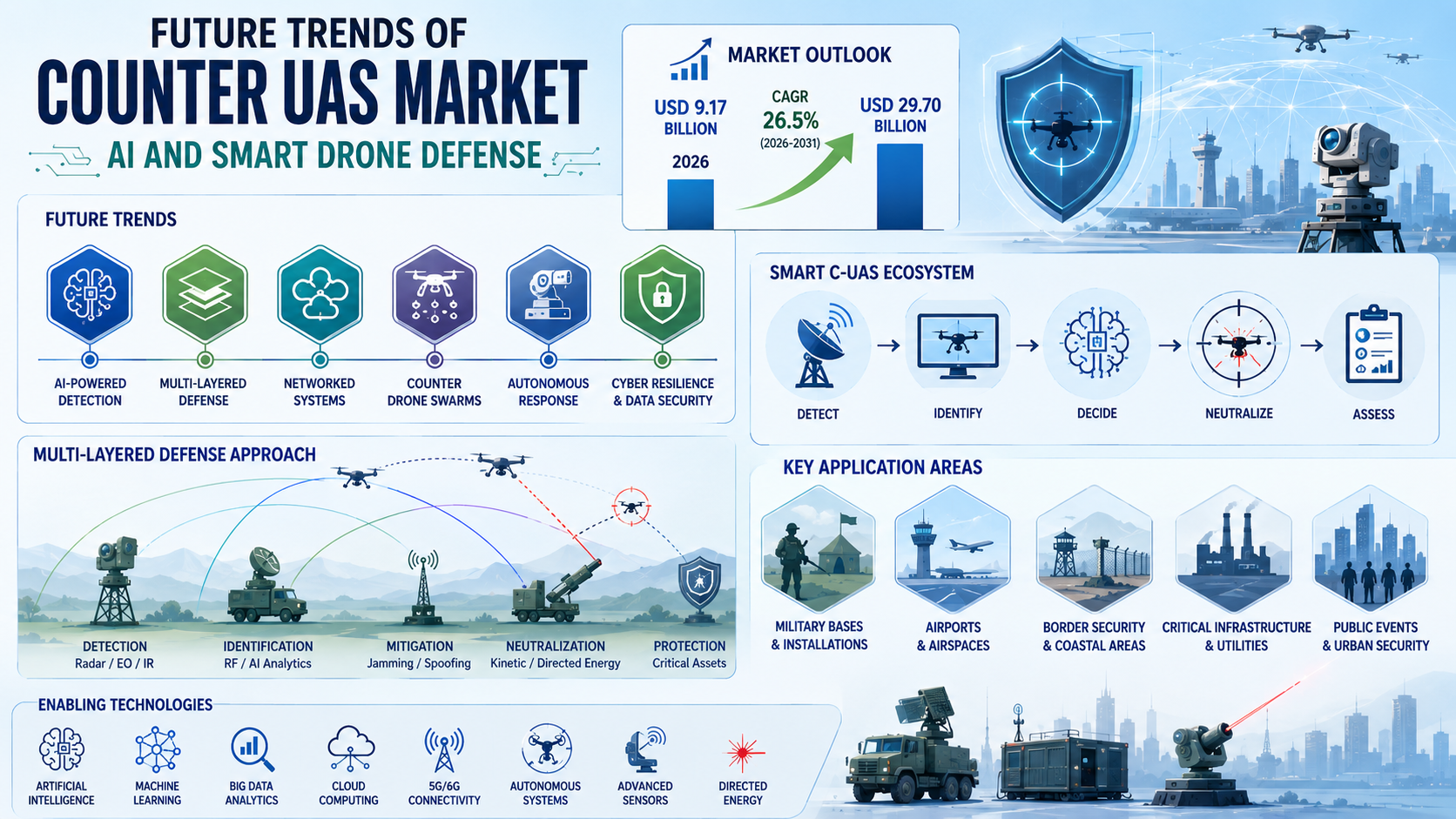
Counter UAS systems, commonly referred to as C UAS, Counter UAV, or Counter Drone systems, are designed to detect, track, identify, and mitigate unauthorized unmanned aerial systems. Modern solutions combine radar, radio frequency detection, electro optical and infrared sensors, command and control platforms, artificial intelligence, and mitigation technologies to create layered protection.
The future of the Counter UAS Market is increasingly centered on intelligent and interconnected architectures. Instead of relying on individual detection or mitigation products, organizations are moving toward integrated platforms capable of combining information from multiple sensors, automatically classifying threats, prioritizing alerts, and supporting coordinated responses. MarketsandMarkets describes this transition toward integrated systems incorporating radar, RF detection, EO/IR sensors, command and control, and multiple countermeasure technologies.
History of Counter UAS Technology
The development of Counter UAS technology accelerated as drones became more accessible to consumers, businesses, and military organizations. Early counter drone solutions focused primarily on detecting drone radio frequency signals or using conventional radar to identify airborne objects.
As drone capabilities advanced, security requirements became more complex. Modern drones can operate at low altitudes, fly autonomously, use sophisticated navigation technologies, and operate with reduced detectability. These developments have encouraged the integration of multiple detection technologies into unified Counter UAS architectures.
Radar provides information about the location and movement of airborne objects, while RF sensors can help identify relevant communications or control signals. EO and IR systems can provide visual confirmation, while command and control platforms combine information from these sources into a common operating picture.
Artificial intelligence is now accelerating another stage of Counter UAS development. AI and machine learning technologies can support drone identification, behavioral analysis, threat prioritization, and decision support. MarketsandMarkets highlights AI enabled multi sensor detection, data fusion, autonomous threat classification, and counter drone swarm capabilities as emerging developments in the market.
Benefits of Counter UAS Systems
Counter UAS technology provides several important benefits for defense organizations, government agencies, airports, critical infrastructure operators, and security providers:
- Early Threat Detection: Advanced detection technologies can identify potentially unauthorized drones before they reach sensitive areas.
- Improved Situational Awareness: Combining radar, RF, EO/IR, and other sensor information provides security teams with a more comprehensive understanding of airspace activity.
- Faster Threat Assessment: AI enabled analytics can help classify objects, prioritize potential threats, and reduce the workload on security operators.
- Layered Airspace Protection: Multiple detection, tracking, identification, command and control, and mitigation capabilities can be combined to address different types of drone threats.
- Flexible Deployment: Counter UAS systems can be deployed at fixed sites, on vehicles, as portable systems, on maritime platforms, or through other configurations depending on mission requirements.
Current Market Size and Growth Trends of Counter UAS Industry
The Counter UAS Market is experiencing rapid growth as governments, military organizations, airports, border agencies, and critical infrastructure operators strengthen protection against unauthorized and hostile drone activity.
According to MarketsandMarkets, the Global Counter UAS System C UAS Market Size was valued at USD 9.17 billion in 2026 and is projected to reach USD 29.70 billion by 2031, growing at a CAGR of 26.5% from 2026 to 2031. The market is being driven by the rising number of hostile and unauthorized drone activities near military bases, airports, border areas, and critical infrastructure.
This rapid growth can be attributed to several factors, including:
- Increasing hostile and unauthorized drone incidents around sensitive facilities
- Growing adoption of drones in military operations and modern conflicts
- Rising demand for low altitude airspace security
- Increasing integration of radar, RF detection, EO/IR sensors, and AI analytics
- Growing adoption of layered Counter UAS architectures
- Expansion of Counter UAS applications beyond traditional military environments
- Increasing demand for fixed site, portable, vehicle mounted, maritime, and other deployment configurations
MarketsandMarkets projects North America to register the fastest growth rate in the Counter UAS Market, with a CAGR of 27.4% during the forecast period. The vehicle mounted segment is projected to grow at a CAGR of 29.9% between 2026 and 2031, demonstrating the increasing importance of mobile Counter UAS capabilities.
Key Drivers and Factors Influencing the Future of Counter UAS
Several important forces are expected to influence the future direction of the Counter UAS Market.
Increase in Hostile and Unauthorized Drone Incidents
The increasing use of commercial, FPV, and autonomous drones in military operations, border infiltration, surveillance, and attacks on sensitive infrastructure is creating stronger demand for Counter UAS systems.
Defense organizations and security agencies increasingly require integrated systems capable of detecting, identifying, tracking, and mitigating unauthorized drones across different environments. MarketsandMarkets identifies the increase in hostile and unauthorized drone incidents as a major market driver.
Drone Heavy Warfare and Defense Modernization
The growing role of unmanned systems in modern military operations is encouraging governments to modernize their air defense and force protection capabilities.
Military organizations require Counter UAS systems to protect bases, command centers, airfields, deployed personnel, vehicles, and strategic assets against surveillance and attack drones.
Growing Need for Low Altitude Airspace Security
Drones operate within airspace that was traditionally difficult to monitor using conventional air defense systems. The expansion of drone activity near airports, government buildings, energy facilities, industrial sites, and public venues is increasing the need for specialized low altitude surveillance.
Counter UAS technologies provide an additional layer of airspace awareness designed specifically around the characteristics of small unmanned aircraft.
Artificial Intelligence and Machine Learning
AI is becoming a major technological driver in the Counter UAS Market. Machine learning can analyze large volumes of sensor data and help distinguish drones from birds, aircraft, and other objects.
AI enabled systems can also support behavioral analysis, threat prioritization, and decision support. MarketsandMarkets identifies AI enabled detection, classification, and decision support as an important opportunity within the market.
Adoption of Layered Counter UAS Architectures
Organizations are increasingly adopting layered architectures that combine radar, RF detection, EO/IR sensors, acoustic sensors, command and control, and multiple mitigation technologies.
This approach improves detection accuracy and provides greater flexibility when addressing different drone types and operating environments.
Emerging Trends in Counter UAS Technology
The future of the Counter UAS Market is being shaped by several important technology trends.
AI Powered Drone Detection
AI powered drone detection is expected to become increasingly important as security organizations face growing numbers of airborne objects.
AI algorithms can analyze movement characteristics, sensor signatures, speed, altitude, and other information to help determine whether an object represents a potential drone threat.
Multi Sensor Data Fusion
Future Counter UAS systems will increasingly integrate information from radar, RF sensors, EO/IR cameras, infrared sensors, acoustic systems, and other sources.
Sensor fusion can improve situational awareness by combining multiple observations into a more comprehensive representation of an aerial threat.
Autonomous Threat Classification
Autonomous classification technologies can help determine whether detected objects represent legitimate aircraft, birds, commercial drones, or potentially hostile unmanned systems.
Automated classification can also help prioritize alerts so security personnel can focus on the most important events.
Counter Drone Swarm Defense
The emergence of coordinated drone operations is creating additional challenges for Counter UAS developers.
Future systems will need to process multiple simultaneous tracks while maintaining situational awareness. AI powered command and control platforms can support the management of complex multi drone environments.
Mobile Counter UAS Platforms
Mobile and modular systems are becoming increasingly important for military operations, border security, temporary security zones, public events, and other locations where fixed infrastructure may not be appropriate.
The vehicle mounted segment is projected to register a CAGR of 29.9% between 2026 and 2031, reflecting strong demand for mobile Counter UAS capabilities.
Integration of Conventional and AI Technologies
The market is not simply replacing conventional Counter UAS technologies with AI. Instead, AI is increasingly being integrated with established radar, RF detection, EO/IR, command and control, and mitigation technologies.
This combination allows organizations to preserve proven sensing capabilities while improving classification, analytics, and decision support.
Opportunities and Challenges in the Counter UAS Market
The Counter UAS Market offers significant opportunities across defense, homeland security, airports, critical infrastructure, government facilities, and commercial applications.
Expansion Into Non Military Applications
Counter UAS technology is expanding beyond traditional military environments. Airports, stadiums, correctional facilities, energy facilities, industrial sites, public venues, and government facilities represent important application opportunities.
MarketsandMarkets identifies expanding use in non military applications as a major market opportunity.
AI Enabled Security Platforms
The integration of AI with Counter UAS sensors and command and control systems creates opportunities for intelligent security platforms.
AI can support drone identification, behavioral analysis, threat prioritization, and decision support, potentially improving the efficiency of security operations.
Critical Infrastructure Protection
Energy facilities, transportation infrastructure, communication networks, industrial facilities, and government installations increasingly require protection from unauthorized drone activity.
Counter UAS solutions that can integrate with existing surveillance and security infrastructure can address these requirements.
Adoption of Layered Defense Architectures
Layered architectures create opportunities for system integrators and technology providers. Organizations can combine multiple detection and mitigation technologies according to their site characteristics, threat environment, and operational requirements.
However, the Counter UAS Market also faces several challenges.
Regulatory and Legal Restrictions
The use of Counter UAS mitigation technologies is subject to regulations concerning spectrum use, RF interference, and authority to intercept or neutralize drones.
In many countries, mitigation authority is restricted to authorized government or defense organizations, which can limit adoption across civilian and commercial sectors.
High Cost and System Complexity
Complete Counter UAS deployments may require multiple sensors, command and control infrastructure, communications systems, trained personnel, and mitigation capabilities.
The cost and complexity of full system deployment can make adoption challenging for organizations with limited budgets.
Rapid Evolution of Drone Technologies
Drone platforms continue to evolve through improved autonomy, lower signatures, encrypted communications, swarm capabilities, and higher speeds.
As drone technology changes, Counter UAS systems must also evolve to maintain effective detection and response capabilities.
Innovations and Advancements in Counter UAS Technology
The future of Counter UAS technology will be shaped by innovation across sensors, analytics, command and control, and mitigation.
AI Based Threat Analytics
AI systems can analyze large volumes of sensor information to identify patterns associated with suspicious drone activity.
Machine learning can improve classification and reduce false alarms by distinguishing drones from birds, aircraft, and other airborne objects.
Advanced Radar Technology
Radar remains a core component of many Counter UAS architectures. Future radar technologies are expected to improve the detection and tracking of small and low altitude targets while operating in increasingly complex environments.
RF Detection and Electronic Warfare
RF detection can help identify relevant communications and control signals associated with drones. Electronic warfare technologies can form part of layered Counter UAS architectures where their deployment is legally authorized and operationally suitable.
EO and IR Sensor Integration
Electro optical and infrared technologies provide visual information that can support identification and tracking. Integration with radar and RF technologies can improve confidence in threat classification.
Directed Energy Technologies
Directed energy represents an emerging category of Counter UAS mitigation. These technologies can provide another layer within a broader Counter UAS architecture and may become increasingly important as organizations seek scalable approaches to evolving drone threats.
Advanced Command and Control
Command and control platforms form the operational core of integrated Counter UAS systems.
These platforms combine data from radar, RF sensors, EO/IR systems, and other technologies into a common operating picture. They help operators assess threats and coordinate appropriate response measures.
Future Applications and Industries That Will Benefit From Counter UAS Technology
The future of Counter UAS technology extends across multiple industries and security environments.
Military and Defense
Military and defense organizations will remain major users of Counter UAS systems. Protection of military bases, airfields, command centers, deployed personnel, vehicles, and strategic assets will continue to drive market demand.
Airports and Aviation
Airports represent an important application because unauthorized drone activity can disrupt flight operations and create significant safety concerns.
Integrated Counter UAS platforms can provide continuous monitoring and help security teams identify and track unauthorized drones.
Critical Infrastructure
Power plants, energy facilities, oil and gas installations, communication infrastructure, transportation networks, and industrial sites can use Counter UAS technologies to strengthen perimeter and airspace security.
Homeland Security and Law Enforcement
Government agencies and law enforcement organizations can use Counter UAS technologies for border security, public safety, government facility protection, and major event security.
Smart Cities
The growth of smart city infrastructure is creating additional requirements for low altitude airspace awareness. Counter UAS technologies can support the protection of transportation systems, government facilities, public spaces, and other sensitive urban infrastructure.
Public Venues
Stadiums, festivals, entertainment venues, and large public gatherings can deploy Counter UAS systems to monitor unauthorized drone activity and support security operations.
Maritime Applications
Shipborne and maritime Counter UAS systems can support the protection of naval vessels, ports, offshore infrastructure, and other strategic maritime assets.
Regional Growth Outlook for Counter UAS Market
Regional demand for Counter UAS technologies is influenced by defense modernization, homeland security investments, critical infrastructure protection, airport security, and increasing drone activity.
North America is projected to register the fastest growth rate in the Counter UAS Market, with a CAGR of 27.4% during the forecast period. The region benefits from defense modernization, homeland security requirements, and increasing adoption of anti drone technologies.
Europe is experiencing increasing demand driven by airport security, border protection, critical infrastructure protection, and military modernization.
Asia Pacific represents an important growth opportunity as defense spending increases, drone adoption expands, and governments strengthen protection around strategic infrastructure and public facilities.
The Middle East also presents opportunities due to investments in airports, energy infrastructure, defense systems, and advanced airspace security.
Key Counter UAS Market Players
The Counter UAS ecosystem includes defense companies, system integrators, radar manufacturers, sensor providers, electronic warfare companies, software developers, and specialized Counter UAS technology providers.
Major companies identified in the MarketsandMarkets Counter UAS Market include RTX, Northrop Grumman, Lockheed Martin, Rheinmetall, Rafael Advanced Defense Systems, Thales, HENSOLDT, Kongsberg, Hanwha Group, Israel Aerospace Industries, ASELSAN, Saab, Leonardo, EDGE Group, and Bharat Electronics Limited.
Specialized companies are also developing focused capabilities covering drone detection, RF monitoring, command and control, electronic countermeasures, and other Counter UAS technologies.
MarketsandMarkets identifies RTX Corporation and Lockheed Martin Corporation as star players based on market share and product footprint.
The Promising Future of Counter UAS Technology
The future of the Counter UAS Market is closely connected to the evolution of unmanned aerial systems and the growing requirement for secure low altitude airspace. As drones become more accessible, autonomous, capable, and difficult to detect, governments, defense organizations, airports, and infrastructure operators will require increasingly sophisticated technologies to protect sensitive environments.
The Global Counter UAS System Market is projected to grow from USD 9.17 billion in 2026 to USD 29.70 billion by 2031, representing a CAGR of 26.5%. This strong expansion reflects increasing investments in defense modernization, homeland security, airport protection, critical infrastructure security, and public safety.
AI, machine learning, sensor fusion, autonomous threat classification, advanced radar, RF detection, EO/IR sensing, electronic warfare, command and control, and emerging mitigation technologies will increasingly shape the next generation of Counter UAS systems.
The industry is also moving toward integrated architectures rather than isolated detection or mitigation products. These architectures can combine multiple sensors and technologies to provide broader situational awareness and more responsive airspace protection.
As the use of drones continues to expand across military, commercial, industrial, and public environments, the requirement for effective Counter UAS technologies will continue to increase. The combination of AI enabled analytics, multi sensor integration, mobile systems, layered architectures, and advanced mitigation capabilities is expected to create substantial opportunities across the global Counter UAS ecosystem.
The future of Counter UAS will ultimately be defined by the ability to detect threats earlier, identify them more accurately, understand their behavior, and support appropriate responses within complex and highly regulated operating environments.
Discover the latest Counter UAS Market insights, market size, growth trends, technologies, regional opportunities, competitive landscape, and industry developments through the MarketsandMarkets research report.
https://www.marketsandmarkets.com/Market-Reports/counter-cuas-systems-market-4197284.html

This FREE sample includes market data points, ranging from trend analyses to market estimates & forecasts. See for yourself.
SEND ME A FREE SAMPLE

