Embodied AI Market Size, Share & Growth Analysis Report, 2030
The global embodied AI market is projected to grow from USD 3.06 billion in 2024 to USD 23.06 billion by 2030, at a CAGR of 39.0% during the forecast period. Growth is being driven by rapid advances in multimodal AI models, robotics hardware, edge computing, sensor fusion, and autonomous decision-making capabilities. Enterprises across manufacturing, healthcare, logistics, automotive, and defense sectors are increasingly investing in physical AI systems to automate labor-intensive operations, improve operational efficiency, and enable real-world intelligent interactions.
Top 10 Key Takeaways
· Humanoid and autonomous robots are emerging as the core commercial embodiment of physical AI systems.
· Vision-language-action models are reshaping how robots understand, reason, and act in dynamic environments.
· Industrial automation remains the largest commercial adoption area for embodied AI deployments.
· Logistics and supply chain operations are becoming major growth opportunities due to warehouse automation demand.
· Companies are increasingly prioritizing on-device edge AI processing for low-latency robotic decision-making.
· Digital twins and simulation-to-real transfer learning are accelerating robot training and deployment cycles.
· Enterprises are shifting from rule-based robotics toward adaptive AI-driven autonomous systems.
· Collaborative robots and human-machine interaction capabilities are becoming central innovation priorities.
· Venture capital and hyperscaler investments in humanoid robotics startups continue to rise significantly.
· Competition is shifting toward vertically integrated ecosystems combining AI models, robotics hardware, and cloud infrastructure.
To know about the assumptions considered for the study download the pdf brochure
Embodied AI Market Introduction
Embodied AI refers to artificial intelligence systems embedded into physical entities such as robots, autonomous machines, exoskeletons, and smart devices capable of perceiving, learning, reasoning, and acting within real-world environments. Unlike conventional software AI systems that operate only in digital environments, embodied AI combines advanced machine learning algorithms with robotics hardware, sensors, actuators, computer vision, and edge processing capabilities to enable physical interaction with the surrounding world.
The market has evolved rapidly as generative AI, multimodal learning, and robotics technologies converge. Organizations across manufacturing, automotive, healthcare, retail, and logistics sectors are increasingly deploying embodied AI systems to improve productivity, automate repetitive workflows, enhance workplace safety, and address labor shortages. The emergence of physical AI ecosystems involving semiconductor vendors, robotics developers, middleware providers, and industrial integrators is creating a highly interconnected value chain for intelligent autonomous systems.
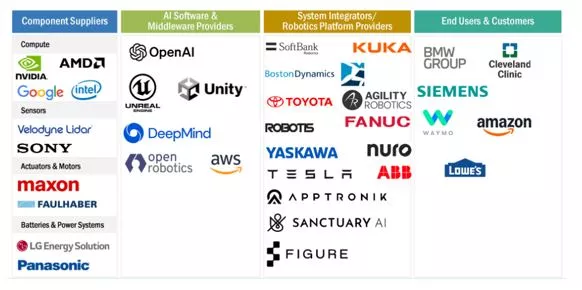
Figure: Embodied AI ecosystem covering component suppliers, middleware providers, robotics platform vendors, and enterprise adopters.
Technology providers including NVIDIA, OpenAI, Google DeepMind, AWS, and robotics companies such as Boston Dynamics, ABB, Agility Robotics, Figure AI, Sanctuary AI, and Apptronik are actively building next-generation embodied intelligence platforms. The ecosystem is also witnessing strong collaboration between AI infrastructure providers and industrial enterprises seeking scalable physical automation capabilities.
Embodied AI Trends and Industry Disruptions
The embodied AI market is witnessing a major transition from traditional programmed robotics toward adaptive autonomous systems capable of contextual reasoning. Vision-language models, multimodal foundation models, and world models are enabling robots to interpret human instructions, understand environmental conditions, and autonomously execute tasks with greater flexibility. Enterprises are increasingly investing in simulation environments and synthetic data generation platforms to accelerate robot training without extensive physical testing cycles.
Industrial organizations are also prioritizing collaborative robotics and human-machine interaction technologies. Modern embodied AI systems are being designed to work alongside humans in factories, hospitals, warehouses, and retail environments. This trend is driving investments in sensor fusion, contextual awareness, safety systems, and real-time edge processing. Procurement priorities are shifting toward scalable AI-native robotics platforms capable of software upgrades, autonomous learning, and interoperability across enterprise systems.
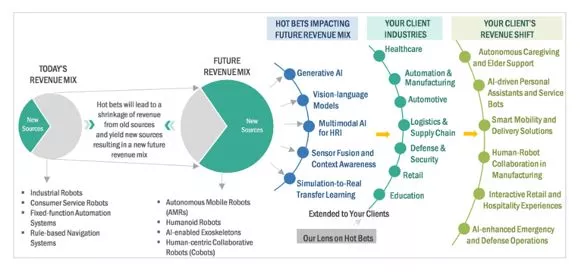
Figure: Future revenue transformation driven by generative AI, multimodal intelligence, and autonomous robotics.
The market is also being influenced by sustainability initiatives and workforce transformation strategies. Companies are deploying autonomous robots to optimize energy consumption, improve warehouse efficiency, reduce operational waste, and support predictive maintenance workflows. At the same time, embodied AI is becoming strategically important for countries investing in advanced manufacturing, resilient supply chains, and industrial modernization programs.
Market Drivers and Opportunities
Growing enterprise demand for intelligent automation remains one of the primary drivers of the embodied AI market. Manufacturers, logistics operators, healthcare providers, and automotive companies are increasingly adopting AI-enabled robotics to address workforce shortages, improve productivity, and enhance operational precision. Rapid advancements in edge AI chips, low-power processors, robotics simulation platforms, and multimodal AI models are making embodied AI systems more commercially viable for large-scale deployments.
The expansion of smart factories, autonomous warehouses, and AI-enabled mobility systems is creating significant opportunities for embodied AI vendors. Enterprises are also investing in digital twins, simulation-to-real transfer learning, and AI-native robotics platforms capable of continuous learning and adaptation. Emerging applications in eldercare, retail automation, defense operations, and AI-assisted mobility solutions are expected to unlock new long-term revenue streams for technology providers.
Challenges and Restraints
Despite strong growth potential, the embodied AI market faces several operational and technological challenges. High hardware costs, deployment complexity, and integration barriers remain significant concerns for enterprises evaluating large-scale robotics adoption. Building reliable systems capable of operating safely in dynamic real-world environments requires advanced sensor integration, high-performance computing, and continuous AI model optimization.
The market also faces cybersecurity, safety, and regulatory concerns associated with autonomous physical systems. Organizations must address data privacy, operational reliability, workforce safety, and liability risks when deploying embodied AI solutions. In addition, shortages of robotics engineers, AI specialists, and systems integration professionals continue to limit deployment scalability across several industries.
Segment Insights
By product type, robots are expected to dominate the embodied AI market due to rising adoption across industrial automation, warehouse logistics, healthcare assistance, and autonomous mobility applications. Humanoid robots, collaborative robots, and autonomous mobile robots are increasingly becoming central to enterprise automation strategies. The robots segment is also expected to witness the fastest growth as AI-driven physical systems gain broader commercial acceptance across industries.
By level of embodiment, Level 2 intermediate embodiment systems are expected to dominate the market in 2025 due to their balance between adaptability, operational efficiency, and deployment feasibility. These systems are already being integrated into industrial automation, warehouse operations, and service robotics applications. Level 3 advanced embodiment systems are expected to witness the fastest growth as multimodal reasoning, autonomous planning, and contextual awareness technologies mature.
By vertical, industrial automation is expected to remain the leading adopter of embodied AI technologies due to increasing demand for smart manufacturing, predictive maintenance, and collaborative robotics. Meanwhile, logistics and supply chain applications are expected to witness the fastest growth as enterprises invest in autonomous warehouses, AI-driven fulfillment operations, and intelligent delivery systems.
Regional Analysis
North America is expected to dominate the embodied AI market due to strong investments in AI infrastructure, robotics innovation, semiconductor technologies, and autonomous systems development. The region benefits from the presence of major technology companies, robotics startups, hyperscalers, and advanced industrial enterprises actively deploying AI-enabled automation solutions. The US remains a major hub for humanoid robotics innovation, AI software platforms, and industrial automation initiatives.
Asia Pacific is expected to emerge as the fastest-growing regional market during the forecast period. Countries including China, Japan, and South Korea are significantly investing in robotics manufacturing, smart factories, AI-enabled mobility systems, and autonomous logistics infrastructure. Europe is also witnessing strong adoption driven by industrial automation modernization, sustainability goals, and collaborative robotics deployment in automotive and manufacturing sectors.
Key Company Insights
The embodied AI market is highly competitive and driven by rapid advancements in robotics, multimodal AI, autonomous systems, and industrial automation technologies. Leading companies are increasingly focusing on vertically integrated ecosystems that combine robotics hardware, AI software, simulation platforms, edge computing, and automation infrastructure. Strategic partnerships, investments in humanoid robotics, and enterprise-focused automation deployments are shaping the competitive landscape. Vendors are also accelerating investments in collaborative robotics, warehouse automation, and AI-enabled mobility solutions to strengthen their long-term market positioning across industrial and commercial applications.
SoftBank Robotics Group, ABB, TOYOTA MOTOR CORPORATION, KUKA AG, and Boston Dynamics are among the leading players shaping the embodied AI ecosystem. SoftBank Robotics Group continues to expand its service robotics portfolio across hospitality, healthcare, and enterprise automation applications. ABB is strengthening its industrial robotics and AI-enabled automation capabilities through smart manufacturing and collaborative robotics initiatives. TOYOTA MOTOR CORPORATION is actively investing in autonomous mobility, humanoid robotics, and AI-driven mobility assistance systems through its advanced robotics research programs. KUKA AG remains a major player in industrial robotics and factory automation, with strong focus on intelligent manufacturing systems and AI-based robotic integration. Boston Dynamics continues to lead innovation in advanced mobile robotics and humanoid systems, with growing enterprise adoption across warehouse automation, logistics, and industrial inspection applications.
Recent Developments
· In March 2024, Figure AI raised USD 675 million in Series B funding with participation from Microsoft, NVIDIA, OpenAI Startup Fund, and Jeff Bezos to accelerate humanoid robotics commercialization.
· In 2025, Figure AI introduced its Helix vision-language-action model and BotQ humanoid manufacturing facility to support large-scale robot production.
· In 2025, Figure AI ended its collaboration with OpenAI to pursue vertically integrated proprietary robotics AI development.
· In 2026, BMW Group expanded pilot deployments of humanoid robots in its manufacturing operations in Europe as part of its Physical AI initiative.
Conclusion and Future Outlook
The embodied AI market is entering a transformative phase as advances in generative AI, robotics hardware, edge computing, and multimodal intelligence converge to enable real-world autonomous systems. Organizations are increasingly recognizing embodied AI as a strategic technology capable of reshaping industrial operations, workforce productivity, customer engagement, and intelligent automation strategies.
Over the next decade, embodied AI systems are expected to become more adaptive, collaborative, and commercially scalable. Continued progress in world models, contextual reasoning, sensor fusion, and simulation environments will significantly improve the ability of robots and autonomous systems to operate safely in complex environments. Enterprises that invest early in AI-native automation ecosystems are likely to gain significant operational and competitive advantages.
As the market matures, competition will increasingly center on ecosystem integration, proprietary AI models, robotics manufacturing scale, and real-world deployment capabilities. The convergence of physical automation and advanced AI is expected to create long-term opportunities across manufacturing, healthcare, logistics, mobility, defense, retail, and service industries worldwide.
Frequently Asked Questions
How big is the embodied AI market?
The embodied AI market was valued at USD 3.06 billion in 2024 and is projected to reach USD 23.06 billion by 2030. Growing investments in robotics, multimodal AI, and autonomous systems are accelerating market expansion globally.
What is the growth rate of the embodied AI market?
The embodied AI market is expected to grow at a CAGR of 39.0% during the forecast period from 2025 to 2030. Increasing enterprise adoption of AI-enabled robotics and intelligent automation is driving this growth.
Which segment leads the embodied AI market?
The robots segment currently leads the embodied AI market due to rising adoption across manufacturing, logistics, healthcare, and industrial automation environments. Humanoid robots and autonomous mobile robots are gaining strong commercial traction.
Who are the key players in the embodied AI market?
Key players operating in the embodied AI market include NVIDIA, OpenAI, ABB, Boston Dynamics, Figure AI, Agility Robotics, SoftBank Robotics, Toyota, and Sanctuary AI. These companies are investing heavily in AI-native robotics platforms and autonomous systems.
What factors are driving the embodied AI market?
The market is being driven by advances in multimodal AI, edge computing, robotics hardware, sensor fusion, and autonomous decision-making technologies. Growing demand for intelligent automation and workforce optimization across industries is also accelerating adoption.
Related Reports:
Embodied AI Market by Product Type [Robots (Humanoid Robots, Mobile Robots, Industrial Robots, Service Robots, Cobots), Exoskeletons, Autonomous Systems, Smart Appliances], Level of Embodiment (Level 1, Level 2, Level 3) - Global Forecast to 2030
Contact:
Mr. Rohan Salgarkar
MarketsandMarkets™ INC.
630 Dundee Road
Suite 430
Northbrook, IL 60062
USA : 1-888-600-6441
[email protected]

This FREE sample includes market data points, ranging from trend analyses to market estimates & forecasts. See for yourself.
SEND ME A FREE SAMPLE

